The AI Employee Moment
What You Will Learn
In this lesson, you will learn one big idea: what makes a Personal AI Employee fundamentally different from a chatbot.
By the end, you should be able to explain the six dimensions of a Personal AI Employee and use one mental model—the Agent OS analogy—to organize how OpenClaw works.
You are also planting the first seed for a larger idea that will return throughout this book: a Personal AI Employee is the individual, owned version of a broader category of digital worker. Later, when we talk about Digital FTEs—digital full-time equivalents—you can think of them as this same category viewed at scale, standardized for broader organizational use. Here, we start with the personal form because it is easier to see the architecture clearly before the enterprise fog machine turns on.
What is a Personal AI Employee?
Think about the difference between eating at a restaurant and hiring a personal cook.
At a restaurant, you sit down, tell the waiter what you want, eat your meal, and leave. The waiter does not come to your house. The waiter does not check your fridge. The waiter does not remember what you ordered last month. Every visit starts from zero. That is a chatbot. You open a window, type a prompt, get a response, close the tab. Next time, you start over.
Now picture hiring a personal cook who lives in your house. She is there when you wake up. She checks the fridge on her own and notices you are low on eggs. You can give her instructions through a phone call, a text message, a note on the fridge, or just by walking into the kitchen. You can teach her new recipes. If you need a second cook for baking, you hire one, and both work in the same kitchen using the same pantry. Every recipe, every preference, every grocery list stays in your house, not in some restaurant's system.
That is a Personal AI Employee: an AI worker that lives in your environment, works under your control, and keeps your data on your terms.
That is the shift this lesson explains.
Six Core Terms in This Lesson
Multi-channel The same AI worker can talk and work across different places, such as web, chat apps, voice, or messaging platforms.
Always-on The AI worker keeps running in the background instead of only waking up when you open a chat window.
Proactive The AI worker can check, remind, watch, or act on schedule without waiting for you to type first.
Extensible The AI worker can gain new abilities by connecting tools, skills, plugins, or external systems.
Multi-agent One main AI worker can coordinate with other specialized agents instead of trying to do everything alone.
Ownership You control where it runs, what data it keeps, and what rules it follows. This is what makes it personal, not just powerful.
The Six Dimensions of an AI Employee
What makes something an "AI Employee" instead of just a chatbot? Six things. Think of them as six requirements on a job description.
1. Multi-Channel (Works Everywhere)
The chatbot way: You can only talk to ChatGPT on chat.openai.com or the app.
The employee way: Your AI employee is available on WhatsApp, Telegram, Discord, Slack, Signal, web, voice, all at the same time. If someone messages on WhatsApp at 9am and follows up on Slack at 2pm, the employee remembers. It is the same conversation, same memory, same brain.
Analogy: A restaurant waiter only serves you inside the restaurant. A personal assistant picks up your call, replies to your texts, AND checks your emails, all the same person.
2. Always-On (Never Sleeps)
The chatbot way: You open a browser tab, use it, close it. When the tab is closed, it is dead.
The employee way: OpenClaw runs as a daemon: a program that runs silently in the background 24/7, like your phone's Bluetooth service. You never "open" Bluetooth. It is just always running.
Why this matters: If it is not always running, it cannot do the next thing...
3. Proactive (Acts Without Being Asked)
The chatbot way: ChatGPT sits there doing nothing until you type something.
The employee way: OpenClaw has heartbeats (checks every 30 minutes) and cron jobs (scheduled tasks at exact times). It can check your inbox at 3am, send you a morning summary, remind you about deadlines, all without you asking.
Analogy: A bad office coordinator waits to be told everything. A good one checks the supplier inbox before the morning meeting, spots problems, and flags them without being asked. OpenClaw is the good coordinator.
4. Extensible (You Can Add New Skills)
The chatbot way: ChatGPT has whatever features OpenAI gives you. You cannot add new ones.
The employee way: OpenClaw has plugins, skills, and MCP servers. Want voice? Install a plugin. Want it to search Google? Add a skill. Want it to connect to a live database? Set up an MCP server. There is even a community hub (ClawHub) where people share extensions.
Analogy: A restaurant cook only makes what is on the menu. Your personal cook can learn any recipe you give them, buy new kitchen tools, and even connect to a grocery delivery service.
5. Multi-Agent (Team of Specialists)
The chatbot way: One AI does everything, whether it is good at it or not.
The employee way: You can run multiple agents behind one gateway. Agent A handles customer support on WhatsApp. Agent B handles technical questions on Discord. Agent C handles internal tasks on Slack. Different specialists, coordinated through one central control.
Analogy: Instead of one cook who does everything badly, you have a pasta chef, a sushi chef, and a dessert chef, all working in the same kitchen, each handling what they are best at.
6. Ownership (It Is Yours)
This is the most important one. The other five make it an employee. This one makes it YOUR employee.
The chatbot way: Your conversations, your data, your history: all live on someone else's servers. Cancel your subscription? Gone. Company changes policy? Tough luck. Company raises prices? Pay or leave.
The employee way: OpenClaw runs on your machine. Your conversations are in your folder. Your memory files are your files. Your API keys are under your control. If you stop using OpenClaw tomorrow, everything stays on your computer. You can back it up, move it, delete it, or fork it.
Analogy: Renting a house vs. owning a house. When you rent, the landlord can raise the rent, change the rules, or kick you out. When you own, it is yours: paint the walls, dig a pool, nobody can stop you.
Key insight: Enterprise tools like Salesforce also have the first five dimensions. But the vendor controls everything. Ownership is what puts the "Personal" in "Personal AI Employee."
James had the OpenClaw docs open on his laptop. He had been using ChatGPT for months: summarizing reports, drafting emails, answering quick questions. It worked. But every morning he opened the same tab, re-explained the same context, and waited for the same "How can I help you today?" It never checked his inbox overnight. It never followed up on yesterday's task. It never did anything unless he typed first.
"I want something that works when I am not looking at it," he had told Emma the day before. "Something that checks my supplier emails at 6 a.m. and has a summary ready before I sit down."
Emma had sent him one link. Now he was reading it.
"350,000+ GitHub stars," James said. "And it describes itself as 'a personal AI assistant you run on your own devices.'" He looked up. "At first glance, it sounds like ChatGPT but open source."
Emma pulled up a chair. "At first glance, yes. But first glances are where software marketing does its best work."
James smiled. "So this is the part where the trailer lies to me?"
"This is the part where you find out whether it belongs in the chatbot category at all," Emma said.
"Fine," James said. "What should I look for?"
"Read the features list," Emma said.
James scanned the page. "Multi-channel messaging: WhatsApp, Telegram, Discord, Slack, Signal, Matrix, IRC, web, and voice." He paused. "All of those at once?"
"Keep reading," Emma said.
Five Dimensions, One at a Time
James scrolled down. "It says it runs as a background daemon with heartbeat self-checks." He frowned. "Daemon?"
"A daemon is just a program that runs in the background without a visible window," Emma said. "Your Mac's Bluetooth service is a daemon. So is the process that indexes files for Spotlight. You never really 'open' them. They are just always there, quietly doing work."
"So OpenClaw is not just a browser tab I open and close," James said.
"Exactly," Emma said.
James sat back. "If it keeps running, then it can do things when I am not watching." He looked at the screen again. "That means it is always-on."
Emma nodded. "And once something is always-on, another dimension becomes possible."
James kept reading. "Heartbeats. Cron jobs." He looked up. "I know enough to be dangerous, which is the worst amount. Define them."
Emma smiled. "A heartbeat is a regular timed check-in the system performs automatically. A cron job is a scheduled task that runs at exact times. One is periodic checking. The other is scheduled execution."
James nodded slowly. "So it can check something every thirty minutes, or do something at 3:00 a.m., even if I do not type a prompt."
"Yes," Emma said.
"That makes it proactive," James said. "ChatGPT waits for me. This thing can move first."
Emma nodded again. "Always-on is the foundation. Proactive depends on it. If nothing is running, nothing can take initiative."
James scrolled further. "Now I'm seeing tools, skills, plugins, MCP servers..."
He looked up. "That is a lot of nouns in one sentence."
"Then separate them by role," Emma said. "Do not treat them as one bucket."
James read more carefully.
"Tools are functions the agent can call. Skills are reusable guidance or know-how the agent can reference. Plugins add capabilities to the system itself, like channels or speech. MCP servers connect the agent to external systems and services through a standard interface."
He paused. "So they are all forms of extension, but not the same kind."
"Exactly," Emma said. "That distinction will matter later. A Skill is usually something the agent uses internally as part of how it thinks or works. An MCP integration is usually about reaching outward into external systems in a structured way. Early on, it is enough to know that both expand capability—but in different directions."
James nodded. "So OpenClaw is extensible."
"What about the channel list from earlier?" Emma asked.
James counted on his fingers. "WhatsApp, Telegram, Discord, Slack, Signal, Matrix, IRC, web, voice." He looked up. "That means one agent can operate across multiple channels. Same worker, different front doors."
"That is multi-channel," Emma said.
James kept scrolling. "It says channels can route to isolated agents. And it can orchestrate subagents for complex tasks." He frowned for a moment, then smiled. "So it is not just one giant agent doing everything. It can coordinate specialized agents behind one gateway."
"That is multi-agent," Emma said.
James leaned back and counted them out loud.
"Multi-channel. Always-on. Proactive. Extensible. Multi-agent."
He grinned. "So that is the category. An AI Employee."
Emma did not grin back. "Salesforce has agents with all five of those dimensions. ServiceNow too. Are those Personal AI Employees?"
The Sixth Dimension
The question sat in the air for a moment.
James looked back at the screen. "No," he said slowly. "Those are enterprise agents. Somebody else runs them."
"And?" Emma said.
"And somebody else decides where they run, what data they keep, when they sleep, what rules they follow, and what disappears when the subscription ends." He sat up. "Wait."
He tapped the phrase on the screen.
"You run on your own devices. That is not just a deployment detail. That is the control boundary."
Emma said nothing.
James kept thinking aloud. "If it runs on my hardware, then my conversations, my memory files, and my API keys remain under my control. If I stop using some SaaS platform, the vendor still controls the system. If I stop using OpenClaw, my files stay with me."
He grabbed his notepad.
"That is ownership."
Emma nodded. "And is ownership just one dimension among the others?"
James thought for a moment. "Not exactly. The other five describe what the system can do. Ownership describes who controls it." He underlined the word on his notepad. "The other five make it an AI Employee. Ownership makes it personal."
He looked up again. "An enterprise agent can be multi-channel, always-on, proactive, extensible, and multi-agent. But if the vendor controls the runtime, the data, the policies, and the retention, then it is not personal. Once it runs on my hardware, with my data, under my rules, the category changes."
Emma almost smiled. "Now you are describing architecture, not just features."
James looked back at the docs. "So 'Personal AI Employee' is not a marketing phrase. It is a category defined by six dimensions."
He wrote them down again:
- Multi-channel
- Always-on
- Proactive
- Extensible
- Multi-agent
- Ownership
"The first five describe capability," he said. "The sixth defines control."
He paused.
"And I can also see how this idea scales. A Personal AI Employee is the version I own and run for myself. A Digital FTE would be the same idea extended into a more standardized digital worker model—something an organization could structure, govern, replicate, and manage more systematically."
Emma nodded. "Good. Do not overdevelop that idea yet. Just keep the thread. First understand the worker. Later, you can understand the workforce."
The Agent OS: A Mental Model
James stared at the architecture section. "I need a way to hold all of this together," he said. "Gateway, workspace files, plugins, sessions. Four moving parts. My brain wants handles."
"Then build a mental model," Emma said.
James picked up his notepad. "What if I think of OpenClaw like an operating system?"
Emma crossed her arms. "That can work, but slow down. Use it as a thinking tool, not as a literal one-to-one mapping."
James nodded. "Fair."
He started writing.
"The gateway routes messages, manages sessions, and coordinates plugins. That feels like a kernel."
He looked up. "For someone who has never taken an OS course: kernel means the core part of an operating system—the part that manages communication, coordination, and access to resources."
Emma nodded. "Good. Say the translation, not just the jargon."
James wrote it down.
"The gateway is like the kernel because it sits at the center and manages how the rest of the system works."
He moved to the next line.
"Plugins add channels, tools, voice, and integrations. That feels like device drivers."
He paused. "Beginner version: a device driver is the software that lets the core system talk to some specific capability or hardware. It is how the operating system learns to work with something new."
Emma nodded. "Good. In this analogy, plugins are how OpenClaw learns new capabilities."
James kept going.
"Sessions hold per-user conversation context and keep it isolated. That feels like process memory."
He looked up again. "Meaning the working state of a running task. One user session should not leak into another any more than one app's memory should spill into a different app."
"Exactly," Emma said.
James paused at workspace files. "SOUL.md, IDENTITY.md, and other instruction files..." He frowned. "My first thought is config files. But that feels too weak."
Emma asked, "When do they matter?"
James checked the docs again. "They are injected into every message."
"And that means?" Emma asked.
"That means they are not just startup settings," James said. "They shape behavior continuously. They are more like persistent behavioral instructions."
He thought for another moment.
"That is why firmware is a better analogy than config files—even though it is not perfect." He looked up. "Beginner translation: firmware is low-level software that helps define how a device behaves, deeper than ordinary user settings. These workspace files are similar in spirit because they influence behavior at a foundational level."
He paused again.
"But the analogy breaks if I push it too far. Real firmware does not reload every time you press a button. These files affect every message. So this is a useful mental model, not a literal description."
He pushed the notepad and image toward Emma.
| OpenClaw Component | OS Analogue | Plain-English Meaning | What It Does |
|---|---|---|---|
| Gateway | Kernel | The central coordinator | Routes messages, manages sessions, coordinates plugins |
| Workspace files | Firmware | Foundational behavioral instructions | Define identity, memory, and behavior across interactions |
| Plugins | Device drivers | Capability add-ons | Add channels, tools, voice, and integrations |
| Sessions | Process memory | Per-task working state | Hold per-conversation context, isolated per user |
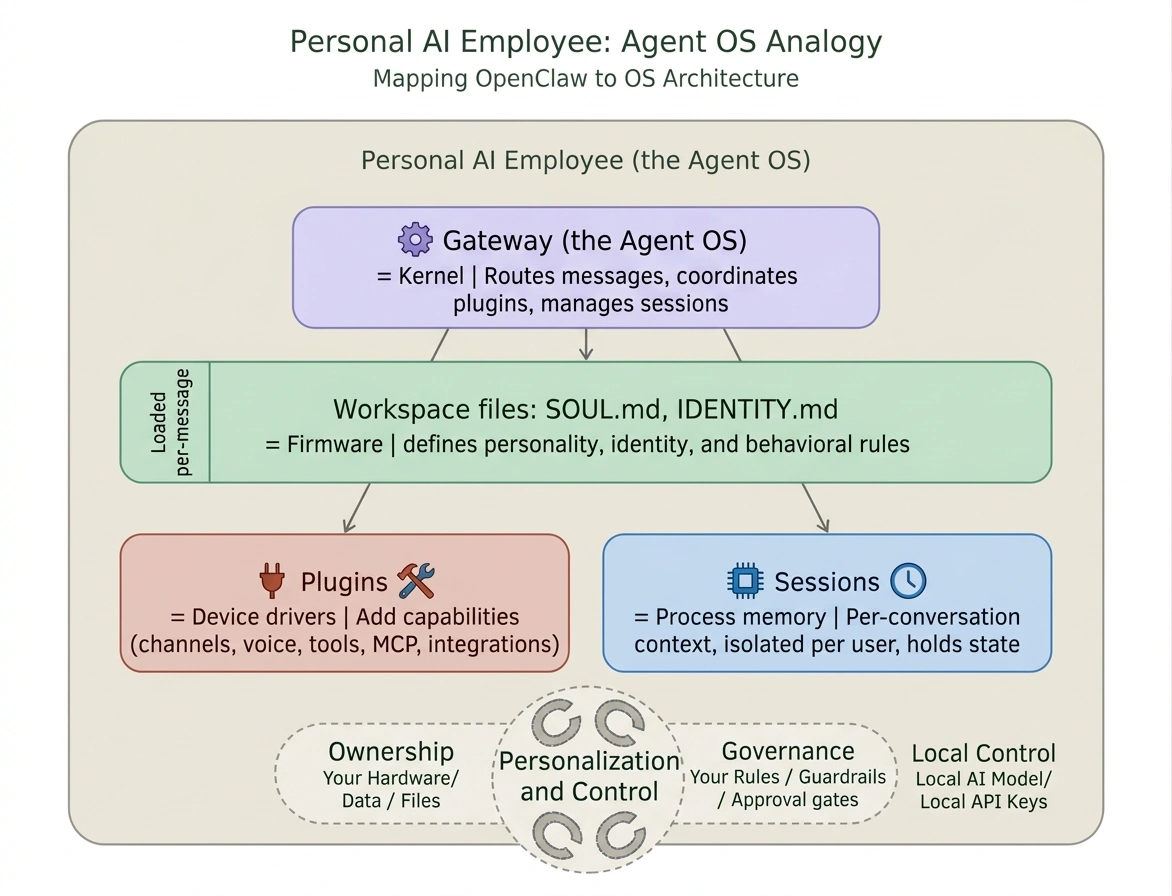
Emma read the table and diagram and nodded. "Good. Now extend it as you encounter more features."
"Such as?" James asked.
"Skills are like built-in reference material the agent can use while working. Tool profiles are like permission rules. Heartbeats are like scheduled checks or timed tasks."
James looked at the table again. "So the goal is not to find a perfect analogy. The goal is to find one that keeps helping."
"Exactly," Emma said. "A mental model is successful when it reduces confusion without creating new confusion faster than you can pay it down."
350,000+ Stars and 28 Gotchas
James scrolled further. "So once I know what category this belongs to, the next question is obvious." He looked up. "How mature is it?"
Emma pulled out her phone. "I spent twenty-five hours across five sessions testing it before writing this chapter. I hit twenty-eight gotchas, fourteen unique bugs, and several silent failures where OpenClaw did not clearly tell me something had gone wrong."
James took the phone. "For 350,000+ stars, that is rough."
"Popularity proves interest," Emma said. "It does not prove polish. A large star count means many people care about the idea. It does not mean the implementation is finished, stable, or gentle with beginners."
She took the phone back.
"Jensen Huang called it 'the next ChatGPT' at GTC 2026. Nvidia built NemoClaw on top of it. Those facts suggest momentum. They do not guarantee maturity."
James nodded slowly. "So the point of this chapter is not to worship it or dismiss it. It is to test it honestly."
"Exactly. Your job in this chapter is to install it, use it, hit real edges, and learn which ones still matter. By the end, you should be able to say not only what OpenClaw is, but how close it is to being production-ready."
What This Chapter Builds
Over the next lessons, you will move from zero to a deployed, secured, multi-agent Personal AI Employee.
| Phase | What You Build |
|---|---|
| Meet | Install OpenClaw, connect a real channel, and delegate your first useful tasks |
| Deepen | Customize the brain, shape behavior, add skills, and introduce proactivity |
| Expand | Add voice, multi-agent coordination, and orchestration patterns |
| Harden | Audit security, add approval gates, and build safer extensions |
| Ship | Deploy to production, evaluate honestly, and confirm what is truly ready |
This chapter is not meant to be read passively. It is meant to be used.
If you can finish a lesson without touching your terminal, the lesson has failed. Starting in Lesson 2, your hands should be on the keyboard for every important concept. You are not here to admire the engine. You are here to start it.
Try With AI
You do not have OpenClaw installed yet. That is Lesson 2. For now, use ChatGPT, Claude, Gemini, or another AI assistant to interrogate the documentation directly.
Exercise 1: Audit the Docs Against the Five Dimensions
Use this prompt:
Read the OpenClaw documentation at:
- https://docs.openclaw.ai
- https://docs.openclaw.ai/tools

I am learning that an AI Employee has five architectural dimensions:
1. Multi-channel
2. Always-on
3. Proactive
4. Extensible
5. Multi-agent

For each dimension:
- find the specific feature in the docs that delivers it
- say whether the dimension is explicitly stated or only implied

Then answer:
- Which dimension does OpenClaw emphasize the most?
- Which dimension does it barely mention?
What you are learning: Documentation often highlights what is easy to showcase and quietly understates what is architectural, subtle, or unfinished.
Exercise 2: Stress-Test the Agent OS Analogy
Use this prompt:
Read:
- https://docs.openclaw.ai
- https://docs.openclaw.ai/tools

I am using this mental model for OpenClaw:

- Gateway = Kernel
- Workspace files = Firmware
- Plugins = Device drivers
- Sessions = Process memory

Based on the docs:
1. Where does this analogy fit well?
2. Where does it break down?
3. Why is the break point important for understanding the system?
What you are learning: Mental models are useful not because they are perfect, but because they help you reason. Their real value appears when you can also identify where they stop working.
Exercise 3: Can ChatGPT Be a Personal AI Employee?
Use this prompt:
I learned that a Personal AI Employee needs six dimensions:

1. Multi-channel
2. Always-on
3. Proactive
4. Extensible
5. Multi-agent
6. Ownership

For ChatGPT, Claude, or Gemini:
- identify which dimensions it currently has
- identify which dimensions it lacks
- for each missing dimension, explain whether it is:
  a) a feature gap, or
  b) an architectural constraint

Then explain:
What would have to change for it to become a true Personal AI Employee?
What you are learning: Some missing capabilities are product choices. Others come from the deeper architecture of the system. Ownership usually belongs to the second category.
What You Should Remember
Core Idea
A Personal AI Employee is not just a better chatbot. It is a different category of system, defined by six dimensions:
- Multi-channel — one agent can operate across multiple communication channels
- Always-on — it runs continuously as a background service
- Proactive — it can act on schedules or timed checks without waiting for a prompt
- Extensible — you can add tools, skills, plugins, and integrations
- Multi-agent — it can coordinate specialized agents for different tasks
- Ownership — it runs under your control, with your data and runtime on infrastructure you control
The Most Important Distinction
The first five dimensions describe capability.
The sixth dimension—ownership—describes control.
That is why ownership is not just another feature. It is the dimension that makes the word personal mean something.
The Mental Model
Use the Agent OS analogy to organize what you learn in the rest of the chapter:
- Gateway = Kernel
- Workspace files = Firmware
- Plugins = Device drivers
- Sessions = Process memory
This is not a perfect mapping. It is a useful one.
The Broader Thread
A Personal AI Employee is the owned, individual form of this category. Later in the book, when you discuss Digital FTEs, you will be looking at the same architectural idea in a more standardized, replicable, and organizational form.
The Practical Stance
OpenClaw may be exciting, category-defining, and still rough around the edges. All three can be true at once.
Your job in this chapter is not to cheerlead and not to dismiss. Your job is to build, test, observe, and judge honestly.
James looked down at his notepad one more time.
On the left, he had written the five dimensions.
On the right, he had circled ownership.
Below them sat the Agent OS table.
At the top of the page, he wrote one phrase and underlined it:
Personal AI Employee
Not "ChatGPT but open source." That was the first draft of the idea.
This was the better one.