PREFACE: The AI Agent Factory
The Day the Market Proved Our Thesis
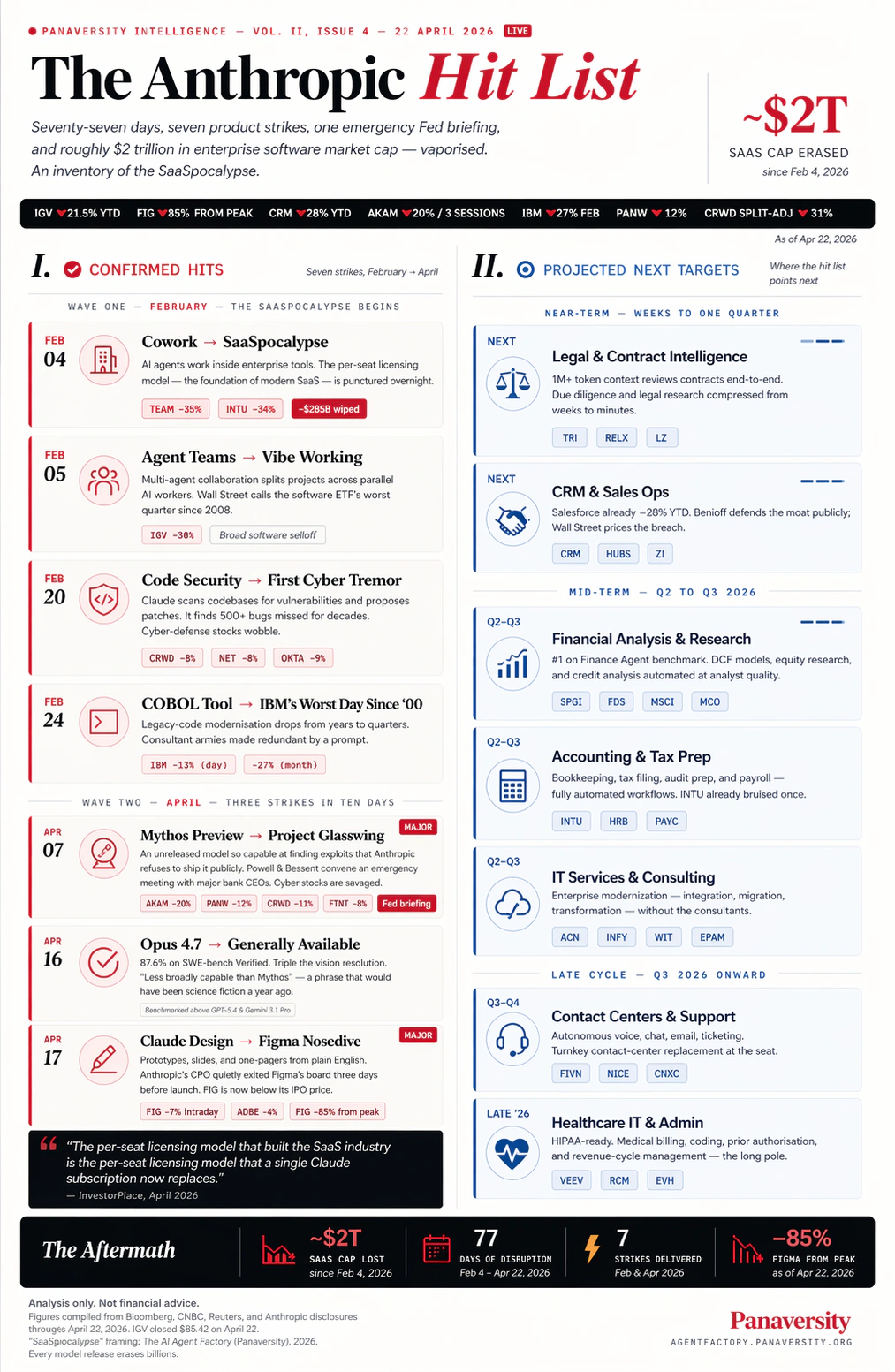
On February 4, 2026, global software stocks suffered their worst stretch since the 2022 rate-hike selloff. Nearly $1 trillion in market value was erased from the software and services sector over six consecutive sessions. Traders called it the "SaaSpocalypse."
The trigger? Anthropic released eleven open-source plugins for Claude Cowork—its agentic productivity platform—targeting legal, finance, sales, marketing, data analysis, and more. One plugin could triage NDAs, track compliance, and review contracts. The market's response was immediate: Thomson Reuters fell 16%. RELX dropped 14%. Salesforce and ServiceNow each shed roughly 7%.
The message was unmistakable. Autonomous agents can now perform the complex professional work that justified $200/month software subscriptions. The era of paying for a "seat" so a human can click buttons in enterprise software is ending.
This book was written for this exact moment.
Start Here: The Presentations
These two presentations lay the strategic and practical foundation for everything in this book. Watch them before reading further.
Build Your AI Workforce
The accessible introduction. Covers the shift from manual work to Digital FTEs, why no coding is required, and how anyone—business owners, marketers, accountants, educators—can build AI employees using natural language.
View Full Presentation — Build Your AI Workforce
Agent Factory: Building Digital FTEs
The comprehensive deep-dive. Covers the Agent Factory thesis, General vs Custom Agents, the decision matrix, Code as Universal Interface, MCP and Agent Skills, monetization models, case studies, security, and the complete roadmap from first spec to first dollar.
View Full Presentation — Agent Factory: Building Digital FTEs
The Anthropic Wake-Up Call
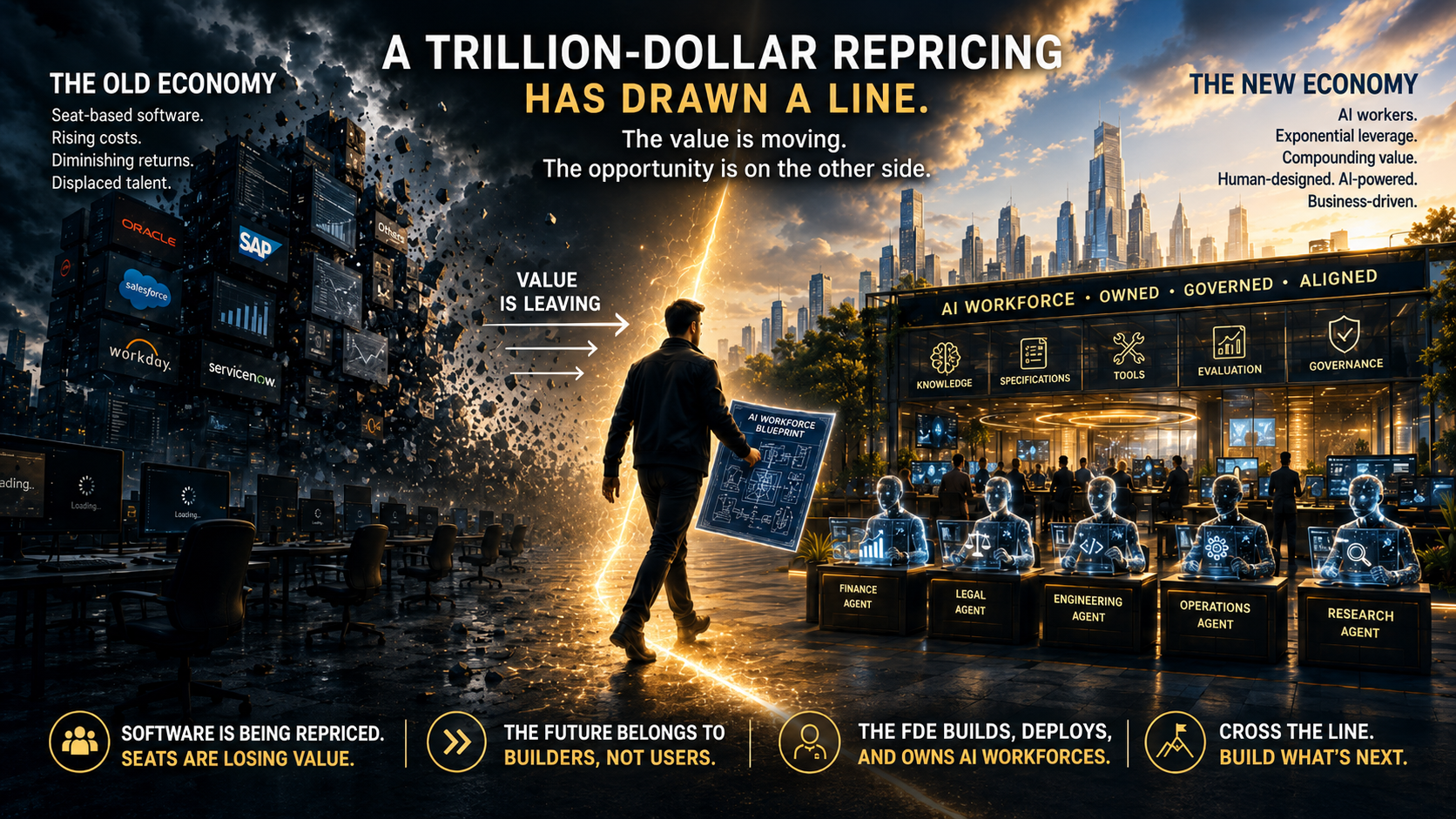
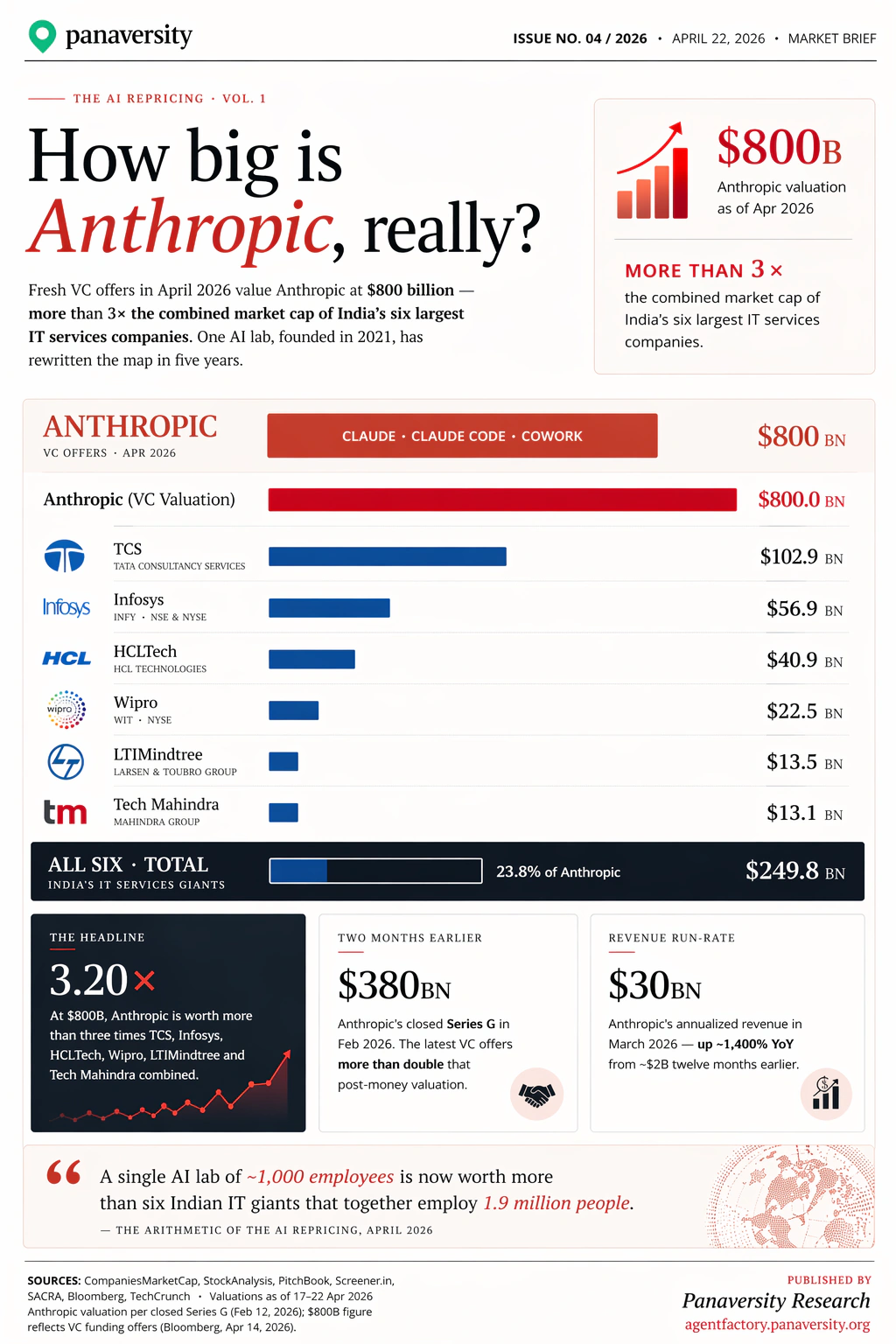
February 2026 wasn't a random market fluctuation. It was a repricing of the entire software industry based on a single realization: agentic AI renders seat-based SaaS obsolete.
The Event. Claude Cowork's eleven open-source plugins demonstrated that autonomous agents could perform the complex professional tasks—contract review, compliance tracking, financial analysis—that were the core business of platforms like Salesforce, ServiceNow, and Thomson Reuters.
The Shift. Investors rotated from companies that sell tools to humans toward companies that deploy Digital FTEs—autonomous agents that do the work directly. This wasn't panic; it was a repricing of which business models survive the agentic era.
The Key Data Point. A single legal plugin—handling NDA triage and compliance tracking—wiped $285 billion off software, legal tech, and professional services firms in one trading session.
The Implication. If your business model relies on humans navigating legacy software, you are being disrupted. The value is shifting to those who own the agents.
The Death of the "Software Seat"
The SaaSpocalypse didn't happen in a vacuum. It was the market catching up to a structural shift already underway: the transition from per-seat software licensing to autonomous Digital FTEs.
The Old Model (Legacy SaaS)
A company pays per "seat"—per human who uses the product. Each seat requires training, a user interface, login credentials, and manual navigation. The software company's revenue scales with headcount.
The New Model (Agentic Era)
A company deploys a Digital FTE via Claude Code. The agent requires no seat, no UI, and no training period. It interacts directly with the data and outputs the result. Revenue scales with tasks completed, not humans hired.
The Disruption Mechanics
| Dimension | Old (Per-Seat SaaS) | New (Digital FTE) |
|---|---|---|
| Cost | $200/mo per human user | 90% reduction in software overhead |
| Speed | Days of human processing | Tasks that took humans days now take agents seconds |
| Integration | Humans log in to separate tools | Agents inhabit the workflow—no UI, no third-party login |
| Scaling | Linear: hire more humans, buy more seats | Exponential: clone the agent instantly |
The Strategic Takeaway
We aren't just building AI. We are replacing high-cost, slow software dependencies with high-speed, low-cost Vertical Intelligence. The companies that make this transition capture the value that legacy SaaS firms are losing.
Capturing the "Disruption Alpha"
While the "Software Giants" are losing valuation, the firms building Custom Digital Workers are capturing that lost value. This is disruption alpha—the opportunity gap between the old world dying and the new world scaling.
How to Pivot
1. Stop buying "Seats." Reduce reliance on software that requires manual human input. Every seat-based subscription is a liability in the agentic era.
2. Build "Skills." Use the Cowork and Claude Code stack to build proprietary agents that own your data. Your domain expertise, encoded into agent skills, becomes your competitive moat.
3. Deploy "Digital FTEs." Reinvest the savings from crashed software licenses into scaling your autonomous workforce. Each Digital FTE replaces dozens of seats.
The Bottom Line
You can either be the company paying for declining software platforms, or the company converting that spend into proprietary Digital FTEs that capture long-term strategic value.
The Agent Factory teaches you how.
The Coding Barrier Is Gone
Here is the shift most people underestimate: the barrier to building software has collapsed.
The primary interface is now natural language—English, Urdu, Spanish, whatever you think in. You describe the job. Claude Code (a General Agent from Anthropic) interprets your instructions and builds the solution.
The Old Way vs. The New Way
| The Old Way | The New Way | |
|---|---|---|
| Input | def process_invoice(data): validate_schema(data) extract_fields(data) match_po_number(data) calculate_totals(data) | "Create an agent that processes invoices. It should validate the data, extract key fields, match with PO numbers, and generate a summary report." |
| Learning | Months of learning. Years to master. | Minutes to describe. Instant to build. |
| Tool | IDE + compiler + documentation | Claude Code — describe what you want in plain English |
This means domain experts without traditional programming backgrounds can now build AI employees:
| Domain Expert | What They Can Build |
|---|---|
| Business Owners | Operations and inventory automation |
| Healthcare Pros | Scheduling and documentation agents |
| Marketers | Content creation and lead qualification |
| Educators | Grading and curriculum planning |
| Accountants | Transaction reconciliation and audit agents |
| Engineers | Code reviews and testing |
If you can describe a job, you can build an AI employee to do it.
The Workforce Revolution
This isn't incremental improvement. It's a structural shift in how work gets done.
The Old Paradigm: Hire humans for every task. Train for months. Hope they stay. Watch AI transform industries from the sidelines.
The New Reality: Build AI employees in hours. They work 24/7. You lead the transformation instead of watching it.
The Future of Work: A Partnership
Three forces working together define the future:
| Force | Role |
|---|---|
| People | Judgment, creativity, oversight |
| Agents | Digital work automation |
| Robots | Physical work automation |
Automation transforms work—it doesn't eliminate it. Most human skills remain relevant but evolve. The key shift: AI fluency is now the fastest-growing workforce requirement. Workflow redesign unlocks greater value than task automation alone.
The $650 Million Proof Point
Even before the SaaSpocalypse, the signals were there.
In 2023, a startup called Casetext was acquired by Thomson Reuters for $650 million in cash. Their product? CoCounsel—an AI legal assistant that could review documents, research case law, and draft memos. It achieved a 97% pass rate on complex legal evaluations.
Thomson Reuters didn't pay $650 million for the technology. They paid for encoded legal expertise—the ability to do substantive legal work that previously required expensive human professionals.
That acquisition hinted at what the market confirmed in February 2026: domain expertise encoded into AI agents is extraordinarily valuable. CoCounsel was the proof of concept. The SaaSpocalypse was the market-wide validation.
This is what encoded domain expertise is worth.
The Agent Factory Vision
The Enterprise Architecture Shift
The most significant transformation isn't just building agents—it's restructuring how enterprises operate.
| Before: Tool-Centric Enterprise | After: Agent-Centric Enterprise | |
|---|---|---|
| Workflow | Humans operate SaaS tools | Humans manage outcomes |
| Logic | Lives in people's heads | Lives in Specs and Skills |
| Automation | Brittle, task-level scripts | Goal-driven agent workflows |
| Knowledge | Undocumented, unscalable | Reusable intellectual property |
| Architecture | Humans → SaaS Apps → APIs → Data | Humans → Digital FTEs → Agent Skills + MCP → Data |
The key shift: from tools you use to digital teammates you manage.
Code as the Universal Interface
Here's a paradigm shift most people miss: code isn't just for building software. It's how agents interrogate reality.
Example: You ask, "Why did sales drop in Q3?"
A chatbot gives you a generic answer. A General Agent:
- Writes a SQL query to fetch sales data
- Writes a Python script to visualize the trend
- Analyzes the chart
- Answers: "Sales dropped because of 40% churn in the Enterprise sector"
The agent used code not to "build an app" but to answer a business question with facts. Code is the universal interface between intent and action.
How the "Factory" Works
The Agent Factory is a systematic process for turning domain expertise into deployable Digital FTEs:
- The Spec. You provide a Markdown file describing the goal (e.g., "Automate Q3 Financial Audits").
- The Builder (Claude Code). Analyzes the spec, scans documentation, and identifies the necessary tools.
- The Manufacturing. Claude Code generates the Custom Agent or Custom Skill and supporting code.
- The Result. A production-ready Digital FTE is born—in minutes, not months.
General Agents (Claude Code) are the "Engine" that uses Spec-Driven Development to manufacture Custom Skills and Custom Agents. This is the engine of automated automation.
The Twin Enablers: MCP and Agent Skills
Two standards make the Agent Factory possible:
Agent Skills are the "How-To"—modular folders containing a SKILL.md file that teaches an agent a specific, repeatable workflow (e.g., "Analyze this financial statement according to our Q4 risk framework"). They standardize expertise into reusable, scalable intellectual property.
MCP (Model Context Protocol) is the "With-What"—the universal protocol that connects those skills to live data: your SQL database, your CRM, your Slack workspace, your financial systems.
Skills provide the expertise. MCP provides the connectivity. Together, they turn a General Agent into a specialized Digital FTE for any domain. Plug in a Finance MCP and Skill, and it's a Finance Agent. Plug in a Sales MCP and Skill, and it's a Sales Agent.
The Reality Check
This is a blueprint, not a get-rich-quick scheme. Building sellable Digital FTEs requires mastering real skills—specification writing, AI collaboration, testing, and deployment. This book teaches you those skills systematically.
The CoCounsel team didn't build a $650M product overnight. They combined deep legal expertise with rigorous AI development practices. You'll need to do the same in your domain.
The Agent Maturity Model: Incubator → Specialist
Building AI products isn't about choosing between two alternatives—it's about progression through stages.
Think of it like biological evolution: you don't engineer a specialist from scratch. You incubate possibilities, let patterns emerge, then evolve toward specialization once the environment stabilizes.
Stage 1: Incubator (General Agents)
Tools: Claude Code, Gemini CLI, Goose
Raw requirements enter a fertile environment where they transform into functional logic through rapid iteration. You don't know the exact solution yet—you're discovering it.
General Agents are reasoning systems. They observe your problem, orient around constraints, decide on an approach, act by writing code or running commands, and correct their mistakes—repeating until the problem is solved. This OODA loop (Observe, Orient, Decide, Act) is what separates them from simple prediction engines.
| Dimension | Incubator Stage |
|---|---|
| Core Purpose | Explore, discover, prototype |
| Optimization Target | Flexibility and reasoning |
| Your Role | Director who specifies intent |
| Best For | Novel problems, unclear requirements, building Custom Agents |
The "Trojan Horse" of AI
Don't let the name "Claude Code" fool you. Calling it a "Coding Agent" is like calling a CEO an "Email Writer" just because they use email to do their job. Code is simply the tool it uses to solve problems.
| Feature | Coding Agent (e.g., Cursor) | General Agent (Claude Code) |
|---|---|---|
| Scope | Software development | Any business domain |
| Identity | Developer's pair programmer | Digital employee |
| Habitat | Embedded in developer tooling | Operates across system-level tools |
| Built For | Developers | Anyone solving problems |
| Example Tasks | "Implement feature, refactor module" | "Plan your 2026", "Draft emails", "Why did sales drop?" |
Coding agents are powerful, software-native agents optimized for development workflows. General agents are goal-native agents trusted with broader objectives, able to choose tools, cross domains, and act at the system level using code as the universal interface.
Stage 2: Specialist (Custom Agents)
Tools: OpenAI Agents SDK, Claude SDK, Google ADK
Proven patterns crystallize into purpose-built systems. The solution is now known—you're engineering it for reliability, scale, and governance.
| Dimension | Specialist Stage |
|---|---|
| Core Purpose | Execute, scale, govern |
| Optimization Target | Reliability and efficiency |
| Your Role | Builder who creates the agent |
| Best For | Well-defined workflows, customer-facing products, high-volume automation |
Key features of Custom Agents: Guardrails for strict control over what the agent can and cannot do. Orchestration for defining exact hand-offs between multiple agents. UI/UX Flexibility for embedding in web apps, Slack, or internal dashboards.
The Decision Matrix: How to Choose
| Requirement | General Agent (Claude Code, Goose) | Custom Agent (OpenAI SDK, Claude SDK) |
|---|---|---|
| Task Type | Novel, problem-solving | Repetitive, standardized |
| End User | Developers / Technical staff | Non-technical / Customers |
| Error Tolerance | High (human in the loop) | Low (must be reliable) |
| Cost Sensitivity | Low (high value per task) | High (volume optimization needed) |
| Implementation | Instant (install and run) | Weeks (design and build) |
The Key Insight: Incubator Gives Birth to Specialist
This isn't a choice between two alternatives. It's a progression. The Incubator gives birth to the Specialist.
- Trying to skip incubation → Over-engineered solutions that solve the wrong problem
- Staying in incubation forever → Never shipping production-ready products
Claude Code isn't just a tool you use—it's an Agent Factory that transforms your domain expertise into deployable products. The Incubator discovers what to build. The Specialist builds it at scale. And the Incubator continues evolving—improving existing Specialists and spawning new ones.
This book teaches the complete progression—from exploration to monetization.
The Digital FTE Value Proposition
A traditional employee works 40 hours per week. A Digital FTE works 168 hours—24/7, no breaks, no vacations. This creates a new product category: the Digital Full-Time Equivalent.
In traditional business, an FTE (Full-Time Equivalent) is a unit of measurement representing the workload of one full-time employee. A Digital FTE is an AI agent that is built, "hired," and priced as if it were a human employee.
| Metric | Human FTE | Digital FTE |
|---|---|---|
| Availability | 40 hours/week | 168 hours/week (24/7) |
| Monthly Cost | $4,000 – $8,000+ | $500 – $2,000 |
| Ramp-up Time | 3 – 6 months | Instant deployment |
| Consistency | Variable (85–95%) | High (when properly evaluated) |
| Scaling | Linear (hire 10 for 10x) | Exponential (instant clone) |
| Cost per Task | $30 – $60 | $3 – $6 |
| Annual Hours | ~2,000 hours | ~8,760 hours |
The "Aha!" Moment for Your Clients
A Human FTE works about 2,000 hours a year; a Digital FTE works nearly 9,000. When you sell a "Digital Accountant" based on your proprietary knowledge, you aren't just giving them a tool that is cheaper—you are giving them an employee that never sleeps, never forgets a compliance rule, and can be cloned instantly when the business grows.
The pitch to a CEO: "Pay $1,500/month for a Digital Sales Agent that does the work of a $6,000/month junior employee—and works nights and weekends."
The Pricing Psychology
Here's why "Digital FTE" is a monetization power-move: it changes who pays for the AI.
IT budgets (software) are usually small and strict. HR and departmental budgets (salaries) are often 10x larger. By positioning your agent as a "Digital FTE," you're being compared to a $50,000 salary, not a $50 software subscription. A CEO doesn't care how many "tokens" the agent uses—they care that the job is done.
This isn't about replacing humans. It's about handling the work humans don't have time for—the repetitive tasks, the overnight monitoring, the high-volume processing.
A Digital FTE in Action: The Digital SDR
The Problem: A B2B startup receives 5,000 leads per month but only contacts 15% due to human bandwidth. SDR (Sales Development Rep) turnover is high, and follow-up is inconsistent.
The Solution: The founder wrote a Markdown spec detailing the brand voice, objection-handling rules, and qualifying questions. Claude Code consumed the spec and generated a custom Agent Skill—a sales-prospector/ folder containing SKILL.md instructions and a lead_scorer.py script.
| Metric | Human SDR Team | Digital SDR (Agent) |
|---|---|---|
| Volume | 50 outreaches/day | 1,000+ outreaches/day |
| Response Time | 4–6 hours | < 2 minutes |
| Monthly Cost | ~$8,200 (salary + tools) | $500 (Digital FTE subscription) |
| ROI (90 Days) | Negative (ramping/training) | 300% (instant deployment) |
The human sales team focuses on closing deals instead of chasing leads.
This is what you'll learn to build.
Four Ways to Monetize Digital FTEs
| Model | How It Works | Best For |
|---|---|---|
| 1. Subscription | Monthly fee for a fully managed Digital FTE ($500-2,000/mo) | Clients who want "hands-off" automation |
| 2. Success Fee | Commission on results ($5 per lead, 2% of savings) | High-trust relationships with aligned incentives |
| 3. License | Annual fee to use your proprietary agent logic | Enterprises needing data in-house (healthcare, finance, defense) |
| 4. Marketplace | Sell via OpenAI Apps to millions of users | Volume play, brand building around niche expertise |
The License Model Deep Dive
In Spec-Driven Development, the "License" isn't just for software—it's for the Skill folder and Agents:
| License Type | What Is Being Sold | Revenue Style |
|---|---|---|
| White-Label | The right to rebrand your Agent Skill as their own | High upfront + royalty |
| Enterprise Site License | Unlimited use of a Skill and Agents across an organization | Annual Recurring Revenue |
| Developer License | The right to use your Skill as a sub-module in their agents | Usage-based or flat tier |
The Distribution Breakthrough
Traditional enterprise sales takes 6 months and a 500-person sales team. The OpenAI Apps marketplace changes this:
- 800+ million users already on the platform
- 1+ million businesses looking for AI solutions
- Single-click adoption—no procurement, no IT integration meetings
Just as the App Store created the Mobile Economy, OpenAI Apps is creating the Agent Economy. You don't need a sales team. You need a great Digital FTE and good positioning. The platform does the distribution.
Building with Confidence
Deploying agents into production requires more than just building them. Enterprises need guarantees.
Agent Evaluations: The "Exam" for Your Digital Employee
Before deployment, your agent must pass a Golden Dataset—50+ real-world scenarios that represent the actual work (e.g., "Here is a messy invoice, extract the tax ID"). This goes beyond traditional code testing:
- Accuracy Scoring. Move beyond pass/fail. Use semantic similarity scoring—did the agent understand the intent even if the phrasing was different?
- Regression Testing. Every time you update the SKILL.md, re-run the exam to ensure previous capabilities haven't degraded.
- The Enterprise Gate. Enterprises need to know the accuracy rate before paying. A 97%+ pass rate on the Golden Dataset is the threshold for production deployment.
Security and Compliance
Non-negotiable for enterprise deployment:
- Data Encryption. AES-256 at rest, TLS 1.3 in transit, key rotation every 90 days
- Access Control. Role-based policies, MFA required, least privilege principle
- Audit Logging. Immutable logs, 7-year retention, real-time anomaly detection
- Input Validation. Prompt injection prevention, content filtering, rate limiting
When NOT to Use AI Agents
Strategic restraint is as important as bold adoption:
- Irreversible high-stakes decisions. Medical diagnoses, legal judgments, large financial approvals without human review
- Undefined success criteria. If you cannot measure success, you cannot validate performance or detect failure
- Relationship-critical interactions. Executive communications, crisis management, sensitive HR matters
- Unstable data environments. Rapidly changing schemas, poor data quality, missing audit trails
The rule: Start with shadow mode—the agent recommends but humans execute. Graduate to full autonomy after 95%+ accuracy over 30 days.
Common Pitfalls
80% of AI agent failures stem from organizational issues, not technical ones:
- Over-automating too fast. Start with 1-2 low-risk processes. Prove value before scaling.
- Ignoring edge cases. Document exceptions upfront. Build escalation paths for every decision branch.
- No monitoring. Implement observability from day 1. Track accuracy, latency, and cost per task.
- Underestimating change management. Train affected teams early. Position AI as augmentation, not replacement.
- No success metrics defined. Define KPIs before building: time saved, error rate, cost, satisfaction.
The Blueprint: What Makes This Possible
What Makes Digital FTEs Possible
| Skill | Why It's Required |
|---|---|
| Specification Writing | AI agents execute specs, not vague ideas. Unclear requirements = endless iterations. |
| AI Collaboration | You must teach AI your domain expertise through the Teacher/Student/Co-Worker dynamic—encoding it into SKILL.md files that become portable, monetizable assets. |
| MCP Integration | Model Context Protocol—the universal standard for connecting agents to real business data (CRM, databases, APIs). |
| Testing & Evaluation | Enterprises need accuracy guarantees—a "Golden Dataset" of 50+ real-world scenarios your agent must pass with 97%+ accuracy before deployment. |
| Cloud Deployment | Scale to thousands of customers without hiring operations teams. |
Without these foundations, you can't build sellable Digital FTEs.
The Nine Pillars of AI-Native Development
These skills rest on a broader foundation—the Nine Pillars that define modern AI development:
- AI CLI & Coding Agents — Claude Code, Gemini CLI, GPT Codex
- Markdown as Programming Language — Specifications become executable
- MCP Standard — Universal protocol for tool integration
- AI-First IDEs — Editors built for AI collaboration
- Linux Universal Dev Environment — Standardized development
- Test-Driven Development — Quality confidence at scale, plus Evals for reasoning testing
- Spec-Driven Development — Intent before implementation
- Composable Vertical Skills — Reusable domain expertise
- Universal Cloud-Native Deployment — Kubernetes, Docker, Dapr
This book teaches you to master each pillar systematically.
The Journey This Book Takes You On
| Phase | What You Learn | What You Build |
|---|---|---|
| Foundation (Parts 1-5) | Spec writing, AI collaboration, MCP, testing | Your first working agent |
| Products (Parts 6-9) | Agent SDKs, multi-agent orchestration | Custom Agents for real workflows |
| Revenue (Parts 10-13) | Deployment, operations, marketplace | Sellable Digital FTEs |
Each phase builds on the previous. The skills from Part 1 become the building blocks for Part 6. The agents from Part 6 become the products you deploy in Part 10.
Honest timeline: Building your first sellable Digital FTE takes weeks to months of focused learning—not days. The skills compound with each project, but there are no shortcuts to mastery.
Who This Book Is For
Domain Experts Who Want to Productize Knowledge
If you can describe a job, you can build an AI employee to do it. No coding required—just your domain expertise.
- Sales professionals → Build Digital SDRs that qualify leads 24/7
- Legal experts → Create contract review agents for law firms
- Finance specialists → Develop compliance monitoring Digital FTEs
- Healthcare professionals → Design scheduling and documentation assistants
- Educators → Build adaptive learning systems with domain-specific pedagogy
- Accountants → Create agents that auto-reconcile transactions and flag audit risks
Your domain knowledge + AI execution = competitive moat. This book teaches you to encode your expertise into Digital FTEs that generate recurring revenue.
Developers Who Want to Build Sellable AI Products
- Transform your workflow — from writing code to writing specifications
- Master the Agent SDK ecosystem — OpenAI, Claude, Google ADK
- Build production systems — not toy demos, but deployable products
- Create recurring revenue — from Digital FTE subscriptions
If you're already coding: You have a massive advantage. You can validate AI-generated output immediately, spot subtle bugs, and architect robust systems. This book shows you how to package that capability into sellable products.
Entrepreneurs Building AI-Native Startups
- Solo founders can compete — build enterprise-scale products without large teams
- Ship faster than competitors — specification-first development compresses iteration cycles
- Focus on product-market fit — let AI handle implementation details
- Build the "micro-unicorn" — small team, massive reach through marketplace distribution
The Common Thread
Whether you're a domain expert, developer, or entrepreneur—you want to build AI products you can sell, not just learn theory. This book is your complete, practical blueprint.
The Paradigm Shift: From Coding to Orchestrating
The Developer as Conductor
Traditional development: You write every line of code. You own all details. You are the typist.
Agent Factory development: You are the conductor. AI agents are your orchestra. You specify the music (requirements); they play the instruments (implementation).
This isn't about being lazy or "letting AI do the work." It's about leverage—applying your expertise at a higher level while AI handles the mechanical execution.
The Three-Role Partnership
In the Agent Factory, both human and AI fulfill three roles:
AI's Roles: Teacher (suggests patterns, explains tradeoffs) · Student (learns your domain, adapts to preferences) · Co-Worker (handles implementation around the clock)
Your Roles: Teacher (guide AI through clear specs) · Student (learn new patterns from AI suggestions) · Orchestrator (design how humans and agents collaborate)
This three-role partnership creates outcomes better than either could produce alone.
Specifications as Living Contracts
A specification is no longer static documentation. It's a living contract between you and your AI collaborator. When you write a spec: AI generates implementation, tests derive from acceptance criteria, documentation stays synchronized, and changes propagate consistently.
The insight: Your success depends on how well you can describe problems, constraints, and goals to intelligent systems.
How to Read This Book
If You're a Domain Expert (New to Coding)
Path: Read all parts sequentially. Don't skip chapters.
Your advantage: Your domain expertise is the valuable ingredient. The technical skills are learnable; your knowledge of sales/legal/finance/healthcare is not easily replicated.
If You're a Developer
Path: Skim Parts 1-3 for paradigm context. Deep dive into Parts 4-9. Skim Parts 10-13 for operations.
Your advantage: You can validate AI output immediately. Focus on the monetization and product-building aspects—that's likely what's new for you.
If You're a Technical Leader or Founder
Path: Read Part 1 for strategy. Parts 2-3 for team capability assessment. Parts 10-13 for scaling decisions.
Focus: Decision-making context, not technical deep-dives. Understand what your team needs to learn and how to evaluate their progress.
Universal Rule
Each part builds on previous ones. Don't skip ahead to "the monetization part." Understanding the foundation makes everything else possible.
The Questions You're Asking
"Is this realistic, or is it hype?"
The CoCounsel acquisition in 2023—$650 million for encoded legal expertise—was the early signal. The SaaSpocalypse in February 2026—nearly $1 trillion erased from software stocks—was the market-wide confirmation. Investors are pricing in a structural shift, not a trend.
"Do I need to be a programmer?"
No. But you need to learn specification writing, AI collaboration, and basic technical concepts. AI handles the mechanical parts of coding; you provide the creative direction and domain judgment.
If you can write clear requirements and think systematically, you can build Digital FTEs.
"How long until I can sell something?"
Honest answer: weeks to months, depending on your starting point and how much time you invest. The first few parts establish foundations. By Part 6, you're building Custom Agents. By Part 10, you're deploying them.
There are no shortcuts, but the path is clearly marked.
"Will this replace human workers?"
Digital FTEs handle the work humans don't have time for—high-volume processing, overnight monitoring, repetitive tasks. They augment human capability rather than replace human judgment.
The enterprises buying Digital FTEs aren't firing their teams; they're expanding what their teams can accomplish.
"What if my agent makes mistakes?"
This is why the book teaches Agent Evaluations alongside Agent Building. You don't deploy without a Golden Dataset of 50+ real-world test scenarios and a 97%+ accuracy threshold. Start in shadow mode—the agent recommends, humans execute—and graduate to autonomy after proving reliability over 30 days.
Welcome to the Agent Factory
You're about to learn how to:
- Manufacture Digital FTEs using General Agents (Claude Code)
- Package your expertise into sellable products
- Distribute through marketplaces reaching millions
- Monetize through subscriptions, licenses, and success fees
The golden rule: In the era of Agents, your Spec is your Source Code. If you can describe the excellence you want, AI can build the agent, skills, and MCP to deliver it for any domain.
The skills compound. The revenue recurs. The opportunity is now.
Let's begin.