The Sales Catalog: Motions for Selling AI Workers
Where this document fits
This document sits inside The AI-Native Company series. The Agent Factory Thesis defines the architecture of the AI-native company. The AI Worker Catalog defines what gets built inside that architecture. The Sales Catalog defines how an AI-native company actually closes deals once those Workers are ready to ship.
This document answers one question: how do we close the deal? You can read it standalone. The few cross-references to the Worker Catalog can be skipped without losing the argument.
How to read this document
This document is a tool, not a story. Different readers will use it differently.
If you are new to enterprise sales or revenue operations. Start with Appendix A: Glossary at the end. Skim it once so the vocabulary feels familiar. Then read the Executive Summary slowly. When you reach the motions, focus only on the In Plain English paragraph at the start of each one — skip the deeper Mechanism, Example, and Risk sections on your first read. Come back to them when you want depth.
If you are a founder, head of sales, or revenue leader designing your motion. Use the Seller Diagnostic and the Strategic Fit Matrix to find which motions might apply to your stage and your buyer. Read those two or three motions in full. Skip the others until you need them.
If you are an investor or experienced operator. The document is built for you. Read top to bottom. The motions are sequenced from buyer-led (where most early-stage AI companies start) through vendor-led and outcome-led to partner-led (where serious revenue scales).
One note on jargon. This document uses business and technical vocabulary from B2B sales, RevOps, and AI deployment. The first time a specialized term appears, it is usually explained in plain language nearby or in parentheses. Appendix A: Glossary gives a quick reference for any term that is tripping you up. You do not need to know every term to follow the document.
Beginner's 10-minute version
If you only have ten minutes, read this section. It gives you everything you need to understand how AI-native companies sell — without the depth and detail of the rest of the document.
What is a sales motion?
A sales motion is the specific way a company sells its product. It includes who initiates the conversation (the buyer or the seller), how long it takes to close a deal, how the product is priced, and who actually does the selling. Different products need different motions. A $20-per-month productivity app sells very differently than a $1M enterprise contract.
Why do different products need different motions?
Four things determine which motion fits: how quickly the buyer experiences value (minutes versus months), how much the buyer is paying (under $100 versus over $1M), how complex the product is to evaluate, and whether the buyer is one person or a whole organization. A vending-machine product (sign up, swipe a card, get value in minutes) cannot be sold the same way as a custom enterprise deployment (six months of stakeholder navigation, signed contract, staged rollout). The motion has to match the product and the buyer.
The four families of motions, in plain language
This document organizes twelve motions into four families:
- Buyer-led motions (1–4). The buyer finds you, evaluates you, and pays you — without a salesperson directly involved. Examples: free trials of an AI app, listings in an app store, open-source projects with paid versions on top.
- Vendor-led motions (5–8). Your team initiates contact, runs the sales process, and closes the deal. Examples: founder personally selling to early customers, AI-powered cold outbound at scale, enterprise account executives navigating big organizations.
- Outcome-led motions (9–10). The buyer pays only when the AI delivers a real result — a resolved support ticket, a processed insurance claim. Pricing tracks delivered value, not access.
- Partner-led motions (11–12). Third parties (consulting firms, cloud providers) sell your product as part of their broader engagements with their own customers.
The easiest way to choose a motion
Start with two questions: How much does my product cost per customer per year? and How long does it take to close a deal, from first contact to signed contract?
A small price plus a short cycle = buyer-led motion (try Self-Serve PLG or Marketplace-Led). A small or medium price plus a medium cycle = vendor-led founder or outbound motion. A large price plus a long cycle = enterprise field, FDE, or value-based engagement. Ongoing measurable outcomes = pay-per-outcome (Motion 9).
When in doubt, use the Strategic Fit Matrix and Decision Flowchart below to narrow your candidates.
The twelve motions in one sentence each
- Self-Serve PLG. Buyers sign up, swipe a card, and use your product without ever talking to a salesperson.
- Marketplace-Led. You sell inside a host platform's app store (Salesforce, Shopify, ChatGPT) and the platform brings you customers.
- Open-Source-Led. You give your core product away free and charge for the managed/enterprise version on top.
- Community-Led. You build an audience (YouTube, Discord, Substack) before launching, and the audience becomes your first customers.
- Founder-Led Sales. The founder personally closes the first 5–50 deals before hiring a sales team.
- AI-Augmented Outbound. A small SDR team uses AI agents to research and reach prospects at scale.
- Enterprise Field Sales. Account executives carry quotas and close six-figure deals over multi-month cycles.
- Forward-Deployed Engineering (FDE). You embed engineers inside customer organizations to build custom solutions, then productize.
- Pay-Per-Outcome. Customers pay per resolved ticket, processed claim, or other measurable result.
- Value-Based Engagement. Strategic deals priced as a percentage of measured business value created.
- Channel & SI Partnership. Consultancies (Accenture, Deloitte) sell your product as part of their implementations.
- Hyperscaler Co-Sell. Cloud providers (AWS, Azure, Google) help sell your product because they earn the underlying compute revenue.
Beginner difficulty per motion
Each motion has a difficulty rating in its detailed section below. As a quick reference:
- Easy (concept is intuitive, common starting point): Self-Serve PLG (1), Marketplace-Led (2), Community-Led (4), Founder-Led Sales (5)
- Medium (requires some operational understanding): Open-Source-Led (3), AI-Augmented Outbound (6), Enterprise Field Sales (7), Channel & SI Partnership (11), Hyperscaler Co-Sell (12)
- Advanced (requires deep domain expertise or substantial capital): Forward-Deployed Engineering (8), Pay-Per-Outcome (9), Value-Based Engagement (10)
That is the entire document in ten minutes. The rest explains each piece in detail and gives you the tools to choose, sequence, and run these motions in your own company.
Executive summary
The Sales Catalog is a recipe book for closing deals with AI-native products in 2026 and beyond. There are many ways to sell an AI Worker, and the right way depends on your stage, your buyer, your product complexity, and the depth of your distribution. This document names twelve motions, organizes them into four families, and tells you which one fits your situation.
The four families — what each kind of motion competes on first.
Buyer-led motions (Motions 1–4) work when the buyer self-discovers, self-evaluates, and self-purchases. The seller's job is to be findable, frictionless, and credible. The seller does not run the sales cycle; the buyer does.
Vendor-led motions (Motions 5–8) work when the seller initiates and orchestrates the deal. The seller's job is precise targeting, value articulation, and procurement navigation. The seller runs the sales cycle.
Outcome-led motions (Motions 9–10) work when the deal is structured around results rather than access. The seller's job is measurement, attribution, and consistent delivery. The buyer pays only for value created.
Partner-led motions (Motions 11–12) work when third parties drive the purchase. The seller's job is alliance management — making partners successful enough that they keep selling for you.
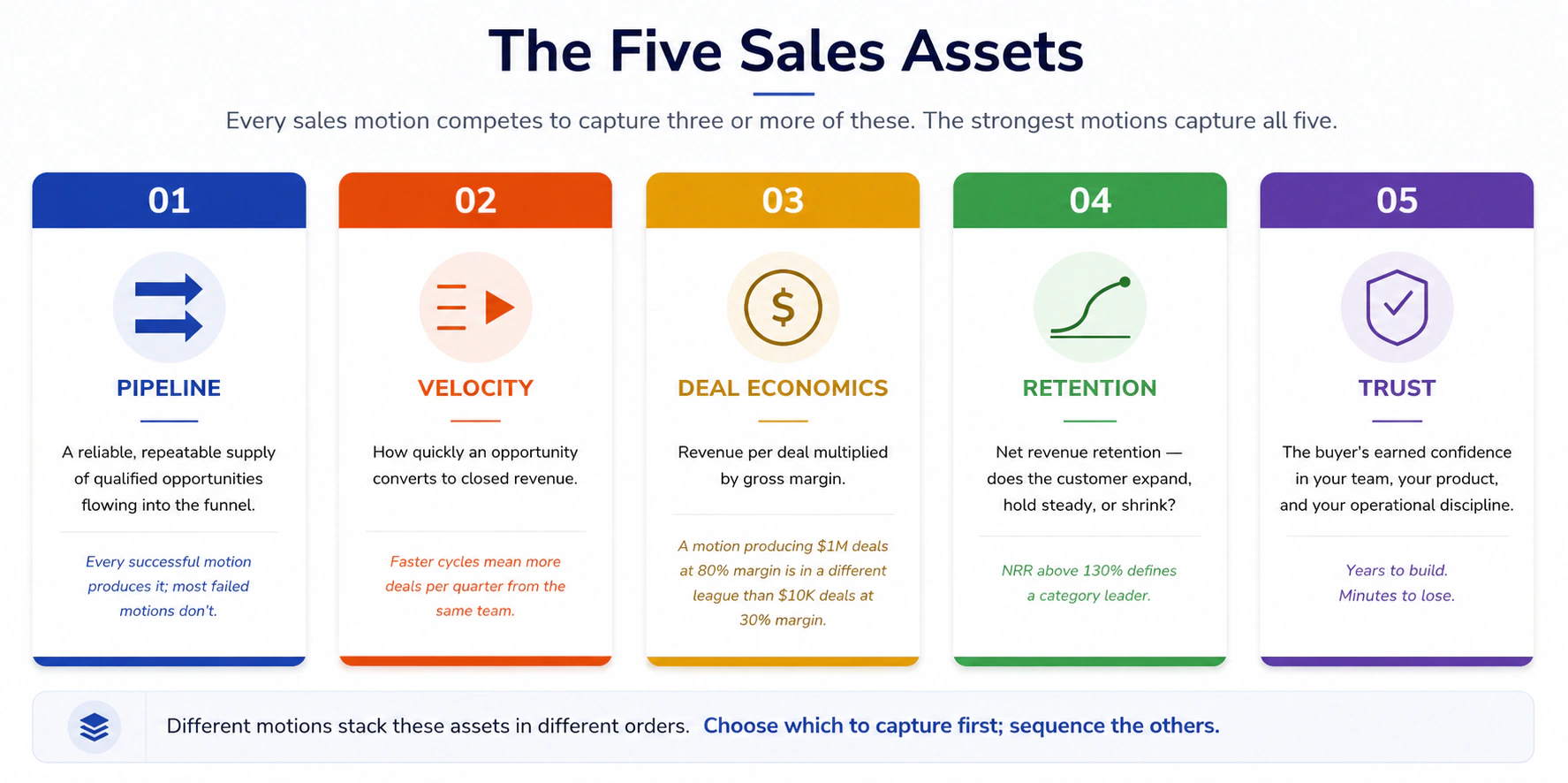
The five sales assets — what every motion is fighting to capture.
Pipeline is a reliable, repeatable supply of qualified opportunities flowing into the sales process. Every successful motion produces it; most failed motions don't.
Velocity is how quickly an opportunity converts to closed revenue. Faster cycles mean more deals per quarter from the same team.
Deal economics are revenue per deal multiplied by gross margin. A motion that produces $1M deals at 80% margin is in a different revenue league than one that produces $10K deals at 30% margin.
Retention is net revenue retention — does the customer expand their spending, hold steady, or shrink? In SaaS, NRR above 130% defines a category leader. In AI, the math is changing because outcome-based revenue grows naturally with usage.
Trust is the buyer's earned confidence in your team, your product, and your operational discipline. Trust takes years to build and minutes to lose.
The strongest motions capture three or more of these assets at once. The job of revenue strategy in the agent era is to choose which asset to capture first, then sequence the others.
A note on scope. This catalog focuses primarily on B2B markets — AI Workers and AI-native software sold to other businesses, not directly to individual consumers. Consumer-facing AI sales (mobile app store, advertising-led, subscription-led) follow different rules and are not the primary subject here, though several motions — Self-Serve PLG, Marketplace-Led, and Community-Led — apply cleanly to both contexts.
The maturity spectrum. Each motion in this catalog is tagged Proven, Emerging, or Speculative based on how many AI-native companies are running it successfully today.
- Proven motions have multiple at-scale companies operating on them right now, with confirmed revenue and a documented playbook.
- Emerging motions are being run by funded companies in 2026, but most outcomes remain pending and the canonical winner has not yet emerged.
- Speculative motions depend on buyer behaviors or contracting structures that do not yet exist at scale, but might soon.
Maturity is not the same as quality. Proven motions are safer; Emerging motions offer larger upside; Speculative motions offer the largest upside to the few teams who position correctly before the rest of the market arrives.
What this page is for
This document serves three purposes.
First, as a chooser. A founder or revenue leader designing a sales motion can use the Strategic Fit Matrix, the Seller Diagnostic, and the Motion Summary Table to find the motions that fit their stage, their buyer, and their product complexity. The deep sections then explain the mechanics, risks, and first moves for the motions on the short list.
Second, as a reference. A revenue team running an existing motion can use the deep sections to audit their own operation against the documented mechanics — comparing their actual conversion rates, cycle times, and deal economics to the patterns described.
Third, as a planning tool. A founder designing the sequence of motions a company will run as it scales (because most successful AI-native companies run two or three motions in sequence, not one in isolation) can use the Common Hybrid Motions section as a planning template.
How to choose a motion
The cleanest predictor of which sales motion fits is the intersection of deal size and cycle length. The matrix below maps the twelve motions onto those two axes. Each motion has a sweet-spot cell and works (less optimally) in adjacent cells.
| Cycle ↓ \ Deal $ → | Self-serve (<$10K) | Mid-market ($10–100K) | Enterprise ($100K–1M) | Strategic (>$1M) |
|---|---|---|---|---|
| Days | PLG (1), Marketplace (2) | — | — | — |
| Weeks | Open-Source (3), Community (4) | Founder-Led (5), AI-Outbound (6) | — | — |
| Months | — | Channel (11) | Enterprise Field (7), Channel (11), Hyperscaler (12) | — |
| Quarters or longer | — | — | Pay-Per-Outcome (9), Hyperscaler (12) | FDE (8), Value-Based (10) |
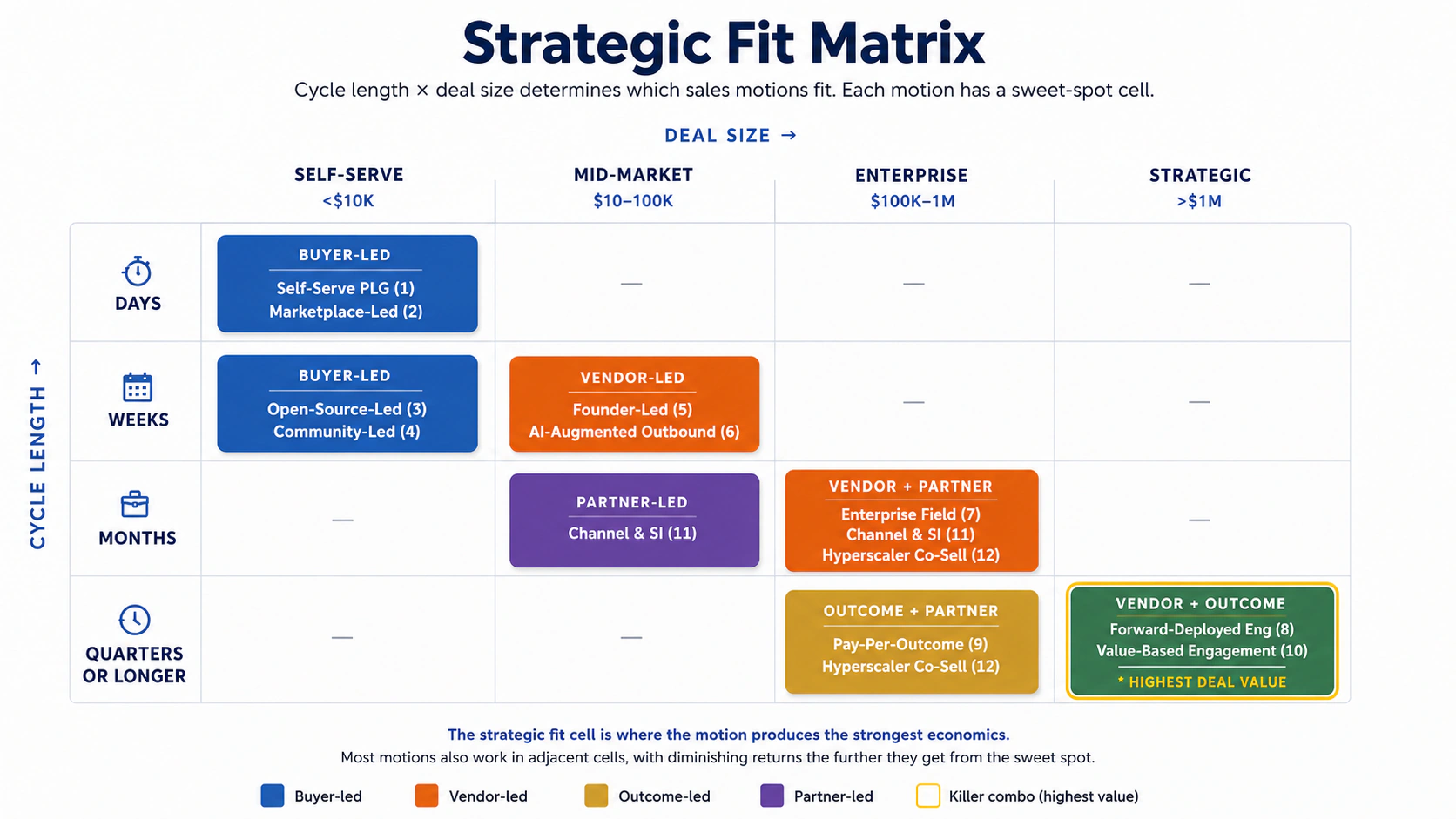
The cell that matters most is the one nobody plans for in advance: multi-month enterprise cycles for products that started self-serve. This is where companies that grew via PLG hit the wall of large enterprise procurement, and where revenue teams that have only ever run a self-serve motion struggle to suddenly run an enterprise field motion. The transition from "buyer-led" to "vendor-led" is the most common motion failure in AI-native companies — and the most teachable.
Seller diagnostic: eight questions
Before picking a motion, score yourself honestly on the eight dimensions below. The motions each row points to are the ones most aligned with that condition. A team that scores High on three or four of these usually narrows quickly to two or three candidate motions.
-
Founder selling capacity. Is the founder still personally closing deals? Yes → Founder-Led, FDE. No, sales team in place → Enterprise Field, AI-Outbound, Channel.
-
Product complexity. Does the product require buyer education before it can be evaluated? Low → PLG, Marketplace, Open-Source. Moderate → Founder-Led, AI-Outbound. High → Enterprise Field, FDE, Value-Based.
-
Time-to-value. How quickly does the buyer experience meaningful value after first interaction? Minutes → PLG, Marketplace. Days–weeks → Open-Source, AI-Outbound, Pilot. Months → Enterprise Field, FDE, Value-Based.
-
Outcome measurability. Can the buyer's success from your product be cleanly measured? High → Pay-Per-Outcome, Value-Based. Low → PLG, Enterprise Field, Channel (priced as access).
-
Buyer technical sophistication. How technically literate is the primary buyer? Developer / engineer → Open-Source, PLG, Marketplace. Business / operator → Founder-Led, AI-Outbound, Enterprise Field. Executive / procurement-led → Enterprise Field, FDE, Value-Based, Hyperscaler.
-
Procurement friction. How long is the buyer's typical procurement cycle? Days–weeks → PLG, Marketplace, Open-Source. Months → Founder-Led, AI-Outbound, Enterprise Field (with pilot phase). Quarters → Enterprise Field, FDE, Channel, Value-Based.
-
Channel and partner ecosystem. Do third parties already serve your target buyer in adjacent ways? Yes, deep → Channel, Hyperscaler, SI partnership. Yes, light → Marketplace, Community. No → Founder-Led, AI-Outbound, Enterprise Field.
-
Capital and patience. How long can your team operate before needing significant revenue? Less than 6 months → PLG, Marketplace, Open-Source. 6–18 months → Founder-Led, AI-Outbound. 18+ months → Enterprise Field, FDE, Value-Based.
The diagnostic does not tell you which motion is correct. It tells you which motions are available to you given your starting position. The matrix above and the deep sections below tell you which of the available motions is sharpest for the buyer you are selling to.
Motion summary table
A one-page reference for all twelve motions. Use it to scan the catalog at a glance — not to make a final decision, since the deeper sections that follow are where the real distinctions live.
| # | Motion | Maturity | Best for | Typical cycle | Typical deal size | Main risk |
|---|---|---|---|---|---|---|
| 1 | Self-Serve PLG | Proven | Developer-tool / productivity products with immediate value | Hours to days | <$10K initial; expands | Conversion-to-paid stalls |
| 2 | Marketplace-Led | Proven | Apps that fit in a host platform | Days | $10–50K | Platform compete or kick-out |
| 3 | Open-Source-Led | Proven | Developer infrastructure and frameworks | Weeks to months (open-to-paid) | $50K–500K commercial | Failed open-to-commercial conversion |
| 4 | Community-Led | Proven | Products with strong identity / target persona | Weeks to months | $10–100K | Community dilution as you scale |
| 5 | Founder-Led Sales | Proven | Pre-product-market-fit; first 5–50 deals | Weeks | $25–250K | Founder bottleneck; failure to hand off |
| 6 | AI-Augmented Outbound | Emerging | Mid-market vendor-led GTM | Weeks to months | $25–250K | Buyer fatigue with AI-generated outreach |
| 7 | Enterprise Field Sales | Proven | Six-figure deals to large organizations | 3–9 months | $100K–1M | Long sales cycle; heavy CAC |
| 8 | Forward-Deployed Engineering | Proven | Strategic enterprise deals where success requires custom work | 6–12 months for first deal | $500K–5M | Service-business gravity |
| 9 | Pay-Per-Outcome | Emerging | Workflows where outcomes can be cleanly attributed | 2–6 months | Variable; usage-based | Negative margin in early years |
| 10 | Value-Based Engagement | Speculative | Strategic transformation deals | 6–18 months | $1M–10M+ | Attribution disputes |
| 11 | Channel & SI Partnership | Proven | Products that need implementation expertise | 3–9 months (through partner) | $100K–1M | Partner economics misalignment |
| 12 | Hyperscaler Co-Sell | Proven | Cloud-native products with large compute footprint | 2–6 months | $100K–1M+ | Hyperscaler de-prioritization |
Which motion should I run?
The flowchart below sequences the most important decisions. Answer the questions top-to-bottom and stop at the first YES — that's your branch. The leaf nodes give one to four candidate motions to read in full.
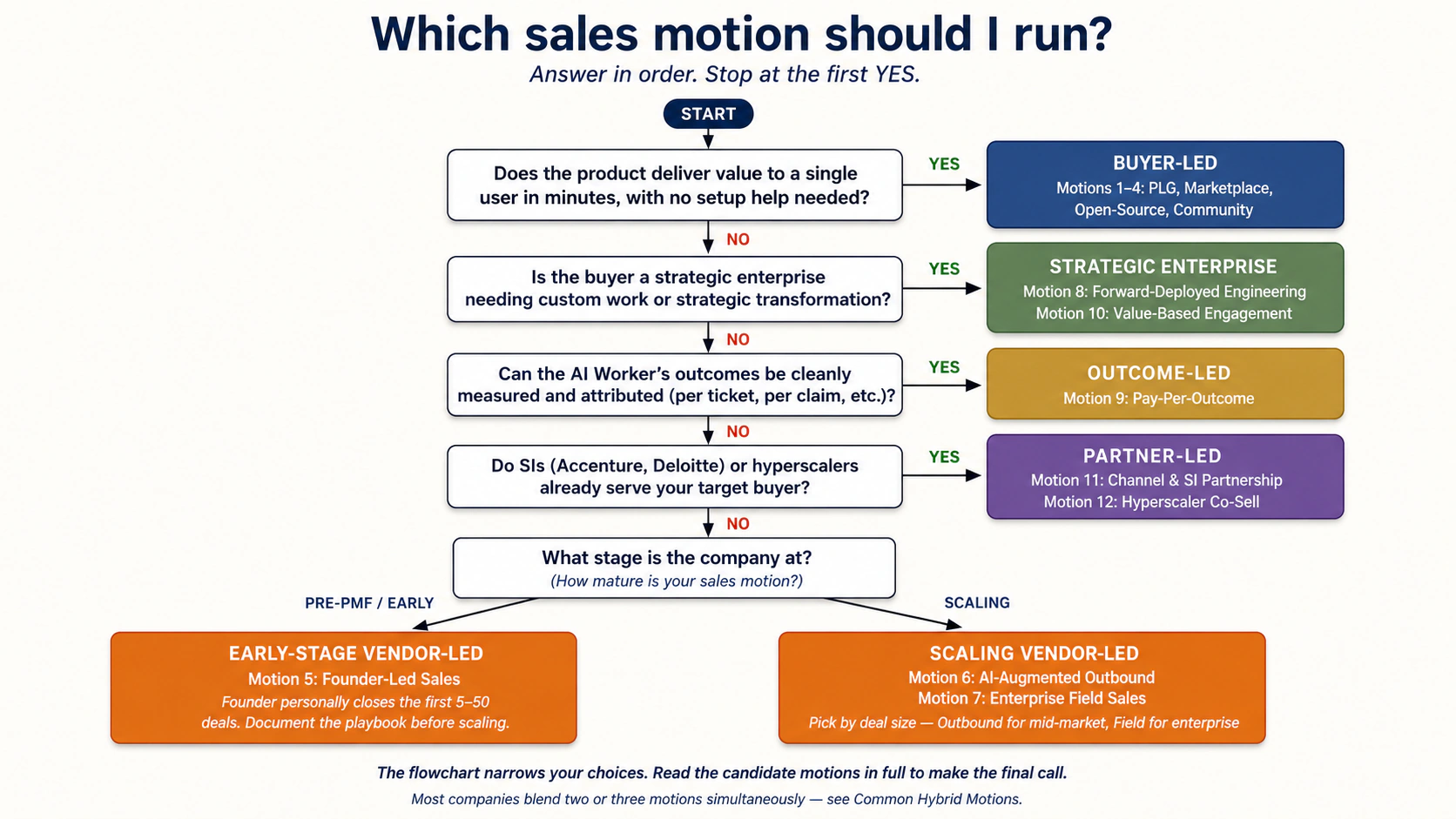
The flowchart is opinionated. It collapses real-world nuance into clean YES/NO splits to narrow your options from twelve to two or three. Use the Seller Diagnostic and Strategic Fit Matrix above to refine the choice once you've narrowed the candidate set. Most companies will end up running two or three motions simultaneously rather than one — see Common Hybrid Motions near the end of the document for the most common combinations.
Buyer maturity and timing
Every motion in this catalog has a window in the buyer's own AI journey. A buyer who has never deployed AI buys differently than a buyer who runs production AI at scale. Motions that work brilliantly for an AI-native buyer feel alien to an AI-curious buyer, and vice versa.
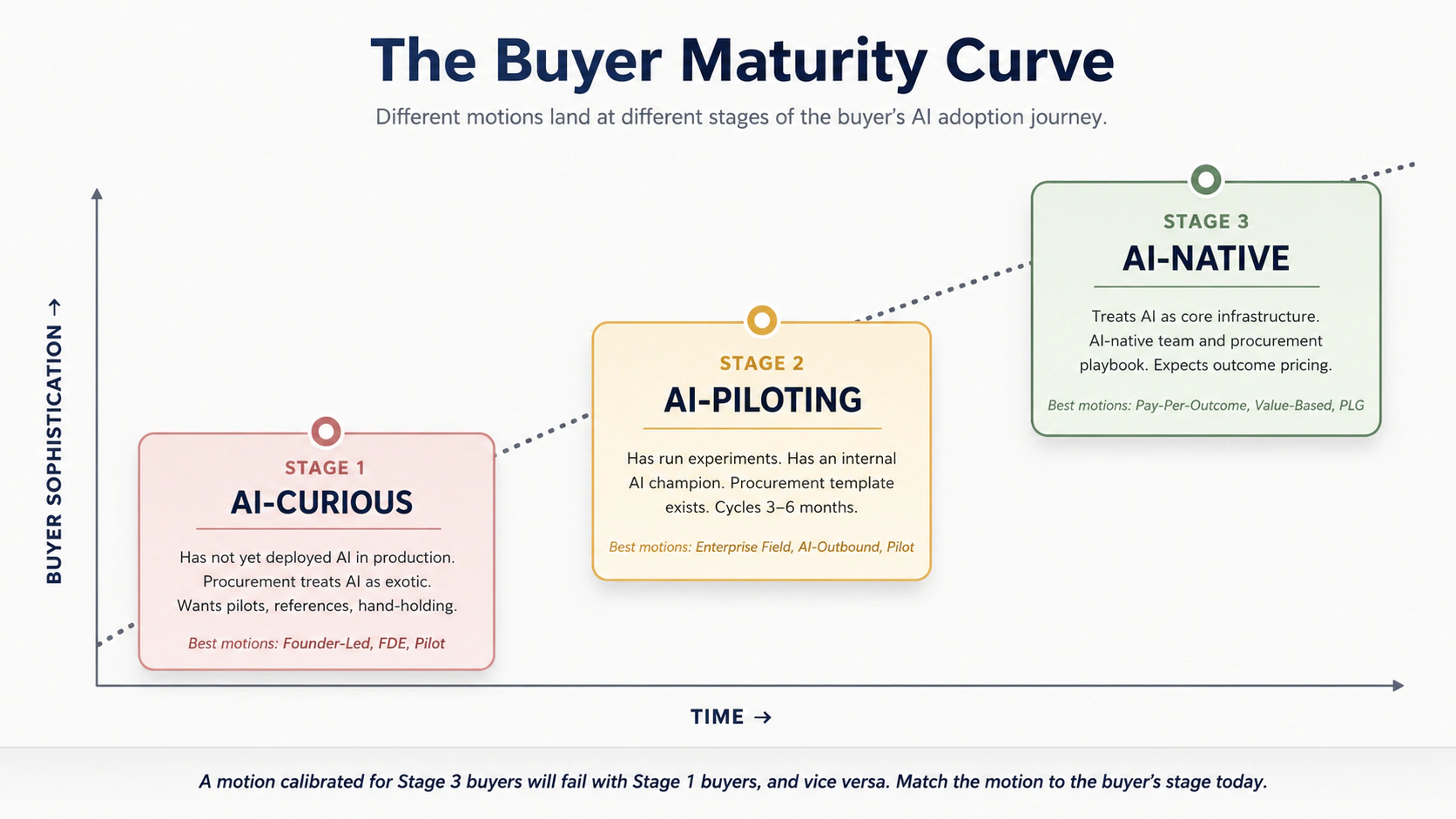
Three stages define the buyer maturity curve.
Stage 1 — AI-Curious. The buyer is interested in AI but has not deployed it in production. Procurement treats AI as exotic; legal needs AI-specific language drafted from scratch; security has no AI vendor template. The buyer wants pilots, references, and a sponsor who can vouch internally. Sales cycles are slow because every objection is being raised for the first time. Best motions: Founder-Led, FDE, Enterprise Field with a paid pilot phase.
Stage 2 — AI-Piloting. The buyer has run experiments. There is an internal AI champion (often a VP of Engineering, Chief Data Officer, or AI-curious COO) who has shipped at least one model into production. Procurement has a basic AI vendor template. Sales cycles are faster (3–6 months) because the buyer knows what to ask. Best motions: Enterprise Field, AI-Augmented Outbound, Channel.
Stage 3 — AI-Native. The buyer treats AI as core infrastructure. There is an AI-native team, an AI procurement playbook, and the buyer expects outcome-based pricing options. Sales cycles can be fast for clear-fit products (weeks) but procurement scrutiny is intense — security review is rigorous, competitive benchmarking is thorough, and the buyer will negotiate on outcomes, not just price. Best motions: Pay-Per-Outcome, Value-Based, Hyperscaler Co-Sell, PLG (for departmental adoption).
Geography accelerates or delays the curve. Silicon Valley, Seattle, Boston, New York, London, Toronto, Berlin, Bangalore, and Singapore are predominantly Stage 2 or Stage 3 markets in 2026 — buyers in those ecosystems have run AI experiments, have written internal AI procurement templates, and are starting to demand outcome-based pricing options. Most of the rest of the world is two to three years behind: enterprise buyers across much of continental Europe, Latin America, the Middle East, Africa, and Southeast Asia are still solidly in Stage 1, transitioning to Stage 2.
The implication for founders selling globally is that the same product needs different motions in different markets. A self-serve PLG product can be sold the same way in San Francisco and São Paulo — the buyer is the user, and the user's sophistication does not depend on geography. But an enterprise field motion calibrated for AI-native buyers in San Francisco will fail in Karachi, Lagos, or Jakarta — not because the local buyer is less sophisticated, but because their AI procurement is less mature. The seller has to slow the motion down: more education, more references, longer pilots, more hand-holding through procurement.
The opposite mismatch is just as costly. A motion calibrated for Stage 1 buyers (heavy hand-holding, long pilots, founder-on-every-call) is needlessly expensive and signals weakness in Stage 3 markets. The Stage 3 buyer wants outcome-based pricing and a four-week procurement cycle. Selling them a Stage 1 motion communicates that the seller is unsophisticated, slow, and probably not worth the integration effort. A founder selling globally needs to know which stage their buyer is in today, not which stage their reference customers are in. A motion calibrated for Stage 3 buyers will fail with Stage 1 buyers, and vice versa.
Maturity legend
- Proven. The motion has multiple AI-native companies operating it at scale today, with confirmed revenue and a documented playbook. The mechanics are well understood.
- Emerging. The motion is being run by funded AI-native companies in 2026, but most outcomes are still pending and the canonical winner has not yet emerged.
- Speculative. The motion depends on buyer behaviors or contracting structures that do not yet exist at scale, but are plausibly forming.
A. Buyer-led motions
The buyer self-discovers, self-evaluates, and self-purchases. The seller's job is to be findable, frictionless, and credible. The seller does not run the sales cycle; the buyer does. These motions excel at velocity and CAC efficiency but typically produce smaller initial deal sizes than vendor-led motions.
Motion 1 — Self-Serve PLG (Product-Led Growth)
Maturity: Proven. Beginner difficulty: Easy.
In Plain English. Imagine a vending machine, but for software. The buyer walks up, swipes a credit card, and the product appears. No salesperson, no contract negotiation, no procurement review for a $20/month subscription. Self-Serve PLG is exactly that: the product itself does the selling. The buyer signs up, experiences value within minutes, and upgrades themselves when usage justifies the paid tier.¹
This works only when the product delivers immediate, obvious value to a single user without organizational coordination. Cursor (the AI code editor) is a clean example: an engineer signs up, writes code with AI assistance, sees the value in their first session, and upgrades when free-tier limits hit. Linear (project management), Notion AI (writing assistance), and ElevenLabs (voice generation) all run variants of this motion.
Best as a founding motion for products with immediate single-user value. Often paired with Enterprise Field as the company scales — the PLG → Enterprise hybrid is one of the most common motion sequences in 2026.
Core idea. Eliminate friction between curiosity and value. Every step in the sign-up flow that does not produce value should be removed. The product itself is the sales pitch, the demo, and the close.
When to use it. When the target buyer is the user (not a separate procurement role), when value is immediate (minutes, not weeks), and when the price point is below corporate-card thresholds (typically <$200/seat/month, though this is rising as AI products demonstrate clear ROI).
Mechanism. PLG works because it inverts the traditional B2B sales funnel. Instead of sales-qualified leads being pushed to a salesperson who pushes them to product, the product produces qualified buyers who pull themselves through to paid conversion. CAC is dominated by product investment (onboarding, activation, in-product upgrade prompts) rather than headcount. Margins are high because there is no sales team to pay. The constraint is conversion-to-paid: most PLG products convert 2–5% of free users to paid.
Fictional walk-through. Imagine FocusFlow, a $20-per-month AI app that helps anyone organize their email. A user signs up at lunch, connects their inbox, and is using the product productively within five minutes. They hit the free-tier ceiling of one hundred AI summaries per day in their first week and upgrade to paid — no salesperson involved. FocusFlow's revenue grows because the product itself converts free users into paying ones, not because anyone called them.
Example. Confirmed examples: Cursor's path from free-tier code editor to paid subscriptions to enterprise contracts. Linear, Notion AI, Perplexity Pro. ElevenLabs for voice generation.
Primary risk. Conversion-to-paid stalls. The product gets adoption but users never upgrade. Mitigation: design the upgrade trigger directly into the product. Free tier should have a usage ceiling tight enough that genuine power users hit it within their first week, not within a year.
Secondary risk. Self-serve plateau. The motion works for departmental adoption but the company's enterprise expansion (security review, multi-seat negotiation, custom contracts) requires a sales motion the team has not built. Mitigation: hire the first enterprise seller before product-led growth produces enterprise-scale prospects, not after. The transition from "buyer-led" to "vendor-led" requires deliberate motion design.
First move. Build a free tier that creates a moment of genuine value within five minutes of sign-up. Without that moment, no other PLG mechanic matters.
Motion 2 — Marketplace-Led
Maturity: Proven. Beginner difficulty: Easy.
In Plain English. Imagine renting a stall in a busy bazaar. You don't have to draw the crowd — the bazaar already does. Your job is to be the best stall in the bazaar. Marketplace-Led selling means listing your AI product inside an established platform's app store (Salesforce AppExchange, Shopify App Store, Microsoft AppSource, the ChatGPT Apps directory, Atlassian Marketplace). The marketplace handles discovery, billing, and the initial trust signal. You handle the product.
The motion is uniquely powerful for AI products because the buyer is often already inside the platform when they decide they need an AI feature. A Salesforce admin who needs an AI lead-scoring tool will search the AppExchange before searching Google.
Best as a founding distribution motion or as a complementary channel for established products. Rarely the company's only motion at scale.
Core idea. Inherit the platform's distribution, billing, and trust apparatus. Pay for it through revenue share or listing fees rather than direct customer acquisition costs.
When to use it. When your AI product fits cleanly inside a platform's existing user base, when the platform's customers map to your target customer, and when the platform's revenue share is below what you would otherwise spend on direct customer acquisition.
Mechanism. A marketplace solves three founder problems at once: discovery (the buyer finds you while shopping in the platform), billing (the platform handles credit cards, invoicing, and tax), and trust (the platform's vetting process is itself a trust signal). The trade-off is the platform's revenue share (typically 15–30%) and the platform's policy risk (they can change terms or build a competing first-party feature).
Fictional walk-through. Imagine NoteSnap, an AI summarization app for Salesforce. NoteSnap lists in the Salesforce AppExchange. A Salesforce admin shopping the AppExchange for productivity tools finds NoteSnap, installs it, sees value during a free trial, and converts to paid — all through Salesforce's own billing system. NoteSnap never ran an outbound campaign; the platform did the customer acquisition.
Example. Confirmed examples: The long tail of successful Salesforce AppExchange and Shopify App Store companies. Productivity agents shipping through Claude Apps and ChatGPT Apps in 2026. AI-native ad-creative tools embedded in the Meta and TikTok ad platforms.
Primary risk. Platform risk is asymmetric and existential. A policy change, a take-rate increase, or a first-party feature launch can erase a marketplace-led business overnight. Mitigation: maintain a direct relationship layer outside the platform — your own email list, community, or data export pathway — so a platform termination is recoverable rather than fatal. Plan for the platform to eventually compete with you.
First move. Pick one platform and become a first-class citizen in it (top-rated, deeply integrated, frequently updated) before listing on a second.
Motion 3 — Open-Source-Led
Maturity: Proven. Beginner difficulty: Medium.
In Plain English. Give the recipe away free; charge for the catering. Open-Source-Led selling means publishing the core of your product as open-source code that any developer can read, modify, and run. As more developers use it, your reputation grows, contributors join the project, and the code gets better — without you paying a marketing team. Then you sell a paid version with the things companies actually need on top: managed hosting, security features, audit logs, support contracts, regulated-environment certifications.
The motion is especially powerful for AI infrastructure: agent frameworks, evaluation tools, and developer libraries where developer mindshare is the primary moat.
Best as a founding motion for infrastructure-shaped products. Often paired with Channel or Hyperscaler Co-Sell as the commercial offering matures.
Core idea. Use the open-source project as a globally distributed marketing function. The community evangelizes the project; a fraction of the users become paying customers when they hit operational, security, or scale needs the open project does not handle.
When to use it. When the target buyer is technical (developers, ML engineers, infrastructure teams), when there is a credible reason a company would pay for a managed version (hosting, compliance, support) rather than running the open version themselves, and when the team can sustain open-source development across the multi-year arc required to build community.
Mechanism. Open-source-led works because developer adoption flows ahead of enterprise adoption — engineers experiment with the open project on their own machines, then advocate internally when their company has a related need. The pre-sales relationship is built before any salesperson is hired. The constraint is the open-to-commercial conversion: many open-source projects fail not because the technology is bad, but because the founders never built a clear paid product on top of the free one.
Fictional walk-through. Imagine AgentCore, an open-source framework that lets developers build AI agents. Thousands of developers download AgentCore for free, contribute back to the project, and build apps with it. AgentCore's commercial offering, AgentCore Cloud, charges enterprises for managed hosting, single sign-on, audit logs, and compliance certifications. The free project drives adoption; the paid version captures the customers who need enterprise features.
Example. Confirmed examples: LangChain, Continue, n8n, Cline, and a long tail of agent frameworks shipping commercial managed versions on top of widely-adopted open cores. The pattern is among the most prominent in the current agent ecosystem.
Primary risk. Failed open-to-commercial conversion. The open project is wildly popular but commercial revenue is weak. Mitigation: decide upfront what you will never give away — typically managed hosting, single-sign-on, audit logs, advanced security, and enterprise support. Commit to the line publicly. Volunteers and contributors lose faith if the line moves.
Secondary risk. Hyperscaler appropriation. AWS, Azure, or GCP wraps your open project in their own managed service and out-distributes you. Mitigation: work directly with hyperscaler partner programs early, or use a license (BSL, SSPL) that limits cloud-provider commercial use without explicit license.
First move. Ship the open project to genuinely useful state before talking about the commercial offering. Communities can smell a bait-and-switch from miles away.
Motion 4 — Community-Led
Maturity: Proven. Beginner difficulty: Easy.
In Plain English. Imagine being famous before you sell anything. Community-Led means building an audience — a Discord server, a YouTube channel, a Substack, a tutorial library, a public-build-in-public X account — long before you ship a paid product. By the time you do ship, the audience is already there. They have been waiting for your product. They will buy it, evangelize it, and forgive its early-version flaws because they feel personal investment in your success.
This motion overlaps with Open-Source-Led for technical audiences and with Marketplace-Led for some AI tools, but its distinctive feature is the founder's (or team's) public identity as the entry point.
Best as a founding motion for products with strong creative identity. Hard to scale beyond the founder's personal reach without deliberately converting community into a structured brand asset.
Core idea. Build the audience first, the product second. Treat distribution as a long-term moat rather than a quarterly expense.
When to use it. When the founder or team can credibly produce content in the target buyer's ecosystem (developer-influencer for dev tools, creator-influencer for creator tools, operator-influencer for vertical SaaS), when there is no established marketplace or platform to embed in, and when the team can patiently invest in audience building for 12+ months before serious revenue.
Mechanism. Community-led works because the audience pre-qualifies itself. People who follow a developer-influencer for two years and then buy that influencer's product are 10–20× more likely to convert than a cold lead from paid acquisition. Trust, the most expensive sales asset to build, is built upstream of the product launch.
Fictional walk-through. Imagine VideoMaker, an AI video editing tool. Its founder spent two years posting tutorials on YouTube and TikTok, building an audience of fifty thousand followers before launching the product. By launch day, the audience was waiting. The first thousand paid customers came directly from her existing followers; the launch-week revenue exceeded what most pre-launch products earn in their first year.
Example. Confirmed examples: Tiago Forte's Building a Second Brain franchise (productivity), Lenny Rachitsky's product-management substack-to-software trajectory, and AI-creator personalities who launch tools to their audiences. The pattern is shaped by individuals more than companies.
Primary risk. Community dilution as you scale. The early audience values intimacy and direct founder access; as the company scales, that intimacy becomes impossible. Mitigation: turn community into a brand asset (named programs, public events, tier rewards) rather than depending on personal founder presence forever.
First move. Start producing content before you have a product to sell. Twelve months of consistent content, with no commercial pitch, is the minimum entry price.
B. Vendor-led motions
The seller initiates and orchestrates the deal. The seller's job is precise targeting, value articulation, and procurement navigation. These motions excel at deal size and predictability but require larger teams and patience that buyer-led motions do not.
Motion 5 — Founder-Led Sales
Maturity: Proven. Beginner difficulty: Easy.
In Plain English. In an early restaurant, the chef who cooks the food also seats the guests, takes the orders, and bills the tab. Founder-Led Sales is exactly that: the founder personally hand-closes the first 5–50 deals before hiring a sales team. There is no other way to learn what the buyer actually values, what objections actually arise, and what the real sales playbook looks like. A founder who skips this step and hires a VP of Sales too early ships a sales motion that has not been validated and a team that cannot improvise it.²
Best as the founding sales motion for any complex B2B AI product. Plan the transition to AI-Augmented Outbound, Enterprise Field, or another vendor-led motion within 6–18 months — founder bandwidth is the binding constraint.
Core idea. The founder is the only person on the team with both the product context and the strategic discretion to close non-standard deals. Use the founder for the first phase, then convert what the founder learned into a repeatable playbook before hiring sellers.
When to use it. Always, for B2B AI-native companies pre-Series A or earlier in the sales motion's evolution. Even companies that primarily run a PLG motion benefit from founder-led sales for early enterprise deals.
Mechanism. Founder-Led works because every early deal is partially custom — the buyer is taking a risk on a young company, and the founder is the only person who can authoritatively say "yes, we can do that" and have it be true. The constraint is founder bandwidth: a founder can typically close 3–5 deals per quarter while also building product, raising capital, and recruiting team. Beyond that, the motion bottlenecks on the founder.
Fictional walk-through. Imagine LegalDraft, an AI legal-research tool. The founder, a former corporate attorney, personally calls thirty friends from her old law firm. She demos the product, negotiates pricing on each call, and signs the first fifteen customers herself — before hiring any salespeople. She also discovers, in those fifteen conversations, that the feature she thought was the killer use case is barely valuable, and that the boring feature she nearly cut is the one customers actually pay for.
Example. Confirmed pattern: Most successful B2B AI-native startups in 2025–2026, regardless of which other motion they eventually scale to, ran founder-led sales for their first 5–50 customers. Harvey, Sierra, Glean, and Hebbia all fit the pattern.
Primary risk. Founder bottleneck. The founder is in too many sales meetings to build the product or run the company. Mitigation: explicitly sunset the motion. After the first 30–50 deals, the founder should be writing the sales playbook, not running the next 50 deals.
Secondary risk. Failure to hand off. The first sales hire cannot replicate what the founder did, because the founder's selling involved unwritten product commitments, pricing improvisation, and personal relationships. Mitigation: document every commitment, every pricing exception, and every deal structure as it happens. The handoff document is built during founder-led sales, not after.
First move. The founder should personally close the next deal. Whatever comes after is built on what is learned in that one.
Motion 6 — AI-Augmented Outbound
Maturity: Emerging. Beginner difficulty: Medium.
In Plain English. Imagine a sales development team of fifty squeezed into a team of five. AI-Augmented Outbound uses AI agents to do the research, drafting, and follow-up work that historically required armies of sales development representatives — leaving a small human team to handle the live conversations and demos that AI cannot yet do well. The traditional SDR sent thirty personalized emails a day. The AI-augmented SDR sends three thousand.³
This is the sales motion that AI itself has made possible. Two years ago, the underlying technology was insufficient. Today, well-tuned AI-augmented outbound matches or exceeds the personalization quality of the best human SDR teams — at a fraction of the headcount, with the human SDR in the loop for the conversations that matter.
Best as a primary motion for mid-market vendor-led GTM. Also works as an augmentation layer on top of any vendor-led motion. The mechanics are evolving rapidly with the underlying AI tooling.
Core idea. Use AI agents to perform the upper-funnel research, drafting, and follow-up work. Keep a small human team to handle the bottom-funnel (live conversations, demo coordination, deal navigation) where the AI cannot yet replace human judgment.
When to use it. When the target buyer is reachable via email or LinkedIn (typical for mid-market tech buyers, less reliable for executive-level enterprise buyers), when the product can be demonstrated in a 30-minute call, and when the team has the RevOps maturity to instrument and tune the AI's prompts and behavior.
Mechanism. AI-augmented outbound works because the limiting factor in traditional outbound was always personalization quality at scale. Humans could write 30 personalized emails per day; AI can write 3,000. The constraint shifts from outreach volume to deliverability, response quality, and the human SDR's capacity to handle the increased response rate. Early teams running this motion well report meaningful pipeline efficiency improvements over pure human outbound — typical claims fall in the 2–4× range — though independent benchmarks are scarce and the comparison depends heavily on what "pipeline" is being measured.
Fictional walk-through. Imagine SalesScope, a B2B AI tool. Its five-person SDR team uses an AI agent to research ten thousand prospects per week, draft personalized outreach for each, and follow up automatically. The human SDRs handle only the live conversations that result. The team books more meetings monthly than a comparable fifty-person SDR team using manual outreach — and at one-tenth the headcount cost.
Example. Emerging analogues: Apollo, Clay, Salesloft AI, Outreach AI, and a wave of AI-native sales engagement platforms shipping in 2025–2026. Many AI-native vendors run this motion as their primary outbound engine.
Primary risk. Buyer fatigue with AI-generated outreach. As AI-augmented outbound spreads, buyers learn to identify and ignore it. Mitigation: use AI for research and drafting, but keep human SDRs in the conversation for the actual sending and follow-up. The "AI-generated, AI-detected, ignored" path is real and growing.
Secondary risk. Compliance and deliverability. AI-augmented outbound at scale can trigger ESP (email service provider) penalties or violate jurisdictional rules. Mitigation: invest in deliverability infrastructure and follow regional regulations rigorously.
First move. Audit your current SDR team's actual time allocation. If they spend more than 40% of their time on research and drafting, AI-augmented outbound has a clear leverage opportunity. If they spend most of their time on live calls and meeting coordination, the leverage is smaller.
Motion 7 — Enterprise Field Sales
Maturity: Proven. Beginner difficulty: Medium.
In Plain English. Selling cars at a dealership, except the dealership is in the customer's office and the car costs $1M. Enterprise Field Sales is the traditional B2B sales motion: account executives carrying quotas of $1–5M annually, working multi-stakeholder deals through 3–9 month cycles, with executive champions, technical evaluators, security reviewers, legal, and procurement all needing to be navigated.⁴
This is the motion most associated with old-school enterprise software (Oracle, SAP, Salesforce). It is also the only motion that reliably produces multi-hundred-thousand-dollar AI deals at scale.
Best as a primary motion for products targeting six-figure deals. Often the destination motion that PLG, Founder-Led, and AI-Augmented Outbound companies graduate into as they scale.
Core idea. Match the buyer's procurement complexity with sales-team specialization. Where the buyer has a CFO who approves spend, a CIO who approves architecture, a security team who approves the vendor, and a legal team who approves the contract — the seller needs equivalent specialists.
When to use it. When deal sizes are above $100K annually, when the buyer is a large organization with formal procurement, when the product requires more than a 30-minute conversation to be evaluated, and when the team has 18+ months of capital to support the long sales cycle.
Mechanism. Enterprise field sales works because large organizations buy through processes designed to minimize bad-vendor risk. The seller's job is to navigate that process — building champions internally, providing security documentation, negotiating contracts — over the months it takes for the organization to formally approve the purchase. Almost every enterprise AI deal is structured as a paid pilot followed by a production contract; the pilot is not a separate motion but the standard entry phase of this one (see Pilot economics in Cross-cutting concepts).
The constraint is sales-team CAC. A fully-loaded enterprise account executive — salary, commission, benefits, sales-engineering allocation, tooling — typically runs in the mid-six-figures annually and takes six to nine months to ramp to full quota. Until that ramp completes, each AE is a cost without offsetting revenue. Companies that hire too many AEs too fast, before the playbook is validated, burn capital faster than the deals can close.
Fictional walk-through. Imagine HRSmart, an AI tool for Fortune 500 HR teams. Closing one deal takes six months. The account executive meets first with the VP of HR, then the CIO, then security review (three weeks), then legal (six weeks), then procurement (four weeks). The deal closes at $400,000 ACV. The AE costs $400,000 per year fully loaded and takes nine months to ramp to full quota. The math only works because each AE closes three to five deals per year at this scale.
Example. Confirmed examples: Most six-figure-and-above AI-native deals at Glean, Harvey, Sierra, Writer, and Cresta run through enterprise field motions. Each of these companies has built a formal sales organization with specialized roles (AEs, SEs, customer success, sales engineering).
Primary risk. Long sales cycles burn capital. A 6–9 month cycle at fully-loaded mid-six-figure AE cost means each AE consumes meaningful capital before any deal closes. Mitigation: concentrate on a small number of high-value target accounts (account-based selling) rather than spraying outbound across 1000s of mid-market companies.
Secondary risk. Heavy CAC ratios. Enterprise field motions can produce CAC payback periods of 18+ months, which are unsustainable for venture-backed companies that need to demonstrate efficiency. Mitigation: combine enterprise field with a PLG or pilot motion that produces lower-cost initial entry, then expand within the account.
First move. Hire one enterprise seller and let them run the playbook for 6 months before hiring a second. The second hire's success is built on what the first hire learned, not on parallel learning.
Motion 8 — Forward-Deployed Engineering (FDE)
Maturity: Proven. Beginner difficulty: Advanced.
In Plain English. Embedded chefs, not menus. Send your engineers to live in the customer's kitchen and cook custom meals. Over time, the recipes become a menu you can sell to other customers. Forward-Deployed Engineering means embedding a small team of your engineers (and now AI Workers) inside one customer's organization for months, building a custom solution exactly for them. Each engagement teaches the team something specific about how the customer's industry actually works. By the third or fourth deployment, you have enough productized patterns to launch a self-serve vertical product.
Palantir invented the model in defense and intelligence. Anthropic's Applied AI team and OpenAI's Forward Deployed function are running it at the lab level today. Sierra and several enterprise AI vendors are running variants of it.
Best as a founding motion for enterprise-scale strategic deals or as a mid-stage path for product companies that need vertical depth in a specific industry. Often transitions into Vertical AI-Native Greenfield .
Core idea. The engagement itself is the product discovery. The patterns earned during the engagement become the moat that lets the company scale.
When to use it. When the target customer is a strategic enterprise (government, large bank, large hospital system, large industrial company), when the buyer's problem is sufficiently complex that a generic product cannot solve it, and when the team has the capital and patience to spend 6–12 months on each early engagement.
Mechanism. FDE works because it solves the cold-start problem of vertical products. The first customer pays the company to learn the industry; subsequent customers buy a product that has been hardened through the first engagement. Each engagement converts a fraction of the work into reusable patterns; over time, the ratio of reusable to custom work flips, and the company graduates from services-margin economics to software-margin economics.
Fictional walk-through. Imagine MedAgent, an AI tool for hospital systems. MedAgent's first customer is a large hospital network. Three of MedAgent's engineers move into the hospital's offices for six months, customizing MedAgent for that hospital's specific clinical workflows. The hospital pays $2M for the engagement. The patterns the engineers discover during the work — common documentation flows, integration points, clinical-language conventions — become reusable features in the productized version that MedAgent later sells to other hospitals at lower margins but higher volume.
Example. Confirmed examples: Palantir's defense and commercial deployments. Anthropic's Applied AI Team. OpenAI's Forward Deployed function for major enterprise accounts. Smaller AI-native consultancies running paid pilots that productize over time.
Primary risk. Service-business gravity. The team makes real revenue from day one selling custom work, which is seductive and addictive. It is tempting to keep doing custom work forever and never make the harder leap to a real product. Mitigation: demand that every engagement produce at least one reusable pattern that ships into the next engagement. Track the ratio of custom to productized work as a top operating metric.
Secondary risk. Senior engineering bandwidth. FDE consumes the company's most senior engineering talent for months at a time. Mitigation: limit the number of concurrent FDE engagements to what the company can sustain. Two FDE deployments running in parallel is reasonable; five usually means quality is suffering on all of them.
First move. Sign one strategic customer for an embedded engagement at full-margin pricing. The company's product roadmap should be partially shaped by what that customer's actual workflow looks like.
C. Outcome-led motions
The deal is structured around results rather than access. The seller's job is measurement, attribution, and consistent delivery. These motions are uniquely enabled by the AI era, because AI Worker outputs can be measured in ways software-seat outputs typically cannot.
Motion 9 — Pay-Per-Outcome (Service-as-Software)
Maturity: Emerging. Beginner difficulty: Advanced.
In Plain English. Pay only when the door is fixed, not when the carpenter shows up. Pay-Per-Outcome means the buyer pays only when the AI Worker actually delivers a result — a resolved support ticket, a closed sales meeting, a processed insurance claim, a drafted legal document. The vendor takes the delivery risk.
This is the pricing model the AI era has made possible at scale, because AI Worker outputs are measurable in ways software-seat outputs typically were not. Sierra (customer support), Decagon (customer service), EvenUp (legal claims), and a wave of AI-native vendors are running outcome-based pricing in 2026.
Best as a founding motion when outcomes are cleanly measurable, or as a mid-stage pricing flip for companies that started seat-based. Tightly coupled to the Service-as-Software pattern .
Core idea. Align vendor revenue with customer value. The vendor only makes money when the customer gets value, and the more value the customer gets, the more the vendor makes.
When to use it. When the AI Worker's output can be cleanly attributed and measured (a resolved ticket is a resolved ticket; a drafted contract is a drafted contract), when the unit economics work at the priced outcome level (compute cost + AI quality cost is below the revenue per outcome), and when the buyer is sophisticated enough to structure outcome contracts (typically AI-native or AI-piloting buyers).
Mechanism. Outcome pricing works because it lets the seller compete for the customer's labor budget rather than the customer's software budget. A mid-market company spends ten times more on customer support headcount than on customer support software. The AI vendor that captures a fraction of the headcount budget through outcome pricing operates in a different revenue category than the vendor capturing a fraction of the software budget.
The pricing math is anchored to the human labor cost, not to a SaaS comparable. If a customer support representative costs roughly $5 per resolved ticket all-in (salary + benefits + management overhead + workspace), the outcome price ceiling is somewhere around $1–3 per resolved ticket — enough below human cost that the customer captures real savings, enough above the vendor's compute cost that gross margin is positive. The vendor's compute cost per outcome (currently $0.20–0.80 for typical agent tasks, falling rapidly as model efficiency improves) sets the floor; the customer's human cost sets the ceiling; the price lives somewhere in between. The vendor's strategic question is how aggressively to compress the gap — wider gap means higher margin per outcome but slower customer adoption; narrower gap accelerates adoption but compresses margin during the years compute prices are still falling.
The technical foundation is outcome attribution. The vendor must produce audit-grade telemetry: for every priced outcome, a verifiable record of what the AI did, what it processed, and how the result was confirmed. Without this, customer disputes have no objective basis and revenue collection becomes a quarterly negotiation. Companies running this motion well treat outcome-attribution infrastructure as part of the product, not as accounting overhead — and they staff it with engineers, not with finance analysts. The discipline this creates is what makes the motion durable; the lack of it is what kills the motion when it fails.
Fictional walk-through. Imagine TicketBot, an AI customer-support agent. TicketBot does not charge customers per seat. Instead, the customer pays $0.50 for every support ticket TicketBot resolves on its own (without escalating to a human). A customer with fifty thousand tickets per month gets a $25,000 monthly bill — but only if TicketBot actually resolves the tickets. If TicketBot resolves only thirty percent of incoming tickets, the bill is one-third of that. The customer's CFO loves this; the customer's procurement team needs to learn how to structure the contract.
Example. Confirmed examples: Sierra's per-resolution pricing for AI customer service. Decagon's outcome-based contracts. EvenUp's per-claim pricing for personal-injury legal work. The pattern is among the most actively-expanding pricing structures in 2026.
Primary risk. Negative gross margin in early years. If the AI quality is not high enough yet, the vendor pays for the failed work in compute and human-fallback costs but gets no revenue. Mitigation: set a price-per-outcome that includes a margin buffer for early-quality issues, and graduate to tighter pricing as quality improves. Many vendors operate at near-zero gross margin for the first 12–18 months until quality stabilizes.
Secondary risk. Attribution disputes. The buyer claims the AI did not produce the outcome (or the buyer's own staff produced it). Mitigation: invest in outcome-attribution telemetry from day one. The vendor needs irrefutable, audit-quality evidence of which outcomes the AI Worker produced.
First move. Pick one outcome (the cleanest, most measurable) and price it. Resist the urge to price multiple outcomes simultaneously until the first one's economics are proven.
Motion 10 — Value-Based Engagement
Maturity: Speculative. Beginner difficulty: Advanced.
In Plain English. Imagine hiring a consulting firm that only gets paid a percentage of the savings they create — McKinsey or BCG style engagement, but where the deliverable is not a slide deck but a live AI Worker, and the pricing is tied directly to the customer's measured P&L improvement. Value-Based Engagement means structuring large strategic deals as a percentage of the business value created, with rates that vary widely by deal complexity and buyer sophistication. Common for AI deployments that touch P&L lines worth hundreds of millions of dollars.
The motion is speculative because it depends on the buyer's willingness to formally commit to value-based contracting, which most enterprise procurement organizations are not yet structured to do. It exists in 2026 mostly as bespoke deals between AI-native vendors and forward-leaning enterprise customers.
Realistic only at strategic-deal scale (>$1M ACV) and only with AI-native buyers. Not a viable motion for early-stage companies; usually layered on top of Enterprise Field or FDE for the largest deals.
Core idea. Price the deal as a function of the customer's measurable economic outcome. The vendor takes upside in proportion to the customer's gain, and (in some structures) takes downside if the gain falls below threshold.
When to use it. When the customer's executive sponsor has authority to commit to value-based contracting (typically only at the C-suite level), when the value created can be cleanly attributed to the AI Worker (not confounded by other initiatives), and when the deal size is large enough to justify the contracting complexity.
Mechanism. Value-Based Engagement works when both parties can agree on what value means and how to measure it. The structure aligns vendor incentives with customer outcomes more tightly than any other pricing model — the vendor's revenue grows in proportion to the customer's measurable gain, removing the conventional vendor-buyer adversarial dynamic where the vendor wants to charge for access and the buyer wants to pay for results.
The contract structure is materially more complex than seat- or outcome-based pricing. A typical agreement has four components. A baseline measurement period (usually 30–90 days before deployment) establishes what the customer's metrics looked like without the AI Worker. A value-share formula defines what fraction of the gain the vendor captures — typically a percentage that varies by deal complexity and buyer sophistication. A ceiling and floor caps both upside (so the vendor doesn't earn more than the customer's executives can defend internally) and downside (so the vendor isn't paying the customer to deploy the product). And audit rights give the vendor the ability to verify the customer's reporting on the metrics that drive billing — without audit rights, the customer's procurement organization will under-report measured value as soon as the contract reaches its first true-up cycle.
The constraint is contracting maturity. Most enterprise procurement organizations are not yet equipped to structure value-based deals at scale; legal, finance, and operations all need representatives who understand the model and have authority to commit to non-standard contract terms. This is why these deals typically require an executive sponsor at the C-suite level — only that authority can override the procurement organization's default of "we don't structure deals this way." Without the sponsor, the proposal stalls in mid-organization indefinitely, regardless of the technical merit. Sellers running Motion 10 spend most of their early energy identifying and recruiting the executive sponsor; the rest of the motion is execution against the sponsor's mandate.
Fictional walk-through. Imagine CashFlow, an AI tool for hedge funds. A $50B fund deploys CashFlow and, over a 12-month measurement period, attributes a $40M annual improvement in trading efficiency to the deployment. CashFlow's contract is structured at fifteen percent of measurable improvement above baseline: the fund pays $6M annually for the duration of the contract. The deal took nine months to negotiate, required the fund's CIO and CFO to personally approve, and only made it through procurement because the executive sponsor pushed it through.
Example. Emerging analogues: Some Anthropic Applied AI engagements with strategic enterprise customers. Some Palantir deployments structured around mission outcomes. Forward-leaning AI deployments at financial services, healthcare, and consulting firms. The pattern is too young to have a canonical exemplar.
Primary risk. Attribution disputes. The customer claims the AI did not produce the value (or the customer's own initiatives did). Mitigation: establish a baseline measurement period before the engagement begins. Compare post-deployment metrics to pre-deployment baseline rather than to a hypothetical counterfactual.
Secondary risk. Long contracting cycles. Value-based contracts can take 6–12 months to negotiate, during which the team is investing in the relationship without revenue. Mitigation: combine value-based engagement with a paid pilot phase that produces revenue while the production contract is being negotiated.
First move. Find the executive sponsor with authority to commit to value-based contracting before investing in the proposal. Without that sponsor, the motion stalls in mid-organization procurement.
D. Partner-led motions
Third parties drive the purchase. The seller's job is alliance management — making partners successful enough that they keep selling for you. These motions are slow to start but produce durable, repeatable revenue once the partner ecosystem is in place.
Motion 11 — Channel & SI Partnership
Maturity: Proven. Beginner difficulty: Medium.
In Plain English. Apple sells through Best Buy. Beverages sell through grocery stores. Many vendors with too many potential customers and not enough sales reps need someone else to do the last mile of selling and deploying for them. Channel and Systems Integrator (SI) Partnership means selling your AI Workers through third parties — value-added resellers, consultancies (Accenture, Deloitte, Slalom, BCG, McKinsey), regional systems integrators — who deploy them as part of broader engagements with their own clients.
The motion is essential for products that require significant implementation expertise. An AI Worker that takes weeks to deploy at a large bank is much easier to sell when Accenture is the one doing the deploying — they already have the bank's trust, they already know the bank's workflows, and they already have a contract template that covers AI services.
Best as a primary motion for products that require implementation expertise, or as a complementary channel alongside Enterprise Field Sales.
Core idea. Use partners to handle the implementation, customization, and ongoing operations work that the AI vendor itself does not want to do. Pay partners through margins or referral fees structured to incentivize their long-term success.
When to use it. When the target customer is a large enterprise that already has SI relationships, when the product requires significant implementation work, and when the company has the patience to invest 12–18 months building partner relationships before the channel produces meaningful revenue.
Mechanism. Channel-led works because SIs have established trust with enterprise buyers that AI vendors do not yet have. The SI's recommendation is itself a sales argument. The constraint is partner economics: SIs need to make 30–50% margin on the engagement, which compresses the AI vendor's pricing flexibility. Companies running this motion well co-sell with SIs (joint sales calls, joint case studies, joint executive briefings) rather than treating the SI as a passive distributor.
Fictional walk-through. Imagine DocAI, an AI document-processing tool. DocAI does not sell directly to large banks — it sells through Accenture. Accenture's consultants implement DocAI for their banking clients as part of larger digital transformation engagements that already command $50M budgets. DocAI gets the recurring software license revenue (typically $500K–$2M per bank); Accenture gets the implementation fees ($5M–$20M per engagement). DocAI never has to navigate bank procurement directly — Accenture's existing relationships do that work.
Example. Confirmed examples: Most enterprise AI vendors selling into Fortune 500 accounts run a channel motion alongside their direct sales motion. Microsoft's partner ecosystem for Copilot. Salesforce's SI ecosystem for Einstein/Agentforce. Most regional banks deploying AI use SI-led engagements.
Primary risk. Partner economics misalignment. The partner makes more money pushing alternative vendors. Mitigation: invest in partner enablement (training, sales materials, technical support) so the partner finds it operationally easier to sell your product than alternatives. Partner sales is a relationship business; the company that invests most in partner success wins.
Secondary risk. Partner conflict with direct sales. The direct sales team and the channel partner end up competing for the same deals, eroding margins. Mitigation: establish clear deal-registration rules from day one. Partners who source the deal own it; direct sales handles deals partners cannot reach.
First move. Identify the three SIs most active in your target vertical. Invest in deep relationships with two of them before adding more.
Motion 12 — Hyperscaler Co-Sell
Maturity: Proven. Beginner difficulty: Medium.
In Plain English. Featured on the cloud provider's menu. Hyperscaler Co-Sell means listing your AI product on AWS Marketplace, Microsoft Azure Marketplace, or Google Cloud Marketplace, and partnering with the hyperscaler's sales organization to drive deals into their existing customer relationships. The hyperscaler's account executives help sell your product because they earn the underlying compute revenue from your deployment.
The motion is uniquely powerful for AI products because the underlying compute load is large — every AI deployment produces meaningful cloud spend, which the hyperscaler's sales team is incentivized to grow.
Best as a primary motion for compute-heavy AI products with significant cloud footprint, or as an additional channel layered on top of Enterprise Field Sales.
Core idea. Align your sales motion with the hyperscaler's sales motion. The hyperscaler's AE earns commission on the underlying compute; the AE has incentive to bring you into their accounts.
When to use it. When the product is cloud-deployed (typically AWS, Azure, or GCP), when the product produces meaningful compute revenue for the hyperscaler, when the team has the partnership-management capacity to maintain hyperscaler relationships, and when the target buyer is already a meaningful cloud customer.
Mechanism. Hyperscaler Co-Sell works because hyperscaler AEs sit on top of relationships AI vendors cannot easily replicate — they have years of trust with the customer, they know the customer's procurement preferences, and they have private channels for technical decision-making. When the hyperscaler AE introduces an AI vendor into one of their accounts, the AI vendor inherits a credibility shortcut. The constraint is hyperscaler-program participation: the AI vendor must invest in the hyperscaler's partner program (certifications, joint case studies, marketplace listings) to be eligible for co-sell.
Fictional walk-through. Imagine VoiceTalk, an AI voice tool with significant cloud compute requirements. VoiceTalk lists on AWS Marketplace and becomes a top-tier AWS partner. An AWS account executive selling to a Fortune 1000 telecom mentions VoiceTalk during a discussion of expanded cloud spend. The customer adds VoiceTalk to their existing AWS contract — using already-allocated AWS budget rather than going through fresh procurement. AWS earns the underlying compute revenue (which is large — voice AI is compute-heavy); VoiceTalk gets the customer with a fraction of the sales cycle a direct deal would have required.
Example. Confirmed examples: Most enterprise AI-native vendors with significant cloud workloads run hyperscaler co-sell motions. AWS Marketplace, Azure Marketplace, and GCP Marketplace each have growing AI-vendor catalogs in 2026. Anthropic's Claude on Amazon Bedrock is itself an extreme version of this dynamic, in which the hyperscaler is selling the AI capability directly.
Primary risk. Hyperscaler de-prioritization. The hyperscaler's strategic priorities shift, and your product is no longer featured. Mitigation: maintain meaningful direct sales motion alongside the hyperscaler motion, so de-prioritization is a setback rather than an existential event.
Secondary risk. Multi-hyperscaler complexity. Selling on AWS, Azure, and GCP simultaneously triples the partner-management work. Mitigation: prioritize the hyperscaler whose customer base most overlaps with your target market. Add others when the team has bandwidth.
First move. Pick one hyperscaler and become a top-tier partner there before listing on the others.
Cross-cutting concepts
Several concepts appear repeatedly across motions and deserve to be defined once rather than repeated each time.
Procurement navigation. The process of moving a deal through a buyer's formal purchasing process — security review, legal review, vendor approval, contract negotiation, integration approval, procurement signoff. Procurement navigation can take days (PLG) or eighteen months (strategic enterprise). It is the single largest source of variance in vendor-led sales cycles. A seller who has not built procurement navigation into the sales motion will repeatedly experience deals "stalled in legal" or "stuck in security review" — code phrases for "the seller did not understand the buyer's process."
For AI-native vendors, three procurement objections appear in nearly every enterprise deal and should be answered in the standard sales kit before the seller's first executive conversation:
Data privacy and model training. The single most common reason AI deals stall in enterprise procurement is the buyer's fear that their proprietary data will be used to train the vendor's models — or worse, shared with the underlying foundation-model provider in identifiable form. Sellers need a clear, written commitment in the master service agreement (not on a marketing page): customer data is not used for model training, is not shared with foundation-model providers in identifiable form, and is deleted on contract termination. Vendors who handle this objection in pre-sales documentation close 30–60 days faster than vendors who let legal counsel surface and negotiate it from scratch.
Hallucination liability. When the AI is wrong, who is responsible? Sellers in regulated industries (healthcare, legal, financial services) need pre-drafted contractual language addressing AI accuracy, warranty limitations, and the customer's obligation to keep humans in the loop for material decisions. Without this language, legal review takes ninety days or more while the buyer's counsel writes it from scratch — and the buyer's counsel almost always writes it more conservatively than the seller would have.
Compute residency and model deployment. For buyers in regulated industries or non-US jurisdictions, where the AI runs matters as much as where the data lives. AWS Bedrock in EU, Azure OpenAI in EU, on-premises deployments, and dedicated-tenant model hosting are increasingly demanded. Sellers without a deployment story for these requirements lose deals in technical due diligence, before legal review even starts.
The Trust Ladder. Defined in the Worker Catalog: the AI Worker's progression from co-pilot (suggests, human approves) through supervised autonomous (acts, human reviews aggregate output) to full autopilot (acts without per-task supervision). Each rung implies a different pricing model. Co-pilot is priced as a tool. Supervised autonomous is priced as a seat-equivalent. Full autopilot is priced as outcome. Sales motions that ignore the Trust Ladder end up with the wrong pricing tier for the buyer's actual deployment posture.
Pilot economics. Almost every six-figure AI deal in 2026 begins with a paid pilot — a time-bounded, scope-limited initial deployment, typically 30–90 days, that lets the buyer validate the product in their own environment before committing to a production contract. The pilot is not a separate sales motion; it is a structure that lives inside Enterprise Field, FDE, AI-Augmented Outbound, and increasingly Pay-Per-Outcome motions. Pilots are paid (so they aren't free consulting) but smaller than the production contract — typically $25–100K for the pilot, then $100K–1M for the production deployment if the pilot succeeds.
The economics rarely justify themselves on a standalone basis: pilots are scoped tightly enough that the team often loses money on them. The economics work only because the pilot converts to a production contract at meaningfully higher pricing. Companies that run pilots without production-conversion mechanics — clear conversion clauses, deadline-based pricing tiers, expanded-scope upgrades — tend to end up with high pilot-revenue and low production-revenue, which is a structural problem rather than a temporary one. Two practical disciplines separate strong pilot operators from weak ones: rigorously scope the pilot's success metrics in the original agreement (out-of-scope work is a separate engagement, not a pilot extension), and structure the contract so that at the end of the pilot the buyer either converts to production within 30 days or loses preferred pricing. The clause prevents indefinite pilot extensions — the most common pilot failure mode — and forces the buyer's procurement organization to make a decision on a defined timeline.
The RevOps stack. The instrumentation that makes any vendor-led motion work — CRM (Salesforce, HubSpot), sales engagement (Outreach, Salesloft), product analytics (Mixpanel, Amplitude), revenue intelligence (Gong, Chorus), forecasting (Clari, Boostup), customer success (Gainsight, Catalyst). In 2026, the AI-native versions of each layer of the stack are emerging — and the discipline of integrating them is itself a meaningful competitive advantage. Companies that under-invest in RevOps tend to run all their motions in the dark, learning from each deal individually rather than from the patterns across deals.
Outcome attribution. The technical infrastructure required to prove which outcomes the AI Worker produced versus which were produced by humans, by other systems, or by happenstance. Outcome attribution is the foundational requirement for outcome-based pricing and value-based engagement. Companies that ship outcome pricing without outcome attribution end up in chronic disputes with customers.
Compensation in outcome-led deals. Outcome-based pricing (Motion 9) and value-based engagement (Motion 10) create a structural problem traditional SaaS commission plans cannot handle. In a seat-based deal, the AE closes a $100K ACV contract and earns commission on the bookable contract value the day it signs. In an outcome-based deal, there is no $100K bookable amount on day one — the customer will pay $0.50 per resolved ticket, $5 per processed claim, $50 per booked meeting. Revenue arrives over the contract term, contingent on the AI Worker performing.
Three approaches are emerging in 2026, and most companies running these motions experiment across them:
Projected-usage commission. The AE earns commission at signing on a projected annual revenue figure, typically derived from the customer's stated volume (e.g., "100,000 tickets per year × $0.50 = $50K projected ACV"). The risk: AEs inflate projected volumes, and a portion of customers deliver dramatically less actual revenue than the estimate. Companies running this model typically claw back commission when actuals fall significantly below projection — which produces angry conversations months after the deal closes.
Realized-revenue commission. The AE earns commission on actual revenue collected, paid quarterly with a 60–90 day lag. Aligns AE incentives with delivery but creates a recruiting problem: AEs working outcome-based deals get paid months after closing. Sellers with seat-based options elsewhere will choose the seat-based path unless the realized-revenue plan compensates with higher rates.
Hybrid. Most companies running outcome-led motions use a blend — a fraction of commission paid at signing on a conservative volume projection, the remainder paid as actual revenue lands. Roughly 30% upfront and 70% trailing is a common starting point, though the ratio varies by company and seller seniority.
The compensation question is rarely solved before the motion ships. Most companies running Motion 9 or Motion 10 spent their first six to twelve months in the motion learning what commission structure produced the right seller behavior — and adjusting it as they learned. The right approach is to start conservative (heavy on realized-revenue), accept that recruiting is harder, and migrate toward more upfront commission as the actual-versus-projected variance becomes predictable.
What AI changes about every motion
The motions in this catalog have ancestors in the pre-AI sales literature. Founder-Led Sales, Enterprise Field, Channel, PLG — none of these is new. What is new is what AI does inside each motion. The AI era doesn't replace the sales motions so much as it changes the unit economics, the role definitions, and the tool stack of every one of them.
Five shifts deserve naming. Together, they explain why the same nominal motions in 2026 produce dramatically different economics than they did in 2020.
The seller is now AI-augmented. Every layer of the RevOps stack now has an AI-augmented version: research and prospecting (Clay, Apollo, ZoomInfo with AI enrichment), outbound drafting (Outreach, Salesloft, instantly.ai), conversation intelligence (Gong, Chorus, Avoma — all heavily AI-instrumented), forecasting (Clari, BoostUp, with AI-driven deal scoring), and contract review (Ironclad, Spotdraft, with AI redlining). A sales team running the same motion as 2020 with the 2026 tool stack produces 2–4× the activity volume per rep. The implication: the SDR-heavy outbound function that defined SaaS sales for fifteen years is being compressed into a smaller team augmented by AI. AI-Augmented Outbound (Motion 6) is the most visible expression of this, but the same dynamic is reshaping every vendor-led motion.
Compute is now COGS. Traditional SaaS gross margins were 75–85%, because the dominant variable cost was customer support, not infrastructure. AI-native products have substantially higher variable costs because each query, each generation, each tool call invokes frontier-model compute that the vendor pays for. AI-native gross margins in early years are typically 50–70%, climbing to 65–80% with scale. This changes which motions are economically viable. Pay-Per-Outcome (Motion 9) is structurally exposed to this: if compute cost per resolved ticket is $0.40 and the price per resolved ticket is $0.50, the unit economics work; if compute cost climbs to $0.60, the company is paying customers to use the product. Motions that price as access (PLG, Enterprise Field with seat pricing) are insulated from compute volatility; motions that price as outcome are not.
Outcome attribution is now its own discipline. In SaaS, the seller delivered access and the buyer measured value. In AI, the seller is delivering value directly — and that value has to be measured by the seller, not the buyer, because the buyer cannot easily distinguish AI-produced outcomes from human-produced ones. This is a new sales-engineering function: instrumenting the AI Worker to produce audit-grade evidence of which outcomes it produced, which it assisted with, and which the human handled. Companies that ship outcome pricing (Motion 9) or value-based engagements (Motion 10) without outcome attribution end up in chronic disputes with customers. The new role this creates — sometimes called AI Outcome Engineer or AI Sales Engineer — sits between traditional sales engineering and traditional customer success.
The buyer is also AI-augmented. Procurement organizations are starting to deploy AI agents to evaluate vendor proposals, summarize security questionnaires, and run pre-screen technical reviews. A sales team that does not anticipate AI-augmented procurement loses to one that does — by writing proposals AI agents can summarize cleanly, by structuring technical documentation AI agents can extract specs from, by pricing in formats AI agents can compare. The era when a salesperson could rely on the buyer not having time to read everything is ending. The buyer's AI reads everything.
The motions themselves are starting to converge. PLG produces enterprise pipeline. Enterprise Field opens accounts that then expand through self-serve usage. AI-Augmented Outbound feeds Founder-Led closing for the first deals, then transitions to Field Sales. The motion taxonomy in this catalog is presented as discrete categories because that's how revenue teams plan and staff. But in operation, most successful AI-native companies blend three or four motions simultaneously, with AI-augmentation acting as the connective tissue across them. This is the Common Hybrid Motions dynamic that the next section maps.
These five shifts together produce the most consequential change in B2B sales economics since the SaaS transition itself. A company running a 2026 motion with 2020 economics is making a category mistake. A company running a 2026 motion with 2026 economics is competing in a different game than its peers.
Common hybrid motions
The twelve motions above are presented as discrete archetypes, but most successful AI-native companies do not run a single motion in isolation. They run a sequence — using one motion to gain a foothold, then evolving into another as the company matures and as deal sizes scale up. The transitions are deliberate strategic choices.
Six hybrid sequences appear often enough to deserve naming.
PLG → Enterprise Field. A founder ships a self-serve product that produces individual-developer or small-team adoption. As usage grows inside larger organizations, security review, multi-seat negotiation, and centralized procurement become the bottleneck. The team hires enterprise account executives to convert the bottom-up usage into top-down contracts — typically 5–20× the per-seat economics of the self-serve plan. Cursor, Linear, and Notion have all run variants of this transition.
Founder-Led → AI-Augmented Outbound. The founder hand-closes the first 30–50 deals to validate the playbook. Once the playbook is documented, the team builds AI-augmented outbound to scale outreach without scaling SDR headcount linearly. The transition is hard because it requires the founder to step back from sales and the team to invest in RevOps infrastructure, but it is the most common scaling path for mid-market AI-native companies in 2026.
Enterprise Field → Pay-Per-Outcome. The team starts by selling seat-based enterprise contracts that include a paid pilot phase. As the AI Worker's quality stabilizes and outcome-attribution infrastructure matures, the team begins offering an outcome-based tier alongside the seat-based one. Existing customers convert to outcome pricing first (the trust is already there); new customers are pitched outcome pricing from day one. Sierra, Decagon, and several customer-service AI vendors are visibly running this evolution.
FDE → Productized Enterprise Field. A team starts by embedding inside two or three large enterprise customers in the same industry. Each engagement teaches the team something specific. By the third or fourth deployment, the team has enough productized patterns to launch a self-serve enterprise field motion that other firms in the same industry can adopt without an embedded team. The FDE phase pays for the learning; the field motion compounds it. The transition is hard because services-business gravity is real — but the patterns earned during FDE are precisely what a generic field motion spends years trying to acquire.
Open-Source-Led → Channel & SI Partnership. A team open-sources an AI infrastructure project and earns developer mindshare. As enterprise customers begin deploying the open project at scale, SI partners (Accenture, Deloitte) find themselves implementing it for their clients. The team formalizes a partner program, adds enterprise features (security, audit, support), and begins selling commercial licenses through the SIs who are already deploying the open project. LangChain and several agent-framework companies are visibly running this play.
Marketplace-Led → Direct Enterprise. A team starts inside a host platform's marketplace (Salesforce AppExchange, Shopify App Store, Microsoft AppSource) where discovery, billing, and trust are inherited from the platform. Smaller customers convert at low marketplace-fee economics. As deal sizes grow into the six- or seven-figure range, the platform's revenue-share becomes punitive and the largest customers prefer direct contracts anyway. The team builds a small enterprise sales motion that bypasses the marketplace for top-tier accounts, while keeping the marketplace as a discovery and self-serve channel for smaller customers. The marketplace continues to fund customer acquisition for the long tail; direct sales captures the head.
The general principle: most motions in this catalog work better as the first half of a revenue strategy than as the whole strategy. Founders who name the second half in advance — the enterprise field motion a PLG company graduates into, the outcome-pricing tier a pilot motion earns the right to introduce, the channel a founder-led motion converts into — outperform founders who treat the entry motion as the entire plan.
Common motion failures
The motions in this catalog are presented as recipes that work. Each one also has a characteristic way of failing — not by the motion being wrong, but by the team running it incorrectly. Nine failure patterns appear often enough to deserve naming. A revenue leader who recognizes these in their own operation can fix them; a revenue leader who does not will keep losing the same way.
PLG without an enterprise motion. A team scales self-serve adoption successfully, individual usage grows inside larger organizations, and the company hits a wall when those organizations want to centralize purchasing. The team has no enterprise sales function and cannot build one fast enough; competitors with weaker products but real enterprise field motions capture the consolidated contracts. The fix is to hire the first enterprise seller before PLG produces enterprise-scale prospects, not after.
PLG-versus-Enterprise roadmap clash. This is the cultural sibling of the failure above. The team builds the enterprise motion successfully, hires the first enterprise sellers, and within months the sellers are pulling the product roadmap toward enterprise features — SSO, audit logs, custom integrations, security certifications, role-based access controls — while the original PLG product team fights to keep the focus on individual-user UX, fast iteration, and the consumer-grade simplicity that produced the bottom-up adoption in the first place. Both sides have legitimate cases. The roadmap fights are bitter; the product team's velocity drops; the engineering org loses its best designers to companies with cleaner mandates. The fix is to acknowledge upfront that the company is now building two products on a shared codebase — the self-serve PLG product and the enterprise-grade variant — and to staff each with separate engineering and design capacity. Companies that try to maintain a single roadmap with a single team typically lose either the PLG growth engine (because the team is consumed by enterprise feature work) or the enterprise business (because the product never gets the security and admin features enterprise buyers require).
Founder-led that never hands off. The founder closes the first 50 deals and builds informal pricing, integration commitments, and customer relationships that exist only in the founder's head. The first sales hire fails because there is no documented playbook to inherit. The founder ends up returning to sales meetings indefinitely, and the company's growth ceiling becomes the founder's calendar. The fix is to document every commitment, every pricing exception, and every deal structure as it happens during the founder-led phase, so that the eventual handoff document is built in real-time.
Enterprise field with too-early VP hire. The team hires a VP of Sales before the founder has personally validated the playbook. The VP arrives expecting an existing motion to scale and instead has to invent one — typically by importing the motion from their previous company, which usually does not fit. The VP fails within twelve months, having burned twelve to eighteen months of capital. The fix is to keep founder-led for longer than feels comfortable: hire the VP after the playbook exists, not while it is still being discovered.
AI-Augmented Outbound without RevOps. The team scales outbound volume by 10× using AI tooling but does not invest in the analytics layer that tunes the AI's prompts, tracks deliverability, or measures response quality. The result is high-volume, low-quality pipeline that overwhelms the SDR team and damages the company's domain reputation with email service providers. The fix is to invest in the RevOps stack (Outreach/Salesloft analytics, Gong/Chorus conversation intelligence, deliverability monitoring) before scaling outbound volume, not after.
Pay-Per-Outcome without attribution infrastructure. The team ships outcome-based pricing — pay per resolved ticket, per booked meeting, per processed claim — without the audit-grade telemetry to prove which outcomes the AI Worker produced. Customers dispute outcomes; the seller cannot win the disputes; revenue collection becomes a quarterly fight. The fix is to instrument outcome attribution from day one, even if the first version of the pricing is seat-based. The infrastructure is the product, not an afterthought.
FDE that becomes a permanent consultancy. The team starts with embedded engineering at one or two strategic accounts. The custom work pays well; the team grows; more accounts request the same engagement. Five years in, the team is profitable but every new customer still requires significant custom work, and the productized version of what they do never ships. The fix is to demand that every engagement produce at least one reusable pattern that ships into the next engagement — and to track the ratio of custom to productized work as a top-level operating metric.
Channel without partner enablement investment. The team announces a partner program, signs MOUs with three SIs, and waits for the channel to produce revenue. Six months later, no deals have closed because the SIs do not know how to position, demo, or implement the product. The fix is to invest in partner enablement (formal training, certification, sales-engineering support, joint case studies) at roughly the same intensity as direct sales enablement. Partners do not sell products; partners sell what is operationally easiest for them to sell.
Value-Based Engagement without baseline measurement. The team signs a value-based contract — pricing as a percentage of measured productivity gain or cost reduction — without first measuring the customer's pre-deployment baseline. When the contract reaches its measurement period, both parties dispute what the baseline was, and the value-share calculation becomes a negotiation rather than a measurement. The fix is to establish baseline measurement before deployment begins, ideally with a paid baseline-measurement period built into the contract structure.
These failures are not symptoms of bad teams. They are the predictable failure modes of motions whose mechanics are not yet widely understood. Naming them is the first step toward operating against them.
How to use the catalog
Three closing instructions for any founder or revenue leader reading this document as a planning tool.
First, name your motion. Whichever motion above best describes how you actually close deals today, write it down. If your real motion is a hybrid — Founder-Led with AI-Augmented Outbound layered on top, Enterprise Field with a Channel partnership for one segment, PLG for individuals plus Enterprise Field for organizations — name both halves, and be explicit about which one is producing the bulk of revenue and which is producing the bulk of opportunities. Teams that cannot name their motion in one sentence usually do not have one.
Second, name your motion transitions in advance. Most successful AI-native companies evolve through two or three motions as they scale. PLG companies graduate into Enterprise Field. Founder-Led transitions into AI-Augmented Outbound. Enterprise Field deals expand to Pay-Per-Outcome once the Trust Ladder is climbed. Each transition is a moment where the team has to do something materially different from what it was doing the day before. Teams that plan the transition in advance survive it. Teams that arrive at the transition surprised by it usually do not.
Third, watch for the motion-buyer mismatch. The most common motion failure in AI-native companies is selling the right product through the wrong motion to the right buyer — running enterprise field at AI-curious mid-market buyers (cycle is too slow), running PLG at strategic enterprise buyers (deal size is too small), running outcome pricing at AI-curious buyers (procurement is not equipped). Match the motion to the buyer, not to the founder's preference.
The Thesis defends the architecture of the agent era. The Worker Catalog defines what gets built inside it. The Sales, Marketing, and Finance Catalogs define how an AI-native company actually closes deals, builds demand, and runs the economics that make all of it sustainable. Together, these documents are the operating manual for the AI-Native Company.
The model is the commodity. The harness is the product. The strategy is the company. The motion is the revenue.
Appendix A: Glossary
This glossary defines every technical, business, and revenue-operations term used in the document. It is organized alphabetically. Each definition uses plain language and at least one concrete example.
ABM (Account-Based Marketing). A B2B sales-and-marketing motion where the team selects a finite list of target accounts and orchestrates marketing, sales, and customer success around each one. Common for deals above $100K ACV. (See Motion 7 for the enterprise-field application.)
ACV (Annual Contract Value). The dollar value of a customer contract on a yearly basis. A three-year contract worth $300K total has an ACV of $100K.
AI-Augmented Outbound. A vendor-led sales motion that uses AI agents to research, draft, and follow up on outbound outreach at scale. (See Motion 6.)
AI-Curious / AI-Piloting / AI-Native. Three stages of buyer maturity in AI procurement. AI-Curious buyers have not yet deployed AI in production; AI-Piloting buyers have run experiments; AI-Native buyers treat AI as core infrastructure. (See Buyer Maturity Curve.)
API (Application Programming Interface). A formal way for two pieces of software to talk to each other. AI Workers are typically connected to other systems via APIs.
Attribution. The technical process of proving that a specific outcome (a resolved ticket, a closed deal) was produced by a specific AI Worker rather than by a human or another system. Foundational for outcome-based pricing.
B2B (Business-to-Business). Products and services sold to other businesses rather than to individual consumers. Salesforce is B2B. Netflix is B2C.
Buyer Maturity Curve. A three-stage progression of how AI-native solutions are bought (AI-Curious, AI-Piloting, AI-Native). Different motions land at different stages of the curve. (See Buyer maturity and timing section above.)
CAC (Customer Acquisition Cost). How much money a company spends to win one new paying customer. CAC includes advertising, sales-team salaries, sales engineering, free-trial costs, and similar expenses.
CAC Payback Period. The number of months required for the gross margin from a new customer to repay the CAC of acquiring them. Healthy SaaS businesses typically run CAC payback below 18 months.
Channel. A third party (a value-added reseller, a systems integrator, a marketplace) that sells your product to end customers. (See Motion 11.)
Cycle Length. The time from a buyer's first contact with the seller to the close of the first deal. Cycle length varies from hours (PLG) to 18 months (strategic enterprise).
Deal Size. The dollar value of a single closed deal. Self-serve deals are typically <$10K; enterprise deals are typically $100K–1M; strategic deals are >$1M.
ESP (Email Service Provider). The email infrastructure (SendGrid, AWS SES, Postmark) that handles outbound email at scale. AI-augmented outbound depends on healthy ESP relationships and deliverability infrastructure.
FDE (Forward-Deployed Engineering). A sales motion in which engineers (and AI Workers) are embedded inside a customer's organization to build custom solutions, then productize what works. Pioneered by Palantir. (See Motion 8 in this catalog.)
Founder-Led Sales. The sales motion where the founder personally hand-closes the first 5–50 deals to learn the playbook before hiring a sales team. (See Motion 5.)
Free Tier. A version of the product available at no charge, designed to produce activation, usage, and ultimately upgrade to paid tiers. The core mechanic of self-serve PLG. (See Motion 1.)
Gross Margin. Revenue minus the direct cost of delivering the product, expressed as a percentage of revenue. SaaS gross margins are typically 70–85%. AI-native gross margins are typically 50–75% in early years (compute costs are high) but climb as scale economics improve.
Hyperscaler. A large cloud provider — AWS, Microsoft Azure, Google Cloud — that operates global cloud infrastructure at massive scale. Hyperscaler co-sell motions partner with the hyperscaler's sales organization. (See Motion 12.)
Land-and-Expand. A sales strategy in which the seller wins a small initial deal in an account, then expands within the account through additional users, products, or business units. Datadog perfected the motion in the 2010s.
LTV (Lifetime Value). The total revenue expected from a customer over the duration of their relationship with the seller. LTV / CAC ratio is a core SaaS health metric — healthy businesses run LTV / CAC above 3.
Marketplace. A platform-operated directory where third-party software is sold to the platform's customers. Salesforce AppExchange, Shopify App Store, AWS Marketplace, ChatGPT Apps. (See Motion 2.)
MEDDIC / MEDDPICC. Enterprise sales qualification frameworks (Metrics, Economic buyer, Decision criteria, Decision process, Identify pain, Champion — and Paper process, Competition for the longer version). Common in field-sales motions.
Motion. A repeatable, named approach to closing deals. Self-Serve PLG is a motion. Enterprise Field Sales is a motion. The twelve motions in this catalog are the most common in AI-native companies in 2026.
MRR / ARR (Monthly / Annual Recurring Revenue). Predictable recurring subscription revenue, expressed monthly or annually. The core revenue metric for SaaS businesses.
NRR (Net Revenue Retention). The percentage of revenue from existing customers that is retained, expanded, or contracted over a period. NRR above 100% means existing customers are spending more over time. NRR above 130% indicates a category-leading business.
Outcome-Based Pricing. A pricing model where the customer pays for results, not for software access. (See Motion 9.)
Pilot. A time-bounded, scope-limited initial deployment that lets the buyer validate the product in their own environment before committing to a production contract. Not a standalone motion in this catalog — pilots are the typical entry structure inside Enterprise Field, FDE, AI-Augmented Outbound, and Pay-Per-Outcome motions. (See Pilot economics in Cross-cutting concepts.)
PLG (Product-Led Growth). A go-to-market motion in which the product itself is the primary mechanism of customer acquisition, conversion, and expansion. The seller's role is product-design and frictionless onboarding rather than direct outreach. (See Motion 1.)
Pipeline. The collection of qualified opportunities flowing through the sales process. Pipeline coverage (the ratio of pipeline value to revenue target) is a core operating metric for vendor-led motions.
Procurement. The formal process by which a buyer's organization approves the purchase of vendor services. Procurement cycles can take days (PLG, marketplace) or 18 months (strategic enterprise).
Production Contract. A long-term commercial contract that follows a successful pilot. Production contracts are typically 3–10× the dollar size of the preceding pilot.
Quota. The annual revenue target assigned to an individual sales rep or team. Quotas are core to vendor-led motions; not present in PLG or marketplace-led motions.
RevOps (Revenue Operations). The internal function responsible for the systems, processes, and data that support the revenue motion — CRM administration, sales analytics, forecasting, compensation design, sales enablement. (See The RevOps stack in Cross-cutting concepts.)
SaaS (Software as a Service). Software you rent monthly or annually rather than buying once. The dominant pricing model for B2B software from approximately 2005 to 2025; partially being displaced in AI-native companies by outcome-based pricing.
SDR (Sales Development Representative). A specialized salesperson focused on the upper sales funnel — qualifying inbound leads or producing outbound outreach. AI-augmented outbound increasingly automates SDR work.
Seat-Based Pricing. A pricing model where the customer pays per user (seat) per period (typically per month or per year). Standard for SaaS; partially being displaced by outcome-based pricing in AI-native companies.
Self-Serve. A sales motion in which the buyer signs up, evaluates, and purchases the product without direct seller interaction. Synonymous with PLG in most usage. (See Motion 1.)
SI (Systems Integrator). A consulting firm that implements technology for enterprise customers — typical examples are Accenture, Deloitte, IBM Global Services, Slalom, Capgemini. SI partnerships are core to channel motions in enterprise AI deployments. (See Motion 11.)
Service-as-Software. A pricing model where the seller charges for outcomes (resolved tickets, drafted documents, processed claims) rather than for software seats. (See Motion 9 in this catalog.)
Trust Ladder. A three-stage maturity curve for AI Workers: co-pilot (the AI suggests, the human approves each action), supervised autonomous (the AI acts on a defined task type, the human reviews aggregate output), full autopilot (the AI acts without per-task supervision). Pricing models track the ladder.
Value-Based Pricing. A pricing model where the deal size is set as a percentage of the customer's measurable economic outcome. (See Motion 10.)
Vendor-Led Motion. A sales motion in which the seller initiates and orchestrates the deal. Contrasts with buyer-led motions, where the buyer drives the cycle. (See Section B — Vendor-led motions, Motions 5–8.)
Notes
¹ Wes Bush, Product-Led Growth: How to Build a Product That Sells Itself, ProductLed Press, 2019. The standard text on the PLG motion. Bush's framework — particularly the distinction between "free trial" and "freemium" as two different PLG strategies — is foundational for Motion 1.
² Mark Roberge, The Sales Acceleration Formula: Using Data, Technology, and Inbound Selling to go from $0 to $100 Million, Wiley, 2015. Roberge's account of building HubSpot's sales engine from founder-led through repeatable motion is the standard reference for the founder-led-to-vendor-led transition. The framework in Motion 5 and Common Hybrid Motions draws on Roberge's stage analysis.
³ Aaron Ross and Marylou Tyler, Predictable Revenue: Turn Your Business into a Sales Machine with the $100 Million Best Practices of Salesforce.com, PebbleStorm, 2011. Ross's articulation of the SDR-driven outbound motion — written about Salesforce's 2000s playbook — defines the pre-AI version of the outbound motion that Motion 6 evolves. AI-augmented outbound inherits the funnel structure and operating cadence Ross documents, while replacing the human-SDR research and drafting work with AI agents.
⁴ Jacco van der Kooij, Blueprints for a SaaS Sales Organization: How to Design, Build and Scale a Customer-Centric Sales Organization, Winning by Design, 2018. Van der Kooij's frameworks for enterprise sales organization design — particularly the role specialization between AE, SE, and customer success — are widely-adopted templates for the enterprise field motion in Motion 7.
⁵ Sangram Vajre and Eric Spett, ABM is B2B: Why B2B Marketing and Sales is Broken and How to Fix It, IdeaPress Publishing, 2019. The standard text on Account-Based Marketing as an enterprise motion. Vajre and Spett's framework for orchestrating marketing, sales, and customer success around a finite list of named accounts informs the vendor-led motions in this catalog and explicitly underlies the ABM half of Motion 7.
⁶ McKinsey Global Institute, "The Economic Potential of Generative AI: The Next Productivity Frontier", June 2023. McKinsey's bottom-up analysis estimates that generative AI could contribute trillions in annual productivity gains across enterprise functions, with the largest impact concentrated in customer operations, sales, marketing, software engineering, and R&D. The labor-budget argument underlying outcome-based pricing (Motion 9) and value-based engagement (Motion 10) draws on these estimates.
⁷ Tien Tzuo and Gabe Weisert, Subscribed: Why the Subscription Model Will Be Your Company's Future — And What to Do About It, Portfolio, 2018. Tzuo's framework for subscription business mechanics — particularly the centrality of net revenue retention as the core operating metric — is foundational for the SaaS motions and informs the discussion of NRR throughout this catalog.