The Marketing Catalog: Motions for Building Demand for AI-Native Products
If you're new to all this — start here
This is a long document. You do not need to read it all to start using it. If you are new to marketing, or running an early-stage AI company, here is the simplest possible answer to "what should I do?"
This week. Pick one platform — LinkedIn if your buyer is a business operator, X (Twitter) if your buyer is a developer or technical person. Post one thing on it: an observation about your industry, a problem you noticed, or a lesson you learned building your product. Do not try to be perfect. Just publish something.
Next week. Post one more thing on the same platform. Different topic, same level of effort.
This month. Post one thing per week, every week. Set a calendar reminder. The first six weeks will feel pointless — almost no one will engage. Keep going anyway.
This quarter. Add one more thing: write one long article (1,000–1,500 words) about the most important question your customers ask. Publish it on your company blog (or Medium, or LinkedIn). Distribute it once on the platform you've been posting on.
That is the entire prescription for the first 90 days. No paid ads. No webinars. No agencies. No marketing-tech stack. No CMO. Just the founder, posting consistently, plus one article per month.
Why so simple? At the earliest stage, no other marketing motion produces meaningful results compared to founder-led content. Paid advertising is wasted because you do not yet know who your buyer is. Webinars require infrastructure you do not have. PR is wasted because you have no story yet. Account-based marketing requires a sales team. The thing that works at month one is the founder, posting.
If you do this consistently for six months, you will know more about marketing than 80% of founders — and you will be ready to read the rest of this document with practical context for what each motion is for. Everything below is the playbook for what comes after: when you have customers, when you hire your first marketer, when you start spending money. You do not need any of it yet.
If you want a slightly broader overview before returning to the prescription above, the Beginner's 10-minute version below gives you the wider map. If you want to dive deeper, read on.
The beginner path through this document
If you are a true beginner, do not read this document linearly. The catalog is built for many readers — founders, CMOs, investors, experienced operators — and most of it is not for you yet. Read these five sections, in this order, and skip everything else until you have posted consistently for 90 days:
- If you're new to all this — start here (above) — the literal week-by-week prescription.
- Beginner's 10-minute version (below) — the broader picture: four families, twelve motions in one sentence each, beginner difficulty per motion.
- Motion 3 — Founder Thought Leadership (in Section A) — the one motion you will actually run in the first 90 days.
- Motion 1 — Content & SEO Marketing (in Section A) — the second motion, which begins around the 90-day mark.
- Appendix A — Glossary (at the end) — open this whenever a term is unfamiliar.
That is the entire beginner reading path. Roughly 4,000 words across five sections. You can skip the executive summary, the marketer diagnostic, the strategic fit matrix, the other ten motions, the cross-cutting concepts, the AI-era shifts, the hybrid motions, the common failures, the anti-patterns, and the stage recommendations until you have specific questions those sections happen to answer.
After 90 days of running Founder Thought Leadership and beginning Content & SEO, come back to the document and read the rest in whatever order interests you. By that point you will have practical context that makes the deeper sections useful rather than overwhelming. Most readers find that what felt dense on the first read feels essential on the second.
Where this document fits
This document sits inside The AI-Native Company series. The Agent Factory Thesis defines the architecture. The AI Worker Catalog defines what gets built. The Sales Catalog defines how those products are sold. The Marketing Catalog defines how the company creates the awareness, demand, and trust that make deals possible in the first place.
If the Sales Catalog tells you what to do once a buyer is in the room, the Marketing Catalog tells you how to fill the room.
You can read this document standalone. The few cross-references to the Sales Catalog (where marketing hands off to sales) can be skipped without losing the argument.
How to read this document
This document is a tool, not a story. Different readers will use it differently.
If you are new to marketing or demand generation. Start with Appendix A: Glossary at the end. Skim it once so the vocabulary feels familiar. Then read the Beginner's 10-minute version immediately following. Then, when you reach the motions, focus only on the In Plain English paragraph and Fictional walk-through of each one — skip the deeper Mechanism, Example, and Risk sections on your first read. Come back to them when you want depth.
If you are a founder, head of marketing, or CMO designing your motion. Use the Marketer Diagnostic and the Strategic Fit Matrix to find which motions might apply to your stage and your buyer. Read those two or three motions in full. Skip the others until you need them.
If you are an investor or experienced operator. The document is built for you. Read top to bottom. The motions are sequenced from pull (where most early-stage AI companies start, because pull is cheap) through push and earned to community (where moats compound).
One note on jargon. This document uses business and technical vocabulary from B2B marketing, demand generation, content strategy, DevRel, and the emerging AI-augmented marketing stack. The first time a specialized term appears, it is usually explained in plain language nearby or in parentheses. Appendix A: Glossary gives a quick reference for any term that is tripping you up.
Beginner's 10-minute version
If you only have ten minutes, read this section. It gives you everything you need to understand how AI-native companies do marketing — without the depth of the rest of the document.
What is a marketing motion?
A marketing motion is the specific way a company creates awareness, builds trust, and produces demand for its product. It includes who initiates the relationship (the audience or the company), how long it takes for the motion to pay off, and which channels and content types are used. Different products need different motions. A self-serve developer tool sells very differently than a $1M enterprise contract — and they need very different marketing.
Why do different products need different motions?
Four things determine which motion fits: who the buyer is (developer, line-of-business operator, executive), how long the typical sales cycle is, how much your product costs, and how mature the category is. A new category needs education-heavy motions (content, thought leadership) because buyers do not yet know they have the problem. A mature category needs differentiation-heavy motions (case studies, analyst rankings, performance ads) because buyers are comparing alternatives.
The four families of motions, in plain language
This document organizes twelve motions into four families:
- Pull motions (1–4). The audience finds you because you have made yourself findable. Examples: blog posts that rank in search, podcasts that buyers listen to, courses that teach prospects.
- Push motions (5–8). You go to the audience. Examples: paid ads on Google or LinkedIn, webinars, account-based marketing campaigns, email nurture sequences.
- Earned motions (9–10). Third parties amplify you. Examples: press coverage, analyst placements (Forrester, Gartner), influencer collaborations.
- Community motions (11–12). Your existing audience drives your future audience. Examples: developer communities, customer case studies, advocacy programs.
The easiest way to choose a motion
Start with two questions: Who is your buyer? and How long are you willing to wait for the motion to pay off?
If your buyer is a developer or technical user, lead with Pull motions (especially Content + SEO and DevRel). If your buyer is a line-of-business operator, lead with Push motions (Performance Marketing, Demand Gen) plus targeted Pull (Founder Thought Leadership, Educational Content). If your buyer is an enterprise executive, you need Earned motions (PR + analyst) and ABM (a Push motion) to reach them, and Customer Advocacy (a Community motion) to close them.
For payoff timing: if you need pipeline this quarter, run Performance Marketing and Demand Gen. If you can wait six to twelve months, build Content + SEO and Founder Thought Leadership. If you can wait two-plus years for compounding moats, invest in DevRel, PR, and Educational Content.
The twelve motions in one sentence each
- Content & SEO Marketing. You produce articles, guides, and resources that rank in search engines and answer the questions your buyers ask.
- Answer-Engine Optimization (AEO). You structure content so AI assistants (ChatGPT, Perplexity, Google AI Overviews) cite you when buyers ask questions.
- Founder Thought Leadership. The founder publishes essays, speaks on podcasts, and builds a personal audience that becomes the product's audience.
- Educational Content & Certification. You build courses, tutorials, and certifications that teach buyers how to use your category — with your product as the foundation.
- Performance Marketing. You buy targeted ad placements on Google, LinkedIn, Meta, TikTok, and AI-search platforms.
- Demand Generation Programs. You produce webinars, white papers, and gated content that capture contact information and feed nurture sequences.
- Account-Based Marketing (ABM). You personalize marketing to a finite list of high-value target accounts.
- AI-Augmented Email & Outreach. You use AI agents to draft and personalize newsletters, drip campaigns, and cold outreach at scale.
- PR & Analyst Relations. You earn coverage in tier-1 press, placements in analyst reports (Forrester, Gartner, IDC), and speaking slots at conferences.
- Influencer & Creator Partnerships. You partner with creators (LinkedIn voices, YouTube channels, X personalities) who already have your target audience.
- Developer Relations (DevRel). You build a developer community through documentation, sample apps, hackathons, ambassadors, and meetups.
- Customer Advocacy & Case Studies. You turn existing customers into your sales force through case studies, testimonials, advocacy programs, and referrals.
Beginner difficulty per motion
- Easy (intuitive, common starting point): Content & SEO Marketing (1), Customer Advocacy (12)
- Medium (requires operational discipline): AEO (2), Founder Thought Leadership (3), Educational Content (4), Performance Marketing (5), Demand Gen (6), ABM (7), AI-Augmented Email (8), Influencer (10)
- Advanced (requires deep domain craft or long lead time): PR & Analyst Relations (9), DevRel (11)
That is the entire document in ten minutes. The rest of the document explains each piece in detail and gives you the tools to choose, sequence, and run these motions in your own company.
Executive summary
The Marketing Catalog is a recipe book for building demand for AI-native products in 2026 and beyond. There are many ways to create awareness and pipeline for an AI Worker, and the right way depends on your buyer, your category maturity, your budget, and how long you can wait for compound effects to land. This document names twelve motions, organizes them into four families, and tells you which one fits your situation.
The four families — what each kind of motion competes on first.
Pull motions (Motions 1–4) work when the audience initiates discovery. The marketer's job is to be findable, useful, and credible at the moment the buyer searches. The audience does the work of finding you.
Push motions (Motions 5–8) work when the marketer initiates the relationship. The marketer's job is precise targeting, message-channel fit, and conversion-rate discipline. The marketer goes to the buyer.
Earned motions (Motions 9–10) work when third parties amplify the marketer's message. The marketer's job is relationship management — making it easy for journalists, analysts, podcasters, and creators to feature you, and easy for them to do so well.
Community motions (Motions 11–12) work when the existing audience grows the future audience. The marketer's job is to remove friction from advocacy and to invest in the practice of community-building over multi-year time horizons.
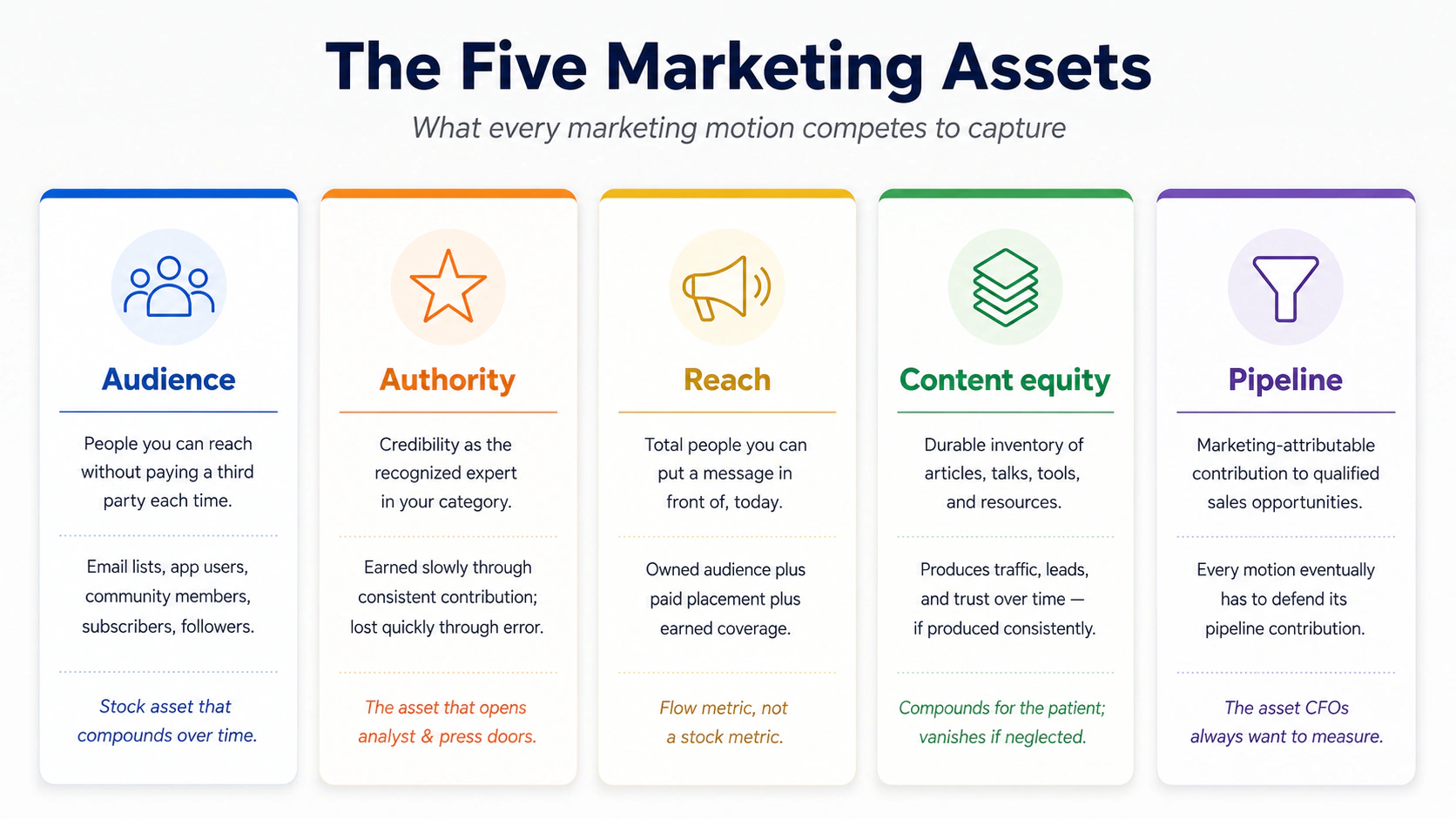
The five marketing assets — what every motion competes to capture.
Audience is the set of people you can reach without paying a third party each time. Email lists, app users, DevRel community members, podcast subscribers, social followers — all are forms of owned audience.
Authority is your credibility as the recognized expert in your category. Authority is earned slowly through consistent contribution, and lost quickly through a single high-profile mistake.
Reach is the total set of people you can put a message in front of, combining owned audience plus paid placement plus earned coverage. Reach is a flow metric; audience is a stock metric.
Content equity is the durable inventory of articles, talks, tools, and resources that produce traffic, leads, or trust over time. Content equity compounds for the patient; for the impatient, it never accumulates.
Pipeline is the marketing-attributable contribution to qualified sales opportunities. Every motion eventually has to defend its pipeline contribution, even motions that primarily build the other four assets — because eventually a CFO will ask.
The strongest motions capture three or more of these assets at once. The weakest motions optimize for one (usually pipeline) at the expense of the others — which produces a short-term win and a long-term collapse.
A note on scope. This catalog focuses primarily on B2B marketing — programs designed to produce qualified sales pipeline for AI-native software and services sold to other businesses. Consumer-facing AI marketing (mobile app stores, paid social acquisition, brand campaigns for consumer apps) follows different rules and is not the primary subject here, though three motions — Performance Marketing, Influencer Partnerships, and Founder Thought Leadership — apply to both contexts.
The maturity spectrum. Each motion is tagged Proven, Emerging, or Speculative based on how widely AI-native companies are running it successfully today.
- Proven motions have many at-scale companies operating on them, with established playbooks and benchmarks.
- Emerging motions are being run by AI-native companies in 2026 but are evolving rapidly with the underlying tooling.
- Speculative motions depend on buyer behaviors or platform dynamics that do not yet exist at scale.
What this page is for
This document serves three purposes.
First, as a chooser. A founder or marketing leader designing a marketing motion can use the Strategic Fit Matrix, the Marketer Diagnostic, and the Motion Summary Table to find the motions that fit their buyer, their stage, and their budget.
Second, as a reference. A marketing team running an existing motion can use the deep sections to audit their own operation against the documented mechanics — comparing their funnel performance, channel mix, and content velocity to the patterns described.
Third, as a sequencing guide. Most successful AI-native companies run a sequence of marketing motions as they scale. The Common Hybrid Motions section maps the most common sequences.
How to choose a motion
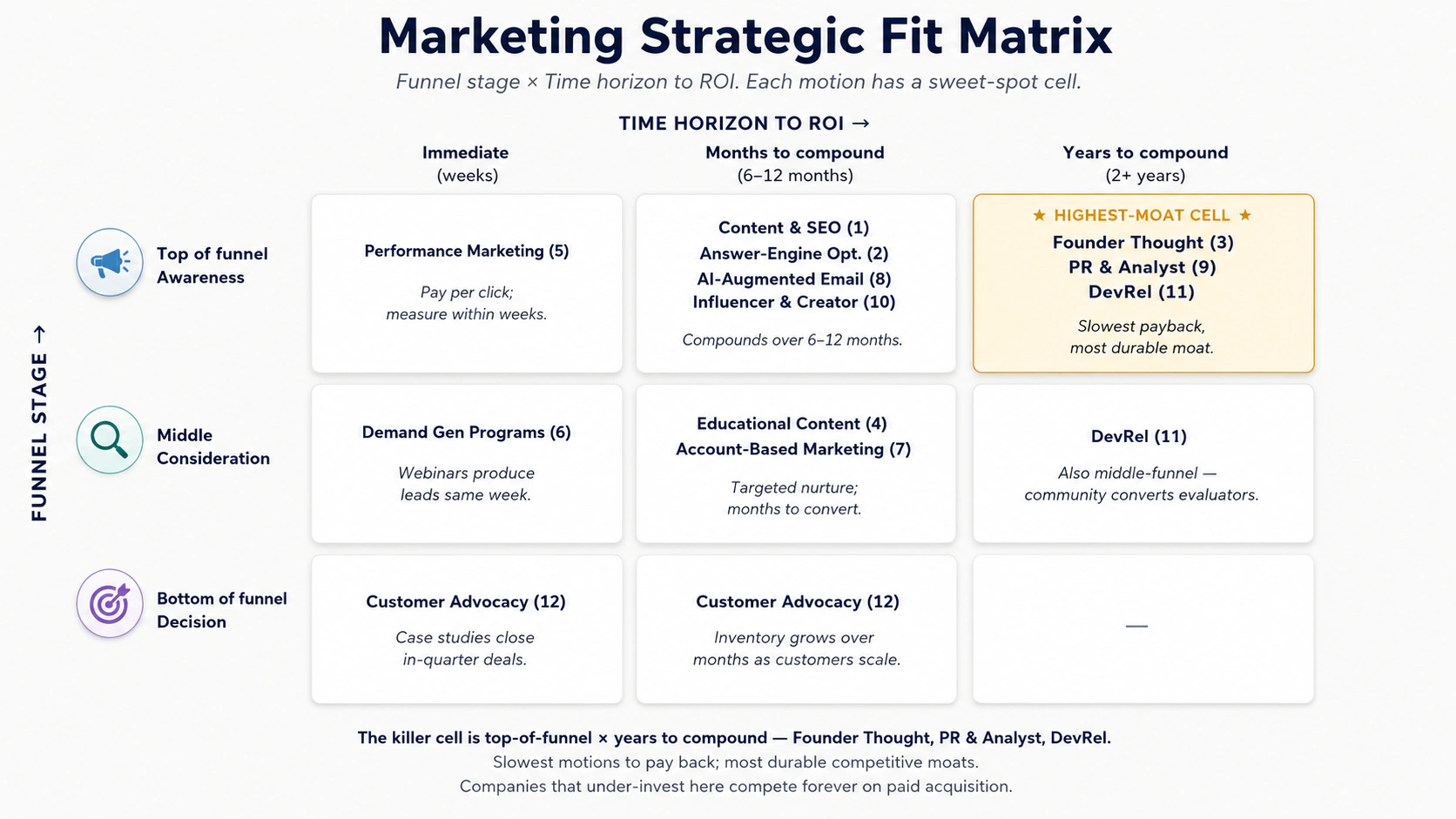
The cleanest predictor of which marketing motion fits is the intersection of funnel stage and time horizon to ROI. The matrix below maps the twelve motions onto those two axes. Each motion has a sweet-spot cell and works (less optimally) in adjacent cells.
| Time → / Funnel ↓ | Immediate (weeks) | Months to compound | Years to compound |
|---|---|---|---|
| Top of funnel (awareness) | Performance Marketing (5) | Content & SEO (1), AEO (2), AI-Email (8), Influencer (10) | Founder Thought (3), PR & Analyst (9), DevRel (11) |
| Middle (consideration) | Demand Gen (6) | Educational Content (4), ABM (7) | DevRel (11) |
| Bottom (decision) | Customer Advocacy (12) | Customer Advocacy (12) | — |
The cell that matters most is top-of-funnel × years to compound — Founder Thought Leadership, PR & Analyst Relations, and DevRel. These are the motions that build the most durable competitive moats, but they also pay back the slowest. Companies that under-invest here will compete forever on paid acquisition and never own a category.
Marketer diagnostic: eight questions
Before picking a motion, score yourself honestly on the eight dimensions below. The motions each row points to are the ones most aligned with that condition. A team that scores High on three or four of these usually narrows quickly to two or three candidate motions.
-
Buyer technical sophistication. How technically literate is your primary buyer? Developer / engineer → DevRel, Content & SEO, AEO. Operator → Educational Content, Demand Gen, ABM. Executive → PR & Analyst, ABM, Customer Advocacy.
-
Category maturity. Is your category well-known, or are you defining it? Defining → Founder Thought Leadership, Content & SEO, PR & Analyst, Educational Content. Mature → Performance Marketing, ABM, Customer Advocacy.
-
Average deal size. <$10K → Content & SEO, AEO, Performance Marketing. $10–100K → AI-Email, Demand Gen, Influencer. $100K+ → ABM, PR & Analyst, Customer Advocacy.
-
Time horizon to ROI. Weeks → Performance Marketing, Demand Gen, Customer Advocacy. Months → Content & SEO, AEO, AI-Email, ABM. Years → Founder Thought Leadership, PR & Analyst, DevRel.
-
Founder availability for content. Will the founder produce regular content (essays, podcasts, videos)? Yes → Founder Thought Leadership, Content & SEO. No → Performance Marketing, Demand Gen, ABM, Influencer.
-
Existing customer base. Do you have customers willing to advocate? Yes → Customer Advocacy, Educational Content. No → Pull and Push motions until you have customers worth featuring.
-
Budget shape. Is your budget heavy on people or heavy on media spend? People-heavy → Content & SEO, DevRel, PR & Analyst. Media-heavy → Performance Marketing, Demand Gen, Influencer.
-
Audience location. Is your buyer reachable through specific channels? Developers (GitHub, Hacker News, X) → DevRel, Content. Executives (LinkedIn, podcasts, conferences) → Founder Thought Leadership, PR & Analyst. Mid-market operators (LinkedIn, search, email) → Performance Marketing, ABM, AI-Email.
The diagnostic does not tell you which motion is correct. It tells you which motions are available to you given your starting position. The matrix above and the deep sections below tell you which of the available motions is sharpest for the buyer you are reaching.
Motion summary table
A one-page reference for all twelve motions.
| # | Motion | Maturity | Best for | Time to ROI | Main moat | Main risk |
|---|---|---|---|---|---|---|
| 1 | Content & SEO Marketing | Proven | Education-heavy categories | Months | Content equity, search authority | Content velocity without distribution |
| 2 | Answer-Engine Optimization | Emerging | Categories where buyers ask AI assistants | Months | AI-search citation rate | Optimizing without content worth citing |
| 3 | Founder Thought Leadership | Proven | New categories needing education | Years | Founder authority + audience | Sporadic posting kills momentum |
| 4 | Educational Content & Certification | Proven | Categories that need buyer-skill development | Months | Curriculum + alumni network | Content production without graduation funnel |
| 5 | Performance Marketing | Proven | Mature categories with clear LTV | Weeks | Channel optimization expertise | Paid acquisition without unit economics |
| 6 | Demand Generation Programs | Proven | Mid-market with measurable funnel | Weeks–months | Nurture sequence + lead scoring | Webinars without follow-through |
| 7 | Account-Based Marketing | Proven | Six-figure-deal targets | Months | Account intelligence + personalization | ABM without sales alignment |
| 8 | AI-Augmented Email & Outreach | Emerging | Broad mid-market reach | Months | AI tooling + deliverability | AI-generated content without distinction |
| 9 | PR & Analyst Relations | Proven | Strategic enterprise categories | Years | Press relationships + analyst placements | Vanity coverage that doesn't move pipeline |
| 10 | Influencer & Creator Partnerships | Proven | Audiences clustered around creators | Months | Creator-of-record relationships | Misalignment with creator's audience |
| 11 | Developer Relations (DevRel) | Proven | Developer-buyer products | Years | Community + ambassadors | DevRel as marketing budget rather than product |
| 12 | Customer Advocacy & Case Studies | Proven | Companies with existing customers | Weeks–months | Reference customers + advocacy ladder | Case studies as one-offs, not a pipeline |
Which motion should I run?
A decision flowchart sequences the most important questions for narrowing your motion choices. (Visual: see marketing_decision_flowchart.png.)
The four key questions are: (1) Is your buyer a developer? (yes → DevRel + Content). (2) Is your category mature with comparable competitors? (no → Founder Thought + PR + Education; yes → Performance + ABM + Advocacy). (3) Do you have customers worth featuring? (yes → start Customer Advocacy now; no → focus on Pull and Push to acquire customers). (4) What is your time horizon for ROI? (weeks → Performance + Demand Gen; years → DevRel + PR + Founder Thought).
Most companies run two or three motions simultaneously. See Common Hybrid Motions near the end of the document for the most common combinations.
Buyer awareness and timing
Every marketing motion has a window in the buyer's awareness journey. A buyer who does not yet know they have a problem responds to marketing differently than a buyer comparing three vendors with quotes in hand. Eugene Schwartz's 1966 Breakthrough Advertising defined the foundational five stages of buyer awareness; the three-stage curve below is a B2B-AI adaptation of his framework, consolidated to three usable stages for product marketing teams in 2026.⁴
Three stages define the Awareness Curve:
Stage 1 — Unaware / Problem-Aware. The buyer either does not know they have the problem your product solves, or knows but has not actively begun looking for solutions. Marketing's job at this stage is education and frame-setting: helping the buyer name the problem, see why it matters, and learn what categories of solution exist. Best motions: Founder Thought Leadership, Content & SEO, PR & Analyst, Educational Content, DevRel.
Stage 2 — Solution-Aware. The buyer is actively researching the category. They are reading articles, comparing approaches, listening to podcasts, attending webinars. They have not yet shortlisted vendors. Marketing's job is to make sure your product appears repeatedly and credibly across the channels they search. Best motions: Content & SEO, AEO, Educational Content, Demand Gen, Influencer Partnerships.
Stage 3 — Vendor-Aware. The buyer has shortlisted vendors and is comparing them. They are reading case studies, requesting demos, checking references, evaluating pricing. Marketing's job is to remove friction in the comparison and to provide the social proof and technical depth that win the bake-off. Best motions: Customer Advocacy & Case Studies, ABM, PR & Analyst (specifically Gartner/Forrester-style placements), Demand Gen (for the late-stage technical content).
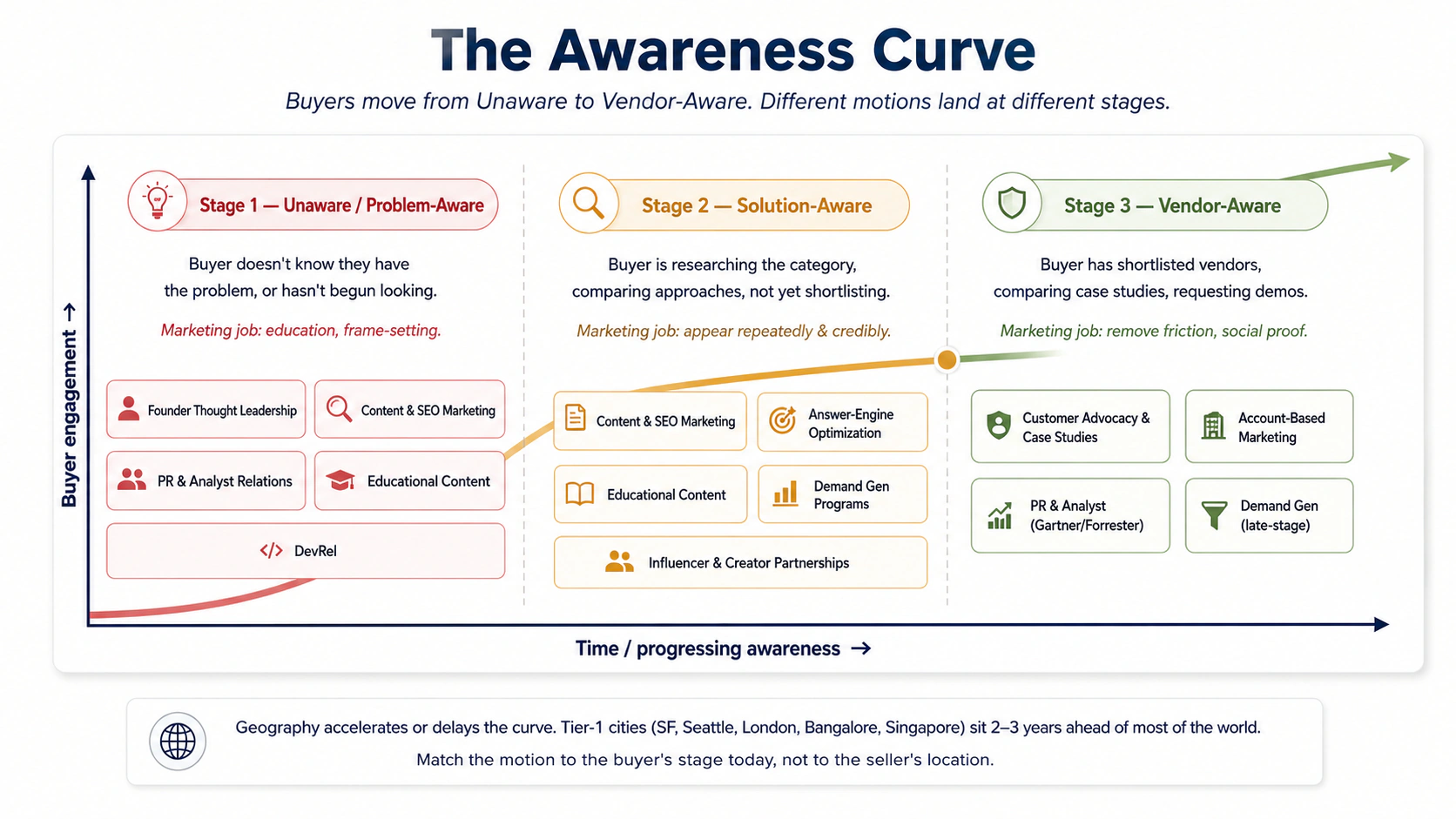
Geography accelerates or delays the curve. AI-native categories in San Francisco, Seattle, Boston, New York, London, Toronto, Berlin, Bangalore, and Singapore tend to have buyers two to three years ahead of the same categories in most other markets — buyers in those ecosystems have already evaluated AI vendors, written internal AI procurement playbooks, and developed sophisticated comparative criteria. A buyer in those markets is typically Stage 2 or Stage 3 from the moment they hear about your category. Most of the rest of the world — including most enterprise buyers in continental Europe, Latin America, the Middle East, Africa, and Southeast Asia — is solidly in Stage 1, transitioning to Stage 2.
The implication for global B2B marketing is that the same content does not work in every market. A Stage 3 vendor-comparison page (with feature-by-feature tables and pricing-tier breakdowns) is exactly what the San Francisco buyer wants and exactly what the São Paulo buyer is not yet ready to evaluate. A Stage 1 educational article (defining the category, explaining why it matters, naming the problem) is exactly what the São Paulo buyer needs and exactly what the San Francisco buyer will scroll past as too basic. Marketing programs calibrated for one stage and targeted across markets land badly on the buyers in the other stage.
The cost of stage-mismatched marketing compounds. A motion calibrated for Stage 3 buyers (heavy on case studies, comparison content, and ROI calculators) lands on Stage 1 buyers as confusing — they don't yet have the context to interpret the comparison, and they bounce. A motion calibrated for Stage 1 buyers (heavy on category education and problem-naming) lands on Stage 3 buyers as too basic — they are already past the educational stage, and they read the content as a signal that the vendor is unsophisticated. The fix for global B2B marketers is to maintain stage-appropriate content libraries and route traffic by market: Stage 1 educational paths for emerging markets, Stage 3 comparison paths for established AI markets, with localization that goes beyond translation to address what the local buyer is actually researching.
Maturity legend
- Proven. The motion has many AI-native (and pre-AI) companies operating it at scale today, with established playbooks and benchmarks.
- Emerging. The motion is being run by AI-native companies in 2026 but is evolving rapidly — the canonical playbook has not yet stabilized.
- Speculative. The motion depends on buyer behaviors or platform dynamics that do not yet exist at scale.
A. Pull motions
The audience initiates discovery. The marketer's job is to be findable, useful, and credible at the moment the buyer searches. These motions excel at compound returns and CAC efficiency but require patience — most pull motions take six to twelve months before they produce meaningful pipeline.
Motion 1 — Content & SEO Marketing
Maturity: Proven. Beginner difficulty: Easy.
In Plain English. Imagine building a public library with a sign on the front door. You stock the library with books — articles, guides, comparison pages, tutorials — that answer the questions your buyers are asking. Search engines act like the road signs that direct travelers to your library. When a buyer searches a relevant question, your library appears in their results, they walk in, they find what they need, and over time they come to associate your brand with the answers. The library compounds: every book you add increases the chance that the next traveler finds you.
This is the oldest pull motion and still the most reliable. AI-native companies producing systematic content over twelve to twenty-four months consistently report content as their largest source of inbound pipeline.¹
Best as a founding motion for almost every B2B AI-native company. Slow to start; rarely the only motion at scale, but typically the foundation that other motions build on.
Core idea. Produce evergreen content that answers buyer questions, ranks in search, and compounds in value over time.
When to use it. Always, for any B2B AI-native company. The category-defining article, the comparison page, the "what is X" guide are mechanics every successful marketing program eventually produces.
Mechanism. Content marketing works because B2B buyers do most of their research before contacting any vendor. Marcus Sheridan documented the discipline a decade ago in They Ask, You Answer; industry surveys including HubSpot's annual State of Marketing reports and the Content Marketing Institute's benchmark studies continue to confirm the underlying finding that buyers complete the majority of their evaluation through self-directed research before engaging sales.¹ The content layer is where that research happens. A company that owns the high-intent search results in its category gets a constant stream of pre-qualified buyers who arrive already educated about the problem.
The economics are what make the motion durable. A well-produced 1,500-word article costs roughly $300–$1,500 to produce in 2026 (faster and cheaper with AI assistance, more expensive when commissioned from credible domain experts). A ranking article in a high-intent category produces qualified leads for years — the typical compounding pattern in B2B SaaS sees content marketing CACs come in roughly an order of magnitude below paid acquisition CACs for the same buyer, though specific figures vary widely by category and channel. Joe Pulizzi's Content Inc. documented the broader pattern of building entire businesses on owned content as the primary acquisition channel.⁵ The math improves every month the article continues ranking.
The execution requires three disciplines. Keyword research maps your buyer's actual questions, separating high-intent commercial queries (the buyer is comparing vendors) from informational queries (the buyer is learning the category). Production depth matters more than production volume in 2026 — shallow content is being commoditized by AI, and average ranking content is being buried by the volume of average AI-generated competition. The articles that win are those with original research, original data, customer quotes, or arguments competitors cannot easily replicate. Distribution gets the content seen beyond pure search — every published article needs a distribution checklist (LinkedIn post, X thread, email blast, partner inclusion, podcast mention) executed deliberately. Companies that produce high-quality content but neglect distribution publish into a void.
The constraint is patience. Search rankings take six to twelve months to compound; the company has to fund consistent content production through a long period of weak-looking metrics before the trend turns. Founders who shut down the program at month four — when nothing seems to be happening — are the most common failure pattern in this motion.
Fictional walk-through. Imagine PromptForge, an AI tool for prompt engineering. The team commits to publishing two long-form articles per week for eighteen months — comparison guides, tutorials, case studies. By month nine, "best AI prompt engineering tools" returns PromptForge as the top result. By month eighteen, the company gets two thousand qualified leads per month from search, with a CAC under $50 — orders of magnitude below paid acquisition.
Example. Confirmed examples: HubSpot built a multi-billion-dollar company on a content-led inbound playbook. In AI-native, the playbook is being reproduced — Anthropic's blog, OpenAI's research posts, and the long tail of AI-native company blogs all anchor inbound funnels.
Primary risk. Content velocity without distribution. The team publishes consistently but the content does not reach anyone. Mitigation: invest in distribution at roughly the same intensity as production. For every article published, build a distribution checklist (LinkedIn post, email blast, X thread, partner inclusion, search optimization) and execute it.
Secondary risk. AI-generated content commoditization. As AI lowers the cost of producing average content to near zero, average content stops working. The bar rises. Mitigation: invest in original research, original data, and original arguments — the things AI cannot easily generate. Repurpose customer interviews, internal data analyses, and founder hot takes into content with a defensible point of view.
First move. Pick one search query your buyer will type next month — the highest-intent, highest-frequency query in your category. Write the best article on the internet for that query. Distribute it ruthlessly. Repeat next week with the second-highest query.
Motion 2 — Answer-Engine Optimization (AEO)
Maturity: Emerging. Beginner difficulty: Medium.
In Plain English. If SEO was "how do I show up in Google?", Answer-Engine Optimization is "how do I show up in ChatGPT, Claude, Perplexity, and Google's AI Overviews?" When a buyer asks an AI assistant "what's the best AI tool for legal research?", you want your product cited by name in the answer. AEO is the practice of structuring your content, your brand presence, and your data footprint so that AI assistants treat you as a credible source — and cite you accordingly.
This motion did not exist in coherent form before 2024. The shift from search-result-clicks to AI-cited-answers is the largest change in B2B buyer behavior in a decade, and the playbook is still being written.
Best as a complement to Content & SEO Marketing — most of AEO is downstream of having strong content. Emerging as a stand-alone discipline; teams in 2026 are running pilots rather than scaled programs.
Core idea. Make AI assistants want to cite your brand when they answer questions in your category.
When to use it. When the target buyer is using AI assistants to research before making purchasing decisions. By 2026, that is most B2B technical buyers and a growing share of operator buyers. AEO is most valuable for AI-native companies because their buyers are already AI-fluent and use AI assistants natively.
Mechanism. AEO works through three vectors. Citation worthiness: AI assistants cite sources they treat as credible — sources that are widely linked-to, well-structured, contain unique data, or carry domain authority. The signals overlap with traditional SEO authority but diverge meaningfully — AI assistants weight original research and quotable claims more heavily than backlink count alone. Brand mention frequency: AI assistants are influenced by training data composition. Brands that appear frequently in news, reviews, podcasts, and analyst reports — especially in named contexts ("Anthropic's Claude" rather than "an AI assistant") — get cited more often. This makes earned media (Motion 9) and creator partnerships (Motion 10) into upstream inputs to AEO. Schema and structure: AI assistants prefer to cite content with clean structure, clear claims, and verifiable facts. Pages that read well to AI parsers — clear hierarchy, named entities, structured FAQs, citations to original sources — get cited more often than pages with the same content in less parseable form.
The constraint is measurement. AEO does not yet have the equivalent of Google Search Console — there is no clean way to track how often your brand is cited in AI answers, or which queries trigger your citations. Companies running AEO in 2026 work from proxy metrics: brand-search lifts (the user heard about you from Claude, then Googled you), self-reported attribution ("how did you find us?"), and dedicated AEO measurement tools (Profound, Athena, and a small handful of competitors building this category from scratch). Rand Fishkin's research at SparkToro is a leading early voice on the discipline.²
The strategic implication is that AEO is downstream of authority. A brand with no original research, no analyst coverage, no podcast presence, and no creator mentions has nothing for AI assistants to cite — and no amount of schema optimization fixes that. Teams treating AEO as a pure technical-SEO discipline (markup, structured data, page hierarchy) without the upstream investment in citable content will find optimization mechanics produce limited returns. The teams winning AEO are the ones investing in original research, named data points, and analyst-coverage cycles — and treating the optimization work as the last mile rather than the whole motion.
Fictional walk-through. Imagine LegalAgent, an AI legal-research tool. The team systematically updates its docs, blog posts, and product pages with structured FAQs, clear "what is" definitions, and citations to original legal sources. Six months in, the team starts seeing prospect signups who answer "How did you find us?" with "I asked Claude what tools to use for M&A diligence and yours came up." The traffic source is invisible to Google Analytics — it is conversational, not click-through — but it is real and growing.
Example. Emerging analogues: Companies like Profound and Athena are building AEO measurement tools. Most large content-driven SaaS companies are running AEO experiments in 2026; few have published systematic playbooks. Rand Fishkin's research at SparkToro is a leading early voice on the discipline.²
Primary risk. Optimizing without content worth citing. AEO is downstream of authority — if your brand has nothing AI assistants would cite, no amount of optimization fixes that. Mitigation: invest in original research, original data, and original perspectives before investing in AEO mechanics.
First move. Ask Claude, ChatGPT, and Perplexity each ten questions a buyer in your category would ask. Note where you appear, where competitors appear, and where the AI cites no specific brand. The third category is your opportunity.
Motion 3 — Founder Thought Leadership
Maturity: Proven. Beginner difficulty: Medium.
In Plain English. Imagine a town where the most respected expert is a single person — and that person also happens to run a business that solves the problem they speak about. The whole town knows them. When the town needs the problem solved, they hire that expert's business by default. Founder Thought Leadership is the deliberate cultivation of this dynamic. The founder writes essays, speaks on podcasts, posts daily on LinkedIn or X, and becomes the recognized voice in the category. The audience that follows the founder becomes the audience for the product.
In 2026, this is one of the most cost-efficient marketing motions available — but it requires a founder who is both willing and able to produce content consistently for years.
Best as a founding motion for any new category. Often combined with Content & SEO Marketing (founder essays become the SEO backbone) and PR (founder authority opens analyst doors).
Core idea. Concentrate the company's earned authority in one person — the founder — and use that person's publishing cadence to build a durable audience.
When to use it. When the founder is a credible domain expert (or can become one), when the category is new enough that someone has to define it, and when the founder is willing to commit to producing content for at least 24 months before judging results.
Mechanism. Founder thought leadership works because B2B audiences trust people more than brands. Founder accounts typically outperform company accounts on the same content — the engagement gap varies by industry and platform but is consistently directional, with founder posts producing meaningfully higher reach and engagement than identical content posted from the company account. Over time, the founder's audience becomes a captive marketing channel that costs nothing per impression — and that competitors cannot replicate, because they do not have your founder.
The execution requires three disciplines: a consistent publishing cadence (typically twice weekly minimum on the primary platform — LinkedIn for B2B operators, X for technical audiences), a defensible point of view (controversial enough to provoke discussion, true enough to defend), and a willingness to engage publicly (responding to comments, hosting podcasts, doing live conversations). Founders who outsource the writing or the engagement produce content that reads as inauthentic and that fails to build durable audience.
The constraint is founder time. A serious thought-leadership program consumes five to ten hours per week from the founder. Founders who try to build it in spare moments produce inconsistent content that builds little audience.
Fictional walk-through. Imagine DataSpace, a founder-led AI analytics company. The founder, Maria, commits to publishing one essay per week on LinkedIn — sharp opinions about the analytics market, customer war stories, predictions about where the category is going. After eighteen months, her LinkedIn following is 80,000. After thirty months, it is 200,000. When DataSpace launches a new product, the launch post drives 10,000 demo requests in 48 hours — for a CAC of effectively zero.
Example. Confirmed examples: Mathilde Collin (Front), Andrew Wilkinson (Tiny), Lenny Rachitsky (Lenny's Newsletter), David Cancel (Drift), Sahil Lavingia (Gumroad). In AI-native, founders like Sarah Tavel (Benchmark, on AI investing) and several Anthropic and OpenAI researchers have built personal audiences that anchor their companies' (or funds') awareness.
Primary risk. Sporadic posting kills momentum. The founder posts three times in week one, twice in week two, once in week three, and then stops for a month when the company hits a fundraising sprint. Audience growth requires consistency, and inconsistency is worse than not starting. Mitigation: commit to a minimum cadence (one post per week on LinkedIn, one essay per month) and treat it as a non-negotiable. Outsource scheduling and editing if needed, but never outsource the content itself.
Secondary risk. Founder dependency on the company. If the founder leaves, the audience leaves with them. Mitigation: build the company brand alongside the founder brand. The founder's account references the company; the company's account amplifies the founder. Over time, the brand absorbs some of the founder's authority.
First move. Pick one platform (LinkedIn for B2B operators, X for technical audiences). Commit to one post per week for sixty weeks. The first six months will feel like nothing is happening; the second six months will compound.
Motion 4 — Educational Content & Certification
Maturity: Proven. Beginner difficulty: Medium.
In Plain English. Imagine running a university where graduates are also customers. You build courses, tutorials, and certifications that teach people how to do their jobs — using your category, your tooling, and your worldview as the foundation. People take your courses to learn the skill. Many of them become customers because your product is what they were taught to use. The most enthusiastic become teachers themselves and bring the next cohort.
HubSpot's Inbound Marketing certification, Salesforce's Trailhead, and Stripe's Atlas are all instances of this motion. The educational content becomes the company's largest top-of-funnel channel.
Best as a mid-stage motion once the company has product-market fit and resources to invest in curriculum. Hard to start before there is a defined skill to teach. Often layered on top of Content & SEO Marketing (educational content draws search traffic).
Core idea. Build the credentialing system for your category — the place where practitioners learn the skill — and use it as a lifelong customer acquisition channel.
When to use it. When the category requires practitioner skill that buyers will need to develop, when the company has resources to invest in curriculum design (a serious certification program is a 6–12 month build), and when the addressable practitioner population is large enough to justify the investment (typically 100,000+ active practitioners).
Mechanism. Educational content works through three compounding effects. Top-of-funnel acquisition: people search for "how to do X" and find your course; the course produces a constant stream of practitioners learning the skill in your worldview. Trust and dependency: graduates use your terminology, frameworks, and tooling preferences for the rest of their careers — which means they default to your product when they reach hiring authority. Network effects: graduates teach next-cohort students, present at meetups, write blog posts, and recommend the certification to peers — for free, because they are emotionally invested in the credential they earned.
The economics work because curriculum is reusable. The first cohort costs the most to produce — typically $50K–$300K for a serious certification program covering content development, video production, assessment design, and platform infrastructure. Subsequent cohorts run at near-zero marginal cost. Programs that price the certification at $200–$2,000 per learner can become meaningful revenue centers in their own right (HubSpot Academy, Salesforce Trailhead, and Snowflake University all generate direct revenue beyond their marketing-funnel value), and even free certifications produce compounding marketing ROI as the alumni base grows year over year.
The constraint is curriculum quality. Educational content has to be genuinely useful or it produces no graduates worth having — and worse, it produces graduates who advocate against your product because the certification did not deliver real skill development. Companies that ship thin certifications get a temporary marketing bump and a long-term reputation hit; companies that invest in genuinely high-quality curriculum get an alumni base that compounds the brand for a decade. The right comparison is to academic credentials, not to whitepapers — the bar is "would a hiring manager actually weigh this on a resume?"
Fictional walk-through. Imagine PromptCert, an AI-native company offering an AI Engineering Certification. The team builds a free 12-hour curriculum covering prompt engineering, evaluation design, and agent architecture, with a $200 paid certification exam. In year one, 50,000 practitioners complete the free curriculum and 8,000 pay for certification. In year two, certified practitioners list "PromptCert Certified" on their LinkedIn profiles, advocates teach unofficial study groups, and PromptCert becomes the de facto credential for AI engineering hires. The certification stops being marketing and becomes infrastructure.
Example. Confirmed examples: HubSpot Academy, Salesforce Trailhead, Google Skillshop, Snowflake University. In AI-native: DeepLearning.AI, the Anthropic Academy (in development as of 2026), and several Cohere/Mistral practitioner programs.
Primary risk. Content production without graduation funnel. The company builds courses, but the courses do not connect to the product or the sales motion — graduates leave without becoming customers. Mitigation: design the curriculum with the product as part of the practical exercises. Graduates should be using the product (in free tier or trial) by the end of the course.
First move. Pick one skill that practitioners in your category genuinely need to learn. Build the best free course on that skill. The first cohort is the proof that the curriculum is worth building further.
B. Push motions
The marketer initiates the relationship. The marketer's job is precise targeting, message-channel fit, and conversion-rate discipline. These motions excel at predictability and immediate ROI but require ongoing budget — they do not compound the way pull motions do.
Motion 5 — Performance Marketing
Maturity: Proven. Beginner difficulty: Medium.
In Plain English. Imagine renting attention by the click. Performance marketing is paid advertising on Google, LinkedIn, Meta, TikTok, YouTube, and the emerging AI-search ad platforms. You bid for placement, the platform shows your ad to a targeted slice of its users, and you pay per impression or per click. The motion works when your unit economics are clear — when you know how much a click is worth to you and you can bid accordingly.
In 2026, AI is dramatically reshaping performance marketing. Generative ad creative is collapsing the cost of producing ad variants. AI-augmented bid optimization is improving spend efficiency. And AI-driven targeting is making LinkedIn, Meta, and Google's audience tools more precise.
Best as a primary motion for mature categories with clear LTV and short sales cycles. Best as a complement to other motions in newer categories. Rarely the only motion at scale.
Core idea. Buy targeted attention at scale, with disciplined measurement of cost per acquired customer relative to lifetime value.
When to use it. When the category is mature enough that buyers are searching with high intent, when the unit economics are clear (you know what an acquired customer is worth), and when the team has the analytics maturity to measure attribution accurately.
Mechanism. Performance marketing works because the platforms (Google, LinkedIn, Meta, TikTok) have the world's most valuable targeting data. Google knows what people are actively searching for. LinkedIn knows where they work, what they do, and how senior they are. Meta knows their interests, behaviors, and life events. The advertiser rents that targeting and converts the targeted attention into traffic, leads, or sales. The unit economics depend on three variables: bid efficiency (cost per click or per impression), conversion rate (what fraction of clicks become leads or customers), and lifetime value.
The math has to clear three thresholds for the motion to scale safely. LTV/CAC > 3 — the ratio of lifetime customer value to fully-loaded acquisition cost — is the standard B2B SaaS benchmark; below 3, the program loses money once payback periods, retention, and discount rates are factored in. CAC payback under 18 months keeps cash from being trapped in pre-revenue cohorts. Cohort LTV empirically validated — not modeled, not projected — before scaling spend. The most common failure pattern in performance marketing is scaling spend on optimistic LTV projections that the cohort does not eventually deliver.
The execution disciplines are creative iteration, attribution modeling, and channel diversification. Creative iteration in 2026 is dramatically easier than it was — generative AI has collapsed the cost of producing ad variants by 90%+ for most formats, and teams that have adapted run dozens of creative variants per channel rather than the handful that were feasible before. The constraint has shifted from production capacity to creative judgment: knowing which variants are worth testing. Attribution modeling matters because the channels are interdependent — a buyer often sees a Performance Marketing ad, then encounters the brand in PR, then signs up after a content piece, and single-touch attribution credits whichever channel happened to be last. Channel diversification means at least three channels with comparable unit economics; companies dependent on a single channel are exposed to platform policy changes, algorithm updates, and CPC inflation. Paid acquisition costs in B2B SaaS have risen meaningfully over the last five years across most channels and categories; companies that build a paid-only acquisition strategy will face that compounding margin pressure indefinitely.
Fictional walk-through. Imagine SyncFlow, a $50/month AI productivity tool. The team runs Google Ads on terms like "AI scheduling assistant" and "calendar AI." They pay $4 per click; 2% of clicks convert to free-trial signups; 15% of free trials convert to paid. CAC is $130 per customer, against a $600 LTV. The math works, the team scales spend from $10K/month to $200K/month over twelve months. By month eighteen, paid CAC has crept to $180 (more competitors bidding) and the team begins building Content & SEO to lower their blended CAC.
Example. Confirmed pattern: Almost every B2B SaaS company runs Performance Marketing. In AI-native, Performance Marketing is most visible for self-serve products (Cursor, Linear, Notion AI, Perplexity Pro) and for category leaders (OpenAI's brand campaigns, Microsoft Copilot). Most enterprise AI vendors run smaller performance programs to support specific demand-gen campaigns.
Primary risk. Paid acquisition without unit economics. The team scales spend without confirming that acquired customers actually generate the LTV the model assumed. Six months later, the LTV calculations were optimistic and the unit economics are negative. Mitigation: hold spend back until cohort LTV is empirically confirmed. Scale only when the math is verified, not projected.
Secondary risk. Channel concentration. Companies dependent on a single channel (Google, LinkedIn) are exposed to platform policy changes, algorithm updates, and CPC inflation. Mitigation: diversify across at least three channels with comparable unit economics.
First move. Run a $5,000 test on the channel where your buyer is most likely to be (Google for high-intent search; LinkedIn for B2B targeting). Measure CAC and conversion rates rigorously. Scale only if the math works.
Motion 6 — Demand Generation Programs
Maturity: Proven. Beginner difficulty: Medium.
In Plain English. Imagine throwing a party for your prospective customers — except the price of admission is their email address. Demand Generation programs are webinars, virtual conferences, white papers, eBooks, gated reports, and other "give me your contact info to access this" content. The exchange is straightforward: useful content for a contact, then a nurture sequence that warms the contact toward a sales conversation.
This motion has been the workhorse of B2B SaaS marketing for fifteen years. The mechanics are well-established and the playbook is mature. AI is changing the production economics — generating gated content is dramatically cheaper than it was — but the underlying motion is unchanged.
Best as a primary motion for mid-market with measurable funnels. Almost always combined with Performance Marketing (paid promotion of the gated asset) and ABM (using the lead pool as input).
Core idea. Trade useful content for contact information, then convert contacts to pipeline through systematic nurture.
When to use it. When the buyer's purchase cycle is multi-month (so nurture has time to work), when the team has marketing automation infrastructure (HubSpot, Marketo, Pardot, or modern AI-native equivalents), and when the team is willing to invest in producing high-quality gated assets.
Mechanism. Demand gen works through a three-stage funnel built on what Seth Godin originally named the permission dynamic — the buyer voluntarily opts in by trading contact information for content, and that opt-in license becomes the basis for everything that follows.⁶ Acquisition: paid ads or organic distribution drive traffic to a landing page where users exchange contact info for content. Nurture: the contact enters a sequence of emails, retargeting ads, and personalized content designed to move them through the awareness curve. Sales handoff: when the contact reaches a behavioral threshold (multiple downloads, repeated visits, calendar request), they are routed to sales as a qualified lead.
The funnel economics depend on conversion rates at each stage. Typical mid-market B2B demand-gen programs see 1–5% of paid traffic convert to gated-content downloads, 5–15% of those leads engage meaningfully with nurture sequences, and 5–10% of engaged leads convert to sales-qualified opportunities. Multiplied through, the overall paid-traffic-to-pipeline conversion rate is typically 0.05–0.5% — meaning the paid promotion of a gated asset has to produce thousands of impressions to generate one qualified opportunity. Programs with disciplined lead scoring and tight nurture sequences operate at the higher end of these ranges; programs without that discipline operate at the lower end and burn budget without meaningful return.
The other constraint is content quality and freshness. The gated asset has to be genuinely useful, or the lead is angry rather than warmed. And opt-in permission decays — a lead who downloaded your white paper nine months ago and has not engaged since is no longer a warm lead, even if they remain on your list. Successful programs treat leads as a perishable asset: re-engaging the active list quarterly with fresh content, suppressing the inactive segment to protect deliverability, and producing one or two flagship assets per quarter rather than many shallow ones. Programs that treat the email list as a durable inventory (sending the same nurture sequence to leads from two years ago) see deliverability collapse, engagement decline, and pipeline contribution erode.
Fictional walk-through. Imagine FinanceAI, an AI tool for FP&A teams. The team produces a 40-page report — "The State of FP&A Automation in 2026" — gated behind an email form. They promote it through Performance Marketing, partner emails, and PR. In six weeks, they capture 8,000 contacts. Of those, 1,200 enter a 12-week nurture sequence. Of those, 80 book sales meetings. Of those, 25 close as customers averaging $30K ACV. The program produces $750K in pipeline at a CAC of about $1,200.
Example. Confirmed examples: Gartner's annual reports, HubSpot's State of Marketing report, Salesforce's State of Sales report. In AI-native: Anthropic's Economic Index reports, OpenAI's research publications, the long tail of company-published industry reports.
Primary risk. Webinars without follow-through. The team runs the webinar, captures the leads, and never follows up systematically. The leads cool, never become pipeline. Mitigation: design the nurture sequence before producing the asset. The asset is the start of the funnel; the nurture is the funnel.
First move. Identify the highest-stakes question your target buyer has (typically about category benchmarks, ROI, or implementation). Produce the most thorough answer to that question as a 30-page report. Gate it; promote it; nurture the leads.
Motion 7 — Account-Based Marketing (ABM)
Maturity: Proven. Beginner difficulty: Medium.
In Plain English. Imagine marketing as targeted hunting rather than broad fishing. Instead of casting a wide net, you pick fifty to two hundred specific companies you most want as customers. Then you personalize every piece of marketing to each one — custom landing pages with their logo, ads that mention their industry, direct mail with their CEO's name, podcast sponsorships in shows they listen to. The goal is to be impossible to ignore, in the right way, for a tightly defined target list.
ABM is the marketing motion most aligned with Enterprise Field Sales (Sales Catalog Motion 7). Marketing and sales work the same target list together — marketing creates awareness and warmth; sales closes.³
Best as a primary motion for companies targeting six-figure-plus deals with limited target accounts. Always combined with Enterprise Field Sales — ABM without sales alignment is wasted.
Core idea. Concentrate marketing spend and personalization on a finite list of named accounts, in tight coordination with sales.
When to use it. When the average deal size is large enough to justify per-account personalization (typically $100K+ ACV), when the target buyer universe is small (typically under 1,000 named accounts), and when the team has the marketing-sales coordination discipline to execute against named accounts.
Mechanism. ABM works through three coordinated tracks. Awareness: each target account sees branded ads (LinkedIn, IP-targeted display, podcast) consistently for months before any sales conversation. Personalization: when sales engages, the buyer has already encountered the brand, the messaging fits their specific industry/use case, and the marketing assets sales sends are pre-customized for the account. Joint orchestration: marketing and sales meet weekly on the named accounts, share intelligence, and coordinate touches.
The constraint is sales-marketing alignment. ABM without aligned sales execution is just expensive marketing. Companies running ABM well have a single shared list, weekly account reviews, and tight feedback loops; companies running it poorly have marketing personalizing for accounts sales is not actively pursuing.
Fictional walk-through. Imagine ClaimsAI, an AI tool for insurance carriers. The marketing team and sales team agree on 75 target carriers. Marketing spends $300K over six months running carrier-specific LinkedIn ads, sending direct mail to executive teams, sponsoring industry podcasts, and producing custom landing pages with carrier-specific case studies. Sales runs ABM-aligned outbound. After nine months, 22 of the 75 carriers have engaged with sales; 8 are in active evaluation; 3 close at average ACV of $850K. The program produces $2.5M in ARR at a CAC of about $100K — high in absolute terms but excellent for the deal size.
Example. Confirmed examples: The ABM playbook is documented in books by Sangram Vajre and others.³ In AI-native: most enterprise AI vendors (Glean, Harvey, Sierra, Writer) run ABM motions for their largest target accounts.
Primary risk. ABM without sales alignment. Marketing personalizes for 200 accounts; sales is pursuing 50; the other 150 are receiving expensive ad campaigns with no follow-up. Mitigation: the named-account list is shared and reviewed weekly. If sales is not pursuing the account, marketing pulls the spend.
Secondary risk. Personalization theater. The team produces "personalized" landing pages that just swap in the account's logo on a generic template. Buyers notice; the personalization signals laziness. Mitigation: invest in genuine personalization — custom case studies, account-specific use-case writing, executive-name direct mail. If you cannot resource real personalization, run fewer accounts.
First move. Identify the 25 accounts you most want as customers. Brief sales on the list. Run a six-month coordinated awareness campaign with marketing and sales touches mapped together.
Motion 8 — AI-Augmented Email & Outreach
Maturity: Emerging. Beginner difficulty: Medium.
In Plain English. Imagine running a library where every subscriber gets a slightly different newsletter — written for them specifically, based on what they've read before, what they care about, and where they are in the buying cycle. AI-Augmented Email & Outreach uses AI agents to draft, personalize, and time outbound communications at scale. Newsletters become personalized. Drip campaigns become adaptive. Cold outreach becomes hyper-targeted. Work that historically required armies of email marketers is now done by small teams with AI augmentation.
This is the marketing-side cousin of Sales Catalog's AI-Augmented Outbound (Motion 6). Both use AI to scale personalized communication; the marketing version targets attention and engagement, the sales version targets meetings.
Best as a complement to most other motions. Rarely a stand-alone motion; almost always layered on top of Content & SEO, Demand Gen, ABM, or Performance Marketing.
Core idea. Use AI agents to personalize and scale email, newsletters, and digital outreach beyond what human marketing teams can produce.
When to use it. When the team has a meaningful email list (10,000+ contacts) or an active outbound program, when the team has the marketing-operations maturity to instrument and tune the AI's prompts and segmentation, and when the brand can survive the deliverability and quality risks of high-volume AI-generated communication.
Mechanism. AI-augmented email works because the limiting factor in traditional email marketing was always the trade-off between personalization and scale. Humans could write deeply personalized emails to dozens of contacts per day; AI agents can write personalized emails to thousands. The constraint shifts from production volume to distinctiveness — when AI is generating millions of personalized emails across the industry simultaneously, the bar for what counts as "valuable" email rises sharply. Recipients trained on AI-generated outreach learn to recognize and ignore it; the channel decays for senders who don't compensate for the rising signal-detection ability.
The execution requires three disciplines that did not exist before AI augmentation. Prompt design — the AI's draft quality is bounded by the prompt; teams that invest in prompt engineering as a marketing-operations function (testing, version-controlling, and refining the prompts that drive the agents) produce dramatically better output than teams treating AI as a black-box "generate this" function. Segmentation depth — AI personalization is most effective on well-defined segments; "personalize this email for everyone" produces generic-feeling output, while "personalize this email for fintech VPs of engineering at companies with 200–500 employees who downloaded our last white paper" produces tight, contextual messaging. Human-in-the-loop quality control — for higher-stakes communications (ABM emails to named-account executives, customer-marketing outreach to reference accounts), having a human review and inject point-of-view, opinion, or personal context before send is what separates AI-augmented from AI-replaced.
The other constraint is deliverability infrastructure. High-volume AI-augmented email can trigger ESP penalties, spam classification, and domain reputation damage that takes months to repair. Teams scaling AI-augmented email need proper authentication (SPF, DKIM, DMARC), list hygiene (regular suppression of inactive contacts), and segmented sender domains (so a deliverability problem in one program does not poison the company's whole email infrastructure). Skipping deliverability work to "scale faster" is the most common reason AI-augmented email programs collapse in their second year.
Fictional walk-through. Imagine GrowthCRM, a B2B sales-tools company with a 50,000-contact email list. The team uses AI agents to generate weekly newsletter content tailored to seven different buyer segments — not just subject-line personalization, but content-personalization. Open rates climb from 18% to 31%; click rates from 1.4% to 3.9%. The newsletter becomes the company's largest single source of pipeline, producing 30% of qualified inbound.
Example. Emerging analogues: Companies like Lavender, Smartlead, Hyperbound, and a long tail of AI-native sales-and-marketing tools are productizing AI-augmented email. Most AI-native vendors with substantial email lists run some form of AI augmentation in 2026.
Primary risk. AI-generated content without distinction. Every company is using AI to draft email; recipients learn to recognize and ignore AI-generated outreach; the channel decays. Mitigation: use AI for research and first-draft generation, but have humans inject point-of-view, opinion, and personal context. The AI does the work; the human adds the spark.
Secondary risk. Deliverability collapse. High-volume AI-augmented email can trigger ESP penalties, spam classification, and domain reputation damage. Mitigation: invest in deliverability infrastructure (proper authentication, list hygiene, segmented sender domains) before scaling volume.
First move. Take one existing email program (newsletter, drip campaign, nurture sequence) and run an AI-augmented variant for 30 days. Measure performance against the baseline. Scale the augmentation only where it materially outperforms.
C. Earned motions
Third parties amplify the marketer's message. The marketer's job is relationship management — making it easy for journalists, analysts, podcasters, and creators to feature you, and to do so well. These motions are slow to build but produce durable trust assets that paid motions cannot replicate.
Motion 9 — PR & Analyst Relations
Maturity: Proven. Beginner difficulty: Advanced.
In Plain English. Imagine borrowing the trust other people have built. PR and Analyst Relations is the discipline of earning third-party coverage from sources your buyer already trusts — tier-1 business and trade press (Wall Street Journal, Bloomberg, TechCrunch, industry trade publications), analyst firms (Forrester, Gartner, IDC, 451 Research), and increasingly the podcast and conference circuit. When a buyer reads about you in a publication they read every morning, that mention carries trust weight your own marketing cannot match.
This is the slowest of the marketing motions and the one most likely to be neglected by founders impatient for quarterly numbers. It is also the motion most likely to produce the moments that change a company's trajectory — the analyst report that lands you on Gartner's Magic Quadrant, the press placement that triggers an inbound flood, the conference keynote that signals you've arrived.
Best as a long-term investment in any company targeting strategic enterprise customers. Slow to compound; rarely produces measurable pipeline in the short term; extremely valuable in the long term.
Core idea. Earn placements in third-party media that your buyer already trusts, and convert those placements into compounding brand authority.
When to use it. When the buyer is enterprise (where analyst reports and tier-1 press matter to procurement), when the company has a credible story to tell, and when the team has the patience for a 12–24 month investment cycle before measurable returns.
Mechanism. PR and analyst relations work through three vectors. Press relationships: journalists cover sources they trust; trust is built over years through consistent, useful, accurate communication. Analyst placements: Forrester, Gartner, and IDC produce category reports (Magic Quadrants, Waves, MarketScapes) that procurement organizations use as shortlist filters; getting placed in these reports requires meaningful customer references, scale, and a years-long relationship with the analysts. Speaking and conference circuit: industry conferences (TechCrunch Disrupt, SaaStr Annual, AWS re:Invent, NeurIPS) produce keynote slots and panels that audience members later remember; getting these slots requires a credible story and a network of conference organizers.
The constraint is time. Analyst placements typically require 18–36 months of relationship-building. Press coverage in tier-1 publications requires journalists to develop trust in the source, which takes years. Conference slots build through the speaking circuit gradually. Founders who decide they need PR "next month" are usually disappointed.
Fictional walk-through. Imagine SecureAI, an AI security company. The CMO commits to a 24-month PR and analyst program. They brief Gartner and Forrester analysts quarterly, share customer references, and respond to research inquiries. They develop relationships with 8 tier-1 journalists who cover enterprise security. They book the founder on 30 podcasts and 6 conference keynotes. Eighteen months in, SecureAI gets named a "Cool Vendor" by Gartner. Twenty-four months in, they appear in a Forrester Wave as a "Strong Performer." The placements produce 200+ inbound enterprise inquiries — and the deals that close from those inquiries are the largest in the company's history.
Example. Confirmed examples: Almost every major enterprise software company invests heavily in analyst relations. In AI-native: companies like Anthropic, OpenAI, Cohere, and Glean have substantial analyst-relations programs. Tier-1 press coverage is uneven — some AI-native companies (OpenAI, Anthropic) get covered constantly; others have to work hard for placements.
Primary risk. Vanity coverage that doesn't move pipeline. The team gets a TechCrunch article that is widely shared internally but produces no measurable pipeline impact. Mitigation: track which press placements produce inbound inquiries (UTM-tracked links, brand-search lifts, mentions in sales conversations). Optimize for placements that move the pipeline needle, not for placements that look good in board decks.
Secondary risk. Negative coverage. PR is bidirectional; the same journalists who write favorable coverage can write unfavorable coverage. Mitigation: invest in genuine relationships and genuine transparency. The companies most resistant to negative coverage are the ones that have built trust through honesty over time.
First move. Identify the three analysts who most influence purchasing in your category. Brief them quarterly. Build the relationship for two years before judging results.
Motion 10 — Influencer & Creator Partnerships
Maturity: Proven. Beginner difficulty: Medium.
In Plain English. Imagine borrowing an audience someone else has already built. Influencer and Creator Partnerships are deals with people who already command attention from your target buyer — LinkedIn voices in B2B, YouTube creators in technical categories, X personalities in their niches. The deal can be paid (sponsored posts, paid integrations) or organic (giving creators early access in exchange for honest coverage). Either way, you skip the years of audience-building and rent the audience for the duration of the partnership.
This motion has migrated from B2C marketing into B2B over the last five years. Creators with 30,000 LinkedIn followers in a specific niche are now meaningful marketing channels for AI-native companies in that niche.
Best as a complement to other motions. Rarely the primary motion at scale, but consistently effective at filling specific funnel gaps and reaching audiences that paid channels cannot.
Core idea. Pay or partner with creators who already have your buyer's attention; rent the audience rather than building it.
When to use it. When your target buyer is reachable through specific creators (true for most technical categories — there's almost always a YouTube creator or LinkedIn voice in the niche), when the deal economics support per-creator partnership costs (typically $5K–$50K per partnership for B2B), and when the team has the discipline to measure attribution properly.
Mechanism. Creator partnerships work because audiences trust creators they have followed for years more than they trust brands they have just encountered. A 90-second integration in a tutorial video from a creator the buyer watches weekly produces dramatically higher conversion than a paid ad with the same message. The constraint is creator-audience fit: a partnership only works if the creator's audience overlaps with your buyer.
The execution requires three disciplines: identifying creators with genuine audience-fit (follower count is a vanity metric; engagement and audience-quality are what matter), structuring partnerships that align creator and brand incentives (pure paid sponsorships often produce inauthentic content; revenue-share or affiliate models produce better outcomes), and respecting creator autonomy (creators who feel managed produce content their audience can detect as managed).
Fictional walk-through. Imagine DevAI, an AI tool for software developers. The team identifies 20 YouTube creators in the developer-tools niche with audiences between 50K and 500K subscribers. They strike paid integration deals with 8 of them at $10K–$25K per integration. Six of the eight integrations land — meaning the creator's audience converts to free signups at meaningful rates. The team scales relationships with the six who worked, drops the two who didn't, and produces $400K in monthly self-serve revenue from the channel within six months.
Example. Confirmed pattern: In B2B AI in 2026, creator partnerships are visible in dev-tools (YouTube creators sponsored by Cursor, Linear, Cline), in creator-economy AI tools (TikTok and YouTube partnerships for video and image AI), and in finance/analytics AI (LinkedIn voices and Substack writers in finance categories).
Primary risk. Misalignment with creator's audience. The partnership produces content that the creator's audience does not engage with — either because the product doesn't fit their interests, or because the integration feels forced. Mitigation: test with one or two creators before scaling. Look for engagement on integrated content, not just total reach.
First move. Identify five creators in your category whose audience most overlaps with your buyer. Watch/read their content for two weeks before approaching. Reach out with a specific integration idea, not a generic sponsorship pitch.
D. Community motions
Your existing audience grows your future audience. The marketer's job is to remove friction from advocacy and to invest in community-building over multi-year horizons. These motions produce the most defensible moats but require patience and authenticity that other motions don't demand.
Motion 11 — Developer Relations (DevRel)
Maturity: Proven. Beginner difficulty: Advanced.
In Plain English. Imagine building a clubhouse where developers want to hang out. DevRel is the discipline of earning developer trust through technical content, sample apps, hackathons, ambassador programs, documentation, sandboxes, and community events. The goal is to make your category — and your product — the natural starting point for developers building in the space. When the developer community decides which tools matter, your tools win not because of marketing but because the community itself decided.
DevRel is the most important marketing motion for any AI-native company targeting developer buyers. AI infrastructure (model APIs, agent frameworks, eval tools, deployment platforms) is bought by developers and the buying decision is heavily influenced by community signal. Companies that win DevRel typically dominate their developer category; companies that ignore DevRel typically lose it.
Best as a primary motion for any developer-buyer product. Should be staffed early — ideally before the product is widely available — because developer communities take years to build.
Core idea. Build the technical community that practitioners trust, and make your product the natural choice for community members building in the space.
When to use it. When the buyer is a developer or technical practitioner, when the company has the engineering depth to ship genuinely useful technical content (sample apps, integrations, technical guides), and when the team has the patience for a multi-year community-building investment.
Mechanism. DevRel works through three compounding effects. Trust through technical authenticity: developers have low tolerance for marketing fluff; DevRel content has to be technically accurate and useful or it produces backlash. Community advocacy: developers who use your product and feel respected by your team will recommend it to peers, which produces growth that paid acquisition cannot replicate. Ambassador effects: a small number of high-credibility developers (5–50) drive a disproportionate share of community signal; investing in those relationships produces compound returns.
The execution requires three disciplines: hire developer-relations engineers who are technically credible (former practitioners, not pure marketers), invest in genuinely useful technical content (sample apps, working code, deep guides — not surface-level tutorials), and treat the community as a product (the community has needs that have to be served; serving them well is what builds trust).
The constraint is treating DevRel as a marketing budget rather than a product investment. Companies that staff DevRel out of the marketing budget (and treat it as cost-per-lead optimization) consistently fail; companies that staff DevRel out of the product budget (and treat it as a long-term moat) consistently win.
Fictional walk-through. Imagine AgentKit, an AI agent framework. The team hires three DevRel engineers in the company's first year. They produce: 50+ sample apps over 18 months, a public Discord with 12,000 active members, a podcast with 50,000 monthly listeners, and a quarterly developer conference with 3,000 attendees. By year three, AgentKit is the de facto framework for AI agents in three specific verticals. Competitors with better products on paper cannot dislodge it because the community's mindshare belongs to AgentKit.
Example. Confirmed examples: Stripe's developer-relations and documentation are the canonical exemplar. In AI-native: LangChain's community, OpenAI's developer ecosystem, Anthropic's developer programs, Hugging Face's community, Modal's developer-first marketing.
Primary risk. DevRel as marketing budget rather than product budget. The function is staffed by traditional marketers with KPIs around lead generation; the developer community detects the inauthenticity within months and disengages. Mitigation: staff DevRel with engineering-credible people (former practitioners, ideally with prior community-building experience), give them product-team-aligned KPIs (community growth, sample-app downloads, ambassador retention) rather than marketing KPIs.
Secondary risk. Community backlash. A misjudged announcement, a perceived bait-and-switch, or a poorly handled outage can produce backlash that damages community trust for years. Mitigation: invest in community-management discipline. Listen first; respond honestly; admit mistakes publicly when you make them.
First move. Hire one developer-relations engineer with genuine technical credibility. Have them ship one excellent sample app and host one community event. The signal you're sending is that the community matters.
Motion 12 — Customer Advocacy & Case Studies
Maturity: Proven. Beginner difficulty: Easy.
In Plain English. Imagine turning your existing customers into your sales force. Customer Advocacy & Case Studies is the systematic practice of converting happy customers into marketing assets — case studies, testimonials, customer-led webinars, peer recommendations, advocacy programs, referral programs. Late-stage buyers trust other customers more than they trust any vendor. A well-run advocacy program is the highest-converting marketing asset most companies have.
This motion is least available to early-stage companies (you need customers to advocate) and most powerful for mid-to-late-stage companies. Once you have 50+ happy customers, advocacy becomes the cheapest and most credible source of pipeline you can run.
Best as a primary late-stage motion once the company has 50+ happy customers. Easy to execute compared to most other motions; requires consistent operational discipline rather than specialized skills.
Core idea. Turn customer success into marketing inventory through systematic case-study production, testimonials, and advocacy programs.
When to use it. When the company has at least 25 happy customers willing to be referenced, when the team has the operational capacity to produce case studies systematically (not as one-offs), and when the sales motion is one where social proof matters (essentially any B2B motion targeting cautious buyers).
Mechanism. Customer advocacy works through three vectors. Case studies: produced systematically (one per month, ideally), they fill the bottom-of-funnel content library that closes deals. Reference customers: late-stage buyers always ask "who else has implemented this?" — having a structured reference program with willing customers shortens sales cycles meaningfully. Advocacy programs: customers who feel valued (through community access, advisory boards, advance product previews, named recognition) become unpaid evangelists who refer peers, speak at events, and write LinkedIn posts about your product.
The constraint is operational discipline. Most companies produce case studies as one-offs whenever a customer happens to volunteer. Companies that win at advocacy treat it as a function: they have a case-study production pipeline (target one per month), a reference-customer program (managed list, regular outreach), and an advocacy ladder (small touches at first, larger asks over time).
Fictional walk-through. Imagine RetailAI, an AI tool for retail merchandisers. The team hires a customer marketing manager and commits to producing one case study per month. After 12 months, they have 12 case studies — covering different industries, deal sizes, and use cases. They also build a reference-customer program with 30 willing customers. Sales cycles shorten by 20% (because every prospect now sees relevant case studies during evaluation). Advocacy-sourced referrals produce 25% of new pipeline. The CAC of advocacy-sourced deals is roughly one-tenth of paid acquisition.
Example. Confirmed pattern: Almost every B2B SaaS company runs some form of customer advocacy. In AI-native: Glean, Harvey, Sierra, and Writer all have customer-marketing programs that produce case studies systematically. Anthropic's Customer Stories and OpenAI's Case Studies are public examples.
Primary risk. Case studies as one-offs, not a pipeline. The team produces a case study when a customer volunteers, which means three case studies per year rather than twelve. Mitigation: hire (or assign) a single owner of customer marketing whose KPI is case-study velocity. Treat case-study production as a quarterly metric.
First move. Identify your three most-successful customers. Ask each one for a 30-minute conversation about their results. Produce three short case studies (1–2 pages each, with hard ROI numbers) within 60 days. The pipeline starts there.
Cross-cutting concepts
Several concepts appear across motions and deserve to be defined once rather than repeated each time.
Attribution and multi-touch journeys. B2B buyers typically interact with 7–15 touchpoints before becoming a sales-qualified lead. A single buyer might read a blog post (Motion 1), see a LinkedIn ad (Motion 5), download a webinar (Motion 6), encounter a creator partnership (Motion 10), and finally sign up after a peer recommendation (Motion 12). Single-touch attribution (counting only the last interaction) systematically underweights pull and earned motions; multi-touch attribution (distributing credit across the journey) is more accurate but harder to operationalize. Companies that under-invest in attribution end up over-funding the most measurable channels (Performance Marketing) and under-funding the most compounding ones (Founder Thought Leadership, DevRel, PR).
The owned/earned/paid framework. A foundational marketing taxonomy. Owned media is what you control (your website, email list, app, community). Earned media is what others give you (press, analyst reports, organic mentions). Paid media is what you rent (advertising). The healthiest marketing programs blend all three; programs over-reliant on paid have margin problems; programs over-reliant on owned have reach problems; programs over-reliant on earned have predictability problems.
Brand vs. demand-gen tension. Brand marketing builds long-term recognition and trust; demand-gen marketing produces near-term qualified leads. The two compete for budget in every marketing org. Pure-demand-gen programs hit a ceiling — once you've harvested the buyers actively searching, growth stalls until brand investment expands the addressable audience. Pure-brand programs are unaccountable — they generate awareness no one can prove translates to pipeline. The healthiest programs split budget roughly 60/40 between demand-gen and brand, accept that the brand half will be measured imprecisely, and over multi-year horizons reap the compounding effects of brand investment. The upstream investment that makes brand work compound is sharp positioning — April Dunford's Obviously Awesome is the canonical reference for the discipline of getting positioning right before turning on the marketing channels that depend on it.⁷
The MarTech stack. The infrastructure that runs marketing in 2026 typically includes: a CRM (Salesforce, HubSpot, or AI-native equivalent), a marketing automation platform (HubSpot, Marketo, Pardot), an attribution / analytics stack (Google Analytics 4, Segment, an AI-native attribution tool), an ad-platform aggregator (Google Ads, LinkedIn Ads, Meta Ads), an email-deliverability stack (SendGrid, Postmark, Mailgun), a content management system (the company website), and increasingly an AI-augmented content production stack (LLM tools, image generation, video generation). Companies underinvested in MarTech run their motions blind; companies over-invested in MarTech buy software they never operate.
Creative production economics in the AI era. Before AI, producing a high-quality ad creative (a 30-second video, a custom landing page, a polished image set) cost thousands of dollars and required outside agencies or staff designers. In 2026, generative AI has collapsed those costs by 90%+ for many formats. The result: ad-variant testing has gone from quarterly to weekly; landing-page personalization is feasible at the account level; video creative is no longer reserved for high-budget campaigns. The companies that have adapted run dramatically more creative tests than companies that haven't — and learn faster as a result. The constraint has shifted from creative production capacity to creative judgment: knowing which variant is worth testing.
Content velocity vs. content quality. A persistent debate. The velocity argument: produce a high volume of content to maximize search and social surface area. The quality argument: produce fewer, deeper pieces that are difficult to commoditize. In 2026, with AI lowering the cost of producing average content to near zero, the quality argument is winning decisively. Average content does not work anymore — it gets buried in the volume of AI-generated competition. Original research, original data, and original perspectives still work. The implication: most teams should reduce their publishing volume and increase their per-piece investment.
What AI changes about every motion
Marketing is one of the disciplines most dramatically reshaped by the AI shift of 2024–2026. Five changes recur across every motion in this catalog and deserve explicit naming.
1. AI-generated content at infinite scale. Every motion that produces content (Motions 1, 2, 3, 4, 8, 9, 12) is reshaped by the fact that AI can now generate articles, emails, posts, and case studies at near-zero marginal cost. The result is paradoxical: content production has never been easier, but content distinction has never been harder. The bar for what works has risen sharply — AI-generated average content gets buried; original research, original data, and original perspectives still cut through. Marketing teams in 2026 are doing fewer, deeper pieces and aggressively rejecting "AI-generated middle of the road."
2. AEO replacing SEO as the new search frontier. For the first time in a decade, the dominant search interface is changing. Buyers increasingly ask AI assistants (ChatGPT, Claude, Perplexity, Google AI Overviews) instead of typing search queries. Every Pull motion has to adapt. SEO is not dead — search engines still drive traffic — but the share of buyer research happening through AI assistants is growing fast. Motions optimized purely for Google rankings will see slow erosion; motions optimized for citation-worthiness in AI assistants will gain.
3. AI-augmented buyer evaluation. Buyers now use AI assistants to summarize websites, compare vendors, and shortlist before any human conversation. A buyer can ask Claude "compare Sierra and Decagon for AI customer service" and get a structured comparison in seconds — produced from your public content, your competitors' public content, and analyst reports. Motions that ignore this are at a structural disadvantage. The implication: every public surface (website, docs, case studies, press releases) needs to be written so AI assistants can summarize it accurately. If your website has no clear "what we do" page, AI assistants will skip you in vendor comparisons.
4. Generative ads at near-zero creative cost. Performance marketing (Motion 5), demand gen (Motion 6), and ABM (Motion 7) are all reshaped by AI-generated ad creative. A team that previously produced 5 ad variants per month can now produce 50. The teams that have adapted are running dramatically more creative tests, learning faster, and outperforming teams stuck on pre-AI production economics. The skill that's gained scarcity value is creative judgment — knowing which variants are worth testing.
5. The new role: AI Marketing Engineer. The marketing team in 2026 has a new function — engineers (not pure marketers) who build and maintain the AI-augmented marketing stack. They write prompts for content-production agents, build segmentation pipelines for AI-personalized email, instrument attribution measurement for AI-search citations, and operate the agent infrastructure that powers AI-augmented motions. This role is parallel to the AI Outcome Engineer in the Sales Catalog. Marketing organizations without one are running AI-augmented motions blind; organizations with one have a meaningful operational advantage.
Common hybrid motions
The twelve motions above are presented as discrete archetypes, but most successful AI-native companies do not run a single motion in isolation. They run two, three, or four in coordinated combination — and they sequence them deliberately as the company matures. The five most common hybrid combinations:
Content & SEO (1) → DevRel (11). A company sells to developers. It begins with content marketing and SEO targeting developer queries — tutorials, comparison pages, technical guides. As the audience grows, the content motion seeds a community: a Discord channel, a newsletter, sample apps. Within 18–24 months, the content motion has evolved into a full DevRel motion with ambassadors, hackathons, and community events. The transition is gradual and the two motions reinforce each other indefinitely. Almost every successful developer-tooling company has run a version of this hybrid.
Founder Thought Leadership (3) → PR & Analyst Relations (9). A founder builds personal authority in a category through consistent essays and podcast appearances. The earned reputation opens doors that institutional PR cannot — analysts return calls, journalists follow up on briefs, conference organizers invite keynotes. Over 24–36 months, the founder's personal brand transitions into category-defining institutional credibility. The founder remains the visible voice but the company brand absorbs the authority.
Performance Marketing (5) → Demand Gen (6). A team starts with paid acquisition (Google Ads, LinkedIn Ads) and discovers that converting cold paid traffic directly to paid customers has poor unit economics. They evolve to using paid media to drive traffic to gated content, capturing emails, and nurturing through email sequences. Performance Marketing becomes the front of the demand-gen funnel rather than a stand-alone conversion motion. CACs typically improve by 30–50% through this transition.
ABM (7) → Customer Advocacy (12). A company runs ABM against a tightly defined named-account list. The accounts that close become the cornerstone of customer advocacy — case studies, reference customers, advocacy program members. Marketing then uses the advocacy assets in the next ABM cycle, targeting similar accounts with the proof of similar accounts succeeding. The two motions feed each other: ABM produces the customers; customer advocacy produces the next ABM cycle's selling materials.
Educational Content (4) → Customer Advocacy (12). A company runs an educational content / certification program. Graduates of the program become customers; customers who graduate become advocates. The educational content fills the top of the funnel; the advocacy fills the bottom; the company sits in the middle as the trusted infrastructure connecting the two. Salesforce Trailhead is the canonical exemplar — a program that produces tens of thousands of certified practitioners annually, many of whom become both customers and evangelists.
These hybrids are not unique configurations. Most successful AI-native companies run a recognizable variant of one or more of them. The mistake is not running multiple motions; the mistake is running them as disconnected functions rather than as a coordinated system.
Common motion failures
The motions in this catalog are presented as recipes that work. Each one also has a characteristic way of failing — not by the motion being wrong, but by the team running it incorrectly. Eleven failure patterns appear often enough to deserve naming. A marketing leader who recognizes these in their own operation can fix them; a leader who does not will keep losing the same way.
Content velocity without distribution. The team publishes consistently but the content does not reach anyone. Production is treated as the work; distribution is treated as an afterthought. The fix is to invest in distribution at roughly the same intensity as production. For every article, build a distribution checklist — LinkedIn post, email blast, X thread, partner inclusion, search optimization, podcast outreach — and execute it.
Performance Marketing without unit economics. The team scales paid spend without confirming that acquired customers actually generate the LTV the model assumed. Six months later, the LTV calculations were optimistic and unit economics are deeply negative. The fix is to hold spend back until cohort LTV is empirically confirmed. Scale only when the math is verified, not projected.
ABM without sales alignment. Marketing personalizes campaigns for 200 named accounts; sales is actively pursuing 50; the other 150 are receiving expensive ad campaigns with no follow-up. The fix is a single shared list reviewed weekly. If sales is not pursuing the account, marketing pulls the spend.
DevRel as marketing budget rather than product investment. The function is staffed out of marketing with KPIs around lead generation; the developer community detects the inauthenticity within months and disengages. The fix is to staff DevRel with engineering-credible people from the product budget, with KPIs that reward community-building (sample-app downloads, ambassador retention, Discord engagement) rather than pure pipeline.
Founder Thought Leadership without consistency. The founder posts three times in week one, twice in week two, once in week three, and stops for a month when fundraising hits. Audience growth requires consistency, and inconsistency is worse than not starting. The fix is a non-negotiable minimum cadence (one post per week on LinkedIn, one essay per month) treated as a permanent commitment, not a project.
AEO without a content moat. The team optimizes for AI-search citation but has no content worth citing. AEO is downstream of authority — if your brand has nothing AI assistants would find authoritative, optimization mechanics cannot save it. The fix is to invest in original research, original data, and original perspectives before investing in AEO mechanics.
Vanity PR coverage that doesn't move pipeline. The team gets a TechCrunch article, a Wired profile, or a Bloomberg mention. The coverage gets shared internally, screenshot in board decks, and produces no measurable pipeline impact. The fix is to track which placements produce inbound (UTM-tracked links, brand-search lifts, mentions in sales conversations) and optimize for placements that move the needle, not placements that look good in board decks.
Case studies as one-offs, not a pipeline. The team produces a case study only when a customer happens to volunteer — which means three case studies per year rather than twelve. The fix is a single owner of customer marketing whose KPI is case-study velocity. Treat case-study production as a quarterly target, not an ad-hoc activity.
The brand-vs-demand-gen budget war. Marketing organizations split spend between brand investments (long-term, hard to measure) and demand-gen investments (short-term, easy to measure). When budget pressure hits — typically after a slow quarter or a board meeting that goes badly — the demand-gen camp wins because it can defend itself with attribution numbers; the brand camp loses because it cannot. Over multiple cycles, the brand budget gets cut to zero and the company finds itself competing entirely on paid acquisition with no compounding awareness asset. The fix is to commit a fixed percentage of marketing budget to brand investment as a non-negotiable, defensible only by long-term cohort data and executive sponsorship — not by quarterly attribution.
Marketing-sales handoff failures. Marketing produces leads at the volume the funnel-math demands. Sales rejects them as "unqualified" and demands different leads. Marketing tightens the qualification, lead volume drops, sales complains about pipeline. The cycle repeats. Beneath the operational symptom is a misalignment about what counts as a qualified lead — marketing has its own definition (typically behavioral: downloaded a paper, attended a webinar), sales has its own (typically demographic plus active need). The fix is a single shared MQL/SQL definition co-owned by both functions, reviewed quarterly, with both sides accountable to the same conversion-rate target rather than separate KPIs.
Founder-vs-CMO authority conflict. A founder who has run marketing personally for three-plus years (using Founder Thought Leadership and Content & SEO motions) hires a CMO to scale the marketing function. The CMO wants to professionalize — adding Performance Marketing, ABM, MarTech infrastructure, formal demand-gen programs. The founder pushes back on motions that feel "corporate" or off-brand; the CMO cannot execute the playbook they were hired to run. Within twelve months the CMO leaves and the company hires another, repeating the cycle. The fix is to have an explicit conversation before the hire about which motions the founder wants to keep owning (typically Founder Thought Leadership and the strategic narrative) and which the CMO has full authority over (typically demand-gen, performance marketing, MarTech, customer marketing). Without that explicit boundary, the conflict is structural.
AI-native marketing anti-patterns
The Common Motion Failures section above describes the universal failure modes — the operational and cultural traps that defeat any marketing team running any motion. The AI era introduces a separate category of trap: failures specific to companies marketing AI products, using AI-augmented marketing tools, or operating in AI-saturated channels. Five anti-patterns recur often enough to deserve naming.
Generic AI content at scale. The team treats AI generation as a content production capability rather than a content distinction problem. They ship a high volume of articles, posts, and emails — most of which sound like everything else AI is producing across the industry. The content is fine, technically; it is also invisible. The fix is to treat AI-generated content as a draft layer that requires human investment to become distinct: original research, original data, customer quotes, founder opinion, specific context. AI does the structural work; the human adds the distinguishing signal. Teams that ship AI-generated content without that human investment are publishing at volume into a void that grows louder every quarter.
AI-generated outreach without point-of-view. Recipients have learned to detect AI-generated outbound — the safe-vanilla phrasing, the over-personalized opener that pivots to a generic ask, the predictable structure. The signal that is missing is not personalization but opinion — a specific point of view, an unexpected observation, a real reaction to something the recipient actually said or did. AI can produce any of those technically; in practice, prompts collapse to safe-vanilla because that is what the model defaults to without explicit instruction. The fix is to either have humans inject opinion into AI drafts before send, or accept that AI-generated outreach is now a low-conversion channel and reduce volume rather than scale it.
Virality mistaken for demand. A founder posts on X, the post goes viral (50,000 likes, 5 million impressions), and the team concludes the marketing is working. The post produces 12 demo requests and zero closed deals. Virality is a vanity metric in B2B — it correlates loosely with brand awareness and not at all with pipeline. The fix is to track conversion all the way through: from viral impression to demo request to qualified opportunity to closed deal. Posts that go viral without producing measurable pipeline are entertainment, not marketing. They feel important; they are not.
Enterprise targeting before trust assets exist. A pre-Series-A startup with no analyst coverage, no published case studies, no audited security report, and no recognized executive presence tries to run an enterprise field motion. They get told some version of "come back when you have references." The fix is to invert the sequence — build trust assets first (Customer Advocacy from your first 10 customers, founder PR for the executive narrative, basic security certifications) over 12–18 months — and then activate the enterprise motion once buyers can actually validate you exist as a credible vendor. Skipping the trust-asset phase to "go faster" produces the slowest path to enterprise pipeline.
Brand voice drift from AI generation. Everything the company publishes starts sounding like everything other companies publish — same paragraph structure, same hedging language, same predictable metaphors — because everyone is prompting the same foundation models with similar instructions. Over twelve months the brand has no recognizable voice; readers cannot tell a piece of your content from a competitor's piece if you remove the logo. The fix is to invest in a single editorial voice (often the founder, or a head of content) who reviews everything before publishing and re-injects voice — specific phrases the brand uses, specific positions the brand holds, specific stories the brand tells. Without that editorial discipline, AI-augmented content production becomes a homogenization machine.
Minimum viable marketing stack and stage recommendations
A common mistake among early-stage founders reading this catalog is concluding that they need to run all twelve motions. They do not. Most successful AI-native companies start with two or three motions and add complexity only when stage and resources warrant it. The sections below give a stage-by-stage prescription.
Minimum viable marketing stack (Pre-PMF through Early Traction).
The smallest set of motions that produces meaningful demand for an early-stage AI-native B2B company:
-
Founder Thought Leadership (Motion 3) — start month 1. The founder posts on LinkedIn or X one to two times per week. Cost: five to ten hours per week of founder time. This is the highest-leverage motion at the earliest stage because it is free, the founder is the most credible voice the company has, and the audience built compounds for years.
-
Content & SEO Marketing (Motion 1) — start month 1. One long-form article per week, written by the founder or a domain-credible writer. Cost: $1,000–$3,000 per month including production and minimal distribution. Expect compounding by month six to nine; before then, the metrics will look weak even when the work is being done correctly.
-
Customer Advocacy & Case Studies (Motion 12) — start once you have five-plus willing customers. One case study per month, with explicit outcome metrics. Cost: $500–$1,500 per case study including production. This motion typically activates around month six to nine of operation.
-
Answer-Engine Optimization (Motion 2) — start month nine to twelve. Layer on top of existing content rather than as a standalone discipline. The marginal cost is small if you already have the underlying content; the cost balloons if you try to produce content specifically for AEO without the underlying authority.
That is the entire minimum viable stack for an early-stage company. Skip the other eight motions until you have product-market fit signals — ARR over $1M, NRR over 110%, customers willingly providing references — that validate which motions actually produce demand for your specific product and buyer.
Stage-based recommendations.
| Company stage | Primary motions to run | Avoid for now |
|---|---|---|
| Pre-product-market fit (0–10 customers) | Founder Thought Leadership (3), Content & SEO (1), Educational Content (4) | Heavy paid spend (5), analyst relations (9), full ABM (7), DevRel team build-out (11) |
| Early traction ($1M–$10M ARR, 10–100 customers) | Content & SEO (1), AEO (2), Demand Gen (6), Customer Advocacy (12) | Over-built ABM, premature DevRel investment, expensive PR retainers |
| Enterprise scaling ($10M+ ARR, six-figure deal sizes) | ABM (7), PR & Analyst Relations (9), Customer Advocacy (12), DevRel (11) for developer-buyer products | Random creator partnerships, content velocity over depth, reactive Performance Marketing |
| Developer-platform company (any stage targeting developers) | DevRel (11), Content & SEO (1), AEO (2), Educational Content (4) | Generic demand gen, broad ABM, non-technical creator partnerships |
| Global expansion (entering new markets) | Localized Content & SEO (1), market-specific Influencer partnerships (10), regional PR (9) | Direct importing of US-stage marketing motions to other markets without localization |
The most common founder mistake is running motions out of stage — investing in ABM before the company has the references to support it, building DevRel before the product is mature enough to deserve it, or scaling Performance Marketing before unit economics are validated. Each of those mistakes wastes 12–24 months of company time. The stage table above is conservative on purpose: when in doubt, stay in the simpler stage and spend the saved capital on better products and better customer outcomes — which feed the next stage anyway.
How to use this catalog
Three closing instructions for the reader.
First, you do not need to run every motion. Most successful AI-native companies run two to four motions in coordinated combination, not all twelve. Use the Marketer Diagnostic and the Strategic Fit Matrix to narrow your candidates. Pick the motions that match your buyer, your stage, and your time horizon.
Second, sequence matters more than selection. A company that runs Content & SEO well for two years before adding Performance Marketing usually has better unit economics than a company that starts with Performance Marketing. A company that builds DevRel for three years before adding ABM dominates a developer category in a way pure-paid competitors cannot. The order of investment compounds; reconstructing a sequence after the fact is much harder than running it correctly the first time.
Third, the AI era rewards depth over breadth. Five years ago, breadth marketing — many channels, many campaigns, many content pieces — was a defensible strategy because production was the constraint. In 2026, with AI generating average content at near-zero cost, breadth without depth gets buried. The companies that win in this era invest in fewer motions, run them deeper, and produce content with original research, original data, and original perspectives that AI cannot easily replicate. Pick fewer; do them better.
Common beginner questions
A non-exhaustive list of questions beginners ask after reading this catalog, with brief answers.
"How is this different from regular marketing?"
Mostly it is not. Most of the motions in this catalog (Content & SEO, Performance Marketing, ABM, PR, Influencer Partnerships, Customer Advocacy) work the same way for AI products as they do for any B2B software. What is different is (a) the AI-era shifts named in What AI changes about every motion — particularly AI-generated content commoditization, AEO replacing SEO, and AI-augmented buyer evaluation; and (b) the AI-native anti-patterns that cause specific failures for AI marketing teams. If you are already familiar with B2B SaaS marketing, the marginal new content for you is in those two sections.
"What is the difference between marketing and sales?"
Marketing creates awareness, demand, and trust. Sales converts that demand into deals. In a typical B2B AI company, marketing produces qualified leads (Marketing Qualified Leads, or MQLs) and hands them to sales, which turns them into Sales Qualified Leads (SQLs) and ultimately closed deals. This catalog is about marketing; The Sales Catalog covers what happens after a lead is qualified.
"How much should I budget for marketing?"
Common B2B SaaS benchmarks place marketing spend at 10–20% of revenue, rising to 30%+ for hyper-growth companies. For early-stage companies pre-revenue, the question is irrelevant — you are not spending money, you are spending founder time. See Minimum viable marketing stack and stage recommendations for stage-appropriate guidance.
"Do I need to hire a marketing agency, or in-house?"
Neither at the earliest stage. Founders do their own marketing through Founder Thought Leadership and Content & SEO until they have enough scale to justify hiring. Once you do hire, the first marketing hire is typically a senior individual contributor (a head of content, a head of growth, or a generalist marketer) — not a CMO. CMOs are for $10M+ ARR companies. Agencies are for specific campaign needs (PR launch, video production, paid-media optimization at scale), not for primary marketing-motion ownership.
"Should I use AI to write my marketing content?"
Yes, but as an assistant — not as a replacement for human point-of-view. The successful pattern in 2026 is: AI does the structural work (research, outlines, first drafts, distribution copy), humans inject the distinctive signal (opinion, original observations, voice, specific examples). The AI-native marketing anti-patterns section explains the failure modes if you skip the human step.
"How long until I see results?"
It depends on the motion. Performance Marketing produces measurable signal within weeks. Content & SEO compounds over six to twelve months. PR & Analyst Relations typically takes 18–24 months for placements that meaningfully affect pipeline. The Strategic Fit Matrix shows the full timing spectrum across all twelve motions.
"What if I am a solo founder with no budget?"
You have one motion: Founder Thought Leadership. That is it. Post consistently for six months. The other motions require either money, customers, or hires you do not yet have. Do the one that is free and produces compounding value. Everything else can wait. See If you're new to all this — start here at the top of the document for the literal week-by-week prescription.
"Where should I start if I have a marketing team but an unclear strategy?"
Run the Marketer Diagnostic (eight questions) to identify the motions that fit your starting position. Pick two or three. Stop running the others. Most marketing teams underperform because they are spread across too many motions, not because they have the wrong ones.
Appendix A: Glossary
ABM (Account-Based Marketing). A B2B marketing motion that personalizes campaigns to a finite list of named accounts, in tight coordination with sales. (See Motion 7.)
Activation rate. The percentage of new signups, free-trial users, or leads that perform a defined "activation" action (first meaningful product use, contact form submission, demo booking).
AEO (Answer-Engine Optimization). The practice of structuring content and brand presence so that AI assistants (ChatGPT, Claude, Perplexity, Google AI Overviews) cite your brand in answers. (See Motion 2.)
Audience. People you can reach without paying a third party each time — email subscribers, app users, community members, social followers. A core marketing asset; one of the five named in this catalog. (See Executive summary — five marketing assets.)
Authority. Your credibility as the recognized expert in a category. Earned slowly; lost quickly. One of the five marketing assets. (See Executive summary and Motions 3, 9 — Founder Thought Leadership and PR & Analyst Relations are the primary authority-building motions.)
Brand marketing. Marketing aimed at long-term recognition, trust, and category association. Contrasts with demand-gen marketing. (See Cross-cutting concepts — Brand vs. demand-gen tension.)
CAC (Customer Acquisition Cost). The fully-loaded cost to acquire one new customer — including marketing spend, sales spend, content production, and any other functions that contribute to acquisition. (See Motion 5 for the unit-economics math; AI-native marketing anti-patterns for the AI-era twist.)
Channel. A medium through which marketing reaches the audience — search, email, paid social, organic social, podcasts, conferences, etc.
Conversion rate. The percentage of users who take a defined desired action — clicking an ad, signing up, booking a demo, becoming a customer.
CPC (Cost per click). The price an advertiser pays each time a user clicks a paid ad.
CPM (Cost per thousand impressions). The price an advertiser pays for one thousand ad impressions.
Creator partnership. A paid or organic deal with a content creator (LinkedIn voice, YouTube creator, podcaster) to feature your brand. (See Motion 10.)
CRM (Customer Relationship Management). Software that tracks customers and sales opportunities — Salesforce, HubSpot, Pipedrive.
CTR (Click-through rate). The percentage of ad impressions or email opens that result in a click.
Demand generation. Marketing programs designed to produce qualified sales pipeline — typically through content offers, webinars, events, and nurture sequences. (See Motion 6.)
DevRel (Developer Relations). The discipline of building developer communities through technical content, sample apps, ambassador programs, and community events. (See Motion 11.)
Distribution. The channels and methods used to deliver content to its intended audience.
Earned media. Coverage and mentions you receive without paying — press articles, analyst reports, organic social mentions, organic backlinks. (See Cross-cutting concepts — owned/earned/paid framework and Motions 9, 10.)
Educational content. Courses, tutorials, certifications produced by a company that teach buyers how to use a category. (See Motion 4.)
ESP (Email Service Provider). Infrastructure that delivers email at scale — SendGrid, Postmark, Mailgun, AWS SES.
Founder thought leadership. A marketing motion in which the founder publishes content (essays, podcasts, social posts) and builds a personal audience that becomes the company's audience. (See Motion 3.)
Funnel. A model of buyer progression from awareness through consideration to decision. Different motions target different funnel stages.
Gated content. Content that requires the user to provide contact information before accessing — used in demand-gen programs. (See Motion 6.)
Influencer marketing. Synonym for creator partnerships in many contexts. (See Motion 10.)
Inbound marketing. Marketing where the buyer initiates the relationship — finding the brand through search, content, or word of mouth. Most pull motions are inbound. (See Section A — Pull motions, Motions 1–4.)
Lead. A contact who has expressed interest by signing up for content, requesting information, or otherwise engaging. Leads are scored, qualified, and nurtured through the funnel.
LTV (Lifetime Value). The total revenue a customer is expected to produce over their lifetime as a customer.
LTV/CAC ratio. The ratio of customer lifetime value to customer acquisition cost. A core unit-economics metric. Healthy SaaS programs target LTV/CAC > 3.
MarTech. The software stack used to run marketing — CRM, marketing automation, attribution, ad platforms, content management.
Marketing automation. Software that automates email sequences, lead scoring, and nurture programs — HubSpot, Marketo, Pardot.
MQL (Marketing Qualified Lead). A lead that meets defined criteria (engagement level, fit, behavior) for handoff from marketing to sales. (See Common motion failures — Marketing-sales handoff failures for what goes wrong with MQL/SQL definitions.)
Multi-touch attribution. A measurement model that distributes credit for conversion across multiple touchpoints, rather than crediting only the last interaction. (See Cross-cutting concepts — Attribution and multi-touch journeys.)
Nurture sequence. A series of emails or other touchpoints designed to move a lead through the funnel toward a sales conversation.
Outbound marketing. Marketing in which the brand initiates contact — paid advertising, cold email, ABM. Most push motions are outbound. (See Section B — Push motions, Motions 5–8.)
Owned media. Channels you control — your website, email list, app, community, podcast. (See Cross-cutting concepts — owned/earned/paid framework.)
Paid media. Channels you rent — paid ads on Google, LinkedIn, Meta, TikTok, YouTube. (See Cross-cutting concepts — owned/earned/paid framework and Motion 5.)
Performance marketing. Paid advertising motions optimized for measurable outcomes (clicks, signups, customers). (See Motion 5.)
Pipeline. The marketing-attributable contribution to qualified sales opportunities. One of the five marketing assets. (See Executive summary — five marketing assets and Common motion failures — Marketing-sales handoff failures.)
Pull motion. A marketing motion in which the audience initiates discovery — content, SEO, AEO, founder thought leadership. (See Motions 1–4.)
Push motion. A marketing motion in which the marketer initiates the relationship — paid ads, demand gen, ABM, AI-augmented email. (See Motions 5–8.)
Reach. The total set of people you can put a message in front of, combining owned audience, paid placement, and earned coverage.
Retargeting. Paid advertising delivered to users who have previously visited your website or interacted with your content.
ROAS (Return on Ad Spend). Revenue produced per dollar of ad spend.
SEO (Search Engine Optimization). The practice of optimizing content to rank in search engines (Google, Bing). The historical foundation of pull motions; increasingly complemented by AEO.
SQL (Sales Qualified Lead). A lead that has been validated by sales as worth pursuing.
Top-of-funnel (TOFU). The earliest stage of the buyer journey — awareness, problem identification, category education.
UTM parameters. Tags appended to URLs that track which marketing campaigns drive traffic.
Notes
¹ Marcus Sheridan, They Ask, You Answer (revised edition, Wiley, 2019), the canonical reference for content-led B2B marketing. Industry surveys including HubSpot's annual State of Marketing reports and the Content Marketing Institute's annual benchmark studies continue to confirm content marketing as a top driver of inbound for B2B companies. Specific percentages vary by source; the directional finding is consistent.
² Rand Fishkin (founder of SparkToro) has been a leading early voice on Answer-Engine Optimization, publishing research on AI-search citation patterns and brand-mention frequency through 2024–2026.
³ Sangram Vajre and the team at Terminus (later acquired) and 6sense have written extensively on ABM mechanics. Vajre's books ABM is B2B (IdeaPress, 2019) and MOVE (Wiley, 2022) are canonical references for B2B account-based marketing teams.
⁴ Eugene Schwartz, Breakthrough Advertising (Boardroom Books, 1966; reprinted 2017). Schwartz's five-stage awareness framework — Unaware, Problem-Aware, Solution-Aware, Product-Aware, Most-Aware — is the foundation of most modern buyer-journey thinking. The three-stage adaptation in this document consolidates Schwartz's framework for B2B AI marketing teams.
⁵ Joe Pulizzi, Content Inc. (second edition, McGraw-Hill, 2021). Pulizzi documents the pattern of building entire businesses on owned content as the primary acquisition channel, and developed much of the modern content-marketing vocabulary through his work at the Content Marketing Institute.
⁶ Seth Godin, Permission Marketing (Simon & Schuster, 1999). Godin's foundational argument that the most valuable marketing relationships are opt-in rather than interruption-based remains the conceptual basis of most modern demand-gen mechanics.
⁷ April Dunford, Obviously Awesome (Ambient Press, 2019). Dunford's framework for positioning B2B products — the upstream strategic work that determines whether marketing motions can compound — is the canonical reference for product-marketing teams setting up the messaging foundation that other motions depend on.
Other references and influences shaping the catalog: Andy Raskin's writing on strategic narrative; the Founding Sales series at First Round Review; Drift and HubSpot's research on conversational marketing; Latane Conant's work on ABM at 6sense; and the broader corpus of writing on AI-augmented marketing emerging through 2024–2026.