Building Your Own Skills
You've experienced skills in action. You've mapped a procedure worth encoding. Now you build.
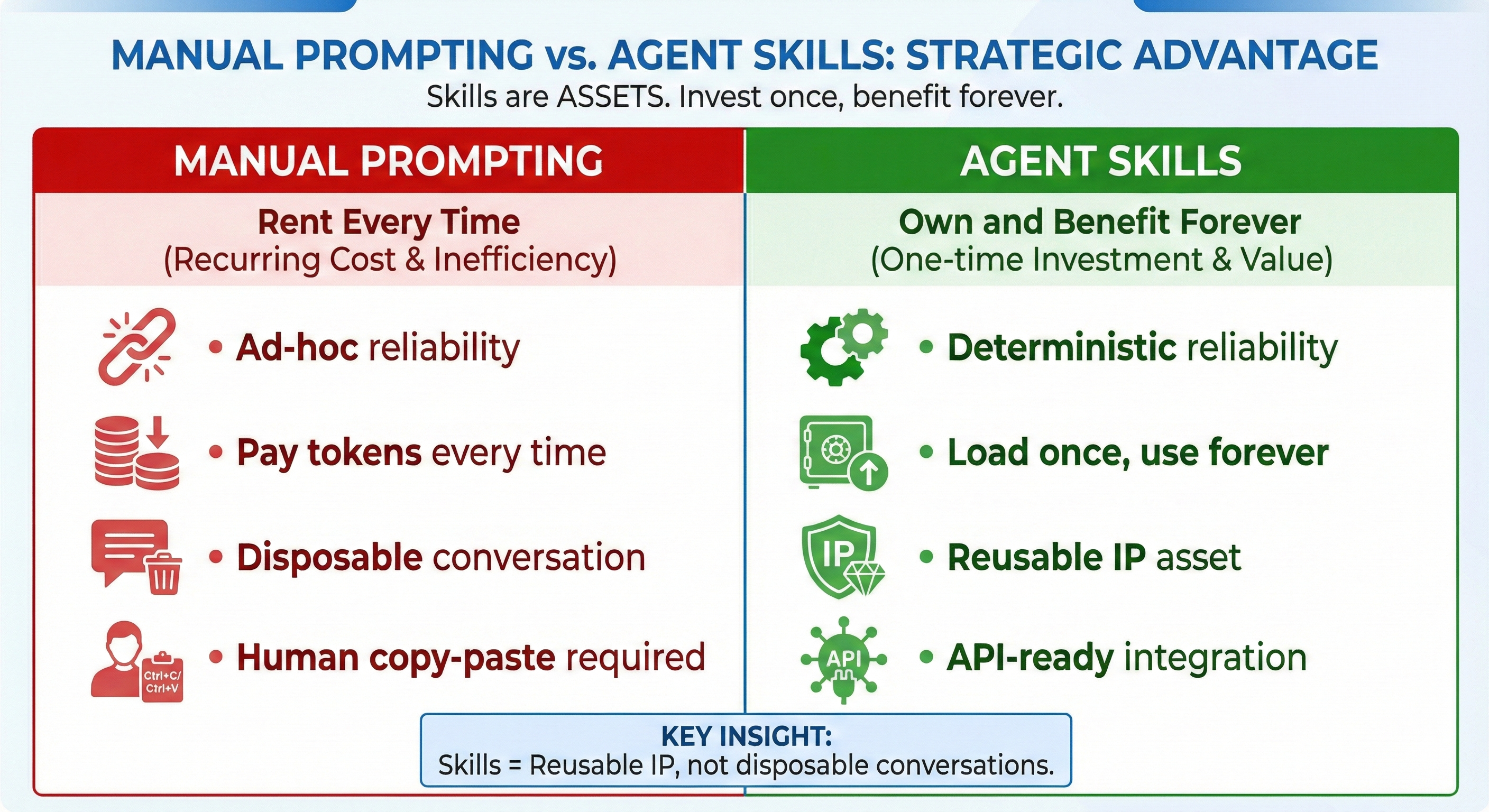
This lesson takes you from understanding skills to creating them. By the end, you'll have a working skill in your .claude/skills/ folder: and know how to use Claude itself to create more.
Skills are written in Markdown with YAML frontmatter. If you're not comfortable with headings, bullet points, code blocks, or YAML syntax, take 15 minutes to review Chapter 13: Markdown for AI-Native Development before continuing. You'll write better skills with that foundation.
The SKILL.md File: Anatomy of Encoded Expertise
Every skill lives in a folder. The folder contains one required file: SKILL.md.
.claude/skills/meeting-notes/
└── SKILL.md    ← This is what you create
Claude Code searches both project (.claude/skills/) and personal (~/.claude/skills/) locations.
.opencode/skills/meeting-notes/
└── SKILL.md    ← This is what you create
OpenCode searches multiple locations and loads whichever it finds:
- Project:
.opencode/skills/<name>/SKILL.md - Global:
~/.config/opencode/skills/<name>/SKILL.md - Claude-compatible (project):
.claude/skills/<name>/SKILL.md - Claude-compatible (global):
~/.claude/skills/<name>/SKILL.md
The Claude-compatible paths mean a skill written for Claude Code generally works in OpenCode without copying.
That's it. A skill can be a single markdown file. The simplicity is intentional: anyone can create one.
The Two Parts of SKILL.md
Part 1: YAML Frontmatter (The ID Card)
---
name: "meeting-notes"
description: "Transform meeting transcripts or raw notes into structured summaries with action items, decisions, and follow-ups. Use when user shares meeting content or asks for meeting notes."
---
Claude Code recognizes name, description, plus optional allowed-tools, model, disable-model-invocation, and user-invocable.
---
name: meeting-notes
description: Transform meeting transcripts or raw notes into structured summaries with action items, decisions, and follow-ups. Use when user shares meeting content or asks for meeting notes.
license: MIT
compatibility: opencode
metadata:
  audience: team-leads
  workflow: meetings
---
OpenCode recognizes name, description, plus optional license, compatibility, and a string-to-string metadata map. Unknown fields are silently ignored, so a Claude-style frontmatter still loads; the extra fields just have no effect.
Part 2: Markdown Body (The Instructions)
# Meeting Notes Skill

## When to Use

- User shares a meeting transcript
- User asks to summarize meeting notes
- User mentions "action items" or "meeting summary"

## Procedure

1. Extract action items with owners and deadlines
2. Highlight decisions made (with who made them)
3. Summarize discussion points (don't transcribe verbatim)
4. Flag open questions for follow-up
5. Keep to one page maximum

## Output Format

**Action Items** (top of document)

- [ ] Task — Owner — Deadline

**Decisions Made**

- Decision: [what] — Made by: [who]

**Discussion Summary**
Brief bullets, not transcription.

**Open Questions**

- Question needing follow-up
That's a complete skill. No scripts required. No complex setup. Just clear instructions in a format your agent (Claude Code or OpenCode) can read.
If your skill performs actions with real-world consequences (deploying code, sending messages, committing to git), guard auto-activation.
Add disable-model-invocation: true to the YAML frontmatter:
---
name: "deploy-production"
description: "Deploy the current branch to production..."
disable-model-invocation: true
---
Without this flag, Claude may auto-trigger the skill whenever your conversation matches its description. With the flag set, only you can invoke it (by typing /deploy-production). A related field, user-invocable: false, hides a skill from the / menu entirely.
OpenCode does not have a per-skill "disable model invocation" frontmatter field. Instead, gate dangerous skills via permissions in opencode.json:
{
  "permission": {
    "skill": {
      "*": "allow",
      "deploy-*": "ask",
      "internal-*": "deny"
    }
  }
}
Permission values: allow (loads immediately), ask (prompts before loading), deny (hidden from the agent). Patterns support wildcards. To disable the skill tool entirely for a specific agent, set tools.skill: false in that agent's frontmatter.
:::
The Fast Way: Let Claude Build Your Skill
Here's the power move: use Claude to create skills for you.
Remember the Skills Lab you downloaded in Lesson 07? It includes a skill-creator skill: a meta-skill for creating other skills.
From the skills lab directory, start your agent:
cd claude-code-skills-lab
claude
cd claude-code-skills-lab
opencode
OpenCode reads the same .claude/skills/ folder, so the lab works without modification. If you prefer the OpenCode-native location, copy or symlink the skill-creator folder into .opencode/skills/.
Then:
I want to create a skill for [your procedure]. Use the skill-creator to help me build it.
For example:
I want to create a skill for writing technical documentation.
My procedure:
1. Start with a one-sentence summary
2. List prerequisites
3. Provide step-by-step instructions with code examples
4. End with troubleshooting section
5. Keep jargon minimal, explain terms on first use

Use the skill-creator to build this into a proper skill.
The skill-creator guides you through understanding your procedure, writing effective descriptions, and generating a complete SKILL.md file. This is how most people should create skills.
The rest of this lesson teaches you what's happening under the hood: useful for refining skills and understanding why they work.
The Description Field: Your Skill's Activation Trigger
The description in YAML frontmatter is the most important line you write. It determines when Claude activates your skill.
Claude sees skill descriptions at startup (Level 1 of the three-level architecture). When you ask for help, Claude scans these descriptions to decide which skills apply.
Good vs. Bad Descriptions
Bad description (too vague):
description: "Helps with notes"
Problem: "notes" could mean anything. Claude won't know when to activate.
Bad description (too narrow):
description: "Summarizes Zoom meeting transcripts from the marketing team"
Problem: Won't activate for Teams calls, non-marketing meetings, or live notes.
Good description (clear context + action):
description: "Transform meeting transcripts or raw notes into structured summaries with action items, decisions, and follow-ups. Use when user shares meeting content or asks for meeting notes."
Why it works:
- States WHAT it does (transform → structured summaries)
- Lists KEY OUTPUTS (action items, decisions, follow-ups)
- Specifies WHEN to use (meeting content, meeting notes request)
The Description Formula
[Action verb] + [input type] + [into/for] + [output type] + [key features].
Use when [trigger conditions].
Examples:
# Blog planning
description: "Plan blog posts with topic research, outline creation, headline variations, and introduction drafts. Use when user asks to plan, outline, or write blog content."

# Code review
description: "Perform systematic code reviews checking security, performance, maintainability, and best practices. Use when user asks to review code or check for issues."

# Email drafting
description: "Draft professional emails matching specified tone and purpose. Use when user needs to write emails or requests communication help."
Hands-On: Create Your First Skill
You mapped a procedure in Lesson 07. Now encode it.
Step 1: Create the Folder
mkdir -p .claude/skills/blog-planner
mkdir -p .opencode/skills/blog-planner
You can also create it in .claude/skills/blog-planner/ if you want both tools to share the same skill file.
Step 2: Create SKILL.md
Create the file at the path matching your agent (.claude/skills/blog-planner/SKILL.md for Claude Code; .opencode/skills/blog-planner/SKILL.md for OpenCode):
---
name: "blog-planner"
description: "Plan engaging blog posts with topic research, structured outlines, headline variations, and compelling introductions. Use when user asks to plan, outline, or write blog content."
---

# Blog Planning Skill

## When to Use This Skill

- User asks to "plan a blog post" or "write an article"
- User mentions blog topics, headlines, or content strategy
- User needs help structuring written content

## Procedure

1. **Understand the topic**: Clarify subject and target audience
2. **Create outline**: Structure into 3-5 main sections
3. **Generate headlines**: Provide 5 variations (curiosity-driven, benefit-focused, direct)
4. **Draft introduction**: Write a hook that challenges assumptions or poses a question

## Output Format

**Topic Summary**: 2-3 sentence overview
**Target Audience**: Who should read this?
**Outline**: Numbered list of main sections with brief descriptions
**Headline Options**: 5 variations
**Introduction Draft**: 1-2 paragraph hook

## Quality Criteria

- Headlines: Curiosity-driven, never clickbait
- Introductions: Challenge assumptions or pose unexpected questions
- Outlines: Problem → failed solutions → insight → application structure
- Specificity: Use numbers over vague claims ("30% improvement" not "significant gains")

## Example

**Input**: "Help me plan a blog post about sustainable living"

**Output**:

- **Topic Summary**: Practical sustainable living tips for busy professionals who want impact without lifestyle overhaul.
- **Target Audience**: Working adults seeking eco-friendly changes that fit their schedule.
- **Outline**:
  1. The myth of the perfect eco-warrior
  2. 5 swaps that take 10 minutes or less
  3. The compound effect of small changes
  4. What NOT to waste time on
  5. Your 30-day sustainable starter plan
- **Headlines**:
  1. "You Don't Need to Be Perfect to Live Sustainably"
  2. "5 Sustainable Swaps That Take Less Time Than Your Coffee Break"
  3. "Why Most Sustainability Advice Is Wrong (And What Works Instead)"
  4. "The Lazy Person's Guide to Environmental Impact"
  5. "Sustainable Living for People Who Don't Have Time for Sustainable Living"
- **Introduction**: "You've seen the Instagram influencers with their zero-waste pantries and composting systems. You've felt guilty scrolling past. Here's what they don't show: most of those lifestyles require hours of maintenance. The good news? You can cut your environmental impact by 40% with changes that take less time than your morning scroll. No mason jars required."
Step 3: Test Your Skill
Start your agent in your project:
claude
opencode
Then ask:
Help me plan a blog post about learning AI tools as a beginner
Watch for:
- Does Claude follow the procedure?
- Does output match the format?
- Does the quality match your criteria?
Step 4: Verify Activation
Ask Claude directly:
What skills are you using in our conversation? Did you activate the blog-planner skill?
Ask the agent directly:
List the skills currently available via the skill tool. Did you load the blog-planner skill for this request?
OpenCode loads skills on demand through its native skill tool, so the agent can confirm by naming the skill it just loaded.
This confirms the skill loaded and helps you understand the activation mechanism.
Refining Skills Through Co-Learning
Your first version won't be perfect. That's expected. Use Claude to improve it.
The Co-Learning Cycle
AI as Teacher: Claude suggests improvements you didn't think of.
Review my blog-planner skill. What could be improved?
Suggest 2-3 specific enhancements.
Claude might suggest:
- Add SEO considerations to the outline section
- Include word count targets for each section
- Add a "common mistakes to avoid" section
You as Teacher: You specify constraints your agent doesn't know.
Good suggestions, but I have constraints:
- Headlines must be curiosity-driven, NEVER clickbait
- I prefer problem → insight → application structure
- Keep introductions under 100 words

Update the skill with these constraints.
Convergence: Together you refine until the skill matches your actual workflow.
Iteration Prompts
After using the skill a few times:
I've used the blog-planner skill 3 times now. Here's what worked and what didn't:
- Worked: Headline variations are great
- Didn't work: Outlines are too generic, need more specific section descriptions

Help me update the skill to fix the outline issue.
Compare the blog-planner output to how I actually wrote my last blog post.
What's different? Should we update the skill to match my real style?
If you encounter references to .claude/commands/ files (in older tutorials or this book's later chapters), those work the same way as skills. A file at .claude/commands/deploy.md and a skill at .claude/skills/deploy/SKILL.md both create a /deploy command. The commands directory was merged into the skills system, so you only need to learn one approach.
If you install many skills, your agent may not surface all of them.
Skill descriptions share a character budget (roughly 2% of the context window). When the budget fills up, some skills are silently excluded. Run /context to check if any skills were dropped. If you see a warning about excluded skills, remove unused ones or shorten descriptions.
OpenCode lists skills inside the skill tool description rather than loading every skill upfront, so the practical limit is the description length plus how clearly your descriptions help the agent pick. To prune visible skills, use permissions in opencode.json ("deny" for unused skills) or set tools.skill: false on agents that don't need any skills at all.
:::
The Bigger Picture
Skills you create now become building blocks for larger systems. In Part 6, you'll build Custom Agents using SDKs, and skills you create here integrate directly into those agents. Skills are reusable intellectual property that compound in value.
Head to Lesson 10: Agent Skills Exercises for 27 hands-on exercises that take you from writing your first skills to building complete skill suites; with one-click exercise downloads and step-by-step guidance.
Try With AI
Create Your Custom Skill:
"I have a procedure I want to encode as a skill: [describe your procedure from Lesson 07]. Walk me through creating a SKILL.md file. Help me write: (1) an effective description that triggers at the right times, (2) clear instructions Claude can follow, (3) quality criteria that match my standards, (4) an example input/output."
What you're learning: The complete skill creation workflow: from procedure to SKILL.md. This is the hands-on application of Lesson 08's architecture.
Use Skill-Creator:
"Use the skill-creator to help me build a skill for [your domain: technical writing / project planning / code review / research summaries]. Start by asking me questions about my procedure, then generate the complete SKILL.md file."
What you're learning: How meta-skills (skills that create skills) accelerate your capability building. The skill-creator pattern appears throughout professional AI workflows.
Refine an Existing Skill:
"Here's my current [skill-name] skill: [paste SKILL.md content]. I've used it 3 times and noticed: [what worked], [what didn't work]. Help me improve the skill to fix these issues."
What you're learning: Skills improve through iteration, not perfection on first attempt. The feedback loop between usage and refinement is how skills mature.
Design a Skill Suite:
"I work on [describe your project type]. Help me identify 3-5 skills I should create that would work together. For each skill, suggest: what it does, when it activates, and how it complements the others."
What you're learning: How to think in skill ecosystems, not isolated tools. Skills that complement each other create more value than skills that work alone.