Axiom II: Knowledge is Markdown
Axiom I solved how to organize commands — the shell coordinates, programs compute. But code is only half of what a team produces. The other half is knowledge: why did we choose this database? What conventions do we follow? How is the system designed? That knowledge has to live somewhere every developer and every AI agent can find it. Should you write it in a Google Doc? A Slack message? A Confluence wiki? A markdown file in the repository? The choice of format determines whether that knowledge survives or disappears — and this axiom makes the choice for you.
Six months before Emma's rewrite, her team had made a critical architecture decision: event-driven messaging over synchronous REST. The discussion happened across four Slack threads, two Zoom calls, a Google Doc that three people edited simultaneously, and a Confluence page that nobody could find anymore. When a new developer named James joined, he looked at the codebase, saw REST calls everywhere except in the user service, and assumed it was an oversight. Nobody told him otherwise — because nobody could find the reasoning. The Google Doc had conflicting comments. The Confluence page referenced a Slack thread that had been archived. So James spent two weeks building a REST integration for the user service. Clean code. Good tests. A pull request that undid three months of deliberate architecture.
Emma caught it during code review. "We moved to event-driven for a reason," she said. "What reason?" James asked. Silence. Nobody could reconstruct the full rationale. They knew the decision was right, but the knowledge about why — the N+1 query analysis, the mobile traffic data, the RFC from the September standup — had been scattered across formats that could not be searched, versioned, or read by an AI agent.
Two weeks of James's work, discarded. Not because the decision was bad. Because the knowledge was lost.
Now consider the alternative: that same decision lives in a file called docs/adr/007-event-driven-messaging.md, committed to the repository. It has a Status, Context, Decision, Consequences, and Alternatives Considered section. Before writing a single line of code, James — or his AI agent — reads the file and understands the complete reasoning in thirty seconds. The REST integration is never built. The two weeks are never wasted. The architecture stays intact.
The difference between these two scenarios is Axiom II.
The Problem Without This Axiom
In Chapter 4, you learned Principle 5: "Persist State in Files." That principle established that files are the durable memory layer for agentic work — the antidote to AI's statelessness. But Principle 5 left a question unanswered: what format should those files use?
Without a format standard, teams persist knowledge in whatever seems convenient at the moment:
| Format | Example | Problem |
|---|---|---|
| Google Docs | Architecture decisions shared via link | Can't be read by CI, can't be diffed in git, requires authentication |
| Confluence wiki | Team knowledge base | Vendor lock-in, no version control integration, search quality degrades over time |
| Slack messages | "Hey, we decided to use Postgres because..." | Disappears into archive, unsearchable after 90 days on free plans |
| Word documents | requirements_v3_FINAL_v2.docx | Binary format, merge conflicts impossible to resolve, requires specific software |
| YAML/JSON files | Configuration stored as pure data | Not human-friendly for prose, no narrative structure, poor for explaining "why" |
| Plain text | notes.txt with no structure | No headers, no hierarchy, not parseable by tools expecting structure |
Each format works in isolation. None works as a system. This is exactly the landscape James walked into — the event-driven messaging decision existed in all of these formats simultaneously, and therefore effectively existed in none of them. AI agents could not read the Slack threads. Git could not track changes to the Google Doc. New team members could not find the Confluence page. The knowledge was technically "persisted" but practically lost.
The Axiom Defined
Axiom II: All persistent knowledge lives in markdown files. Markdown is the universal knowledge format because it is human-readable, version-controllable, AI-parseable, and tool-agnostic.
This axiom doesn't say "documentation should be in markdown." It says all persistent knowledge — specifications, decisions, context, guides, learning objectives, project conventions — lives in markdown. Markdown is not merely a documentation format. It is the knowledge substrate of agentic development.
Historical Background: The Origin of Markdown (click to expand)
Markdown was not designed by a committee or released by a corporation. It was created in 2004 by John Gruber, a writer and blogger, with substantial contributions from Aaron Swartz — who was seventeen years old at the time and had already created atx, a precursor format, two years earlier.
Their design goal was radical in its simplicity: create a format that reads as well before rendering as it does after. Unlike HTML, where <h1>Title</h1> obscures the content behind tags, markdown's # Title is immediately legible. The format drew directly from the conventions people had already been using for decades in plain-text email — asterisks for emphasis, dashes for lists, blank lines for paragraphs. Gruber and Swartz did not invent a new syntax. They formalized the one that humans had already converged on naturally.
This origin matters for Axiom II because it explains why markdown satisfies the four properties so well. It was not designed for machines and then adapted for humans. It was designed for human readability first, and machines turned out to be able to parse it too. Twenty years later, that design decision is what makes markdown the natural interface between human developers and AI agents — both can read the same file with the same ease, because readability was the original and only design constraint.
From Principle to Axiom: The Format Decision
In Chapter 4, Principle 5 taught you that persisting state in files is essential for AI collaboration. You learned to create CLAUDE.md files, write ADRs, and structure projects for reproducibility. That principle answered whether to persist knowledge (yes, always) and where to persist it (in version-controlled files).
Axiom II answers the next question: how to format that knowledge.
The relationship is hierarchical:
Principle 5: "Persist state in files"
    └── Axiom II: "Format that state as markdown"
        └── Implementation: CLAUDE.md, ADRs, specs, README.md
The principle is about durability — ensuring knowledge survives across sessions. The axiom is about interoperability — ensuring that knowledge can be read, processed, and acted upon by every tool in the chain: humans, AI agents, linters, CI pipelines, documentation generators, and search engines.
Think of it this way. A team's knowledge is like a library. Markdown files in a repository are books on open shelves — anyone can walk in, find the right shelf, pull the book, and read it. A Google Doc is a book locked in someone's desk drawer — it exists, but you need their permission and their key to read it. A Slack message is a conversation someone overheard in the hallway last month — it happened, but good luck reconstructing it. A Confluence page is a book in a private library across town that requires a membership card, a login, and the hope that someone has not rearranged the shelves since you last visited. The markdown repository is the only library where every reader — human developers, AI agents, CI pipelines, new hires on their first day — can walk in and find what they need without asking anyone for access.
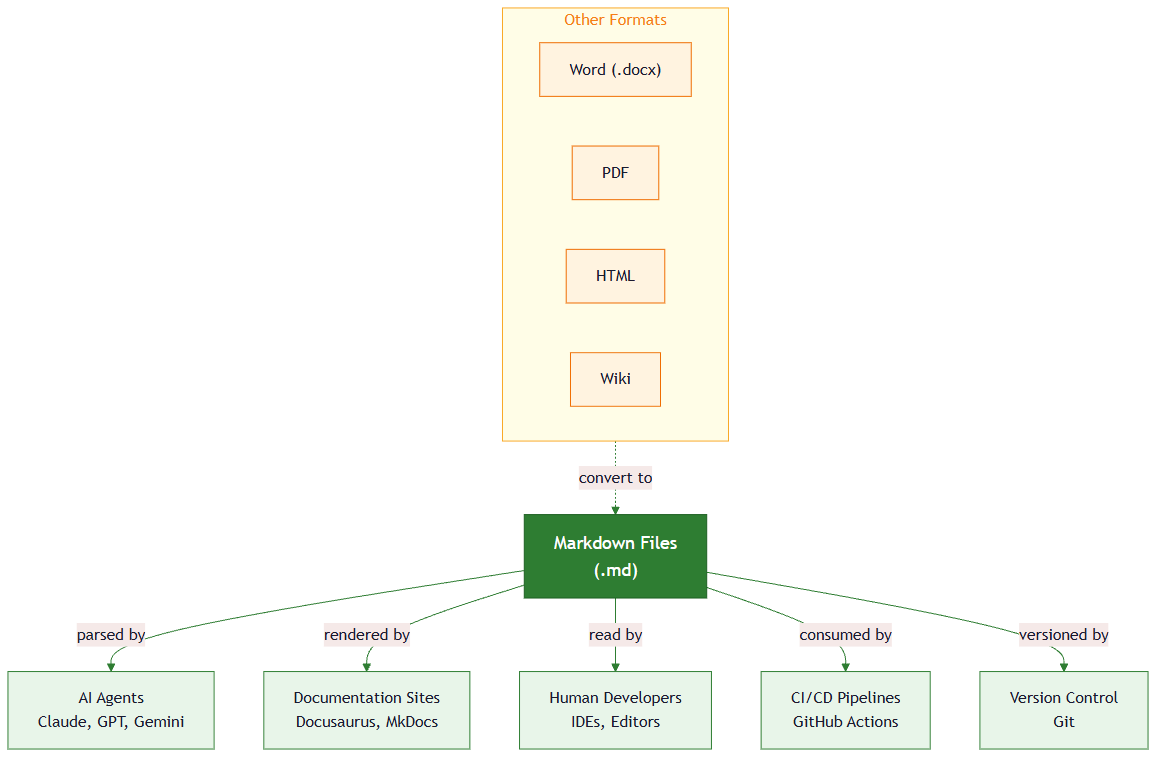
Why Markdown?
After the incident, Emma told James: "We need to write down every decision." James agreed — but the question was not whether to write things down. It was how. If the team had written docs/adr/007-event-driven-messaging.md on the day they made the decision, James would have found his answer in thirty seconds. But why markdown specifically? Why not a JSON file, a YAML config, or a well-organized text file?
Markdown wins not because it is the most powerful format, but because it satisfies all four requirements simultaneously. No other format does.
The Four Properties
| Property | What It Means | Why It Matters for Agents |
|---|---|---|
| Human-readable | You can read raw markdown without any special tool | Developers edit knowledge directly; no rendering step required |
| Version-controllable | Plain text diffs cleanly in git | Every knowledge change has a commit, author, and timestamp |
| AI-parseable | LLMs process markdown natively — headers, lists, tables, code blocks | AI agents extract structured information without custom parsers |
| Tool-agnostic | Works with any editor, any platform, any operating system | No vendor lock-in; knowledge survives tool migrations |
The Comparison
Every alternative format fails on at least one property. This is not a matter of taste — it is a testable claim:
| Format | Human-Readable | Version-Controllable | AI-Parseable | Tool-Agnostic |
|---|---|---|---|---|
| Markdown | Yes | Yes | Yes | Yes |
| YAML | Partial (data only, not prose) | Yes | Yes | Yes |
| JSON | No (noise from braces/quotes) | Yes | Yes | Yes |
| Word (.docx) | Yes (rendered) | No (binary) | Partial | No (requires Office) |
| Google Docs | Yes (rendered) | No (proprietary history) | No (requires API auth) | No (requires Google) |
| Confluence | Yes (rendered) | No (database-backed) | No (requires API auth) | No (requires Atlassian) |
| Plain text | Yes | Yes | Partial (no structure) | Yes |
| HTML | Partial (tag noise) | Yes | Yes | Yes |
Markdown is the only format that scores "Yes" on all four. HTML comes close but fails human-readability — raw HTML is cluttered with tags that obscure the content. Plain text fails AI-parseability — without headers and structure, an agent cannot distinguish a section title from body text.
The Structure Advantage
This is where markdown's design genius — and its relevance to James's situation — becomes concrete. It provides just enough structure to be parseable without becoming a data format that sacrifices readability:
# Decision Title           ← Parseable as section boundary
## Context                 ← Parseable as subsection
We needed a database...    ← Prose that explains reasoning

## Alternatives            ← Another parseable subsection
| Option | Pros | Cons |   ← Structured data within prose
|--------|------|------|
| Postgres | ACID | Scale |

## Decision                ← The conclusion, identifiable by header
We chose Postgres.
An AI agent reading this file can:
- Identify the decision by finding the
## Decisionheader - Extract alternatives from the table
- Understand reasoning from the
## Contextprose - All without a custom parser — markdown structure is the parser
Markdown as Knowledge System
Once Emma's team committed to markdown, something unexpected happened. The ADR that would have saved James's two weeks was just the beginning. Axiom II is not about individual files. A single ADR in markdown is useful. A complete knowledge system in markdown — where specs, decisions, context, and documentation all share the same format, the same repository, and the same version history — is transformative. Different knowledge types serve distinct purposes but use identical infrastructure.
Specifications: What to Build
A spec file like LEARNING-SPEC.md contains the goal, success criteria (as checkboxes), and constraints. The developer writes it, the AI agent implements against it, and the CI pipeline can validate the checkboxes. One file, three audiences, zero format translation.
Decisions: Why We Built It This Way
# ADR-003: Use SQLModel Over Raw SQLAlchemy

## Status
Accepted

## Context
Our FastAPI application needs an ORM. Team has mixed SQL experience.
SQLModel combines Pydantic validation with SQLAlchemy ORM capabilities.

## Decision
Use SQLModel for all database models.

## Consequences
- Positive: Single model definition serves as both API schema and DB model
- Positive: Type safety from Pydantic reduces runtime errors
- Negative: Less flexibility than raw SQLAlchemy for complex queries
- Negative: Smaller community, fewer Stack Overflow answers

## Alternatives Considered
- Raw SQLAlchemy: More flexible, but requires separate Pydantic models
- Tortoise ORM: Async-native, but less mature ecosystem
Context: How to Work Here
# CLAUDE.md

## Project Overview
Task management API built with FastAPI and SQLModel.

## Commands
- `uvicorn app.main:app --reload` → Start dev server
- `pytest` → Run tests
- `alembic upgrade head` → Apply migrations

## Conventions
- Models in `app/models/`
- Routes in `app/routes/`
- Every route has a corresponding test file
- Use dependency injection for database sessions
Documentation: How It Works
API references, setup guides, deployment runbooks — all markdown, all in the repo. A docs/guides/setup.md file with headers, code blocks, and tables serves the same purpose as a Confluence page but without the vendor lock-in, authentication walls, or staleness that plagues wiki platforms.
All four knowledge types — spec, decision, context, documentation — use the same format. They live in the same repository. They are tracked by the same version control. They are readable by the same AI agents. This is what makes markdown a system, not just a file format.
YAML Frontmatter: The Metadata Layer
As Emma's team migrated their knowledge into markdown, James noticed a gap. The ADR captured the reasoning behind a decision, but he also wanted to record when it was made, who approved it, and what status it had — structured data that did not belong in prose paragraphs. Raw markdown provides structure through headers, lists, and tables. But some knowledge is better expressed as structured data: lesson duration, skill proficiency levels, creation dates, taxonomy categories. This is where YAML frontmatter adds a metadata layer on top of markdown content.
---
title: "Axiom II: Knowledge is Markdown"
chapter: 14
lesson: 2
duration_minutes: 20
skills:
  - name: "Knowledge Format Selection"
    proficiency_level: "A2"
    bloom_level: "Understand"
---

# Axiom II: Knowledge is Markdown

The lesson content begins here...
The frontmatter block (between --- delimiters) contains machine-processable metadata. The body contains human-readable prose. Together, they give you the best of both worlds:
| Layer | Format | Purpose | Processed By |
|---|---|---|---|
| Frontmatter | YAML | Structured metadata (dates, tags, numbers) | Build tools, CI, search indexes |
| Body | Markdown | Narrative content (explanations, examples, decisions) | Humans, AI agents, documentation generators |
This pattern appears throughout professional tooling: Jekyll blogs, Docusaurus documentation, Hugo sites, Obsidian notes, and Astro pages all use YAML frontmatter on markdown files. The pattern works because it respects the boundary between data and narrative.
Anti-Patterns: Knowledge Trapped Outside Markdown
Every team has a Knowledge Graveyard. It is the Google Doc with forty-seven comments, twelve of which contradict each other. It is the Confluence page that starts with "This document is a living document" — last updated eight months ago. It is the Slack thread where the CTO explained exactly why the team chose one technology over another — messages that disappeared behind the archive wall while nobody noticed.
The knowledge existed. It was written down. It was even shared. But it was scattered across formats that could not be searched together, versioned together, or read by an AI agent. When a new developer asked their AI assistant to "explain why we use this technology," the agent searched the repository, found nothing, and hallucinated an answer. The developer believed it. A wrong decision followed.
Here are the most common ways knowledge gets trapped:
| Anti-Pattern | What Happens | The Fix |
|---|---|---|
| Decisions in Slack | Knowledge archived after 90 days; unsearchable; no structure | Write an ADR in docs/adr/ and commit it |
| Specs in Google Docs | AI can't read without authentication; merge conflicts impossible to resolve | Write specs as markdown in the repo |
| Docs in Confluence | Vendor lock-in; pages go stale; separate from the code they describe | Co-locate docs with code as markdown |
| Notes without headers | AI can't parse sections; search returns the whole file instead of the relevant part | Use # headers to create parseable structure |
The common thread: every anti-pattern breaks at least one of the four properties. Slack breaks version-controllability. Google Docs breaks tool-agnosticism. Plain text without headers breaks AI-parseability. Proprietary formats break all four.
The Knowledge Architecture
After Emma's Makefile rewrite from Axiom I, her team adopted Axiom II. They migrated every decision from Slack, every spec from Google Docs, and every convention from tribal knowledge into markdown files in the repository. Within a month, the project looked like this:
project/
├── CLAUDE.md                    ← Context: How to work here
├── README.md                    ← Context: What this project is
├── docs/
│   ├── adr/
│   │   ├── 001-database.md     ← Decision: Why Postgres
│   │   ├── 002-framework.md    ← Decision: Why FastAPI
│   │   └── 003-orm.md          ← Decision: Why SQLModel
│   ├── specs/
│   │   ├── auth-spec.md        ← Spec: Authentication requirements
│   │   └── api-spec.md         ← Spec: API design
│   └── guides/
│       ├── setup.md            ← Documentation: Getting started
│       └── deployment.md       ← Documentation: How to deploy
├── src/                         ← Implementation
└── tests/                       ← Verification
Every knowledge type has a place. Every file is markdown. Every change is tracked. Every agent can read everything. When the next James joins the team and asks "why event-driven messaging?", the answer is one grep away — or one question to an AI agent that can read every file in the repository.
The Openness Trade-Off
During the migration, James almost committed the team's database connection string into CLAUDE.md. Emma caught it in review. "That's the other side of this axiom," she said. Markdown's greatest strength — plain text that anyone and anything can read — is also its greatest risk. A markdown file committed to a repository is visible to every person and every tool with access. This openness is exactly what makes it the universal knowledge format. It is also exactly what makes it dangerous for secrets.
Never store API keys, passwords, tokens, or customer data in markdown files, even in private repositories. An AI agent reading your CLAUDE.md should find instructions like DATABASE_URL is set via environment variable — not the actual connection string. A spec file should reference Use the Stripe API key from .env — not embed the key itself.
The rule is simple: markdown is for knowledge, not for secrets. Knowledge wants to be readable. Secrets need to be hidden. These are opposite requirements, and they belong in opposite systems — markdown files for the first, environment variables and secret managers for the second.
Try With AI
Prompt 1: Knowledge Audit
I want to audit where my project's knowledge currently lives.

Help me categorize my project knowledge into these buckets:
1. Decisions (why we chose X over Y)
2. Specifications (what we're building and the success criteria)
3. Context (how to work on this project, conventions, patterns)
4. Documentation (how things work, API references, guides)

For each piece of knowledge I identify, help me determine:
- Where does it currently live? (Slack, Google Docs, someone's head, README, etc.)
- Is it in markdown in the repo? If not, what's the migration path?
- What breaks if this knowledge disappears tomorrow?

Start by asking me about my project and where I keep information today.
What you're learning: How to identify knowledge that is currently trapped in non-markdown, non-version-controlled locations. You are building the skill of recognizing when the four properties (human-readable, version-controllable, AI-parseable, tool-agnostic) are violated and understanding the operational cost of each violation.
Prompt 2: Markdown Knowledge Migration
I have a technical decision that currently lives outside my repository:

[Paste or describe a decision from Slack, a Google Doc, meeting notes, or memory —
for example: "We decided to use Redis for caching because..." or
"The team agreed that all API responses should follow the JSON:API spec because..."]

Help me convert this into a proper Architecture Decision Record (ADR) in markdown format.
Include: Status, Context, Decision, Consequences (positive and negative), Alternatives Considered.

Then explain:
- What information was I about to lose by not writing this down?
- How would an AI agent use this ADR when suggesting changes to my project?
- What would happen if someone proposed a change that contradicts this decision?
What you're learning: The practical mechanics of converting knowledge from ephemeral formats into durable, structured markdown. You are experiencing how the act of writing an ADR forces you to articulate reasoning that was previously implicit — making it available to both future humans and AI agents.
Prompt 3: YAML Frontmatter Design
I'm designing a markdown-based knowledge system for my project. I need to decide
what metadata belongs in YAML frontmatter versus what belongs in the markdown body.

My project involves [describe: API docs, internal guides, decision records, specs, etc.].

Help me design a frontmatter schema for my most common document types.
For each type, help me decide:
- What fields go in frontmatter? (things tools/CI need to process)
- What stays in the body? (things humans/AI need to read as narrative)
- What's the boundary between "data about the document" and "the document itself"?

Give me a concrete template for each document type with example frontmatter
and explain why each field is in frontmatter rather than the body.
What you're learning: The design principle behind YAML frontmatter — separating machine-processable metadata from human-readable content. You are learning to draw the boundary between structured data (dates, tags, numbers, categories) and narrative content (explanations, reasoning, examples), and understanding how build tools, CI pipelines, and AI agents use each layer differently.
Key Takeaways
James's question — "Why don't we just use REST?" — is asked in every team, about every major decision. The difference between teams that can answer it and teams that cannot is not memory. It is format. Knowledge that lives in markdown, in the repository, survives everything: team turnover, tool migrations, Slack archive limits, and the statelessness of AI agents.
- All persistent knowledge belongs in markdown. Specifications, decisions, context, documentation — one format, one repository, one version history.
- Markdown satisfies four properties no other format matches: human-readable, version-controllable, AI-parseable, and tool-agnostic. This is not opinion — the comparison table shows it empirically.
- Markdown was designed for readability first. Gruber and Swartz formalized what humans already did in plain-text email. That design decision is why AI agents can read it natively, two decades later.
- YAML frontmatter adds a metadata layer that separates machine-processable data from narrative content — the best of both worlds without sacrificing either.
- Markdown is for knowledge, not for secrets. Its openness is its strength and its risk. Secrets belong in environment variables, never in committed files.
Looking Ahead
Your knowledge now has a format. Your shell orchestrates programs. But what kind of programs? When you ask an AI agent to implement a feature, should it produce a quick script — or a structured, typed, testable program?
In Axiom III, you will discover why the answer matters more than you think — and why the gap between a script and a program is the gap between a prototype and a product.