Axiom IV: Composition Over Monoliths
Axiom III turned James's fifteen-line script into a disciplined program — types, tests, error handling, packaging. One well-built tool. But a single well-built tool is not a system. The question from the last lesson remains: how do you combine well-built pieces into something larger without everything tangling together?
James was about to find out. Emma assigned him to the company's order management system — the core platform that handled every customer purchase. This system would follow him through the rest of the chapter, growing more disciplined with each axiom.
From this lesson onward, code examples use Python features you have not learned yet — classes, decorators, type annotations, and more. That is fine. Focus on the architecture: how code is organized, what each piece does, and why it is separate. The syntax will make sense when you reach the Python lessons later in Part 4.
"Before you touch the order system," Emma told him on his second month, "I need to warn you about process_order()."
James opened the file. The function was 1,400 lines long. It validated the order, checked inventory, processed payment through Stripe, calculated shipping based on weight and destination, computed tax for three jurisdictions, generated a receipt PDF, updated loyalty points, logged analytics events, and sent a confirmation email. All in one function. All interleaved. Variable names from the payment section were reused in the shipping section two hundred lines later. A tax calculation on line 890 depended on an inventory check on line 340 that had been silently modified six months ago.
James's task was simple: add a discount code feature. After two days of tracing dependencies through 1,400 lines, he made a change on line 712 and ran the tests. The discount worked. But the tax calculation now produced wrong numbers for Canadian orders — because his change moved a variable assignment that the tax logic read three hundred lines below. He fixed the tax issue. The receipt PDF broke. He fixed the receipt. The loyalty points doubled.
"Now you understand why I warned you," Emma said. "That function is not code. It is a trap. Every change touches everything because nothing is separate."
Emma spent the following weekend showing James a different way to build the same logic — not as one massive function, but as small, focused units that connected through clear interfaces. Each unit did one thing. Each could be tested alone. Each could be changed without breaking the others. The discount feature, in the composed version, was a single new function inserted into a pipeline. Nothing else changed. Nothing else could break.
The difference between these two architectures is Axiom IV.
The Problem Without This Axiom
James's process_order() was not written by a bad engineer. Like James's deploy.sh in Axiom I, it started small and grew one feature at a time. The first version was 80 lines — clean and readable. But without deliberate composition, software grows like a tangled vine. Each new feature weaves deeper into existing code. Each change requires understanding the entire system. Each bug hides behind layers of unrelated logic.
Here is the trajectory that James's team followed — and that every monolith follows:
| Month | What Happens | Consequence |
|---|---|---|
| 1 | Single function works perfectly for initial scope | Developer feels productive |
| 3 | New requirements added inside the function | Function grows to 300 lines |
| 6 | Bug fix touches unrelated code paths | Regression in seemingly unrelated feature |
| 9 | New developer joins, cannot understand the function | Onboarding takes weeks instead of days |
| 12 | AI assistant asked to modify function | AI hallucinates because context exceeds useful window |
| 18 | Feature request requires architectural change | "We need to rewrite everything" |
The trajectory is predictable. Monoliths start convenient and become unmaintainable. Composed systems start with slightly more structure and remain maintainable indefinitely.
The Axiom Defined
Axiom IV: Composition Over Monoliths
Complex systems are built from composable, focused units. Each unit does one thing well. Units communicate through well-defined interfaces. The Unix philosophy applied to software architecture.
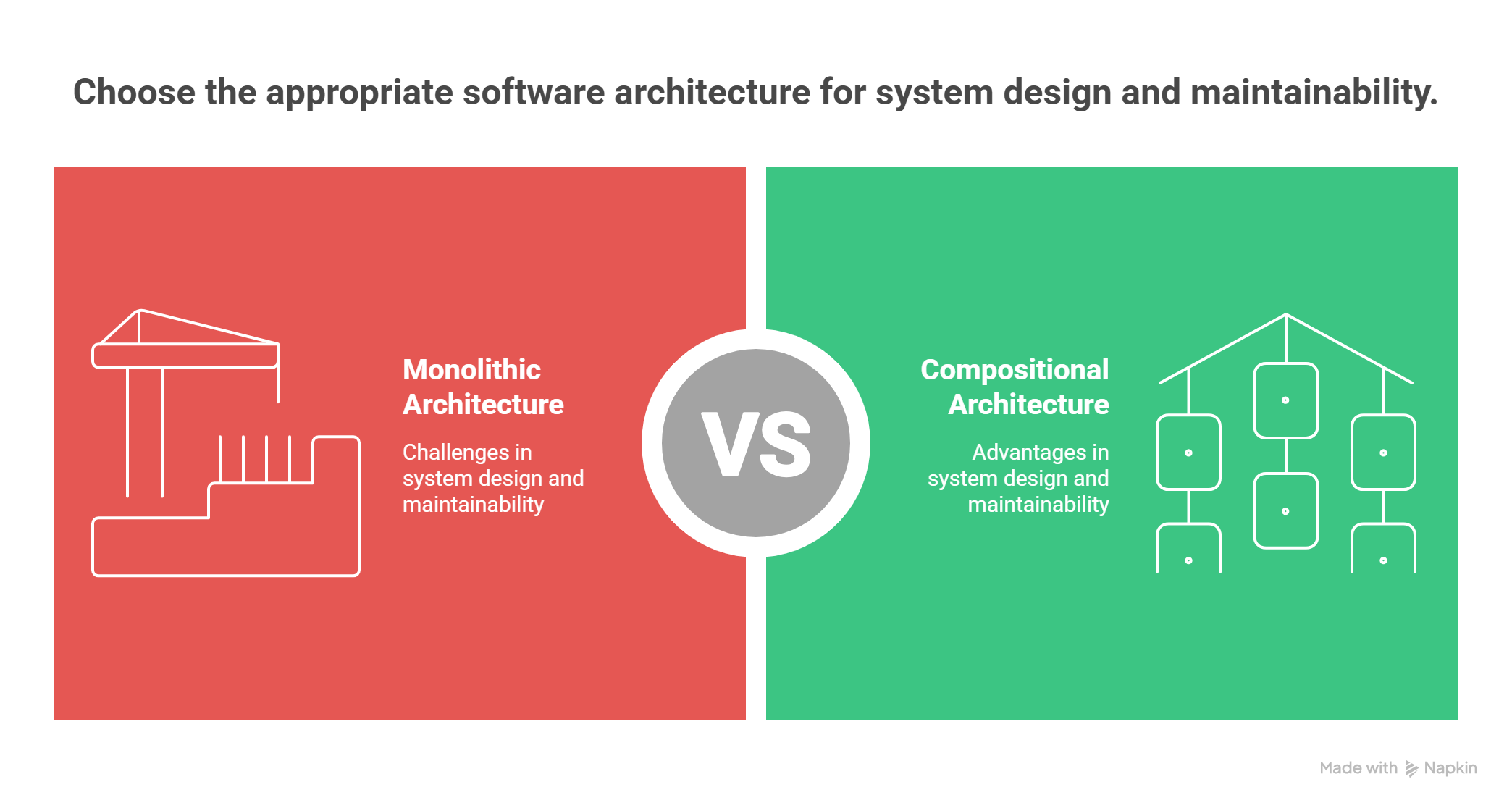
Three properties define a composable unit:
- Focused: It does one thing and does it completely
- Interface-defined: Its inputs and outputs are explicit and typed
- Independent: It can be tested, understood, and replaced without touching other units
When these properties hold, units compose naturally — like LEGO bricks that snap together in countless configurations, each brick useful on its own but powerful in combination. The 1,400-line process_order() had none of these properties. Emma's refactored version had all three.
From Principle to Axiom
In Chapter 4, you learned Principle 4: Small, Reversible Decomposition—breaking problems into atomic steps that can be independently verified and rolled back. That principle governs your process: how you approach solving problems.
Axiom IV governs your architecture: how you structure the solutions themselves.
| Aspect | Principle 4 (Process) | Axiom IV (Architecture) |
|---|---|---|
| Focus | How you work | What you build |
| Unit | A commit, a step | A function, a module |
| Goal | Manageable progress | Maintainable systems |
| Reversibility | Git revert a step | Swap out a component |
| Scale | Task decomposition | System decomposition |
The principle says: "Break your work into small steps." The axiom says: "Build your systems from small parts." One is about the journey; the other is about the destination. Together, they ensure both your process and your product remain manageable.
The Paper That Changed Software Architecture
In Axiom I, you encountered Doug McIlroy's Unix philosophy: programs that do one thing well and work together through pipes. That philosophy governs how you compose programs through the shell. Axiom IV extends the same idea inside the programs themselves — to functions, modules, and systems. And the person who formalized this extension was not McIlroy, but a mathematician named David Parnas.
In 1972, Parnas published a paper at Carnegie Mellon with a title that reads like an axiom itself: "On the Criteria To Be Used in Decomposing Systems into Modules." The paper examined a single problem — a keyword-in-context indexing system — and showed two ways to decompose it. The first decomposition followed the obvious approach: break the system into steps that mirror the processing flow (input, shift, alphabetize, output). The second decomposition followed a different principle: break the system so that each module hides a design decision from the others.
The first approach was what every programmer instinctively did. The second was what Parnas argued they should do. His reasoning was precise: when a design decision is hidden inside a module, changing that decision affects only that module. When a design decision is shared across modules, changing it cascades through the entire system.
Parnas called this principle information hiding. It is the theoretical foundation for Axiom IV. James's process_order() violated it completely — every design decision (how to validate, how to calculate tax, how to format receipts) was exposed to every other part of the function. Changing any decision cascaded through 1,400 lines. Emma's composed version hid each decision inside a focused unit. Changing tax calculation affected calculate_tax() and nothing else.
Parnas's paper is over half a century old. The principle it established has never been overturned, because it addresses a property of complexity itself: the only way to manage a system too large to fit in one mind is to decompose it into parts that can each be understood independently.
Composition at Every Scale
The principle Emma taught James applies at every level of software, from individual functions to distributed systems.
Scale 1: Functions
This is the scale where James experienced the problem. Here is what the monolithic process_order() looked like in essence — a single function doing five things:
def process_order(order_data):
    # Validate (30 lines of validation logic interleaved with...)
    # Calculate price (20 lines dependent on validation variables...)
    # Process payment (25 lines reusing price variables...)
    # Generate receipt (20 lines dependent on payment result...)
    # Send notification (15 lines dependent on everything above...)
    # Total: 110+ lines, every section entangled with every other
And here is Emma's composed alternative — the same logic as focused units:
def validate_order(order: Order) -> ValidatedOrder:
    """Check order data. Raises ValueError if invalid."""
    ...

def calculate_total(order: ValidatedOrder) -> PricedOrder:
    """Compute price, tax, shipping. Pure calculation, no side effects."""
    ...

def process_payment(order: PricedOrder) -> PaidOrder:
    """Charge the customer. Returns payment confirmation."""
    ...

def generate_receipt(order: PaidOrder) -> Receipt:
    """Create receipt PDF from paid order."""
    ...

def send_confirmation(order: PaidOrder, receipt: Receipt) -> None:
    """Email receipt to customer."""
    ...

def process_order(order_data: dict) -> Receipt:
    """Orchestrate order processing from composable units."""
    validated = validate_order(Order(**order_data))
    priced = calculate_total(validated)
    paid = process_payment(priced)
    receipt = generate_receipt(paid)
    send_confirmation(paid, receipt)
    return receipt
Read the orchestrating function process_order() at the bottom. Six lines. Each line is one step. Each step is one function. Adding James's discount feature means inserting one line — discounted = apply_discount(priced, code) — between calculate_total and process_payment. Nothing else changes. Nothing else can break, because each function only sees its own inputs and outputs. This is Parnas's information hiding made concrete.
Scale 2: Modules
Functions compose into modules. Each module groups related functions around a single domain concept:
user_management/
    __init__.py
    validation.py      # validate_registration, validate_password_strength
    security.py        # hash_password, verify_password, generate_token
    storage.py         # store_user, get_user, update_user
    notifications.py   # send_verification_email, send_welcome_email
    registration.py    # register_user (orchestrates the above)
Each module can be imported independently. Testing validation.py never touches the database. Replacing the email provider means changing only notifications.py. An AI assistant can work within a single module without needing context from the others.
Scale 3: Packages and Services
Modules compose into packages. Packages compose into services. The same principle applies at every level:
Order System (composed of services)
├── auth-service/        → Handles identity and permissions
├── catalog-service/     → Manages product information
├── payment-service/     → Processes transactions
├── notification-service/→ Sends emails and alerts
└── order-service/       → Orchestrates the order workflow
Each service does one thing. Each communicates through defined interfaces (APIs). Each can be developed, deployed, and scaled independently. The pattern is fractal—the same structure repeats at every scale.
Why AI Needs Composition
This is where Axiom IV connects to everything this book teaches — and where the lesson becomes urgent rather than merely architectural.
When James asked an AI agent to "add a discount code feature to process_order()," the agent received all 1,400 lines as context. It generated a change. The change broke tax calculations. This was not the AI's fault — it was an architectural failure. The monolith forced the AI to modify code it did not need to understand, and the entanglement guaranteed collateral damage.
Composition solves this at the structural level:
| With Monolith | With Composition |
|---|---|
| AI receives 1,400 lines to add one feature | AI receives calculate_total() — 20 lines |
| AI might modify unrelated sections | AI can only touch the unit it was given |
| Testing requires full system state | Testing requires only the unit's inputs and outputs |
| A bad AI generation breaks everything | A bad AI generation breaks one replaceable unit |
Context windows are finite. Every AI model can hold a limited amount of text in working memory. A 1,400-line function consumes that window with code the AI does not need to see. Twenty composed functions, each 20-70 lines, give the AI exactly the context it needs — no more, no less.
Focused generation produces better results. When James asked the AI to "fix the bug in calculate_tax()" instead of "fix the tax bug somewhere in process_order()," the AI had complete, focused context. Its output was accurate because its attention was not diluted across 1,400 lines of unrelated logic.
Composed units are independently testable. AI-generated code needs verification. With the monolith, testing the discount feature required setting up inventory, payment processors, and email servers — because the function touched all of them. With composition, testing apply_discount() requires only an order and a discount code. No database. No email server. Just the function and its expected behavior.
Any unit can be replaced without breaking the whole. If an AI generates a poor implementation of calculate_tax(), you regenerate just that function. The rest of the system remains untouched. This makes AI-assisted development iterative and safe — you improve one piece at a time, verifying each change in isolation.
Dependency Injection: Composition of Behavior
Emma showed James one more technique that made the composed version powerful in a way the monolith could never be: instead of hardcoding which payment processor or which database the function uses, you pass the implementation as a parameter.
# Hardcoded: permanently bound to Stripe and PostgreSQL
def process_order(order_data):
    charge_stripe(order_data)          # Can't test without Stripe
    save_to_postgres(order_data)       # Can't test without database

# Composed: behavior is injectable
def process_order(order_data, charge: Callable, save: Callable):
    charge(order_data)                 # Any payment processor
    save(order_data)                   # Any storage backend
Now the same function works in three contexts without changing a line:
# Production: real Stripe and Postgres
process_order(data, charge=charge_stripe, save=save_to_postgres)

# Testing: fake payment, in-memory storage
process_order(data, charge=fake_charge, save=save_to_memory)

# Development: log to console, SQLite
process_order(data, charge=log_charge, save=save_to_sqlite)
This is why Emma's team could write tests for the order pipeline without a database, a payment processor, or an email server. The behavior was composed from the implementations they provided. In testing, they provided fakes. In production, they provided the real thing. The orchestration logic was identical in both cases.
Anti-Patterns: What Composition Violations Look Like
You have seen the God Object. Every codebase has one. It is the class called ApplicationManager or Utils or Helpers — the one with fifty-three methods that handles user authentication, payment processing, email sending, report generation, and "miscellaneous things nobody knew where to put." It is the file that every pull request touches, the one that causes merge conflicts every sprint, the one where new developers are told "don't change anything in there unless you absolutely have to."
It is the function that started as handle_request() and grew to 800 lines because every new feature was "just one more if-statement." The function works. It also cannot be tested, cannot be understood by a new team member in less than a week, and cannot be modified by an AI agent without hallucinating about what the variable temp3 on line 412 is supposed to contain.
The God Object is the monolith at the code level — and like all monoliths, it was not built deliberately. It was grown, one convenience at a time, by developers who did not recognize the moment when "add it here" became "this needs to be its own thing."
| Anti-Pattern | Symptom | Consequence | Composed Alternative |
|---|---|---|---|
| God Class | One class with 50+ methods handling unrelated concerns | Changes to any feature risk breaking all others | Split into focused classes, each with a single responsibility |
| Monolithic Function | 500+ line function with multiple responsibilities | Cannot test, understand, or modify in isolation | Extract focused helper functions with clear interfaces |
| Tight Coupling | Module A directly imports internals of Module B | Changes to B cascade as breaking changes to A | Define interfaces; A depends on the interface, not B's internals |
| Circular Dependencies | Module A imports B, B imports A | Cannot understand either module in isolation; import errors | Extract shared logic to Module C; both A and B import C |
The test is simple: if you cannot explain what a class does in one sentence, it is a God Object. If modifying one feature requires understanding ten others, you are looking at a monolith. The fix is the same as Emma's — decompose until each unit does one thing, communicates through typed interfaces, and can be tested without setting up the entire world.
The Composition Test
After the refactoring, Emma gave James a four-question checklist that he now applies to every piece of code — whether written by a human, an AI, or himself:
- Can I explain this unit in one sentence? If not, it does too much.
- Can I test this unit without setting up unrelated systems? If not, it has hidden dependencies.
- Can I replace this unit without modifying other units? If not, coupling is too tight.
- Can I reuse this unit in a different context? If not, it contains unnecessary specifics.
If any answer is "no," the code needs decomposition. Break it into smaller units until every answer is "yes."
The Decomposition Trap
After learning Axiom IV, James went through a phase that Emma had seen before. He decomposed everything. A 15-line function became five 3-line functions. A simple data transformation grew a three-layer abstraction. He created interfaces for components that would only ever have one implementation. The code was technically "composed" but harder to read than the original — because now you had to trace through five files to understand what used to be fifteen obvious lines.
"Composition is a spectrum, not a religion," Emma told him. "The goal is not maximum decomposition. It is appropriate decomposition."
The Decomposition Trap is the mirror image of the monolith. Where the monolith puts everything in one place, the over-decomposed system scatters simple logic across so many units that understanding the whole requires assembling a mental map of dozens of tiny pieces. Both fail for the same reason: they make the system harder to understand than it needs to be.
The heuristic is simple. Compose when a function does multiple unrelated things, when you cannot test a behavior without setting up unrelated state, or when changes to one concern break unrelated concerns.
Do not compose when the code is simple and unlikely to change, when the abstraction would be more complex than the duplication, or when you are designing for a future that may never arrive. A 20-line function that does one clear thing does not need to be split into four 5-line functions. A script that runs once does not need a plugin architecture. Parnas's principle is about hiding design decisions that might change — not about hiding everything.
Try With AI
Prompt 1: Refactor a Monolith
Here is a monolithic function. Help me decompose it into composable units.

[Paste a long function from your own code, or use this example:]

def process_csv_report(filepath):
    # Read file
    with open(filepath) as f:
        lines = f.readlines()
    # Parse headers
    headers = lines[0].strip().split(',')
    # Parse rows
    rows = []
    for line in lines[1:]:
        values = line.strip().split(',')
        row = dict(zip(headers, values))
        rows.append(row)
    # Filter valid rows
    valid = [r for r in rows if r.get('status') == 'active']
    # Calculate totals
    total = sum(float(r['amount']) for r in valid)
    # Format output
    report = f"Active records: {len(valid)}\nTotal amount: ${total:.2f}"
    # Write report
    with open('report.txt', 'w') as f:
        f.write(report)
    return report

For each composed unit you extract:
1. What is its single responsibility?
2. What are its inputs and outputs (the interface)?
3. How would you test it independently?
4. Could an AI regenerate just this unit without affecting the rest?
What you're learning: The practical skill of identifying composition boundaries in real code. You are developing an eye for where responsibilities separate and where interfaces naturally emerge—the core skill for writing AI-friendly, maintainable code.
Prompt 2: Design an Interface
I want to understand dependency injection and interface-based design.

Take this tightly coupled function:

def save_user_data(user):
    db = PostgresConnection("localhost", 5432, "mydb")
    db.insert("users", user)
    logger = FileLogger("/var/log/app.log")
    logger.info(f"User {user['name']} saved")
    emailer = SmtpClient("smtp.gmail.com", 587)
    emailer.send(user['email'], "Welcome!", "Account created.")

Help me redesign this so that:
- The storage mechanism is injectable (could be Postgres, SQLite, or in-memory)
- The logging mechanism is injectable (could be file, console, or nothing)
- The notification mechanism is injectable (could be email, SMS, or a test stub)

Show me:
1. The interface each dependency should satisfy
2. The refactored function using dependency injection
3. Three different compositions: production, testing, development
4. Why this makes the code more AI-friendly
What you're learning: How to decouple behavior from implementation through interfaces and dependency injection. You are learning to think about what a component needs (its interface) separately from how that need is fulfilled (its implementation)—a fundamental skill for composable architecture.
Prompt 3: Composition in Your Domain
I work in [describe your domain: web development, data science, DevOps, mobile apps, etc.].

Help me apply the Composition Over Monoliths axiom to my specific context:

1. What are the "focused units" in my domain?
   (In web dev: components, middleware, routes. In data science: transforms, models, pipelines.)

2. What are the "interfaces" between units?
   (In web dev: props, request/response. In data science: DataFrames, arrays.)

3. What does a "god class" look like in my domain?
   (Show me a realistic anti-pattern I might encounter.)

4. What does a well-composed system look like in my domain?
   (Show me the same functionality decomposed into focused units.)

5. How does composition specifically help AI tools in my domain?
   (What can an AI do better when my code is composed vs. monolithic?)

Use concrete examples from [my specific technology stack or project type].
What you're learning: How to translate the universal principle of composition into the specific patterns and practices of your domain. Every field has its own version of "focused units" and "interfaces"—learning to recognize yours is what transforms abstract knowledge into practical skill.
Key Takeaways
James spent two days fighting a 1,400-line function and learned what David Parnas formalized over half a century ago: the only way to manage a system too complex to fit in one mind is to decompose it into parts that can each be understood independently. Emma's refactoring did not add new logic. It separated existing logic into units that could be tested, modified, and replaced without cascading breakage.
- Complex systems are built from composable, focused units. Each unit does one thing well, communicates through typed interfaces, and can be tested independently. This is Parnas's information hiding made practical.
- Composition is not just good engineering — it is an AI requirement. Monolithic code overwhelms context windows, dilutes AI attention, and makes every AI-generated change a gamble. Composed code gives AI exactly the context it needs, nothing more.
- The pattern is already in the previous axioms. Emma's Makefile in Axiom I composed programs through the shell. The knowledge system in Axiom II composed markdown files into a repository. The discipline stack in Axiom III composed verification tools into a pipeline. Axiom IV makes the pattern explicit: it applies to everything you build.
- Dependency injection composes behavior. By passing implementations as parameters, the same orchestration logic works in production, testing, and development without changing a line.
- The Decomposition Trap is the monolith's mirror. Over-decomposition scatters simple logic across too many pieces. Compose when concerns are genuinely separate. Leave simple things simple.
Looking Ahead
Your shell orchestrates programs. Your knowledge lives in markdown. Your programs have types and tests. Your systems are composed from focused units. But how do you verify that all of these pieces actually work together? How do you know that the code an AI generated does what you asked — and keeps doing it as the system evolves?
In Axiom V, you will discover that types are not just annotations — they are guardrails that catch errors before they reach production, and the first line of defense against AI-generated code that looks correct but is not.