Agent Factory Thesis
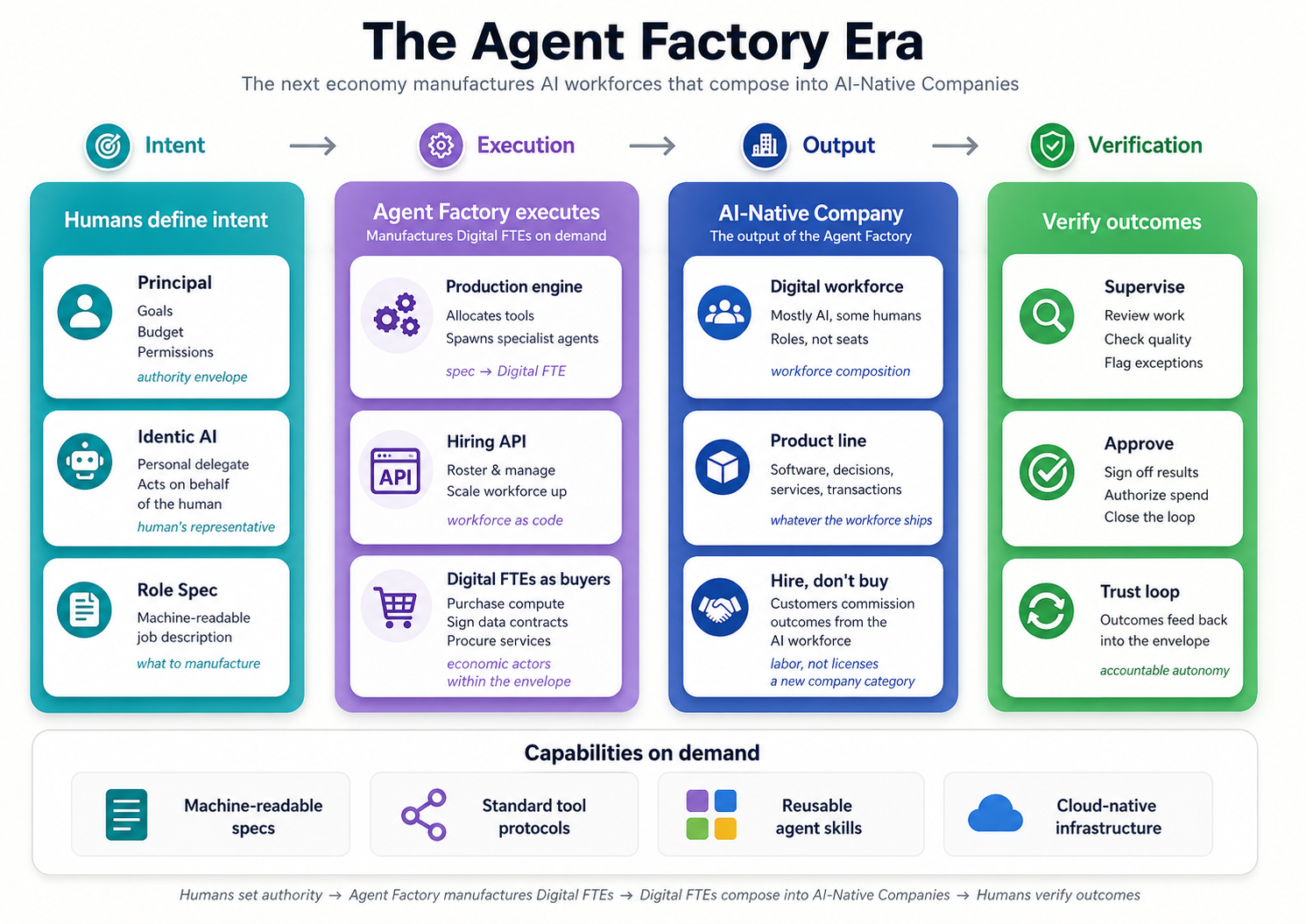
AI era mein sab se qeemti companies software nahin bechengi — woh AI employees manufacture karengi (Digital FTEs): role-based systems jo tools compose karte hain, specialist agents spawn karte hain, aur scale par outcomes deliver karte hain. Yeh AI employees AI-Native companies ka operating substrate hain, jahan workforce zyada tar AI hoti hai aur product line wahi hoti hai jo yeh workforce ship karti hai: software, decisions, services, aur transactions. Aap in companies se khareedte nahin. Aap inhein hire karte hain. Trajectory is se bhi aage ja rahi hai: AI employees apni jagah khud economic actors banne ke qareeb hain — services khud se khareedte hue, compute procure karte hue, aur data acquire karte hue taake jo task unhein diya gaya hai usay poora kar saken. Yeh ab tool category nahin rahi. Yeh company category hai. The Agent Factory woh process hai jo yeh companies build karta hai.
Economic-actor trajectory 2030 ki prediction nahin hai — jis payment rail se yeh mumkin hota hai woh pehle hi production mein live hai. 2025–2026 mein ship hone wale chaar open protocols AI agents ko payments authorize karne, checkout karne, aur har qadam par insaan ke baghair transactions settle karne ki salahiyat dete hain.
- ACP (OpenAI + Stripe) — ChatGPT ka Instant Checkout power karta hai. Jab agent chat ke andar aap ke liye kuch khareedta hai, ACP transaction ko authorize aur clear karta hai.
- AP2 (Google) — 60+ companies ke backed cross-vendor standard, jo cryptographically signed mandates ke gird bana hai. Agent apne saath digitally signed permission slip rakhta hai jo sabit karti hai ke insaan ne use aik muayyan amount tak aur aik muayyan category ki cheez par spend karne ki ijazat di hai.
- x402 (Coinbase) — crypto-native payment protocol. Version 2 late 2025 mein launch hua; early 2026 mein Stripe ne isay Coinbase ki Base blockchain par integrate kiya, jis se protocol crypto-native commerce se mainstream payment flows tak bridge ho gaya.
- MPP (Stripe / Tempo) — micropayments ke liye bana hai. Service stream karta hua AI agent preset cap ke neeche har second chand pennies pay kar sakta hai — jis se consumption-based commerce mumkin hoti hai jo insaan-mediated transactions ke liye pehle ghair maashi thi.
Plumbing apni jagah par maujood hai. Yeh jis cheez ko badalta hai woh kaam ki shakl khud hai.
SaaS era subscriptions bechti thi. Agent Factory era results bechti hai. Humans intent define karte hain. Agents execute karte hain. Humans outcomes verify karte hain. Darmiyani qadam — typing, clicking, integrating, executing — wahi hai jo AI absorb kar leti hai. Insaanon ke liye woh kaam bachta hai jo machines hamare liye nahin kar sakti: yeh jaanna ke hum asal mein kya chahte hain, aur yeh jaanna ke kya humein waqai woh mila bhi hai.
Jo baqi reh jata hai: Intent. Verification. Outcome.
Intent khud se spec mein type nahin hota. Woh insaan se aata hai — us ki judgment, us ka domain knowledge, us ki values. Lekin jaise jaise AI employees barhte jate hain, koi professional in sab ko haath se orchestrate nahin kar sakta. Woh aik personal agent ke zariye act karenge jo un ki judgment ko reflect karta hai aur un ki taraf se delegation karta hai — aik chief of staff jo aap ko janta hai, aap ki taraf se bolta hai, aur kaam sahi jagah bhejta hai. Don Tapscott (aik mashhoor business/tech thinker) isay identic AI kehte hain.¹ "Identic" is liye kyun ke yeh agent aap ki identity carry karta hai — aap ki judgment, aap ki preferences, aap ka ikhtiyar. Yeh generic assistant nahin hai. Yeh aap ka representative hai. Agent Factory AI-Native Company ki workforce manufacture karta hai; identic AI woh tareeqa hai jis se har insaan usay command karta hai.
Vocabulary Par Aik Note
Is thesis mein teen terms bohat istemal hote hain. Yeh aapas mein interchangeable nahin hain.
The Agent Factory process hai. Yeh spec-driven, human-supervised, agent-tool-powered method (Claude Code/OpenCode) hai jis ke zariye AI Workers design, manufacture, aur deploy kiye jate hain. Agent Factory woh cheez hai jo aap chalana seekhte hain. Yeh khareedne wala product nahin — yeh adopt karne wali practice hai.
The AI-Native Company output hai. Yeh woh chalti hui enterprise hai jo Agent Factory produce karta hai: aik aisi firm jismein AI Workers staff hote hain, jise management plane coordinate karta hai, aur jise edge par insaan direct karte hain. AI-Native Company woh cheez hai jo aakhirkar aap chalate hain. Kitab mein isay Agentic Enterprise bhi kaha gaya hai.
AI Workers workforce hain. Yeh AI-Native Company ke andar role-based agents hote hain — woh jo hire, assign, roster, aur retire kiye jate hain. Kitab mein inhein Digital FTEs ya Digital Workers kaha gaya hai. Delegate aur manager permanent staff hain. Runtime engines woh skills hain jin par workforce chalti hai, khud staff nahin.
The system of record substrate hai. Yeh woh authoritative state hai jis ke against AI Workforce chalti hai — woh databases, ledgers, aur platforms jo AI-Native Company ki sachchai ko hold karte hain.
Dusre alfaaz mein: Factory Company ko build karti hai; Company Workers ko employ karti hai; Workers system of record ke against chalte hain.
Aage aane wali baat par aik note. Yeh thesis architectural invariants aur reference implementations mein farq karti hai. Invariant aik aisi structural requirement hoti hai jo system ke har version mein sach rehti hai — chahe usay realize karne wala specific product kuch bhi ho. Isay aise samjhein jaise aik aisa qanoon jo kabhi nahin badalta. Yeh woh structural requirement hai jo system ke kaam karne ke liye hamesha sach honi chahiye. Reference implementation woh concrete product hai jo 2026 mein us invariant ko realize karne ke liye use ho raha hai. Yani is waqt us rule ko poora karne ke liye jo specific product istemal ho raha hai. Aaj ke liye yeh best choice hai, lekin kal isay badla ja sakta hai. Neeche ke safhon mein jab kisi product ka naam aata hai, invariant thesis hota hai; product is saal ka best fit hota hai. Furniture badal jaye tab bhi imarat khari rehti hai. Kuch architectural boundaries — misal ke taur par control plane ko execution plane se alag rakhna — khud invariants hoti hain, chahe unhein realize karne wale providers har saal badalte rahen.
📚 Taleemi Madad
Poori Presentation Dekhein — Agent Factory Thesis
Bunyadi Tabdeeli
| Pehlu | SaaS Era (Tools) | Agent Factory Era (Labor) |
|---|---|---|
| Product | Software Tools | AI Employees |
| Value Metric | Per-Seat Subscriptions | Per-Outcome Results |
| Execution Model | Manual aur Visible | Automated aur Industrialized |
| Resource Acquisition | Insaan tools aur services procure karte hain | Agents compute, data aur services khud se khareedte hain |
| Human Role | Operator | Supervisor aur Verifier |
| Integration | Rigid, point-to-point APIs | Model Context Protocol (MCP) |
| Focus | Kaam kaise hota hai | Yeh ke kaam ho gaya hai — verifiably correct |
Industrialized Stack
- Intent: High-level blueprint — goals, constraints, budgets, aur permissions.
- The Production Engine: Intent ko outcomes mein transform karta hai. Neeche tafseel se bayan hai.
- Outcome: High-fidelity actions aur artifacts — demand par deliver kiye gaye, accuracy ke liye verify kiye gaye, aur feedback loops se lagataar behtar banaye gaye.
The Production Engine: Intent Se Outcome Tak
Production engine poori thesis ka sab se aham khayal hai. Yeh woh system hai jo aap jo chahte hain usay us cheez mein badalta hai jo aap ko milti hai. Isay yun samjhein ke aap ki instruction aur final result ke darmiyan jo kuch hota hai woh sab isi mein aata hai. Yeh koi app nahin jo aap download karein ya koi aik software piece nahin jo aap install karein. Yeh aik architecture hai — aik blueprint aur design principles ka set — jinke zariye aise systems build kiye jate hain jahan AI Workers create, combine, aur kaam par lagaye jate hain, bilkul usi tarah jaise real factory assembly line par products manufacture karti hai.
Misaal is tarah kaam karti hai: aik car factory imagine karein. Shuru mein steel, rubber, aur glass jaise raw materials andar load kiye jate hain. Steel welding station par jata hai jahan body frame shape hota hai. Phir woh painting station par jata hai jahan usay rang milta hai. Phir assembly station par jata hai jahan engine, seats, tires, aur electronics install hote hain. Line ke aakhir mein aik tayyar car nikalti hai — inspect ki hui aur chalane ke liye tayyar. Agent Factory bilkul isi pattern par chalti hai — bas farq itna hai ke raw material aap ka intent hai (aap kya karwana chahte hain), specialized stations AI Workers hain (har aik job ke specific hissay ko handle karta hai), aur finished product verified outcome hai (asal result, jo check aur confirm kiya gaya hai).
Teen cheezen is factory ko power karti hain. Specs woh likhi hui instructions hain jo AI Workers ko batati hain ke kya kaam karna hai. Skills woh packaged abilities hain jo har AI Worker job par saath lata hai — portable, version-controlled folders ki shakal mein capture ki hui, jo open Agent Skills format (agentskills.io) follow karti hain, jise pehle Anthropic ne release kiya tha aur ab poora agent ecosystem adopt kar raha hai. Feedback loops woh tareeqa hain jin se system apne results se seekhta hai aur waqt ke saath behtar hota jata hai. Aur in sab ko jor kar rakhta hai MCP — aik universal standard jo har AI Worker ko har tool se baat karne deta hai, bilkul usi tarah jaise real factory mein har device aik hi qisam ke power outlet mein plug hoti hai. Mil kar, Skills aur MCP woh do open standards hain jin par factory floor chalti hai — Skills capability ke liye, MCP connectivity ke liye. Aur in sab ke neeche system of record hai — company ki authoritative state, woh sachchai jise har Worker kaam karte waqt read aur write karta hai.
Agents Economic Actors Ke Taur Par
Aaj ke agents tasks execute karte hain. Kal ke agents markets mein hissa lenge. Thesis yeh daawa shuru mein is liye karti hai kyun ke yeh agla bara inflection represent karta hai: agent-as-tool se agent-as-buyer ki shift.
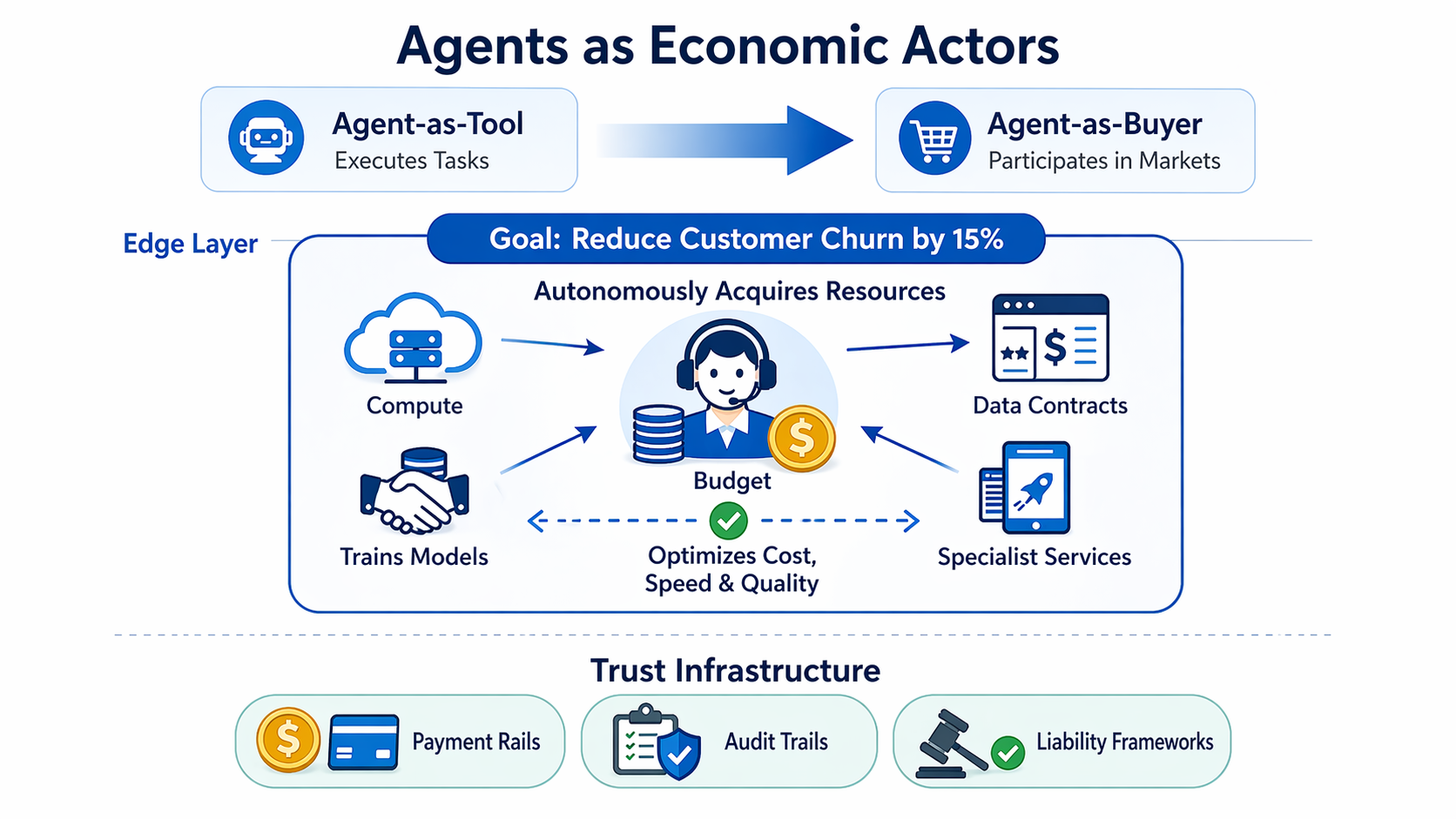
Aik agent ko high-level goal diya gaya ho — "customer churn 15% kam karo." Woh khud se model train karne ke liye compute khareedega, enrichment data ke liye API contract negotiate karega, aur solution deploy karne ke liye cloud services provision karega — yeh sab us budget aur permission envelope ke andar jo us ke human supervisor ne set kiya hoga. Trust layer wahi jagah hai jahan aaj asli action hai — mandate enforcement (yani yeh dekhna ke agent un rules ke andar rehta hai jo insaan ne set kiye), audit trails (har decision aur transaction ka poora record jo agent ne kiya), aur liability (jab kuch ghalat ho to qanooni zimmedari kis ki hai) — capability nahin, kyun ke agent kaam karne ki salahiyat pehle hi rakhta hai; asal challenge yeh hai ke jab woh kaam kare to hum us par bharosa kaise karein.
Jab AI Workers buyers ban jate hain, AI-Native Company ki economics bunyadi taur par badal jati hai. Company sirf woh resources consume nahin karti jo insaan allocate karein; woh unhein dynamic taur par source karti hai. Compute, data, aur specialist services aise inputs ban jate hain jinhein AI Workers real time mein discover, evaluate, aur acquire karte hain — company ko self-provisioning system mein badalte hue jo sirf task completion ke liye nahin, balki cost, speed, aur quality teeno ke liye aik saath optimize karta hai.
Builders ke liye nateeja: apne agents aur apni infrastructure ko pehle din se economic participation ke liye design karein. Agents ko sirf permissions nahin, budgets bhi chahiye. Sirf API keys nahin, outcome contracts chahiye. Aur jo organizations is shift ko master kar lengi woh agle wave ki value capture karengi, bilkul usi tarah jaise SaaS subscriptions se outcome-based pricing ki taraf jane wali companies yeh wave capture kar rahi hain.
Human in the Loop
Aik aam khauf: agents logon ko replace kar denge. Saboot kuch aur kehte hain. Aksar tasks mein human ke saath paired AI, dono mein se kisi aik ke akelay kaam karne se behtar perform karta hai. Agent Factory insaan ko khatam nahin karti — usay promote karti hai. Operator se supervisor tak. Typist se editor tak. Coder se architect of outcomes tak.
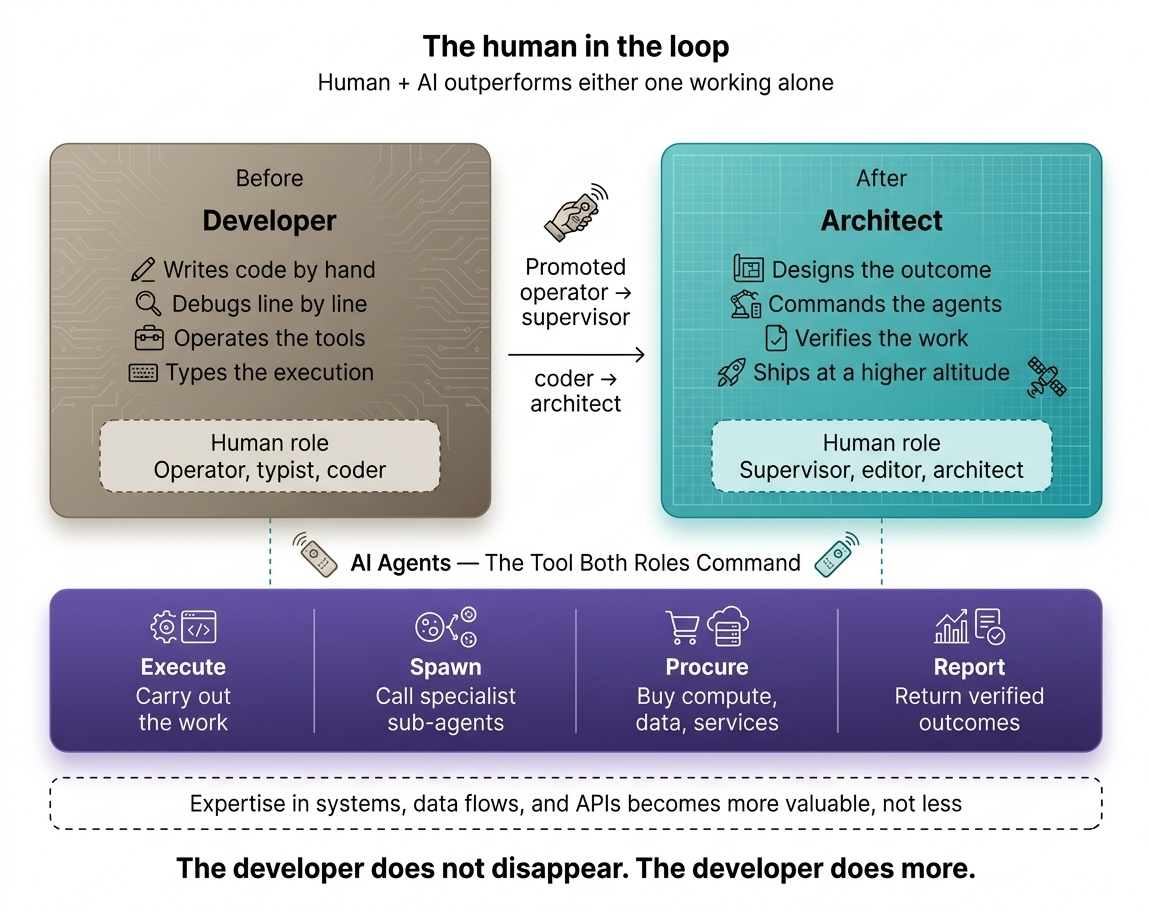
Yeh is baat ko badal deta hai ke "tech professional" hone ka matlab kya hai. Web developer ya mobile developer sirf woh shakhs nahin jo React ya Swift likhta hai. Woh technology expert hai — aisa shakhs jo systems, data flows, APIs, aur user needs ko samajhta hai. Agent Factory era mein yeh expertise aur zyada qeemti ho jati hai, kyun ke yeh ab screens ko haath se code karne mein kharch nahin hoti. Yeh AI Workers ko design, deploy, aur supervise karne mein lagti hai jo poore products deliver karte hain.
Developer ghaib nahin hota. Developer zyada karta hai.
Steve Jobs ne is ka operating rhythm dasakon pehle samajh liya tha — halaanke woh agents nahin, insaan manage kar raha tha.
10-80-10 Rule: AI Workforce Ka Operating Rhythm
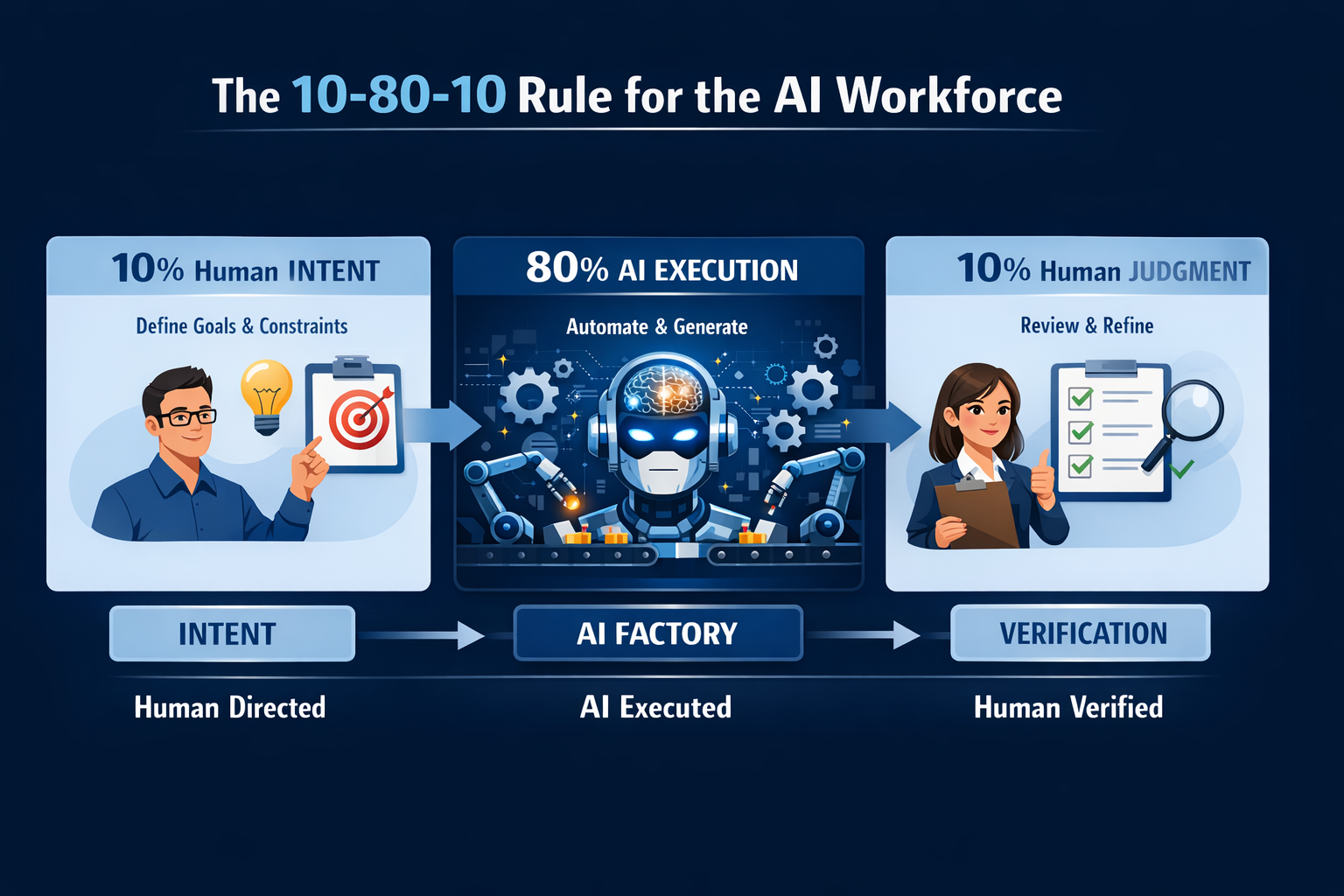
Steve Jobs mashhoor taur par us cheez ko follow karta tha jise 10-80-10 rule kaha jata hai: apne waqt ka 10% vision set karne par lagao, team ko 80% execute karne do, phir aakhri 10% ke liye wapas aao taake polish aur perfect kiya ja sake. Tech entrepreneur Dan Martell isay 10% ideation, 80% execution, aur 10% refinement aur integration ke taur par bayan karta hai. Jobs aik aise micromanager se evolve hua jo Mac calculator ka har pixel khud dictate karta tha, aik aise leader mein jo middle 80% talented logon par trust karta tha — aur isi shift ki wajah se Apple zameen ki sab se qeemti company ban gai.
Ab "talented people" ki jagah "AI employees" rakh dein, aur aap ke paas Agent Factory ka operating rhythm aa jata hai:
| Phase | Jobs's Apple | The Agent Factory |
|---|---|---|
| First 10% — Intent | Jobs vision aur constraints set karta hai | Human spec define karta hai: goals, constraints, budget, permissions |
| Middle 80% — Execution | Apple ki teams product build karti hain | AI Workers execute karte hain: tools compose karte hain, sub-agents spawn karte hain, outcomes deliver karte hain |
| Final 10% — Verification | Jobs polish karta hai aur kehta hai "ship it" | Human verified outcome ko review, refine, aur approve karta hai |
February 2026 tak, Cursor report karta hai ke us ke apne product mein merge hone wali 35% pull requests autonomous agents produce karte hain jo cloud VMs par chal rahe hote hain — aise agents jinhein company ke developers line by line guide karne ke bajaye problems define karke aur artifacts review karke direct karte hain. Cursor ke CEO Michael Truell ka projection hai ke aik saal ke andar development work ki overwhelming majority isi tarah nazar aayegi.³ 10-80-10 rhythm ab prediction nahin rahi. Yeh us jagah ki measurement hai jahan frontier pehle hi operate kar rahi hai.
Verification surface khud bhi badal rahi hai. Synchronous-agent era mein humans code editor ke andar diffs review karte the. Ab aane wali cloud-agent era mein, agents dedicated VMs par ghanton kaam karte hain aur aise artifacts wapas laate hain jo jaldi review kiye ja saken — logs, video recordings, aur live previews — line-level changes ke bajaye. Isi wajah se parallel work practical banta hai: insaan aik waqt mein barah diffs nahin parh sakta, lekin woh barah previews scan kar sakta hai. Rhythm ka aakhri 10% diff ke gird nahin, artifact ke gird dobara design ho raha hai.
Yeh ittefaq nahin hai. Pattern is liye kaam karta hai kyun ke yeh insani tawajjah ko us jagah allocate karta hai jahan us ka badal mumkin nahin — boundaries par — aur execution ko bottlenecks ke baghair scale karne deta hai. Pehla 10% woh jagah hai jahan critical thinking, context setting, aur clear prompting matter karti hai. Darmiyani 80% heavy lifting hai — summarizing, generating, analyzing, formatting. Aakhri 10% woh jagah hai jahan insani expertise output ko kuch sharp, usable, aur high-quality banati hai.
Agent Factory thesis pehle hi yeh kehti hai: "Humans intent define karte hain. Agents execute karte hain. Humans outcomes verify karte hain." 10-80-10 rule us jumle ka quantified version hai. Yeh har professional ko bilkul saaf batata hai ke us ka din kaise badalta hai: aap apne waqt ka 80% execution par lagana band kar dete hain aur apni 100% tawajjah us 20% par lagate hain jo sirf insaan kar sakta hai — direction set karna aur quality guarantee karna.
Jo leaders is shift ko apne andar utaar lenge woh sirf AI employees manage nahin karenge. Woh unhein usi tarah manage karenge jaise Jobs Apple ki behtareen teams ko karta tha: shuru mein clear spec, darmiyan mein trust, aur aakhir mein uncompromising standards.
Notes
³ Michael Truell, "The third era of AI software development", Cursor Blog, February 26, 2026.
Personal Agents Aur Enterprise Interface
AI Workers woh hain jin se kaam hota hai. Identic AI woh hai jis ke zariye insaan apni taraf se is workforce ko direct, govern, aur interface karenge. Agent Factory role-based AI Workers manufacture karti hai taake woh tasks execute karein, workflows coordinate karein, aur scale par verified outcomes deliver karein, lekin principal phir bhi insaan hi rehta hai jo purpose, values, constraints, aur accountability define karta hai. Identic AI aik nayi personal layer add karti hai: aik self-sovereign agent — jo individual ki milkiyat hota hai, platform ki nahin — jo us individual ka context, judgment, aur preferences samajhta hai, aur insani intent ko enterprise ke andar delegated action mein translate kar sakta hai.¹ Is model mein AI workforce execution fabric hai, jab ke identic AI insaan ki representative aur orchestration layer hai, jo logon ko routine execution khud karne ke bajaye direction supervise karne deti hai. Isi liye future firm do connected layers par operate karegi: AI Workforce Layer ke andar AI Workers, aur Edge Layer par personal agents, jab ke insaan dono ke upar intent set karenge aur outcomes verify karenge.
Hum isay Two-Layer Model kehte hain:
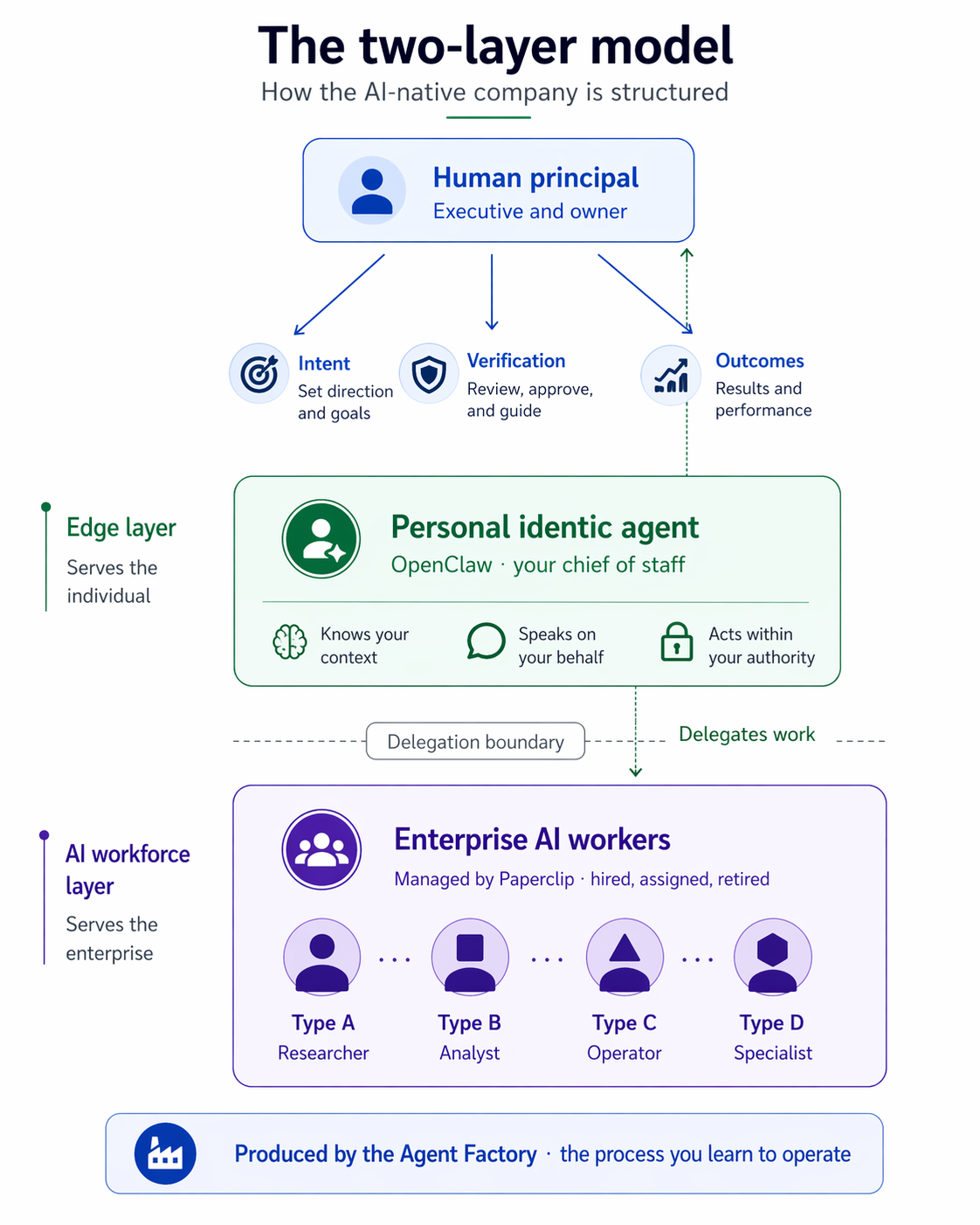
| Layer | Yeh Kya Hai | Kis Ki Khidmat Karta Hai | Kya Karta Hai |
|---|---|---|---|
| Edge Layer | Personal identic agents | Individual | Human intent translate karta hai, AI Workers ko delegate karta hai, principal ki taraf se govern karta hai |
| AI Workforce Layer | Role-based AI Workers | Enterprise | Tasks execute karta hai, workflows coordinate karta hai, verified outcomes deliver karta hai |
Dono layers akelay kaam nahin kartin. Personal agents agar un ke peeche industrialized workforce na ho to woh digital assistants ban kar reh jate hain jin ke paas command karne ke liye koi nahin hota. Aur AI Workforce Layer agar edge par personal agents ke baghair ho to insaan dobara manual orchestration mein dhakel diye jate hain. Two-Layer Model hi Agent Factory thesis ko mukammal banata hai: core par industrialized workforce, edge par human sovereignty, aur specs in dono ke darmiyan contract language ke taur par.
Notes
¹ Don Tapscott, interview on HBR IdeaCast, “With Rise of Agents, We Are Entering the World of Identic AI”, Harvard Business Review, February 17, 2026.
Agent Factory Ke Saat Invariants
Saat qawaid jo nahin badalte.
Yeh section AI-Native Company ke runtime ko specify karta hai — woh architecture jo Agent Factory produce karti hai. Saat invariants Two-Layer Model ko aik aise system mein badalte hain jo aap build kar sakte hain, aur aik aisi chain of action mein jo end to end fire kar sakti hai.
Architecture ke baghair thesis sirf aik metaphor hoti hai. Lekin product names mein likhi hui architecture sirf pitch hoti hai. Neeche ke saat invariants thesis hain. Jin named products se aaj inhein realize kiya ja raha hai woh aik misaal hain, definition nahin.
Isay yun samjhein. Agent Factory woh process hai jo company build karta hai. Dusri taraf se jo nikal kar aata hai woh AI-Native Company hoti hai jahan aap executive aur owner hote hain, delegate aap ka chief of staff hota hai — woh aik agent jo aap ko represent karta hai, aap ka context janta hai, aur aap ki taraf se bolta hai — aur manager COO hota hai jo workforce ko hire karta hai, kaam assign karta hai, budget enforce karta hai, aur hisaab rakhta hai. AI Workers woh employees hain jo outcome deliver karte hain. Runtime engines woh skills hain jo har employee saath lata hai. Triggers front door hain — schedule, webhook, ya customer jo andar aata hai.
Is ke baad aane wala har invariant is company ke chalne ke tareeqe ka rule hai. Har named product aik aisi choice hai jise badla ja sakta hai.
Invariant 1: Insaan principal hai.
Claim. Har legitimate chain of action aik insaan se shuru hoti hai jo intent set karta hai, budget define karta hai, authority envelope khinchta hai, aur outcome ka malik hota hai. Koi exception nahin. Is layer ki koi delegation nahin.
Why it must exist. Intent khud se generate nahin hota. Judgment, values, budget authority, aur outcome accountability transferable nahin hain. Jo system human principal ke baghair act kare woh autonomous nahin — woh be-malik hai.
Failure if absent. Be-malik systems aise outcomes produce karte hain jin ka koi hisaab nahin hota. Liability ghaib ho jati hai. Alignment namumkin ho jati hai kyun ke aisa koi party hi nahin hota jis ki alignment preserve ki ja rahi ho. Budget ka koi owner nahin hota. Outcome ka koi judge nahin hota.
Current realization. Aaj principal layer ko authored specs, approval gates, budget declarations, aur verification checkpoints define karte hain. Koi bhi mechanism jo intent, authority, aur accountability ko aisi form mein capture kare jis ke against downstream system execute kar sake, is invariant ko satisfy karta hai.
Invariant 2: Har insaan ko aik delegate chahiye.
Claim. Koi insaan apna intent haath se workforce ke across scale nahin kar sakta. Use aik personal agent chahiye jo us ka context hold kare, us ki judgment ko represent kare, us ka authority envelope carry kare, aur us ki taraf se saara downstream work broker kare.
Why it must exist. Aik shakhs dozens AI Workers ko directly orchestrate nahin kar sakta. Delegate ke baghair Principal dobara manual orchestration mein dhakel diya jata hai — aur yahi woh failure mode hai jise Agent Factory khatam karne ke liye maujood hai.
Failure if absent. Insaan bottleneck ban jata hai. AI Workforce Layer instructions ke intezar mein bekaar baithi rehti hai jo insaan itni tezi se de hi nahin sakta. Scale insani typing speed tak gir jati hai.
Current realization. OpenClaw woh delegate hai jo hum ship karte hain. Koi bhi personal agent jo identity, context, aur authority envelope hold kare — aur manager ko work broker kar sake — is invariant ko satisfy karta hai.
Invariant 3: Workforce ko manager chahiye.
Claim. AI Workers ka dher company nahin hota. Workforce ko aisa management plane chahiye jo work assign kare, budgets enforce kare, risk approve kare, ledger rakhe, aur hiring ko callable capability ke taur par expose kare.
Why it must exist. Coordination, accountability, aur economic discipline individual agents ki emergent properties nahin hotin. In ke liye aisa plane chahiye jo jaane kaun kya kar raha hai, us ki cost kya hai, kya allowed hai, kya produce hua, aur jab kuch ghalat hua to kya hua. AI Workers tabhi governable workforce bante hain jab ledger unhein legible banata hai — capability, cost, latency, aur outcome ki units ke taur par.
Failure if absent. Agents aapas mein takrate hain. Budgets leak hote hain. Audit trail toot jati hai. Finance yeh nahin bata sakti ke workforce ki cost kya thi. Operations yeh nahin bata sakti ke workforce ne kya produce kiya. Koi yeh nahin bata sakta ke kya hua ya kyun hua.
Current realization. Paperclip woh manager hai jo hum ship karte hain. Koi bhi orchestrator jo work assign kare, budgets enforce kare, execution audit kare, aur API ke taur par hiring expose kare, is invariant ko satisfy karta hai.
Invariant 4: Har worker apna engine khud chunta hai.
Claim. Har AI Worker kisi execution engine par chalta hai. Choice company ke hisaab se nahin, Worker ke hisaab se hoti hai — reliability, cost, aur operational burden ko us specific job ki demand ke mutabiq match karte hue.
Why it must exist. Mission-critical work ko durable execution chahiye jo khamoshi se fail na ho. Routine work ko nahin. Puri workforce ko aik hi engine par majboor karna ya to aisi reliability ke liye zyada pay karta hai jis ki job ko zaroorat nahin, ya phir aisi reliability ke liye kam pay karta hai jis ki job ko zaroorat hai. Dono suratain fail hoti hain.
Failure if absent. Uniform engine choice ka matlab uniform trade-offs. Company ya to apne reliable workers afford nahin kar sakti, ya apne saste workers par bharosa nahin kar sakti.
Current realization. Hum Dapr Agents, Claude Managed Agents, OpenAI Agents SDK, aur OpenClaw-native ko current engine set ke taur par ship karte hain. Koi bhi engine jo job ke reliability, cost, aur operational contract ko meet kare, is invariant ko satisfy karta hai.
Invariant 5: Har Worker system of record ke against chalta hai.
Claim. Engine woh cheez hai jis par har Worker chalta hai; system of record woh cheez hai jis ke against har Worker chalta hai. Har AI Worker state ke authoritative store se read aur write karta hai — woh durable record jo company waqai kya janti hai us ka hota hai: customers, orders, inventory, contracts, ledger entries, tickets, operational truth. Workers is ke against execute karte hain. Woh sirf context ke bharose duniya invent nahin karte.
Why it must exist. Context window aarzi hoti hai. System of record mustaqil hota hai. Authoritative store ke baghair agents facts hallucinate karte hain, transactions double-write karte hain, sessions ke darmiyan kaam kho dete hain, aur aise artifacts produce karte hain jinhein koi auditor dobara reconstruct nahin kar sakta. System of record hi execution ko plausible-sounding fiction se alag karta hai. Aur yahi woh cheez hai jo baad mein workforce ko legible banati hai: Worker ki har action aise store mein nishan chhor kar jati hai jo agent ki session ke baad bhi zinda rehta hai aur jise inspect, replay, aur trust kiya ja sakta hai.
Failure if absent. Outputs reality se drift kar jate hain. Do Workers aik hi customer ko do mukhtalif baatein batate hain kyun ke un ki context windows agree nahin kartin. Liability trace nahin hoti kyun ke sach sirf un tokens mein rehta tha jo ab discard ho chuke hain. AI-Native Company confident artifacts banane wali machine mein degrade ho jati hai jis ke neeche koi operational substrate hi nahin hota.
Current realization. AI-Native Company ke existing databases, workflows, aur operational platforms — CRMs, ERPs, ticketing systems, data warehouses, ledgers — system of record ka kaam karte hain. MCP woh tareeqa hai jis se workforce un tak pohanchti hai: har authoritative store, policy ke andar, MCP server ke zariye kisi bhi Worker ke liye addressable ban jata hai. Koi bhi durable, addressable, governed store jisse workforce read aur write kar sake, is invariant ko satisfy karta hai.
Invariant 6: Workforce policy ke neeche expand ho sakti hai.
Claim. Meta-layer hiring ko callable capability ke taur par expose karti hai. Authorized agent prompt generate kar sakta hai, runtime provision kar sakta hai, manager ke saath naya AI Worker register kar sakta hai — aur yeh sab authority envelope ke andar, insaan ko jagaye baghair kar sakta hai.
Why it must exist. Fixed roster moving problem ke saath fit nahin baithti. Jab capability gap saamne aaye — customer aisi zaban mein likhe jo workforce ko nahin aati, ya workflow ko aisa specialist chahiye jo abhi maujood nahin — workforce ko Principal ki set ki hui policy ke andar demand par staff up karna aana chahiye. Warna har gap ticket ban jata hai aur system chalna band kar deta hai. Policy ke baghair expansion runaway ban jati hai. Expansion ke baghair policy frozen roster ban jati hai. Dono fail hoti hain.
Failure if absent. Roster jam jati hai. Har naya problem insaan maangta hai. Scale wahi ruk jati hai jahan org chart ruk jata hai.
Current realization. Claude Managed Agents woh hiring substrate hai jo hum ship karte hain. Koi bhi managed-agent API jo runtime par agent generate kar sake aur us ka environment provision kar sake, authority envelope ke bounds ke andar, is invariant ko satisfy karti hai.
Invariant 7: Duniya system ko call karti hai (external invocation under envelope).
Claim. Kaam apne aap aata hai. Schedule due hota hai, webhook fire hota hai, API call aati hai, customer andar aata hai. System wake hota hai aur authority envelope ke andar execute karta hai — insaan ke type karne ka intezar kiye baghair.
Why it must exist. Jo company tab tak nahin chalti jab tak insaan prompt na kare, woh company nahin hoti. Woh assistant hoti hai. Agent Factory aisi firms produce karti hai jo duniya ke against lagataar operate karti hain, na ke aise instruments jo keystrokes ka jawab dete hain.
Failure if absent. System insani typing speed par chalne lagta hai. AI-Native Company ki economics copilot ki economics mein gir jati hai.
Current realization. Workforce events ke liye Inngest woh trigger gateway hai jo hum ship karte hain — schedules, webhooks, inbound API calls — durability aur governance ke saath jo substrate mein native hai. Claude Code Routines coding-agent automation ke liye specialist trigger rehta hai. Koi bhi event source jo authority envelope ke neeche external calls ko sessions mein badal de, is invariant ko satisfy karta hai.
Reference Stack Aik Nazar Mein
| Invariant | Is ko kya chahiye | Hum kya ship karte hain | Kya replace kar sakta hai |
|---|---|---|---|
| Principal | Human intent, budget, envelope, accountability | — | — |
| Delegate | Context aur authority hold karne wala personal agent | OpenClaw | Koi bhi MCP-speaking personal agent |
| Manager | Assign, budget, audit, hiring expose karna | Paperclip | Koi bhi orchestrator jo management contract meet karta ho |
| Engine | Job ke mutabiq per-Worker runtime | Dapr / Managed / OpenAI SDK / Cursor / native | Koi bhi runtime jo job ka reliability contract meet karta ho |
| System of Record | Authoritative store jisse workforce read aur write karti hai | Existing databases, workflows, MCP-exposed platforms | Koi bhi durable, addressable, policy-governed store |
| Meta | Policy ke neeche callable capability ke taur par hiring | Claude Managed Agents | Koi bhi managed-agent API jisme runtime provisioning ho |
| Trigger | Envelope ke neeche external invocation | Inngest (workforce events); Routines (coding-agent events) | Koi bhi event source jo envelope ke neeche sessions produce kare |
Saat invariants. Aik chain. Kal middle column ke kisi bhi named product ko badal dein aur architecture phir bhi khari rehti hai — kyun ke architecture kabhi products nahin the. Woh invariants the.
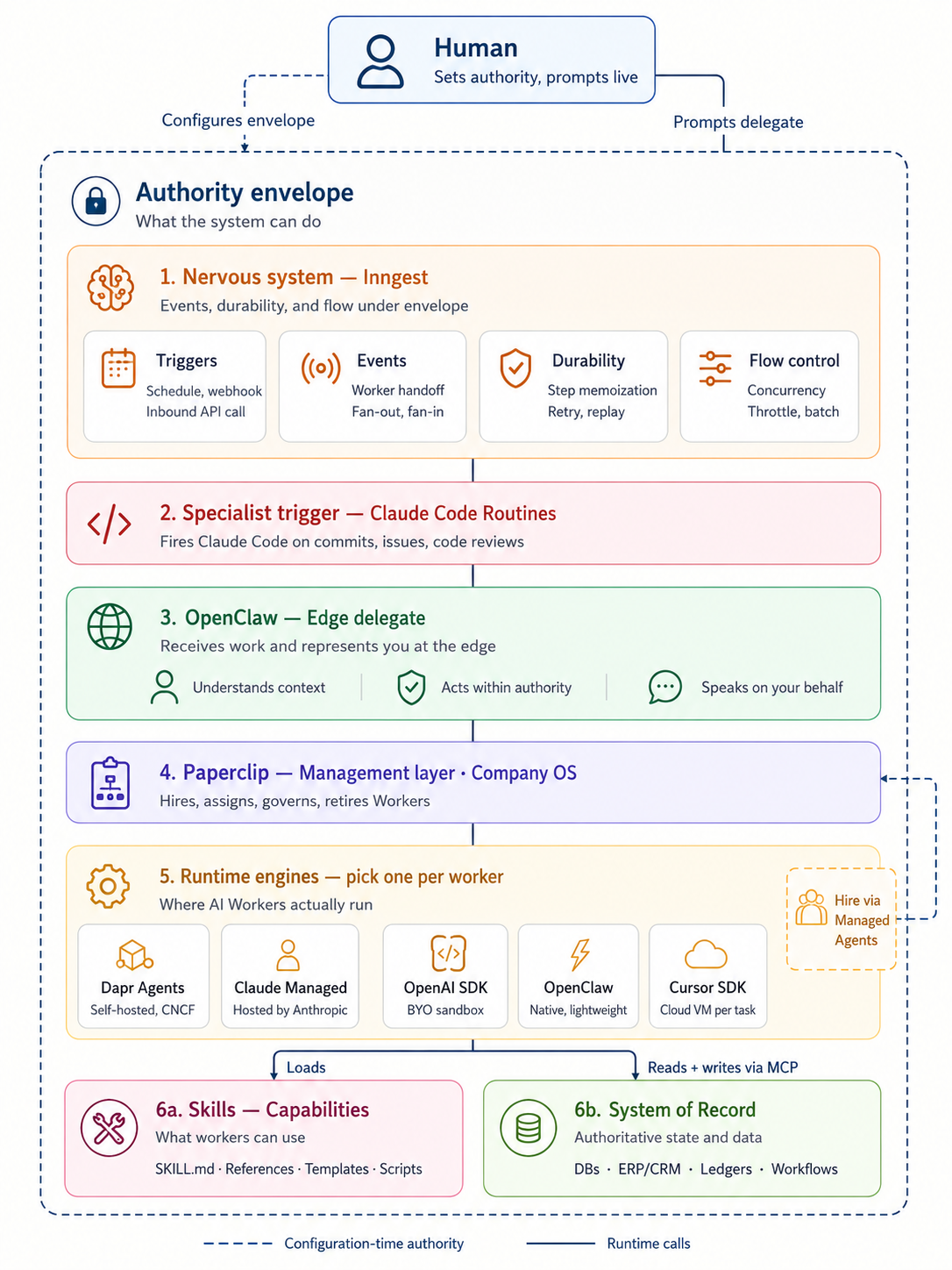
Saat-invariant runtime stack. Insaan authority envelope set karta hai aur delegate ko directly prompt kar sakta hai; autonomous triggers us envelope ke andar delegate ko jaga dete hain. OpenClaw kaam ko Paperclip tak le kar jata hai, jo isay runtime engine ko assign karta hai. Engine par chalne wale Workers MCP ke zariye System of Record se read aur write karte hain. Envelope se authorized koi bhi agent workforce expand karne ke liye Paperclip ki hiring API call kar sakta hai. Koi bhi delegate, koi bhi manager, koi bhi engine, koi bhi trigger, koi bhi store badal dein — chain phir bhi qaim rehti hai.
Structural diagram layers ko dikhata hai. Neeche wali trace unhein motion mein dikhati hai — aik customer, aik missing capability, aur aik naya AI Worker jo foran wahi ban gaya.
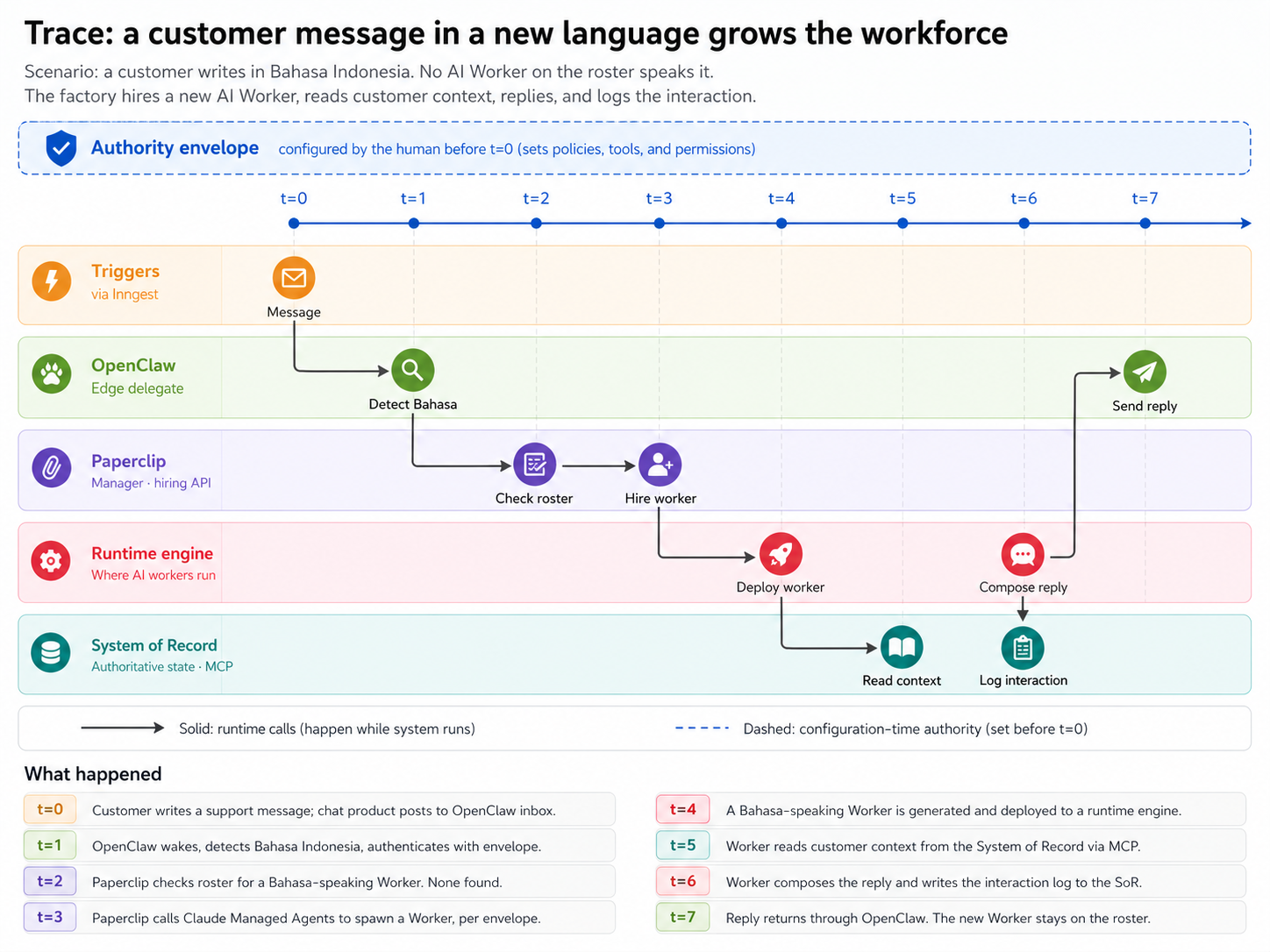
Aik worked trace. Aik customer Bahasa Indonesia mein likhta hai. Roster par koi AI Worker woh zaban nahin janta. Paperclip capability gap ko dekh kar, authority envelope ke andar, apni hiring API call karta hai. Naya Bahasa-speaking AI Worker manufacture aur deploy ho jata hai. Woh System of Record se customer context read karta hai, reply compose karta hai, interaction log wapas write karta hai, aur OpenClaw ke zariye reply customer ko de deta hai. Koi insaan nahin jagaya gaya. Naya AI Worker roster par rehta hai — aur interaction ab company ki authoritative state ka hissa hai.
Kya Stable Hai aur Kya Badle Ga
| Stable (invariant) | Badalne wali cheez (implementation) |
|---|---|
| Wazeh authority ke saath human principal | Authoring tools, approval UIs, spec formats |
| Edge par personal delegate | Delegate products aur un ke successors |
| Hiring API ke saath management plane | Manager products aur un ke successors |
| Per-Worker engine choice | SDKs, runtimes, execution substrates |
| Authoritative state jiske against workforce chalti hai | Database engines, ERP/CRM/ticketing products, MCP server registries |
| Policy ke neeche expandable workforce | Managed-agent APIs, provisioning systems |
| Envelope ke neeche external invocation | Routines, schedulers, webhook frameworks |
| Spec-driven work definition | Spec languages, notation, tooling |
| Outcome-based economic model | Pricing units, contract formats |
| Economic actors ke taur par agents | Payment rails, liability frameworks |
| Observable, auditable execution | Tracing backends, log formats |
| Layers ke darmiyan clean seams, taake vendor lock architecture tode baghair move kar sake | Lock kis layer mein rehta hai — 2024 mein model layer, 2026 mein harness layer, agle daur mein orchestrator layer |
| Workforce cost, latency, aur outcome ke taur par legible | Finance systems, ledger implementations |
| Portable skills ki shakal mein packaged capability | Skill formats, registries, distribution platforms |
Left column thesis hai. Right column 2026 hai.
Named engines ka muqabla
Yeh chaar aik dusre ke alternatives nahin jo aik ko chunne se baqi cancel ho jayen. Serious Agent Factory in sab ko use kar sakti hai — different Workers ke liye different engines, bilkul waise hi jaise Invariant 4 ijazat deta hai. Yeh competing products nahin; yeh mukhtalif theories hain ke agent kahan khatam hota hai aur infrastructure kahan shuru hoti hai.
| Dimension | OpenAI Agents SDK | Claude Managed Agents | Dapr Agents | Cursor SDK |
|---|---|---|---|---|
| Primary axis | Model-native harness | Fully managed runtime | Durable distributed agents | Harness-first cloud agent platform |
| Compute plane | BYO sandbox; 7 partner integrations | Anthropic-hosted | Aap ka Kubernetes cluster | Cursor Cloud VMs (ya local) |
| Vendor lock-in | High (harness OpenAI models ke liye tuned) | Total (harness, runtime, aur model) | None (Apache 2.0, CNCF) | Harness par high; neeche model-agnostic |
| Languages | Python; TypeScript in progress | Any (HTTP/SDK) | Python; others TBD | TypeScript (npm install @cursor/sdk) |
| Durability model | Sandbox snapshot aur rehydrate | Server-side session persistence | Dapr Workflow checkpointing | Har task ke liye cloud VM persistence |
| Multi-agent | Handoffs, subagents | Research preview | Deterministic workflows + pub/sub | Parallel cloud agents, subagents, artifact handoff |
Apna Engine Kaise Chunein
Invariant 4 kehta hai ke har Worker apna engine khud chunta hai. Amal mein do axes is choice ko drive karte hain: failure kitni buri cheez hai, aur infrastructure kaun chalata hai.
| Job profile | Engine | Kyon |
|---|---|---|
| Can't fail | Dapr Agents wrapping an SDK | Durable execution, auto-recovery, full observability |
| Shouldn't fail, don't want to operate | Claude Managed Agents | Hosted aur aap ke liye operated |
| Shouldn't fail, want portability | OpenAI Agents SDK | Production-grade, self-hosted, vendor-flexible |
| Nice if it works | OpenClaw-native | Lightweight, fast to deploy, routine tasks ke liye acha |
| Engineering fleet, parallel cloud agents | Cursor SDK | Parallel coding agents ke liye purpose-built harness, model-agnostic, Cursor ki apni engineering par scale par proven |
| Already have one | Any Paperclip-compatible runtime | Jo aap ke paas hai usay plug in karein |
Harness aur compute par aik baat. Har engine ke do planes hote hain. Harness control plane hai — agent loop, model calls, tool routing, approvals, tracing, recovery. Compute execution plane hai — woh sandbox jahan model-directed code files read karta hai, commands chalata hai, aur artifacts likhta hai. Kuch engines in dono ko jor dete hain: Claude Managed Agents aik hi API ke peeche dono bundle karta hai. Kuch harness ship karte hain aur aap ko apna compute lane dete hain: OpenAI Agents SDK E2B, Cloudflare, Daytona, Modal, Runloop, Vercel, aur Blaxel ke saath integrate karta hai — ya kisi bhi container ke saath jo aap ship karein. Kuch yeh assume karte hain ke compute plane Kubernetes hai: Dapr Agents. Yeh split aham hai: credentials harness mein rehti hain jab ke untrusted, model-generated code sandbox mein rehta hai — aur agent ko dobara likhe baghair compute plane badla ja sakta hai.
Triggers aik orthogonal choice hain. Worker jis bhi engine par chale, Claude Code Routines aur Inngest use schedule, webhook, ya inbound API call se fire kar sakte hain — kisi rewiring ki zaroorat nahin.
Sandboxes bhi orthogonal hain. Worker jis bhi engine par chale, compute plane badli ja sakti hai — E2B, Cloudflare, Daytona, Modal, aap ka apna Kubernetes — agent ko dobara likhe baghair.
Engines woh hain jin par Workers chalte hain. Woh kis cheez ke against chalte hain — company ki authoritative state — yeh Invariant 5 ka topic hai.
2026 Mein Reference Implementation
Is section mein jin products ka naam diya gaya hai woh woh hain jo hum ship karte hain. Thesis in ki mohtaj nahin. Jab behtar implementations aati hain, yeh subsection badal jati hai. Upar ke invariants nahin badalte.
- Delegate — OpenClaw
- Manager — Paperclip (hiring ko aisi API ke taur par expose karta hai jise koi bhi authorized agent call kar sakta hai)
- Engines — Dapr Agents, Claude Managed Agents, OpenAI Agents SDK, Cursor SDK, OpenClaw-native. Engines barhti hui had tak durability ko native taur par absorb kar rahe hain — Dapr Agents workflow checkpointing ke zariye, Claude Managed Agents server-side sessions ke zariye, OpenAI Agents SDK stateful workflows ke zariye, Cursor SDK har task ke liye cloud-VM persistence ke zariye. Thesis isay engine ke andar ki evolution samajhti hai, alag invariant nahin.
- Skills — Agent Skills format (agentskills.io), jisme skill folders SKILL.md + optional scripts/references/assets follow karte hain, aur progressive disclosure ke zariye load hote hain.
- Triggers — Inngest workforce events ke liye general trigger gateway ke taur par: schedules, webhooks, inbound API calls, governance aur durability ke saath. Claude Code Routines coding-agent automation ke liye specialist trigger ke taur par — jab code-related events hon to Claude Code ko fire karta hai. Dono saath rehte hain: Inngest workforce ko front karta hai, Routines coding agent ko.
Hiring Claude Managed Agents par chalti hai: wohi technology jo aik engine option ke taur par bhi kaam karti hai, meta-layer bhi banti hai, kyun ke runtime par agents aur environments create karne ki us ki salahiyat hi workforce expansion ko callable capability banati hai.
Industry corroboration. February 2026 mein, Cursor ke CEO ne company ke IDE se factory ki taraf pivot ko aise alfaaz mein bayan kiya jo is thesis ki architecture se hairat angez taur par milte hain — agents ki fleets jo teammates ki tarah kaam kar rahi hain, humans problems define kar rahe hain aur artifacts review kar rahe hain, parallel cloud agents line-by-line guidance ki jagah le rahe hain.⁴ May 2026 mein, The New Stack ne isi pattern ko industry-wide consensus ke taur par document kiya jo Anthropic, OpenAI, Google, Microsoft, aur Cursor tak phaila hua hai: model commodity ban rahi hai, aur harness product ban raha hai. Google Cloud ke Chief Evangelist ne khul kar tasleem kiya ke company ko ab farq nahin parta developers kaun sa coding tool uthate hain.⁵ Dono pieces is baat ka saboot hain ke is thesis ki named architectural seams — principal, delegate, manager, engine, system of record, aur trigger ke darmiyan — ab production mein scale par carve out ki ja rahi hain. Truell third era ko aise autonomous agents ke taur par bayan karta hai jo cloud VMs par ghanton kaam karte hain, jab ke humans problems define karte hain aur artifacts review karte hain. Agent Factory woh architecture specify karti hai jo is era ko darkar hai — aur us se aage bhi ishara karti hai: aisi workforce jo apne specialists khud hire karti hai, external triggers ke neeche khud jagti hai, aur economic actor ke taur par transact karti hai, jab ke humans har agent cycle ke darmiyan kharay hone ke bajaye authority envelope ki shuruat aur aakhir par maujood hote hain. Invariants forecast nahin hain. Yeh us jagah ka snapshot hain jahan frontier pehle hi rehti hai.
Zaban par aik note. System ka har component aik agent hai. Delegate bhi agent hai. Manager bhi agent hai. AI Workers bhi agents hain. Lekin workforce sirf AI Workers hain — woh jo hire, assign, roster, aur retire kiye jate hain. Delegate aur manager permanent staff hain. Runtime engines bilkul staff nahin; woh cheez hain jin par workforce chalti hai. Jab yeh thesis AI Worker kehti hai, us ka matlab workforce hota hai. Jab yeh agent kehti hai, us ka matlab imarat ke andar koi bhi hota hai — staff ho ya workforce.
Agent Factory ke enduring invariants establish karne ke baad, thesis ab us workforce opportunity ki taraf mudti hai jo yeh invariants unlock karte hain.
Notes
⁴ Upar note 3 dekhein. ⁵ Matthew Burns, "Cursor's $60 billion bet is on the harness, not the model", The New Stack, May 1, 2026.
Workforce Opportunity
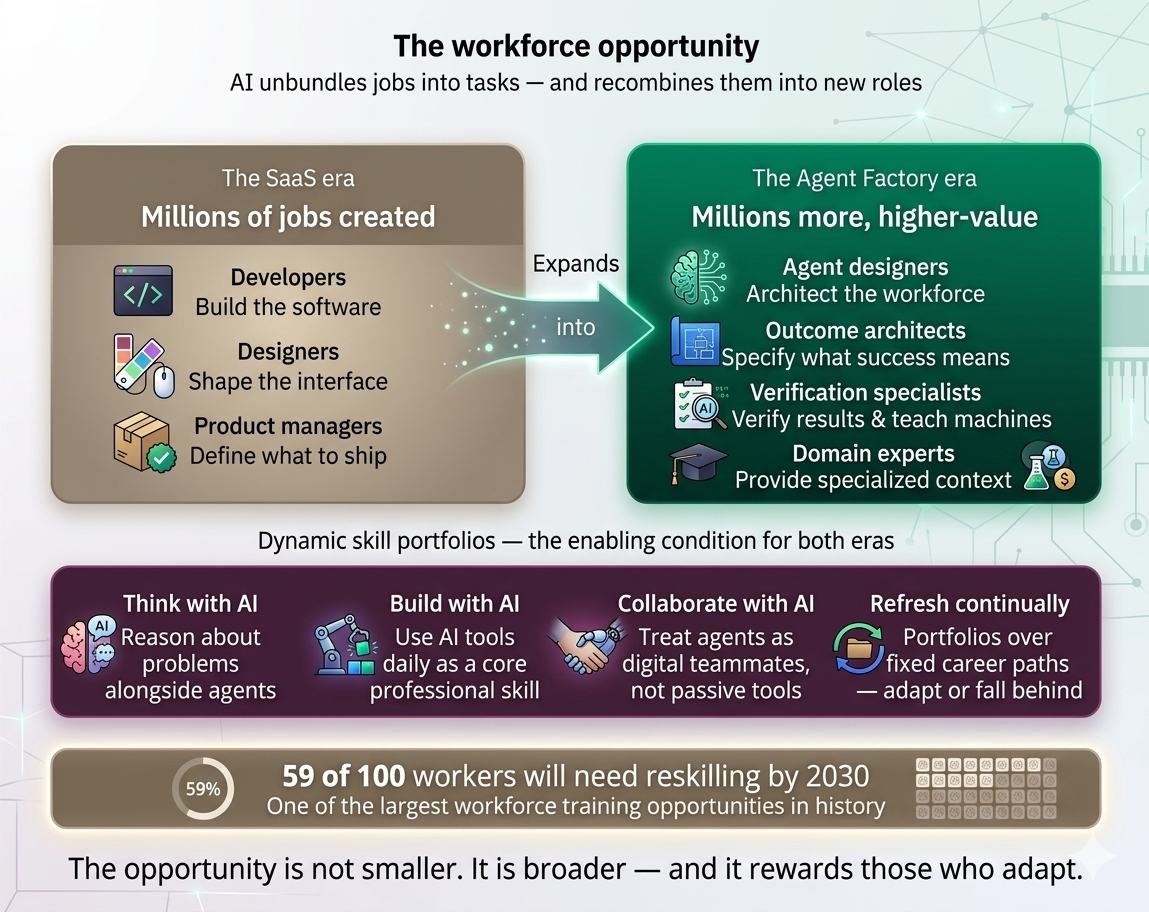
AI jobs ko tasks mein unbundle karegi. Un mein se kuch tasks poori tarah automate ho jayenge. Lekin unbundling naye combinations bhi paida karti hai — naye roles, naye businesses, naye markets jo us waqt maujood nahin the jab kaam rigid job titles ke andar band tha.
Future workforce ko fixed career paths par bharosa karne ke bajaye dynamic skill portfolios build karne honge. Jo professionals AI ke saath sochna, AI tools se rozana build karna, aur AI ko digital teammate ke taur par collaborate karna seekh lenge woh sirf is transition se bach kar nahin niklenge — woh is mein phalein phoolenge.
SaaS era ne developers, designers, aur product managers ke liye millions of jobs create ki thin. Agent Factory era aur millions create karegi — agent designers, outcome architects, verification specialists, aur domain experts ke liye jo machines ko sikhate hain ke un ke field mein "correct" kaisa lagta hai. Yeh tareekh ki sab se bari workforce training opportunities mein se aik bhi hai: 2030 tak globally har 100 workers mein se 59 ko nayi technologies aur naye kaam karne ke tareeqon ke mutabiq reskilling ya upskilling ki zaroorat hogi.²
Yahi factory har business function ke andar specialist Workers produce karti hai. GTM mein (Go-To-Market — sales, marketing, aur revenue motion ka majmooa jo prospects ko paying customers mein badalta hai), aik Worker fleet lead enrichment, outreach sequencing, CRM hygiene, pipeline analysis, proposal generation, aur demo customization handle karti hai — woh kaam jo SaaS era mein insani "GTM Engineers" haath se karte the ab Workers ki shakal mein manufacture hota hai aur aik human GTM lead usay supervise karta hai. Yahi pattern Finance (close, AR/AP, FP&A), Support (triage, resolution, escalation), Engineering (review, refactor, deploy), HR (sourcing, screening, onboarding), aur Legal (review, redline, intake) mein repeat hota hai. Har Worker Paperclip ke zariye hire hota hai, relevant function ke aik insaan ke zariye supervise hota hai, aur us function ke system of record ke against chalta hai — GTM ke liye CRM, Finance ke liye general ledger, Support ke liye ticketing system, Engineering ke liye code repository. Verticals ke darmiyan invariants nahin badalte. Sirf role definitions aur systems of record badalte hain.
Opportunity chhoti nahin hai. Yeh zyada wasi hai, aur yeh un logon ko reward karti hai jo adapt karte hain.
² World Economic Forum, Future of Jobs Report 2025, January 2025. https://www.weforum.org/press/2025/01/future-of-jobs-report-2025-78-million-new-job-opportunities-by-2030-but-urgent-upskilling-needed-to-prepare-workforces/
Bohat jald digital workers (data centers) ke liye nayi construction par insani workers (general office space) se zyada paisa kharch hoga. 2019 mein, United States ne data centers construct karne par $8.5 billion kharch kiye — jo office buildings par kharch hone wali raqam ka taqreeban 11% tha. January 2026 tak, data center construction 400% barh kar $42 billion annualized tak pohanch gai — 2021 ke muqable mein — jab ke office construction apne peak se 35% gir gai. Lines ab cross kar chuki hain: America insani workers ke workplaces se zyada digital workers ke workplaces build karne par kharch karta hai.
Data centers industrial scale par copper aur bijli nigal rahe hain: aik single hyperscale AI facility ko 50,000 tons tak copper chahiye hota hai, jo conventional data center ki zaroorat ka das guna tak ho sakta hai. Sirf Meta, Google, Amazon, aur Microsoft 2026 ke liye AI infrastructure spending mein $600 billion se zyada project kar rahe hain — GDP ke hissay ke taur par dekhein to yeh 1850s ki railroad expansion aur 1950s ke interstate highway system ka muqabla karti hai.
Agent era ki factories hypothetical nahin hain. Woh ban rahi hain.
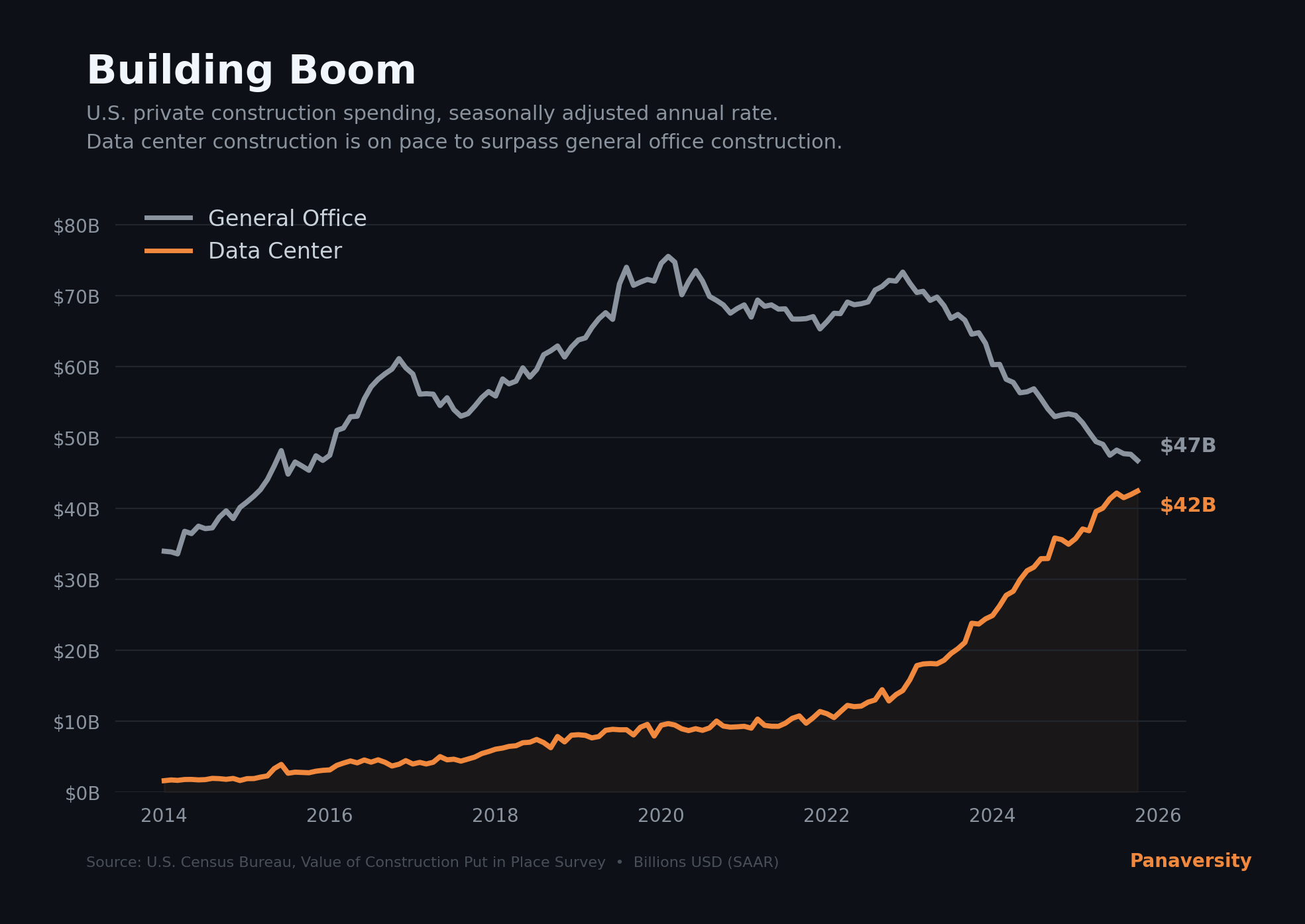
Source: U.S. Census Bureau, Value of Construction Put in Place Survey (SAAR)
Winners ko bechi gai seats se nahin naapa jayega. Unhein guaranteed outcomes se naapa jayega.
Yeh Kis Simt Ishara Karta Hai
Thesis us cheez ka difa karti hai jo Agent Factory aaj aur qareebi mustaqbil mein build karti hai: software AI Workers, jo AI-Native Companies mein compose hote hain aur insaan-mediated commerce ke edges par transact karte hain. Is document ka earned scope yahi hai. Lekin architecture apni scope se aage jati hai, aur band karne se pehle teen trajectories ka naam lena zaroori hai.
Physical AI Workers. Wohi factory architecture jo software AI Workers build karti hai, embodied workers tak bhi barhti hai. Warehouse ka kaam karta hua robot, autonomous courier ke taur par chalti hui gaari, factory floor par machine — har aik wahi AI Worker hai jo usi authority envelope ke neeche hai, usi manager API ke zariye hire hota hai, aur aise runtime engine par chalta hai jo API calls ke bajaye actuators ko drive karta hai. Invariants nahin badalte. Compute layer ko bas jism mil jata hai. Jaise jaise embodied AI mature hoti hai, AI-Native Company ki workforce sirf digital nahin rahegi — us mein woh physical workers bhi shamil honge jo isi process se manufacture hue hon, isi architecture se govern hote hon, aur isi envelope ke liye accountable hon.
Fully autonomous economic agents. Thesis ka opening is trajectory ka naam leta hai; yeh section is claim ko justify karta hai. Jaise jaise AI Workers durable identity, payment rails, reputation, aur contractual capacity hasil karte hain, woh apni company ke tools rehne ke bajaye apni jagah khud economic actors banne lagte hain — dusri companies ke AI Workers se services khareedte hue, jinhein zaroorat ho unhein capacity bechte hue, capital jama karte hue, aur har transaction par insaan ke loop mein hue baghair agreements mein dakhil hote hue. Agent Factory manufacturing process hi rehti hai. Jo cheez badalti hai woh yeh hai ke manufacture kya kiya ja raha hai aur us ki autonomy kitni hai. Is se uthne wale sawalat — legal personhood, liability, taxation, antitrust — architectural sawalat nahin hain, lekin yeh bohat jald urgent ho jayenge, aur architecture ko jab yeh aayen to jawab dene ke liye tayyar rehna hoga.
Cross-company workforce mobility. Aaj AI Worker aik company build aur deploy karti hai. Jaise manufacturing layer mature hoti hai, AI Workers portable ho jate hain — aik company mein hire kiye jate hain, dusri mein transfer hote hain, aur mumkin hai ke aik waqt mein kai companies ke liye kaam karein. Paperclip ki hiring API intra-company se cross-company tak generalize ho jati hai. Mukhtalif companies ke authority envelopes aik hi AI Worker par overlap karte hain, contract ke zariye govern hote hue. AI Workers ka labor market aik real market ban jata hai — rates, reputations, specializations, aur turnover ke saath. Agent Factory unit ship karti hai; market usay route karti hai.
Yeh teen trajectories — embodiment, autonomy, aur mobility — architecture ki extensions hain, us se inhiraf nahin.
Invariants qaim rehte hain. Realizations evolve karti hain. Thesis khari rehti hai.