The Agent Factory Thesis: Sada Zuban Wala Version
AI mein fluent hain? Professional version parhein ->
Yeh version kis ke liye hai? Yeh version do qisam ke readers ke liye likha gaya hai: woh log jo technology aur business mein naye hain, aur woh log jin ki pehli zuban English nahin hai. Is version ki zuban simple rakhi gayi hai. Jumle chhote hain. Har aham lafz pehli dafa istemaal hote hi samjha diya gaya hai. Original thesis un readers ke liye bhi available hai jo terms pehle se jaante hain aur deeper version chahte hain. Dono versions aik hi baat kehte hain. Bas wahan tak pahunchne ke raaste different hain.
Is document ko parhne ke teen tareeqe
10-minute path - Sirf agla section parhein: "Yahan Se Shuru Karein: Pura Thesis 2 Pages Mein." Sirf woh section aap ko complete argument de dega.
30-minute path - Sections 1, 5, 9, 13, 15, aur 17 parhein. Aap ko core ideas ke saath aik worked example bhi mil jayegi.
Full path - Har section order mein parhein. Taqreeban 60 se 90 minutes. Yeh tab best hai jab aap depth, evidence, aur stories chahte hon.
Teeno paths aakhir mein aik hi jagah pahunchte hain. Woh path chunein jo aap ke waqt ke saath fit baithta ho.
Yahan Se Shuru Karein: Pura Thesis 2 Pages Mein
Agar aap ke paas sirf das minutes hain, to yeh section parhein. Is mein pura argument hai. Is ke baad jo kuch hai, woh isi idea ko dheere aur zyada examples ke saath samjhata hai.
Bari Tabdeeli
Pichhle bees saalon se technology companies aap ko software bechti rahi hain. Aap login karte the. Kaam khud karte the. Access ke liye har month payment karte the.
Ab woh model akela nahin raha. Us ke saath aik naya model uth raha hai. Nayi companies ban rahi hain jahan workers AI hain - tools nahin. Aap in companies se tool nahin khareedte. Aap un ki AI workforce ko apne liye kaam karne ke liye hire karte hain.
Farq ko is tarah samjhein. Microsoft aap ko Word bechta hai, aur document aap khud likhte hain. Naya model aap ko finished document bechta hai - AI worker ne likha, quality check hui, phir aap ko mil gaya. Aap ne tool ke liye nahin, result ke liye payment ki.
Pehle Yeh Teen Alfaaz Seekhein
- AI Worker (jise Digital FTE bhi kaha jata hai - Full-Time Employee jo software se bana ho): Aisi AI jo aik specific job karne ke liye banayi gayi ho, jaise human employee karta hai. Customer support, bookkeeping, sales - har aik role-shaped AI hai.
- AI-Native Company: Aisi company jahan zyada tar workers AI hote hain. Company wohi bechti hai jo yeh workers banate hain.
- The Agent Factory: AI workers aur un companies ko banane ka method jinhein yeh workers staff karte hain. Yeh khareedne wala product nahin - yeh seekhne wali practice hai.
Kaam Kaise Split Hota Hai
Humans direction set karte hain. AI kaam karta hai. Humans results check karte hain.
Yahi 10-80-10 rhythm hai:
- Pehla 10% - human clear plan likhta hai (goal, limits, budget)
- Beech ka 80% - AI workers actual kaam karte hain
- Aakhri 10% - human check karta hai aur approve karta hai
Teen cheezein humans ke paas rehti hain aur kabhi AI ko transfer nahin hotin: intent (yeh jaanna ke aap kya chahte hain), verification (yeh jaanna ke kya aap ko woh mila), aur result ki zimmedari (result ki zimmedari lena).
Future Company Ki Do Layers
Aik human bees AI workers ko haath se manage nahin kar sakta. Is liye company ki do layers hoti hain:
- Edge Layer - Har human ke paas personal AI agent hota hai (aik delegate) jo usay jaanta hai aur us ki taraf se act karta hai.
- AI Workforce Layer - Specialist AI workers actual jobs karte hain, aur unhein management layer coordinate karti hai.
Aap apne delegate se baat karte hain. Aap ka delegate workforce se baat karta hai. Results wapas aap ke paas aate hain.
Powerful AI Tool Istemaal Karne Ke Do Tareeqe
Jab aap general AI tool ke saath baithte hain, to aap do mein se aik kaam kar rahe hote hain:
- Problem-solving - Aap ke paas abhi problem hai, aap finished answer chahte hain, session khatam ho jata hai. Bug fix karein. Report analyze karein.
- Manufacturing - Aap naya AI worker bana rahe hain jo is session ke baad bhi chalta rahega. Output answer nahin. Output permanent worker hai jo ab se answers produce karega.
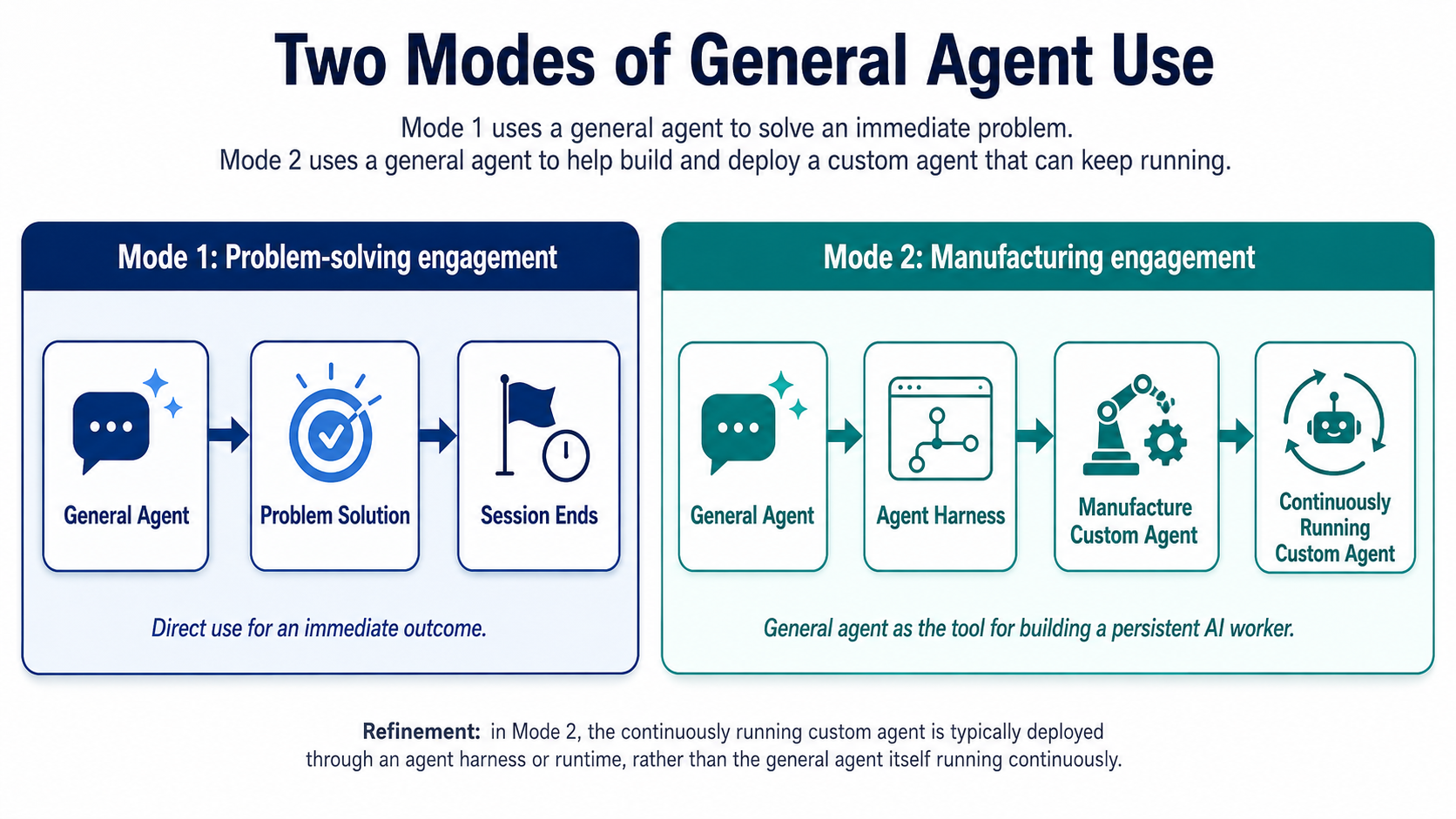
Aik mode aaj ka problem solve karta hai. Dusra mode kal ka worker banata hai.
Saat Rules Jo Nahin Badalte
Kisi bhi AI-Native Company ki architecture saat rules par chalti hai:
- Human in charge hai. Har action us human tak trace hota hai jis ne direction set ki.
- Har human ke paas delegate hota hai. Aik AI agent aap ko represent karta hai aur aap ki taraf se act karta hai.
- Workforce ke paas management layer hoti hai. Yeh workers hire karti hai, kaam assign karti hai, budgets control karti hai.
- Har worker right engine istemaal karta hai. Important kaam ke liye reliable engines. Routine kaam ke liye cheaper engines.
- Har worker system of record istemaal karta hai. AI workers company ki official memory se parhte hain aur us mein likhte hain.
- Workforce rules ke under grow kar sakti hai. Jab gap aaye, system naya worker hire karta hai - human ki set ki hui limits ke andar.
- Company nervous system par chalti hai. Events workers ke darmiyan automatically flow karte hain, crashes survive karte hain, aur traffic control karte hain.
Rules nahin badalte. Aaj jo specific products unhein fill karte hain (OpenClaw, Paperclip, Inngest, aur dusre) woh badal jayenge - aur yeh theek hai. Tools badalte hain. Rules rehte hain.
Yeh Real Kyun Hai, Forecast Nahin
Yeh 2030 ki prediction nahin. 2026 tak:
- AI agents chaar open payment standards (ACP, AP2, x402, MPP) ke zariye khud cheezon ki payment kar sakte hain.
- Kuch companies jin mein sirf chand human employees hain, almost entirely AI workforce ke saath aik billion dollars per year revenue report kar rahi hain.
- U.S. history mein pehli dafa AI workers ke workplaces (data centers) banane par human workers ke workplaces (offices) se zyada paisa kharch ho raha hai.
- Cursor ke apne product mein 35% changes AI agents ne apne aap kiye, humans ne sirf problem set kiya aur result review kiya.
Is Ka Aap Ke Liye Matlab
- Agar aap developer hain, to aap coder se results ke designer ban rahe hain. Aap har line nahin likhte. Aap AI workers ko direct karte hain ke woh whole products banayein.
- Agar aap business chalate hain, to aap tools khareedne se workforces hire karne ki taraf ja rahe hain. Pricing unit "per seat" se "per result" par shift hota hai.
- Agar aap study kar rahe hain, to sab se valuable skill fast typist hona nahin rahi. Valuable skill clear specs likhna, right system of record chunna, aur quality verify karna hai.
Yaad Rakhne Ke Paanch Parts
Agar aap is pure document se aur kuch yaad na rakhein, to AI-Native Company ke yeh paanch parts yaad rakhein:
- Aik human decide karta hai ke kya hona chahiye.
- Aik personal agent (delegate) human ko represent karta hai aur us ki authority carry karta hai.
- Aik management layer AI workers ko kaam assign karti hai aur budgets control karti hai.
- AI workers actual kaam karte hain, har aik job-shaped hota hai.
- Aik system of record truth store karta hai - company waqai kya jaanti hai.
Is book ki baqi har cheez in paanch parts ke oopar detail hai. Agar kabhi lost feel ho, is list par wapas aa jayein.
Yahan Se Aage Kahan Jayen
Agar yeh summary samajh aa gayi hai aur aap depth chahte hain, to yeh hai ke har key section kya add karta hai:
- Section 1 - Big picture: AI-Native Company kya hai aur kya bechti hai
- Section 5 - Woh chaar vocabulary words jo har jagah wapas aate hain
- Section 9 - Production Engine kaise kaam karta hai (architecture ka heart)
- Section 13 - Two-Layer Model
- Section 15 - Seven Rules detail mein
- Section 17 - A worked example: support-ticket AI worker 5 steps mein banayein
Yeh chhe sections 30-minute path hain. Ya har section order mein parhein - har idea pichhle idea ke oopar banta hai.
Yahi pura thesis hai. Is ke baad har cheez wahi idea hai, bas dheere.
Mukhtasar Glossary
Yeh is book ke sab se important words hain. Har word aage pehli dafa appear hone par phir zyada detail mein explain hoga. Agar baad mein lost feel ho, yahan wapas aa jayein.
- AI Worker (ya Digital FTE) - Aisa AI system jo aik specific job karne ke liye banaya gaya ho, jaise customer support rep ya financial analyst. FTE ka matlab Full-Time Employee hai.
- AI-Native Company - Aisi company jahan zyada tar workers AI hote hain, human nahin. Isay Agentic Enterprise bhi kaha jata hai.
- Agent Factory - AI-Native Companies banane ka method. Product nahin. Kaam karne ka tareeqa.
- Delegate - Aap ka personal AI agent. Yeh aap ko jaanta hai aur aap ke liye act karta hai. Isay identic AI ya personal agent bhi kaha jata hai.
- System of Record - Company ki official memory. Woh jagah jahan truth hota hai: customers, orders, money, contracts. AI workers is se parhte hain aur is mein likhte hain.
- MCP - AI ke liye universal connector. Is ka matlab Model Context Protocol hai. USB jaisa, lekin AI ke liye. Yeh kisi bhi AI worker ko kisi bhi tool ya data source se aik shared standard ke through connect karne deta hai.
- Spec - Clear written instruction jo AI worker ko batati hai ke kya karna hai. Casual chat message nahin - carefully written plan.
- Skill - Chhota portable package jo AI worker ko aik specific cheez achhi tarah karna sikhata hai.
- Invariant - Aisa rule jo nahin badalta. Design ki structural requirement.
- Reference Implementation - Woh specific product jo hum aaj rule par chalne ke liye istemaal karte hain. Kal replace ho sakta hai bina rule toray.
- Engagement - Aik single session jahan human general AI agent ke saath kaam karta hai. Do modes: problem-solving (abhi aik cheez solve karo, session khatam) aur manufacturing (company ke liye permanent AI worker banao).
Parhai Ki Madad
Is thesis ka slideshow version bhi available hai. Kuch readers prose ke bajaye slides se behtar seekhte hain. Wahi ideas, visuals ke saath: View the Full Presentation on Google Slides
1. Aik Nayi Qisam Ki Company Paida Ho Rahi Hai
Sochiye aaj technology companies paisa kaise banati hain.
Microsoft aap ko Word bechta hai. Salesforce aap ko customers track karne ka tool bechta hai. Zoom aap ko video calls bechta hai. Aap unhein har month payment karte hain. Aap login karte hain. Kaam khud karte hain. Software aik tool hai. Useful hai, lekin sirf tab jab human buttons press kare.
Software bechne ka yeh tareeqa SaaS kehlata hai. Yeh word "sass" ki tarah bola jata hai. Is ka matlab Software-as-a-Service hai. Aap software own nahin karte. Aap usay rent karte hain. SaaS pichhle bees saalon se technology ka main business model raha hai.
Ab woh model akela nahin raha. Us ke saath aik naya model uth raha hai.
AI ke daur mein sab se valuable companies aap ko tools nahin bechein gi. Woh AI workers banayengi aur workers aap ko rent par dengi.
Ab dheere se samjhte hain.
Aik AI worker aisa AI system hai jo aik specific job karne ke liye banaya gaya hai - wahi qisam ki job jo human employee karta hai. Kuch examples:
- Aik AI worker jo customer support handle karta hai. Questions parhta hai, customer accounts check karta hai, replies likhta hai, aur hard cases human ko bhejta hai.
- Aik AI worker jo bookkeeping karta hai. Expenses sort karta hai, accounts check karta hai, aur monthly reports tayyar karta hai.
- Aik AI worker jo sales work, legal contract review, ya data analysis karta hai.
Har aik job ki shakal wali AI hai. Yeh instructions leti hai, tools istemaal karti hai, aur kaam complete karti hai.
Is book mein hum in AI workers ko Digital FTEs bhi kehte hain. FTE ka matlab Full-Time Employee hai - companies permanent staff ko count karne ke liye yeh term istemaal karti hain. Aik FTE ka matlab aik full-time job. To Digital FTE ka simple matlab hai "insan ke bajaye software se bana hua full-time employee" - 24/7 kaam karta hua, puri role lete hue, sirf aik single task mein help nahin karta.
In AI workers ke gird bani company ko AI-Native company kehte hain. Is company ke andar zyada tar workers human nahin hote. Woh AI hote hain. Aur company jo bechti hai, woh kuch bhi ho sakta hai jo us ke AI workers banate hain: software, decisions, services, advice, transactions, ya kisi bhi qisam ka finished work.
Big change yeh hai.
Aap in companies se product nahin khareedte. Aap un ki AI workforce ko apne liye job karne ke liye hire karte hain. Yeh accounting firm hire karne jaisa hai jo aap ki books close kare, ya law firm hire karne jaisa hai jo contract draft kare. Aap tool ke liye payment nahin kar rahe. Aap finished work ke liye payment kar rahe hain.
Aur aage aur bhi kuch aa raha hai. AI workers jald independent economic actors ban jayenge. Is ka matlab hai woh:
- Apne aap services khareed sakenge.
- Jis computing power ki zaroorat ho us ki payment kar sakenge.
- Jo data chahiye ho woh khareed sakenge.
- Dusre AI workers ko madad ke liye payment kar sakenge.
Yeh sab har chhoti purchase par human approval ke baghair.
Yeh naye software type se bari cheez hai. Yeh nayi qisam ki company hai.
Yeh book isi ko banana sikhati hai.
Agent Factory in companies ko banane ka method hai. Yeh rules, design, aur discipline ka set hai. Aap isay AI workers design karne, unhein kaam par lagane, aur un ke gird business chalane ke liye istemaal karte hain. Word factory important hai. Real factory cars ya phones banane ke liye clear, repeatable method par chalti hai. Agent Factory AI workers banane ke liye clear, repeatable method par chalti hai. Yeh product nahin jo aap khareed sakte hain. Yeh kaam karne ka tareeqa hai jo aap seekhte aur istemaal karte hain.
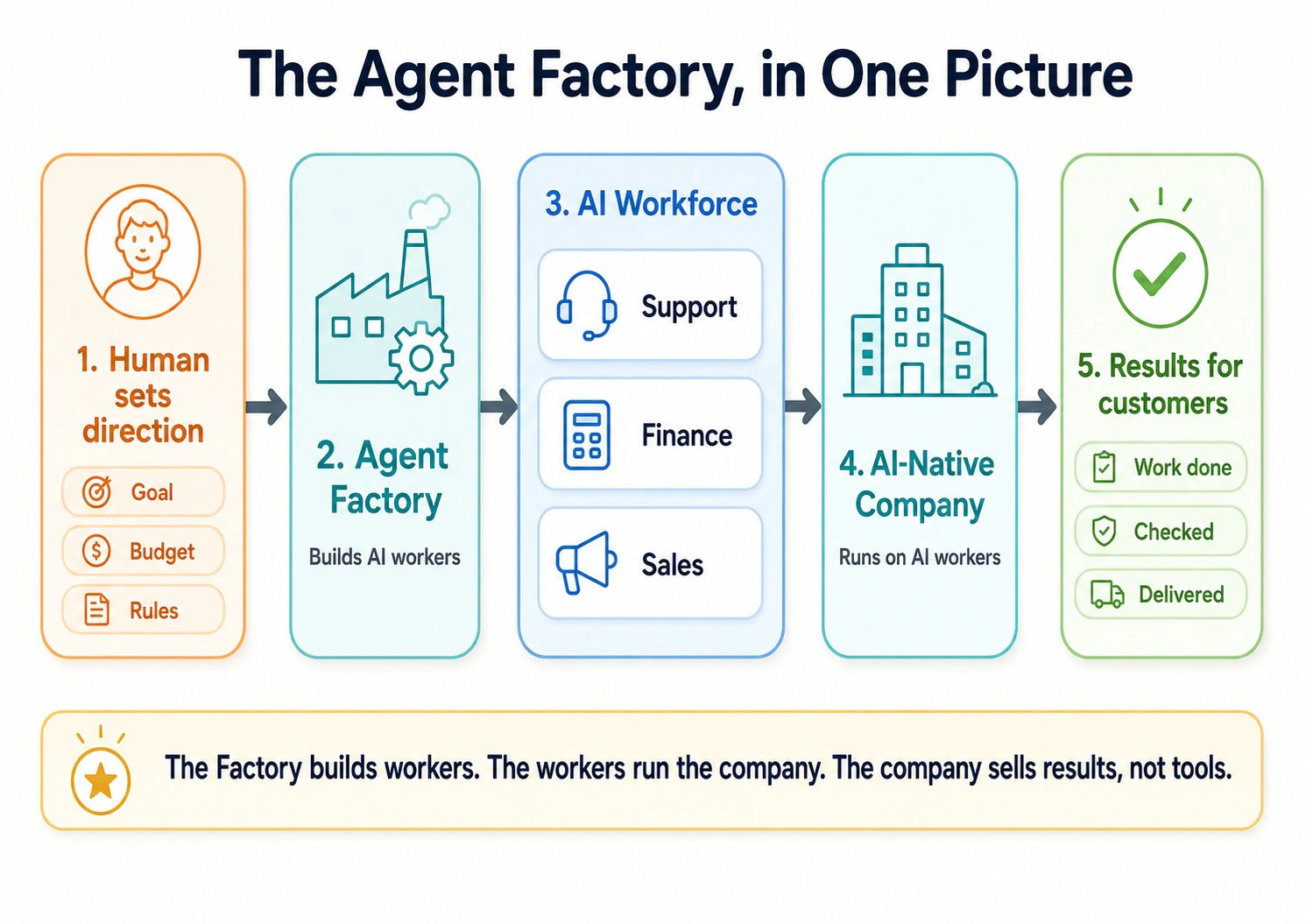
Puri picture paanch stages mein. (1) Human direction set karta hai - goal, budget, rules. (2) Agent Factory AI workers banati hai. (3) Workers different departments staff karte hain - Support, Finance, Sales. (4) Mil kar AI-Native Company chalate hain. (5) Company customers tak finished results pahunchati hai.
2. AI Pehle Hi Cheezon Ki Payment Kar Sakta Hai
Jab hum kehte hain ke AI workers "independent economic actors" banenge, to yeh science fiction lag sakta hai. Yeh science fiction nahin. Basic systems jo AI agents ko cheezon ki payment karne dete hain, 2026 mein already kaam kar rahe hain.
Yeh chaar payment systems AI agents ke liye banaye gaye hain taake woh humans ke liye buy aur sell kar saken. Aap ko names yaad rakhne ki zaroorat nahin. Point yeh hai: yeh aaj real hai.
- ACP - OpenAI (jo ChatGPT banati hai) aur Stripe (bari online payment company) ne banaya. Jab ChatGPT chat ke andar aap ke liye kuch khareedta hai - jaise koi product order karna jo aap ne poocha - ACP payment handle karta hai.
- AP2 - Google ka version. 60 se zyada companies isay istemaal karne par agree kar chuki hain. Yeh digital permission slip jaisa kaam karta hai. Human slip sign karta hai: "Yeh AI agent is month cloud services par $500 tak spend kar sakta hai." Agent payment karte waqt yeh slip carry karta hai. Slip strong digital security se signed hoti hai, is liye koi isay fake nahin kar sakta.
- x402 - Cryptocurrency ke gird built payment standard. Pehle Coinbase ne banaya. Early 2026 mein Stripe ne isay normal payment systems se connect kiya. Ab crypto payments aur card payments same agent payment system istemaal kar sakte hain.
- MPP - Bahut chhoti, repeated payments ke liye system. Sochiye aik AI agent service stream karta hai aur har second cent ke fraction ki payment karta hai. Normal credit cards ke saath fees payment kha jayengi. MPP is qisam ki tiny payment mumkin banata hai.
Plumbing ready hai. Yeh kaam ki shape ko badal deta hai.
3. Tools Se Results Ki Taraf Shift
SaaS subscriptions bechta tha. Aap access ke liye har month payment karte the. Chahe aap tool achhi tarah istemaal karein ya buri tarah, seller ko same payment milti thi. Seller access deta tha. Kaam aap karte the.
Agent Factory era results bechta hai. Humans kehte hain ke woh kya chahte hain. AI agents kaam karte hain. Humans check karte hain ke result achha hai ya nahin.
Beech wala step - typing, clicking, cheezein connect karna, kaam karna - AI sambhal leta hai. Humans ke paas woh kaam rehta hai jo machines hamare liye nahin kar saktin: yeh jaanna ke hum kya chahte hain, aur yeh jaanna ke kya hamein woh mila.
Teen cheezein human hands mein rehti hain:
- Intent - yeh jaanna ke aap kya chahte hain, aur usay clear kehna.
- Verification - check karna ke AI ka kaam good aur correct hai ya nahin.
- Result ownership - result ka responsible person hona.
Aap yeh teen cheezein AI ko nahin de sakte. Judgment, values, "good enough" ka standard - yeh sab person se aana hota hai. AI middle part karta hai.
4. Aap Ka Personal AI Helper
Yahan aik problem hai. Agar company ke paas bahut se AI workers bahut si cheezein kar rahe hon, to koi single human un sab ko haath se guide nahin kar sakta. Aap pura din har worker ko instructions nahin likh sakte. To phir aap in charge kaise rehte hain?
Jawab: aap ke paas apna personal AI agent hota hai - jo aap ko jaanta hai - aur aap workforce ko us ke through direct karte hain.
Is personal AI agent ke different names hain. Hum isay delegate kehte hain. Kuch log isay personal agent kehte hain. Business thinker Don Tapscott isay identic AI kehte hain. Word identic ka matlab "identity carry karna" hai. Yeh agent aap ki identity carry karta hai. Yeh aap ki judgment, preferences, aur decisions lene ki authority jaanta hai. Yeh general assistant nahin jo koi bhi istemaal kar le. Yeh aap ka representative hai. Yeh aap ki taraf se bolta hai. Yeh aise choices karta hai jo aap ki values se match karti hain. Yeh aap ke liye kaam right AI workers ko hand off karta hai.
Isay apne second self ki tarah samjhein jo aap ke saath parallel chalta hai. Yeh jaanta hai ke aap kya kahenge, aap kis cheez ka khayal rakhte hain, aur aap kya approve karenge. Jab chhoti cheezein aati hain - routine reply, scheduling choice, normal yes-or-no - yeh unhein aap ki tarah handle karta hai. Jab kisi cheez ko waqai aap ki zaroorat ho, yeh ruk kar poochta hai. Aap is ke boss nahin; yeh busy waqt mein halka sa aap hi hai.
Picture yeh hai:
- Agent Factory company ki AI workforce banati hai.
- Identic AI (aap ka personal agent) woh tareeqa hai jis se har human us workforce ko control karta hai.
Aap direction set karte hain. Aap ka personal agent us direction ko specific instructions mein badalta hai. AI workforce kaam karti hai. Aap results check karte hain.
5. Woh Alfaaz Jo Aap Ko Jaanna Chahiye
Aage badhne se pehle chaar important words lock kar lete hain. Yeh similar lagte hain, lekin in ka matlab different hai. Inhein mix karna confusion ki sab se common wajah hai.
The Agent Factory method hai. Yeh AI workers design, build, aur istemaal karne ka careful tareeqa hai. Agent Factory woh cheez hai jo aap istemaal karna seekhte hain. Yeh product nahin jo aap khareedte hain. Yeh practice hai jo aap adopt karte hain - jaise kitchen chalane ka naya tareeqa ya team chalane ka naya tareeqa.
The AI-Native Company output hai. Yeh woh running business hai jo Agent Factory banati hai. Us ke zyada tar staff AI workers hote hain. Management layer unhein jor kar rakhti hai. Humans top aur edges par sab kuch direct karte hain. AI-Native Company woh hai jo aap aakhir mein chalate hain. Is book mein hum isay Agentic Enterprise bhi kehte hain.
AI Workers workforce hain. Yeh AI-Native Company ke andar role-based AI agents hote hain. Inhein hire kiya jata hai, kaam diya jata hai, team par rakha jata hai, aur role khatam hone par retire kiya jata hai. Hum inhein Digital FTEs ya Digital Workers bhi kehte hain. Yeh company ki real labor hain.
System of record foundation hai. Yeh company ki official memory hai. Yeh woh jagah hai jahan truth hota hai: customer records, money records, stock counts, contracts, support tickets, business ke real facts. AI workers is jagah se parhte hain. Isi jagah wapas likhte hain. Is ke baghair AI worker sirf baat kar raha hota hai. Us ke kaam ke chipakne ki koi jagah nahin hoti. (Hum thori der mein explain karenge ke yeh itna important kyun hai.)
Sab mila kar: Factory Company banati hai. Company Workers employ karti hai. Workers system of record ke against kaam karte hain.
Yahan aik aur pair of words introduce karna zaroori hai, kyun ke hum inhein baar baar istemaal karenge.
Engagement aik single session hai jahan human general AI agent ke saath kaam karta hai. Is ke do types hain:
- Problem-solving engagement - Aap AI agent ke saath baith kar problem solve karte hain. Aap answer lete hain. Example: developer AI coding helper ke saath bug fix karta hai. Session shuru hota hai, kaam khatam hota hai, session khatam.
- Manufacturing engagement - Aap AI agent ke saath baith kar naya AI worker banate hain. Naya AI worker is session ke baad bhi kaam karta rahega. Example: customer support AI banana jo har roz tickets answer kare.
Same tools. Different goal. Hum is farq par wapas aayenge.
6. Rules Jo Kabhi Nahin Badalte Vs. Tools Jo Badal Jayenge
Next sections mein hum AI-Native Company ka design describe karenge. Is dauran aap do qisam ke statements dekhenge. Dono similar lagte hain, lekin matlab bahut different hai.
Invariant structural rule hai jo hamesha true rehna chahiye. Word invariant bas fancy lafz hai "aisa rule jo nahin badalta." Isay building rule ki tarah samjhein jo kehta hai, "Har building ke paas roof ko sambhalne ke liye strong wall honi chahiye." Rule yeh nahin kehta ke wall kis material ki bani ho. Brick, concrete, steel - koi bhi chal sakta hai. Lekin kuch na kuch roof sambhalna chahiye.
Reference implementation woh specific product hai jo hum abhi us rule par chalne ke liye istemaal karte hain. Yeh aaj ki best choice hai. Agle saal better choice aa sakti hai. Jab aisa ho, aap naya product swap kar dete hain, aur system ka baqi hissa kaam karta rehta hai - kyun ke system product ke gird nahin, rule ke gird bana tha.
Is book mein jab hum product name karte hain - example, "hum OpenClaw ko personal agent ke tor par istemaal karte hain" - to woh product reference implementation hai. Rule hai "har human ko personal agent chahiye." OpenClaw us rule ko follow karne ka aik tareeqa hai. Agle saal better personal agent aa sakta hai. Aap us par switch kar sakte hain bina baqi system toray.
Yeh important hai. Technology fast move karti hai. Aaj ke products shayad do saal mein exist na karein. Lekin rules bahut dheere badalte hain. Building khari rehti hai, furniture badal jata hai.
Jab hum products name karein, unhein 2026 ki best choice samjhein. Rule khud nahin.
Is book ko parhne ke liye simple guideline: product names memorize mat karein. Woh job memorize karein jo har product perform karta hai. Job rehti hai. Product badalta hai.
7. Purani Duniya Vs. Nayi Duniya
Yahan side-by-side comparison hai ke pehle cheezein kaise kaam karti thin aur Agent Factory era mein kaise kaam karti hain.
Shift aik picture mein. Old model: aap software rent karte hain aur kaam khud karte hain. New model: aap AI workers hire karte hain aur woh aap ko finished results dete hain. Neeche table full breakdown dikhata hai.
| Question | SaaS Era (Tools) | Agent Factory Era (Labor) |
|---|---|---|
| Kya becha jata hai? | Software tools | AI workers |
| Price kaise set hoti hai? | Monthly fee, aksar per user ("per seat") | Per result |
| Kaam kaun karta hai? | Human, tool istemaal karte hue | AI, human supervision ke saath |
| Kaam ko jo cheezein chahiye woh kaun khareedta hai? | Humans tools aur services khareedte hain | AI agents compute, data, aur services apne aap khareedte hain |
| Human ka job kya hai? | Operator - jo buttons press karta hai | Supervisor - jo direction set karta hai aur quality check karta hai |
| Tools kaise connect hote hain? | One-by-one custom connections | Universal connector called MCP (neeche explain hai) |
| Focus | Kaam kaise hota hai | Yeh ke kaam ho gaya - aur correct hai |
"Per seat" se "per result" par shift sab se bari tabdeeliyon mein se aik hai. Aaj company har employee ko tool istemaal karne ke liye $30 per month deti hai. Nayi duniya mein company results ke liye pay karti hai: har closed support ticket ke liye $5, har good sales lead ke liye $50, har finished monthly close ke liye $200. Jis cheez ke liye aap payment karte hain, woh us cheez se match karti hai jo aap receive karte hain.
8. Teen Layers: Intent, Engine, Result
Agent Factory ki teen high-level layers hain.
- Intent - plan. Aap kya karwana chahte hain? Goals kya hain? Limits kya hain? Budget kya hai? Kya allowed hai?
- The Production Engine - woh system jo intent ko result mein badalta hai. Hum next section mein isay explain karenge.
- Result - finished work, jo aap tak pahunchta hai, correctness ke liye check hota hai, aur feedback ke zariye time ke saath improve hota hai.
Aap intent likhte hain. Engine result banata hai. Humans check aur improve karte hain. Yahi loop hai.
9. Production Engine Kaise Kaam Karta Hai
Production engine is puri book ka sab se important idea hai. Yeh woh system hai jo aap ki chahat ko result mein badalta hai. Aap ki instruction aur final result ke darmiyan jo kuch hota hai, woh isi engine ke andar hota hai.
Yeh app nahin jo aap download karte hain. Yeh single software piece nahin. Yeh design hai. Yeh plan plus rules ka set hai, un systems ko banane ke liye jahan AI workers create, combine, aur kaam par lagaye jate hain.
Car factory example. Car factory imagine karein. Raw materials - steel, rubber, glass - aik side se andar aate hain. Steel welding station par jata hai. Wahan workers usay frame ki shakal dete hain. Frame paint station par jata hai. Wahan color lagta hai. Phir assembly station par jata hai. Wahan engine, seats, tires, aur electronics add hote hain. Line ke end par finished car nikalti hai. Check hoti hai aur drive ke liye ready hoti hai.
Agent Factory bhi isi tarah kaam karti hai. Sirf differences yeh hain:
- Raw material aap ka intent hai - jo aap karwana chahte hain.
- Stations AI workers hain - har aik job ke aik part ko handle karta hai.
- Finished product checked result hai - real answer, jise correct confirm kiya gaya hai.
Chaar cheezein is factory ko power karti hain.
Specs written instructions hain. Yeh AI workers ko batati hain ke kya karna hai - goal, limits, success ke rules. Spec casual chat message nahin. Yeh carefully written plan hai, us qisam ka jo project manager human team ke liye likhta hai. Good specs likhne ki skill ko spec-driven development kehte hain.
Skills woh abilities hain jo har AI worker job mein lata hai. Skill chhota, portable package hota hai. Yeh AI worker ko aik specific cheez achhi tarah karna sikhata hai. Examples: "professional email kaise likhna hai" ya "sales contract kaise parhna hai." Skills aik open standard follow karti hain jise Agent Skills format kehte hain. Anthropic (jo Claude AI banati hai) ne standard create kiya. Ab industry isay istemaal karti hai. Kyun ke skills shared format follow karti hain, aap unhein different AI systems ke darmiyan move kar sakte hain. USB stick ki tarah jo kisi bhi laptop mein kaam karti hai.
Feedback loops woh tareeqa hain jis se system seekhta hai. Har result milne ke baad result review hota hai. Jo seekha jata hai woh system mein wapas feed hota hai. Mistakes fix hoti hain. Good patterns rakhe jate hain. Factory time ke saath behtar hoti hai.
MCP universal connector hai. MCP ka matlab Model Context Protocol hai. MCP ko samajhne ka sab se aasan tareeqa: isay AI ke liye USB samjhein. USB se pehle har device ka apna special cable hota tha. Printers ka aik type. Mice ka dusra. Cameras ka teesra. Mess tha. USB ne yeh fix kiya. Ab har device same cable istemaal karta hai. MCP AI ke liye wahi kaam karta hai. Yeh kisi bhi AI worker ko kisi bhi tool ya data source se aik shared standard ke through connect karne deta hai. MCP ke baghair har AI worker ko har tool ke liye custom connection chahiye hota. MCP ke saath har important data store kisi bhi permitted AI worker tak pahunch sakta hai.
Together: Skills AI workers ko abilities deti hain. MCP unhein connections deta hai. Yeh do open standards factory ka floor hain.
Sab ke neeche system of record hota hai - company ki official memory jiske bare mein hum pehle baat kar chuke hain. AI worker ka har action ya to is memory se parhta hai ya is mein likhta hai. System of record business ka truth hai.
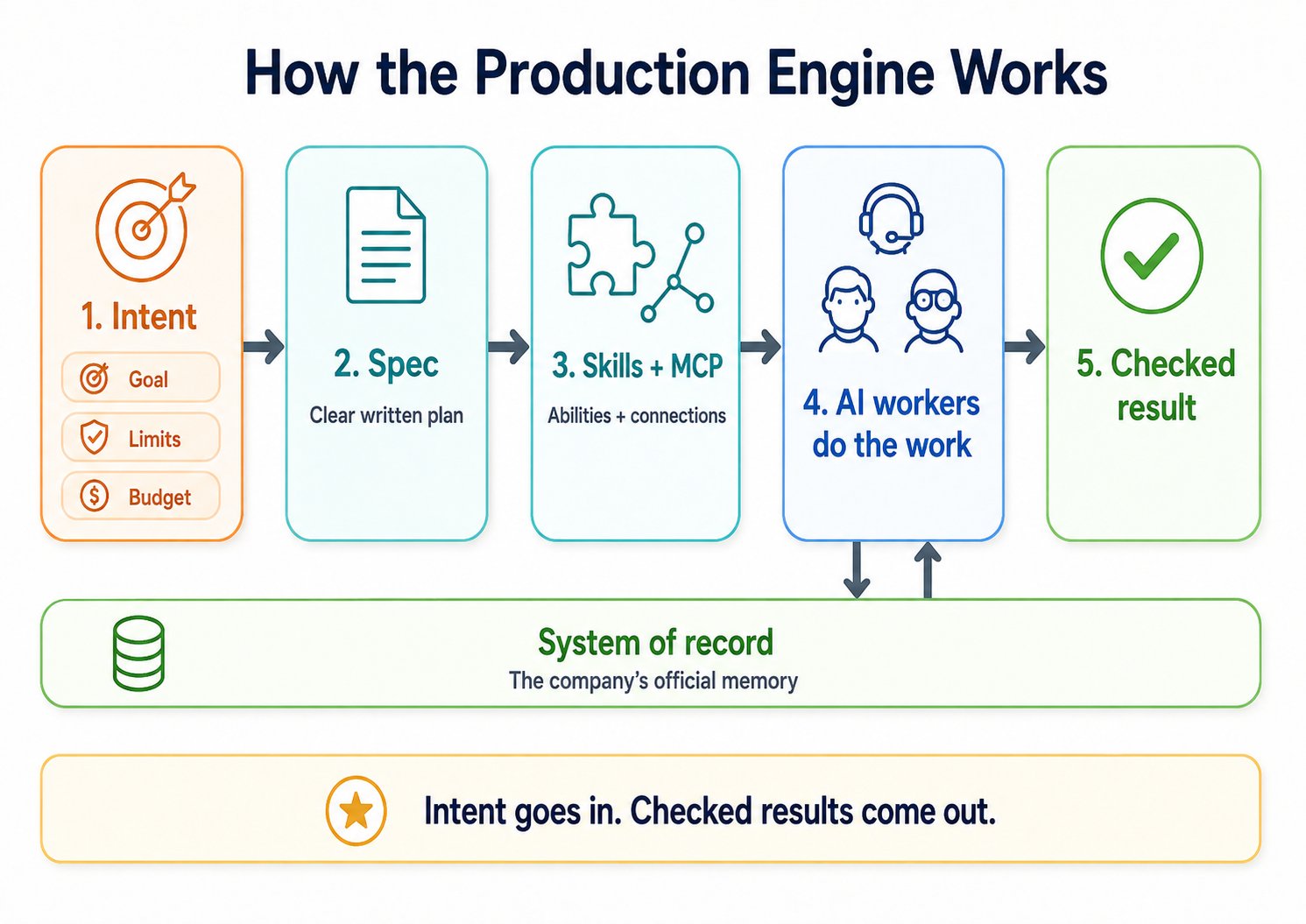
Production engine aik picture mein. Intent (goal, limits, budget ke saath) left se andar jata hai. Yeh spec se guzarta hai, phir skills aur MCP se, phir AI workers se. Right par checked result nikalta hai. Pura engine system of record ke oopar baitha hai - company ki official memory.
10. AI Agents Jo Cheezein Khareed Sakte Hain
Hum ne isay pehle touch kiya tha. Ab deeper jate hain. Yeh economics badal deta hai.
Aaj ke AI agents tasks karte hain. Kal ke AI agents markets mein hissa lenge. Change "AI as a tool" se "AI as a buyer" tak hai.
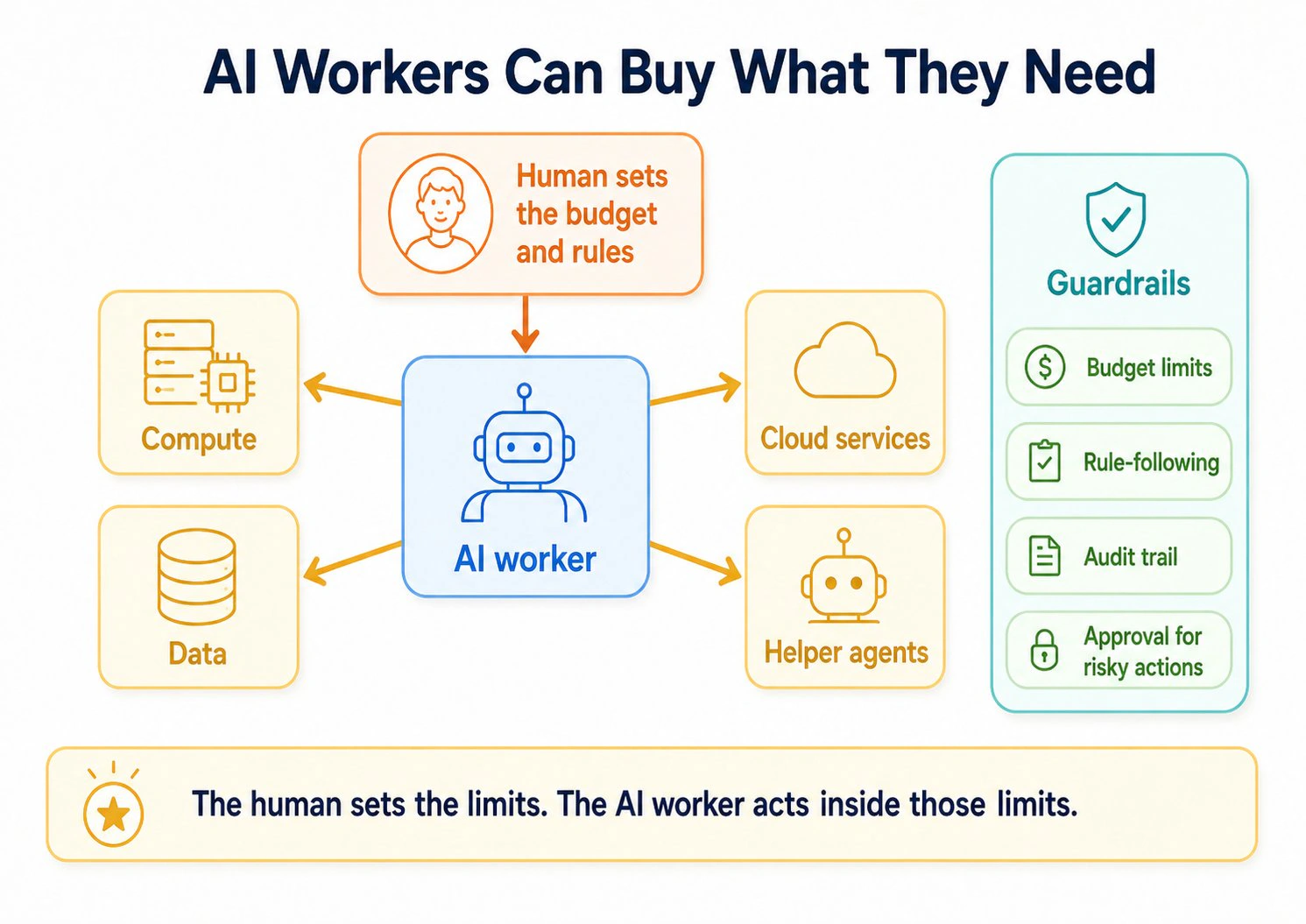
AI workers as economic actors. AI worker compute, data, cloud services, aur dusre AI workers ki help khareed sakta hai - lekin sirf human ke set kiye hue guardrails ke andar: budget limits, rule-following, har action ki audit trail, aur risky decisions ke liye approval gates.
Aik AI worker imagine karein jis ka goal hai: "Customer churn 15% kam karo." (Churn ka matlab business se customers ke chhorne ki rate hai.) Is goal tak pahunchne ke liye AI worker ko shayad yeh karna pade:
- Model train karne ke liye computing power khareedna jo predict kare ke kaun se customers chhor sakte hain.
- Data provider se richer customer data ke liye payment karna.
- Solution chalane ke liye cloud services set up karna aur un ki payment karna.
Yeh sab - budget aur rules ke andar jo human supervisor ne pehle set kiye.
Notice karein AI worker kya nahin kar raha. Yeh har chhote decision par human approval nahin maang raha. Human ne budget aur rules set kiye. Un rules ke andar AI worker apne aap act karta hai.
Yahan hard problem ability nahin. AI kaam already kar sakta hai. Hard problem trust hai - yeh yaqini banana ke AI rules ke andar rahe. Is liye focus in cheezon par ja raha hai:
- Rule-following - yaqini banana ke agent human ki set ki hui limits ke andar rahe.
- Audit trails - agent ki har choice aur har transaction ka complete record rakhna, taake baad mein check kiya ja sake.
- Liability - jab kuch ghalat ho to legally responsible kaun hai, yeh samajhna.
Jab AI workers cheezein khareed sakte hain, AI-Native Company ka money side gehri tarah badalta hai. Company sirf woh resources istemaal nahin karti jo humans ne diye. Woh apne resources khud dhoondti hai. Jo chahiye hota hai dhoondti hai. Options compare karti hai. Real time mein khareedti hai. Company aisa system ban jati hai jo apni needs khud sambhalta hai.
Builders ke liye lesson: apne AI agents aur systems ko day one se buying aur selling ke liye design karein. Agents ko sirf permissions nahin, budgets chahiye. Unhein sirf access keys nahin, results ke contracts chahiye. Jo companies yeh right karengi woh value ki next wave capture karengi - bilkul un companies ki tarah jo subscriptions se result-based pricing par shift hui aur yeh wave capture kar rahi hain.
11. Humans Replace Nahin Hote - Promote Hote Hain
Aam darr: AI agents logon ko replace kar denge.
Evidence ulta dikhata hai. Taqreeban har qisam ke task mein AI ke saath kaam karta hua human dono mein se kisi aik se better perform karta hai. Agent Factory human ko remove nahin karti. Usay promote karti hai.
- Operator se -> supervisor.
- Typist se -> editor.
- Coder se -> results ke designer.
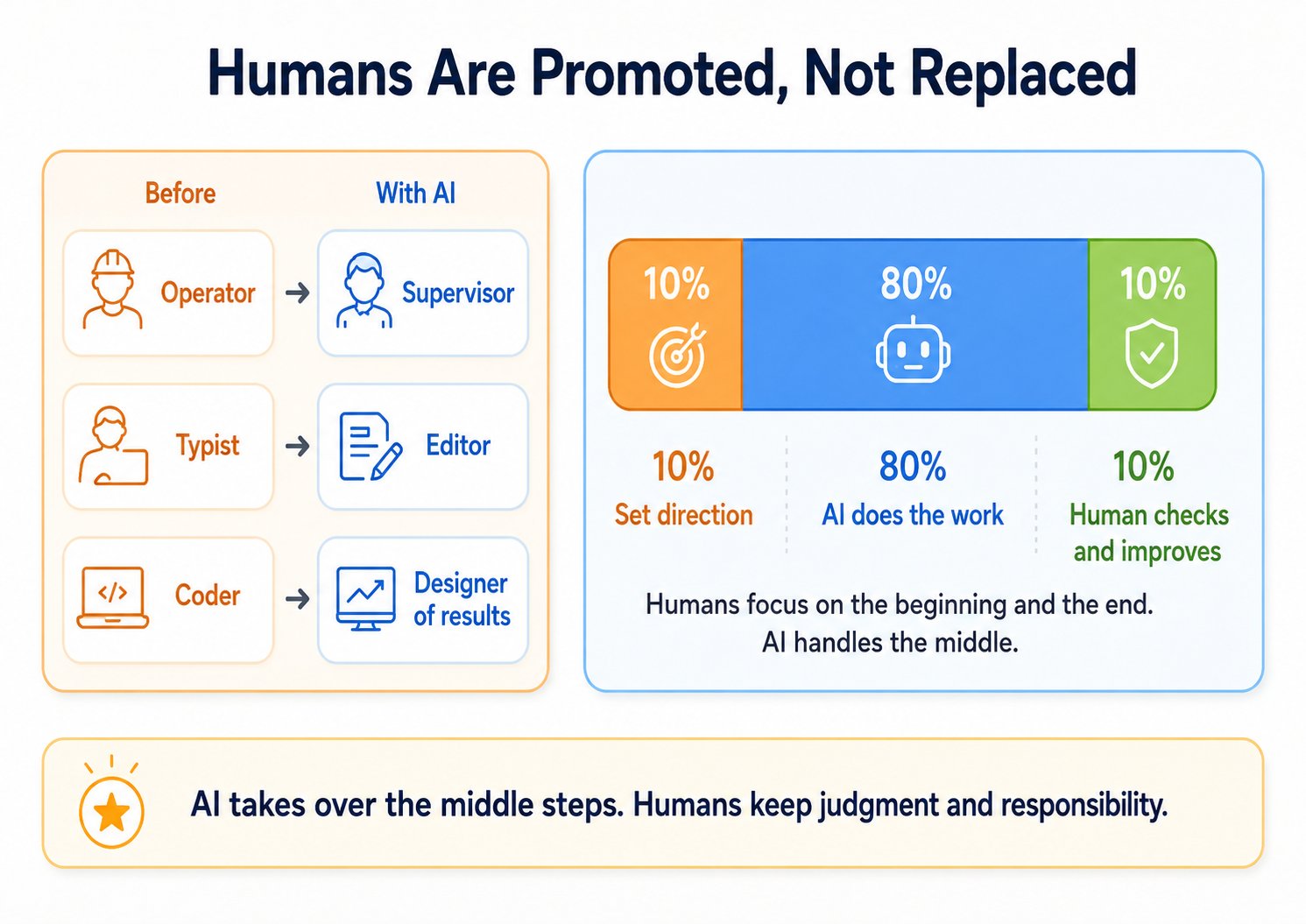
Humans promote hote hain, replace nahin. Human higher role mein move karta hai. AI middle steps sambhalta hai. Human start (direction) aur end (judgment aur responsibility) rakhta hai.
Yeh "tech professional" hone ka matlab badalta hai. Web developer ya mobile developer sirf woh nahin jo specific language mein code likhta hai. Woh technology expert hai. Woh systems samajhta hai. Woh samajhta hai ke data kaise flow karta hai. Woh samajhta hai ke apps aik dusre se kaise connect hoti hain. Woh samajhta hai ke users ko waqai kya chahiye. Agent Factory era mein yeh expertise bahut zyada valuable ho jati hai. Yeh ab aik aik button likhne par kharch nahin hoti. Yeh AI workers design, deploy, aur supervise karne par kharch hoti hai jo whole products dete hain.
Developer disappear nahin hota. Developer zyada karta hai.
Steve Jobs ne kayi saal pehle humans lead karte hue is working rhythm ko samajh liya tha. Hum isay seedha borrow kar sakte hain.
12. 10-80-10 Working Rhythm
Steve Jobs woh follow karte the jise ab 10-80-10 rule kehte hain:
- Apne waqt ka pehla 10% vision set karne par lagayein.
- Beech ka 80% team ko kaam karne dein.
- Aakhri 10% polish, improve, aur approve karne ke liye wapas aayen.
Business teacher Dan Martell isay isi tarah explain karte hain: 10% ideas ke liye, 80% kaam karne ke liye, 10% refine karne ke liye.
Jobs shuru se aise nahin the. Career ke early days mein woh har chhoti detail control karne ke liye mashhoor the. Unhon ne aik dafa team ko exactly bataya ke Macintosh calculator ka har pixel kaisa dikhna chahiye. Time ke saath woh badle. Unhon ne good people par middle 80% trust karna seekha. Apple isi change ki wajah se partly duniya ki sab se valuable companies mein se aik bani.
Ab "good people" ko "AI workers" se replace karein, aur aap ke paas Agent Factory ka working rhythm hai.
| Step | Jobs At Apple | The Agent Factory |
|---|---|---|
| First 10% - Intent | Jobs vision aur limits set karta hai | Human spec likhta hai: goals, limits, budget, rules |
| Middle 80% - Work | Apple ki teams product banati hain | AI workers kaam karte hain: tools istemaal karte hain, kaam dusre AI workers ko dete hain, results dete hain |
| Final 10% - Check | Jobs polish karta hai aur "ship it" kehta hai | Human checked result review, improve, aur approve karta hai |
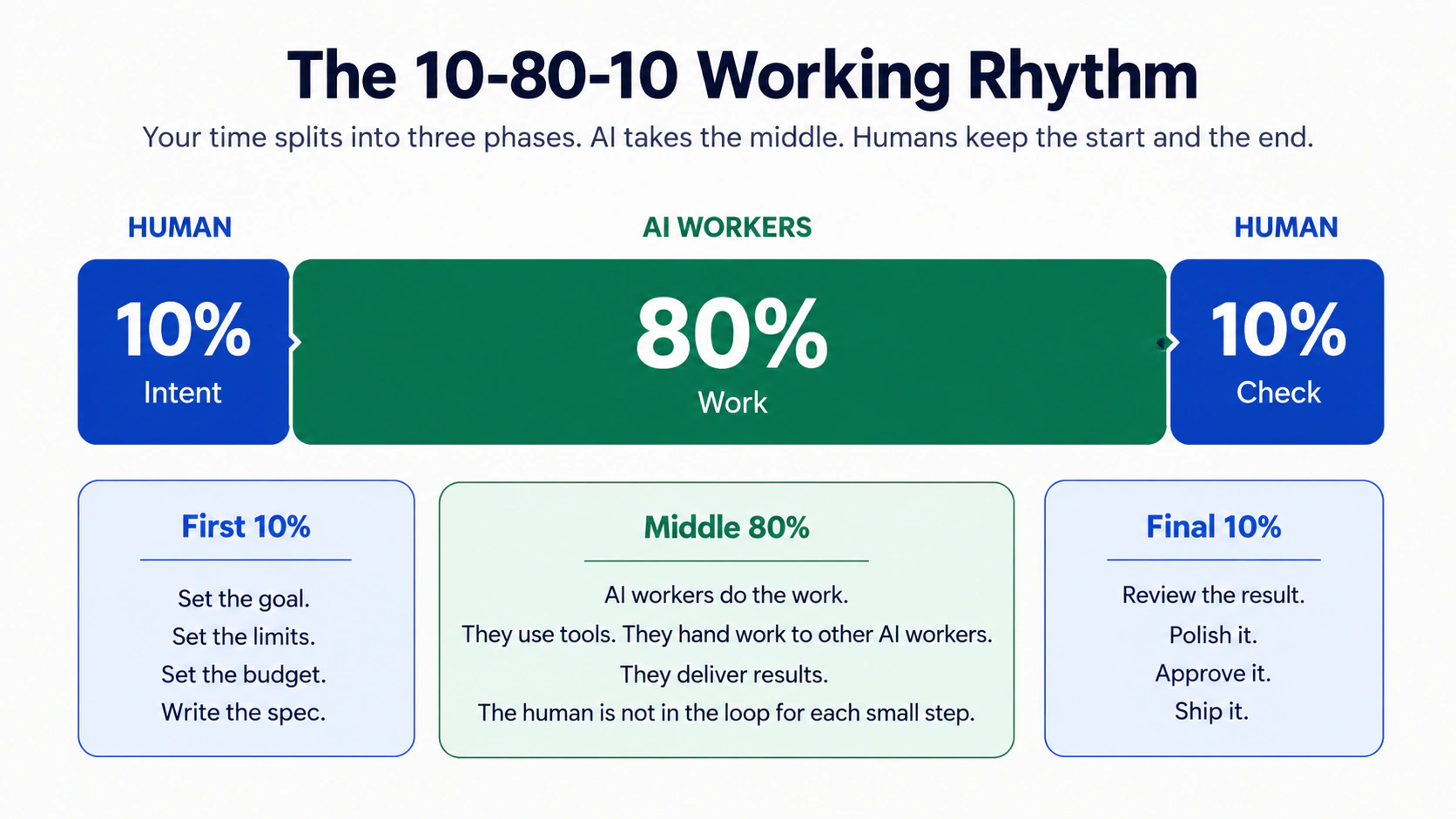
10-80-10 working rhythm. Pehla 10% human direction hai. Beech ka 80% AI worker hai. Aakhri 10% human checking hai.
Early 2026 mein AI coding company Cursor ne report kiya ke us ke apne product mein add hone wali 35% changes AI agents ne apne aap cloud computers par kaam karte hue ki. Human developers ne problem set karke aur finished work review karke agents guide kiye. Unhon ne code line by line guide nahin kiya. Cursor ke CEO Michael Truell expect karte hain ke aik saal ke andar zyada tar software development isi tarah dikhegi.
10-80-10 rhythm ab prediction nahin rahi. Yeh measurement hai ke leading companies already kahan kaam kar rahi hain.
Human jo check karta hai woh bhi badal raha hai. Past mein developer code line by line review karta tha. Ab AI agents cloud computers par ghanton kaam karte hain. Woh short videos return karte hain ke unhon ne kya kiya, working previews jo aap click karke dekh sakte hain, aur easy-to-read logs. Aap code line by line nahin parhenge. Aap short video dekhenge ya preview mein click karke work check karenge. Yeh important hai: human aik waqt mein twelve sets of code changes nahin parh sakta. Lekin human aik waqt mein twelve previews scan kar sakta hai. Yahi cheez many AI agents ko parallel kaam karne ke qabil banati hai.
Yeh rhythm sirf coding ke liye nahin. Har professional job ke liye kaam karti hai. Pehla 10% - clear thinking, context set karna, careful prompting - sirf humans ke liye hai. Middle 80% - summarizing, generating, analyzing, formatting, drafting - AI sambhalta hai. Final 10% - judgment, refinement, quality control - phir humans ke liye hai.
Aap apne waqt ka 80% kaam karne par kharch karna band karte hain. Aap apni 100% attention us 20% par lagana shuru karte hain jo sirf human kar sakta hai - start par direction set karna, aur end par quality achhi hai ya nahin yaqini banana.
13. Do Layers: Personal Aur Workforce
Ab hum future company ki full picture draw kar sakte hain.
AI workers woh tareeqa hain jis se kaam hota hai. Lekin humans AI workers se directly baat nahin karte. Yeh manage karna bahut mushkil hoga. Is ke bajaye humans apne personal AI agent se baat karte hain (pehle wala delegate ya identic AI). Personal agent human intent ko workforce ke liye instructions mein badalta hai.
Is se Two-Layer Model milta hai:
| Layer | Is mein kya hota hai | Kis ko serve karta hai | Kya karta hai |
|---|---|---|---|
| Edge Layer | Aap ka personal AI agent (delegate) | Individual human | Aap ke intent ko instructions mein badalta hai, AI workers ko kaam deta hai, aap ke liye choices karta hai |
| AI Workforce Layer | Role-based AI workers | Company | Tasks karta hai, workflows chalata hai, checked results deta hai |
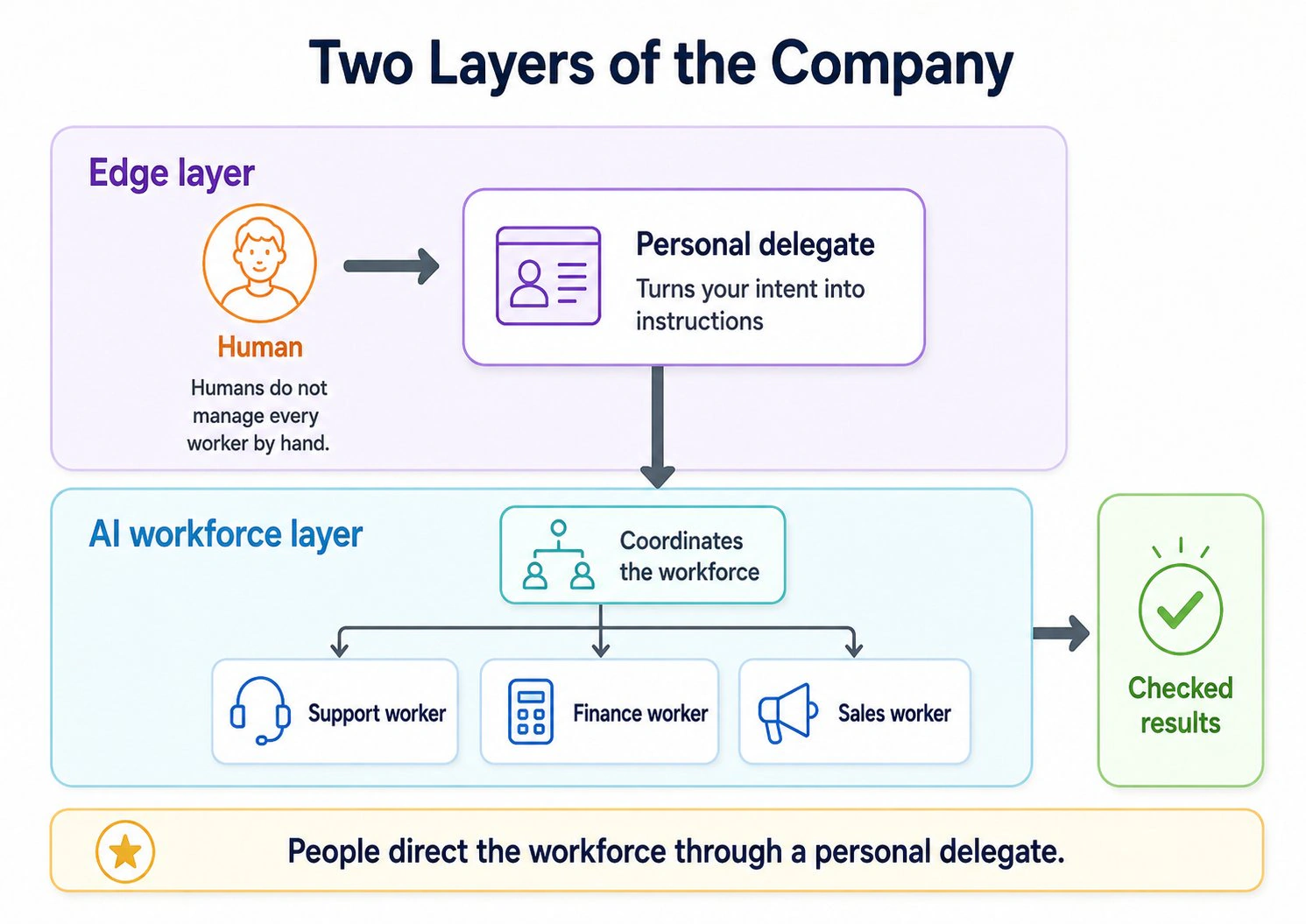
Two-Layer Model motion mein. Intent neeche flow karta hai: aap -> aap ka personal delegate -> workforce coordinator -> AI workers. Results wapas oopar aap tak aate hain, already checked. Aap har worker ko haath se manage nahin karte. Aap workforce ko apne delegate ke through direct karte hain.
Dono layers chahiye.
- Agar peeche AI workforce na ho, to personal agent sirf chatbot hai jise orders dene ke liye koi nahin.
- Agar edge par personal agents na hon, to workforce idle baithi rehti hai, humans ke instructions aik aik karke likhne ka intezar karti hai. Yeh exactly woh problem hai jise solve karne ke liye Agent Factory banayi gayi.
Two-Layer Model picture complete karta hai. Company ke beech mein industrial-style workforce. Edge par human control. Dono ke darmiyan language ke tor par clear written specs.
14. General AI Agent Istemaal Karne Ke Do Modes
Pehle hum ne kaha tha ke engagements do qisam ki hoti hain. Ab hum unhein sahi jagah rakh sakte hain.
Aik general AI agent powerful AI tool hai jise humans directly istemaal karte hain. Kuch engineers ke liye banaye gaye hain - examples Claude Code aur OpenCode. Yeh AI tools engineers terminal mein istemaal karte hain (text-only screen jahan developers kaam karte hain). Kuch non-engineers ke liye banaye gaye hain - examples Claude Cowork aur OpenWork. Yeh finance analysts, lawyers, marketers, aur writers jaise knowledge workers ke liye AI tools hain.
Humans in general agents ko do different modes mein istemaal karte hain.
| Mode | Kaun kis ke saath istemaal karta hai | End par kya milta hai | Kis se governed hai |
|---|---|---|---|
| Problem-solving engagement | Engineers Claude Code ya OpenCode istemaal karte hain. Domain experts Claude Cowork ya OpenWork istemaal karte hain. | Human ke liye finished result | Seven Principles |
| Manufacturing engagement | Koi bhi - hamesha Claude Code ya OpenCode ke saath | Naya AI worker jo workforce join karta hai | Seven Invariants |
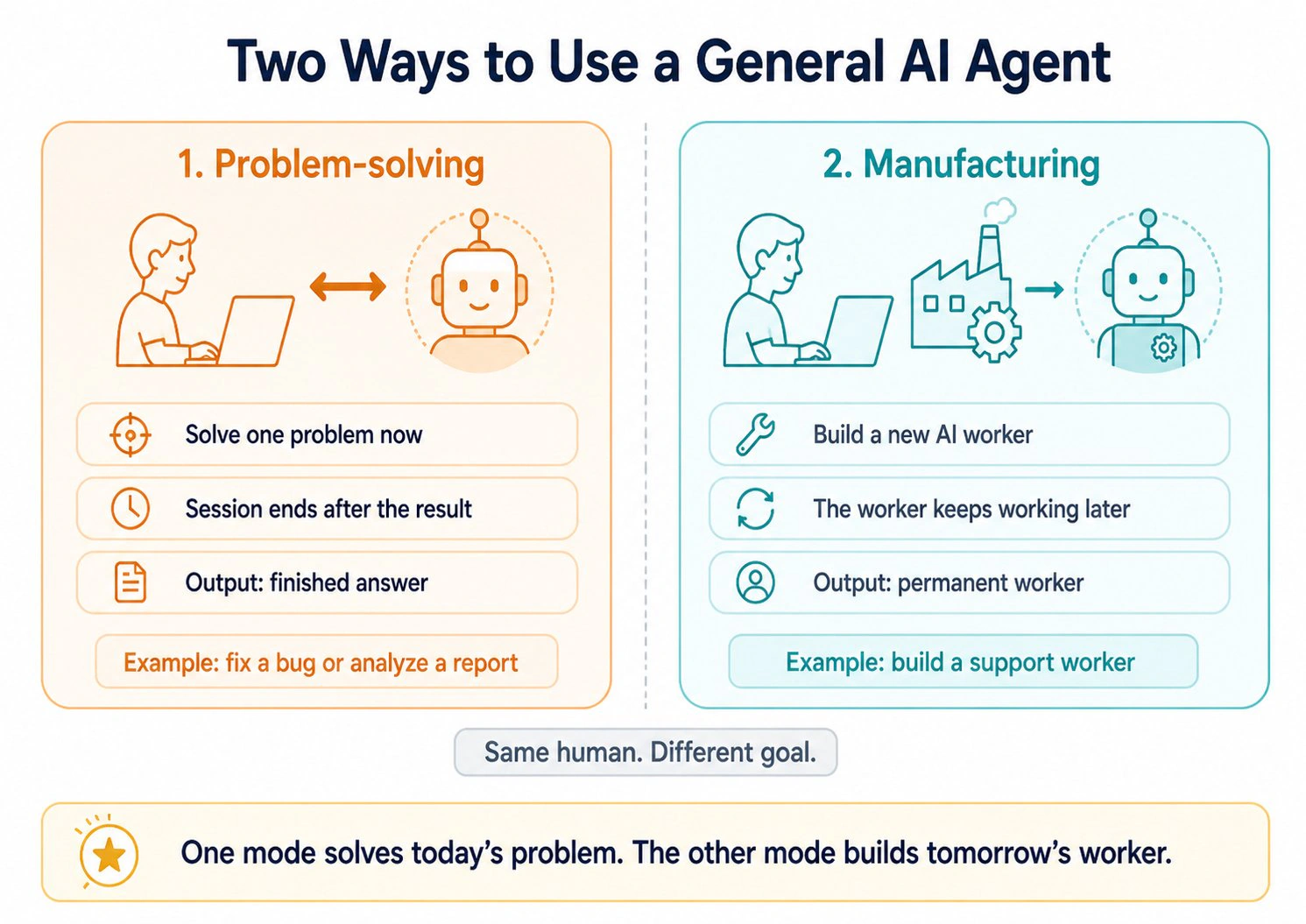
Do modes, aik core farq. Mode 1 conversation hai - aap AI se baat karte hain, finished result lete hain, session khatam. Mode 2 production line hai - aap AI ko naya AI worker banane ke liye istemaal karte hain jo is session ke baad bhi chalta rahe. Aik mode aaj ka problem solve karta hai. Dusra mode kal ka worker banata hai.
Mode 1 - Problem-solving. Developer Claude Code kholta hai aur software ka aik piece improve karta hai. Finance analyst Claude Cowork kholta hai aur monthly financial close dobara banata hai. Session shuru hota hai. Kaam khatam hota hai. Session khatam. Koi naya permanent AI worker nahin banta. General agent khud kaam karta hai, sirf us session ke liye. Session over, kaam over.
Problem-solving engagements audience ke hisaab se split hoti hain. Engineers Claude Code ya OpenCode uthate hain - terminal-native tools jo code, infrastructure, aur systems work ke liye tuned hain. Domain experts Claude Cowork ya OpenWork uthate hain - knowledge-work tools jo documents, spreadsheets, briefs, aur reviews ke liye tuned hain. Same engagement mode. Same rules. Do interface families.
Yeh mode Seven Principles of General Agent Problem Solving se governed hai. Yeh good problem-solving session ke saat rules hain. Yeh thousands of sessions ko dekh kar aaye - successful aur failed dono - coding, contract review, financial models, hiring, aur research work ke across. Same seven rules chaaron tools par apply hote hain. Sirf surface badalta hai.
-
Bash is the Key - AI ko act karne dein, sirf baat nahin. General AI agent tab sab se useful hota hai jab woh waqai kar sake - commands run kare, files parhe, work save kare. (Bash text-based command system hai jo computer ko direct commands run karne deta hai.) Yaqini banayein ke aap ki AI real commands run kar sakti hai. Usay sirf describe karne tak mehdood na rakhein.
-
Code as Universal Interface - jab precision matter kare to structure istemaal karein. Jab precise result chahiye ho, AI se structured format maangein - table, list, code block, checklist, fixed outline. Paragraph na maangein. Structure result ko sharper banata hai. Mistakes dhoondna bhi aasan hota hai.
-
Verification as Core Step - kaam hamesha check karein. Har result ko check chahiye. Code par tests run karein. Memos ko clear standard ke against score karein. Second AI se first AI ka work review karwayein. "Sahi lag raha hai" enough nahin. Confident-looking output phir bhi ghalat ho sakta hai.
-
Small, Reversible Decomposition - chhote steps lein jinhein undo kiya ja sake. Kaam ko chhote pieces mein torein. Har piece save karein phir next par jayen. AI ko kabhi aik ghanta baghair save point ke run na karne dein. Aik bari change ghalat ho jaye to hours ka kaam mita sakti hai.
-
Persisting State in Files - files memory hain. Chat history temporary hai. Gayab ho jati hai. Files permanent hain. Jo bhi cheez sessions ke across yaad rakhne layak ho - decisions, plans, conventions, customer details - usay file mein likhein. Next session usay parhega.
-
Constraints and Safety - AI ko sirf utni access dein jitni zaroori hai. Limited access se shuru karein. Pehle read-only. Pehle approve-each-step. Dekhein AI tight limits mein kaise behave karti hai. Zyada access sirf tab dein jab aap usay correct kaam karte dekh chuke hon. Day one se AI ko broad access na dein.
-
Observability - dekhein AI kya kar rahi hai. Agar aap dekh nahin sakte ke AI kya kar rahi hai, to aap us par trust nahin kar sakte. Har action visible hona chahiye - logs, step-by-step view, short video, ya clickable preview ke through. Agar aap work dekh nahin sakte, to check nahin kar sakte.
Mil kar yeh seven rules powerful AI tool ko clever toy se real work ship karne wali cheez banate hain. Pehle five rules - act, structure, verify, small steps, files as memory - daily discipline hain. Aakhri do rules - constraints aur observability - pehle five ko safe rakhte hain.
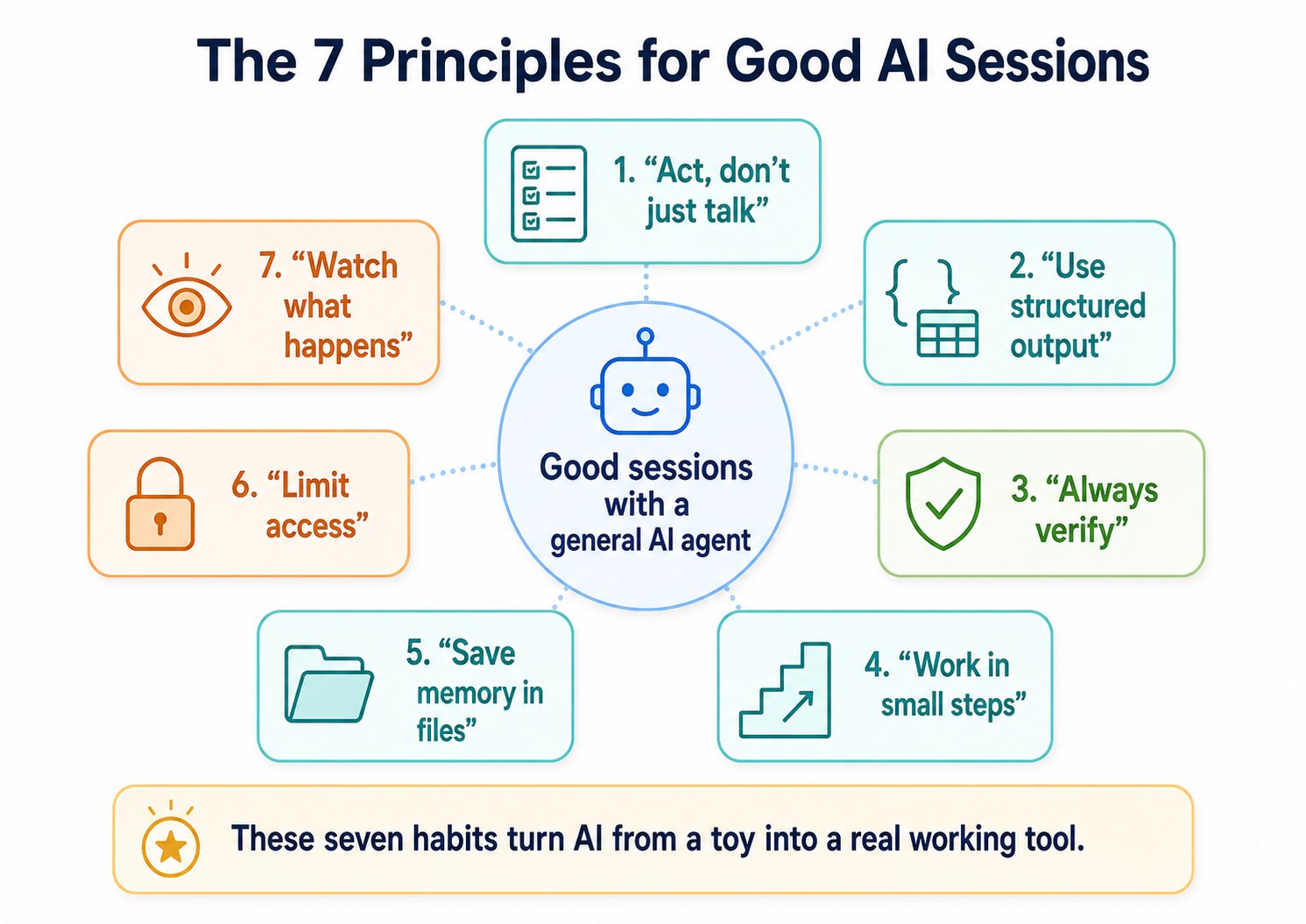
General AI agent ke saath good sessions ke saat habits. Pehle five daily working rules hain. Aakhri do - access limit karo aur dekho kya ho raha hai - kaam ko safe rakhte hain.
Mode 2 - Manufacturing. Yeh tab hota hai jab goal kuch banana ho jo baad tak rahe - naya AI worker jo is session ke baad bhi chalta rahega. Manufacturing hamesha engineering tools (Claude Code ya OpenCode) istemaal karti hai. Farq nahin padta human finance analyst hai ya marketer. AI worker banana mostly coding task hai. Wahi developer Claude Code istemaal karke code review karne wala AI worker design, build, aur deploy kar sakta hai. Finance analyst, aksar engineer ke saath, Claude Code istemaal karke monthly close karne wala AI worker bana sakta hai. Output problem ka answer nahin. Output worker hai jo ab se baar baar answers produce karega. Yeh mode Seven Invariants se governed hai - kisi bhi AI-Native Company ke design rules. Hum inhein next section mein cover karte hain.
Principles session guide karte hain. Invariants design guide karte hain. Problem-solving engagement principles se guided hoti hai kyun ke woh aisa result banati hai jo session ke saath khatam hota hai - koi lasting structure nahin jise obey karna ho. Manufacturing engagement invariants se guided hoti hai kyun ke us ka output workforce mein fit hona chahiye jo many sessions, many agents, aur many product cycles ke across saath rehti hai.
Dono modes mein 10-80-10 rhythm apply hota hai. Chahe aap AI se apna problem solve karwa rahe hon ya woh worker bana rahe hon jo problem aap ke liye solve karega, aap ka waqt phir bhi intent, work, aur checking mein split hota hai.
15. Saat Rules Jo Nahin Badalte (The Seven Invariants)
Ab hum book ke heart par aate hain - saat design rules jin par har AI-Native Company ko chalna chahiye, chahe un par chalne ke liye kaun se products istemaal hon.
Farq yaad rakhein. Invariant woh rule hai jo hamesha true rehna chahiye. Reference implementation woh product hai jo hum 2026 mein us rule ko follow karne ke liye istemaal karte hain. Rule main idea hai. Product aik option.
Saat rules par jane se pehle players name karte hain. AI-Native Company mein:
- Aap leader aur owner hain. Aap direction set karte hain.
- Delegate aap ka personal assistant hai - woh aik AI agent jo aap ka context jaanta hai aur aap ki taraf se bolta hai.
- Management layer company ka operating system hai. Yeh AI workers hire karti hai, unhein kaam deti hai, budgets control karti hai, decide karti hai har worker kya kar sakta hai, records rakhti hai, aur role khatam hone par workers retire karti hai.
- AI workers woh staff hain jo results pahunchate hain.
- Runtime engines woh machines hain jin par har worker actual run karta hai. Different workers different engines par run kar sakte hain, job ke mutabiq. Hum isay explain karenge.
- Nervous system workers ke darmiyan messages carry karta hai, crash ke bawajood company ko chalta rakhta hai, aur traffic control karta hai taake heavy load mein bhi workforce kaam karti rahe.
Neeche har rule company ke chalne ke tareeqe ke bare mein hai. Har named product aik option hai jo replace ho sakta hai.
Rule 1: Human Principal Hai.
Rule. Company ka har action human se shuru hota hai. Human principal hai - woh jo goal set karta hai, budget deta hai, line draw karta hai ke AI kya kar sakti hai, aur result own karta hai. No exceptions. Yeh part kabhi AI ko nahin diya jata.
Yeh kyun zaroori hai. Direction apne aap appear nahin hoti. Judgment, values, paisa spend karne ka right, aur results ki responsibility - in mein se koi cheez machine ko nahin di ja sakti. Aisa system jo human in charge ke baghair act kare independent nahin. Woh unowned hai. Aur unowned systems aise results banate hain jin ka jawab koi nahin de sakta.
Is ke baghair kya ghalat hota hai. Koi responsible nahin hota. Koi nahin hota jis ki values system follow kare. Budget kisi ka nahin hota. Result ka judge nahin hota.
Aaj yeh kaise kaam karta hai. Written specs, approval points, declared budgets, aur check steps ke through. Koi bhi method jo human intent, authority, aur responsibility capture kare - aur usay baqi system tak pass kare - rule par chalta hai.
Rule 2: Har Human Ko Delegate Chahiye.
Rule. Human dozens of AI workers ko haath se personally direct nahin kar sakta. Har human ko personal AI agent chahiye. Yeh agent us ka context hold karta hai, us ki taraf se bolta hai, us ki authority carry karta hai, aur us ke liye right jagahon par kaam deta hai.
Yeh kyun zaroori hai. Aik person aik saath twenty AI workers direct nahin kar sakta. Itne hours nahin. Aur humans AI se bahut slow type karte hain. Delegate ke baghair human phir haath se instructions dene par majboor hota hai - jo exactly woh problem hai jise solve karne ke liye Agent Factory bani.
Is ke baghair kya ghalat hota hai. Human slow point ban jata hai. AI workforce instructions ka intezar karti hai. Pura system human typing speed tak slow ho jata hai.
Aaj yeh kaise kaam karta hai. OpenClaw personal agent hai jo hum is book mein istemaal karte hain. Koi bhi personal agent jo aap ki identity, context, aur authority hold kar sake - aur management layer ko kaam pass kar sake - rule par chalta hai.
Rule 3: Workforce Ko Management Layer Chahiye.
Rule. AI workers ka group company nahin hota. Workforce ko aik layer chahiye jo unhein coordinate kare. Yeh layer company ka operating system hai. Yeh workers hire karti hai. Kaam assign karti hai. Budgets control karti hai. Risky choices approve karti hai. Decide karti hai har worker ko kya karne ki ijazat hai. Records rakhti hai ke kis ne kya kiya aur kis cost par. Role khatam hone par workers retire karti hai.
Yeh kyun zaroori hai. Coordination, responsibility, aur cost control apne aap appear nahin hote. Unhein aisi layer chahiye jo jaanti ho kaun kya kar raha hai, kitni cost hai, kya allowed hai, kya bana, aur jab kuch ghalat hua to kya hua. AI workers workforce ke tor par tabhi controllable bante hain jab single layer unhein visible banaye - ability, cost, speed, aur result ke units ke tor par. Aur woh affordable tabhi rehte hain jab wahi layer unhein zaroorat na rehne par shut down kar sake.
Is ke baghair kya ghalat hota hai. Workers same kaam do dafa karte hain. Budgets leak hote hain. Records toot kar alag ho jate hain. Finance nahin bata sakti workforce ki cost kya thi. Operations nahin bata sakti workforce ne kya banaya. Retired workers chalte rehte hain kyun ke unhein rokne ka responsible koi nahin.
Aaj yeh kaise kaam karta hai. Paperclip management layer hai jo hum istemaal karte hain. Yeh AI-Native Company ke operating system ke tor par built hai. Koi bhi system jo correct authority ke under workers hire, assign, govern, observe, aur retire kar sake, rule par chalta hai.
Rule 4: Har Worker Apna Engine Chunta Hai.
Rule. Har AI worker ko kisi na kisi engine par run karna hota hai - woh software jo us ka kaam actual run karta hai. Engine per worker choose hota hai, per company nahin. Different workers different engines istemaal kar sakte hain, job ki real need ke mutabiq.
Yeh kyun zaroori hai. Kuch kaam bahut important hota hai - woh silently fail nahin ho sakta, data lose nahin kar sakta. Us kaam ko strong, reliable engine chahiye. Dusra kaam routine hota hai aur chhoti failures survive kar sakta hai. Us kaam ke liye cheaper, lighter engine chalega. Har worker ko aik hi engine par force karne ka matlab hai ya to aap us reliability ke liye zyada pay karte hain jise job ko zaroorat nahin, ya us reliability ke liye kam pay karte hain jise job ko zaroorat hai. Dono bura hai.
Is ke baghair kya ghalat hota hai. Aik engine ka matlab aik set of trade-offs. Company ya to reliable workers afford nahin kar sakti ya cheap workers par trust nahin kar sakti.
Aaj yeh kaise kaam karta hai. Hum job ke mutabiq several engines istemaal karte hain - Dapr Agents, Claude Managed Agents, OpenAI Agents SDK, Cursor SDK, aur OpenClaw-native. Names abhi important nahin. Rule important hai: engine job ke fit ke mutabiq chunein.
Rule 5: Har Worker System Of Record Ke Against Run Karta Hai.
Rule. Engines woh hain jin par har worker run karta hai. System of record woh hai jis ke against har worker run karta hai. Har AI worker official memory store se parhta hai aur us mein likhta hai. Yeh company ka lasting record hai ke woh waqai kya jaanti hai: customers, orders, stock, contracts, money entries, support tickets, business ke real facts.
Yeh kyun zaroori hai. AI ki short-term memory (jise context window kehte hain) temporary hoti hai. Session khatam ho to gayab ho jati hai. System of record permanent hota hai. Official truth store ke baghair AI agents facts invent karne lagte hain, same transaction do dafa save karte hain, sessions ke darmiyan kaam lose karte hain, aur aise results banate hain jinhein baad mein koi check nahin kar sakta. System of record real work ko confident-sounding made-up answers se alag rakhta hai. Yeh workforce ko baad mein readable bhi banata hai - worker ka har action aise system mein record chhor kar jata hai jo worker session khatam hone ke baad bhi rehta hai.
Is ke baghair kya ghalat hota hai. Results real life se drift karte hain. Do workers same customer ko do different baatein batate hain kyun ke un ki short-term memories disagree karti hain. Responsibility trace nahin hoti. Company confident-sounding output banane wali machine ban jati hai jis ke neeche real basis nahin.
Aaj yeh kaise kaam karta hai. Company ke existing databases aur operational systems system of record ke tor par serve karte hain - CRM (customer database), ERP (company operations chalane wala system), support ticket system, data warehouse, financial ledger. MCP (universal connector jiska zikr pehle hua) AI workers ko in tak pahunchata hai. Koi bhi lasting, reachable, governed store jise workforce parh aur likh sake, rule par chalta hai.
Aik Database, Paanch Nahin
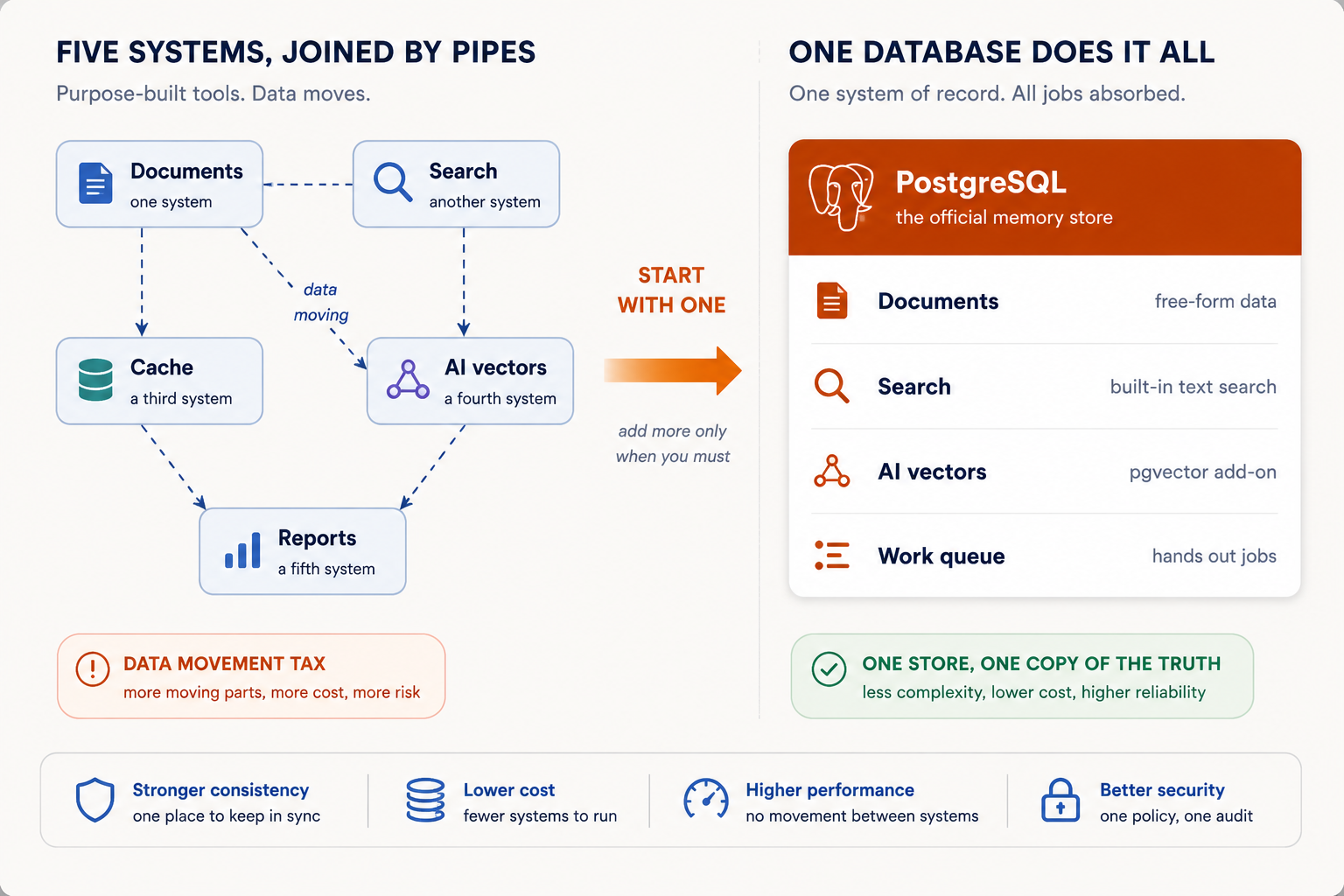
Rule 5 kehta hai ke worker ko official memory store chahiye. Yeh nahin kehta kaun sa. Yeh note is par hai ke jab aap woh store khud build karte hain, pehle se existing store connect karne ke bajaye, to kya use karein.
Kaafi arsay tak habit simple thi: naya kind of data matlab naya database. Documents aik system mein jate the. Search doosre mein. Cache teesre mein. AI vectors chauthe mein. Reports paanchwein mein. Har choice apni jagah sense banati thi.
Problem yeh hai ke saath mil kar woh kya cost karti hain. Har extra system aik aur pipe hai jo data ko next system tak le jata hai. Har pipe peeche reh sakta hai, sync se bahar ho sakta hai, ya aisi jagah break ho sakta hai jo aap dekh nahin sakte. Yeh data movement tax hai. Real cost extra hosting bill nahin. Yeh hai ke aadhi team product build karne ke bajaye pipes fix karne lagti hai.
Agent Factory ulta karti hai. Rule hai aik se shuru karein, aur zyada sirf tab add karein jab zaroorat ho. Aik database, PostgreSQL (aksar sirf Postgres kaha jata hai), zyada tar logon ki expectation se kahin zyada kar sakta hai. Yeh rakh sakta hai:
- Documents - flexible, free-form data, separate document system nahin chahiye.
- Search - built-in text search, separate search system nahin chahiye.
- AI vectors - number-lists jinhein AI meaning-based search ke liye use karta hai, unhi data ke paas store hoti hain jinhein woh describe karti hain; yeh pgvector add-on hai.
- Work queue - aik ordinary table kai Workers ko aik saath safely jobs hand out kar sakta hai.
AI vectors ko real data ke saath same place mein rakhna sirf tidy nahin. Yeh problem ki poori class hata deta hai. Separate vector store ko real data ke saath step mein rakhna parta hai, aur yahi "step mein rakhna" break hota hai. One store ka matlab truth ki one copy, jo worker ko read karni chahiye.
Aik real example, service bechne wali company ne bataya hai, is liye isay example samjhein, proof nahin: Apollo Hospitals, India ke bare hospital groups mein se aik, records ko purane system par, reports ko doosre system par, aur cache aur search ko doosre systems par chala raha tha. Chhe mahine study karne ke baad team ne sab kuch single Postgres platform par move kiya. Un ka main reason tha ke aik engine un ke saare data types, records, documents, text search, aur AI vectors, ko saath handle kar sakta tha. Is se duplication aur pipe-fixing hate, aur team patient care par kaam kar saki.
Is ka matlab yeh nahin ke Postgres hamesha jeetta hai. Special-purpose system tab use karein jab aap ke apne work par test dikhaye ke Postgres woh target hit nahin kar sakta jis ki aap ko waqai zaroorat hai. Yeh cases real hain, lekin rare hain. Ghalti yeh hai ke tutorial ya headline ne kaha is liye special tool pehle utha lein. One store se shuru karein. Doosra sirf tab add karein jab evidence kahe.
Pura build crash course Give Your AI Searchable Context mein hai.
Rule 6: Workforce Rules Ke Under Apne Aap Grow Kar Sakti Hai.
Rule. Management layer ko naye AI workers automatically hire karne ke qabil hona chahiye. Jab gap aaye - customer aisi zuban mein likhe jo koi current worker nahin bolta, ya naya kaam aaye jo koi current worker nahin kar sakta - authorized agent naya worker spec likh sake, usay set up kare, management layer ke saath register kare, aur kaam par laga de. Sab human ke set kiye hue rules ke andar.
Yeh kyun zaroori hai. Fixed worker list changing problem ke saath pace nahin rakh sakti. Agar har naya gap human se manually naya worker banwane ka talab kare, system slow ho jata hai. Workforce ko apne aap grow karne ke qabil hona chahiye - lekin hamesha human ki set ki hui limits ke andar, kabhi un ke bahar nahin.
Is ke baghair kya ghalat hota hai. Workers ki list freeze ho jati hai. Har naye kind of problem ke liye human chahiye. Company sirf utni fast grow kar sakti hai jitni fast humans manually naye workers bana sakte hain.
Aaj yeh kaise kaam karta hai. Claude Managed Agents woh technology hai jo hum is ke liye istemaal karte hain. Koi bhi system jo runtime par naye AI workers create kar sake aur un ka environment set up kar sake, human ke set kiye rules ke andar rehte hue, rule par chalta hai.
Rule 7: Workforce Nervous System Par Chalti Hai.
Rule. Kaam apne aap aata hai. Human ke har step route kiye baghair workers ke darmiyan flow karta hai. Scheduled time aata hai. Customer web form fill karta hai aur chhota message fire hota hai. Aik worker task finish karta hai aur next ko pass karta hai. Yeh sab aik single event system carry karta hai - company ke nervous system ki tarah. Yeh workers ko jagata hai jab kuch karna ho. Work ke beech crash survive karta hai. Traffic control karta hai taake aik busy customer sab ko block na kare.
Yeh kyun zaroori hai. Workforce ko har step par human ke baghair operate karne ke liye chaar cheezein true honi chahiye:
- External triggers. System ko apne aap wake up hona chahiye - jab scheduled time aaye, jab webhook fire ho (webhook aik chhota message hai jo aik system se dusre system ko bheja jata hai jab kuch hota hai), ya jab customer request bheje.
- Internal handoffs. Workers ko human ke har handoff route kiye baghair dusre workers ko kaam pass karna aana chahiye.
- Durability. Multi-step kaam ko beech mein crash survive karna chahiye. Yeh kyun matter karta hai: har step ke fail hone ka chhota chance hota hai. Jab aap six steps chain karte hain, chhote chances multiply hote hain. Agar har step 95% time kaam karta hai, to six steps in a row sirf 95% x 95% x 95% x 95% x 95% x 95% lagbhag 74% time kaam karte hain. Is ka matlab har chaar runs mein se aik silently fail karega. Proper durability ke saath (jahan system yaad rakhta hai kya ho chuka hai aur sirf failed step retry karta hai), same task lagbhag 99.7% time finish hota hai. Yeh result dene wali workforce aur quietly one-in-four jobs drop karne wali workforce ka farq hai.
- Flow control. Agar aik customer achanak thousand requests bhej de, system ko spike handle karna chahiye bina baqi customers ko forever wait karaye.
Is ke baghair kya ghalat hota hai. External triggers ke baghair system sirf tab move karta hai jab human prompt kare - aur economics chatbot wali economics ban jati hai. Internal handoffs ke baghair workers human ke beech mein aaye baghair coordinate nahin kar sakte. Durability ke baghair multi-step runs mein reliability worse hoti hai. Flow control ke baghair aik busy customer sab ko block kar deta hai.
Aaj yeh kaise kaam karta hai. Inngest nervous system hai jo hum istemaal karte hain - aik system jo in chaar features ko saath carry karta hai. Day AI, aik real company jo AI-native CRM (customer database) bana rahi hai, apni Inngest layer ko exactly in terms mein describe karti hai. Founding engineer Erik Munson ne isay product ka "nervous system" kaha. Yeh language real builder se real market mein aati hai, textbook se nahin.
16. Pura Design Aik Picture Mein
Yahan seven-rule design aik table mein hai.
| Rule | Kya require karta hai | 2026 mein hum kya istemaal karte hain | Kya replace kar sakta hai |
|---|---|---|---|
| Principal | Human jo intent, budget, authority, responsibility set karta hai | - | - |
| Delegate | Personal agent jo aap ka context aur authority hold karta hai | OpenClaw | Koi bhi MCP-speaking personal agent |
| Management layer | Workforce operating system - hire, assign, govern, observe, retire | Paperclip | Koi bhi system jo management contract meet kare |
| Engine | Per-worker runtime jo job se match karta hai | Dapr / Claude Managed Agents / OpenAI SDK / Cursor / OpenClaw-native | Koi bhi runtime jo job ki reliability needs meet kare |
| System of record | Official store jise workforce parhti aur likhti hai | Existing databases, workflows, MCP-exposed platforms | Koi bhi lasting, reachable, governed store |
| Workforce growth | Rules ke under demand par naye workers hire karne ki ability | Claude Managed Agents | Koi bhi system jo runtime par new agents create kar sake |
| Nervous system | Authority ke under events, durability, aur traffic control | Inngest (workforce); Claude Code Routines (coding agents ke liye) | Koi bhi system jo durability aur flow control ke saath events carry kare |
Seven rules. Aik chain. Aap kal middle column ka koi bhi product swap kar dein, design phir bhi kaam karega - kyun ke design kabhi products nahin tha. Design rules tha.
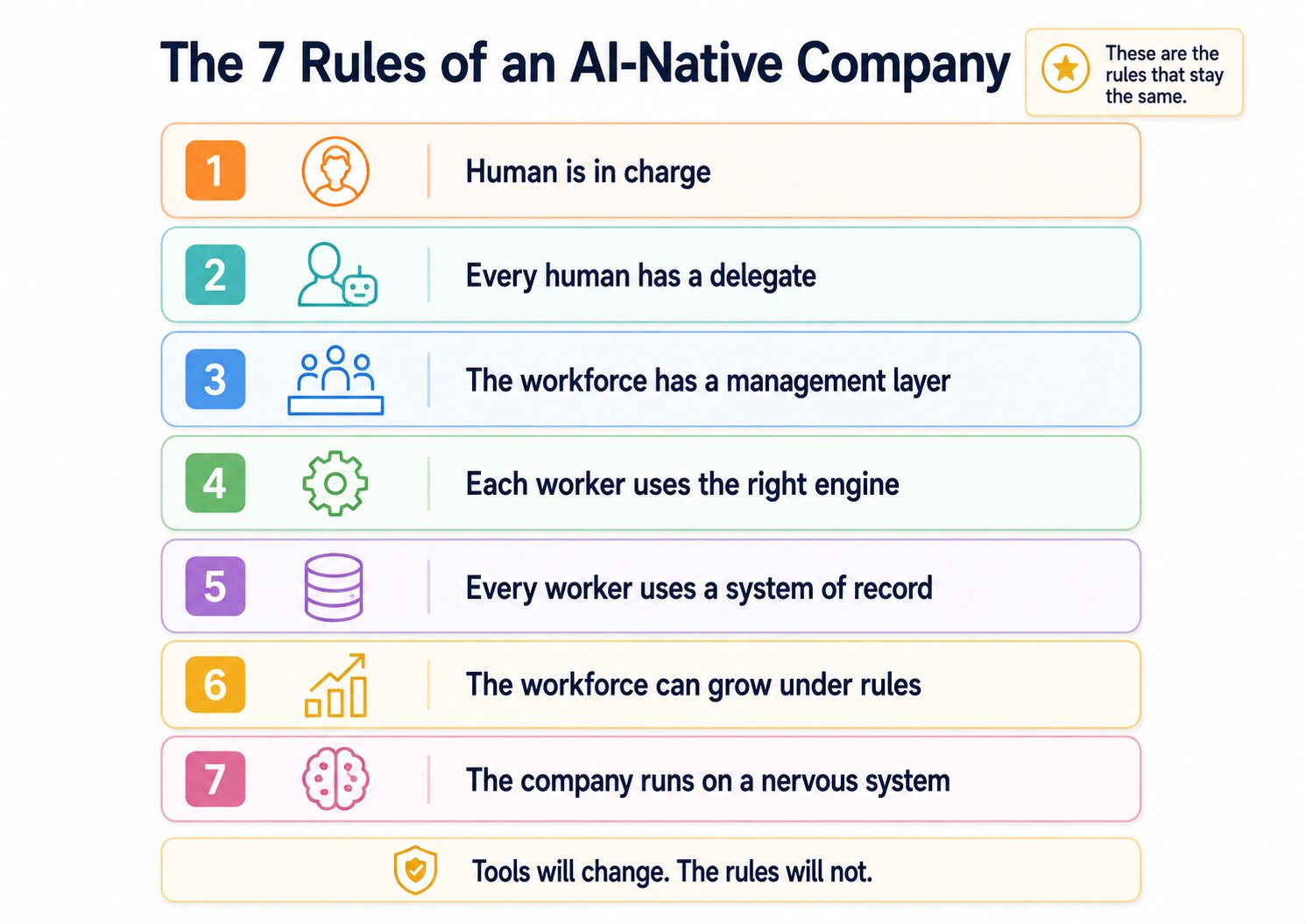
AI-Native Company ke seven rules aik view mein. Yeh rules nahin badalte. Specific tools (OpenClaw, Paperclip, Dapr, Inngest) replace ho sakte hain - rules rehte hain.
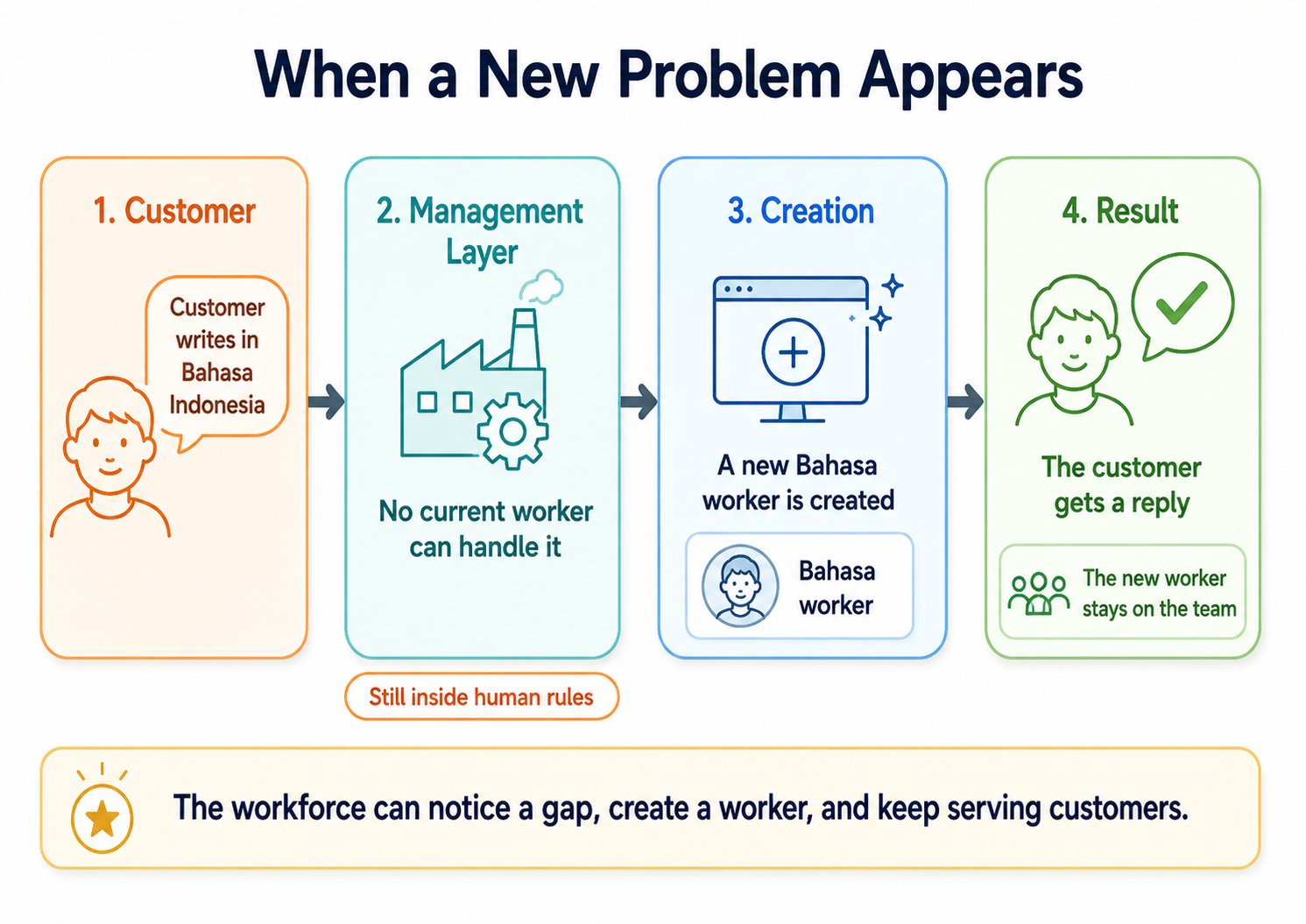
Real life mein yeh kaisa dikhta hai. Imagine karein customer Bahasa Indonesia mein support message likhta hai, aur koi current AI worker woh zuban nahin bolta. Yeh hota hai:
- Customer ka message nervous system (Inngest) ke through aata hai.
- Management layer (Paperclip) dekhti hai ke koi current worker language nahin bolta. Gap hai.
- Paperclip, human ke set kiye rules ke andar act karte hue, apne hiring system (Claude Managed Agents) ko call karti hai taake naya Bahasa-speaking worker create ho.
- Naya worker system of record se customer ki history parhta hai, reply likhta hai, conversation ko system of record mein wapas save karta hai, aur reply bhejta hai.
- Reply same chain ke through customer tak pahunchta hai.
- Naya worker team par rehta hai, future Bahasa-speaking customers ke liye ready.
Koi human jagaya nahin gaya. Company ne nayi situation handle ki, rules ke andar apni workforce expand ki, customer ko serve kiya, aur baad mein check karne ke liye pura event record kiya. Seven rules yahi mumkin banate hain.
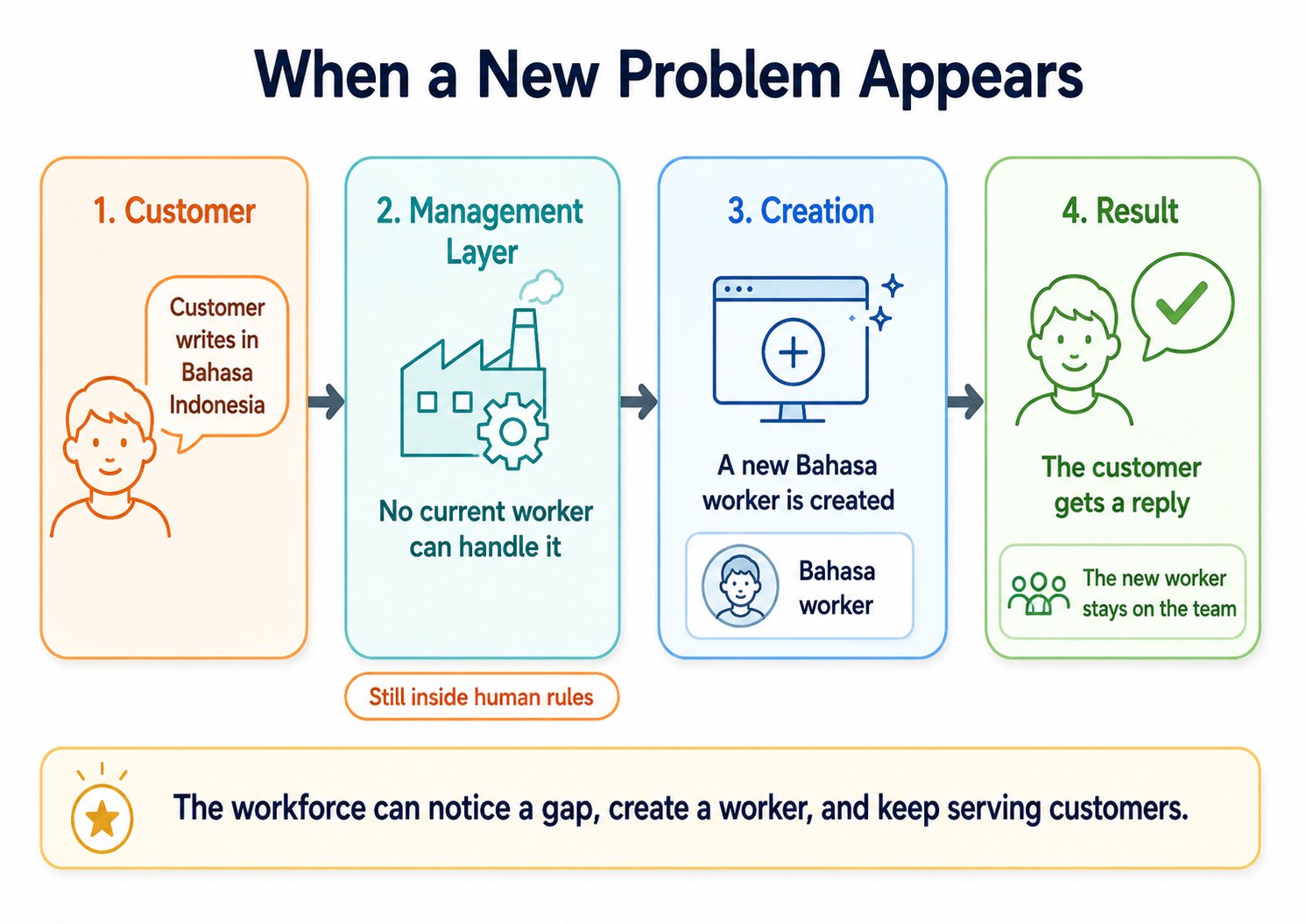
Customer nayi zuban mein likhta hai. Workforce gap notice karti hai. Naya worker banta hai - human ke set kiye rules ke andar. Customer ko reply milta hai. Naya worker next time ke liye team par rehta hai.
17. Worked Example: Support-Ticket AI Worker 5 Steps Mein Banayein
Ab tak yeh book ideas ke bare mein thi. Ab isay concrete banate hain.
Imagine karein aap Mehndi Mart naam ki small online store ke liye customer support chalate hain (fictional shop jo duniya bhar ke customers ko henna products bechti hai). Aap support tickets mein doob rahe hain - refund requests, shipping questions, product inquiries. Aap decide karte hain ke har ticket par first response handle karne ke liye AI worker banaya jaye.
Section 15 ke seven rules aur Section 14 ke seven principles istemaal karte hue aap yeh kaise karenge:
Step 1 - Spec Likhein (Rule 1: Human In Charge Hai)
Aap Claude Code ya OpenCode kholte hain (engineering tool - Section 14, Mode 2 dekhein). Aap worker ke liye spec likhte hain. Spec bas written plan hai. Yeh kuch is tarah dikh sakta hai:
WORKER: First-Response Support Agent for Mehndi Mart

GOAL:
- Read every incoming customer ticket
- Classify it: refund, shipping question, product question, or other
- Write a first draft reply
- Hand off to a human if the case is complex or angry

LIMITS:
- May not promise refunds above $100 without human approval
- May not commit to delivery dates not in the shipping system
- May not respond in any language the worker is not trained for

BUDGET:
- Maximum $200/month in compute costs
- Maximum 30 seconds per ticket

SUCCESS LOOKS LIKE:
- 80% of tickets get a useful first reply within 5 minutes
- Less than 5% of replies need human correction before sending
- All tickets are recorded in the support system of record
Yeh spec aap ka intent, budget, aur limits capture karta hai. Ab aap is worker ke principal hain. Aap us ke results own karte hain.
Step 2 - System Of Record Chunein (Rule 5)
Worker ko company ki official memory se parhna aur us mein likhna hoga. Support worker ke liye iska matlab teen jagah hain:
- Customer records (aap ka CRM - example, HubSpot ya Salesforce)
- Order records (aap ka e-commerce platform - example, Shopify)
- Support history (aap ka ticket system - example, Zendesk ya Freshdesk)
Aap in systems ko MCP ke through AI worker se connect karte hain (universal connector - AI ke liye USB jaisa, Section 9 se). Har system MCP server ke tor par expose hota hai. Worker ab permission hone par kisi bhi system ko query kar sakta hai.
Aap decide karte hain: yeh worker teeno systems se read kar sakta hai aur ticket system mein write kar sakta hai. Yeh customer ya order records mein write nahin kar sakta - woh changes abhi bhi human require karte hain.
Step 3 - Worker Ko Zaroori Skills Attach Karein
Skill chhota, portable package hota hai jo worker ko aik specific cheez achhi tarah karna sikhata hai (Section 9). Is support worker ke liye aap aisi skills attach karte hain:
- "Professional support reply kaise likhna hai" - tone, structure, signoff
- "Support ticket classify kaise karna hai" - ticket types ki list aur unhein alag pehchanne ka tareeqa
- "Order record kaise parhna hai" - kaun se fields matter karte hain, un ka matlab kya hai
- "Human ko kab escalate karna hai" - triggers jaise anger, legal threats, complex refunds
Skills library se download ki ja sakti hain ya aap aur aap ki team likh sakte hain. Yeh open Agent Skills format follow karti hain, is liye kisi bhi AI system mein kaam karti hain.
Step 4 - Engine Chunein Aur Guardrails Set Karein (Rules 3, 4, 6)
Aap decide karte hain ke worker kahan run karega. Support worker ke liye - jahan reliability bhi matter karti hai lekin cost bhi matter karti hai - aap middle-tier engine choose karte hain. (Aap baad mein isay change kar sakte hain. Rule 4 kehta hai har worker apna engine choose karta hai.)
Phir aap management layer (Paperclip, ya jo bhi management layer aap istemaal karte hain) ke through guardrails set karte hain:
- Budget cap: $200/month, sakht limit
- Approval gate: $100 se upar har refund ko reply bhejne se pehle human "yes" chahiye
- Audit trail: worker jis bhi ticket ko touch karta hai woh worker actions, cost, aur time taken ke saath logged hota hai
- Rate limit: maximum 50 tickets per minute (taake messages ka flood five minutes mein budget exhaust na kare)
Worker ab clear envelope ke andar exist karta hai: kya kar sakta hai aur kya nahin.
Step 5 - Verify Aur Deploy Karein (Rule 7 + Seven Principles)
Real customers handle karne se pehle aap worker verify karte hain. Aap usay past tickets ke sample par run karte hain - maan lein 100 historical tickets - aur replies check karte hain. Kya yeh unhein correctly classify karta hai? Kya replies professional hain? Kya yeh right cases escalate karta hai?
Aap worker ke har action ko dekhte hain - har file jo woh kholta hai, har step jo woh run karta hai, har decision jo woh leta hai. Yeh observability hai: worker jo kuch karta hai woh aap se hidden nahin. Aap mistakes pakarte hain. Spec adjust karte hain. Retest karte hain.
Jab aap satisfied hon, aap deploy karte hain. Nervous system (Inngest, ya jo bhi event system aap istemaal karte hain) real tickets aate hi worker ko feed karna shuru karta hai. Worker unhein handle karta hai. Human har roz chhota sample review karta hai. Time ke saath aap spec refine karte hain aur skills add karte hain, aur worker behtar hota hai.
Abhi Kya Hua
Aap ne spec likhi. System of record connect kiya. Skills attach ki. Guardrails set kiye. Verify aur deploy kiya. Aap ne abhi Digital FTE bana liya.
Worker ab 24 hours a day, 7 days a week, aap ke set kiye rules ke andar run karta hai. Jab business grow karta hai, aap tickets triage karne ke liye aur humans hire karke scale nahin karte - aap spec tight karte hain aur skills add karte hain. Aap ki team ke humans value chain mein upar move karte hain: complex cases, customer relationships, product feedback, strategy.
Agent Factory yahi karti hai. Aik worker at a time.
Aap Ke First-Worker Ki Checklist
Apna banaya hua koi bhi AI worker ship karne se pehle is list se guzrein. Agar har box checked hai, to aap ke paas aisa worker hai jo Seven Invariants satisfy karta hai aur deploy ke liye ready hai.
- Spec written - clear goal, clear limits, clear budget, clear definition of success
- Principal named - specific human is worker ko own karta hai aur us ke results ke liye accountable hai
- System of record chosen - worker jaanta hai company truth kahan se parhna hai aur kahan wapas likhna hai
- MCP connections set - worker un systems tak pahunch sakta hai jin ki zaroorat hai, aur sirf unhi tak
- Skills attached - worker ki zaroori abilities portable skill packages ke tor par loaded hain
- Engine picked - runtime job ki reliability aur cost needs se match karta hai
- Budget cap set - monthly spend par hard limit, management layer enforce karti hai
- Audit trail enabled - har action logged, inspectable, aur replayable hai
- Approval gates set - risky actions hone se pehle human "yes" require karte hain
- Verification plan ready - aap jaante hain ke worker ke pehle 100 outputs kaise check karenge
Agar aap har box tick kar sakte hain, aap ka worker ab clever toy nahin. Yeh Digital FTE hai.
18. Kya Same Rehta Hai Vs. Kya Badlega
Yahan table dikhata hai ke is design ke kaun se parts permanent rules hain (left column - main idea) aur kaun se parts is saal ke specific tools hain (right column - 2026).
| Stable (rule, invariant) | Badlega (specific tool, implementation) |
|---|---|
| Clear authority wala human principal | Authoring tools, approval screens, spec formats |
| Edge par personal delegate | Delegate products aur un ke baad aane wali cheezein |
| Full workforce control wali management layer | Management-layer products aur un ke baad aane wali cheezein |
| Per-worker engine choice | SDKs, runtimes, platforms jo agents run karte hain |
| Official store jis ke against workforce run karti hai | Database engines, CRM/ERP/ticketing products, MCP server lists |
| Rules ke under grow kar sakne wali workforce | Managed-agent APIs, setup systems |
| Authority ke under events, durability, aur flow | Schedulers, webhook frameworks, durable-execution platforms |
| Work ki spec-driven definition | Spec languages, formats, tools |
| General agents istemaal karne ke seven operator principles | Specific agent products, command-line tools, prompt patterns |
| Result-based money model | Pricing units, contract formats |
| Agents as economic actors | Payment systems, liability frameworks |
| Observable, audit-able runs | Tracing systems, log formats |
| Layers ke beech clean joints, taake vendor lock-in design toray baghair shift ho sake | Kaun si layer lock-in carry karti hai - 2024 mein AI model, 2026 mein "harness" layer (AI ke gird software), next mein orchestrator |
| Workforce jise cost, speed, result ke tor par measure kiya ja sake | Finance systems, ledger implementations |
| Abilities jo portable skills ke tor par packaged hain | Skill formats, registries, distribution platforms |
Left column main idea hai. Right column 2026 hai.
Agar aap left column ke liye banate hain, aap ki company right column ki changes survive karti hai. Agar aap left ko samjhe baghair right column ke liye banate hain, to aap ko har do saal baad rebuild karna padega.
19. Specific Tools Jo Hum Aaj Istemaal Karte Hain
Completeness ke liye, yahan products ki list hai jo hum 2026 mein har rule par chalne ke liye istemaal karte hain. Yeh reference implementations hain. Yeh badlenge. Rules nahin. Yaad rakhein: product names memorize mat karein. Woh job memorize karein jo har product perform karta hai.
- Delegate - OpenClaw (open-source personal AI agent)
- Management layer - Paperclip (AI-native company operating system; yeh hire, assign, govern, observe, aur retire ko functions ke tor par expose karta hai jinhein dusre systems call kar sakte hain)
- Engines - Dapr Agents, Claude Managed Agents, OpenAI Agents SDK, Cursor SDK, aur OpenClaw-native (har aik different job profiles ke liye suited hai)
- Skills - agentskills.io ka Agent Skills format (AI abilities package karne ke liye portable folder format)
- Nervous system - Inngest (company ka main event system) aur Claude Code Routines (coding agents ke liye specialist trigger)
Rule 6 ke liye (workforce apne aap grow kar sakti hai), hum Claude Managed Agents istemaal karte hain. Wahi technology jo engine options mein se aik ke tor par serve karti hai, hiring system ke tor par bhi serve karti hai, kyun ke runtime par new agents create karne ki us ki ability exactly woh cheez hai jo "hiring as a callable function" mumkin banati hai.
Real-world support. Yeh sirf theory nahin. February 2026 mein Cursor ke CEO ne apni company ke AI coding tool se "agent factory" banne ki shift ko is book ke bahut qareeb alfaaz mein describe kiya: AI agents ke groups teammates ke tor par kaam karte hue, humans problems define aur finished work review karte hue, agents cloud computers par parallel kaam karte hue line by line guide hone ke bajaye. May 2026 mein The New Stack ne same pattern ko Anthropic, OpenAI, Google, Microsoft, aur Cursor ke across industry-wide pattern ke tor par report kiya.
2026 ka leading view sharp hai: AI model commodity ban raha hai (commodity woh cheez hoti hai jahan bahut si companies achhe versions banati hain, is liye woh interchangeable ho jati hain - sugar ya wheat ki tarah). Ab bahut si companies good AI models banati hain, aur aik model ko dusre se swap kiya ja sakta hai. Valuable cheez "harness" ban rahi hai - model ke gird woh software wrapper jo usay safely, reliably, aur scale par act karne deta hai. Google ke aik senior leader ne openly kaha ke company ko ab parwah nahin ke developers kaun sa AI coding tool choose karte hain. Model layer ab competition ki jagah nahin. Is book ke named seams - human, delegate, management layer, engine, system of record, aur nervous system ke darmiyan - ab real production systems mein large scale par built ho rahe hain.
Rules forecast nahin. Yeh leading edge ki tasveer hain.
Words par chhota note. Is book mein system ka har part technically agent hai - OpenClaw agent hai, Paperclip agent hai, AI workers agents hain. Lekin sirf AI workers workforce hain - woh jo hire hote hain, kaam lete hain, team par rehte hain, aur retire hote hain. OpenClaw aur Paperclip company ke permanent parts hain, workforce nahin. To jab yeh book AI Worker kehti hai, iska matlab workforce hai. Jab yeh agent kehti hai, iska matlab company mein koi bhi ho sakta hai - permanent part ya workforce.
20. Workforce Opportunity
AI jobs ko individual tasks mein break apart karegi. Un tasks mein se kuch fully machines karengi. Lekin jobs ko break apart karna naye combinations bhi banata hai - naye roles, naye businesses, naye markets jo tab exist nahin karte the jab work fixed job titles ke andar locked tha.
Future workforce ko fixed career paths par rely karne ke bajaye flexible skill sets banane honge. Jo professionals AI ke saath sochna seekhenge, roz AI tools istemaal karenge, aur AI ko digital teammate samjhenge, woh sirf change survive nahin karenge. Woh is mein achha karenge.
SaaS era ne developers, designers, aur product managers ke liye millions jobs banayi. Agent Factory era millions aur banayega - agent designers, result architects, verification specialists, aur domain experts ke liye jo machines ko sikhate hain ke un ke field mein "correct" kaisa dikhta hai.
Yeh history ke sab se bare worker training opportunities mein se aik bhi hai. 2030 tak, World Economic Forum estimate karta hai ke duniya ke har 100 workers mein se 59 ko new technologies aur new ways of working ke saath pace rakhne ke liye new training chahiye hogi.
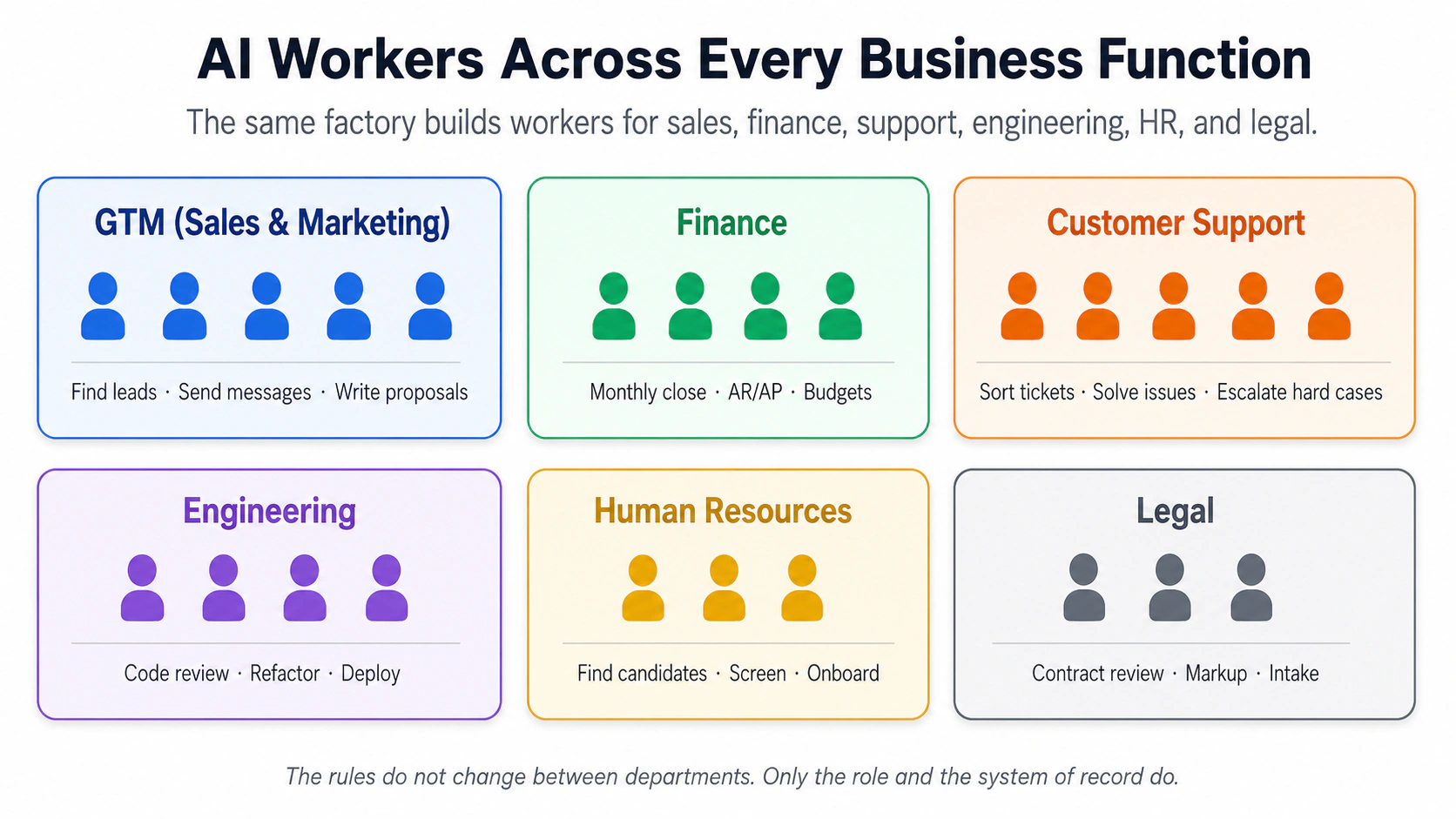
Workforce opportunity. Same Agent Factory har business function ke across specialist AI workers banati hai - sales, finance, support, engineering, HR, legal. Departments ke darmiyan rules nahin badalte. Sirf role aur system of record badalte hain.
Same factory har business function ke across specialist workers banati hai:
-
GTM mein (is ka matlab Go-To-Market hai - sales, marketing, aur revenue work ka combined kaam jo possible buyers ko paying customers banata hai). AI workers ka group yahan bahut se tasks handle karta hai:
- New leads dhoondna.
- Outreach messages bhejna.
- Customer database clean rakhna.
- Sales pipeline analyze karna.
- Proposals likhna.
- Demos customize karna.
Jo kaam SaaS era mein haath se hota tha, woh ab AI workers ke tor par built hota hai aur human GTM lead usay supervise karta hai.
-
Finance mein: monthly close (month ke end par books prepare karna), AR/AP (jis ka matlab accounts receivable - company ko milne wala paisa - aur accounts payable - company ko dusron ko dene wala paisa), aur FP&A (jis ka matlab financial planning and analysis - budgets aur forecasts banane wali team).
-
Customer Support mein: tickets sort karna, issues solve karna, hard cases escalate karna.
-
Engineering mein: code review, refactoring (existing code improve karna), deployment.
-
Human Resources mein: candidates dhoondna, screen karna, new hires onboard karna.
-
Legal mein: contract review, changes mark up karna, new matters ka intake.
Har AI worker Paperclip ke through hire hota hai, right department ke human ke under supervised hota hai, aur us department ke system of record ke against run karta hai - sales ke liye CRM, finance ke liye general ledger, support ke liye ticket system, engineering ke liye code storage. Departments ke darmiyan rules nahin badalte. Sirf role definitions aur systems of record badalte hain.
Opportunity chhoti nahin. Yeh wider hai. Aur yeh un logon ko reward karti hai jo adapt karte hain.
21. Paisa Already Kharch Ho Raha Hai
Agar aap sure nahin ke yeh change real hai, to dekhein paisa kahan ja raha hai.
January 2026 tak, U.S. data center construction $42 billion per year tak grow ho chuki thi, jab ke office construction apne peak se 35% drop ho chuki thi.
History mein pehli dafa, America ab AI workers ke workplaces (data centers) banane par human workers ke workplaces (offices) se zyada paisa kharch kar raha hai.
Data centers industrial scale par copper aur electricity istemaal kar rahe hain. Aik single very large AI data center ko 50,000 tons tak copper chahiye hota hai - normal data center se lagbhag das guna. Meta, Google, Amazon, aur Microsoft mil kar 2026 alone mein AI infrastructure par $600 billion se zyada spend karne ka plan rakhte hain.
AI age ki factories sirf idea nahin. Woh abhi ban rahi hain.
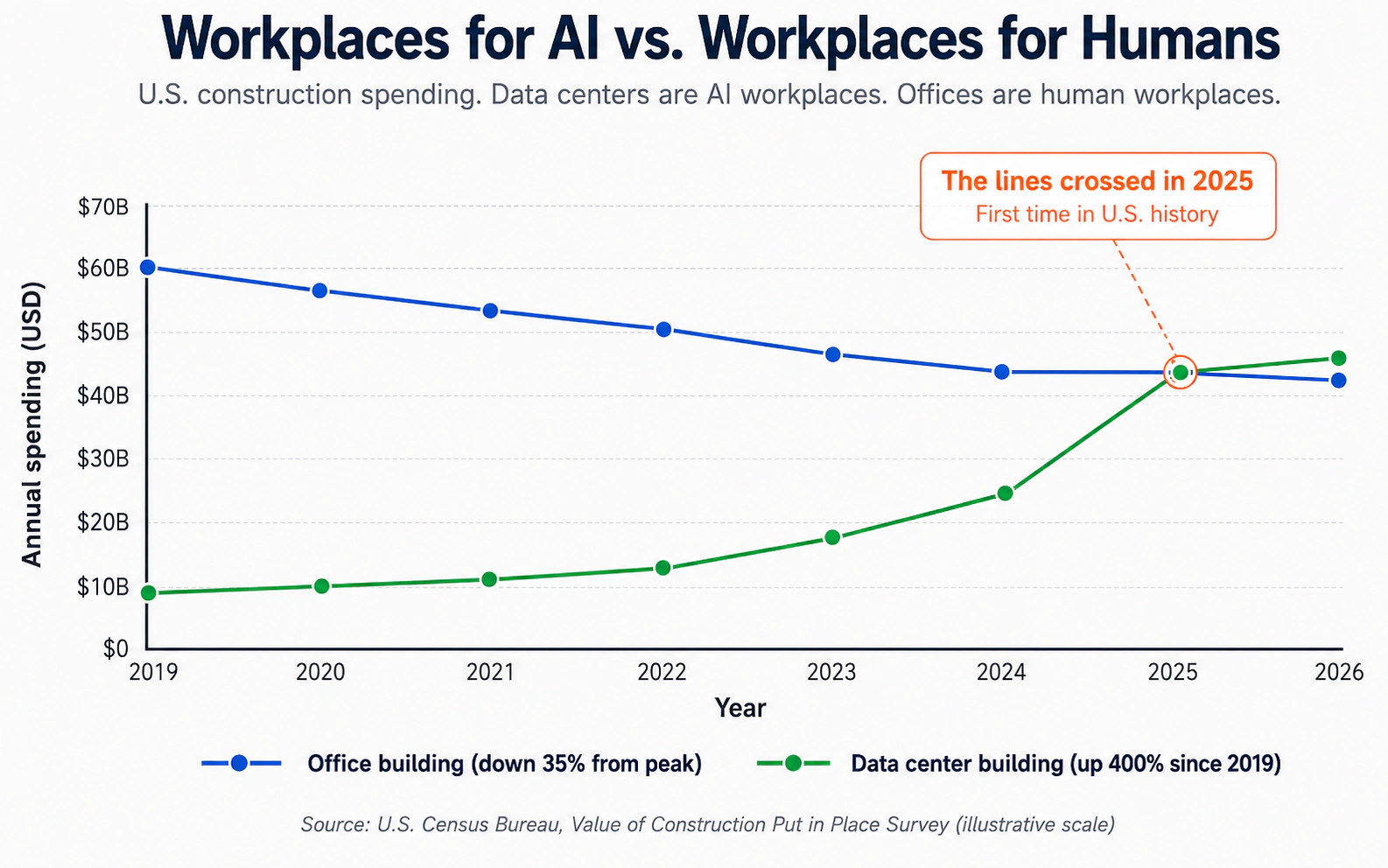
U.S. construction spending. Office building (human workers ka workplace) neeche ja rahi hai. Data center building (AI workers ka workplace) oopar ja rahi hai. Dono lines 2025 mein cross hui. Source: U.S. Census Bureau, Value of Construction Put in Place Survey.
Winners is se measure nahin honge ke unhon ne kitni software subscriptions bechi. Woh is se measure honge ke unhon ne kitne results pahunchaye.
22. Yeh Sab Kahan Point Karta Hai
Close karne se pehle yeh mark karna zaroori hai ke yeh thesis already kahan khara hai. AI-Native Company ab future idea nahin rahi. Mid-2026 tak, single-digit human headcounts wali firms AI-operated workforces ke against aik billion dollars per year revenue report kar rahi thin - company ki aisi category jo teen saal pehle meaningful form mein exist nahin karti thi. Kuch specific companies succeed karengi. Dusri fail hongi. Kuch regulatory problems face karengi. Lekin category rahegi. Thesis ne company ki shape predict ki thi. Company aa chuki hai.
Yeh thesis aaj aur near future mein Agent Factory jo banati hai us ka defense karti hai: software AI workers, AI-Native Companies mein organized, human business ke edges par kaam karte hue. Yeh is book ka earned scope hai.
Lekin design aage tak extend hota hai. Teen directions name karne layak hain.
Physical AI workers. Wahi factory design jo software AI workers banata hai, physical workers - robots - tak extend hota hai. Warehouse work karta robot. Package khud pahunchane wali vehicle. Factory floor par machine. In mein se har aik same rules ke under AI worker hai, same management layer ke through hired, aise engine par running jo software calls ke bajaye physical parts move karta hai. Rules nahin badalte. Computer ko bas body mil jati hai. Jaise physical AI mature hogi, AI-Native Company ki workforce sirf digital nahin hogi. Us mein same method se built physical workers bhi shamil honge, same design se controlled, same rules ke accountable.
Fully independent economic agents. Is thesis ki opening ne is direction ko name kiya. Jaise AI workers lasting identities, payment systems, reputations, aur contracts mein enter karne ki legal ability gain karte hain, woh apni company ke tools rehna band kar dete hain. Woh apne aap economic actors ban jate hain - dusri companies ke AI workers se services khareedna, un companies ko capacity bechna jinhein zaroorat hai, capital build karna, human ke har transaction approve kiye baghair contracts mein enter karna. Agent Factory same rehti hai. Badalta yeh hai ke us se built workers kitne independent ho jate hain. Is se jo questions uthte hain - legal status, responsibility, taxes, antitrust (woh laws jo companies ko bahut powerful ho kar fair competition ko nuksan dene se rokte hain) - design questions nahin, lekin urgent banenge, aur design ko un ke liye ready hona chahiye.
AI workers companies ke darmiyan move karte hue. Aaj AI worker aik company banati hai aur woh sirf us company ke liye kaam karta hai. Jaise banane wali layer mature hoti hai, AI workers portable ban jate hain - aik company mein hired, phir dusri mein transferred, ya aik waqt mein several companies ke liye kaam karte hue. Hiring system inside-the-company se between-companies tak grow karta hai. Different companies ke authority rules same AI worker par milte hain, contract ke through controlled. AI workers ki labor market real market ban jati hai - rates, reputations, specialties, aur turnover ke saath. Agent Factory worker ship karti hai. Market usay route karta hai.
Yeh teen directions - physical workers, full independence, aur worker mobility - design ki extensions hain, departures nahin.
Ikhtitam
Rules hold karte hain. Tools badalte hain. Thesis khara rehta hai.
Aik nayi qisam ki company ban rahi hai - AI workers se staffed, management layer se coordinated, personal agents ke through humans se directed. Isay banane ka method Agent Factory hai. Jo company yeh banati hai woh AI-Native Company hai. Jo workers yeh employ karti hai woh Digital FTEs hain. Jis truth ke against woh run karte hain woh system of record hai. Jo rules woh follow karte hain woh Seven Invariants hain. Aaj jo products un rules ko follow karte hain woh badlenge. Rules nahin badlenge.
Agar aap is sab mein naye hain, to aik paragraph mein pura thesis yahi hai. Is book ka baqi hissa usay banane ka design, practice, aur kaam hai.
Notes Aur Sources
-
Don Tapscott, interview on HBR IdeaCast, "With Rise of Agents, We Are Entering the World of Identic AI", Harvard Business Review, February 17, 2026.
-
World Economic Forum, Future of Jobs Report 2025, January 2025.
-
Michael Truell, "The third era of AI software development", Cursor Blog, February 26, 2026.
-
Matthew Burns, "Cursor's $60 billion bet is on the harness, not the model", The New Stack, May 1, 2026.
-
Erik Munson, Founding Engineer, Day AI, quoted in "Day AI - Customer Story", Inngest, accessed May 2026.
-
Jodie Cook, "The 2-Person $1 Billion Company Is The Real Business Goal - And How To Do It", Forbes, May 10, 2026.
Yeh Agent Factory Thesis ka beginner-friendly version hai, simple Roman Urdu mein. Original technical version agentfactory.panaversity.org par available hai. Dono versions same design ke liye argument karte hain aur same conclusions tak pahunchte hain. Yeh version simple words aur short sentences istemaal karta hai. Original industry words aur longer sentences istemaal karta hai. Jo aap ke current level se fit baithta ho woh parhein - aur ready hon to switch kar lein.