Sales Catalog: AI Workers Sell Karne Ke Motions
Yeh document kahan fit hota hai
Yeh document The AI-Native Company series ke andar hai. The Agent Factory Thesis AI-native company ki architecture define karti hai. The AI Worker Catalog batata hai ke us architecture ke andar kya build hota hai. Sales Catalog batata hai ke jab woh Workers ship hone ke liye ready hon to AI-native company deals asal mein kaise close karti hai.
Yeh document aik sawal ka jawab deta hai: deal kaise close karni hai? Aap ise standalone parh sakte hain. Worker Catalog ke chand cross-references skip bhi kar dein to argument samajhne mein kami nahin aati.
Is document ko kaise parhein
Yeh document story nahin, aik tool hai. Mukhtalif readers ise mukhtalif tareeqe se use karenge.
Agar aap enterprise sales ya revenue operations mein naye hain. End par Appendix A: Glossary se shuru karein. Aik dafa skim kar lein taake vocabulary familiar lage. Phir Executive Summary ahista parhein. Jab motions par pohanchein to har motion ke start mein sirf In Plain English paragraph par focus karein. Pehli read par deeper Mechanism, Example, aur Risk sections skip kar dein. Depth chahiye ho to baad mein wapas aayen.
Agar aap founder, head of sales, ya revenue leader hain aur apna motion design kar rahe hain. Seller Diagnostic aur Strategic Fit Matrix use karein taake pata chale kaun se motions aapke stage aur buyer par apply ho sakte hain. Sirf un do ya teen motions ko full parhein. Baqi tab tak skip karein jab tak zarurat na ho.
Agar aap investor ya experienced operator hain. Yeh document aapke liye built hai. Top to bottom parhein. Motions buyer-led se start hote hain, jahan zyada early-stage AI companies shuru karti hain, phir vendor-led aur outcome-led se guzarte hue partner-led tak jate hain, jahan serious revenue scale hota hai.
Jargon par aik note. Yeh document B2B sales, RevOps, aur AI deployment ki business aur technical vocabulary use karta hai. Jab koi specialized term pehli dafa aati hai, usay usually paas hi plain language mein ya parentheses mein explain kiya gaya hai. Appendix A: Glossary kisi confusing term ke liye quick reference deta hai. Document follow karne ke liye har term pehle se aani zaruri nahin.
Beginner ka 10-minute version
Agar aapke paas sirf das minute hain to yeh section parhein. Yeh aapko batata hai ke AI-native companies sell kaise karti hain, baqi document ki depth aur detail ke baghair.
Sales motion kya hota hai?
Sales motion woh specific tareeqa hai jisse company apna product sell karti hai. Is mein yeh shamil hota hai ke conversation kaun start karta hai, buyer ya seller; deal close hone mein kitna waqt lagta hai; product price kaise hota hai; aur asal selling kaun karta hai. Different products ko different motions chahiye hote hain. $20/month productivity app $1M enterprise contract se bilkul mukhtalif tareeqe se sell hoti hai.
Different products ko different motions kyun chahiye hote hain?
Chaar cheezen decide karti hain ke kaun sa motion fit hota hai: buyer value kitni jaldi experience karta hai, minutes ya months; buyer kitna pay kar raha hai, $100 se kam ya $1M se zyada; product evaluate karna kitna complex hai; aur buyer aik person hai ya poori organization. Vending-machine product, jahan sign up, card swipe, aur minutes mein value mil jati hai, custom enterprise deployment ki tarah sell nahin ho sakta jahan six months stakeholder navigation, signed contract, aur staged rollout lagta hai. Motion ko product aur buyer dono se match karna hota hai.
Motions ki chaar families, plain language mein
Yeh document twelve motions ko chaar families mein organize karta hai:
- Buyer-led motions (1-4). Buyer aapko find karta hai, evaluate karta hai, aur pay karta hai, direct salesperson ke baghair. Examples: AI app ke free trials, app store listings, open-source projects jinke upar paid versions hotay hain.
- Vendor-led motions (5-8). Aapki team contact initiate karti hai, sales process chalati hai, aur deal close karti hai. Examples: founder early customers ko personally sell karta hai, AI-powered cold outbound scale par, enterprise account executives big organizations navigate karte hain.
- Outcome-led motions (9-10). Buyer tabhi pay karta hai jab AI real result deliver kare: resolved support ticket, processed insurance claim. Pricing access par nahin, delivered value par hoti hai.
- Partner-led motions (11-12). Third parties, jaise consulting firms aur cloud providers, apne customers ke broader engagements ke hissa ke taur par aapka product sell karte hain.
Motion choose karne ka sab se asaan tareeqa
Do sawalon se start karein: Mera product per customer per year kitna cost karta hai? aur First contact se signed contract tak deal close hone mein kitna waqt lagta hai?
Small price plus short cycle = buyer-led motion (Self-Serve PLG ya Marketplace-Led try karein). Small ya medium price plus medium cycle = vendor-led founder ya outbound motion. Large price plus long cycle = enterprise field, FDE, ya value-based engagement. Ongoing measurable outcomes = pay-per-outcome (Motion 9).
Doubt ho to neeche Strategic Fit Matrix aur Decision Flowchart use karein taake candidate motions narrow ho jayen.
Twelve motions, har aik aik sentence mein
- Self-Serve PLG. Buyers sign up karte hain, card swipe karte hain, aur salesperson se baat kiye baghair product use karte hain.
- Marketplace-Led. Aap host platform ke app store ke andar sell karte hain, jaise Salesforce, Shopify, ChatGPT, aur platform customers lata hai.
- Open-Source-Led. Aap core product free dete hain aur uske upar managed/enterprise version ke liye charge karte hain.
- Community-Led. Aap launch se pehle audience build karte hain, YouTube, Discord, Substack, aur wahi audience pehle customers ban jati hai.
- Founder-Led Sales. Founder sales team hire karne se pehle pehli 5-50 deals personally close karta hai.
- AI-Augmented Outbound. Chhoti SDR team AI agents se prospects research aur reach karti hai, scale par.
- Enterprise Field Sales. Account executives quotas carry karte hain aur multi-month cycles mein six-figure deals close karte hain.
- Forward-Deployed Engineering (FDE). Aap engineers ko customer organizations ke andar embed karte hain taake custom solutions build hon, phir unhein productize kiya jaye.
- Pay-Per-Outcome. Customers resolved ticket, processed claim, ya kisi aur measurable result per pay karte hain.
- Value-Based Engagement. Strategic deals measured business value ke percentage ke taur par price hoti hain.
- Channel & SI Partnership. Consultancies, jaise Accenture aur Deloitte, implementations ke hissa ke taur par product sell karti hain.
- Hyperscaler Co-Sell. Cloud providers, AWS, Azure, Google, product sell karne mein madad karte hain kyun ke underlying compute revenue unhein milta hai.
Har motion ki beginner difficulty
Har motion ke detailed section mein difficulty rating hai. Quick reference:
- Easy (concept intuitive hai, common starting point): Self-Serve PLG (1), Marketplace-Led (2), Community-Led (4), Founder-Led Sales (5)
- Medium (kuch operational samajh chahiye): Open-Source-Led (3), AI-Augmented Outbound (6), Enterprise Field Sales (7), Channel & SI Partnership (11), Hyperscaler Co-Sell (12)
- Advanced (deep domain expertise ya substantial capital chahiye): Forward-Deployed Engineering (8), Pay-Per-Outcome (9), Value-Based Engagement (10)
Das minute mein poora document yahi hai. Baqi document har piece ko detail mein explain karta hai aur aapko tools deta hai taake aap apni company mein in motions ko choose, sequence, aur run kar saken.
Executive summary
Sales Catalog 2026 aur uske baad AI-native products ke saath deals close karne ki recipe book hai. AI Worker sell karne ke bohat tareeqe hain, aur right tareeqa aapke stage, buyer, product complexity, aur distribution ki depth par depend karta hai. Yeh document twelve motions name karta hai, unhein chaar families mein organize karta hai, aur batata hai ke kaun sa aapki situation mein fit hota hai.
Chaar families — har type ka motion pehle kis cheez par compete karta hai.
Buyer-led motions (Motions 1-4) tab kaam karte hain jab buyer khud discover, khud evaluate, aur khud purchase karta hai. Seller ka kaam findable, frictionless, aur credible hona hai. Seller sales cycle nahin chalata; buyer chalata hai.
Vendor-led motions (Motions 5-8) tab kaam karte hain jab seller deal initiate aur orchestrate karta hai. Seller ka kaam precise targeting, value articulation, aur procurement navigation hai. Seller sales cycle chalata hai.
Outcome-led motions (Motions 9-10) tab kaam karte hain jab deal access ke bajaye results ke around structure hoti hai. Seller ka kaam measurement, attribution, aur consistent delivery hai. Buyer sirf created value ke liye pay karta hai.
Partner-led motions (Motions 11-12) tab kaam karte hain jab third parties purchase drive karti hain. Seller ka kaam alliance management hai: partners ko itna successful banana ke woh aapke liye sell karte rahein.
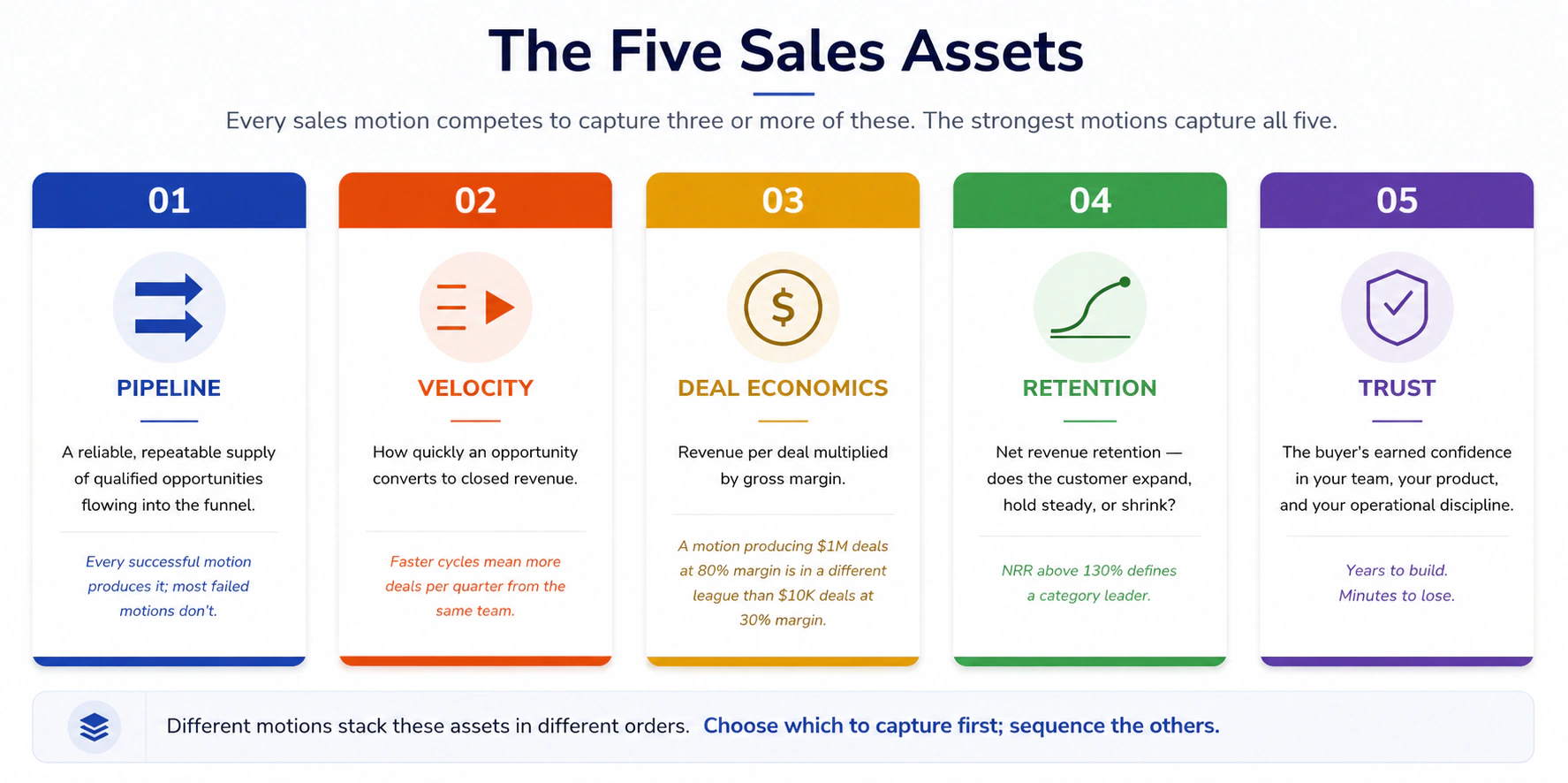
Paanch sales assets — har motion kis cheez ko capture karne ki koshish karta hai.
Pipeline qualified opportunities ki reliable, repeatable supply hai jo sales process mein flow karti hai. Har successful motion pipeline produce karta hai; aksar failed motions nahin karte.
Velocity yeh hai ke opportunity closed revenue mein kitni jaldi convert hoti hai. Faster cycles ka matlab same team se per quarter zyada deals.
Deal economics revenue per deal multiplied by gross margin hai. Jo motion $1M deals 80% margin par produce karta hai woh $10K deals 30% margin par produce karne wale motion se different revenue league mein hai.
Retention net revenue retention hai: customer spend expand karta hai, steady rehta hai, ya shrink hota hai? SaaS mein 130% se upar NRR category leader define karta hai. AI mein math change ho rahi hai kyun ke outcome-based revenue usage ke saath naturally grow hoti hai.
Trust buyer ka earned confidence hai aapki team, product, aur operational discipline mein. Trust build hone mein saal lagte hain aur lose hone mein minutes.
Strongest motions in assets mein se teen ya zyada aik saath capture karte hain. Agent era mein revenue strategy ka kaam yeh choose karna hai ke pehle kaun sa asset capture karna hai, phir baqi sequence karne hain.
Scope par aik note. Yeh catalog primarily B2B markets par focus karta hai: AI Workers aur AI-native software jo businesses ko sell hota hai, individual consumers ko directly nahin. Consumer-facing AI sales, mobile app store, advertising-led, subscription-led, different rules follow karti hain aur yahan primary subject nahin, lekin kuch motions, Self-Serve PLG, Marketplace-Led, aur Community-Led, dono contexts mein cleanly apply hote hain.
Maturity spectrum. Is catalog mein har motion ko Proven, Emerging, ya Speculative tag diya gaya hai, based on kitni AI-native companies aaj use successfully run kar rahi hain.
- Proven motions par multiple at-scale companies abhi operate kar rahi hain, confirmed revenue aur documented playbook ke saath.
- Emerging motions funded companies 2026 mein run kar rahi hain, lekin aksar outcomes abhi pending hain aur canonical winner abhi emerge nahin hua.
- Speculative motions buyer behaviors ya contracting structures par depend karte hain jo abhi scale par exist nahin karte, lekin jald ban sakte hain.
Maturity quality jaisi cheez nahin. Proven motions safer hain; Emerging motions larger upside dete hain; Speculative motions sab se bada upside un chand teams ko dete hain jo market ke baqi logon se pehle correctly position kar leti hain.
Yeh page kis liye hai
Yeh document teen purposes serve karta hai.
Pehla, chooser ke taur par. Founder ya revenue leader jo sales motion design kar raha ho Strategic Fit Matrix, Seller Diagnostic, aur Motion Summary Table use karke woh motions find kar sakta hai jo uske stage, buyer, aur product complexity se fit hote hain. Deep sections phir shortlisted motions ke mechanics, risks, aur first moves explain karte hain.
Doosra, reference ke taur par. Existing motion run karne wali revenue team deep sections use karke apni operation audit kar sakti hai: actual conversion rates, cycle times, aur deal economics ko documented patterns se compare karte hue.
Teesra, planning tool ke taur par. Founder jo motions ki sequence design kar raha ho, kyun ke most successful AI-native companies isolate aik motion nahin balkay sequence mein do ya teen motions run karti hain, Common Hybrid Motions section ko planning template ke taur par use kar sakta hai.
Motion kaise choose karein
Sales motion fit hone ka cleanest predictor deal size aur cycle length ka intersection hai. Neeche matrix twelve motions ko in do axes par map karta hai. Har motion ka sweet-spot cell hai aur woh adjacent cells mein bhi kam optimal tareeqe se kaam karta hai.
| Cycle ↓ \ Deal $ → | Self-serve (<$10K) | Mid-market ($10-100K) | Enterprise ($100K-1M) | Strategic (>$1M) |
|---|---|---|---|---|
| Days | PLG (1), Marketplace (2) | — | — | — |
| Weeks | Open-Source (3), Community (4) | Founder-Led (5), AI-Outbound (6) | — | — |
| Months | — | Channel (11) | Enterprise Field (7), Channel (11), Hyperscaler (12) | — |
| Quarters or longer | — | — | Pay-Per-Outcome (9), Hyperscaler (12) | FDE (8), Value-Based (10) |
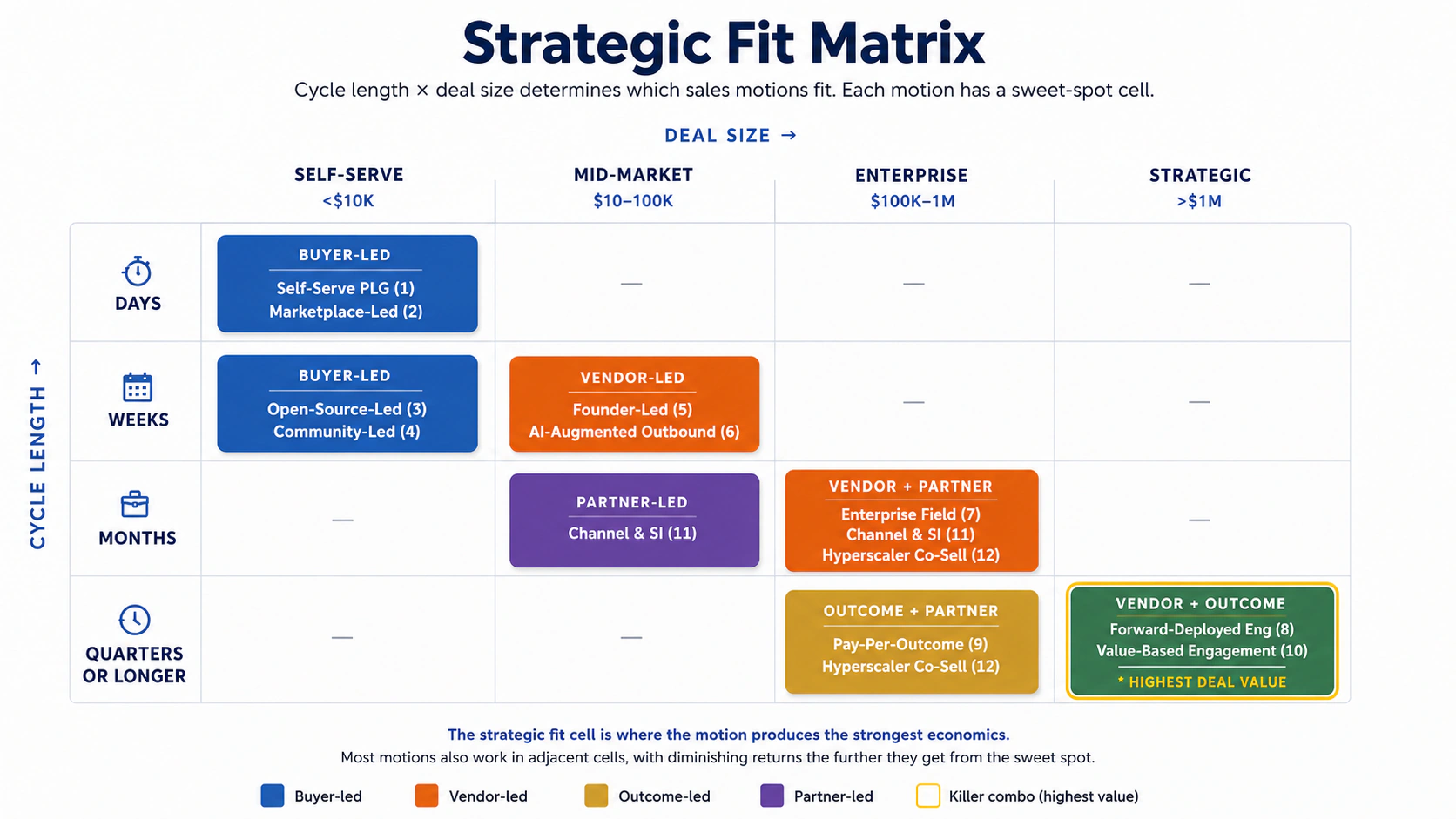
Sab se important cell woh hai jise koi pehle plan nahin karta: self-serve se start hone wale products ke liye multi-month enterprise cycles. Yahin PLG se grow karne wali companies large enterprise procurement ki wall se takrati hain, aur yahin revenue teams jo sirf self-serve motion chala chuki hoti hain achanak enterprise field motion chalane mein struggle karti hain. "Buyer-led" se "vendor-led" transition AI-native companies ka sab se common motion failure hai, aur sab se zyada teachable bhi.
Seller diagnostic: aath sawal
Motion pick karne se pehle neeche ki eight dimensions par khud ko honestly score karein. Har row jin motions ki taraf point karti hai woh us condition ke saath sab se aligned hain. Jo team in mein se teen ya chaar par High score karti hai, woh usually jaldi do ya teen candidate motions tak narrow ho jati hai.
-
Founder selling capacity. Kya founder abhi bhi deals personally close kar raha hai? Yes → Founder-Led, FDE. No, sales team in place → Enterprise Field, AI-Outbound, Channel.
-
Product complexity. Kya product evaluate hone se pehle buyer education require karta hai? Low → PLG, Marketplace, Open-Source. Moderate → Founder-Led, AI-Outbound. High → Enterprise Field, FDE, Value-Based.
-
Time-to-value. First interaction ke baad buyer meaningful value kitni jaldi experience karta hai? Minutes → PLG, Marketplace. Days-weeks → Open-Source, AI-Outbound, Pilot. Months → Enterprise Field, FDE, Value-Based.
-
Outcome measurability. Kya buyer ki success aapke product se cleanly measure ho sakti hai? High → Pay-Per-Outcome, Value-Based. Low → PLG, Enterprise Field, Channel (access ke taur par priced).
-
Buyer technical sophistication. Primary buyer kitna technical literate hai? Developer / engineer → Open-Source, PLG, Marketplace. Business / operator → Founder-Led, AI-Outbound, Enterprise Field. Executive / procurement-led → Enterprise Field, FDE, Value-Based, Hyperscaler.
-
Procurement friction. Buyer ka typical procurement cycle kitna lamba hai? Days-weeks → PLG, Marketplace, Open-Source. Months → Founder-Led, AI-Outbound, Enterprise Field (pilot phase ke saath). Quarters → Enterprise Field, FDE, Channel, Value-Based.
-
Channel aur partner ecosystem. Kya third parties already adjacent ways mein aapke target buyer ko serve karti hain? Yes, deep → Channel, Hyperscaler, SI partnership. Yes, light → Marketplace, Community. No → Founder-Led, AI-Outbound, Enterprise Field.
-
Capital aur patience. Significant revenue chahiye hone se pehle team kitni der operate kar sakti hai? Less than 6 months → PLG, Marketplace, Open-Source. 6-18 months → Founder-Led, AI-Outbound. 18+ months → Enterprise Field, FDE, Value-Based.
Diagnostic yeh nahin batata ke kaun sa motion correct hai. Yeh batata hai ke aapki starting position ke mutabiq kaun se motions available hain. Upar ki matrix aur neeche ke deep sections batate hain ke available motions mein se aapke buyer ke liye sab se sharp motion kaun sa hai.
Motion summary table
Twelve motions ke liye one-page reference. Isay catalog ko glance par scan karne ke liye use karein, final decision ke liye nahin, kyun ke real distinctions neeche ke deeper sections mein hain.
| # | Motion | Maturity | Best for | Typical cycle | Typical deal size | Main risk |
|---|---|---|---|---|---|---|
| 1 | Self-Serve PLG | Proven | Immediate value wale developer-tool / productivity products | Hours to days | <$10K initial; expands | Conversion-to-paid stall hoti hai |
| 2 | Marketplace-Led | Proven | Host platform mein fit hone wali apps | Days | $10-50K | Platform compete ya kick-out |
| 3 | Open-Source-Led | Proven | Developer infrastructure aur frameworks | Weeks to months (open-to-paid) | $50K-500K commercial | Open-to-commercial conversion fail |
| 4 | Community-Led | Proven | Strong identity / target persona wale products | Weeks to months | $10-100K | Scale ke saath community dilution |
| 5 | Founder-Led Sales | Proven | Pre-product-market-fit; first 5-50 deals | Weeks | $25-250K | Founder bottleneck; handoff failure |
| 6 | AI-Augmented Outbound | Emerging | Mid-market vendor-led GTM | Weeks to months | $25-250K | AI-generated outreach se buyer fatigue |
| 7 | Enterprise Field Sales | Proven | Large organizations ko six-figure deals | 3-9 months | $100K-1M | Long sales cycle; heavy CAC |
| 8 | Forward-Deployed Engineering | Proven | Strategic enterprise deals jahan success custom work require karti hai | First deal ke liye 6-12 months | $500K-5M | Service-business gravity |
| 9 | Pay-Per-Outcome | Emerging | Workflows jahan outcomes cleanly attributed ho sakte hain | 2-6 months | Variable; usage-based | Early years mein negative margin |
| 10 | Value-Based Engagement | Speculative | Strategic transformation deals | 6-18 months | $1M-10M+ | Attribution disputes |
| 11 | Channel & SI Partnership | Proven | Products jinko implementation expertise chahiye | 3-9 months (partner ke through) | $100K-1M | Partner economics misalignment |
| 12 | Hyperscaler Co-Sell | Proven | Large compute footprint wale cloud-native products | 2-6 months | $100K-1M+ | Hyperscaler de-prioritization |
Mujhe kaun sa motion chalana chahiye?
Neeche flowchart sab se important decisions ko sequence karta hai. Sawalon ke jawab top-to-bottom dein aur pehle YES par stop karein. Leaf nodes aapko one to four candidate motions dete hain jinko full parhna chahiye.
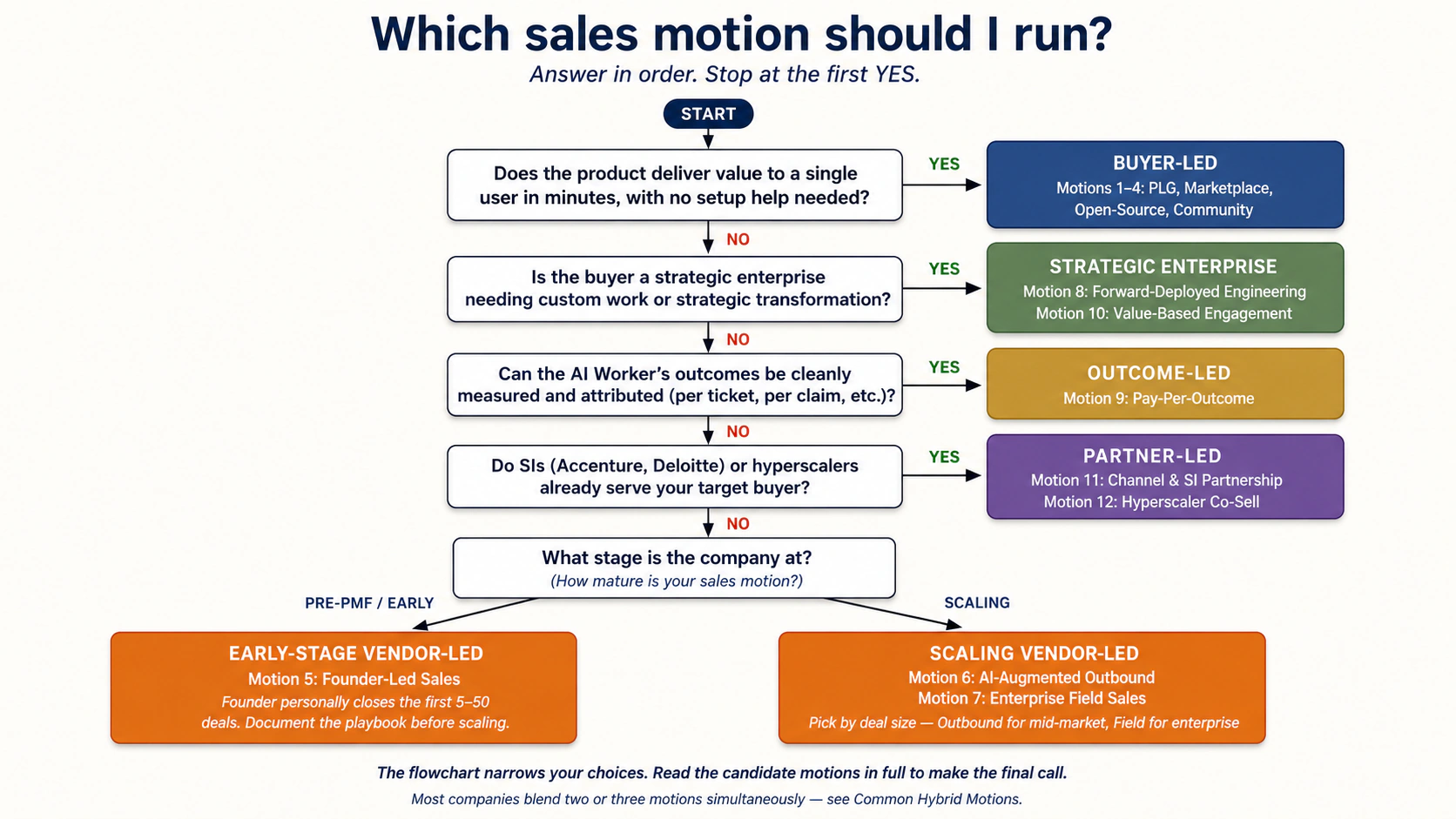
Flowchart opinionated hai. Yeh real-world nuance ko clean YES/NO splits mein collapse karta hai taake options twelve se do ya teen tak narrow ho jayen. Candidate set narrow hone ke baad choice refine karne ke liye upar Seller Diagnostic aur Strategic Fit Matrix use karein. Most companies aik motion ke bajaye do ya teen motions simultaneously run karengi. Common combinations ke liye document ke end ke qareeb Common Hybrid Motions dekhein.
Buyer maturity aur timing
Is catalog ke har motion ki buyer ke apne AI journey mein aik window hai. Jis buyer ne kabhi production mein AI deploy nahin kiya, woh us buyer se different tareeqe se buy karta hai jo scale par production AI run karta hai. Jo motions AI-native buyer ke liye brilliant lagte hain, AI-curious buyer ke liye alien lag sakte hain, aur vice versa.
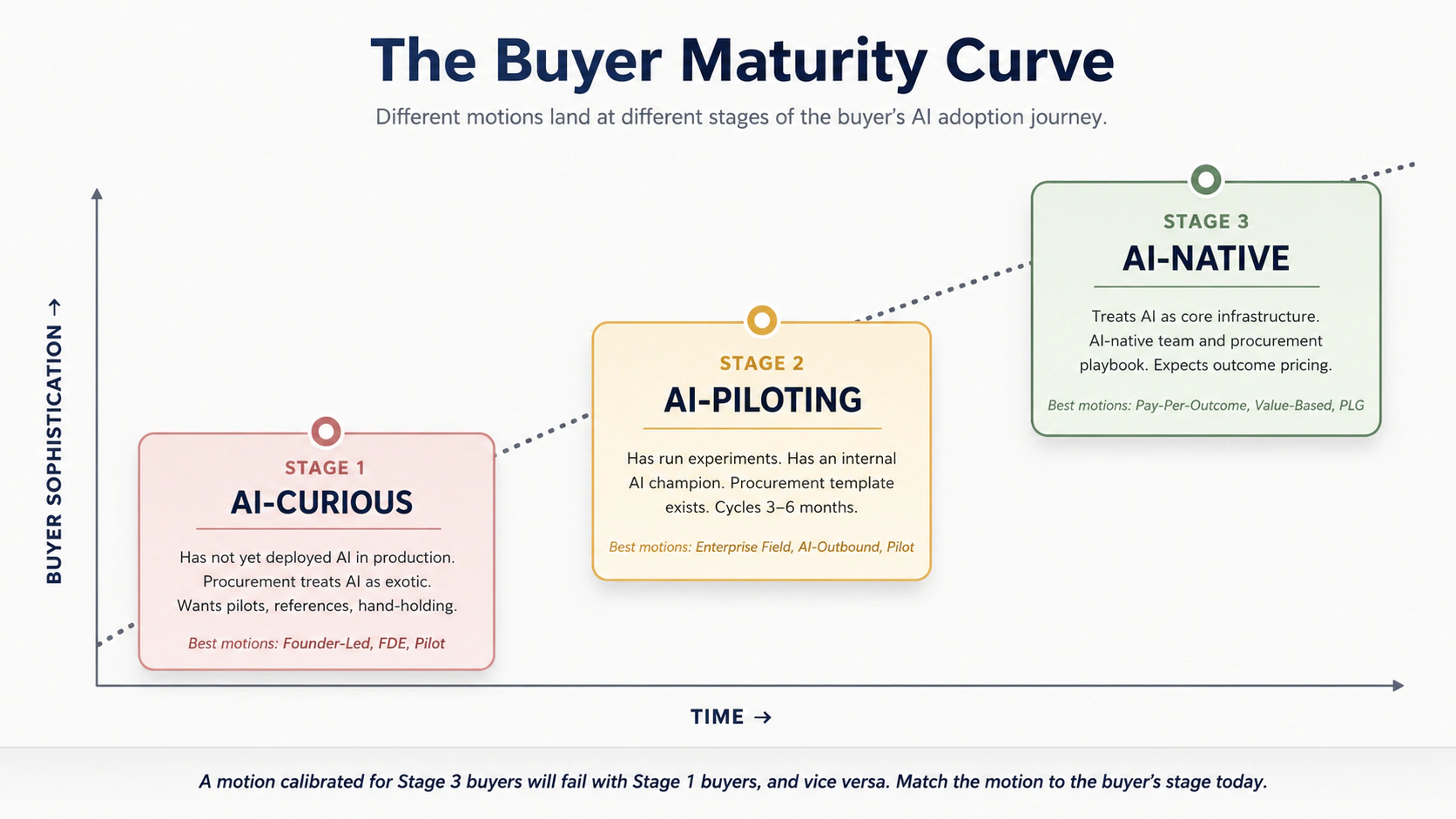
Teen stages buyer maturity curve define karte hain.
Stage 1 — AI-Curious. Buyer AI mein interested hai lekin production mein deploy nahin kiya. Procurement AI ko exotic treat karta hai; legal ko AI-specific language scratch se draft karni hoti hai; security ke paas AI vendor template nahin. Buyer pilots, references, aur internal sponsor chahta hai jo vouch kar sake. Sales cycles slow hote hain kyun ke har objection pehli dafa raise ho raha hota hai. Best motions: Founder-Led, FDE, paid pilot phase ke saath Enterprise Field.
Stage 2 — AI-Piloting. Buyer experiments run kar chuka hai. Internal AI champion hota hai, aksar VP of Engineering, Chief Data Officer, ya AI-curious COO, jisne kam az kam aik model production mein ship kiya hota hai. Procurement ke paas basic AI vendor template hota hai. Sales cycles faster hote hain, 3-6 months, kyun ke buyer janta hai kya poochna hai. Best motions: Enterprise Field, AI-Augmented Outbound, Channel.
Stage 3 — AI-Native. Buyer AI ko core infrastructure treat karta hai. AI-native team, AI procurement playbook, aur outcome-based pricing options ki expectation hoti hai. Clear-fit products ke liye sales cycles fast ho sakte hain, weeks, lekin procurement scrutiny intense hoti hai: rigorous security review, thorough competitive benchmarking, aur buyer outcomes par negotiate karega, sirf price par nahin. Best motions: Pay-Per-Outcome, Value-Based, Hyperscaler Co-Sell, PLG (departmental adoption ke liye).
Geography curve ko accelerate ya delay karti hai. Silicon Valley, Seattle, Boston, New York, London, Toronto, Berlin, Bangalore, aur Singapore 2026 mein mostly Stage 2 ya Stage 3 markets hain. In ecosystems ke buyers AI experiments run kar chuke hain, internal AI procurement templates likh chuke hain, aur outcome-based pricing options demand karna start kar rahe hain. Duniya ka baqi hissa zyada tar two to three years behind hai: continental Europe, Latin America, Middle East, Africa, aur Southeast Asia ke bohat se enterprise buyers abhi Stage 1 mein solid hain, Stage 2 ki taraf transition kar rahe hain.
Global selling karne wale founders ke liye implication yeh hai ke same product ko different markets mein different motions chahiye. Self-serve PLG product San Francisco aur Sao Paulo mein same tareeqe se sell ho sakta hai, kyun ke buyer user hai aur user sophistication geography par depend nahin karti. Lekin San Francisco ke AI-native buyers ke liye calibrated enterprise field motion Karachi, Lagos, ya Jakarta mein fail ho sakta hai. Local buyer kam sophisticated nahin; unki AI procurement kam mature hai. Seller ko motion slow karna hota hai: zyada education, zyada references, longer pilots, procurement mein zyada hand-holding.
Opposite mismatch bhi equally costly hai. Stage 1 buyers ke liye calibrated motion, heavy hand-holding, long pilots, founder-on-every-call, Stage 3 markets mein unnecessary expensive aur weak signal hota hai. Stage 3 buyer outcome-based pricing aur four-week procurement cycle chahta hai. Unhein Stage 1 motion sell karna yeh communicate karta hai ke seller slow, unsophisticated, aur integration effort ke qabil shayad nahin. Globally selling founder ko pata hona chahiye ke unka buyer aaj kis stage mein hai, reference customers kis stage mein hain yeh nahin. Stage 3 buyers ke liye calibrated motion Stage 1 buyers ke saath fail hoga, aur vice versa.
Maturity legend
- Proven. Motion ko multiple AI-native companies aaj scale par operate kar rahi hain, confirmed revenue aur documented playbook ke saath. Mechanics well understood hain.
- Emerging. Motion funded AI-native companies 2026 mein run kar rahi hain, lekin aksar outcomes pending hain aur canonical winner abhi emerge nahin hua.
- Speculative. Motion buyer behaviors ya contracting structures par depend karta hai jo abhi scale par exist nahin karte, lekin plausibly form ho rahe hain.
A. Buyer-led motions
Buyer khud discover, khud evaluate, aur khud purchase karta hai. Seller ka kaam findable, frictionless, aur credible hona hai. Seller sales cycle nahin chalata; buyer chalata hai. Yeh motions velocity aur CAC efficiency mein strong hote hain, lekin vendor-led motions ke muqablay mein usually smaller initial deal sizes produce karte hain.
Motion 1 — Self-Serve PLG (Product-Led Growth)
Maturity: Proven. Beginner difficulty: Easy.
In Plain English. Software ki vending machine imagine karein. Buyer aata hai, credit card swipe karta hai, aur product appear ho jata hai. Na salesperson, na contract negotiation, na $20/month subscription ke liye procurement review. Self-Serve PLG exactly yahi hai: product khud selling karta hai. Buyer sign up karta hai, minutes mein value experience karta hai, aur usage paid tier justify kare to khud upgrade karta hai.¹
Yeh sirf tab kaam karta hai jab product single user ko organizational coordination ke baghair immediate, obvious value de. Cursor, AI code editor, clean example hai: engineer sign up karta hai, AI assistance ke saath code likhta hai, first session mein value dekhta hai, aur free-tier limits hit hone par upgrade karta hai. Linear, Notion AI, aur ElevenLabs bhi is motion ke variants run karte hain.
Immediate single-user value wale products ke founding motion ke taur par best. Company scale ho to often Enterprise Field ke saath pair hota hai. PLG → Enterprise hybrid 2026 ki most common motion sequences mein se aik hai.
Core idea. Curiosity aur value ke darmiyan friction remove karein. Sign-up flow ka har step jo value produce nahin karta remove hona chahiye. Product khud sales pitch, demo, aur close hai.
When to use it. Jab target buyer hi user ho, separate procurement role na ho; value immediate ho, minutes mein, weeks mein nahin; aur price point corporate-card thresholds se neeche ho, typically <$200/seat/month, though AI products clear ROI dikhate hain to yeh rise ho raha hai.
Mechanism. PLG traditional B2B sales funnel ko invert karta hai. Sales-qualified leads ko salesperson ke paas push karne ke bajaye product qualified buyers produce karta hai jo khud paid conversion ki taraf pull hote hain. CAC product investment se dominated hota hai: onboarding, activation, in-product upgrade prompts, headcount se nahin. Margins high hote hain kyun ke sales team pay nahin karni. Constraint conversion-to-paid hai: most PLG products free users ka 2-5% paid mein convert karte hain.
Fictional walk-through. FocusFlow imagine karein, $20/month AI app jo email organize karne mein help karti hai. User lunch par sign up karta hai, inbox connect karta hai, aur five minutes mein productively use kar raha hota hai. First week mein one hundred AI summaries per day ka free-tier ceiling hit hota hai aur woh paid upgrade kar leta hai. Koi salesperson involved nahin. FocusFlow ki revenue grow hoti hai kyun ke product khud free users ko paying users mein convert karta hai.
Example. Confirmed examples: Cursor ka free-tier code editor se paid subscriptions aur enterprise contracts tak path. Linear, Notion AI, Perplexity Pro. Voice generation ke liye ElevenLabs.
Primary risk. Conversion-to-paid stall hoti hai. Product adoption leta hai lekin users upgrade nahin karte. Mitigation: upgrade trigger ko directly product ke andar design karein. Free tier ka usage ceiling itna tight ho ke genuine power users first week mein hit karen, aik saal baad nahin.
Secondary risk. Self-serve plateau. Motion departmental adoption ke liye kaam karta hai lekin company ki enterprise expansion, security review, multi-seat negotiation, custom contracts, aik aise sales motion ki demand karti hai jo team ne build nahin kiya. Mitigation: enterprise-scale prospects aane ke baad nahin, usse pehle first enterprise seller hire karein. "Buyer-led" se "vendor-led" transition deliberate motion design require karta hai.
First move. Free tier build karein jo sign-up ke five minutes ke andar genuine value ka moment create kare. Us moment ke baghair koi PLG mechanic matter nahin karta.
Motion 2 — Marketplace-Led
Maturity: Proven. Beginner difficulty: Easy.
In Plain English. Busy bazaar mein stall rent karna imagine karein. Crowd khud lane ki zarurat nahin; bazaar already karta hai. Aapka kaam bazaar ka best stall banna hai. Marketplace-Led selling ka matlab hai apna AI product kisi established platform ke app store ke andar list karna: Salesforce AppExchange, Shopify App Store, Microsoft AppSource, ChatGPT Apps directory, Atlassian Marketplace. Marketplace discovery, billing, aur initial trust signal handle karta hai. Aap product handle karte hain.
AI products ke liye yeh motion uniquely powerful hai kyun ke buyer aksar platform ke andar hi hota hai jab use AI feature ki zarurat mehsoos hoti hai. Salesforce admin jise AI lead-scoring tool chahiye, Google se pehle AppExchange search karega.
Founding distribution motion ya established products ke complementary channel ke taur par best. Scale par rarely company ka only motion hota hai.
Core idea. Platform ka distribution, billing, aur trust apparatus inherit karein. Direct customer acquisition costs ke bajaye revenue share ya listing fees se pay karein.
When to use it. Jab aapka AI product platform ke existing user base mein cleanly fit hota ho, platform ke customers aapke target customer se map karte hon, aur platform ka revenue share us direct customer acquisition spend se kam ho jo aap otherwise karte.
Mechanism. Marketplace founder ke teen problems aik saath solve karta hai: discovery, buyer platform mein shopping karte hue aapko find karta hai; billing, platform credit cards, invoicing, tax handle karta hai; trust, platform ka vetting process khud trust signal hota hai. Trade-off platform ka revenue share hai, typically 15-30%, aur platform policy risk: woh terms change kar sakte hain ya competing first-party feature build kar sakte hain.
Fictional walk-through. NoteSnap imagine karein, Salesforce ke liye AI summarization app. NoteSnap Salesforce AppExchange mein list hota hai. Productivity tools search karne wala Salesforce admin NoteSnap find karta hai, install karta hai, free trial mein value dekhta hai, aur Salesforce ke billing system se paid convert ho jata hai. NoteSnap ne outbound campaign nahin chalayi; platform ne customer acquisition ki.
Example. Confirmed examples: Successful Salesforce AppExchange aur Shopify App Store companies ki long tail. 2026 mein Claude Apps aur ChatGPT Apps ke through ship hone wale productivity agents. Meta aur TikTok ad platforms mein embedded AI-native ad-creative tools.
Primary risk. Platform risk asymmetric aur existential hai. Policy change, take-rate increase, ya first-party feature launch marketplace-led business ko overnight erase kar sakta hai. Mitigation: platform ke bahar direct relationship layer maintain karein, apni email list, community, ya data export pathway, taake platform termination fatal na ho balkay recoverable ho. Plan karein ke platform eventually aap se compete karega.
First move. Aik platform pick karein aur second par list karne se pehle us mein first-class citizen ban jayen: top-rated, deeply integrated, frequently updated.
Motion 3 — Open-Source-Led
Maturity: Proven. Beginner difficulty: Medium.
In Plain English. Recipe free dein; catering ke paise lein. Open-Source-Led selling ka matlab hai product ka core open-source code ke taur par publish karna jise koi developer read, modify, aur run kar sake. Jitne zyada developers use karte hain, reputation grow hoti hai, contributors project join karte hain, aur code behtar hota hai, marketing team pay kiye baghair. Phir aap paid version sell karte hain jisme companies ko required cheezen milti hain: managed hosting, security features, audit logs, support contracts, regulated-environment certifications.
Yeh motion AI infrastructure ke liye especially powerful hai: agent frameworks, evaluation tools, aur developer libraries jahan developer mindshare primary moat hota hai.
Infrastructure-shaped products ke founding motion ke taur par best. Commercial offering mature ho to often Channel ya Hyperscaler Co-Sell ke saath pair hota hai.
Core idea. Open-source project ko globally distributed marketing function ke taur par use karein. Community project evangelize karti hai; users ka aik fraction jab operational, security, ya scale needs hit karta hai jinko open project handle nahin karta, paying customers ban jata hai.
When to use it. Jab target buyer technical ho, developers, ML engineers, infrastructure teams; jab credible reason ho ke company managed version ke liye pay karegi, hosting, compliance, support, khud open version run karne ke bajaye; aur jab team multi-year community build karne ke liye open-source development sustain kar sakti ho.
Mechanism. Open-source-led is liye kaam karta hai ke developer adoption enterprise adoption se pehle flow karti hai. Engineers apni machines par open project experiment karte hain, phir company mein related need aaye to internally advocate karte hain. Pre-sales relationship salesperson hire hone se pehle ban jata hai. Constraint open-to-commercial conversion hai: bohat se open-source projects technology buri hone ki wajah se fail nahin karte, balkay founders free project ke upar clear paid product build nahin karte.
Fictional walk-through. AgentCore imagine karein, open-source framework jo developers ko AI agents build karne deta hai. Hazaron developers AgentCore free download karte hain, project mein contribute karte hain, aur apps build karte hain. AgentCore ka commercial offering, AgentCore Cloud, enterprises se managed hosting, single sign-on, audit logs, aur compliance certifications ke liye charge karta hai. Free project adoption drive karta hai; paid version un customers ko capture karta hai jinko enterprise features chahiye.
Example. Confirmed examples: LangChain, Continue, n8n, Cline, aur widely-adopted open cores ke upar commercial managed versions ship karne wale agent frameworks ki long tail. Current agent ecosystem mein yeh sab se prominent patterns mein se hai.
Primary risk. Open-to-commercial conversion fail. Open project wildly popular hai lekin commercial revenue weak hai. Mitigation: pehle se decide karein ke kya aap kabhi free nahin denge: usually managed hosting, single-sign-on, audit logs, advanced security, aur enterprise support. Is line ko publicly commit karein. Line move ho to volunteers aur contributors ka faith toot jata hai.
Secondary risk. Hyperscaler appropriation. AWS, Azure, ya GCP aapke open project ko apni managed service mein wrap karke aap se zyada distribution le jata hai. Mitigation: hyperscaler partner programs ke saath early direct work karein, ya license use karein, jaise BSL, SSPL, jo explicit license ke baghair cloud-provider commercial use limit karta ho.
First move. Commercial offering ki baat karne se pehle open project genuinely useful state tak ship karein. Communities bait-and-switch ko door se pehchan leti hain.
Motion 4 — Community-Led
Maturity: Proven. Beginner difficulty: Easy.
In Plain English. Kuch sell karne se pehle famous hona imagine karein. Community-Led ka matlab hai paid product ship karne se bohat pehle audience build karna: Discord server, YouTube channel, Substack, tutorial library, public-build-in-public X account. Jab aap product ship karte hain, audience already hoti hai. Woh product ka wait kar rahi hoti hai. Woh buy karegi, evangelize karegi, aur early-version flaws forgive karegi kyun ke use aapki success mein personal investment mehsoos hota hai.
Yeh motion technical audiences ke liye Open-Source-Led ke saath aur kuch AI tools ke liye Marketplace-Led ke saath overlap karta hai, lekin iska distinctive feature founder ya team ki public identity ka entry point hona hai.
Strong creative identity wale products ke founding motion ke taur par best. Founder ke personal reach se aage scale karna mushkil hai jab tak community ko deliberately structured brand asset mein convert na kiya jaye.
Core idea. Audience pehle build karein, product baad mein. Distribution ko quarterly expense ke bajaye long-term moat treat karein.
When to use it. Jab founder ya team target buyer ecosystem mein credible content produce kar sakti ho, dev tools ke liye developer-influencer, creator tools ke liye creator-influencer, vertical SaaS ke liye operator-influencer; jab embed hone ke liye established marketplace ya platform na ho; aur jab team 12+ months audience building mein patiently invest kar sakti ho before serious revenue.
Mechanism. Community-led kaam karta hai kyun ke audience khud pre-qualify hoti hai. Jo log do saal developer-influencer ko follow karte hain aur phir uska product buy karte hain, woh paid acquisition ke cold lead se 10-20x zyada convert karte hain. Trust, jo sab se mehnga sales asset hai, product launch se upstream build ho jata hai.
Fictional walk-through. VideoMaker imagine karein, AI video editing tool. Founder ne product launch se pehle do saal YouTube aur TikTok par tutorials post kiye aur fifty thousand followers ki audience build ki. Launch day tak audience wait kar rahi thi. Pehle thousand paid customers directly uske existing followers se aaye; launch-week revenue ne zyada pre-launch products ke first-year revenue ko exceed kar diya.
Example. Confirmed examples: Tiago Forte ka Building a Second Brain franchise (productivity), Lenny Rachitsky ka product-management substack-to-software trajectory, aur AI-creator personalities jo apni audiences ko tools launch karte hain. Pattern companies se zyada individuals se shaped hai.
Primary risk. Scale ke saath community dilution. Early audience intimacy aur direct founder access value karti hai; company scale ho to woh intimacy impossible ho jati hai. Mitigation: community ko brand asset mein convert karein, named programs, public events, tier rewards, forever personal founder presence par depend na karein.
First move. Product sell karne se pehle content produce karna start karein. Commercial pitch ke baghair twelve months consistent content minimum entry price hai.
B. Vendor-led motions
Seller deal initiate aur orchestrate karta hai. Seller ka kaam precise targeting, value articulation, aur procurement navigation hai. Yeh motions deal size aur predictability mein strong hote hain, lekin larger teams aur zyada patience require karte hain jo buyer-led motions nahin karte.
Motion 5 — Founder-Led Sales
Maturity: Proven. Beginner difficulty: Easy.
In Plain English. Early restaurant mein chef hi food cook karta hai, guests ko seat karta hai, orders leta hai, aur bill banata hai. Founder-Led Sales exactly yahi hai: founder sales team hire karne se pehle pehli 5-50 deals personally hand-close karta hai. Buyer asal mein kya value karta hai, kaun se objections aate hain, aur real sales playbook kaisa dikhta hai, yeh seekhne ka koi aur tareeqa nahin. Jo founder yeh step skip karke VP of Sales bohat jaldi hire karta hai, woh unvalidated sales motion aur aisi team ship karta hai jo improvise nahin kar sakti.²
Kisi bhi complex B2B AI product ke founding sales motion ke taur par best. 6-18 months ke andar AI-Augmented Outbound, Enterprise Field, ya kisi aur vendor-led motion ki transition plan karein, kyun ke founder bandwidth binding constraint hai.
Core idea. Team mein founder hi woh person hai jiske paas product context aur strategic discretion dono hote hain taake non-standard deals close kar sake. First phase mein founder use karein, phir founder ne jo seekha use repeatable playbook mein convert karein before hiring sellers.
When to use it. B2B AI-native companies ke liye hamesha, pre-Series A ya sales motion ke evolution ke early stage par. Jo companies primarily PLG motion run karti hain unhein bhi early enterprise deals ke liye founder-led sales se benefit hota hai.
Mechanism. Founder-Led is liye kaam karta hai kyun ke har early deal partially custom hoti hai. Buyer young company par risk le raha hota hai, aur founder hi authoritatively keh sakta hai "yes, we can do that" aur usay true bana sakta hai. Constraint founder bandwidth hai: founder usually product build, capital raise, aur recruiting ke saath saath per quarter 3-5 deals close kar sakta hai. Is se zyada motion founder par bottleneck ho jata hai.
Fictional walk-through. LegalDraft imagine karein, AI legal-research tool. Founder, former corporate attorney, apni old law firm ke thirty friends ko personally call karti hai. Woh product demo karti hai, har call par pricing negotiate karti hai, aur salespeople hire karne se pehle pehle fifteen customers sign karti hai. In conversations mein usay yeh bhi pata chalta hai ke jis feature ko woh killer use case samajh rahi thi woh barely valuable hai, aur jo boring feature woh cut karne wali thi wahi customers actually pay karte hain.
Example. Confirmed pattern: 2025-2026 ki zyada successful B2B AI-native startups, chahe woh baad mein kisi bhi motion ko scale karein, pehle 5-50 customers ke liye founder-led sales run kar chuki hain. Harvey, Sierra, Glean, aur Hebbia pattern fit karte hain.
Primary risk. Founder bottleneck. Founder bohat zyada sales meetings mein hota hai, product build ya company run nahin kar pata. Mitigation: motion ko explicitly sunset karein. Pehli 30-50 deals ke baad founder next 50 deals run karne ke bajaye sales playbook write kare.
Secondary risk. Handoff failure. First sales hire founder ke kaam ko replicate nahin kar pata kyun ke founder ki selling unwritten product commitments, pricing improvisation, aur personal relationships par based thi. Mitigation: har commitment, har pricing exception, aur har deal structure ko as-it-happens document karein. Handoff document founder-led sales ke dauran banta hai, baad mein nahin.
First move. Founder next deal personally close kare. Jo bhi baad mein aata hai, woh is aik deal se learned cheezon par built hota hai.
Motion 6 — AI-Augmented Outbound
Maturity: Emerging. Beginner difficulty: Medium.
In Plain English. Fifty logon ki sales development team ko five logon ki team mein squeeze karna imagine karein. AI-Augmented Outbound AI agents se research, drafting, aur follow-up ka woh kaam karwata hai jo historically sales development representatives ki armies require karta tha, aur chhoti human team live conversations aur demos handle karti hai jahan AI abhi achha nahin. Traditional SDR din mein thirty personalized emails bhejta tha. AI-augmented SDR three thousand bhejta hai.³
Yeh woh sales motion hai jo AI ne khud possible banaya hai. Do saal pehle underlying technology insufficient thi. Aaj well-tuned AI-augmented outbound best human SDR teams ki personalization quality match ya exceed karta hai, fraction of headcount par, aur human SDR un conversations ke loop mein rehta hai jo matter karti hain.
Mid-market vendor-led GTM ke primary motion ke taur par best. Kisi bhi vendor-led motion ke upar augmentation layer ke taur par bhi kaam karta hai. Mechanics underlying AI tooling ke saath rapidly evolve ho rahe hain.
Core idea. Upper-funnel research, drafting, aur follow-up work AI agents se karwayein. Bottom-funnel, live conversations, demo coordination, deal navigation, ke liye chhoti human team rakhein jahan AI human judgment replace nahin kar sakta.
When to use it. Jab target buyer email ya LinkedIn se reachable ho, typical mid-market tech buyers; executive-level enterprise buyers ke liye less reliable; jab product 30-minute call mein demonstrate ho sakta ho; aur team ke paas RevOps maturity ho taake AI prompts aur behavior instrument aur tune ho saken.
Mechanism. AI-augmented outbound is liye kaam karta hai kyun ke traditional outbound mein limiting factor hamesha scale par personalization quality thi. Humans din mein 30 personalized emails likh sakte the; AI 3,000. Constraint outreach volume se shift ho kar deliverability, response quality, aur human SDR ki increased response rate handle karne ki capacity par aa jata hai. Is motion ko achhi tarah run karne wali early teams pure human outbound ke muqablay meaningful pipeline efficiency improvements report karti hain, typical claims 2-4x range mein hain, though independent benchmarks scarce hain aur comparison heavily depend karta hai ke "pipeline" se kya measure ho raha hai.
Fictional walk-through. SalesScope imagine karein, B2B AI tool. Uski five-person SDR team aik AI agent use karti hai jo per week ten thousand prospects research karta hai, har aik ke liye personalized outreach draft karta hai, aur automatically follow up karta hai. Human SDRs sirf resulting live conversations handle karte hain. Team monthly us manual-outreach fifty-person SDR team se zyada meetings book karti hai, one-tenth headcount cost par.
Example. Emerging analogues: Apollo, Clay, Salesloft AI, Outreach AI, aur 2025-2026 mein ship hone wale AI-native sales engagement platforms ki wave. Bohat se AI-native vendors is motion ko primary outbound engine ke taur par run karte hain.
Primary risk. AI-generated outreach se buyer fatigue. Jaise jaise AI-augmented outbound spread hota hai, buyers usay identify aur ignore karna seekh lete hain. Mitigation: AI ko research aur drafting ke liye use karein, lekin actual sending aur follow-up mein human SDRs ko conversation mein rakhein. "AI-generated, AI-detected, ignored" path real aur growing hai.
Secondary risk. Compliance aur deliverability. Scale par AI-augmented outbound ESP penalties trigger kar sakta hai ya jurisdictional rules violate kar sakta hai. Mitigation: deliverability infrastructure mein invest karein aur regional regulations rigorously follow karein.
First move. Apni current SDR team ka actual time allocation audit karein. Agar woh apne time ka 40% se zyada research aur drafting par lagate hain to AI-augmented outbound ke paas clear leverage opportunity hai. Agar zyada time live calls aur meeting coordination par hai to leverage smaller hai.
Motion 7 — Enterprise Field Sales
Maturity: Proven. Beginner difficulty: Medium.
In Plain English. Dealership par cars sell karna, lekin dealership customer ke office mein hai aur car $1M ki hai. Enterprise Field Sales traditional B2B sales motion hai: account executives $1-5M annual quotas carry karte hain, 3-9 month cycles mein multi-stakeholder deals work karte hain, jahan executive champions, technical evaluators, security reviewers, legal, aur procurement sab navigate karne hote hain.⁴
Yeh motion old-school enterprise software, Oracle, SAP, Salesforce, se sab se zyada associated hai. Yeh woh only motion bhi hai jo scale par multi-hundred-thousand-dollar AI deals reliably produce karta hai.
Six-figure deals target karne wale products ke primary motion ke taur par best. Aksar woh destination motion hai jisme PLG, Founder-Led, aur AI-Augmented Outbound companies scale par graduate karti hain.
Core idea. Buyer ki procurement complexity ko sales-team specialization se match karein. Jab buyer ke paas spend approve karne wala CFO, architecture approve karne wala CIO, vendor approve karne wali security team, aur contract approve karne wali legal team ho, to seller ko equivalent specialists chahiye.
When to use it. Jab deal sizes annually $100K se upar hon, buyer formal procurement wali large organization ho, product evaluate karne ke liye 30-minute conversation se zyada require karta ho, aur team ke paas long sales cycle support karne ke liye 18+ months capital ho.
Mechanism. Enterprise field sales is liye kaam karti hai kyun ke large organizations bad-vendor risk minimize karne ke liye designed processes ke through buy karti hain. Seller ka kaam us process ko navigate karna hai: internal champions build karna, security documentation dena, contracts negotiate karna, months tak jab tak organization formally purchase approve na kare. Almost har enterprise AI deal paid pilot ke taur par structure hoti hai jiske baad production contract hota hai; pilot separate motion nahin, is motion ka standard entry phase hai.
Constraint sales-team CAC hai. Fully-loaded enterprise account executive, salary, commission, benefits, sales-engineering allocation, tooling, annually mid-six-figures cost karta hai aur full quota tak ramp hone mein six to nine months leta hai. Jab tak ramp complete nahin hota, har AE offsetting revenue ke baghair cost hai. Jo companies playbook validate hone se pehle bohat zyada AEs jaldi hire karti hain, woh deals close hone se tez capital burn karti hain.
Fictional walk-through. HRSmart imagine karein, Fortune 500 HR teams ke liye AI tool. Aik deal close hone mein six months lagte hain. Account executive pehle VP of HR se milta hai, phir CIO, phir security review, three weeks, phir legal, six weeks, phir procurement, four weeks. Deal $400,000 ACV par close hoti hai. AE fully loaded per year $400,000 cost karta hai aur full quota tak ramp hone mein nine months leta hai. Math sirf is liye work karta hai ke har AE is scale par per year three to five deals close karta hai.
Example. Confirmed examples: Glean, Harvey, Sierra, Writer, aur Cresta par most six-figure-and-above AI-native deals enterprise field motions ke through run hoti hain. In companies ne specialized roles, AEs, SEs, customer success, sales engineering, ke saath formal sales organization build ki hai.
Primary risk. Long sales cycles capital burn karte hain. 6-9 month cycle at fully-loaded mid-six-figure AE cost ka matlab hai har AE deal close hone se pehle meaningful capital consume karta hai. Mitigation: 1000s mid-market companies par outbound spray karne ke bajaye small number high-value target accounts par concentrate karein, account-based selling.
Secondary risk. Heavy CAC ratios. Enterprise field motions 18+ months CAC payback periods produce kar sakte hain, jo venture-backed companies ke liye unsustainable hain jinko efficiency demonstrate karni hoti hai. Mitigation: enterprise field ko PLG ya pilot motion ke saath combine karein jo lower-cost initial entry produce karta hai, phir account ke andar expand karein.
First move. Aik enterprise seller hire karein aur second hire se pehle usay 6 months playbook run karne dein. Second hire ki success first hire ki learning par built hai, parallel learning par nahin.
Motion 8 — Forward-Deployed Engineering (FDE)
Maturity: Proven. Beginner difficulty: Advanced.
In Plain English. Menus nahin, embedded chefs. Apne engineers ko customer ki kitchen mein rehne bhejein aur custom meals cook karwayein. Waqt ke saath recipes menu ban jati hain jo baqi customers ko sell hota hai. Forward-Deployed Engineering ka matlab hai apne engineers, aur ab AI Workers, ki chhoti team ko months ke liye customer organization ke andar embed karna, taake unke liye exactly custom solution build ho. Har engagement team ko specific lesson deta hai ke customer ki industry asal mein kaise work karti hai. Teesri ya chauthi deployment tak aapke paas itne productized patterns hotay hain ke self-serve vertical product launch kar saken.
Palantir ne defense aur intelligence mein model invent kiya. Anthropic ki Applied AI team aur OpenAI ki Forward Deployed function lab level par aaj yeh run kar rahi hain. Sierra aur several enterprise AI vendors iske variants run kar rahe hain.
Enterprise-scale strategic deals ke founding motion ke taur par ya mid-stage path ke taur par best, jab product companies ko kisi specific industry mein vertical depth chahiye. Often Vertical AI-Native Greenfield mein transition karta hai.
Core idea. Engagement khud product discovery hai. Engagement ke dauran earned patterns moat ban jate hain jo company ko scale karne dete hain.
When to use it. Jab target customer strategic enterprise ho, government, large bank, large hospital system, large industrial company; buyer ka problem itna complex ho ke generic product solve na kar sake; aur team ke paas har early engagement par 6-12 months spend karne ka capital aur patience ho.
Mechanism. FDE vertical products ke cold-start problem ko solve karta hai. First customer company ko industry seekhne ke paise deta hai; baad ke customers woh product buy karte hain jo first engagement se hardened hota hai. Har engagement ka aik fraction reusable patterns mein convert hota hai; waqt ke saath reusable-to-custom work ratio flip hota hai, aur company services-margin economics se software-margin economics mein graduate karti hai.
Fictional walk-through. MedAgent imagine karein, hospital systems ke liye AI tool. MedAgent ka first customer large hospital network hai. MedAgent ke three engineers six months ke liye hospital offices mein move karte hain aur MedAgent ko us hospital ke specific clinical workflows ke liye customize karte hain. Hospital engagement ke liye $2M pay karta hai. Work ke dauran engineers jo patterns discover karte hain, common documentation flows, integration points, clinical-language conventions, woh productized version mein reusable features ban jate hain jo MedAgent baad mein other hospitals ko lower margins but higher volume par sell karta hai.
Example. Confirmed examples: Palantir ki defense aur commercial deployments. Anthropic ki Applied AI Team. Major enterprise accounts ke liye OpenAI ka Forward Deployed function. Smaller AI-native consultancies jo paid pilots run karke time ke saath productize karti hain.
Primary risk. Service-business gravity. Team day one se custom work sell karke real revenue banati hai, jo seductive aur addictive hota hai. Forever custom work karte rehna aur real product ki harder leap na lena tempting hai. Mitigation: demand karein ke har engagement kam az kam aik reusable pattern produce kare jo next engagement mein ship ho. Custom-to-productized work ratio ko top operating metric ke taur par track karein.
Secondary risk. Senior engineering bandwidth. FDE company ke most senior engineering talent ko months ke liye consume karta hai. Mitigation: concurrent FDE engagements ki tadaad itni rakhein jitni company sustain kar sakti hai. Parallel two FDE deployments reasonable hain; five ka usually matlab quality sab par suffer kar rahi hai.
First move. Aik strategic customer ko full-margin pricing par embedded engagement ke liye sign karein. Company ka product roadmap partially us customer ke actual workflow se shaped hona chahiye.
C. Outcome-led motions
Deal access ke bajaye results ke around structure hoti hai. Seller ka kaam measurement, attribution, aur consistent delivery hai. Yeh motions AI era se uniquely enabled hain, kyun ke AI Worker outputs aise measure ho sakte hain jaise software-seat outputs usually nahin ho sakte.
Motion 9 — Pay-Per-Outcome (Service-as-Software)
Maturity: Emerging. Beginner difficulty: Advanced.
In Plain English. Carpenter ke appear hone par nahin, darwaza fix hone par pay karein. Pay-Per-Outcome ka matlab buyer sirf tab pay karta hai jab AI Worker actual result deliver kare: resolved support ticket, closed sales meeting, processed insurance claim, drafted legal document. Vendor delivery risk leta hai.
Yeh pricing model AI era ne scale par possible banaya hai, kyun ke AI Worker outputs measurable hain jahan software-seat outputs typically nahin the. Sierra (customer support), Decagon (customer service), EvenUp (legal claims), aur AI-native vendors ki wave 2026 mein outcome-based pricing run kar rahi hai.
Jab outcomes cleanly measurable hon to founding motion ke taur par best, ya seat-based se start karne wali companies ke liye mid-stage pricing flip. Service-as-Software pattern se tightly coupled.
Core idea. Vendor revenue ko customer value ke saath align karein. Vendor tabhi paisa banata hai jab customer value leta hai, aur customer jitni zyada value leta hai, vendor utna zyada banata hai.
When to use it. Jab AI Worker ka output cleanly attributed aur measured ho sakta ho, resolved ticket resolved ticket hai, drafted contract drafted contract hai; jab unit economics priced outcome level par work karte hon, compute cost + AI quality cost revenue per outcome se below ho; aur buyer outcome contracts structure karne ke liye sophisticated ho, typically AI-native ya AI-piloting buyers.
Mechanism. Outcome pricing is liye kaam karta hai kyun ke seller customer ke software budget ke bajaye labor budget ke liye compete kar sakta hai. Mid-market company customer support software se das guna zyada customer support headcount par spend karti hai. Jo AI vendor outcome pricing ke through headcount budget ka fraction capture karta hai, woh us vendor se different revenue category mein operate karta hai jo software budget ka fraction capture karta hai.
Pricing math human labor cost se anchored hoti hai, SaaS comparable se nahin. Agar customer support representative ka all-in cost roughly $5 per resolved ticket hai, outcome price ceiling shayad $1-3 per resolved ticket ke around hai: human cost se enough below taake customer real savings capture kare, vendor ke compute cost se enough above taake gross margin positive ho. Vendor ka compute cost per outcome, currently typical agent tasks ke liye $0.20-0.80 aur model efficiency improve hone ke saath rapidly falling, floor set karta hai; customer ka human cost ceiling set karta hai; price beech mein rehti hai. Strategic question yeh hai ke gap kitna aggressively compress karna hai: wider gap per-outcome margin high karta hai lekin adoption slow; narrower gap adoption accelerate karta hai lekin un saalon mein margin compress karta hai jab compute prices abhi fall ho rahe hote hain.
Technical foundation outcome attribution hai. Vendor ko audit-grade telemetry produce karni hoti hai: har priced outcome ke liye verifiable record ke AI ne kya kiya, kya process kiya, aur result confirm kaise hua. Iske baghair customer disputes ka objective basis nahin hota aur revenue collection quarterly negotiation ban jati hai. Jo companies is motion ko achhi tarah run karti hain woh outcome-attribution infrastructure ko product ka hissa treat karti hain, accounting overhead nahin, aur usay engineers se staff karti hain, finance analysts se nahin. Yeh discipline motion ko durable banata hai; iski kami motion fail hone par kill karti hai.
Fictional walk-through. TicketBot imagine karein, AI customer-support agent. TicketBot customers se per seat charge nahin karta. Instead, customer har support ticket ke liye $0.50 pay karta hai jo TicketBot khud resolve karta hai, human escalation ke baghair. Fifty thousand tickets per month wala customer $25,000 monthly bill leta hai, lekin sirf tab jab TicketBot actual tickets resolve kare. Agar TicketBot incoming tickets ka sirf thirty percent resolve karta hai to bill uska one-third hota hai. Customer CFO ko yeh pasand hai; procurement team ko contract structure karna seekhna padta hai.
Example. Confirmed examples: Sierra ki AI customer service ke liye per-resolution pricing. Decagon ke outcome-based contracts. Personal-injury legal work ke liye EvenUp ki per-claim pricing. Pattern 2026 ki sab se actively expanding pricing structures mein se hai.
Primary risk. Early years mein negative gross margin. Agar AI quality abhi high enough nahin, vendor failed work ke compute aur human-fallback costs pay karta hai lekin revenue nahin milti. Mitigation: price-per-outcome mein early-quality issues ke liye margin buffer rakhein, aur quality improve hone par tighter pricing par graduate karein. Bohat se vendors first 12-18 months near-zero gross margin par operate karte hain jab tak quality stabilize na ho.
Secondary risk. Attribution disputes. Buyer claim karta hai ke AI ne outcome produce nahin kiya, ya buyer ke apne staff ne kiya. Mitigation: day one se outcome-attribution telemetry mein invest karein. Vendor ko irrefutable, audit-quality evidence chahiye ke kaun se outcomes AI Worker ne produce kiye.
First move. Aik outcome pick karein, sab se clean aur measurable, aur usay price karein. Jab tak pehle outcome ki economics prove na ho, simultaneously multiple outcomes price karne ki urge resist karein.
Motion 10 — Value-Based Engagement
Maturity: Speculative. Beginner difficulty: Advanced.
In Plain English. Aisi consulting firm hire karna imagine karein jo sirf created savings ka percentage leti hai: McKinsey ya BCG style engagement, lekin deliverable slide deck nahin live AI Worker hai, aur pricing customer ke measured P&L improvement se directly tied hai. Value-Based Engagement ka matlab large strategic deals ko created business value ke percentage ke taur par structure karna hai, rates deal complexity aur buyer sophistication ke hisab se widely vary karte hain. Yeh un AI deployments ke liye common hai jo hundreds of millions dollars ki P&L lines ko touch karti hain.
Motion speculative hai kyun ke yeh buyer ki value-based contracting formally commit karne ki willingness par depend karta hai, aur most enterprise procurement organizations abhi is tarah structure nahin hoti. 2026 mein yeh mostly AI-native vendors aur forward-leaning enterprise customers ke bespoke deals ke taur par exist karta hai.
Sirf strategic-deal scale (>$1M ACV) par realistic aur sirf AI-native buyers ke saath. Early-stage companies ke liye viable motion nahin; usually largest deals ke liye Enterprise Field ya FDE ke upar layer hota hai.
Core idea. Deal ko customer ke measurable economic outcome ke function ke taur par price karein. Vendor customer gain ke proportion mein upside leta hai, aur kuch structures mein gain threshold se below ho to downside bhi leta hai.
When to use it. Jab customer ke executive sponsor ke paas value-based contracting commit karne ka authority ho, typically C-suite level; jab created value cleanly AI Worker se attributed ho sakti ho, other initiatives se confounded na ho; aur deal size itna large ho ke contracting complexity justify ho.
Mechanism. Value-Based Engagement tab kaam karta hai jab dono parties value ka matlab aur uski measurement par agree kar saken. Structure vendor incentives ko customer outcomes ke saath kisi bhi pricing model se tight align karta hai: vendor revenue customer ke measurable gain ke proportion mein grow hoti hai, conventional vendor-buyer adversarial dynamic remove karte hue jahan vendor access ke liye charge karna chahta hai aur buyer results ke liye pay karna chahta hai.
Contract structure seat- ya outcome-based pricing se materially zyada complex hota hai. Typical agreement ke chaar components hote hain. Baseline measurement period, usually deployment se 30-90 days pehle, establish karta hai ke AI Worker ke baghair customer metrics kya the. Value-share formula define karta hai ke vendor gain ka kaun sa fraction capture karega, typically percentage jo deal complexity aur buyer sophistication ke hisab se vary karta hai. Ceiling and floor upside aur downside dono cap karte hain, taake vendor customer executives ke internally defend karne layak limit se zyada earn na kare aur product deploy karne ke liye customer ko pay bhi na karna pade. Audit rights vendor ko woh metrics verify karne ka haq dete hain jo billing drive karte hain. Audit rights ke baghair customer procurement organization first true-up cycle par measured value under-report karegi.
Constraint contracting maturity hai. Most enterprise procurement organizations abhi scale par value-based deals structure karne ke liye equipped nahin; legal, finance, aur operations sab ko model samajhne wale aur non-standard contract terms commit karne wale representatives chahiye. Isi liye yeh deals usually C-suite executive sponsor require karte hain. Sirf woh authority procurement organization ke default "we don't structure deals this way" ko override kar sakti hai. Sponsor ke baghair proposal technical merit ke bawajood mid-organization mein indefinitely stall ho jata hai. Motion 10 run karne wale sellers apni early energy ka zyada hissa executive sponsor identify aur recruit karne mein lagate hain; baqi motion sponsor ke mandate ke against execution hai.
Fictional walk-through. CashFlow imagine karein, hedge funds ke liye AI tool. $50B fund CashFlow deploy karta hai aur 12-month measurement period mein deployment se trading efficiency mein $40M annual improvement attribute karta hai. CashFlow ka contract baseline se upar measurable improvement ke fifteen percent par structured hai: fund contract duration ke liye annually $6M pay karta hai. Deal negotiate karne mein nine months lagay, fund ke CIO aur CFO ki personal approval required thi, aur procurement se sirf is liye guzri kyun ke executive sponsor ne push kiya.
Example. Emerging analogues: Strategic enterprise customers ke saath kuch Anthropic Applied AI engagements. Mission outcomes ke around structured kuch Palantir deployments. Financial services, healthcare, aur consulting firms mein forward-leaning AI deployments. Pattern abhi itna young hai ke canonical exemplar nahin.
Primary risk. Attribution disputes. Customer claim karta hai ke AI ne value produce nahin ki, ya customer ke apne initiatives ne ki. Mitigation: engagement start hone se pehle baseline measurement period establish karein. Post-deployment metrics ko hypothetical counterfactual ke bajaye pre-deployment baseline se compare karein.
Secondary risk. Long contracting cycles. Value-based contracts negotiate karne mein 6-12 months lag sakte hain, jisme team revenue ke baghair relationship mein invest kar rahi hoti hai. Mitigation: value-based engagement ko paid pilot phase ke saath combine karein jo production contract negotiate hotay waqt revenue produce kare.
First move. Proposal mein invest karne se pehle woh executive sponsor find karein jiske paas value-based contracting commit karne ka authority ho. Us sponsor ke baghair motion mid-organization procurement mein stall ho jata hai.
D. Partner-led motions
Third parties purchase drive karti hain. Seller ka kaam alliance management hai: partners ko itna successful banana ke woh aapke liye sell karte rahein. Yeh motions start mein slow hote hain lekin partner ecosystem place mein aa jaye to durable, repeatable revenue produce karte hain.
Motion 11 — Channel & SI Partnership
Maturity: Proven. Beginner difficulty: Medium.
In Plain English. Apple Best Buy ke through sell karta hai. Beverages grocery stores ke through sell hoti hain. Bohat zyada potential customers aur kam sales reps wale vendors ko aksar last mile selling aur deployment ke liye kisi aur ki zarurat hoti hai. Channel and Systems Integrator (SI) Partnership ka matlab AI Workers ko third parties ke through sell karna hai: value-added resellers, consultancies, Accenture, Deloitte, Slalom, BCG, McKinsey, regional systems integrators, jo unhein apne clients ke broader engagements ke hissa ke taur par deploy karte hain.
Yeh motion un products ke liye essential hai jinko significant implementation expertise chahiye. Large bank mein weeks lagane wala AI Worker Accenture ke deploy karne par behtar sell hota hai, kyun ke bank pehle se Accenture par trust karta hai, Accenture bank ke workflows janta hai, aur Accenture ke paas AI services cover karne wala contract template already hota hai.
Implementation expertise require karne wale products ke primary motion ke taur par best, ya Enterprise Field Sales ke saath complementary channel ke taur par.
Core idea. Implementation, customization, aur ongoing operations work partners se handle karwayein jo AI vendor khud nahin karna chahta. Partners ko margins ya referral fees ke through pay karein jo long-term success incentivize karein.
When to use it. Jab target customer large enterprise ho jiske paas already SI relationships hon, product significant implementation work require karta ho, aur company 12-18 months partner relationships build karne mein invest karne ka patience rakhti ho before channel meaningful revenue produce kare.
Mechanism. Channel-led is liye kaam karta hai kyun ke SIs ke paas enterprise buyers ke saath established trust hota hai jo AI vendors ke paas abhi nahin. SI ki recommendation khud sales argument hai. Constraint partner economics hai: SIs engagement par 30-50% margin banana chahte hain, jo AI vendor ki pricing flexibility compress karta hai. Is motion ko achhi tarah run karne wali companies SIs ke saath co-sell karti hain, joint sales calls, joint case studies, joint executive briefings, SI ko passive distributor treat nahin karti.
Fictional walk-through. DocAI imagine karein, AI document-processing tool. DocAI large banks ko directly sell nahin karta; woh Accenture ke through sell karta hai. Accenture ke consultants larger digital transformation engagements ke hissa ke taur par banking clients ke liye DocAI implement karte hain, jinke budgets already $50M hotay hain. DocAI recurring software license revenue leta hai, typically $500K-$2M per bank; Accenture implementation fees leta hai, $5M-$20M per engagement. DocAI ko bank procurement directly navigate nahin karna padta; Accenture ke existing relationships woh kaam karte hain.
Example. Confirmed examples: Fortune 500 accounts mein sell karne wale most enterprise AI vendors direct sales motion ke saath channel motion run karte hain. Copilot ke liye Microsoft ka partner ecosystem. Einstein/Agentforce ke liye Salesforce ka SI ecosystem. AI deploy karne wale most regional banks SI-led engagements use karte hain.
Primary risk. Partner economics misalignment. Partner alternative vendors push karke zyada paisa banata hai. Mitigation: partner enablement mein invest karein, training, sales materials, technical support, taake partner ke liye aapka product alternatives ke muqablay operationally easier to sell ho. Partner sales relationship business hai; jo company partner success mein zyada invest karti hai woh jeetti hai.
Secondary risk. Direct sales ke saath partner conflict. Direct sales team aur channel partner same deals ke liye compete karte hain, margins erode hoti hain. Mitigation: day one se clear deal-registration rules establish karein. Jo partners deal source karte hain woh own karte hain; direct sales woh deals handle karti hai jahan partners reach nahin kar sakte.
First move. Apne target vertical mein sab se active three SIs identify karein. Zyada add karne se pehle un mein se do ke saath deep relationships mein invest karein.
Motion 12 — Hyperscaler Co-Sell
Maturity: Proven. Beginner difficulty: Medium.
In Plain English. Cloud provider ke menu par featured hona. Hyperscaler Co-Sell ka matlab hai apna AI product AWS Marketplace, Microsoft Azure Marketplace, ya Google Cloud Marketplace par list karna, aur hyperscaler ki sales organization ke saath partner karna taake deals unke existing customer relationships mein drive hon. Hyperscaler ke account executives aapka product sell karne mein help karte hain kyun ke deployment se underlying compute revenue unhein milta hai.
AI products ke liye yeh motion uniquely powerful hai kyun ke underlying compute load large hota hai. Har AI deployment meaningful cloud spend produce karta hai, jise grow karne ka hyperscaler sales team ko incentive hota hai.
Significant cloud footprint wale compute-heavy AI products ke primary motion ke taur par best, ya Enterprise Field Sales ke upar additional channel ke taur par.
Core idea. Apna sales motion hyperscaler ke sales motion ke saath align karein. Hyperscaler AE underlying compute par commission earn karta hai; uske paas incentive hai ke woh aapko apne accounts mein introduce kare.
When to use it. Jab product cloud-deployed ho, typically AWS, Azure, ya GCP; product hyperscaler ke liye meaningful compute revenue produce karta ho; team ke paas hyperscaler relationships maintain karne ke liye partnership-management capacity ho; aur target buyer already meaningful cloud customer ho.
Mechanism. Hyperscaler Co-Sell is liye kaam karta hai kyun ke hyperscaler AEs un relationships ke upar baithe hote hain jinko AI vendors easily replicate nahin kar sakte. Unke paas customer ke saath years of trust hota hai, woh customer ki procurement preferences jante hain, aur technical decision-making ke private channels hotay hain. Jab hyperscaler AE kisi AI vendor ko apne account mein introduce karta hai, AI vendor credibility shortcut inherit karta hai. Constraint hyperscaler-program participation hai: AI vendor ko co-sell eligible hone ke liye hyperscaler partner program mein invest karna hota hai, certifications, joint case studies, marketplace listings.
Fictional walk-through. VoiceTalk imagine karein, AI voice tool jiske significant cloud compute requirements hain. VoiceTalk AWS Marketplace par list hota hai aur top-tier AWS partner banta hai. Fortune 1000 telecom ko sell karne wala AWS account executive expanded cloud spend ki discussion ke dauran VoiceTalk mention karta hai. Customer VoiceTalk ko apne existing AWS contract mein add kar leta hai, fresh procurement ke bajaye already-allocated AWS budget use karte hue. AWS underlying compute revenue earn karta hai, jo large hai kyun ke voice AI compute-heavy hai; VoiceTalk fraction of direct sales cycle ke saath customer le leta hai.
Example. Confirmed examples: Significant cloud workloads wale most enterprise AI-native vendors hyperscaler co-sell motions run karte hain. AWS Marketplace, Azure Marketplace, aur GCP Marketplace ke AI-vendor catalogs 2026 mein grow kar rahe hain. Amazon Bedrock par Anthropic Claude khud is dynamic ka extreme version hai, jahan hyperscaler AI capability directly sell kar raha hai.
Primary risk. Hyperscaler de-prioritization. Hyperscaler ki strategic priorities shift hoti hain aur aapka product featured nahin rehta. Mitigation: hyperscaler motion ke saath meaningful direct sales motion maintain karein, taake de-prioritization existential event nahin balkay setback ho.
Secondary risk. Multi-hyperscaler complexity. AWS, Azure, aur GCP par simultaneously sell karna partner-management work triple karta hai. Mitigation: us hyperscaler ko prioritize karein jiska customer base aapke target market se sab se zyada overlap karta hai. Jab team ke paas bandwidth ho to others add karein.
First move. Aik hyperscaler pick karein aur doosron par list karne se pehle wahan top-tier partner ban jayen.
Cross-cutting concepts
Kuch concepts motions ke across baar baar aate hain aur unhein har dafa repeat karne ke bajaye aik dafa define karna behtar hai.
Procurement navigation. Buyer ke formal purchasing process se deal ko guzarna: security review, legal review, vendor approval, contract negotiation, integration approval, procurement signoff. Procurement navigation days le sakti hai, PLG mein, ya eighteen months, strategic enterprise mein. Vendor-led sales cycles mein variance ka single largest source yahi hai. Jis seller ne procurement navigation ko sales motion mein build nahin kiya, woh repeatedly deals "stalled in legal" ya "stuck in security review" experience karega. Yeh code phrases hain: seller buyer ka process nahin samjha.
AI-native vendors ke liye three procurement objections nearly har enterprise deal mein aate hain aur seller ki first executive conversation se pehle standard sales kit mein answer hone chahiye:
Data privacy aur model training. Enterprise procurement mein AI deals stall hone ki single most common reason buyer ka yeh fear hai ke proprietary data vendor ke models train karne ke liye use hoga, ya worse, identifiable form mein underlying foundation-model provider ke saath share hoga. Sellers ko master service agreement mein clear written commitment chahiye, marketing page par nahin: customer data model training ke liye use nahin hota, identifiable form mein foundation-model providers ke saath share nahin hota, aur contract termination par delete hota hai. Jo vendors pre-sales documentation mein yeh objection handle karte hain woh un vendors se 30-60 days faster close karte hain jo legal counsel ko scratch se surface aur negotiate karne dete hain.
Hallucination liability. Jab AI ghalat ho to responsible kaun? Regulated industries, healthcare, legal, financial services, mein sellers ko AI accuracy, warranty limitations, aur customer ki obligation to keep humans in the loop for material decisions par pre-drafted contractual language chahiye. Is language ke baghair legal review ninety days ya zyada leta hai jab buyer ka counsel scratch se language likhta hai, aur buyer ka counsel almost always seller se zyada conservative language likhta hai.
Compute residency aur model deployment. Regulated industries ya non-US jurisdictions ke buyers ke liye AI kahan run hota hai utna hi important hai jitna data kahan rehta hai. EU mein AWS Bedrock, EU mein Azure OpenAI, on-premises deployments, aur dedicated-tenant model hosting increasingly demanded hain. In requirements ke liye deployment story na rakhne wale sellers technical due diligence mein deals lose karte hain, legal review start hone se pehle.
The Trust Ladder. Worker Catalog mein defined: AI Worker ka progression co-pilot se, jahan AI suggest karta hai aur human har action approve karta hai, supervised autonomous tak, jahan AI defined task type par act karta hai aur human aggregate output review karta hai, phir full autopilot tak, jahan AI per-task supervision ke baghair act karta hai. Har rung different pricing model imply karta hai. Co-pilot tool ke taur par priced hai. Supervised autonomous seat-equivalent ke taur par. Full autopilot outcome ke taur par. Jo sales motions Trust Ladder ignore karte hain woh buyer ke actual deployment posture ke liye wrong pricing tier par end hote hain.
Pilot economics. 2026 mein almost har six-figure AI deal paid pilot se start hoti hai: time-bounded, scope-limited initial deployment, typically 30-90 days, jo buyer ko apne environment mein product validate karne deti hai before production contract. Pilot separate sales motion nahin; yeh aik structure hai jo Enterprise Field, FDE, AI-Augmented Outbound, aur increasingly Pay-Per-Outcome motions ke andar rehti hai. Pilots paid hote hain, taake free consulting na ban jayen, lekin production contract se chhote hote hain: typically pilot ke liye $25-100K, phir successful pilot par production deployment ke liye $100K-1M.
Standalone basis par economics rarely justify hoti hain: pilots itne tightly scoped hote hain ke team often un par paisa lose karti hai. Economics sirf is liye work karti hain ke pilot meaningfully higher pricing par production contract mein convert hota hai. Jo companies production-conversion mechanics ke baghair pilots run karti hain, clear conversion clauses, deadline-based pricing tiers, expanded-scope upgrades ke baghair, woh high pilot-revenue aur low production-revenue ke saath end hoti hain, jo temporary nahin structural problem hai. Strong pilot operators ko weak ones se do disciplines separate karte hain: original agreement mein pilot success metrics rigorously scope karna, out-of-scope work separate engagement hai pilot extension nahin; aur contract ko is tarah structure karna ke pilot ke end par buyer 30 days mein production convert kare ya preferred pricing lose kare. Clause indefinite pilot extensions ko rokta hai, jo sab se common pilot failure mode hai, aur buyer procurement ko defined timeline par decision lene par force karta hai.
The RevOps stack. Instrumentation jo kisi bhi vendor-led motion ko work karwati hai: CRM (Salesforce, HubSpot), sales engagement (Outreach, Salesloft), product analytics (Mixpanel, Amplitude), revenue intelligence (Gong, Chorus), forecasting (Clari, Boostup), customer success (Gainsight, Catalyst). 2026 mein stack ke har layer ke AI-native versions emerge ho rahe hain, aur unhein integrate karne ka discipline khud meaningful competitive advantage hai. Jo companies RevOps mein under-invest karti hain, woh apne motions andhere mein run karti hain, each deal se individually learn karti hain patterns across deals se nahin.
Outcome attribution. Technical infrastructure jo prove karta hai ke kaun se outcomes AI Worker ne produce kiye versus humans, other systems, ya happenstance ne. Outcome attribution outcome-based pricing aur value-based engagement ki foundational requirement hai. Jo companies outcome attribution ke baghair outcome pricing ship karti hain woh customers ke saath chronic disputes mein phans jati hain.
Outcome-led deals mein compensation. Outcome-based pricing (Motion 9) aur value-based engagement (Motion 10) aik structural problem create karte hain jo traditional SaaS commission plans handle nahin kar sakte. Seat-based deal mein AE $100K ACV contract close karta hai aur sign hone ke din bookable contract value par commission earn karta hai. Outcome-based deal mein day one par $100K bookable amount nahin hota: customer $0.50 per resolved ticket, $5 per processed claim, $50 per booked meeting pay karega. Revenue contract term ke dauran aati hai, AI Worker performance par contingent.
2026 mein three approaches emerge ho rahe hain, aur most companies jo yeh motions run karti hain in par experiment karti hain:
Projected-usage commission. AE signing par projected annual revenue figure par commission earn karta hai, usually customer ke stated volume se derived, e.g., "100,000 tickets per year x $0.50 = $50K projected ACV." Risk: AEs projected volumes inflate karte hain aur customers ka aik hissa estimate se dramatically less actual revenue deliver karta hai. Is model ko run karne wali companies usually actuals projection se significantly below hon to commission claw back karti hain, jo deal close hone ke months baad angry conversations produce karta hai.
Realized-revenue commission. AE actual collected revenue par commission earn karta hai, quarterly 60-90 day lag ke saath paid. AE incentives delivery ke saath align hote hain lekin recruiting problem create hota hai: outcome-based deals par working AEs closing ke months baad paid hotay hain. Seat-based options elsewhere rakhne wale sellers seat-based path choose karenge jab tak realized-revenue plan higher rates se compensate na kare.
Hybrid. Outcome-led motions run karne wali most companies blend use karti hain: commission ka fraction conservative volume projection par signing par paid, baqi actual revenue land hone par. Roughly 30% upfront aur 70% trailing common starting point hai, though ratio company aur seller seniority ke hisab se vary karta hai.
Compensation question motion ship hone se pehle rarely solved hota hai. Motion 9 ya Motion 10 run karne wali most companies ne pehle six to twelve months yeh seekhne mein spend kiye ke kaun sa commission structure right seller behavior produce karta hai, aur phir learning ke saath adjust kiya. Right approach yeh hai ke conservative start karein, realized-revenue heavy, accept karein ke recruiting harder hai, aur actual-versus-projected variance predictable hone par more upfront commission ki taraf migrate karein.
AI har motion ko kya change karta hai
Is catalog ke motions ke ancestors pre-AI sales literature mein hain. Founder-Led Sales, Enterprise Field, Channel, PLG — yeh nayi cheezen nahin. Naya yeh hai ke AI har motion ke andar kya karta hai. AI era sales motions ko replace nahin karta itna jitna har motion ki unit economics, role definitions, aur tool stack change karta hai.
Paanch shifts name karna zaruri hai. Together, yeh explain karte hain ke 2026 ke same nominal motions 2020 se dramatically different economics kyun produce karte hain.
Seller ab AI-augmented hai. RevOps stack ke har layer ka AI-augmented version hai: research and prospecting (Clay, Apollo, ZoomInfo with AI enrichment), outbound drafting (Outreach, Salesloft, instantly.ai), conversation intelligence (Gong, Chorus, Avoma, sab heavily AI-instrumented), forecasting (Clari, BoostUp, AI-driven deal scoring ke saath), aur contract review (Ironclad, Spotdraft, AI redlining ke saath). 2020 wala same motion 2026 tool stack ke saath run karne wali sales team per rep 2-4x activity volume produce karti hai. Implication: fifteen years tak SaaS sales define karne wala SDR-heavy outbound function chhoti AI-augmented team mein compress ho raha hai. AI-Augmented Outbound (Motion 6) iska sab se visible expression hai, lekin same dynamic har vendor-led motion reshape kar raha hai.
Compute ab COGS hai. Traditional SaaS gross margins 75-85% the, kyun ke dominant variable cost customer support thi, infrastructure nahin. AI-native products ke variable costs substantially higher hain kyun ke har query, generation, aur tool call frontier-model compute invoke karta hai jiska vendor pay karta hai. Early years mein AI-native gross margins typically 50-70% hotay hain, scale ke saath 65-80% tak climb karte hain. Yeh change karta hai ke kaun se motions economically viable hain. Pay-Per-Outcome (Motion 9) structurally exposed hai: agar compute cost per resolved ticket $0.40 hai aur price $0.50, unit economics work karte hain; agar compute cost $0.60 ho jaye, company customers ko product use karne ke paise de rahi hai. Access ke taur par price hone wale motions, PLG, seat pricing ke saath Enterprise Field, compute volatility se insulated hain; outcome price karne wale motions nahin.
Outcome attribution ab apna discipline hai. SaaS mein seller access deliver karta tha aur buyer value measure karta tha. AI mein seller value directly deliver kar raha hai, aur woh value seller ko measure karni hoti hai, buyer ko nahin, kyun ke buyer easily distinguish nahin kar sakta ke kaun se outcomes AI-produced hain aur kaun se human-produced. Yeh naya sales-engineering function hai: AI Worker ko instrument karna taake audit-grade evidence produce ho ke usne kaun se outcomes produce kiye, kaun se assist kiye, aur kaun se human ne handle kiye. Jo companies outcome pricing (Motion 9) ya value-based engagements (Motion 10) outcome attribution ke baghair ship karti hain woh customers ke saath chronic disputes mein phans jati hain. Is se jo naya role create hota hai, kabhi AI Outcome Engineer ya AI Sales Engineer kehlata hai, woh traditional sales engineering aur customer success ke beech baithta hai.
Buyer bhi AI-augmented hai. Procurement organizations vendor proposals evaluate karne, security questionnaires summarize karne, aur pre-screen technical reviews run karne ke liye AI agents deploy karna start kar rahi hain. Jo sales team AI-augmented procurement anticipate nahin karti woh us team se lose karti hai jo karti hai: proposals aise likhti hai jinko AI agents cleanly summarize kar saken, technical documentation aise structure karti hai jahan AI agents specs extract kar saken, pricing formats aise deti hai jinko AI agents compare kar saken. Woh era end ho raha hai jahan salesperson rely kar sakta tha ke buyer ke paas sab kuch parhne ka time nahin. Buyer ka AI sab kuch parhta hai.
Motions khud converge karna start kar rahe hain. PLG enterprise pipeline produce karta hai. Enterprise Field accounts open karta hai jo phir self-serve usage se expand hote hain. AI-Augmented Outbound pehli deals ke liye Founder-Led closing feed karta hai, phir Field Sales mein transition hota hai. Catalog mein taxonomy discrete categories ke taur par present hai kyun ke revenue teams plan aur staff aise karti hain. Lekin operation mein most successful AI-native companies simultaneously three ya four motions blend karti hain, AI-augmentation unke across connective tissue ke taur par. Yeh Common Hybrid Motions dynamic hai jise next section map karta hai.
Yeh five shifts mil kar SaaS transition ke baad B2B sales economics mein sab se consequential change produce karte hain. Jo company 2026 motion ko 2020 economics ke saath run kar rahi hai woh category mistake kar rahi hai. Jo company 2026 motion ko 2026 economics ke saath run kar rahi hai woh peers se different game compete kar rahi hai.
Common hybrid motions
Upar twelve motions discrete archetypes ke taur par present hain, lekin most successful AI-native companies single motion isolation mein run nahin karti. Woh sequence run karti hain: aik motion se foothold gain karna, phir company mature aur deal sizes scale hotay hi doosre motion mein evolve karna. Transitions deliberate strategic choices hain.
Six hybrid sequences itni frequently appear hoti hain ke name karna banta hai.
PLG → Enterprise Field. Founder self-serve product ship karta hai jo individual-developer ya small-team adoption produce karta hai. Larger organizations ke andar usage grow hoti hai to security review, multi-seat negotiation, aur centralized procurement bottleneck ban jate hain. Team enterprise account executives hire karti hai taake bottom-up usage ko top-down contracts mein convert kare, typically self-serve plan ke per-seat economics se 5-20x. Cursor, Linear, aur Notion ne is transition ke variants run kiye hain.
Founder-Led → AI-Augmented Outbound. Founder first 30-50 deals hand-close karta hai taake playbook validate ho. Jab playbook document ho jaye, team SDR headcount linearly scale kiye baghair outreach scale karne ke liye AI-augmented outbound build karti hai. Transition hard hai kyun ke founder ko sales se step back karna hota hai aur team ko RevOps infrastructure mein invest karna hota hai, lekin 2026 mein mid-market AI-native companies ke liye yeh most common scaling path hai.
Enterprise Field → Pay-Per-Outcome. Team seat-based enterprise contracts sell kar ke start karti hai jisme paid pilot phase included hota hai. Jaise AI Worker quality stabilize hoti hai aur outcome-attribution infrastructure mature hota hai, team seat-based ke saath outcome-based tier offer karna start karti hai. Existing customers pehle outcome pricing mein convert karte hain, trust already hota hai; new customers ko day one se outcome pricing pitch hoti hai. Sierra, Decagon, aur several customer-service AI vendors visibly yeh evolution run kar rahe hain.
FDE → Productized Enterprise Field. Team same industry ke two ya three large enterprise customers ke andar embed ho kar start karti hai. Har engagement team ko specific lesson deta hai. Teesri ya chauthi deployment tak team ke paas itne productized patterns hotay hain ke self-serve enterprise field motion launch kar sake jise same industry ki other firms embedded team ke baghair adopt kar saken. FDE phase learning pay karta hai; field motion usay compound karta hai. Transition hard hai kyun ke services-business gravity real hai, lekin FDE ke dauran earned patterns wahi hain jo generic field motion years spend kar ke acquire karta hai.
Open-Source-Led → Channel & SI Partnership. Team AI infrastructure project open-source karti hai aur developer mindshare earn karti hai. Jab enterprise customers open project ko scale par deploy karna start karte hain, SI partners, Accenture, Deloitte, apne clients ke liye usay implement karte hue milte hain. Team partner program formalize karti hai, enterprise features add karti hai, security, audit, support, aur commercial licenses un SIs ke through sell karti hai jo already open project deploy kar rahe hotay hain. LangChain aur several agent-framework companies visibly yeh play run kar rahi hain.
Marketplace-Led → Direct Enterprise. Team host platform ke marketplace mein start karti hai, Salesforce AppExchange, Shopify App Store, Microsoft AppSource, jahan discovery, billing, aur trust platform se inherit hotay hain. Smaller customers low marketplace-fee economics par convert karte hain. Deal sizes six- ya seven-figure range mein grow hotay hain to platform revenue-share punitive ban jata hai aur largest customers direct contracts prefer karte hain. Team top-tier accounts ke liye marketplace bypass karne wala small enterprise sales motion build karti hai, jabke smaller customers ke liye marketplace discovery aur self-serve channel rehta hai. Marketplace long tail ke liye customer acquisition fund karta rehta hai; direct sales head capture karti hai.
General principle: is catalog ke most motions revenue strategy ke first half ke taur par whole strategy se behtar kaam karte hain. Jo founders second half pehle se name karte hain, PLG company jis enterprise field motion mein graduate hogi, pilot motion jise outcome-pricing tier introduce karne ka haq earn hoga, founder-led motion jis channel mein convert hoga, woh un founders se outperform karte hain jo entry motion ko entire plan samajh lete hain.
Common motion failures
Is catalog ke motions workable recipes ke taur par present hain. Har aik ka characteristic failure mode bhi hai: motion wrong nahin hota, team use incorrectly run karti hai. Nine failure patterns itni often appear hoti hain ke name karna zaruri hai. Revenue leader jo apni operation mein inhein recognize kar leta hai, fix kar sakta hai; jo nahin karta, same tareeqe se lose karta rahega.
PLG without an enterprise motion. Team self-serve adoption successfully scale karti hai, individual usage larger organizations ke andar grow hoti hai, aur company wall hit karti hai jab organizations purchasing centralize karna chahti hain. Team ke paas enterprise sales function nahin aur woh fast enough build nahin kar pati; weaker products lekin real enterprise field motions wale competitors consolidated contracts capture kar lete hain. Fix: first enterprise seller PLG ke enterprise-scale prospects produce karne se pehle hire karein, baad mein nahin.
PLG-versus-Enterprise roadmap clash. Yeh upar wale failure ka cultural sibling hai. Team enterprise motion successfully build karti hai, first enterprise sellers hire karti hai, aur months ke andar sellers product roadmap ko enterprise features ki taraf pull karte hain: SSO, audit logs, custom integrations, security certifications, role-based access controls. Original PLG product team individual-user UX, fast iteration, aur consumer-grade simplicity par focus bachane ki fight karti hai jisne bottom-up adoption produce ki thi. Dono sides ke legitimate cases hain. Roadmap fights bitter hoti hain; product team ki velocity drop hoti hai; engineering org apne best designers cleaner mandates wali companies ko lose karta hai. Fix: upfront acknowledge karein ke company shared codebase par ab do products build kar rahi hai: self-serve PLG product aur enterprise-grade variant. Har aik ko separate engineering aur design capacity dein. Single roadmap aur single team maintain karne wali companies usually ya PLG growth engine lose karti hain, kyun ke team enterprise feature work mein consume ho jati hai, ya enterprise business lose karti hain, kyun ke product enterprise buyers ke required security aur admin features kabhi nahin paata.
Founder-led that never hands off. Founder first 50 deals close karta hai aur informal pricing, integration commitments, aur customer relationships build karta hai jo sirf founder ke head mein exist karte hain. First sales hire fail hota hai kyun ke inherit karne ke liye documented playbook nahin. Founder indefinitely sales meetings mein wapas jata rehta hai, aur company ka growth ceiling founder calendar ban jata hai. Fix: founder-led phase ke dauran har commitment, pricing exception, aur deal structure as it happens document karein taake eventual handoff document real-time mein build ho.
Enterprise field with too-early VP hire. Team founder ke personally playbook validate karne se pehle VP of Sales hire karti hai. VP existing motion scale karne ki expectation ke saath aata hai aur instead aik motion invent karna padta hai, usually previous company ka motion import karke, jo fit nahin hota. VP twelve months ke andar fail hota hai aur twelve to eighteen months capital burn kar chuka hota hai. Fix: founder-led ko comfortable lagne se zyada der tak rakhein. VP tab hire karein jab playbook exist karta ho, jab woh abhi discover ho raha ho tab nahin.
AI-Augmented Outbound without RevOps. Team AI tooling se outbound volume 10x scale karti hai lekin analytics layer mein invest nahin karti jo AI prompts tune kare, deliverability track kare, ya response quality measure kare. Result high-volume, low-quality pipeline hai jo SDR team ko overwhelm karta hai aur email service providers ke saath company ki domain reputation damage karta hai. Fix: outbound volume scale karne se pehle RevOps stack mein invest karein, Outreach/Salesloft analytics, Gong/Chorus conversation intelligence, deliverability monitoring, baad mein nahin.
Pay-Per-Outcome without attribution infrastructure. Team outcome-based pricing ship karti hai, pay per resolved ticket, per booked meeting, per processed claim, lekin audit-grade telemetry nahin hoti jo prove kare ke AI Worker ne kaun se outcomes produce kiye. Customers outcomes dispute karte hain; seller disputes win nahin kar sakta; revenue collection quarterly fight ban jati hai. Fix: day one se outcome attribution instrument karein, chahe pricing ka first version seat-based ho. Infrastructure product hai, afterthought nahin.
FDE that becomes a permanent consultancy. Team one ya two strategic accounts par embedded engineering se start karti hai. Custom work well pay karta hai; team grow hoti hai; more accounts same engagement request karte hain. Five years baad team profitable hai lekin har new customer abhi bhi significant custom work require karta hai, aur productized version kabhi ship nahin hota. Fix: demand karein ke har engagement kam az kam aik reusable pattern produce kare jo next engagement mein ship ho, aur custom-to-productized work ratio ko top-level operating metric ke taur par track karein.
Channel without partner enablement investment. Team partner program announce karti hai, three SIs ke saath MOUs sign karti hai, aur wait karti hai ke channel revenue produce kare. Six months baad koi deal close nahin hoti kyun ke SIs product position, demo, ya implement karna nahin jante. Fix: partner enablement mein invest karein, formal training, certification, sales-engineering support, joint case studies, lagbhag same intensity par jaisi direct sales enablement. Partners products nahin sell karte; partners woh sell karte hain jo unke liye operationally easiest ho.
Value-Based Engagement without baseline measurement. Team value-based contract sign karti hai, measured productivity gain ya cost reduction ke percentage par pricing, lekin pehle customer ka pre-deployment baseline measure nahin karti. Jab contract measurement period par pohanchta hai, dono parties dispute karte hain ke baseline kya tha, aur value-share calculation measurement ke bajaye negotiation ban jati hai. Fix: deployment start hone se pehle baseline measurement establish karein, ideally contract structure mein paid baseline-measurement period ke saath.
Yeh failures bad teams ki symptoms nahin. Yeh un motions ke predictable failure modes hain jinke mechanics abhi widely understood nahin. Inhein name karna unke against operate karne ka pehla step hai.
Catalog kaise use karein
Is document ko planning tool ke taur par parhne wale founder ya revenue leader ke liye three closing instructions.
Pehla, apna motion name karein. Upar ka jo motion aaj aapke deals close karne ke actual tareeqe ko best describe karta hai, use likh lein. Agar real motion hybrid hai, Founder-Led jiske upar AI-Augmented Outbound layered hai, Enterprise Field jiske aik segment ke liye Channel partnership hai, individuals ke liye PLG plus organizations ke liye Enterprise Field, to dono halves name karein, aur explicit hon ke revenue ka bulk kaun produce kar raha hai aur opportunities ka bulk kaun. Jo teams apna motion aik sentence mein name nahin kar sakti, usually unke paas motion hota hi nahin.
Doosra, apni motion transitions pehle se name karein. Most successful AI-native companies scale hotay hue do ya teen motions se guzarti hain. PLG companies Enterprise Field mein graduate karti hain. Founder-Led AI-Augmented Outbound mein transition karta hai. Enterprise Field deals Trust Ladder climb hone ke baad Pay-Per-Outcome tak expand hoti hain. Har transition woh moment hai jahan team ko kal se materially different kaam karna hota hai. Jo teams transition pehle se plan karti hain woh survive karti hain. Jo transition par surprise hoti hain, usually nahin.
Teesra, motion-buyer mismatch par nazar rakhein. AI-native companies mein sab se common motion failure right product ko right buyer ko wrong motion ke through sell karna hai: AI-curious mid-market buyers par enterprise field run karna, cycle bohat slow; strategic enterprise buyers par PLG run karna, deal size bohat small; AI-curious buyers par outcome pricing run karna, procurement equipped nahin. Motion ko buyer se match karein, founder preference se nahin.
Thesis agent era ki architecture defend karti hai. Worker Catalog define karta hai ke uske andar kya build hota hai. Sales, Marketing, aur Finance Catalogs define karte hain ke AI-native company deals kaise close karti hai, demand kaise build karti hai, aur economics kaise run karti hai jo sab kuch sustainable banate hain. Together, yeh documents AI-Native Company ka operating manual hain.
Model commodity hai. Harness product hai. Strategy company hai. Motion revenue hai.
Appendix A: Glossary
Yeh glossary document mein use hone wali har technical, business, aur revenue-operations term define karti hai. Alphabetically organized hai. Har definition plain language aur kam az kam aik concrete example use karti hai.
ABM (Account-Based Marketing). B2B sales-and-marketing motion jahan team target accounts ki finite list select karti hai aur har account ke around marketing, sales, aur customer success orchestrate karti hai. $100K ACV se upar deals ke liye common. Enterprise-field application ke liye Motion 7 dekhein.
ACV (Annual Contract Value). Customer contract ki yearly dollar value. $300K total wala three-year contract $100K ACV rakhta hai.
AI-Augmented Outbound. Vendor-led sales motion jo AI agents se outbound outreach research, draft, aur follow up karwata hai, scale par. Motion 6 dekhein.
AI-Curious / AI-Piloting / AI-Native. AI procurement mein buyer maturity ke three stages. AI-Curious buyers ne production mein AI deploy nahin kiya; AI-Piloting buyers experiments run kar chuke hain; AI-Native buyers AI ko core infrastructure treat karte hain. Buyer Maturity Curve dekhein.
API (Application Programming Interface). Do software pieces ko aik dusre se baat karne ka formal tareeqa. AI Workers typically APIs ke through other systems se connected hotay hain.
Attribution. Technical process jo prove karta hai ke specific outcome, resolved ticket ya closed deal, specific AI Worker ne produce kiya, human ya kisi aur system ne nahin. Outcome-based pricing ke liye foundational.
B2B (Business-to-Business). Products aur services jo individual consumers ke bajaye other businesses ko sell hoti hain. Salesforce B2B hai. Netflix B2C hai.
Buyer Maturity Curve. AI-native solutions buy hone ki three-stage progression, AI-Curious, AI-Piloting, AI-Native. Different motions curve ke different stages par land karte hain. Upar Buyer maturity and timing section dekhein.
CAC (Customer Acquisition Cost). Aik new paying customer win karne ke liye company kitna paisa spend karti hai. CAC mein advertising, sales-team salaries, sales engineering, free-trial costs, aur similar expenses shamil hain.
CAC Payback Period. New customer se gross margin ko us customer acquire karne ka CAC repay karne ke liye required months. Healthy SaaS businesses usually CAC payback 18 months se below run karte hain.
Channel. Third party, value-added reseller, systems integrator, marketplace, jo aapka product end customers ko sell karta hai. Motion 11 dekhein.
Cycle Length. Buyer ke first contact se first deal close hone tak ka waqt. Cycle length hours (PLG) se 18 months (strategic enterprise) tak vary hoti hai.
Deal Size. Aik closed deal ki dollar value. Self-serve deals typically <$10K hoti hain; enterprise deals typically $100K-1M; strategic deals >$1M.
ESP (Email Service Provider). Email infrastructure, SendGrid, AWS SES, Postmark, jo scale par outbound email handle karta hai. AI-augmented outbound healthy ESP relationships aur deliverability infrastructure par depend karta hai.
FDE (Forward-Deployed Engineering). Sales motion jahan engineers, aur AI Workers, customer organization ke andar embed hotay hain custom solutions build karne ke liye, phir jo work karta hai usay productize karte hain. Palantir ne pioneer kiya. Is catalog mein Motion 8 dekhein.
Founder-Led Sales. Sales motion jahan founder pehli 5-50 deals personally hand-close karta hai taake sales team hire karne se pehle playbook seekhe. Motion 5 dekhein.
Free Tier. Product ka no-charge version jo activation, usage, aur ultimately paid tiers upgrade produce karne ke liye designed hota hai. Self-serve PLG ka core mechanic. Motion 1 dekhein.
Gross Margin. Revenue minus product deliver karne ka direct cost, revenue ke percentage ke taur par. SaaS gross margins typically 70-85% hoti hain. AI-native gross margins early years mein typically 50-75% hoti hain, compute costs high, lekin scale economics improve hone par climb karti hain.
Hyperscaler. Large cloud provider, AWS, Microsoft Azure, Google Cloud, jo massive scale par global cloud infrastructure operate karta hai. Hyperscaler co-sell motions hyperscaler ki sales organization ke saath partner karte hain. Motion 12 dekhein.
Land-and-Expand. Sales strategy jahan seller account mein small initial deal win karta hai, phir additional users, products, ya business units ke through account ke andar expand karta hai. Datadog ne 2010s mein motion perfect kiya.
LTV (Lifetime Value). Customer ke seller ke saath relationship duration mein expected total revenue. LTV / CAC ratio core SaaS health metric hai; healthy businesses LTV / CAC 3 se upar run karte hain.
Marketplace. Platform-operated directory jahan third-party software platform ke customers ko sell hota hai. Salesforce AppExchange, Shopify App Store, AWS Marketplace, ChatGPT Apps. Motion 2 dekhein.
MEDDIC / MEDDPICC. Enterprise sales qualification frameworks: Metrics, Economic buyer, Decision criteria, Decision process, Identify pain, Champion, aur longer version mein Paper process, Competition. Field-sales motions mein common.
Motion. Deals close karne ka repeatable, named approach. Self-Serve PLG aik motion hai. Enterprise Field Sales aik motion hai. Is catalog ke twelve motions 2026 ki AI-native companies mein sab se common hain.
MRR / ARR (Monthly / Annual Recurring Revenue). Predictable recurring subscription revenue, monthly ya annually expressed. SaaS businesses ka core revenue metric.
NRR (Net Revenue Retention). Existing customers se revenue ka percentage jo period ke dauran retained, expanded, ya contracted hota hai. NRR above 100% ka matlab existing customers waqt ke saath zyada spend kar rahe hain. NRR above 130% category-leading business indicate karta hai.
Outcome-Based Pricing. Pricing model jahan customer software access ke liye nahin, results ke liye pay karta hai. Motion 9 dekhein.
Pilot. Time-bounded, scope-limited initial deployment jo buyer ko production contract commit karne se pehle apne environment mein product validate karne deta hai. Is catalog mein standalone motion nahin. Pilots Enterprise Field, FDE, AI-Augmented Outbound, aur Pay-Per-Outcome motions ke andar typical entry structure hain. Cross-cutting concepts mein Pilot economics dekhein.
PLG (Product-Led Growth). Go-to-market motion jahan product khud customer acquisition, conversion, aur expansion ka primary mechanism hota hai. Seller ka role direct outreach ke bajaye product-design aur frictionless onboarding hai. Motion 1 dekhein.
Pipeline. Sales process ke through flow hone wali qualified opportunities ka collection. Pipeline coverage, pipeline value to revenue target ratio, vendor-led motions ke liye core operating metric hai.
Procurement. Formal process jisse buyer ki organization vendor services ki purchase approve karti hai. Procurement cycles days (PLG, marketplace) ya 18 months (strategic enterprise) le sakte hain.
Production Contract. Successful pilot ke baad long-term commercial contract. Production contracts typically preceding pilot se 3-10x dollar size ke hotay hain.
Quota. Individual sales rep ya team ko assigned annual revenue target. Quotas vendor-led motions ke core hain; PLG ya marketplace-led motions mein present nahin.
RevOps (Revenue Operations). Internal function jo revenue motion support karne wale systems, processes, aur data ka responsible hota hai: CRM administration, sales analytics, forecasting, compensation design, sales enablement. Cross-cutting concepts mein The RevOps stack dekhein.
SaaS (Software as a Service). Software jo aap monthly ya annually rent karte hain, once buy nahin karte. 2005 se 2025 tak B2B software ka dominant pricing model; AI-native companies mein outcome-based pricing isay partially displace kar rahi hai.
SDR (Sales Development Representative). Specialized salesperson jo upper sales funnel par focus karta hai: inbound leads qualify karna ya outbound outreach produce karna. AI-augmented outbound increasingly SDR work automate kar raha hai.
Seat-Based Pricing. Pricing model jahan customer per user (seat) per period pay karta hai, usually per month ya per year. SaaS ke liye standard; AI-native companies mein outcome-based pricing isay partially displace kar rahi hai.
Self-Serve. Sales motion jahan buyer direct seller interaction ke baghair sign up, evaluate, aur purchase karta hai. Most usage mein PLG ka synonym. Motion 1 dekhein.
SI (Systems Integrator). Consulting firm jo enterprise customers ke liye technology implement karti hai; typical examples Accenture, Deloitte, IBM Global Services, Slalom, Capgemini. Enterprise AI deployments mein SI partnerships channel motions ke core hain. Motion 11 dekhein.
Service-as-Software. Pricing model jahan seller software seats ke bajaye outcomes, resolved tickets, drafted documents, processed claims, ke liye charge karta hai. Is catalog mein Motion 9 dekhein.
Trust Ladder. AI Workers ke liye three-stage maturity curve: co-pilot, AI suggest karta hai aur human har action approve karta hai; supervised autonomous, AI defined task type par act karta hai aur human aggregate output review karta hai; full autopilot, AI per-task supervision ke baghair act karta hai. Pricing models ladder ko track karte hain.
Value-Based Pricing. Pricing model jahan deal size customer ke measurable economic outcome ke percentage ke taur par set hota hai. Motion 10 dekhein.
Vendor-Led Motion. Sales motion jahan seller deal initiate aur orchestrate karta hai. Buyer-led motions se contrast karta hai, jahan buyer cycle drive karta hai. Section B — Vendor-led motions, Motions 5-8 dekhein.
Notes
¹ Wes Bush, Product-Led Growth: How to Build a Product That Sells Itself, ProductLed Press, 2019. PLG motion par standard text. Bush ka framework, khas taur par "free trial" aur "freemium" ko two different PLG strategies ke taur par separate karna, Motion 1 ke liye foundational hai.
² Mark Roberge, The Sales Acceleration Formula: Using Data, Technology, and Inbound Selling to go from $0 to $100 Million, Wiley, 2015. Roberge ka HubSpot sales engine founder-led se repeatable motion tak build karne ka account founder-led-to-vendor-led transition ka standard reference hai. Motion 5 aur Common Hybrid Motions ka framework Roberge ke stage analysis se draw karta hai.
³ Aaron Ross and Marylou Tyler, Predictable Revenue: Turn Your Business into a Sales Machine with the $100 Million Best Practices of Salesforce.com, PebbleStorm, 2011. Ross ka SDR-driven outbound motion ka articulation, Salesforce ke 2000s playbook par written, pre-AI outbound motion define karta hai jise Motion 6 evolve karta hai. AI-augmented outbound Ross ki documented funnel structure aur operating cadence inherit karta hai, lekin human-SDR research aur drafting work ko AI agents se replace karta hai.
⁴ Jacco van der Kooij, Blueprints for a SaaS Sales Organization: How to Design, Build and Scale a Customer-Centric Sales Organization, Winning by Design, 2018. Van der Kooij ke enterprise sales organization design frameworks, khas taur par AE, SE, aur customer success ke role specialization, Motion 7 ke enterprise field motion ke widely-adopted templates hain.
⁵ Sangram Vajre and Eric Spett, ABM is B2B: Why B2B Marketing and Sales is Broken and How to Fix It, IdeaPress Publishing, 2019. Account-Based Marketing ko enterprise motion ke taur par standard text. Vajre aur Spett ka finite named accounts ki list ke around marketing, sales, aur customer success orchestrate karne ka framework is catalog ke vendor-led motions ko inform karta hai aur Motion 7 ke ABM half ko explicitly underlie karta hai.
⁶ McKinsey Global Institute, "The Economic Potential of Generative AI: The Next Productivity Frontier", June 2023. McKinsey ka bottom-up analysis estimate karta hai ke generative AI enterprise functions mein annual productivity gains ke trillions contribute kar sakta hai, sab se zyada impact customer operations, sales, marketing, software engineering, aur R&D mein concentrated hai. Outcome-based pricing (Motion 9) aur value-based engagement (Motion 10) ke neeche labor-budget argument in estimates se draw karta hai.
⁷ Tien Tzuo and Gabe Weisert, Subscribed: Why the Subscription Model Will Be Your Company's Future — And What to Do About It, Portfolio, 2018. Tzuo ka subscription business mechanics framework, khas taur par net revenue retention ko core operating metric ke taur par centrality, SaaS motions ke liye foundational hai aur catalog mein NRR discussion ko inform karta hai.