Yeh Kitab Jin Roles Ki Training Deti Hai
Market titles itni tezi se invent kar raha hai ke unhein define karne ka waqt nahin milta. In mein se zyada tar titles mukhtalif depths par same discipline hain: woh discipline jo yeh kitab sikhati hai. Yeh map hai, aur yeh bhi ke kitab har role ki taraf aap ko bilkul kitni door le jati hai.
Har title ke peeche sawal
Historian Yuval Noah Harari ne modern education ka sab se mushkil sawal uthaya hai: history mein pehli baar humein koi andaaza nahin ke das saal baad job market kaisi hogi, jis ka matlab hai ke humein nahin pata aaj young people ko kya sikhayein. Purana jawab seedha tha: unhein code karna sikhayein. Woh jawab toot raha hai, kyunke AI code karna seekh rahi hai aur aik saal ke andar shayad zyada tar code zyada tar insano se behtar likhe. Syntax sikhana aisi skill sikhana hai jise machine real time mein absorb kar rahi hai.
Yeh page Harari ke sawal ka kitab wala jawab hai. Syntax-writers train na karein; machine ke oopar kharay log train karein: jo specify karte hain kya banana hai, usay banane wale AI Workers supervise karte hain, aur jo wapas aaye usay verify karte hain. Syntax automate ho sakta hai. Judgment, specification aur deployment nahin: machine ladder chadhti hai to yeh bhi oopar move karte hain. Neeche har role us ladder ki aik seat hai, aur is page ka demand data dikhata hai ke market abhi bilkul isi cheez ke paise de raha hai, kyunke market bhi Harari ke sawal ka jawab nahin de sakta aur un logon ko hire kar raha hai jo de sakte hain.
📚 Parhai mein madad
Poori presentation dekhein, Yeh Kitab Jin Roles Ki Training Deti Hai
Yahan hum naye agentic AI era ke roles define karte hain: woh jobs jo is liye maujood hain ke companies ab AI Workers manufacture, run aur govern karti hain. Entries ko is hisaab se order kiya gaya hai ke kaam asal mein kin clusters mein jama hota hai, aur har entry ke saath verdict imandaar scope line hai: yeh kitab aap ko us role ki taraf kitni door le jati hai aur certification tracks kahan se aage ka kaam sambhalte hain. Verdicts names se zyada aham hain. Jahan kitab rukti hai, woh saaf kehti hai. Aur kyunke koi role utna hi real hai jitni us ke peeche demand, yeh page har us market mein demand track karta hai jo ab in roles ke liye hire kar rahi hai: AI labs, hyperscalers, consulting giants, independent services firms aur open freelance market.
Map: teen levels, aik line. Aik jumla is poore page ko jor kar rakhta hai. Yeh kitab aap ko AI Workers (Digital FTEs) banana aur un Workers ko aisi company mein combine karna sikhati hai jo un par chalti hai, yani AI-Native Company. Job market ke paas yeh sab karne wale shakhs ke liye naya aur tezi se ubharta naam hai: Forward Deployed Engineer (FDE). Is liye teen levels hain aur har level agla banata hai: shakhs, yani aap; unit, yani aap ka banaya AI Worker; aur enterprise, yani woh company jo in Workers se mil kar banti hai. Is page ka har role ya is line par aik stop hai, ya line ko support karta hai, ya kitab ki imandari se khainchi hui limit hai. Map se pehle aik aur baat: "FDE" batata hai ke aap kahan kaam karte hain, yeh nahin ke aap kya jaante hain. Client ki company ke andar kaam karein to market aap ko FDE kehti hai. Wahi company aap ko hire kar le to wahi skills aap ko us ka AI-Native Company Architect banati hain. Kitab skills train karti hai. Market naam chunta hai.
Woh definition durust bhi hai aur na-mukammal bhi, kyunke address yeh nahin batata ke aap darwaze se kya le kar jate hain. Vendor ka FDE vendor ki platform lata hai. Vendor-neutral FDE kya lata hai, yeh zyada mushkil sawal hai, aur is ka bilkul precise jawab nikalta hai: do Systems of Record, aik jo usay diya gaya aur aik jo woh khud banati hai. Woh section neeche FDE map ke andar hai, kyunke jawab tabhi samajh aata hai jab aap dekh chuke hon ke vendor ka version kaisa hota hai.
Har shakhs same Foundations se shuru karta hai, woh browser skills jo kisi bhi agent work se pehle har reader ko chahiye hoti hain. Us floor par general agent use ke do modes hain. Mode 1 general agent ko apna kaam zyada tezi se karne ke liye use karna hai, aik proficiency jo har reader ko chahiye, job title nahin. Mode 2 AI Workers manufacture karna hai jo aap ke liye kaam karte hain, aur job titles yahin rehte hain. Map Foundations floor aur Mode 1 Practitioner se shuru hota hai, phir Mode 2 roles ki taraf murta hai, jo is ka lagbhag sara hissa hain.
Vocabulary mein naye hain, jaise Digital FTE, SKILL.md ya Agent Factory? Pehle Thesis aur glossary se shuru karein, kyunke yeh page unhein pehle se maloom samajhta hai.
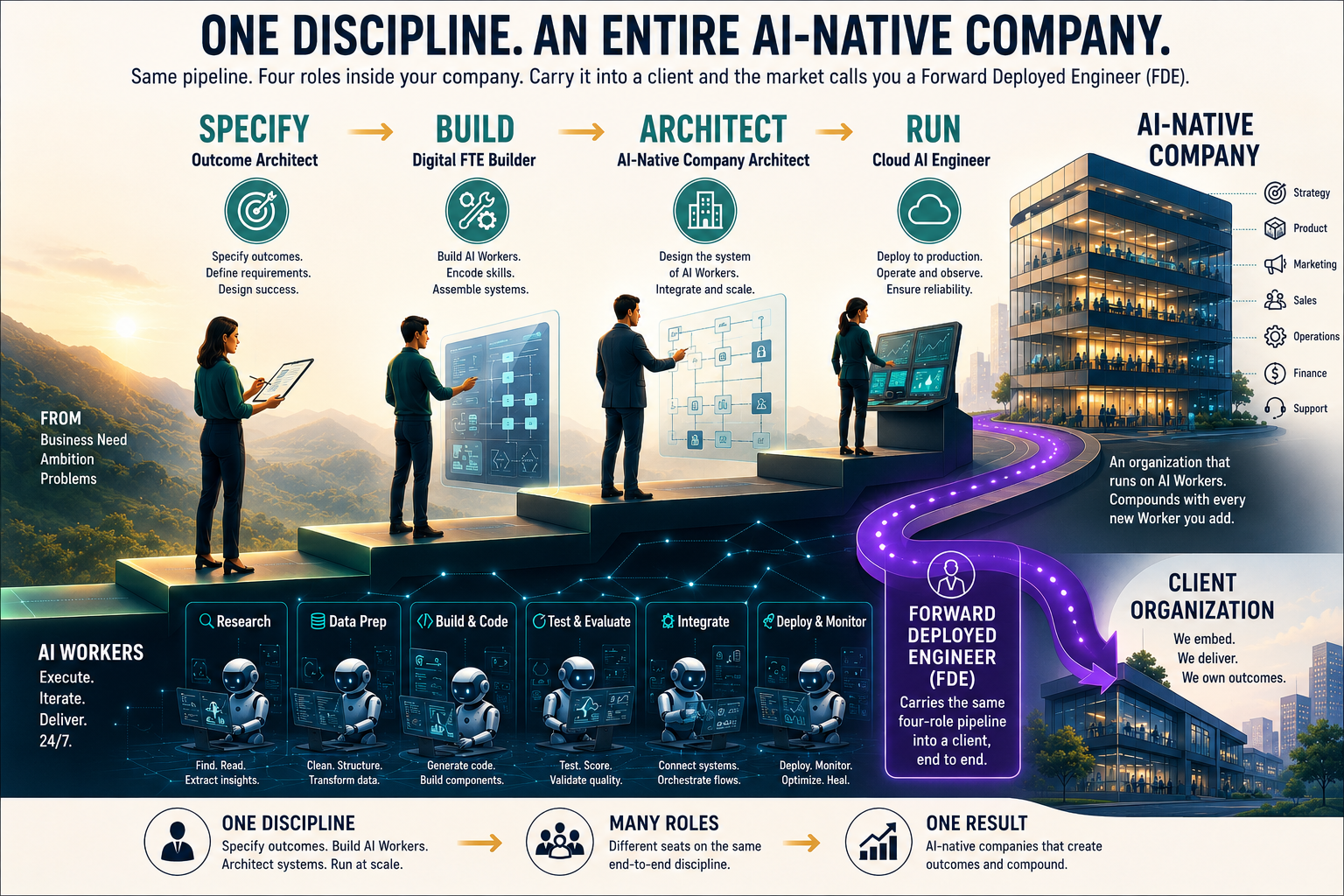 Do settings mein aik discipline: chaar roles apni company ke andar pipeline chalate hain; Forward Deployed Engineer wahi pipeline client tak le jata hai.
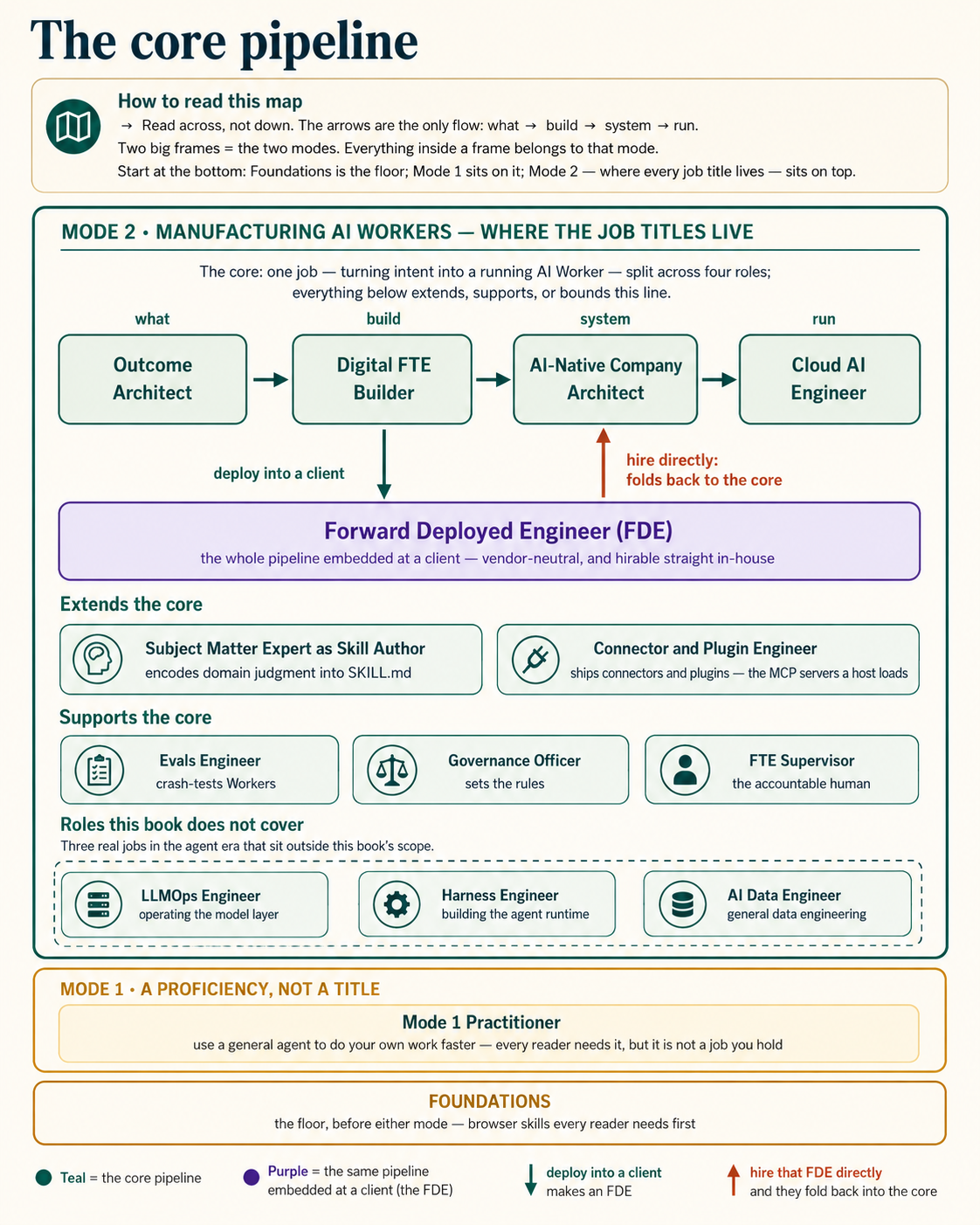 Poora map aik nazar mein: core pipeline, jo usay extend aur support karta hai, kitab kahan rukti hai aur sab ke neeche baseline.
Woh baseline jahan se sab shuru karte hain
Foundations: floor, dono modes se pehle. Har reader same tareeqe se shuru karta hai, browser tab mein, Foundations par: prompting kaise karein, agentic work ki do document languages, woh code kaise commission karein jo aap khud kabhi nahin likhte, skills aur connectors, aur AI era mein kaise sochna hai. Koi mode nahin, koi role nahin, install karne ke liye kuch nahin. Yeh woh floor hai jis par poora map khara hai. Jahan sab shuru karte hain, title nahin.
Mode 1 Practitioner: title nahin, proficiency hai. Isi floor par aap general agent ko apna kaam tezi se karne ke liye use karte hain: reason karna, likhna, code karna, analyze karna, plan karna, outcome ship karna, aur session close karna. Yeh Mode 1 hai, aur kitab isay sab ke liye train karti hai: engineers ke liye Claude Code ya OpenCode ke zariye, domain experts ke liye Claude Cowork ya OpenWork ke zariye, Seven Principles of General Agent Problem Solving ke under. Yeh pehla mode hai jo har reader neeche diye gaye Mode 2 roles se pehle run karta hai, aur yeh aapko us job mein sharper banata hai jo aap ke paas pehle se hai, naya title nahin deta. Pehla mode jo sab run karte hain, title nahin.
Generalist bunyad
Yeh core roles aik single pipeline ki tarah chalte hain, intent se production tak: Outcome Architect (kya) -> Digital FTE Builder (build) -> AI-Native Company Architect (system) -> Cloud AI Engineer (run). Isay apni company ke andar chalayen to yeh chaar roles hain; client ki company ke andar chalayen, end to end aik embedded, vendor-neutral engineer carry kare, to yeh Forward Deployed Engineer hai. Map par baqi sab kuch is line ko support, extend, ya bound karta hai.
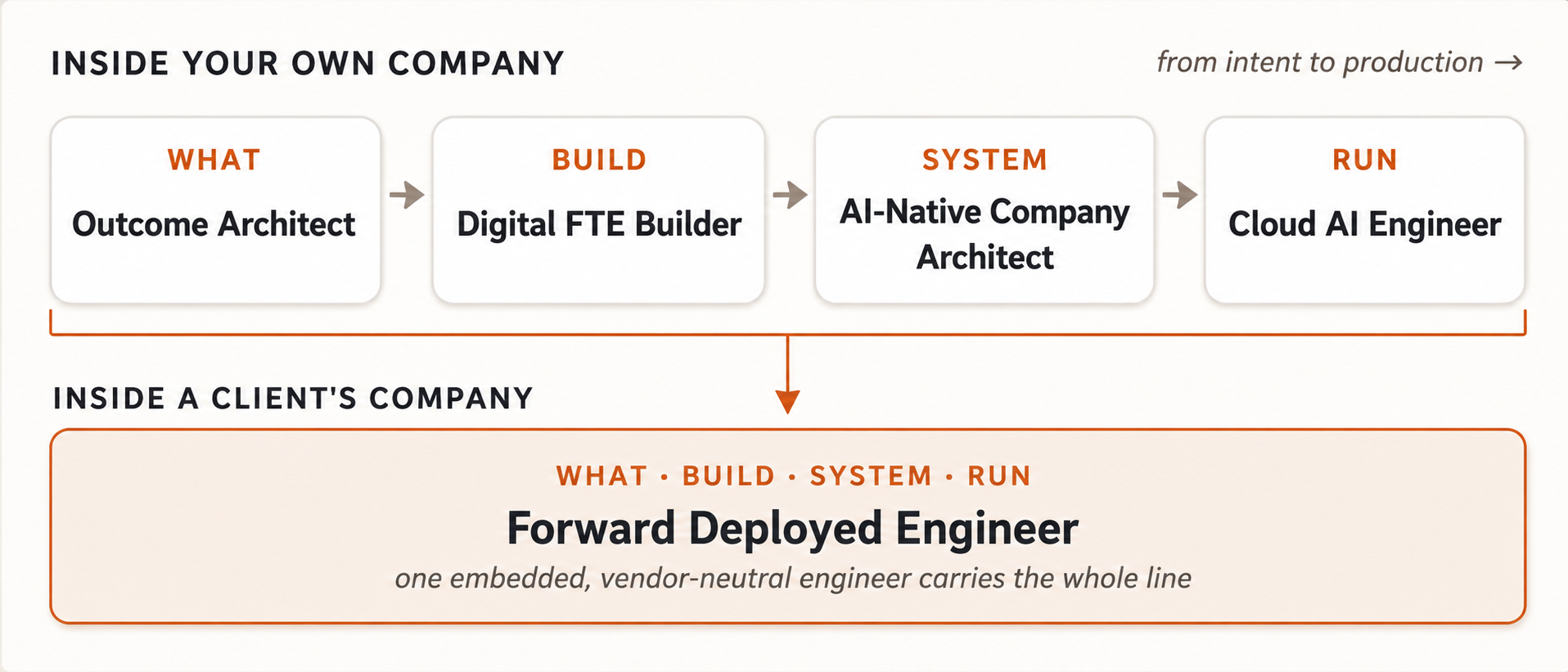 Chaar roles aap ki apni company ke andar line chalate hain; aik embedded engineer wahi line client ki company ke andar le jata hai.
Outcome Architect: intent own karta hai, execution nahin. Agent era mein kaam teen hisson mein bantta hai: intent, execution aur verification. Worker execution own karta hai; yeh role intent own karta hai. Yeh tay karta hai ke Worker ko kya hasil karna chahiye, woh spec likhta hai jo is maqsad ko pin down kare, "correct" ka matlab tay karta hai aur yeh prioritize karta hai ke kaun se Workers banaye hi jayein. Builder "kaise" ka jawab de, us se pehle yeh insan "kya" aur "kyun" ka jawab deta hai. Jahan Strategist track client-facing discovery aur ROI own karta hai, Outcome Architect internal Worker roadmap aur us ke peeche ki specs own karta hai. Kitab isay seedha train karti hai: spec-driven development apne core mein aisi intent likhne ki discipline hai jis ke liye Worker ko accountable rakha ja sake.
Software ki zyada tar history mein dheema hissa cheez ko banana tha. Coding agents ne yeh badal diya. Aik engineer ab pehle se kai guna zyada ship karta hai, kyunke agent building karta hai. Magar us speed ne aik naya dheema hissa saamne la diya. Agar aik engineer aik saath paanch cheezein bana sakta hai, to kisi ko ab bhi tay karna hai ke un mein kaunsi paanch banane ke qabil hain, aur har aik ko kya karna chahiye yeh itni safai se likhna hai ke agent usay execute kar sake. Isi faisla-sazi ko yeh role intent kehta hai, aur woh zara tez nahin hui.
Is tabdeeli ko aik number mein dekhein. Companies pehle taqreeban har aath engineers ke liye aik product manager rakhti thin, yani direction set karne wala aik shakhs. Har engineer ka output barha to wahi aik shakhs ab amli taur par bees engineers ke kaam ko feed karta hai.1 Building scale hui. Faisla-sazi nahin hui. Is liye faisla-sazi bottleneck ban gai: woh nuqta jahan baqi har cheez intezar karti hai.
Market yeh dekh kar nateeja nikalti hai ke product managers ki kami hai. Yeh kitab isay doosre tareeqe se parhti hai: yeh woh lamha hai jab intent own karne wala role, Outcome Architect, company ki sab se aham seat ban jata hai. AI workforce jitni bari hoti hai, utna hi woh aise insan par depend karti hai jo bilkul precise taur par keh sake ke usay kya banana chahiye.
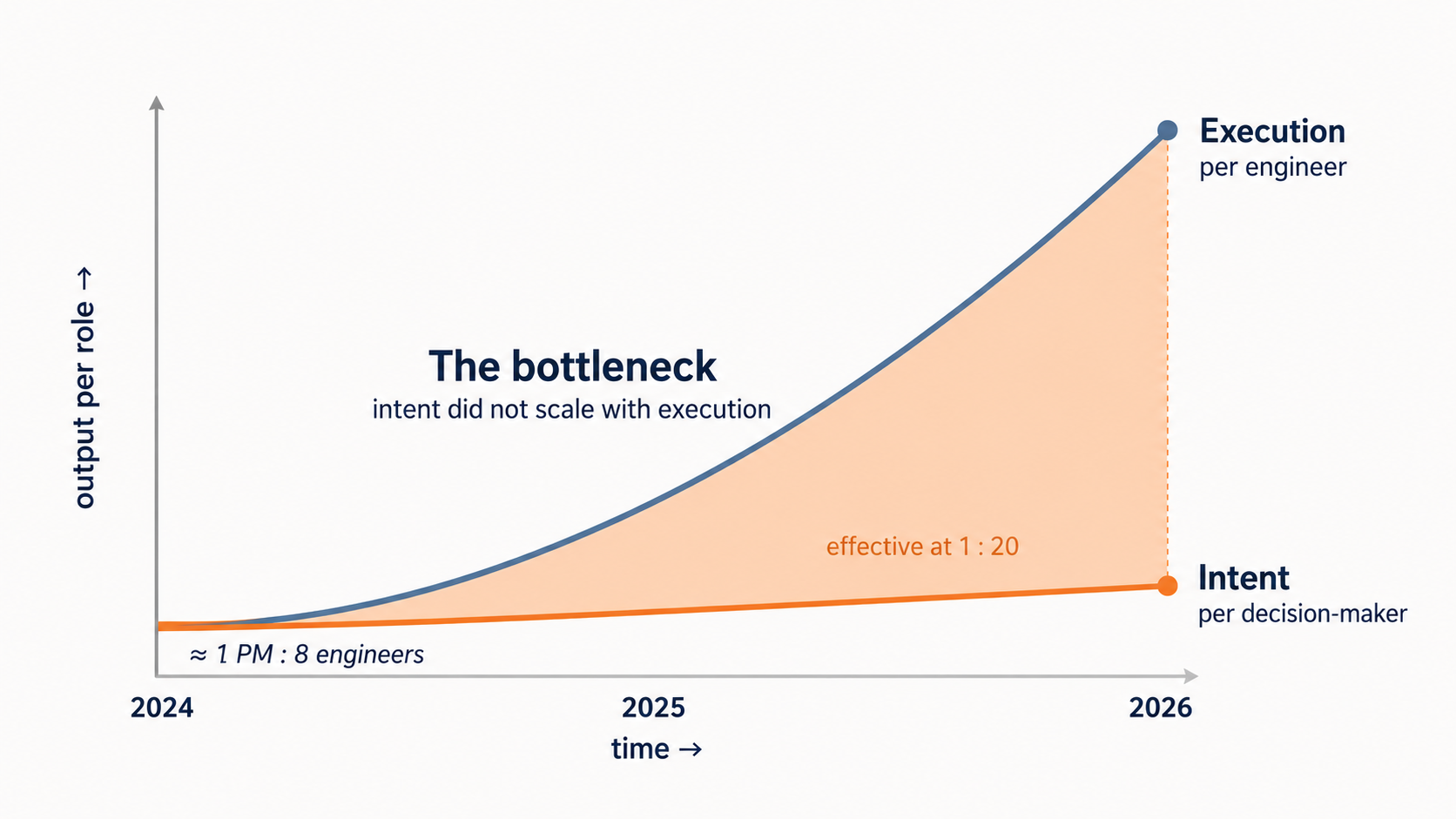 Agentic coding ke saath execution scale hua; kya banana hai yeh tay karne ka kaam nahin. Naya ratio engineers ki kami nahin, isi barhte hue gap ko measure karta hai.
Isay poora train karti hai: woh discipline jis par poora method khara hai.
Digital FTE Builder: unit product, end to end banaya hua. Market isay AI Engineer kehti hai, jo AI components se applications banane aur AI coding agents chalane wale shakhs ke liye us ka catch-all naam hai. Is kitab ka naam zyada precise hai, kyunke aap jo cheez banate hain woh bhi zyada precise hai: Digital FTE, woh unit jis se poori company assemble hoti hai. Yeh kitab ka primary graduate hai. Kitab poori bunyadi line train karti hai: spec-driven development, SKILL.md authoring, agent architecture, tool aur MCP interfaces, jahan MCP standard tareeqa hai jis se agent bahar ke tools aur data se jurta hai, evaluation aur human oversight; deployment itna ke product ship ho sake, aur gehri production expertise Cloud AI Engineer ke liye. Isay end to end train karti hai.
AI-Native Company Architect: company design karta hai, single Worker nahin. Poori enterprise: Two-Layer Model, management layer, workforce, woh nervous system jo in ke darmiyan events le jata hai, aur woh system of record jis ke against sab kuch chalta hai. Agent Factory woh process hai jis ki yeh architect practice karta hai; AI-Native Company woh product hai jo woh ship karta hai. Kitab is ki canonical source hai. Paanch-quarter Certified Agentic AI Architect program is ki credential hai. Poora train hota hai; Architect track se certify hota hai.
Cloud AI Engineer: jo production mein AI Worker aur AI-Native Company chalata hai. Digital FTE banana kaam ka aik hissa hai; usay bharose ke saath chalana doosra, aur us poori AI-Native Company ko chalana bhi jis ka woh hissa hai. Jahan AI-Native Company Architect enterprise design karta hai, yeh role usay operate karta hai: Workers, management layer aur nervous system ko real cloud infrastructure par deploy aur scale karna; ship karne ke liye Azure Container Apps, durable execution ke liye Inngest, aur scale ke liye Dapr aur Kubernetes. Yahin system prototype rehna chhor kar aisi company banta hai jis par organization depend kar sake. Production path train hota hai; scale aur platform operations ki zyada gehrai cloud track mein hai.
Forward Deployed Engineer (FDE): vendor-neutral version jo market ko nahin milta
Oopar diye gaye chaar core roles aap ki apni company ke andar line chalate hain. Wahi line client ki company ke andar le jayein, aik embedded engineer ke zariye end to end, to us ka aik naam hai jis ke liye market ab bechaini se hire kar rahi hai.
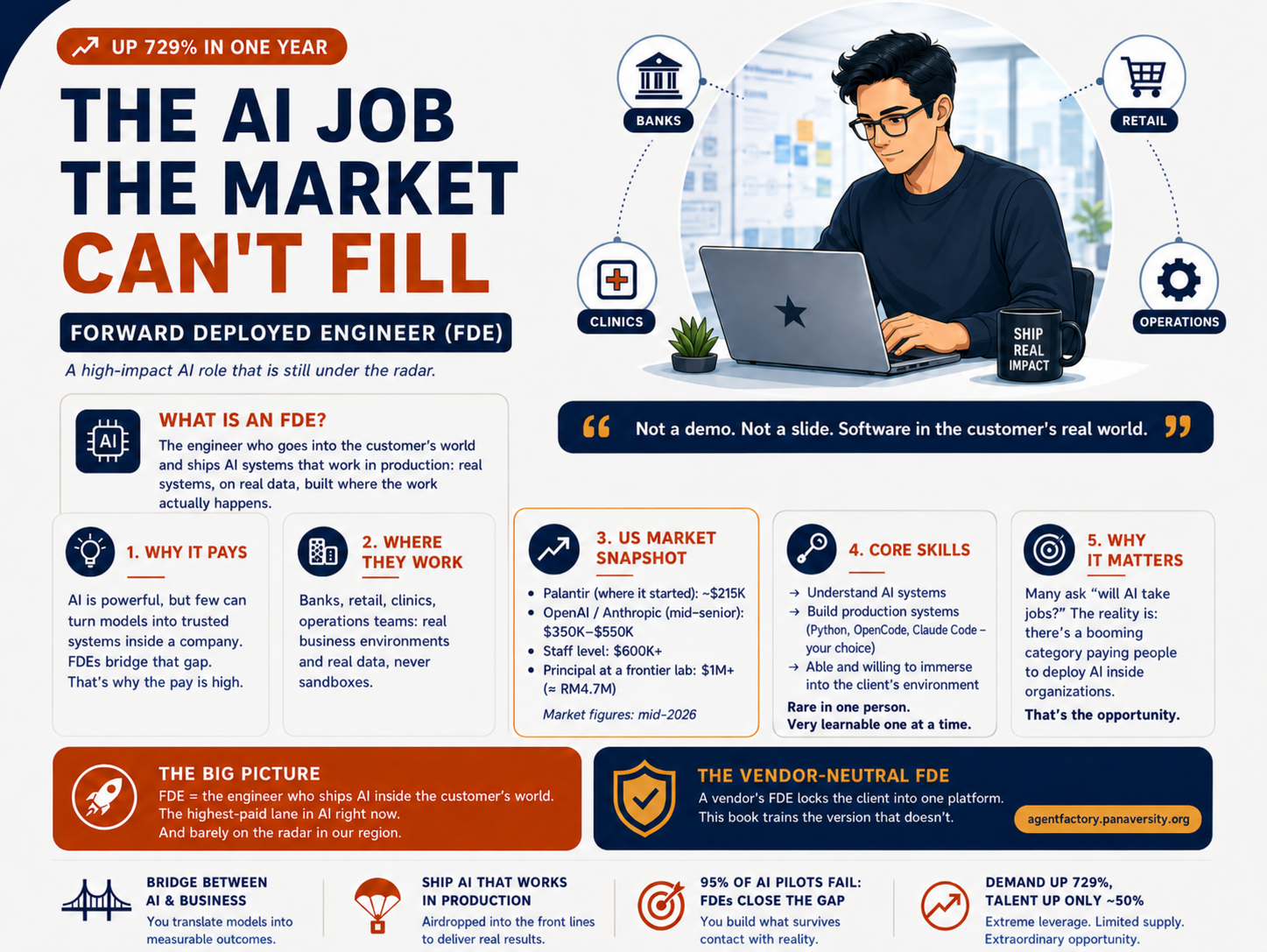 FDE asal mein kya karta hai. Aksar software engineers headquarters mein product banate hain aur us customer se kabhi nahin milte jo usay use karta hai. FDE iska ulta karta hai. Woh customer ke asal workplace par jata hai, kaam karne wale logon ke saath baithta hai, un ke asal masail samajhta hai aur apni company ki platform istemaal karte hue wahin, on-site, solutions banata hai. Demo nahin. Slide deck nahin. Working software jo customer ke asal environment mein chalta hai.
Isay doctor ki misaal se samjhein: aik doctor doosre shehar se aap ka chart parhta hai, aur doosra doctor room mein baith kar aap ko examine karta hai aur treatment foran shuru karta hai. FDE doosra doctor hai.
Palantir, aik bari data analytics company jo governments aur large enterprises ke liye software banati hai, ne early 2010s mein yeh role banaya aur asal mein in engineers ko "Deltas" kehti thi.2 2016 ke qareeb tak Palantir ke paas regular software engineers se bhi zyada FDEs the, kyunke us ke customers, government agencies aur bari traditional enterprises, ko on-site aisa shakhs chahiye tha jo startup mentality ke saath internal bureaucracy ko cheer kar nikal sake. Palantir is farq ko sab se saaf samjhata hai: regular developer aik capability, bohat se customers par focus karta hai, yani aik feature banayein aur sab ko ship karein; FDE aik customer, bohat si capabilities par focus karta hai, yani aik client ke saath embed ho kar jo usay chahiye hal kare. Job ki description scope pakar leti hai: yeh startup CTO ke role jaisi hai. High-stakes projects mein aap shuru se aakhir tak har cheez own karte hain. Ab bahar se bhi is lineage ki tasdeeq ho chuki hai: 2026 mein apni 6,000-logon ki FDE unit launch karte hue Microsoft ne public taur par Palantir ko title popular karne ka credit diya.3
FDE 101: Palantir ko role kyun chahiye tha
Yeh bayan kaun kar raha hai, aur is ki ahmiyat kyun hai. Is role ke wajood ki sab se saaf wazahat Kevin Bai se aati hai, us talk mein jis ka title us ne Forward Deployed Engineering 101 rakha. Talk 2026 ke darmiyan AI Engineer World's Fair ke usi nau-session FDE track par hui jis par is page mein baad mein Brunet ki talk bhi thi.4 Us ka career aik shakhs ke zariye role ki mukhtasar history hai. Us ne job banane wali company Palantir mein FDE engagements lead kiye, un institutions ke liye jinhein woh duniya ke aham tareen idare kehta hai. Phir woh wahan gaya jahan function tha hi nahin: Rippling ki FDE team ka pehla shakhs bana aur aik saal mein us team ko qareeban 25 engineers tak barhaya. Yani us ne andar se wahi kiya jise yeh page bahar se bayan karta hai: zero se aisi company mein FDE practice shuru aur staff ki jahan pehle koi practice nahin thi. Ab woh Anthropic ki Applied AI team mein member of technical staff hai, woh team jis ke role ka title yeh page Applied AI Engineer note karta hai. Us ke apne background ka bayan neeche wale Venn diagram jaisa hai: diplomacy, sales, business development, product management, customer success aur software engineering, jinhein forward deployed engineering aik job mein jorti hai.
Daleel se pehle do imandaar notes. Us ne aam discipline par baat ki aur wazeh taur par apne current kaam par guftagu se inkar kiya, is liye yahan koi baat kisi frontier lab ki internal practice ko describe nahin karti. Aur aage aik practitioner ka framework aur stage par yaad se bataye figures hain, audited research nahin. Page isay wahi darja deta hai jo Aggarwal ke hisaab aur Brunet ke playbook ko deta hai: us shakhs ki gawahi jis ne waqai kaam chalaya hai, aur usi naam ke saath label ki hui.
Masla kabhi software nahin tha. Pehle samjhein Palantir asal mein kya bechta hai. Foundry kisi bhi size ki organization ko data centralize karne aur ontology banane deta hai: table one, table two aur table three ko proper nouns mein badalna, taake warehouses wali company ke paas aik table ho jo warehouses ke bare mein sach ho. Us ke oopar customers applications banate hain.
Ab yeh industry leader ko dikhayein. Bai ke mutabiq jawab yeh hota hai: aap ne mera data organize kar diya, magar is se mere business ko kya mila? Yahin sirf technology bechna kam par jata hai. Is se bhi bura, vendor ki success ab customer ki software use karne ki salahiyat par depend karti hai, is liye customer do martaba pay karta hai: pehle platform ke liye, phir apne logon ko itna train karne ke liye ke woh us par kuch bana saken. Bai isay business karne ka bohat bura tareeqa kehta hai, aur us ka hal wahi jumla hai jis par is page ka pehla role named hai. Software bechna band karein, hours bechna band karein aur outcome bechein. Aise log bhejein jo customer ke business ki fitrat samjhein, platform par solution banayein aur result hand over karein. Consumer-goods executive shelf placement aur sales throughput ki parwah karta hai. Data ka organization implementation detail hai, aur Bai kehta hai usay aisa hi rehna chahiye.
Kin buyers ko yeh chahiye tha, aur kyun. Foundry app-building platform hai, is liye un companies ke liye dilchasp nahin thi jin ke paas pehle hi behtareen engineers hain: Google, Meta aur labs, jo organization ki zaroorat ki har cheez bana sakte hain. Is ka buyer oil and gas ki Fortune 500 company thi, jahan Bai ke lafzon mein pipelines data pipelines nahin hotin. Us buyer ke liye offer loan par engineers tha: aise log jinhein client ko hire, recruit, manage ya retain nahin karna, jo platform par trained hon aur kaam ke itne qareeb baithen ke asal masla dhoond kar us ke liye build kar saken.
Saboot contract size mein hai. Fortune 500 ko serve karne wali public SaaS companies ko average contract value se measure karein, yani aik customer vendor ke saath kitna kharch karta hai, to Bai Palantir ko qareeban $4 million par pehle, ServiceNow ko qareeban $1.2 million, Workday ko qareeban $600,000 aur kisi doosri public SaaS company ko aadhe million se oopar nahin rakhta.4 Un figures ko usi saans mein diye chand hazar logon ke headcount aur page mein aage market capitalization ke figure ke saath parhein. Outcomes bechne ki qeemat seats bechne se mukhtalif hoti hai, aur average contract value woh number hai jo yeh dikhata hai. Yeh vendor ki taraf se aane wala kitab ka Digital FTEs ke bare mein claim bhi hai.
Pehla test: kya FDE chahiye bhi?
Bai ka screen two-by-two hai: aap jo cheez bechte hain woh kitni technical hai, aur usay khareedne wala kitna technical hai. Chaar mein se teen cells ko forward deployment bilkul nahin chahiye.
- Technical product, technical buyer. GitHub, Datadog. Software complicated hai, magar buyer CTO ya CIO aur user software engineer hai, aur complexity absorb karna un ki job ka hissa hai. Unhein documentation aur developer relations se serve karein.
- Configurable product, technical buyer. Yahan bhi kuch khaas nahin chahiye. Technical buyer simple product ko kisi ke ur kar madad dene aaye baghair configure karta hai. Self-serve, ya sales-led motion.
- Configurable product, non-technical buyer. Rippling, Jira, Slack. Yeh complex ho sakte hain, magar in par development ke bajaye configuration hoti hai. Traditional sales-led motion kaam karta hai.
- Technical product, non-technical buyer. Sirf yeh cell hai jahan FDE zaroori hai, aur yahi Palantir ka market corner hai.
Diagram ke bare mein us ki discipline diagram se zyada aham hai. Sawal yeh nahin ke kya mujhe FDE function chahiye, kyunke fashion wali cheez chahna aasaan hai. Sawal yeh hai ke kya aap ko technically complicated cheez aise buyer tak le jani hai jo usay implement nahin kar sakta. Agar jawab nahin hai, to woh saaf kehta hai: forward deployment shayad sahi fit nahin, aur developer engagement ya sales-led motion aap ko behtar serve kare ga.
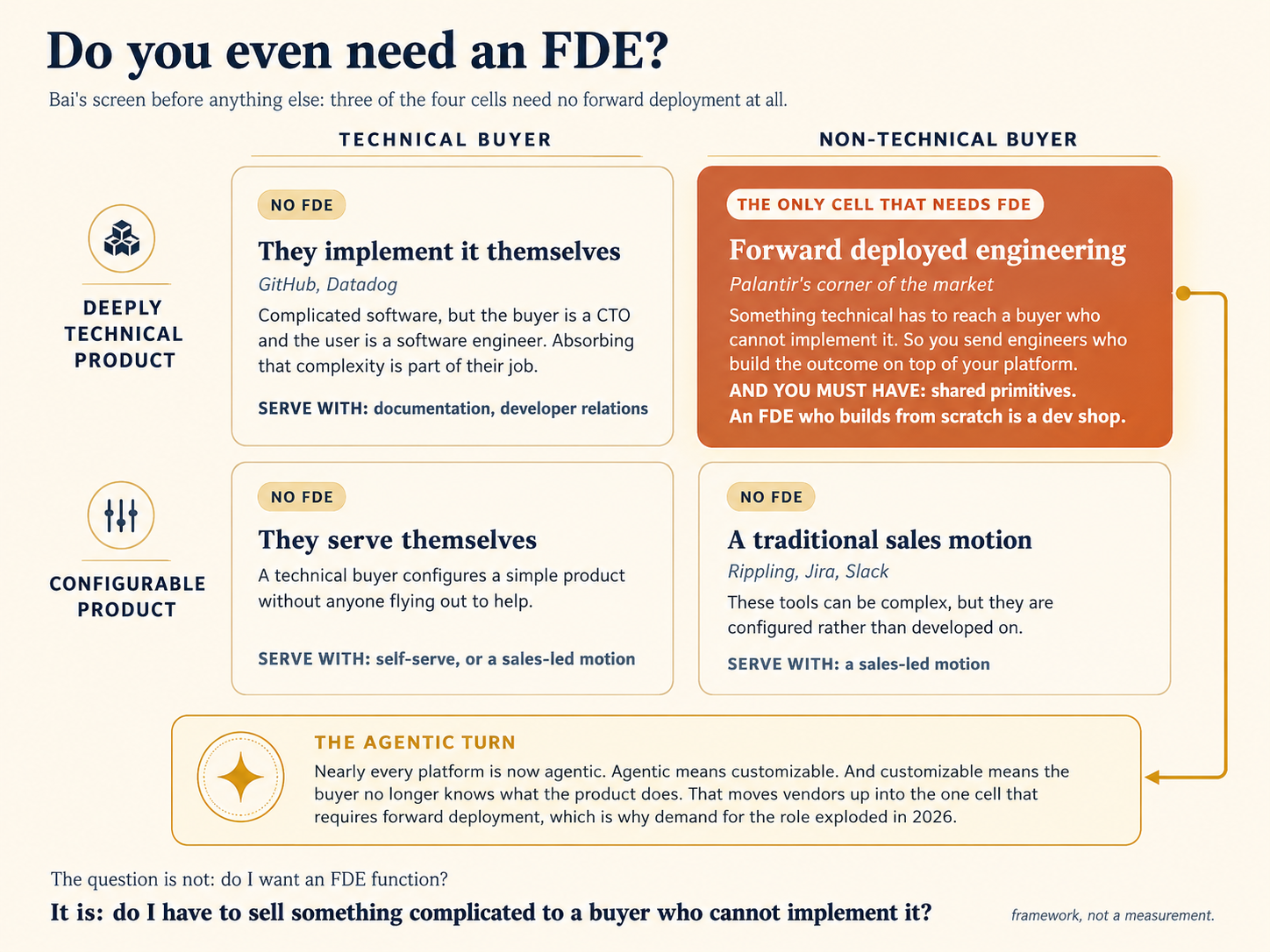 Sab se pehle Bai ka screen: chaar mein se teen cells ko FDE nahin chahiye, aur agentic turn vendors ko chauthi taraf dhakel raha hai. Yeh us ka framework hai, measurement nahin.
Do matrices, do mukhtalif sawal. Bai ka square vendor ka company-level build-or-not decision hai: kya is company ko FDE function rakhna bhi chahiye. Brunet ki matrix, jo page par aage hai, har engagement ke liye hai: kya yeh client FDE client hai. Is kitab ka reader dono ko teesri position se use karta hai, kyunke woh apni platform nahin bechta. Bai ka square batata hai kin clients ki taraf chalna hai, yani jo aisi technical cheez pakre hain jise woh implement nahin kar sakte, aur neeche batayi tabdeeli ke baad yeh qareeban sab hain. Brunet ki matrix batati hai ke kamre mein pahunch kar engagement ka scope kaise tay karna hai.
Yeh Solutions Architect ya Sales Engineer jaisa nahin. Solutions Architect mashwara deta hai: demos chalata, whiteboard par solutions design karta aur sample data se proof-of-concept prototypes banata hai taake prospect sign kare. Deal close hone ke baad aam taur par us ki shirkat kam ho jati hai. FDE wahan se kaam uthata hai jahan Solutions Architect chhorta hai. Woh customer ki infrastructure par real data ke saath seedha production code likhta aur tab tak rehta hai jab tak customer ko real value na mile. Seedha test: agar role customer-specific kaam ko production mein waqai chalane ka accountable hai to FDE ke qareeb hai. Agar product ko prove ya explain karne ka accountable hai to solutions architect ke qareeb.
Aik real misaal OpenAI ka John Deere ke saath kaam hai, qareeban 190 saal purani farming company, jo wahi deployment logic dikhata hai: See & Spray, customer success, dealer workflows aur preseason recommendations ke gird real operational context ke andar AI. John Deere See & Spray ko chemical use mein 70% tak kami ka credit deta hai, aur OpenAI ki case study dikhati hai ke setup, in-season recommendations, dealer support aur ROI reporting ke gird AI kaise use hui.5 Kaam customer ke planting calendar par rehta hai, product roadmap par nahin. Aik line mein yahi FDE job hai: customer ki duniya mein bana real production software, tab ship hua jab customer ko asal zaroorat thi.
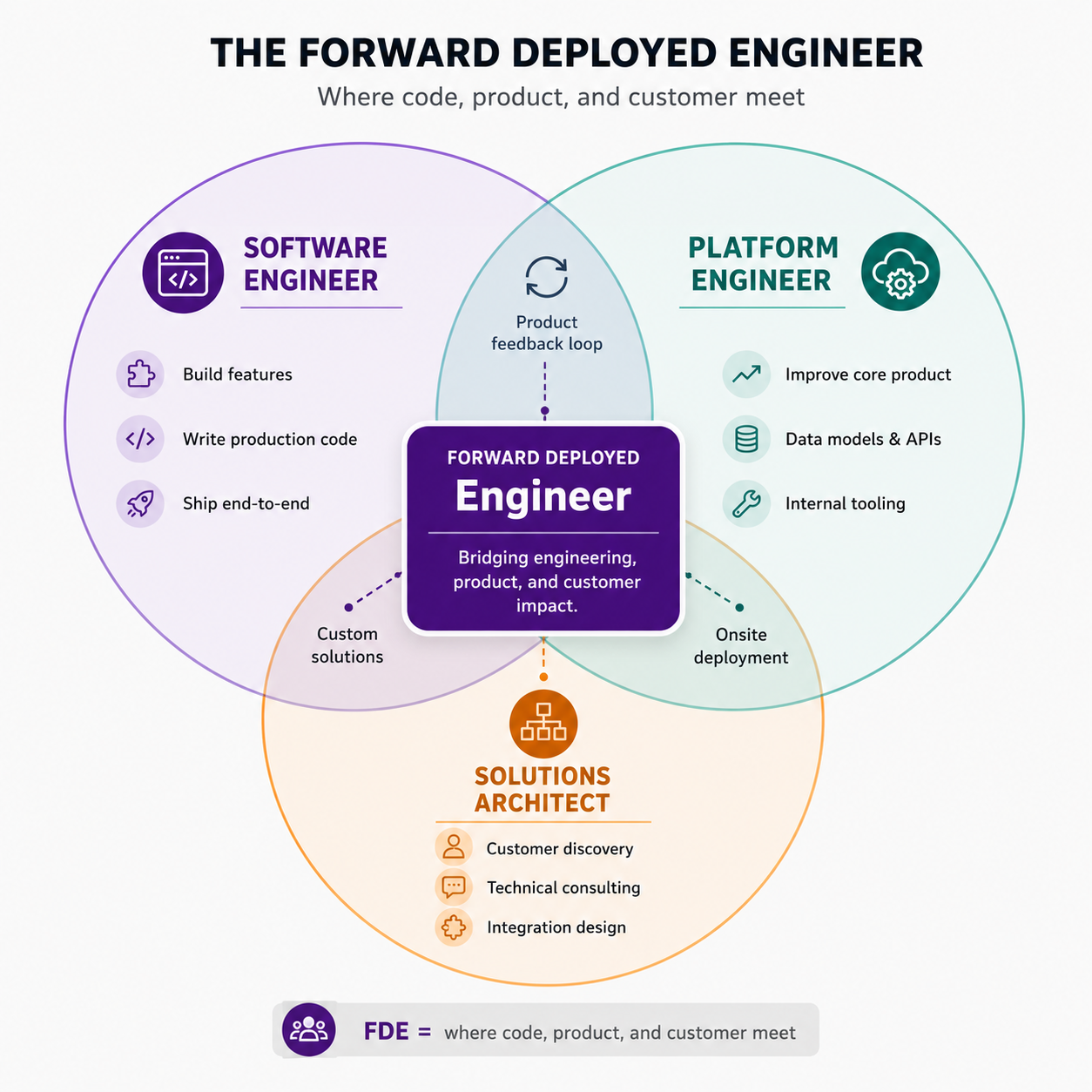 FDE woh jagah hai jahan code, product aur customer milte hain: software engineer ki build capability, platform engineer ki product instinct aur solutions architect ki customer read, aik aise shakhs mein jo headquarters ke bajaye customer ki duniya mein build karta hai.
Bai isi tasveer ko do conditions wale hiring test mein samet deta hai: FDE customer-facing software engineer se zyada kuch nahin, yani aisa shakhs jise sirf engineering bar par engineering team mein hire karein aur customer ke saamne bhi bharosa karein.4 Dono hisse sach hone chahiye. Pehla gira dein to account manager hai jo build nahin kar sakta. Doosra gira dein to engineer hai jise un logon se door rakhna parta hai jin ka masla woh hal kar raha hai.
Kyun har AI company ab FDEs chahti hai. 2025 ke pehle teen quarters mein FDE job postings 800% se zyada barhin.6 Salesforce ne Agentforce platform ke liye dedicated FDE team banai.7 OpenAI ne "Deployment Company" banai, investor consortium se qareeban $4 billion backing wali majority-owned subsidiary, jo zyada tar enterprises ko FDEs dene ke gird bani.8
2026 ke darmiyan model hyperscalers tak pahuncha: AWS ne nai Forward Deployed Engineering unit ke liye $1 billion commit kiye, clients ko taqreeban 45 din ke deployments par paanch ya chhe engineers ke pods bhejne aur unit ko hazaron tak staff karne ka plan banaya. Yeh bet lagane wala pehla major cloud provider tha aur funding OpenAI ya Anthropic jaisi private-equity joint venture ke bajaye apni balance sheet se thi.9 Do din baad Microsoft ne ab tak ka sab se bara commitment diya: Microsoft Frontier Co., $2.5 billion backing aur 6,000 logon wali nai operating unit, jis mein existing Microsoft FDEs, technical consultants, support staff aur industry-experienced salespeople clients ke andar embed hote hain; shuruati customers mein Unilever aur Novo Nordisk the.3 Aik haftay mein do sab se bare cloud providers ne same job title ke peeche kul $3.5 billion laga diye. Model sectors bhi paar kar chuka hai: McKinsey ka QuantumBlack seedha Lead Forward-Deployed Engineers hire kar raha hai, aath se zyada saal ki hands-on engineering mangte hue; consulting giant maan raha hai ke deployment ke baghair advice ab nahin bikti.10
Microsoft ki announcement ki aik detail yaad rakhne ke qabil hai. Woh platform install ya models integrate karne ka wada nahin karti. Woh aisi team ka wada karti hai jo AI systems co-design, deploy aur lagatar behtar kare, aur jis ka faisla measurable business outcomes par ho.3 Yeh client ka apna success test vendor ke charter mein likha hai, aur isi page par aage vendor ki FDE lead delivery side se wahi test deti hai.
Is sab ki wajah seedhi hai: 2025 MIT Media Lab study, Project NANDA, ne paya ke custom enterprise AI pilots mein qareeban 95% measurable return nahin dikhate.11 Is liye nahin ke AI kaam nahin karti, balki is liye ke usay company ke messy real-world systems mein fit karna intehai mushkil hai. FDEs yeh gap band karne ke liye hain. Isi wajah se Palantir late 2024 tak $136 billion market cap paar karke Lockheed Martin se aage nikal gaya,12 aur ab har AI company model copy karna chahti hai.
Wahi study yeh bhi batati hai ke bachne walon ne kya kiya. 95% figure failure samjhata hai. Usi report ki doosri finding exception samjhati hai: outside partners ke saath chalne wale initiatives taqreeban 67% martaba deployment tak pohanche, jabke mukammal in-house tools taqreeban 33%.11 Dono numbers ko ehtiyat se parhein, kyunke woh mukhtalif cheezein naapte hain. 95% profit-and-loss impact ke bare mein hai. 67% sirf deployment tak pahunchne ke bare mein. Dono mil kar kehte hain pilots kamzor models se nahin marte. Woh integration work se marte hain jise karne ke liye koi embed nahin, aur bahar ke log lane wali companies ne do guna zyada ship kiya.
Us number ki do limits hain. Report kehti hai outside partners aur success ka link cause prove nahin karta, findings preliminary hain aur har deployment ko sirf chhe maheene dekha gaya.11 Aur dekhein compare kya hua: vendor se khareedna aur akele banana. Vendor-neutral teesra column sample hi nahin hua, kyunke 2025 mein woh qareeban maujood nahin tha. Is liye finding reader ko is section ke darwaze tak lati hai, aage nahin. Bahar ki expertise akele jane se behtar hai. Kya woh expertise aik vendor ki platform ke saath welded honi chahiye, yeh sawal section neeche uthata hai.
Ab kyun, 2012 mein kyun nahin. Failure rate batati hai role kyun pay karta hai. Timing nahin batati. Palantir ka model aik decade public, profitable aur visible raha aur qareeban kisi ne copy nahin kiya. Bai ki hypothesis structural aur filhal behtareen jawab hai: industry ne der se Palantir ko sahi maana, yeh tabdeeli nahin. Software business khud badla. Qareeban har platform ab agentic hai. Agentic ka matlab customizable. Customizable ka matlab customer ko ab pata nahin product kya karta ya kitna aage dhakela ja sakta hai. Is se qareeban har vendor us square ki aik cell mein chala jata hai jo forward deployment mangti hai: technical cheez aise buyer ko jo implement nahin kar sakta.4 Product ki success customer ki implementation ability par chhor dein, woh warn karta hai, to na upmarket bechein ge na nai industry mein expand hon ge.
Dono findings ko saath parhein to bilkul fit hoti hain. Bai cause batata hai: agentic platforms ne har vendor ko Palantir bana diya. MIT effect naapta hai: pilots kahin nahin jate kyunke implementation gap band karne ke liye koi embed nahin. Aur page par $4 billion, $1 billion aur $2.5 billion industry ki isi gap ko band karne ki payment hai.
Market kya pay karti hai: imandari se parhein. Viral posts is role ko "saal ke $1M tak" se shuru karti hain. Asal numbers inflation ke baghair kaafi mazboot hain. Indeed ne April 2025 mein 643 US FDE postings aur aik saal baad 5,330 ginain, 729% izafa; aam salary bands $170,000 se $200,000 se zyada aur Anthropic ki apni FDE postings $200,000 se $300,000 hain.10 Market ka median qareeban $190,000 hai, aur range taqreeban $160,000 se $220,000.13 Frontier labs ke senior aur staff FDEs $450,000 se $600,000 paar karte hain, aur seven-figure numbers aik lab ki engineering ladder ke bilkul oopar maujood hain, magar woh career ki ceiling hai, darwaza nahin.14 Data ki do details aik figure se zyada aham hain. Pehli, role postings nau maheene mein 800% se zyada barhin jabke candidate pool taqreeban 50%: yeh supply gap hai, jahan se salary pressure aur trained reader ki entry aati hai.6 Doosri, verified FDE roles ke aik review mein kisi ke saath sales quota nahin tha:14 market FDEs ko engineers ki tarah pay karti hai, salespeople ki tarah nahin; Sales Engineer se oopar khaincha farq price mein nazar aata hai. Is section ka market data aakhri martaba July 2026 mein verify hua; role tezi se move kar raha hai, aur durable point discipline hai, koi aik salary band ya hiring count nahin.
Services industry doosri taraf se wahi hisaab dekhti hai
Oopar ke vendors FDEs ko bahar bhejte hain; outsourcing duniya ke paas parwah karne ki zyada wajoodi wajah hai, kyunke us ka poora model, hazaron logon ke zariye human execution ke hours bechna, bilkul wahi layer hai jise AI absorb karti hai. Is liye AWS aur Microsoft ki announcements ke aik haftay ke andar us duniya ne apne aap ko FDE ke gird dobara position karna shuru kiya. Sanjeev Aggarwal, jis ne India ki BPO industry ke pioneers mein se aik Daksh banai aur phir Infosys ke Nandan Nilekani ke saath venture firm Fundamentum co-found ki, ne CNBC-TV18 ke Young Turks Reloaded par hisaab seedha rakha: FDE engineer, product manager aur AI architect ko aik shakhs mein jorta hai, "qareeban unicorn jaisa... 10x engineer", aur is fusion par firm qareeban 100 FDEs ke saath $100 million business bana sakti hai; riwayati IT services model isi kaam ke liye 2,000 se 2,500 log rakhta tha, aur Aggarwal gross margins 70 se 90 percent batata hai.15 Figures ko veteran ki projection samjhein, measurement nahin; magar dekhein projection kis ki hai. Purana model banane wala shakhs us ke successor ka elan kar raha hai: pyramid ke 25 heads ko aik se badalna, yani company scale par pod-of-one compression. Us ka nateeja geography ke bare mein hai: "India duniya ki FDE factory ban sakta hai," aur IT delivery ke decades nai discipline mein badal sakte hain. Claim us ki had se aage generalize hota hai. IT-services ke decades ne South Asia ko client ke messy systems mein embed ho kar ship karna sikhaya; yeh muscle Bangalore jitni Karachi aur Lahore mein bhi hai. Isay naye role mein badalne wali cheez geography nahin, training hai, aur is kitab ka method wahi conversion hai, har us shakhs ke liye jo kaam kare.
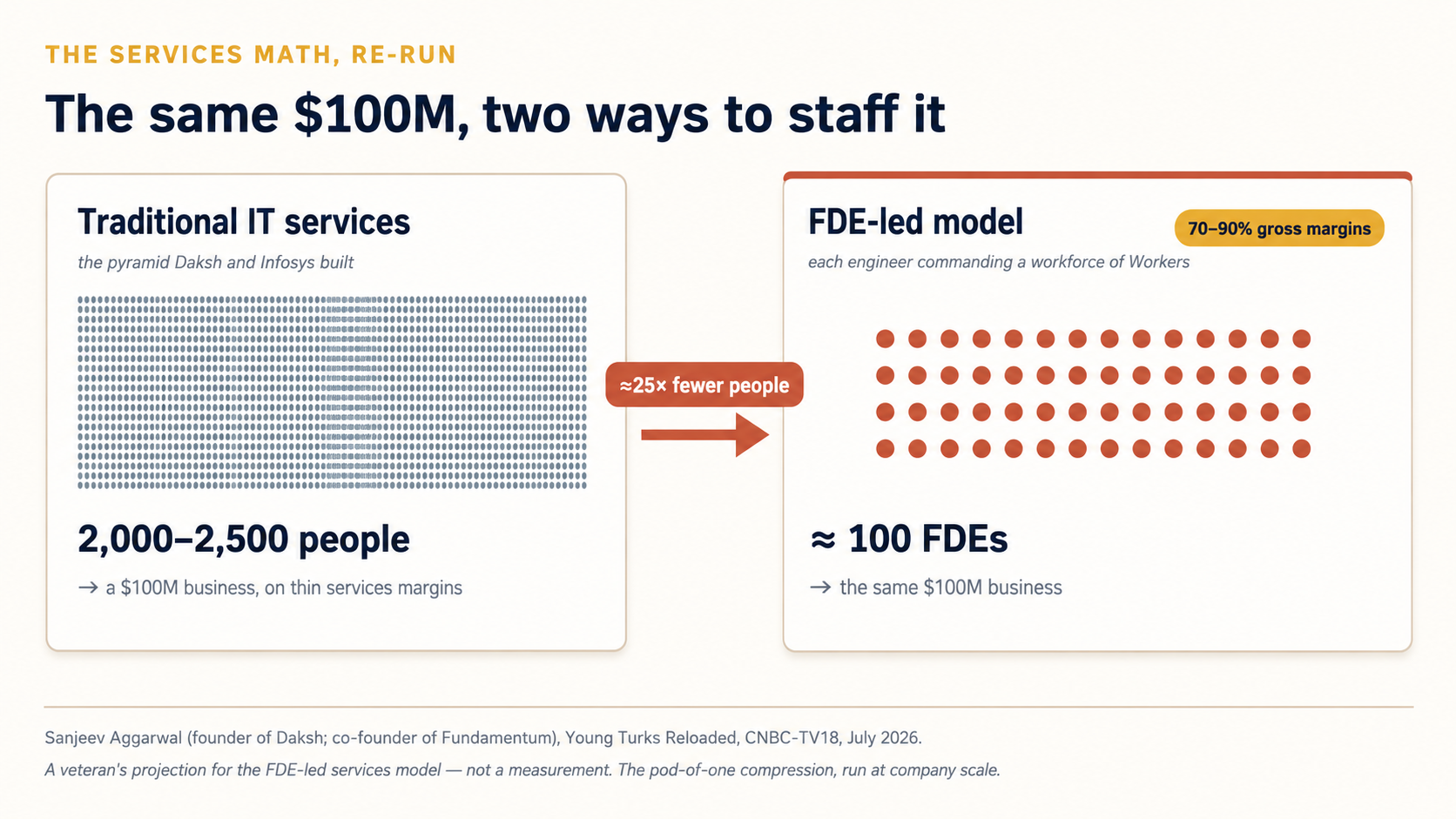 Aggarwal ka hisaab scale par: company scale par chalti pod-of-one compression. Us ki projection, measurement nahin.
Aur professional services firms apne product ki qeemat dobara tay kar rahi hain. Aggarwal projection deta hai. Big Four ship kar chuke hain. March 2026 mein PwC ke US CEO Paul Griggs ne Financial Times ko bataya ke firm staff ke kaam ke hours ke hisaab se client billing ke alternatives dena shuru kare gi, aur tax aur consulting practice ke kuch hisson ko AI-powered tools mein badle gi jinhein clients shuruati qadam mein PwC professional ke baghair seedha use kar saken, mumkin hai annual subscription par.16 Yeh platform PwC One ke naam se ship hui, jis ne M&A due diligence se tax rules tak chhe automated services se shuruat ki. Griggs ne internal matlab bhi saaf rakha: senior log jo AI-first hone par nahin soch rahe unhein aise log badal dein ge jo soch rahe hain, aur jo samjhe ke woh opt out kar sakta hai woh firm mein zyada der nahin rahe ga.
Isay aik saath teen cheezon ki tarah parhein, kyunke yeh aik saath teen cheezein hai.
Yeh Aggarwal ka hisaab hai, industry ke doosre sire se tasdeeq hua. Us ne pyramid ke 25 se aik tak compress hone ki projection di. PwC kuch services ke pehle qadam se insan ko mukammal hata rahi hai, jo staffing ratio ke bajaye product decision ki zaban mein wahi compression hai. Bohat mukhtalif do firms, aik Indian IT services se aur aik Big Four se, same quarter mein same jagah pahunchein.
Yeh outcome-pricing ka claim hai, us firm ke zariye jis ki economics is ke ulat par depend karti thi. Page par pehle Bai ke average contract value figures kehte hain outcomes bechne ki pricing seats bechne se mukhtalif hai. Big Four firm ka billable hour se hatna is daleel par sab se bare mumkin incumbent ka apne revenue model ke khilaf amal hai. Billable hour pricing preference nahin tha. Wahi poora business tha.
Aur yeh naya cage hai. PwC One platform hai. Client mein deploy hua PwC professional us par build karta hai, aur client ke paas baad mein jo rehta hai woh wahin chalta hai. Structure agle section ke vendor lock-in jaisa hai, bas vendor ki seat par consultancy hai. Is liye vendor-neutrality ka argument AI labs aur hyperscalers par nahin rukta. Ab professional services firms tak bhi pahunch gaya hai, aur embedded professional work ke liye compete karne wale reader ko is version se milne ki umeed rakhni chahiye.
Griggs ki aik aur line doosri wajah se is page par honi chahiye. Inefficient process ke oopar AI laga dein, woh warn karta hai, to zyada complicated process aur aik tez report mile gi ke process hamesha kitna bura tha. Yeh buyer ke zariye samjhaya MIT failure rate hai, aur client ki taraf se likhi FDE job description: role is liye hai ke kisi ko process dobara banana hai, decorate nahin karna.
Is sab ko aik firm ki strategy samjhein, industry measurement nahin, usi class mein jahan Aggarwal ki projection aur Bai ke yaad se bataye figures hain. Jo projection nahin woh platform hai: woh ship ho chuki hai.
Vendor ke andar se playbook. Oopar ka demand data press releases aur posting counts se aata hai. June 2026 mein andar ka view mila: Pauline Brunet, jo enterprise AI deployment ke das saal baad Cursor ki global FDE team chalati hai, ne AI Engineer World's Fair mein apna playbook pesh kiya. Is saal pehli martaba dedicated FDE track tha.17 Us ne wahi reading se shuru kiya jis se yeh page shuru hota hai: woh us article ka intezar kar rahi hai jo FDE ko 2026 ki hottest job kahe. Us ke chaar rules is kitab ke reader ke liye aham hain, kyunke woh role ko payment karne wali taraf se describe karte hain.
Pehla, fit test. Brunet har engagement ko do axes par score karti hai: customer kitna digitally mature hai aur product kitna customizable. Simple product wala mature customer documentation chahta hai, FDE nahin. Simple product wala immature customer traditional rollout chahta hai, FDE nahin. FDE darmiyani band mein rehta hai: embedded transformation, jahan customer khud kaam staff nahin kar sakta, aur acceleration, jahan customer capable hai magar build gehra hai. Vendor-neutral reader ke liye sabaq seedha hai: buyer pehle hi isi matrix se sochta hai. Discovery call mein yeh jaante hue jayein ke aap kis cell mein kharay hain.
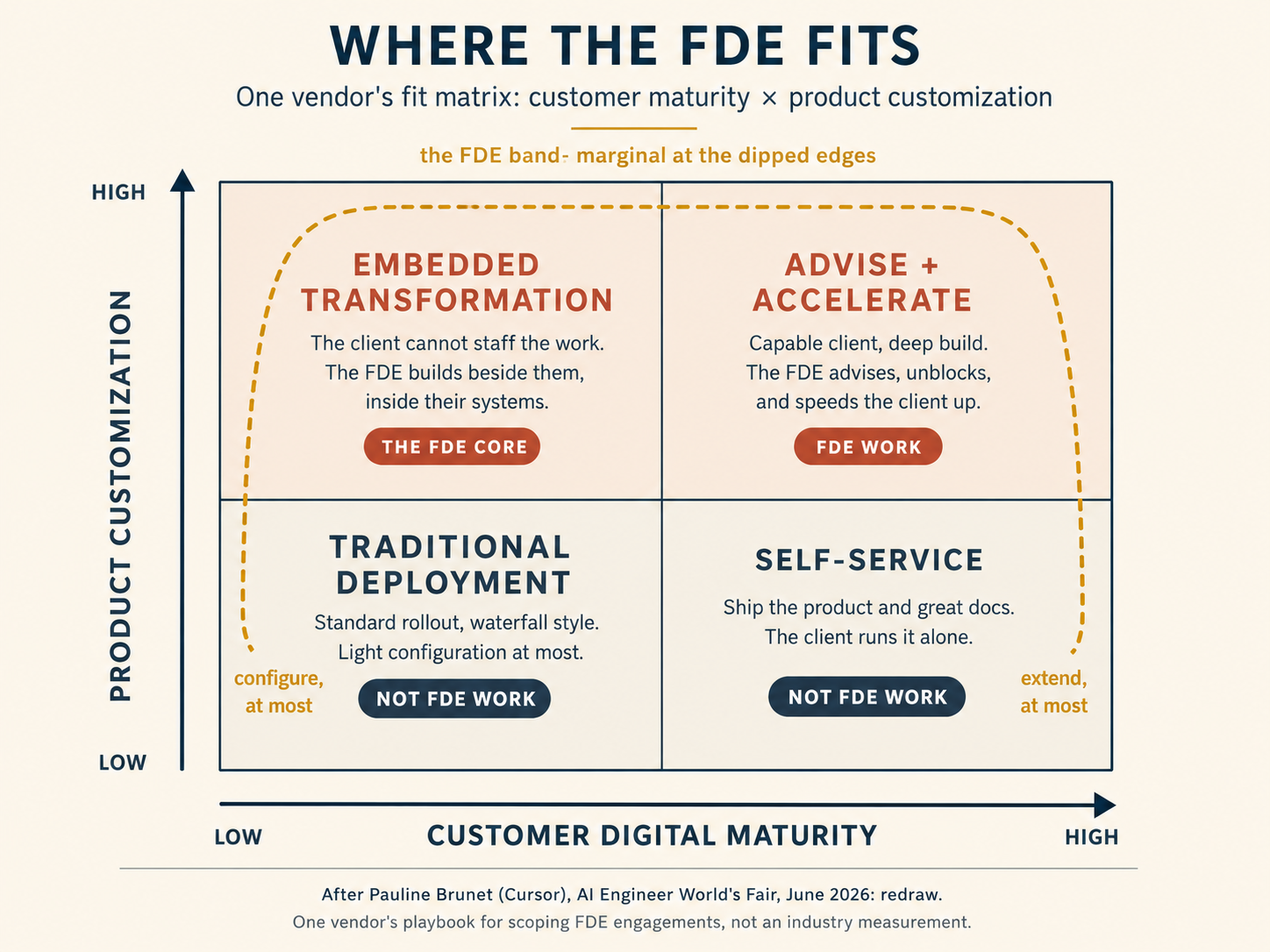 Buyer ki taraf se role ka scope: FDE wahan rehta hai jahan customization gehri hai, aur core mein jahan client khud kaam staff nahin kar sakta. Brunet ki talk se dobara banaya gaya; us ka framework, measurement nahin.
Doosra, staff-augmentation line. Us ka red flag woh client hai jo kehta hai "hum understaffed hain": yeh capability transfer nahin, hours rent karne ki request hai, aur woh mana kar deti hai. Us ka counter-move aik sawal hai: working team kaun hogi? Agar client un logon ka naam nahin de sakta jo aap ke saath build karein ge, engagement chhupi hui body-shopping hai. Yeh sawal saath le jayein. FDE aur services pyramid ke darmiyan page ke farq ka yahi field test hai.
Teesra, directional scope. Woh open-ended engagements, "chhe maheene ke liye do FDEs lein", aur fixed waterfall promises dono se inkar karti hai. Us ka format: masle ka naam, KPI baseline ka naam, "yeh process teen ghante leta hai; success bees minute hai", marhala-war six-week directional plan ka wada, aur client ke real systems jo sikhayein us par pivot ki umeed. Wajah kitab ke readers pehchanenge: us ne abhi customer ka data, processes ya systems nahin dekhe, is liye contact se pehle precision jhoot hai. Yeh delivery side se boli spec-driven development hai: ground truth aate hi spec hard hoti hai.
Is rule ko ghour se parhein, kyunke isay tayyar ho kar na aane ki daleel samajhna aasaan hai. Yeh daleel nahin. Contact se pehle is client ka plan precise nahin ho sakta: un ke systems, data aur baseline number. Jo pehle se maujood ho sakta aur hona chahiye woh profession ka apna governed knowledge hai, jo client ke saath nahin badalta. Brunet ki team Cursor ki pehle se bani platform ke saath aati hai. Vendor-neutral version pehle se governed profession ke saath. Dono khali nahin aate, aur dono client ke numbers pehle se jaanne ka dikhawa nahin karte.
Chautha, teen sawalon mein ROI. Har engagement kam az kam aik par khatam ho: kya revenue barhi, cost ghati ya risk kam hua? Us ki misaal: client is baat se ghabraya ke agent roz $2,000 kharch karta hai, jab tak us ne poocha agent kya kar raha hai, yani failing equipment ke paas sahi technician bhej raha tha, aur client ne maana agent sasta tha. Client ne cost napi thi, return kabhi nahin. Strategist track yeh framing sikhata hai; Brunet tasdeeq karti hai ke buyer side sirf isi framing par chalti hai.
Us ke do aur disclosures seedha parhna chahiye. Woh sirf paanch ya zyada saal ke tajurbe wale engineers hire karti hai aur abhi early-career candidates nahin leti: is liye salaried vendor door aaj senior door hai. Kitab is ke ulat dikhawa nahin karti. Is ke bajaye woh doors deti hai jo tenure check nahin karte: portfolio, freelance market aur pod of one, jahan credential resume line nahin, deployed Worker aur profession ka governed slice hai. Us ne aik aisi offering ka naam bhi liya jis ka plan kabhi nahin tha magar clients ki demand par ban rahi hai: company ko khud reorganize karne mein madad, kisay hire karein, job descriptions kya kahen, aur agents aane ke baad kaam ke tareeqe kaise badlein. Ghour karein. Vendor ki FDE team se client Harari ke sawal ka jawab mang raha hai. Woh service yeh page aur us ke peeche Strategist track hai.
Aakhri detail woh baghair hichkichahat ke kehti hai: us ki team client codebase ke andar Cursor ke cloud agents deploy aur Cursor SDK par applications banati hai. Agla paragraph parhte hue yeh yaad rakhein.
Vendor lock-in ka masla. Catch yeh hai. Palantir ka har FDE Palantir ki platform par build karta hai. OpenAI ka har FDE OpenAI ke models par. Salesforce ka har FDE Salesforce ke tools par. Cursor ka har FDE Cursor ke agents deploy aur Cursor SDK par build karta hai. Engineer client ki company mein gehrai tak jata hai, us aik vendor ki product ko har cheez mein wire karta hai aur chala jata hai. Baad mein switch karna dardnaak aur mehnga hai, jaise plumber jo sirf aik brand ki pipes lagata hai: plumbing chalti hai, magar walls tore baghair doosra plumber nahin la sakte. Andrew Ng ne The Batch mein note kiya hai ke clients ko single vendor se azad FDEs dhoondhne mein mushkil hoti hai, kyunke vendor ke liye role ka poora maqsad client ko lock in karna hai.18 AWS ki apni launch trap saaf dikhati hai. Wada tha clients self-sufficient ho kar jayen ge aur khud build karte rahen ge, aur usi saans mein kaha ke un ke paas rehne wale agentic systems un ke apne AWS environment ke andar chalenge. Aik vendor ke cloud par self-sufficiency. Yeh lock-in ko feature kehna hai: aap build karte rehne ko azad hain, bas yahin build karein. Microsoft launch ne doosre tareeqe se wahi concession di. Palantir se muqable par Frontier chalane wale executive ne kaha Microsoft zyada models, data connectors aur open systems of record ke integrations support karta hai.3 Ghour karein defense kya hai: vendor apne lock-in ko doosre se naap kar dhili cage ko feature keh raha hai. Kitab ka objection vendor ke apne stage se maan liya gaya.
Yeh kitab woh FDE train karti hai jise market mangti rehti magar dhoond nahin pati. Yahan ka method kisi vendor se bandha nahin. Graduate poori pipeline, intent spec karna, Worker banana, system design karna aur production mein chalana, client organization ke andar le jata hai baghair usay aik platform mein lock kiye. Agle quarter behtar model aaye ya agle saal sasta runtime ship ho, aap switch karte hain. Client choice ki azadi rakhta aur aap har stack par chalne wali discipline. Imandaar tradeoff: vendor ka FDE bohat subsidized, kabhi muft hota hai, kyunke vendor cost lock-in se kamata hai; vendor-neutral FDE ko client ya independent firm pay karti hai. Yeh bug nahin, feature hai: client baad ke switching costs ke bajaye ab optionality khareedta hai. Is engineer ka blueprint FDE AF Model hai: framework se customer tak paanch layers, aur har layer par FDE ki earning.
Bohat kam programs vendor-neutral role ko end to end train karte hain, aur claim ko bilkul exact rakhna ho to kitab vendor-neutral FDE ka technical core, yani market ko na milne wala aadha hissa, train karti hai. Doosra aadha, client discovery, prioritization, ROI framing aur unrealistic request par pushback ki discipline, Certified Agentic AI Business Strategist track mein hai. Technical core yahan train hota hai; consulting layer Strategist track mein hai.
Sab se sakht objection: platform ke baghair aap dev shop hain
Oopar wale section ne daleel di ke platform cage hai. Ab jawab ka sab se mazboot version lein, aur dekhein isay kaun deta hai: wahi practitioner jis ne pehle samjhaya role maujood kyun hai.
Bai us audience member ko pehle hi jawab deta hai jo kehta hai FDE function enterprise mein zinda nahin reh sakta, kyunke har customer ke liye custom cheez banane se dozens repositories ho jati hain jinhein koi maintain nahin kar sakta, aur engineers unhein seekhne ke bajaye resign kar dete hain. Woh aik shart ke saath maan leta hai. Agar har FDE mukammal zero se build karta hai, to us ke lafzon mein aap ke paas FDE function nahin, dev shop hai: mumkin hai profitable business ho, magar same business nahin. FDE function is liye banta hai ke engineers kabhi zero se software nahin likhte. Shared primitives ka set pehle se hota hai aur engineer unhein assemble karke customer ke liye kisi bhi qeemat ki cheez banata hai. Is ke baghair, woh kehta hai, maintenance cost profit-and-loss statement kha jaye gi, agar pehle engineers sab resign na kar chuke hon.4 Primitives kitne granular hon, is ka universal jawab woh nahin deta: kuch industries mein application 60% pehle se bani hoti hai aur customer baqi customize karta hai; doosron mein domain granular tooling mangta hai. Mufeed comparison AWS hai, jo DynamoDB deta hai taake kisi ko database invent na karna pare, kyunke woh intehai broad customers serve karta hai.
Isay sanjeedgi se lein, kyunke vendor-neutrality ka bill yahi hai. Vendor hata kar aap ne cage ke saath shared primitives bhi hata diye. Kuch na karein to pod of one dev shop of one ban jata hai: har client par bespoke code, koi reuse nahin, aur har engagement ke saath barhta maintenance load jo margin kha jata hai. Bai ka apna test khud par lagana imandaar tareeqa hai: kya mere paas platform hai, ya mein aik banane mein investment ke liye tayyar hun?
Jawab agla section hai, aur isi liye woh section maujood hai. Vendor-neutral FDE shared primitives lati hai. Woh sirf vendor ki milkiyat wala code nahin.
Pod ko kya bharta hai: do Systems of Record
Oopar sab kuch batata hai FDE kahan kaam karti hai. Abhi kuch nahin batata ke woh darwaze se kya lati hai, aur vendor-neutrality yahi sawal majboor karti hai.
Pehle vendor ke version se poochein. Palantir engineer Palantir ki pehle se bani ontology aur tooling ke saath aata hai. Yeh real leverage hai, aur isi liye aik engineer hafton mein woh kar sakta hai jo team saalon mein karti thi. Yahi oopar ka cage bhi hai: client build karte rehne ko azad hai, jab tak wahin build kare.
Ab vendor hata dein. Kya bacha? Agar imandaar jawab "method, us ke sar mein" hai, to woh human execution ke hours bech rahi hai, wahi services pyramid jise replace karna tha, aur "hum understaffed hain" wala client bilkul yahi mang raha hai. Pod of one hours par zinda nahin reh sakta. Woh aise assets par rehta hai jo aik client se doosre tak jate hain.
Aise do assets hain, aur dono Systems of Record. What You Carry In is daleel ko mukammal deta hai, aur yeh section us ka career-facing aadha hai.
Pehla method hai, aur us ne nahin banaya. Yeh kitab, gehri aur pehle se governed, human readers ke liye website aur agents ke liye MCP par serve hoti hai. Is mein outcome specify karna, Worker manufacture karna, loop chalana, checker par trust karna aur production mein result prove karna hai. Har graduate same system lata hai, aur Karachi accounting firm aur Chicago firm mein woh identical hai, kyunke method domain ke saath nahin badalta.
Doosra profession hai, aur us ne khud banaya. Aik vertical, aik jurisdiction, us ke zariye governed aur committed domain expert se licensed: law, standards, expert ki derived procedures, invariants aur decision map. Yeh aik professional outcome ko mukammal cover karke shuru hota aur engagement by engagement mota hota hai. Yeh wala kisi aur ke paas nahin.
Dono MCP bolte hain, is liye us ka agent dono aik saath parhta hai: aik source batata hai Worker kaise banana hai, doosra profession kya mangta hai. Integration work nahin, kyunke ecosystem ka kernel bilkul isi pairing ke liye design hua.
Aur yeh dev-shop objection ka jawab hai. Bai ki condition shared primitives thi, taake engineer zero se shuru na kare. Dono Systems of Record ko test karein to dono pass hote hain. Method kaam kaise banta hai us ki primitive layer hai: outcome specify, Worker manufacture, loop run, checker trust aur production result prove. Har client par identical, bilkul woh property jo Bai mangta aur dev shop mein nahin hoti. Profession primitive layer hai ke aik vertical aur jurisdiction mein kaam kis cheez ki pabandi kare. Koi per-customer fork hua code nahin, aur isi se maintenance curve murti hai: aap governed corpus maintain karte hain, aur us ke gird code ko paalne ke bajaye regenerate karte hain. Do baatein seedhi kahni chahiye. Pehli, vendor ke baghair bhi us ki condition poori hoti hai, yani poora page aik line mein. Doosri, cost gayab nahin hui, move hui hai. Ab repositories ke bajaye corpus maintain hota hai, aur pehle client ki payment se pehle kisi ko fund karna hai. Isi liye neeche order hai: pehle build, phir sell. Is doosre aadhe ko kitab ki reasoning samjhein, Aggarwal ke hisaab ki class mein. Bai ki warning aik decade real teams par maintenance costs girte dekhne se hai. Governed corpus curve ko flat karta hai, yeh claim hai, abhi measurement nahin.
Doosra system kaise mota hota hai. Bai vendor ke rakhne ka rule bhi deta hai: jo aik customer ke liye bespoke aur unique hai woh sirf usi ke liye rehna chahiye; jo generalize ho sakta hai use waqt ke saath generalize hona chahiye. Is se forward deployment scouting function ban jata hai, vendor ko pata chalta hai product mein agla kya banana hai.4 Vendor-neutral version wahi rule doosri manzil par chalata hai. Jo generalize hota hai vendor platform mein nahin jata. Vertical System of Record mein jata hai: woh standard jo aik ke bajaye teen clients govern karta nikla, procedure jo expert ne aik baar likhi aur ab har jagah sign off karti hai, invariant jo jurisdiction ki har firm par qaim raha. "Engagement by engagement mota" hone ka mechanical matlab yahi hai, aur isi liye doosra client pehle se kam cost karta hai.
Aur isi liye vendor-neutrality choice ko majboor karti hai. Vendor ka FDE platform se specialize karta hai. Platform hata dein to specialization ko kahin aur utarna hoga, warna aap generalist consultant hain jis ke paas reuse ko kuch nahin. Poochein client do se teen tak kya jata hai. Kaam ki shape muft jati hai, kyunke document ko rule ke against parhna, rule cite karna aur unclear cheez escalate karna method hai, aur pehle System of Record mein maujood hai. Koi is par premium nahin deta. Buyer us cheez ke liye pay karta hai jo generalize nahin hoti: is sawal ko kaunsa standard govern karta hai, is period mein kaunsa version effective tha, kis mulk ka regulator rule own karta hai, aur partner ko kya khud sign karna hai. Yeh sab professional aur jurisdictional hai. Audit files se customs declarations mein move karne par kuch nahin bachta.
Is liye axis profession hai, aur vendor-neutrality usay wahan rakhti hai. Choosing Your Vertical chunne ka method aur Designing the Vertical System of Record usay banane ka method hai.
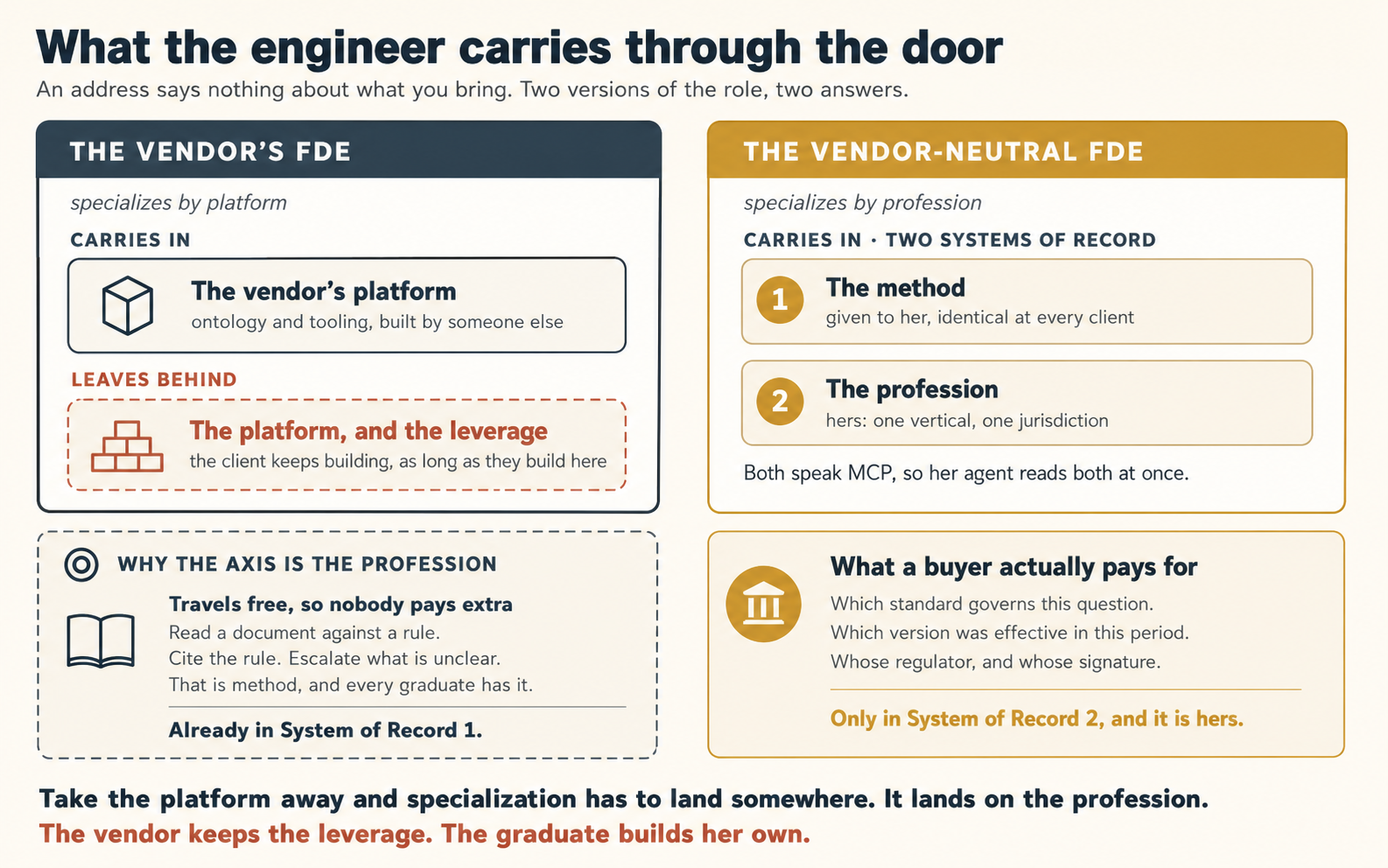 Dono jawab saath: vendor engineer aisi platform ke saath aata hai jo peeche rehti hai; vendor-neutral engineer us method ke saath aati hai jo usay mila aur us profession ke saath jo us ne banaya.
Aik order nikalta hai, aur woh career ka start tay karta hai. Pehle build, phir sell. Slice woh qadam nahin jo customer ka intezar kare. Yahi qadam customer paida karta hai. Page teen martaba wajah keh chuka hai: portfolio credential hai, resume shipped systems par screen hota hai, aur jis buyer ko kuch dikhaya na gaya ho woh apna baseline number nahin batata. Mid-size firm mein usi profession ka aik governed page le kar jayein to agla sawal table ki us taraf se aata hai.
Client ka sab se insaf wala sawal baat band karta hai. Vendor engineer seedha kehta hai: mein platform lata hun aur leverage hamare paas rehta hai. Aap ka jawab mukhtalif hai: mein method aur pehle se governed profession lati hun; mere jane par aap ke paas working system hota hai jise aap apni chosen stack par badal sakte hain, aur mujhe seedha hire karne ka option. Dekhein yeh jawab kya claim nahin karta. Client vertical System of Record own karke nahin jata. Woh us domain startup ke paas hai jo us ne expert ke saath banai, expert material licence ke neeche aur third-party sources un ki terms ke neeche hain. Is liye us ke system mein standard serve karne ki licence client ki licence nahin ban jati. Client ko woh azadi milti hai jo vendor version nahin de sakta.
Salary section ki rooh mein aik imandaar label. Demand data measured hai. Pod of one method se nikalta hai. Magar vendor-neutral graduates ke governed corpus ko pehle client mein badalne ka verified count abhi nahin, kyunke category nai aur neeche shelf khali hai. Order ko kitab ki reasoning samjhein, Aggarwal ke hisaab ki class mein: mazboot, magar abhi measurement nahin.
Aik shakhs ka pod
Dekhein AWS client ko kya bhejta hai: paanch ya chhe engineers ka pod, on-site taqreeban 45 din ke liye. Jab log ab bhi building haath se karte hon to forward deployment aisa dikhta hai: choti team chahiye. Kitab pod ke log badalti hai. Graduate wahi kaam akele client ke andar le jata hai. Jo log pehle paas baithte the ab Digital FTEs, yani engineer ke banaye aur chalaye Workers hain. Paanch ya chhe ki team aik insan ki command wali Workers workforce ban jati hai. Job same hai; pod ko bharne wali cheez nahin. Power log barhane se nahin, method aur us ke banaye Workers se aati hai. Oopar ke section ke saath parhein to pod ke do aadhe hain: Workers logon ko replace karte hain aur do Systems of Record vendor platform ko. Product-to-engineer ratio ke doosre sire par bhi yahi tabdeeli hai: har shakhs ka output barhta aur log kam hote hain. Legacy pod se compressed pod aur pod of one tak poora arc How the team got this small mein hai.
Aik risk jo purane tareeqe se staff karne wale shakhs ne khud bataya. Jab Bai se poocha gaya ke project par kai FDEs hone chahiye, us ne kaha yeh acha pattern hai, aur wajah yahan aham hai: aap single point of failure nahin chahte, aik shakhs ke paas tamam maloomat, woh chhutti par jaye aur engagement ruk jaye.4 Pure form mein pod of one yahi risk hai, aur is se inkar be-imani hoga. Kitab ka jawab risk gayab hona nahin, insan ke sar se bahar move hona hai. Doosra engineer knowledge redundancy deta hai, aur is method mein knowledge pehle se likha hai: spec, evals, governed corpus, deployed Worker aur us ka runbook. Headcount ke bajaye artifacts se redundancy claim hai, aur khud par chalane ka test bhi. Agar aap do haftay unreachable hon to kya is kitab ka doosra graduate sirf repository se engagement utha sakta hai? Agar nahin, to aap ke paas pod of one nahin. Bus factor one hai.
Teesra darwaza: freelance FDE
Ab tak FDE ke do addresses the: vendor ka payroll aur independent firm. Ab teesra khula hai: open freelance market. Upwork ke paas Forward Deployed Engineers hire karne ki dedicated category aur published project bands hain: pehli integration ke liye qareeban $2,000 se $5,000, custom implementation $5,000 se $15,000, enterprise deployment $15,000 se oopar, ongoing support $4,000 se $10,000 maheena, aur strategic consulting $150 se $250 ghanta.19 UK mein contract FDE mid-level par £600 se £750 daily, senior par £750 se £1,200 aur principal par £1,200 se £2,000 bill karte hain; specialist recruiter kehta hai senior FDEs actively permanent roles par contract work chun rahe hain.20 Fractional platforms bhi aa gai hain: dedicated FDE matching aur "Fractional Forward-Deployed Engineering Lead" postings jo dinon mein fill hoti hain.21
Ab imandaar reading, kyunke marketplace page ghour se parhne par reward deta hai. Category hai; us ke neeche supply nahin. Upwork ke Forward Deployed Engineer profiles dekhein to capable generalists, full-stack developers, DevOps engineers aur app builders milte hain, koi FDE work, embedded delivery ya end-to-end pipeline describe nahin karta. Marketplace ne shelf stock aane se pehle bana di. Page ki opening line marketplace level par chal rahi hai: title training se pehle aa gaya. Aksar titles mein khali shelf warning hai. Trained reader ke liye opening: demand side projects aur published rates post karti hai, supply ne abhi fill karna nahin seekha.
Teen cheezein is door ko pehle do se mukhtalif karti hain. Pehli, yeh vendor-neutral FDE ka native market hai. Vendor ka FDE freelance nahin kar sakta: role sirf vendor payroll mein, platform ke saath welded hota hai. Har asli freelance FDE by construction vendor-neutral qisam ka hai; open market par neutrality differentiator nahin, entry requirement. Doosri, retainer tier chhupa maintenance nahin. Yeh bahar se chalaya Digital FTE subscription model hai, aur monthly fee aap ke banaye Workers operate karne ke liye; pod of one recurring revenue mein badal gaya. Teesri, aur readers ke liye aham: is door ki border nahin. Salaried market zyada tar US ya European work address mangti hai; freelance aur fractional market portfolio aur connection. Aggarwal ka India ke IT decades wala claim is channel se har shakhs ke liye chalta hai: same contract Karachi, Lagos ya Bangalore se clear hota hai.
Do constraints seedhe. Embedding job ka core hai, aur remote embedding remote coding se mushkil: freelance FDE over-communicate karke, client-timezone hours rakh kar aur kabhi on-site presence ko premium ki qeemat samajh kar jeetta hai. Premium list nahin, earn hota hai: unproven profiles generalist rates ke qareeb shuru hoti hain, aur demonstrated outcomes engineer ko bands mein oopar le jate hain, bilkul kitab ke capstones. Deployed Worker, shipped plugin, live connector app, profession ka governed slice: is market mein yahi credential hain. Kitab delivery train karti hai; client discovery aur pricing Strategist track mein; reputation aap har contract se banate hain.
FDE ko seedha hire karein aur title gayab ho jata hai. "FDE" engineer ya skills ka bayan kabhi nahin tha. Yeh batata hai woh kahan kaam karta hai: outsider ke taur par client ki company mein embedded, poori line end to end liye. Faisla-kun sawal: woh kis ki company bana raha hai? Apni company mein build karein to chaar core roles. Client ki company mein to wahi kaam FDE. Ab engineer ko seedha hire karein. Client ki company us ki apni ho jati hai. Woh forward deployed nahin, sirf deployed hai. Kaam nahin badla, sirf address. Title girta aur woh internal core mein laut kar company ke andar poori pipeline own karta hai. Single naam AI-Native Company Architect hai jo enterprise design karta aur aam taur par Cloud AI Engineer ki tarah chalata bhi hai.
Yeh azadi sirf vendor-neutral FDE ko hai: company seedha hire kar sakti hai. Client graduate ko employee banaye aur agle subah woh bilkul same kaam karta hai, kyunke discipline shakhs mein hai, vendor platform mein nahin. Woh us ke saath darwaze se aati hai. Vendor FDE yeh nahin kar sakta. Palantir ya OpenAI chhorne ke din poori job ki platform peeche reh jati hai: engineer talented hai, leverage vendor ka. Vendor FDE permanent loan hai, embedded waqt mufeed aur vendor relationship khatam hote hi gayab. Hamara graduate hamesha ke liye hire ho sakta hai. Client pehle FDE ke taur par rent, phir AI-Native Company Architect ke taur par in-house la sakta hai baghair qadam khoye. Vendor-neutrality aisa engineer deti hai jise company borrow nahin, own kar sakti hai.
Aik asymmetry safar mein rehti hai. Do mein se pehla, Agent Factory System of Record, us ke saath jata aur har jagah available hai, kyunke ecosystem ka aur open hai. Doosra seedha travel nahin karta. Domain startup usay hold karti hai aur woh expert ki licence aur third-party terms par khara hai, is liye direct hire automatic transfer nahin, us business ke bare mein guftagu hai. Discipline hamesha portable. Asset ka owner hai.
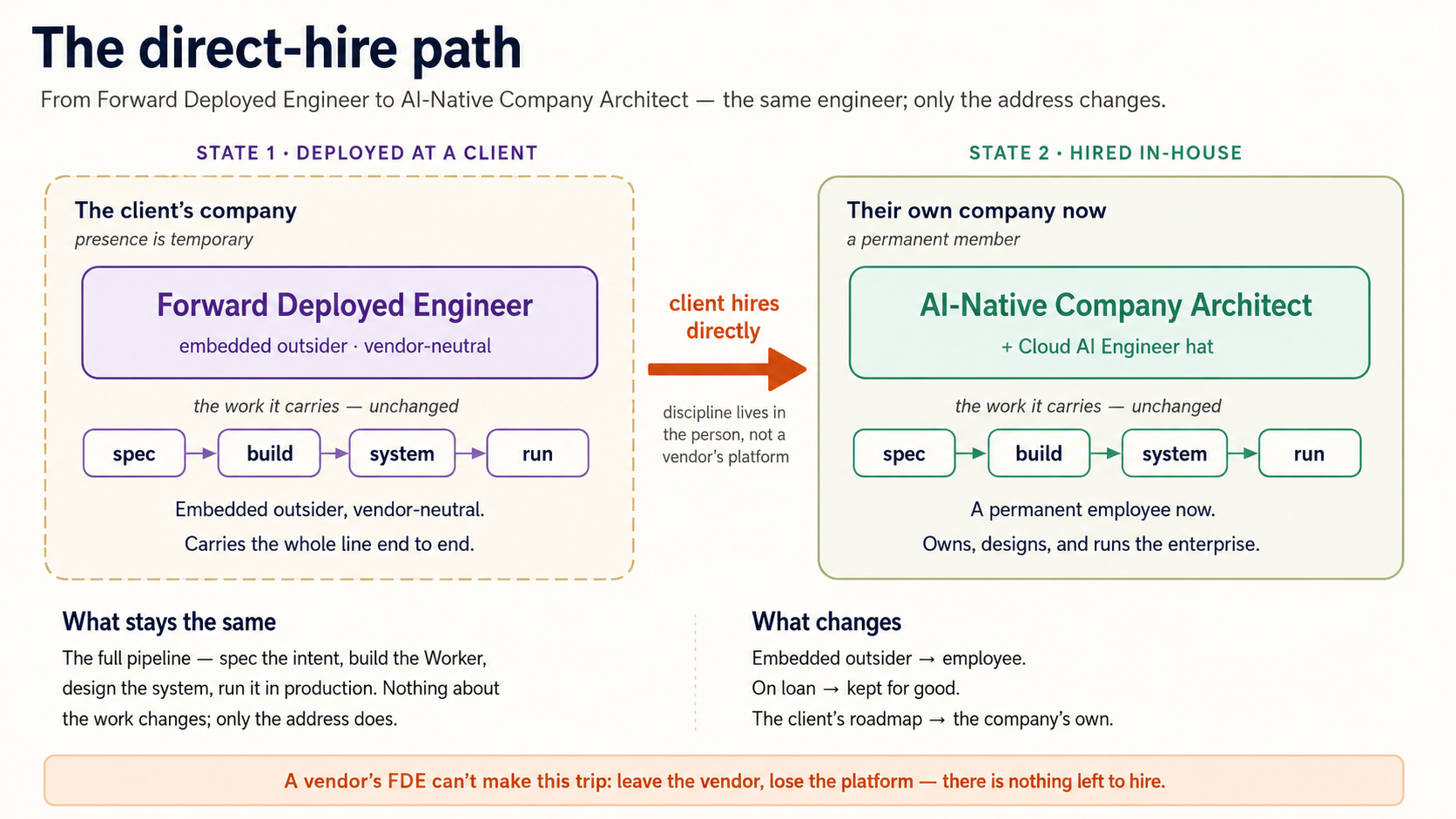 Direct-hire path: client par deploy karein to FDE; seedha hire karein to core mein AI-Native Company Architect. Sirf vendor-neutral FDE yeh safar kar sakta hai.
Job land karna apni discipline hai. FDE resume software engineer se mukhtalif signals par screen hota, aur interview us round ke liye mashhoor hai jahan zyada tar strong engineers fail hote hain. Appendix A aur B dono cover karte hain, aur Appendix C kitab ke courses se har interview round ka map deta hai.
Skill Author ke taur par Subject Matter Expert
Subject Matter Expert as Skill Author: woh role jis ka market ne abhi naam nahin rakha. Accountant, lawyer ya supply-chain expert jo judgment ko SKILL.md, yani plain-text file jo agent ke load aur follow karne ke liye skill package karti hai, mein encode karke Digital FTE ka knowledge engine banta hai. Kaam concrete hai: woh tacit rule lein jo aap baghair soche lagate hain, jaise experienced auditor kin transactions ko flag karta hai ya claims adjuster borderline case kaise parhta hai, usay itni precision se likhein ke agent execute kar sake, phir agent ke calls ko apne calls se milayein aur SKILL.md ko tab tak revise karein jab tak woh match na hon. Zyada tar market lists yeh role miss karti hain kyunke woh AI work ko ab bhi sirf engineering samajhti hain. Kitab domain judgment ko author, test aur deploy hone wali cheez samajhti aur expert ko teeno train karti hai. Vendor-neutral Forward Deployed Engineer ki tarah yeh bhi aisa role hai jise qareeban koi aur train nahin karta. Poora train hota hai: judgment andar, working agent bahar.
Dekhein yeh do be-naam roles sirf milte julte nahin. Inhein aik doosre ki zaroorat hai. Vendor-neutral FDE ka doosra System of Record author ke baghair nahin ban sakta, kyunke procedures practitioner ki awaz mein aur us ki real files se derived hoti hain. Skill Author ko bhi koi chahiye jo us ke judgment ka governed home banaye. Koi junior partner nahin. Expert bees saal aur licence lata hai. Engineer method aur build. FDE AF Model is pairing ko vertical kehta hai, aur isi liye Choosing Your Vertical committed expert ke baghair launch se inkar karta hai.
Market ne abhi is role par qeemat chhapi hai. 2026 ke darmiyan Business Insider ne Yousuf Imran ko profile kiya, Google account executive jis ki commissions ne $170,000 base ko saalana qareeban $986,000 banaya. April mein us ne Mangosteen Studio, salespeople ke liye sales tools banane wali AI product lab, shuru karne ke liye job chhor di.22 Headline number se aage dekhein aur dekhein woh kya nahin: software engineer. Us ka stated asset salespeople ke masail seekhne ke bees saal tha, aur bet yeh ke apni milkiyat wale AI products mein encoded judgment ko rent karne ki qareeban million-dollar salary se zyada qeemat hai. Us ne faisla ownership mein frame kiya: agar is era ka upside equity mein hai, equity us company mein honi chahiye jo woh khud banaye. Yeh Skill Author ki bet hai, market ki ab tak sab se visible qeemat par; Aggarwal ke hisaab ki tarah aik shakhs ki bet, signal, statistic nahin. Headline kehti hai aik shakhs $986,000 chhor gaya; mechanism kehta hai domain expertise manufacturing input bani aur expert ne factory rakhi.
Connector aur Plugin Engineer
Connector aur Plugin Engineer: un agent hosts ko extend karta hai jin mein doosre log pehle se kaam karte hain. Apna loop own karne wala Worker banane se pehle aik poori discipline un cheezon ko banane ki hai jin tak agent haath barhata hai, aur market aik waqt mein paanch naam de rahi hai: MCP engineer, integrations engineer, connector developer, plugin developer, agent-tooling engineer. Aik job, do addresses. Connector-native app end users ke liye chat app, claude.ai, ko extend karti hai: aap remote MCP server, tools, stored state, real sign-in aur fail-closed session gate ship karte hain jise ajnabi aik pasted URL se add kare, aur phir model khud aap ka customer hai. Plugin builders ke liye coding agent, Claude Code ya OpenCode, ko extend karta hai: skills, subagents, hooks aur MCP servers aik install ke peeche, jahan deterministic hook us advice ke darmiyan line hai jise model chhor sakta hai aur us rule ke darmiyan jo har baar chalta hai. Same move, do hosts, aur dono ke neeche same artifact, MCP server; isi liye kitab unhein back to back sikhati hai. Thesis ki aik idea through-line hai: aap unit ship karte hain jise host load karta hai; extension aap own karte, loop host. Dono end to end, deployed artifact tak train hote hain; identity issue karna, yani apna sign-in server aur agents ki identity, AI Identity course mein hai, aur runtime khud banana scope se bahar rehta hai, jaisa kitab ke rukne ka section batata hai.
Madadgar roles
Har pipeline ko log chahiye jo work check karein, rules set karein, aur responsibility lein. Yeh teen roles yeh kaam karte hain.
Evals Engineer: woh shakhs jo AI Workers ko live jane se pehle crash-test karta hai. Aap car ko crash-test ke baghair ship nahin karenge. Medicine ko clinical trials ke baghair release nahin karenge. AI Worker jo real logon aur real paisay ko affect karne wale decisions leta hai, usay bhi wahi discipline chahiye. Evals Engineer woh tests design karta hai: kya Worker sahi answer deta hai? Kya woh gracefully fail karta hai jab usay aisi cheez mile jo us ne kabhi nahin dekhi? Kya woh diye gaye boundaries ke andar rehta hai? Yeh end par bolt-on kiya gaya afterthought nahin. Yeh har chapter mein built in hai. Core curriculum, add-on nahin.
AI Governance Officer: decide karta hai ke AI kya kar sakta hai. Company mein har employee ki limits hoti hain. Junior accountant $500 tak expenses approve kar sakta hai, us se upar manager signature chahiye. Bank teller deposit process kar sakta hai, loan approve nahin kar sakta. AI Workers ko bhi wahi structure chahiye. Governance Officer company level par woh rules likhta hai: AI apne aap kya decide kar sakta hai, kya human approval ke liye jana chahiye, aur AI ko kya kabhi touch nahin karna chahiye. Woh regulations ki mapping bhi handle karta hai: bank mein fair lending rules, hospital mein patient privacy, Europe mein data residency laws. AI-Native Company Architect woh system build karta hai jo yeh rules enforce karta hai; Governance Officer decide karta hai ke rules mein kya likha ho. Kitab yeh framework discipline directly train karti hai; aap ki industry ki specific regulations woh inputs hain jo aap late hain. Governance framework train karti hai; aap ki jurisdiction ke rules aap supply karte hain.
Digital FTE Supervisor: woh human jiska naam line par hai. Jab AI Worker claim process karta hai, contract draft karta hai, ya transaction flag karta hai, kisi ko accountable hona parta hai. Woh Supervisor hai. Woh human-in-the-loop hai: reviewer jo work check karta hai, manager jo output approve karta hai, woh naam jahan audit trail point karti hai jab kuch ghalat hota hai. Yeh Worker build karne wala shakhs nahin. Yeh woh shakhs hai jo usay day to day run karta hai, jaise shift manager team run karta hai. Isay train karti hai.
Jahan kitab jaan boojh kar rukti hai
LLMOps Engineer: model tak, model itself nahin. Production mein agents run karna Cloud AI Engineer ka job hai, aur kitab isay train karti hai. Kitab fine-tuning hands-on bhi train karti hai, lekin last resort ke tor par, default nahin. Fine-tune aap ke system ko aik model snapshot se bind karta hai aur us optionality ki cost lagata hai jise poora method protect karta hai, is liye aap isay sirf tab use karte hain jab prompting, context, tools, aur retrieval waqai kam par jayen. Hard stop model itself build karna hai: foundation model ko scratch se pre-train karna scope se bahar rehta hai, kyun ke woh capability commoditize ho rahi hai. Fine-tuning aur model ke gird ops train karti hai, foundation models build karna nahin.
Harness Engineer: runtime jo aap use karte hain, woh nahin jo aap build karte hain. Harness agent runtime hai, OpenAI Agents SDK, Claude ke managed agents, aur aisi cheezen, jo agent loop run karti hain, state manage karti hain, aur tool calls execute karti hain. Kitab aapko inhein fluently use karna aur in ke darmiyan portable rehna train karti hai, kyun ke aap ki discipline kisi bhi winning runtime se zyada long-lived hai. Runtime itself build karna job nahin. Kisi bhi runtime ko use karne wale operator ko train karti hai, usay build karne wale engineer ko nahin.
AI Data Engineer: agent-facing data layer. System-of-record work agent-facing data layer ko touch karta hai: Postgres, pgvector, aur MCP woh spine hain jis se agent read karta hai. Classic pipeline aur warehouse engineering adjacent hain, central nahin. Agent-facing data layer train karti hai, general data engineering nahin.
Doosra axis: sirf seat nahin, aap ki type
Oopar ka map batata hai kaam kahan rehta hai. Yeh nahin batata kaunsi seat aap ko fit karti hai. June 2026 mein Boris Cherny, Claude Code ka creator aur is page ke measure kiye execution explosion ka sab se bara sabab banne wale tool ka maker, ne apni team ko dekha aur poocha roles ka kya banta hai jab engineering, product, design aur data science "pighal kar nai qisam ka role" ban jayein.23 Us ka jawab paanch archetypes tha, jin mein se koi job function nahin. Prototyper bilkul naye ideas bohat tezi se nikalta hai, jin mein aksar kabhi ship nahin hote. Builder prototype ko production-grade product ya infrastructure mein jaldi badalta hai. Sweeper system simplify, UI clean, unship aur optimize karta hai. Grower bani hui product ko product-market fit ki taraf iterate karta hai. Maintainer mature system own karke scale ke saath secure, reliable, fast aur efficient rakhta hai.
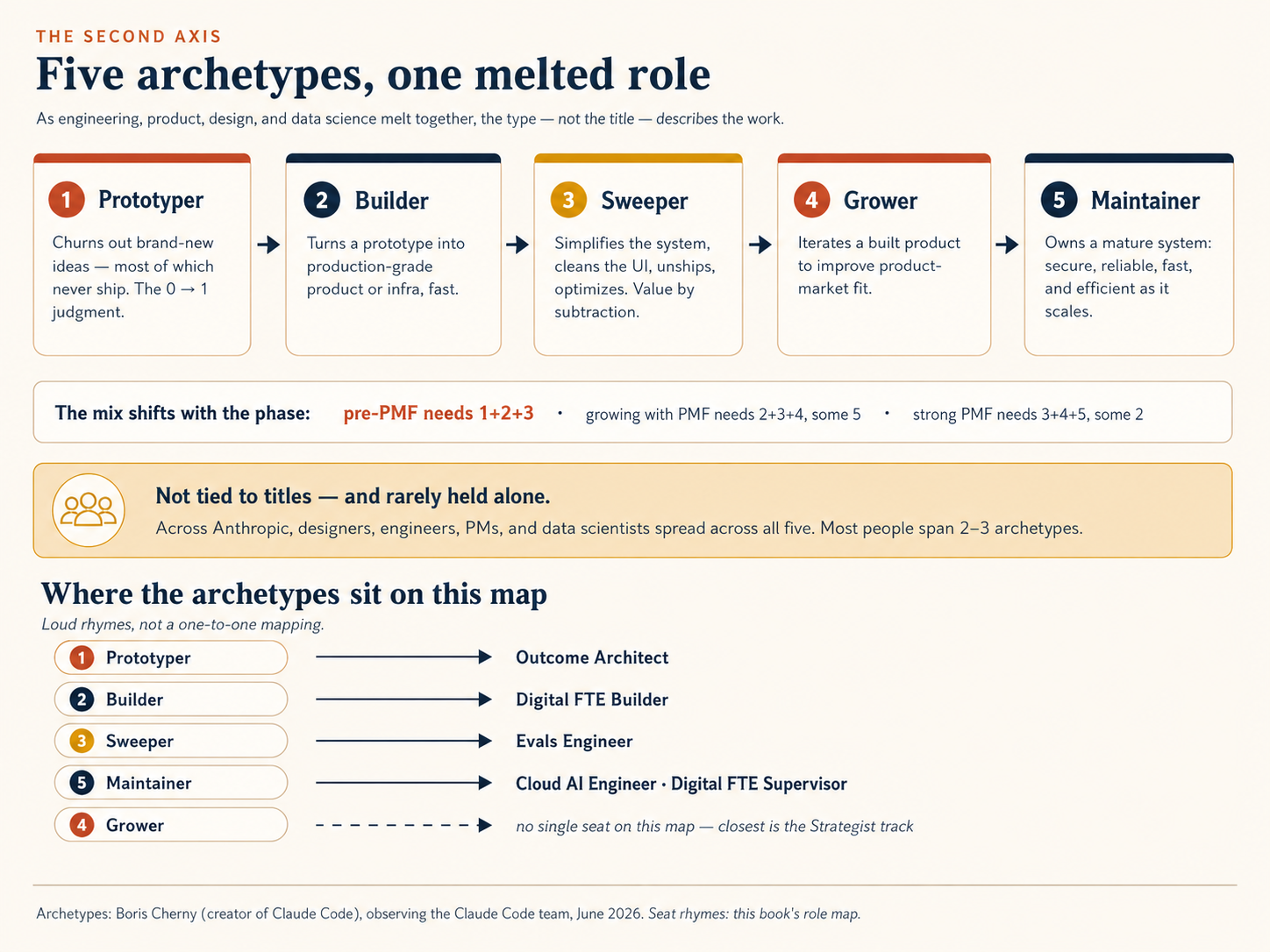 Cherny ke paanch archetypes, aur is map ki seats ke saath un ki rhyme: buland, magar one-to-one nahin.
Us ki do observations yahan kaam karti hain. Pehli, archetypes titles se bandhe nahin: Anthropic bhar mein kuch designers Prototypers, kuch Builders aur kuch Sweepers hain, aur engineers, PMs aur data scientists mein bhi yahi spread hai. Page ka opening claim, ke title ab kaam describe nahin karta, lab ke andar se confirm hota hai. Doosri, zyada tar log do, kabhi teen archetypes span karte hain, aur team ka mix product phase ke saath badalta hai: pre-PMF product pehle teen par, mature product aakhri teen par jhukta hai. Is map ke against rhymes loud hain magar one-to-one nahin. Outcome Architect Prototyper ki seat. Digital FTE Builder Builder ki. Evals Engineer Sweeper ki. Cloud AI Engineer aur Supervisor Maintainer ki. Spanning pod of one ko andar se dikhata hai: Workers tasks absorb karte hain, jabke insan ke do ya teen archetypes tay karte hain ke woh kaunsi seats waqai own kar sakta hai aur kaunsi supporting disciplines fake karne ke bajaye borrow kare, jaise Sweeper ki subtraction ke liye evals aur Maintainer ki ehtiyat ke liye governance. Cherny claim par nahin, sawal par khatam hota hai: shayad future ke product roles aaj ke domain roles se kam aur us ke paanch archetypes se zyada milte hon. Yeh page us sawal ka aik jawab hai. Roles batate hain kaam kahan. Aap ke archetypes batate hain kaunsi seats lein.
Pattern hi tell hai. Agent era kaam ko aik nahin, bohat roles mein phailata hai: Workers banana, unhein chalana aur govern karna, unhein judgment sikhana. Map point hai: dekhein aap pehle se kahan kharay hain, kaun se archetypes span karte hain aur kitab wahan se kitni door le jati hai.
Appendix A: FDE resume, chhe signals
Interview aur screening practices tezi se badalti hain; yeh appendix aur agla mid-2026 ke sources ke against verify hua.
Recruiters FDE profile ko software engineer ki tarah nahin parhte. Real screening practice ka analysis chhe signals par jama hota hai, aur jo profile unhein daba de woh technical bar test hone se pehle reject hoti hai.24 Pehle teen poochte hain kya aap ne waqai deliver kiya: shipped production systems, yani real deployments, team backlog ke features nahin; quantifiable impact, yani "feature X banaya" nahin balki customer ko numbers mein kya mila; aur direct customer exposure, yani aap stakeholder ke saath baithe, product manager ke peeche nahin. Doosre teen poochte hain aap kaise deliver karte hain: messy-data work, kyunke real client environments clean nahin; ambiguity mein ownership, yani jab kisi ne define nahin kiya tab aap ne project chalaya; aur AI/LLM depth, RAG, agents aur evals, yani role ke wajood ki wajah.
Signals se teen rewrites nikalti hain. Pehli, har bullet ko activity se outcome banayein: "ETL pipeline banai" ko "pipeline ship ki jis ne client ka month-end close paanch din se do din kar diya." Doosri, "hum" nahin, "mein" likhein; FDE screeners "hum" ko "team ne utha kar chalaya" parhte aur hiring-manager round mein probe karte hain. Teesri, competitive-programming awards hata dein. Data-structure puzzles solve karne ka prize doosre interview ki preparation dikhata hai. Is ki jagah portfolio hai. Freelance section rule de chuka hai: portfolio credential hai, deployed Worker, shipped plugin, live connector app, har aik ke saath one-line outcome. Kitab ka har capstone bilkul wahi line banne ke liye design hai.
Us list mein aik item baqiyon jaisa nahin, aur vendor-neutral candidate ko us se lead karna chahiye: profession ka governed slice, dono readers ke liye published. Deployed Worker sabit karta hai aap build kar sakte hain. Governed slice sabit karta hai aap aisi cheez own karte hain jo employer ne nahin di, aur page par yahi line hai jo screener ne qareeban yaqeenan pehle nahin dekhi.
Appendix B: FDE interview, loop aur trap
Loop teen se chhe hafton mein paanch se aath stages chalta hai: recruiter screen, hiring-manager screen, practical coding round, system-design round, decomposition case study, client simulation aur behavioral round; kuch AI labs apni APIs par take-home bhi deti hain.24 Do rounds outcome tay karte hain, aur koi woh nahin jis ke liye engineers tayari karte hain.
Decomposition round filter hai. Aap ko vague real enterprise masla milta hai: "aik bara shehar emergency response times kam karna chahta hai; call data, traffic data aur ambulance GPS hai; aap ke paas 60 minute hain." Sab se aam rejection us ka jawab dena hai. "Mein XGBoost se predictive model banaoonga" se shuru karne wala fail, kyunke scope se pehle solution. Score sequence ko: asal goal clarify, stakeholders aur success metric, available data aur owners, risk ke order mein subproblems, phir sab se patla end-to-end skeleton; assumptions buland awaz mein, failure modes bina pooche, soch lagatar narrate. Readers pehchanenge: zubani spec-driven development. Round answer janna test nahin karta; yeh test karta hai ke aap human ya agent ko execute dene se pehle spec likhte hain ya nahin.
Client simulation doosra filter hai. Interviewer kabhi frustrated, kabhi non-technical customer banta hai, aur aap bad news dete, governance compromise karne wali request par pushback karte ya samjhate hain system 100% accuracy kyun promise nahin kar sakta, baghair jargon aur us wade ke jo nibha na saken. Sources mein paanch red flags same: clarify se pehle solve; cost aur constraints ignore; patli deployment stories, yani production mein API fail hone par kya hua nahin bata sakte; regulated domains mein compliance vocabulary zero; aur customer instinct nahin.24
Aik aur format phail raha hai aur apni line chahta hai: live build. Aik documented loop teen ghante chala: 30 minute vague use case ko cross-examination ke neeche requirements mein badalne ke, 90 minute AI coding assistant ke saath working solution banane, har suggestion validate aur live debug karne ke, aur 60 minute role-played stakeholder ko pure business language mein result dikhane ke.25 Kisi stage par LeetCode nahin. Darmiyani round observation ke neeche kitab ki Mode 1 discipline hai: agent ko direct karein, har output verify karein, loop narrate karein.
Company flavor margin par farq dalta hai: Palantir data engineering, ontology thinking aur apne banaye decomposition round par jhukta hai; OpenAI apni APIs ke against systems build aur evaluate karne par, jahan "aap ko kaise pata yeh waqai kaam kar raha hai?" differentiator hai; Anthropic, jo title Applied AI Engineer rakhta hai, production LLM systems, evals aur mission alignment par.24 Magar oopar ke fundamentals har jagah loop hain, aur preparation chaar se chhe hafton ki discipline: pehle fundamentals aur stories, phir system design, phir partner ke saath timed aur recorded decomposition practice, kyunke candidates hairan hote hain kitni jaldi solutions par chalang lagate hain, aur aakhir company-specific tuning.
Appendix C: Is kitab ke saath FDE ki tayari
Interview is kitab ke gird design nahin hua tha, magar aisa ho sakta tha. Har round us material se map hota hai jo aap ko pehle hi diya gaya hai:
| Interview round | Kya test karta hai | Yeh kitab kahan train karti hai |
|---|---|---|
| Decomposition case study | Solve karne se pehle scope, buland awaz mein spec discipline | Spec-Driven Development, AI Era Mein Kaise Sochein |
| Practical coding | Agent ke saath real engineering, verified | AI Era Mein Python; Code You Never Write; Problem Solving ke Seven Principles |
| AI-specific depth | RAG, agents, evals, "kaise pata yeh kaam karta hai?" | Apni AI Ko Searchable Context Dein, Build AI Agents, Eval-Driven Development |
| System design | Constraints ke neeche enterprise deployment | Thesis invariants; Agentic Architectures Chunna; Agent Harness Deploy Karna |
| Client simulation | Trust, pushback, business language | Human-Agent Teams; Strategist track |
| Live build | Observation ke neeche agent direct karna | Claude Code aur OpenCode; Agentic Engineering Fundamentals |
| Peeche khara poora portfolio | Shipped, demonstrate hone wale outcomes | Har capstone: deployed Worker, plugin, connector-native app, governed slice |
Table ko neeche se oopar parhein to aik baat numayan hai: interview ke mushkil tareen rounds, decomposition, live build aur eval question, curriculum ke saath chipkaya extra material nahin. Yeh curriculum ka exam hain. Spec discipline ke neeche Worker manufacture kar chuka candidate decomposition round mein dozens martaba rehearsal ke saath aata hai, kyunke aisi intent likhna jis ke against Worker accountable ho aur vague enterprise masle ko buland awaz mein scope karna same skill ki do mukhtalif volumes hain.