The Marketing Catalog: AI-Native Products Ke Liye Demand Build Karne Ke Motions
Agar aap in sab mein naye hain, yahan se shuru karein
Yeh aik lamba document hai. Ise use karna shuru karne ke liye aapko poora parhne ki zarurat nahin. Agar aap marketing mein naye hain, ya koi early-stage AI company chala rahe hain, to "mujhe kya karna chahiye?" ka sab se simple jawab yeh hai.
Is hafte. Aik platform pick karein: LinkedIn agar aapka buyer business operator hai, X (Twitter) agar aapka buyer developer ya technical person hai. Us par aik cheez post karein: apni industry ke baare mein koi observation, koi problem jo aapne notice ki, ya koi lesson jo product build karte hue seekha. Perfect hone ki koshish na karein. Bas kuch publish karein.
Agle hafte. Usi platform par aik aur cheez post karein. Different topic, same level ka effort.
Is mahine. Har hafte aik cheez post karein, har hafte. Calendar reminder set karein. Pehle chhe hafte pointless lagenge, almost koi engage nahin karega. Phir bhi karte rahein.
Is quarter. Aik aur cheez add karein: apne customers ke sab se important sawal par aik lamba article likhein (1,000–1,500 words). Ise apne company blog (ya Medium, ya LinkedIn) par publish karein. Jis platform par aap post kar rahe the, wahan aik dafa distribute karein.
Pehle 90 din ke liye poora prescription bas yahi hai. Koi paid ads nahin. Koi webinars nahin. Koi agencies nahin. Koi marketing-tech stack nahin. Koi CMO nahin. Sirf founder, consistently post karte hue, plus per month aik article.
Itna simple kyun? Sab se early stage par, founder-led content ke muqablay koi aur marketing motion meaningful results produce nahin karta. Paid advertising waste hoti hai kyun ke abhi aap nahin jante ke aapka buyer kaun hai. Webinars ko aisi infrastructure chahiye jo aapke paas nahin. PR waste hoti hai kyun ke abhi aapke paas koi story nahin. Account-based marketing ko aik sales team chahiye. Month one par jo cheez kaam karti hai woh hai founder, post karte hue.
Agar aap chhe mahine yeh consistently karte hain, to aap 80% founders se zyada marketing ke baare mein jaan jayenge, aur aap is document ka baqi hissa is practical context ke saath parhne ke liye ready hon ge ke har motion kis liye hai. Neeche jo bhi hai woh us ke baad aane wale ka playbook hai: jab aapke paas customers hon, jab aap apna pehla marketer hire karein, jab aap paisa kharch karna shuru karein. Abhi aapko in mein se kisi ki zarurat nahin.
Agar oopar diye gaye prescription par wapas aane se pehle aap thora broader overview chahte hain, to neeche Beginner's 10-minute version aapko wider map deta hai. Agar deeper jaana chahte hain, to parhte rahein.
Is document mein beginner ka raasta
Agar aap true beginner hain, to is document ko linearly mat parhein. Yeh catalog bohat se readers ke liye built hai, founders, CMOs, investors, experienced operators, aur iska zyada hissa abhi aapke liye nahin. Yeh paanch sections, isi order mein, parhein, aur 90 din consistently post karne tak baqi sab skip karein:
- Agar aap in sab mein naye hain, yahan se shuru karein (oopar), literal hafta-dar-hafta prescription.
- Beginner's 10-minute version (neeche), broader picture: chaar families, twelve motions har aik aik sentence mein, har motion ki beginner difficulty.
- Motion 3 — Founder Thought Leadership (Section A mein), woh aik motion jo aap pehle 90 din mein asal mein chalayenge.
- Motion 1 — Content & SEO Marketing (Section A mein), doosra motion, jo 90-din ke mark ke aas paas shuru hota hai.
- Appendix A — Glossary (end par), jab bhi koi term unfamiliar lage ise kholein.
Beginner ka poora reading path bas yahi hai. Paanch sections mein roughly 4,000 words. Aap executive summary, marketer diagnostic, strategic fit matrix, baqi dus motions, cross-cutting concepts, AI-era shifts, hybrid motions, common failures, anti-patterns, aur stage recommendations ko tab tak skip kar sakte hain jab tak aapke paas specific sawal na hon jin ka jawab woh sections dete hon.
Founder Thought Leadership chala kar aur Content & SEO shuru kar ke 90 din ke baad, document par wapas aayen aur baqi jo bhi order interesting lage parhein. Us point tak aapke paas practical context hoga jo deeper sections ko overwhelming ke bajaye useful banata hai. Most readers ko lagta hai ke pehli read par jo dense laga, doosri par essential lagta hai.
Yeh document kahan fit hota hai
Yeh document The AI-Native Company series ke andar hai. The Agent Factory Thesis architecture define karti hai. The AI Worker Catalog batata hai ke kya build hota hai. The Sales Catalog batata hai ke woh products kaise sell hote hain. The Marketing Catalog batata hai ke company woh awareness, demand, aur trust kaise create karti hai jo pehli jagah deals ko possible banati hai.
Agar Sales Catalog aapko batata hai ke buyer room mein aa jaye to kya karna hai, to Marketing Catalog aapko batata hai ke room ko kaise bharna hai.
Aap ise standalone parh sakte hain. Sales Catalog ke chand cross-references (jahan marketing sales ko handoff karti hai) skip bhi kar dein to argument samajhne mein kami nahin aati.
Is document ko kaise parhein
Yeh document story nahin, aik tool hai. Mukhtalif readers ise mukhtalif tareeqe se use karenge.
Agar aap marketing ya demand generation mein naye hain. End par Appendix A: Glossary se shuru karein. Aik dafa skim kar lein taake vocabulary familiar lage. Phir foran baad aane wala Beginner's 10-minute version parhein. Phir, jab motions par pahunchein, har aik ke sirf In Plain English paragraph aur Fictional walk-through par focus karein, pehli read par deeper Mechanism, Example, aur Risk sections skip kar dein. Depth chahiye ho to baad mein wapas aayen.
Agar aap founder, head of marketing, ya CMO hain aur apna motion design kar rahe hain. Marketer Diagnostic aur Strategic Fit Matrix use karein taake pata chale kaun se motions aapke stage aur buyer par apply ho sakte hain. Sirf un do ya teen motions ko full parhein. Baqi tab tak skip karein jab tak zarurat na ho.
Agar aap investor ya experienced operator hain. Yeh document aapke liye built hai. Top to bottom parhein. Motions pull se sequence hote hain (jahan zyada early-stage AI companies shuru karti hain, kyun ke pull sasta hai), phir push aur earned se guzarte hue community tak jate hain (jahan moats compound hote hain).
Jargon par aik note. Yeh document B2B marketing, demand generation, content strategy, DevRel, aur emerging AI-augmented marketing stack ki business aur technical vocabulary use karta hai. Jab koi specialized term pehli dafa aati hai, usay usually paas hi plain language mein ya parentheses mein explain kiya gaya hai. Appendix A: Glossary kisi confusing term ke liye quick reference deta hai.
Beginner's 10-minute version
Agar aapke paas sirf das minute hain to yeh section parhein. Yeh aapko batata hai ke AI-native companies marketing kaise karti hain, baqi document ki depth ke baghair.
Marketing motion kya hota hai?
Marketing motion woh specific tareeqa hai jisse company apne product ke liye awareness create karti hai, trust build karti hai, aur demand produce karti hai. Is mein yeh shamil hota hai ke relationship kaun start karta hai (audience ya company), motion ke pay off hone mein kitna waqt lagta hai, aur kaun se channels aur content types use hote hain. Different products ko different motions chahiye hote hain. Self-serve developer tool $1M enterprise contract se bilkul mukhtalif tareeqe se sell hoti hai, aur unhein bohat different marketing chahiye.
Different products ko different motions kyun chahiye hote hain?
Chaar cheezen decide karti hain ke kaun sa motion fit hota hai: buyer kaun hai (developer, line-of-business operator, executive), typical sales cycle kitna lamba hai, aapka product kitna cost karta hai, aur category kitni mature hai. Nayi category ko education-heavy motions (content, thought leadership) chahiye hote hain kyun ke buyers ko abhi tak pata hi nahin ke unke paas problem hai. Mature category ko differentiation-heavy motions (case studies, analyst rankings, performance ads) chahiye hote hain kyun ke buyers alternatives compare kar rahe hote hain.
Motions ki chaar families, plain language mein
Yeh document twelve motions ko chaar families mein organize karta hai:
- Pull motions (1–4). Audience aapko find karti hai kyun ke aapne khud ko findable banaya. Examples: blog posts jo search mein rank karte hain, podcasts jo buyers sunte hain, courses jo prospects ko teach karte hain.
- Push motions (5–8). Aap audience tak jate hain. Examples: Google ya LinkedIn par paid ads, webinars, account-based marketing campaigns, email nurture sequences.
- Earned motions (9–10). Third parties aapko amplify karti hain. Examples: press coverage, analyst placements (Forrester, Gartner), influencer collaborations.
- Community motions (11–12). Aapki existing audience aapki future audience drive karti hai. Examples: developer communities, customer case studies, advocacy programs.
Motion choose karne ka sab se asaan tareeqa
Do sawalon se start karein: Aapka buyer kaun hai? aur Motion ke pay off hone ka kitna intezar karne ko tayar hain?
Agar aapka buyer developer ya technical user hai, to Pull motions se lead karein (especially Content + SEO aur DevRel). Agar aapka buyer line-of-business operator hai, to Push motions se lead karein (Performance Marketing, Demand Gen) plus targeted Pull (Founder Thought Leadership, Educational Content). Agar aapka buyer enterprise executive hai, to unhein reach karne ke liye aapko Earned motions (PR + analyst) aur ABM (aik Push motion) chahiye, aur unhein close karne ke liye Customer Advocacy (aik Community motion).
Payoff timing ke liye: agar aapko is quarter pipeline chahiye, to Performance Marketing aur Demand Gen chalayein. Agar aap chhe se barah mahine wait kar sakte hain, to Content + SEO aur Founder Thought Leadership build karein. Agar aap compounding moats ke liye two-plus saal wait kar sakte hain, to DevRel, PR, aur Educational Content mein invest karein.
Twelve motions, har aik aik sentence mein
- Content & SEO Marketing. Aap articles, guides, aur resources produce karte hain jo search engines mein rank karte hain aur aapke buyers ke poochay sawalon ka jawab dete hain.
- Answer-Engine Optimization (AEO). Aap content ko is tarah structure karte hain ke jab buyers sawal poochein to AI assistants (ChatGPT, Perplexity, Google AI Overviews) aapko cite karein.
- Founder Thought Leadership. Founder essays publish karta hai, podcasts par bolta hai, aur aik personal audience build karta hai jo product ki audience ban jati hai.
- Educational Content & Certification. Aap courses, tutorials, aur certifications build karte hain jo buyers ko aapki category use karna sikhate hain, aapke product ko foundation banate hue.
- Performance Marketing. Aap Google, LinkedIn, Meta, TikTok, aur AI-search platforms par targeted ad placements buy karte hain.
- Demand Generation Programs. Aap webinars, white papers, aur gated content produce karte hain jo contact information capture karta hai aur nurture sequences ko feed karta hai.
- Account-Based Marketing (ABM). Aap high-value target accounts ki aik finite list ke liye marketing personalize karte hain.
- AI-Augmented Email & Outreach. Aap AI agents use karte hain taake newsletters, drip campaigns, aur cold outreach scale par draft aur personalize ho.
- PR & Analyst Relations. Aap tier-1 press mein coverage, analyst reports (Forrester, Gartner, IDC) mein placements, aur conferences par speaking slots earn karte hain.
- Influencer & Creator Partnerships. Aap aise creators (LinkedIn voices, YouTube channels, X personalities) ke saath partner karte hain jin ke paas already aapki target audience hai.
- Developer Relations (DevRel). Aap documentation, sample apps, hackathons, ambassadors, aur meetups ke through aik developer community build karte hain.
- Customer Advocacy & Case Studies. Aap existing customers ko case studies, testimonials, advocacy programs, aur referrals ke through apni sales force banate hain.
Har motion ki beginner difficulty
- Easy (intuitive, common starting point): Content & SEO Marketing (1), Customer Advocacy (12)
- Medium (operational discipline chahiye): AEO (2), Founder Thought Leadership (3), Educational Content (4), Performance Marketing (5), Demand Gen (6), ABM (7), AI-Augmented Email (8), Influencer (10)
- Advanced (deep domain craft ya lamba lead time chahiye): PR & Analyst Relations (9), DevRel (11)
Das minute mein poora document yahi hai. Baqi document har piece ko detail mein explain karta hai aur aapko tools deta hai taake aap apni company mein in motions ko choose, sequence, aur run kar saken.
Executive summary
The Marketing Catalog 2026 aur uske baad AI-native products ke liye demand build karne ki recipe book hai. AI Worker ke liye awareness aur pipeline create karne ke bohat tareeqe hain, aur right tareeqa aapke buyer, category maturity, budget, aur is par depend karta hai ke aap compound effects land hone ka kitna intezar kar sakte hain. Yeh document twelve motions name karta hai, unhein chaar families mein organize karta hai, aur batata hai ke kaun sa aapki situation mein fit hota hai.
Chaar families — har type ka motion pehle kis cheez par compete karta hai.
Pull motions (Motions 1–4) tab kaam karte hain jab audience discovery initiate karti hai. Marketer ka kaam us lamhe par findable, useful, aur credible hona hai jab buyer search kare. Aapko find karne ka kaam audience karti hai.
Push motions (Motions 5–8) tab kaam karte hain jab marketer relationship initiate karta hai. Marketer ka kaam precise targeting, message-channel fit, aur conversion-rate discipline hai. Marketer buyer tak jata hai.
Earned motions (Motions 9–10) tab kaam karte hain jab third parties marketer ka message amplify karti hain. Marketer ka kaam relationship management hai: journalists, analysts, podcasters, aur creators ke liye aapko feature karna asaan banana, aur achhe tareeqe se karna asaan banana.
Community motions (Motions 11–12) tab kaam karte hain jab existing audience future audience grow karti hai. Marketer ka kaam advocacy se friction remove karna aur multi-year time horizons par community-building ki practice mein invest karna hai.
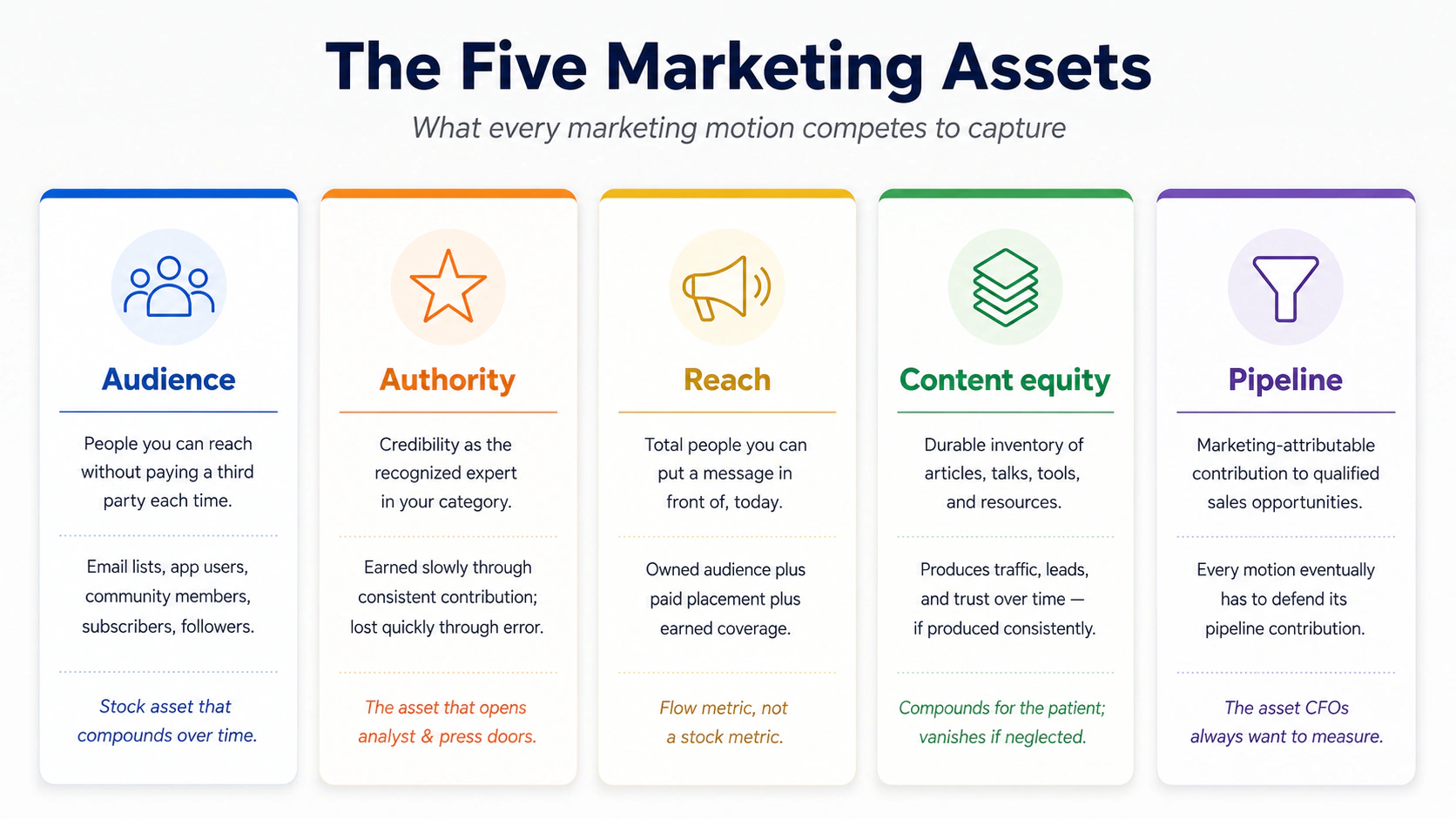
Paanch marketing assets — har motion kis cheez ko capture karne ki koshish karta hai.
Audience un logon ka set hai jinhein aap har dafa kisi third party ko pay kiye baghair reach kar sakte hain. Email lists, app users, DevRel community members, podcast subscribers, social followers, yeh sab owned audience ki shaklen hain.
Authority aapki credibility hai apni category ke recognized expert ke taur par. Authority consistent contribution se ahista earn hoti hai, aur aik single high-profile mistake se jaldi lose hoti hai.
Reach un logon ka total set hai jin ke saamne aap message rakh sakte hain, owned audience plus paid placement plus earned coverage ko combine karte hue. Reach aik flow metric hai; audience aik stock metric hai.
Content equity articles, talks, tools, aur resources ki woh durable inventory hai jo waqt ke saath traffic, leads, ya trust produce karti hai. Content equity sabar karne walon ke liye compound hoti hai; betaab logon ke liye yeh kabhi accumulate nahin hoti.
Pipeline qualified sales opportunities mein marketing-attributable contribution hai. Har motion ko aakhir mein apni pipeline contribution defend karni hoti hai, woh motions bhi jo primarily baqi chaar assets build karte hain, kyun ke aakhir mein koi CFO poochega.
Strongest motions in assets mein se teen ya zyada aik saath capture karte hain. Weakest motions aik ke liye optimize karte hain (usually pipeline) baqi ke kharch par, jo short-term win aur long-term collapse produce karta hai.
Scope par aik note. Yeh catalog primarily B2B marketing par focus karta hai: woh programs jo doosre businesses ko sell hone wale AI-native software aur services ke liye qualified sales pipeline produce karne ke liye designed hain. Consumer-facing AI marketing (mobile app stores, paid social acquisition, consumer apps ke liye brand campaigns) different rules follow karti hai aur yahan primary subject nahin, lekin teen motions, Performance Marketing, Influencer Partnerships, aur Founder Thought Leadership, dono contexts mein apply hote hain.
Maturity spectrum. Har motion ko Proven, Emerging, ya Speculative tag diya gaya hai, based on kitni AI-native companies aaj use successfully run kar rahi hain.
- Proven motions par bohat si at-scale companies operate kar rahi hain, established playbooks aur benchmarks ke saath.
- Emerging motions AI-native companies 2026 mein run kar rahi hain, lekin yeh underlying tooling ke saath rapidly evolve ho rahe hain.
- Speculative motions buyer behaviors ya platform dynamics par depend karte hain jo abhi scale par exist nahin karte.
Yeh page kis liye hai
Yeh document teen purposes serve karta hai.
Pehla, chooser ke taur par. Marketing motion design karne wala founder ya marketing leader Strategic Fit Matrix, Marketer Diagnostic, aur Motion Summary Table use karke woh motions find kar sakta hai jo uske buyer, stage, aur budget se fit hote hain.
Doosra, reference ke taur par. Existing motion run karne wali marketing team deep sections use karke apni operation audit kar sakti hai: apni funnel performance, channel mix, aur content velocity ko documented mechanics se compare karte hue.
Teesra, sequencing guide ke taur par. Most successful AI-native companies scale karte hue marketing motions ki aik sequence run karti hain. Common Hybrid Motions section sab se common sequences map karta hai.
Motion kaise choose karein
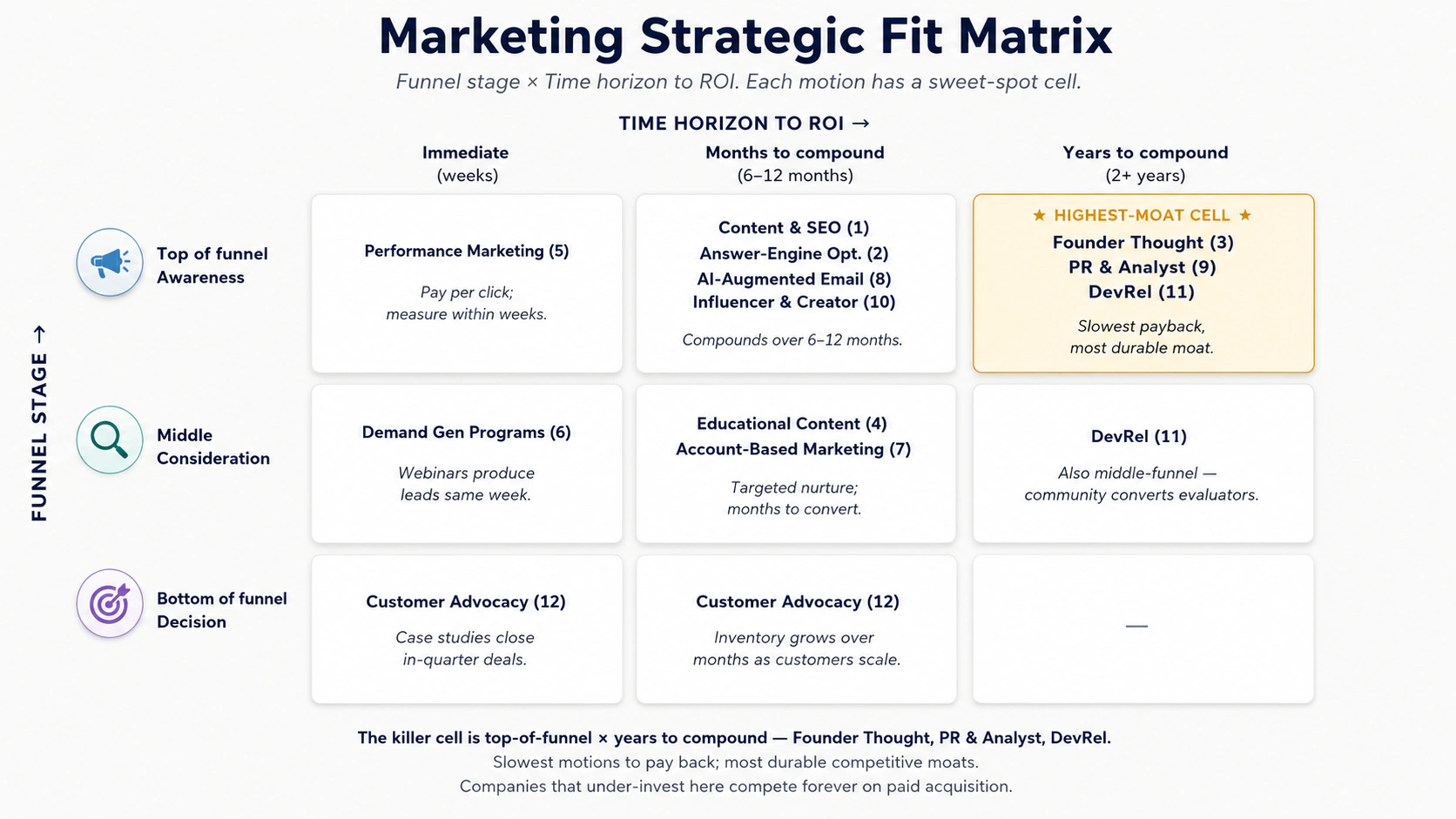
Kaun sa marketing motion fit hota hai iska cleanest predictor funnel stage aur time horizon to ROI ka intersection hai. Neeche matrix twelve motions ko in do axes par map karta hai. Har motion ka sweet-spot cell hai aur woh adjacent cells mein bhi kam optimal tareeqe se kaam karta hai.
| Time → / Funnel ↓ | Immediate (weeks) | Months to compound | Years to compound |
|---|---|---|---|
| Top of funnel (awareness) | Performance Marketing (5) | Content & SEO (1), AEO (2), AI-Email (8), Influencer (10) | Founder Thought (3), PR & Analyst (9), DevRel (11) |
| Middle (consideration) | Demand Gen (6) | Educational Content (4), ABM (7) | DevRel (11) |
| Bottom (decision) | Customer Advocacy (12) | Customer Advocacy (12) | — |
Sab se important cell top-of-funnel × years to compound hai, Founder Thought Leadership, PR & Analyst Relations, aur DevRel. Yeh woh motions hain jo sab se durable competitive moats build karte hain, lekin yeh sab se slow pay back bhi karte hain. Jo companies yahan under-invest karti hain woh hamesha paid acquisition par compete karengi aur kabhi category own nahin karengi.
Marketer diagnostic: aath sawal
Motion pick karne se pehle neeche ki eight dimensions par khud ko honestly score karein. Har row jin motions ki taraf point karti hai woh us condition ke saath sab se aligned hain. Jo team in mein se teen ya chaar par High score karti hai, woh usually jaldi do ya teen candidate motions tak narrow ho jati hai.
-
Buyer technical sophistication. Aapka primary buyer kitna technical literate hai? Developer / engineer → DevRel, Content & SEO, AEO. Operator → Educational Content, Demand Gen, ABM. Executive → PR & Analyst, ABM, Customer Advocacy.
-
Category maturity. Aapki category well-known hai, ya aap usay define kar rahe hain? Defining → Founder Thought Leadership, Content & SEO, PR & Analyst, Educational Content. Mature → Performance Marketing, ABM, Customer Advocacy.
-
Average deal size. <$10K → Content & SEO, AEO, Performance Marketing. $10–100K → AI-Email, Demand Gen, Influencer. $100K+ → ABM, PR & Analyst, Customer Advocacy.
-
Time horizon to ROI. Weeks → Performance Marketing, Demand Gen, Customer Advocacy. Months → Content & SEO, AEO, AI-Email, ABM. Years → Founder Thought Leadership, PR & Analyst, DevRel.
-
Content ke liye founder availability. Kya founder regular content (essays, podcasts, videos) produce karega? Yes → Founder Thought Leadership, Content & SEO. No → Performance Marketing, Demand Gen, ABM, Influencer.
-
Existing customer base. Kya aapke paas advocate karne ko tayar customers hain? Yes → Customer Advocacy, Educational Content. No → Pull aur Push motions jab tak aapke paas feature karne layak customers na hon.
-
Budget shape. Aapka budget logon par heavy hai ya media spend par heavy? People-heavy → Content & SEO, DevRel, PR & Analyst. Media-heavy → Performance Marketing, Demand Gen, Influencer.
-
Audience location. Kya aapka buyer specific channels ke through reachable hai? Developers (GitHub, Hacker News, X) → DevRel, Content. Executives (LinkedIn, podcasts, conferences) → Founder Thought Leadership, PR & Analyst. Mid-market operators (LinkedIn, search, email) → Performance Marketing, ABM, AI-Email.
Diagnostic yeh nahin batata ke kaun sa motion correct hai. Yeh batata hai ke aapki starting position ke mutabiq kaun se motions available hain. Oopar ki matrix aur neeche ke deep sections batate hain ke available motions mein se aapke buyer ke liye sab se sharp motion kaun sa hai.
Motion summary table
Twelve motions ke liye one-page reference.
| # | Motion | Maturity | Best for | Time to ROI | Main moat | Main risk |
|---|---|---|---|---|---|---|
| 1 | Content & SEO Marketing | Proven | Education-heavy categories | Months | Content equity, search authority | Distribution ke baghair content velocity |
| 2 | Answer-Engine Optimization | Emerging | Categories jahan buyers AI assistants se poochte hain | Months | AI-search citation rate | Cite karne layak content ke baghair optimizing |
| 3 | Founder Thought Leadership | Proven | Nayi categories jinhein education chahiye | Years | Founder authority + audience | Sporadic posting momentum kill karti hai |
| 4 | Educational Content & Certification | Proven | Categories jinhein buyer-skill development chahiye | Months | Curriculum + alumni network | Graduation funnel ke baghair content production |
| 5 | Performance Marketing | Proven | Clear LTV wali mature categories | Weeks | Channel optimization expertise | Unit economics ke baghair paid acquisition |
| 6 | Demand Generation Programs | Proven | Measurable funnel wala mid-market | Weeks–months | Nurture sequence + lead scoring | Follow-through ke baghair webinars |
| 7 | Account-Based Marketing | Proven | Six-figure-deal targets | Months | Account intelligence + personalization | Sales alignment ke baghair ABM |
| 8 | AI-Augmented Email & Outreach | Emerging | Broad mid-market reach | Months | AI tooling + deliverability | Distinction ke baghair AI-generated content |
| 9 | PR & Analyst Relations | Proven | Strategic enterprise categories | Years | Press relationships + analyst placements | Vanity coverage jo pipeline move nahin karti |
| 10 | Influencer & Creator Partnerships | Proven | Creators ke around clustered audiences | Months | Creator-of-record relationships | Creator ki audience ke saath misalignment |
| 11 | Developer Relations (DevRel) | Proven | Developer-buyer products | Years | Community + ambassadors | Product ke bajaye marketing budget ke taur par DevRel |
| 12 | Customer Advocacy & Case Studies | Proven | Existing customers wali companies | Weeks–months | Reference customers + advocacy ladder | Case studies one-offs ke taur par, pipeline nahin |
Mujhe kaun sa motion chalana chahiye?
Aik decision flowchart aapki motion choices narrow karne ke liye sab se important sawalon ko sequence karta hai. (Visual: dekhein marketing_decision_flowchart.png.)
Chaar key questions yeh hain: (1) Kya aapka buyer developer hai? (yes → DevRel + Content). (2) Kya aapki category comparable competitors ke saath mature hai? (no → Founder Thought + PR + Education; yes → Performance + ABM + Advocacy). (3) Kya aapke paas feature karne layak customers hain? (yes → Customer Advocacy abhi shuru karein; no → customers acquire karne ke liye Pull aur Push par focus karein). (4) Aapka ROI ke liye time horizon kya hai? (weeks → Performance + Demand Gen; years → DevRel + PR + Founder Thought).
Most companies do ya teen motions simultaneously run karti hain. Common combinations ke liye document ke end ke qareeb Common Hybrid Motions dekhein.
Buyer awareness aur timing
Har marketing motion ki buyer ke awareness journey mein aik window hai. Jis buyer ko abhi tak pata nahin ke uske paas problem hai, woh us buyer se different tareeqe se marketing par respond karta hai jo haath mein quotes le kar teen vendors compare kar raha hai. Eugene Schwartz ki 1966 wali Breakthrough Advertising ne buyer awareness ke foundational five stages define kiye; neeche di gayi three-stage curve uske framework ka B2B-AI adaptation hai, jo 2026 ke product marketing teams ke liye teen usable stages mein consolidate ki gayi hai.⁴
Teen stages Awareness Curve define karte hain:
Stage 1 — Unaware / Problem-Aware. Buyer ko ya to pata hi nahin ke uske paas woh problem hai jo aapka product solve karta hai, ya pata hai lekin usne actively solutions dhoondhne shuru nahin kiye. Is stage par marketing ka kaam education aur frame-setting hai: buyer ki madad karna ke woh problem ko name kare, samjhe ke woh kyun matter karti hai, aur seekhe ke kis tarah ke solution categories exist karte hain. Best motions: Founder Thought Leadership, Content & SEO, PR & Analyst, Educational Content, DevRel.
Stage 2 — Solution-Aware. Buyer actively category research kar raha hai. Woh articles parh raha hai, approaches compare kar raha hai, podcasts sun raha hai, webinars attend kar raha hai. Usne abhi vendors shortlist nahin kiye. Marketing ka kaam yeh yaqeeni banana hai ke aapka product un channels par jahan woh search karte hain repeatedly aur credibly appear ho. Best motions: Content & SEO, AEO, Educational Content, Demand Gen, Influencer Partnerships.
Stage 3 — Vendor-Aware. Buyer ne vendors shortlist kar liye hain aur unhein compare kar raha hai. Woh case studies parh raha hai, demos request kar raha hai, references check kar raha hai, pricing evaluate kar raha hai. Marketing ka kaam comparison mein friction remove karna aur woh social proof aur technical depth provide karna hai jo bake-off jeet le. Best motions: Customer Advocacy & Case Studies, ABM, PR & Analyst (specifically Gartner/Forrester-style placements), Demand Gen (late-stage technical content ke liye).
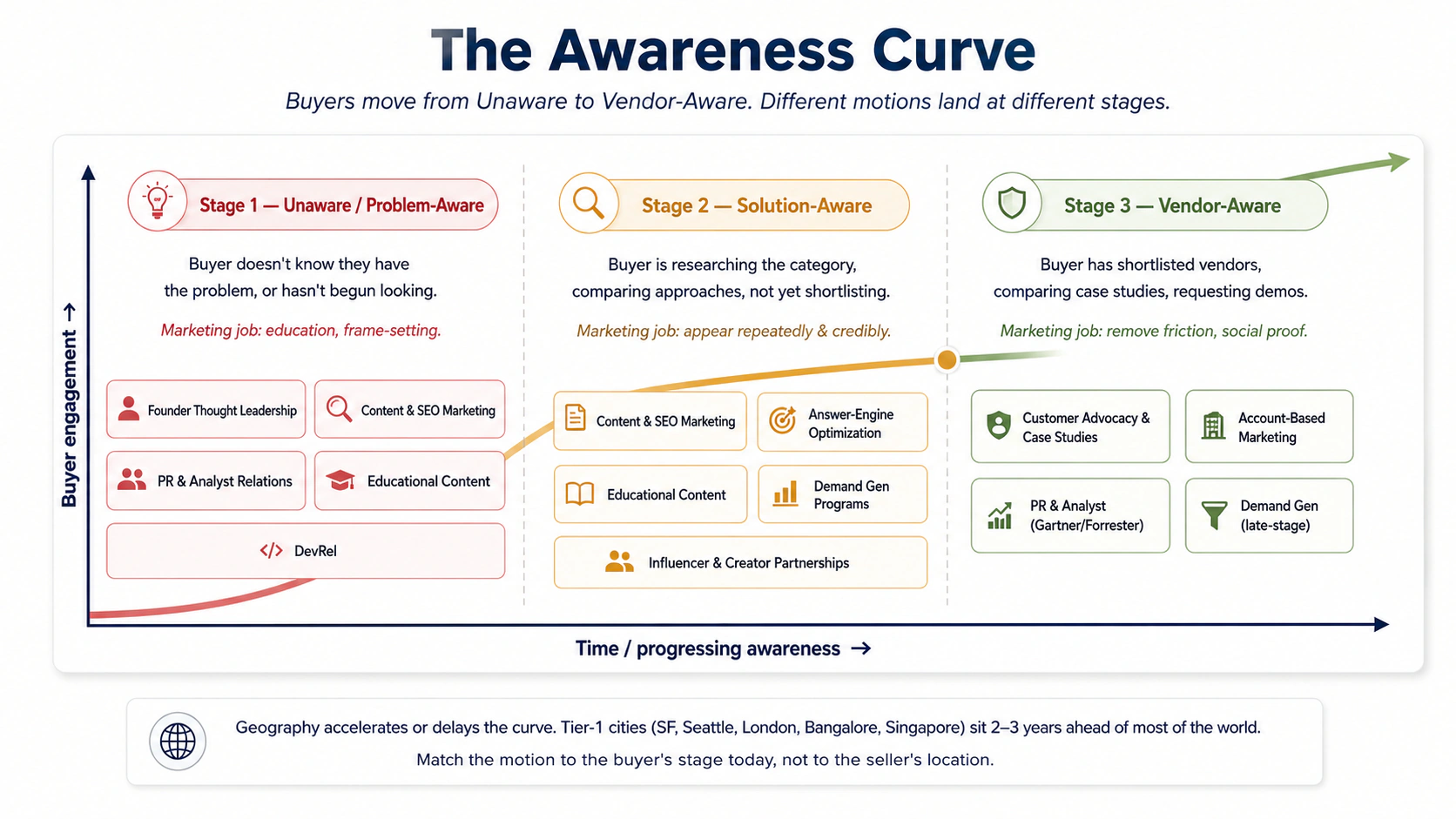
Geography curve ko accelerate ya delay karti hai. San Francisco, Seattle, Boston, New York, London, Toronto, Berlin, Bangalore, aur Singapore ki AI-native categories ke buyers usually usi category ke baqi markets ke buyers se two to three years aage hote hain, in ecosystems ke buyers AI vendors evaluate kar chuke hain, internal AI procurement playbooks likh chuke hain, aur sophisticated comparative criteria develop kar chuke hain. In markets ka buyer typically Stage 2 ya Stage 3 mein hota hai usi lamhe se jab woh aapki category ke baare mein sunta hai. Duniya ka baqi hissa, including continental Europe, Latin America, Middle East, Africa, aur Southeast Asia ke zyada enterprise buyers, solidly Stage 1 mein hai, Stage 2 ki taraf transition kar rahe hain.
Global B2B marketing ke liye implication yeh hai ke same content har market mein kaam nahin karta. Stage 3 vendor-comparison page (feature-by-feature tables aur pricing-tier breakdowns ke saath) bilkul wahi hai jo San Francisco ka buyer chahta hai aur bilkul wahi jise Sao Paulo ka buyer abhi evaluate karne ke liye ready nahin. Stage 1 educational article (category define karte hue, samjhate hue ke woh kyun matter karti hai, problem ko name karte hue) bilkul wahi hai jo Sao Paulo ke buyer ko chahiye aur bilkul wahi jise San Francisco ka buyer too basic samajh kar scroll past kar dega. Aik stage ke liye calibrated aur markets ke across targeted marketing programs doosri stage ke buyers par bure tareeqe se land karte hain.
Stage-mismatched marketing ki cost compound hoti hai. Stage 3 buyers ke liye calibrated motion (case studies, comparison content, aur ROI calculators par heavy) Stage 1 buyers par confusing land karta hai, unke paas abhi comparison interpret karne ka context nahin, aur woh bounce kar jate hain. Stage 1 buyers ke liye calibrated motion (category education aur problem-naming par heavy) Stage 3 buyers par too basic land karta hai, woh already educational stage se aage hain, aur woh content ko is signal ke taur par parhte hain ke vendor unsophisticated hai. Global B2B marketers ke liye fix yeh hai ke stage-appropriate content libraries maintain karein aur traffic ko market ke hisab se route karein: emerging markets ke liye Stage 1 educational paths, established AI markets ke liye Stage 3 comparison paths, aisi localization ke saath jo translation se aage ja kar address kare ke local buyer asal mein kya research kar raha hai.
Maturity legend
- Proven. Motion ko aaj bohat si AI-native (aur pre-AI) companies scale par operate kar rahi hain, established playbooks aur benchmarks ke saath.
- Emerging. Motion AI-native companies 2026 mein run kar rahi hain lekin yeh rapidly evolve ho raha hai, canonical playbook abhi stabilize nahin hua.
- Speculative. Motion buyer behaviors ya platform dynamics par depend karta hai jo abhi scale par exist nahin karte.
A. Pull motions
Audience discovery initiate karti hai. Marketer ka kaam us lamhe par findable, useful, aur credible hona hai jab buyer search kare. Yeh motions compound returns aur CAC efficiency mein excel karte hain lekin sabar require karte hain, most pull motions meaningful pipeline produce karne se pehle chhe se barah mahine lete hain.
Motion 1 — Content & SEO Marketing
Maturity: Proven. Beginner difficulty: Easy.
In Plain English. Aik public library imagine karein jiske front door par aik sign hai. Aap library ko books se stock karte hain, articles, guides, comparison pages, tutorials, jo aapke buyers ke poochay sawalon ka jawab dete hain. Search engines un road signs ki tarah kaam karte hain jo travelers ko aapki library tak direct karte hain. Jab koi buyer relevant sawal search karta hai, aapki library uske results mein appear hoti hai, woh andar aata hai, jo chahiye milta hai, aur waqt ke saath woh aapke brand ko answers ke saath associate karne lagta hai. Library compound hoti hai: har book jo aap add karte hain agle traveler ke aapko find karne ka chance barhati hai.
Yeh sab se purana pull motion hai aur abhi bhi sab se reliable. Bara se chaubees mahine systematic content produce karne wali AI-native companies consistently content ko apne sab se bare inbound pipeline source ke taur par report karti hain.¹
Almost har B2B AI-native company ke founding motion ke taur par best. Shuru karne mein slow; scale par rarely only motion, lekin typically woh foundation jis par baqi motions build karte hain.
Core idea. Aisa evergreen content produce karein jo buyer questions ka jawab de, search mein rank kare, aur waqt ke saath value mein compound ho.
When to use it. Hamesha, kisi bhi B2B AI-native company ke liye. Category-defining article, comparison page, "X kya hai" guide woh mechanics hain jo har successful marketing program aakhir mein produce karta hai.
Mechanism. Content marketing is liye kaam karta hai kyun ke B2B buyers apni zyada research kisi vendor se contact karne se pehle karte hain. Marcus Sheridan ne aik dahai pehle is discipline ko They Ask, You Answer mein document kiya; industry surveys including HubSpot ki annual State of Marketing reports aur Content Marketing Institute ki benchmark studies us underlying finding ko confirm karti rehti hain ke buyers sales engage karne se pehle apni majority evaluation self-directed research ke through complete kar lete hain.¹ Content layer wahi jagah hai jahan woh research hoti hai. Jo company apni category ke high-intent search results own karti hai usay pre-qualified buyers ki constant stream milti hai jo problem ke baare mein already educated aate hain.
Economics hi woh cheez hai jo motion ko durable banati hai. Aik well-produced 1,500-word article 2026 mein roughly $300–$1,500 mein produce hota hai (AI assistance se faster aur cheaper, credible domain experts se commission karne par zyada expensive). High-intent category mein aik ranking article saalon tak qualified leads produce karta hai, B2B SaaS ka typical compounding pattern dikhata hai ke content marketing CACs same buyer ke liye paid acquisition CACs se roughly aik order of magnitude neeche aate hain, though specific figures category aur channel ke hisab se widely vary karte hain. Joe Pulizzi ki Content Inc. ne owned content ko primary acquisition channel bana kar poore businesses build karne ke broader pattern ko document kiya.⁵ Article jitne mahine ranking jari rakhta hai, math har mahine behtar hoti hai.
Execution ko teen disciplines chahiye. Keyword research aapke buyer ke actual sawalon ko map karta hai, high-intent commercial queries (buyer vendors compare kar raha hai) ko informational queries (buyer category seekh raha hai) se separate karte hue. Production depth 2026 mein production volume se zyada matter karti hai, shallow content AI se commoditize ho raha hai, aur average ranking content average AI-generated competition ke volume se buried ho raha hai. Jo articles jeette hain woh woh hain jin mein original research, original data, customer quotes, ya aise arguments hon jo competitors easily replicate nahin kar sakte. Distribution content ko pure search se aage dikhata hai, har published article ko aik distribution checklist (LinkedIn post, X thread, email blast, partner inclusion, podcast mention) chahiye jo deliberately execute ho. Jo companies high-quality content produce karti hain lekin distribution neglect karti hain woh aik void mein publish karti hain.
Constraint sabar hai. Search rankings compound hone mein chhe se barah mahine lete hain; company ko weak-looking metrics ke aik lambay period ke through consistent content production fund karni hoti hai isse pehle ke trend mure. Jo founders month four par program shut kar dete hain, jab kuch hota hua nazar nahin aata, woh is motion mein sab se common failure pattern hain.
Fictional walk-through. PromptForge imagine karein, prompt engineering ke liye AI tool. Team athaarah mahine ke liye per week do long-form articles publish karne ka commit karti hai, comparison guides, tutorials, case studies. Month nine tak, "best AI prompt engineering tools" PromptForge ko top result ke taur par return karta hai. Month eighteen tak, company ko search se per month do thousand qualified leads milte hain, $50 se neeche CAC par, paid acquisition se orders of magnitude neeche.
Example. Confirmed examples: HubSpot ne content-led inbound playbook par aik multi-billion-dollar company build ki. AI-native mein, playbook reproduce ho raha hai, Anthropic ka blog, OpenAI ki research posts, aur AI-native company blogs ki long tail sab inbound funnels anchor karte hain.
Primary risk. Distribution ke baghair content velocity. Team consistently publish karti hai lekin content kisi tak nahin pahunchta. Mitigation: distribution mein roughly utni hi intensity par invest karein jitni production mein. Har published article ke liye aik distribution checklist build karein (LinkedIn post, email blast, X thread, partner inclusion, search optimization) aur usay execute karein.
Secondary risk. AI-generated content commoditization. Jaise jaise AI average content produce karne ki cost ko near zero karta hai, average content kaam karna chhor deta hai. Bar barhta hai. Mitigation: original research, original data, aur original arguments mein invest karein, woh cheezen jo AI easily generate nahin kar sakta. Customer interviews, internal data analyses, aur founder hot takes ko aise content mein repurpose karein jis ka aik defensible point of view ho.
First move. Aik search query pick karein jise aapka buyer agle mahine type karega, aapki category ka highest-intent, highest-frequency query. Us query ke liye internet ka best article likhein. Usay ruthlessly distribute karein. Agle hafte doosre highest query ke saath repeat karein.
Motion 2 — Answer-Engine Optimization (AEO)
Maturity: Emerging. Beginner difficulty: Medium.
In Plain English. Agar SEO "main Google mein kaise show up karoon?" tha, to Answer-Engine Optimization "main ChatGPT, Claude, Perplexity, aur Google ke AI Overviews mein kaise show up karoon?" hai. Jab koi buyer AI assistant se poochta hai "legal research ke liye best AI tool kya hai?", to aap chahte hain ke aapka product answer mein naam se cite ho. AEO woh practice hai jis mein aap apne content, apne brand presence, aur apne data footprint ko is tarah structure karte hain ke AI assistants aapko credible source treat karein, aur accordingly cite karein.
Yeh motion 2024 se pehle coherent form mein exist nahin karta tha. Search-result-clicks se AI-cited-answers ki taraf shift aik dahai mein B2B buyer behavior ki sab se badi tabdeeli hai, aur playbook abhi likha ja raha hai.
Content & SEO Marketing ke complement ke taur par best, AEO ka zyada hissa strong content rakhne ka downstream hai. Aik stand-alone discipline ke taur par emerging; 2026 mein teams scaled programs ke bajaye pilots run kar rahi hain.
Core idea. AI assistants ko is qabil banayein ke jab woh aapki category ke sawalon ka jawab dein to aapke brand ko cite karna chahein.
When to use it. Jab target buyer purchasing decisions lene se pehle research ke liye AI assistants use kar raha ho. 2026 tak, woh zyada B2B technical buyers aur operator buyers ka aik growing share hai. AEO AI-native companies ke liye sab se valuable hai kyun ke unke buyers already AI-fluent hain aur AI assistants natively use karte hain.
Mechanism. AEO teen vectors ke through kaam karta hai. Citation worthiness: AI assistants un sources ko cite karte hain jinhein woh credible treat karte hain, woh sources jo widely linked-to hon, well-structured hon, unique data rakhte hon, ya domain authority carry karte hon. Signals traditional SEO authority se overlap karte hain lekin meaningfully diverge bhi karte hain, AI assistants original research aur quotable claims ko sirf backlink count se zyada weight dete hain. Brand mention frequency: AI assistants training data composition se influence hote hain. Jo brands news, reviews, podcasts, aur analyst reports mein frequently appear hote hain, especially named contexts mein ("Anthropic's Claude" na ke "an AI assistant"), woh zyada cite hote hain. Yeh earned media (Motion 9) aur creator partnerships (Motion 10) ko AEO ke upstream inputs bana deta hai. Schema and structure: AI assistants aise content ko cite karna prefer karte hain jis ki clean structure, clear claims, aur verifiable facts hon. Jo pages AI parsers ko achhe parhi jaati hain, clear hierarchy, named entities, structured FAQs, original sources ke citations, woh same content wale un pages se zyada cite hote hain jo kam parseable form mein hon.
Constraint measurement hai. AEO ke paas abhi Google Search Console ka equivalent nahin, yeh track karne ka koi clean tareeqa nahin ke aapka brand AI answers mein kitni dafa cite hota hai, ya kaun se queries aapke citations trigger karte hain. 2026 mein AEO run karne wali companies proxy metrics se kaam karti hain: brand-search lifts (user ne aapke baare mein Claude se suna, phir aapko Googled kiya), self-reported attribution ("aapne hamein kaise dhoonda?"), aur dedicated AEO measurement tools (Profound, Athena, aur is category ko scratch se build karte chand competitors). SparkToro par Rand Fishkin ki research is discipline par aik leading early voice hai.²
Strategic implication yeh hai ke AEO authority ka downstream hai. Jis brand ke paas koi original research, koi analyst coverage, koi podcast presence, aur koi creator mentions nahin, uske paas AI assistants ke cite karne ke liye kuch nahin, aur koi schema optimization usay fix nahin karti. Jo teams AEO ko pure technical-SEO discipline treat karti hain (markup, structured data, page hierarchy) citable content mein upstream investment ke baghair, woh payengi ke optimization mechanics limited returns produce karte hain. Jo teams AEO jeet rahi hain woh woh hain jo original research, named data points, aur analyst-coverage cycles mein invest kar rahi hain, aur optimization work ko poore motion ke bajaye last mile treat kar rahi hain.
Fictional walk-through. LegalAgent imagine karein, aik AI legal-research tool. Team systematically apni docs, blog posts, aur product pages ko structured FAQs, clear "kya hai" definitions, aur original legal sources ke citations ke saath update karti hai. Chhe mahine baad, team prospect signups dekhna shuru karti hai jo "aapne hamein kaise dhoonda?" ka jawab dete hain "maine Claude se poocha ke M&A diligence ke liye kaun se tools use karoon aur aapka aaya." Traffic source Google Analytics ke liye invisible hai, yeh conversational hai, click-through nahin, lekin yeh real hai aur grow ho raha hai.
Example. Emerging analogues: Profound aur Athena jaisi companies AEO measurement tools build kar rahi hain. Most large content-driven SaaS companies 2026 mein AEO experiments run kar rahi hain; chand ne systematic playbooks publish kiye hain. SparkToro par Rand Fishkin ki research is discipline par aik leading early voice hai.²
Primary risk. Cite karne layak content ke baghair optimizing. AEO authority ka downstream hai, agar aapke brand ke paas aisa kuch nahin jo AI assistants cite karein, to koi optimization usay fix nahin karti. Mitigation: AEO mechanics mein invest karne se pehle original research, original data, aur original perspectives mein invest karein.
First move. Claude, ChatGPT, aur Perplexity har aik se das aise sawal poochein jo aapki category ka buyer poochega. Note karein ke aap kahan appear hote hain, competitors kahan appear hote hain, aur kahan AI koi specific brand cite nahin karta. Teesri category aapki opportunity hai.
Motion 3 — Founder Thought Leadership
Maturity: Proven. Beginner difficulty: Medium.
In Plain English. Aik aisa town imagine karein jahan sab se respected expert aik single person hai, aur woh person aisa business bhi chalata hai jo us problem ko solve karta hai jis par woh bolta hai. Poora town unhein janta hai. Jab town ko problem solve karwani hoti hai, woh by default us expert ke business ko hire karte hain. Founder Thought Leadership is dynamic ki deliberate cultivation hai. Founder essays likhta hai, podcasts par bolta hai, LinkedIn ya X par daily post karta hai, aur category ki recognized voice ban jata hai. Jo audience founder ko follow karti hai woh product ki audience ban jati hai.
2026 mein, yeh sab se cost-efficient marketing motions mein se aik hai, lekin ise aisa founder chahiye jo saalon tak consistently content produce karne ke liye willing aur able dono ho.
Kisi bhi nayi category ke founding motion ke taur par best. Aksar Content & SEO Marketing ke saath combine hota hai (founder essays SEO backbone ban jate hain) aur PR ke saath (founder authority analyst doors kholti hai).
Core idea. Company ki earned authority ko aik person, founder, mein concentrate karein, aur us person ki publishing cadence use karke aik durable audience build karein.
When to use it. Jab founder credible domain expert ho (ya ban sakta ho), jab category itni nayi ho ke kisi ko usay define karna ho, aur jab founder results judge karne se pehle kam az kam 24 mahine content produce karne ka commit karne ko tayar ho.
Mechanism. Founder thought leadership is liye kaam karta hai kyun ke B2B audiences brands se zyada logon par trust karti hain. Founder accounts usually same content par company accounts se outperform karte hain, engagement gap industry aur platform ke hisab se vary karta hai lekin consistently directional hai, founder posts company account se posted identical content se meaningfully higher reach aur engagement produce karte hain. Waqt ke saath, founder ki audience aik captive marketing channel ban jati hai jis ki per impression koi cost nahin, aur jise competitors replicate nahin kar sakte, kyun ke unke paas aapka founder nahin.
Execution ko teen disciplines chahiye: aik consistent publishing cadence (typically primary platform par minimum twice weekly, B2B operators ke liye LinkedIn, technical audiences ke liye X), aik defensible point of view (itna controversial ke discussion provoke kare, itna true ke defend ho sake), aur publicly engage karne ki willingness (comments ka jawab dena, podcasts host karna, live conversations karna). Jo founders writing ya engagement outsource karte hain woh aisa content produce karte hain jo inauthentic parha jata hai aur durable audience build karne mein fail hota hai.
Constraint founder time hai. Aik serious thought-leadership program founder se per week paanch se das ghante consume karta hai. Jo founders ise spare moments mein build karne ki koshish karte hain woh inconsistent content produce karte hain jo little audience build karta hai.
Fictional walk-through. DataSpace imagine karein, aik founder-led AI analytics company. Founder, Maria, LinkedIn par per week aik essay publish karne ka commit karti hai, analytics market ke baare mein sharp opinions, customer war stories, predictions ke category kidhar ja rahi hai. Athaarah mahine baad, uski LinkedIn following 80,000 hai. Tees mahine baad, yeh 200,000 hai. Jab DataSpace naya product launch karti hai, launch post 48 ghanton mein 10,000 demo requests drive karta hai, effectively zero CAC par.
Example. Confirmed examples: Mathilde Collin (Front), Andrew Wilkinson (Tiny), Lenny Rachitsky (Lenny's Newsletter), David Cancel (Drift), Sahil Lavingia (Gumroad). AI-native mein, Sarah Tavel (Benchmark, AI investing par) jaise founders aur kayi Anthropic aur OpenAI researchers ne aisi personal audiences build ki hain jo unki companies' (ya funds') awareness anchor karti hain.
Primary risk. Sporadic posting momentum kill karti hai. Founder week one mein teen dafa post karta hai, week two mein do dafa, week three mein aik dafa, aur phir aik mahine ke liye ruk jata hai jab company fundraising sprint par pahunchti hai. Audience growth consistency require karti hai, aur inconsistency shuru na karne se bhi buri hai. Mitigation: aik minimum cadence ka commit karein (LinkedIn par per week aik post, per month aik essay) aur usay non-negotiable treat karein. Zarurat ho to scheduling aur editing outsource karein, lekin content khud kabhi outsource na karein.
Secondary risk. Founder ki company par dependency. Agar founder chala jaye, audience uske saath chali jati hai. Mitigation: founder brand ke saath saath company brand build karein. Founder ka account company ko reference karta hai; company ka account founder ko amplify karta hai. Waqt ke saath, brand founder ki authority ka kuch hissa absorb kar leta hai.
First move. Aik platform pick karein (B2B operators ke liye LinkedIn, technical audiences ke liye X). Saath hafton ke liye per week aik post ka commit karein. Pehle chhe mahine aisa lagega ke kuch nahin ho raha; doosre chhe mahine compound honge.
Motion 4 — Educational Content & Certification
Maturity: Proven. Beginner difficulty: Medium.
In Plain English. Aisi university chalana imagine karein jahan graduates customers bhi hon. Aap courses, tutorials, aur certifications build karte hain jo logon ko unka kaam karna sikhate hain, aapki category, aapki tooling, aur aapke worldview ko foundation banate hue. Log skill seekhne ke liye aapke courses lete hain. Un mein se bohat se customers ban jate hain kyun ke aapka product wahi hai jo unhein use karna sikhaya gaya. Sab se enthusiastic khud teachers ban jate hain aur agla cohort late hain.
HubSpot ki Inbound Marketing certification, Salesforce ka Trailhead, aur Stripe ka Atlas sab is motion ke instances hain. Educational content company ka sab se bara top-of-funnel channel ban jata hai.
Aik mid-stage motion ke taur par best jab company ke paas product-market fit aur curriculum mein invest karne ke resources hon. Defined skill teach karne se pehle shuru karna mushkil hai. Aksar Content & SEO Marketing ke upar layer hota hai (educational content search traffic draw karta hai).
Core idea. Apni category ke liye credentialing system build karein, woh jagah jahan practitioners skill seekhte hain, aur usay aik lifelong customer acquisition channel ke taur par use karein.
When to use it. Jab category ko aisi practitioner skill chahiye jo buyers ko develop karni hogi, jab company ke paas curriculum design mein invest karne ke resources hon (aik serious certification program 6–12 mahine ka build hai), aur jab addressable practitioner population itni large ho ke investment justify ho (typically 100,000+ active practitioners).
Mechanism. Educational content teen compounding effects ke through kaam karta hai. Top-of-funnel acquisition: log "X kaise karein" search karte hain aur aapka course paate hain; course practitioners ki constant stream produce karta hai jo skill aapke worldview mein seekhte hain. Trust and dependency: graduates apne baqi careers ke liye aapki terminology, frameworks, aur tooling preferences use karte hain, jiska matlab hai ke hiring authority tak pahunch kar woh aapke product par default karte hain. Network effects: graduates next-cohort students ko teach karte hain, meetups par present karte hain, blog posts likhte hain, aur peers ko certification recommend karte hain, free mein, kyun ke woh us credential mein emotionally invested hain jo unhone earn kiya.
Economics is liye kaam karti hain kyun ke curriculum reusable hai. First cohort produce karne mein sab se zyada cost aati hai, typically aik serious certification program ke liye $50K–$300K, jo content development, video production, assessment design, aur platform infrastructure cover karti hai. Subsequent cohorts near-zero marginal cost par chalte hain. Jo programs certification ko per learner $200–$2,000 par price karte hain woh apne aap mein meaningful revenue centers ban sakte hain (HubSpot Academy, Salesforce Trailhead, aur Snowflake University sab apni marketing-funnel value se aage direct revenue generate karte hain), aur free certifications bhi compounding marketing ROI produce karte hain jaise jaise alumni base saal dar saal grow hoti hai.
Constraint curriculum quality hai. Educational content ko genuinely useful hona hota hai warna woh aise koi graduates produce nahin karta jo rakhne layak hon, aur worse, woh aise graduates produce karta hai jo aapke product ke khilaf advocate karte hain kyun ke certification ne real skill development deliver nahin ki. Jo companies thin certifications ship karti hain unhein temporary marketing bump aur long-term reputation hit milti hai; jo companies genuinely high-quality curriculum mein invest karti hain unhein aik alumni base milta hai jo aik dahai tak brand ko compound karta hai. Right comparison academic credentials se hai, whitepapers se nahin, bar yeh hai ke "kya koi hiring manager ise resume par actually weigh karega?"
Fictional walk-through. PromptCert imagine karein, aik AI-native company jo AI Engineering Certification offer karti hai. Team aik free 12-hour curriculum build karti hai jo prompt engineering, evaluation design, aur agent architecture cover karta hai, aik $200 paid certification exam ke saath. Year one mein, 50,000 practitioners free curriculum complete karte hain aur 8,000 certification ke liye pay karte hain. Year two mein, certified practitioners apni LinkedIn profiles par "PromptCert Certified" list karte hain, advocates unofficial study groups teach karte hain, aur PromptCert AI engineering hires ke liye de facto credential ban jati hai. Certification marketing hona chhor kar infrastructure ban jati hai.
Example. Confirmed examples: HubSpot Academy, Salesforce Trailhead, Google Skillshop, Snowflake University. AI-native mein: DeepLearning.AI, the Anthropic Academy (2026 tak development mein), aur kayi Cohere/Mistral practitioner programs.
Primary risk. Graduation funnel ke baghair content production. Company courses build karti hai, lekin courses product ya sales motion se connect nahin hote, graduates customers bane baghair chale jate hain. Mitigation: curriculum ko product ke saath practical exercises ka hissa bana kar design karein. Graduates ko course ke end tak product (free tier ya trial mein) use kar raha hona chahiye.
First move. Aik skill pick karein jo aapki category ke practitioners ko genuinely seekhni hai. Us skill par best free course build karein. First cohort woh proof hai ke curriculum ko aage build karna worth hai.
B. Push motions
Marketer relationship initiate karta hai. Marketer ka kaam precise targeting, message-channel fit, aur conversion-rate discipline hai. Yeh motions predictability aur immediate ROI mein excel karte hain lekin ongoing budget require karte hain, yeh pull motions ki tarah compound nahin hote.
Motion 5 — Performance Marketing
Maturity: Proven. Beginner difficulty: Medium.
In Plain English. Per click attention rent karna imagine karein. Performance marketing Google, LinkedIn, Meta, TikTok, YouTube, aur emerging AI-search ad platforms par paid advertising hai. Aap placement ke liye bid karte hain, platform aapka ad apne users ke aik targeted slice ko dikhata hai, aur aap per impression ya per click pay karte hain. Motion tab kaam karta hai jab aapki unit economics clear hon, jab aap jante hain ke aik click aapke liye kitni worth hai aur accordingly bid kar sakte hain.
2026 mein, AI performance marketing ko dramatically reshape kar raha hai. Generative ad creative ad variants produce karne ki cost ko collapse kar rahi hai. AI-augmented bid optimization spend efficiency improve kar rahi hai. Aur AI-driven targeting LinkedIn, Meta, aur Google ke audience tools ko zyada precise bana rahi hai.
Clear LTV aur short sales cycles wali mature categories ke primary motion ke taur par best. Newer categories mein doosre motions ke complement ke taur par best. Scale par rarely only motion.
Core idea. Targeted attention scale par buy karein, lifetime value ke relative mein per acquired customer cost ki disciplined measurement ke saath.
When to use it. Jab category itni mature ho ke buyers high intent ke saath search kar rahe hon, jab unit economics clear hon (aap jante hain ke aik acquired customer kitni worth hai), aur jab team ke paas attribution accurately measure karne ki analytics maturity ho.
Mechanism. Performance marketing is liye kaam karta hai kyun ke platforms (Google, LinkedIn, Meta, TikTok) ke paas duniya ka sab se valuable targeting data hai. Google janta hai ke log kya actively search kar rahe hain. LinkedIn janta hai ke woh kahan kaam karte hain, kya karte hain, aur kitne senior hain. Meta unke interests, behaviors, aur life events janta hai. Advertiser woh targeting rent karta hai aur targeted attention ko traffic, leads, ya sales mein convert karta hai. Unit economics teen variables par depend karti hai: bid efficiency (per click ya per impression cost), conversion rate (clicks ka kaun sa fraction leads ya customers banta hai), aur lifetime value.
Math ko motion safely scale hone ke liye teen thresholds clear karne hote hain. LTV/CAC > 3, lifetime customer value ka fully-loaded acquisition cost se ratio, standard B2B SaaS benchmark hai; 3 se neeche, jab payback periods, retention, aur discount rates factor karte hain to program paisa lose karta hai. CAC payback under 18 months cash ko pre-revenue cohorts mein trap hone se bachata hai. Cohort LTV empirically validated, modeled nahin, projected nahin, spend scale karne se pehle. Performance marketing mein sab se common failure pattern optimistic LTV projections par spend scale karna hai jo cohort eventually deliver nahin karta.
Execution disciplines creative iteration, attribution modeling, aur channel diversification hain. Creative iteration 2026 mein pehle se dramatically asaan hai, generative AI ne most formats ke liye ad variants produce karne ki cost 90%+ collapse kar di hai, aur jin teams ne adapt kar liya woh per channel dozens creative variants run karti hain us mutthi bhar ke bajaye jo pehle feasible thi. Constraint production capacity se creative judgment par shift ho gaya hai: yeh jaanna ke kaun se variants testing worth hain. Attribution modeling matter karta hai kyun ke channels interdependent hain, aik buyer aksar aik Performance Marketing ad dekhta hai, phir PR mein brand encounter karta hai, phir aik content piece ke baad sign up karta hai, aur single-touch attribution jo bhi channel last hota hai usay credit deti hai. Channel diversification ka matlab comparable unit economics ke saath kam az kam teen channels hai; single channel par dependent companies platform policy changes, algorithm updates, aur CPC inflation ke exposed hain. B2B SaaS mein paid acquisition costs pichle paanch saalon mein most channels aur categories ke across meaningfully barhi hain; jo companies paid-only acquisition strategy build karti hain woh us compounding margin pressure ka indefinitely saamna karengi.
Fictional walk-through. SyncFlow imagine karein, aik $50/month AI productivity tool. Team "AI scheduling assistant" aur "calendar AI" jaise terms par Google Ads chalati hai. Woh per click $4 pay karte hain; 2% clicks free-trial signups mein convert hote hain; 15% free trials paid mein convert hote hain. CAC per customer $130 hai, $600 LTV ke against. Math kaam karti hai, team barah mahine mein spend $10K/month se $200K/month tak scale karti hai. Month eighteen tak, paid CAC $180 tak creep ho jata hai (zyada competitors bidding) aur team apna blended CAC kam karne ke liye Content & SEO build karna shuru karti hai.
Example. Confirmed pattern: Almost har B2B SaaS company Performance Marketing run karti hai. AI-native mein, Performance Marketing self-serve products (Cursor, Linear, Notion AI, Perplexity Pro) aur category leaders (OpenAI ki brand campaigns, Microsoft Copilot) ke liye sab se zyada visible hai. Most enterprise AI vendors specific demand-gen campaigns support karne ke liye chhote performance programs run karte hain.
Primary risk. Unit economics ke baghair paid acquisition. Team spend scale karti hai bina confirm kiye ke acquired customers asal mein woh LTV generate karte hain jo model ne assume kiya. Chhe mahine baad, LTV calculations optimistic thin aur unit economics negative hain. Mitigation: spend tab tak roak ke rakhein jab tak cohort LTV empirically confirm na ho. Scale tab karein jab math verified ho, projected nahin.
Secondary risk. Channel concentration. Single channel (Google, LinkedIn) par dependent companies platform policy changes, algorithm updates, aur CPC inflation ke exposed hain. Mitigation: comparable unit economics ke saath kam az kam teen channels par diversify karein.
First move. Us channel par jahan aapka buyer most likely hai (high-intent search ke liye Google; B2B targeting ke liye LinkedIn) aik $5,000 test chalayein. CAC aur conversion rates rigorously measure karein. Scale sirf tab karein jab math kaam kare.
Motion 6 — Demand Generation Programs
Maturity: Proven. Beginner difficulty: Medium.
In Plain English. Apne prospective customers ke liye aik party throw karna imagine karein, sivaye iske ke admission ki price unka email address hai. Demand Generation programs webinars, virtual conferences, white papers, eBooks, gated reports, aur doosra "isay access karne ke liye mujhe apni contact info dein" content hain. Exchange straightforward hai: aik contact ke liye useful content, phir aik nurture sequence jo contact ko sales conversation ki taraf warm karti hai.
Yeh motion pandrah saal se B2B SaaS marketing ka workhorse raha hai. Mechanics well-established hain aur playbook mature hai. AI production economics change kar raha hai, gated content generate karna pehle se dramatically cheaper hai, lekin underlying motion unchanged hai.
Measurable funnels wale mid-market ke primary motion ke taur par best. Almost hamesha Performance Marketing (gated asset ka paid promotion) aur ABM (lead pool ko input ke taur par use karte hue) ke saath combine hota hai.
Core idea. Contact information ke liye useful content trade karein, phir systematic nurture ke through contacts ko pipeline mein convert karein.
When to use it. Jab buyer ka purchase cycle multi-month ho (taake nurture ke paas kaam karne ka waqt ho), jab team ke paas marketing automation infrastructure ho (HubSpot, Marketo, Pardot, ya modern AI-native equivalents), aur jab team high-quality gated assets produce karne mein invest karne ko tayar ho.
Mechanism. Demand gen aik three-stage funnel ke through kaam karta hai jo us cheez par built hai jise Seth Godin ne originally permission dynamic naam diya, buyer voluntarily opt in karta hai content ke liye contact information trade kar ke, aur woh opt-in license aage aane wali har cheez ki basis ban jata hai.⁶ Acquisition: paid ads ya organic distribution traffic ko aik landing page par drive karte hain jahan users content ke liye contact info exchange karte hain. Nurture: contact emails, retargeting ads, aur personalized content ki aik sequence mein enter karta hai jo usay awareness curve ke through move karne ke liye designed hai. Sales handoff: jab contact aik behavioral threshold (multiple downloads, repeated visits, calendar request) tak pahunchta hai, usay aik qualified lead ke taur par sales ki taraf route kiya jata hai.
Funnel economics har stage par conversion rates par depend karti hain. Typical mid-market B2B demand-gen programs paid traffic ka 1–5% gated-content downloads mein convert hote dekhte hain, un leads ka 5–15% nurture sequences ke saath meaningfully engage karta hai, aur engaged leads ka 5–10% sales-qualified opportunities mein convert hota hai. Multiplied through, overall paid-traffic-to-pipeline conversion rate typically 0.05–0.5% hai, yani aik gated asset ke paid promotion ko aik qualified opportunity generate karne ke liye thousands of impressions produce karne hote hain. Disciplined lead scoring aur tight nurture sequences wale programs in ranges ke higher end par operate karte hain; us discipline ke baghair programs lower end par operate karte hain aur meaningful return ke baghair budget burn karte hain.
Doosri constraint content quality aur freshness hai. Gated asset ko genuinely useful hona hota hai, warna lead warmed ke bajaye angry hota hai. Aur opt-in permission decay hoti hai, jis lead ne nau mahine pehle aapka white paper download kiya aur tab se engage nahin kiya woh ab warm lead nahin, chahe woh aapki list par rahe. Successful programs leads ko aik perishable asset treat karte hain: active list ko fresh content ke saath quarterly re-engage karte hue, inactive segment ko deliverability bachane ke liye suppress karte hue, aur per quarter aik ya do flagship assets produce karte hue na ke kayi shallow. Jo programs email list ko aik durable inventory treat karte hain (do saal pehle ke leads ko same nurture sequence bhejte hue) woh deliverability collapse, engagement decline, aur pipeline contribution erode hote dekhte hain.
Fictional walk-through. FinanceAI imagine karein, FP&A teams ke liye aik AI tool. Team aik 40-page report produce karti hai, "The State of FP&A Automation in 2026", aik email form ke peeche gated. Woh isay Performance Marketing, partner emails, aur PR ke through promote karte hain. Chhe hafton mein, woh 8,000 contacts capture karte hain. Un mein se, 1,200 aik 12-week nurture sequence mein enter karte hain. Un mein se, 80 sales meetings book karte hain. Un mein se, 25 average $30K ACV par customers ke taur par close hote hain. Program $750K pipeline produce karta hai, roughly $1,200 ke CAC par.
Example. Confirmed examples: Gartner ki annual reports, HubSpot ki State of Marketing report, Salesforce ki State of Sales report. AI-native mein: Anthropic ki Economic Index reports, OpenAI ki research publications, company-published industry reports ki long tail.
Primary risk. Follow-through ke baghair webinars. Team webinar chalati hai, leads capture karti hai, aur kabhi systematically follow up nahin karti. Leads thande ho jate hain, kabhi pipeline nahin bante. Mitigation: asset produce karne se pehle nurture sequence design karein. Asset funnel ka start hai; nurture funnel hai.
First move. Apne target buyer ka highest-stakes sawal identify karein (typically category benchmarks, ROI, ya implementation ke baare mein). Us sawal ka sab se thorough jawab aik 30-page report ke taur par produce karein. Usay gate karein; promote karein; leads ko nurture karein.
Motion 7 — Account-Based Marketing (ABM)
Maturity: Proven. Beginner difficulty: Medium.
In Plain English. Marketing ko broad fishing ke bajaye targeted hunting imagine karein. Aik wide net daalne ke bajaye, aap pachaas se do sau specific companies pick karte hain jinhein aap sab se zyada customers ke taur par chahte hain. Phir aap har aik ke liye marketing ka har piece personalize karte hain, unke logo ke saath custom landing pages, ads jo unki industry mention karte hain, unke CEO ke naam ke saath direct mail, woh shows jo woh sunte hain un par podcast sponsorships. Goal yeh hai ke aik tightly defined target list ke liye, right tareeqe se, ignore karna naamumkin ho jaye.
ABM woh marketing motion hai jo Enterprise Field Sales (Sales Catalog Motion 7) ke saath sab se zyada aligned hai. Marketing aur sales aik saath same target list par kaam karte hain, marketing awareness aur warmth create karti hai; sales close karti hai.³
Limited target accounts ke saath six-figure-plus deals target karne wali companies ke primary motion ke taur par best. Hamesha Enterprise Field Sales ke saath combine hota hai, sales alignment ke baghair ABM waste hai.
Core idea. Marketing spend aur personalization ko named accounts ki aik finite list par concentrate karein, sales ke saath tight coordination mein.
When to use it. Jab average deal size itni large ho ke per-account personalization justify ho (typically $100K+ ACV), jab target buyer universe chhota ho (typically 1,000 se kam named accounts), aur jab team ke paas named accounts ke against execute karne ki marketing-sales coordination discipline ho.
Mechanism. ABM teen coordinated tracks ke through kaam karta hai. Awareness: har target account kisi bhi sales conversation se pehle mahinon tak consistently branded ads (LinkedIn, IP-targeted display, podcast) dekhta hai. Personalization: jab sales engage karti hai, buyer already brand encounter kar chuka hai, messaging unki specific industry/use case se fit hai, aur jo marketing assets sales bhejti hai woh account ke liye pre-customized hain. Joint orchestration: marketing aur sales named accounts par weekly milte hain, intelligence share karte hain, aur touches coordinate karte hain.
Constraint sales-marketing alignment hai. Aligned sales execution ke baghair ABM bas expensive marketing hai. Jo companies ABM achhi tarah run karti hain unke paas aik single shared list, weekly account reviews, aur tight feedback loops hote hain; jo poorly run karti hain unke paas marketing un accounts ke liye personalize kar rahi hoti hai jinhein sales actively pursue nahin kar rahi.
Fictional walk-through. ClaimsAI imagine karein, insurance carriers ke liye aik AI tool. Marketing team aur sales team 75 target carriers par agree karti hain. Marketing chhe mahine mein $300K kharch karti hai carrier-specific LinkedIn ads chala kar, executive teams ko direct mail bhej kar, industry podcasts sponsor kar ke, aur carrier-specific case studies ke saath custom landing pages produce kar ke. Sales ABM-aligned outbound chalati hai. Nau mahine baad, 75 mein se 22 carriers sales ke saath engage ho chuke hain; 8 active evaluation mein hain; 3 average $850K ACV par close hote hain. Program $2.5M ARR produce karta hai, roughly $100K ke CAC par, absolute terms mein high lekin deal size ke liye excellent.
Example. Confirmed examples: ABM playbook Sangram Vajre aur doosron ki kitabon mein documented hai.³ AI-native mein: most enterprise AI vendors (Glean, Harvey, Sierra, Writer) apne largest target accounts ke liye ABM motions run karte hain.
Primary risk. Sales alignment ke baghair ABM. Marketing 200 accounts ke liye personalize karti hai; sales 50 pursue kar rahi hai; baqi 150 follow-up ke baghair expensive ad campaigns receive kar rahe hain. Mitigation: named-account list shared hai aur weekly review hoti hai. Agar sales account pursue nahin kar rahi, marketing spend pull kar leti hai.
Secondary risk. Personalization theater. Team "personalized" landing pages produce karti hai jo bas aik generic template par account ka logo swap kar deti hain. Buyers notice karte hain; personalization laziness signal karti hai. Mitigation: genuine personalization mein invest karein, custom case studies, account-specific use-case writing, executive-name direct mail. Agar aap real personalization resource nahin kar sakte, to kam accounts chalayein.
First move. Woh 25 accounts identify karein jinhein aap sab se zyada customers ke taur par chahte hain. Sales ko list par brief karein. Marketing aur sales touches ko aik saath map karte hue aik six-month coordinated awareness campaign chalayein.
Motion 8 — AI-Augmented Email & Outreach
Maturity: Emerging. Beginner difficulty: Medium.
In Plain English. Aisi library chalana imagine karein jahan har subscriber ko thora different newsletter milta hai, specifically uske liye likha, is base par ke usne pehle kya parha, kis ki parwah karta hai, aur buying cycle mein kahan hai. AI-Augmented Email & Outreach AI agents use karta hai taake outbound communications scale par draft, personalize, aur time hon. Newsletters personalized ho jate hain. Drip campaigns adaptive ho jati hain. Cold outreach hyper-targeted ho jata hai. Jo kaam historically email marketers ki armies require karta tha woh ab AI augmentation ke saath chhoti teams karti hain.
Yeh Sales Catalog ke AI-Augmented Outbound (Motion 6) ka marketing-side cousin hai. Dono personalized communication scale karne ke liye AI use karte hain; marketing version attention aur engagement target karta hai, sales version meetings target karta hai.
Most doosre motions ke complement ke taur par best. Rarely aik stand-alone motion; almost hamesha Content & SEO, Demand Gen, ABM, ya Performance Marketing ke upar layer hota hai.
Core idea. AI agents use karein taake email, newsletters, aur digital outreach ko us se aage personalize aur scale karein jo human marketing teams produce kar sakti hain.
When to use it. Jab team ke paas meaningful email list ho (10,000+ contacts) ya active outbound program ho, jab team ke paas AI ke prompts aur segmentation instrument aur tune karne ki marketing-operations maturity ho, aur jab brand high-volume AI-generated communication ke deliverability aur quality risks survive kar sake.
Mechanism. AI-augmented email is liye kaam karta hai kyun ke traditional email marketing mein limiting factor hamesha personalization aur scale ke darmiyan trade-off thi. Humans per day dozens contacts ko deeply personalized emails likh sakte the; AI agents thousands ko personalized emails likh sakte hain. Constraint production volume se distinctiveness par shift hoti hai, jab AI poori industry mein simultaneously millions personalized emails generate kar raha hai, to "valuable" email kya count hoti hai uska bar sharply barhta hai. AI-generated outreach par trained recipients usay pehchanna aur ignore karna seekh lete hain; channel un senders ke liye decay hota hai jo barhti signal-detection ability ka compensate nahin karte.
Execution ko teen disciplines chahiye jo AI augmentation se pehle exist nahin karti thin. Prompt design, AI ki draft quality prompt se bounded hai; jo teams prompt engineering mein aik marketing-operations function ke taur par invest karti hain (testing, version-controlling, aur agents ko drive karne wale prompts refine karte hue) woh AI ko black-box "yeh generate karo" function treat karne wali teams se dramatically behtar output produce karti hain. Segmentation depth, AI personalization well-defined segments par sab se effective hai; "yeh email sab ke liye personalize karo" generic-feeling output produce karta hai, jab ke "yeh email un fintech VPs of engineering ke liye personalize karo jo 200–500 employees wali companies mein hain aur jinhone hamara last white paper download kiya" tight, contextual messaging produce karta hai. Human-in-the-loop quality control, higher-stakes communications (named-account executives ke liye ABM emails, reference accounts ke liye customer-marketing outreach) ke liye, send se pehle aik human ka review karna aur point-of-view, opinion, ya personal context inject karna wahi cheez hai jo AI-augmented ko AI-replaced se separate karti hai.
Doosri constraint deliverability infrastructure hai. High-volume AI-augmented email ESP penalties, spam classification, aur domain reputation damage trigger kar sakta hai jise repair karne mein mahine lagte hain. Jo teams AI-augmented email scale karti hain unhein proper authentication (SPF, DKIM, DMARC), list hygiene (inactive contacts ki regular suppression), aur segmented sender domains chahiye (taake aik program mein deliverability problem company ki poori email infrastructure poison na kare). "Faster scale" karne ke liye deliverability work skip karna AI-augmented email programs ke apne doosre saal mein collapse hone ki sab se common reason hai.
Fictional walk-through. GrowthCRM imagine karein, aik B2B sales-tools company jiske paas 50,000-contact email list hai. Team AI agents use karti hai taake saat different buyer segments ke liye tailored weekly newsletter content generate ho, sirf subject-line personalization nahin balkay content-personalization. Open rates 18% se 31% tak charh jate hain; click rates 1.4% se 3.9% tak. Newsletter company ka sab se bara single pipeline source ban jata hai, qualified inbound ka 30% produce karte hue.
Example. Emerging analogues: Lavender, Smartlead, Hyperbound jaisi companies aur AI-native sales-and-marketing tools ki long tail AI-augmented email ko productize kar rahi hain. Substantial email lists wale most AI-native vendors 2026 mein AI augmentation ki koi na koi shakl run karte hain.
Primary risk. Distinction ke baghair AI-generated content. Har company email draft karne ke liye AI use kar rahi hai; recipients AI-generated outreach pehchanna aur ignore karna seekh lete hain; channel decay hota hai. Mitigation: AI ko research aur first-draft generation ke liye use karein, lekin humans ko point-of-view, opinion, aur personal context inject karne dein. AI kaam karta hai; human spark add karta hai.
Secondary risk. Deliverability collapse. High-volume AI-augmented email ESP penalties, spam classification, aur domain reputation damage trigger kar sakta hai. Mitigation: volume scale karne se pehle deliverability infrastructure mein invest karein (proper authentication, list hygiene, segmented sender domains).
First move. Aik existing email program (newsletter, drip campaign, nurture sequence) lein aur 30 din ke liye aik AI-augmented variant chalayein. Performance ko baseline ke against measure karein. Augmentation sirf wahan scale karein jahan woh materially outperform kare.
C. Earned motions
Third parties marketer ka message amplify karti hain. Marketer ka kaam relationship management hai: journalists, analysts, podcasters, aur creators ke liye aapko feature karna aur achhe tareeqe se karna asaan banana. Yeh motions build hone mein slow hote hain lekin aise durable trust assets produce karte hain jo paid motions replicate nahin kar sakte.
Motion 9 — PR & Analyst Relations
Maturity: Proven. Beginner difficulty: Advanced.
In Plain English. Doosre logon ka build kiya trust borrow karna imagine karein. PR aur Analyst Relations woh discipline hai jis mein aap apne buyer ke already trusted sources se third-party coverage earn karte hain, tier-1 business aur trade press (Wall Street Journal, Bloomberg, TechCrunch, industry trade publications), analyst firms (Forrester, Gartner, IDC, 451 Research), aur increasingly podcast aur conference circuit. Jab koi buyer aapke baare mein aisi publication mein parhta hai jo woh har subah parhta hai, woh mention aisa trust weight carry karta hai jo aapki apni marketing match nahin kar sakti.
Yeh marketing motions mein sab se slow hai aur woh jise quarterly numbers ke betaab founders sab se zyada neglect karte hain. Yeh woh motion bhi hai jo sab se zyada woh moments produce karta hai jo company ki trajectory badal dete hain, woh analyst report jo aapko Gartner ke Magic Quadrant par land karti hai, woh press placement jo aik inbound flood trigger karti hai, woh conference keynote jo signal karta hai ke aap aa gaye hain.
Strategic enterprise customers target karne wali kisi bhi company mein aik long-term investment ke taur par best. Compound hone mein slow; short term mein rarely measurable pipeline produce karta hai; long term mein extremely valuable.
Core idea. Aisi third-party media mein placements earn karein jise aapka buyer already trust karta hai, aur un placements ko compounding brand authority mein convert karein.
When to use it. Jab buyer enterprise ho (jahan analyst reports aur tier-1 press procurement ke liye matter karte hain), jab company ke paas batane ke liye aik credible story ho, aur jab team ke paas measurable returns se pehle aik 12–24 month investment cycle ka sabar ho.
Mechanism. PR aur analyst relations teen vectors ke through kaam karte hain. Press relationships: journalists un sources ko cover karte hain jin par woh trust karte hain; trust saalon mein consistent, useful, accurate communication ke through build hota hai. Analyst placements: Forrester, Gartner, aur IDC category reports (Magic Quadrants, Waves, MarketScapes) produce karte hain jinhein procurement organizations shortlist filters ke taur par use karti hain; in reports mein place hone ke liye meaningful customer references, scale, aur analysts ke saath aik years-long relationship chahiye. Speaking and conference circuit: industry conferences (TechCrunch Disrupt, SaaStr Annual, AWS re:Invent, NeurIPS) keynote slots aur panels produce karti hain jinhein audience members baad mein yaad rakhte hain; in slots ke liye aik credible story aur conference organizers ka network chahiye.
Constraint waqt hai. Analyst placements typically 18–36 mahine ki relationship-building require karti hain. Tier-1 publications mein press coverage ke liye journalists ko source par trust develop karna hota hai, jisme saal lagte hain. Conference slots speaking circuit ke through gradually build hote hain. Jo founders decide karte hain ke unhein "agle mahine" PR chahiye, woh usually disappointed hote hain.
Fictional walk-through. SecureAI imagine karein, aik AI security company. CMO aik 24-month PR aur analyst program ka commit karta hai. Woh Gartner aur Forrester analysts ko quarterly brief karte hain, customer references share karte hain, aur research inquiries ka jawab dete hain. Woh enterprise security cover karne wale 8 tier-1 journalists ke saath relationships develop karte hain. Woh founder ko 30 podcasts aur 6 conference keynotes par book karte hain. Athaarah mahine baad, SecureAI Gartner se "Cool Vendor" named hoti hai. Chaubees mahine baad, woh aik Forrester Wave mein "Strong Performer" ke taur par appear hoti hai. Placements 200+ inbound enterprise inquiries produce karti hain, aur un inquiries se jo deals close hoti hain woh company ki history ki sab se badi hain.
Example. Confirmed examples: Almost har major enterprise software company analyst relations mein heavily invest karti hai. AI-native mein: Anthropic, OpenAI, Cohere, aur Glean jaisi companies ke paas substantial analyst-relations programs hain. Tier-1 press coverage uneven hai, kuch AI-native companies (OpenAI, Anthropic) constantly cover hoti hain; doosron ko placements ke liye mehnat karni padti hai.
Primary risk. Vanity coverage jo pipeline move nahin karti. Team ko aik TechCrunch article milta hai jo internally widely share hota hai lekin koi measurable pipeline impact produce nahin karta. Mitigation: track karein ke kaun se press placements inbound inquiries produce karte hain (UTM-tracked links, brand-search lifts, sales conversations mein mentions). Un placements ke liye optimize karein jo pipeline needle move karte hain, un ke liye nahin jo board decks mein achhe lagte hain.
Secondary risk. Negative coverage. PR bidirectional hai; wahi journalists jo favorable coverage likhte hain unfavorable coverage bhi likh sakte hain. Mitigation: genuine relationships aur genuine transparency mein invest karein. Negative coverage ke khilaf sab se zyada resistant companies woh hain jinhone waqt ke saath honesty ke through trust build kiya.
First move. Woh teen analysts identify karein jo aapki category mein purchasing ko sab se zyada influence karte hain. Unhein quarterly brief karein. Results judge karne se pehle do saal relationship build karein.
Motion 10 — Influencer & Creator Partnerships
Maturity: Proven. Beginner difficulty: Medium.
In Plain English. Aik audience borrow karna imagine karein jo kisi aur ne already build ki hai. Influencer aur Creator Partnerships un logon ke saath deals hain jo already aapke target buyer se attention command karte hain, B2B mein LinkedIn voices, technical categories mein YouTube creators, apni niches mein X personalities. Deal paid ho sakti hai (sponsored posts, paid integrations) ya organic (creators ko honest coverage ke badle early access dena). Kisi bhi tarah, aap audience-building ke saal skip karte hain aur partnership ki duration ke liye audience rent karte hain.
Yeh motion pichle paanch saalon mein B2C marketing se B2B mein migrate hua hai. Aik specific niche mein 30,000 LinkedIn followers wale creators ab us niche ki AI-native companies ke liye meaningful marketing channels hain.
Doosre motions ke complement ke taur par best. Scale par rarely primary motion, lekin specific funnel gaps bharne aur aisi audiences reach karne mein consistently effective jo paid channels nahin kar sakte.
Core idea. Un creators ko pay ya partner karein jin ke paas already aapke buyer ki attention hai; audience build karne ke bajaye rent karein.
When to use it. Jab aapka target buyer specific creators ke through reachable ho (most technical categories ke liye true, niche mein almost hamesha koi YouTube creator ya LinkedIn voice hota hai), jab deal economics per-creator partnership costs support karein (typically B2B ke liye per partnership $5K–$50K), aur jab team ke paas attribution properly measure karne ki discipline ho.
Mechanism. Creator partnerships is liye kaam karti hain kyun ke audiences un creators par jinhein woh saalon se follow karte hain un brands se zyada trust karti hain jinhein woh abhi encounter karte hain. Aik creator ki tutorial video mein aik 90-second integration, jise buyer weekly dekhta hai, same message wale paid ad se dramatically higher conversion produce karta hai. Constraint creator-audience fit hai: partnership tabhi kaam karti hai jab creator ki audience aapke buyer se overlap kare.
Execution ko teen disciplines chahiye: genuine audience-fit wale creators identify karna (follower count aik vanity metric hai; engagement aur audience-quality woh hain jo matter karte hain), aisi partnerships structure karna jo creator aur brand incentives align karein (pure paid sponsorships aksar inauthentic content produce karti hain; revenue-share ya affiliate models behtar outcomes produce karte hain), aur creator autonomy ka ehtraam karna (jo creators managed mehsoos karte hain woh aisa content produce karte hain jise unki audience managed ke taur par detect kar leti hai).
Fictional walk-through. DevAI imagine karein, software developers ke liye aik AI tool. Team developer-tools niche mein 20 YouTube creators identify karti hai jin ki audiences 50K se 500K subscribers ke darmiyan hain. Woh un mein se 8 ke saath per integration $10K–$25K par paid integration deals strike karte hain. Aath mein se chhe integrations land karti hain, yani creator ki audience meaningful rates par free signups mein convert hoti hai. Team un chhe ke saath relationships scale karti hai jinhone kaam kiya, un do ko drop karti hai jinhone nahin kiya, aur chhe mahine ke andar channel se $400K monthly self-serve revenue produce karti hai.
Example. Confirmed pattern: 2026 mein B2B AI mein, creator partnerships dev-tools mein visible hain (Cursor, Linear, Cline se sponsored YouTube creators), creator-economy AI tools mein (video aur image AI ke liye TikTok aur YouTube partnerships), aur finance/analytics AI mein (finance categories mein LinkedIn voices aur Substack writers).
Primary risk. Creator ki audience ke saath misalignment. Partnership aisa content produce karti hai jis ke saath creator ki audience engage nahin karti, ya is liye ke product unke interests se fit nahin karta, ya is liye ke integration forced lagti hai. Mitigation: scale karne se pehle aik ya do creators ke saath test karein. Integrated content par engagement dekhein, sirf total reach nahin.
First move. Apni category mein paanch creators identify karein jin ki audience aapke buyer se sab se zyada overlap karti hai. Approach karne se pehle do hafte unka content watch/read karein. Aik generic sponsorship pitch ke bajaye aik specific integration idea ke saath reach out karein.
D. Community motions
Aapki existing audience aapki future audience grow karti hai. Marketer ka kaam advocacy se friction remove karna aur multi-year horizons par community-building mein invest karna hai. Yeh motions sab se defensible moats produce karte hain lekin aisa sabar aur authenticity require karte hain jo doosre motions demand nahin karte.
Motion 11 — Developer Relations (DevRel)
Maturity: Proven. Beginner difficulty: Advanced.
In Plain English. Aik clubhouse build karna imagine karein jahan developers hang out karna chahte hain. DevRel woh discipline hai jis mein aap technical content, sample apps, hackathons, ambassador programs, documentation, sandboxes, aur community events ke through developer trust earn karte hain. Goal yeh hai ke aapki category, aur aapka product, us space mein build karne wale developers ke liye natural starting point ban jaye. Jab developer community decide karti hai ke kaun se tools matter karte hain, aapke tools is liye nahin jeette ke marketing ki gayi balkay is liye ke community ne khud decide kiya.
DevRel developer buyers target karne wali kisi bhi AI-native company ke liye sab se important marketing motion hai. AI infrastructure (model APIs, agent frameworks, eval tools, deployment platforms) developers buy karte hain aur buying decision heavily community signal se influence hoti hai. Jo companies DevRel jeett ti hain woh typically apni developer category dominate karti hain; jo DevRel ignore karti hain woh typically usay lose karti hain.
Kisi bhi developer-buyer product ke primary motion ke taur par best. Ise early staff hona chahiye, ideally product widely available hone se pehle, kyun ke developer communities build hone mein saal lagte hain.
Core idea. Woh technical community build karein jis par practitioners trust karte hain, aur apne product ko us space mein build karne wale community members ke liye natural choice banayein.
When to use it. Jab buyer developer ya technical practitioner ho, jab company ke paas genuinely useful technical content (sample apps, integrations, technical guides) ship karne ki engineering depth ho, aur jab team ke paas aik multi-year community-building investment ka sabar ho.
Mechanism. DevRel teen compounding effects ke through kaam karta hai. Trust through technical authenticity: developers ki marketing fluff ke liye low tolerance hai; DevRel content ko technically accurate aur useful hona hota hai warna woh backlash produce karta hai. Community advocacy: jo developers aapka product use karte hain aur aapki team se respected mehsoos karte hain woh usay peers ko recommend karenge, jo aisi growth produce karta hai jo paid acquisition replicate nahin kar sakti. Ambassador effects: aik chhoti tadaad high-credibility developers (5–50) community signal ka aik disproportionate share drive karte hain; un relationships mein invest karna compound returns produce karta hai.
Execution ko teen disciplines chahiye: aise developer-relations engineers hire karein jo technically credible hon (former practitioners, pure marketers nahin), genuinely useful technical content mein invest karein (sample apps, working code, deep guides, surface-level tutorials nahin), aur community ko aik product treat karein (community ki needs hain jinhein serve karna hota hai; unhein achhe tareeqe se serve karna wahi cheez hai jo trust build karti hai).
Constraint DevRel ko product investment ke bajaye marketing budget treat karna hai. Jo companies DevRel ko marketing budget se staff karti hain (aur usay cost-per-lead optimization treat karti hain) woh consistently fail hoti hain; jo companies DevRel ko product budget se staff karti hain (aur usay aik long-term moat treat karti hain) woh consistently jeett ti hain.
Fictional walk-through. AgentKit imagine karein, aik AI agent framework. Team company ke pehle saal mein teen DevRel engineers hire karti hai. Woh produce karte hain: 18 mahine mein 50+ sample apps, 12,000 active members wala aik public Discord, 50,000 monthly listeners wala aik podcast, aur 3,000 attendees wali aik quarterly developer conference. Year three tak, AgentKit teen specific verticals mein AI agents ke liye de facto framework hai. Paper par behtar products wale competitors usay dislodge nahin kar sakte kyun ke community ka mindshare AgentKit ke paas hai.
Example. Confirmed examples: Stripe ki developer-relations aur documentation canonical exemplar hain. AI-native mein: LangChain ki community, OpenAI ka developer ecosystem, Anthropic ke developer programs, Hugging Face ki community, Modal ki developer-first marketing.
Primary risk. Product budget ke bajaye marketing budget ke taur par DevRel. Function traditional marketers se staff hota hai jin ke KPIs lead generation ke around hain; developer community mahinon mein inauthenticity detect kar leti hai aur disengage ho jati hai. Mitigation: DevRel ko engineering-credible logon se staff karein (former practitioners, ideally prior community-building experience ke saath), unhein marketing KPIs ke bajaye product-team-aligned KPIs dein (community growth, sample-app downloads, ambassador retention).
Secondary risk. Community backlash. Aik misjudged announcement, aik perceived bait-and-switch, ya aik poorly handled outage aisa backlash produce kar sakta hai jo saalon tak community trust ko damage kare. Mitigation: community-management discipline mein invest karein. Pehle suno; honestly respond karo; jab mistakes karo to unhein publicly admit karo.
First move. Aik developer-relations engineer hire karein jiski genuine technical credibility ho. Unhein aik excellent sample app ship karwayein aur aik community event host karwayein. Jo signal aap bhej rahe hain woh yeh hai ke community matter karti hai.
Motion 12 — Customer Advocacy & Case Studies
Maturity: Proven. Beginner difficulty: Easy.
In Plain English. Apne existing customers ko apni sales force banana imagine karein. Customer Advocacy & Case Studies woh systematic practice hai jis mein aap happy customers ko marketing assets mein convert karte hain, case studies, testimonials, customer-led webinars, peer recommendations, advocacy programs, referral programs. Late-stage buyers kisi bhi vendor se zyada doosre customers par trust karte hain. Aik well-run advocacy program most companies ka highest-converting marketing asset hai.
Yeh motion early-stage companies ke liye sab se kam available hai (advocate karne ke liye aapko customers chahiye) aur mid-to-late-stage companies ke liye sab se powerful. Jab aapke paas 50+ happy customers ho jate hain, advocacy aapke chalaye ja sakne wale pipeline ka sab se sasta aur sab se credible source ban jati hai.
Aik primary late-stage motion ke taur par best jab company ke paas 50+ happy customers hon. Most doosre motions ke muqablay execute karna asaan; specialized skills ke bajaye consistent operational discipline require karta hai.
Core idea. Customer success ko systematic case-study production, testimonials, aur advocacy programs ke through marketing inventory mein convert karein.
When to use it. Jab company ke paas kam az kam 25 happy customers hon jo referenced hone ko tayar hon, jab team ke paas case studies systematically produce karne ki operational capacity ho (one-offs ke taur par nahin), aur jab sales motion aisi ho jahan social proof matter karta ho (essentially cautious buyers target karne wali koi bhi B2B motion).
Mechanism. Customer advocacy teen vectors ke through kaam karti hai. Case studies: systematically produce ki gayi (ideally per month aik), woh bottom-of-funnel content library bharti hain jo deals close karti hai. Reference customers: late-stage buyers hamesha poochte hain "aur kis ne yeh implement kiya hai?", willing customers ke saath aik structured reference program hona sales cycles ko meaningfully chhota karta hai. Advocacy programs: jo customers valued mehsoos karte hain (community access, advisory boards, advance product previews, named recognition ke through) woh unpaid evangelists ban jate hain jo peers ko refer karte hain, events par bolte hain, aur aapke product ke baare mein LinkedIn posts likhte hain.
Constraint operational discipline hai. Most companies case studies one-offs ke taur par produce karti hain jab bhi koi customer volunteer kar de. Jo companies advocacy mein jeett ti hain woh usay aik function treat karti hain: unke paas aik case-study production pipeline hai (target per month aik), aik reference-customer program (managed list, regular outreach), aur aik advocacy ladder (pehle chhote touches, waqt ke saath bare asks).
Fictional walk-through. RetailAI imagine karein, retail merchandisers ke liye aik AI tool. Team aik customer marketing manager hire karti hai aur per month aik case study produce karne ka commit karti hai. 12 mahine baad, unke paas 12 case studies hain, different industries, deal sizes, aur use cases cover karte hue. Woh 30 willing customers ke saath aik reference-customer program bhi build karte hain. Sales cycles 20% chhote ho jate hain (kyun ke ab har prospect evaluation ke dauran relevant case studies dekhta hai). Advocacy-sourced referrals new pipeline ka 25% produce karte hain. Advocacy-sourced deals ki CAC paid acquisition ki roughly one-tenth hai.
Example. Confirmed pattern: Almost har B2B SaaS company customer advocacy ki koi na koi shakl run karti hai. AI-native mein: Glean, Harvey, Sierra, aur Writer sab ke paas customer-marketing programs hain jo systematically case studies produce karte hain. Anthropic ki Customer Stories aur OpenAI ki Case Studies public examples hain.
Primary risk. Case studies one-offs ke taur par, pipeline nahin. Team aik case study tab produce karti hai jab koi customer volunteer kar de, jiska matlab hai per year barah ke bajaye teen case studies. Mitigation: customer marketing ka aik single owner hire (ya assign) karein jiska KPI case-study velocity ho. Case-study production ko aik quarterly metric treat karein.
First move. Apne teen most-successful customers identify karein. Har aik se unke results ke baare mein 30-minute conversation maangein. 60 din ke andar teen short case studies (har aik 1–2 pages, hard ROI numbers ke saath) produce karein. Pipeline wahin se shuru hoti hai.
Cross-cutting concepts
Kuch concepts motions ke across appear hote hain aur unhein har dafa repeat karne ke bajaye aik dafa define karna deserve karte hain.
Attribution and multi-touch journeys. B2B buyers typically sales-qualified lead banne se pehle 7–15 touchpoints ke saath interact karte hain. Aik single buyer aik blog post parh sakta hai (Motion 1), aik LinkedIn ad dekh sakta hai (Motion 5), aik webinar download kar sakta hai (Motion 6), aik creator partnership encounter kar sakta hai (Motion 10), aur aakhirkaar aik peer recommendation ke baad sign up kar sakta hai (Motion 12). Single-touch attribution (sirf last interaction count karte hue) systematically pull aur earned motions ko underweight karti hai; multi-touch attribution (journey ke across credit distribute karte hue) zyada accurate hai lekin operationalize karna mushkil. Jo companies attribution mein under-invest karti hain woh most measurable channels (Performance Marketing) ko over-fund aur most compounding wale (Founder Thought Leadership, DevRel, PR) ko under-fund kar deti hain.
The owned/earned/paid framework. Aik foundational marketing taxonomy. Owned media woh hai jo aap control karte hain (aapki website, email list, app, community). Earned media woh hai jo doosre aapko dete hain (press, analyst reports, organic mentions). Paid media woh hai jo aap rent karte hain (advertising). Sab se healthy marketing programs teenon ko blend karte hain; paid par over-reliant programs ke margin problems hote hain; owned par over-reliant programs ke reach problems hote hain; earned par over-reliant programs ke predictability problems hote hain.
Brand vs. demand-gen tension. Brand marketing long-term recognition aur trust build karti hai; demand-gen marketing near-term qualified leads produce karti hai. Dono har marketing org mein budget ke liye compete karte hain. Pure-demand-gen programs aik ceiling par hit karte hain, jab aap actively search karne wale buyers harvest kar lete hain, growth tab tak stall hoti hai jab tak brand investment addressable audience expand na kare. Pure-brand programs unaccountable hote hain, woh aisi awareness generate karte hain jise koi prove nahin kar sakta ke pipeline mein translate hoti hai. Sab se healthy programs budget roughly 60/40 demand-gen aur brand mein split karte hain, accept karte hain ke brand half imprecisely measure hoga, aur multi-year horizons par brand investment ke compounding effects samet te hain. Woh upstream investment jo brand work ko compound karwati hai woh sharp positioning hai, April Dunford ki Obviously Awesome us discipline ki canonical reference hai jis mein marketing channels on karne se pehle positioning right karna hota hai jin par woh channels depend karte hain.⁷
The MarTech stack. Woh infrastructure jo 2026 mein marketing chalati hai typically include karti hai: aik CRM (Salesforce, HubSpot, ya AI-native equivalent), aik marketing automation platform (HubSpot, Marketo, Pardot), aik attribution / analytics stack (Google Analytics 4, Segment, aik AI-native attribution tool), aik ad-platform aggregator (Google Ads, LinkedIn Ads, Meta Ads), aik email-deliverability stack (SendGrid, Postmark, Mailgun), aik content management system (company website), aur increasingly aik AI-augmented content production stack (LLM tools, image generation, video generation). Jo companies MarTech mein underinvested hain woh apne motions andhere mein chalati hain; jo companies MarTech mein over-invested hain woh aisa software buy karti hain jise woh kabhi operate nahin karti.
Creative production economics in the AI era. AI se pehle, aik high-quality ad creative (aik 30-second video, aik custom landing page, aik polished image set) produce karne mein thousands of dollars lagte the aur outside agencies ya staff designers chahiye the. 2026 mein, generative AI ne kayi formats ke liye un costs ko 90%+ collapse kar diya hai. Result: ad-variant testing quarterly se weekly ho gayi hai; landing-page personalization account level par feasible hai; video creative ab high-budget campaigns ke liye reserved nahin. Jin companies ne adapt kiya woh un companies se dramatically zyada creative tests run karti hain jinhone nahin kiya, aur natijatan tezi se seekhti hain. Constraint creative production capacity se creative judgment par shift ho gaya hai: yeh jaanna ke kaun sa variant testing worth hai.
Content velocity vs. content quality. Aik persistent debate. Velocity argument: search aur social surface area maximize karne ke liye high volume content produce karein. Quality argument: kam, deeper pieces produce karein jo commoditize karna mushkil hon. 2026 mein, AI average content produce karne ki cost ko near zero karte hue, quality argument decisively jeet raha hai. Average content ab kaam nahin karta, woh AI-generated competition ke volume mein buried ho jata hai. Original research, original data, aur original perspectives abhi bhi kaam karte hain. Implication: most teams ko apna publishing volume kam karna chahiye aur per-piece investment barhani chahiye.
AI har motion ko kya change karta hai
Marketing un disciplines mein se aik hai jise 2024–2026 ki AI shift ne sab se zyada dramatically reshape kiya. Is catalog ke har motion ke across paanch changes recur karte hain aur explicit naming deserve karte hain.
1. Infinite scale par AI-generated content. Har motion jo content produce karta hai (Motions 1, 2, 3, 4, 8, 9, 12) is haqiqat se reshape hota hai ke AI ab articles, emails, posts, aur case studies near-zero marginal cost par generate kar sakta hai. Result paradoxical hai: content production kabhi itni asaan nahin thi, lekin content distinction kabhi itni mushkil nahin thi. Kya kaam karta hai uska bar sharply barh gaya hai, AI-generated average content buried ho jata hai; original research, original data, aur original perspectives abhi bhi cut through karte hain. 2026 mein marketing teams kam, deeper pieces kar rahi hain aur aggressively "AI-generated middle of the road" reject kar rahi hain.
2. AEO SEO ko nayi search frontier ke taur par replace kar raha hai. Aik dahai mein pehli dafa, dominant search interface change ho raha hai. Buyers increasingly search queries type karne ke bajaye AI assistants (ChatGPT, Claude, Perplexity, Google AI Overviews) se poochte hain. Har Pull motion ko adapt karna hai. SEO mara nahin, search engines abhi bhi traffic drive karte hain, lekin AI assistants ke through hone wali buyer research ka share tezi se grow ho raha hai. Purely Google rankings ke liye optimized motions slow erosion dekhenge; AI assistants mein citation-worthiness ke liye optimized motions gain karenge.
3. AI-augmented buyer evaluation. Buyers ab kisi bhi human conversation se pehle websites summarize karne, vendors compare karne, aur shortlist karne ke liye AI assistants use karte hain. Aik buyer Claude se pooch sakta hai "AI customer service ke liye Sierra aur Decagon compare karo" aur seconds mein aik structured comparison paa sakta hai, jo aapke public content, aapke competitors ke public content, aur analyst reports se produce hota hai. Jo motions ise ignore karte hain woh aik structural disadvantage par hain. Implication: har public surface (website, docs, case studies, press releases) ko is tarah likha jaana chahiye ke AI assistants usay accurately summarize kar saken. Agar aapki website par koi clear "hum kya karte hain" page nahin, to AI assistants vendor comparisons mein aapko skip kar denge.
4. Near-zero creative cost par generative ads. Performance marketing (Motion 5), demand gen (Motion 6), aur ABM (Motion 7) sab AI-generated ad creative se reshape hote hain. Jo team pehle per month 5 ad variants produce karti thi woh ab 50 produce kar sakti hai. Jin teams ne adapt kiya woh dramatically zyada creative tests run kar rahi hain, tezi se seekh rahi hain, aur pre-AI production economics par stuck teams se outperform kar rahi hain. Jo skill scarcity value gain kar rahi hai woh creative judgment hai, yeh jaanna ke kaun se variants testing worth hain.
5. Naya role: AI Marketing Engineer. 2026 mein marketing team ke paas aik naya function hai, engineers (pure marketers nahin) jo AI-augmented marketing stack build aur maintain karte hain. Woh content-production agents ke liye prompts likhte hain, AI-personalized email ke liye segmentation pipelines build karte hain, AI-search citations ke liye attribution measurement instrument karte hain, aur woh agent infrastructure operate karte hain jo AI-augmented motions power karti hai. Yeh role Sales Catalog mein AI Outcome Engineer ke parallel hai. Is ke baghair marketing organizations AI-augmented motions andhere mein chalati hain; is wale organizations ke paas aik meaningful operational advantage hai.
Common hybrid motions
Oopar ki twelve motions discrete archetypes ke taur par present ki gayi hain, lekin most successful AI-native companies isolation mein aik single motion nahin chalati. Woh do, teen, ya chaar coordinated combination mein chalati hain, aur company mature hone ke saath unhein deliberately sequence karti hain. Paanch sab se common hybrid combinations:
Content & SEO (1) → DevRel (11). Aik company developers ko sell karti hai. Woh developer queries target karte hue content marketing aur SEO se shuru karti hai, tutorials, comparison pages, technical guides. Jaise audience grow hoti hai, content motion aik community seed karta hai: aik Discord channel, aik newsletter, sample apps. 18–24 mahine ke andar, content motion ambassadors, hackathons, aur community events ke saath aik full DevRel motion mein evolve ho jata hai. Transition gradual hai aur dono motions aik doosre ko indefinitely reinforce karte hain. Almost har successful developer-tooling company ne is hybrid ka aik version chalaya hai.
Founder Thought Leadership (3) → PR & Analyst Relations (9). Aik founder consistent essays aur podcast appearances ke through aik category mein personal authority build karta hai. Earned reputation woh doors kholti hai jo institutional PR nahin kar sakti, analysts calls return karte hain, journalists briefs par follow up karte hain, conference organizers keynotes ke liye invite karte hain. 24–36 mahine ke dauran, founder ka personal brand category-defining institutional credibility mein transition karta hai. Founder visible voice rehta hai lekin company brand authority absorb kar leta hai.
Performance Marketing (5) → Demand Gen (6). Aik team paid acquisition (Google Ads, LinkedIn Ads) se shuru karti hai aur discover karti hai ke cold paid traffic ko directly paid customers mein convert karne ki poor unit economics hain. Woh evolve ho kar paid media ko gated content par traffic drive karne, emails capture karne, aur email sequences ke through nurture karne ke liye use karti hai. Performance Marketing aik stand-alone conversion motion ke bajaye demand-gen funnel ka front ban jata hai. CACs typically is transition ke through 30–50% improve hote hain.
ABM (7) → Customer Advocacy (12). Aik company aik tightly defined named-account list ke against ABM chalati hai. Jo accounts close hote hain woh customer advocacy ke cornerstone ban jate hain, case studies, reference customers, advocacy program members. Marketing phir agle ABM cycle mein advocacy assets use karti hai, similar accounts ko similar accounts ke succeed hone ke proof ke saath target karte hue. Dono motions aik doosre ko feed karte hain: ABM customers produce karta hai; customer advocacy agle ABM cycle ke selling materials produce karti hai.
Educational Content (4) → Customer Advocacy (12). Aik company aik educational content / certification program chalati hai. Program ke graduates customers ban jate hain; jo customers graduate karte hain woh advocates ban jate hain. Educational content funnel ka top bharta hai; advocacy bottom bharti hai; company beech mein trusted infrastructure ke taur par baithti hai jo dono ko connect karti hai. Salesforce Trailhead canonical exemplar hai, aik program jo annually tens of thousands certified practitioners produce karta hai, jin mein se bohat se customers aur evangelists dono ban jate hain.
Yeh hybrids unique configurations nahin. Most successful AI-native companies in mein se aik ya zyada ka aik recognizable variant chalati hain. Galti multiple motions chalana nahin; galti unhein aik coordinated system ke bajaye disconnected functions ke taur par chalana hai.
Common motion failures
Is catalog ke motions aise recipes ke taur par present kiye gaye hain jo kaam karte hain. Har aik ke fail hone ka bhi aik characteristic tareeqa hai, motion ke galat hone se nahin, balkay team ke usay incorrectly run karne se. Gyarah failure patterns itni baar appear hote hain ke naming deserve karte hain. Jo marketing leader inhein apni operation mein pehchan le woh unhein fix kar sakta hai; jo nahin pehchanta woh usi tarah lose karta rahega.
Distribution ke baghair content velocity. Team consistently publish karti hai lekin content kisi tak nahin pahunchta. Production ko kaam treat kiya jata hai; distribution ko afterthought. Fix yeh hai ke distribution mein roughly utni hi intensity par invest karein jitni production mein. Har article ke liye, aik distribution checklist build karein, LinkedIn post, email blast, X thread, partner inclusion, search optimization, podcast outreach, aur usay execute karein.
Unit economics ke baghair Performance Marketing. Team paid spend scale karti hai bina confirm kiye ke acquired customers asal mein woh LTV generate karte hain jo model ne assume kiya. Chhe mahine baad, LTV calculations optimistic thin aur unit economics deeply negative hain. Fix yeh hai ke spend tab tak roak ke rakhein jab tak cohort LTV empirically confirm na ho. Scale tab karein jab math verified ho, projected nahin.
Sales alignment ke baghair ABM. Marketing 200 named accounts ke liye campaigns personalize karti hai; sales 50 actively pursue kar rahi hai; baqi 150 follow-up ke baghair expensive ad campaigns receive kar rahe hain. Fix yeh hai ke aik single shared list jo weekly review hoti hai. Agar sales account pursue nahin kar rahi, marketing spend pull kar leti hai.
Product investment ke bajaye marketing budget ke taur par DevRel. Function marketing se staff hota hai jis ke KPIs lead generation ke around hain; developer community mahinon mein inauthenticity detect kar leti hai aur disengage ho jati hai. Fix yeh hai ke DevRel ko product budget se engineering-credible logon se staff karein, aise KPIs ke saath jo community-building ko reward karein (sample-app downloads, ambassador retention, Discord engagement) na ke pure pipeline.
Consistency ke baghair Founder Thought Leadership. Founder week one mein teen dafa post karta hai, week two mein do dafa, week three mein aik dafa, aur fundraising hit hone par aik mahine ke liye ruk jata hai. Audience growth consistency require karti hai, aur inconsistency shuru na karne se buri hai. Fix yeh hai ke aik non-negotiable minimum cadence (LinkedIn par per week aik post, per month aik essay) jise aik permanent commitment treat kiya jaye, project nahin.
Content moat ke baghair AEO. Team AI-search citation ke liye optimize karti hai lekin uske paas cite karne layak content nahin. AEO authority ka downstream hai, agar aapke brand ke paas aisa kuch nahin jo AI assistants authoritative paayein, to optimization mechanics usay nahin bacha sakte. Fix yeh hai ke AEO mechanics mein invest karne se pehle original research, original data, aur original perspectives mein invest karein.
Vanity PR coverage jo pipeline move nahin karti. Team ko aik TechCrunch article, aik Wired profile, ya aik Bloomberg mention milta hai. Coverage internally share hoti hai, board decks mein screenshot hoti hai, aur koi measurable pipeline impact produce nahin karti. Fix yeh hai ke track karein ke kaun se placements inbound produce karte hain (UTM-tracked links, brand-search lifts, sales conversations mein mentions) aur un placements ke liye optimize karein jo needle move karte hain, un ke liye nahin jo board decks mein achhe lagte hain.
Case studies one-offs ke taur par, pipeline nahin. Team aik case study sirf tab produce karti hai jab koi customer volunteer kar de, jiska matlab hai per year barah ke bajaye teen case studies. Fix yeh hai ke customer marketing ka aik single owner jiska KPI case-study velocity ho. Case-study production ko aik quarterly target treat karein, aik ad-hoc activity nahin.
Brand-vs-demand-gen budget war. Marketing organizations spend ko brand investments (long-term, measure karna mushkil) aur demand-gen investments (short-term, measure karna asaan) ke darmiyan split karti hain. Jab budget pressure hit hoti hai, typically aik slow quarter ya bure ja chuke board meeting ke baad, demand-gen camp jeett ta hai kyun ke woh attribution numbers se khud ko defend kar sakta hai; brand camp lose karta hai kyun ke woh nahin kar sakta. Multiple cycles ke dauran, brand budget zero tak cut ho jata hai aur company khud ko bina kisi compounding awareness asset ke entirely paid acquisition par compete karte huye paati hai. Fix yeh hai ke marketing budget ka aik fixed percentage brand investment ke liye aik non-negotiable ke taur par commit karein, jo sirf long-term cohort data aur executive sponsorship se defensible ho, quarterly attribution se nahin.
Marketing-sales handoff failures. Marketing un volume par leads produce karti hai jo funnel-math demand karti hai. Sales unhein "unqualified" ke taur par reject karti hai aur different leads demand karti hai. Marketing qualification tighten karti hai, lead volume girta hai, sales pipeline ki complain karti hai. Cycle repeat hota hai. Operational symptom ke neeche aik misalignment hai ke qualified lead kya count hoti hai, marketing ki apni definition hai (typically behavioral: paper download kiya, webinar attend kiya), sales ki apni hai (typically demographic plus active need). Fix yeh hai ke aik single shared MQL/SQL definition jo dono functions co-own karte hain, quarterly review hoti hai, dono sides separate KPIs ke bajaye same conversion-rate target ke accountable hote hue.
Founder-vs-CMO authority conflict. Aik founder jo teen-plus saal personally marketing chala chuka hai (Founder Thought Leadership aur Content & SEO motions use karte hue) marketing function scale karne ke liye aik CMO hire karta hai. CMO professionalize karna chahta hai, Performance Marketing, ABM, MarTech infrastructure, formal demand-gen programs add karte hue. Founder un motions par push back karta hai jo "corporate" ya off-brand lagte hain; CMO woh playbook execute nahin kar sakta jiske liye usay hire kiya gaya. Barah mahine ke andar CMO chala jata hai aur company doosra hire karti hai, cycle repeat karte hue. Fix yeh hai ke hire se pehle aik explicit conversation karein ke founder kaun se motions own karte rehna chahta hai (typically Founder Thought Leadership aur strategic narrative) aur kaun se motions par CMO ka full authority hai (typically demand-gen, performance marketing, MarTech, customer marketing). Us explicit boundary ke baghair, conflict structural hai.
AI-native marketing anti-patterns
Oopar ka Common Motion Failures section universal failure modes describe karta hai, woh operational aur cultural traps jo kisi bhi motion chalane wali kisi bhi marketing team ko shikast deti hain. AI era aik separate category ke traps introduce karta hai: woh failures jo AI products market karne wali, AI-augmented marketing tools use karne wali, ya AI-saturated channels mein operate karne wali companies ke liye specific hain. Paanch anti-patterns itni baar recur karte hain ke naming deserve karte hain.
Scale par generic AI content. Team AI generation ko aik content distinction problem ke bajaye aik content production capability treat karti hai. Woh articles, posts, aur emails ka aik high volume ship karte hain, jin ka zyada hissa baqi har us cheez jaisa lagta hai jo AI poori industry mein produce kar raha hai. Content technically theek hai; woh invisible bhi hai. Fix yeh hai ke AI-generated content ko aik draft layer treat karein jise distinct banne ke liye human investment chahiye: original research, original data, customer quotes, founder opinion, specific context. AI structural kaam karta hai; human distinguishing signal add karta hai. Jo teams us human investment ke baghair AI-generated content ship karti hain woh aik aise void mein volume par publish kar rahi hain jo har quarter louder hota jata hai.
Point-of-view ke baghair AI-generated outreach. Recipients ne AI-generated outbound detect karna seekh liya hai, woh safe-vanilla phrasing, woh over-personalized opener jo aik generic ask par pivot karta hai, woh predictable structure. Jo signal missing hai woh personalization nahin balkay opinion hai, aik specific point of view, aik unexpected observation, recipient ne jo asal mein kaha ya kiya us par aik real reaction. AI in mein se kisi ko bhi technically produce kar sakta hai; practice mein, prompts safe-vanilla par collapse ho jate hain kyun ke explicit instruction ke baghair model usi par default karta hai. Fix yeh hai ke ya to send se pehle humans AI drafts mein opinion inject karein, ya accept karein ke AI-generated outreach ab aik low-conversion channel hai aur volume scale karne ke bajaye usay kam karein.
Virality ko demand samajhna. Aik founder X par post karta hai, post viral ho jati hai (50,000 likes, 5 million impressions), aur team conclude karti hai ke marketing kaam kar rahi hai. Post 12 demo requests aur zero closed deals produce karta hai. Virality B2B mein aik vanity metric hai, yeh brand awareness se loosely correlate karta hai aur pipeline se bilkul nahin. Fix yeh hai ke conversion ko poore tareeqe se track karein: viral impression se demo request se qualified opportunity se closed deal tak. Jo posts measurable pipeline produce kiye baghair viral hote hain woh entertainment hain, marketing nahin. Woh important mehsoos hote hain; woh hain nahin.
Trust assets exist hone se pehle enterprise targeting. Aik pre-Series-A startup jiske paas koi analyst coverage, koi published case studies, koi audited security report, aur koi recognized executive presence nahin, aik enterprise field motion chalane ki koshish karta hai. Unhein "references hon to wapas aana" ka koi version sun ne ko milta hai. Fix yeh hai ke sequence invert karein, pehle trust assets build karein (apne pehle 10 customers se Customer Advocacy, executive narrative ke liye founder PR, basic security certifications) 12–18 mahine ke dauran, aur phir enterprise motion tab activate karein jab buyers asal mein validate kar saken ke aap aik credible vendor ke taur par exist karte hain. "Faster jaane" ke liye trust-asset phase skip karna enterprise pipeline ka sab se slow raasta produce karta hai.
AI generation se brand voice drift. Company jo bhi publish karti hai woh baqi companies ke publish karne jaisa lagne lagta hai, same paragraph structure, same hedging language, same predictable metaphors, kyun ke har koi same foundation models ko similar instructions ke saath prompt kar raha hai. Barah mahine ke dauran brand ki koi recognizable voice nahin rehti; readers logo hata dein to aapke content ka aik piece kisi competitor ke piece se nahin pehchan sakte. Fix yeh hai ke aik single editorial voice (aksar founder, ya aik head of content) mein invest karein jo publish karne se pehle har cheez review kare aur voice wapas inject kare, specific phrases jo brand use karta hai, specific positions jo brand rakhta hai, specific stories jo brand sunata hai. Us editorial discipline ke baghair, AI-augmented content production aik homogenization machine ban jati hai.
Minimum viable marketing stack aur stage recommendations
Is catalog ko parhne wale early-stage founders ki aik common galti yeh conclude karna hai ke unhein twelve ke twelve motions chalane chahiye. Unhein nahin chahiye. Most successful AI-native companies do ya teen motions se shuru karti hain aur complexity sirf tab add karti hain jab stage aur resources warrant karein. Neeche sections aik stage-by-stage prescription dete hain.
Minimum viable marketing stack (Pre-PMF se Early Traction tak).
Aik early-stage AI-native B2B company ke liye meaningful demand produce karne wala sab se chhota motions ka set:
-
Founder Thought Leadership (Motion 3) — month 1 se shuru. Founder LinkedIn ya X par per week aik se do dafa post karta hai. Cost: per week paanch se das ghante founder time. Yeh sab se early stage par highest-leverage motion hai kyun ke yeh free hai, founder company ki sab se credible voice hai, aur build ki gayi audience saalon tak compound hoti hai.
-
Content & SEO Marketing (Motion 1) — month 1 se shuru. Per week aik long-form article, founder ya domain-credible writer ka likha. Cost: production aur minimal distribution sameth per month $1,000–$3,000. Month six se nine tak compounding expect karein; us se pehle, kaam correctly hone par bhi metrics weak lagenge.
-
Customer Advocacy & Case Studies (Motion 12) — jab paanch-plus willing customers ho jayen tab shuru. Per month aik case study, explicit outcome metrics ke saath. Cost: production sameth per case study $500–$1,500. Yeh motion typically operation ke month six se nine ke aas paas activate hota hai.
-
Answer-Engine Optimization (Motion 2) — month nine se twelve se shuru. Existing content ke upar layer karein, aik standalone discipline ke taur par nahin. Marginal cost chhota hai agar aapke paas already underlying content hai; cost balloon hoti hai agar aap underlying authority ke baghair specifically AEO ke liye content produce karne ki koshish karein.
Aik early-stage company ke liye poora minimum viable stack bas yahi hai. Baqi aath motions ko tab tak skip karein jab tak aapke paas product-market fit signals na hon, ARR $1M se upar, NRR 110% se upar, customers willingly references provide karte hue, jo validate karte hain ke kaun se motions asal mein aapke specific product aur buyer ke liye demand produce karte hain.
Stage-based recommendations.
| Company stage | Primary motions to run | Avoid for now |
|---|---|---|
| Pre-product-market fit (0–10 customers) | Founder Thought Leadership (3), Content & SEO (1), Educational Content (4) | Heavy paid spend (5), analyst relations (9), full ABM (7), DevRel team build-out (11) |
| Early traction ($1M–$10M ARR, 10–100 customers) | Content & SEO (1), AEO (2), Demand Gen (6), Customer Advocacy (12) | Over-built ABM, premature DevRel investment, expensive PR retainers |
| Enterprise scaling ($10M+ ARR, six-figure deal sizes) | ABM (7), PR & Analyst Relations (9), Customer Advocacy (12), DevRel (11) developer-buyer products ke liye | Random creator partnerships, depth ke bajaye content velocity, reactive Performance Marketing |
| Developer-platform company (developers target karne wala koi bhi stage) | DevRel (11), Content & SEO (1), AEO (2), Educational Content (4) | Generic demand gen, broad ABM, non-technical creator partnerships |
| Global expansion (naye markets mein entering) | Localized Content & SEO (1), market-specific Influencer partnerships (10), regional PR (9) | Localization ke baghair US-stage marketing motions ka direct importing doosre markets mein |
Sab se common founder mistake motions ko stage ke bahar chalana hai, company ke paas support karne ki references hone se pehle ABM mein invest karna, product deserve karne layak mature hone se pehle DevRel build karna, ya unit economics validate hone se pehle Performance Marketing scale karna. In mein se har mistake company ka 12–24 mahine waste karti hai. Oopar ka stage table jaan boojh kar conservative hai: doubt ho to simpler stage mein rahein aur bachaya gaya capital better products aur better customer outcomes par kharch karein, jo waise bhi agle stage ko feed karte hain.
Is catalog ko kaise use karein
Reader ke liye teen closing instructions.
Pehla, aapko har motion chalane ki zarurat nahin. Most successful AI-native companies do se chaar motions coordinated combination mein chalati hain, sab twelve nahin. Apne candidates narrow karne ke liye Marketer Diagnostic aur Strategic Fit Matrix use karein. Woh motions pick karein jo aapke buyer, stage, aur time horizon se match karte hain.
Doosra, sequence selection se zyada matter karti hai. Jo company Performance Marketing add karne se pehle do saal Content & SEO achhi tarah chalati hai uski usually us company se behtar unit economics hoti hain jo Performance Marketing se shuru karti hai. Jo company ABM add karne se pehle teen saal DevRel build karti hai woh aik developer category ko aise dominate karti hai jaise pure-paid competitors nahin kar sakte. Investment ki order compound hoti hai; baad mein aik sequence reconstruct karna usay pehli dafa correctly chalane se kahin zyada mushkil hai.
Teesra, AI era breadth par depth ko reward karta hai. Paanch saal pehle, breadth marketing, kayi channels, kayi campaigns, kayi content pieces, aik defensible strategy thi kyun ke production constraint thi. 2026 mein, AI ke near-zero cost par average content generate karte hue, depth ke baghair breadth buried ho jati hai. Jo companies is era mein jeett ti hain woh kam motions mein invest karti hain, unhein deeper chalati hain, aur aisa content produce karti hain jis mein original research, original data, aur original perspectives hon jo AI easily replicate nahin kar sakta. Kam pick karein; unhein behtar karein.
Common beginner questions
Beginners ke is catalog parhne ke baad poochay jaane wale sawalon ki aik non-exhaustive list, brief jawabon ke saath.
"Yeh regular marketing se kaise different hai?"
Zyada tar nahin. Is catalog ke most motions (Content & SEO, Performance Marketing, ABM, PR, Influencer Partnerships, Customer Advocacy) AI products ke liye usi tarah kaam karte hain jaise kisi bhi B2B software ke liye. Jo different hai woh (a) AI har motion ko kya change karta hai mein named AI-era shifts hain, particularly AI-generated content commoditization, AEO SEO ko replace karte hue, aur AI-augmented buyer evaluation; aur (b) woh AI-native anti-patterns jo AI marketing teams ke liye specific failures cause karte hain. Agar aap already B2B SaaS marketing se familiar hain, to aapke liye marginal new content un do sections mein hai.
"Marketing aur sales mein kya farq hai?"
Marketing awareness, demand, aur trust create karti hai. Sales us demand ko deals mein convert karti hai. Aik typical B2B AI company mein, marketing qualified leads (Marketing Qualified Leads, ya MQLs) produce karti hai aur unhein sales ko handoff karti hai, jo unhein Sales Qualified Leads (SQLs) aur aakhirkaar closed deals mein turn karti hai. Yeh catalog marketing ke baare mein hai; The Sales Catalog cover karta hai ke lead qualify hone ke baad kya hota hai.
"Mujhe marketing ke liye kitna budget rakhna chahiye?"
Common B2B SaaS benchmarks marketing spend ko revenue ka 10–20% rakhte hain, hyper-growth companies ke liye 30%+ tak charh ti hai. Pre-revenue early-stage companies ke liye, sawal irrelevant hai, aap paisa nahin balkay founder time kharch kar rahe hain. Stage-appropriate guidance ke liye Minimum viable marketing stack aur stage recommendations dekhein.
"Kya mujhe marketing agency hire karni chahiye, ya in-house?"
Sab se early stage par koi nahin. Founders Founder Thought Leadership aur Content & SEO ke through apni marketing khud karte hain jab tak unke paas hiring justify karne ke liye enough scale na ho. Jab aap hire karein, to pehla marketing hire typically aik senior individual contributor hota hai (aik head of content, aik head of growth, ya aik generalist marketer), aik CMO nahin. CMOs $10M+ ARR companies ke liye hain. Agencies specific campaign needs ke liye hain (PR launch, video production, scale par paid-media optimization), primary marketing-motion ownership ke liye nahin.
"Kya mujhe apna marketing content likhne ke liye AI use karni chahiye?"
Haan, lekin aik assistant ke taur par, human point-of-view ke replacement ke taur par nahin. 2026 mein successful pattern yeh hai: AI structural kaam karta hai (research, outlines, first drafts, distribution copy), humans distinctive signal inject karte hain (opinion, original observations, voice, specific examples). Agar aap human step skip karein to AI-native marketing anti-patterns section failure modes explain karta hai.
"Results dekhne mein kitni der lagegi?"
Yeh motion par depend karta hai. Performance Marketing hafton ke andar measurable signal produce karta hai. Content & SEO chhe se barah mahine ke dauran compound hota hai. PR & Analyst Relations typically un placements ke liye 18–24 mahine leta hai jo pipeline ko meaningfully affect karte hain. Strategic Fit Matrix sab twelve motions ke across poora timing spectrum dikhata hai.
"Agar main bina budget ke aik solo founder hoon to kya?"
Aapke paas aik motion hai: Founder Thought Leadership. Bas yahi. Chhe mahine consistently post karein. Baqi motions ke liye ya to paisa, customers, ya hires chahiye jo abhi aapke paas nahin. Woh karein jo free hai aur compounding value produce karta hai. Baqi sab wait kar sakta hai. Literal hafta-dar-hafta prescription ke liye document ke top par Agar aap in sab mein naye hain, yahan se shuru karein dekhein.
"Agar mere paas aik marketing team hai lekin strategy unclear hai to mujhe kahan se shuru karna chahiye?"
Apni starting position se fit hone wale motions identify karne ke liye Marketer Diagnostic (aath sawal) chalayein. Do ya teen pick karein. Baqi chalana band karein. Most marketing teams is liye underperform karti hain kyun ke woh bohat zyada motions ke across phaili hui hain, is liye nahin ke unke paas galat motions hain.
Appendix A: Glossary
ABM (Account-Based Marketing). Aik B2B marketing motion jo campaigns ko named accounts ki aik finite list ke liye personalize karta hai, sales ke saath tight coordination mein. (Dekhein Motion 7.)
Activation rate. Naye signups, free-trial users, ya leads ka woh percentage jo aik defined "activation" action perform karte hain (pehla meaningful product use, contact form submission, demo booking).
AEO (Answer-Engine Optimization). Woh practice jis mein content aur brand presence ko is tarah structure kiya jata hai ke AI assistants (ChatGPT, Claude, Perplexity, Google AI Overviews) answers mein aapke brand ko cite karein. (Dekhein Motion 2.)
Audience. Woh log jinhein aap har dafa kisi third party ko pay kiye baghair reach kar sakte hain, email subscribers, app users, community members, social followers. Aik core marketing asset; is catalog mein named paanch mein se aik. (Dekhein Executive summary — paanch marketing assets.)
Authority. Aik category ke recognized expert ke taur par aapki credibility. Ahista earn hoti hai; jaldi lose hoti hai. Paanch marketing assets mein se aik. (Dekhein Executive summary aur Motions 3, 9, Founder Thought Leadership aur PR & Analyst Relations primary authority-building motions hain.)
Brand marketing. Long-term recognition, trust, aur category association ke liye aimed marketing. Demand-gen marketing se contrast karti hai. (Dekhein Cross-cutting concepts — Brand vs. demand-gen tension.)
CAC (Customer Acquisition Cost). Aik naye customer ko acquire karne ki fully-loaded cost, including marketing spend, sales spend, content production, aur koi bhi doosre functions jo acquisition mein contribute karte hain. (Unit-economics math ke liye Motion 5 dekhein; AI-era twist ke liye AI-native marketing anti-patterns.)
Channel. Woh medium jiske through marketing audience tak pahunchti hai, search, email, paid social, organic social, podcasts, conferences, waghaira.
Conversion rate. Un users ka percentage jo aik defined desired action lete hain, aik ad par click karna, sign up karna, demo book karna, customer banna.
CPC (Cost per click). Woh price jo aik advertiser har dafa pay karta hai jab koi user aik paid ad par click karta hai.
CPM (Cost per thousand impressions). Woh price jo aik advertiser aik hazaar ad impressions ke liye pay karta hai.
Creator partnership. Aik content creator (LinkedIn voice, YouTube creator, podcaster) ke saath aik paid ya organic deal taake woh aapka brand feature karein. (Dekhein Motion 10.)
CRM (Customer Relationship Management). Software jo customers aur sales opportunities track karta hai, Salesforce, HubSpot, Pipedrive.
CTR (Click-through rate). Un ad impressions ya email opens ka percentage jo aik click mein result hote hain.
Demand generation. Qualified sales pipeline produce karne ke liye designed marketing programs, typically content offers, webinars, events, aur nurture sequences ke through. (Dekhein Motion 6.)
DevRel (Developer Relations). Technical content, sample apps, ambassador programs, aur community events ke through developer communities build karne ki discipline. (Dekhein Motion 11.)
Distribution. Woh channels aur methods jo content ko uski intended audience tak pahunchane ke liye use hote hain.
Earned media. Woh coverage aur mentions jo aapko pay kiye baghair milti hain, press articles, analyst reports, organic social mentions, organic backlinks. (Dekhein Cross-cutting concepts — owned/earned/paid framework aur Motions 9, 10.)
Educational content. Aik company ke produce kiye courses, tutorials, certifications jo buyers ko aik category use karna sikhate hain. (Dekhein Motion 4.)
ESP (Email Service Provider). Woh infrastructure jo scale par email deliver karti hai, SendGrid, Postmark, Mailgun, AWS SES.
Founder thought leadership. Aik marketing motion jis mein founder content (essays, podcasts, social posts) publish karta hai aur aik personal audience build karta hai jo company ki audience ban jati hai. (Dekhein Motion 3.)
Funnel. Awareness se consideration se decision tak buyer progression ka aik model. Different motions different funnel stages target karte hain.
Gated content. Woh content jise access karne se pehle user ko contact information provide karni hoti hai, demand-gen programs mein use hota hai. (Dekhein Motion 6.)
Influencer marketing. Kayi contexts mein creator partnerships ka synonym. (Dekhein Motion 10.)
Inbound marketing. Woh marketing jahan buyer relationship initiate karta hai, search, content, ya word of mouth ke through brand find karte hue. Most pull motions inbound hain. (Dekhein Section A — Pull motions, Motions 1–4.)
Lead. Aik contact jisne content ke liye sign up kar ke, information request kar ke, ya otherwise engage kar ke interest express ki hai. Leads scored, qualified, aur funnel ke through nurtured hote hain.
LTV (Lifetime Value). Woh total revenue jo aik customer apni lifetime ke dauran aik customer ke taur par produce karne ki expectation rakhta hai.
LTV/CAC ratio. Customer lifetime value ka customer acquisition cost se ratio. Aik core unit-economics metric. Healthy SaaS programs LTV/CAC > 3 target karte hain.
MarTech. Marketing chalane ke liye use hone wala software stack, CRM, marketing automation, attribution, ad platforms, content management.
Marketing automation. Software jo email sequences, lead scoring, aur nurture programs automate karta hai, HubSpot, Marketo, Pardot.
MQL (Marketing Qualified Lead). Aik lead jo marketing se sales ko handoff ke liye defined criteria (engagement level, fit, behavior) meet karta hai. (MQL/SQL definitions ke saath kya galat hota hai ke liye Common motion failures — Marketing-sales handoff failures dekhein.)
Multi-touch attribution. Aik measurement model jo conversion ka credit sirf last interaction ko credit dene ke bajaye multiple touchpoints ke across distribute karta hai. (Dekhein Cross-cutting concepts — Attribution and multi-touch journeys.)
Nurture sequence. Emails ya doosre touchpoints ki aik series jo aik lead ko funnel ke through aik sales conversation ki taraf move karne ke liye designed hai.
Outbound marketing. Woh marketing jis mein brand contact initiate karta hai, paid advertising, cold email, ABM. Most push motions outbound hain. (Dekhein Section B — Push motions, Motions 5–8.)
Owned media. Woh channels jo aap control karte hain, aapki website, email list, app, community, podcast. (Dekhein Cross-cutting concepts — owned/earned/paid framework.)
Paid media. Woh channels jo aap rent karte hain, Google, LinkedIn, Meta, TikTok, YouTube par paid ads. (Dekhein Cross-cutting concepts — owned/earned/paid framework aur Motion 5.)
Performance marketing. Measurable outcomes (clicks, signups, customers) ke liye optimized paid advertising motions. (Dekhein Motion 5.)
Pipeline. Qualified sales opportunities mein marketing-attributable contribution. Paanch marketing assets mein se aik. (Dekhein Executive summary — paanch marketing assets aur Common motion failures — Marketing-sales handoff failures.)
Pull motion. Aik marketing motion jis mein audience discovery initiate karti hai, content, SEO, AEO, founder thought leadership. (Dekhein Motions 1–4.)
Push motion. Aik marketing motion jis mein marketer relationship initiate karta hai, paid ads, demand gen, ABM, AI-augmented email. (Dekhein Motions 5–8.)
Reach. Un logon ka total set jin ke saamne aap aik message rakh sakte hain, owned audience, paid placement, aur earned coverage ko combine karte hue.
Retargeting. Un users ko deliver ki gayi paid advertising jinhone pehle aapki website visit ki ya aapke content ke saath interact kiya.
ROAS (Return on Ad Spend). Per dollar ad spend produce hone wali revenue.
SEO (Search Engine Optimization). Content ko search engines (Google, Bing) mein rank karne ke liye optimize karne ki practice. Pull motions ki historical foundation; increasingly AEO se complemented.
SQL (Sales Qualified Lead). Aik lead jise sales ne pursue karne layak validate kiya hai.
Top-of-funnel (TOFU). Buyer journey ka sab se early stage, awareness, problem identification, category education.
UTM parameters. URLs par appended tags jo track karte hain ke kaun se marketing campaigns traffic drive karte hain.
Notes
¹ Marcus Sheridan, They Ask, You Answer (revised edition, Wiley, 2019), content-led B2B marketing ki canonical reference. Industry surveys including HubSpot ki annual State of Marketing reports aur Content Marketing Institute ki annual benchmark studies content marketing ko B2B companies ke liye inbound ka aik top driver confirm karti rehti hain. Specific percentages source ke hisab se vary karti hain; directional finding consistent hai.
² Rand Fishkin (SparkToro ke founder) Answer-Engine Optimization par aik leading early voice rahe hain, 2024–2026 ke dauran AI-search citation patterns aur brand-mention frequency par research publish karte hue.
³ Sangram Vajre aur Terminus (baad mein acquired) aur 6sense ki team ne ABM mechanics par extensively likha hai. Vajre ki kitabein ABM is B2B (IdeaPress, 2019) aur MOVE (Wiley, 2022) B2B account-based marketing teams ke liye canonical references hain.
⁴ Eugene Schwartz, Breakthrough Advertising (Boardroom Books, 1966; reprinted 2017). Schwartz ka five-stage awareness framework, Unaware, Problem-Aware, Solution-Aware, Product-Aware, Most-Aware, most modern buyer-journey thinking ki foundation hai. Is document mein three-stage adaptation Schwartz ke framework ko B2B AI marketing teams ke liye consolidate karta hai.
⁵ Joe Pulizzi, Content Inc. (second edition, McGraw-Hill, 2021). Pulizzi owned content ko primary acquisition channel bana kar poore businesses build karne ke pattern ko document karte hain, aur Content Marketing Institute par apne kaam ke through modern content-marketing vocabulary ka zyada hissa develop kiya.
⁶ Seth Godin, Permission Marketing (Simon & Schuster, 1999). Godin ka foundational argument ke sab se valuable marketing relationships interruption-based ke bajaye opt-in hoti hain most modern demand-gen mechanics ki conceptual basis raha hai.
⁷ April Dunford, Obviously Awesome (Ambient Press, 2019). B2B products ki positioning ke liye Dunford ka framework, woh upstream strategic kaam jo decide karta hai ke marketing motions compound kar sakte hain ya nahin, product-marketing teams ke liye canonical reference hai jo messaging foundation set karti hain jis par doosre motions depend karte hain.
Catalog ko shape karne wale doosre references aur influences: strategic narrative par Andy Raskin ki writing; First Round Review par Founding Sales series; conversational marketing par Drift aur HubSpot ki research; 6sense par ABM par Latane Conant ka kaam; aur 2024–2026 ke dauran emerging AI-augmented marketing par writing ka broader corpus.