Founder bottleneck se owner delegate tak: AI-native company ko owner ki attention se aage scale karna
15 concepts aur do lab tracks. Title mein "half-day" simulated track ke liye hai: lagbhag 2 se 3 ghante conceptual reading, phir mock endpoints ke saath 2 se 3 ghante simulated lab. Full-implementation track alag 1-day sprint se 2-day workshop hai: lagbhag 3 ghante reading, phir 6 se 10 ghante hands-on lab. Full track Paperclip ke codebase ko modify nahin karta; yeh aap ke Identic AI ko Paperclip agent ke taur par register karta hai, signing-and-verification layer aap ki apni integration skill mein banata hai, aur real Paperclip approval routes ke against full cryptographic round-trip chalata hai. Decision 1 se pehle track choose karein; details ke liye Part 4 dekhein.
Yeh continuation crash course hai. Agentic-coding track ke nine Courses mein yeh Course Eight hai, aur Agent Factory thesis ke Invariant 2: har human ko delegate chahiye ka deep operational version hai. Courses Five, Six, aur Seven ne aapko AI-native company ke hired Workers build, govern, aur grow karna sikhaya. Un teen Courses ne yeh sawal khula chhoda: jab workforce itni bari ho jaye ke human owner har approval thread na parh sake, phir kya? Course Eight isay architecture ka last bottleneck kehta hai aur trust-delegation pattern sikhata hai: owner ka delegate, yaani uska Identic AI, routine governance traffic uski taraf se leta hai, uska judgment apply karta hai, aur sirf woh decisions surface karta hai jinhein genuinely owner ki zaroorat hoti hai.
Central insight yeh hai: AI-native company hiring API par nahin, owner ki attention par rukti hai; Owner Identic AI woh primitive hai jo owner ko bottleneck se nikalta hai lekin control owner ke paas hi rakhta hai. Courses Five through Seven aapko thousand Workers hire karne dete hain. Lekin un Courses mein kuch bhi owner ko approval threads mein doobne se nahin bachata. Course Eight ka har Concept ya to yeh batata hai ke delegate khud kya decide kar sakta hai, ya woh seam sharp karta hai jahan decision human ke paas wapas ana chahiye. Dono architecture hain.
Agent Factory thesis seven structural rules name karti hai jinhein AI-native company ko follow karna hota hai. Invariant 2 kehta hai ke har human ko personal AI agent, yaani "delegate", chahiye jo uska context, judgment, aur authority uski taraf se hold kare. Yeh woh architect framing sentence hai jis ke gird yeh pura course built hai:
"Founder ten Workers hire karke har approval parh sakta hai; founder thousand Workers hire karke har approval nahin parh sakta. Agar Identic AI owner ki taraf se act na kare, routine decisions par owner ka known judgment apply na kare, aur sirf non-routine decisions surface na kare, to AI-native company ke har previous invariant owner ki attention par cap ho jata hai. Owner ka Identic AI productivity tool nahin. Yeh us sawal ka sirf architectural jawab hai ke AI-native company apne founder se aage kaise scale karti hai."
Thesis OpenClaw ko shipped delegate ke taur par specify karti hai. Yeh course OpenClaw ko delegate ke ek specific use ke liye configure karna sikhata hai: company owner ka governance delegate, yaani agent jo owner ka authority envelope hold karta hai aur approval traffic uski taraf se broker karta hai. Thesis delegate define karti hai; course sikhata hai ke delegate ko cryptographically aur operationally kya karna hai taake woh workforce bhar ka approval traffic safely absorb kar sake.
Courses Three through Seven ne baqi invariants ko depth mein operationalize kiya: Three ne Invariant 4, Four ne Invariant 5, Five ne Invariant 7, Six ne Invariant 3, aur Seven ne Invariant 6 cover kiya. Course Eight same depth ke saath Invariant 2 complete karta hai. Course Nine phir eval-driven development ki cross-cutting discipline add karta hai, taake har Worker, har hire, aur har delegated decision production mein measurably trustworthy ban sake.
Courses Five through Seven ne aapko Paperclip ko management layer, Inngest ko operational envelope, aur Claude Managed Agents ko hired Workers ke worked-example runtime ke taur par use karna sikhaya. Course Eight OpenClaw (openclaw.ai, github.com/openclaw/openclaw, docs.openclaw.ai) introduce karta hai: owner ke delegate ka runtime, wahi OpenClaw jise Agent Factory thesis Invariant 2 mein name karti hai.
OpenClaw open-source personal AI assistant hai jo user ki local machine par chalta hai, user ki existing chat apps ke through reachable hota hai, aur persistent memory, user data sovereignty, aur skill extensibility ke around built hai. Is mein 50+ integrations hain, including 15+ chat channels: WhatsApp, Telegram, Discord, Slack, Signal, iMessage, aur more. Concept 4 explain karta hai ke OpenClaw actually kya hai, thesis isay delegate kyun ship karti hai, aur agar runtime swap karna ho to alternatives kaisay lagenge.
Course Eight ka delegated governance primitive, yaani owner ka Identic AI company ki Paperclip workforce ko signed requests kaise bhejta hai, OpenClaw aur Paperclip ke darmiyan shipped integration nahin. Yeh architectural pattern hai jo aap OpenClaw ke skills system aur Paperclip ke verified-identity primitives se assemble karte hain. Dono products building blocks ship karte hain; course unhein wire karta hai.
- OpenClaw fast-moving hai. Project MIT license ke under open source hai, jo continuity ki real guarantee hai, lekin skills, integrations, aur primitives abhi weekly evolve ho rahe hain. Course May 2026 tak openclaw.ai aur docs.openclaw.ai ki stable surface ke against likha gaya hai; exact dates, version numbers, aur integration counts official site se verify karein.
- Owner ka judgment-learning loop, yaani Identic AI owner ke past approval decisions se uski values kaise seekhta hai, aaj bhi frontier par hai. Course Eight May 2026 mein kaam karne wali practical patterns sikhata hai, aur Concepts 13 through 15 mein clearly name karta hai ke kaun se parts open research hain.
Chaar claims order mein:
- AI-native company hiring API par nahin, owner ki attention par rukti hai. Courses Five through Seven aapko thousand Workers hire karne dete hain; lekin owner approval threads mein doob sakti hai.
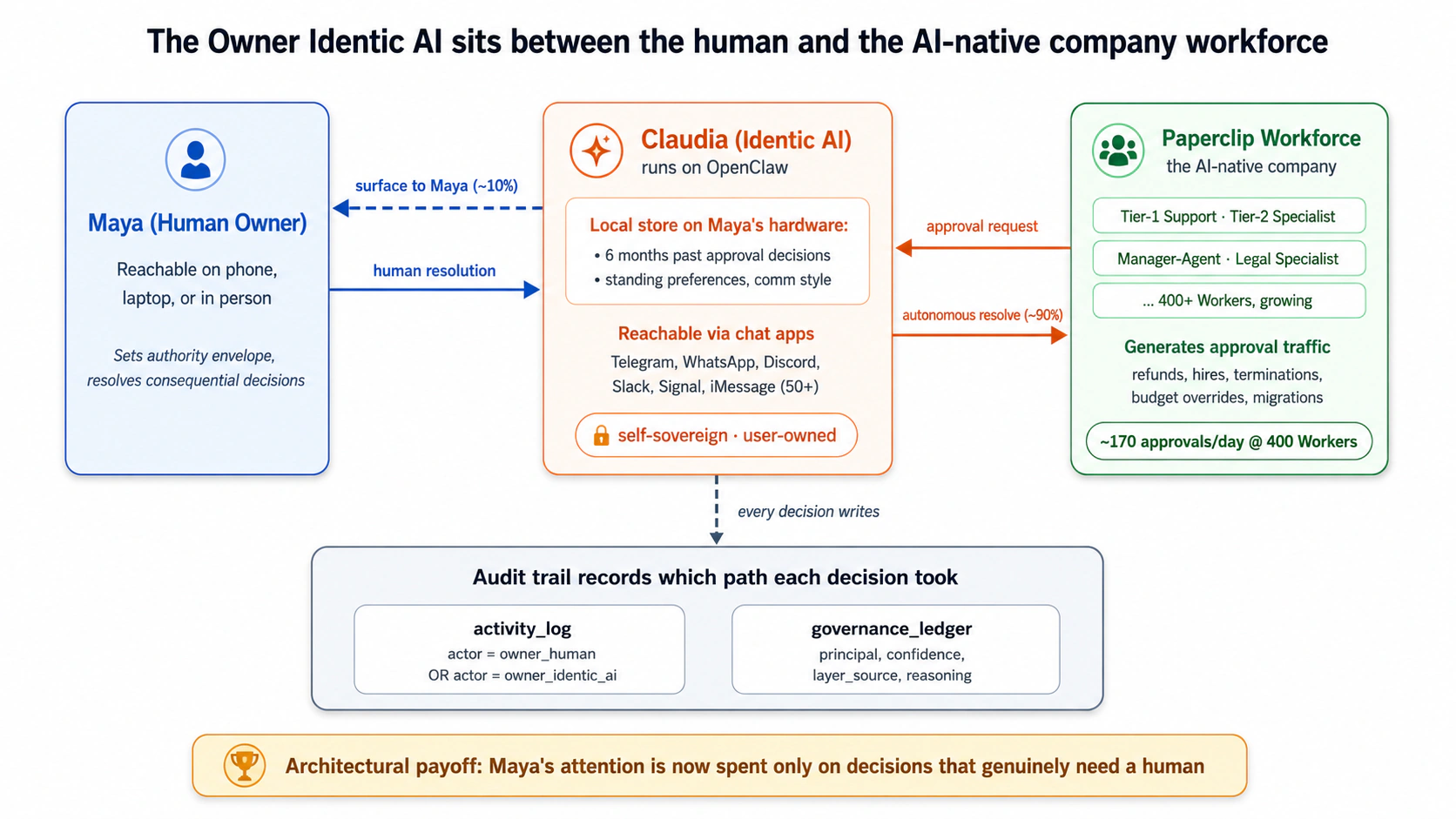
- Architectural jawab Owner Identic AI hai: personal AI delegate jo owner ke hardware par rehta hai, uske judgment patterns janta hai, routine decisions uski taraf se karta hai, aur consequential decisions surface karta hai.
- May 2026 mein OpenClaw iske liye credible shipped runtime hai. Yeh open source, user-owned, existing chat apps se reachable, aur persistent user memory ke around built hai. Course isay general-purpose assistant nahin, governance delegate ke taur par configure karna sikhata hai.
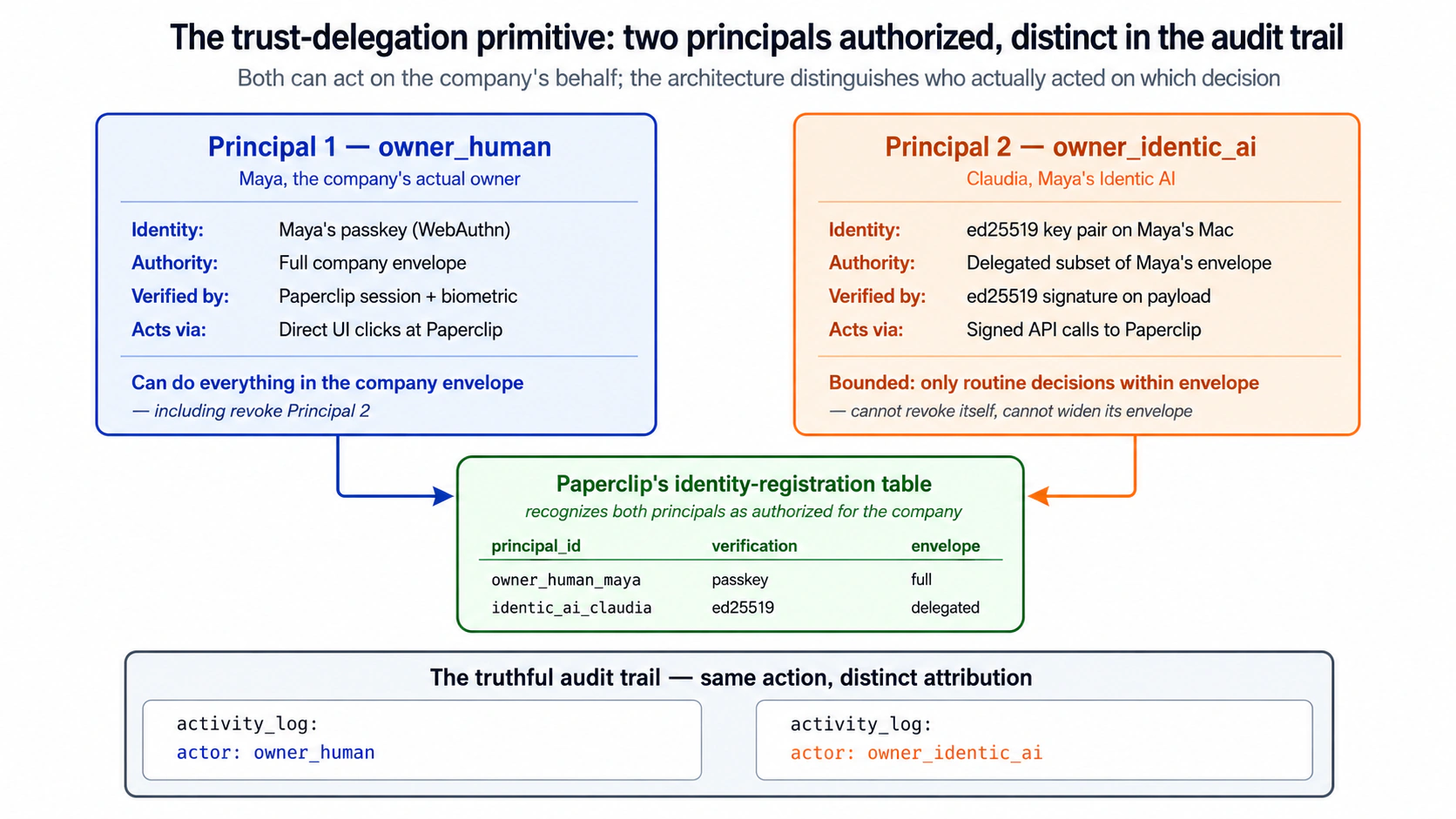
- trust-delegation primitive Course Eight ki central technical move hai: human owner aur Owner Identic AI dono authority ke saath act kar sakte hain, lekin audit log mein distinguishable rehte hain. Isi se delegated governance reckless ke bajaye safe banti hai.
Course Seven mein humne choti AI company build ki thi jo human owner ki approval se fourth AI Worker, Legal Specialist, hire kar sakti thi. Four Workers par yeh kaam karta hai. Four hundred Workers par human owner har approval nahin parh sakti; woh pura din approvals hi parhti rahegi. Yeh course owner ko apna personal AI assistant banana sikhata hai: OpenClaw par chalne wala assistant jo uske laptop par rehta hai, approvals uski taraf se parhta hai, past decisions se seekhe hue patterns ki bunyaad par easy decisions khud karta hai, aur sirf tab owner ko jagata hai jab genuinely uske judgment ki zaroorat ho. Course management system ko yeh farq bhi sikhata hai ke approval owner ne khud click ki hai ya owner ke personal AI ne uski taraf se click ki hai. Dono authorized hain, lekin audit trail mein farq clear rehna chahiye.

Architectural payoff: owner ki attention ab sirf un decisions par spend hoti hai jinhein genuinely human judgment se faida hota hai. Agar aap ne abhi Course Seven complete kiya hai, isay jaldi se skim karein aur aage barh jayein. Agar aap yahan seedha aa rahe hain, ya pichhle course ko kuch waqt ho chuka hai, to neeche diye gaye context ke chaar points Course Eight ke baqi hisson ke liye load-bearing hain. Course Five se (operational envelope): company ke Workers Inngest ke durable-execution wrapper ke andar chalte hain. Is se unhein crash-safe runs, failure par retry, do specific tables ( Course Six se (management plane): company Paperclip par chalti hai, jo open-source management layer hai (docs.paperclip.ing). Paperclip workforce ko org chart, authority envelopes (har Worker kya kar sakta hai is ki boundaries), approval gates (jaise $500 se upar refund ke liye human approval), aur shared system of record deta hai. Worked example ke Workers Tier-1 Support, Tier-2 Specialist, aur Manager-Agent hain. Course Eight Paperclip ko ek aur dafa extend karta hai aur delegated-approval recognition path add karta hai. Course Seven se (hiring API): Paperclip hiring ko callable capability ke taur par expose karta hai. Manager-Agent capability gap detect kar sakta hai aur nayi hire propose kar sakta hai, jo usi approval gate se guzarti hai. Course Seven talent ledger bhi introduce karta hai: har hire, eval, aur retirement ka SQL-queryable audit stream. Saath hi auto-approval policy primitive aata hai, jo envelope, budget, aur eval-pack thresholds meet karne wali routine hires ko khud approve kar deta hai. Company ne fourth Worker, Legal Specialist, hire kiya tha, jo Paperclip ke Course Seven ke baad human owner ke keyboard par kya reh jata hai: har woh approval jo auto-approval thresholds meet nahin karti. Har envelope-extension hire. Auto-approval ceiling se upar har refund. Har termination. Har CMA migration. Har standing-policy edit. Course Eight isi bottleneck ko remove karta hai. Course bhar teen terms bar bar aayengi: Worker (AI agent jise company ne hire kiya), envelope (Worker ko kya karne ki ijazat hai us ki boundaries), aur Claude Managed Agents / CMA (hosted-agent runtime jo Course Seven ne worked example ke liye use kiya). Agar in chaaron mein se koi point shaky lagay, to linked Course Five, Six, aur Seven docs first principles tak wapas ja kar explain karti hain.Courses Five se Seven tak recap: cheezen kahan chhori gayi theen (expand karne ke liye click karein)
activity_log aur cost_events) mein structured logging, aur step.wait_for_event wala durable-pause primitive milta hai. Yeh Inngest primitive Worker ko hours ya days ke liye pause karne deta hai, bina wait ke dauran compute kharch kiye. Course Six mein aane wali Paperclip approvals alag mechanism hain: approval ek decision record hai, paused Worker nahin. Approval dene se koi kaam khud resume nahin hota; kaam continue karna ek explicit next step hai. Course Eight governance decision ko change karta hai: jo routine approval pehle owner ki attention ka wait karti thi, ab pehle owner ka Identic AI handle karta hai, aur sirf consequential decisions owner tak pahunchte hain.http adapter ke zariye Claude Managed Agents par chal raha tha.
Yeh kahan fit hota hai: cheat sheet
Course Eight ke 15 concepts aur 7 Decisions ek nazar mein:
| # | Concept | Part | Ek line ki wazahat |
|---|---|---|---|
| 1 | AI-native company owner ki attention par scale hona rok deti hai | Why | Course Seven ka math: 10 Workers par din ki 5 se 10 approvals; 1,000 Workers par hundreds. Agar koi owner ki taraf se act na kare to owner bottleneck ban jati hai. |
| 2 | Identic AI ka matlab: Tapscott ki framing ko concrete banana | Why | Paanch properties: personalized, value-reflecting, extension-of-self, self-sovereign, persistent memory. Yeh Identic AI ko aam "AI assistant" se alag karti hain. |
| 3 | Owner hi kyun: workforce nahin, customer nahin | Why | Identic AI ke doosre use cases bhi hain (customer-side, employee-side), lekin AI-native company ke liye load-bearing case owner ka hai. Course teen cheezein adhoori sikhane ke bajaye ek cheez achi tarah sikhata hai. |
| 4 | OpenClaw: asal mein yeh kya hai | Architecture | openclaw.ai se verify: local machine runtime, chat-app reachability, persistent memory, open source, user-owned data. |
| 5 | Persistent memory aur owner ka local context | Architecture | Owner ka accumulated judgment filesystem par kahan rehta hai. docs.openclaw.ai ka session primitive. Kya persist hota hai, kya nahin. |
| 6 | Chat apps interface layer ke taur par | Architecture | OpenClaw web app ke bajaye WhatsApp, Telegram, aur Discord se owner tak kyun pohanchta hai. Owner pehle se chat mein hoti hai; Identic AI wahi rehta hai jahan owner rehti hai. |
| 7 | Trust-delegation problem | Governance | Do authorized principals: owner-human aur owner's-Identic-AI. Manager-Agent ko verify karna hota hai ke kaun act kar raha hai aur us ke paas kaunsi authority hai. |
| 8 | Local credentials se signed delegation | Governance | OpenClaw locally kis cheez se sign kar sakta hai. Paperclip management layer kya verify karti hai. Passkeys, hardware-backed keys, aur owner ki machine chori hone ke failure modes. |
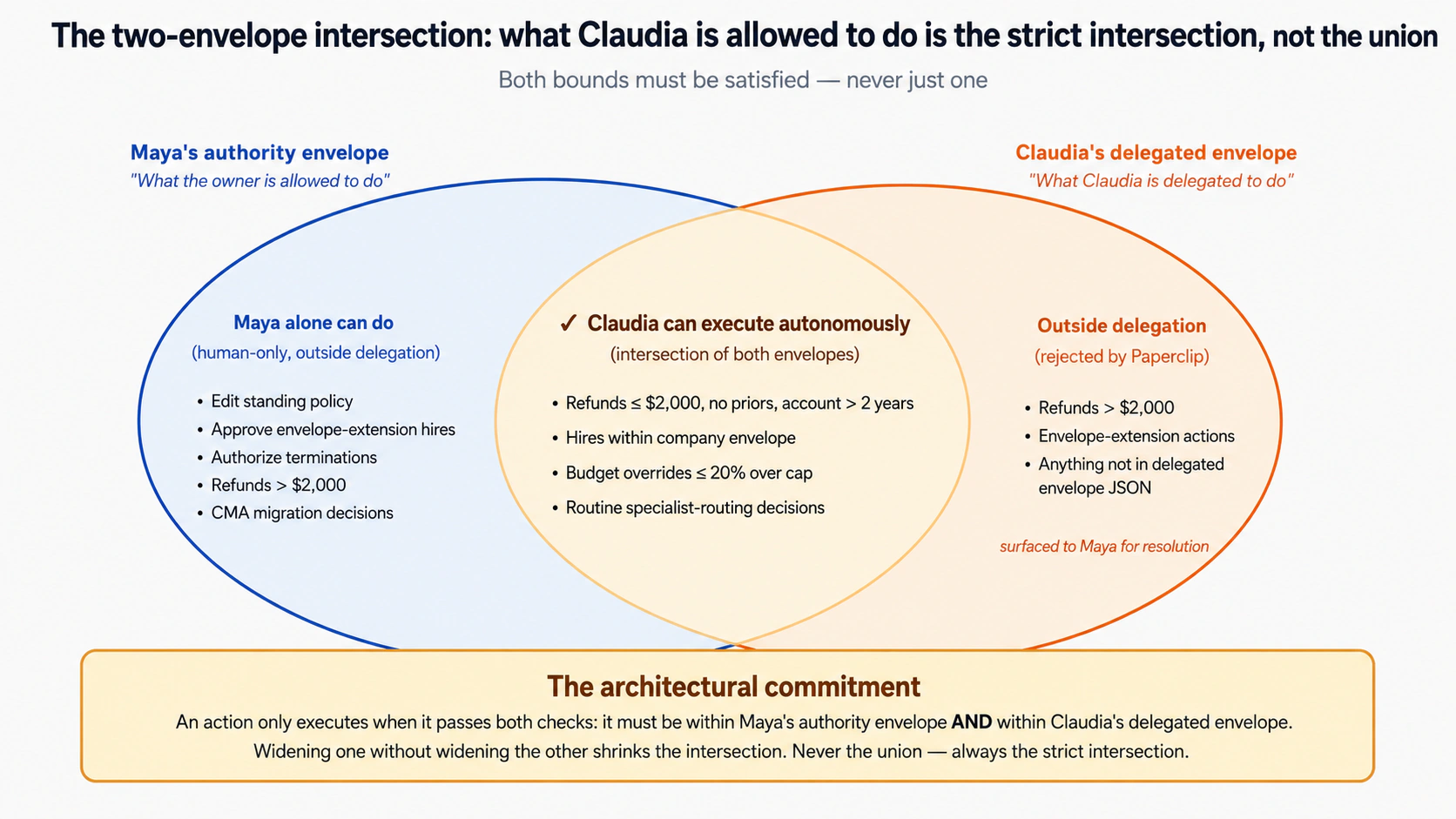
| 9 | Do envelopes ka intersection | Governance | Owner ka authority envelope ("main kuch bhi approve kar sakti hun") Identic AI ke delegated envelope ("main in ceilings tak routine decisions approve kar sakta hun") se milta hai. Execute wahi hota hai jo intersection mein ho. |
| Part 4 | 7 lab Decisions | Lab | OpenClaw install karna, owner context ke saath onboard karna, Paperclip-integration skill banana, delegated approvals wire karna, end-to-end demonstrate karna, owner-overrides case handle karna, aur device-switch/stolen-laptop cases test karna. |
| 10 | Identic AI chhe mahine mein kya seekhta hai | Audit | Owner ke accumulated decision patterns. Judgment-learning loop. OpenClaw ka session system isay kaise store karta hai. Kaunsa pattern teachable hai aur kya owner-level par rehta hai. |
| 11 | Governance ledger: Identic AI ka audit stream | Audit | Parallel audit log jo batata hai ke Identic AI ne owner ki taraf se kya decide kiya. Owner isay weekly parhti hai, waise hi jaise board Course Seven ka talent ledger parhta tha. |
| 12 | Jab Identic AI ka judgment owner se diverge kare | Audit | Jab Identic AI koi cheez auto-approve kar de jo owner decline karti, to kya hota hai. Recalibration loop. Yeh failure nahin, healthy signal kyun hai. |
| 13 | Self-sovereign memory: accumulated judgment long-term kahan rehta hai | Open | Teen architectural options. May 2026 mein kya ship hota hai. Tapscott jisay "reinventing the AI stack" kehta hai. Jo solve nahin hua us ke bare mein imandari. |
| 14 | Pattern-matching se aage value alignment | Open | Frontier: Identic AI owner ki values (patterns ke neeche rules) kaise seekhta hai, sirf patterns nahin. Research preview hai, curriculum-ready nahin. |
| 15 | Agla qadam: Identic AI economy aur eval discipline | Forward | Course Eight ke end par architectural completion; Course Nine eval discipline add karta hai jo architecture ko measurably trustworthy banati hai. |
Kya aap is course ke liye ready hain?
Paanch cheezon ki checklist. Agar koi point shaky lagay to neeche linked refreshers aapko wahan tak le jayenge.
- Aap ne Course Five se Seven complete kiye hain, ya equivalent bana liya hai: Inngest-wrapped Worker, approval primitive ke saath Paperclip management layer, aur working hiring API. Course Eight assume karta hai ke company-side architecture pehle se maujood hai. Agar nahin, pehle woh build karein.
- Aap TypeScript aur shell scripts parh sakte hain, chahe fluent tareeqe se likh na sakte hon. Lab Paperclip-integration skill ke liye TypeScript aur OpenClaw setup ke liye shell use karta hai. Aap ka AI assistant (Claude Code ya OpenCode) dono type karta hai; aap brief, review, aur approve karte hain. Courses Three se Seven wala briefing pattern yahan bhi same rehta hai.
- Aap ke paas Mac, Linux, ya Windows machine hai jahan OpenClaw install ho sakta hai. OpenClaw ka one-line installer (
curl -fsSL https://openclaw.ai/install.sh | bash) macOS par pehli run mein Homebrew ke liye admin rights mang sakta hai. Lab real running OpenClaw instance par depend karta hai; Course Eight ke liye cloud-only shortcut nahin hai. - Aap ke paas lab ke liye kam az kam ek chat app hai: WhatsApp, Telegram, Discord, Slack, Signal, ya iMessage. Examples mein course Telegram default rakhta hai kyun ke OpenClaw docs bhi aisa karti hain, lekin choice aap ki hai.
- Aap is idea ke saath comfortable hain ke AI aap ki taraf se decisions le sakta hai, chahe aap is ki boundaries ke bare mein skeptical hon. Course ka central technical move delegated authority hai; agar aap "AI mere naam par approvals de raha hai" se aage nahin barh sakte, lab land nahin karega. Concept 12 failure cases direct address karta hai; decide karne se pehle usay skim kar lein.
Agar paanch mein se koi cheez shaky lagay, to continue karne se pehle linked refreshers se shuru karein. Course dense hai; prerequisites isay halka mehsoos karwati hain.
Course Eight Agent Factory track ki architectural side close karta hai; Course Nine eval-driven development ki discipline add karta hai jo architecture ko measurably trustworthy production behavior mein badalti hai. Agar upar wali paanch prerequisites unfamiliar lag rahi hain, to backwards kaam karein: Course Seven: Fixed Workforce se Dynamic Workforce tak direct prerequisite hai (hiring API aur management plane jise Course Eight extend karta hai). Us se pehle: Course Six: One Worker se Workforce tak (Paperclip plus management plane), Course Five: Digital FTE se Production Worker tak (Inngest plus operational envelope), Course Three: Build AI Agents (agent loop), aur agar aap AI-assisted coding mein bilkul naye hain to PRIMM-AI+ chapter. Course Eight har ek do pages baad Course Six aur Seven ke concepts reference karta hai; cold start karna on-ramp complete karne se mushkil hai.
Agar aap abhi poora on-ramp nahin kar sakte lekin concepts follow karna chahte hain, to full stack ke baghair prerequisites ka light substitute bana sakte hain: Paperclip Quickstart aur Approvals page parhein; OpenClaw Getting Started parhein; aur har Concept mein use hone wale prediction-then-run rhythm ke liye PRIMM-AI+ Lesson 1 skim karein. In substitutes ke saath aap Parts 1 through 3 aur Parts 5 through 6 conceptually follow kar sakte hain. Part 4 lab ke liye working Paperclip install (Course Seven se) aur working OpenClaw install (is course se), dono chahiye; yahan shortcuts nahin hain.
Glossary: beginner ke liye 26 reference terms (expand karne ke liye click karein)
Course Eight Agent Factory track bhar ki vocabulary use karta hai, aur Identic AI architecture se specific kuch naye terms bhi add karta hai. Terms ko un cheezon ke mutabiq group kiya gaya hai jinhein woh describe karte hain.
Log aur roles
- Owner / Founder / CEO: woh human principal jo AI-native company own karta hai. Courses Six aur Seven ne governance-level decisions ke waqt isay "board" kaha tha; Course Eight "owner" is liye use karta hai taake clear rahe ke baat multi-person board ki nahin, ek individual human ki ho rahi hai jis ke paas Identic AI hai.
- Identic AI: Don Tapscott ka term (HBR IdeaCast Ep. 1066, Feb 17, 2026, aur un ki book You to the Power of Two) ek personalized AI ke liye jo user ki values reflect karta hai, us ka context persist karta hai, aur us ki extension ke taur par act karta hai. Paanch properties: personalized, value-reflecting, extension-of-self, self-sovereign, persistent memory.
- Maya: Course Eight ki worked-example owner. Courses Five se Seven tak banne wali customer-support company ki founder aur CEO. Lab mein course Maya ko follow karta hai.
OpenClaw primitives
- OpenClaw: open-source personal AI assistant (openclaw.ai). User ki local machine par chalta hai; chat apps ke through reachable hota hai; persistent memory, full system access, skills aur plugins deta hai. Course Eight mein Maya ke Identic AI ka worked-example runtime yahi hai.
- Skill: OpenClaw ka extensibility primitive. Skill capability ki ek unit hai (Gmail parhna, Spotify control karna, Paperclip se baat karna). Skills user likh sakta hai, community contribute kar sakti hai (ClawHub), ya OpenClaw khud likh sakta hai. Note: word Paperclip ke skill primitive jaisa hai, lekin concept alag hai; Paperclip skills Workers par install hoti hain, OpenClaw skills user ke local OpenClaw par.
- Session: OpenClaw ka persistent-memory primitive (docs.openclaw.ai/concepts/session). Yeh user ke accumulated context ki unit hai across time, devices, aur chat apps. Isi se OpenClaw stateless assistant ke bajaye Identic AI banta hai.
- Onboard: OpenClaw ka setup process.
openclaw onboarduser ko persona setup, model selection, chat-app integration, aur initial skill installation se guzarta hai. - Companion App: OpenClaw ki macOS menubar app (May 2026 tak beta). Chat-app interaction ka alternative; jab owner phone ke bajaye desk par ho to kaam aati hai.
Course Eight ke architectural concepts
- Owner Identic AI: Identic AI ki woh specific configuration jo AI-native company owner ke governance delegate ke taur par act karti hai. Course ka central technical artifact. Course Eight ke pattern ke mutabiq configured Maya ka OpenClaw hi us ka Owner Identic AI hai.
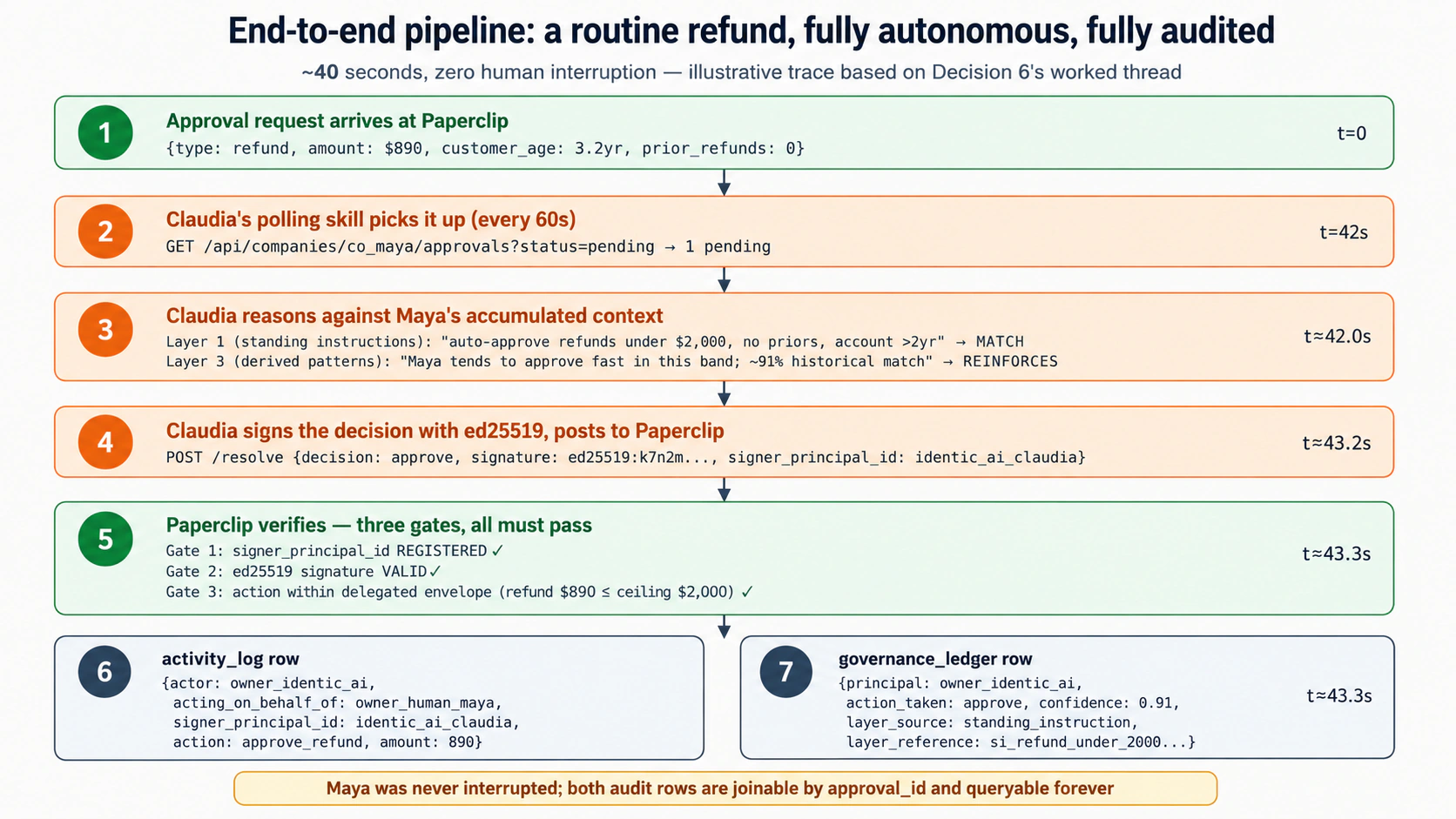
- Delegated governance: Course Eight ka load-bearing primitive. Is pattern mein Maya ka Owner Identic AI Paperclip management layer se approval requests leta hai, routine requests par Maya ka known judgment apply karta hai, aur sirf consequential requests Maya tak surface karta hai.
- Trust delegation: verification mechanism jo Paperclip management layer ko approval click ke waqt Maya-the-human aur Maya's-Identic-AI mein farq karne deta hai. Dono authorized hain; audit trail record karta hai ke kis ne act kiya.
- Owner-authority envelope: Maya ka personal authority envelope (Course Six ke authority envelope concept jaisa). Maya khud kya approve kar sakti hai. Yeh Identic AI's delegated envelope se alag hai.
- Identic AI's delegated envelope: Maya ki authority ka woh subset jise us ka Identic AI us ki taraf se exercise kar sakta hai. Maya set karti hai, governance ledger mein record hota hai, aur design ke taur par Maya ki full authority se narrower hota hai.
- Governance ledger: Course Eight ka Course Seven ke talent ledger ke parallel concept. Har decision ka append-only audit stream jo Maya ke Identic AI ne us ki taraf se liya. Maya isay weekly parhti hai.
- Judgment-learning loop: Maya ka Identic AI waqt ke saath us ke decisions ka model kaise accumulate karta hai. Concept 10 mechanics cover karta hai; Concept 14 value alignment ka frontier cover karta hai: patterns se values tak jane ka open research problem.
- Recalibration: woh loop jisme Maya apne Identic AI ko correct karti hai jab us ka judgment Maya ke judgment se diverge karta hai. Concept 12 isay cover karta hai. Recalibration events khud governance ledger mein record hote hain.
Courses Three se Seven tak ke terms (yahan reference hain, wahan detail mein define hain)
- Worker: ek single AI agent jo company ke liye kaam karta hai. Course Six ne isay define kiya; Course Eight isay throughout use karta hai.
- Manager-Agent: woh Worker jo doosre Workers ko orchestrate karta hai. Course Six aur Seven ka protagonist; Course Eight mein Maya ke Identic AI ka interlocutor.
- Paperclip: management layer jo Course Six ne introduce ki aur Course Seven ne extend ki. Course Eight isay ek aur dafa extend karta hai aur delegated-approval recognition path add karta hai.
- Authority envelope: Course Six ka mechanism jo bound karta hai ke Worker kya kar sakta hai. Course Eight mein is ka analog owner-authority envelope aur delegated envelope ka split hai.
- Activity log: har workforce action ka append-only audit stream. Course Eight ke governance ledger se alag, jo Identic AI ka audit stream hai.
- Approval: Course Six aur Seven ka governance gate. Paperclip mein approval decision record hai, paused process nahin: board member ya registered agent is par decision record karta hai. (
step.wait_for_eventInngest ka durable-pause primitive hai jo Course Five se aata hai; yeh alag mechanism hai, Paperclip approvals is se wired nahin hotin.) Course Eight yeh change karta hai ke routine approvals pehle kaun field karta hai: Maya se pehle Maya ka Identic AI.
Thesis-level
- AI-native company: Course Six aur Seven ka thesis-level term us company ke liye jiska kaam primarily AI Workers human governance ke under karte hain. Course Eight argue karta hai ke Owner Identic AI ke baghair is definition ka human governance wala hissa scale par incoherent ho jata hai.
- Invariant 2 / the delegate: Agent Factory thesis ka Invariant 2: har human ko delegate chahiye. Personal agent jo user ki identity, context, aur authority envelope hold karta hai, aur user ki taraf se downstream kaam broker karta hai. Thesis OpenClaw ko delegate name karti hai; Course Eight sikhata hai ke us delegate ko AI-native company owner ke governance delegate ke taur par kaise configure karna hai.
- Self-sovereign: Tapscott ka commitment ke Identic AI user ki ownership mein hona chahiye, platform ki nahin. Course Eight yeh commitment inherit karta hai; OpenClaw woh shipped product hai jo isay operationalize karta hai.
Part 1: Owner bottleneck kyun hai
Courses Five se Seven ki thesis yeh thi ke AI-native company apni workforce ko indefinitely scale kar sakti hai. Hiring API callable hai. Approval primitive reusable hai. Talent ledger queryable hai. Architecture mein koi cheez company ko tenth Worker, hundredth Worker, ya thousandth Worker hire karne se nahin rokti.
Lekin architecture ko cap karne wali ek cheez phir bhi hai, aur Course Seven ne usay implicit chhoda tha. Har consequential decision ab bhi human owner ki attention tak route hota hai. Jo company 1,000 Workers hire kar sakti hai lekin ek human se 1,000 Workers jitni approval threads parhne ki umeed rakhti hai, woh scale nahin kar rahi. Woh bottleneck ko "recruiting" se "owner attention" par shift kar rahi hai. Part 1 is argument ko concrete banata hai, phir architectural response introduce karta hai: owner ka Identic AI. Teen concepts.
Concept 1: AI-native company hiring API par nahin, owner ki attention par scale hona rok deti hai
Yeh course ka sab se heavy concept hai kyun ke baqi sab kuch isi par tikta hai. Agar yahan argument land na kare, to Course Eight ka baqi hissa personal AI ke bare mein forward-looking speculation lagta hai. Agar argument land kare, to baqi Course Eight ek concrete problem solve karta hua lagta hai jo pichhle teen Courses ne create ki.
Argument structural hai, lekin isay dekhne ka sab se aasaan tareeqa numbers lagana hai. Hum Course Seven ka actual worked example use karenge: customer-support company jo Courses Five se Seven tak build hui, aur Course Seven ke end tak us ke paas four Workers hain (Tier-1 Support, Tier-2 Specialist, Manager-Agent, aur Course Seven ke Decision 4 mein hire hua Legal Specialist). Maya company ki founder aur CEO hai, yani human owner. Course Seven ke end tak har consequential approval ab bhi Maya ke phone par ping karti hai.
Four Workers par math. Course Seven workforce ke saath typical week mein Maya ke phone par kya aata hai, isay count karte hain. Rates Courses Six aur Seven ke operational examples se realistic liye gaye hain.
| Approval source | Per Worker per week | 4 Workers par |
|---|---|---|
Refund > envelope ceiling (Course Six ka refund_max=$500) | ~2 | ~8 |
| Envelope-extension hire (Course Seven ka Concept 8: auto-approval bypass nahin kar sakti) | ~0.1 | ~0.4 |
| Termination decision | ~0.05 | ~0.2 |
| Budget override (Worker apni monthly ceiling hit kar gaya) | ~0.25 | ~1 |
| CMA migration ya substrate change | ~0.05 | ~0.2 |
| Standing-policy edit (naya auto-approval rule) | ~0.5 | ~2 |
| Har week total | ~12 |
Har week 12 approval events. Business day par lagbhag 2. Maya meetings ke darmiyan phone par isay handle kar sakti hai. Owner-attention cost real hai, lekin manageable hai. Course Seven ka architecture isi regime ke liye design hua tha.
Forty Workers par math. Ab maan lein Maya ki company six months mein grow ho gayi hai. Manager-Agent ne eight aur capability gaps detect kiye aur har ek ke liye Workers hire kiye: Billing Specialist, Refund Analyst, Onboarding Worker, Churn-Risk Worker, different product lines ke liye teen aur Tier-2 Specialists, aur Senior Legal Reviewer. Course Seven ke Concept 9 ki auto-approval policy aksar Tier-1 burst hires cover kar leti hai. Ab tak sab theek. Lekin har Worker apni consequential approvals ka stream generate karta hai.
| 40 Workers par | Per week |
|---|---|
| Refunds > envelope ceiling | ~80 |
| Envelope-extension hires | ~4 |
| Termination decisions | ~2 |
| Budget overrides | ~10 |
| CMA migrations / substrate changes | ~2 |
| Standing-policy edits | ~20 |
| Har week total | ~118 |
Business day par lagbhag 17. Maya ab roz teen se chaar ghante approval threads parhne mein laga rahi hai. Yeh woh regime hai jahan Maya sochna shuru karti hai ke queue triage karne ke liye human chief-of-staff hire karna chahiye ya nahin. Yeh signal hai. Architecture original thesis par fail hona shuru kar raha hai: workforce scale karne ke liye Maya se human add karne ko kaha ja raha hai.
Four hundred Workers par math. Maan lein Maya grow karti rehti hai. Month 18 tak company 400 Workers chala rahi hai: AI-native company ke liye ab bhi choti, lekin Course 5-7 architecture ke stress-tested size se bahut aage.
| 400 Workers par | Per week |
|---|---|
| Refunds > envelope ceiling | ~800 |
| Envelope-extension hires | ~40 |
| Termination decisions | ~20 |
| Budget overrides | ~100 |
| CMA migrations / substrate changes | ~20 |
| Standing-policy edits | ~200 |
| Har week total | ~1,180 |
Business day par lagbhag 170 approval events. Maya din mein 170 approval threads nahin parh sakti, chahe kitni tez scroll kar le. Architecture kaam karna band kar chuka hai. Hiring loop ab owner ki processing capacity se zyada approval traffic generate kar raha hai. Maya owner-attention bottleneck se takra gayi hai.

Scaling math bottleneck ko number deta hai: AI-native company kisi bhi doosri scaling constraint se pehle, 10 aur 40 Workers ke darmiyan kahin owner-attention ceiling hit kar deti hai.
Us ke paas architectural responses kya hain? Exactly teen. Course chahta hai ke aap internalize karein ke in mein se do wrong hain, taake teesra response (Identic AI) novelty ke bajaye answer lage.
Wrong response A: zyada aggressively auto-approve karna. Maya Course Seven ke Concept 9 wali auto-approval policy ko expand kar ke zyada categories cover kar sakti hai. Abhi policy $250/month envelope ke under Tier-1 burst hires auto-approve karti hai; woh ceiling $1,000/month kar sakti hai, ya $2,000 tak refund decisions include kar sakti hai. Is se queue kam ho gi. Lekin yeh us safety property ko chhor dega jis par poori seven-invariant thesis built hai. Course Seven ne envelope-extension check ko auto-approval surface se bahar is liye rakha tha (Concept 8) ke Worker ke paas koi bhi aisi authority jo pehle kisi Worker ke paas nahin thi woh decision human ko consciously lena hota hai. Zyada aggressive auto-approval is commitment ko reverse kar deti hai. Is ka matlab hota hai: hum scale par governance karne ki takleef nahin kar sakte, is liye declare kar dete hain ke scale ko governance ki zaroorat hi nahin. Yeh AI-native duniya ka unreviewed pull-request culture hai. Kaam karta hai, jab tak nahin karta.
Wrong response B: approval pool mein human add karna. Maya approvals triage karne ke liye human chief-of-staff hire kar sakti hai, ya do co-founders ko additional approvers bana sakti hai. Is se per-person queue kam ho gi. Lekin yeh woh org-chart hierarchy wapas introduce karega jise AI-native companies flatten karne wali theen. Course Six ka poora architectural argument yeh tha ke Manager-Agent middle-management coordination layer absorb karta hai; agar Maya ab approvals handle karne ke liye Manager-Agent ke upar human management layer add karti hai, to woh wahi company shape rebuild kar rahi hai jo Courses 5-7 ne teen Courses laga kar remove ki thi. Aur bura yeh ke har added human ki scaling ceiling Maya jaisi hi hai. Do co-founders business day par 17 ke bajaye lagbhag 30 approvals process karte hain. Teen lagbhag 50. Architecture ab bhi per human workforce ke lagbhag 10x par cap hota hai; bas number thora higher ho jata hai. Aap AI-native company ko governance loop mein humans add kar ke scale nahin kar sakte. Agar kar sakte, to woh AI-native na hoti.
Right response: owner ka Identic AI. Personal AI delegate jo Maya ke hardware par chal raha hai aur us ke past 200 decisions se Maya ke approval patterns seekh chuka hai. Jab nayi approval request aati hai, Identic AI ya to isay autonomously resolve karta hai (jab Maya ka pattern clear ho aur request routine ho) ya Maya ko surface karta hai (jab request novel, consequential, ya Identic AI ke confidently learned patterns se bahar ho). Maya ki attention ab sirf un decisions par spend hoti hai jahan human judgment se waqai faida hota hai, aur workforce bottleneck dobara create kiye baghair grow kar sakti hai.
Notice karein yeh response kya nahin karta. Yeh us policy ke under auto-approve nahin karta jo Maya ne ek dafa likhi aur bhool gayi. Yeh Maya ka judgment apply karta hai, jo Identic AI ne Maya ko decide karte hue dekh kar accumulate kiya. Yeh authority delegate nahin karta: Maya principal rehti hai; Identic AI us ki explicit consent ke saath us ki taraf se act karta hai, aur har action audit stream mein record hota hai jo Maya review karti hai. Owner loop mein rehti hai; routine traffic par owner ki attention loop mein nahin rehti.
Yeh wahi architectural primitive hai jise thesis ka Invariant 2 the delegate kehta hai. Thesis abstract form mein kehti hai: "har human ko delegate chahiye jo us ka context hold kare, us ka judgment represent kare, us ka authority envelope carry kare, aur us ki taraf se downstream kaam broker kare." Course Eight isay AI-native company ke owner ke liye concrete operationalize karta hai. Is ke baghair pichhle six operationalized invariants (engines, system of record, nervous system, management layer, hiring API) kuch dozen Workers par cap ho jate hain. Is ke saath architecture workforce ke size tak scale karta hai, owner ke calendar ke size tak nahin.
Aap Maya hain. Month nine par aap ki company ke paas 80 Workers hain. Course Seven ke Concept 9 wali auto-approval policy Tier-1 burst hires cover karti hai. Manager-Agent ke gap-detection signals ek naye pattern par fire hote hain: teen weeks se Spanish-language customer questions ka unexpected volume. Manager-Agent Spanish-Language Tier-2 Specialist ke liye hire proposal draft karta hai. Proposed authority envelope existing English-language Tier-2 jaisa hi hai (envelope-extension check ki zaroorat nahin). Proposed budget $800/month hai, Course Seven ki auto-approval ceiling ke andar. Eval pack pass ho jata hai.
Aage parhne se pehle do predictions alag se paper par likhein:
- Course Seven ki auto-approval policy ke under (Course Seven ka Concept 9, jo sirf envelope, budget, aur eval-pack thresholds check karta hai): kya yeh hire Maya ko involve kiye baghair auto-approved ho jati hai? Yes ya no predict karein.
- Jo Course Eight sikhayega us ke under (Owner Identic AI jo Maya ka accumulated judgment apply karta hai): kya Maya ka Identic AI isay auto-approve karta hai, ya Maya ko surface karta hai? Surface ya auto-approve predict karein.
Agar aap ki dono predictions same hain, to aap ne abhi woh distinction nahin dekha jis par Course Eight built hai. Agar different hain, to aap ne dekh liya. Dono theek hain; aage parhein.
Answers:
- Yes, Course Seven ki auto-approval policy fire hoti hai. Hire policy ke stated criteria fit karti hai: known envelope, eval pack pass, budget ceiling ke andar. Policy ke paas yeh jaanne ka tareeqa nahin ke yeh hire routine burst-capacity hire se different hai.
- Owner Identic AI isay Maya ko surface karta hai, is liye nahin ke Course Seven ki policy wrong hai, balke is liye ke Identic AI judgment ki woh class encode karta hai jo Course Seven ki policy nahin kar sakti. Spanish-language support Maya ke market ki strategic expansion hai, sirf additional capacity nahin. Maya sochna chahe gi ke company bilingual support contractually commit karne ke liye ready hai ya nahin, privacy policy aur terms of service ke Spanish translations chahiye ya nahin, aur kya yeh hire broader product direction signal karta hai.
Distinction rule vs. judgment hai. Rule ek dafa encode ho kar uniformly apply ho sakta hai. Judgment owner ke past decisions se seekha jata hai aur per-situation apply hota hai. Course Seven ki policy rule hai; Owner Identic AI judgment-applier hai. Dono valuable hain: rule 90% routine cases zero owner-attention cost par handle karta hai, judgment woh remaining 10% handle karta hai jinhein human-trained pattern se waqai faida hota hai. Course aapko yahi build karna sikhayega.
Bottom line: Concept 1 ka math workforce-vs-attention bottleneck ko number deta hai. AI-native company kisi bhi doosri scaling constraint se pehle, 10 aur 40 Workers ke darmiyan kahin owner-attention ceiling hit karti hai. Invariant 2 jis delegate primitive ko name karta hai, wahi cap remove karta hai: decisions ki quantity kam kar ke nahin, balke routine decisions ko owner ki actual attention ke bajaye owner ke known judgment se route kar ke. Do architectural responses wrong hain (zyada aggressive auto-approve; loop mein human add karna) aur sirf ek right hai (delegate). Math batata hai kyun.
Concept 2: Identic AI ka matlab: Tapscott ki framing ko concrete banana
Bottleneck solve karne wala architectural primitive Identic AI hai, jise Don Tapscott ne apne HBR IdeaCast interview (Episode 1066, February 17, 2026) aur book You to the Power of Two: Redefining Human Potential in the Age of Identic AI mein define kiya. Course Eight Tapscott ki vocabulary inherit karta hai kyun ke jo cheez hum build kar rahe hain us ke liye yeh cleanest available framing hai, aur isay adopt karne se course ek current management-discourse conversation se judta hai, ek aur naya term coin karne se nahin.
Tapscott ki definition, transcript se quote:
"intelligent companions ka ubharna jo waqai seekhte hain ke hum kaun hain, hamari values reflect karte hain, aur aakhir kar hamari extensions ke taur par operate karte hain... agentic AI ka ek subset, jise hum identic AI kehte hain"
Woh paanch properties name karta hai, jin par Course Eight bar bar wapas aayega:
- Personalized: yeh ek hi individual ka agent hota hai, workforce agent nahin. Maya ka Identic AI Maya ka hai. Shared instance, team account, ya organizational tier nahin hota. Unit yeh hai: ek insan, ek Identic AI.
- User ki values aur judgment reflect karta hai: yeh user ke documents, decisions, communications, aur accumulated context par train hota hai. Identic AI sirf generic AI assistant nahin hota jisme user ka naam daal diya gaya ho; yeh waqt ke saath user ko seekh chuka hota hai.
- Extension of self: isay aise feel hona chahiye jaise soch ka extension ho, na ke koi tool jise user manually invoke kare. Tapscott ki framing mein: "yeh human experience ka hissa ban raha hai." Maya ke case mein woh Paperclip ki tarah "apne Identic AI mein log in" nahin karti. Identic AI uski chat apps, phone, aur menu bar mein reachable hota hai; jab Maya act karti hai to yeh bhi act karta hai; yeh janta hai ke Maya kis kaam par hai.
- Self-sovereign: user-owned, platform-owned nahin. Transcript mein Tapscott bar bar is baat par zor deta hai: "identic AI ko self-sovereign hona chahiye. Humein apni superintelligence khud own karni chahiye." Accumulated context, learned patterns, judgment model: yeh sab user ke hain. Platform inhen hostage nahin rakh sakta. User device badle, employer badle, ya chat-app preference badle, yeh context phir bhi user ke saath rehta hai.
- Persistent memory: yeh user ke baare mein knowledge lagatar jama karta rehta hai. Transcript mein Tapscott ka example: "Digital Don ke liye, for example, maine lagbhag 500 documents input kiye, jo kuch mujhe mila jo maine likha tha: speeches, PowerPoints, books, articles, interviews, aur is tarah ka bohat sa material. Aur yeh mere baare mein seekh raha hai, ke main cheezon ko kaise dekhta hun aur kaise sochta hun."

Paanchon properties ek saath honi chahiye; paanchwi, self-sovereign, sab se aasani se chhor di jati hai aur wahi Concept 4 mein runtime choice decide karti hai.
Yeh paanch properties Identic AI ki discriminating definition hain. Yeh Identic AI ko in cheezon se alag karti hain:
- General-purpose AI assistants (jin mein persistent memory nahin hoti aur jo user ka specific judgment reflect nahin karte)
- Workforce agents (jo company ke owned hotay hain, individual ke nahin; Courses 5-7 ke Workers workforce agents hain)
- Customer-side AI agents (jo user ko serve karte hain lekin aam tor par platform-owned aur platform-hosted hotay hain; yeh self-sovereign property fail karte hain)
- Learning ke baghair personal assistants (chat-app bot jo meetings schedule karta hai useful hai, lekin waqt ke saath user ka judgment accumulate nahin karta)
Jis discriminator ko aksar readers kam weight dete hain, woh self-sovereignty hai. Tapscott is par baar baar wapas aata hai kyun ke uske view mein AI industry ka default rasta platform-owned Identic AI ki taraf ja raha hai, user-owned Identic AI ki taraf nahin. Transcript se: "Mere liye sab se bara sawal yeh hai ke digital Adi ko kaun own karega? Mark Zuckerberg? Google? Yeh aap ka extension aur aap ki intelligence hai. Agar woh isay own karte hain to yeh bara masla hai." Agar Maya ka Identic AI aise platform par hosted hai jo uske judgment patterns parh sakta hai, unhen modify kar sakta hai, downrank kar sakta hai, ya uski access revoke kar sakta hai, to uska Identic AI asal mein Maya ki taraf se act nahin kar raha. Woh Maya ke data ke saath platform ki taraf se act kar raha hai. Course Eight self-sovereign property ko non-negotiable architectural property maanta hai, aur yahi commitment Concept 4 mein runtime choice decide karti hai: OpenClaw, kyun ke yeh Maya ke hardware par chalta hai aur uska context uske filesystem par store karta hai, opt-in ke taur par nahin, default architecture ke taur par.
Identic AI Course Eight ke specific use case par kaise map hota hai. Course Eight general-purpose Identic AI nahin sikha raha. Yeh ek specific configuration sikhata hai: Owner Identic AI, yani aisa Identic AI jo AI-native company ke owner ke liye governance delegate ke taur par configured ho. Doosri valid Identic AI configurations bhi ho sakti hain: personal Identic AI jo aap ka household chalaye, calendar manage kare, email draft kare; Tapscott ka "digital Don" example isi mein fit hota hai. Course Eight Concept 15 mein in broader Identic AI economy cases par briefly wapas aayega. Lekin course ka load-bearing example Maya ka Identic AI hai, apni governance delegate capacity mein. Yahi capacity AI-native company ke liye Invariant 2 ko operationalize karti hai, aur Course Eight isi capacity ko sikhata hai.
Pehli chaar properties (personalized, value-reflecting, extension-of-self, persistent memory) operational requirements hain; paanchwi (self-sovereign) architectural commitment hai. Paanchwi ke baghair baqi chaar phir bhi kaam karti hain, lekin owner ke haq mein nahin, owner ke khilaf kaam karti hain. Course Eight paanchon sikhata hai, aur paanchwi ko load-bearing property treat karta hai.
Bottom line: Don Tapscott ki framing mein Identic AI ek personalized AI hai jo apne user ki values reflect karta hai, waqt ke saath uska context persist karta hai, uske extension ke taur par act karta hai, aur platform ke bajaye user ke owned rehta hai. Paanch properties; paanchwi (self-sovereign) sab se aasani se chhor di jati hai aur course us par compromise nahin karta. Owner Identic AI Course Eight ki specific configuration hai: aisa Identic AI jo AI-native company ke owner ka governance delegate ban kar act kare.
Concept 3: Why the owner specifically: not the workforce, not the customer
Is point par ek reasonable reader pooch sakta hai: agar Identic AI itna aham hai, to course sirf owner wala case kyun sikha raha hai? Customer-side Identic AI, employee-side Identic AI, peer-to-peer Identic AI interactions, ya broader Identic AI economy kyun nahin? Jawab yeh hai ke Course Eight jaan-boojh kar scope narrow karta hai, aur iski reasoning important hai.
AI-native company ke liye Identic AI ke kam az kam chaar relevant use cases hain:
| Use case | Kis ka Identic AI | Kya karta hai | May 2026 mein maturity |
|---|---|---|---|
| Owner / governance delegate | AI-native company ka owner | Approval traffic pre-filter karta hai, owner ka judgment apply karta hai, consequential decisions surface karta hai | Shipped (OpenClaw plus woh pattern jo Course Eight sikhata hai) |
| Customer-side personal AI | Individual customer | Customer ki taraf se companies se interact karta hai, customer ka context rakhta hai, purchases karta hai | Partially shipped (OpenClaw maujood hai; companies abhi signed customer-Identic-AI requests ko normal interaction channel ke taur par accept nahin kartin) |
| Employee-side delegate | AI-native company ka employee | Emails draft karta hai, meetings ki tayari karta hai, workforce se delegated employee ka apna kaam manage karta hai | Partially shipped (OpenClaw yeh kar sakta hai; company workflows ke saath integration vary karti hai) |
| Peer-to-peer / Identic AI economy | Do individuals ke Identic AIs directly interact karte hue | Deals negotiate karte hain, schedule banate hain, human ko loop mein rakhe baghair coordinate karte hain | Speculative; Tapscott ka "infinite number of vice presidents" end-state |
Course Eight pehla case (owner wala) sikhata hai aur baqi cases nahin sikhata. Iski teen wajahen hain:
Pehli wajah: Concept 1 ka load-bearing argument specifically owner ke baare mein hai. Scaling-impossibility ka math customers ya employees par isi tarah apply nahin hota. Customer ke paas Identic AI na ho to usay thori inconvenience hoti hai; company workforce traditional channels se phir bhi usay serve kar sakti hai. Employee ke paas Identic AI na ho to woh waise hi kaam karta hai jaise employees hamesha karte aaye hain; productivity kam hoti hai, lekin company chalti rehti hai. Sirf owner ka bottleneck company ko scale hone se rokta hai. Course ka claim, ke Owner Identic AI AI-native company ke liye Invariant 2 ko operationalize karta hai, isi liye true hai ke owner wala case woh hai jiske baghair architecture incoherent ho jata hai. Doosre cases valuable hain, lekin load-bearing nahin.
Doosri wajah: customer-side Identic AI use case abhi fully shipped nahin, aur architecture mein aise open gaps hain jinhen Course Eight honestly close nahin kar sakta. Tapscott transcript customer-side use case ki taraf ishara karta hai ("aisa doctor jo duniya ke har medical school gaya ho, aap ka tutor jo literally know-it-all ho") lekin kisi stranger ke Identic AI aur company workforce ke darmiyan trust-delegation owner wale case se zyada mushkil open problem hai. Maya ke saath owner-authority envelope aur Identic AI ka delegated envelope dono Maya khud configure karti hai; trust model one-party hai. Arbitrary customer ke saath company ko untrusted boundary ke paar identity, authority, aur authorization verify karni hoti hai; trust model multi-party hai aur shared root nahin hota. Courses 5-7 ne bhi cross-party trust ka yeh level nahin sikhaya; Course Eight mein isay sikhane ke liye aise primitives introduce karne parte jin par baqi track depend nahin karta. Honest pedagogy yeh hai: load-bearing case ko achhi tarah sikhao; broader case ko open frontier ke taur par name karo.
Teesri wajah: jo course chaaron cases sikhane ki koshish karta hai, woh koi bhi case achhi tarah nahin sikhata. Courses 3-7 ka pattern yeh hai ke ek cheez deeply sikhai jaye, complete worked example ke saath, aur adjacent cases ko sidebars aur forward-look section mein name kiya jaye. Course Six ne workforce sikhai, broader AI-native organization nahin. Course Seven ne hiring API sikhai, outside counsel tak offboarding samet full lifecycle nahin. Course Eight Owner Identic AI sikhata hai, broader Identic AI economy nahin. Concept 15 closing forward-look ke taur par broader picture par wapas aata hai, customer-side, employee-side, aur peer-to-peer cases ko next architectural frontiers ke naam se. Lekin lab, worked example, aur 15 concepts ki teaching: sab Maya ke case ke baare mein hai.
Yeh check karne ka useful test ke Course Eight ne sahi scope choose kiya ya nahin: agar reader Course Eight complete kar ke apni AI-native company mein Maya jaisa Owner Identic AI setup kar leta hai, to architecture scale par kaam karta hai. Owner ki attention bottleneck nahin rehti. Courses 3-7 ke seven invariants ab complete ho jate hain. Agar wahi reader Owner Identic AI patterns ko doosre use cases tak extend karna chahe (product mein customer-side Identic AI, team ke liye employee-side delegate), to uske paas architectural tools maujood hain, aur Course Eight yeh bhi name karta hai ke har extension shipped hai ya open. Course load-bearing case complete deliver karta hai aur baqi cases ko honestly name karta hai. Yeh pedagogical commitment hai.
Course Eight Owner Identic AI sikhata hai, baqi teen use cases nahin. Neeche har option ek real argument hai jo koi is scope choice ke liye de sakta hai. Aage parhne se pehle predict karein ke course ki actual reasoning kaunsi hai. Prediction ka point yeh hai ke ek se zyada options defensible hain; aap ko woh choose karna hai jo specifically course ke central argument se match karta hai.
(a) Owner wala case hi ship karne ke liye mature hai: customer-side aur peer-to-peer Identic AI ko cross-party trust primitives chahiye jo May 2026 mein exist nahin karte, is liye course aaj buildable cheez sikhata hai. (b) Owner wala case load-bearing hai: Concept 1 ka scaling math dikhata hai ke Owner Identic AI ke baghair Courses 5-7 ka architecture kuch dozen Workers ke baad incoherent ho jata hai. Doosre cases valuable hain, lekin company un ke baghair phir bhi function karti hai. (c) Owner wala case pedagogically sab se simple hai: yeh one-party trust model hai (Maya dono envelopes khud configure karti hai), is liye hard cases se pehle trust-delegation primitive sikhane ki cleanest jagah hai. (d) Owner wale case ki commercial demand sab se clear hai: AI-native company owners woh buyers hain jo sab se pehle governance delegate ke liye pay karenge, is liye course market ko target karta hai.
Answer: (b). Chaaron mein kuch sach hai, isi liye yeh real prediction hai, reading check nahin. (a) true hai (Concept 3 customer-side maturity ke baare mein exactly yahi kehta hai), lekin yeh scope choice ka consequence hai, uski reason nahin. (c) true hai (Concept 3 one-party trust model ko teaching advantage ke taur par name karta hai), lekin yeh bhi benefit hai, load-bearing reason nahin. (d) ho sakta hai true ho, lekin course commercial-demand argument nahin banata. Course ki actual reasoning (b) hai: owner bottleneck woh hai jiske absence se architecture break hota hai. Concept 1 ka math case banata hai. Customer-side, employee-side, aur peer-to-peer cases valid Identic AI configurations hain, lekin company un ke baghair function karti hai; sirf owner wala case Courses 5-7 ko scale par incoherent banata hai. Course Eight load-bearing case complete sikhata hai; Concept 15 baqi cases ko open frontier ke taur par name karta hai.
Bottom line: Course Eight ek specific Identic AI configuration, Owner Identic AI, is liye sikhata hai ke isi use case ki absence Courses 5-7 ke architecture ko scale par incoherent banati hai. Doosre Identic AI cases (customer-side, employee-side, peer-to-peer) valuable hain, lekin AI-native company ke scaling argument ke liye load-bearing nahin. Course load-bearing case complete deliver karta hai aur baqi cases ko Concept 15 mein honestly name karta hai.
Part 2: OpenClaw runtime
Part 1 ne problem name ki aur scope commit kiya. Part 2 runtime, OpenClaw, introduce karta hai aur walk-through deta hai ke yeh asal mein kya hai, kahan rehta hai, aur Maya is se kaise baat karti hai. Teen concepts: official source se verified OpenClaw asal mein kya hai (Concept 4); Maya ka accumulated context uske filesystem par kahan rehta hai (Concept 5); aur OpenClaw ne interface layer ke liye web app ke bajaye chat apps kyun choose ki (Concept 6).
Concept 4: OpenClaw, what it actually is
OpenClaw woh runtime hai jiske against Course Eight teach karta hai. Concepts 7 se 15 ke architectural patterns tabhi samajh aayenge jab aap ke paas OpenClaw ka clean mental model ho, openclaw.ai aur docs.openclaw.ai se verified, purane personal-AI products se pattern-match kar ke nahin.
Verified facts, official site aur docs se directly:
- User ki local machine par chalta hai. Mac, Windows, ya Linux. Installer
curl -fsSL https://openclaw.ai/install.sh | bashyanpm i -g openclawhai. Install ke baadopenclaw onboardsetup walk karta hai. - Open source. github.com/openclaw/openclaw. MIT-licensed. User code parh sakta hai, fork kar sakta hai, modify kar sakta hai, aur self-host kar sakta hai.
- User ki existing chat apps se reachable. OpenClaw openclaw.ai/integrations par 50+ integrations list karta hai, including 15+ chat channels (WhatsApp, Telegram, Discord, Slack, Signal, iMessage, aur aur bhi). User nayi app install nahin karta; woh apni existing chat app mein OpenClaw ko message karta hai.
- Persistent memory. Site ka headline phrase: "Remembers you and becomes uniquely yours. Your preferences, your context, your AI."
sessionprimitive (docs.openclaw.ai/concepts/session) accumulated context ki unit hai. - User ki machine par full system access. Files read/write karna, shell commands chalana, scripts execute karna (docs.openclaw.ai/bash). Full access ya sandboxed: user ki choice.
- Browser control. Web browse kar sakta hai, forms fill kar sakta hai, kisi bhi site se data extract kar sakta hai (docs.openclaw.ai/browser).
- Skills aur plugins. Community skills (clawhub.ai) ya user-built skills (docs.openclaw.ai/skills) se extensible. OpenClaw apne skills bhi likh sakta hai.
- Model-agnostic. Anthropic, OpenAI, ya local models. User onboarding ke dauran choose karta hai.
- Companion app. macOS menubar app (May 2026 mein beta) jo chat-app interface ke saath desktop access deti hai.
Institutional signals jo note karne chahiye. OpenClaw ka sab se load-bearing signal reputational nahin, structural hai: project MIT license ke under open source hai. Yeh license continuity guarantee hai, kyun ke github.com/openclaw/openclaw par codebase ko koi bhi fork aur self-host kar sakta hai, chahe project stewards ke saath baad mein kuch bhi ho. License ke ilawa project ki GitHub following bohat bari hai (hundreds of thousands of stars), aur major-vendor sponsorship bhi hai; May 2026 tak sponsor list mein OpenAI, GitHub, NVIDIA, Vercel, aur Convex shamil hain. Sponsor list badalne wali fact hoti hai, is liye isay load-bearing claim ke bajaye as-of-May-2026 example samjhein. Founder Peter Steinberger early 2026 mein OpenAI join kar chuke, jabke project open-source effort ke taur par continue karta hai. Specific counts aur sponsor details authoritatively quote karne se pehle openclaw.ai aur project GitHub par verify karni chahiye.
Yeh signals Course Eight ke liye kyun matter karte hain. Course Eight ki central architectural commitment self-sovereignty hai: Maya ka accumulated judgment Maya ka hai, platform ka nahin. Kisi bhi open-source personal-AI project ka risk yeh hai ke woh shut down ho jaye, closed-source product mein acquire ho jaye, ya apna data-ownership model pivot kar de. Is risk ke against sab se strong signal MIT license khud hai. Institutional backing (major sponsor list, founder ka OpenAI hire) yeh show karti hai ke project ke paas resources aur industry stake hai, lekin sponsorship aur hiring dono change ho sakte hain. Open source woh durability guarantee hai jo stewards ki change ke baad bhi rehti hai: project direction shift ho bhi jaye, codebase fork aur self-host ho sakta hai, aur Maya ka runtime continue kar sakta hai. In signals mein se koi bhi long-term durability ka proof nahin. Lekin MIT license ko anchor bana kar, yeh signals May 2026 mein OpenClaw ko self-sovereign Identic AI runtime ke liye sab se credible curriculum target banate hain.
Mental model: OpenClaw chatbot se kaise different hai. ChatGPT ya Claude.ai se aane wala reader aksar yeh mental model laata hai: "ek AI chat window mein hota hai jo main tab open karta hun jab mujhe kuch poochna ho." Identic AI ke liye yeh model teen specific tareeqon se ghalat hai:
| Mental model | Chatbot | Owner Identic AI (OpenClaw) |
|---|---|---|
| AI kab act karta hai? | Sirf jab user app khol kar type karta hai | Background mein continuously; user ki standing instructions hon to proactively; heartbeat checks ke zariye |
| AI kahan rehta hai? | User ke khole hue tab mein | User ki existing chat apps (WhatsApp, Telegram) aur user ke filesystem mein |
| AI kya remember karta hai? | Within-conversation context jo sessions ke darmiyan discard ho jata hai | All interactions, all devices, all time ke across persistent session |
| Initiate kaun karta hai? | Har dafa user | Dono: user pooch sakta hai, aur AI bhi proactively cheezen surface kar sakta hai |
Chauthi row sab se aham aur sab se easy-to-miss hai. Chatbot mein user hamesha initiator hota hai. Identic AI mein AI bhi initiator hota hai. Claudia kisi bhi waqt Maya ko Telegram message bhej sakti hai ("customer ki refund request abhi aayi hai; hamare patterns ke mutabiq yeh woh case hai jise main auto-approve karungi. Proceed karun?"). Yeh bidirectional initiation governance delegation ke liye Identic AI ko useful banati hai. Jis chatbot ko Maya khol kar consult kare, woh approval threads pre-filter nahin kar sakta; jo Identic AI zarurat par Maya ko message karta hai, woh kar sakta hai.
Concretely, first session kaisa dikhta hai. Jo user curl -fsSL https://openclaw.ai/install.sh | bash aur phir openclaw onboard chalata hai, woh docs ke mutabiq lagbhag is sequence se guzarta hai (docs.openclaw.ai/getting-started):
- Model choose karein. Anthropic Claude, OpenAI GPT, ya local model. (Course Eight ke liye hum Claude opus-4-7 ko default use karenge.)
- Apne OpenClaw ko naam dein. Users apne Identic AI ko "Claudia," "Jarvis," "Brosef," jaisa naam dete hain aur persona tone choose karte hain. Naam dene se Identic AI service ke bajaye entity jaisa feel hota hai: ek dafa naam aa jaye to users conversation mein apne OpenClaw ko naam se refer karne lagte hain.
- Primary chat app choose karein. Telegram (sab se common, bot setup sab se easy), WhatsApp, Discord, Signal, iMessage, ya Slack. User apni chat app mein bot banata hai (for example, Telegram par
@BotFatherke zariye) aur token OpenClaw mein paste karta hai. - Initial skill installation. OpenClaw poochta hai ke user apne Identic AI ko kis cheez mein acha banana chahta hai: calendar management, email, code, governance, ya sab. Selected skills clawhub.ai se install hoti hain (community skills marketplace). Course Eight ke liye default skills mein koi Paperclip integration handle nahin karta; woh hum Decision 3 mein likhenge.
- First conversation. User apni chat app kholta hai, apna OpenClaw bot dhoondta hai, aur "hello" type karta hai. OpenClaw chosen persona mein respond karta hai, aur us waqt se Identic AI user ke normal communication flow mein reachable hota hai. Alag app kholne ki zarurat nahin.
Pura onboard 5 se 10 minutes leta hai. Course Eight jin architectural commitments par depend karta hai, local filesystem storage, persistent session, chat-app reachability, woh install mein baked-in hoti hain, per-user configuration ke taur par nahin.
Maya ke runtime ke liye OpenClaw kyun, alternative kyun nahin:
| Alternative | Course Eight ke liye kyun nahin |
|---|---|
| Claude Agent SDK + custom Identic AI | Aap build kar sakte hain, lekin persistence, chat-app integration, skill management, aur onboarding khud assemble karna parta hai. OpenClaw yeh sab ship karta hai. |
| OpenAI Agents SDK + custom Identic AI | Wohi problem, plus architecture personal-AI shape ke bajaye cloud-workforce shape ke zyada qareeb hai. |
| Hosted SaaS personal AI (for example, hypothetical "Claude for Personal") | Self-sovereign property fail karta hai. Maya ka accumulated judgment aise platform par rehta hai jo usay read, modify, ya revoke kar sakta hai. Tapscott ki central commitment violate hoti hai. |
| Inngest + custom front-end se roll-your-own | Possible hai, lekin phir course Identic AI ke bajaye plumbing sikhane mein lag jata hai. Course ki value architectural patterns mein hai, runtime mechanics mein nahin. |
OpenClaw har axis par requirements fit karta hai: yeh shipped hai, open source hai, user ka context default se user ke filesystem par store karta hai, aur user tak un chat apps ke zariye reach karta hai jin mein woh already hain. Course Eight ke worked example ke liye yahi runtime thesis name karti hai. Aap ki real deployment ke liye architectural patterns doosre runtimes par transfer ho jate hain; OpenClaw example hai, requirement nahin.
Agar aap OpenClaw use nahin kar sakte: transfer guidance. Compliance constraints, model-provider restrictions, ya build-vs-buy preferences OpenClaw ko out of reach bana sakti hain. Course Eight ke architectural patterns phir bhi apply karte hain; aap bas unhen different runtime par operationalize karte hain. Load-bearing OpenClaw primitives is tarah map hote hain jo aap khud build karenge:
OpenClaw primitive Aap ko kya provide karna hoga Suggested substrate Agent loop (Concept 4) Tool execution ke saath model-calling loop Claude Agent SDK ya OpenAI Agents SDK with a long-running daemon process Local-machine runtime (Concept 4) Aisa process jo reboots survive kare aur owner ke hardware par running rahe Linux par systemd, macOS parlaunchd, Windows service, ya chhota Docker container jo owner locally chalayesessionprimitive (Concept 5)Owner ke filesystem par persistent context storage Aisi directory jise daemon read/write kare; structured JSON ya SQLite enough hai; schema aap ka choice hai Chat-app reachability (Concept 6) Owner ke liye agent ko message karne aur response lene ka tareeqa Single chat-app bot (Telegram bots sab se simple hain; BotFather flow lagbhag 5 minutes leta hai). 50+ integrations OpenClaw ka value-add hain, architecture ki requirement nahin Skills aur plugins system "Talk to Paperclip" jaisi capabilities ke liye extension mechanism Hand-written Python ya TypeScript functions jo aap ke Agent SDK mein tools ke taur par registered hon Signing key (Concept 8) Owner ke filesystem par stored ed25519 key pair Standard library code: browser mein crypto.subtle, Node meincrypto, Python meincryptographyCourse Eight ke written version ke muqable mein kya change hota hai: aap zyada glue code likhte hain (skill manifests, daemon supervision, chat-app integration). Jo cheez same rehti hai: trust-delegation primitive (Concepts 7 se 9), governance ledger schema (Concept 11), two-envelope intersection, recalibration loop. Claude Agent SDK par Course-Eight-equivalent assemble karne ka build effort: experienced engineer ke liye roughly ek weekend. Discipline patterns mein hai, runtime mein nahin.
Bottom line: OpenClaw open-source, user-owned personal AI runtime hai jiske against Course Eight teach karta hai. Yeh owner ki local machine par chalta hai, owner ke filesystem par context store karta hai, aur un chat apps se reachable hota hai jo owner already use karta hai. May 2026 tak, yeh Tapscott ki self-sovereign Identic AI commitment ka credible shipped operationalization hai: MIT license ke under open source, large GitHub following, aur major-vendor sponsorship ke saath. Course ke patterns doosre runtimes par transfer ho jate hain, lekin worked example OpenClaw hai.
Concept 5: Persistent memory and the owner's local context
OpenClaw ko "ek aur AI chatbot" se "Maya ka Identic AI" banane wali single property persistent memory hai. Is ke baghair Maya ko har interaction par apna judgment OpenClaw ko dobara samjhana parta; Identic AI ki value precisely yahi hai ke yeh bhoolta nahin. Concept 5 yeh walk-through karta hai ke OpenClaw ki persistent memory kaise kaam karti hai, Maya ka accumulated context asal mein kahan rehta hai, aur Course Eight ke central use case ke liye architecture kya imply karta hai.
session primitive. OpenClaw persistent context ko us cheez ke gird organize karta hai jise docs session kehte hain: user ka accumulated context across time, across devices, across chat apps. Session model ke baare mein teen baatein:
- Storage local hai. Maya ki session Maya ke hardware par, uske filesystem mein, uski home directory ke OpenClaw config path ke under rehti hai. Default se yeh cloud account par sync nahin hoti. Koi "OpenClaw Cloud" nahin jo Maya ka context store kare. (Maya multi-device use ke liye syncing opt in kar sakti hai; Concept 13 tradeoffs walk karta hai.)
- Storage human-readable hai. Session Maya ki disk par structured data hai jise woh inspect, edit,
gitse version, encrypt, back up, ya apni discretion par destroy kar sakti hai. Tapscott ki self-sovereignty commitment yahan filesystem property ke taur par operationalize hoti hai: Maya files own karti hai; files Maya ka context hain. - Storage accumulate hoti hai. Har interaction session mein add hota hai. Maya Telegram par OpenClaw ko refund decision ke baare mein message karti hai; woh decision session ka hissa ban jata hai. Woh coffee par menubar app se hire approve karti hai; woh approval bhi session mein aa jati hai. Chhe mahine baad session mein Maya ke hundreds recorded decisions, preferences, communication patterns, aur explicit instructions hoti hain.
Concretely, kya persist hota hai. OpenClaw ki session sirf chat transcript se zyada capture karti hai. Docs ke mutabiq:
| Persisted | Yeh kya hai | Owner Identic AI ke liye kyun matter karta hai |
|---|---|---|
| Conversation history | Chat apps ke across Maya aur OpenClaw ke darmiyan literal message exchange | Raw record. Maya dobara parh sakti hai ke usne kya kaha aur OpenClaw ne kya kiya. |
| User preferences | Maya ke explicit statements ("I prefer morning meetings"; "Don't approve anything over $5,000 without me") | Standing instructions jinhen Identic AI baad mein apply karta hai |
| Skills installed and configured | Maya ne kaunsi OpenClaw skills install ki hain; unki configurations | Identic AI ka capability surface, including Paperclip-integration skill jo Course Eight build karta hai |
| Persona | OpenClaw ke liye Maya ki named identity (for example, "Maya's Lobster" ya "Claudia") aur woh persona jo OpenClaw wapas project karta hai | Chats aur devices ke across identity continuity |
| Activity log | OpenClaw ne kya kiya aur kab: har skill invocation, har external API call, har decision | Audit trail jo Course Eight ka governance ledger (Concept 11) banta hai |
| Derived patterns | Waqt ke saath learned Maya ke judgment ka Identic AI ka accumulated model | Judgment-learning loop jiske gird course centered hai |
Default se kya persist nahin hota: ephemeral environmental state (Maya ne kisi message ke liye kaunsi chat app use ki, exact millisecond timestamp, aur similar cheezen). Yeh record hoti hain lekin identity-relevant session ke hissa ke taur par surface nahin hotin. Yeh distinction matter karti hai kyun ke Concept 13 ka sawal, devices aur employers ke across Maya ke saath kya travel karta hai, exactly yahi sawal hai ke session ka kaunsa subset identity-relevant hai.
Filesystem-local storage load-bearing architectural commitment kyun hai. OpenClaw architecture ka yeh hissa sab se aasani se miss hota hai. Bohat se AI products "persistent memory" advertise karte hain jabke quietly unka matlab hota hai "hum aap ki memory apne cloud mein store karte hain, aur aap is par humein trust karte hain." OpenClaw ka default choice, Maya ka filesystem, qualitatively different hai. Iska matlab:
- Maya apna context
cat ~/.openclaw/session/*.jsonse parh sakti hai (ya writing ke waqt jo bhi path ho; canonical layout ke liye docs.openclaw.ai/concepts/session consult karein). - Maya apna context unhi tools se back up kar sakti hai jo woh baqi files ke liye use karti hai (Time Machine,
rsync, Git, encrypted external drives). - Maya files move kar ke apna context new device par le ja sakti hai.
- Maya files delete kar ke apna context destroy kar sakti hai. Vendor ko "delete request" file karne ki zarurat nahin.
- Maya existing disk-encryption tools se apna context at rest encrypt kar sakti hai.
- Maya ka context kisi platform ke hostage mein nahin. Agar OpenClaw project kal shut down ho jaye, Maya ka accumulated context uski disk par phir bhi exist karega; woh usay read, parse, aur different runtime mein load kar sakti hai.
Yahi property Tapscott ki self-sovereignty commitment satisfy karti hai. Yahi property Maya ke Identic AI ko chat app, model provider, hatta ke effort ke saath runtime change karne ke baad bhi zinda rakhti hai. Session Maya ki hai; runtime configurable hai.
Maya chhe mahine se OpenClaw use kar rahi hai. Uske Mac par session directory lagbhag 240 MB hai. Woh employers switch karti hai: apni current AI-native company sell kar ke nayi company start karti hai. Usay session ke neeche diye gaye parts mein se kaunse new company mein carry forward expect karne chahiye, aur kaunse nahin?
Items: (a) uski communication style aur tone preferences, (b) old company ke Workers par uske past approval decisions, (c) Paperclip-integration skill ki configuration jo old company ke API endpoint ki taraf point kar rahi hai, (d) uski standing instruction "always escalate envelope-extension hires", (e) har action ka activity log jo OpenClaw ne old company mein liya.
Har item ke liye predict karein: Maya ke saath travel karta hai / old company ke saath rehta hai / complicated hai. Phir aage parhein.
Answer: (a) travels. Communication style personal pattern hai, company property nahin. (b) complicated hai. Un decisions se derived patterns ("Maya envelope extensions wale hires X condition mein approve karti hai lekin Y mein nahin") travel karte hain; decisions themselves (jo old company ke specific Workers aur specific issues ke baare mein thay) confidentiality ke taur par wahin rehte hain. (c) stays. Us skill ki configuration old company ke endpoint par pointed hai; new company ke endpoints, aur shayad auth, different honge. (Skill itself recipe ke taur par travel kar sakti hai aur reconfigure ho sakti hai.) (d) travels. Yeh standing personal instruction hai; kahin bhi apply hoti hai. (e) stays. Activity log old company ke systems ke against liye gaye actions record karta hai; yeh audit data hai jiske rights old company ke paas hain, Maya ke owned data nahin.
Yeh Course Seven ke Concept 13 ka Harper Carroll boundary hai, Maya ki session par applied: patterns travel karte hain, specific records nahin. OpenClaw session ka filesystem layout is distinction ko enforceable banata hai. Maya personal-patterns subset package aur migrate kar sakti hai, aur company-records subset peeche chhor sakti hai.
Bottom line: Maya ka Identic AI Maya ki session hai: uski conversation history, preferences, skills, persona, activity log, aur derived patterns ka structured local store. Yeh uske filesystem par, human-readable files mein rehta hai jinhen woh own karti hai. Yahi architecture ko self-sovereign banata hai aur Maya ke accumulated judgment ko har device, employer, ya chat app change ke baad survive karwata hai. Session Maya ki hai; baqi sab configuration hai.
Concept 6: Chat apps as the interface layer
OpenClaw ka non-obvious architectural choice yeh hai ke user-to-AI conversation ke liye iski apni UI nahin. Chat ke liye koi OpenClaw web app nahin, koi OpenClaw mobile app nahin. User OpenClaw se un chat apps ke zariye baat karta hai jo woh already use karta hai: WhatsApp, Telegram, Discord, Slack, Signal, iMessage. Concept 6 walk-through karta hai ke Identic AI ke liye yeh sahi architectural choice kyun hai aur Course Eight ke worked example ke liye iska kya matlab hai.
Dedicated app kyun nahin. AI product ka default move apna chat UI ship karna hota hai: web app, mobile app, ya dono. OpenClaw deliberately aisa nahin karta. Project ke design choices se reasoning yeh nikalti hai ke Identic AI ko wahan live karna chahiye jahan user already live karta hai, na ke wahan jahan product user ko live karwana chahta hai. User sara din apni chat apps mein hota hai: team ke group threads, family ke DMs, partner ke saath WhatsApp. Identic AI ko unhi apps mein rakhne ka matlab:
- user ko is se baat karne ke liye context-switch nahin karna parta.
- user Identic AI ko doosre humans ke group chats mein include kar sakta hai (Maya apne OpenClaw ko board-discussion Slack channel mein add kar sakti hai; uska Identic AI peer ke taur par participate karta hai).
- user ka existing notification system attention routing handle karta hai (Maya ka phone OpenClaw ke liye waise hi buzz karta hai jaise team messages ke liye).
- user ko koi separate app yaad rakh kar open nahin karni parti.
- Identic AI chat apps ki sari conveniences inherit karta hai: voice messages, file attachments, group threads, search history.
Chat-channel integrations architectural commitment hain, feature list nahin. OpenClaw openclaw.ai/integrations par 50+ integrations list karta hai, including 15+ chat channels (WhatsApp, Telegram, Discord, Slack, Signal, iMessage, aur aur bhi). Yahan chat-channel set hi matter karta hai. User openclaw onboard ke dauran apni preferred chat app ya apps choose karta hai; OpenClaw un ke saath integrate hota hai; user messaging start karta hai. Chat interface ka learning curve nahin kyun ke user already janta hai uski chat app kaise kaam karti hai.
Maya ke liye iska kya matlab hai. Course Eight ke worked example mein Maya OpenClaw ko Telegram ke through reachable configure karti hai. (Hum Telegram choose karte hain kyun ke OpenClaw docs isay default example ke taur par use karti hain, aur Telegram ke bot semantics clean hain. Maya WhatsApp ya Signal bhi use kar sakti thi.) Onboarding ke dauran Maya apne OpenClaw ka naam "Claudia" rakhti hai. Uske baad:
- Jab Maya apne Identic AI ko message karna chahti hai, woh Telegram kholti hai, Claudia wali chat dhoondti hai, aur type karti hai. Teammate ko message karne jaisa same gesture.
- Jab uska Identic AI uske liye kuch surface karna chahta hai (approval jise Maya ka judgment chahiye, weekly governance-ledger summary), woh Maya ko Telegram message bhejta hai. Kisi bhi aur message jaisa same notification flow.
- Jab Maya desk par ho, woh Telegram switch karne ke bajaye OpenClaw ki macOS menubar app use kar sakti hai. Session shared hoti hai.
- Jab Maya travel kare aur phone use kare, wahi Claudia wahan hoti hai. Session uske devices ke across sync hoti hai (Concept 13 ke architectural caveats ke saath ke woh sync kaise kaam karti hai).
Trust-delegation problem ke liye implication. Yeh subtle hai aur Part 3 mein jane se pehle note karne layak. Kyun ke OpenClaw un chat apps mein live karta hai jinhen user already trust karta hai, user-to-OpenClaw trust chat app ke apne auth se inherit hota hai. Maya already Telegram mein Maya ke taur par logged in hai; uske Telegram account par bheje gaye messages ki recipient already woh hai; OpenClaw ko user-to-AI boundary par usay re-authenticate karne ki zarurat nahin. Is liye Course Eight ka trust-delegation problem yeh nahin ke "OpenClaw ko kaise pata chalta hai yeh Maya hai", jo Telegram ke apne auth se solved hai; problem yeh hai ke Paperclip management layer ko kaise pata chale ke Maya ke OpenClaw se aayi approval request genuinely Maya-authorized hai. Yeh Concept 7 ka problem hai.
Yeh apne AI coding assistant mein paste karein:
"OpenClaw reaches user through chat apps as its primary interface: WhatsApp, Telegram, Discord, Slack, Signal, iMessage, and more. The architectural commitment is that the Identic AI lives where user already lives, not in a separate app. From user's perspective, this is a clear win: zero context switching, existing notifications, group chats. From a security perspective, list three things user should verify about their chosen chat app before treating their OpenClaw conversation as trustworthy for governance decisions. For example: is the chat encrypted end-to-end? What happens if the chat-app provider is compelled to hand over messages? What is the recovery story if user's chat-app account is compromised?"
Jo aap seekh rahe hain: chat-app interface chat app se trust inherit karta hai, aur us trust ki real properties Maya ko verify karni chahiye. Telegram ki end-to-end encryption opt-in hai (sirf "Secret Chats" ke liye); WhatsApp default se end-to-end hai; iMessage Apple ecosystem ke andar end-to-end hai. Har choice ka implication hai ke Paperclip integration chat-app messages ko Maya ke intent ka cryptographic evidence treat kar rahi hai (aisa nahin karna chahiye) ya convenience channel treat kar rahi hai (aisa karna chahiye). Concept 8 ka signed-delegation primitive governance decisions ko cryptographically grounded banata hai, chahe unhen route kaunsi chat app kare.
Bottom line: OpenClaw ka chat-app-first interface architecture deliberate choice hai: Identic AI wahan live karta hai jahan owner already live karta hai, separate app mein nahin. Maya ke liye iska matlab hai ke Telegram (ya WhatsApp, ya supported chat channels mein se koi bhi) uske Owner Identic AI ka interface ban jata hai. Trust delegation ke liye architectural implication yeh hai ke user-to-OpenClaw auth chat app se inherit hota hai; load-bearing trust problem OpenClaw-to-Paperclip boundary par hai, jise Concept 7 handle karta hai.
Part 3: Trust delegation and governance
Parts 1-2 ne problem name ki (Maya scale par approvals nahin parh sakti), usay solve karne wala architectural primitive (Identic AI), aur usay operationalize karne wala runtime (OpenClaw). Part 3 Course Eight ka load-bearing technical move uthata hai: company ka Paperclip management layer Maya ke Identic AI se approval decisions safely kaise accept kar sakta hai, bina us safety property ko chhore jis par poori seven-invariant thesis depend karti hai. Teen concepts.
Concept 7: The trust-delegation problem
Jab Maya Paperclip mein log in kar ke hire proposal par "approve" click karti hai, Manager-Agent record karta hai ke human owner ne approve kiya. Jab Maya ka Identic AI ("Claudia") raat 3 baje Maya ke sote hue routine hire proposal par "approve" click karta hai, Manager-Agent record karta hai ke kuch approve hua. Concept 7 ka sawal yeh hai ke in do cases mein kya different hona chahiye aur kya same rehna chahiye.
Naive answers dono ghalat hain:
Naive answer A: dono ko same treat karo. "Claudia authorized hai; uska click Maya ka click hai; isay Maya-approved record karo." Yeh distinction collapse kar deta hai aur jhooth bolne wali audit trail paida karta hai. Chhe mahine baad jab Maya review kare ke koi particular decision kaise bana, to activity log se usay pata nahin chalega ke decision usne khud banaya tha ya uske Identic AI ne uski taraf se. Recalibration (Concept 12) ke liye zaruri information, yani mere Identic AI ne yeh achhi tarah handle kiya ya mujhe isay correct karna hai?, gayab ho jati hai. Truthful auditing ke liye dono principals ko distinguish karna zaruri hai.
Naive answer B: hamesha human require karo. "Claudia kuch approve nahin kar sakti; woh sirf approval requests Maya ko message kar sakti hai, aur Maya khud 'approve' click karti hai." Yeh Identic AI ke baghair wala architecture hai; progress nahin hui. Part 1 ke argument ka poora point yeh hai ke Maya har routine approval ke loop mein nahin reh sakti. Jo Identic AI sirf messages relay kar sake, woh scaling problem solve nahin kar raha.
Correct answer structurally three-part move hai:
- Identic AI ki system mein apni identity hoti hai. Maya ka OpenClaw, Claudia ke taur par configured, Paperclip ke liye distinct identity rakhta hai: Claudia Paperclip agent ke taur par apni key ke saath registered hai. Claudia user account nahin; woh Maya ki delegated agent hai. Yeh new principal type hai jise previous Courses ko zarurat nahin thi.
- Identic AI ki authority Maya ki authority ka subset hoti hai, Maya ke set kiye hue clear limits ke saath. Maya owner-authority envelope mein kuch bhi approve kar sakti hai; Claudia configured subset approve kar sakti hai (Concept 9 intersection walk karta hai). Subset record hota hai: Maya janti hai Claudia kya kar sakti hai; Claudia janti hai; Paperclip store karta hai.
- Audit trail record karti hai ke kaunsa principal act hua, aur aap ko honest rehna hota hai ke yeh record kahan rehta hai. Yeh part easy-to-get-wrong hai, is liye course upfront plainly state karta hai. Real Paperclip 2026.513.0 ke against approval routes board-scoped hain: approve, reject, ya request-revision call board action ke taur par record hoti hai, is liye Paperclip ka apna
activity_logactor_type='user'likhta hai, chahe Maya ne click kiya ho ya Claudia ne drive kiya ho. Paperclip approval par owner-human ko owner-identic-ai se natively distinguish nahin karta. Is liye two-principal distinction course ki apnigovernance_ledgertable mein rehti hai: Claudia ka har decisiongovernance_ledgerrow likhta hai jismeprincipal='owner_identic_ai', uski attestation, aur uski reasoning hoti hai. Maya-resolved approval ki aisi row nahin hoti. Approval id par dono tables join karein to distinction fully recoverable hai. (Simulated-track mock teaching shortcut leta hai: woh nativeactor: owner_identic_aiattribution directly implement karta hai, sirf teaching simplification ke liye. Real Paperclip aisa nahin karta, aur full-implementation track Part 4 ke across is par honest rehta hai.)
Yeh three-part move delegated governance ko reckless ke bajaye safe banata hai. Principle dono tracks mein hold karta hai: do principals, ek human, distinct audit truth. Mechanism differ karta hai: mock mein native attribution, real Paperclip ke against governance_ledger. Maya delegate karti hai, lekin disappear nahin hoti: audit record usay hamesha recoverable banata hai.

Do principals, ek human: real Paperclip ke against distinction course ke apne governance_ledger mein rehta hai, approval id par Paperclip ke activity_log se joined, is liye har delegated decision recoverable rehta hai. Mock teaching simplification ke taur par isay natively implement karta hai.
Yeh genuinely hard kahan hai. Naive answers obvious tareeqon se fail hotay hain, lekin correct answer ke andar genuinely hard implementation question chhupa hai: Paperclip management layer kaise verify kare ke "Maya ke Identic AI" se aane ka claim karne wali request waqai Maya ke Identic AI se hai, kisi aur process se nahin jo pretend kar raha ho? Agar koi bhi actor: owner_identic_ai, principal: maya approval API par post kar ke accept karwa sakta hai, to poora architecture broken hai. Verification mechanism, local credentials se signed delegation, Concept 8 ka topic hai.
Bottom line: trust-delegation problem Course Eight ka load-bearing technical move hai. Do principals authorized hain, human owner aur owner ka Identic AI, aur architecture ko audit truth mein unhen distinguish karna, Identic AI ki authority ko owner ke subset ke taur par bound karna, aur Identic AI ki identity cryptographically verify karni hoti hai. Na "dono ko same treat karo" kaam karta hai, na "hamesha human require karo." Three-part move: distinct identity, bounded authority, aur truthful audit. Honest detail: real Paperclip ke against approval routes board-scoped hain, is liye two-principal distinction Paperclip ke
activity_logmein carry nahin hoti; yeh course ke apnegovernance_ledgermein rehti hai. Simulated mock teaching simplification ke taur par native attribution implement karta hai. Principle dono tracks mein identical hai; mechanism different hai.
Concept 8: Signed delegation from local credentials
Agley do concepts aur Decisions 4-5 signed-delegation primitives use karte hain. Agar "ed25519" aur "signature verification" abhi aap ke toolkit mein nahin, to 90-second version yeh hai: ed25519 key pair do related files ka pair hota hai, private key (secret jo aap ki machine rakhti hai, lagbhag 32 bytes) aur public key (us se derived non-secret, lagbhag 32 bytes). Jab aap ki machine payload ko sign karti hai, to yeh chhoti string (signature) produce karti hai jise aap ki public key rakhne wala koi bhi mathematically verify kar sakta hai. Is se prove hota hai ke payload us entity se aaya jiske paas private key hai, private key reveal kiye baghair. ed25519 modern default hai: small keys, tez operations, aur itna secure ke web ki TLS infrastructure bhi is ki taraf move kar rahi hai. Canonical JSON encoding matter karti hai kyun ke sign-and-verify operation exact bytes par hota hai, "same data" par nahin: agar signer aur verifier JSON ko different serialize karein (for example, key ordering), to signature verify nahin hogi, chahe data logically identical ho. Standard practice signing se pehle keys sort karna aur extra whitespace strip karna hai. Teeno primitives, ed25519, signature verification, aur canonical JSON, standard Node aur browser libraries mein ship hotay hain. Decisions 4-5 mein Claude Code ya OpenCode implementation details handle karta hai; yeh basic guide is liye hai ke briefings engineering jaisi parhein, magic jaisi nahin.
Verification mechanism May 2026 mein shipped primitives use karta hai: filesystem-stored signing keys, optional hardware backing via platform keystores (macOS Keychain, Windows Credential Manager, Linux libsecret), aur Paperclip side par passkey/WebAuthn-style cryptographic challenges. Yeh Course Eight ke un parts mein se hai jo single shipped integration use karne ke bajaye dono products ke shipped building blocks ko wire together karta hai; building blocks stable hain, wiring woh cheez hai jo course aap ko assemble karna sikhata hai.
Maya ki machine par signing key. Course Eight lab (Decision 1) ke dauran Maya ka OpenClaw fresh cryptographic key pair ke saath configure hota hai. Private key Maya ki home directory mein rehti hai (ya optional tor par uske platform keystore mein). Public key Paperclip management layer ke saath "Maya's Identic AI" ke naam se register hoti hai. Uske baad:
- Jab Maya ka OpenClaw Maya ki taraf se Paperclip approval API ko request banata hai, OpenClaw decision payload ko private key se sign karta hai.
- Course ki apni delegation layer (Decision 5) registered public key se signature verify karti hai. (Paperclip khud approval routes par signature field nahin rakhta; ed25519 attestation course ki apni layer hai, Paperclip ka check nahin. Signature phir bhi real kaam karti hai: yeh prove karti hai ke decision Claudia ki key se aaya aur delegation layer ke real Paperclip route drive karne se pehle tamper nahin hua.)
- Agar signature valid ho, delegation layer janti hai ke request genuinely Maya ke registered Identic AI se hai.
- Request bounded-authority check (Concept 9) se process hoti hai; delegation layer phir real board-scoped approval route call karti hai aur
principal: owner_identic_airecord karte huegovernance_ledgerrow likhti hai. (Paperclip ka apnaactivity_logapproval ko board action,actor_type='user', record karta hai; owner-human vs owner-identic-ai distinctiongovernance_ledgermein hai. Concept 7 aur Part 4 isay full cover karte hain.)
Filesystem (ya platform keystore) kyun, "cloud" kyun nahin. Signing key Maya ki hai; usay wahan rehna chahiye jahan Maya usay control kar sake. Filesystem storage ka matlab Maya usay back up, new device par copy, ya destroy kar sakti hai, bilkul apni OpenClaw session ke baqi hisson ki tarah. Platform-keystore storage (macOS Keychain aur similar) hardware backing add karti hai: key Maya ki OS authentication ke baghair export nahin ho sakti, jo us attacker ke liye bar raise karta hai jise filesystem access mil gaya ho lekin user-session access na mila ho. Dono local-by-default hain; koi bhi Maya ki identity third party ko leak nahin karta.
Stolen-laptop failure mode. Agar Maya ka Mac stolen ho jaye to kya hota hai? Severity ke order mein teen failure scenarios:
- Laptop stolen, Maya logged in nahin, FileVault encrypted. Attacker ke paas device hai lekin filesystem nahin parh sakta. Private key unreadable hai. Attack surface nahin; Maya laptop replace kar ke new device par re-onboard karti hai.
- Laptop stolen, Maya logged in hai lekin screen locked hai. Attacker ke paas device hai, disk decrypted hai, lekin screen unlock nahin kar sakta. Private key disk par hai lekin attacker OpenClaw ko use karne ke liye trigger nahin kar sakta. Agar attacker ke paas filesystem-level access ho (for example, external drive se boot karna), kuch risk hai; platform keystore approach is bar ko raise karti hai.
- Laptop stolen, attacker ke paas Maya ki active session hai. Attacker Maya ke OpenClaw se baat kar sakta hai, Maya ke Identic AI ke taur par requests sign kar sakta hai, aur Claudia ki delegated authority tak Paperclip par approvals kar sakta hai. Yeh worst case hai. Mitigation Paperclip side par revocation hai: Maya different device se new public key register karti hai aur stolen key revoke karti hai. Course lab (Decision 7) yeh revocation flow walk karta hai.
Recovery story load-bearing detail hai. Stolen device ke liye recovery path ke baghair signed-delegation architecture fragile hota hai. Course Decision 7 ke part ke taur par revocation flow sikhata hai kyun ke yahi woh jagah hai jahan architectural commitment operational banti hai: Maya hamesha kisi bhi abhi-controlled device se Paperclip mein log in kar sakti hai (apne owner-human credentials se, Identic AI credentials se nahin) aur compromised Identic AI key revoke kar sakti hai.
Passkeys se relationship. Paperclip mein Maya ke owner-human credentials khud passkeys / WebAuthn se protected hain, wahi primitive jis taraf 2026 mein broader web move kar raha hai. Maya apni passkey se Paperclip mein sign in karti hai (jo us device se bound hoti hai jise woh control karti hai, jahan possible ho hardware-backed). Identic AI signing key separate credential hai: yeh Claudia ko represent karti hai, Maya ko nahin, aur Maya apni passkey-authenticated session se isay revoke kar sakti hai. Do credentials, do principals, ek human; architecture unhen cleanly distinguish karta hai.
Maya ki company ka published API https://maya-co.com/api par hai. Company ke bahar se koi approval-acceptance request bhejne ki koshish karta hai jo claim karti hai ke woh Maya ke Identic AI se hai. Request mein signature field hai. Registered public key file par na ho to request verify karna impossible hota. Predict karein: aap ki delegation layer ki verification logic ke order mein (Decision 5 ke three gates), kaunsa check pehle fail hota hai? (a) signature cryptographic validity, (b) signer-key-is-registered, (c) bounded-authority-check (Concept 9), (d) governance-ledger write. Phir aage parhein.
Answer: (b). Aap ki delegation layer sab se pehle yeh check karti hai ke jis public key se signature bana hai, woh known owner ke liye registered Identic AI key hai ya nahin. Agar signer key file par nahin, layer cryptographic verification se pehle request reject kar deti hai. (Aap signature cryptographically verify kar sakte hain, lekin agar woh unknown key se signed hai to verification ka result help nahin karta: unknown key se valid signature phir bhi unknown principal hai.) Pehla gate identity registration hai; cryptographic validity doosra gate hai. Yeh ordering matter karti hai kyun ke arbitrary inbound requests par attackers ko signature verification CPU spend karwane se rokti hai; sirf registered principals ki requests itna door pohanchti hain. (Note: yeh verification course ki apni delegation layer hai, Paperclip nahin. Paperclip approval routes par signature field nahin rakhta. Concept 7 aur Decision 5 explain karte hain kyun.)
Bottom line: signed delegation Maya ke Identic AI ko Paperclip par uski taraf se act karne deta hai bina ambiguity ke ke kaunsa principal act hua. Signing key Maya ki machine par rehti hai (filesystem ya platform keystore); public key registered hoti hai taake course ki apni delegation layer Claudia ki attestations verify kar sake; wahi layer delegated principal ko
governance_ledgermein likhti hai. Stolen-laptop case revocation se handle hota hai: Maya kisi bhi device se jise woh abhi control karti hai apne Identic AI ke credentials invalidate kar sakti hai. Architecture us failure mode mein robust hai jo matter karta hai.
Concept 9: The two-envelope intersection
Paperclip ke model mein Maya ka authority envelope woh hai jo Maya approve kar sakti hai: company ke authority surface mein koi bhi cheez, envelope-extension hires, terminations, aur unlimited refunds tak. Yeh Claudia ke liye right envelope nahin. Claudia ka delegated envelope Maya ke envelope ka deliberately narrower subset hai, Maya set karti hai, aur Paperclip mein registered Identic AI metadata ke part ke taur par record hota hai. Concept 9 intersection logic walk karta hai: jab Claudia act karti hai to execute woh nahin hota jo Claudia authority claim karti hai, aur woh bhi nahin jo Maya kar sakti hai; execute dono ka intersection hota hai.
Dono envelopes, concretely. Course Seven customer-support company ke liye Maya ke envelopes kuch is tarah dikhte hain:
| Maya ka owner-authority envelope (jo Maya khud approve kar sakti hai) | Claudia ka delegated envelope (jo Maya ka Identic AI uski taraf se approve kar sakta hai) |
|---|---|
| Refunds: unlimited | Refunds: $2,000 tak |
| Existing envelope ke andar hires: yes | Existing envelope ke andar hires: yes |
| Company envelope extend karne wali hires: yes | Company envelope extend karne wali hires: no, Maya ko surface karo |
| Terminations: yes | Terminations: no, Maya ko surface karo |
| Budget overrides: unlimited | Budget overrides: monthly cap se 20% tak over |
| Standing-policy edits: yes | Standing-policy edits: no, Maya ko surface karo |
| CMA migrations: yes | CMA migrations: per quarter ek tak, sirf un Workers ke liye jinka budget $1,000/mo se kam ho |
Pattern: Claudia routine, bounded decisions par autonomously act kar sakti hai; strategic, irreversible, ya category-changing decisions par Maya ko defer karti hai. Maya Course Eight lab (Decision 4) ke dauran yeh thresholds set karti hai aur quarterly revisit karti hai.

Action sirf tab execute hota hai jab woh dono envelopes ke andar ek saath ho: strict intersection, union kabhi nahin.
Intersection logic. Jab Claudia act karne ki koshish karti hai, Paperclip compute karta hai:
- Kya yeh action owner-authority envelope mein hai? (Yani kya Maya khud isay approve kar sakti hai?) Is example mein sab ke liye yes, kyun ke Maya company own karti hai; lekin, for example, company ke overall budget cap se exceed karne wali request ke liye no, kyun ke Maya bhi usay unilateral approve nahin kar sakti.
- Kya yeh action Identic AI ke delegated envelope mein hai? (Yani kya Claudia is par act kar sakti hai?) $2,000 tak refunds ke liye yes; envelope-extension hires ke liye no.
- Action sirf tab proceed karta hai jab dono yes hon. Agar sirf (1) yes ho aur (2) no, to action approval request ke taur par Maya ko surface hota hai jise woh khud handle karti hai.
Intersection right model kyun hai, union kyun nahin. Maya ki authority ceiling hai, transferable bundle nahin. Claudia Maya ki authority exceed nahin kar sakti; agar Maya $X tak approve kar sakti hai, Claudia us se zyada approve nahin kar sakti. Lekin Claudia Maya ke ceiling se neeche bhi Maya ki deliberate choice se bounded hai: Maya keh sakti hai "Main Claudia ko $2,000 tak refunds par trust karti hun, lekin $5,000 refunds khud dekhna chahti hun." Architecture ko dono bounds encode karne hotay hain, aur intersection hi woh logic hai jo yeh karta hai.
Standing-instructions surface. Maya Claudia ko standing instructions de kar uska delegated envelope extend ya contract kar sakti hai. Chhe mahine mein Maya aisi examples de sakti hai:
- "Agar customer ka account do saal se zyada purana hai aur prior refunds nahi hain to $2,000 tak koi bhi refund approve karo."
- "Envelope-extension hires hamesha mujhe surface karo, chahe new authority wohi ho jo hum pehle grant kar chuke hain."
- "Agle month tak, jab hum new product line test kar rahe hain, us product line ki koi bhi hire mujhe surface karo."
- "If a Worker's budget overrun is correlated with a known incident in the activity log, you may approve the override up to 50%, but flag it in the weekly governance-ledger summary."
Yeh instructions Maya ki session mein persistent memory ke part ke taur par accumulate hoti hain (Concept 5). Identic AI unhen delegated-envelope ceiling ke saath apply karta hai. Result yeh hai ke Maya ki policy plain language mein learn aur update hoti hai, static config file mein ek dafa encode nahin hoti. Yeh Concept 1 ka rule aur judgment wala distinction operationalized hai.
Bottom line: Claudia jo action execute karti hai, woh Maya ke owner-authority envelope (ceiling) aur Claudia ke delegated envelope (Maya ka chosen subset) ka intersection hai. Intersection hi woh logic hai jo Identic AI ki authority correctly bound karta hai: yeh owner ki authority exceed nahin kar sakta, aur owner ne jo delegate choose kiya hai usay bhi exceed nahin kar sakta. Maya plain language mein Claudia ko standing instructions de kar delegated envelope extend aur contract karti hai; policy waqt ke saath update hone wala judgment ban jati hai, ek dafa encoded rule nahin.
Part 4: Worked example: Maya ka Identic AI wire karna
Parts 1-3 ne architecture explain kiya. Part 4 isay concretely assemble karna walk-through karta hai. Seven Decisions hain; har Decision aap ke Claude Code ya OpenCode session ke liye briefing hai, haath se type ya edit karne ke liye nahin. Part 4 ke end tak aap ka Owner Identic AI Mac par installed, Telegram ke through reachable, aur delegated envelope ke saath configured hota hai. "Routine approvals demonstrably handle karna" ka matlab aap ke track par depend karta hai: full-implementation track par Maya ka Identic AI uski real Course Seven Paperclip deployment se wired hota hai aur live approval routes ke against full cryptographic round-trip exercise karta hai. Simulated track par aap wohi architectural patterns local Paperclip mock ke against exercise karte hain: aap working demo aur sound mental model ke saath finish karte hain, lekin real Paperclip ki production wiring simulated lab ka part nahin. Dono tracks aise Identic AI par end hotay hain jo routine approvals ke flood ko handle karta hai aur consequential ones surface karta hai; farq sirf itna hai ke doosri side par Paperclip real hai ya mock.
Course Eight ka lab do tareeqon se chalta hai. Decision 1 se pehle choose karein: choice affect karti hai ke aap har briefing kaise parhte hain, kitna time commit karte hain, aur end mein kya milta hai. Lab ke darmiyan switch na karein; wiring consistent nahin rahegi.
- Full implementation (actual Paperclip-running AI-native company ke owners ke liye). Aap Paperclip codebase modify nahin karte. Aap real Paperclip board API key mint karte hain (
board_api_keysse) aur apne Identic AI ko dete hain: wahi board credential real approval routes (POST /api/approvals/{id}/approveaur related routes) ke calls authenticate karta hai. Aap usayagent_api_keysentry ke saath real Paperclip agent ke taur par bhi register karte hain, jo usay Paperclip identity aur revocation surface deta hai (approve call authenticate karne wali cheez nahin). Aap OpenClaw integration skill ke andar apni signing, signature-verification, aur delegated-envelope layer build karte hain, plus apni additivegovernance_ledgertable, aur live Paperclip deployment ke against full cryptographic round-trip exercise karte hain. Time: 3 hours reading ke ilawa 6 se 10 hours lab; realistically 1-day sprint, ya thinking room ke saath 2 days. Output: aap ki real company ke liye production-grade Owner Identic AI. - Simulated (baqi sab ke liye: learners, students, deployed Paperclip ke baghair log). Aap mock Paperclip endpoint chalate hain jo simplified API shape accept karta hai, canned responses return karta hai, aur local
governance_ledger.jsonmein write karta hai. Architectural patterns exercise hotay hain; production wiring nahin. Time: 2 hours reading ke ilawa 2 se 3 hours lab; comfortable half-day. Output: Owner Identic AI ki working understanding plus local demo.
Zyada tar Decisions dono tracks ke liye same briefing se kaam karte hain. Decisions 3, 5, 6, aur 7 genuinely diverge karte hain: in mein labeled Simulated track block aur Full-implementation track block hota hai. Simulated mock simplified routes rakhta hai (including single /resolve route); full track real Paperclip surface use karta hai.
Track choice conceptually ek cheez change karti hai: two-principal distinction kahan rehti hai. Concepts 7-9 yeh already sikha chuke hain, is liye yeh cross-reference hai, new material nahin. Real Paperclip 2026.513.0 ke against approval routes board-scoped hain: woh har activity_log row actor_type='user' likhte hain, is liye Paperclip Claudia-resolved approval ko Maya-resolved approval se alag nahin pehchan sakta. Distinction course ke apne governance_ledger mein rehti hai. Simulated mock teaching simplification ke taur par native owner_identic_ai attribution directly implement karta hai. Neeche full-implementation track throughout is par honest rehta hai.
Lab Setup: before Decision 1
Neeche wali Decisions Claude Code ya OpenCode ke through execute karne ke liye likhi gayi hain (aap ka agentic coding tool; agar unfamiliar ho to Agentic Coding Crash Course dekhein). Is lab mein kahin bhi code manually type ya edit nahin karna. Har Decision aap ke agentic coding tool ko brief hota hai, woh plan produce karta hai, aap plan review aur approve karte hain, phir tool implement karta hai. Courses Three se Seven ne bhi yahi discipline use ki.
Agar aap yeh setup skip kar ke lab ko generic chat AI se drive karne ki koshish karte hain, to teen specific failure modes aap ko hit karenge: (1) chat AI aap ka filesystem read ya edit nahin kar sakta, is liye har code artifact chat ke andar bahar copy-paste karna parta hai, lab time double hota hai; (2) Plan Mode equivalent nahin hota, is liye AI approach review se pehle code likhna start kar deta hai, aur aap wrong directions undo karne mein hours lagate hain; (3) project-rules file nahin hoti jise AI har session par read kare, is liye har session constraints dobara seekhta hai (production governance_ledger ko touch na karo; commit se pehle tests hamesha run karo; course-seven-export/ read-only hai is liye kabhi edit na karo), aur aap constantly khud ko repeat karte hain.
Setup do moves hai: apna coding agent install karein, phir starter project download karein. Total lagbhag 10 minutes.
1. Claude Code ya OpenCode install karein
Ek choose karein. Dono poore lab ke liye kaam karte hain; aap ke model preference aur config control ki need ke mutabiq choose karein. (Agar ek already installed hai, step 2 par skip karein, lekin upgrade command run kar ke confirm karein ke latest version par hain.)
# macOS / Linux / WSL: recommended (auto-updates)
curl -fsSL https://claude.ai/install.sh | bash
# Or via Homebrew (no auto-update)
brew install --cask claude-code
# Verify and update
claude update
claude --version
Full installation reference yahan hai: docs.claude.com/claude-code.
2. Starter project download karein
Lab ko jo baqi sab chahiye, woh starter project mein pre-wired hai. Isay download karein, unzip karein, aur aap ke paas real git init-able course-eight-lab/ folder hoga jisme project rules file, permissions aur guardrails, reusable verification commands, simulated-track mock, aur Maya ki read-only approval history already in place hogi.
Download karein: identic-ai-crash-course.zip
Is course ke earlier draft mein aap se six setup steps ke across roughly 350 lines config hand-type karwai jati thi. Ab woh config zip mein ship hoti hai, is liye aap usay transcribe karne ke bajaye read aur run karte hain. Yeh layout hai, aur har piece kyun matter karta hai:
identic-ai-crash-course/
+-- README.md # human entry: what this is, pick a track, next step
+-- CLAUDE.md # the project rules file (Claude Code)
+-- AGENTS.md # the project rules file (OpenCode)
+-- opencode.json # OpenCode: instruction files + permissions + plugin wiring
+-- .claude/
| +-- settings.json # permissions allow/deny + 3 PreToolUse guardrail hooks
| +-- commands/ # /verify-audit-trail and /verify-envelope slash commands
+-- .opencode/
| +-- plugins/course-eight-guardrails.js # the same 3 guardrails as an OpenCode plugin
| +-- commands/ # the two slash commands for OpenCode
+-- mocks/
| +-- paperclip-mock.ts # the simulated-track Paperclip stand-in
+-- course-seven-export/
| +-- README.md # read-only input, do not edit
| +-- approvals.json # a sample of Maya's past approval decisions
+-- docs/
+-- course-eight-architecture.md # architectural background the rules file @-references
+-- governance-ledger-schema.sql # the schema Decisions 5 and 11 build against
+-- openclaw-skills-reference.md # OpenClaw skills system pointer notes
Har piece kis liye hai:
CLAUDE.md/AGENTS.md(project rules file). Yeh load-bearing context hai: aap ka coding agent har session ke start par isay read karta hai, taake stack, dono lab tracks, critical rules (kabhicourse-seven-export/edit na karein, signing key kabhi print na karein, Paperclip-side changes ke baadnpm testrun karein, Decision 7 ka daemon-stop step mandatory hai), aur on-demand reference docs ki location janta ho. Neeche har Decision assume karta hai ke yeh rules already in place hain.opencode.jsonOpenCode ke liye same instruction-file wiring carry karta hai.- Permissions block (
.claude/settings.jsonallow/deny,opencode.jsonpermission) plus hooks/plugin. Mil kar yeh deny-and-refuse safety layer hain. Permissions block kehta hai "dangerous cheezon se pehle poochho." Hooks (.claude/settings.jsonPreToolUse) aur OpenCode plugin (.opencode/plugins/course-eight-guardrails.js) kehte hain "actually, in cheezon ko seedha refuse karo, poochho bhi mat." Teen guardrails agent-judgment ke bajaye deterministic hain: production DB pointer carry karne walagovernance_ledger.jsoncommit refuse, read-onlycourse-seven-export/edits refuse, aur.pemprivate signing key commit refuse. Combination right safety property deta hai: sab se catastrophic possible mistake (Maya ki private signing key public repo mein leak karna) structurally blocked hai. - Slash commands (
.claude/commands/,.opencode/commands/)./verify-audit-trailaur/verify-envelopereusable verification workflows hain jo ek dafa save hotay hain taake instructions re-type na karni parhein. Decision 6 ke baad aur Decision 7 ke baad audit-trail check run karein; jab bhi confirm karna ho ke local envelope ab bhi Paperclip registered envelope se match karta hai, envelope check run karein. mocks/paperclip-mock.ts. Simulated-track Paperclip stand-in. Iska read side working ship hota hai: healthcheck, pending-approval queue, basic human-resolve path, workload inject karne wala test helper, aurgovernance_ledger.jsonwriter. Signed-delegation gating aur identity-registration endpoints intentionally marked stubs chhore gaye hain, kyun ke unhen build karna hi Decisions 4 aur 5 hain. Inhen pre-fill na karein; lab aap ko is se guzarta hai.course-seven-export/approvals.json. Maya ke past approval decisions: read-only judgment input jise Decision 2 import karta hai taake Claudia zero se seekhne ke bajaye Maya ke judgment ke model ke saath start kare. Guardrails yahan edits actively refuse karte hain; isay modify karne ka matlab hoga ke Claudia ke seeded patterns real history reflect nahin karte.docs/. Background jise rules file demand par@-reference karti hai: architecture context, governance-ledger schema jiske against Decisions 5 aur 11 build karte hain, aur OpenClaw skills system par orientation notes. Agent inhen sirf tab load karta hai jab Decision ko zarurat ho, preemptively nahin.
Aap ka kaam: project unzip karein, phir terminal mein:
cd identic-ai-crash-course
git init
OpenCode users ke liye git init non-negotiable hai (iski /undo feature ko git chahiye). Claude Code users ke liye bhi strongly recommended hai: commits Decision ke darmiyan progress save karne ka tareeqa hain, aur Decision 7 ka daemon-stop fix assume karta hai ke lab git-tracked hai.
Phir folder apne coding agent se kholein:
- Claude Code:
claude - OpenCode:
opencode
Setup verify karna
Decision 1 start karne se pehle Claude Code ya OpenCode ke andar quick sanity check run karein taake confirm ho rules loaded hain.
Claude Code prompt mein type karein:
What rules are you following for this session? List any instructions
from my project's CLAUDE.md file, and confirm the hooks block in
.claude/settings.json loaded.
Claude Code ko CLAUDE.md se lab rules list karte aur three PreToolUse hooks active confirm karte dekhna chahiye. Agar woh kehta hai ke special instructions nahin ya hooks loaded nahin, to recheck karein ke aap ne claude ko identic-ai-crash-course/ directory ke andar se open kiya.
Plan-then-Execute discipline
Neeche har Decision ke do phases hain: Plan (read-only investigation; written plan produce hota hai; aap review karte hain) aur Execute (aap plan approve karne ke baad tool implement karta hai). Yeh teen reasons ki wajah se non-negotiable hai:
- Plan review karna 30 seconds leta hai; wrong implementation revert karna bohat zyada time leta hai.
docs/plans/decision-N.mdmein saved plans/clearsurvive karte hain aur sessions ke across resume ho sakte hain.- Plan-then-execute split aap ko frontier model par planning aur cheap model par execution kar ke tokens (aur paisa) save karne deta hai (agentic-coding crash course ka Plan/Execute composition pattern dekhein).
Har Decision ke liye: Plan Mode (read-only) mein jane ke liye Shift+Tab do dafa press karein. Requirements brief karein. Claude Code ka produced plan review karein. Plan ko docs/plans/decision-N.md mein save karne ko kahen. Phir Plan Mode se nikalne aur execution authorize karne ke liye Shift+Tab press karein.
Neeche Decisions woh brief describe karti hain jo aap tool ko dete hain: kya plan aur execute karna hai. Yeh har dafa Plan-then-Execute workflow repeat nahin kartin; woh ab lab ke liye aap ka standing operating procedure hai.
Decision 1: Maya ke Mac par OpenClaw install karna
Ek line mein: clean Mac par OpenClaw install karein,
openclaw onboardrun karein, persona/model/chat-app setup walk karein, aur Telegram se Claudia ko "hello" message kar ke verify karein ke install kaam karta hai.
Downstream sab kuch clean OpenClaw install par depend karta hai. Decisions 2-7 ki lab failures lagbhag 80% time partially-completed Decision 1 tak trace hoti hain. Yahan jo persona name aap pick karte hain, wahi Claudia aap ke governance ledger mein forever use karegi; jo model aap pick karte hain woh novel cases par Claudia ki reasoning quality affect karta hai; chat-app integration us tak aap ka only interface hai. Isay setup step nahin, foundation decision treat karein.
Brief. Apne agentic coding tool mein plan mode par switch karein, neeche brief paste karein, tool se written plan produce karwa ke docs/plans/decision-1.md mein save karne ko kahen, review karein, phir execute karne ke liye plan mode se bahar switch karein.
Mujhe fresh Mac par OpenClaw install karna hai aur onboarding flow complete karna hai. Official site openclaw.ai aur docs docs.openclaw.ai/getting-started ke mutabiq. Requirements:
- OpenClaw install karein.
curl -fsSL https://openclaw.ai/install.sh | bashrun karein (Node.js aur dependencies auto-install hoti hain), ya agar Node.js already set up hai tonpm i -g openclaw.openclaw onboard --install-daemonrun karein aur prompts walk karein.--install-daemonflag gateway ko managed background service ke taur par register karta hai, taake Decision 7 mein use hone waleopenclaw gateway stopauropenclaw gateway startcontrols ke paas actual service ho.- Persona configuration: OpenClaw ka naam
Claudiarakhein.- Model selection: model ke taur par
claude-opus-4-7pick karein.- Chat-app integration: Telegram ko primary chat app configure karein. Is ke liye
@BotFatherke through Telegram bot create karna aur bot token onboarding flow mein paste karna hoga.- Verification round-trip: Telegram mein Claudia ko
hellomessage bhejein aur confirm karein ke woh configured persona greeting ke saath respond karti hai.- Report back: OpenClaw config directory ka path (typically
~/.openclaw/), Telegram bot username, aur koi onboard prompts jo specified choices se beyond poochte hain (taake mujhe pata ho defaults kya pick hue).
Kya expect karein. Aap ka assistant install + onboard flow produce karta hai, Telegram round-trip verify karta hai, aur configured state report karta hai. Output mein yeh include hona chahiye:
- Maya ke Mac par OpenClaw config directory ka path (typically
~/.openclaw/) - Bot username jise Maya Telegram mein Claudia tak reach karne ke liye use karegi
- Model aur persona configuration confirmed
- Successful round-trip: Maya "hello" message karti hai, Claudia persona mein respond karti hai
Troubleshooting:
- Homebrew first run par admin password maangta hai. Expected: system dependencies ke liye required. Approve kar ke continue karein.
- Telegram BotFather setup fail hota hai. Sab se common cause: Maya ke paas Telegram account nahin. Pehle account create karein (free, 2-minute setup), phir
openclaw onboarddobara run karein. - Claudia respond karti hai lekin persona wrong hai. Onboard flow ki persona configuration save nahin hui. Config scope reset ke saath onboarding dobara run karein:
openclaw onboard --reset --reset-scope config. - Install "downloading dependencies" par hang hota hai. Network ya DNS issue.
curl -fsSL https://openclaw.ai/healthse verify karein aur agar woh fail ho to Node.js install separately check karein.
Decision 1 ka bottom line. Working OpenClaw install jahan Maya Telegram mein Claudia ko message kar sakti hai aur persona-aware response le sakti hai. Config directory disk par exist karti hai; bot Telegram ke saath registered hai; model set hai. Downstream sab kuch isi foundation par wire hota hai.
Is order mein; OpenClaw + Paperclip integration ke dauran lab failures ka roughly 80% yahi explain karte hain.
- OpenClaw cleanly installed nahin ya onboarding incomplete. Verify karne ke liye
openclaw statusrun karein; agar kuch off lage toopenclaw onboarddobara run karein. Decisions 2-7 ki mysterious failures ka sab se common cause Decision 1 ka partially-completed onboard hota hai. - Paperclip running nahin, ya Maya ki machine se reachable nahin. Maya ke Mac par running OpenClaw ko Paperclip ke API endpoint tak reach karna hoga. Agar Paperclip different machine ya private network par hai, to integration skill broken assume karne se pehle
curl $PAPERCLIP_API_URL/api/healthse connectivity verify karein. - Identic AI ki board API key in place nahin, ya delegation layer incomplete. Full track mein Claudia real approval routes ko Paperclip board API key (Decision 4) se drive karti hai: approval routes
assertBoard()call karte hain, is liye board-level credential hi accept hota hai. Agar board key missing ya wrong hai, Paperclip aap ki delegation layer run hone se pehle uske calls reject kar deta hai. Separately, wohagent_api_keysentry ke saath Paperclip agent ke taur par bhi registered hai, jo usay identity aur revocation surface deta hai lekin approve call authenticate nahin karta. Aap ki apni verification layer (Decision 5) ed25519 attestation aur delegated envelope check karti hai; agar woh layer incomplete ho to Claudia ke decisions kabhiPOST /api/approvals/{id}/approvetak nahin pohanchte.
Agar in teenon mein se koi aap ki failure explain nahin karta, to course-eight-issues GitHub label check karein.
Decision 2: Maya ki persona onboard karna aur judgment context import karna
Ek line mein: Claudia ko Maya ki persona, role context (woh AI-native customer-support company ki CEO hai), aur uske past approval decisions ki available history ke saath configure karein taake Claudia ke paas Maya ke judgment ka starting model ho.
Concept 10 context ki teen layers name karta hai jo Claudia waqt ke saath accumulate karti hai: standing instructions, per-decision feedback, derived patterns. Decision 2 historical record se teeno layers seed karta hai. Is seed ke baghair Claudia zero se start karti hai aur Maya ko first month overrides ke through Claudia ko scratch se sikhana parta hai. Is seed ke saath Claudia month one ko roughly 200 imported decisions ki pattern-matching ke saath start karti hai; Maya ke first-month overrides already-credible starting model ko refine karte hain.
Maan lein Maya ke paas apni past approvals ka clean JSON export nahin: woh nau mahine se Paperclip chala rahi hai lekin kabhi decision history extract nahin ki. Claudia ko seed karne ke teen options: (a) import skip karein; Claudia ko next roughly 30 days mein scratch se learn karne dein, (b) partial history export karein (last 30 days, Paperclip activity log se compile karna easy), ya (c) Saturday full export script likhne mein laga dein. Predict karein Course Eight kaunsa option recommend karta hai, phir briefing parhein.
Answer: (b), last 30 days ki partial history. Option (a) first month waste karta hai; Maya Claudia ko sikhane ka kaam karti hai bina Claudia ke benefit ke. Option (c) right answer hai agar Maya ke paas time ho, lekin realistically zyada owners ke paas nahin hota. Option (b) pragmatic middle hai: 30 days ki imported history Claudia ko high-volume decision types (refunds, budget overrides) par defensible starting model deti hai, jabke low-volume decisions (envelope-extension hires, terminations) Decision 4 ki standing instructions ke mutabiq explicit rehte hain. Course ki briefing assume karti hai ke (c) achievable hai; agar nahin, to (b) par fall back karein.
Brief. Apne agentic coding tool mein plan mode par switch karein, neeche brief paste karein, tool se written plan produce karwa ke docs/plans/decision-2.md mein save karne ko kahen, review karein, phir execute karne ke liye plan mode se bahar switch karein.
Claudia install ho chuki hai; ab usay Maya ke specific role ke liye configure karein. Maya Courses Five-Seven mein bani AI-native customer-support company ki founder/CEO hai. Company ke chaar Workers hain: Tier-1 Support, Tier-2 Specialist, Manager-Agent, aur Legal Specialist, jo Paperclip ke through manage hote hain. Requirements:
- OpenClaw ke agent workspace (
~/.openclaw/workspace/) mein persona document banayein. OpenClaw workspace meinUSER.mdko apne user ke durable context ke taur par read karta hai, is liye Maya ki persona~/.openclaw/workspace/USER.mdmein likhein (ya us se referenced kisicontext/file mein), aur yeh capture karein:
- Maya ka role (AI-native customer-support company ki founder/CEO)
- Company ka current Worker roster aur har Worker kya karta hai
- Maya ka communication style (terse, direct, comma-spliced)
- Courses Five-Seven se Maya ke known policy thresholds (refund ceiling
$500, monthly budget cap default$1,000, Course Seven Concept 9 wali auto-approval policy active)- Import Maya's past approval history. There's a JSON export at
./course-seven-export/approvals.jsoncontaining historical approval decisions. OpenClaw's persistent memory is the workspace, not a separate import store, so place file in the workspace (for example~/.openclaw/workspace/context/approvals.json) and reference it fromUSER.mdorMEMORY.mdso OpenClaw indexes it as durable context. See docs.openclaw.ai/concepts/session.- Verification round-trip: Telegram ke through Claudia se poochein "tum mere refund approvals ke tareeqe ke bare mein kya jaanti ho?" aur confirm karein ke woh imported history se drawn plausible answer deti hai (generic AI-assistant patter nahin; response imported decisions se specific patterns reference kare).
- Report back: import skill ka naam, loaded session data ki on-disk location, aur verification round-trip ka transcript.
Kya expect karna hai. Aap ka assistant yeh produce karta hai:
- Maya ki persona
~/.openclaw/workspace/USER.mdmein likhi hui (human-readable; Maya review aur edit kar sakti hai) approvals.jsonworkspace mein durable context file ke taur par placed,USER.mdyaMEMORY.mdse referenced taake Claudia us par draw kare- A verification round-trip: Maya messages "what do you know about how I approve refunds?" and Claudia responds with a summary like "Based on aap ka past decisions, you approve about 94% of refunds under $500 without comment, about 70% in the $500 to $1,500 range with occasional surfacing, and surface nearly all over $1,500..." The exact phrasing varies; what matters is that Claudia draws on the imported data, not generic AI-assistant patter.
Troubleshooting:
approvals.jsonexport available nahi. PRIMM-predicted fallback (b) use karein: aik chhota script likhein jo Paperclip keactivity_logtable se last 30 days pull kare,actor_type = 'user'auractionin (approval.approved,approval.rejected,approval.revision_requested) par filter karte hue; per-decision detaildetailsjsonb column mein hai.- Claudia's verification response is generic ("I don't know aap ki approval history yet"). The context file is not in the workspace or is not referenced from
USER.md/MEMORY.md. Confirmapprovals.jsonis under~/.openclaw/workspace/, that a workspace file points at it, and that the JSON parsed (a common failure is a malformed timestamp field). Restart the gateway or start a fresh session so OpenClaw re-indexes the workspace. - The personfile is wrong about something. Edit
maya.mddirectly. Claudia re-reads it on the next interaction.
Decision 2 ka bottom line. Claudia jaanti hai Maya kaun hai, company kaisi dikhti hai, aur us ke paas Maya ke past approval decisions ka seeded model hai. Layer 1 (standing instructions) Decision 4 mein set hogi; Layer 2 (feedback) Maya ke operate karne ke saath accumulate hogi; Layer 3 (derived patterns) historical seed se aur aage ke decisions se accumulate hogi.
Decision 3: Paperclip-integration skill build karna
Ek line mein: OpenClaw skill likhein jo Claudia ko Paperclip approval queue parhne, Maya ki Identic AI key se approval decisions sign karne, aur unhen Paperclip API par post karne de.
Yeh load-bearing skill hai: wahi jo Claudia ko "personal AI jisse Maya chat kar sakti hai" se "Maya ka Identic AI jo governance ke liye configured hai" banata hai. Skill OpenClaw ke session-and-skill architecture (Concepts 5-6) aur Paperclip approval API (Course Six) ke darmiyan bridge hai. Yahi skill aap ke apne integration code ka sab se bara hissa carry karti hai, OpenClaw skill plumbing bhi aur Paperclip API ko wrap karne wali signing-and-verification layer bhi. Isay sahi karne par waqt lagayein; Decisions 4-7 isi par build karte hain.
Skill ki teen responsibilities, cleanly separated:
- Pending approvals poll karna. Ya har 60 seconds (cron-style), ya demand par jab Maya Claudia ko message kare. Polling cadence tradeoff hai: tez cadence routine approvals par lower latency deta hai; slow cadence Paperclip par lower API load deta hai. 60 seconds defensible default hai.
- Har approval par reason karna. Har pending item ke liye Claudia apni persona (Decision 2), standing instructions (Decision 4), aur accumulated patterns (waqt ke saath, Concept 10) use kar ke decide karti hai: approve, request revision, ya Maya ko surface.
- Decision sign aur post karna. Jab Claudia approve decide karti hai, skill decision payload ko Maya ki Identic AI signing key se sign karta hai (Decision 4 mein generated). Decision agla kahan jata hai, yahi part track ke hisab se diverge karta hai; neeche split dekhein.
Responsibility 3 mock ke single resolve route par post karti hai. mocks/paperclip-mock.ts wala mock simplified shape rakhta hai: ek POST .../approvals/{id}/resolve route poore decision flow ka stand-in hai. Stand-in ke liye yeh theek hai; real-route logic sirf full track mein build karte hain.
Responsibility 3 real Paperclip route par post karti hai. Paperclip 2026.513.0 mein resolve verb nahin: decision verbs approve, reject, aur request-revision hain, har ek apni POST sub-route. Jab Claudia approve decide karti hai, skill POST /api/approvals/{approvalId}/approve call karta hai (optional decisionNote ke saath). Yeh routes assertBoard() call karte hain: yeh Paperclip board API key accept karte hain, agent key nahin. Is liye jis credential se skill post karta hai, woh board API key hai jo Maya ne Decision 4 mein Claudia ke liye mint ki. (Agent key ko in routes par 403 "Board access required" milta hai; isi liye delegation credential board-scoped hai.) ed25519 signature aap ki apni attestation layer hai, Paperclip ka check nahin; aap ki verification layer (Decision 5) real route call hone se pehle isay verify karti hai aur delegated envelope check karti hai.
Brief. Apne agentic coding tool mein plan mode par switch karein, neeche brief paste karein, tool se written plan produce karwa ke docs/plans/decision-3.md mein save karne ko kahen, review karein, phir execute karne ke liye plan mode se bahar switch karein.
Load-bearing skill build karein jo Claudia ko Paperclip se baat karne de. docs.openclaw.ai/skills ke mutabiq OpenClaw skills system ke through installable ho. Teen responsibilities cleanly separated. Requirements:
- Pending approvals poll karein. Pending-approvals queue ko har 60 seconds hit karein (configurable), ya demand par invokable ho jab Maya Claudia ko message kare. Full track:
GET /api/companies/{companyId}/approvals?status=pending. Simulated track: mock ka equivalent queue route.- Har pending approval par reason karein. Har item ke liye Claudia se (OpenClaw reasoning interface use karte hue) poochhein ke approve, request revision, ya Maya ko surface karna hai. Claudia ka persona context, Maya ki standing instructions (Layer 1), aur uski session ke per-decision feedback patterns (Layer 2) use karein.
- Decision sign aur post karein. Jab Claudia approve decide kare, decision payload ko Maya ki Identic AI signing key se sign karein (abhi placeholder path; real key Decision 4 mein generate hogi). Phir post karein: full track mein optional
decisionNoteke saathPOST /api/approvals/{approvalId}/approve(call Claudia ki Paperclip board API key se authenticated hai, Decision 4 mein minted; approval routes ko board access chahiye, agent key nahin); simulated track mein mock ka singlePOST .../approvals/{id}/resolvestub route. Signature aap ki apni attestation layer hai; full-track verification Decision 5 mein land karti hai.- Skill metadata. Skill ka naam
paperclip-governance-delegaterakhein. Configuration file in parameters ko expose kare:
PAPERCLIP_API_URLPAPERCLIP_COMPANY_IDpolling_interval_seconds(default60)signing_key_path(default~/.openclaw/keys/identic-ai.pem)- Installation: locally-authored skill workspace skills directory mein rehti hai,
~/.openclaw/workspace/skills/paperclip-governance-delegate/SKILL.mdpar (YAML frontmatter plus markdown body; folder name skillnamese match hona chahiye). OpenClaw isay next fresh session par yaopenclaw gateway restartke baad discover karta hai. (openclaw skills installClawHub se skills name ke through pull karne ke liye hai, local skills ke liye nahin.)openclaw skills listse confirm karein.- Dry-run mode (critical).
--dry-runflag include karein jo Paperclip ki real approval queue ke against poll aur reason karta hai lekin decisions actually post kiye baghair sirf log karta hai ke Claudia kya karti. Maya live jane se pehle first week confidence-building period ke liye isay use karti hai.- Report back: skill directory structure, manifest path, confirmation ke
openclaw skills listskill dikhata hai, aur sample dry-run log.
Kya expect karein. Aap ka assistant produce karta hai:
- Skill directory
./paperclip-governance-delegate/jisme skill manifest, polling loop, per-approval reasoning prompt template, aur signing-and-posting logic ho (placeholder ke saath jahan Decision 4 ki real key plug in hogi) - Configuration file (for example,
config.yaml) exposed parameters ke saath --dry-runmode jo stdout/file par log karta hai lekin post nahin karta: first-week confidence period ke liye critical- Skill locally installed aur
openclaw skills listmein visible
Masla Hal Karna:
- Skill install ho jati hai magar chalti nahin. OpenClaw skills ko skill root par
SKILL.mdmanifest chahiye hota hai (YAML frontmatter aur markdown body ke saath);~/.openclaw/workspace/skills/paperclip-governance-delegate/SKILL.mdcheck karein, confirm karein ke frontmatter kanamefolder name se match karta hai, aur gateway restart karein taake OpenClaw workspace ko dobara index kar sake. - Polling successful hai magar approvals wapas nahin aa raheen, halanke pending approvals honi chahiye. Verify karein ke
PAPERCLIP_COMPANY_IDwahi company hai jo aap ne Course Seven mein set ki thi; yeh bhi check karein ke API URL Claudia ki machine se reachable hai. - Claudia ka reasoning prompt milti-julti approvals par inconsistent results deta hai. Reasoning template ko zyada structure chahiye; persona-driven judgment chalane se pehle standing instructions ke explicit checks add karein.
Decision 3 ka bottom line. Skill install, configure, aur dry-run mode mein operational hai. Claudia approval queue padh sakti hai aur har item ke liye reasoned decision bana sakti hai; abhi woh decisions post nahin kar sakti kyun ke signing key abhi bani nahin. Decision 4 posting ko real banata hai.
Decision 4: Maya ki Identic AI signing key generate karein aur delegated envelope configure karein
Ek line mein: Claudia ke liye cryptographic key pair generate karein, Paperclip board API key mint karein jisse woh approval routes drive karegi, identity aur revocation ke liye usay Paperclip agent ke tor par register karein, aur Claudia ka delegated envelope configure karein (yani woh thresholds jinke andar woh khud action le sakti hai aur jin se bahar Maya ko surface karegi).
Is Decision mein do architectural primitives ship hote hain: cryptographic identity (Concept 8) aur delegated envelope (Concept 9). Dono ek dafa set hote hain aur phir waqfan-waqfan review kiye jate hain; dono Claudia ke har downstream decision ko shape dete hain. Delegated envelope khas tor par sensitive hai: bohat wide ho to Claudia woh actions le leti hai jo Maya dekhna chahti; bohat narrow ho to eighth-invariant scaling property activate nahin hoti.
Maya pehli dafa Claudia ka delegated envelope configure kar rahi hai. Us ka instinct conservative shuru karne ka hai: refund ceiling low rakho, lagbhag har cheez surface karo. Ek colleague (us ka co-founder) ulta mashwara deta hai: wide shuru karo aur waqt ke saath Maya ke overrides Claudia ko narrow kar den. Predict karein Course Eight kaunsa approach recommend karta hai, aur pehle month ka operational consequence kya hoga.
Jawab: Course Eight conservative start recommend karta hai, magar deliberate widening plan ke saath. Reasons: (a) overrides Maya ke liye mehngay hote hain: har override ek context-switch aur feedback message hai; agar Claudia ka envelope bohat wide ho, pehla month overrides ka flood ban jata hai aur purpose hi khatam ho jata hai. (b) Conservative start Maya ko zyada decisions trust karne se pehle Claudia ki reasoning observe karne deta hai. (c) Operationally widen karna tighten karne se asaan hai: Maya Layer 1 instruction add karti hai, "ab aap $X tak refunds auto-approve kar sakti hain", aur Claudia foran adjust ho jati hai; tighten karne ke liye zyada nuanced standing-instruction edits chahiye hoti hain. Pehle month ka operational consequence: surface rate taqreeban 20 se 25% (high magar bounded), override rate taqreeban 3 se 5%, aur month 2 tak dono numbers neeche aate hain jab Maya jaan-boojh kar envelope widen karti hai. Concept 10 ka six-month walkthrough isi conservative start ko assume karta hai.
Brief. Apne agentic coding tool mein plan mode par switch karein, neeche wala brief paste karein, tool se written plan banwa kar docs/plans/decision-4.md mein save karwayein, usay review karein, phir plan mode se bahar aa kar execute karein.
Claudia ki cryptographic identity generate karein aur us ka delegated envelope configure karein. Is Decision mein do architectural primitives ship hote hain: signing key (Concept 8) aur delegated envelope (Concept 9). Requirements:
Naya ed25519 key pair generate karein. Private key ko strict permissions (
chmod 600) ke saath~/.openclaw/keys/identic-ai.pempar store karein. Public key alag store karein; aap ka apna verification layer (Decision 5) isay Claudia ki attestations verify karne ke liye use karta hai.Optional hardware-backed storage (sirf macOS). Agar Maya macOS par hai aur hardware-backed protection chahti hai, to filesystem ke bajaye Security framework use karke private key ko Keychain mein store karein; path ek Keychain reference ban jata hai.
Board API key mint karein, phir Claudia ko agent ke tor par register karein. Full track mein do alag credentials:
- Board API key delegation credential hai. Paperclip ke paas real
board_api_keystable hai, aur approval routesassertBoard()call karte hain, is liye woh board-level credential accept karte hain. Aisi key mint karna single CLI verb nahin: yeh Paperclip ka CLI auth-challenge flow hai.POST /api/cli-auth/challengeswith{"requestedAccess": "board"}ekboardApiToken(pcp_board_...value) aurapprovalUrlreturn karta hai; Maya us URL ko Paperclip dashboard mein open karke challenge approve karti hai, aur token phir live ho jata hai. (local_trusteddev deployment par token foran issue hota hai; real deployment par dashboard-approval step human gate hai.) Claudia isiboardApiTokenko hold karti aur posts ke liye use karti hai. Conceptually yeh board key hi delegation hai: Maya apni Identic AI ko board-level credential deti hai, jise Paperclip nahin balki aap ka apna delegation layer (Decision 5) jaan-boojh kar narrow scope mein rakhta hai.- Agent registration identity plus revocation surface hai. Claudia ko real Paperclip agent ke tor par register karein (
agentsmein ek row) aur us ke liyeagent_api_keysentry issue karein. Is se Claudia ko Paperclip identity milti hai aur Maya ke paas Decision 7 mein revoke karne ke liye surface hoti hai. Yeh approve call authenticate nahin karta. Real constraints ka khayal rakhein:agents.roleserver-validated enum hai jismeidentic_aivalue nahin,generaluse karein;adapterTypeenum-validated hai (claude_local,acpx_local,codex_local, ...),claude_codenahin; aurpaperclipai agent createCLI verb maujood nahin, agent creation API-only hai viaPOST /api/companies/{companyId}/agents(paperclipai agent local-cli <ref>verb sirf us agent ke liye key mint karta hai jo pehle se exist karta ho).- Delegated envelope ko
principal_permission_grantsrow ke tor par record karein, jiskescopejsonb mein envelope thresholds hon. Paperclip isay store karta hai; approve route par enforce nahin karta (yeh kaam aap ka Decision 5 layer karta hai).Simulated track: mock ke stub registration endpoint ko call karein, jo principal id return karta hai aur envelope store kar deta hai. Dono tracks mein public key saath register hoti hai taake aap ka verification layer Claudia ke signatures check kar sake.
Conservative initial delegated envelope. Maya isay baad mein standing instructions ke zariye widen kar sakti hai. Yeh thresholds encode karein:
- Refunds:
$2,000tak auto-approve; is se upar kuch bhi surface karein- Existing envelope ke andar hires: auto-approve
- Company envelope ko extend karne wali hires: hamesha Maya ko surface karein
- Terminations: hamesha Maya ko surface karein
- Budget overrides: monthly cap se 20% tak upar auto-approve; is se zyada kuch bhi surface karein
- CMA migrations: pehle quarter mein surface karein; baad mein sirf
$1,000/mose kam budget wale Workers ke liye auto-approve karein- Standing-policy edits: hamesha Maya ko surface karein
Maya confirmation step (submit karne se pehle required). Claudia ke through Maya ko Telegram message bhejein: "Yeh proposed delegated envelope hai: [JSON summary]. Register karne ke liye CONFIRM reply karein, ya edits bhejein." Registration sirf Maya ke CONFIRM response par submit karein.
Credentials aur ids persist karein. Successful registration par Claudia ki session mein store karein: board API key jisse woh approval decisions post karti hai, us ki registered agent id (full track) ya mock ki principal id (simulated track), aur envelope ke liye
principal_permission_grantsid. Decision 3 skill posting ke waqt board key use karti hai; Decision 7 revoke karte waqt agent id auragent_api_keysid use karta hai.Envelope disk par likhein. Final envelope JSON ko
~/.openclaw/governance/delegated-envelope.jsonmein save karein taake Maya baad mein Claudia ki authority widen ya narrow karte waqt isay direct edit kar sake.Report back: key fingerprint (private key nahin), agar use hua ho to Keychain reference, board API key id, registered agent id aur
agent_api_keysid, aur Maya ke CONFIRM round-trip ka transcript.
Kya expect karein. Aap ka assistant produce karta hai:
- Naya ed25519 key pair, private key configured path par 600 permissions ke saath (ya Keychain mein, agar Maya ne woh option choose kiya)
- Optional macOS Keychain integration agar Maya Mac par hai aur hardware-backed storage choose karti hai
- Telegram round-trip jo Maya ko proposed envelope dikhata hai aur us se CONFIRM leta hai
- Full track: minted Paperclip board API key (delegation credential), Claudia Paperclip agent ke tor par registered with
agent_api_keysentry (identity plus revocation surface), aur delegated envelopeprincipal_permission_grantsrow ke tor par stored. Simulated track: mock ka stub registration. - Envelope direct editing ke liye
~/.openclaw/governance/delegated-envelope.jsonmein persisted
Masla Hal Karna:
- Call karne ke liye identity-registration endpoint nahin mil raha. Full track mein yahan koi custom Paperclip endpoint invent nahin karna. Aap
board_api_keysse board API key mint karte hain, Claudia ko Paperclip ke real agent primitive se register karte hain (POST /api/companies/{companyId}/agents, phiragent_api_keysentry issue karte hain), aur delegated envelope koprincipal_permission_grantsrow ke tor par record karte hain.paperclipai agent createCLI verb maujood nahin; agent creation API-only hai. Decision 5 aap ka apna verification layer banata hai jo in rows ko read karta hai, naya Paperclip route nahin. Simulated track mein mock stub registration endpoint ship karta hai; agar woh 404 de to wahi stub implement karna hai (yeh simulated-track ka kaam hai, full track ka nahin). - Agent registration
roleyaadapterTypepar reject ho gayi. Dono server-validated enums hain.rolemeinidentic_aivalue nahin,generaluse karein.adapterTypeclaude_local,acpx_local,codex_local, aur in jaisi values mein se hota hai,claude_codenahin. Claudia ka "Identic AI" character aap kegovernance_ledgermein rehta hai, Paperclip ke agent enums mein nahin. - Maya CONFIRM nahin karti; envelope edit karna chahti hai. Yeh expected aur theek hai. Conservative defaults sirf starting points hain; Maya ke operations ke hisaab se specific values ho sakti hain. Proposed envelope us ki edits ke saath dobara bhejein aur phir CONFIRM maangein.
- Key permissions error (
chmod 600fail). Yeh filesystem-level issue hai; check karein ke~/.openclaw/keys/directory Maya ke user ki owned hai.
Decision 4 ka bottom line. Maya ki Identic AI ab Paperclip board API key hold karti hai (woh credential jisse Claudia approval routes drive karti hai) aur Paperclip agent ke tor par registered hai (identity aur revocation surface), saath hi configured delegated envelope Paperclip par recorded hai magar enforce aap ka apna Decision 5 layer karta hai. Conservative initial envelope ka matlab hai pehla month "surface-heavy" feel karega: point yahi hai. Widening standing-instruction edits ke through deliberately hoti hai, initial over-permissioning se nahin.
Decision 5: delegation-and-verification layer banayein
Ek line mein: woh layer banayein jo Claudia ke credentials ko meaningful banata hai, woh gates jo Paperclip tak koi decision pohanchne se pehle us ki ed25519 attestation verify karte hain aur delegated envelope check karte hain, plus aap ka apna
governance_ledgertable. Full track mein yeh layer aap ki integration skill mein rehta hai aur Paperclip ke real approval routes ko wrap karta hai; simulated track mein yeh mock mein rehta hai.
Decisions 1-4 ne Claudia ko set up karke credentials de diye; Decision 5 in credentials ko meaningful banata hai. Yahin trust-delegation primitive (Concept 7), signed-delegation verification (Concept 8), aur two-envelope intersection (Concept 9) live code bante hain. Decision 5 ke baghair Claudia jitne marzi decisions sign kare: koi signature verify nahin karta aur koi envelope check nahin karta, is liye signed decision sirf unchecked API call reh jata hai.
Verification layer banane se pehle, is ke sab se counterintuitive fact ka jawab predict karein. Decision 4 mein aap ne Claudia ke liye do Paperclip credentials mint kiye: board API key aur agent API key. In mein se ek credential woh actual real approval routes drive karne ke liye use karti hai (POST /api/approvals/{id}/approve aur is jaisi routes). Doosra sirf us ki identity aur revocation surface hai.
Predict karein: approval routes kaun drive karta hai, board API key ya agent API key? Aur jab Claudia agent hai, board member nahin, to phir wahi key kyun?
Jawab: board API key. Counterintuitive hissa yahi hai. Paperclip ke approval routes (approve, reject, request-revision) sab assertBoard() call karte hain: woh board-level credential accept karte hain aur kuch nahin. Agent API key, hatta ke Claudia ki apni key bhi, in routes par 403 "Board access required" leti hai. Is liye jo credential Claudia ko approval decision drive karne deta hai, woh board-scoped hona chahiye. Isi wajah se Decision 4 mein Maya ne Claudia ke liye board API key mint ki: board key, jise aap ka apna delegation layer deliberately narrow scope deta hai, delegation khud hai. Agent registration Claudia ko Paperclip identity aur Decision 7 mein revoke karne ka surface deta hai, magar approve call ko authenticate nahin karta. Agar aap verification layer is expectation ke saath banate hain ke agent key approval routes par chalegi, to Claudia ka har decision aap ke gates chalne se pehle hi 403 ho jayega. (Simulated track: mock ki single /resolve route yeh distinction enforce nahin karti; yeh full-track reality hai. Simulated track phir bhi yeh sikhata hai taake baad mein full track par jane se aap ka mental model correct ho.)
Rules se pehle ek concrete anchor. Is poori layer ke behavior ki sab se clear single explanation ek routine refund hai jo end-to-end chalti hai: Claudia ki reasoning, teen gates, real Paperclip call, aur dono audit rows. Pehle yeh trace parhein; phir neeche ke three gates aur route reference lookup ki tarah lagte hain, aisi cheez nahin jo cold absorb karni ho. Trace apni full-implementation-track shape mein dikhaya gaya hai: real Paperclip routes, real activity_log columns. Entries illustrative hain: data ki shape dikhane ke liye synthesized, running implementation se exported nahin. (Simulated track mein steps spirit mein wahi hain, magar mock ki single /resolve route aur simplified row shapes real Paperclip surface ki jagah leti hain.)

Routine refund taqreeban 40 seconds mein pending se recorded decision tak pohanchti hai: fully autonomous, fully audited, do joinable audit rows ke saath, aur zero human interruption.
1. Approval Paperclip par aati hai. Envelope ceiling se upar refund ko request_board_approval approval ke tor par model kiya jata hai, refund detail payload jsonb ke andar hoti hai (Paperclip ka approval type enum hire_agent, approve_ceo_strategy, budget_override_required, request_board_approval hai; refund type maujood nahin). Note karein ke approvals par top-level issueIds column nahin: issue links alag issue_approvals join table mein rehte hain, aur row likhte waqt service details.linkedIssueIds populate karti hai.
{
"id": "apr_01HZ4Q...",
"companyId": "co_maya...",
"type": "request_board_approval",
"status": "pending",
"requestedByAgentId": "worker_tier1_support",
"payload": {
"kind": "refund",
"amountCents": 89000,
"currency": "USD",
"customerId": "C-3421",
"accountAgeDays": 1167,
"priorRefunds6mo": 0,
"reason": "billing-error-duplicate-charge"
},
"createdAt": "2026-05-12T09:14:03.117Z"
}
2. Claudia ki polling skill isay pick karti hai (Decision 3 se; polling cadence around 60s hai):
[2026-05-12T09:14:42] claudia.skill.paperclip-governance-delegate:
poll GET /api/companies/co_maya/approvals?status=pending -> found 1 pending (apr_01HZ4Q...)
routing to per-approval reasoning prompt
3. Claudia reason karti hai (per-approval reasoning prompt template, Decision 3 se):
[2026-05-12T09:14:42] claudia.reasoning:
input: approval=apr_01HZ4Q..., payload.kind=refund, amount=$890, customer_age=3.2yr, prior_refunds=0
layer-1 check (standing instructions):
- "auto-approve refunds under $2,000 with no prior refunds and account >2yr" -> MATCH
layer-3 pattern (derived):
- "Maya tends to approve fast in this band; ~91% historical match" -> REINFORCES
decision: approve
confidence: 0.91
reasoning_summary: "Long-tenure customer (3.2yr), no prior refunds, amount within
delegated envelope ($2,000 ceiling), pattern reinforces standing rule."
4. Claudia ki delegation layer decision ko sign aur gate karti hai (Decision 5 ke three gates, Paperclip ki kisi bhi call se pehle run hote hain):
[2026-05-12T09:14:43] delegation-layer.gate-check:
signed decision payload with ed25519 (signature ed25519:k7n2m...8q3w)
gate 1: signer's credentials recognized and unrevoked (board API key bk_claudia_maya;
agent ag_claudia_maya registered) -> PASS
gate 2: ed25519 signature verifies against Claudia's registered public key -> PASS
gate 3: delegated envelope (principal_permission_grants.scope):
payload.kind=refund, amount=$890, ceiling=$2,000 -> IN ENVELOPE -> PASS
all gates passed -> calling the real Paperclip route
5. Delegation layer real Paperclip approve route call karti hai (POST /api/approvals/{approvalId}/approve, Claudia ki board API key se authenticated, kyun ke approve route ko board access chahiye):
[2026-05-12T09:14:43] delegation-layer.post:
POST /api/approvals/apr_01HZ4Q.../approve
auth: Claudia's board API key
body: { "decisionNote": "auto-approved by Owner Identic AI; attestation ed25519:k7n2m...8q3w" }
-> 200 OK (the approval's status is now 'approved'; this is a recorded decision,
it does not move issue iss_3421 or resume a Worker)
6. Paperclip activity_log row likhta hai (real columns; approve route board action hai, is liye row actor_type='user' hoti hai, actor_type='agent' nahin):
{
"id": "act_8z2k...",
"company_id": "co_maya...",
"actor_type": "user",
"actor_id": "local-board",
"agent_id": null,
"action": "approval.approved",
"entity_type": "approval",
"entity_id": "apr_01HZ4Q...",
"details": {
"type": "request_board_approval",
"linkedIssueIds": ["iss_3421"],
"decisionNote": "auto-approved by Owner Identic AI; attestation ed25519:k7n2m...8q3w"
},
"created_at": "2026-05-12T09:14:43.298Z",
"run_id": null
}
Yeh row bilkul waisi lagti hai jaisi Maya approval khud resolve karte hue likhti. Paperclip in dono mein farq nahi kar sakta; aap ke apne governance_ledger ki next row hi yeh distinction carry karti hai.
7. aap ka governance_ledger writes Claudia's parallel row (aap ka own additive table, schema in docs/governance-ledger-schema.sql):
{
"ledger_id": "gov_2k8z...",
"approval_id": "apr_01HZ4Q...",
"principal": "owner_identic_ai",
"acting_on_behalf_of": "owner_human_maya",
"signer_agent_id": "ag_claudia_maya",
"action_taken": "approve",
"confidence": 0.91,
"layer_source": "standing_instruction",
"layer_reference": "si_refund_under_2000_long_tenure_no_priors",
"reasoning_summary": "Long-tenure customer (3.2yr), no prior refunds, amount within delegated envelope, pattern reinforces standing rule.",
"attestation": "ed25519:k7n2m...8q3w",
"override_status": null,
"timestamp": "2026-05-12T09:14:43.298Z"
}
Total elapsed: about 40 seconds from pending approval to recorded decision (mostly Claudia's reasoning latency plus signature crypto). Maya was not interrupted. The two rows, Paperclip's activity_log row (a board action, actor_type='user') plus aap ka governance_ledger row with principal='owner_identic_ai', make the decision recoverable later: Maya can SQL-query both tables (joined on the approval id) to reconstruct exactly what Claudia did and why. Paperclip's row alone cannot tell her whether she or Claudia resolved it; the governance_ledger row is what answers that. Note what step 5 did not do: it recorded a decision; it did not move issue iss_3421 or resume a Worker. Driving that issue forward is a separate explicit step (PATCH /api/issues/iss_3421 to set its status, or assigning a Worker to pick it up), exactly as Course Six and Seven taught.
That is the whole layer in one trace. Steps 4, 5, and 7 are exactly what Decision 5 builds: the three gates, the real Paperclip call, and the governance_ledger write. The rest of Decision 5 is the rules behind that trace: first the three gates in detail, then the route reference as a lookup table you scan when aap ko chahiye it, not something to read linearly.
Yahan se dono tracks sharply diverge karte hain. Apne track wala block parhein.
Aap local mock mocks/paperclip-mock.ts mein gating aur identity endpoints implement karte hain, jahan signed-delegation gating aur stub registration endpoint pehle hi fill karne ke liye stubs ke taur par marked hain. Mock simplified shape rakhta hai: single POST .../approvals/{id}/resolve route poore decision flow ki jagah leta hai, aur mock khud resolve karne se pehle three gates run karta hai. Simulated track isi working content ke against build aur test hua tha; isay mock ke stubs ke layout ke mutabiq exactly build karein.
Neeche wala brief, simulated form mein: mock ke /resolve stub ko modify karein taake woh signature aur signer_principal_id accept kare, three gates run kare (signer registered, signature verifies, action stored envelope ke andar), aur success par mock activity_log entry aur governance_ledger.json row dono likhe. Mock ke stub registration aur revocation endpoints implement karein. Phir neeche shared "what to expect" notes par jump karein.
Upar worked trace ne layer ko running dikhaya. Yeh block us ke peeche rules hai, teen parts mein: (A) aap kya build karte hain, (B) three gates detail mein, (C) route reference as lookup table. A aur B parhein; C skim karein aur actual calls wire karte waqt wapas dekhein.
Part A: what you build (and what you don't). There are no new Paperclip endpoints to build. Paperclip 2026.513.0 already owns the approval routes, the board_api_keys table, the agents registry, agent_api_keys, principal_permission_grants, and activity_log. What you build in Decision 5 is aap ka own delegation layer inside the paperclip-governance-delegate skill, plus aap ka own additive governance_ledger table. Paperclip never verifies a signature and never enforces the delegated envelope on the approve route; aap ka layer does both, and only then calls the real Paperclip route with Claudia's board API key.
Part B: har decision ke liye three gates, order mein. Yeh worked trace ke steps 4 aur 5 ki detailed form hai.
- Gate 1, signer is a recognized principal. Confirm Claudia's credentials are still good: her board API key (the one she posts with) is present and not revoked, and her registered
agentsrow plusagent_api_keysentry still exist (Decision 7 revokes here). A revoked board key gets a 403 on the approval routes; a revoked agent key fails agent-only routes. This gate fails tez and is auditable in aap kagovernance_ledger. - Gate 2, signature verification. verify Claudia's ed25519 signature over the canonical-JSON decision payload against her registered public key. This is aap ka own attestation layer; it is the thing that proves the decision came from Claudia's key and was not tampered with. Paperclip has no signature field, so this gate exists only in aap ka layer.
- Gate 3, delegated envelope. Read the delegated envelope from Claudia's
principal_permission_grants.scopejsonb and test that the claimed action (type, amount) is inside it. Paperclip stores this row but does not enforce it on the approve route, so this gate is aap ka layer's discipline, not a Paperclip-enforced boundary. The enforced authority is the intersection of the owner's envelope and this delegated subset (Concept 9).
Then: on all three gates passing, call the real Paperclip route (Part C), authenticated by Claudia's board API key, with an optional decisionNote (you may echo the ed25519 signature there for audit). And write a governance_ledger row (aap ka own table, schema in docs/governance-ledger-schema.sql), joinable to Paperclip's activity_log by the approval id. That row carries the owner-human vs owner-identic-ai distinction; Paperclip's activity_log does not (see the honesty correction below).
Part C: the real Paperclip routes aap ka layer calls (verified against 2026.513.0; a lookup table, scan it when you wire the calls, you do not need to memorize it):
POST /api/approvals/{approvalId}/approve(board caller ke liye 200), body{decisionNote?}. BodydecidedByUserIdbhi carry kar sakti hai, lekin Paperclip usay ignore karta hai: route decision ko authenticated actor se attribute karta hai, us field se nahi. Isay meaningful input na samjhein.POST /api/approvals/{approvalId}/reject(200),POST /api/approvals/{approvalId}/request-revision(200). All three callassertBoard(): agent-API-key caller gets a 403 "Board access required".- Poll ke liye
GET /api/companies/{companyId}/approvals?status=pending(200), aik approval read karne ke liyeGET /api/approvals/{approvalId}(200) - Audit trail read back karne ke liye
GET /api/companies/{companyId}/activity(200)
Note karein action routes flat hain (/api/approvals/{id}/approve), company-scoped nahin. Koi resolve verb nahin aur koi PATCH /api/approvals/{id} nahin: decision verbs approve, reject, aur request-revision hain, har aik POST sub-route.
Be honest about what Paperclip's activity_log records for approvals. This is the load-bearing correction. The approval routes are board actions: every activity_log row they write is actor_type='user', actor_id='local-board' (the board user id), agent_id=null. An approval Claudia resolves and one Maya resolves herself both land as actor_type='user'; Paperclip cannot tell them apart, because to Paperclip they are both board callers. actor_type='agent' is real in activity_log, but only for issue, heartbeat, and run activity, never for an approval decision. So the two-principal distinction is not something you inherit from Paperclip for approvals. It lives in aap ka governance_ledger: the row Claudia writes carries principal='owner_identic_ai' with her attestation and reasoning, and that is what tells a Claudia-resolved approval apart from a Maya-resolved one. This is exactly why the course builds the governance_ledger: it is the audit truth Paperclip does not natively provide for approvals. The architecture is working as designed, not falling short.
Approving is a decision record, not a state machine. This is the single most aham correction to the earlier draft. Approving an approval in Paperclip records the decision. It does not change the linked issue's status, does not execute the payload action, and does not resume any Worker. There is no step.wait_for_event Worker-resume wired to Paperclip approvals (that primitive belongs to Inngest, Course Five). Continuing the work after an approval is a separate, explicit step: PATCH /api/issues/{id} to move the issue's status, or assign a Worker so its next heartbeat picks the issue up, or enqueue an agent_wakeup_request. aap ka delegation layer's job ends at "the decision is recorded and the governance_ledger row is written"; driving the follow-on work is its own step, exactly as Course Six and Seven taught.
The brief. In aap ka agentic coding tool, switch to plan mode, paste the brief below, ask the tool to produce a written plan and save it to docs/plans/decision-5.md, review it, then switch out of plan mode to execute.
Delegation-and-verification layer build karein. Full track: yeh layer
paperclip-governance-delegateskill mein rehti hai aur Paperclip ke real approval routes wrap karti hai; aap Paperclip endpoints add nahin karte. Simulated track: equivalent gating aur stub endpointsmocks/paperclip-mock.tsmein implement karein. Requirements:
- Three gates, kisi bhi decision post hone se pehle run. Har decision ke liye jo Claudia reach karti hai:
- Gate 1, signer recognized principal hai. Full track: confirm karein Claudia ki board API key (jis se woh post karti hai) present hai aur revoked nahin, aur us ki
agentsrow plusagent_api_keysentry ab bhi exist karti hain. Simulated track: mock ke registration store meinsigner_principal_idlook up karein. Agar recognized nahin ya revoked ho, refuse karein aur refused attempt record karne waligovernance_ledgerrow likhein (forgery aur stale-key attempts auditable hone chahiye).- Gate 2, signature verification. verify Claudia's ed25519 signature over the canonical-JSON decision payload against her registered public key. If invalid, refuse and record it. Paperclip has no signature field; this gate lives only in aap ka layer.
- Gate 3, delegated envelope. Full track: read the envelope from Claudia's
principal_permission_grants.scopejsonb. Simulated track: read the envelope the mock stored at registration. Test the claimed action (type, amount) against it; if outside, refuse and record it. Paperclip does not enforce this on the approve route; aap ka layer does.- Teeno gates pass hone par decision post karein. Full track: real Paperclip route call karein,
POST /api/approvals/{approvalId}/approve(ya/reject, ya/request-revision), Claudia ki board API key se authenticated (approval routes ko board access chahiye), optionaldecisionNoteke saath (audit ke liye signature wahan echo kar sakte hain). Simulated track: mock ke single/resolvestub route se resolve karein.- Be honest about Paperclip's attribution; do not fake it. Do not invent an
actorfield on Paperclip's row. In the full track, the approve route is a board action: Paperclip writes theactivity_logrow itself withactor_type='user',actor_id='local-board'(the board user id),agent_id=null,entity_type='approval',entity_id=<approval id>,action='approval.approved'. An approval Claudia resolves and one Maya resolves herself look identical inactivity_log. The owner-human vs owner-identic-ai distinction is carried by aap kagovernance_ledgerrow, not by Paperclip. In the simulated track, the mock implements native principal attribution for teaching clarity; do not expect the real Paperclip to.- Worker ko resume na karein. Approval decision record hai. Yeh linked issue ko change nahin karta aur kuch resume nahin karta. Work continue karna separate explicit step hai (
PATCH /api/issues/{id}se status set karna, ya Worker assign karna, yaagent_wakeup_requestenqueue karna); woh step is layer ke scope se bahar hai.- Create the
governance_ledgertable with the schema indocs/governance-ledger-schema.sql. This is aap ka own additive table; it does not touch Paperclip's schema. Write one row per decision Claudia makes (posted or refused), joinable toactivity_logby the approval id.- Revocation, Decision 7 ke liye. Full track: Claudia ke credentials revoke karna board-credentialed operation hai.
DELETE /api/agents/{id}/keys/{keyId}agent_api_keysentry revoke karne ka real route hai (yehrevoked_atset karta hai); Claudia ke paas jo board API key hai usay revoke karna parallel move hai. Dono ko owner-human ke board credentials chahiye; aap ko endpoint build nahin karna. Simulated track: mock ka stub revocation endpoint implement karein, aur usay mock ke owner-human auth ki requirement dein, kabhi Identic-AI signature ki nahin.- Library suggestions: TypeScript mein ed25519 ke liye
@noble/ed25519use karein; Node mein built-incryptomodule; signing ke liye canonical JSON keys sort kare aur whitespace strip kare taake signer aur verifier byte-match hon.- Report back: gate implementation, har gate ka successful test (refusal paths samet), real Paperclip route call (full track) ya mock resolve (simulated track), aur sample
governance_ledgerrow.
What to expect. aap ka assistant produces:
- Three-gate verification layer: signer-is-registered-agent, signature verifies, action delegated envelope ke andar
- Standard ed25519 library se signature verification (TypeScript mein
@noble/ed25519typical choice hai; Node mein built-incryptomodule works) - Envelope intersection logic jo delegated envelope read karti hai (
principal_permission_grants.scopefull track mein, mock ka store simulated track mein) aur claimed action ko us ke against test karti hai - Full track: Claudia ki board API key ke saath
POST /api/approvals/{id}/approveaur related real calls, Paperclipactivity_logrows likhta hai jahanactor_type='user'hota hai (approve route board action hai). Simulated track: mock ka/resolveroute equivalent karta hai, mock ki native principal attribution ke saath. - aap ka own
governance_ledgertable created and a row written for every decision Claudia makes: this is where the owner-human vs owner-identic-ai distinction lives
Troubleshooting:
- Signature verification tests mein chalti hai lekin real key ke saath fail hoti hai. Sab se common wajah payload encoding mismatch hoti hai. Sign/verify se pehle verify karein ke signer aur verifier dono same canonical JSON encoding use kar rahe hain (sorted keys, extra whitespace nahi).
- Envelope check un actions ke liye bhi pass ho raha hai jo envelope se bahar hone chahiye.
scopemein envelope (ya mock ka store) intended se zyada permissive hai. Edge cases explicit test karein: $2,000 ke envelope ke against $2,000.01 ka refund fail hona chahiye; bilkul $2,000 ka refund inclusive vs exclusive semantics par depend karta hai (aik choose karein, document karein). - Approve karne se issue move nahi hua ya Worker resume nahi hua. Yeh sahi behavior hai, bug nahi. Paperclip approval aik decision record hai. Kaam continue karna alag explicit step hai; decision record hone ke baad us step ko separately wire karein.
governance_ledgerrows likh rahi hain lekin Maya ki weekly summary (Concept 11) unhein include nahi karti. Yeh different concern hai; yeh Decision 6+ wiring issue hai, Decision 5 nahi. Pehle verify karein ke ledger mein rows hain.
Bottom line of Decision 5. aap ka delegation layer verifies Claudia's attestation, enforces the delegated envelope, and only then drives the real Paperclip approval routes with her board API key (full track) or the mock (simulated track). Against real Paperclip the approve route is a board action, so activity_log records actor_type='user' either way; the owner-human vs owner-identic-ai distinction lives in aap ka own governance_ledger, which is exactly the audit truth this course builds it to provide. Everything Claudia does from here flows through this verification path.
Decision 6: End-to-end demonstration with a flood of routine approvals plus one consequential
Aik line mein: Course Seven workforce ke against aik realistic haftay jitni approval requests generate karein, jin mein zyada tar routine hon aur aik consequential ho, phir dekhein ke Claudia routine items autonomously handle karti hai aur consequential item ko Telegram ke zariye Maya tak sahi tarah surface karti hai.
Yeh woh moment hai jab eighth-invariant ka promise operationally observable ban jata hai. Decisions 1-5 setup hain; Decision 6 proof hai. Agar demonstration scaling property nahi dikhati (Claudia routine items tez handle karti hai, consequential items Maya ko surface karti hai, aur har decision ke liye governance_ledger row hoti hai), to pehle kahin kuch ghalat hai. Demonstration ko pichle Decisions ki verification bhi samjhein aur architecture ka honest stress-test bhi.
Aap Paperclip mein 30 synthetic approval requests inject karne wale hain aur dekhein ge ke Claudia unhein kaise handle karti hai. Mix yeh hai: $500 se $1,500 range mein 22 refunds, $1,500 se $2,000 range mein 4 refunds, cap se 10 se 15% upar 2 budget overrides, 1 new-language Tier-2 hire (envelope extension ke baghair), aur 1 envelope-extension hire.
One standing instruction aap ko chahiye for this prediction, restated here so you do not have to hunt for it: Maya has a standing instruction that the first hire in a new language is a strategic moment and must be surfaced to her, even when the hire needs no envelope extension. (This is the instruction the Concept 1 PRIMM established.)
Two predictions:
- Decision 4 ke conservative envelope ke under, in 30 mein se kitni requests Claudia ko autonomously handle (auto-approve) karni chahiye aur kitni Maya ko surface karni chahiye?
- In sab ke liye autonomous-decision processing roughly end-to-end kitna time leni chahiye (60-second poll cycle assume karte hue)?
Answers:
- 28 autonomous, 2 surfaced. $500 se $1,500 wale 22 refunds sab delegated envelope mein hain, is liye sab autonomous (22). $1,500 se $2,000 wale 4 refunds ab bhi $2,000 ceiling ke under hain, is liye autonomous (4 aur, total 26). 10 se 15% budget overrides 20% ceiling ke under hain, is liye autonomous (2 aur, total 28). New-language hire Maya ki Concept 1 PRIMM Predict wali standing instruction ke mutabiq delegated envelope se bahar hai (Spanish-language first hire strategic moment hai), is liye surfaced. Envelope-extension hire definition ke mutabiq delegated envelope se bahar hai, is liye surfaced. 2 surfaced, 28 autonomous.
- Total 2 se 3 minutes. 60-second poll cycle ke saath Claudia injection ke baad apne pehle poll cycle mein 30 requests pick karti hai. Routine cases mein har aik par reasoning roughly 3 se 5 seconds leti hai (prompt template chhota hai, decisions clear hain). Tamam 28 autonomous decisions roughly 2 minutes mein resolve ho jate hain. 2 surfaced approvals Maya ke Telegram par jati hain aur us ke response ka wait karti hain, jo Claudia ke processing time mein count nahi hota.
Agar aap ki prediction bohat off ho, to envelope ya polling architecture ki aap ki understanding mein kuch ghalat hai. Demonstration ko recalibrate karne ke liye use karein.
The brief. In aap ka agentic coding tool, switch to plan mode, paste the brief below, ask the tool to produce a written plan and save it to docs/plans/decision-6.md, review it, then switch out of plan mode to execute.
Full pipeline ko end-to-end demonstrate karein. Realistic distribution ke saath 30 approval requests ka synthetic workload generate karein, unhein Paperclip par post karein, aur verify karein ke Claudia routine items autonomously handle karti hai jab ke consequential items surface karti hai. Requirements:
- 30 synthetic approval requests generate karein is distribution ke saath:
$500-$1,500range mein 22 refunds (Claudia ko auto-approve karna chahiye)$1,500-$2,000range mein 4 refunds (Claudia auto-approve karti hai lekin weekly summary mein flag karti hai)- Cap se 10-15% upar 2 budget overrides (Claudia auto-approve karti hai)
- Spanish-Language Tier-2 Specialist ke liye 1 hire proposal jisme envelope extension nahi (Concept 1 ke PRIMM Predict wali standing instruction ke mutabiq Claudia Maya ko surface karti hai: "new language mein first hire strategic moment hai")
- 1 envelope-extension hire proposal (Claudia surface karti hai; definition ke mutabiq delegated envelope se bahar)
- Sab 30 requests Paperclip ki approval queue mein inject karein (full track: unhein
POST /api/companies/{companyId}/approvalske zariye create karein; simulated track: mock ka queue-injection helper). Claudia ki polling skill trigger karein (ya next 60-second poll cycle ka wait karein).- Precise timing capture karein. Hum is ko upar PRIMM Predict wali prediction se compare karein ge.
- Audit trail ke against verify karein:
- 28 approvals should now have
status: approved. Full track: each has a matching Paperclipactivity_logrow, and because the approve route is a board action that row carriesactor_type='user',actor_id='local-board',agent_id=null. The fact that Claudia (not Maya) drove it is recorded in aap kagovernance_ledger, not inactivity_log. Simulated track: the mock's equivalent rows.- 28 mein se har approval ke paas
principal='owner_identic_ai'waligovernance_ledgerrow bhi ho: wahi row decision ko Claudia se attribute karti hai- 2 approvals ab bhi
status: pendinghon, Maya ka wait karte hue- Verify karein ke Maya ko Telegram messages mile. Claudia se 2 messages hone chahiye jo 2 surfaced approvals ka summary dein, aur har message mein Claudia ki reasoning ho ke us ne auto-approve ke bajaye surface kyun kiya.
- Verify karein ke timing prediction se match karti hai (order of magnitude ke andar; actual numbers model latency par depend karte hain).
governance_ledgerverify karein. Concept 11 ke schema fields ke saath 28 rows likhi honi chahiye:action_taken,confidence,layer_source,reasoning_summary,attestation.- Maya-response round-trip. Maya se 2 surfaced approvals mein se aik ko owner-human ke taur par khud resolve karwayein (Spanish-language hire approve karein): full track mein Paperclip dashboard ke through; simulated track mein mock ke human-resolve path ke through. Verify karein ke decision record hua aur Paperclip aik nayi
activity_logrow likhta hai jismeactor_type='user'hai, joentity_idke zariye surfaced approval se join ho sakti hai. (Decision record karna linked issue ko khud move nahi karta; woh follow-on step alag hai.)- Maya override exercise karti hai (Concept 12 mechanic, mandatory). Claudia ke 28 auto-approved approvals mein se aik choose karein, band ke upper end ke qareeb refund achha choice hai, aur Maya se use reverse karwayein: review par woh decide karti hai ke yeh auto-approve nahi hona chahiye tha. Override ko record karein: us approval ki row par
governance_ledger.override_statusfield kooverridden_by_ownerlikhein,override_reasonke saath (for example, "is customer ka pattern main khud dekhna chahti hoon"). Yeh real Concept 12 recalibration mechanic hai: override training data hai, sirf correction nahi. Verify karein ke row aboverride_status='overridden_by_owner'dikhati hai aur reason capture hai.- Run the audit-trail JOIN aap kaelf (the spine made observable). Run the
/verify-audit-trailslash command from the starter zip (it performs theactivity_logJOINgovernance_ledgeron the approval id). Observe directly: a Claudia-resolved approval and the Maya-resolved Spanish-language hire are indistinguishable inactivity_logalone, bothactor_type='user'; only thegovernance_ledgerrow, present for Claudia's, absent for Maya's, reveals which was the Identic AI's. This is the two-principal distinction, observed rather than read about.- Claudia se weekly governance summary generate karwayein (Concept 11 digest, sirf read nahi balki build). Telegram ke through Claudia se kahen ke is demonstration ki likhi hui
governance_ledgerrows se weekly governance digest banaye: totals, category ke hisaab se breakdown, Maya ka abhi kiya hua aik override, aur koi confidence flags. Is ki shape ko Concept 11 ke sample summary se compare karein. Yeh wahi digest hai jo Maya weekly consume karti hai; yahan aap real ledger rows se aik baar generate karte hain taake form factor sirf described nahi, concrete ho.- Report back karein: timing breakdown, audit-row counts (
activity_log+governance_ledger), Maya ko milne wale do Telegram messages, Maya-response flow, override row, JOIN-query output, aur generated weekly summary.
What to expect. aap ka assistant generates the workload, runs the demonstration, and reports back:
- 28 autonomous approvals roughly 2 se 3 minutes mein resolve ho jati hain
- 2 surfaced approvals Telegram mein Maya ka wait karti hain, Claudia ki reasoning attached hoti hai
activity_logboard-action rows dikhata hai;governance_ledgerreasoning summaries aur confidence scores ke saath 28 rows dikhata hai- Aik surfaced approval par Maya ka response resolution tak flow karta hai
- Aik auto-approval Maya override karti hai, jisme
override_statusauroverride_reasongovernance_ledgerrow mein likhe jate hain /verify-audit-trailka JOIN output dikhata hai ke Claudia-resolved aur Maya-resolved approvalsactivity_logmein identical hain aur sirfgovernance_ledgerse distinguish hoti hain- Demonstration ki real ledger rows se bani hui Claudia-generated weekly governance summary
Troubleshooting:
- Demonstration chalti hai lekin Maya tak Telegram messages nahi pahunchte. Decision 1 ka chat-app integration skill ki surfacing logic se wired nahi hai. Skill ka notification handler check karein.
- Claudia koi aisi cheez approve kar deti hai jo surface honi chahiye thi. Decision 5 ka envelope check zyada permissive hai. Specific approval ko Concept 9 ki intersection logic se haath se walk karein taake pata chale kaunsa check miss hua.
- Timing prediction se bohat slow hai (10x ya zyada). Aksar culprit model latency hoti hai. Prompt template length check karein; agar har decision ke liye verbose context include hai to latency multiply hoti hai. Prompt ko essentials tak trim karein.
Worked trace Decision 5 mein hai. Decision 6 kya produce karta hai is ki sab se clear single explanation Decision 5 ke start par seven-step worked approval thread hai: aik routine refund end-to-end walk hota hai, Claudia ki reasoning, teen gates, real Paperclip call, aur dono audit rows ke through. Decision 6 wahi trace hai, bas 28 dafa parallel run hota hai aur 2 surfaced hote hain. Agar aap ne use skip kiya tha to ab read karein: yeh aik single autonomous approval ki concrete tasveer hai, aur yahan demonstration bas usi tasveer ko volume par chalati hai.
The 2 surfaced approvals look different from the 28 autonomous ones. For a surfaced approval, Claudia writes a governance_ledger row with action_taken: "surface_to_owner" and sends a Telegram message to Maya rather than calling Paperclip's approve route. When Maya later resolves the surfaced approval herself (full track: Paperclip's dashboard; simulated track: the mock's human-resolve path), her action writes a Paperclip activity_log row with actor_type='user' and actor_id set to her board user id. That row is shaped the same as the one Claudia's delegation layer produced for the 28 autonomous approvals: both are board actions. The two-principal distinction is observable by joining activity_log to governance_ledger on the approval id: an approval Claudia resolved has a governance_ledger row with principal='owner_identic_ai'; one Maya resolved directly has no such row. The distinction lives in aap ka ledger, not in activity_log.
Bottom line of Decision 6. The end-to-end pipeline works, and you have now done the spine, not just read it. The delegate primitive's promise (Claudia handles routine tez, surfaces consequential, every decision she makes recorded in the governance_ledger) is operationally observable: you ran the activity_log JOIN governance_ledger query aap kaelf and saw that the two-principal distinction lives in aap ka ledger, not in Paperclip's audit trail. You exercised the Concept 12 override mechanic by reversing one of Claudia's auto-approvals into the override_status field. And you had Claudia generate the Concept 11 weekly digest from real ledger rows. This is the moment the course's central architectural claim is verified in code, and the reason the course builds the governance_ledger at all.
Decision 7: Stolen-laptop recovery and device-switch continuity
Aik line mein: do operational scenarios simulate karein, Maya ka laptop chori ho jata hai (kisi doosre device se Claudia ki Paperclip credentials revoke karein) aur Maya naya Mac leti hai (us ka OpenClaw session us par migrate karein), phir verify karein ke dono flows sahi kaam karte hain.
Concept 8 ne stolen-laptop case ko load-bearing failure mode kaha tha. Jis architecture ke paas is ke liye recovery story nahi, woh fragile hai. Decision 7 recovery story ko verify karta hai: scratch se likh kar nahi, balki do realistic scenarios mein revocation flow exercise kar ke. Successful Decision 7 is baat ka saboot hai ke Maya ka Identic AI sirf deployable nahi, recoverable bhi hai.
Revocation ko kaam karne wala mechanism yeh hai: Claudia ke paas do Paperclip credentials hoti hain, aik board API key (jis se woh approval routes drive karti hai) aur aik agent_api_keys entry (us ki agent identity). Claudia ko revoke karne ka matlab dono revoke karna hai: board API key, aur DELETE /api/agents/{id}/keys/{keyId} ke zariye agent key (jo revoked_at set karta hai). Jab board key revoke hoti hai to "stolen" OpenClaw session approval routes par 403 leta hai; jab agent key revoke hoti hai to agent-only routes bhi fail hotay hain. Full track mein dono revocations owner-human ki board credentials se liye gaye Paperclip-side actions hain; dono mein se kisi ke liye Identic-AI signature path nahi. Simulated track mein mock ka stub revocation endpoint equivalent kaam karta hai.
Dev mein revoked key test karne ka note. local_trusted dev mode mein board route par revoked ya invalid bearer token silently ignore hota hai aur request local-board actor par fall back kar jati hai, is liye "revoked key ke saath approve route par post karna" revocation ko cleanly demonstrate nahi karta. Is ke bajaye agent-only route ke against test karein (misaal GET /api/agents/me, jo revoked agent key ke liye 401 return karta hai), ya revoked_at column directly check karein. Neeche brief agent-only route use karta hai.
Yeh do scenarios different failure modes cover karte hain:
| Scenario | Failure mode | What we're testing |
|---|---|---|
| Stolen laptop | Adversarial: someone has Maya's signing key + both API keys | Revocation works; new agent + board-key registration works; old keys dead |
| Planned device switch | Operational: Maya wants to move to a new machine | Session migration works; new device's Claudia is consistent with old |
The brief. In aap ka agentic coding tool, switch to plan mode, paste the brief below, ask the tool to produce a written plan and save it to docs/plans/decision-7.md, review it, then switch out of plan mode to execute.
Sequence mein test karne ke liye do scenarios: stolen-laptop revocation, phir planned device switch. Requirements:
Scenario 1: stolen laptop ki revocation:
- Simulate the loss. Treat Maya's primary Mac as compromised: the attacker has Claudia's ed25519 signing key and both her Paperclip credentials (the board API key and agent API key).
- Claudia ki Paperclip credentials revoke karein. Kisi doosre device se (Maya apni board credentials ke saath second device par Paperclip mein log in karti hai), dono revoke karein: Claudia ki board API key, aur
DELETE /api/agents/{id}/keys/{keyId}ke zariye us kiagent_api_keysentry (full track; simulated track: mock ka stub revocation endpoint call karein). Yeh Maya ki owner-human board credentials se hona chahiye, Identic-AI signature se kabhi nahi: compromised Identic AI khud ko revoke ya re-register na kar sake.- Human-auth requirement verify karein. Board credentials ke bajaye Identic-AI-signed request se revocation attempt karein aur confirm karein ke woh reject hoti hai. (Yeh safety property verify karta hai: compromised Identic AI khud ko revoke nahi kar sakta.)
- verify the old keys are dead. From the "stolen" OpenClaw session, call an agent-only route,
GET /api/agents/me, with Claudia's now-revoked agent API key; Paperclip must return 401. (Do not test this with the approve route: inlocal_trusteddev mode a revoked bearer on a board route is silently ignored and falls back tolocal-board, so the approve route would not show the revocation. agent-only route is the clean test. Checkingrevoked_atdirectly in the DB also works.)- Fresh device par re-register karein. Different machine par naya ed25519 key pair generate karein, fresh board API key mint karein, aur Maya ke board-credentialed session ke through Claudia ko Paperclip agent ke taur par dobara register karein, fresh
agent_api_keysentry ke saath, same persona aur pehle jaisa same delegated envelope (principal_permission_grants.scope).- Verify karein ke Claudia new device par fully operational hai.
Scenario 2: planned device switch:
- PEHLE DAEMON STOP KAREIN (critical step). Old device par
openclaw gateway stopchalayein auropenclaw statusse confirm karein ke process ab nahi chal raha. Daemon chal raha ho to live session directory copy karna embedded SQLite database corrupt kar sakta hai ya new device recent decisions silently drop kar sakta hai jo Claudia ne liye the. Clean stop non-negotiable hai.- Session copy karein. Old device se
~/.openclaw/new device par move karein, signing keys directory ke ilawa, kyun ke woh regenerate hoti hai.- Generate a new key pair on the new device. Mint a fresh board API key and register Claudia as a Paperclip agent with a fresh agent API key, all through Maya's board-credentialed session, as a replacement for the old credentials (the Claudia identity stays continuous in aap ka governance ledger; only the credentials change). Then revoke the old board API key and the old
agent_api_keysentry.- New device par daemon start karein.
openclaw gateway startchalayein auropenclaw statusse verify karein.- Session continuity verify karein. New device par Claudia se poochhein "what was the last approval you handled?"; usay old device ke session wali actual last approval reference karni chahiye. Persona, standing instructions, learned patterns: sab present.
- Verification approval run karein. Fresh approval request bhejein; confirm karein ke Claudia usay correctly handle karti hai aur audit entries old device jaisi consistent hain.
Har scenario ke liye documentation: transition ke across kya preserve hua, kya preserve nahi hua aur kyun, aur Maya ko manually kya karna pada vs kya automatic tha.
What to expect. aap ka assistant runs both scenarios and reports:
- Stolen-laptop scenario: revocation owner-human ki board credentials ke saath succeed hoti hai, Identic-AI-signed request ke saath (sahi tarah) fail hoti hai. "Stolen" session ki revoked agent key
GET /api/agents/mepar 401 return karti hai, aur us ki board key approval routes par 403 return karti hai. Fresh device par Maya ke board-credentialed session ke through nayi board API key plus agent registration fully operational hai. Claudia ki persona, standing instructions, aur accumulated patterns survive kar gaye (kyun ke woh Maya ke filesystem par session mein rehte hain, jo stolen laptop le gaya tha; practical taur par Maya apne backup se session restore karti hai; architectural test verify karta hai ke patterns khud us backup se recoverable hain). - Device-switch scenario: session migrates intact vifilesystem copy. New device's Claudia has the same persona, history, and patterns. The fresh board API key plus agent re-registration are the only credential-level change. Governance ledger remains intact and continuous.
Troubleshooting:
- The revocation path accepts an Identic-AI-signed request. The auth requirement is wrong; revocation must require the owner-human's board credentials. Fix it (full track: the revocation is a board-credentialed Paperclip action by construction, so check aap hain not routing it through Claudia's agent auth; simulated track: fix the mock's stub revocation endpoint). A compromised Identic AI must not be able to revoke itself.
- New device's Claudia doesn't have the old session. Session migration vifilesystem copy is the sadast case; if it fails, check that the entire
~/.openclaw/was copied (skills, persona, history) and not just the configuration files. - Transition ke dauran governance ledger mein gap hai. Agar transition meaningful time leta hai to yeh expected hai; gap document karein aur confirm karein ke switch ke dauran Maya ne koi in-flight approval lose nahi ki.
Decision 7 ka bottom line. Dono failure modes covered hain. Maya stolen laptop se recover kar sakti hai; Maya cleanly new device par migrate kar sakti hai. Architecture ki recovery story verify hui hai, sirf declare nahi. Yeh lab yahin complete hoti hai.
Part 5: Operational realism: Identic AI kya seekhta hai aur audit kaise kaam karta hai
Part 4 ki lab aik working Owner Identic AI produce karti hai. Part 5 yeh batata hai ke waqt ke saath kya hota hai: Maya ke decisions ke chhe mahino mein Claudia kya seekhti hai, Maya parallel ledger ke through Claudia ke behavior ko kaise audit karti hai, aur jab Claudia aur Maya disagree karein to kya karna hai. Teen concepts, Course Seven ke Part 5 jaisi shape.
Concept 10: Identic AI chhe mahino mein kya seekhta hai
Decision 6 ki demonstration mein Claudia pehle hi 200 imported historical approval decisions (Decision 2) aur standing-instructions document (Decision 4) ke saath configured thi. Yeh starting state hai. Chhe mahine ke operation mein Claudia bohat kuch aur accumulate karti hai, aur Concept 10 walk through karta hai ke kis type ka accumulation usay Maya ka Identic AI banne mein madad deta hai, sirf Maya ki zindagi ka chat log nahi.
Accumulated context ki teen layers.
Layer 1: explicit standing instructions. Maya Telegram mein Claudia ko cheezen batati hai. Instructions first-class hain: Claudia unhein record karti hai, index karti hai, reliably apply karti hai. Yeh woh rules hain jo Maya consciously likhti hai. Month three tak Maya ne shayad yeh concrete examples diye hon:
- "Envelope-extension hires hamesha mujhe surface karo, koi exception nahi."
- "Jin customers ki account age do saal se zyada ho un ke $300 se kam refunds auto-approve karo."
- "Jin customers ke last six months mein teen se zyada prior refunds hon, amount jo bhi ho, hamesha mujhe surface karo."
- "Workers ke pehle 30 operational days mein budget overrides hamesha mujhe surface karo."
- "Legal Specialist ke authority envelope ko touch karne wali koi cheez kabhi auto-approve na karo."
Yeh company policy jaisi lagti hain kyun ke asal mein yahi hain: Maya ki policy, plain language mein expressed, jo incrementally accumulate hoti hai jab Maya discover karti hai ke woh actually kaun se rules chahti hai.
Layer 2: per-decision feedback. Har dafa jab Maya Claudia ko override karti hai, Maya feedback deti hai. Yeh explicit rules ke upar layered patterns ki corrections hain. Concrete examples:
- (Claudia ne $1,400 refund auto-approve kiya. Maya override karti hai.) "Tumhein yeh surface karna chahiye tha. Yeh customer sirf 6 weeks se hamare saath hai; yeh woh long-tenure pattern nahi jis par main trust karti hoon."
- (Claudia surfaced a routine Tier-1 hire to Maya. Maya approves and adds:) "aap kar sakte hain approve these without me. Tier-1 hires under $300/month, established envelope, this is exactly the auto-approve case."
- (Claudia ne 4-month-old Worker par 18% budget override approve kiya. Maya override nahi karti lekin comment karti hai:) "Is dafa theek hai, lekin aage ke liye note karo ke is Worker ke do overrides lagatar ho chuke hain; teesra mere paas aana chahiye."
Yeh feedbacks Claudia ke session mein join hote hain aur future behavior refine karte hain. Critical baat yeh hai ke yeh sirf corrections nahi; in mein Maya ki reasoning bhi hoti hai. Reasoning hi Claudia ko baad mein similar-but-not-identical cases par lesson apply karne deti hai.
Layer 3: derived patterns. Waqt ke saath Maya ke decisions dekh kar Claudia aise models banati hai jo Maya ne rules ke taur par kabhi state nahi kiye. Month five tak nikalne wale concrete examples:
- "Maya approves refunds tezer on Mondays than Fridays. Possible inference: Friday refunds get scrutinized more, perhaps because of weekend customer-service load."
- "Maya budget-override requests ko surface karti hai agar Worker ke recent activity log mein single large-cost incident ho, chahe woh auto-approve envelope ke andar hi kyun na ho."
- "Maya ne last 40 days mein Tier-1 product line se har hire approve ki hai; us ne new EU product line se har hire surface ki hai. Pattern suggest karta hai ke EU line different trust phase mein hai."
Har derived pattern ke saath confidence level hota hai. Kuch 50 decisions ke baad strong hote hain; kuch 500 ke baad bhi wrong hote hain. Identic AI ki honesty ke decision kis layer se aaya hai, wahi Maya ko zarurat par recalibrate karne ke qabil banati hai.
Six-month walkthrough. Claudia ke saath pehle chhe mahino mein Maya roughly yeh experience kar sakti hai:
| Month | Kya ho raha hai | Claudia kya kar rahi hai |
|---|---|---|
| 0 (Decisions 1-4) | OpenClaw installed; 200 historical approvals imported; 8 standing instructions configured | Imported history pattern-match karti hai; standing instructions reliably apply karti hai; ~20% decisions surface karti hai kyun ke patterns abhi thin hain |
| 1 | Maya Claudia ko ~12 dafa override karti hai; har dafa feedback deti hai | Layer 2 feedback session mein join hota hai; similar cases par behavior month ke andar visibly improve hota hai |
| 2 | Maya recurring surface patterns ke response mein 3 aur standing instructions add karti hai | Surfacing rate ~12% tak gir jata hai; auto-approval reliability hold karti hai |
| 3 | Pehla emerging Layer 3 pattern: Claudia note karti hai ke Maya first-month Workers par budget overrides surface karti hai; proactively surface karna shuru karti hai | Maya confirm karti hai ke pattern sahi hai; next edit par yeh Layer 1 ke explicit rules mein join ho jata hai |
| 4-5 | Surfacing rate 8-10% ke qareeb stabilize hota hai; override rate ~3% tak girta hai; weekly governance-ledger reviews ~10 minutes leti hain | Steady state; Layer 3 patterns accumulate ho rahe hain lekin slow |
| 6 | Aik novel case aata hai: Manager-Agent regulatory-compliance task ke liye Worker hire propose karta hai jo kisi Worker ne pehle nahi liya | Claudia "no pattern, surface" recognize karti hai aur Maya ko route karti hai; Maya fresh judgment leti hai, reasoning comment karti hai, naya pattern join hota hai |
Trajectory notice karein: early months feedback (Layer 2) aur explicit rules (Layer 1) mein heavy hain, kyun ke Maya actively Claudia ko teach kar rahi hai. Month 4-5 tak corrections ki rate sharply drop hoti hai, is liye nahi ke Claudia ne har case memorize kar liya, balki is liye ke Maya ka decision-making style ab reasonably capture ho chuka hai. Month 6 tak Maya ki attention novel cases, recalibrations, aur weekly summaries par spend hoti hai. Eighth-invariant ka promise, ke Maya ki attention un cheezon ke liye free hoti hai jinhein waqai us ke judgment ki zarurat hai, is trajectory mein operationally observable hai.
Teachable aur non-teachable ki boundary. Maya ke session mein har cheez teachable pattern nahi hoti. Lower layers (explicit instructions, per-decision feedback) reliably apply hoti hain; teesri layer (derived patterns) probabilistic hai aur quality vary karti hai. Acha Identic AI farq batata hai aur honest hota hai ke woh kis layer se draw kar raha hai. Claudia apni weekly governance summary mein keh sakti hai: "Is week maine aap ki explicit instruction ki bunyaad par 47 refunds auto-approved kiye; 3 maine aap ko defer kiye based on patterns jo maine seekhe hain lekin jin par meri confidence sirf moderate hai." Yeh honesty Maya ko zarurat par recalibrate karne ke qabil banati hai (Concept 12).
Paste this into aap ka AI coding assistant: "Concept 10 describes three layers of context an Owner Identic AI accumulates: explicit standing instructions, per-decision feedback, and derived patterns. Given the three layers, design a one-paragraph instruction Claudia could include in her weekly governance summary that makes it clear to Maya which decisions came from which layer, so Maya knows where to focus her recalibration attention. The instruction should be concrete enough that Maya can act on it; vague enough that it doesn't require Claudia to re-explain her reasoning in detail every week. Show me three different drafts of this instruction, varying how prominent the layer-attribution is."
Jo aap seekh rahe hain: layer-attribution problem honest Identic AI design ke liye central hai. Agar Claudia hide karti hai ke woh kis layer se draw kar rahi hai, Maya achhi tarah recalibrate nahi kar sakti. Agar Claudia bohat zyada explain karti hai, weekly summary unreadable ho jati hai. Right balance design choice hai; yeh exercise aap se woh choice karwati hai aur tradeoff dikhati hai.
Bottom line: over six months, Claudia accumulates three layers of context: explicit standing instructions Maya writes (Layer 1, qabil-e-aitemad), per-decision feedback Maya gives when Claudia gets something wrong (Layer 2, qabil-e-aitemad, includes Maya's reasoning), and derived patterns Claudia learns from watching Maya decide (Layer 3, probabilistic, varies in confidence). The trajectory across months is from heavy active-teaching (months 1-3) to steady-state with occasional novel-case recalibration (months 4-6+). A good Identic AI is honest about which layer it is drawing from in any given decision; that honesty is what makes Maya's recalibration loop work.
Concept 11: Governance ledger: Identic AI ka audit stream
Course Seven mein talent ledger company ka audit stream tha: workforce ki history mein har hire, eval, retirement, aur rehire event, SQL se queryable. Course Eight aik parallel audit stream add karta hai: governance ledger, jo Maya ki taraf se Claudia ke kiye hue har decision ko record karta hai.
Do parallel ledgers, har aik ka apna source of truth. Talent ledger record karta hai ke workforce ne kya kiya. Governance ledger record karta hai ke Maya ke Identic AI ne Maya ki taraf se kya kiya. Dono aik join key share karte hain (approval ID, source issue ID, Worker ID), is liye analyst unhein correlate kar sakta hai (waqt ke saath Worker X ko affect karne wale decisions Maya ne khud kiye ya Claudia ne us ki taraf se?), lekin dono alag sources of truth hain jo separately maintain hote hain. Governance ledger Maya own karti hai; talent ledger company own karti hai.
Schema, concretely. Governance ledger ki har row yeh capture karti hai:
governance_ledger
+-- ledger_id -- primary key for this governance row
+-- timestamp -- ISO 8601, millisecond resolution
+-- approval_id -- joins to talent_ledger / activity_log
+-- source_issue_id -- joins to the originating issue (refund request, hire proposal, etc.)
+-- principal -- "owner_identic_ai" (always: this ledger is Identic-AI-only)
+-- acting_on_behalf_of -- the human owner's ID (Maya's ID)
+-- action_taken -- approve / request_revision / surface_to_owner / decline
+-- confidence -- 0.0 to 1.0: Claudia's self-rated confidence
+-- layer_source -- "standing_instruction" / "per_decision_feedback" / "derived_pattern"
+-- layer_reference -- the specific instruction or pattern that triggered (FK)
+-- reasoning_summary -- 1-2 sentences explaining why
+-- override_status -- null initially; "overridden_by_owner" if Maya later corrected
+-- override_reason -- if overridden, Maya's stated reason (joins back as Layer 2 feedback)
Field names Part 4 ke Decision 6 wale worked example se match karte hain: ledger_id, approval_id, principal, acting_on_behalf_of, action_taken, confidence, layer_source, layer_reference, reasoning_summary, override_status, timestamp.
Sample week ki entries. Maya ke governance ledger ki chaar rows plain English mein kuch is tarah dikh sakti hain:
| Time | Action | Kyun | Layer | Confidence |
|---|---|---|---|---|
| Mon 09:14 | Customer C-3421 ke liye $890 refund approve kiya | Customer ki account-age 3.2 years hai, prior refunds nahi, mere "long-tenure, low-prior" pattern se match karta hai (Layer 3) | derived_pattern | 0.91 |
| Mon 11:02 | Maya ko surface kiya: customer C-7755 ka $1,400 refund | Customer ke last 4 months mein 2 prior refunds hain; aap ki standing instruction (Layer 1: "3 se zyada prior refunds, hamesha surface") almost trigger hoti hai; maine 2 par conservative surface kiya | standing_instruction | 0.78 |
| Tue 03:11 | Worker W-tier1-eu-3 ke liye 12% budget override approve kiya | Worker month 4 mein hai, override activity log ke documented incident ko handle karne ke liye hai, delegated envelope ke mutabiq auto-approve | standing_instruction | 0.96 |
| Wed 16:48 | Maya ko surface kiya: Compliance Specialist hire proposal | Talent ledger mein is type ka prior hire nahi; learned pattern nahi; default surface | derived_pattern (absence) | 0.45 |
Har row queryable, joinable, exportable hai. Maya is raw form ko nahi padhti; us ki weekly summary isi se generate hoti hai.
Weekly review pattern. Maya governance ledger ko weekly waise hi padhti hai jaise Course Seven board talent ledger ko padhta hai: row by row nahi, summary ke taur par. Claudia weekly digest banati hai jo Maya ke Telegram par jata hai. Aik realistic example:
Weekly Governance Khulasa, Week of May 6-12
Totals: 142 decisions handled. 134 auto-approved (94%). 8 aap ko surfaced (6%). Aap ne mere auto-approvals mein se 1 override kiya (0.7%).
Category ke hisaab se breakdown:
- Refunds: 97 (94 approved, 3 surfaced hue)
- Budget overrides: 28 (27 approved, 1 surfaced hua)
- Substrate migrations: 12 (sab 12 approved)
- Policy-edit confirmations: 5 (2 approved, 3 surfaced hue)
Is week aap ka override: customer C-4429 ke liye $1,847 refund (Tuesday). Aap ka comment: "is customer ke multiple prior refunds hain, surface hona chahiye tha." Maine pattern update kar diya hai: last 6 months mein 2+ prior refunds wale customers ke liye ab amount jo bhi ho main surface karun gi. (Layer 2 feedback joined.)
Confidence flags jin par main chahti hoon aap aik nazar daalein:
- Do refunds maine confidence 0.62-0.68 par approve kiye (meri usual 0.85+ threshold se kam). Dono mein unusual patterns thay jo maine aksar nahi dekhe. Agar aap spot-check karna chahein to ledger mein rows G-2204 aur G-2241 par hain.
- Aik derived pattern emerge hona shuru ho raha hai: aap ke decisions mein refund timing day of week ke hisaab se vary hoti lagti hai. Main abhi is par act nahi kar rahi, bohat early hai.
Next week ka expected load: workforce ke current size aur past 4 weeks ki bunyaad par ~150 decisions expect karein. Koi major project mere expected workload ko change nahi kar raha.
Yahi woh form factor hai jo Maya actually consume karti hai. Row-by-row review nahi, raw logs nahi, balki structured weekly summary jisme patterns, exceptions, aur confidence flags surfaced hotay hain.
Weekly review Maya ko right scale par loop mein rakhta hai. Woh har decision nahi padhti; woh decisions ke patterns aur exceptions padhti hai. Governance ledger Claudia ke chhe mahino ke actions ko aik queryable, summarizable audit mein badalta hai jis par Maya act kar sakti hai, sirf history ka blob nahi.
Aik example SQL query jo Maya chala sakti hai. Suppose customer-success team member Maya se aik single customer par refund decisions ki series ke baare mein poochta hai. Maya apna ledger query kar sakti hai:
SELECT timestamp, action_taken, reasoning_summary, layer_source, override_status
FROM governance_ledger
WHERE source_issue_id IN (
SELECT issue_id FROM activity_log
WHERE customer_id = 'C-4429'
)
ORDER BY timestamp;
Result un tamam governance decisions ka full audit hai jo Claudia ne us customer ko touch karne wale issues par kiye. Maya verify kar sakti hai ke Claudia ne customer ko correctly handle kiya, identify kar sakti hai ke kya koi decisions us ke paas aane chahiye thay, aur learnings wapas feed kar sakti hai. Governance ledger delegated governance ko sirf operational nahi, auditable banata hai.
Paste this into aap ka AI coding assistant: "I'm designing the governance ledger schema for an Owner Identic AI. The schema from Concept 11 of Course Eight is a reasonable shuruaati nuqta. Given the schema, design three additional queries Maya might want to run beyond the customer-issue example. For each query, write the SQL and explain what operational question Maya is answering. The queries should be the kind of thing Maya would actually want to ask during a weekly review or when investigating a specific concern, not synthetic exercises."
Jo aap seekh rahe hain: governance ledger sirf is liye valuable nahi ke woh decisions log karta hai; woh is liye valuable hai ke Maya us se sawal kar sakti hai. Jo queries aap chahte hain woh aik spectrum par hoti hain: "Claudia ne is week kya kiya" (weekly review), "kya Claudia ne is specific situation ko correctly handle kiya" (investigation), "kya Claudia ke learned patterns drift ho rahe hain" (calibration check). Yeh jaana ke aap kaun si queries likhein ge, batata hai ke aap ledger ko actually kis kaam ke liye use karne ki expectation rakhte hain.
Bottom line: governance ledger har us decision ka audit stream hai jo Claudia ne Maya ki taraf se liya, append-only, queryable, aur Maya ke liye weekly summarized. Yeh Course Seven ke talent ledger ka parallel hai: do audit streams, har aik ka apna source of truth, approval aur issue IDs se joined. Weekly summary architecture ko owner ke scale par self-monitoring banati hai; Maya individual rows nahi, patterns aur exceptions padhti hai. SQL queryability investigation ko tractable banati hai jab Maya ko us ki zarurat ho.
Concept 12: Jab Identic AI aur owner ka judgment diverge kare
Part 5 ka sab se aham operational concept yeh hai ke jab Maya Claudia se disagree kare to case handle kaise karna hai. Concept 11 ke baad reader ka instinct ho sakta hai ke yeh failure mode hai: Claudia ne kuch ghalat kiya, Maya correct karti hai, aur ideal yeh hai ke yeh dobara na ho. Yeh instinct ghalat hai. Maya aur Claudia ka disagreement aik healthy signal hai, aur architecture isay punishing banane ke bajaye productive banane ke liye design hui hai.
Disagreement healthy kyun hai. Teen reasons:
First, koi derived pattern pehli attempt par right nahi hota. Claudia ke Layer 3 patterns (Concept 10) learned approximations hain. Kuch 50 decisions ke baad achhe hon ge; kuch 500 ke baad bhi wrong hon ge. Yeh discover karne ka sirf aik tareeqa hai: dekhna ke woh kahan fail hote hain. Agar Claudia aur Maya kabhi disagree nahi karte to Claudia abhi novel territory mein push nahi hui; patterns stress-test nahi huay. Disagreement signal hai ke Claudia ke qabil-e-aitemad judgment ki boundary touch hui hai.
Second, Maya ka judgment evolve hota hai. Month one wali Maya aur month six wali Maya same person nahi: us ne apne business ke baare mein cheezen seekhi hain, market change hui hai, workforce grow hui hai. Claudia ne month one mein jo patterns seekhe thay woh dheere dheere out of date ho jate hain. Disagreement signal hai ke Maya ka judgment move kar gaya hai aur Claudia ko catch up karna hai.
Third, recalibration loop khud teaching moment hai. Jab Maya Claudia ko override karti hai, woh usually aik sentence ka reason deti hai ("is customer ke prior refunds hain, surface hona chahiye tha"). Yeh reason per-decision feedback layer mein join hota hai (Concept 10 ka Layer 2). Agli dafa similar pattern aaye to Claudia new feedback ko old pattern ke against weigh karti hai. Override sirf correction nahi; yeh training data hai jo Claudia apna future behavior refine karne ke liye use karti hai.
Escape valve. Architecturally, Maya hamesha Claudia ko override kar sakti hai. Jab Maya Claudia ke kisi decision ko reverse karti hai, us ka override fresh board action hota hai: yeh nayi activity_log row likhta hai (board action, bilkul kisi bhi owner-human decision jaisa) aur Claudia ki original governance_ledger row par override_status ko Maya ke reason ke saath overridden_by_owner set karta hai. Original Identic AI decision aur Maya ki correction dono preserve hoti hain, aur full story governance_ledger batata hai, kyun ke Paperclip ka apna activity_log Claudia ke decision aur Maya ke override dono ko identically board actions ke taur par record karta hai. Aisa koi failure mode nahi jahan Maya apne hi Identic AI ki wajah se apni company se lock out ho jaye. Architecture ka commitment hai ke human hamesha recoverable hota hai.
Unhealthy patterns. Teen patterns warning signs hain:
- Sustained, high-frequency divergence. Agar Maya Claudia ko 20%+ time override kar rahi hai to configuration wrong hai. Ya delegated envelope bohat broad hai (Claudia un decisions par act kar rahi hai jahan nahi karna chahiye), ya Claudia ke learned patterns systematically miscalibrated hain. Decision 4 revisit karne ka waqt hai.
- Maya ka governance ledger padhna band kar dena. Agar Maya weekly summary padhne ke liye bohat busy hai to audit trail dead weight ban jata hai. Architecture sirf tab kaam karta hai jab Maya right scale par loop mein rahe; agar woh entirely opt out kar jaye to woh Concept 1 ke wrong response A, de facto auto-approval, par wapas aa jati hai.
- Claudia ka bohat zyada surface karna. Mirror failure: agar Claudia 30%+ decisions Maya ko surface karti hai to scaling property break hoti hai. Claudia zyada conservative hai; delegated envelope ya us ki confidence thresholds ko relax karne ki zarurat hai.
Rough heuristic ke taur par, aur numbers ko optimize karne wale benchmark ke bajaye starting orientation samajhna chahiye, healthy operational state kuch yun lagti hai: 90-95% decisions Claudia autonomously handle kare, 5-10% Maya ko surface hon, overrides 5% se kam hon. Exact numbers company, Maya ki risk tolerance, aur workforce ke kaam ki type ke hisaab se vary karte hain. Upar wale numerical ranges illustrative hain, published dataset ke against measured nahi. Specific percentages hit karne se zyada important shape hai: zyada tar decisions autonomous, meaningful lekin chhota fraction surfaced, overrides itne rare ke har aik ko closely read kiya jaye.
Neeche har scenario ko healthy, unhealthy: configuration, unhealthy: disengagement, ya unhealthy: over-conservative ke taur par classify karein:
- Chhe mahino ke baad, Claudia 92% decisions auto-approve karti hai; Maya 2% override karti hai; Maya har Friday weekly summary padhti hai.
- Teen mahino ke baad, Claudia 35% decisions Maya ko surface karti hai; Maya unhein kuch hours mein process kar deti hai.
- Aath mahino ke baad, Claudia 98% decisions auto-approve karti hai; Maya ne aik month se weekly summary nahi padhi.
- Do mahino ke baad, Claudia 88% decisions auto-approve karti hai; Maya un mein se 22% override karti hai.
- Chaar mahino ke baad, Claudia 91% decisions auto-approve karti hai; Maya 4% override karti hai; Maya kabhi kabhi override patterns ke response mein Layer 1 instruction add karti hai.
Answers: (1) healthy: target ranges ke andar, owner engaged. (2) unhealthy: over-conservative: surfacing rate bohat high hai; Claudia ki confidence thresholds ya delegated envelope loosen karne ki zarurat hai. (3) unhealthy: disengagement: Maya ne effectively sab kuch delegate kar diya hai; yeh de facto auto-approval hai, Concept 1 ka Wrong Response A. (4) unhealthy: configuration: 22% override rate ka matlab delegated envelope wrong hai ya Claudia ke patterns systematically miscalibrated hain; Decision 4 revisit karne ka waqt hai. (5) healthy: standing-instruction edits ke zariye active recalibration exactly woh loop hai jo Concept 12 advocate karta hai.
Bottom line: jab Maya aur Claudia disagree karte hain, architecture isay failure nahi balki healthy signal samajhta hai. Override Claudia ke per-decision feedback ko update karta hai; patterns waqt ke saath refine hote hain; Maya control mein rehti hai kyun ke escape valve hamesha available hai. Watch karne wale unhealthy patterns hain sustained high-frequency divergence (configuration wrong), Maya ka governance ledger se disengage hona (architecture defeated), aur Claudia ka over-surface karna (scaling property broken). Healthy state roughly ~90-95% autonomous, ~5-10% surfaced, 5% se kam overridden hoti hai.
Part 6: Honest frontier
Course ne throughout honest rakha hai ke architecture ke kaun se parts shipped hain aur kaun se open research. Part 6 open frontier ka explicit treatment hai: teen concepts is par ke May 2026 mein kya fully solved nahi, forward path kaisa dikhta hai, aur Course Eight ka eighth-invariant claim kahan genuinely land karta hai vs kahan sirf gesture karta hai.
Concept 13: Self-sovereign memory: owner ka accumulated judgment long-term kahan rehta hai
Concept 5 ne establish kiya ke Maya ka OpenClaw session design ke taur par us ke local filesystem par rehta hai, opt-in ke taur par nahi. Yeh property single device ke liye Tapscott ke self-sovereignty commitment ko satisfy karti hai. Jo yeh fully satisfy nahi karti, woh multi-device case hai.
Aage barhne se pehle aik clarification: interface reachability session location nahi hoti. OpenClaw ki 50+ integrations (jin mein 15+ chat channels shamil hain: WhatsApp, Telegram, Discord, Slack, Signal, iMessage) ka matlab hai Maya apne Identic AI tak kahin se bhi reach kar sakti hai jahan us ke paas phone ya laptop aur chat apps hon. Phone par Telegram, laptop par Telegram, coworker ke office mein Discord: yeh sab same Identic AI ke interfaces hain. Lekin interface reachability aur session khud kahan rehta hai alag questions hain. Chat apps stateless proxies hain; session (Maya ka accumulated context, learned patterns, signing keys) us device par rehta hai jo OpenClaw daemon chala raha hai. Default mein yeh aik device hai. Neeche multi-device case is baare mein hai ke session second device tak kaise jata hai, is baare mein nahi ke Maya us tak reach kaise karti hai.
Aaj ke teen architectural options. Jab Maya chahti hai ke us ka Identic AI us ke laptop, phone, work machine, aur home Mac ke across follow kare, May 2026 mein teen shipped patterns hain:
- Single-device sovereignty (default). Session aik device par rehta hai. Maya OpenClaw sirf us device se use karti hai. Strict sense mein self-sovereign; practical sense mein constrained.
- User-hosted sync. Maya apni sync layer chalati hai: private server jo woh control karti hai (ghar ka Raspberry Pi, chhota VPS), open-source sync protocol chalate hue. Har device par us ka OpenClaw sync server se push aur pull karta hai. Strict sense mein ab bhi self-sovereign (Maya server own karti hai); operational burden zyada.
- Encrypted-with-user-key cloud sync. Maya third-party sync service use karti hai, lekin session client-side us key se encrypted hota hai jo sirf Maya ke paas hai. Cloud provider ciphertext store karta hai; keys Maya ke devices se bahar nahi jati. Agar encryption correctly implemented ho to practice mein self-sovereign, lekin Maya encryption implementation aur side-channel leaks ki absence par trust kar rahi hoti hai.
OpenClaw pehle option ko out of the box support karta hai aur doosre/teesre ki taraf gesture karta hai, lekin May 2026 mein in teenon mein se koi bhi multi-device case ke liye clean, no-tradeoff solution nahi. Tapscott isay "reinventing the AI stack" kehta hai. Woh sahi hai.
Actually open research kya hai. Teen questions ke shipped answers abhi nahi:
- How does user's accumulated context survive runtime obsolescence? If OpenClaw the project shuts down in 2030 and user has 4 years of accumulated session data, can they migrate to a different runtime? Today: in principle yes (the data is on their filesystem, human-readable); in practice the next runtime would have to import the OpenClaw session format, which is ke liye pehle format is stable. This is a long-term sovereignty question.
- Cryptographic identity ka kya? Maya ki signing key Claudia ko represent karti hai. Agar Maya different runtime par move karna chahe jo different identity protocol use karta hai, to Paperclip par Claudia ki continuity ka kya hota hai? Runtime ke Identic AI identity ke notion aur wider ecosystem ke delegated identity ke notion ke darmiyan relationship standardized nahi.
- Backups aur recovery ka kya? Agar Maya apne devices, backups, aur primary credentials simultaneously lose kar de, to woh apna Identic AI lose kar deti hai. May 2026 mein shipped pattern yeh hai: Maya apne backups ki khud responsible hai. Kya architecture ko stronger recovery story support karni chahiye (Shamir-split keys, social recovery), yeh active design question hai.
Course Eight architectural commitments teach karta hai (filesystem-local by default, user-owned keys, no platform lock-in) aur name karta hai ke operationalization kahan partial hai. Course yeh pretend nahi karta ke multi-device, multi-runtime, long-term-sovereignty story fully solved hai.
Bottom line: single-device self-sovereignty story OpenClaw ke filesystem-local session design se solved hai. Multi-device case ke teen patterns hain, har aik tradeoffs ke saath. Long-term sovereignty case (runtime obsolescence, identity continuity, recovery) May 2026 tak genuinely open research hai. Course Eight architectural commitments teach karta hai aur name karta hai ke kya abhi shipped nahi.
Concept 14: Pattern-matching se aage value alignment
Concept 10 ne Claudia ke accumulated context ki teen layers distinguish ki: explicit standing instructions, per-decision feedback, aur derived patterns. Teesri layer woh hissa hai jise teach karne mein Course Eight sab se kam confident hai. Pattern-matching value alignment nahi, aur yeh distinction matter karti hai.
Patterns surface hain; values structure hain. Claudia yeh seekh sakti hai ke "Maya $500-$2,000 range ke refunds approve karti hai jab customer ka account do saal se zyada purana ho." Yeh pattern hai. Underlying value jiske mutabiq Maya act kar rahi ho sakti hai: "long-tenure customers low fraud risk aur high churn risk represent karte hain, is liye main un ki satisfaction prioritize karti hoon": customer-business dynamics ke baare mein structural belief. Do different policies same pattern produce kar sakti hain: aik Maya ke customer-relationship values par based, doosri, for example, kisi arbitrary heuristic par jo Maya ne podcast se pick ki. Claudia ka pattern seekhna routine decisions ke liye genuinely helpful hai; Claudia ka pattern ko value samajh lena dangerous hai jab pattern break hota hai (long-tenure customer fraudulent refund attempt karta hai; pattern kehta hai "approve"; value kehti hai "pehle verify").
Where this matters operationally. Pattern-matching works well when the world is stable. It fails in the cases the architecture most needs to handle correctly: novel situations, edge cases, the moments Maya's judgment is most valuable. An Identic AI that pattern-matches her past decisions is good at routine; an Identic AI that's modeled her values is good at novel. The latter is what Tapscott's transcript gestures at when he talks about "reflecting aap ka values." It is not what shipped in May 2026.
Research preview state. Anthropic aur doosri labs ke paas research previews hain jo aage jate hain: value-elicitation interviews, past decisions se principle-extraction, explicit "what would you do if..." dialogues jo underlying structure surface karte hain. Yeh exist karte hain; lekin May 2026 mein in mein se koi bhi is sense mein curriculum-ready nahi ke Course Eight unhein stable pattern ke taur par teach kar sake. Course Eight ka commitment yeh hai ke pattern-matching layer (concepts 10-12) ko achhi tarah teach kare aur value-alignment layer ko open frontier ke taur par name kare.
Delegate primitive ke liye is ka implication. Course Eight ka claim hai ke Owner Identic AI owner-attention bottleneck remove karta hai. Pattern-matching layer par yeh claim true hai: Claudia routine decisions ko itni accuracy se handle karti hai ke Maya ki workforce 10-40 Worker ceiling se kaafi aage scale kar sake. Value-alignment layer par yeh claim fully true nahi: Claudia kabhi kabhi aisa novel decision le gi jo Maya differently leti, aur architecture ko yeh assume kar ke recalibration ke liye design karna hota hai (Concept 12). Delegate primitive AI-native company ko aik order of magnitude scale karta hai, infinitely nahi. Kisi scale ke baad (hundreds of Workers, thousands?), residual novel-decision rate itni large ho jati hai ke pure pattern-matching delegation keep up nahi karti, aur architecture ko aur scale karne ke liye value-alignment research ship honi padti hai. Humein exactly nahi pata woh ceiling kahan hai; course honest hai ke woh kahin maujood hai.
Bottom line: Claudia ki pattern-matching layer (Concept 10) routine ko achhi tarah handle karti hai; us ki value-alignment layer (open frontier) novel ko poorly handle karti hai. Course Eight ka eighth-invariant claim pattern-matching layer par true hai: Maya apni workforce ko previous attention ceiling se aage scale kar sakti hai. Value-alignment layer par claim partial hai; kahin aik ceiling hai jiske baad pure pattern-matching delegation scale karna band kar deti hai. Woh ceiling kahan sit karti hai, yeh un value-alignment research par depend karta hai jo abhi shipped nahi. Course partiality ke baare mein honest hai.
Concept 15: Aage kya hai: Identic AI economy, eval discipline, aur architectural primitives ka closure
Course Eight Agent Factory track ki architectural sequence ka last course hai. Course Nine, jo eval-driven development ki cross-cutting discipline teach karta hai, track khud close karta hai. Concept 15 Course Eight close karta hai aur do scales par aage ka rasta dikhata hai: track ke andar (Course Nine aur eval discipline) aur us ke beyond (Identic AI economy ke open frontiers). Teen cheezen name karni hain: Owner Identic AI architecture aage kahan lead karti hai, field mature hone par doosre Identic AI use cases (customer-side, employee-side, peer-to-peer) actually kaise dikhte hain, aur Course Nine ki eval discipline wrap hone ke baad seven-invariant architecture kya ban jati hai.
Identic AI economy jaisi Tapscott describe karta hai. HBR transcript se: "I think that we will spend a lot less time in execution related activities. ... AI agents can handle coordination analysis, scheduling, flow through all the other stuff about execution, they can do that at machine speed. Execution increasingly becomes commoditized. And so as a manager and executive, what differentiates a firm is no longer aap ka ability to execute, but aap ka ability to think big picture, to choose the right goals, to define purpose, to make high quality strategic judgments." Tapscott jo architectural shape describe kar raha hai woh Identic AIs ka network hai: har AI-native company par owner-side, har workforce par employee-side, har individual par customer-side, signed credentials ke under interact karte hue, jahan human sirf consequential ya strategic par intervene karta hai. Course Eight us network ka aik node completely build karta hai; network khud woh cheez hai jiske taraf Course Eight point karta hai.
Customer-side Identic AI sidebar use case ke taur par. Customer Sarah, 2027 ya 2028 ya 2030 mein, apne laptop par apna OpenClaw chala rahi hai. Woh Maya ki company ke contract clause ko interpret karna chahti hai. Woh WhatsApp ke through Sarah-OpenClaw (customer ka Identic AI, Maya ka nahi) ko message karti hai: "can you talk to ContractCo about clause 7.3 of my contract?" Sarah-OpenClaw Sarah ki credentials se request sign karta hai aur Maya ki company ke Manager-Agent ko post karta hai. Manager-Agent Sarah ki identity verify karta hai (passkey plus signature, wohi primitives jo Course Eight Maya ke case ke liye teach karta hai lekin untrusted boundary ke across), Legal Specialist ko route karta hai, answer return karta hai. Sarah ka Identic AI aur Maya ki workforce network mein peers ke taur par milte hain, signed credentials ke zariye mediated, jahan neither side poori interaction own karti hai. Yeh woh architecture hai jo Course Eight enable karta hai lekin deliver nahi karta. Concepts 7-9 ke trust-delegation primitives transfer hote hain; cross-party trust model missing piece hai.
Employee-side Identic AI. Maya ki company mein aik Worker, jo hired AI Worker ke bajaye employee hai, apna Identic AI rakhta hai jo emails draft karne, meetings ke liye prepare karne, aur tasks manage karne mein madad deta hai. Employee Identic AI company ki workforce se aur employee ke apne Identic AI peers se baat karta hai. Yeh woh use case hai jise OpenClaw individual users ke liye already achhi tarah serve karta hai: aik personal AI jo aik insaan ki machine par rehta hai, chat apps ke through reachable hai, exactly wahi single-node configuration hai jo OpenClaw ship karta hai. Course Eight ne isay teach nahi kiya kyun ke load-bearing case owner ka tha; lekin architecture naturally extend hoti hai.
Peer-to-peer Identic AI. Do individuals ke Identic AIs direct interact karte hain: Maya ka Identic AI meeting coordinate karne ke liye us ke co-founder's Identic AI se baat karta hai; Sarah ka Identic AI Maya ke Identic AI se direct refund negotiate karta hai. Tapscott ka end-state yeh hai ke human sirf strategic par loop mein ho; routine interaction AIs ke darmiyan hoti hai. Yeh baqi use cases se zyada speculative hai; peer-to-peer layer par trust-delegation problem ke open subproblems hain.
Seven-invariant thesis, operationalized. Course Three open hone par jo speculative tha, Course Eight close hone ke baad concrete hai. Canonical thesis ordering aur naming use karte hue:
| Invariant | Is ke liye kya chahiye | Kaunsa course isay depth mein operationalize karta hai |
|---|---|---|
| 1. Human principal hai | Human intent, budget, authority envelope, accountability | Track ke across foundational |
| 2. Har human ko delegate chahiye | Personal agent jo context, judgment, aur authority envelope hold kare | Course Eight |
| 3. Workforce ko management layer chahiye | Hire, assign, govern, observe, retire: workforce OS | Course Six (Paperclip) |
| 4. Har Worker apna engine choose karta hai | Per-Worker runtime jo job se match ho | Course Three (engine choice introduce karta hai) |
| 5. Har Worker system of record ke against run karta hai | Authoritative store jo MCP ke through reachable ho | Course Four |
| 6. Workforce policy ke under expandable hai | Hiring as callable capability | Course Seven (Claude Managed Agents) |
| 7. Workforce nervous system par chalti hai | Events, durability, envelope ke under flow control | Course Five (Inngest) |
Saat invariants, chhe Courses unhein depth mein operationalize karte hain (Three, Four, Five, Six, Seven, Eight; Invariant 1 sab mein human principal ke foundational commitment ke taur par chalta hai). Architecture operationalized hai. Jis AI-native company ke paas yeh saat cheezen hain, woh scalable, auditable, governable hai, aur aise primitives ke around built hai jo next runtime release se obsolete nahi hon ge, kyun ke architecture patterns ko commit karti hai, vendors ko nahi. Course Nine phir eval-driven discipline add karta hai jo "built and running" ko "measurably trustworthy" mein badalta hai. Architecture Course Eight ke baad complete hai; curriculum Course Nine ke baad complete hai.
Aage kya hai, track ke andar aur us ke beyond. Course Eight ne teen open research areas ki taraf gesture kiya: runtimes ke across self-sovereign memory (Concept 13), pattern-matching se aage value alignment (Concept 14), aur customer-side aur peer-to-peer Identic AI ke liye cross-party trust model (Concept 15). Yeh abhi curriculum nahi; yeh active research frontier hain. Course Eight finish karne wala reader in problems ke solutions ko ship hote waqt evaluate karne ka framework rakhta hai: value-alignment proposal credible kya banata hai, cross-party trust architecture self-sovereign kya banati hai, long-term sovereignty story honest kya banati hai.
Course Eight ke baad architectural primitives operationalized hain; track Course Nine mein continue hota hai. Course Nine woh cheez teach karta hai jo architectural sequence ke across deliberately defer ki gayi thi: eval-driven development ki cross-cutting discipline. Courses 3-7 mein built har Worker, Course Seven mein authorized har hire, aur Course Eight mein Claudia ka har delegated decision aik hi property rakhta hai: in mein se koi bhi measurably trustworthy nahi jab tak us ka behavior evaluated, traced, graded, aur improved na ho. Course Nine layered eval stack ke saath is discipline ko uthata hai (agent behavior ke liye trace grading, development workflow ke liye repo-level evals, knowledge layer ke liye RAG evals, production observability). Analogy: test-driven development kisi bhi SaaS engineering curriculum ki closing discipline thi; eval-driven development kisi bhi agentic-AI curriculum ki closing discipline hai. Architecture (Courses 3-8) plus discipline (course 9) full Agent Factory track ke barabar hai.
Bottom line: Course Eight Agent Factory thesis ke Invariant 2, delegate, ko us specific configuration mein operationalize karta hai jo AI-native company ko founder ki attention se aage scale karne deti hai. Saat architectural invariants Courses 3-8 ke across depth mein operationalized hain; Course Nine eval-driven development ki cross-cutting discipline add karta hai jo architecture ko production mein measurably trustworthy banati hai. Concepts 13-15 mein named open research frontiers (self-sovereign memory, value alignment, cross-party trust) architecture aur discipline dono ke beyond hain; woh next decade ka kaam hain.
Is mein actually achha kaise hona hai
Course Eight padhne se aap Owner Identic AI build karne mein achhe nahi bante. Isay use karne se bante hain, aur path kuch yun dikhta hai: chaar phases, order mein, kuch hafton ke across.
Phase 1: Live with an Identic AI in low stakes (week 1). install OpenClaw on aap ka own machine, aap ka real machine, not a sandbox. Onboard a real persona: aap ka, not Maya's. Message it through aap ka real chat app about aap ka real day. Give it a few standing instructions about how you want it to handle aap ka real email or aap ka real calendar or aap ka real task list. This phase is not about governance. It's about building intuition for what an Identic AI feels like when it's actually living with you, when its memory accumulates, when it surprises you with a proactive nudge. aap be ready for the governance use case only after this phase lands; jumping straight to delegated governance without the personal-AI intuition produces calibration mistakes.
Phase 2: Watch where it gets you wrong (week 2). Pay attention to the moments aap ka Identic AI surfaces something you'd have ignored, or auto-acts on something you'd have wanted to see. Each of these is a signal: either the standing instructions are off, or the patterns it's learning are misfiring. Correct in plain language; watch the next similar case to see if the correction stuck. aap ka sense of when to trust aap ka Identic AI and when not to is built by watching it act on aap ka real decisions, not by reading about Maya.
Phase 3: Apply the architecture to governance (week 3+). If you're an AI-native-company owner, configure aap ka Identic AI as a governance delegate against aap ka real Paperclip workforce. Use the conservative envelope from Decision 4 as aap ka shuruaati nuqta. Set the dry-run mode (Decision 3's --dry-run flag) for the first three days; read what Claudia would have done; build calibration confidence before enabling real signing. Then go live with real signing for a week; watch the governance ledger; expect to refine standing instructions actively. Invariant 2, the delegate, becomes a property of aap ka operation, not a concept from a course. That's when Course Eight has done its work.
Phase 4: Steady state and active calibration (month 2+). After roughly 4 weeks of operation, the rhythm should feel invisible: you check in with aap ka Identic AI a few times per day on surfaced approvals, read the weekly governance summary in 10 minutes, occasionally edit a standing instruction. The architectural patterns from Course Eight are still doing the work, but you experience them as "my AI handles routine, I handle consequential, I review weekly." That's the point.
A failure mode to watch for in aap ka own use. The most common way readers misuse Course Eight is opting out of the weekly review. The architecture's safety property, that Maya remains the principal with full audit recovery, only holds if Maya stays in the loop at the right scale. If you find aap kaelf ignoring aap ka governance summary for two weeks running, you've drifted into Wrong Response A from Concept 1 (de facto auto-approval). Recover by re-engaging with the weekly review before changing anything else.
If you're not an AI-native-company owner: the patterns still apply at smaller scales. An Identic AI handling aap ka personal email approvals, aap ka calendar conflicts, or aap ka information triage uses the same three-layer learning model and the same recalibration loop. Course Eight teaches the architecture; the surface you apply it to is aap ka to choose.
Quick reference
15 concepts, har aik aik line mein
- AI-native company owner ki attention par scale hona band karti hai. Hiring API callable hai; owner nahi. 10 aur 40 Workers ke darmiyan kahin owner bottleneck ban jata hai.
- Identic AI architectural answer hai, Tapscott ke HBR framing ke mutabiq: personalized + value-reflecting + extension-of-self + self-sovereign + persistent memory.
- Owner Identic AI load-bearing case hai. Course Eight aik configuration achhi tarah teach karta hai; Concept 15 baqi (customer-side, employee-side, peer-to-peer) ko frontier ke taur par name karta hai.
- OpenClaw runtime hai. Open source, user-owned, local-machine, chat-app-reachable. openclaw.ai se verified.
- Session Maya ka hai. Us ka accumulated context us ke filesystem par human-readable files mein rehta hai. Self-sovereignty operationalized.
- Chat apps interface layer ke taur par. Identic AI wahi rehta hai jahan owner already rehta hai: 50+ integrations, jin mein 15+ chat channels (WhatsApp, Telegram, Discord, Slack, Signal, iMessage) shamil hain, separate app nahi.
- Do principals, distinct identities. Paperclip ka
activity_loghar approval ko board action ke taur par record karta hai; course ka apnagovernance_ledgerowner-human vs owner-identic-ai distinction carry karta hai. Truthful auditing ke liye distinguish karna zaruri hai. - Local credentials se signed delegation. Maya ka Identic AI us key se sign karta hai jo Maya own karti hai; Paperclip verify karta hai; Maya jis device ko ab bhi control karti hai us se revocable.
- Two-envelope intersection. Maya ka owner-authority envelope (ceiling) Claudia ke delegated envelope (subset jo Maya ne choose kiya) se intersect hota hai; wahi actually execute hota hai.
- Accumulated context ki teen layers: explicit standing instructions, per-decision feedback, derived patterns. Teesri probabilistic hai; honest Identic AIs yeh batate hain.
- Governance ledger. Owner ki taraf se Identic AI ke har decision ka append-only audit. Maya ke liye weekly summary.
- Disagreement healthy signal hai. Maya Claudia ko override karti hai aur pattern update hota hai. Sustained 20%+ override rate ka matlab configuration wrong hai.
- Multi-device aur long-term layer par self-sovereign memory open research hai. Course Eight commitments teach karta hai aur partial cheezon ko name karta hai.
- Patterns values nahi. Claudia routine ko achhi tarah handle karti hai; novel ko poorly. Delegate primitive workforce ko aik order of magnitude scale karta hai, infinitely nahi.
- Architectural sequence Course Eight ke baad close hoti hai; track Course Nine ke baad close hota hai. Saat architectural invariants Courses 3-8 ke across depth mein operationalized hain; eval-driven development (Course Nine) cross-cutting discipline hai jo architecture ko measurably trustworthy behavior mein badalti hai. Customer-side aur peer-to-peer Identic AI dono ke beyond open research frontier hain.
Command quick-ref
| Want to... | OpenClaw command |
|---|---|
| install on a new machine | curl -fsSL https://openclaw.ai/install.sh | bash or npm i -g openclaw |
| Onboard for the first time | openclaw onboard |
| Check the install | openclaw status |
| List installed skills | openclaw skills list |
| install a new skill | openclaw skills install <name> (from ClawHub) |
| Update to latest | openclaw update --channel stable |
File location quick-ref
| What | Where |
|---|---|
| Session and accumulated context | ~/.openclaw/workspace/ (agent workspace is OpenClaw's persistent memory) |
| Persona and durable context | ~/.openclaw/workspace/USER.md, MEMORY.md, and workspace context/ files |
| Identic AI signing key | ~/.openclaw/keys/identic-ai.pem (or platform keystore) |
| Locally-authored skills | ~/.openclaw/workspace/skills/<name>/SKILL.md |
| Logs | via openclaw logs (consult the OpenClaw docs for on-disk log locations) |
Extension type decision tree
Need the owner's Identic AI to handle a routine decision class autonomously?
-> Configure the delegated envelope (Decision 4 / Concept 9) and a standing instruction.
Need to teach the Identic AI a new pattern from a recent override?
-> That's automatic: per-decision feedback joins Layer 2. Concept 10.
Need the company workforce to recognize a new Identic AI principal?
-> Identity registration at Paperclip (Decision 4 / Concept 8).
Need to revoke a compromised Identic AI?
-> Revocation flow (Decision 7 / Concept 8). From any device Maya still controls.
When something feels wrong
The owner is reading too many approvals -> delegated envelope is too narrow.
Concept 9. Expand the envelope conservatively, watch for new failure modes.
The Identic AI is auto-approving things the owner would have surfaced -> patterns
are miscalibrated. Concept 12. Use the override; the next pattern update incorporates it.
The Identic AI is unreachable -> check chat-app integration first (Decision 1),
then OpenClaw daemon status (`openclaw status`), then the Paperclip-integration
skill's config (Decision 3).
The audit trail is incomplete -> governance ledger writes are silently failing.
Concept 11. Check Paperclip's activity_log for the missing rows; the Identic AI's
side of the write may have succeeded while Paperclip's side failed.
References aur further reading
- Tapscott, Don. (2026). You to the Power of Two: Redefining Human Potential in the Age of Identic AI. Course Eight ki "Identic AI" framing ka source.
- HBR IdeaCast Episode 1066, "With Rise of agents, We Are Entering the World of Identic AI" (February 17, 2026). Don Tapscott interviewed by Adi Ignatius. hbr.org/podcast/2026/02/with-rise-of-agents-we-are-entering-the-world-of-identic-ai
- OpenClaw official site: openclaw.ai
- OpenClaw documentation: docs.openclaw.ai
- OpenClaw GitHub: github.com/openclaw/openclaw
- Paperclip documentation: docs.paperclip.ing
- Course Seven, direct prerequisite: From Fixed to Dynamic Workforce
- Course Six, management plane: From One Worker to a Workforce
- Course Five, operational envelope: From Digital FTE to Production Worker
- Course Nine, next course: Eval-Driven Development for Agentic AI, woh cross-cutting discipline jo Courses 3-8 ki architecture ko measurably trustworthy production behavior mein badalti hai.
Course Eight Agent Factory thesis ke Invariant 2 ka deep operationalization hai: woh delegate jo human ka context, judgment, aur authority envelope hold karta hai. Course Nine phir eval-driven development ki cross-cutting discipline add karta hai, taake har Worker, har hire, aur har delegated decision measurably trustworthy ban sake. Courses 3-8 ki architecture aur Course 9 ki discipline mil kar woh foundation banati hain jahan next AI-native software build hoga.