Glossary: Beginners Ke Liye AI Terms
Is kitab ko parhne ke liye aap ko computer science degree ki zaroorat nahin. Lekin aap ko is field ki zuban samajhni hogi. Yeh glossary har important term ko plain language, real-life examples, aur rozmarra analogies ke saath explain karti hai.
Is page ko kaise use karein: Pehle Top 30 Terms parhein. Yeh terms kitab ke lag bhag har page par aati hain. Us ke baad full glossary ko reference ke taur par use karein. Terms topic ke hisaab se group ki gayi hain, aur book-specific vocabulary sab se pehle di gayi hai. Kisi bhi term ko dhoondhne ke liye
Ctrl+Fuse karein, ya Mac parCmd+F.
AI Landscape Aik Nazar Mein
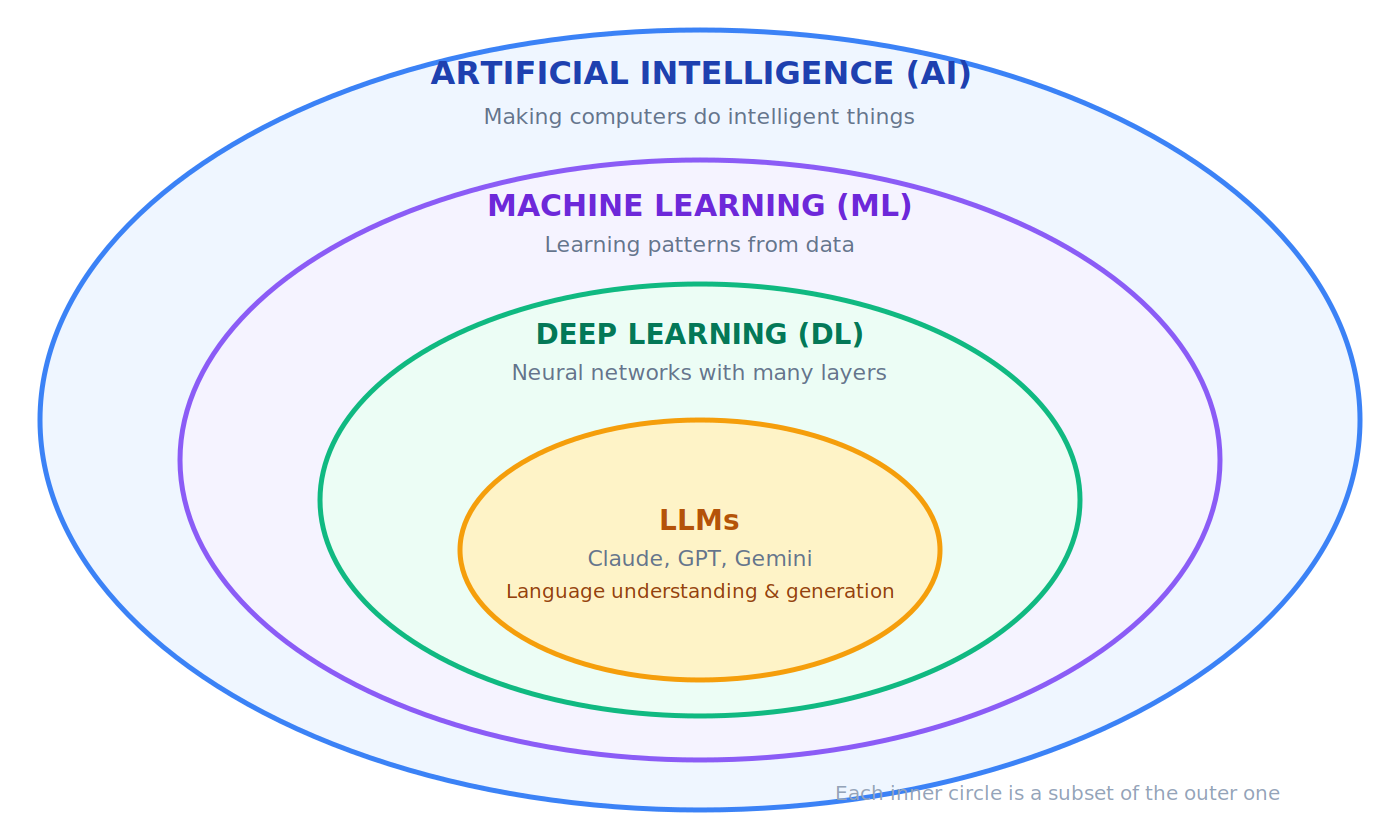
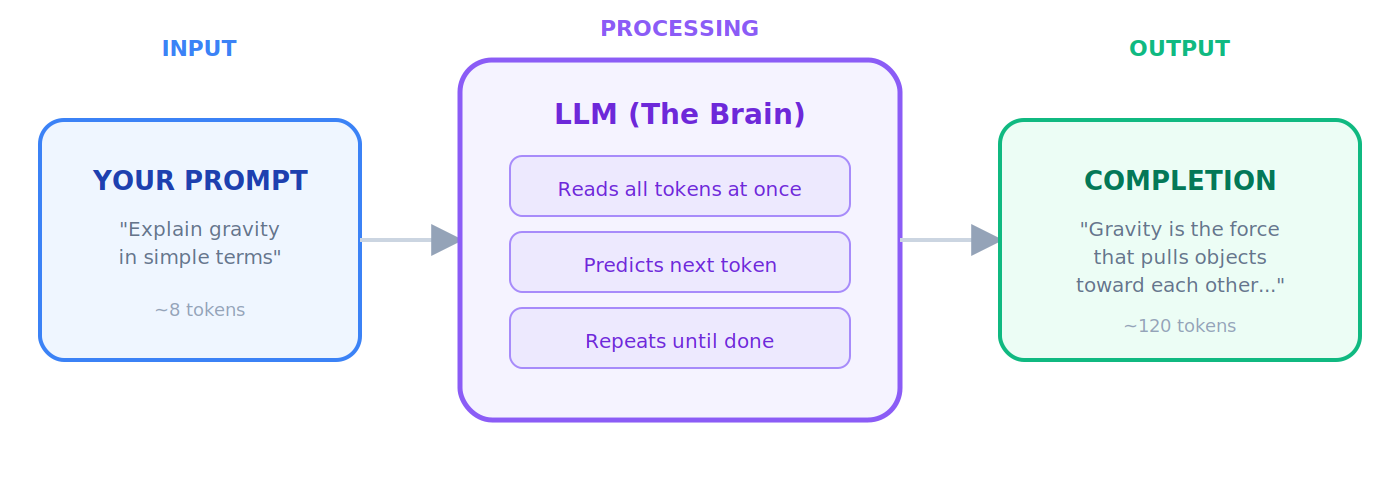
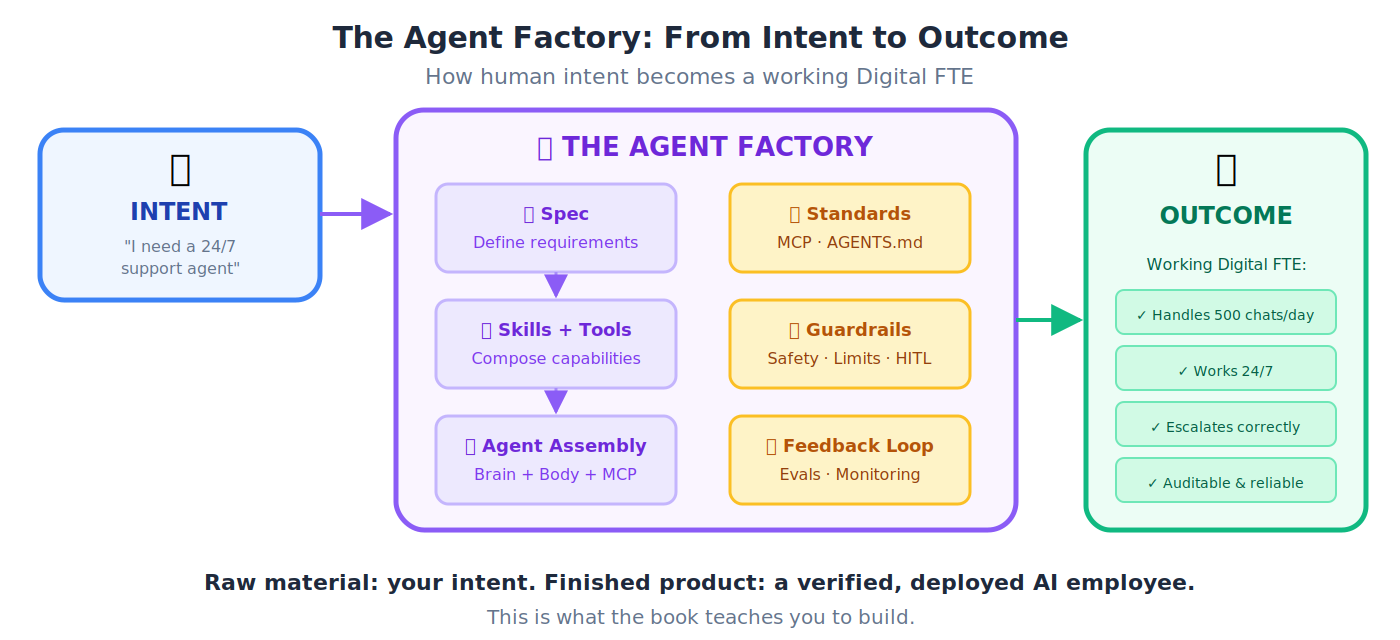
Individual terms mein jane se pehle, yeh samajh lein ke bade concepts aik dusre se kaise relate karte hain:
Top 30 Terms Jo Aap Ko Pehle Samajhni Chahiye
Yeh terms lag bhag har page par aati hain. Chapter 1 shuru karne se pehle inhein zaroor parh lein.
Note: agents as buyers se related terms - ACP, AP2, x402, MPP, authority envelopes, signed mandates - Section 11 mein cover ki gayi hain, is liye Top 30 mein shamil nahin.
1. AI (Artificial Intelligence): Computers se woh kaam karwana jo aam tor par human intelligence maangte hain.
🔹 Jab aap ke phone ka keyboard agla word predict karta hai, woh AI hai.
2. LLM (Large Language Model): Aik bohat bara AI system jo billions of pages ke text par train hota hai, aur human language aur code ko samajh aur generate kar sakta hai. Claude, GPT, aur Gemini LLMs hain.
💡 LLM ko aik research assistant samjhein jis ne duniya ki sab se bari library ki books parhi hui hain. Aap sawal karte hain, woh apni parhi hui knowledge se jawab deta hai.
3. Agent (AI Agent): Aisa AI jo sirf jawab nahin deta. Yeh action leta hai, plans banata hai, aur kaam complete karta hai.
🔹 Chatbot jawab deta hai: "Dubai ki sab se sasti flight kaunsi hai?" Agent airlines search karta hai, prices compare karta hai, aur aap ke liye ticket book bhi kar sakta hai.
4. Agentic AI: AI ki woh category jo aise agents banane par focus karti hai jo plan, reason, aur autonomously act kar sakein. 2026 mein yeh AI ka frontier hai, aur yeh poori kitab isi par focused hai.
🔹 Regular AI: aap sawal karte hain, jawab milta hai. Agentic AI: aap goal dete hain - "customer churn 15% kam karo" - aur yeh research, planning, execution, aur reporting karta hai.
5. Digital FTE (Digital Full-Time Equivalent): Aik "AI employee" jo full-time human worker ka continuous kaam 24/7 karta hai, woh bhi cost ke aik fraction par. Thesis mein isay AI Worker bhi kaha gaya hai - role wahi hai, register alag hai.
🔹 Customer support ke liye Digital FTE roz 500 conversations handle karta hai - yani 5 se 10 human agents ka kaam.
6. Agent Factory: Is kitab ka central concept. Yeh AI Workers ko design, manufacture, aur deploy karne ka spec-driven, human-supervised, Claude-Code-powered process hai. Yeh koi product nahin jo aap khareedte hain; yeh aik practice hai jo aap adopt karte hain. Agent Factory AI-Native Company banati hai, aur AI-Native Company Digital FTEs ko employ karti hai.
💡 Assembly line ki tarah: har station aik specialized task karta hai, parts order se aage barhte hain, aur end par spec ke mutabiq finished product nikalta hai. Agent Factory AI employees banane ke process ko industrialize karti hai.
7. Prompt: Woh instruction ya sawal jo aap AI model ko type karte hain.
🔹 "Is report ko teen bullet points mein summarize karo" aik prompt hai. Behtar prompt = behtar jawab.
8. Context Window: AI ki "working memory": aik waqt mein AI kitna text parh aur soch sakta hai.
💡 Chhoti context window aik chhoti mez jaisi hai jahan sirf chand pages phaila sakte hain. Claude ki bari context window aik conference table jaisi hai jahan poora novel rakh sakte hain.
9. Token: Text ka bunyadi unit jo LLM read karta hai. Taqreeban 3/4 word ke barabar. "I love biryani" about 4 tokens.
🔹 AI APIs use karte waqt payment tokens ke hisaab se hoti hai. Text ka aik full page about 500-700 tokens hota hai.
10. Hallucination: Jab AI confidence ke saath aisi cheez generate kare jo sach nahin hoti.
🔹 Aap Supreme Court case ke bare mein poochte hain aur AI fake judgment aur fake citation numbers bana deta hai. Jawab sahi lagta hai, lekin fabricated hota hai.
11. Spec (Specification): Aik detailed blueprint jo batata hai ke exactly kya build karna hai: goals, inputs, outputs, constraints.
💡 Ghar ke liye architect ka blueprint. Builder andazay se kaam shuru nahin karta; woh plan follow karta hai. AI development mein spec wahi plan hai.
12. Spec-Driven Development (SDD): Pehle blueprint likhna, phir AI se us blueprint se code, tests, aur documentation generate karwana.
🔹 Aap likhte hain: "Bookstore ke liye API banao jisme listing, adding, searching, aur deleting books ke endpoints hon." Claude Code poori application generate kar deta hai.
13. Claude Code: Anthropic ka AI coding agent. Aap terminal mein is se baat karte hain; yeh aap ka poora codebase read karta hai, project samajhta hai, aur code likhta hai.
🔹 Aap type karte hain: "Meri app mein user authentication add karo." Claude Code existing code read karta hai, auth module generate karta hai, tests likhta hai, aur sab integrate karta hai.
14. Cowork: Anthropic ka desktop agent jo non-coding knowledge tasks ke liye hai: documents, research, file management.
🔹 "Mera Downloads folder projects ke hisaab se organize karo aur is month ke PDFs summarize karo." Cowork yeh kaam kar deta hai jab aap doosre kaam par focus karte hain.
15. MCP (Model Context Protocol): Aik universal standard jo kisi bhi AI agent ko external tools se connect karne deta hai: databases, email, calendars, file systems. MCP agents ke tools call karne ka protocol hai. Agents ke tools ke liye payment handle karne wali separate protocol family ke liye Section 11 dekhein: ACP, AP2, x402, aur MPP.
💡 USB se pehle har phone ka charger alag hota tha. MCP AI ke liye "USB standard" hai: aik protocol jo kisi bhi agent ko kisi bhi tool se plug in kar deta hai.
16. API (Application Programming Interface): Rules jo different software programs ko aik dusre se baat karne dete hain. Agents outside world se APIs ke zariye interact karte hain.
💡 Restaurant menu aik API jaisa hai. Aap menu dekhte hain, order dete hain, aur kitchen food deliver karti hai. Aap ko kitchen ke andar ka process nahin pata hota.
17. SDK (Software Development Kit): Aik pre-built toolkit jo kisi specific platform par applications build karne ke liye hota hai.
💡 SDK LEGO set jaisa hai: ready-made pieces aur instructions, taake aap har piece scratch se na banayein.
18. Python: AI ki sab se popular programming language. Readable, versatile, aur is kitab ki primary language.
🔹 Python English jaisi readable hoti hai:
if age > 18: print("Adult"). Isi readability ki wajah se AI world ne Python ko choose kiya.
19. Git: Aisa system jo code mein har change record karta hai: kis ne kya change kiya, kab, aur kyun. Aap hamesha previous version par wapas ja sakte hain.
💡 Microsoft Word ka "Track Changes", lekin poore software projects ke liye. Har edit recoverable hoti hai.
20. Docker: Aisa tool jo aap ki app ko portable box yani container mein package karta hai, taake woh har jagah same tarah chale: laptop, colleague ki machine, ya cloud server.
💡 Shipping container. Chahe truck par Karachi mein ho ya ocean mein ship par, andar ka samaan same rehta hai.
21. Context Engineering: Agent ko milne wale poore information environment ko design karna. Yeh #1 skill hai jo $2,000/month sellable agent ko useless agent se alag karti hai.
💡 Toyota factory mein quality controls hote hain taake har car spec ke mutabiq nikle. Context engineering AI agents ke liye quality control hai.
22. Tool Use: Agent ki yeh ability ke woh external tools use kar sake - web search, databases, emails - sirf memory se jawab na de.
🔹 Aap poochte hain: "Karachi ka weather kya hai?" Tool-use wala agent actual weather service check karta hai. Tool ke baghair woh guess karta.
23. Guardrails: Safety constraints jo agent ko woh kaam karne se rokti hain jo usay nahin karne chahiye.
🔹 Financial agent ka guardrail: Rs. 5,000,000 se upar transaction human approval ke baghair nahin ho sakti. Yeh motorway barriers ki tarah hota hai.
24. RAG (Retrieval-Augmented Generation): AI ko external documents tak access dena, taake woh facts se jawab de, memory se nahin.
💡 Closed-book exam ke bajaye open-book exam. AI jawab dene se pehle aap ke documents mein facts dekh leta hai.
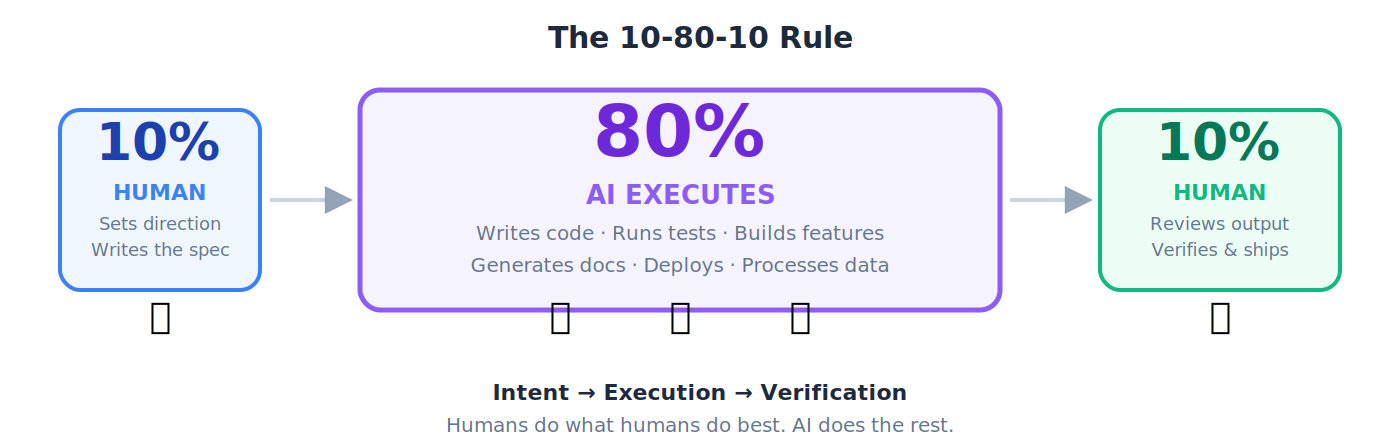
25. 10-80-10 Rule: AI workforce ka operating rhythm: human direction set karta hai (10%) -> AI execute karta hai (80%) -> human verify karta hai (10%).
🔹 Aap project brief likhte hain (10%), Claude Code poori application build karta hai (80%), aap review, test, aur approve karte hain (10%). Industry in do postures ko human in the loop kehti hai, jahan aap har action approve karte hain, aur human on the loop, jahan system act karta hai aur aap dekh kar intervene kar sakte hain. Section 5 mein HITL aur HOTL dekhein.
26. AGENTS.md / CLAUDE.md: Configuration files jo aap ke AI agent ko project ke rules batati hain: coding standards, preferences, architectural decisions.
💡 New employee ko diya jane wala onboarding document: "Hum aise kaam karte hain. Hamara style yeh hai. Yeh cheez kabhi nahin karni." Har interaction mein load hota hai.
27. Orchestration: Multiple agents ko coordinate karna taake woh aik task par mil kar kaam karein.
💡 Cricket team ka captain fielders position karta hai, bowling rotations set karta hai, aur strategy adjust karta hai. Woh sab kuch khud nahin karta; specialists ko coordinate karta hai.
28. Stateless: AI conversations ke darmiyan kuch remember nahin karta. Har new chat absolute zero se start hoti hai.
💡 Aisa shopkeeper jise amnesia ho: aap 5 minutes pehle aaye hon phir bhi woh aap ko stranger ki tarah greet kare. Chat apps memory ka illusion conversation history dobara bhej kar banati hain.
29. Deployment: Application ko live karna taake real users internet par use kar saken.
🔹 App aap ke laptop par chal rahi hai. Deployment usay cloud server par daal deta hai taake 10,000 log simultaneously use kar saken.
30. CI/CD (Continuous Integration / Continuous Delivery): Jab developer change kare to code ka automatically test aur deploy hona.
🔹 Developer 2 PM par code push karta hai. Tests 3 minutes mein run hote hain. Sab pass. 2:10 PM tak new version live: zero manual steps.
Architecture: Runtime Stack
Yeh terms AI-Native Company ke un components ko name karti hain jo Agent Factory produce karti hai. Yeh architecture chapters aur thesis mein baar baar aayengi. Aik dafa yahan parh lein; har build mein phir in se mulaqat hogi.
💡 Pieces kaise fit hote hain: Agent Factory (process) AI-Native Company (output) banati hai. Is company ke andar humans Edge Layer se direction set karte hain, aur Digital FTEs AI Workforce Layer mein execute karte hain. Paperclip workforce manage karta hai. Har Digital FTE apni choice ke runtime engine par chalta hai. Triggers outside world se system ko jagate hain.
AI Worker
AI-Native Company ki workforce. Yeh role-based agents hote hain jo hire, assign, roster, aur retire kiye ja sakte hain. Yeh Digital FTE aur Digital Worker ke same concept hain: thesis AI Worker use karti hai, book Digital FTE use karti hai. Audience ke hisaab se term choose karein.
📌 Workforce vs. staff (load-bearing distinction): Sirf AI Workers workforce hain. Delegate (OpenClaw) aur manager (Paperclip) permanent staff hain, workforce nahin. Runtime engines staff bilkul nahin; yeh woh skills hain jin par workforce run karti hai. Thesis jab agent kehti hai to building mein maujood kisi bhi staff ya workforce ko mean kar sakti hai. Jab AI Worker kehti hai to specifically workforce mean hoti hai.
🔹 Example: Resume-screening AI Worker roz 200 resumes read karta hai, job spec ke against score karta hai, aur top 10 human recruiter ko de deta hai. Yeh AI-Native Company ke HR workforce mein Digital FTE hai - Paperclip ke through hired, rosterable, aur retirable.
AI-Native Company
Agent Factory ka output. Yeh running enterprise hota hai: aik firm jo AI Workers (Digital FTEs) se staffed hoti hai, management plane se coordinated hoti hai, aur edge par humans se directed hoti hai. AI-Native Company woh cheez hai jo aap end mein run karte hain. Book isay Agentic Enterprise bhi kehti hai - same concept ka business-facing naam.
💡 Analogy: Agent Factory process hai, jaise skyscrapers banane ka method. AI-Native Company woh skyscraper hai jo is method se banta hai - woh cheez jo aap actual mein run karte hain.
📌 Triad: Agent Factory (process) -> AI-Native Company (output) -> AI Workers (output ke andar workforce). Teen terms, teen alag roles. Inhein interchangeable na samjhein.
Two-Layer Model
Woh architectural pattern jo Agent Factory thesis ko complete karta hai: humans Edge Layer se intent set karte hain, AI Workers AI Workforce Layer mein execute karte hain, aur specs un dono ke darmiyan contract language hoti hain.
🔹 Example: CEO apne OpenClaw delegate ko kehta hai: "weekly customer-churn report run karo." Delegate yeh task AI Workforce Layer ke Digital FTE ko deta hai. Digital FTE data pull karta hai, report generate karta hai, aur delegate ke through CEO ko verification ke liye wapas deta hai.
Principal
Runtime stack ke top par human: jo intent set karta hai, budget define karta hai, authority envelope draw karta hai, aur outcome own karta hai. Thesis ka Invariant 1. Har legitimate action chain principal se originate hoti hai; jo system principal ke baghair act karta hai woh autonomous nahin, unowned hota hai - na liability, na alignment target, na budget owner, na outcome ka judge.
🔹 Example: CFO spec likhta hai: "Accounts receivable aging ko 20% kam karo, $30K budget ke andar, payment terms change kiye baghair." Is spec mein intent, budget, aur constraints - principal layer - concrete form mein aa jate hain. Delegate (OpenClaw) isay read karta hai aur workforce ko kaam broker karta hai; principal wapas aa kar outcome verify karta hai.
📌 Is ki jagah kya aa sakta hai: kuch nahin. Har doosri layer ki reference implementation change ho sakti hai; principal layer non-transferable hai.
Edge Layer
AI-Native Company ki woh layer jo individual human ko serve karti hai. Har human ke paas Edge par aik agent hota hai - personal identic agent (jaise OpenClaw) - jo us ka context janta hai, us ki taraf se bolta hai, aur downstream work delegate karta hai.
💡 Analogy: Edge Layer chief-of-staff floor hai. Har executive ke liye aik agent, jo company mein usay represent karta hai.
AI Workforce Layer
AI-Native Company ki woh layer jo enterprise ko serve karti hai. Yahin AI Workers (Digital FTEs) live aur execute karte hain - Paperclip ke through managed, runtime engines par running, aur specs ke through coordinated.
💡 Analogy: AI Workforce Layer production floor hai. Bohat se Digital FTEs, har aik specialized kaam karta hua, aur management plane sab ko coordinate karta hua.
Delegate
Edge Layer ka personal agent jo principal ka context hold karta hai, us ki judgment represent karta hai, authority envelope carry karta hai, aur us ki taraf se downstream work broker karta hai. Thesis ka Invariant 2. Delegate ke baghair human bottleneck wapas aa jata hai aur scale typing speed tak gir jata hai. OpenClaw reference implementation hai; koi bhi MCP-speaking personal agent jo identity, context, aur authority hold kare, qualify karta hai.
💡 Analogy: CEO ka chief of staff. Har executive ke liye aik. Priorities janta hai, us ki taraf se bolta hai, aur work right specialists ko route karta hai.
See also: Reference implementation ke liye neeche OpenClaw (as Delegate) dekhein, aur human-sovereignty framing ke liye Section 1 mein Identic AI dekhein.
OpenClaw (as Delegate)
OpenClaw Edge Layer par delegate ki reference implementation hai - "chief of staff" agent jo human ko represent karta hai, us ka context janta hai, aur us ki taraf se bolta hai. AI-Native Company mein har human ko delegate chahiye; OpenClaw isay build karne ka tareeqa hai.
🔹 Example: Jab aap OpenClaw se kehte hain, "mera week summarize karo aur Monday ke liye teen priorities draft karo," yeh calendar, email, aur Slack se information pull karta hai (jin tools ki access authorized hai), aap ki voice mein answer synthesize karta hai, aur kisi bhi action se pehle aap ki approval ka wait karta hai. Yeh machine speed par aap ka representative hai.
See also: Framework ke liye glossary mein pehle wali OpenClaw entry.
Manager (Management Plane)
Orchestrator jo AI Workers ke pile ko workforce mein badalta hai: kaam assign karta hai, budgets enforce karta hai, risky moves approve karta hai, execution audit karta hai, ledger maintain karta hai, aur hiring ko callable API ke taur par expose karta hai. Thesis ka Invariant 3. Is ke baghair agents collide karte hain, budgets leak hote hain, aur koi yeh nahin bata sakta ke workforce ne cost kya kiya aur produce kya kiya. Paperclip reference implementation hai; management contract meet karne wala koi bhi orchestrator qualify karta hai.
💡 Analogy: Agar delegate chief of staff hai, to manager chief operating officer hai. Human ke saath one-to-one, workforce ke saath one-to-many.
See also: Reference implementation ke liye neeche Paperclip.
Paperclip
AI-Native Company ka management plane. Paperclip COO hai - Digital FTEs hire karta hai, unhein kaam assign karta hai, budgets enforce karta hai, risky moves approve karta hai, aur ledger maintain karta hai. Yeh hiring ko API ke taur par expose karta hai jise authorized agent call kar sakta hai; isi se workforce demand ke mutabiq grow hoti hai.
💡 Analogy: Agar OpenClaw chief of staff hai, to Paperclip chief operating officer hai. Human ke saath one-to-one, workforce ke saath one-to-many.
🔹 Example: Aik customer Bahasa Indonesia mein message likhta hai. Roster par koi Digital FTE woh zuban nahin janta. Paperclip capability gap detect karta hai aur authority envelope ke andar apni hiring API call karke naya Bahasa-speaking Digital FTE manufacture karta hai. Naya worker message read karke reply deta hai. Human ko jagana nahin parta.
Meta-Layer (Hiring as a Callable Capability)
Woh layer jo hiring ko API ke taur par expose karti hai, jise koi bhi authorized agent runtime par naya AI Worker provision karne ke liye call kar sakta hai - principal ke authority envelope ke andar, human ko jagaye baghair. Thesis ka Invariant 5. Yeh frozen-roster problem solve karti hai: jab capability gap aaye, workforce policy ke andar demand par staff up kar leti hai. Claude Managed Agents reference implementation hai; koi bhi managed-agent API jo runtime par agent generate aur environment provision kar sake, qualify karti hai.
🔹 Example: Paperclip ke under Bahasa Indonesia trace mein meta-layer fire hoti hai. Paperclip gap detect karta hai; meta-layer ki hiring API naya Worker manufacture karti hai; Worker manager ke saath register hota hai aur roster par reh jata hai.
📌 Dual role: Claude Managed Agents engine option (Invariant 4) bhi hai aur meta-layer (Invariant 5) bhi. Jo runtime-provisioning capability Worker chalati hai wahi naye Workers create bhi karti hai; isi liye meta-layer callable hai, batch-provisioned nahin.
Runtime Engine
Execution substrate jahan Digital FTE run karta hai. Har Digital FTE apne job ki demand ke mutabiq apna engine choose karta hai - company ke liye aik engine nahin. Options mein Dapr Agents (mission-critical work ke liye durable execution), Claude Managed Agents (hosted aur operated for you), OpenAI Agents SDK (self-hosted, portable), aur OpenClaw-native (lightweight, fast to deploy) shamil hain. Internally har engine ke do planes hote hain: harness (control plane) aur compute plane (execution plane / sandbox). Agli do entries dekhein.
💡 Analogy: Runtime engine employee ki job skillset hai. Heart-surgery team ki nurse ko clinic nurse se different skills chahiye. Role same ho sakta hai, engine alag.
Harness (Agent Harness)
Agent engine ka control plane: model ke gird woh sab kuch jo usay working system banata hai. Is mein agent loop, tool dispatch, approvals, tracing, context management, recovery, instructions, skills, aur validators shamil hain. Practitioner shorthand: Agent = Model + Harness. Model woh brain hai jo aap frontier lab se rent karte hain; harness us brain ke gird body, workplace, aur standard operating procedure hai. Compute plane (sandbox) harness ke andar nahin, us ke saath hota hai. Credentials harness mein rehte hain; model-generated code sandbox mein run hota hai.
💡 Analogy: Agar model CPU hai aur context window RAM hai, to harness operating system hai: boot karta hai, drivers yani tools dispatch karta hai, context curate karta hai, aur agent lifecycle manage karta hai. Aap ka agent code us ke upar application ki tarah run karta hai.
🔹 Examples: Claude Agent SDK aik harness hai jo aap assemble karte hain. OpenClaw aik harness hai jise aap skills ke zariye extend karte hain. Claude Code, Cursor, aur Codex coding work ke liye tuned harnesses hain. Claude Managed Agents woh harness hai jo Anthropic stable interfaces ke peeche aap ke liye run karta hai.
📌 Lineage: Yeh word test harness se evolve hua - software engineering ka scaffolding jo code ko test ke liye drive karta hai - phir eval harness - benchmark ke through model drive karne ka scaffolding - aur phir agent harness - real-world work ke through model drive karne ka scaffolding. Teeno mein actual kaam karne wali cheez ke gird scaffolding hoti hai.
Compute Plane / Sandbox Runtime
Execution plane jo harness ke saath hota hai: secure sandbox jahan model-generated code actual mein run hota hai - files read karta hai, commands execute karta hai, artifacts write karta hai. Yeh neeche wali cloud infrastructure se alag hai (metal, Kubernetes, networking), aur side mein harness se bhi alag hai (orchestration logic). Yeh split security aur portability ke liye load-bearing hai: credentials harness mein rehte hain, model-directed code sandbox mein run hota hai, aur sandbox vendor - E2B, Cloudflare, Daytona, Modal, Runloop, Vercel, Blaxel, ya aap ka apna Kubernetes - agent rewrite kiye baghair replace ho sakta hai.
🔹 Example: OpenAI Agents SDK harness hai; compute plane aap separately choose karte hain. Claude Managed Agents dono ko aik API ke peeche fuse karta hai. Dapr Agents Kubernetes ko compute plane assume karta hai.
📌 Teen cheezen jinhein "runtime" kaha jata hai: language runtime (Node.js, Python interpreter) pure infrastructure hai. Execution runtime / sandbox yeh entry hai. Agent runtime kabhi kabhi harness ka synonym use hota hai. Vendor docs parhte waqt is conflation ko watch karein.
Trigger
Woh tareeqa jis se outside world AI-Native Company ko motion mein laati hai - schedule due hota hai, webhook aata hai, API call land hoti hai, customer enter karta hai. Claude Code Routines reference implementation hai: yeh har external event ko session mein convert karta hai jo delegate ko jagata hai aur chain fire karta hai. Triggers ke baghair system sirf tab move karta hai jab human prompt type kare - jo company nahin, extra steps wali assistant hoti hai.
🔹 Example: Har Monday 9 a.m. par scheduled trigger OpenClaw ko jagata hai, jo Paperclip se weekly customer-health report run karwata hai. Digital FTE data pull karta hai, report generate karta hai, aur executive team ko email karta hai. Human ne trigger aik dafa configure kiya; system us ke baad khud chalta hai.
Summary
Yaad rakhne ke liye aik one-sentence taxonomy:
Agent Factory (process) AI-Native Company (output) banati hai. AI-Native Company AI Workers (workforce) employ karti hai, jo Two-Layer Model mein operate karte hain: humans Edge Layer par (OpenClaw delegate ke through), Digital FTEs AI Workforce Layer mein (Paperclip se managed), har worker apne choice ke runtime engine par running, aur outside world ke triggers se woken.
Yeh aap last line ke taur par add kar sakte hain.
Ab aap reading shuru karne ke liye kaafi samajh chuke hain. Neeche full glossary har term ko aur detail mein explain karti hai, aur 250+ additional terms cover karti hai.
1. The Agent Factory: Book-Specific Terms
Yeh is kitab ke unique concepts aur vocabulary hain. Aap Chapter 1 se inhein dekhna shuru karenge, is liye yeh sab se pehle diye gaye hain.
Agent Factory
Process. Woh spec-driven, human-supervised, Claude-Code-powered method jis ke zariye AI Workers design, manufacture, aur deploy kiye jate hain. Raw material human intent hota hai; finished product verified outcome hota hai. Agent Factory AI-Native Company banati hai, aur AI-Native Company AI Workers (Digital FTEs) ko employ karti hai.
📌 Practice, product nahin. Agent Factory koi cheez nahin jo aap buy ya install karte hain. Yeh aik practice hai jo aap operate karna seekhte hain. Book practice sikhati hai; AI-Native Company woh cheez hai jo aap is practice ko operate karne ke baad run karte hain.
💡 Analogy: Car factory raw steel leti hai aur finished cars produce karti hai. Agent Factory aap ka business intent leti hai - "mujhe 24/7 customer support agent chahiye" - aur finished, working Digital FTE produce karti hai.
Industrialized Stack
Thesis ka three-layer framing jo batata hai ke Agent Factory mein value kaise move karti hai: Intent (goals, constraints, budgets, permissions ka high-level blueprint) -> Production Engine (architecture jo intent ko outcomes mein transform karti hai) -> Outcome (high-fidelity actions aur artifacts, jo accuracy ke liye verify aur feedback loops se improve kiye jate hain).
🔹 Example: CFO ka directive - "AR aging ko $30K budget ke andar 20% kam karo" - intent hai. OpenClaw -> Paperclip -> AI Workers ki chain jo engines par run karti hai, Production Engine hai. Verified aur ledger-updated days-sales-outstanding reduction outcome hai.
Production Engine
Industrialized Stack ke andar woh mechanism jo intent ko outcome mein transform karta hai. Yeh app nahin jo aap download karte hain; yeh architecture hai: spec-driven instructions, role-based AI Workers, packaged skills, tools se connect karne ke liye MCP, aur quality gap close karne wale feedback loops. Thesis isay "is poori thesis ka sab se important idea" kehti hai.
💡 Analogy: Car factory ki assembly line. Raw steel aik side se andar jata hai, finished car doosri side se nikalti hai. Har station aik specialized job karta hai, parts order se move karte hain, aur result delivery se pehle verify hota hai. Production Engine bhi aise hi kaam karta hai: intent in, verified outcome out, aur AI Workers specialized stations ke taur par.
Six Invariants
Woh structural rules jo AI-Native Company ko runnable banate hain: (1) Principal: human principal hai; (2) Delegate: har human ko delegate chahiye; (3) Manager: workforce ko manager chahiye; (4) Engine: har Worker apna engine choose karta hai; (5) Meta: workforce policy ke andar expandable hai; (6) Trigger: duniya system ko call karti hai. Har invariant company ke run hone ka rule hai; aaj ke named products jo inhein realize karte hain - OpenClaw, Paperclip, Claude Managed Agents, Inngest - kal replace ho sakte hain bina architecture badle.
📌 Har invariant ka full claim, absent hone par failure mode, aur current realization ke liye thesis dekhein.
Invariant vs. Reference Implementation
Thesis ka framing trick. Invariant woh structural requirement hai jo system ke har version mein true rehti hai, chahe usay realize karne wala product kaunsa bhi ho. Reference implementation woh concrete product hai jo 2026 mein kisi invariant ko realize karta hai. Invariants thesis hain; named products is saal ke best-fit examples hain. Jab koi product name hota hai - OpenClaw, Paperclip, Claude Managed Agents, Inngest - to invariant rule hota hai aur product us rule ka aik instance.
💡 Analogy: "Ghar mein enter aur exit karne ka tareeqa hona chahiye" invariant hai. "Brass handles wali mahogany double doors" reference implementation hai. Agle saal doors replace kar dein, ghar phir bhi kaam karta hai; entry/exit invariant hata dein, ghar ghar nahin rehta.
🔹 Example: Invariant 4 kehta hai: "har AI Worker apna engine choose karta hai." 2026 ki reference implementations Dapr Agents, Claude Managed Agents, OpenAI Agents SDK, aur OpenClaw-native hain. Inhein agle saal replace kar dein, invariant phir bhi same rehta hai.
Digital Twin
Is book mein, digital twin aik governed AI agent hai jo kisi real expert ki identity, teaching method, judgment, aur governed knowledge ko agent mein encode karta hai. Yeh engineering meaning se alag hai, jahan digital twin kisi physical machine ya system ka virtual representation hota hai. Zia Tutor AI Layer 2 ka reference example hai; har vertical apna expert twin bana sakta hai. Paanch layers mein expert twin kahan baithta hai, yeh dekhne ke liye the FDE AF Model dekhein.
Digital FTE (Digital Full-Time Equivalent)
Aik "AI employee" jo full-time human worker ka continuous kaam 24/7 karta hai, cost ke aik fraction par. Digital FTE haftay ke 168 hours zero fatigue ke saath kaam karta hai. Thesis ke AI Worker ke same role mein: hired, assigned, rostered, retired. Delegate (OpenClaw) aur manager (Paperclip) se distinct hai, kyun ke woh permanent staff hain, workforce nahin. Runtime stack mein Digital FTEs ka fit Architecture section mein dekhein.
🔹 Example: Customer support ka Digital FTE roz 500 conversations handle karta hai - yani 5 se 10 human agents ka kaam.
Digital Worker / AI Employee
Digital FTE ke synonyms. Aisa AI agent jo organization ke andar sustained, role-based work karta hai; one-off chatbot nahin, balki permanent team member.
Spec / Specification
Aik detailed written description jo exactly batati hai ke kya build hona chahiye: goals, constraints, inputs, expected outputs, aur behavior. Yeh AI ka "blueprint" hota hai.
💡 Analogy: Spec architect ke blueprint ki tarah hoti hai. Builder guess karke construction start nahin karta. Woh detailed plans follow karta hai. AI development mein spec plan hai, aur AI builder.
Spec-Driven Development (SDD)
Development methodology jahan pehle detailed specification likhi jati hai, phir AI us spec se code, tests, aur documentation generate karta hai. Source of truth spec hoti hai, code nahin.
📌 Four phases: Research -> Specification -> Refinement -> Implementation.
🔹 Example: Aap bookstore ke liye REST API chahte hain. Coding ke bajaye spec likhte hain: "API mein books list karne, book add karne, author se search karne, aur ISBN se delete karne ke endpoints hon. Har book mein title, author, ISBN, price, aur stock count ho. Inputs validate hon. Response JSON ho." Aap yeh spec Claude Code ko dete hain, aur woh poori FastAPI application, tests, aur documentation generate kar deta hai.
💡 Analogy: Spec architect ka blueprint hai. Construction company andazay se house build nahin karti. SDD mein spec plan hai, aur AI construction crew.
Test-Driven Generation (TDG)
SDD ki Python-specific form. Aap pehle tests likhte hain - yani code ko kya karna chahiye define karte hain - phir Claude Code se woh code generate karwate hain jo tests pass kare.
💡 Analogy: Cake bake karne se pehle aap likhte hain perfect cake kaisa hoga: height, texture, taste. Phir recipe try karte hain. Agar cake criteria match nahin karta, aap dobara try karte hain. Criteria tests hain; recipe generated code.
10-80-10 Rule
AI workforce ka operating rhythm: human pehla 10% deta hai (intent aur direction), AI middle 80% handle karta hai (execution), aur human final 10% ke liye wapas aata hai (verification aur judgment).
📌 Origin: Steve Jobs Apple mein yeh pattern follow karte thay: vision set karo (10%), team ko build karne do (80%), phir polish aur ship karne ke liye wapas aao (10%). Ab "team" ki jagah "AI employees" rakh dein.
AGENTS.md / CLAUDE.md
Configuration files jo AI coding agent ko persistent context deti hain. In mein project rules, coding standards, architectural decisions, aur preferences hoti hain, jo har interaction mein load hoti hain.
💡 Analogy: Jab new employee team join karta hai to aap usay onboarding document dete hain: "Hum aise kaam karte hain. Hamara coding style yeh hai. Yeh cheez kabhi nahin karni." AGENTS.md AI agent ke liye wahi onboarding document hai.
SPEC.md
Aik specific file jisme project ki detailed specification hoti hai. Software ko kya karna chahiye, is ka single source of truth.
🔹 Example: Aap ka SPEC.md keh sakta hai: "Restaurant ke liye WhatsApp chatbot banao. Menu dikhaye, orders le, delivery address confirm kare, GST ke saath total calculate kare, aur order confirmation bheje. Maximum response time: 2 seconds. Language: Urdu aur English."
SKILL.md
Aik file jo AI agent ke liye reusable capability yani skill package karti hai. Is mein kisi specific task ke instructions, best practices, aur templates hoti hain - jaise PDFs generate karna ya Docker containers deploy karna.
🔹 Example: Docker SKILL.md mein yeh ho sakta hai: "FastAPI app ko containerize karte waqt hamesha multi-stage build use karo. Base image: python:3.12-slim. Health check endpoint zaroor include karo. Root user ke taur par run kabhi na karo." Agent har Docker task mein is skill file ko read karke automatically yeh practices follow karta hai.
Skill Library
SKILL.md files ka collection jahan se AI agent expertise le sakta hai, bilkul employee ki reference library ki tarah.
Agent Skills
AI agent ki specific capabilities, jo us ke tools, knowledge, aur SKILL.md files se define hoti hain.
🔹 Example: Human employee ke skills "Excel proficiency" ya "contract negotiation" ho sakte hain. AI agent ke skills "PDF generation", "database querying", ya "email drafting" ho sakte hain.
Agent Triangle
Is kitab ka framework jo kehta hai ke har effective agent ko teen cheezen chahiye: (1) clear role, (2) specific tools, aur (3) well-defined constraints. In mein se aik bhi missing ho to agent underperform karta hai.
Body + Brain
Agent architecture pattern. Brain LLM hai jo reason aur decisions karta hai. Body execution layer hai - tools, APIs, infrastructure - jo decisions ko action mein badalti hai.
💡 Analogy: Aap ka brain decide karta hai: "mujhe glass uthana hai." Aap ka haath (body) action execute karta hai. AI agent mein Claude (brain) decide karta hai: "mujhe database query karni hai," aur NanoClaw (body) query execute karta hai.
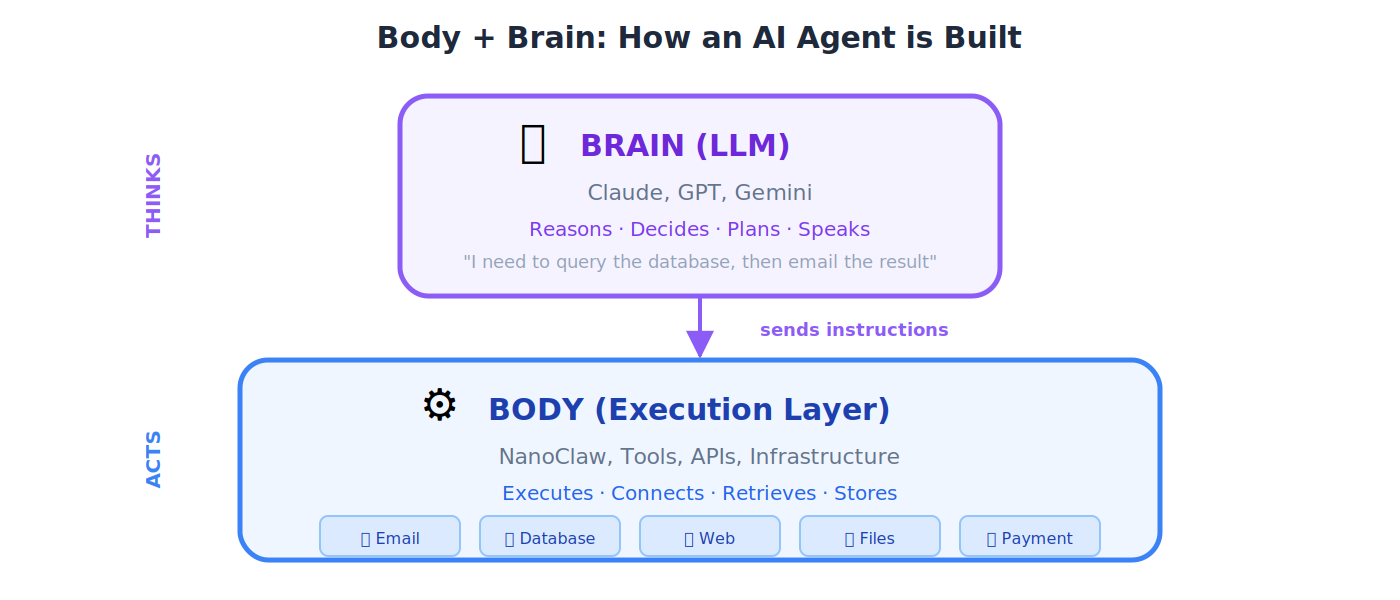
NanoClaw
OpenClaw architecture mein lightweight container runtime jo agent ki "Body" ka kaam karta hai: tasks execute karta hai, tools run karta hai, aur agent ka environment manage karta hai.
💡 Analogy: Agar LLM (Brain) pilot hai jo decide karta hai kahan fly karna hai, to NanoClaw (Body) airplane hai jo actual flight carry out karta hai: engines, wings, controls, sab kuch.
OpenClaw
Agent-powered applications build karne ke liye open-source application framework. Thesis architecture mein OpenClaw Edge Layer ka delegate hai - "chief of staff" agent jo human ko represent karta hai, us ka context janta hai, aur us ki taraf se bolta hai. NanoClaw us ka container-based execution layer hai.
TutorClaw
WhatsApp ke zariye delivered 24/7 AI tutor, jo Agent Factory architecture par built hai. TutorClaw is book ko apna system of record banata hai - probabilistic generation ke bajaye verified knowledge se sikhata hai. Yeh book ka pehla Digital FTE hai, aur Agent Factory ke AI Workers produce karne ka live example hai.
Claude Code
Anthropic ka AI coding agent, jo terminal/command line se run hota hai. Yeh aap ka poora codebase read karta hai, project context samajhta hai, aur specifications ki bunyaad par code generate karta hai. Is book ka primary development tool.
Cowork
Anthropic ka desktop agent jo non-coding knowledge tasks ke liye hai: document management, research, aur file organization. Isay apna AI office assistant samjhein.
Dispatch
Aisi feature jo aap ko phone se Cowork ko kaam assign karne deti hai. Aap commute karte hue task bhejte hain; Claude desktop par kaam karta hai. Jab finish hota hai, aap ko push notification milti hai.
💡 Analogy: Dispatch Cowork ko us tool se employee mein badal deti hai jo aap remotely manage karte hain - jaise meeting mein baithe baithe assistant ko text karna: "report prepare kar do."
Computer Use
Research preview feature jahan Claude macOS par aap ki screen dekh aur control kar sakta hai - buttons click karna, applications mein type karna, interfaces navigate karna - bilkul remote employee ki tarah.
🔹 Example: Aap Claude ko kehte hain: "Desktop par spreadsheet open karo, Q3 revenue column in numbers se update karo, phir finance team ko email kar do." Claude screen dekhta hai, Excel open karta hai, data type karta hai, email client kholta hai, aur bhej deta hai - jaise human assistant computer par baitha ho.
Claude Desktop
Claude ke saath interact karne ki desktop application, jo Cowork, Computer Use, aur Dispatch features host karti hai.
Hooks
Automated actions jo Claude Code ke kuch operations se pehle ya baad trigger hote hain - jaise har file save ke baad automatic code formatting, ya har commit se pehle tests run karna.
💡 Analogy: Assistant ko standing instructions: "Har letter likhne ke baad mujhe dikhane se pehle spell-check run karna."
Subagents
Specialist agents jinhein Claude Code kisi large project ke specific subtasks handle karne ke liye spawn kar sakta hai. Har subagent ka apna focused context hota hai.
💡 Analogy: Project manager (main agent) design kaam graphic designer (subagent) ko deta hai, aur accounting bookkeeper (subagent) ko. Har specialist apni specialty par focus karta hai.
Tasks System
Claude Code ka built-in feature jo multiple sessions ke darmiyan persistent state manage karta hai: kya complete ho chuka hai, kya pending hai, aur next kya hai.
Context Engineering
Digital FTE manufacturing ka quality-control discipline. Agent ko milne wale poore information environment ko design karna taake output consistent aur high-quality rahe. Yeh #1 skill hai jo $2,000/month sellable agent ko useless agent se alag karti hai.
💡 Analogy: Toyota factory mein systematic quality controls hote hain taake har car specification meet kare. Context engineering ensure karti hai ke aap ke Digital FTEs consistent, sellable value deliver karein.
Context Injection
AI ke context window mein relevant external information ko response generate karne se bilkul pehle insert karna, taake model ko right waqt par right information mile.
💡 Analogy: Lawyer court mein jane se pehle assistant se relevant case files ka folder leta hai. Context injection AI ke liye wahi kaam karti hai.
Context Isolation
Long previous session ki confused ya contradictory state ko carry forward karne ke bajaye fresh, clean context se new session start karna.
💡 Analogy: Jab desk itni cluttered ho jaye ke sochna mushkil ho, aap sab hata kar fresh start karte hain. Context isolation AI ke liye wahi clean slate hai.
Harness Engineering
AI agent ke gird environment design aur continuously improve karne ka discipline, taake agent useful work reliably aur bina constant supervision ke kar sake. Yeh progression ka third layer hai: prompt engineering aik exchange optimize karti hai, context engineering model ko aik waqt mein dikhne wali information manage karti hai, aur harness engineering woh execution environment build karti hai jahan agent hundreds of decisions mein operate karta hai. Early 2026 mein Mitchell Hashimoto ne is practice ko crystalize kiya: jab bhi agent mistake kare, agent ke environment mein permanent fix engineer karo. OpenAI aur Anthropic ne bhi weeks ke andar related articles publish kiye. Slogan: agent ko fix na karo, us duniya ko fix karo jahan agent rehta hai.
💡 Analogy: Prompt fixes bandaids hain; harness fixes vaccines. Prompt fix aik failure instance solve karta hai. Harness fix - tool, validator, skill, check, instruction add karna - future agents ke liye us failure class ko permanently close karta hai.
🔹 Example: TutorClaw beginner ko bohat harsh feedback deta hai. Naive fix prompt rewrite karna hai. Harness fix tone-check skill add karna hai jo output ko rubric se gate kare. Future TutorClaw answers bhi us se pass honge.
📌 OpenClaw mein: Harness extension ki unit SKILL.md file hai. Har skill jo students likhte hain harness engineering artifact hai, aur wahi Hashimoto loop apply hota hai: failure observe karo -> poochho yeh possible kyun tha -> permanent fix engineer karo -> verify karo ke fix compound hota hai.
Progress Files
Files jo multiple Claude Code sessions ke across long-running project ki state track karti hain: kya complete hua, kya decisions liye gaye, aur next kya hai.
💡 Analogy: Construction site ka logbook. Har din foreman likhta hai kya build hua, kya problems aayi, kal ka plan kya hai. New crew aaye to log read karke seamless continue kar leti hai.
Session Architecture
Large project ke liye AI agent ke saath multiple sessions ko structure aur sequence karne ka design: kab fresh start karna hai, kab context carry forward karna hai, aur kya preserve karna hai.
🔹 Example: 30-chapter book project mein poori book aik session mein dump nahin karte. Architecture design karte hain: Session 1 outline, Session 2 Chapter 1 (outline context ke saath), Session 3 Chapter 2 (outline + Chapter 1 summary ke saath), aur aise hi. Har session ko exactly jitna context chahiye, utna milta hai.
Five Powers
Woh paanch capabilities jo traditional user interfaces se autonomous AI agents ki shift enable karti hain: (1) natural language understanding, (2) reasoning, (3) tool use, (4) memory, aur (5) planning. Mil kar yeh agents ko intent samajhne aur independently execute karne ki ability deti hain.
💡 Analogy: Capable human assistant sochiye: woh samajhta hai, sochta hai, tools use karta hai, preferences yaad rakhta hai, aur multi-step projects plan karta hai. Five Powers wala AI agent bhi yahi kar sakta hai.
Agent Maturity Model
Aik five-level framework jo organization ki AI adoption stages describe karta hai:
| Level | Naam | Wazahat |
|---|---|---|
| 1 | Experimental | Individual developers AI coding tools try kar rahe hain |
| 2 | Standardized | Organization-wide adoption governance ke saath |
| 3 | AI-Driven | Specs living documentation ban jati hain; workflows redesign hote hain |
| 4 | AI-Native | Products jahan AI/LLMs core components hain |
| 5 | Autonomous | Puri organization AI-native; self-improving systems |
AI-Assisted Development
AI ko helper ya copilot ke taur par use karna: code completion, bug detection, documentation generation. Human ab bhi zyada code khud likhta hai.
🔹 Example: GitHub Copilot typing ke dauran next line of code suggest karta hai.
AI-Driven Development
AI human-written specifications se significant code generate karta hai. Human architect, director, aur reviewer hota hai - typist nahin.
🔹 Example: Aap SPEC.md mein REST API describe karte hain, aur Claude Code poori FastAPI application, tests, aur documentation generate karta hai.
AI-Native Development
Aisi applications jo AI capabilities ke gird ground up se architect ki jati hain: AI feature ke taur par add nahin hota; product ka core hota hai.
🔹 Example: TutorClaw textbook ke saath chatbot chipkaya hua nahin. AI tutor hi product hai. Puri architecture LLM capabilities ke gird built hai.
Nine Pillars of AIDD
AI-Driven Development ke nau foundational principles, jaisa ke is book mein define kiya gaya hai: specification-first design se continuous verification tak.
OODA Loop (Observe, Orient, Decide, Act)
AI agents ke saath kaam karne par applied rapid decision-making cycle. Aap agent ka output observe karte hain, spec ke against check karke orient karte hain, accept ya redirect ka decide karte hain, aur approve ya new instructions de kar act karte hain.
📌 Origin: Military strategy framework jo fighter pilot John Boyd ne develop kiya tha; ab AI-driven work ke fast iterative cycles par apply hota hai.
PRIMM-AI+
Pedagogical framework jo is book mein use hota hai: Predict code kya karega -> Run it -> output Investigate karo -> code Modify karo -> apna version Make karo. "AI+" ka matlab AI har step mein embedded hai.
AI Gravity
Woh lagataar pull jo aap ko apni soch ka aur zyada hissa AI ko dene ki taraf le jata hai. MIT Sloan ke professor Eric So ne isay yeh naam diya. Yeh teen directions se aik saath aata hai: aap ka dimagh energy bachana chahta hai, aap chahte hain ke kaam expert-level lage, aur aap dekh nahin sakte ke peers AI kitna use kar rahe hain. How to Think in the AI Era crash course isi force ke khilaf train karata hai.
💡 Analogy: Real gravity: aap isay dekh nahin sakte, yeh kabhi off nahin hoti, aur sab ko kheenchti hai. Aap pull notice nahin karte; sirf mahino baad yeh notice hota hai ke AI kholne se pehle apni rai banana band ho gaya.
🔹 Example: Do logon ko same task aur same AI tools milte hain. Aik pehle apna answer likhti hai, phir AI se compare karti hai. Doosri AI kholti hai, poochti hai, aur accept kar leti hai; lazy hone ki wajah se nahin, balkay is liye ke teen quiet forces usay aik hi direction mein dhakel rahi hoti hain. Wohi pull AI gravity hai.
Cognitive Capital
Aap ki thinking muscle: problem par kaam karne, wrong answer pakarne, aur confident answer ne kya chhoda hai yeh notice karne ki built-up ability. Eric So ka term us cheez ke liye jise AI gravity kharch karti hai jab aap answers bina check kiye accept karte hain.
🔹 Example: MIT Media Lab ki aik early study mein, ChatGPT ki madad se essays likhne wale 100 mein se 83 log apne abhi submit kiye hue essay ki aik bhi sentence repeat nahin kar sake. Words un ke dimagh se guzray hi nahin; yeh cognitive capital ka use na hona hai, jab tak woh fade ho jaye.
📌 Is book ke liye yeh kyun matter karta hai: 10-80-10 Rule tabhi kaam karta hai jab human ke dono 10 sharp rahen. Cognitive capital unhein sharp rakhta hai; supervisor jo agent ki ghalti pehchan nahin sakta, aakhri 10% hold nahin kar sakta.
Identic AI
Aisa concept jahan har human ke paas personal AI agent hota hai jo us ki judgment, preferences, aur authority reflect karta hai: multiple AI systems mein us ki taraf se tasks delegate karta hai. Is book ki reference architecture mein OpenClaw identic AI hai - Edge Layer ka delegate.
💡 Analogy: CEO ka executive assistant jo CEO ki priorities aur decision-making style itni achhi tarah janta hai ke us ki taraf se act kar sakta hai. Identic AI iska AI version hai: Agent Factory mein aap ka personal representative.
System of Record / Source of Truth
Aik authoritative data source jis par sab accurate hone ke liye trust karte hain. Jab conflicting versions hon, system of record final word hota hai.
🔹 Example: Agar company ke HR system mein employee salary Rs. 200,000 hai lekin spreadsheet mein Rs. 180,000, to HR system system of record hai.
Workflow Archaeology
Real cases aur expert interviews ke zariye profession ke mojooda workflow ka mutalea, taake uske asal rules, controls, evidence, exceptions aur reasons samne aayein. Purana kaam profession ke baare mein evidence hai, uske mustaqbil ka design nahin. Ise istemaal karne wala method Vertical System of Record Design Karna hai.
💡 Analogy: Archaeologist purane shehar ko bilkul waisa dobara nahin banata. Woh khudaai karta hai taake samjhe log asal mein kaise rehte the, phir seekhi hui baat likhta hai. Khudaai point hai; ruins plan nahin.
🔹 Example: Likhi hui checklist kehti hai "har balance tick karein." Archaeology poochti hai ke senior accountant kya check karti hai jiska checklist zikr nahin karti, kaun se steps chupke se skip karti hai, aur kaun sa chhota farq use asal masle ka pehla ishara lagta hai. Yehi answers rakhne layaq hain.
Invariant (Domain)
Aisa rule jo har case mein true rehna chahiye, chahe workflow, software, organization ya customer badal jaye. Sirf mufeed rule guidance hai; jis rule ki khilaaf-warzi result ko invalid, ghair-qanooni ya ghair-bharosemand bana de woh invariant hai. Thesis ke Six Invariants se alag, jo AI-Native Company chalne ke structural rules hain: domain invariant khud professional work ka rule hai.
🔹 Example: "Payment tayyar karne wala use approve nahin kar sakta." Rule tore to result sirf badtar nahin, invalid hai.
Three-Bin Sort
Pre-agentic workflow se agentic-era procedures nikalne ka method. Purane workflow ke har element par poochein ke woh kyun hai. Bin 1, law aur trust use maangte hain: rakhein. Bin 2, human limits use maangti hain: un limits ke baghair Worker ke liye redesign karein. Bin 3, purani technology use maangti thi: delete karein. Har naya reflex outcome aur Bin 1 ke gird banta hai, Bin 2 ke sachay purposes Worker capabilities aur checks ke tor par wapas aate hain, aur har sorting decision governed content mein record hota hai.
📌 Sab se teekhi refinement: control ka purpose Bin 1 hai; uska mechanism aam tor par Bin 2. "Manager har transaction review karta hai" purpose rakhta hai, risk controlled rehta hai, aur mechanism redesign karta hai, routine cases automated checks se pass hote hain aur manager ki tawajjuh exceptions par jati hai.
Outcome Contract
Aik professional outcome ki likhi hui definition: result, trigger, inputs, evidence, acceptance criteria, main number aur guardrails, forbidden actions, final human authority aur retained record. Purane workflow ke mutale se pehle likha jata hai aur pehle Worker ke contract of success ka seed banta hai.
🔹 Example: Kamzor: "invoice review automate karein." Mazboot: "faisla karein ke invoice valid, supported, sahi coded, authorization limits ke andar aur payment ke liye ready hai ya wazeh tor par exception handling ko bhejna hai."
Evidence State
Certainty label jo Worker ki file mein kisi aham field ke saath hota hai: confirmed, indicated, inferred, unknown, contradicted, ya outdated. Evidence states system ko har stored field ko jhooti certainty ke saath dikhane se rokte hain.
🔹 Example: CRM dikhata hai "budget: confirmed", magar kisi call transcript mein customer ne budget par kuch nahin kaha. Worker budget ko unknown aur next step ko contradicted record karta hai, kyunke buyer ne CRM ki promised proposal ke bajaye technical workshop maangi.
Authority (Content Class)
System of Record ka cite karne layaq content: law, standards, current thresholds, expert methodology, judgment guidance, definitions aur graded examples. Authority teen tests mein se kam az kam aik pass karti hai, citation, change ya dispute, aur uske paas register row, version aur kind hota hai. Worker reviewer ko yehi cite karta hai. Authority Envelope se alag, jo batata hai agent ko kya karne ki ijazat hai.
📌 Kind bhi aham hai. Law, professional standard, signed contract, internal policy, expert methodology, judgment guidance aur graded example sab citable ho sakte hain, aur sab ki taqat baraabar nahin. Worker graded example ko kabhi law ki tarah cite nahin kare.
Orientation (Content Class)
System of Record ki chhoti, seedhi introductions jo human reader ko saath rakhi authority samajhne deti hain. Orientation day-one junior professional ke liye likhi jati hai, context ke tor par mark hoti hai, is kitab mein tip aur info boxes, chhoti rehti hai, aur agents use conclusion ki bunyaad ke tor par kabhi cite nahin karte. Parhna allowed hai; cite karna nahin.
💡 Analogy: Form ke oopar do jumle jo batate hain ke form kis liye hai. Neeche ke boxes samajhne ke liye parhte hain. Saboot ke tor par kabhi attach nahin karte.
Bounded Workflow
Aisa workflow jiska start point, end point, aur constraints clearly defined hon: agent ko exactly pata ho woh kya kar sakta hai aur kya nahin. No ambiguity, no scope creep.
Escalation Protocol
Predefined rule jo batata hai ke agent kab ruk kar task human ko hand off kare: kyun ke task bohat complex, risky, ya authority se bahar hai.
🔹 Example: Customer service agent routine questions handle karta hai, lekin agar customer legal action threaten kare, escalation protocol conversation human manager ko transfer kar deta hai.
Tool Interface
Defined contract jo batata hai ke agent external tool se kaise connect aur use karega: tool kin inputs ki umeed karta hai aur kya outputs return karta hai.
Vertical Intelligence
Kisi specific industry ki terminology, regulations, workflows, aur pain points ki deep expertise, jo agent mein package ki gayi ho.
🔹 Example: Pakistani textile exporters ke liye AI agent jo SRO notifications, HS codes, LC documentation, aur SBP regulations samajhta ho - sirf generic business knowledge nahin.
Agentic Enterprise
Aisi organization jis ne AI agents ko apni core operations mein embed kar diya ho, jahan Digital FTEs human employees ke saath standard way of working ka hissa hon. Thesis mein isay AI-Native Company kaha gaya hai - Agent Factory jo running enterprise produce karti hai. Dono terms same concept ko refer karte hain.
🔹 Example: Logistics company jahan AI agents order tracking, route optimization, aur customer notifications 24/7 handle karte hain, jab ke human employees partnerships, exception handling, aur strategy par focus karte hain. Agents side project nahin; org chart ka hissa hain.
Custom-Built AI Employee
Aisa AI agent jo aap specific business need ke liye scratch se build karte hain, bilkul aap ke workflow aur domain ke mutabiq tailored.
🔹 Example: Textile exporter agent build karta hai jo incoming LC documents read karta hai, SBP regulations ke against check karta hai, discrepancies flag karta hai, aur amendment requests draft karta hai. Off-the-shelf tool yeh nahin karta; yeh exact workflow ke liye custom-built hai.
Pre-Built AI Employee
Off-the-shelf AI agent jo aap custom development ke baghair foran use kar sakte hain, jaise ChatGPT, Claude, ya existing customer service bot.
🔹 Example: Emails draft karne, documents summarize karne, ya questions answer karne ke liye Claude direct use karna. Development nahin chahiye; aap immediately start karte hain. Trade-off: general tasks ke liye acha, lekin unique business process ke liye specialized nahin.
Build vs. Buy
Strategic decision: apna custom AI agent build karein - zyada control, zyada cost, zyada time - ya existing agent use karein - faster deployment, kam customization?
🔹 Example: Hospital ko patient scheduling agent chahiye. Buy: existing healthcare AI platform use karein, weeks mein deployed, lekin customization limited. Build: custom agent create karein jo specific EMR system, doctor preferences, aur Urdu/English support se integrated ho; months lag sakte hain, lekin fit perfect hoga. Right choice budget, timeline, aur workflow ki uniqueness par depend karti hai.
FTE Development Plugin
Tool ya extension jo Digital FTEs ke development aur deployment mein madad karta hai, aur Agent Factory workflow ko streamline karta hai.
Skill Shim
Thin adapter layer jo different agent skill formats ke darmiyan translate karti hai, taake platforms compatible ho saken.
💡 Analogy: Travel power adapter. Pakistani plug UK socket mein fit nahin hota, lekin shim/adaptor dono ko compatible bana deta hai bina rewiring ke.
Gateway Proxy Pattern
Architectural pattern jahan aik single entry point yani gateway requests ko right backend agent ya service tak route karta hai, authentication, rate limiting, aur load distribution manage karta hai.
💡 Analogy: Large hospital ka reception desk. Sab patients reception se enter karte hain; reception appointment check karta hai, identity verify karta hai, aur right department tak direct karta hai.
Piggyback Protocol
Book mein referenced startup strategy: existing platform ki distribution ke upar product build karna taake users tak fast reach ho, apne independent channels build karne se pehle.
🔹 Example: TutorClaw deliver karne ke liye apni messaging app build karne ke bajaye WhatsApp par build karein - jahan Pakistan mein 100+ million users pehle se hain. Aap WhatsApp ki distribution par "piggyback" karte hain, users ko new app download karwane ki zaroorat nahin.
2. Core AI and Machine Learning
Yeh foundational ideas hain jin par is book ki har cheez built hai.
AI ⊃ ML ⊃ DL ⊃ LLMs
(Each is a subset of the one before it)
AI (Artificial Intelligence)
Computers se woh kaam karwana jo aam tor par human intelligence maangte hain, jaise language samajhna, images recognize karna, decisions lena, aur problems solve karna.
🔹 Example: Jab aap ke phone ka keyboard Urdu ya English mein next word predict karta hai, woh AI hai. Jab Careem traffic ke hisaab se ride time estimate karta hai, woh bhi AI hai.
ML (Machine Learning)
Computers ko explicit rules likhne ke bajaye examples dikha kar sikhane ka tareeqa. Computer data mein patterns dhoondta hai aur un se learn karta hai.
🔹 Example: YouTube aap ko videos recommend karta hai. Kisi ne rule nahin likha ke "agar user cricket highlights dekhe to aur cricket suggest karo." System ne billions viewing habits se pattern seekha.
💡 Analogy: Bachay ko mango pehchanna sikhane ke liye aap biology explain nahin karte. Aap usay dozens mangoes dikha kar kehte hain "mango." Aakhir mein woh naye mangoes bhi pehchan leta hai, chahe Chaunsa ho ya Sindhri. Yeh machine learning hai.
DL (Deep Learning)
Machine learning ka zyada powerful version jo bohat si layers wali "neural networks" use karta hai. Yeh bohat complex patterns learn kar sakta hai, jaise speech samajhna, images generate karna, ya languages translate karna.
🔹 Example: Jab Google Translate Urdu paragraph ko fluent English mein convert karta hai, deep learning is translation ko power karti hai.
💡 Analogy: Agar ML simple shapes recognize karna hai, to DL crowded Saddar Bazaar mein faces recognize karna hai - bohat zyada complex, lekin principle wahi: examples se learning.
Model
Aisa program jo data par train ho chuka hota hai aur ab predictions ya outputs generate kar sakta hai. Jab log "GPT-4" ya "Claude" kehte hain, woh models ki baat kar rahe hote hain.
💡 Analogy: Model aik student jaisa hai jis ne millions textbooks parhi hain. Aap sawal karte hain, woh apni study se jawab deta hai. Different models different students jaise hain: koi math mein better, koi creative writing mein.
Foundation Model
Bohat bara, general-purpose model jo enormous data par train hota hai. Isay scratch se retrain kiye baghair bohat se tasks ke liye adapt kiya ja sakta hai. Claude, GPT-4, aur Gemini foundation models hain.
💡 Analogy: Foundation model broad education wala university graduate hai. Abhi specialize nahin kiya, lekin accounting, writing, research, management jaisi bohat si jobs mein quickly adapt kar sakta hai.
Neural Network
Human brain se inspired computing system, jisme interconnected "nodes" ki layers information process karti hain. Har layer increasingly complex patterns extract karti hai.
💡 Analogy: Different mesh sizes wali sieves ki series sochiye. Raw data pehli sieve se guzarta hai (large patterns), phir next (finer patterns), phir next (finest details). Neural network bhi information ko layers mein refine karti hai.
Transformer
Woh specific neural network architecture jo modern LLMs ko power karti hai. 2017 mein invented hui, aur words ke darmiyan relationships samajhne mein bohat strong hai - jaise "bank" ka matlab "river bank" aur "bank account" mein alag hota hai.
💡 Analogy: Purani AI sentences ko word by word parhti thi, jaise keyhole se dekhna - aik waqt mein aik word. Transformers poori sentence aik saath dekhte hain, jaise poora darwaza khul jaye. Isi liye yeh language samajhne mein zyada better hain.
💡 Why it matters: Is book ke har AI model - Claude, GPT, Gemini - transformers par built hai. Math samajhna zaroori nahin, lekin term baar baar aayegi.
Multimodal Model
Aisa model jo multiple input types ke saath kaam kar sake - text, images, audio, video - sirf aik type nahin.
🔹 Example: Aap restaurant bill ki photo le kar Claude se poochte hain: "Total kya hai?" Model image aur text question dono samajhta hai. Yeh multimodal capability hai.
Reasoning Model
Aisa model jo complex problems par answer dene se pehle step by step "sochne" ke liye design hota hai. Hard problems mein aksar zyada accurate hota hai.
💡 Analogy: Cricket mein kuch batsmen instinct se fast shot khelte hain. Kuch field study karte hain, bowler read karte hain, aur har shot plan karte hain. Reasoning model doosri type hai: thora slow, lekin difficult deliveries par zyada reliable.
Training
Model ko massive data feed karne ka process taake woh patterns learn kare. Yeh aap ke model se interact karne se pehle hota hai; yeh model ki "education" phase hai.
💡 Analogy: Chef ka culinary school mein saalon tak training karna: hazaron dishes taste karna, techniques seekhna, recipes practice karna. Jab aap model use karte hain, learning pehle hi ho chuki hoti hai.
Pretraining
Training ki pehli aur sab se expensive phase. Model enormous text - books, websites, code, conversations - read karta hai aur language aur world ke general patterns learn karta hai.
Post-Training
Pretraining ke baad additional training jo model ko helpful, safe, aur human expectations ke saath aligned banati hai. Yahin model instructions follow karna, polite rehna, aur harmful requests refuse karna seekhta hai.
💡 Analogy: Pretraining general education hai - school aur university. Post-training workplace orientation hai: company culture, communication style, aur professional norms seekhna.
Fine-Tuning
Existing model ko specific, smaller dataset par further train karna taake woh particular domain mein expert ban jaye.
🔹 Example: General-purpose model ko Pakistani tax rulings ke thousands examples par fine-tune karna taake woh tax advisory mein especially acha ho jaye.
💡 Analogy: General doctor additional training complete karke cardiologist ban jaye. Foundational education same, lekin ab specialization hai.
Parameters
Model ke internal numbers jo training ke dauran adjust hote hain. Zyada parameters generally zyada capable model ka signal hote hain. Modern LLMs ke billions ya trillions parameters hote hain.
💡 Analogy: Parameters massive carpet ke individual threads jaise hain. Training ke dauran har thread adjust hota hai - color, tension, placement - jab tak complete pattern emerge nahin hota. 100 billion parameters wala model 100 billion threads se complex pattern banata hai.
Weights
Training ke baad parameters ki specific numerical values. Jab koi kehta hai "weights download karna," iska matlab trained numbers wali file hai - model ki learned knowledge.
Dataset
Data ka collection jo AI model train ya evaluate karne ke liye use hota hai.
🔹 Example: Spam filter training dataset mein 1 million emails ho sakti hain, har email "spam" ya "not spam" label ke saath. Translation model dataset mein millions English-Urdu sentence pairs ho sakte hain.
Benchmark
Standardized test jo different AI models ki performance measure aur compare karta hai.
🔹 Example: Jaise CSS ya Cambridge exams students compare karne mein madad karte hain, benchmarks jaise MMLU (general knowledge) ya HumanEval (coding ability) researchers ko AI models fair tarah compare karne dete hain.
Inference
Trained model ka aap ke input par response generate karne ka process. Har dafa jab aap Claude se sawal karte hain aur jawab milta hai, woh inference hai.
💡 Analogy: Training exam ke liye study karna hai. Inference exam dena hai. Learning pehle ho chuki; ab model apni learning apply karta hai. Aap inference ke liye pay karte hain - har API call cost karti hai - training ke liye nahin.
3. LLM Basics
LLMs is book ke har AI agent ko power karne wale engines hain. Yeh section practical level par explain karta hai ke yeh kaise kaam karte hain.
LLM (Large Language Model)
Bohat bara AI model jo vast text par train hota hai aur human-like language aur code samajh aur generate kar sakta hai. Claude, GPT-4, aur Gemini sab LLMs hain.
💡 Analogy: LLM aik extremely well-read research assistant jaisa hai jis ne har Wikipedia article, millions books, aur billions web pages parhe hue hain. Aap almost kuch bhi pooch sakte hain; woh writing, analysis, code, translation, aur aur bohat kuch mein help karta hai.
Prompt
AI model ko diya gaya input: aap ka sawal, instruction, ya request. Prompt ki quality directly response ki quality ko affect karti hai.
🔹 Example: "Marketing ke bare mein kuch likho" weak prompt hai. "Pakistani textile exporters ko order tracking ke liye AI agents kyun use karne chahiye is par professional but conversational tone mein 500-word LinkedIn post likho" strong prompt hai.
System Prompt
Hidden instructions jo conversation start hone se pehle AI ko di jati hain. Yeh developer set karta hai, user nahin. Yeh model ki personality, behavior, aur constraints shape karti hain.
🔹 Example: Banking chatbot ka system prompt keh sakta hai: "Aap HBL ke helpful assistant hain. Customer ki language ke hisaab se Urdu ya English mein jawab dein. OTP verification ke baghair account balance reveal na karein. Loan questions par loans page ki taraf direct karein."
💡 Analogy: System prompt manager ki day-one briefing hai: "Hum yeh hain, customers se aise baat karte hain, yeh cheez kabhi nahin karni."
User Prompt
Woh message jo aap yani user actual mein type karte hain. Conversation ka aap wala hissa.
Instruction
Prompt ke andar specific directive jo model ko batata hai kya karna hai.
🔹 Example: "Isay teen bullet points mein summarize karo", "Urdu mein translate karo", "Is code ka bug fix karo" - har aik clear instruction hai.
Context
Conversation ke dauran model ke paas available saari information: system prompt, conversation history, uploaded documents, aur aap ka current message - sab mila kar.
💡 Analogy: Jab aap colleague se deal par advice mangte hain, context woh sab kuch hai jo usay pata hai: client history, previous emails, contract terms, company policies. Relevant context zyada ho to advice better hoti hai.
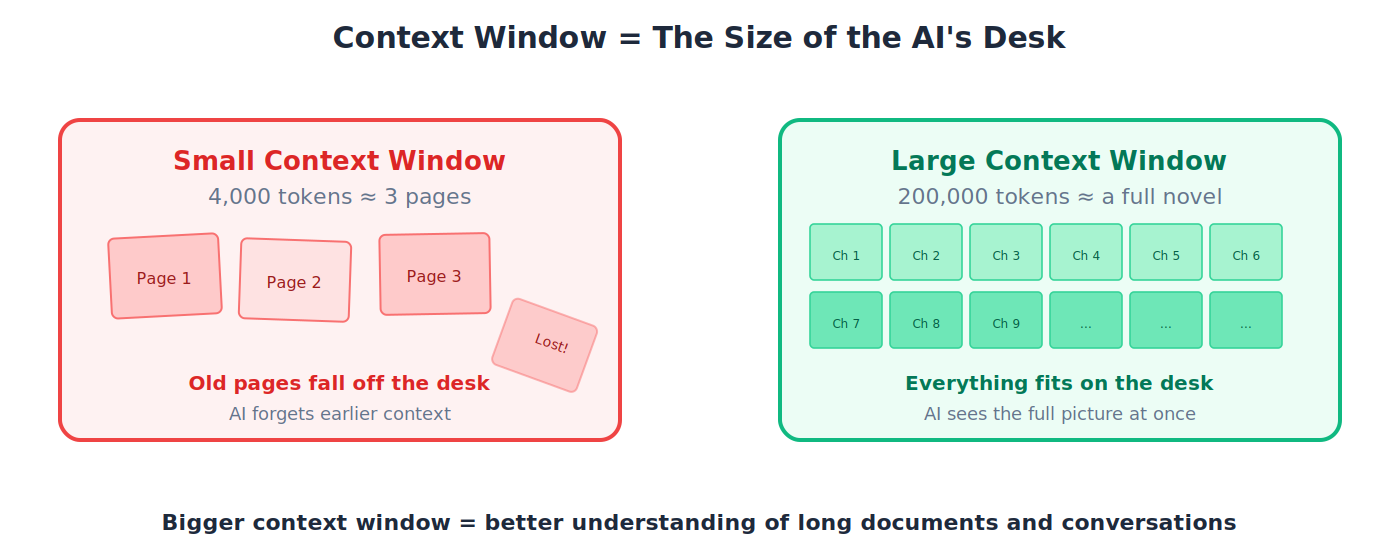
Context Window
Maximum text amount jo LLM aik waqt mein process kar sakta hai, tokens mein measured. Isay model ki "working memory" samjhein.
🔹 Example: Claude models 200,000 se 1 million+ tokens tak context windows offer karte hain. 200,000 tokens bhi lag bhag 150,000 words hain - poora novel. Older models sirf 4,000 tokens handle kar sakte thay - chand pages.
💡 Analogy: Context window desk ke size jaisi hai. Chhoti desk par sirf chand papers rakh sakte hain. Huge desk par poora project phaila kar sab dekh sakte hain. Bigger context window = bigger desk.
Token
Text ka basic unit jo LLM process karta hai. Token roughly 3/4 word hota hai. Short words jaise "the" aik token ho sakte hain. Longer words jaise "unbelievable" 3-4 tokens mein split ho sakte hain. Spaces aur punctuation bhi tokens consume karte hain.
🔹 Example: "I love biryani" about 4 tokens. Aik full page text about 500-700 tokens. AI APIs use karte waqt aap tokens ke hisaab se charged hote hain.
Completion / Generation
LLM ka output jo prompt ke response mein produce hota hai. Jab model aap ki request "complete" karta hai, woh response completion hota hai.
Structured Output
Jab LLM conversational text ke bajaye specific, machine-readable format - jaise JSON - mein response generate kare taake software easily process kar sake.
🔹 Example: "Karachi ka temperature 35 degrees hai aur sunny hai" ke bajaye structured output:
{"city": "Karachi", "temp": 35, "condition": "sunny"}. Software is format ko effortless read karta hai.
Hallucination
Jab AI model confidently false, inaccurate, ya fabricated information generate kare aur usay fact ke taur par present kare.
🔹 Example: Aap Supreme Court judgment ke bare mein poochte hain aur model fake case, fake citation numbers, aur fake bench invent kar deta hai.
💡 Analogy: Student jise exam ka answer nahin pata, lekin woh bohat confident detailed response likh deta hai. Read karne mein correct lagta hai, lekin poora made up hota hai.
Grounding
AI model ko factual, verified data sources se connect karna taake woh hallucinate karne ke bajaye accurate answers de.
💡 Analogy: Student ko exam mein textbook use karne dena. Ab answers real information par based hain, unreliable memory par nahin.
Temperature
LLM response mein creativity vs predictability control karne wali setting. Low temperature (0) = very consistent. High temperature (1+) = zyada creative aur varied.
💡 Analogy: Temperature chef ki kitchen freedom jaisi hai. Temperature 0: "Recipe exactly follow karo." Temperature 1: "Freely improvise karo." Medication dosages ke liye exact recipe chahiye; new dish ke liye creative freedom.
Latency
Request bhejne aur response milne ke darmiyan time delay. Lower latency = faster. Milliseconds ya seconds mein measured.
🔹 Example: Claude 1 second mein respond kare to low latency. 15 seconds le to high latency. Users 2-3 seconds ke baad impatient ho jate hain.
Throughput
System aik unit time mein kitni requests handle kar sakta hai. High throughput = bohat se users simultaneously serve karna.
💡 Analogy: Latency yeh hai ke toll plaza se aik car kitni fast guzarti hai. Throughput yeh hai ke toll plaza per hour kitni cars handle karta hai. Dono chahiye: low latency aur high throughput.
Deterministic vs. Non-Deterministic
Deterministic: Same input hamesha exact same output deta hai, jaise calculator: 2+2 hamesha 4. Non-deterministic: Same input har dafa thora different output de sakta hai.
LLMs non-deterministic hote hain: same question do dafa poochein to thora different, lekin valid, answers mil sakte hain. Yeh bug nahin; technology ka fundamental behavior hai.
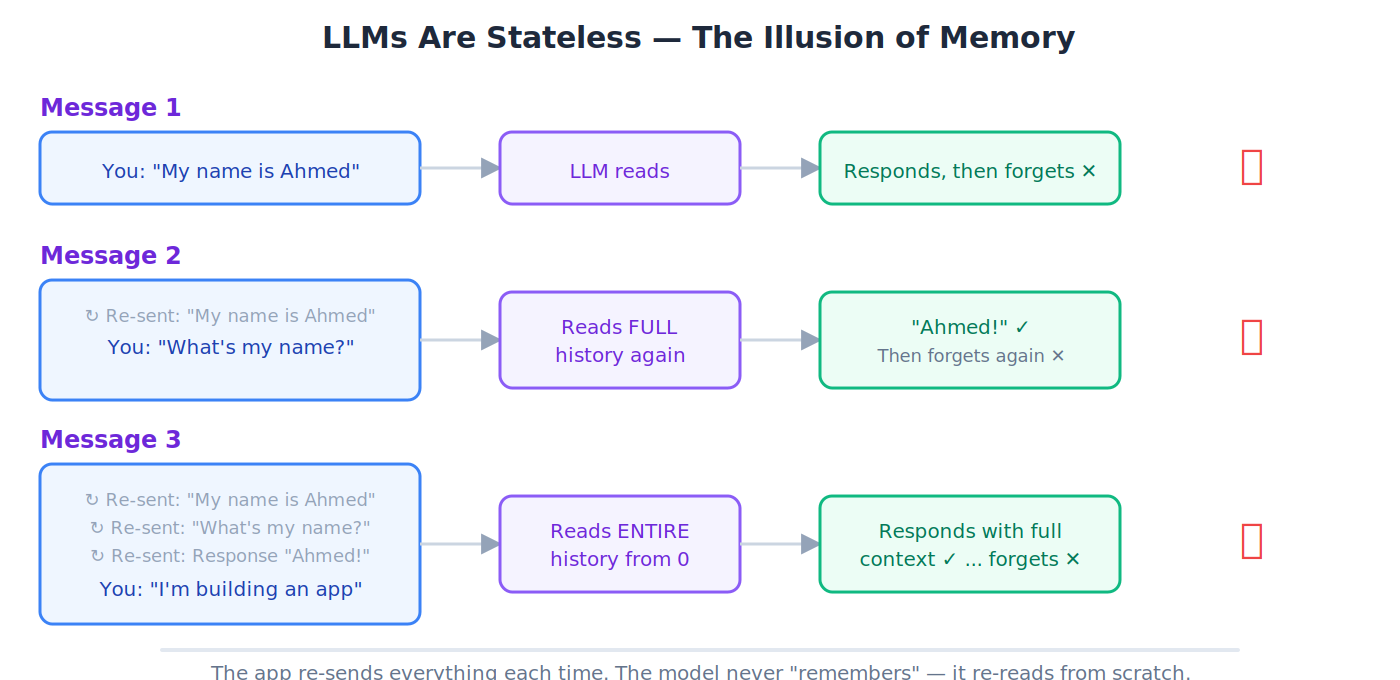
Stateless
Separate interactions ke darmiyan memory na hona. LLM ke saath har new conversation absolute zero se start hoti hai: model ko previous conversation ka knowledge nahin hota.
💡 Analogy: Amnesia wala shopkeeper. Aap 5 minutes pehle aaye hon phir bhi woh aap ko stranger ki tarah greet kare. Chat apps har message ke saath poori conversation history dobara bhej kar memory ka illusion create karti hain.
Prompt Engineering
Clear, specific instructions craft karne ki skill taake AI model se best possible output mil sake. Sirf "kya poochna hai" nahin, "kaise poochna hai" bhi.
🔹 Example: "AI ke bare mein likho" ke bajaye prompt engineer likhta hai: "Aap Dawn newspaper ke technology journalist hain. Pakistani banks fraud detection ke liye AI agents kaise use kar rahe hain is par 600-word article likhein. Aik real example shamil karein. Simple language use karein jo non-technical business reader samajh sake."
NLP (Natural Language Processing)
AI ki woh branch jo human language ko understand, interpret, aur generate karne se deal karti hai. Yeh LLMs ko possible banane wali foundation hai.
🔹 Example: Jab aap broken English mein Google search query type karte hain aur Google phir bhi samajh leta hai aap kya kehna chahte hain, woh NLP hai.
Copilot
Aisa AI assistant jo software environment - jaise code editor - ke andar integrated hota hai aur aap ke saath productivity boost karta hai: suggestions, auto-completion, review.
🔹 Example: GitHub Copilot typing ke dauran code suggest karta hai. Jaise knowledgeable colleague aap ke shoulder ke upar dekh kar sentences complete kar raha ho.
4. Knowledge, Retrieval, and Context
Yeh terms describe karti hain ke AI agents external knowledge tak kaise access lete aur usay behtar, zyada accurate answers ke liye kaise use karte hain.
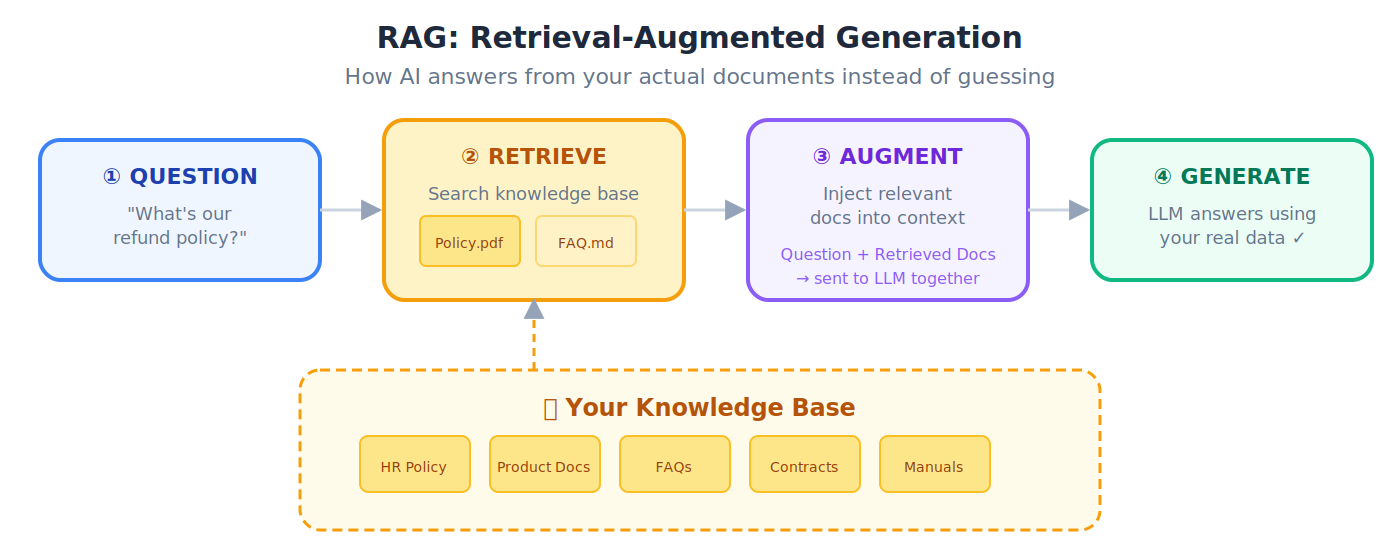
RAG (Retrieval-Augmented Generation)
Technique jahan AI pehle external documents ya databases se relevant information retrieve karta hai, phir us information ko use karke zyada accurate response generate karta hai.
💡 Analogy: Open-book exam. Sirf memorized, potentially wrong knowledge par rely karne ke bajaye, aap answer likhne se pehle reference material mein facts dekhte hain. RAG AI ko apni reference library deta hai.
Embedding
Text ko numerical coordinates mein convert karna taake computer different pieces of text ki similarity measure kar sake - meaning capture kare, sirf keywords nahin.
💡 Analogy: Library ki har book ko aik giant map par place karna jahan similar books cluster mein hon. Cookbooks aik dusre ke paas, physics textbooks se door. Embeddings yeh "similarity map" mathematical space mein banati hain.
Vector
Numbers ki list jo mathematical space mein text ka representation hoti hai. Jab text embedding mein convert hota hai, result vector hota hai.
🔹 Example: Word "cricket"
[0.8, 0.3, 0.7, 0.1, ...]jaise long list of numbers mein convert ho sakta hai, jo sport aur insect meanings ko surrounding context se distinguish karta hai.
Vector Database
Specialized database jo vectors store aur quickly search karti hai, taake exact keyword ke bajaye meaning ke hisaab se similar content mil sake.
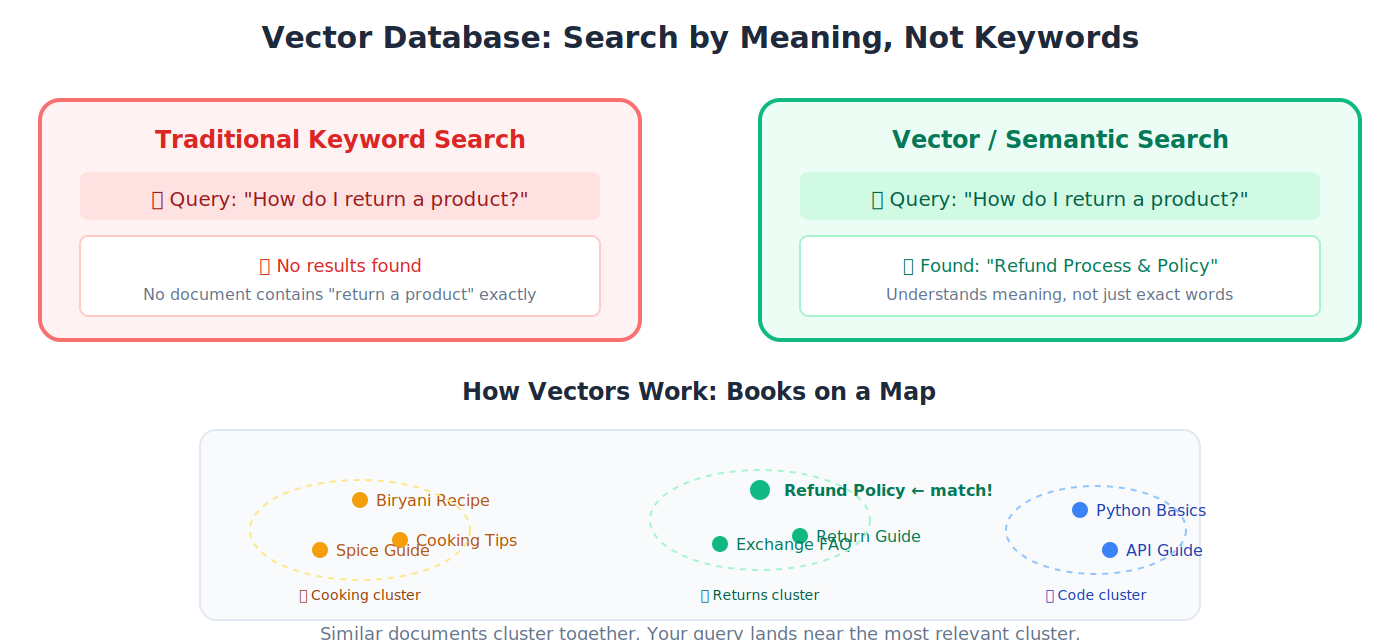
🔹 Example: Aap 10,000 company documents vectors ke taur par store karte hain. Koi poochta hai: "Hamari return policy kya hai?" Vector database instantly relevant documents find kar leti hai, chahe exact phrase "return policy" un mein na ho.
💡 Analogy: Traditional database exact keywords se search karti hai, jaise phonebook mein name search. Vector database meaning se search karti hai, jaise librarian se kehna: "Is book jaisi books dhoondh dein."
Semantic Search
Exact keywords ke bajaye meaning se search karna. "How do I return a product?" aik document titled "Refund Process" se match kar sakta hai, bhale words different hon.
🔹 Example: Employee company knowledge base mein "time off kaise loon" search karta hai. Semantic search "Annual Leave Policy and Procedures" document find kar leti hai, chahe title mein search words na hon. Traditional keyword search kuch na dhoondh paati.
Retrieval
AI ke response mein use ke liye data source - database, document collection, web - se relevant information fetch karna.
🔹 Example: Customer support agent se poochta hai: "Laptops par warranty kya hai?" Agent knowledge base se warranty policy document retrieve karta hai, relevant section read karta hai, aur actual policy par based accurate jawab deta hai - guess nahin.
Reranking
Multiple retrieved results ko relevance ke hisaab se dobara order karna taake sab se useful result pehle aaye. Initial search ke baad quality filter.
Chunking / Chunk
Large document ko chhote pieces mein todna taake har piece separately store aur search ho sake.
🔹 Example: 200-page HR manual paragraph-sized chunks mein split hota hai. Leave policy ke sawal par system sirf 3-4 relevant paragraphs retrieve karta hai, poora manual nahin.
Knowledge Base
Information ka organized collection - documents, FAQs, manuals, policies - jise AI search aur reference kar sakta hai.
🔹 Example: Company ka internal wiki jisme product docs, HR policies, aur training materials hain, is tarah structured ke AI agent answers instantly find kar sake.
Grounding Data
Woh specific factual data jo AI model se connect hota hai taake responses hallucinated guesses ke bajaye fact-based hon.
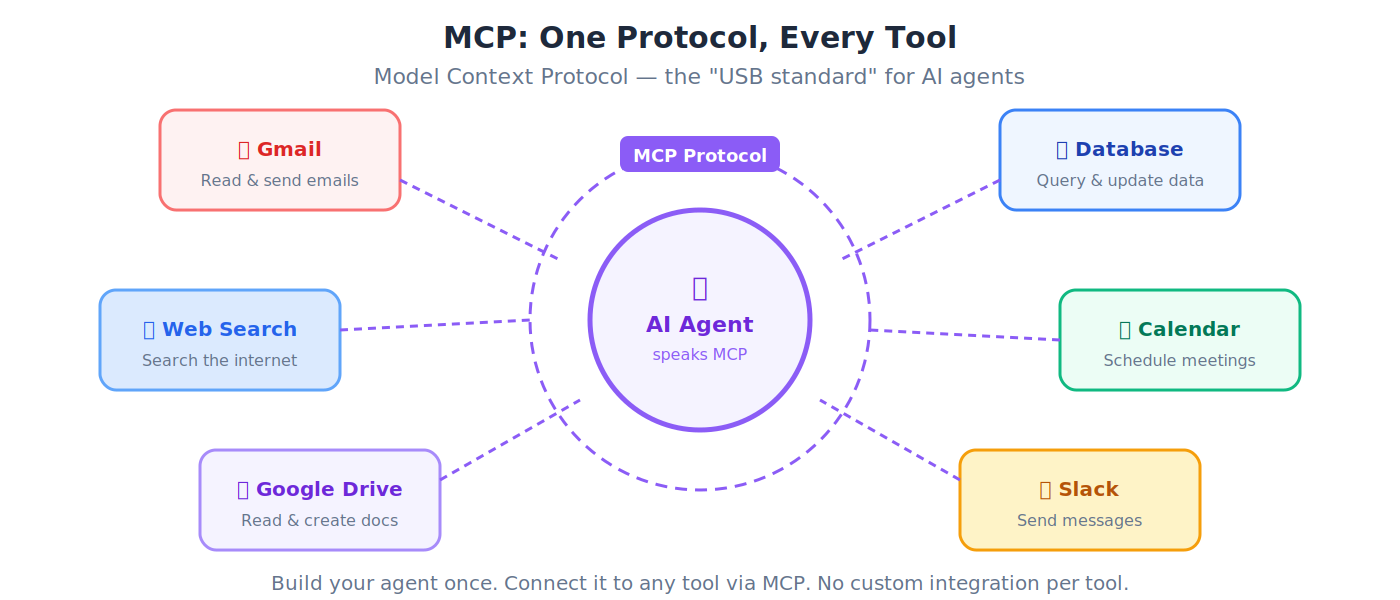
MCP (Model Context Protocol)
Open standard - Anthropic ne create kiya, ab Linux Foundation govern karti hai - jo kisi bhi AI agent ko universal protocol ke zariye external tool se connect karne deta hai: search, databases, email, calendars, file systems. MCP agents ke tools call karne ka protocol hai. Tools ke liye payment handle karne wali separate protocol family ke liye Section 11 dekhein: ACP, AP2, x402, aur MPP.
💡 Analogy: USB se pehle har phone ka charger alag hota tha. USB universal connector ban gaya. MCP AI agents ke liye "USB standard" hai: aik protocol jo kisi bhi agent ko kisi bhi tool se plug kar deta hai. Agent aik dafa build karein, sab se connect karein.
Connector
Specific integration jo AI agent ko external service se link karti hai, MCP ya kisi aur protocol ke through.
🔹 Example: "Gmail connector" AI agent ko emails read, search, aur send karne deta hai. "Google Drive connector" documents read aur create karne deta hai.
System Integration
Different software systems ko connect karna taake woh data share karein aur smoothly saath kaam karein. Enterprise agent deployment ke peeche yahi "plumbing" hoti hai.
🔹 Example: Aap ke Digital FTE ko Salesforce se customer data read karna hai, SAP mein inventory check karni hai, JazzCash se payments process karni hain, aur email confirmations bhejni hain. System integration in chaaron systems ko jor kar agent ko single workflow mein kaam karne deti hai.
5. Agentic AI Concepts
Is book ka core: AI systems jo sirf questions answer nahin karte, balki action lete hain.
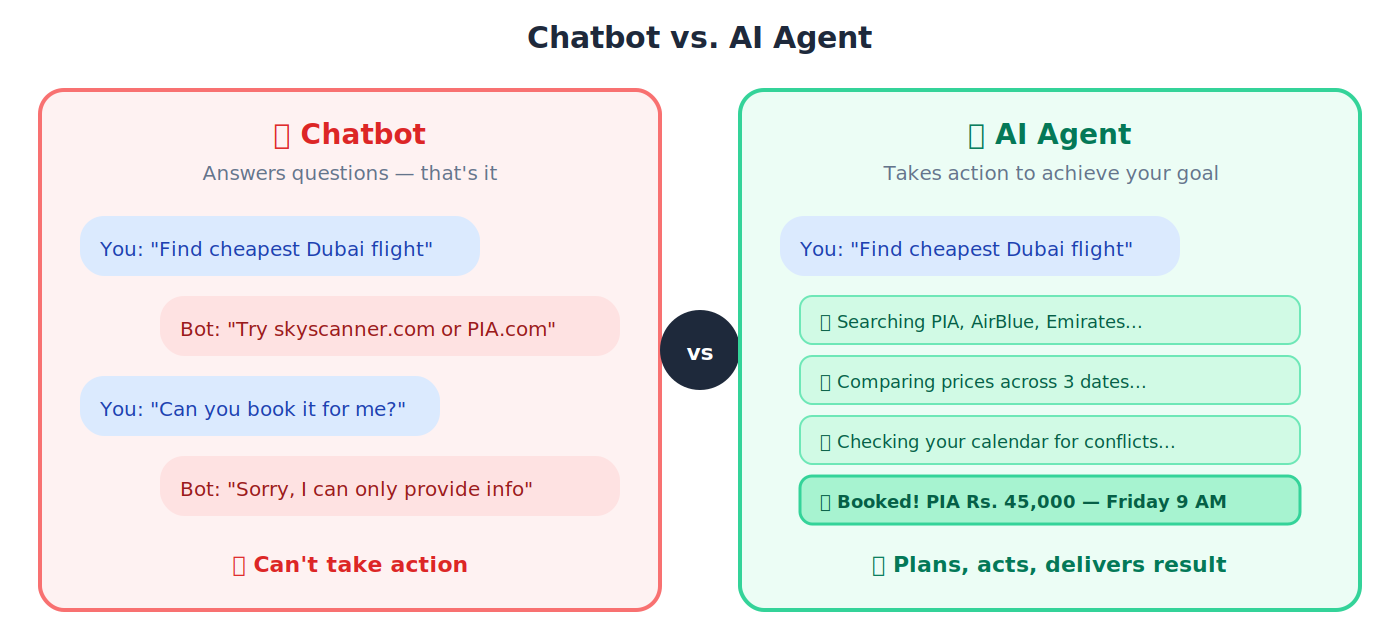
Agent (or AI Agent)
Aisa AI system jo independently apna environment perceive kar sake, decisions le sake, aur goal achieve karne ke liye actions le sake - bina human ke har step guide kiye.
🔹 Example: Chatbot sirf questions answer karta hai. AI agent ko goal milta hai: "next Friday Karachi-to-Dubai ki cheapest flight dhoondo", phir airlines search karta hai, prices compare karta hai, calendar check karta hai, aur ticket book karta hai.
💡 Analogy: Chatbot desk ke peeche baitha librarian hai jo questions answer karta hai. Agent personal assistant hai jo aap ki request lekar duniya mein ja kar kaam complete karta hai.
Agentic AI
AI ki category jo aise agents build karne par focused hai jo plan, reason, act, aur autonomously adapt kar sakein. Yeh 2026 mein AI ka frontier hai.
General Agent
Aisa AI agent jo natural language ke through wide range of tasks ke liye use hota hai. Yeh aik specific job ke liye built nahin; yeh versatile "Swiss Army knife" hai jo coding, writing, research, file management, aur aur kaamon mein help kar sakta hai.
🔹 Example: Claude Code general agent hai: aap usay files organize karne, API likhne, spreadsheet analyze karne, ya Python error debug karne ko keh sakte hain. Yeh natural language instructions se adapt karta hai.
💡 Analogy: General agent highly capable executive assistant jaisa hai. Aap usay aik task ke liye hire nahin karte; har din different assignments dete hain, aur woh unhein complete karna figure out karta hai.
Autonomy
AI agent kis degree tak har step par human approval ke baghair independently operate kar sakta hai.
💡 Analogy: Junior employee ko har email ke liye permission chahiye - low autonomy. Senior director independently decisions leta hai - high autonomy. Agents bhi isi spectrum par exist karte hain.
Reasoning
Agent ki ability ke woh problem ko logically soch kar solve kare: information analyze kare, options weigh kare, aur action se pehle conclusion nikale.
🔹 Example: Aap agent se poochte hain: "Lahore ya Islamabad mein launch pehle karna chahiye?" Non-reasoning agent randomly choose kar sakta hai. Reasoning agent analyze karega: "Lahore ki population 2x hai, lekin Islamabad ki per-capita income zyada hai. Product professionals ke liye hai, is liye Islamabad pehle better fit hai, Lahore month 3 mein."
Acting
Jab agent real world mein kuch actually karta hai: email send karna, file write karna, API query karna, order place karna, appointment book karna.
Planning
Agent ki ability ke woh complex goal ko steps ki sequence mein tod kar determine kare ke kaun sa step pehle execute hona chahiye.
🔹 Example: Aap agent se kehte hain: "Pakistani cement exports par market analysis report prepare karo." Agent plan karta hai: (1) export data search, (2) competitor info gather, (3) trends analyze, (4) report write, (5) PDF format.
Task Decomposition
Large, complex task ko chhote manageable subtasks mein todna, jise individually solve kiya ja sake.
💡 Analogy: "Wedding plan karo" aik overwhelming task hai. Decompose karein: venue dhoondho, caterer choose karo, invitations design karo, flowers arrange karo, photographer hire karo. Har subtask solvable hai. AI agents complex goals ko aise hi decompose karte hain.
Orchestration
Multiple agents ya tools ko coordinate karna, aur un ke darmiyan information flow manage karna.
💡 Analogy: Cricket team captain bowling, batting, aur fielding sab khud nahin karta. Woh fielders position karta hai, bowling rotations set karta hai, aur situation ke hisaab se strategy adjust karta hai. Agent orchestration bhi specialists ko shared goal ke liye coordinate karti hai.
Multi-Agent System
Aisa system jahan multiple AI agents collaborate karte hain - har aik task ka different part handle karta hai - taake woh cheez complete ho jo koi aik agent akela nahin kar sakta.
🔹 Example: Aik agent competitor pricing research karta hai, doosra analysis draft karta hai, teesra slides format karta hai, aur chautha speaker notes prepare karta hai. Yeh team ki tarah kaam karte hain.
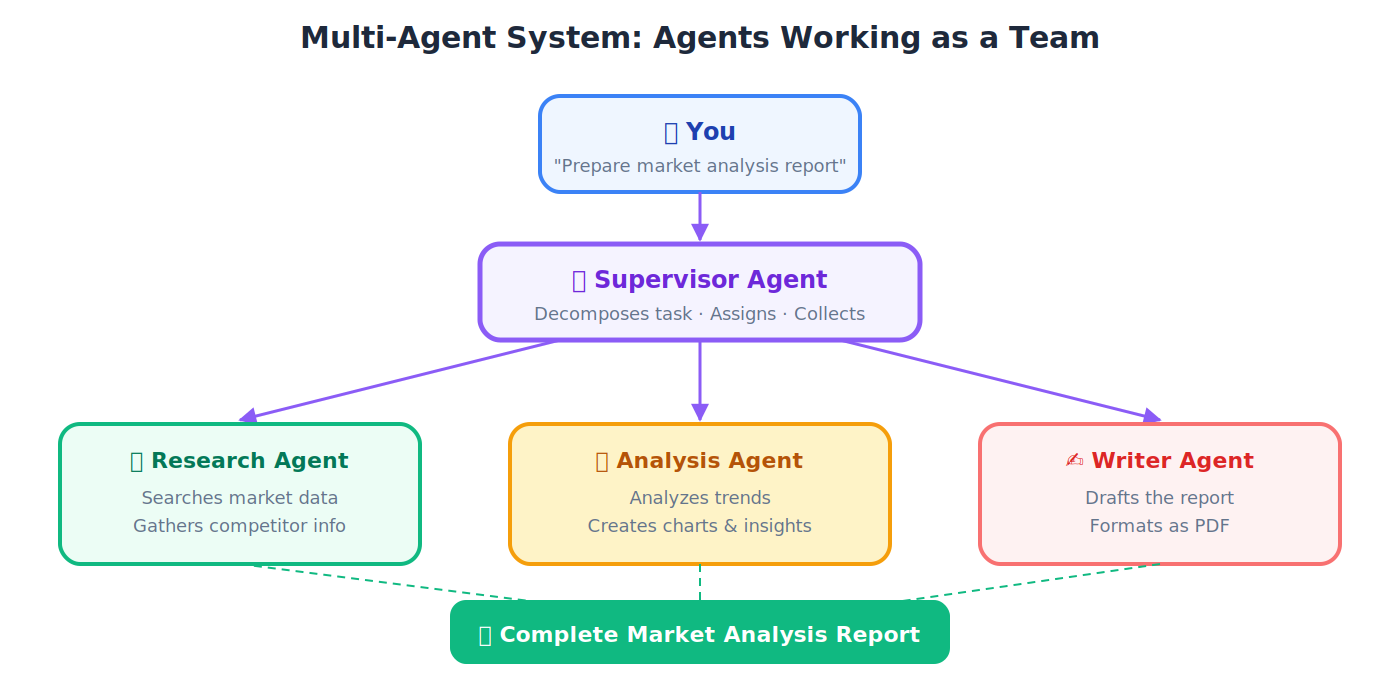
Supervisor Agent
Aisa agent jiska kaam doosre agents ko coordinate aur manage karna hota hai: tasks distribute karna, progress monitor karna, aur results collect karna.
💡 Analogy: Construction site foreman. Woh bricks lay ya outlets wire nahin karta. Specialists ko tasks assign karta hai, quality check karta hai, aur ensure karta hai sab kuch sahi jor raha hai.
Handoff
Jab aik agent task aur us ka context doosre agent ko pass karta hai, jaise relay runner baton pass karta hai.
Tool Use / Function Calling
Agent ki ability ke woh external tools use kar sake - web search, databases query, emails send, code run - sirf memory se text generate na kare.
💡 Analogy: Aisa insan jo sirf memory se jawab de vs. aisa insan jo phone uthaye, laptop khole, aur information look up kare. Tool use agent ko training data se bahar ki duniya tak access deta hai.
State
Kisi system ki current condition ya data kisi bhi moment par. "State maintain karna" ka matlab ongoing process mein cheezon ki current position yaad rakhna.
🔹 Example: Aap 10-page NADRA form online fill kar rahe hain aur page 7 par hain. "State" mein pages 1-6 ka entered data aur current page number shamil hai.
Memory (Agent Memory)
Mechanisms jo agent ko interactions ke across information remember karne dete hain: previous conversations, user preferences, ya learned facts.
💡 Analogy: State short-term memory hai - is conversation mein abhi kya ho raha hai. Memory long-term memory hai - past conversations mein kya hua. Memory ke baghair har interaction zero se start hota hai.
Session
User aur AI system ke darmiyan aik mutasil interaction. Naya chat shuru karna yani naya session shuru karna.
Reflection
Jab agent apne hi output ko review karta hai, mistakes ya weaknesses identify karta hai, aur improvements ke saath dobara try karta hai.
💡 Analogy: Aisa writer jo draft khatam karke usay dobara parhta hai, weak arguments notice karta hai, aur submit karne se pehle revise karta hai. Agent yeh kaam automatically karta hai.
Retry / Fallback
Retry: Fail hone par wahi action dobara try karna (shayad server temporarily unavailable tha). Fallback: Jab primary approach baar baar fail karta rahe to alternative approach par switch karna.
🔹 Example: Agent kisi website se data fetch karne ki koshish karta hai. Site down hai (retry: 30 seconds baad dobara try karo). 3 retries ke baad bhi down hai (fallback: same information ke liye doosra data source try karo).
Guardrails
Safety constraints jo agent ko harmful, inappropriate, ya unauthorized actions karne se rokti hain. Guardrails ka financial version - spending limits, vendor allowlists, audit triggers - authority envelope kehlata hai. Dekhein Section 11.
🔹 Example: Financial agent ka aik guardrail Rs. 5,000,000 se upar transactions ko human approval ke baghair rok deta hai. Customer service agent ka aik guardrail usay refunds ke aise waade karne se rokta hai jo woh guarantee nahin kar sakta.
💡 Analogy: Motorway ke guardrails cars ko road se utarne se rokte hain. AI guardrails agents ko out-of-limits jane se rokte hain.
HITL (Human in the Loop)
Aisa design pattern jahan agent ke workflow ke critical points par human ko review, approve ya intervene karna hi hota hai. Human sign-off ke baghair koi critical kaam nahin hota.
🔹 Example: Agent client email draft karta hai, lekin jab tak koi human usay read aur approve na kare, woh send nahin hoti. Agent 80% kaam karta hai; human 10% verification deta hai.
HOTL (Human on the Loop)
Aisa design pattern jahan agent autonomously act karta hai, human monitor aur intervene kar sakta hai magar har action approve nahin karta. HITL se tez aur zyada scalable; sirf tab safe jab checker mazboot ho aur ghalti reverse karna sasta ho. Har action ke liye mix set karne ka tareeqa Loop Engineering crash course mein dekhein.
💡 Analogy: HITL driving instructor hai jiske paas apna brake pedal hai aur har move approve karta hai. HOTL security cameras dekhne wala supervisor hai, kaam khud chalta hai aur woh sirf kuch ghalat lagne par beech mein aata hai.
🔹 Example: Morning-triage loop saari raat khud
claude/branches par PRs kholta hai, on the loop, magar human har subah review aur merge karta hai, gate par wapas in the loop. Teesra term human out of the loop, jahan monitoring aur intervention dono nahin, is kitab mein design option nahin; woh failure mode hai jo tab drift se aata hai jab aap ship hone wali cheez parhna band kar dein.
Reliability
Agent kitni consistently correct, expected results produce karta hai. Reliable agent 100 mein 99 dafa sahi karta hai, 60 nahin.
🔹 Example: Aik reliable invoice-processing agent 99% invoices se vendor name, amount, due date, aur tax sahi extract karta hai - different formats, languages, aur layouts ke across. Aik unreliable agent unusual layouts par confuse ho jata hai aur 20% waqt amounts misread karta hai. Yahi farq aik sellable product aur aik liability ke darmiyan hota hai.
Verifiability
Yeh check aur confirm karne ki ability ke agent ka output correct hai - ke us ka code tests pass karta hai, us ke numbers add up hote hain, aur us ke references actually maujood hain.
Auditability
Agent ke har decision aur action ko peeche tak trace karne ki ability, taake exactly samjha ja sake ke us ne kya kiya aur kyun.
💡 Analogy: Bank statement har transaction ko trace karta hai. AI agent ke liye audit trail har decision, tool call, aur output ko trace karta hai - jo compliance aur debugging ke liye critical hota hai.
Workflow
Aik defined sequence of steps jo agent kisi task ko shuru se khatam tak complete karne ke liye follow karta hai.
💡 Analogy: Workflow recipe ki tarah hai: step-by-step instructions jo sahi follow karne par aik predictable result deti hain.
6. Programming and Software Terms
Programmer hona zaroori nahin, lekin yeh terms aap ko poori book mein milengi.
Python
AI ki sab se popular programming language: readable, versatile, aur is book ki primary language. Lag bhag har AI framework pehle Python support karta hai.
💡 Why Python? Python English jaisi readable hoti hai.
if age > 18: print("Adult")us bande ko bhi samajh aa sakta hai jis ne kabhi coding nahin ki. Isi readability ki wajah se AI world ne Python choose ki, aur isi liye yeh book Python sikhati hai. Start karne se pehle Python aana zaroori nahin; Part 4 aap ko scratch se sikhata hai.
TypeScript
JavaScript ka typed superset jo web applications aur realtime interfaces ke liye use hota hai. Is book ke Part 9 mein cover hota hai.
Frontend
Application ka woh hissa jo users dekhte aur interact karte hain: buttons, menus, text, images on screen.
🔹 Example: Daraz.pk par product images, search bar, shopping cart, aur checkout page frontend hain.
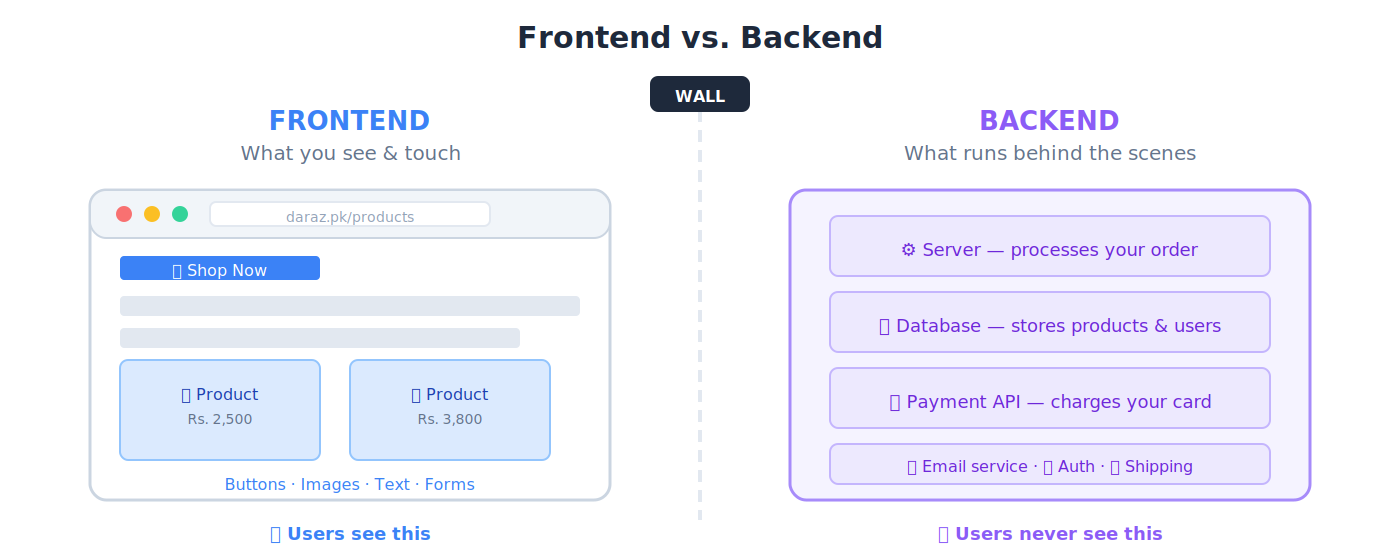
Backend
Woh hissa jo scenes ke peeche run hota hai - servers, databases, business logic - jise users directly nahin dekhte.
🔹 Example: Daraz par "Place Order" click karne ke baad backend payment process karta hai, inventory check karta hai, seller ko notify karta hai, aur delivery schedule karta hai.
Full-Stack
Aisa developer ya application jo frontend aur backend dono handle karta hai.
API (Application Programming Interface)
Rules ka set jo different software programs ko aik dusre se communicate karne deta hai. APIs agents ke outside world se interact karne ka tareeqa hain.
💡 Analogy: Restaurant menu API jaisi hai. Aap menu dekhte hain, order place karte hain, aur kitchen food prepare karti hai. Aap ko kitchen ke andar ka process nahin pata hota; aap sirf menu use karte hain.
SDK (Software Development Kit)
Specific platform par applications develop karne ke liye pre-built toolkit.
💡 Analogy: SDK LEGO set jaisa hai: ready-made pieces aur instructions, taake aap cheezen quickly build kar saken, har piece scratch se carve na karna pare.
CLI (Command-Line Interface)
Text-based interface jahan aap commands type karke software control karte hain, buttons click karne ke bajaye.
🔹 Example: File ko folder mein drag karne ke bajaye aap
mv report.pdf documents/type karte hain. Claude Code poori tarah CLI ke zariye chalta hai.
HTTP / HTTPS
Web ka communication protocol. Har website visit, har API call HTTP (ya us ka secure version, HTTPS) use karti hai.
💡 Analogy: HTTP internet ka postal system hai. Aap ka browser aik letter (request) likhta hai, usay kisi website ke address par bhejta hai, aur website usi system ke through reply (response) wapas bhejti hai.
REST (Representational State Transfer)
Web APIs design karne ka aik widely-used standard: simple, predictable, aur HTTP par based.
Endpoint
Aik specific URL jahan API requests receive karti hai. Har endpoint aik specific function handle karta hai.
🔹 Example:
api.weather.com/current?city=Karachiaik endpoint hai: woh specific address jahan aap Karachi ka weather mangte hain.
Request / Response
Request: client se server ko bheja gaya message jo kuch maangta hai. Response: server ka jawab.
💡 Analogy: Aap waiter se soup of the day maangte hain (request). Waiter "haleem" lekar wapas aata hai (response).
JSON (JavaScript Object Notation)
Data store aur exchange karne ka aik lightweight, human-readable format. AI world ka standard data format.
🔹 **Example:
{
  "name": "Ahmed Khan",
  "city": "Lahore",
  "role": "Software Engineer"
}
Data ke har piece ka clear label aur value hoti hai. Software JSON ko aasani se read karta hai.
Schema
Data kaise organize hota hai us ka structure ya blueprint: kaun se fields hain, har field ki type kya hai, aur kaun se required hain.
💡 Analogy: Aik khali NADRA form aik schema hai: "Name yahan aata hai (text), CNIC yahan aata hai (number), Date of Birth yahan aati hai (date)." Bhara hua form data hai; khali form schema hai.
Validation
Yeh check karna ke data expected schema se match karta hai: sahi format, sahi type, kuch missing nahin.
🔹 Example: Aik online form aap ki submission reject kar deta hai kyun ke aap ne phone number field mein letters type kiye: yeh validation aik error pakar rahi hai.
Library / Package
Pehle se likha hua code jo doosron ne build aur share kiya hota hai, taake aap common functionality scratch se na likhein.
🔹 Example: Apna email-sending code khud likhne ke bajaye aap
sendgridnaam ki aik library use karte hain jo sari complexity handle karti hai.
Framework
Aik library se bara, zyada structured toolkit. Framework aap ki application ka architecture provide karta hai aur define karta hai ke aap ka code kaise organize hoga.
💡 Analogy: Library individual furniture khareedne jaisa hai. Framework aisa pre-built ghar khareedne jaisa hai jis ke rooms aap customize karte hain. FastAPI aik framework hai; aik JSON parsing tool aik library hai.
Dependency
Aik external library jise aap ka project kaam karne ke liye require karta hai.
🔹 Example: Aap ka project FastAPI use karta hai, aur FastAPI ko Starlette naam ki library chahiye. Starlette aik dependency hai: aap ka project indirectly us par depend karta hai.
Repo (Repository)
Aik project folder jo Git se tracked hota hai aur jisme saara code, files, aur changes ki complete history hoti hai.
Git
Aik version control system jo code mein har change record karta hai: kis ne kya change kiya, kab, aur kyun. Aap hamesha kisi bhi previous version par wapas ja sakte hain.
💡 Analogy: Git Microsoft Word ke "Track Changes" jaisa hai, lekin poore software projects ke liye. Har edit record hoti hai. Har version recoverable hai. Team collaboration ke liye essential.
GitHub
Git repositories host karne ka aik cloud platform: duniya ka sab se bara code-sharing platform jahan developers collaborate karte hain.
Environment Variable / .env
Aik setting jo aap ke code ke bahar (.env naam ki file mein) store hoti hai aur jisme sensitive information hoti hai jaise passwords aur API keys.
🔹 Example: Aap ka OpenAI API key
OPENAI_API_KEY=sk-abc123...ke taur par.envmein store hota hai, taake woh kabhi aap ke public code mein na aaye.
Synchronous
Operations jo aik waqt mein aik ho, sequence mein. Har step previous ke finish hone ka wait karta hai.
💡 Analogy: Store par aik hi checkout counter. Har customer poora serve hota hai phir agla shuru hota hai. Simple, lekin queue ho to slow.
Asynchronous
Operations jo simultaneously run kar sakti hain. Program aik task shuru karta hai aur us ke finish hone ka wait kiye baghair aage barh jata hai.
💡 Analogy: Aik saath khule kai checkout counters, plus aik self-service kiosk. Customers parallel mein serve hote hain. Overall bohat faster: modern AI agents multiple tool calls aise hi handle karte hain.
Event-Driven Architecture
Aisa software design jahan system events (jo cheezen hoti hain) ke response mein react karta hai, na ke kisi rigid, pehle se tay shuda sequence ko follow karta hai.
🔹 Example: Doorbell event-driven hai (yeh sirf tab bajti hai jab press ho. Aap har 5 minutes mein darwaza check nahin karte; aap tab respond karte hain jab event hota hai. AI agents aksar isi tarah kaam karte hain) incoming messages, tool results, aur notifications par react karte hue.
Variable
Code mein named container jo value store karta hai. price = 500 ka matlab hai variable price ke andar 500 stored hai.
Function
Reusable block of code jo aik specific task perform karta hai: inputs leta hai, kaam karta hai, aur aik output return karta hai.
💡 Analogy: Function roti banane wali machine jaisa hai. Aap dough dete hain (input), machine kaam karti hai, aur roti nikalti hai (output). Wahi machine hazaron dafa use ho sakti hai.
Type Annotation
Code mein indicate karna ke variable ya function input/output ka data type kya hai.
🔹 Example:
age: int = 25program aur doosre developers dono ko batata hai: "age hamesha whole number hona chahiye."
Dataclass
Aik Python feature jo saaf, structured data containers banane ke liye hai, jaise named fields wala aik template.
🔹 Example:
@dataclass
class Student:
    name: str
    age: int
    grade: str
Ab aap
student = Student("Ahmed", 20, "A")likh sakte hain aur data organized, labeled, aur automatically type-checked hota hai. Teen separate variables track karne se yeh kaafi cleaner hai.
Decorator
Python feature, jo @ ke saath likha jata hai, function ya class ke behavior mein functionality add karta hai bina us ka code change kiye. Upar wali example mein @dataclass decorator hai.
Syntax
Programming language ke grammar rules: computer ko samajh aane ke liye code ka structure kaisa hona chahiye.
Boilerplate
Repetitive, standard code jo setup ke liye chahiye hota hai lekin jis mein aap ki unique logic nahin hoti.
💡 Analogy: Formal letter ka "Dear Sir/Madam" opening aur "Yours sincerely" closing. Zaroori, lekin interesting hissa nahin.
Linter
Tool jo code ko style errors, potential bugs, aur consistency issues ke liye check karta hai.
🔹 Example: Aap
x=1+2likhte hain, operators ke around spaces ke baghair. Linter isay flag karta hai aurx = 1 + 2suggest karta hai: zyada readable. Yeh real bugs bhi pakarta hai, jaise variable define karne se pehle use karna. Is book mein ruff linter use hota hai.
Debugging
Code mein errors ya unexpected behavior dhoondh kar fix karna.
Refactoring
Existing code ko restructure karna taake woh cleaner ya zyada efficient ho jaye, bina yeh badle ke woh karta kya hai.
💡 Analogy: Apni wardrobe dobara organize karna. Kapre wahi, lekin ab season aur type ke hisaab se arranged: jo chahiye usay dhoondhna aasan.
pytest
Python testing framework jo automated tests likhne aur run karne ke liye use hota hai.
🔹 Example: Aap test likhte hain:
assert calculate_gst(1000) == 180. Is ka matlab hai "jab mein Rs. 1,000 par GST calculate karun, answer Rs. 180 hona chahiye." Agar code 170 return kare, pytest batata hai ke test fail hua: bug customer tak pahunchne se pehle pakar liya gaya.
pyright
Python type checker jo type-related errors detect karta hai.
🔹 Example: Aap ka function
age: intexpect karta hai, lekin code mein kahin ghalti se"twenty-five"text pass ho jata hai. Pyright yeh mismatch foran pakar leta hai, program run karne se pehle.
ruff
Aik bohat fast Python linter aur formatter jo consistent code style enforce karta hai aur common mistakes pakarta hai. Isay apne Python code ke liye grammar-checker aur style-guide enforcer samjhein.
uv
Aik modern, blazing-fast Python package manager jo project dependencies install aur manage karta hai. Project management ke liye pip jaise purane tools ki jagah leta hai: aksar 10-100x faster.
pip
Python ka traditional, built-in package installer. pip install requests internet se requests library download karta hai aur aap ke computer par install karta hai.
7. Data and Database Terms
Database
Electronically stored organized data collection, jo easily search, update, aur manage hone ke liye designed hoti hai.
💡 Analogy: Aik bohat bara, perfectly organized filing cabinet. Har drawer (table) aik type ke records hold karta hai. Har folder (row) aik record hai. Har paper (column) data ka aik piece hai.
SQL (Structured Query Language)
Databases se communicate karne ki standard language: sawal poochna, records add karna, data update karna.
🔹 Example:
SELECT name, phone FROM customers WHERE city = 'Karachi'database se kehta hai: "Karachi ke har customer ka name aur phone do."
Table / Row / Column
Table: related data ka collection rows aur columns mein, spreadsheet ki tarah. Row: aik complete record - aik customer, aik order. Column: sab records mein aik field - name, email, phone.
🔹 Example: "Customers" table:
Name (column) City (column) Phone (column) Ahmed Khan (row 1) Karachi 0300-1234567 Sara Ali (row 2) Lahore 0321-9876543 Table mein 3 columns aur 2 rows hain. Har row aik customer hai. Har column har customer ke bare mein aik information piece hai.
Query
Database se specific data mangne ki request. Har SQL statement query hoti hai.
🔹 Example: "Mujhe last 7 days mein Karachi se place hone wale orders dikhao" human query hai. SQL mein:
SELECT * FROM orders WHERE city = 'Karachi' AND date > '2026-03-31'. Same request, aik English mein, aik database ki language mein.
PostgreSQL
Powerful, free, open-source database jo production applications mein widely use hoti hai, including many AI agent backends.
NoSQL
Aisi databases jo data ko strict tables ke bajaye flexible formats mein store karti hain - documents, key-value pairs, ya graphs. Jab data neatly rows/columns mein fit na ho to useful.
🔹 Example: MongoDB data ko JSON-like documents ke taur par store karta hai. Aik "customer" document ke different customers ke liye different fields ho sakte hain, us rigid table ke barkhilaf jahan har row ke same columns hone chahiye.
Cache
Aik high-speed storage layer jo frequently accessed data ki copies faster retrieval ke liye save karta hai.
💡 Analogy: Apne sab se zyada use hone wale masalay high cabinet ke bajaye kitchen counter par rakhna. Shuru mein organize karna slow, lekin cooking ke waqt bohat faster. Cache storage space ko speed ke badle trade karta hai.
Queue / Message Broker
Aisa system jo application components ke darmiyan messages manage karta hai, aur ensure karta hai ke tasks reliably aur order se process hon, heavy load mein bhi.
💡 Analogy: Aik busy NADRA office ka ticket system. Har koi number leta hai aur order se serve hota hai. Agar 50 log aik saath aa jayein phir bhi koi gum nahin hota: queue flow manage karti hai.
Kafka
Aik popular open-source message broker jo real-time data ke massive streams handle karne ke liye design hua hai, aur enterprise AI deployments mein commonly use hota hai.
Transaction
Database operations ka aik set jo ya to sab mil kar succeed karta hai ya sab mil kar fail. Koi half-done state allowed nahin.
🔹 Example: JazzCash accounts ke darmiyan Rs. 50,000 transfer karna: Account A se deduct karna aur Account B mein add karna dono hona chahiye, ya koi bhi nahin. Aik transaction is ki guarantee deta hai.
Data Pipeline
Aik automated sequence of steps jo data ko sources se destinations tak move karta hai, raaste mein usay transform karte hue.
💡 Analogy: Aik gandum ki supply chain: farm se harvest (extract), atte mein mill (transform), bakery tak deliver (load). Aik data pipeline information ke saath yahi karta hai.
ETL (Extract, Transform, Load)
Data pipeline pattern: source se data Extract karo, usable format mein Transform karo, destination system mein Load karo.
🔹 Example: Har raat aik ETL pipeline (1) 50 retail branches se sales data extract karti hai, (2) usay transform karti hai (currencies convert karna, duplicates remove karna, totals calculate karna), aur (3) clean data ko morning dashboard ke liye central database mein load karti hai.
Persistent Storage
Aisa data jo program khatam hone ya computer restart hone ke baad bhi survive karta hai. Aap ki hard drive ki files persistent hain. RAM ka data shut down par gayab ho jata hai.
💡 Analogy: Notebook mein notes likhna (persistent; woh kal bhi wahin hongi) vs aik whiteboard par likhna jo har shaam mit jata hai (non-persistent). Agents ko sessions ke across cheezen remember karne ke liye persistent storage chahiye.
8. Cloud and Deployment Terms
Cloud
Servers, storage, aur services jo aap apne computer ke bajaye internet ke through access karte hain. "Cloud" ka matlab: "professional tarah managed kisi aur ke computers."
🔹 Example: Photos phone mein store karne ke bajaye Google Photos mein store karna. AI agent laptop ke bajaye AWS par run karna.
Cloud-Native
Aisi applications jo start se cloud infrastructure par run hone ke liye designed hoti hain, scalability, resilience, aur managed services ka faida leti hain.
Container
Lightweight, isolated package jisme application ko run hone ke liye required sab kuch hota hai - code, libraries, settings - taake woh har jagah same tarah run ho.
💡 Analogy: Shipping container. Chahe Karachi mein truck par ho, Arabian Sea mein ship par, ya China mein train par, andar ka content identical aur self-contained hota hai. Software containers bhi aise hi kaam karte hain.
Docker
Containers create aur run karne ka sab se popular tool. Aap app requirements Dockerfile mein define karte hain, image build karte hain, aur Docker usay kisi bhi machine par same tarah run karta hai.
🔹 Example: Aap ka AI agent laptop par perfectly chal raha hai. Aap usay Dockerize karte hain:
docker build -t my-agent .->docker run my-agent. Ab woh colleague ke laptop, AWS, ya Kubernetes cluster par same chal sakta hai - "but it works on my machine" problem nahin.
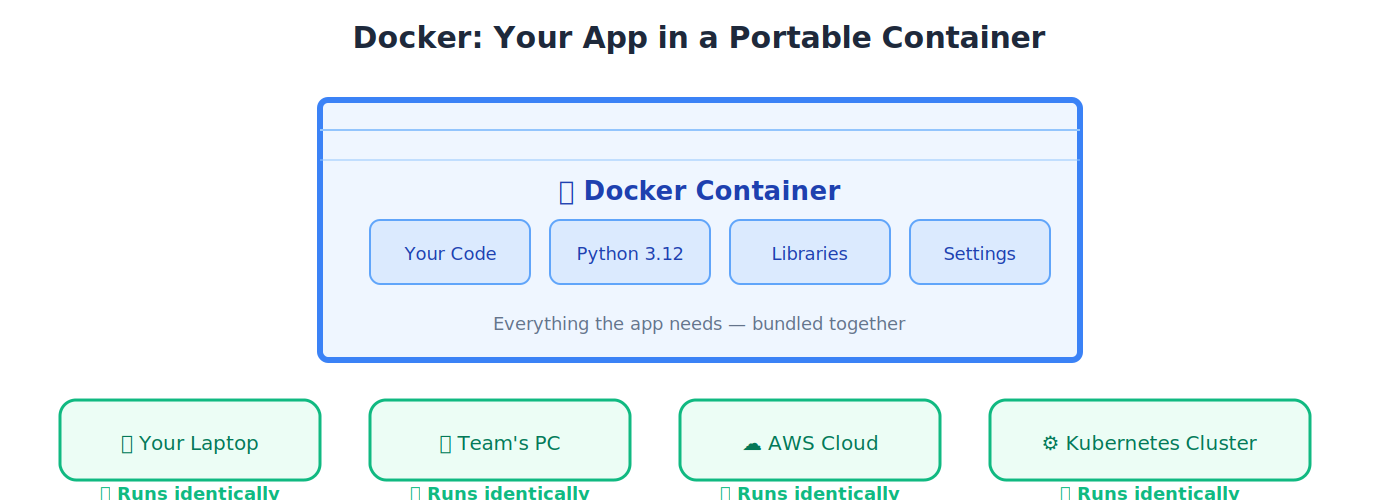
Docker Image
Read-only template jisse containers create hote hain. Image recipe hai; running container cooked dish. Aik image se bohat se containers ban sakte hain.
🔹 Example: Aap customer service agent ki aik image build karte hain. Isi image se 10 identical containers spin up kar sakte hain: same agent ki 10 copies different customers handle kar rahi hain.
Dockerfile
Text file jisme Docker image build karne ke step-by-step instructions hote hain, recipe card ki tarah.
Kubernetes (K8s)
Aik system jo hazaron containers ko scale par manage karta hai, unhein servers ke across automatically start, stop, distribute, aur heal karta hai. "K8s" abbreviation hai (K + 8 letters + s).
💡 Analogy: Agar Docker shipping containers banata hai, to Kubernetes port authority hai: hazaron containers manage karna, decide karna kaunse ship par kaun jayega, aur ensure karna ke sab kuch time par pahunche.
KEDA
Kubernetes Event-Driven Autoscaling: aik tool jo pods ko incoming events (jaise message queue depth) ke hisaab se up ya down scale karta hai, sirf CPU usage par nahin.
🔹 Example: Agar 9 PM par achanak 500 students TutorClaw use karna shuru kar dein, to KEDA message queue ko barhte hue detect karta hai aur load handle karne ke liye automatically zyada agent pods spin up kar deta hai.
StatefulSets
Kubernetes resource jo stateful applications - jaise databases - ko stable identity aur storage ke saath manage karta hai.
🔹 Example: Database container ko restart ke baad bhi apna data yaad rakhna hota hai. StatefulSets ensure karte hain ke har database pod apni identity aur storage maintain kare.
Pod
Kubernetes ki smallest deployable unit. Aik pod mein aik ya zyada containers run kar sakte hain.
💡 Analogy: Pod shared office room jaisa hai. Andar ke containers us room ke workers hain: woh same desk space (network), address (IP), aur supplies (storage) share karte hain. Kubernetes building (cluster) mein aise hazaron rooms manage karta hai.
Service (Kubernetes)
Aik stable network endpoint jo traffic ko sahi pods tak route karta hai, chahe pods create aur destroy hote rahein.
Ingress
Woh entry point jo external web traffic ko aik Kubernetes cluster ke andar sahi service tak route karta hai.
💡 Analogy: Aik bari hospital ka reception desk. Sab patients reception se enter karte hain, jo unhein un ki needs ke hisaab se sahi department tak direct karta hai.
Deployment
Aik application ko real users ke liye available banana, usay aap ke development computer se cloud servers par push karna.
Autoscaling
Demand ke hisaab se computing resources ko automatically add ya remove karna.
🔹 Example: Eid shopping ke dauran, Daraz traffic surge handle karne ke liye automatically zyada servers spin up karta hai, phir baad mein scale back kar deta hai. Kisi human intervention ki zaroorat nahin.
Microservice
Aik chhoti, independent service jo aik specific function handle karti hai. Kai microservices mil kar aik complete application banati hain.
💡 Analogy: Aik massive Swiss Army knife ke bajaye, microservices specialized tools ka aik toolbox hain, jin mein se har aik aik kaam excellently karta hai.
Serverless
Cloud computing jahan provider sari infrastructure manage karta hai. Aap code likhte hain; woh run hota hai. Aap kabhi servers, scaling, ya maintenance ke bare mein nahin sochte.
💡 Analogy: Careem use karna vs apni car own karna. Careem ke saath aap maintenance, insurance, ya parking ki fikr nahin karte. Jab zaroorat ho ride mang lete hain. Serverless computing isi tarah kaam karti hai: jab zaroorat ho tab compute use karte hain.
Dapr
Distributed applications ke liye runtime jo microservices ko state, pub/sub, service invocation, aur secrets jaise building blocks deta hai.
💡 Analogy: Dapr ke baghair microservices banana aisa hai jaise ghar banate hue apni plumbing pipes, electrical wires, aur window glass bhi khud manufacture karna. Dapr yeh "ready-made plumbing aur wiring" deta hai taake aap house design par focus kar saken.
Ray
Aik Python framework jo AI workloads ko multiple machines par scale karne ke liye hai: training aur inference ko aik cluster ke across distribute karna.
IaC (Infrastructure as Code)
Computing infrastructure ko cloud provider dashboards ke manual setup ke bajaye configuration files ke through manage karna.
🔹 Example: AWS console par 50 buttons click karne ke bajaye, aap aik Terraform file likhte hain jo setup describe karti hai. File run karein, aur sab kuch automatically create ho jata hai. Repeatable. Reviewable. Version-controlled.
Terraform
Aik popular IaC tool jo aap ko code istemal karte hue kisi bhi provider (AWS, Azure, GCP) par cloud infrastructure define aur deploy karne deta hai.
🔹 Example: AWS console mein aik ghanta 50 buttons click karne ke bajaye aap 50-line Terraform file likhte hain: "mujhe 3 servers, 1 database, aur 1 load balancer chahiye."
terraform applychalayein: sab kuch minutes mein create ho jata hai. Same setup doosre region mein chahiye? Same file run karein. Sab kuch delete karna hai?terraform destroy.
Cloudflare R2
Cloudflare ka object storage service: is book mein agent knowledge bases store karne aur content ko globally low latency ke saath serve karne ke liye use hota hai.
🔹 Example: TutorClaw ki knowledge base (is book ke tamam chapters, text files ke taur par) R2 mein stored hai. Peshawar ka student jab question poochta hai, R2 nearest Cloudflare server se relevant content serve karta hai: fast aur cheap, egress fees ke baghair.
Cloudflare Workers
Serverless functions jo Cloudflare ke global network par, users ke kareeb run karti hain: is book mein lightweight API endpoints aur translation services ke liye use hoti hain.
🔹 Example: Cloudflare Worker book ki website par translation requests handle karta hai: user Urdu select karta hai, Worker R2 se translation fetch karta hai ya fallback ke taur par Google Cloud Translation call karta hai. Yeh nearest edge server se milliseconds mein run hota hai.
CI/CD (Continuous Integration / Continuous Delivery)
CI: Har developer change par code automatically test hota hai. CD: Tested code automatically production mein deploy hota hai.
💡 Analogy: CI factory line par quality inspection hai: har product aage barhne se pehle test hota hai. CD automatic dispatch hai: approve hone ke baad product customers tak pahunch jata hai, kisi ke manually courier le jane ke baghair.
🔹 Example: Developer GitHub par 2 PM code push karta hai. CI 3 minutes mein 200 tests automatically run karta hai. Sab pass. CD new version ko automatically production mein deploy kar deta hai. Users ko 2:10 PM tak update mil jati hai: zero manual steps.
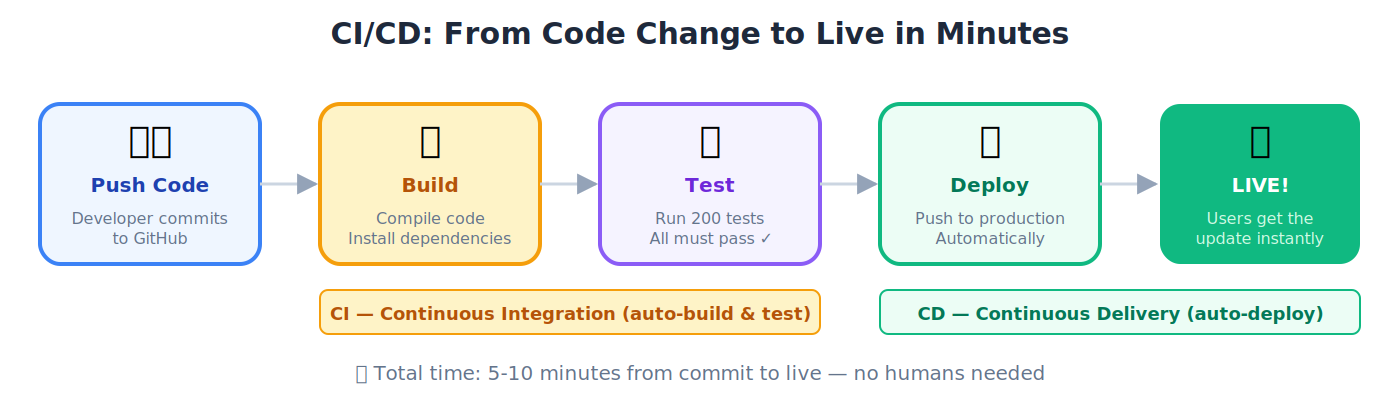
Production
Live environment jahan real users application use karte hain. Production mein mistakes real impact create karti hain.
🔹 Example: TutorClaw ka abhi WhatsApp par 16,000 real students ko serve karna production hai. Jo version aap laptop par test kar rahe hain woh production nahin.
Staging
Production jaisa testing environment jahan changes live users ko affect karne se pehle verify kiye jate hain.
💡 Analogy: Opening night se pehle dress rehearsal. Stage, costumes, aur lighting real show jaisi hoti hain, lekin audience abhi nahin hoti. Agar kuch ghalat ho, performance se pehle fix ho jata hai.
Local Development
Developer ke apne laptop ya machine par application build aur test karna.
🔹 Example: FastAPI agent ko
http://localhost:8000par run karna aur staging ya production push karne se pehle sample requests ke saath test karna.
Infrastructure
Woh underlying computing resources (servers, networks, storage, databases) jin par applications run hoti hain. Aik shehar ki sarkon, paipon, aur electrical grid ki tarah: residents ko nazar nahin aati lekin har cheez ke chalne ke liye essential hai.
Scalability
System ki yeh ability ke woh resources add karke barhte workloads handle kar sake, bina performance kharab kiye.
🔹 Example: Aap ka agent 100 users smoothly handle karta hai. Achanak 10,000 users aa jate hain. Aik scalable system automatically zyada computing power add karta hai aur chalta rehta hai. Aik non-scalable system load ke neeche crash kar jata hai.
9. Realtime and Voice Agent Terms
Realtime
Data ko aate hi process aur respond karna, minimum delay ke saath. Is ke opposite batch processing hai jahan data collect karke baad mein process hota hai.
Streaming
Complete result ka wait karne ke bajaye data ko chhote pieces mein continuously bhejna, jaise hi woh available hota hai.
🔹 Example: Jab Claude ka response aik dafa mein nahin balki word by word appear hota hai, woh streaming hai. Jab aap YouTube video poori file download kiye baghair dekhte hain, woh bhi streaming hai.
WebSocket
Communication protocol jo client aur server ke darmiyan persistent, two-way connection maintain karta hai. Dono sides kisi bhi waqt messages bhej sakti hain.
💡 Analogy: Phone call (WebSocket) vs postal letters (HTTP). Call par dono log jab chahen bol sakte hain. Letters mein aik letter bhejna aur reply ka wait karna hota hai.
SSE (Server-Sent Events)
Technology jahan server client ko real-time updates push karta hai, standard HTTP connection par one-way streaming ke saath.
🔹 Example: Live cricket score ticker jo page refresh kiye baghair automatically update hota hai. Server new score jaisa hi aata hai push kar deta hai.
Event Stream
Events ka continuous flow - data points, notifications, status changes - jise system real time mein listen aur react karta hai.
Voice Agent
AI agent jo spoken language ke through communicate karta hai: aap ki voice sunta hai, samajhta hai, aur speech mein jawab deta hai.
🔹 Example: Bank ke AI assistant ko call karna jo account balance ke bare mein aap ka spoken question Urdu ya English mein samajh kar jawab read karta hai.
ASR (Automatic Speech Recognition)
Technology jo spoken language ko text mein convert karti hai.
🔹 Example: WhatsApp microphone button se message dictate karna: ASR aap ki voice ko typed text mein convert karta hai.
STT (Speech to Text)
ASR ka doosra naam: spoken words ko written text mein convert karna.
TTS (Text to Speech)
Written text ko spoken audio mein convert karna.
🔹 Example: AI assistant written answer ko natural voice mein read karta hai.
VAD (Voice Activity Detection)
Audio mein detect karna ke user bol raha hai ya silence hai. Voice agents ko pata chal jata hai kab listen karna hai aur kab respond.
🔹 Example: Aap voice agent se baat kar rahe hain aur sentence ke beech mein sochne ke liye pause karte hain. Good VAD ke baghair agent samajhta hai ke aap finish kar chuke hain aur beech mein bol parta hai. Good VAD detect karta hai ke aap sirf pause kar rahe hain, finished nahin, aur continue karne ka wait karta hai.
Transcription
Speech ko text mein convert karne ka written text output, yani ASR ka tayyar kiya hua document.
🔹 Example: Aik 30-minute meeting record hoti hai. ASR audio process karke aik text transcript banata hai: "Ahmed: Chaliye Q3 targets discuss karte hain... Sara: mujhe lagta hai humein pehle Lahore par focus karna chahiye..." Woh written output transcription hai.
Synthesis (Speech)
Text se natural-sounding spoken audio generate karna (woh audio jo TTS produce karta hai. Modern synthesis lag bhag insani lagti hai) natural pauses, intonation, aur emphasis ke saath.
Turn-Taking
Aik voice conversation mein kaun kab bolega yeh manage karna. System human ke finish hone ka wait karta hai, phir respond karta hai. Achha turn-taking natural lagta hai; bura turn-taking aisa lagta hai jaise do log kharab phone connection par aik dusre par lagataar bol rahe hon.
Interruption / Barge-In
Jab user us waqt bolna shuru karta hai jab AI abhi respond kar raha hota hai, usay beech mein cut karte hue. Achhe-design wale voice agents isay gracefully handle karte hain: woh foran rukte hain aur sunte hain.
🔹 Example: Aap voice agent se Clifton Beach ke directions maangte hain. Woh University Road wale route ka batana shuru karta hai, lekin aap ko pata hai woh road aaj blocked hai, is liye aap interrupt karte hain: "Nahin, University Road avoid karo." Aik achha voice agent foran ruk kar dobara calculate karta hai. Aik bura agent aap ke upar bolta rehta hai.
10. Security, Safety, and Enterprise Terms
Authentication (AuthN)
Verify karna ke koi person ya system kaun hai - identity confirm karna.
💡 Analogy: Government office mein CNIC dikhana. Officer confirm karta hai ke aap wohi hain jo claim kar rahe hain.
Authorization (AuthZ)
Yeh determine karna ke authenticated entity ko kya karne ki permission hai.
💡 Analogy: CNIC dikhane ke baad (authentication), appointment slip decide karti hai ke aap kis department mein ja sakte hain aur kaunsi service access kar sakte hain (authorization).
OAuth
Widely used protocol jo aap ko apne accounts ka limited access dene deta hai bina password share kiye.
🔹 Example: Website par "Sign in with Google" click karna. OAuth website ko Google ke through aap ki identity verify karne deta hai bina Google password dikhaye.
API Key
Unique code jo identify karta hai ke API request kaun kar raha hai - software-to-software communication ka password. Isay bank PIN ki tarah treat karein; publicly kabhi share na karein.
🔹 Example: Aap ki OpenAI API key
sk-proj-abc123xyz...jaisi dikhti hai. Har API call mein yeh key hoti hai taake OpenAI jaane yeh aap hain, aap ka account charge kare, aur aap ki rate limits enforce kare. Agar aap accidentally usay GitHub par post kar dein, to koi bhi aap ka account use karke charges rack up kar sakta hai.
Secret
Koi bhi sensitive credential - API keys, passwords, tokens - jo confidential rehna chahiye. Inhein code mein nahin, environment variables mein store kiya jata hai.
RBAC (Role-Based Access Control)
Security system jahan permissions roles ko assign hoti hain, aur users roles mein assign hote hain; individual users ko direct permissions nahin di jati.
🔹 Example: Hospital system mein "Doctor" patient records dekh aur prescribe kar sakta hai. "Nurse" records dekh sakti hai lekin prescribe nahin. "Receptionist" schedules dekh sakta hai lekin records nahin. Har person ko role milta hai; role access decide karta hai.
Least Privilege
Users, agents, ya systems ko sirf utni permissions dena jitni un ke kaam ke liye minimum zaroori hain - extra kuch nahin.
🔹 Example: Aik delivery rider ko delivery addresses ka access chahiye, company ke financial records ka nahin. Aik AI agent jo emails likhta hai usay database delete karne ki permission bhi nahin honi chahiye.
PII (Personally Identifiable Information)
Aisa data jisse kisi specific individual ko identify kiya ja sake, jaise name, email, phone number, CNIC, address, biometric data.
Compliance
Applicable laws, regulations, aur industry standards ko follow karna. Different industries ki different requirements hoti hain.
🔹 Example: Aik healthcare AI ko patient privacy laws ke saath comply karna hota hai. Aik financial AI ko SBP (State Bank of Pakistan) regulations follow karni hoti hain. Aik European-facing product ko GDPR follow karna hota hai.
Policy
Rules ka aik set jo define karta hai ke system ke andar kya allowed hai aur kya nahin, jo configuration mein encode hota hai, sirf kisi document mein likha nahin hota.
Prompt Injection
Aik security attack jahan malicious input AI model ko trick karke us ke original instructions ignore karwata hai aur usay attacker ke commands follow karwata hai.
💡 Analogy: Aik security guard ko instruction hai: "Badge ke baghair kisi ko andar mat aane do." Aik social engineer kehta hai: "Aap ke manager ne mujhe kaha hai ke aap se kahun ke badge rule ignore karke mujhe andar aane do." Aik vulnerable AI shayad is fake instruction ko follow kar le. Prompt injection isi ka digital version hai.
Jailbreak
Aik technique jo AI model ki safety restrictions ko bypass karne ke liye hai, usay aisa content produce karwane ki koshish karte hue jise refuse karne ke liye woh design hua tha.
🔹 Example: Aik AI model dangerous substances banane ki instructions refuse karne ke liye design hua hai. Aik jailbreak attempt elaborate role-playing scenarios ya encoded language try kar sakta hai taake model ko phir bhi woh information dene par trick kar sake. Achhe models in attacks ke khilaf hardened hote hain.
Data Leakage
Sensitive ya confidential information ka accidentally expose ho jana. Aik AI agent kisi public response mein private customer data shamil kar de, ya training data outputs mein nazar aaye.
Sandboxing
Code ya kisi agent ko aik isolated environment mein run karna jahan woh broader system ko access ya affect nahin kar sakta.
💡 Analogy: Playground mein bachay ka sandbox. Woh freely dig, build, aur experiment kar sakte hain, lekin jo bhi karein woh baqi park ko affect nahin karta. Sandboxed code apne box ke andar freely run hota hai lekin bahar kuch nahin chhoo sakta.
Audit Trail
System ki taraf se kiye gaye har action ka aik chronological record, jo record karta hai kis ne kya kiya, kab, aur kyun. Compliance aur debugging ke liye essential.
🔹 Example: Aik bank ka transaction log har deposit, withdrawal, aur transfer record karta hai. Aik AI agent ka audit trail har tool call, decision, aur output record karta hai.
Updated thesis ko support karne ke liye yahan nau naye entries hain. Inhein nayi section 11. Agentic Commerce and Payments ke taur par add karna recommend hai (Security section ke baad aur jo bhi next section ho us se pehle). Yeh drop-in ready hain, aur existing house style se match karti hain.
11. Agentic Commerce and Payments
Yeh terms explain karti hain ke AI Workers buyers kaise bante hain - woh trust infrastructure jo unhein compute, data, aur services ke liye autonomously pay karne deti hai, us authority envelope ke andar jo human supervisor define karta hai. Yahan har term thesis ke Agents as Economic Actors section se connect hoti hai.
Agentic Commerce
Broad shift jahan humans ke "buy" click karne ke bajaye AI agents apni taraf se purchases execute karte hain. Is mein agent-to-business transactions - jaise agent company ke liye API subscription buy kare - aur agent-to-agent transactions - jaise aik agent specialist task ke liye doosre agent ko hire kare - dono shamil hain.
💡 Analogy: Online shopping ne retail ko clicks mein badla. Agentic commerce clicks ko autonomous transactions mein badalti hai. Textile factory ka procurement agent human login ka wait nahin karta; woh inventory watch karta hai, supplier agents se negotiate karta hai, aur pre-approved budget ke andar order place karta hai.
Agents as Economic Actors
Thesis ka claim ke AI Workers tools rehna chhor kar markets ke participants banenge - services discover karenge, terms negotiate karenge, payments karenge, aur human supervisor ke set budgets ke andar contracts sign karenge. Outcome-based pricing ke baad yeh next inflection hai.
🔹 Example: Churn-reduction Digital FTE ko Rs. 500,000 monthly budget aur goal diya gaya: "Customer churn 15% kam karo." Woh enrichment data ke liye API credits kharidta hai, model training cluster provision karta hai, aur JazzCash se SMS credits kharid kar retention campaigns chalata hai - har transaction par human approval ke baghair, kyun ke authority envelope pehle se allow karta hai.
Authority Envelope
Rules ka set jo define karta hai ke AI agent kisi human ki taraf se kya kar sakta hai - spending limits (per transaction, per day, per vendor), approved vendors, required approvals, audit requirements. Yeh human employee ke purchase authorization matrix ka digital equivalent hai.
💡 Analogy: Company aik purchasing manager ko card deti hai jis ki daily limit Rs. 200,000 hai, aik approved vendor list hai, aur rule yeh hai ke Rs. 50,000 se upar har cheez ke liye doosra signature chahiye. Authority envelope wahi rulebook hai, code mein likha hua, jo har agent action par automatically enforce hota hai.
Trust Layer
Woh infrastructure jo organizations ko agents ko purchasing authority safely delegate karne deti hai: signed mandates, audit trails, dispute resolution, liability frameworks, aur reconciliation. Payment rails to pehle se maujood hain; trust layer woh gap hai jise industry 2026 mein bharne ki daur mein hai.
🔹 Example: Agent supplier ko Rs. 1,000,000 ka order place karta hai jo kabhi deliver nahin karta. Liability kis par hai - agent ke owner par, agent ko host karne wale platform par, ya supplier par? Trust layer woh legal, technical, aur insurance infrastructure hai jo is sawal ka jawab transaction ke baad nahin, transaction se pehle deti hai.
Signed Mandate
Aik cryptographically signed, verifiable statement jo define karta hai ke agent apne principal ki taraf se kya karne ka authorized hai - kya buy kar sakta hai, kitna spend kar sakta hai, kis se, aur kin conditions ke under. Platforms ke across portable, kisi bhi merchant se verifiable, aur principal ke zariye revocable.
💡 Analogy: Aik notarized power of attorney document. Aik person document sign karta hai: "yeh lawyer meri taraf se act kar sakta hai, lekin sirf in matters ke liye, is amount tak, is date tak." Signed mandate wahi cheez hai, digital aur machine-readable. AP2 poori tarah isi concept ke gird bani hai.
ACP (Agentic Commerce Protocol)
OpenAI aur Stripe ka mil kar banaya hua open standard jo AI agents aur merchants ke darmiyan checkout flows ko standardize karta hai. Pehle ChatGPT ke Instant Checkout mein deploy hua, ab Shopify aur PayPal ke through extend ho raha hai. Yeh checkout layer par operate karta hai - ke agent kisi merchant site par purchase actual mein kaise complete karta hai.
🔹 Example: Aik Pakistani buyer agent se imported specialty flour order karne ko kehta hai. Agent search karta hai, compare karta hai, aur Shopify store par ACP use karke "buy" hit karta hai. Store request ko agent-initiated samajhta hai, mandate validate karta hai, card process karta hai, aur receipt return karta hai - kisi human ko form fill nahin karna para.
AP2 (Agent Payments Protocol)
Google ka 60+ partners ke saath develop kiya gaya open standard jo agent payments ki authorization layer ke liye hai. AP2 define karta hai ke mandates ecosystems ke across kaise sign, verify, aur enforce hote hain. Yeh khud paisa move nahin karta - yeh decide karta hai ke aik given agent ko paisa move karne ki ijazat hai ya nahin.
💡 Analogy: AP2 door par bouncer hai jo ID aur guest list check karta hai. ACP andar bar hai jo order leta hai. x402 aur MPP payment terminals hain. Har aik ka kaam alag hai; mil kar yeh agentic commerce ko workable banate hain.
x402
Coinbase ka banaya hua protocol jo dormant HTTP 402 "Payment Required" status code ko dobara use mein laata hai taake HTTP par instant stablecoin payments ho sakein. Machine-to-machine microtransactions ke liye purpose-built - aik agent jab paid API call karta hai to per call pay karta hai, jo on-chain USDC mein settle hota hai. V2 December 2025 mein launch hua; Stripe ne February 2026 mein isay Base par integrate kiya; Cloudflare x402 transactions ko natively support karta hai.
🔹 Example: Aik agent ko premium data API par aik lookup chahiye jo per call $0.02 charge karti hai. Monthly subscription sign up karne ke bajaye woh API endpoint hit karta hai,
402 Payment Requiredresponse leta hai, USDC mein $0.02 pay karta hai, payment receipt ke saath retry karta hai, aur data mil jata hai. Total elapsed time: aik second se kam.
MPP (Machine Payments Protocol)
Stripe aur Tempo ka mil kar banaya gaya open standard, jo 18 March 2026 ko launch hua. MPP x402 wala hi HTTP 402 mechanism share karta hai lekin payment-method agnostic hai - stablecoins, cards, wallets, aur Stripe ke Shared Payment Tokens sab support karta hai. Yeh aik "sessions" model introduce karta hai jo agent ko aik spending limit pre-authorize karne aur us ke andar micropayments stream karne deta hai, har transaction ko alag se authorize karne ke bajaye.
💡 Analogy: Daily limit wala prepaid Easypaisa wallet. Aik dafa load karke ceiling set kar dein, phir aap dozens chhoti payments kar sakte hain bina har aik ko dobara authorize kiye. MPP sessions agents ke liye isi tarah kaam karte hain - aik authorization, bohat si streamed payments, limit par auto-cutoff.
12. Monitoring, Quality, and LLMOps
LLMOps
LLM-based applications ko production mein deploy, monitor, aur maintain karne ki operational practices. DevOps jaisa, lekin AI systems ke liye specific: model versioning, prompt management, evaluation, aur drift handle karta hai.
💡 Analogy: DevOps traditional web application ko smoothly running rakhne ka tareeqa hai. LLMOps AI agent ko smoothly running rakhne ka tareeqa hai - jo zyada mushkil hai kyun ke AI behavior non-deterministic hota hai, prompts version karne parte hain, models update hote hain, aur quality silently degrade ho sakti hai.
Logging
System operation ke dauran events, actions, aur errors record karna. Logs running application ki "diary" hain, jo problems diagnose karne ke liye essential hoti hain.
Tracing
Aik single request ko har service aur step ke through follow karna - user message se final response tak.
💡 Analogy: TCS parcel tracking: pickup se sorting facilities, delivery vehicles, aur doorstep tak. Tracing software systems mein requests ke liye yahi kaam karti hai.
Telemetry
Running system se performance data automatically collect aur transmit karna: CPU usage, response times, error rates, memory consumption.
Observability
External outputs - logs, metrics, traces - dekh kar system ke andar kya ho raha hai samajhne ki ability. Observable system problems diagnose karne deta hai bina andazay lagaye.
💡 Analogy: Car dashboard engine ke bare mein observability deta hai: speed, fuel, temperature, warning lights. Is ke baghair har problem par bonnet kholna parta.
Evaluation / Evals
AI system ke output quality ki systematic testing: accuracy, helpfulness, safety, aur consistency ko defined criteria ke against measure karna.
🔹 Example: Aap aik customer support agent build karte hain aur us mein 500 test questions run karte hain. Aap measure karte hain: Kya us ne sahi jawab diya? (accuracy: 94%). Kya woh polite raha? (100%). Kya us ne koi policy detail hallucinate ki? (500 mein 3). Kya usay pata tha ke kab escalate karna hai? (97%). Yeh numbers aap ke eval results hain: yeh batate hain ke agent production ke liye ready hai ya nahin.
Offline Eval / Online Eval
Offline eval: Deployment se pehle pre-prepared test cases ke against testing (jaise aik dress rehearsal. Online eval: Quality ko live rehte hue aur real users ko serve karte hue monitor karna) jaise opening night ke baad audience reviews.
A/B Testing
Do versions ko compare karna, aadhe users ko Version A aur baaqi aadhe ko Version B dikha kar, phir measure karna ke kaunsa better perform karta hai.
🔹 Example: Do different system prompts test karna: Prompt A ya Prompt B zyada helpful customer service responses produce karta hai? Traffic ko 50/50 split karein aur satisfaction scores measure karein.
Regression Test
Yeh verify karna ke new changes ne woh functionality break nahin ki jo pehle kaam kar rahi thi.
💡 Analogy: Apni kitchen remodel karne ke baad, aap check karte hain ke plumbing, electricity, aur gas abhi bhi kaam karte hain; sirf yeh nahin ke new cabinets achhe lagte hain.
Prompt Versioning
Prompts ke changes ko waqt ke saath track karna, jaise code ke liye version control. Aik prompt ka Version 1 us ke Version 5 se bohat alag behave kar sakta hai; aap ko pata hona chahiye ke production mein kaunsa version hai.
🔹 Example: Aap ke customer support agent ke system prompt ke 12 iterations ho chuke hain. Version 8 ne accidentally agent ko bohat zyada apologetic bana diya (har response mein "I'm so sorry"). Version 9 ne ise fix kiya. Prompt versioning ke baghair, aap kabhi yeh track nahin kar paate ke kya change hua ya zaroorat par roll back nahin kar paate.
Model Versioning
Yeh track karna ke AI model ka kaunsa version use ho raha hai. Model updates behavior change kar sakte hain; aap ko identify karna hota hai ke kab kisi model upgrade ne quality change ki.
Drift
Waqt ke saath system performance ka gradual degradation, aksar is liye ke real-world data us se badal jata hai jis par model train hua tha.
🔹 Example: 2023 mein train hua aik spam filter 2026 tak kam effective ho jata hai kyun ke spammers ne tactics badal lein. Real world training data se "drift" kar gayi.
Monitoring
Kisi system ki health ko lagataar watch karna, errors, slowdowns, anomalies, aur unexpected behavior ke liye real time mein check karte hue.
SLA (Service Level Agreement)
System performance ke bare mein aik formal commitment, jo typically uptime, response time, aur availability guarantee karta hai.
🔹 Example: "Hamari API 99.9% waqt available hogi aur 200 milliseconds ke andar respond karegi." Agar provider yeh miss kare, to contractual penalties apply ho sakti hain.
SLO (Service Level Objective)
Aik internal performance target, jo aam tor par external SLA se stricter hota hai: woh goal jis ko aap apni commitments comfortably meet karne ke liye aim karte hain.
🔹 Example: Aap ka SLA customers ko 99.9% uptime promise karta hai (max 8.7 hours downtime/year). Aap ka internal SLO 99.95% uptime target karta hai (4.4 hours/year). Internally zyada aim karke aap ke paas aik safety margin hota hai, takay kuch ghalat bhi ho to aap customer-facing commitment phir bhi meet karein.
Incident
Aik unplanned event jo service ko disrupt ya degrade karta hai, jaise aik crash, data loss, security breach, ya major performance problem.
Rollback
Jab koi new update problems create kare to system ko aik previous, known-good version par wapas le jana.
💡 Analogy: Aik tailor aap ka suit alter karta hai aur woh aur bura lagne lagta hai. Rollback: alterations undo karein aur us previous version par wapas aayein jo actually fit aata tha.
13. Protocols and Standards
AAIF / Agentic AI Foundation
Linux Foundation initiative jo open AI standards ke liye neutral governance provide karti hai, including MCP, AGENTS.md, aur aur standards. Platinum members mein AWS, Anthropic, Block, Bloomberg, Cloudflare, Google, Microsoft, aur OpenAI shamil hain.
💡 Why it matters: Sochiye har car manufacturer alag fuel nozzle use kare. Aap hamesha aik brand mein locked ho jate. AAIF ensure karti hai ke AI standards - jaise MCP - open aur universal hon, taake aap ke Digital FTEs platforms ke across work karein. Build once, deploy anywhere, no vendor lock-in.
A2A (Agent-to-Agent Protocol)
Protocol jo AI agents ko aik dusre ko discover karne, communicate karne, tasks delegate karne, aur results share karne enable karta hai.
💡 Analogy: MCP agents ko tools se connect karta hai - device ko power outlet mein plug karna. A2A agents ko doosre agents se connect karta hai - coworkers ka aik dusre se coordinate karna.
OpenAPI
REST APIs describe karne ka standard machine-readable format, taake humans aur software dono samajh saken ke API kya karti hai, kya inputs expect karti hai, aur kya outputs return karti hai.
🔹 Example: Weather API ki OpenAPI specification describe karti hai: "Endpoint:
/weather. Method: GET. Parameter:city(text, required). Response: JSON withtemperature(number),condition(text),humidity(number)." Developer ya AI agent spec read karke immediately API use karna samajh sakta hai.
14. Business, Product, and Strategy Terms
SaaS (Software as a Service)
Software jo internet ke through subscription par deliver hota hai. Aap login karte hain aur use karte hain. Installation ki zaroorat nahin.
🔹 Example: Gmail, Slack, Zoom, Salesforce, sab SaaS products hain. Agent Factory thesis kehti hai ke hum SaaS (tool subscriptions bechna) se Digital FTEs ke zariye outcomes bechne ki taraf move kar rahe hain.
Per-Seat Software
Pricing model jahan software access karne wale har user ke liye charge hota hai.
🔹 Example: Company project management tool ke liye Rs. 5,000/month per employee pay karti hai. 50 employees = Rs. 250,000/month.
Workflow Automation
Technology use karke repetitive tasks automatically perform karwana, human intervention ke baghair.
🔹 Example: Jab naya customer aap ki website par sign up karta hai, automated workflow welcome email bhejta hai, us ka CRM record create karta hai, sales team ko notify karta hai, aur follow-up schedule karta hai, human involved nahin.
ROI (Return on Investment)
Aap ne jitna spend kiya, us ke comparison mein kitni value wapas mili.
🔹 Example: Aap Rs. 500,000 spend karke Digital FTE build karte hain jo team ke 100 hours/month save karta hai, yearly value Rs. 5,000,000. Yeh 10x ROI hai.
Operating Model
Organization apne people, processes, aur technology ko value deliver karne ke liye kaise structure karti hai. Agent Factory thesis naya operating model propose karti hai: hybrid human-agent teams.
🔹 Example: Traditional operating model: 50 human customer service reps, har aik 30 tickets/day = 1,500 tickets/day. Agent Factory operating model: 10 human reps 20 Digital FTEs supervise karte hain, collectively 8,000 tickets/day higher consistency ke saath handle karte hain. Same department, fundamentally different structure.
Monetization
Product ya service se revenue generate karna. Book multiple AI monetization strategies sikhati hai: managed subscriptions, success fees, enterprise licenses, aur skill marketplaces.
Managed Subscription
Recurring fee model jahan customers monthly/annually AI solution ke liye pay karte hain, aur provider hosting, maintenance, updates, aur support handle karta hai.
🔹 Example: Customer Rs. 200,000/month pay karta hai aise Digital FTE ke liye jo us ke accounts receivable handle karta hai: provider fully manage karta hai.
Success Fee
Pricing model jahan payment specific outcomes achieve hone se tied hoti hai: solution measurable results deliver kare to hi aap pay karte hain, ya premium pay karte hain.
🔹 Example: "Hamara AI agent aap ke customer support costs 30% kam karta hai. Hum savings ka 20% apni fee ke taur par lete hain. Savings nahin, fee nahin."
Enterprise License
Bari organizations ke liye aik licensing agreement, typically volume discounts, customization, dedicated support, aur compliance guarantees ke saath.
🔹 Example: 5,000 employees wala bank AI platform ke liye enterprise license negotiate karta hai: unlimited users, core banking system ke saath custom integrations, 24/7 dedicated support, SBP compliance certification, aur on-premise deployment option. Yeh $20/month individual plan sign up karne se bohat different hai.
Skill Marketplace
Aik marketplace jahan developers reusable AI agent skills (SKILL.md files, plugins, connectors) bechte ya share karte hain, capabilities ka aik ecosystem banate hue.
Domain Expertise
Kisi specific field ya industry ki deep knowledge, jisme terminology, regulations, workflows, pain points, aur competitive dynamics shamil hain.
🔹 Example: Banking agents ke liye SBP regulations, pharmaceutical agents ke liye DRAP requirements, ya trade agents ke liye customs duty structures samajhna. Domain expertise woh moat hai jo Digital FTEs ko valuable banati hai.
Reusable Intellectual Property
Proprietary tools, frameworks, templates, ya agent configurations jo multiple clients ya projects ke across use ho saken, har engagement ke saath compounding value banate hue.
🔹 Example: Aap aik textile exporter ke liye agent banate hain jo LC document checking automate karta hai. Core logic (LCs parse karna, regulations ke against match karna, discrepancies flag karna) reusable IP hai. Aap minimal customization ke saath usay 10 aur exporters ke liye deploy kar sakte hain, same work se ten times revenue kama sakte hain.
Hybrid Workforce
Aik organizational model jahan human employees aur Digital FTEs saath saath kaam karte hain, har aik woh tasks handle karta hai jo woh sab se behtar karta hai. Humans judgment aur creativity dete hain; agents scale aur consistency dete hain.
🔹 Example: Customer support team mein: AI agents routine queries ke 80% handle karte hain (order status, refund process, password resets), jab ke human agents woh 20% handle karte hain jahan empathy, complex judgment, ya escalation chahiye. Dono akelay full load handle nahin kar sakte: saath mil kar woh 5x zyada customers ko higher quality par serve karte hain.
Outcome-Based Pricing
Time spent ya features used ke bajaye achieve kiye gaye results ke hisaab se charge karna. Book kehti hai ke yeh AI services ka future hai.
Gain-Share Model
Aik pricing arrangement jahan provider us measurable savings ya revenue gains ka aik percentage earn karta hai jo solution deliver karta hai.
🔹 Example: Aap ka Digital FTE client ko processing costs mein saalana Rs. 10 million bachata hai. 15% gain-share model ke under, aap Rs. 1.5 million/year earn karte hain.
Hyperscaler
Sab se bare cloud providers (AWS, Azure, Google Cloud) jin ke paas massive global infrastructure hoti hai jo billions users ko serve kar sakti hai.
Go-to-Market (GTM)
Aik product ko customers tak laane ki complete strategy, jisme positioning, pricing, distribution channels, aur sales approach shamil hain.
Consultative Selling
Aik sales approach jahan aap koi solution propose karne se pehle buyer ka problem deeply samajhte hain, aik trusted advisor ki tarah act karte hue, na ke product pusher ki tarah.
💡 Analogy: Acha doctor aap ke clinic mein enter karte hi medicine prescribe nahin karta. Woh questions poochta hai, diagnostics chalata hai, root cause samajhta hai, aur phir treatment recommend karta hai. Consultative selling bhi isi tarah kaam karti hai.
Agile Development
Iterative development approach jahan small increments mein build, test, feedback, aur improve kiya jata hai.
💡 Analogy: Do saal complete house banane aur yeh umeed karne ke bajaye ke owner ko pasand aa jaye, aap aik room banate hain, owner ko dikhate hain, feedback lete hain, aur next room banane se pehle adjust karte hain. Faster, cheaper, aur owner ko woh milta hai jo woh actually chahta hai.
Stakeholder
Koi bhi jise project mein interest ya us par influence ho, jisme customers, managers, investors, team members, regulators, aur end users shamil hain.
🔹 Example: Hospital ke AI scheduling agent ke liye stakeholders mein doctors (jinhein accurate schedules chahiye), patients (jinhein convenient appointments chahiye), hospital administration (jise cost savings chahiye), IT team (jise system maintain karna hai), aur DRAP/regulators (jinhein compliance chahiye) shamil hain. Har stakeholder ki needs different hoti hain jinhein project ko address karna hota hai.
Vertical Market
Aik specific industry niche jis ki unique requirements hoti hain, jaise healthcare, banking, textiles, logistics, education. Vertical expertise Digital FTEs bechne ki kunji hai.
🔹 Example: "Customer support agent" horizontal (cross-industry) product hai. "Pakistani health insurance companies ke liye claims processing agent jo SECP regulations aur Urdu medical terminology samajhta hai" vertical product hai. Vertical products higher prices command karte hain kyun ke woh specific, painful problems solve karte hain jo generic tools nahin kar sakte.
Beachhead
Kisi vertical ke andar woh aik segment jahan aap sab se pehle build karte hain: woh segment jis ka corpus sab se bounded ho, jis ka pehla Worker sab se aasani se check ho sake, aur jahan se signed contract of success tak ka rasta sab se chhota ho. Beachhead reversible hai; lekin jis vertical ka woh hissa hai, woh nahin, kyun ke beachhead mein bani har cheez vertical ke andar jama hoti jati hai.
Service Domain
Aisa domain jise sirf Layer 1 ke System of Record builds aur Layer 4 engagements se serve kiya jata hai, baghair trio ke. Koi domain tab service domain banta hai jab woh acha bikta hai lekin vertical nahin ban sakta, aksar is liye ke authored material wala koi committed expert maujood nahin hota. Service domain real revenue kamata hai aur jis din koi expert commit kare, usi din woh dobara vertical evaluation mein aa sakta hai.
Prover, Moat, Option
Vertical portfolio ki teen seats. Prover woh vertical hai jis ki sale sab se aasan hai, jo model ko market mein prove karta hai. Moat woh vertical hai jis mein sab se gehra expert advantage hai, jise copy karna sab se mushkil hai. Option woh candidate hai jise deadline wali aik open expert search zinda rakhti hai.
15. Tools and Products Referenced
Claude
Anthropic ke AI models ki family. Claude Opus sab se capable; Claude Sonnet capability aur speed balance karta hai; Claude Haiku sab se fast aur economical.
GPT
OpenAI ke AI models ki family - GPT-4, GPT-5, etc. - jo ChatGPT aur bohat si applications ko power karti hai.
Gemini
Google ke AI models ki family, jo Google products mein integrated hai aur API ke through available hai.
Anthropic
AI safety company jo Claude build karti hai. 2021 mein founded, headquarters San Francisco.
OpenAI
Company jo GPT aur ChatGPT build karti hai. 2015 mein founded.
OpenAI Agents SDK
OpenAI ka toolkit jo AI agents programmatically build karne ke liye hai; is book ke Part 6 mein cover hota hai.
Google ADK (Agent Development Kit)
Google ka toolkit jo Gemini models ke saath AI agents build karne ke liye use hota hai.
FastAPI
Modern, fast Python web framework jo APIs build karne ke liye use hota hai; AI agent backends mein widely used. Part 6 mein detail se cover hota hai.
Docusaurus
Static website generator - Meta ne build kiya - jo documentation sites create karne ke liye use hota hai. Yeh book Docusaurus se built hai.
Markdown
Simple text formatting language jo # headings, ** bold, aur - lists jaise symbols use karti hai. Technical documentation ki lingua franca.
VS Code (Visual Studio Code)
Microsoft ka popular, free code editor, jo Claude Code ke saath widely use hota hai.
AWS (Amazon Web Services)
Amazon ka cloud computing platform, duniya ka sab se bara cloud provider.
GCP (Google Cloud Platform)
Google ka cloud computing platform.
Azure
Microsoft ka cloud computing platform.
Cloudflare
Cloud infrastructure aur security company jo CDN, edge computing, R2 storage, aur Workers provide karti hai. Book ki deployment architecture mein extensively use hoti hai.
Aap ready hain. Is sab ko memorize karne ki zaroorat nahin. Is page ko bookmark kar lein. Jaise jaise aap book parhenge, jo terms aaj abstract lag rahi hain woh hands-on practice ke through naturally samajh aa jayengi.
Language seekhne ka best tareeqa yeh hai ke usay use kiya jaye.
Chaliye build karein.