Kahan se Shuru Karein: Mahino Nahin, Dinon Mein Agentic AI Engineer Ban Jayein
Aap ke paas AI seekhne ke liye mahine nahin hain. Achi khabar yeh hai ke aap ko un ki zaroorat bhi nahin. Har koi aik hi tareeqe se shuru karta hai: browser mein aath Foundations courses, kuch bhi install kiye baghair, chahe aap code kar sakte hon ya nahin. Phir aap aik decision lete hain, AI se apna kaam karwana hai ya aisa AI banana hai jo aap ke liye kaam kare, aur courses wahan se aage barhte hain. Engineer destination hai, prerequisite nahin.
Yeh section beginner se aise Agentic AI Engineer tak ka sab se chota raasta hai jo waqai work ship kar sake, semesters mein nahin, dinon mein measure kiya gaya: kuch hours mein AI ke saath productive, aik weekend mein pehla Digital FTE, aur focused evenings ke aik mahine mein poora Agent Factory stack.
Din Kyun, Mahine Kyun Nahin
Yeh promise impossible lagta hai jab tak aap us ke peeche ka method nahin dekhte. Yeh wahi method hai jo koi bhi kam background ke saath nayi job survive karne ke liye istemaal karta hai. Pehle, aap kaam ka overview lete hain. Doosra, aap woh chand topics identify karte hain jo waqai kaam karne ke liye critical hote hain. Teesra, aap har topic ka woh 80% seekhte hain jo routine mein istemaal hota hai, kaam shuru karte hain, aur baqi cheezen raste mein seekhte jate hain, reference material paas rakh kar.
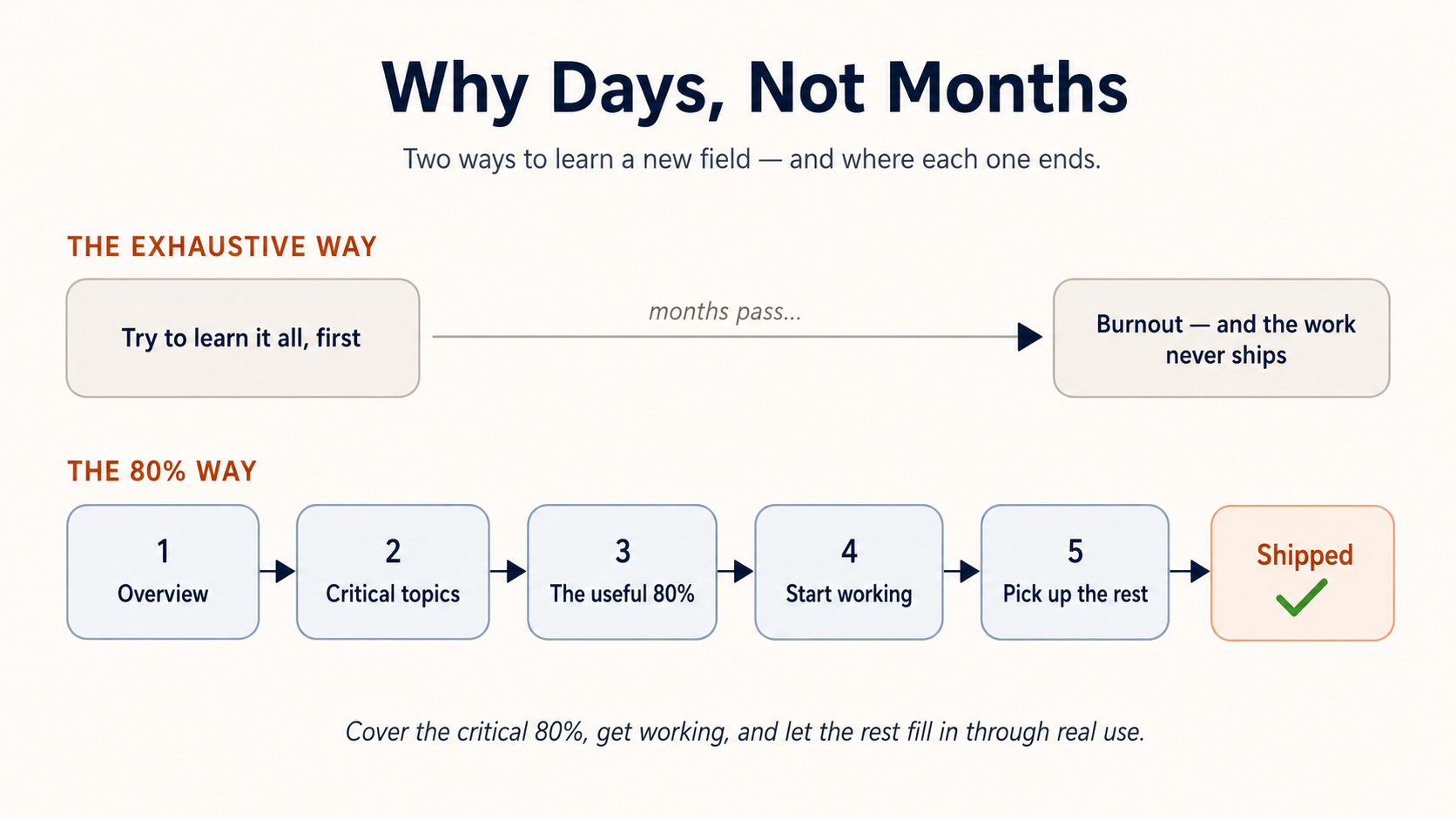
Har topic ki har detail pehle hi seekhne ki koshish mein mahine lag jate hain. Aap kuch ship karne se pehle hi burn out ho jayein ge. Hamari pedagogy ulte philosophy par bani hai: critical 80% cover karein, aap ko kaam par lagayein, aur baqi real use ke zariye fill hota rahe. Is section ka har crash course isi tareeqe se design hua hai.
Yeh Kaise Organized Hai (Yahan se Shuru Karein)
Aap yeh sab kuch parh kar nahin seekhte; aap aik clear path chal kar seekhte hain. Is liye yeh woh path hai, sirf wohi map jo aap ko yaad rakhna hai. Yeh wahi map hai jo sidebar pehle se dikhata hai: Foundations pehle, phir General Agents, phir Personal Agent Harnesses, jahan har koi apna persistent agent hasil karta hai, phir do tracks mein se aik, Mode 1 ya Mode 2, aur aakhir mein References & Companions. Pura silsila beech mein aik hi decision par ghoomta hai (kaun sa mode), aur us decision se pehle ki har cheez har reader ke liye shared hai.
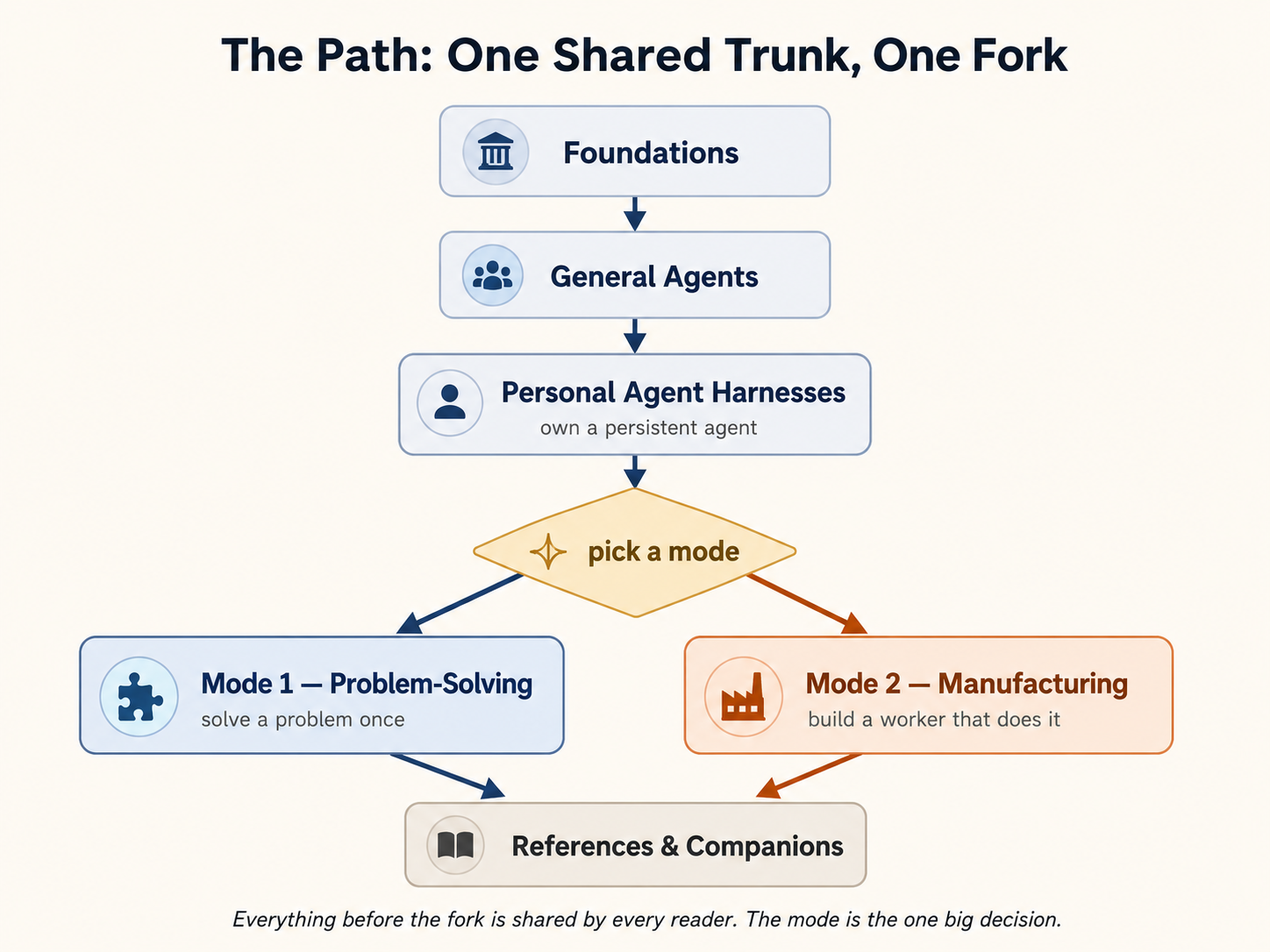
Sab se pehle thesis parhein. Yeh do versions mein aata hai, aik technical aur business professionals ke liye, aur aik absolute beginners ke liye, taake background kuch bhi ho, har reader follow kar sake. Thesis ke baad Foundations aati hain: language model asal mein kya hai, prompting, agentic kaam ki do document languages, woh code commission karna jo aap kabhi nahin likhte, AI ko task aik baar sikhana aur usay apni apps se connect karna, aur AI era mein sochna seekhna. Har reader mode choose karne se pehle yeh courses leta hai.
Aap kahan se shuru karte hain? Browser mein. Aap ke pehle aath courses, Foundations, chat tab mein chalte hain: Claude.ai, ChatGPT, ya Gemini, kuch bhi install kiye baghair, chahe aap pehle se code kar sakte hon ya nahin. Wohi browser tab woh jagah hai jahan everyday AI value ka bara hissa pehle se rehta hai. Jab kaam ko aap ki real files chahiye hoti hain, to aap apni machine par chalne wale general agent tak graduate karte hain, aur agentic work ki teen layers shuru hoti hain.
Aap ko jo mental model chahiye: AI era mein kaam teen layers mein hota hai. Aap general agents se problems solve karwate hain. Aap specialized jobs ke liye AI Workers banate hain. Aap un Workers ko mila kar AI-Native Companies assemble karte hain. Har professional engagement ek hi tarah shuru hoti hai: aik human general agent ko direct kar raha hota hai. Sirf sawal yeh hota hai ke kaun sa agent, aur yeh is baat par depend karta hai ke aap kya accomplish karna chahte hain.
Naming par aik quick note. Is book mein AI Worker, Digital FTE, aur AI Employee ek hi idea ke naam hain: aik specialized agentic system jo human-defined policy ke under real job karta hai. Jab business value par zor ho to hum Digital FTE kehte hain, implementation par zor ho to AI Worker, aur company ke andar role par zor ho to AI Employee. Kisi aur unfamiliar term ke liye glossary aap ka dost hai.
Yahi teen layers woh arc hain jis par yeh section aap ko us jagah se le jata hai jahan aap abhi hain:
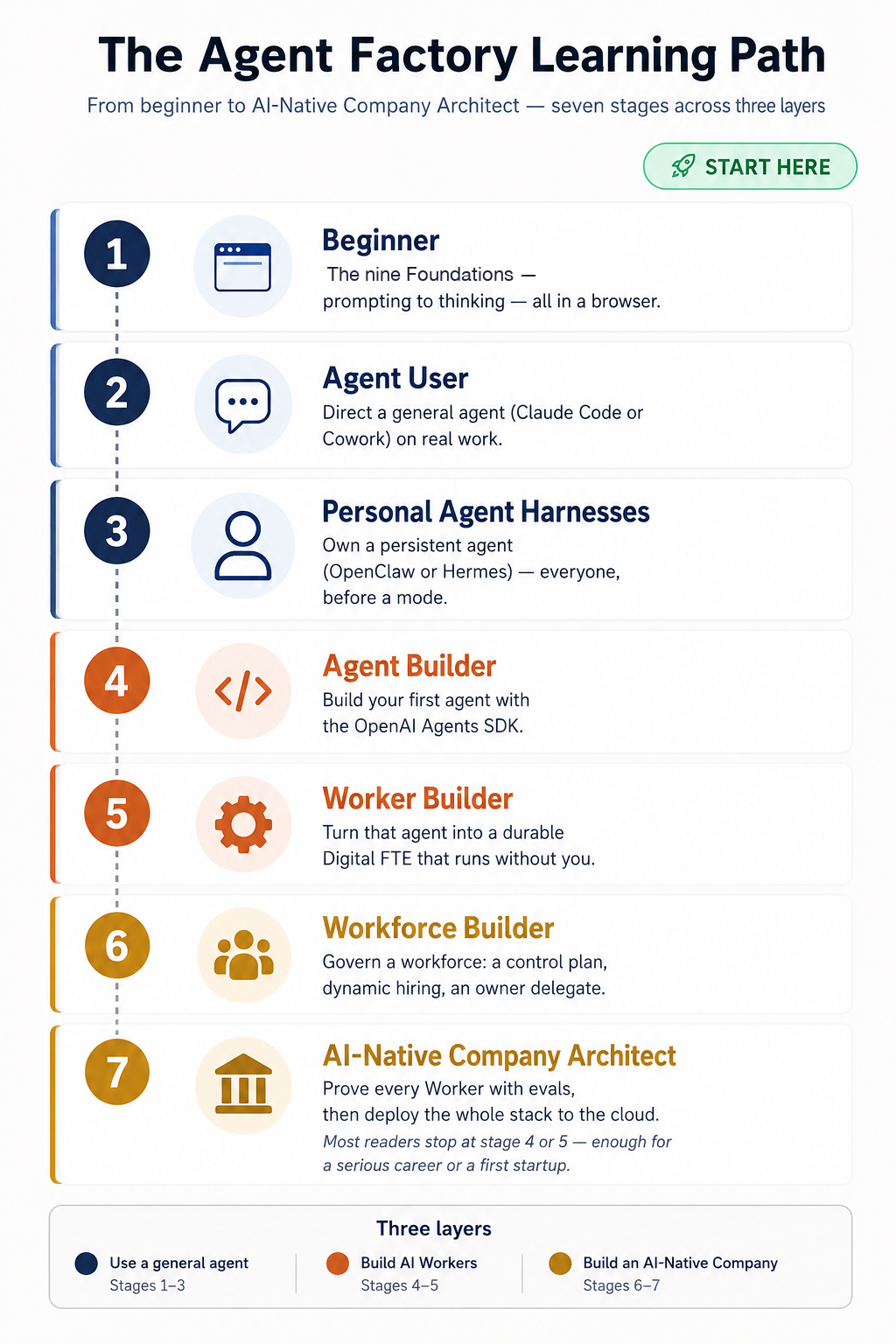
Aap ko poora path chalna zaroori nahin. Zyada tar readers stage 4 ya 5 par ruk jate hain, aur serious career ya first startup ke liye yeh kaafi hota hai. Full path wahan hai agar aap chahen.
Apna Mode Choose Karein
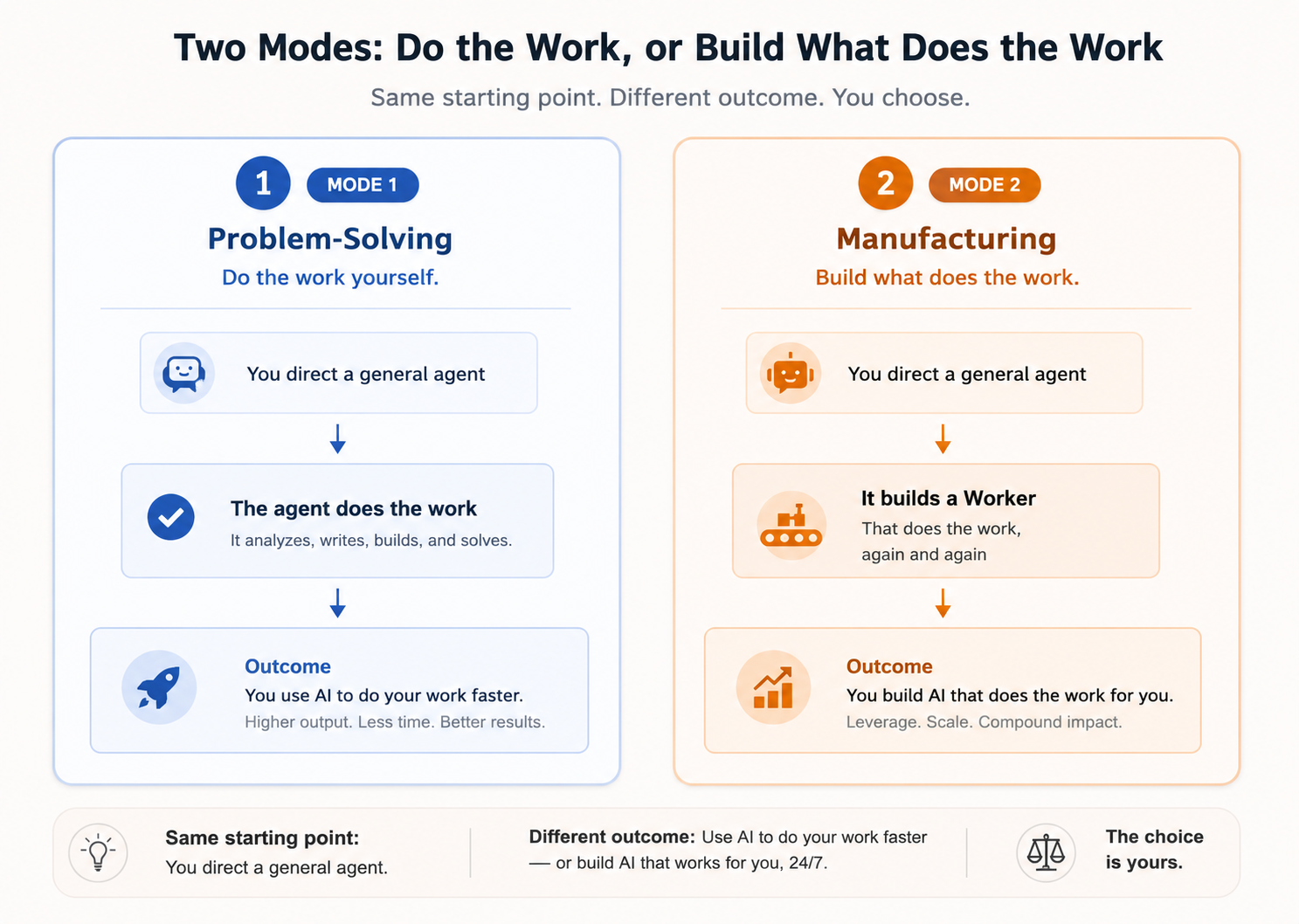
Yeh decision qareeb se dekhein: AI use karne aur aisa AI banane ke darmiyan fork jo aap ke liye kaam kare. Pehle isay abstract mein choose karein, phir apni row dhoondein.
Thesis ka section general agent use ke do modes batata hai ke log general-purpose agents ko asal mein do tareeqon se istemaal karte hain. Mode 1 jab aap AI ko apna kaam karne ke liye istemaal karna chahte hain. Mode 2 jab aap aisa AI banana chahte hain jo aap ke liye kaam kare. "Manufacturing" ka label industrial lagta hai, aur hai bhi: Workers banana unhein istemaal karne se alag discipline hai.
Aik cheez decision change nahin karta: Foundations ke bilkul baad har koi general agent choose karta hai, Course 12 ya Course 10. Mode decision aap ko track par route karta hai; yeh decide nahin karta ke aap general agent use karein ge ya nahin. Aap hamesha karte hain.
| Mode 1: Problem-Solving | Mode 2: Manufacturing | |
|---|---|---|
| Yeh choose karein agar aap... | Chahte hain ke AI aap ko kaam tez karne mein madad de | AI Workers banana chahte hain jo aap ke liye kaam karein |
| Yeh kis ke liye hai | Koi bhi: engineers ya knowledge workers | Engineers, ya knowledge worker jo engineer ke saath paired ho |
| Aap ka tool | Claude Code/OpenCode ya Claude Cowork/OpenWork | Claude Code/OpenCode build karne ke liye; course pages concepts sikhate hain jinhein aap pehle khud parhte hain, phir agent se build karwate hain |
| Shuru yahan se karein | Course 12 (engineers) ya Course 10 (knowledge workers) | Course 32: Build AI Agents |
| Aap produce karte hain | Completed work | Aisa Worker jo khud work produce karta hai |
| Governance kis se hoti hai | Seven Principles of Problem Solving | Seven Invariants of the Agent Factory |
Fork se pehle aik note. Mode pick karne se pehle har koi aik shared step leta hai: khud ko apna persistent personal agent dena. Yeh Personal Agent Harnesses section hai (OpenClaw with General Agents, Course 21, aur Hermes with General Agents, Course 22). Yeh shared path ka step hai, mode nahin: aap yahan apna agent banate hain, phir Mode 1 ya Mode 2 choose karte hain.
Mode 2 par aik note. General agent ka output outcome nahin hota: woh Worker hota hai jo outcome produce karta hai. Developer Claude Code se code-reviewing Worker ki spec banata hai, usay build karta hai, aur deploy karta hai. Finance analyst, engineer ke saath paired ho kar, Claude Code se close-process Worker ki spec banata hai jo har month-end chalti hai. Same tool, same discipline, different domain.
Aap Ka Starter Path
Agar Mode picker abhi bhi abstract lag raha hai, to wahi decision concrete terms mein yahan hai: jo row aap par fit hoti hai usay choose karein aur leftmost course se shuru karein. Har path universal Foundations (Courses 1-8) se shuru hota hai.
| Aap hain... | Aap ka starter path | Pehla milestone |
|---|---|---|
| Absolute beginner | Thesis -> Course 1 (AI kya hai) -> Course 2 (AI Fluency) -> Course 3 (Prompting) -> Course 4 (Claude & ChatGPT 101) -> Course 5 (Markdown & HTML) -> Course 6 (Code jo aap kabhi nahin likhte) -> Course 7 (Skills & Connectors) -> Course 8 (Thinking) | Foundations ready; neeche kisi mode ke saath continue karein |
| Knowledge worker | Foundations (Courses 1-8) -> Course 10 (Cowork) -> Course 21 ya 22 (coding agent ke zariye apna harness own karein) -> Course 23 (Kya Yeh Agent Problem Hai?) -> Course 24 (Principles) | AI ke saath real knowledge work ship karein |
| Engineer | Foundations (Courses 1-8) -> Course 12 (Claude Code) -> Course 21 ya 22 (apna harness own karein) -> Course 32 -> Course 33 (FTE) | Apna pehla Digital FTE ship karein |
| Workforce builder | Engineer path, phir Course 37 (Paperclip) -> Course 40 (Evals) -> Course 41 (Deploy) | Governed aur cloud-deployed AI workforce |
Courses
Aap ne call kar li hai, to yahan har course hai, exactly us grouping mein jo sidebar dikhata hai, fastest route aur har depth ka time full list se pehle.
Kai courses mein Reader track hota hai: conceptual, no-build pass jo aap kaam samajhne aur direct karne ke liye lete hain, har line implement karne ke liye nahin. Jahan yeh available ho, usay use kar ke shipped Digital FTE tak sab se tez path hai Foundations (Courses 1-8) -> Course 12 -> Course 32 -> Course 33 -> Course 40 (Reader track): lag bhag 15 ghante focused work. Baqi courses us Digital FTE ko governed workforce mein badalte hain, lekin pehla ship karne ke liye woh zaroori nahin.
Depth ke hisaab se total time: Mode 1 (AI ke saath productive) ~8h; Mode 2 minimum (pehla Digital FTE) ~15h; Mode 2 full (governed workforce) ~32h; Full Agent Factory mastery ~52h, cloud deployment course ke saath.
Neeche aath Foundations sab ke liye same hain; us ke baad path mode ke hisaab se split hota hai.
Foundations (Everyone)
-
AI Asal Mein Kya Hai - Machine andar se asal mein kya hai, is ka no-math, no-code mental model. Nau ideas jo explain karte hain ke language model look up karne ke bajaye predict kyun karta hai, ghalat hone par bhi certain kyun lagta hai, "strawberry" ke letters ghalat kyun count karta hai, aur us ki skill jagged kyun hoti hai. Isay pehle parhein, aur neeche ke courses mein har "is ne yeh kyun kiya?" ka jawab pehle se mil jaye ga. Lag bhag 45 minutes.
-
AI Fluency (4Ds) - Woh chaar insani salahiyatein jo tay karti hain ke AI waqai aap ki madad kare ga ya nahin, alag tips ke bajaye aik framework ke taur par: Delegation, AI ko kya karna chahiye aur kya mere paas rahe; Description, use kya maloom hona chahiye; Discernment, jo wapas aya kya woh waqai acha hai; aur Diligence, kya yeh zimmedar istemal hai aur nateeje ka malik kaun hai. AI ke sath kaam ke teen modes, automation, augmentation, aur agency, aur doosron ke liye banate waqt chaaron ka specs, system prompts, evals, aur governance ban jana bhi shamil hai. Lag bhag 40 minutes aur chhe practice prompts. Prereq: Course 1.
-
AI Prompting in 2026 - ChatGPT, Claude, aur Gemini ko 2026 mein achi tarah istemaal karne ka 45-minute, 13-concept primer: context, reasoning modes, deep research, multimodal, aur AI desktop apps. Yeh mechanics is book ka har chapter assume karta hai ke aap pehle se jaante hain.
-
Claude & ChatGPT 101 - Un do chat workspaces ka 9-concept tour jahan aap waqai apne din guzarein ge. Dono ko saath saath sikhaya gaya hai taake aap do products ke bajaye aik discipline seekhein: model tiers aur thinking modes, attachment asal mein kya karta hai, aik workstream ke room ke taur par projects, instructions, memory aur projects ka farq, artifacts ke muqable mein writing blocks, skills aur plugins, connectors ke muqable mein apps aur dono ke neeche MCP standard, sawal ko search, thinking ya research ki taraf kaise bhejna hai, aur woh proving loop jo pehle se maloom jawab wale kaam ko dobara bana kar trust hasil karta hai. Har product claim August 2026 mein verify kiya gaya. Lag bhag 35 minutes aur chhe practice prompts. Prereq: Courses 1-3.
-
Markdown In, HTML Out - Agentic kaam ki do document languages par 13-concept primer: machine ke liye kaafi precise Markdown specs likhna, headings, lists, fences, links, aur spec skeleton apne grade-to-9 validation loop ke saath, aur human ke liye kaafi rich HTML output demand karna, us publishing ladder ke saath jo artifact ko shareable link mein badal deti hai. Closing prompts ke saath lag bhag 90 minutes. Prereq: Course 3.
-
Code Jo Aap Kabhi Nahin Likhte - AI se aisa code likhwana, run karwana, aur verify karwana jo aap kabhi nahin parhte. 13-concept primer: kaun se tasks code problems hain (Volume, Precision, Repetition, Files), bina technical words ke five-section brief kaise likhna hai, estimation ke bajaye computation kaise force karni hai, aisa result kaise verify karna hai jo aap parh nahin sakte, aur woh five surfaces jahan AI aap ke liye code run karta hai: Claude.ai, Claude Code, OpenCode, Cowork, aur OpenWork. Lag bhag aik ghanta, plus closing prompts aur four projects ke liye 40 minutes. Prereq: Courses 3 aur 5.
-
Skills & Connectors - Do upgrades ka no-code primer jo chat box ko coworker mein badal dete hain. A Skill AI ko task aik baar sikhata hai, aik
SKILL.mdjo sirf jab aap ki request match ho load hota hai, taake woh har baar aap ke tareeqe se kaam kare; a Connector AI ko aap ki real apps, Drive, Gmail, Slack, ya tracker, tak safe, permission-scoped access deta hai, MCP standard ke zariye. Kis waqt kisay use karna hai, built-in ones kaise use karne hain, AI se apna kaise banwana hai, woh file aap ke liye likhta hai, aur same five surfaces par yeh sab safely kaise karna hai, ChatGPT aur Gemini equivalents ki notes ke saath. Accountants, doctors, marketers, engineers, aur students ke liye built. Closing prompts aur projects ke saath lag bhag 75 minutes. Prereq: Courses 3-6. -
How to Think in the AI Era - Woh cognitive discipline jo AI se real value lene walon ko un logon se alag karta hai jo value nahin le pate: agent kab use karna hai, kab nahin, aur problem ko kaise frame karna hai taake agent waqai help kar sake.
General Agents (Apna Co-Worker Choose Karein)
Yeh woh general-purpose agents hain jinhein aap har aglay mode mein direct karein ge. Engineers coding agent choose karte hain; knowledge workers desktop co-working agent choose karte hain. Dono Mode 2 mein bhi reuse hote hain: yeh Mode-1-specific nahin, balkay har mode ke neeche tool layer hain. Har koi web se shuru karta hai, phir raasta foran bat jata hai: knowledge workers seedha Cowork par jate hain, jabke coding track Open Source LLMs se khulta hai, jo open model ko teenon scales par chalata hai, aap ke laptop par, aap ke control wale server par, aur cloud mein, taake aap shuru se dekh sakein ke andar kya hai. Uske baad Agentic Coding aata hai. Phir jo bhi co-worker choose kiya ho us par paanch disciplines chalate hain: Spec-Driven Development, Loop Engineering, Harness Engineering, Graph Engineering, aur Trusting the Checker. Kya banana hai usay specify karein, woh loop design karein jo aap ke liye banaye, woh harness engineer karein jo us loop ko bharose ke qabil banaye, aik se zyada loops chalane par unhein shared memory dein, phir evals se us ke markaz mein maujood checker ko prove karein.
-
General Agents on the Web - Browser tab se chalne wala aap ka pehla general agent, baghair kuch install kiye. July 2026 ke web work surfaces, Claude Cowork on the web aur ChatGPT Work, ka 12-concept tour: remote session kya hota hai; aap ki files asal mein kahan rehti hain, yani teen-tier exit discipline; connectors ka reach aur exit door hona; woh approval jo aap ke phone tak pohanchta hai; chaar-qadam delegation loop; aur scheduled tasks jo kisi device ke online hue baghair chalte hain. Is ka lasting lesson aik reading lens hai: har agent product wohi chhe parts hai, is liye har naya tool aadhe ghante mein samajh aa jata hai. Poori section ka sab se narm on-ramp; chahe aap code kar sakte hon ya nahin, koi tool install karne se pehle har shakhs browser mein yahin se shuru karta hai.
-
Cowork Crash Course - Claude Cowork par 90-minute, 15-concept primer: real desktop knowledge work delegate karna, autonomy ladder, prompt-injection defenses, aur plan-review habit jo zyada tar regrets rok deti hai. Knowledge workers ke liye general-agent starting point.
-
Open Source LLMs: Aap ka Laptop, Server ya Cluster, aur Cloud - Teen standalone parts. Ollama se local, free aur offline model; vLLM se apni GPU par Qwen3 8B aur concurrency comparison; OpenRouter se woh frontier open models jinhein aik person host nahin kar sakta. Claude Code aur OpenCode teenon tiers par chalte hain. Durable idea: agent aik harness plus swappable brain hai, aur brain sirf aik address hai. Coding track ka open-model on-ramp.
-
Agentic Coding Crash Course: Claude Code and OpenCode - Claude Code aur OpenCode ka 90-minute, 15-concept tour. Vocabulary same, keybindings thori different; skills dono tools ke darmiyan clean transfer hoti hain. Engineers ke liye general-agent starting point.
-
Website Design Crash Course - 15-concept applied build course jo ab tak seekhi har cheez ko aik job par lagata hai: real client website design, verify aur ship karna, single-page aur multi-page dono, jo generated ke bajaye soch samajh kar banayi hui lage. Taste ko model ke load karne wali file banana, free photos se paid video tak four-lane media pipeline, screenshots ko tests ke taur par use karna, aur end par live URL. Agentic machine ke saath aap ki pehli real build.
-
Spec-Driven Development - 13-concept primer is baat par ittefaq karne ka ke kya banana hai, is se pehle ke yeh kaise banta hai woh generate ho: project constitution, chaar phases (Research, Specify, Clarify, Build), aur wahi discipline teen tareeqon se chalayi gayi, claude.ai, Claude Code, aur OpenCode mein. Yeh aik thinking discipline hai, coding skill nahin, is liye non-programmers bhi isay chalate hain. Lag bhag 90 minutes, plus do baar bana hua worked example aur chhe hands-on projects. Woh discipline jo aap ke chune hue co-worker ko reliable banati hai.
-
The Four Layers - Is field mein baar baar uljhay jane wale alfaaz ka 12-concept naqsha, aur jaan boojh kar is section ka sab se chhota course. Prompt, context, harness aur loop chaar skills ya chaar seerhiyan nahin; yeh chaar containers hain, har aik agle ke andar aur apni unit of work se pehchana jata hai. Aap har layer ki failure signature, maker beat ka akela success signal, insani gate ke stop ke bajaye exit hone ki wajah, Mode 1 aur Mode 2 mein apni layers, aur graphs ki jagah seekhte hain. Aakhir mein aath-case diagnosis drill hai. Faida aik aadat hai: agent khud ko dohrata rahe to prompt dobara likhne ke bajaye poochein ke kaunsi layer tooti. Taqreeban 50 minute, kuch install nahin karna. Prereq: Course 12 ya 10; Course 16 se pehle parhein.
-
Loop Engineering - 15-concept primer is shift par ke agent ko bari bari prompt karne se hat kar woh loop design karna jo aap ke liye usay prompt kare. Aap aik loop ke chhe hisse seekhte hain: aik heartbeat, worktree isolation, aik skill, maker-checker sub-agent split, aik connector, aur woh state spine jo runs ke darmiyan zinda rehti hai, dono Claude Code aur OpenCode mein aik baar bana kar, phir aik hi morning-triage-to-PR loop mein compose kiya gaya. Dynamic workflows ko aik beat ke codified body ke taur par cover karta hai, woh cost-by-cadence discipline jo loop ko affordable rakhti hai, aur kyun durable skill un do siron par rehti hai jinhein loop kabhi automate nahin kar sakta: intent aur accountability. Lag bhag do ghante parhne mein, banane mein zyada. Prereq: Course 12; seedha Courses 14 aur 15 par banta hai.
-
Harness Engineering - 12-concept primer us layer par jo model ke ird-gird hoti hai aur raw intelligence ko aise agent mein badal deti hai jis par aap bharosa kar sakein: Agent = Model + Harness. Woh paanch verbs jo har harness surface ko tarteeb dete hain (constrain, inform, verify, correct, escalate), permission rules jo blast radius ke hisaab se sort ki gayi hain, sandboxes jo nuqsaan ko mana karne ke bajaye namumkin bana deti hain, hooks jo kaam khud-ba-khud check karti hain, typed output jise koi program validate kar sakta hai, chaar failure classes, aur woh ratchet habit jo har pakri gayi ghalti ko permanent fix mein badal deti hai. Aakhir mein Loop Engineering ke morning-triage loop ko end to end harden karta hai, dono Claude Code aur OpenCode mein, plus aath practice harness builds. Parhne mein lag bhag do ghante. Prereq: Course 12; seedha Course 16 par banta hai.
-
Graph Engineering - Kai agents ke liye shared memory par 16-concept primer. Do graphs ko kabhi merge na karein: work ke liye commit DAG aur facts ke liye knowledge graph, schema, reversible entity resolution aur har edge par provenance ke saath. Agents ko bounded subgraphs milte hain aur checker edge cite karta hai. Governance graph aur graph na banane ka honest case bhi shamil hai. Prereq: Course 12; Loop aur Harness Engineering par banta hai.
-
Trusting the Checker: Evals Crash Course - Tester ko test karne par 12-concept primer. Pass rate grade karein, answer, actions aur trace evaluate karein, real failures se golden set banayein, blind human grading ke against judge calibrate karein aur sealed hold-outs ke saath regression run karein. Framework nahin: cases ka folder, shell runner aur
jq. Prereq: Course 12; Harness Engineering par banta hai. -
Leaving the Laptop: Runtime Crash Course - Proven loop ko kahan rehna chahiye is runtime decision par 12-concept primer. Local session, cloud schedule, managed runtime aur apna process compare hote hain; headless mode bridge hai, suitcase test portable discipline ko rebuilt mechanics se alag karta hai aur naye ghar mein trust dobara earn hota hai. Prereq: Course 12; Trusting the Checker par banta aur Stage 3 trilogy close karta hai.
Personal Agent Harnesses
Aik agent use karne aur aik mode chunne ke darmiyan shared step. Yahan har koi khud ko aik persistent personal agent deta hai, aik aisa jo sessions ke darmiyan yaad rakhta hai aur aap ki apni infrastructure par chalta hai, har chat mein naye sire se shuru karne ke bajaye. Aap isay coding agent (Claude Code ya OpenCode) ko direct kar ke banate hain; woh install aap ke liye karta hai, is liye agar Cowork aap ka daily driver bhi ho to is aik step par coding agent lagate hain. Yahan apna agent own karein, phir Mode 1 ya Mode 2 pick karein.
-
OpenClaw with General Agents - 90-minute, 6-scenario hands-on course jahan aap ka general agent OpenClaw par Personal AI Employee install aur configure karta hai: zero se phone par AI Employee tak, aik custom skill, aik MCP tool, aik heartbeat task, aur closing ACP-spawn demo jahan AI Employee apna coding agent khud summon karta hai. Karpathy ki "little skill," expanded. Prereq: Course 12.
-
Hermes with General Agents - 90-minute, 6-scenario hands-on course jahan aap ka general agent Hermes (Nous Research) install aur chalata hai, yani memory-first, self-improving harness: persistent cross-session memory taake woh jo seekhta hai usay runs ke darmiyan saath le jaye, aik learning loop jo jin mushkil tasks ko hal karta hai un se apni skills khud likhta hai, model-agnostic taake aap vendor lock-in se bachein, yeh sab aap ki apni infrastructure par chalta hua. Wahi Personal AI Employee idea jo Course 21 mein hai, magar aik aise harness par bana hua jo apni seekhi hui cheezon ko compound karne ke liye design kiya gaya hai. Prereq: Course 12; Course 21 (OpenClaw) ke saath pair hota hai.
Mode 1: Problem-Solving Track
Mode 1 teen courses ka aik arc hai: diagnose, solve, cross. Aap faisla karte hain ke koi task agent mein aata bhi hai ya nahin aur woh kaun sa mode hai (Course 23), usay aik hi session ke andar achi tarah solve karte hain (Course 24), aur jab koi solve rakhne ke qabil saabit ho jaye to usay aik permanent worker mein promote karte hain (Course 25, Mode 2 ki taraf bridge).
-
Kya Yeh Aik Agent Problem Hai? - Woh das-minute triage jo aap koi bhi agent kholne se pehle chalate hain. Teen gates: kya yeh agent ka kaam bhi hai (ya aik regular tool, ya aik chatbot jo bas jawab deta hai), kya aap isay aik baar karenge ya har hafte (Mode 1 ya Mode 2), aur "finished" kaisa dikhta hai? Teen gates, teen ghalat mod, aik clear path - aakhir mein aik reference card jo har jawab ko sahi 2026 tool se map karta hai. Woh course jo aap ko aise task par poora session zaaya karne se rok deta hai jo kabhi agent mein belong hi nahin karta tha. Beginners aur aik international audience ke liye likha gaya. Mode 1 ki on-ramp aur pehla page.
-
Problem Solving with General Agents - 90-minute, 7-principle crash course jo woh operating discipline sikhata hai jis se koi bhi general agent, Claude Code, OpenCode, Cowork, ya OpenWork, clever toy se real work ship karne wale tool mein badalta hai. Seven principles charon tools par apply hote hain: Bash as the key, code as the universal interface, verification as a core step, small reversible decomposition, persisting state in files, constraints and safety, aur observability. Is mein four-phase workflow: explore, plan, implement, commit, aur capstone exercise shamil hain.
-
From One-Off to Worker: The Handoff to Manufacturing - Woh bridge jo Mode 1 ko khatam aur Mode 2 ko shuru karta hai. Jab koi task jise aap baar baar hath se solve karte aaye hain itna proven ho jaye ke woh aik permanent worker ban sake, aur usay kaise promote karna hai: aik signal (method badalna band ho gaya), chaar promotions (aap ka brief -> aik spec, aap ka eyeball check -> aik eval, loop mein aap -> aik escalation rule, aap ka session -> aik runtime), aur aik fork (aik personal harness ke maalik banein, ya aik Digital FTE manufacture karein). Yeh Mode 1 -> Mode 2 ke crossing ko aik cliff se aik chalne-layeq step mein badal deta hai, aur dikhata hai ke aik worker zyada tar promotion hai, invention nahin. Mode 1 ka aakhri page; Mode 2 track ke hawale kar deta hai (Course 26 se aage).
Mode 2: Manufacturing Track
Pehle gateway hai. Neeche har course assume karta hai ke aap apne agent ka likha Python parh sakte hain, is liye agar aap ne kabhi code nahin kiya, to build courses se pehle AI Era Mein Python se shuru karein. Aap ki pehli build loop se pehle aati hai: connector-native app, yani aik server jo aap ship karte hain aur jise host ka model call karta hai, abhi aap ki apni agent loop ke baghair. Wahan se manufacturing path seven moves mein end-to-end chalta hai: Agent banayein, usay Employee mein promote karein, Employees ko nervous system se connect karein, management add karein, hiring ko dynamic banayein, founder ko free karein, aur evals se prove karein ke poori workforce measurably trustworthy hai. Is last move ke baghair manufacturing unprovable hai: jin Workers ko aap measure nahin kar sakte, unhein aap asal mein ship nahin kar sakte.
Phase 1: Building Blocks
-
AI Era Mein Python - Un logon ke liye read-before-you-write primer jinhein kabhi code karna nahin aaya. Aap blank page se Python nahin likhte; aap apne agent ke generated Python ko parhna, predict karna, test karna, aur verify karna seekhte hain, PRIMM-AI+ method aur Test-Driven Generation (TDG) loop ke saath. 17 concepts aur six small projects, aik companion base ke saath jo aap ke agent ko disciplined tutor mein badal deta hai. Har Mode 2 build course jis literacy gateway ko assume karta hai. Prereq: Course 12.
-
Connector-Native Apps - pre-loop build course: aik remote MCP server ship karein jise free-tier Claude user aik pasted URL aur aik Authorize click se add karta hai, kabhi agent loop likhne se pehle. Connector-native app ke four invariants par 14 concepts: one gateway, tools only, verified sign-in se identity prove karna, fail closed, jinhein OAuth 2.1, two-table Postgres memory, session-init gate, aur real deploy wale Reading Room worked example mein banaya gaya hai. Host model aur loop lata hai; aap ka server tools, state, aur identity lata hai. Parhne mein taqriban 90-120 minutes, build ke liye aik focused day. Prereq: Courses 12 aur 25; Build AI Agents, jo path mein aage aata hai, aap ko loop deta hai.
-
Give Your AI Searchable Context: RAG on Postgres with pgvector - Apne AI ko searchable context dene par 15-concept primer: aap apne agent ko direct karte hain ke woh Neon + pgvector ko working RAG system mein badal de: schema, aik embedding worker, chunking, semantic aur hybrid search, eval-driven retrieval, aur aik read-only RAG MCP server jise koi bhi agent call kar sakta hai. Woh retrieval foundation jis par Digital FTE banta hai, usi Manufacturing base se. ~90-minute read plus aik build. Prereq: Course 12.
-
Building the Context Layer - Apne khud ke store se bahar nikalne wali scope jump. Pichle course ne aik Worker ko aisa searchable store diya jo aap ne khud bhara tha; yeh course woh corpus banata hai jise poori workforce parhti hai, aur usay aik asli customer sawal ke ird-gird banata hai jo darasal aik saath chaar professional sawal hai. Saat hisson mein pandrah concepts: woh chaar classes jo koi connected source ho sakta hai, aur unhein aapas mein mila dena kyun sab se mehngi ghalti hai; Onyx Standard deploy kiya gaya aur andar se parha gaya; permission inheritance, aur woh gate jo aap khud banate hain kyun ke Community Edition nahin banata, aise role se test kiya gaya jis ka sahi jawab bilkul kuch bhi nahin hai; aap ka Neon record MCP par serve kiya gaya taake discovery aur confirmation do alag calls rahein; aik
authority-map.yamljo prompt se pehle likhi jati hai; aur aik Context Router jo har baar wahi saat sections citations ke saath return karta hai, aur kisi conflict ko aik aaram-deh "haan" mein blend karne se inkaar karta hai. Aakhir mein poora build end to end, usay jaan boojh kar torne ke chaar tareeqe, aath-dimension eval set, aur aik Context Gateway jo wahi corpus Claude Code, OpenCode, aur aap ke Digital FTE ko aik hi identity boundary ke zariye serve karta hai. Parhne mein lag bhag do ghante, banane mein aik dopahar. Prereq: Course 28 (woh Neon project rakhein); Courses 7 aur 11 ka assumption hai. -
AI Agents ke liye Plugins - Aik real plugin banayein aur ship karein jo aik aise AI agent ko extend kare jo aap ka nahin (Claude Code ya OpenCode), aur dekhein wahi bundle claude.ai tak pohanchta hai. Aik agent plugin ke four invariants aur us ke four levers (aik skill, aik subagent, aik MCP server, aik hook) par 13 concepts, plus woh deterministic exit-2 guard jo mashware ko guarantee mein badal deta hai. Aik tested starter aap ko khali folder se aise plugin tak le jata hai jise aik teammate aik hi command mein install kar leta hai. Connector-Native Apps ka aaina: wahan aap ne chat app extend ki thi; yahan aap coding agent extend karte hain. Prereq: Course 26.
-
AI Identity: Human Sign-In aur Agent Access - Identity aur access layer, do hisson mein: apna sign-in own karein (email aur social login, sessions, two-factor, aur aik OAuth/OIDC server jo real tokens issue karta hai, Better Auth par bana), phir aik AI worker ko us ka apna credential dein aur aik scoped, time-boxed, revocable, human-approved tareeqa taake woh kisi shakhs ki taraf se act kar sake. Markazi silsila: yeh identity kis ki hai, aur authority aik human se aik agent tak kaise pohanchti hai? Human sign-in aaj production-grade hai; agent identity abhi settle ho rahi hai, is liye course durable primitives par tikta hai. Prereq: Course 26.
Phase 2: Build Workers
-
Build AI Agents Crash Course - OpenAI Agents SDK par 90-minute, 16-concept primer: agent loop, tools, sessions, streaming, handoffs, guardrails, tracing, day-1 evals, human approval, Cloudflare par sandboxed deployment, aur cost discipline ke liye DeepSeek V4 Flash. Prereq: Course 12.
-
From Agent to Digital FTE - Basic agent ko durable Worker mein badalne ki 4-hour workshop: portable Skills, Neon Postgres with pgvector as system of record, Model Context Protocol as the wire between them, audit-trail discipline, approval as authority model, aur end-to-end customer-support Worker. 15 concepts, 8 build decisions. Quick Win in 15 minutes; cheat-sheet skim in 90; full build ke liye lag bhag 3 aur ghante. Prereq: Course 32.
-
From Digital FTE to Production Worker with a Nervous System - 90-minute, 15-concept course jo aap ke Digital FTE ko Inngest operational envelope mein wrap karta hai: durable execution, event-driven triggers, step memoization, concurrency and throttling, replay, aur HITL gates. Customer-support Worker ko extend karta hai taake woh network blips, restarts, aur long-pending approvals ke bawajood survive kare. Prereq: Course 33.
Phase 3: Scale the Workforce
-
Human-Agent Teams: Aap ki Workforce ka Operating Model - Humans aur Digital FTEs ko aik hi team ke taur par chalane ka operating model: khule mein kaam, clear roles wala aik roster, aik north star, aur aisa trust jo verified reliability ke saath barhta hai. No code; aap apne agent ko aath operating documents (roster, role cards, north star, verification rubric, doer-verifier, weekly report, attention budget) draft karne ki direction dete hain aur aik asli team ka operating manual le kar nikalte hain. Aap ke pehle worker ke wujood mein aane se pehle planning mode mein karne ke qabil. Prereq: planning mode ke liye Course 12; live mode aik Digital FTE (Course 33) assume karta hai.
-
Designing Agent Experiences - Jab software khud act karta hai to design craft badal jati hai. Agentic product ke do users hain: human jise trust karna hai aur doosre agents jinhein output parse karna hai. 18 concepts mein judgment ko legible, autonomy ko adjustable aur mistakes ko survivable banana seekhein. Apne agent se Agent Experience Brief draft karwayein, phir official
create-mcp-appskill ke saath MCP App ship karein. Human-Agent Teams operating model likhta hai; yeh course woh surface design karta hai jahan human team ko kaam karte hue experience karta hai. -
Building a Workforce with Paperclip - 90-minute, 6-scenario hands-on course jahan aap ka coding agent Paperclip khara karta hai (open-source, MIT-licensed AI-native company control plane), keyless local Worker hire karta hai, board approval ko permanent audited decision record ke taur par file karta hai, real Gemini-backed Worker swap karta hai taake budget ke paas finally billable work ho jise meter kiya ja sake, aur activity log ke against aik SQL query se poori company history reconstruct karta hai. Scenarios 1-4 aur 6 no API key ke saath chalte hain; sirf budget scenario ko free Gemini key chahiye. Prereq: Course 33 ya Course 21.
-
From Fixed to Dynamic Workforce - Half-day, 15-concept aur 7-decision workshop jahan Course 37 ki workforce capability gap detect karti hai, hire proposal draft karti hai, usay usi approval primitive se guzarti hai jo $500 refund ko gate karta hai, aur Claude Managed Agents par Legal Specialist provision karti hai. Hiring as a callable function. Invariant 6 close karta hai: workforce policy ke under expandable hai. Prereq: Course 37.
-
From Founder Bottleneck to Owner Delegate - Half-day, 15-concept aur 7-decision workshop jahan workforce ka owner OpenClaw par Owner Identic AI configure karta hai: yeh routine Paperclip approval requests parhta hai, signed delegated envelope ke andar wali approvals clear karta hai, aur sirf woh decisions surface karta hai jinhein waqai human chahiye. Owner last bottleneck hai; yeh course usay remove karta hai. Invariant 2 close karta hai: har human ko delegate chahiye. Mock endpoints, rules templates, aur sample judgment context ke saath downloadable lab starter zip ship karta hai. Prereq: Course 38.
-
Eval-Driven Development for AI Employees - Woh discipline jo manufacturing arc close karta hai aur is point tak built har cheez ko wrap karta hai. Four learning tracks: Reader (~3-4 hours, conceptual), Beginner (~1 day), Intermediate (~2 days), Advanced (~3 days for full implementation). 15 concepts plus a 7-decision lab. Nine-layer evaluation pyramid sikhata hai: unit, integration, output, tool-use, trace, RAG, safety, regression, production, aur four-tool stack jo usay fill karta hai: OpenAI Agent Evals with trace grading, DeepEval, Ragas, Phoenix. End state: aisi workforce jahan har member measurably trustworthy ho, weekly trace-to-regression-test promotion ritual ke saath jo eval suite ko mahino tak alive rakhta hai. Reader track leaders ke liye; Advanced track shipping teams ke liye. OpenAI Agents SDK ya Claude Managed Agents runtime mein se kisi aik ka assumption hai.
-
Agent Harness ko Cloud par Deploy Karein - Course jo manufacturing track ki har built cheez ship karta hai. Yeh harness/sandbox split sikhata hai: control plane, yani harness jo secrets hold karta hai, agent loop run karta hai, aur state rakhta hai, execution plane se different security boundary mein rehta hai, yani sandbox jahan agent ka generated code asal mein run hota hai. Aap aik complete production path deploy karte hain: harness ke liye Azure Container Apps par FastAPI, durable state ke liye Neon Postgres, files ke liye Cloudflare R2, code-execution sandbox, four-surface observability, aur Course 40 eval suite ko CI gate ke taur par wire karna. Four learning tracks: leaders aur architects ke liye Reader; shipping teams ke liye Beginner through Advanced; 17 concepts, aur 9-decision agent-driven lab jahan aap ka coding agent companion AGENTS.md parhta hai aur harness banata hai jab aap usay direct karte hain. Prereq: Course 40; Decision 8 us ki eval suite wire karta hai. Reader track ko cloud accounts nahin chahiye.
-
Choosing Agentic Architectures - Pattern selection par conceptual crash course: aap ke task ke baare mein five questions aik four core patterns mein map hote hain (sequential workflow; single agent + ReAct + tools; planning + ReAct execution; multi-agent specialist), plus reflection as an additive layer on top. Discipline yeh hai ke architectural fit se choose karna hai, impressiveness se nahin: har pattern task ke baare mein aik bet hai, aur correct bet woh hai jis ki assumptions reality se match karti hain. Five-question decision tree, do equally common failure modes (overshooting aur undershooting), runtime signals jo mismatch reveal karte hain, aur har pattern aap ki deployment topology aur eval suite ke saath kaise compose hota hai. Four learning tracks: Reader ~2-3 hours conceptual; Beginner ~1 day; Intermediate ~2-3 days; Advanced ~4-5 days, five-case decision lab, aur design reviews ke liye printable classify-this-task worksheet. Prereq: aap agents build aur evaluate kar sakte hain; agent-building, operational-envelope, aur eval courses ko cross-reference karta hai.
-
Payment-Enabled Agents: ACP, AP2, x402, aur MPP - Four protocols jo agents ko money move karne dete hain: consumer shopping ke liye ACP, authorization mandates ke liye AP2, HTTP-native machine payments ke liye x402, aur session-based settlement ke liye MPP. Key idea: chaaron layers hain, rivals nahin. Aap use case parhte hain, har layer ke liye protocol choose karte hain (discovery, authorization, commerce, settlement), aur unhein OpenAI Agents SDK code ke taur par compose karte hain, tool-input guardrail ke saath jo payment hone se pehle rok deta hai. Four learning tracks: Reader ~2-3 hours conceptual; Beginner through Advanced shipping teams ke liye; 19 concepts, five-decision lab, aur three-level spend-limit discipline jo runaway agent ko wallet drain karne se rokti hai. Prereq: Course 32 (OpenAI Agents SDK); Course 34 (Inngest) aur Course 41 (cloud deployment) ke saath pair hota hai.
References & Companions
-
Which AI Employees Should You Use in 2026? - Paanch tools jo aap ki identity aur zaroorat se match hain. Ek minute se kam waqt mein apna starting point dhoondein.
-
Cheatsheets - Is book ke key tools ke liye interactive quick-reference cards: Claude Code, Claude collaborative workspace, aur OpenClaw.
-
Agentic Engineering Fundamentals - 45-minute primer us engineering discipline par jo is section ki har cheez ko support karta hai: agent-based systems ko usi rigor ke saath design, ship, aur operate kaise karna hai jo aap kisi bhi production software par apply karte hain. Course 33 se aage jane walon ke liye optional companion read.
Glossary aap ka doosra constant companion hai. Dono tabs mein open rakhein.
Finish Karne Ke Baad Aap Ke Paas Kya Hoga
Jab aap is section ke end tak pohanchein ge, aap sirf Agent Factory thesis samajh nahin rahe hon ge; aap us ke against build kar chuke hon ge. Aap general agents se real work ship kar chuke hon ge. Aap kam az kam aik Digital FTE deploy kar chuke hon ge jo aap ke baghair chalta hai. Aap usay nervous system se connect kar chuke hon ge, Paperclip-governed workforce ke andar rakh chuke hon ge, us workforce ko apne colleagues hire karte dekh chuke hon ge, aur Identic AI ke zariye khud ko us ka bottleneck banne se free kar chuke hon ge. Aap poori cheez ko apne likhe hue evals mein wrap kar chuke hon ge, taake aap prove kar sakein, sirf hope nahin, ke har Worker trustworthy hai.
Yahi is book aur har doosre AI course ka farq hai: aap notes ke saath finish nahin karte. Aap working AI workforce ke saath finish karte hain.
Aur yeh section finish karne ke baad bhi useful rehta hai: oopar diye gaye References & Companions wohi hain jahan aap stuck hone par wapas aate hain.
Is section ke baad har cheez usay refine karti hai jo aap already build kar chuke hain. Ab apna mode choose karein aur shuru karein.