Code Jo Aap Kabhi Nahin Likhte
AI se apni job ka asli, thaka dene wala kaam karwana, aur nateeje par bharosa karna, baghair code ki ek line likhe ya parhe
Aap masla bayan karte hain. AI language chunta hai, code likhta hai, use chalata hai, aur fix karta hai. Aap kabhi ek line nahin likhte, aur us ki syntax kabhi nahin parhte, lekin aap yeh check karna seekhenge ke us ne kiya kya. 13 concepts, asal istemaal ka 80%.
Ek choti company ki bookkeeper ka tasawwur karein. Us ne kabhi code ki ek line nahin likhi, aur woh kabhi nahin likhegi. Har mahine, do files ko match hona chahiye: company ne kharch kya record kiya, aur bank ne asal mein kya charge kiya. Aur har mahine woh shaam kho deti hai, line by line, un chand entries ko dhoondhte hue jo match nahin kartin.
Pichle mahine us ne kuch naya try kiya. Us ne AI chat kholi aur plain English mein type kiya: "These two files should match, my own spending record and the bank statement. Find every transaction that is in one but not the other." Ek minute baad jawab screen par tha: 23 mismatches, har ek ke saath amount aur date. Woh poori shaam bach gayi.
Isay dobara parhein aur dekhein kya ghaib hai. Us ne programming nahin seekhi. Us ne code ki ek line nahin parhi. Us ne masla bayan kiya, AI ne code likha aur chalaya, aur jo kaam pehle us ki shaam kha jaata tha ab coffee daalne jitne waqt mein khatam ho gaya.
Woh bookkeeper hai, lekin yeh move accounting ke baare mein nahin: masla seedhi zabaan mein bayan karein, AI ko code likhne aur chalane dein, phir check karein ke us ne kya kiya. 200 grades wala teacher, ek mahine ke logs wali nurse, files ke bikhre folder wala student, sab ke paas isi qisam ka masla aur isi qisam ka raasta hai. Yeh course woh move un sab ke liye, aur aap ke liye, sikhata hai.
Sattar saal tak code ka gatekeeper tha: aap ko use likhna aana chahiye tha. Woh gate ab khula hai. Duniya ki sab se kaam ki programming language (Python, spreadsheets crunch karne, files rename karne, reports generate karne, aur devices automate karne ki language) har us shakhs ke liye mojood hai jo masla wazeh tareeqe se bayan kar sakta hai. Yeh nahin ke "agar aap chhe mahine ka bootcamp karein to available hai." Aaj available hai, us chat tab mein jo shayad pehle se khuli hai.
Agar aap prompting course se aaye hain, to aap code ka playful side dekh chuke hain: aap ne chota game banaya, shayad apna web page, aur use ek link par ship kiya jo dost ko text kar sakein. Woh real tha, mazedar tha, aur yeh course us ke baare mein nahin. Yeh doosra hissa hai, aur bara hissa: jis kaam ke liye code asal mein invent hua tha. Toys nahin, balke woh be-rang chores jo real work mein chup chaap poore din kha jaate hain, jahan real stakes hote hain: grade, paycheck, patient ka record, client ka paisa, total ya merge ya check is tareeqe se ke aap prove kar sakein ke sahi hai, baghair us ki ek line parhe. Yeh aakhri hissa, jo kaam aap dekh nahin sakte us par bharosa karna, asal skill hai jiske baare mein yeh course hai.
Yeh course us accountant ke liye hai jiske paas do spreadsheets hain jo match honi chahiyein lekin hoti nahin. Us doctor ke liye jiske paas clinic data ka ek saal hai aur analyze karne ka waqt nahin. Us marketer ke liye jiske paas chaar platforms ke exports hain jo combine hone se inkaar karte hain. Us teacher ke liye jiske paas 200 grade entries hain. Us student ke liye jiske paas 300 bure naam wali files hain. Hatta ke us network engineer ke liye jise har subah forty devices mein log in karna hota hai. Aap mein se kisi ko Python, ya koi bhi language, seekhne ki zaroorat nahin. Aap sab ko is page ke thirteen concepts seekhne ki zaroorat hai: kaunse masail code problems hain, code ko contractor ki tarah kaise commission karna hai, jo kaam aap parh nahin sakte use kaise verify karna hai, aur yeh sab un paanch surfaces par kaise karna hai jahan AI ab aap ke liye code likhta hai.
Ek jumla poore course ko pakar leta hai: aap code likhna nahin seekh rahe; aap code ke liye acha client banna seekh rahe hain. Ache clients eent nahin lagate. Woh clear briefs likhte hain, kaam ko un cheezon ke khilaaf check karte hain jo woh measure kar sakte hain, aur jis cheez ke liye pay kiya use sambhal kar rakhte hain.
Title ke waade ko bilkul precise banayein: aap kabhi code likhenge nahin, aur aap ko us ki syntax parhne ki zaroorat kabhi nahin: punctuation, keywords, line-by-line grammar jo seekhne mein mahine leti hai. (Aap ko language bhi chunni nahin paregi; AI woh karta hai, jaise aap Concept 2 mein dekhenge.) Jo aap seekhenge woh hai check karna ke code ne kiya kya: totals confirm karna, plain English mein steps inspect karna, ghalat jawab pakarna. Syntax na parhna woh azaadi hai jo yeh course deta hai. Nateeja verify karna woh zimmedari hai jo yeh wapas maangta hai. Yeh dono tension mein nahin; ache client ka poora kaam yehi hai.
📚 Teaching Aid
Poori Presentation Dekhein - Code Jo Aap Kabhi Nahin Likhte
Do minute mein sabit karein
Theory se pehle, gate khulte hue mehsoos karein. Claude.ai kholein (free account ek minute leta hai; ChatGPT ya Gemini bhi kaam karte hain) aur yeh paste karein, fake data ke saath:
Here are my expenses for the month. Write and run code to total them by category, find my biggest category, and tell me the exact total. Show me that the code actually ran.
Groceries 4,250 Fuel 3,100 Groceries 2,890 Internet 2,499 Fuel 2,750 Eating out 1,850 Groceries 3,120 Mobile 1,200 Eating out 2,400 Fuel 2,950
Dekhein kya hota hai. AI ek nazar se jawab nahin deta. Woh chota program likhta hai (taqreeban yaqeenan Python, kyunke is qisam ke masle ke liye wohi munasib hai, halanke aap ne koi language nahin maangi aur zaroorat bhi nahin thi), use aap ke numbers par chalata hai, aur wapas report karta hai: per-category totals, biggest category, grand total, computed, estimated nahin. Aur har woh cheez notice karein jo aap ne nahin ki: aap ne language nahin chuni, kuch install nahin kiya, code kahin copy nahin kiya, run button nahin dabaya. Tool chunna, code likhna, aur use chalana sab AI ka kaam hai. Aap ne working program ko commission, receive, aur istemaal kiya, baghair us ka ek character parhe.
Ab woh move jo isay trick ke bajaye skill banata hai. Usi conversation mein paste karein:
Add up the Groceries lines yourself by hand-checking: 4,250 + 2,890 + 3,120. Does it match what your code reported?
Match karta hai. Yeh chota sa check, machine output ko itni choti calculation ke khilaaf verify karna jo aap khud kar sakte hain, Concept 6 ka beej hai, aur un logon ke darmiyan farq hai jo AI-written code par bharosa kar sakte hain aur un logon ke darmiyan jo bas umeed karte hain.
Do minute mein aap yeh course jo sikhata hai woh sab ek baar, ittefaqan, kar chuke hain: masla bayan kiya, code demand kiya, use chalte dekha, aur jawab ka ek slice verify kiya. Neeche diye thirteen concepts in qadam ko iraadi banate hain, taake jab fake expense lines ki jagah aap ka apna real data ho to bhi yeh kaam karte rahein.
Yeh crash course apne se pehle Foundations ko assume karta hai: machine ka mental model ke liye What AI Actually Is, aadaton ke liye AI Prompting in 2026, khaas taur par Concept 10 (model code likhta aur chalata hai) aur Concept 7 (brainstorm-iterate loop), aur Markdown In, HTML Out, kyunke yahan jo briefs aap likhte hain woh Markdown specs hain aur jo reports aap wapas maangte hain woh HTML hain. Yeh page dono ko ek discipline mein gehra karta hai: code as the thing in the middle. Poore tool walkthroughs Agentic Coding Crash Course aur Cowork & OpenWork Crash Course mein hain; is page ko finish karne ke liye dono ki zaroorat nahin. Aage, Problem Solving with General Agents yahan ki har cheez assume karta hai.
Woh dono nahin parhe? 60-second version
Aap un ke baghair yeh poora page follow kar sakte hain; asal mein bas yeh le kar chalna hai.
- AI Prompting in 2026 se: modern AI chota program likh sakta hai, use chala sakta hai, aur result ko apne jawab mein istemaal kar sakta hai, lekin yeh reliably tab karta hai jab aap ki wording isay maange; andaza lagane ko chhor dein to aksar bas estimate karta hai. Aur sab se high-value aadat loop hai: context dein, options maangein, react karein, iterate karein. Pehli cheez accept na karein.
- Markdown In, HTML Out se: jab aap AI ko likhte hain, structure prose se behtar hai, kyunke headings aur bullets guesswork hata dete hain (yahan "Markdown" ka matlab bas itna hai: text jisme heading ke liye
#aur bullet ke liye-ho). Jab aap aisa result chahte hain jo insan parhe, use HTML page ke taur par maangein (designed, shareable document), text ki deewar nahin.
Yehi poora dependency hai. Agar yeh dono ideas samajh aa gaye, aap ready hain.
Aap ko chahiye:
- Ek free chat account. Examples Claude.ai istemaal karte hain; wohi patterns ChatGPT aur Gemini mein bhi kaam karte hain, halanke exact file upload, code execution, aur usage limits product aur plan ke hisaab se badalti hain. (Claude.ai account holder ko 18 ya us se bara maangta hai; agar aap chote hain to ChatGPT ya Gemini istemaal karein, jo parent ki permission ke saath 13+ allow karte hain.)
- Apne kaam ya zindagi se ek real spreadsheet ya folder: bank export, sales sheet, grades file, messy downloads folder. Exercises aap ke data par hamare data se dus guna zyada asar karti hain.
- Kuch install nahin. Parts 1 aur 2 poori tarah browser mein hote hain. Part 3 woh surfaces dikhata hai jahan installation faida deti hai, lekin parhne ke liye kuch nahin chahiye.
Parhne mein taqreeban ek ghanta lagta hai, aur saath-saath 🔬 Abhi yeh karein boxes chalane se shayad tees minute aur. Unhein karein; asal point wohi hain.
Aakhir tak, aap yeh kar sakenge:
- Code problem pehchanenge: seconds mein bata sakenge ke task AI ke zehan ka sawal hai ya us ke haath ka kaam.
- Paanch-section code brief likhenge (Goal, Input, Output, Rules, Edge cases) bina technical language ke.
- Computation ko estimation par force karenge: AI se waqai code chalwayenge, guess nahin, aur sabit karenge ke chalaya.
- Jo result aap parh nahin sakte use verify karenge: AI-written work ko un cheezon ke khilaaf check karenge jo aap independently jaante hain, Python chhuye baghair.
- Real files par scripts safely chalayenge: backups, dry runs, scoped folders, taake ghalti catastrophe nahin, bas shrug ho.
- Jo banayein use rakhenge: one-time solution ko reusable script banayenge jo aap, ya colleague, hamesha chala sake.
Poora page qeemti hai, lekin agar length dara rahi hai, yeh core skill fast de deta hai: Concepts 3-6 parhein (kaunse problems code maangte hain, computation force kaise karna hai, brief kaise likhna hai, verify kaise karna hai) aur har ek ka 🔬 Abhi yeh karein box chalayein. Baad mein surfaces (Part 3), safety rules (Concept 12), aur Projects ke liye wapas aayen. Sirf yeh chand pieces hi aap ko code ka competent client bana dete hain.
Part 1: Deal
Teen concepts jo badalte hain ke aap kya maangne ke haqdar samajhte hain.
1. Code ab coding se gated nahin
Bookkeeper ki khoi hui shaam itni important kyun hai? Kyunke us ke poore career mein deal wahi sakht either/or thi: ya programming seekho, ya haath se karo. Do files reconcile karne ka matlab tha manual hunting ki ek shaam, ya developer se script ke liye request, do hafte ka intezaar, aur phir kuch aisa jo almost fit ho.
Naya deal: AI developer hai, aap client hain, aur developer seconds mein, free mein, aur aap ki revisions se kabhi thakta nahin.
Badla yeh nahin ke AI code likh sakta hai; 2022 mein bhi likh sakta tha, buri tarah. Teen cheezein saath mature hui:
- AI achi tarah bayan kiye gaye chote masail ke liye working code likhta hai. Is course ke scale ke liye (ek file, ek folder, ek repetitive task), modern models aksar pehli ya doosri koshish mein kamyab hote hain.
- AI code khud chalata hai. Aap code ko kisi tool mein copy nahin karte jo aap ke paas nahin. AI use execute karta hai, chat ke apne sandbox mein (Claude.ai, ChatGPT, Gemini) ya aap ki permission ke saath aap ki machine par (Claude Code, OpenCode, Cowork, OpenWork), result dekhta hai, aur apni errors khud fix karta hai.
- AI code khud repair karta hai. Jab kuch toot-ta hai, error message loop mein wapas jaata hai aur AI course correct karta hai. Debugging skill jo programmers ko saal leti thi ab service ka hissa hai.
(Yeh woh jagahen hain jahan AI aap ke liye code likh aur chala sakta hai, aur Part 3 har ek se guzarta hai. Short version: Claude.ai chat website hai jo shayad aap pehle se istemaal karte hain, aur ChatGPT aur Gemini bhi wohi tareeqe se kaam karte hain; Claude Code aur OpenCode aise tools hain jo aap ke computer ke folder ke andar seedhe kaam karte hain; Cowork aur OpenWork desktop apps hain jo non-programmers ke liye wohi karti hain. Yeh five surfaces teen qisam ki jagahon mein grouped hain (browser, folder, desktop app); folder pair aur desktop pair ke andar pehla tool commercial product hai aur doosra free, open-source alternative. Abhi aap ko is se zyada jaanne ki zaroorat nahin.)
Us waqt AI aap ko code ka block de kar chala jaata tha, aur jab tak aap ke paas Python installed nahin hota aur pata na hota ke block kahan paste karna hai, conversation wahi khatam. Woh era khatam ho gaya. Aaj aap masla bayan karte hain, aur AI code likhta aur chalata hai, usi response mein, aap ki taraf kuch install kiye baghair. Koi qadam nahin jahan code aap ke hawale ho aur aap us se niptein. Aap tak sirf woh cheezein pahunchti hain jo aap asal mein chahte the: jawab, chart, cleaned file, report.
Inhein jor dein to unit of work badal jaata hai. Aap ab nahin poochte "kya main yeh likh sakta hun?" Aap poochte hain "kya main isay bayan kar sakta hun?" Bayan karna woh skill hai jo aap ke paas pehle se hai. Aap har hafte colleagues, contractors, aur tailors ko masail bayan karte hain.
Field se, chhe professions:
| Kaun | Jo masla unhon ne bayan kiya | AI ke Python ne kya kiya |
|---|---|---|
| Bookkeeper | "These two sheets should match: my ledger and the bank statement. Find every transaction in one but not the other." | 1,400 rows seconds mein reconcile kiye; 23 mismatches amounts aur dates ke saath flag kiye. |
| Doctor (clinic owner) | "A year of appointment exports. Which days and slots have the worst no-show rates?" | Weekday aur hour ke hisaab se no-show rates compute kiye; Monday 9 a.m. average se 3 guna worse tha. |
| Marketer | "Four platform exports, four different column layouts. One table: spend, leads, cost-per-lead by campaign." | Formats merge kiye, currencies normalize keen, table aur chart produce kiya. |
| Teacher | "200 students, three assessment columns. Compute weighted finals, letter grades, and a personalized one-line comment per student." | Teenon kiye; sirf comment merge ne ek shaam bacha di. |
| Student | "300 scanned files named IMG_4501.jpg onward. Rename them using the date stored inside each photo file." | 300 files ek minute se kam mein rename keen. |
| Network engineer | "Log into these devices each morning, pull interface status and error counters, write a health report." | Opening message ka script, jo rozana us ke desk par pahunchne se pehle chalta hai. |
Chhe professions, code ki zero lines parhi. Har row ka pattern: masla hamesha describable tha lekin kabhi commissionable nahin tha, ab tak.
"Kya mujhe yeh karna aata hai?" poochhna band karein. "Kya main bayan kar sakta hun ke done kaisa dikhta hai?" poochhna shuru karein. Agar aap done bayan kar sakte hain, aap code commission kar sakte hain.
🔬 Abhi yeh karein (1 min). Naya deal mehsoos karein: aap real chore bayan karte hain, AI karta hai. Claude.ai kholein aur yeh paste karein:
Here are eight students, one per line: their average score, then how many days their final project is overdue. Tell me which students are BOTH below 50 AND more than 30 days late, so I know who to contact, and how many that is. Write and run code so the count is exact.
72, 12 41, 45 88, 60 35, 8 47, 38 29, 90 51, 33 44, 5
Aap ne haath se kuch sort ya tally nahin kiya. Aap ne bayan kiya ke kaunse students matter karte hain aur kya dhoondhna hai; AI ne chota program likha, chalaya, aur jawab wapas diya (teen students: 41, 47, aur 29 score karne wale). Yehi naya deal hai, start se finish tak: done bayan karein, done receive karein, arithmetic guaranteed.
2. Code asal mein kya hai (60-second version)
(Khud code likhte hain? Isay skim karein. Course asal mein aap ke liye Concept 3 se shuru hota hai, aur Concepts 6 aur 12, verification aur blast radius, woh hissa hain jahan seasoned programmers bhi jal jaate hain.) Aap is course mein kabhi code nahin parhenge, lekin aap ko itna pata hona chahiye ke aap commission kya kar rahe hain, bilkul us homeowner ki tarah jo eent nahin lagata lekin jaanta hai deewar hai kya.
Code exact instructions ki list hai jise computer perfectly follow karta hai, kisi bhi speed par, kisi bhi martaba. Bas. "File kholo. Har row ke liye category aur amount parho. Amount ko us category ke running total mein add karo. Jab ho jaye, har total print karo." English mein likha ho to procedure hai. Programming language mein likha ho to code hai, aur machine isay million times execute karti hai, attention ki ek bhi slip ke baghair.
Code kai languages mein hota hai, bilkul contracts ki tarah jo kai human languages mein ho sakte hain, aur jaise aap translator ko sahi language chunne dete hain, waise AI ko job ke liye sahi code language chunne dete hain. Screen par aap do dekheng:
- Python woh hai jo aap sab se zyada dekhenge, aur is course ka protagonist hai. Yeh bilkul aap ke qisam ke masail (files, spreadsheets, data, charts, reports, automation) ke liye default language hai, aur faisla-kun taur par, yeh AI ki sab se behtar language hai. AI training data mein kisi bhi aur language se zyada Python hai, is liye jab AI Python likhta hai to apni mother tongue mein likhta hai. Real-data problems ke liye jise agla concept pin down karta hai, AI taqreeban har dafa Python ki taraf jaata hai.
- JavaScript / TypeScript woh hai jo aap tab dekhenge jab aap kuch click karne layak maangte hain: web tool, chota game, shareable calculator. Yeh wahi duniya hai jahan prompting course rehta tha, games aur pages jo aap ne wahan banaye. (TypeScript bas JavaScript hai extra safety checks ke saath; aap ke liye dono thore alag libaas mein ek hi cheez hain.) Yeh course us duniya mein bahut kam jaata hai. Yahan ka kaam, real data ko reliably handle karna, Python ka ghar hai.
Yahan woh hissa hai jo aap ka kaam saada rakhta hai: aap kabhi in dono mein se chunte nahin. Language chunna technical judgment hai, aur technical judgments wohi hain jo aap delegate kar rahe hain. Acha client building bayan karta hai aur architect ko steel aur timber ke darmiyan decide karne deta hai; aap masla bayan karte hain aur AI ko Python aur JavaScript ke darmiyan decide karne dete hain. Yeh aap ke masle ki zaroorat ke hisaab se chunta hai, spreadsheet ka number (Python) ya button jo koi click kar sake (JavaScript), aur is choice mein beginner se kahin zyada reliably sahi hota hai. Dono naam jaanne ki sirf itni wajah hai ke jo screen par scroll ho usay pehchan sakein aur hairan na hon jab "make me a tool" request kisi aur language mein aaye aur "total my expenses" kisi aur mein.
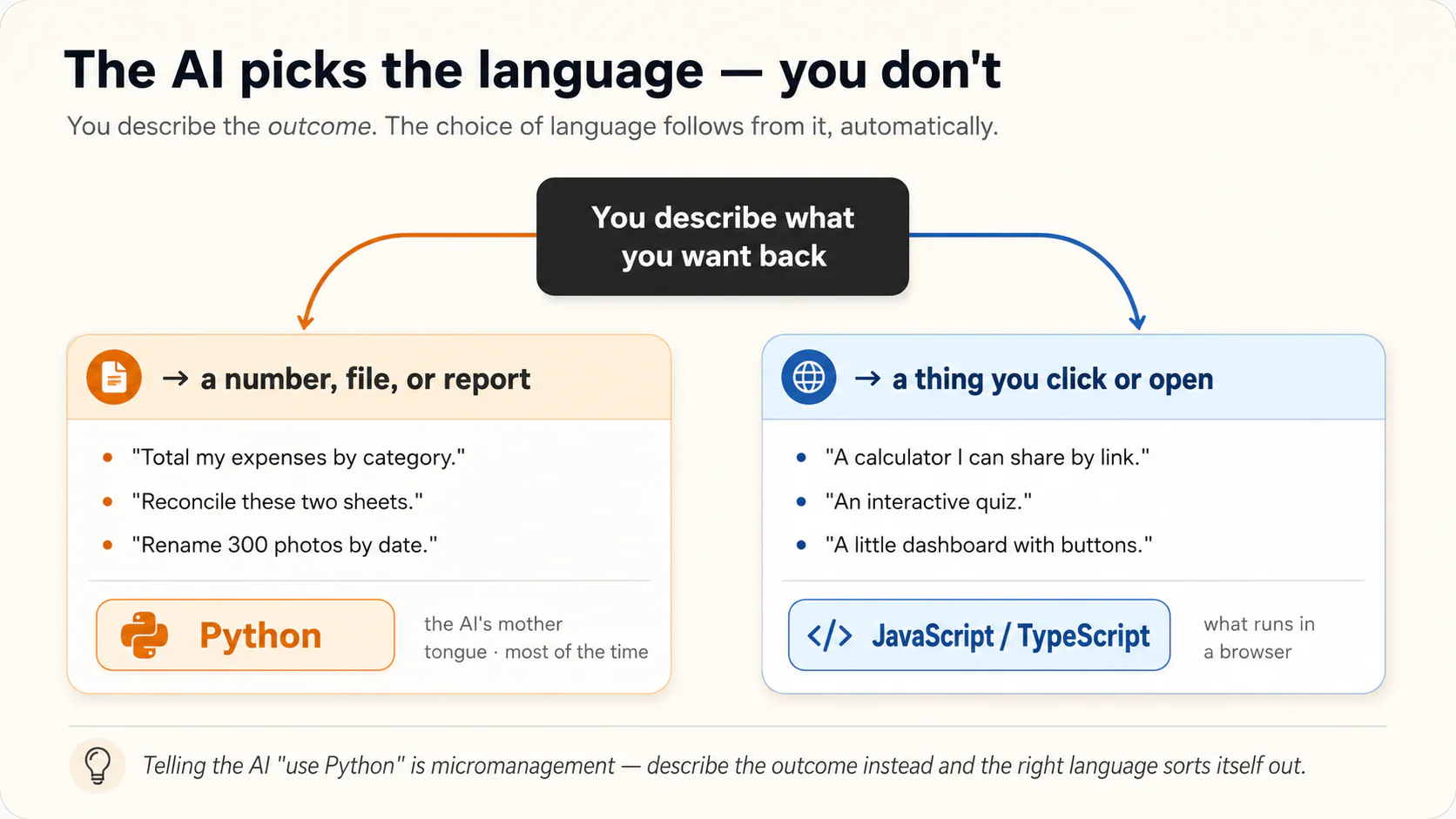
Code jab scroll karta hai to dikhta kaisa hai? Python ka ek tukra aisa dikhta hai:
totals = {}
for row in rows:
    totals[row.category] = totals.get(row.category, 0) + row.amount
Kya aap ki aankhen is par se phisal gayin? Bilkul theek. Is course mein code aap se bas itni hi attention maangta hai. Phir bhi aap isay aadha parh sakte hain: "for each row, add the amount to that category's total" punctuation ke beech se dikh jaata hai. Yeh course aap se isi level ki reading maangta hai, aur is se zyada nahin.
(Kya aur languages bhi hain? Bohat: Go, Rust, SQL, aur aur bhi, har ek technical kaam ke liye munasib jo is course ke bahar hai. Kabhi nazar aa sakti hai, lekin rule nahin badalta: rozmarra data problems ke liye is course mein Python ya JavaScript hai, aur dono surat mein aap outcome bayan karte hain aur AI language chunta hai.)
Aap ko isay dekhne ki ijazat hai. Aap par lazim nahin. Is course ka waada hai ke har skill jo aap ko chahiye (commissioning, steering, verifying, keeping) ek line parse kiye baghair kaam karti hai. Scrolling code ko mechanic ke khule engine bay ki tarah samjhein: saboot ke real kaam ho raha hai, test nahin jo aap ko pass karna hai.
Code ki ek property yaad rakhne layak hai: code dono directions mein exact hota hai. Yeh aap ke totals last cent tak zero arithmetic errors ke saath compute karega, aur yeh bilkul wohi karega jo isay kaha gaya, ghalat cheez samait, perfectly, scale par. Misunderstanding wala script 300 files ko utni hi tezi se ghalat rename karta hai jitni tezi se sahi karta. Isi liye Concept 6 (verification) aur Concept 12 (blast radius) mojood hain. Power aur danger ek hi property se aate hain.
Non-software analogy. Recipe insan ke liye code hai. "Simmer 20 minutes" attentive cook execute kare to dinner banta hai; perfectly obedient robot jisay ghalti se "simmer 20 hours" kaha gaya ho execute kare to charcoal banta hai, flawlessly. Robot fail nahin hua. Brief fail hua. Part 2 ki har cheez aise briefs likhne ke baare mein hai jo kitchen na jala dein.
🔬 Abhi yeh karein (1 min). Dekhein "AI code likhta aur chalata hai" asal mein kaisa dikhta hai. Yeh paste karein:
Write and run code to total these numbers, then tell me the average and how many are above 40: 12, 47, 8, 93, 21, 56. Show me the code you ran.
Wapas chota Python program, "ran successfully" result, aur answers aate hain (total 237, average 39.5, 40 se upar teen). Aap ne koi language nahin maangi; is qisam ke kaam ke liye Python hi munasib hai, aur isi course ke baqi hisson mein aap yahi dekhenge. (Clickable cheezon ke liye yeh JavaScript bhi likhta hai, lekin woh prompting course ke games aur pages the. Yahan, hum kaam karte hain.)
3. Dividing line: kaunse problems code problems hain
Yeh woh concept hai jis par poora course ghoomta hai, kyunke yeh woh faisla hai jo aap kisi bhi prompt se pehle karte hain: kya yeh AI ke zehan ka sawal hai, ya AI ke haath ka kaam?
AI do tareeqon se madad kar sakta hai. Yeh answer kar sakta hai (draft, advise, summarize, explain, brainstorm) apni reasoning se. Aur yeh compute kar sakta hai: code likh kar chala sakta hai jo aap ke actual data par operate karta hai. Zyada tar log sirf pehla use karte hain, phir hairan hote hain ke AI ki spreadsheet "analysis" ke totals ghalat kyun the. Totals ghalat is liye the kyunke AI ne compute karne ke bajaye answer kiya: data ko insani skim ki tarah glance se describe kiya, machine ki tarah process nahin kiya.
Chaar signals batate hain ke problem code problem hai. In mein se ek bhi kaafi hai:
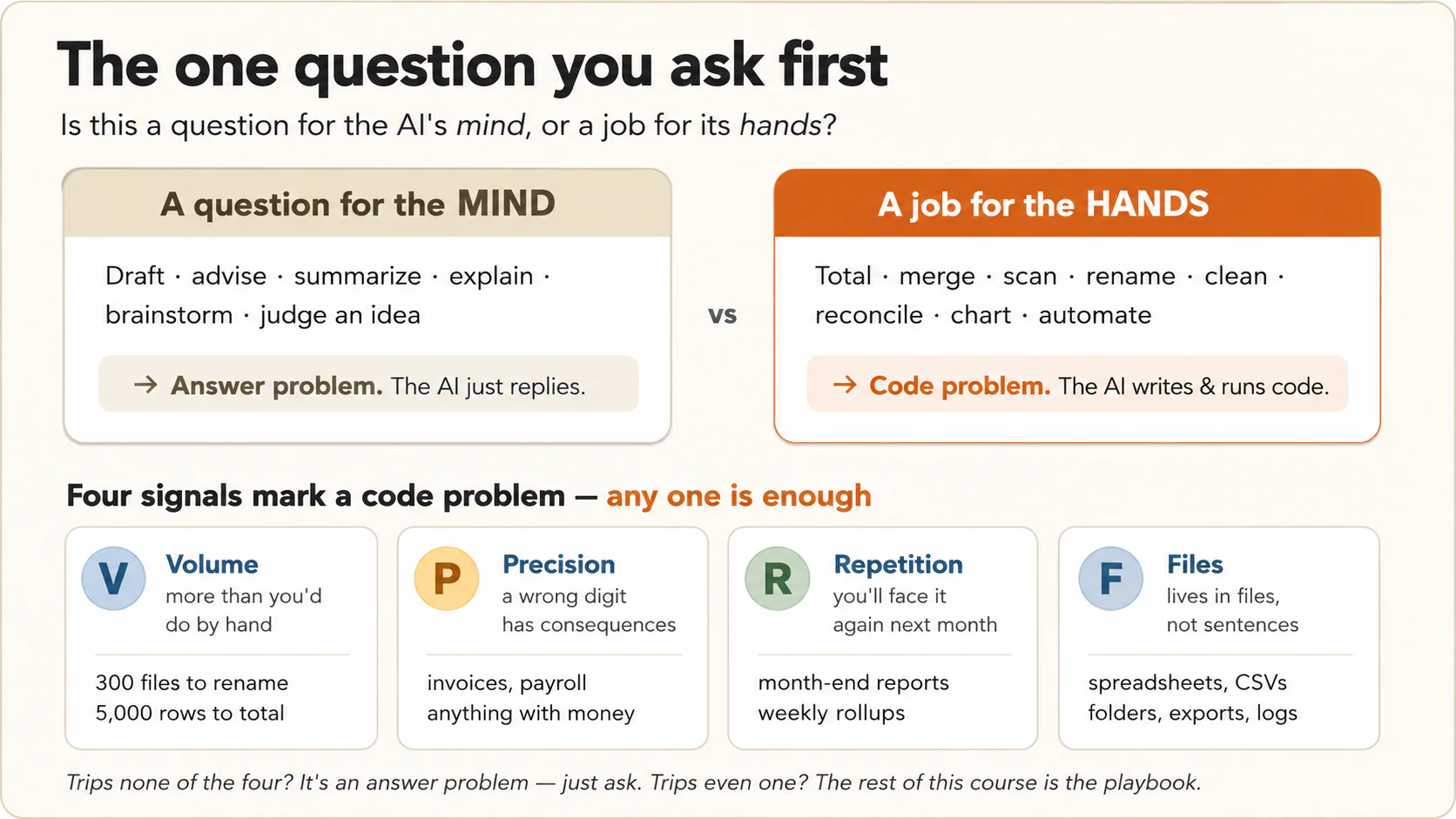
| Signal | Test | Examples |
|---|---|---|
| Volume | Itne items jitne aap aaram se haath se na karein. | 300 files rename karni, 5,000 rows total karni, 80 PDFs mein clause scan karna. |
| Precision | Ghalat digit ke consequences hon. | Invoices, payroll, grades, dosage tables, reconciliations, paise wali har cheez. |
| Repetition | Wohi task agle hafte ya agle mahine dobara aayega. | Month-end reports, daily device health checks, weekly campaign rollups. |
| Files | Problem sentences mein nahin, files mein rehta hai. | Spreadsheets, exported data files, images ke folders, logs. |
Volume, Precision, Repetition, Files: short mein VPRF, chaar-letter test jise yeh course baar baar yaad dilata hai. Agar task chaaron mein se kisi ko trigger nahin karta, woh answer problem hai: AI Prompting in 2026 ki skills use karein aur code ke baare mein na sochein. Agar ek bhi trigger hota hai, woh code problem hai, aur baqi course playbook hai.
Apna week filter se guzarein:
| Task | Code problem? | Kyun |
|---|---|---|
| "Draft a polite email declining a meeting." | No | Volume nahin, precision stakes nahin, files nahin. Pure answer problem. |
| "Summarize this one contract." | No | Ek document, judgment-heavy. AI use seedha parhta hai. |
| "Which of these 80 contracts have a non-standard termination clause?" | Yes | Volume + files. Code 80 sab scan karta hai; glance-based answer kuch miss karega. |
| "Is my business idea good?" | No | Judgment. Prompting course ka rubric pattern use karein. |
| "What did I spend on fuel this year?" | Yes | Precision + files. Number computation se aana chahiye, impression se nahin. |
| "Explain what a mutual fund is." | No | Knowledge question. |
| "Rename these vacation photos by date taken." | Yes | Volume + files. |
| "Every Monday I combine three exports into one report." | Yes | Repetition, sab se mazboot signal, kyunke script asset ban jaata hai (Concept 8). |
Trap jis se bachna hai: woh problems jo answer problems lagte hain lekin Precision trip karte hain. "Roughly how did my sales trend this year?" conversational lagta hai, is liye log conversationally poochte hain aur conversational (yaani approximated) jawab lete hain. Agar decision number par depend karta hai, to woh code problem hai chahe aap usay kitni casual wording mein poochte. Wording fix Concept 4 hai.
In mein se har ek ko kaunsi language milti hai? (Sirf curiosity; aap kabhi nahin chunte)
Concept 2 se yaad rakhein ke AI language chunta hai, aur choice output ke peeche chalti hai, task ke nahin:
| Agar result jo aap chahte hain woh ho... | AI aksar likhta hai... | Oopar ki examples |
|---|---|---|
| Number, cleaned file, report, renamed folder | Python | Fuel total, contract scan, photo rename, Monday rollup |
| Aisi cheez jo koi click kare, type kare, ya browser mein khole | JavaScript / TypeScript | Shareable expense calculator, interactive quiz, buttons wala chota dashboard |
Is course ki taqreeban har cheez (VPRF problems, projects, aap ka real working week) number ya file produce karti hai, is liye aap taqreeban har dafa Python dekhenge. Clickable tools prompting course ki territory hain, hamari nahin.
Non-software example. Ek school administrator ne AI se kaha "look at this fee spreadsheet and tell me which families are behind on payments." AI ne confidently eight families list kar dein. Real number, baad mein computed, eleven tha. Koi jhoot nahin bol raha tha; AI ne answer kiya tha (skim se pattern match) jab compute karna chahiye tha. Teen missed families ki partial payments thin jo skim ko paid lagti hain. Ek sentence isay rok deta: "write and run code to find them." Ab woh har data question us sentence par khatam karti hai, aur yahin se Part 2 shuru hota hai.
🔬 Abhi yeh karein (2 min). Woh ek faisla karein jis par poora course ghoomta hai, aath martaba. Yeh paste karein:
Sort these 8 tasks into ANSWER problems (you just reply) or CODE problems (you write and run code). Give one short reason each, and name which signal fires: Volume, Precision, Repetition, or Files.
- Draft a polite email declining a meeting.
- Add up 2,000 rows of sales and break the total down by month.
- Is my business idea any good?
- Rename 300 photos using the date stored inside each one.
- Explain what a mutual fund is.
- Find which of 80 contracts have a non-standard cancellation clause.
- Summarize this one news article.
- Every Monday, combine three exported files into one report.
Us ke reasons parhne se pehle us ke answers ko apni gut se compare karein. Odd-numbered tasks answer problems hain; even-numbered code problems. Aap ne abhi mind-work ko hands-work se alag kiya, woh move jo aap baqi zindagi har code prompt se pehle karenge.
Part 2: Code commission karna
Aap ne decide kar liya ke yeh code problem hai. Paanch concepts client-side craft cover karte hain: yeh yaqeen banana ke code waqai chalta hai, brief likhna, jo kaam aap parh nahin sakte use verify karna, failure handle karna, aur jo cheez aap ne pay ki use rakhna.
4. AI ke haath chalwayein: automatic vs. explicit
Modern AI tools decide karte hain ke code likhna hai ya nahin, is baat se ke aap ka prompt kaisa lagta hai. Spreadsheet upload kar ke poochhein "which products grew fastest?" aur zyada tar compute karenge. Lekin kisi bhi aisi cheez par jo glance se answerable lagti ho, AI code skip kar ke estimate kar sakta hai, aur estimate bilkul computation jaisi format hoti hai: wahi confident tone, wahi tidy numbers. Yeh silent failure mode hai, aur is course ke liye enemy number one.
Aap isay ek aadat se neutralize karte hain: jo bhi Precision signal trip kare, us par faisla AI par kabhi na chhorein. Alfaaz kaheein.
Teen-line incantation, desk ke oopar pin karne layak:
Write and run code to answer this. Show me the code you ran. Before analyzing anything, tell me the exact row count, the column names, and the date range of the file.
Line one computation force karti hai. Line two proof deti hai: agar code block nazar nahin aata, code nahin chala, prose kuch bhi claim kare. Line three is course ka sab se sasta lie detector hai: agar AI waqai aap ki file parh raha hai, row count aur column names exactly sahi honge; agar woh bana raha hai, to suspiciously round number aur plausible-but-wrong column names milenge, aur "analysis" shuru hone se pehle aap stop kar denge.
Notice incantation "code" kehti hai, "Python" nahin. Yeh jaan boojh kar hai, aur is course ke har prompt ka rule hai: aap AI ko compute karne kehte hain; kabhi nahin batate kis language mein compute karna hai. "Write and run code" AI ko aap ke masle ke liye sahi tool chunne deta hai (Concept 2). "in Python" add karna us ke haath ko aise guess par force karega jise justify karne ke liye aap equipped nahin, aur rare problem jahan Python ghalat choice ho, aap ne chupke se use ghalat steer kar diya. Job bayan karein, code demand karein, language AI par chhorein.
Aap ki phrasing AI ko kaise steer karti hai, side by side:
| Aap ki phrasing | Aksar kya hota hai | Risk |
|---|---|---|
| "What does this data show?" | Glance-based summary, shayad code. | Estimates jo facts jaise dressed hain. |
| "Roughly how did costs trend?" | Taqreeban hamesha glance. "Roughly" AI ko batata hai precision matter nahin karti. | Sirf tab theek jab aap ko waqai parwah nahin. |
| "Write and run code to compute cost by month." | Code, har dafa. | Minimal. |
| "Are you running code on this file, or estimating? If estimating, stop and run code instead." | AI apna method declare karta hai, phir compute karta hai. | Jab aap ko glance ka shak ho, sab se mazboot single move. |
Aur opposite discipline: answer problems ke liye code demand na karein. "Write and run code to tell me if my essay is persuasive" tool waste karta hai. Concept 3 ki dividing line dono directions mein kaat-ti hai.
Aap ke data ke baare mein aisa response jisme visible code block, row counts, aur "here's what I computed" na ho, woh aap ke data ke baare mein opinion hai, analysis nahin. Use us contractor ke invoice ki tarah treat karein jis ka kaam aap ne hota hua nahin dekha.
🔬 Abhi yeh karein (2 min). AI ko prove karwayein ke us ne compute kiya, guess nahin. Yeh choti file aur teen-line incantation saath paste karein:
Here is a small commute log.
Date,Mode,Minutes 2025-03-03,Bus,35 2025-03-03,Walk,10 2025-03-04,Bike,20 2025-03-05,Bus,40 2025-03-06,Walk,15 2025-03-07,Bike,25 2025-03-10,Bus,30 2025-03-11,Walk,12
Write and run code to total the minutes by mode. Show me the code you ran. Before anything else, tell me the exact number of rows, the column names, and the date range.
Aap khud answer check kar sakte hain: 8 rows, columns Date / Mode / Minutes, sab March 2025 mein. Woh exactly yahi report karega, phir code block, phir totals (Bus 105 hota hai). Hundreds rows wali file par jise aap eyeball nahin kar sakte, yehi opening question AI ke invented numbers pakarta hai.
5. Problem brief karein, program nahin
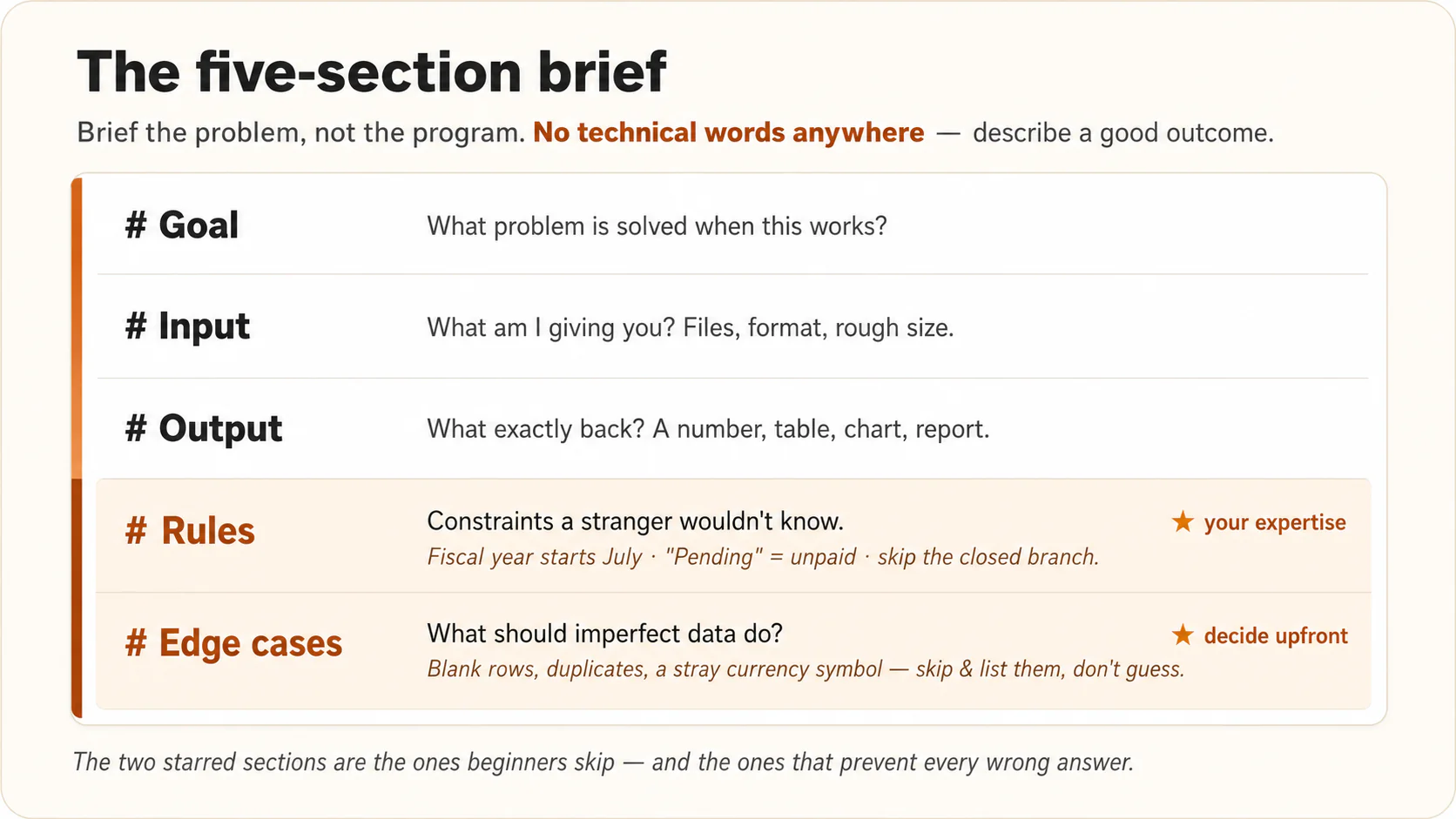
Is course ki sab se azaad karne wali fact: behtareen code briefs mein technical language bilkul nahin hoti. Aap loops, libraries, file-handling, ya hatta ke programming language specify nahin karte. Aap specify karte hain ke acha outcome kaisa dikhta hai, bilkul insani assistant ke liye, aur AI intent ko implementation mein translate karta hai, language samait. Jo log programming thori si jaante hain woh aksar total beginners se bure briefs likhte hain, kyunke woh how ko micromanage karte hain aur what ko under-specify. "Write this in Python" isi qisam ki micromanagement hai: aap ne AI ki choice ko aisi preference ke base par constrain kar diya jise aap justify nahin kar sakte, jab outcome bayan karna ("a tool I can click" vs. "a number from my spreadsheet") use khud sahi choice karne deta.
Complete brief paanch sawalon ka jawab deta hai. Pehle teen aap prompting course ki app recipe mein mil chuke hain (Goal, Input, Output); code problems do aur add karte hain:
# Brief: [name the task]

## Goal
What problem is solved when this works?

## Input
What am I giving you? (files, their format, roughly how many rows/items)

## Output
What exactly do I want back? (a number, a table, a chart, a cleaned
file, an HTML report)

## Rules
The constraints a stranger wouldn't know. (The school year starts in
August. "Pending" means not yet submitted. Ignore rows before 2024.)

## Edge cases
What should happen when the data is imperfect? (blank rows, duplicates,
a date in the wrong format, an amount with a currency symbol)
Haan, yeh Markdown spec hai, bilkul wahi jise Markdown In, HTML Out ne aap ko likhna sikhaya. Code briefs wahi jagah hain jahan woh skill compound interest dena shuru karti hai: har heading ek cheez hai jiska AI ko ab guess nahin lagana.
Do sections jo beginners skip karte hain, wahi sab se zyada matter karte hain:
Rules woh jagah hai jahan aap ki professional knowledge rehti hai. AI Python jaanta hai; yeh nahin jaanta ke aap ka school year August mein shuru hota hai, "Pending" ka matlab aap ke system mein not-yet-submitted hai, ya downtown store March mein band ho gaya tha aur exclude hona chahiye. Har ghalat analysis jise aap kabhi dekhenge, kisi aise Rule tak trace hota hai jo aap jaante the aur state nahin kiya. Concept 3 mein school administrator ki missed partial payments? Missing Rule: "a family with any unpaid balance counts as behind."
Edge cases woh jagah hai jahan aap pehle se decide karte hain ke imperfect data kya kare, kyunke aap ka data imperfect hai; sab ka hota hai. Professional move ek sentence hai: "If you hit a row you can't interpret, don't guess; skip it, and list every skipped row at the end." Yeh sentence silent corruption ko visible report mein badal deta hai.
Worked brief, teacher edition (yahan inputs .csv files hain, bas spreadsheets jo plain text ke taur par save hui hain; Part 3 mein aur):
# Brief: Who hasn't turned in the essay

## Goal
Find which students on my class list have NOT submitted the essay,
so I know exactly who to chase before grades are due.

## Input
Two files, attached. "class-list.csv": Name, Student ID (about 180
students). "submissions.csv": one row per file turned in, with
Student Name, Filename, Date.

## Output
A list of students with no matching submission, and a count, then a
one-line summary. Format it as an HTML page I can print for class.

## Rules
- Match on student name; names in the submissions may have extra
  spaces or different capitalization than the class list.
- A student who submitted twice still counts as submitted (once).

## Edge cases
- A submission whose name matches nobody on the class list: list it
  separately (a typo or a wrong upload), don't silently drop it.
- Any row you can't read: skip it and list it at the end.
Programming words kahin nahin, aur yeh brief "find who hasn't submitted" se kahin zyada pehli run mein succeed karega, kyunke har guess hata di gayi. (Notice Output line pichle course ko quietly apply kar rahi hai: human-facing result HTML hai.)
Imaandaar sach: aksar aap nahin jaante ke data mein kya chhupa hua hai. To discovery ko pehla prompt banayein: "Before doing anything, examine the files and tell me: what could be ambiguous, inconsistent, or surprising in here? List the questions you'd want answered before processing." AI inspect karta hai, wapas aata hai "14 rows with blank dates aur do currency formats hain. Har ek ke saath kya karun?", aur ab aap Edge cases section knowledge se likhte hain, imagination se nahin. Inspect, ask, phir brief. Yeh prompting course ka brainstorm-iterate loop hai, data par apply hua.
🔬 Abhi yeh karein (3 min). Apna pehla brief likhein, aise data par jo wapas ladta hai. Yeh choti file jaan boojh kar messy hai: stray unit, number ke andar comma, duplicate row, aur blank date wali row. File aur brief saath paste karein, exactly jaisa dikhaya:
Here is my data, and my brief for it.

Date,Meal,Calories
2025-03-02,Breakfast,420
2025-03-02,Lunch,650 kcal
2025-03-02,Lunch,650 kcal
2025-03-05,Dinner,"1,100"
,Snack,200
2025-03-06,Breakfast,380

# Brief: Total my March calories by meal

## Goal
A clean total for each meal, so I can see where the calories went.

## Output
A table of meal and total, biggest first, then the grand total.

## Rules
- Calories may have a unit like "kcal" or a comma; treat them as plain numbers.
- The exact same row appearing twice is a double-entry; count it once.

## Edge cases
- A row with no date: do not guess. Skip it, and list it at the end.

Write and run code to do this, and tell me which rows you skipped or
treated as duplicates.
Dekhein yeh kcal aur comma strip karta hai, repeated Lunch row drop karta hai, blank-date row alag rakhta hai (aur batata hai ke ki), aur baqi total karta hai. Rules aur Edge cases lines ne yeh karwaya. Yeh dono sections delete karein, dobara chalayein, aur mess seedha wapas aa jaata hai. Yehi brief ki poori power hai, ek before-and-after mein. Yahan chhe messy rows; aap ke real export mein kuch hundred, jahan ek ghalat number aasani se chhup jaata hai. Brief hi big version ko trust ke qabil banata hai.
6. Jo kaam aap parh nahin sakte use verify karna
Yaad rakhein, AI Asal Mein Kya Hai (Idea 3) se, ke model ke paas apna truth-checker nahin hota. Code ke saath aap ke paas woh checker hai jo us ke paas nahin: aap isay run kar sakte hain. Isi liye yahan verification ka matlab run karna aur parhna hai, trust karna nahin.
Yeh woh sawal hai jo har skeptic poochta hai, aur woh sahi poochte hain: agar aap code nahin parh sakte, kaise jaante hain ke yeh sahi hai?
Jawab computers se purana hai: waise hi jaise aap kisi bhi expert ko check karte hain jiska craft aap audit nahin kar sakte. Aap accountant ko tax law dobara derive kar ke verify nahin karte; aap totals ko apne records ke khilaaf check karte hain. Aap builder ko cement test kar ke verify nahin karte; aap check karte hain deewar seedhi hai aur door band hota hai. Aap outputs ko independent knowledge ke khilaaf verify karte hain, aur aap, domain expert, ke paas independent knowledge hoti hai jo AI ke paas kabhi nahin hogi.
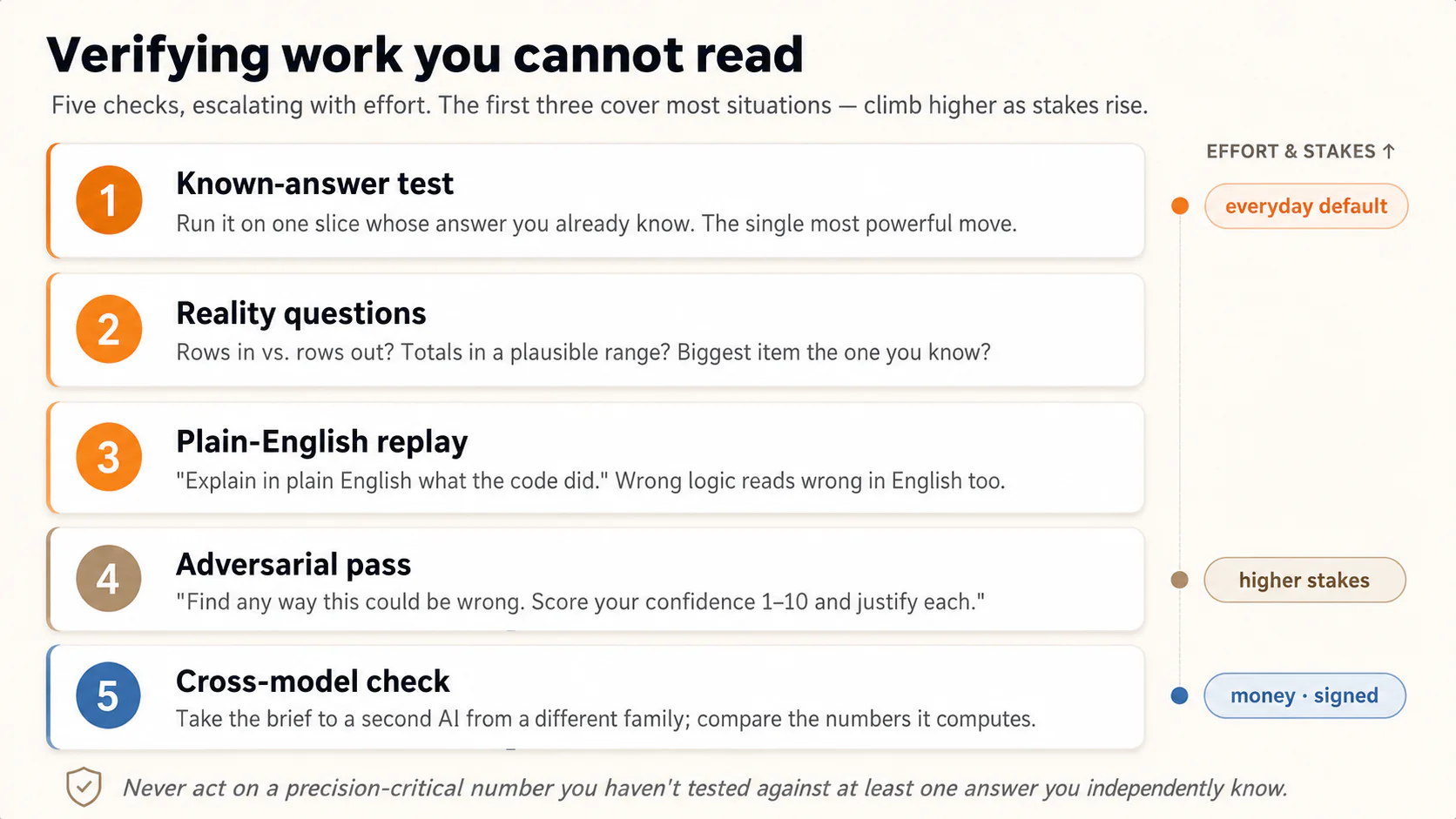
Paanch checks, effort ke hisaab se barhte hue. Pehle teen zyada tar situations cover karte hain:
1. Known-answer test. 5,000 rows par script trust karne se pehle, use aise slice par feed karein jiska jawab aap pehle se jaante hain. Ek month par run karein jise aap haath se close kar chuke hain. Ek student chunein aur us ka weighted grade paper par compute karein. Agar script har checkable answer reproduce karti hai, aap ka un answers par confidence jo aap check nahin kar sakte earned hai, hoped nahin. Yeh is page ka single most powerful move hai.
Before running on the full file, run the code on just March. I already know March's correct total is $184,250. Show me what the code gets.
2. Reality questions. Output ko us cheez se interrogate karein jo aap apni duniya ke baare mein jaante hain. Row counts in versus rows out: agar 1,400 andar gaye aur report 1,381 cover karti hai, missing 19 kahan hain? Kya totals plausible range mein hain? Kya "biggest customer" wohi hai jo aap jaante hain ke biggest hai? Har answer jo aap ke professional gut se takraye ya data surprise hai ya code bug, aur dono ko agla prompt chahiye: "Your report says X. Walk me through, in plain English, exactly how you computed that number, and show me three of the underlying rows."
3. Plain-English replay. AI se code ke behavior ko procedure ke taur par explain karwayein:
Explain, step by step in plain English, what this code does, as if describing it to a colleague who will check the logic but can't read code. Include what it does with blank rows and duplicates.
Aap Python audit nahin kar sakte, lekin "I matched on amount and date within two days, treated debits as negative, and skipped 14 unparseable rows (listed below)" ko zaroor audit kar sakte hain. Agar procedure ghalat hai (ghalat rule, ghalat assumption), woh English mein bhi ghalat hoga, aur aap pakar lenge. Zyada tar real errors procedure errors hain, typo errors nahin, isi liye yeh kaam karta hai.
4. Adversarial pass. Prompting course ki rubric aadat se seedha liya hua: "Find any way this analysis could be wrong or misleading. What assumptions did the code make? What's the weakest link? Score your own confidence 1-10 per claim and justify each score." AI apne kaam par attack karne mein waqai acha hota hai jab specifically invite kiya jaye.
5. Cross-model check. High-stakes outputs ke liye (auditor ko jaane wali reconciliation, board ko jaane wali analysis), brief aur data ko different family ke doosre model ke paas le jayein (prompting course, Concept 13) aur computed numbers compare karein. Do independently written programs ka 23 mismatches par agree karna is technology ka sab se mazboot signal hai.
| Stakes | Minimum verification |
|---|---|
| Personal curiosity (apna spending) | Reality questions. |
| Work product jis par colleague rely kare | Known-answer test + plain-English replay. |
| Money, grades, health, signed cheez | Sab paanch, aur human load-bearing claims review karta hai. |
Non-software example. Ek pharmacist ne dispensing log ko stock counts ke khilaaf cross-check karne ke liye script commission ki. Trust karne se pehle us ne trap plant kiya: data ki copy mein khud ek fake discrepancy insert ki, 10-unit gap jise woh jaanti thi kyunke us ne banaya tha. Script ne us plant ko pakra, plus four real discrepancies jo use pata nahin thin. Plant ne usay four par bharosa karne diya. Apne data mein ek known error salt karein aur dekhein code use dhoondhta hai ya nahin, known-answer test ka sab se elegant form, aur cost ninety seconds.
Is poore course ke neeche ek fikr hai, aur use seedha jawab milna chahiye: kya code na parhna beginners ka compromise hai? Kya yeh aisi cheez hai jo koi asal programmer kabhi qubool nahin karega?
Robert C. Martin, programmers ki ek nasl ke liye Uncle Bob, ne Clean Code likhi, jo ab tak ki sab se zyada parhi jane wali programming kitabon mein se ek hai. Chalees saal tak us ne sikhaya ke code ko ghaur se parhna hi kaam hai. July 2026 mein us ne post kiya ke ab woh apne agents ka likha code nahin parhta, aur isi tarah use un se asal raftaar milti hai. Is ke bajaye woh unhein un cheezon se gher deta hai jinhein woh "extreme constraints" kehta hai: automated checks ki layers jin se code ko guzarna parta hai, is se pehle ke woh uski kisi baat par yaqeen kare.
Is liye nahin, yeh compromise nahin hai. Field ke sab se tajurbekaar log usi raaste se yahan pahunche hain jis par aap chal rahe hain: parhna band karein, check karna shuru karein.
Lekin tarteeb par ghaur karein, kyunke online zyadatar logon ne yehi miss kiya. Us ne parhna chhor kar behtari ki umeed nahin lagayi. Us ne pehle checks banaye. Code na parhna woh cheez thi jiski checks ne ijazat di. Uska aetmaad koi ehsaas nahin. Woh uske checks ka daira hai, aur woh har check ka naam bata sakta hai.
Aur yeh hissa aapko apna lagna chahiye. Uski list ka ek item mutation testing hai: aap jaan boojh kar code torte hain, ek waqt mein ek chhoti tabdeeli, aur dekhte hain ke koi test use notice karta hai ya nahin. Jo test chup rehta hai jab code chupke se ghalat ho, us ne bata diya ke woh kuch prove nahin karta.
Ab ek paragraph oopar pharmacist ko dobara dekhein. Us ne apne data ki copy mein fake discrepancy plant ki aur check kiya ke script use dhoondhta hai. Us ne mutation testing ka naam kabhi nahin suna tha. Phir bhi us ne use khud daryaft kar liya, kyunke verification ko sanjeedgi se lete hi yeh wazeh qadam banta hai: aisa fault daalein jiska aapko pata ho, aur dekhein ke check use pakarta hai ya nahin.
Uska version aise code par chalta hai jise aap nahin parh sakte. Aapka version ek aisi cheez par chalta hai jo uske paas kabhi nahin hogi: aap pehle se jante hain ke March ka total kya tha. Tools alag, discipline wohi. Aap uske kaam ka aasaan version nahin kar rahe. Aap wohi kaam doosri taraf se kar rahe hain.
Aap is list ka koi bhi check skip kar sakte hain ek ke siwa: kabhi precision-critical number par act na karein jise aap ne kam az kam ek independently known answer ke khilaaf test na kiya ho. Code exact hai (Concept 2), exactly wrong bhi. Known-answer test aap ka firewall hai.
🔬 Abhi yeh karein (2 min). Ek aise slice par woh check chalayein jise haath se verify karna aasaan hai. Pehle yeh teen numbers khud add karein: 8,000 + 6,500 + 9,000 = 23,500. Ab AI ko prove karwayein ke us ka code wahan land karta hai:
Here are my steps for three days, one per line: Monday 8000 Tuesday 6500 Wednesday 9000 Write and run code to total the steps. I worked it out by hand and it should be 23,500. Show me the code and the total it gets.
Agar code 23,500 return karta hai, aap ne known-answer test kaam karte dekh liya: aap ne aisa slice check kiya jise khud verify kar sakte the, is liye aap wohi code full year of steps par trust kar sakte hain jise aap kabhi dimagh mein add nahin kar sakte. Agar kuch aur return kare, aap ne bug free mein, tees seconds mein pakar liya.
7. Jab yeh toot-ta hai: errors dialogue hain, failure nahin
Kuch na kuch ghalat hoga. Script ruk jaata hai; red text aata hai; ya worse, woh finish karta hai aur output ajeeb lagta hai. Yahan mindset shift hai jo push-through karne walon ko give-up karne walon se alag karta hai: error project ka fail hona nahin; computer ka bahut precise tareeqe se batana hai ke use kya chahiye. Aur aap ke paas staff par expert hai, already conversation mein, jo woh zabaan fluently parhta hai.
Red-text errors ke liye poori skill:
It stopped and showed this error. Diagnose it, fix the code, and run it again:
[paste the red text, all of it]
Bas. Aap error interpret nahin karte; aap forward karte hain. AI apne error messages ko mechanic ke engine noise ki tarah parhta hai, script fix karta hai, aur rerun. Zyada tar errors pehli paste par mar jaate hain. Part 3 ki surfaces jahan AI apne loop mein code chalata hai, wahan yeh aksar error khud dekhta hai aur aap ke notice karne se pehle fix kar deta hai: aap use try, fail, adjust, aur succeed karte ek hi response mein dekhenge.
Subtler case wrong-but-running hai: red text nahin, lekin numbers ajeeb smell karte hain. "it's wrong, fix it" na kaheein; AI nahin jaanta kaunsa hissa offend kar raha hai. Doctor ko symptom batane ki tarah report karein:
The output shows total sales of 4.2 million, but I know this year was around 12 million. Something is being dropped or misread. Investigate: show me the row count you processed, the date range you found, and the first 5 rows as the code sees them.
Specific symptom, expected value, inspect karne ki request pehle, re-fix baad mein. Das mein se nau dafa culprit foran saamne aata hai: code ne three-sheet Excel file ka sirf first sheet (tab) parha, ya "1,200" ko comma ke saath text treat kiya, ya aap ka export quietly halfway cut off ho gaya. Notice yeh Concept 6 ke reality questions hi hain, ab repair tool ke taur par.
Teen patterns taqreeban har breakdown cover karte hain:
| Symptom | Prompt |
|---|---|
| Red text, script ruk gaya | Full error paste karein: "diagnose, fix, rerun." |
| Chalta hai, lekin number aap ki knowledge se takrata hai | Symptom aur expected value batayein; fix karne se pehle row counts aur sample rows dikhane ko kahein. |
| Wohi fix teen dafa lagataar fail hota hai | Khodna band. "We've tried this three times. Step back, restate the problem fresh, and propose two completely different approaches." Three strikes ka matlab approach ghalat hai, typing nahin, aur agar conversation lambi aur confused ho gayi ho, brief aur learned lesson ke saath clean chat shuru karein (context rot, prompting course Concept 4). |
Non-software example. Ek marketer ka campaign-merge script "codec" mention karne wali error ke saath crash hua. Us ne ek syllable samjhe baghair paste kar diya. AI ne, roughly, jawab diya: aap ke exports mein se ek different text encoding mein saved hai (older systems ki files mein common), code ko detect karne ke liye adjust kar raha hun. Rerun; worked. Total downtime: forty seconds. Us ne kabhi codec kya hai nahin seekha, aur zaroorat bhi nahin padi. Errors mein fluency required nahin. Unhein paste karne ki tayyari required hai.
🔬 Abhi yeh karein (2 min). Aaj jaan boojh kar crash karwayein, jab kuch stake par nahin, taake next month real crash routine lage. Yeh paste karein, deliberate typo ke saath:
Here is a tiny reading log: Title,Genre,Pages Dune,SciFi,412 Hamlet,Drama,150 Sapiens,History,498 First write and run code to total the Pages by Genre. Then misspell the 'Pages' column as 'Pagse' in the data, rerun the same code WITHOUT fixing it, and show me the exact error.
Red text aata hai. (Agar AI helpfully typo fix karne lage aur error na dikhaye, use kaheein: "no, run it exactly as written so I can see the failure.") Aap us ka ek lafz nahin samjhenge, aur yehi point hai. Ab woh sirf cheez karein jo skill maangti hai:
Here is the error. Diagnose it, fix the code, and run it again.
Woh apni error parhta hai, column name repair karta hai, aur finish karta hai. Aap apna pehla crash survive kar chuke hain, aur poori skill thi: red text wapas paste karna. Aap ko kabhi us ka matlab jaanne ki zaroorat nahin padi.
8. Script rakhein: solved problem button ban jaata hai
Concept 3 ka Repetition signal aisa payoff rakhta hai jo baqi teen nahin rakhte: ek dafa likha script woh asset hai jo aap hamesha ke liye own karte hain. Teacher ka submission-check brief pehli dafa effort leta hai. Agli assignment par, wohi job ek sentence hai: "Run my submission-check script on this new class list." Har future round ki marginal cost zero ke qareeb. Yeh woh lamha hai jahan aap AI use karna band kar ke us ke saath accumulate karna shuru karte hain, AI Workers ki taraf pehla saadah qadam jo yeh book later parts mein banati hai.
Aadat ke teen parts hain:
Script ko file ke taur par maangein. Jab code-built result aisa ho jo aap dobara chahenge, end karein: "Save this as a script file, named clearly, with a plain-English description at the top of what it does, what files it expects, and the rules it applies." Claude.ai par aap file download karte hain; Part 3 surfaces par woh pehle se aap ke folder mein hoti hai.
Brief ko script ke saath rakhein. Concept 5 ka Markdown brief us ke saath save karein. Script how hai (machines ke liye); brief what aur why hai (humans aur future AI sessions ke liye). Chhe mahine baad, jab kuch change karna ho, aap dobara scratch se explain nahin karenge; aap kisi bhi AI ko brief plus script denge aur kahenge "the late-cutoff rule changed; update it." Pichle course ne isay Intent Layer kaha. Files ka yeh pair, brief.md aur submissions.py, us ka aap ka pehla piece hai.
Unhein ghar dein. Ek folder, my-scripts/, har task ke liye ek subfolder. Har ek ke andar: brief, script, aur ek choti sample input file. Woh sample kal ka known-answer test hai, pre-packaged.
my-scripts/
  essay-submissions/
    brief.md          ← what & why, in your words
    submissions.py    ← the code (you still never read it)
    sample-class/     ← inputs whose correct answer you know
  monthly-campaign-rollup/
    brief.md
    rollup.py
    sample-april/
Rerunning, surface ke hisaab se. Claude.ai par aap script ko naye mahine ki files ke saath re-upload karte hain aur kehte hain "run this on these": workable, thora manual. Part 3 surfaces par script aap ki machine par rehta hai, is liye rerun ek sentence hai aise tool mein jo pehle se aap ka folder dekh sakta hai. Yeh asymmetry, honestly, Part 3 parhne ki sab se behtar daleel hai: chat woh jagah hai jahan scripts paida hote hain; aap ki machine woh jagah hai jahan woh rehte hain.
| Keep-the-script aadat ke baghair | Is aadat ke saath |
|---|---|
| Har mahine, task ko memory se dobara explain. | Har mahine: "run the script on the new files." |
| Subtle rule drift: May ki logic June jaisi nahin. | Rules script mein frozen hain; har run identical logic. |
| Aap ki AI skill sirf aap ki madad karti hai. | Folder colleague ko dein: brief, script, sample. Woh minutes mein productive. |
Non-software example. Ek clinic manager ne March mein no-show analysis banaya aur script rakh liya. August tak, "run the no-show script on this month's export" ek 30-second Friday ritual tha, aur jab nai branch khuli, us ne folder us manager ko diya, jis ne day one par bina ek sawal ke chala liya. Ek afternoon of describing, chhe logon ka recurring work automated. Yeh multiplication (describe once, run forever, hand to anyone) is course ki poori economic argument hai ek anecdote mein.
🔬 Abhi yeh karein (1 min). Result ko aisi cheez banayein jo aap own karte hain. Yeh paste karein, data ke saath:
Total this study log by subject, then save the code as a script file I can download: Math 3 History 2 Math 1.5 Science 2 At the very top of the script, put a plain-English note: what it does, what file it expects, and the rules it follows. Name it something I will recognize in a year.
Ab aap ke paas real file hai. Agli dafa naye numbers paste karein aur kaheein "run this on these." Jo kaam aap ne ek dafa kiya woh button ban gaya jo aap hamesha press karte hain. Yehi exact lamha hai jahan AI use karna kuch own karne mein badalta hai, is book ke har AI Worker ki pehli eent.
Part 3: Ek problem, paanch surfaces
Parts 1 aur 2 ki har cheez (dividing line, brief, verification, loop, kept script) har jagah identically kaam karti hai. Surfaces ke darmiyan sirf yeh badalta hai ke code kahan chalta hai aur kya chhoo sakta hai. Paanch surfaces hain, lekin code chalne ki sirf teen qisam ki jagahen: browser sandbox (Claude.ai, ChatGPT aur Gemini wohi), aap ke folder ke andar terminal (Claude Code, OpenCode), aur desktop app (Cowork, OpenWork). Agle teen concepts in teen jagahon se guzarte hain, ek running job ke saath taake differences saamne rahen:
Twelve monthly expense CSVs ka folder. Unhein merge karein, category ke hisaab se total karein, duplicate transactions flag karein, aur chart ke saath one-page HTML report banayein.
(Start se pehle ek lafz, agar "CSV" naya hai: CSV spreadsheet file ki sab se simple qisam hai: values ki plain rows jo commas se separated hoti hain. Aap ka bank, school portal, fitness app, aur taqreeban har system jisme "export" ya "download" button hota hai, yeh produce karta hai, aur Excel unhein kisi bhi spreadsheet ki tarah kholta aur save karta hai. Aur agar aap ka data regular Excel file hai to kuch nahin badalta: is course ka har prompt us par bhi wohi kaam karta hai.)
9. Claude.ai: home surface (aur ChatGPT, Gemini)
Browser chat woh jagah hai jahan yeh course rehta hai, jahan ab tak har prompt chala, aur jahan aap ke code problems ka zyada hissa kaafi der tak solve hoga. Jab aap Claude.ai ko code likhne aur chalane ko kehte hain, code sandbox mein execute hota hai: Anthropic ki side par aap ki conversation ke liye temporary computer. Aap ke uploads andar jaate hain; results, files, aur charts bahar aate hain; aap ke computer ko kuch nahin chhoota, jo isay seekhne ke liye zero-risk surface banata hai. ChatGPT (us ki data-analysis capability) aur Gemini bhi wohi tareeqe se kaam karte hain: upload, code demand, verify. Is course ka har prompt unchanged transfer hota hai.
Claude.ai par running job:
Attached are 12 CSV files, one per month of my 2025 expenses (columns: Date, Description, Category, Amount).
Write and run code to:
- Merge all 12 into one dataset. Tell me the total row count and confirm all 12 months are present before going further.
- Total spending by category and by month.
- Flag likely duplicate transactions (same date, amount, and description); list them, don't delete anything.
- Produce a one-page HTML report: monthly trend chart, category table, duplicates list, and three observations worth my attention.
Rules: amounts use commas as thousand separators. Refunds are negative. If any row can't be parsed, skip it and list it at the end.
Chand minute baad: rendered HTML artifact, bilkul jaisa Markdown In, HTML Out course ne promise kiya tha: aap ka Markdown-shaped brief in, designed page out, beech mein Python invisible. Concept 6 checks chalayein (kya row count match karta hai? kya ek month jo aap achi tarah jaante hain sahi lagta hai?), phir report publish ya download karein.
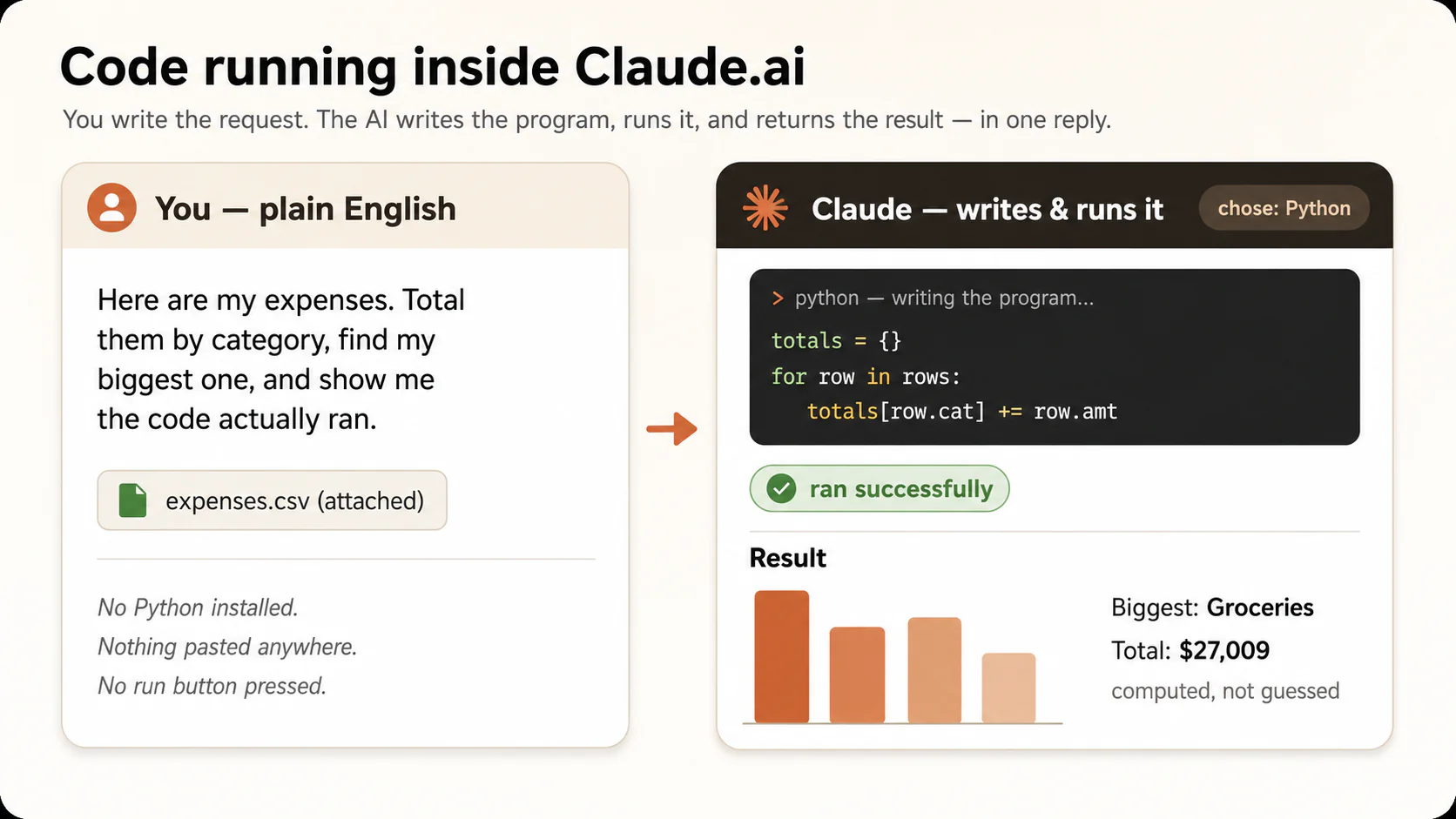
Yeh hai "AI code chalata hai": program aur us ka result ek hi reply mein saath nazar aate hain. Aap ne kuch nahin likha aur run button nahin dabaya.
Home surface kis cheez mein best hai, aur kahan khatam hota hai:
| Strength | Limit |
|---|---|
| Zero installation, aap ki machine ke liye zero risk. | Sandbox sirf woh dekhta hai jo aap upload karte hain. Forty files ka matlab forty uploads, aur "log into my network devices" yahan impossible hai. |
| One-off aur exploratory jobs ke liye perfect. | Sandbox temporary hai. Scripts download karne hote hain (Concept 8) warna woh effectively chat ke saath mar jaate hain. |
| Poora brief -> code -> verify -> iterate loop, sab visible. | Recurring jobs ka matlab har dafa re-upload. Monthly theek; daily tedious. |
Boundary, ek line mein: chat sandbox woh workshop hai jahan aap visit karte hain; woh jagah nahin jahan aap ki files rehti hain. Jis lamhe aap ka problem aap ke computer ke baare mein ho (us ke folders, us ki hundreds files, us ki daily rhythms), aap visit se aage nikal chuke hote hain, aur agle do surfaces isi liye hain.
🔬 Abhi yeh karein (2 min). Ab tak har exercise Claude.ai par chali, is liye aap pehle se home surface par rehte hain. Yeh us ka signature move hai, designed report. Yeh paste karein, data ke saath:
Here is last month's screen time, hours per app: Instagram,28 YouTube,41 Messages,12 Maps,6 Games,19 Produce a one-page HTML report: a headline with the total hours, a simple bar chart by app, the full table, and two observations worth my attention. Make it look good enough to send to someone.
Designed page nazar aata hai, text ki deewar nahin: aap ke plain words in, real report out, code beech mein unseen kaam kar raha hai. Yeh pichle course ka "Markdown in, HTML out" hai, ab us code se powered jo aap kabhi nahin likhte.
10. Claude Code & OpenCode: agent aap ke folder mein
Claude Code (Anthropic) aur OpenCode (open-source, kai AI models ke saath kaam karta hai; yeh book principle par har commercial tool ke saath open alternative pair karti hai) terminal mein rehte hain: woh plain text window jo graphical screens se pehle se har computer mein hai. Agar lafz se hichkichahat hoti hai, yeh reframe pakrein: terminal bas chat box hai jo folder ke andar baitha hota hai. Aap sentences type karte hain; agent jawab deta hai. Browser se farq chat ke gird har cheez hai: agent wahan pehle se mojood files dekh sakta hai (uploading nahin), un par directly code chala sakta hai, scripts save kar sakta hai jo hamesha rehte hain, aur errors ko tight loop mein khud fix kar sakta hai bina aap ke messages idhar udhar le jaane ke.
(Terminal in tools ko picture karne ka sab se clear tareeqa hai, aur woh jagah jahan yeh course inhein sikhata hai, lekin dono is se aage barh chuke hain. Claude Code code editors, desktop app, aur browser mein bhi chalta hai; OpenCode editors aur desktop app mein bhi. "Folder mein chat box" ka idea har jagah hold karta hai: jahan bhi rehta ho, yeh agent hai jo aap ki files dekh aur un par act kar sakta hai. Jo entry point aap ke tool mein ho use chun lein; skills identical hain.)
Running job phir, aur notice karein kya missing hai:
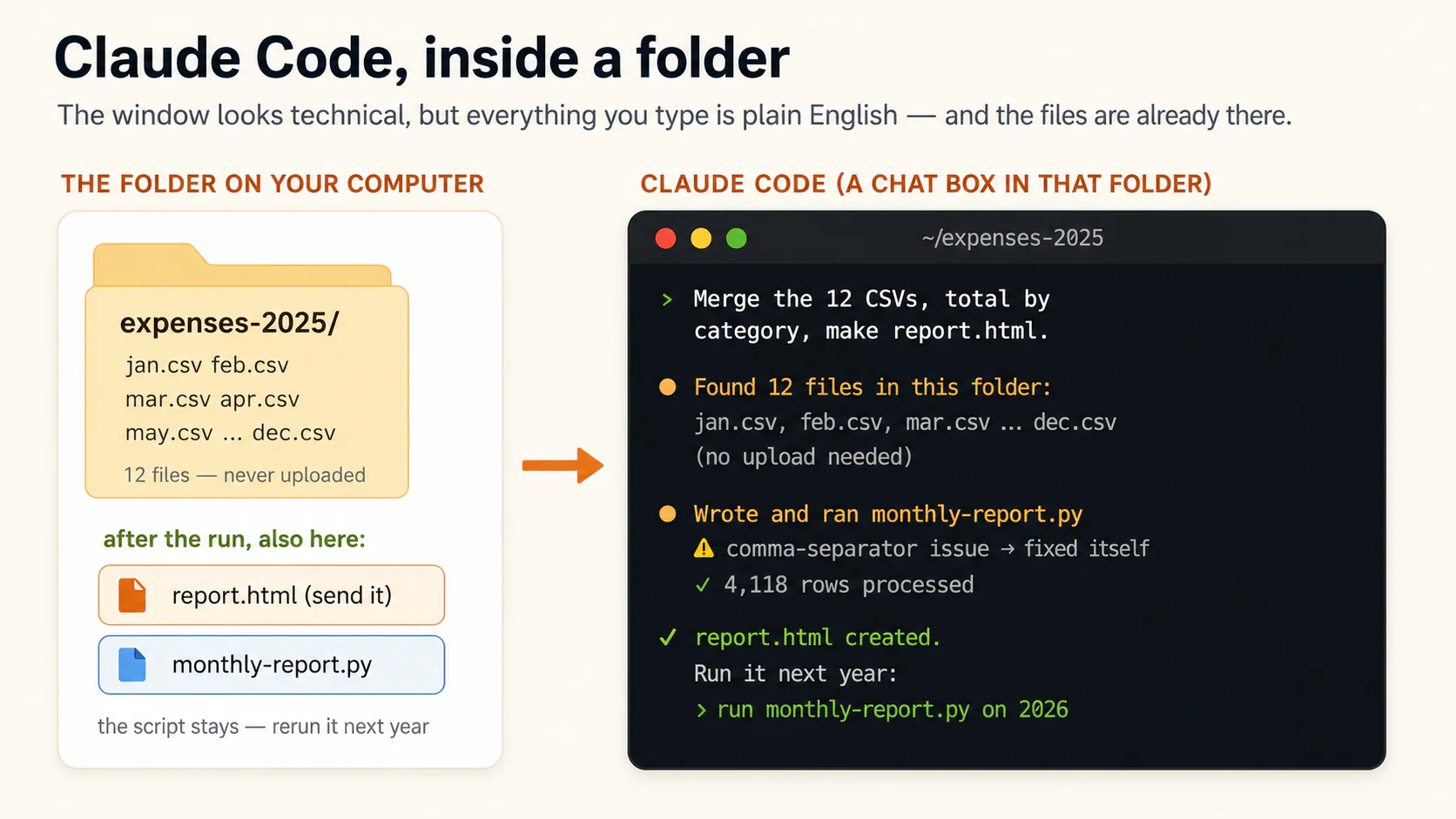
The expenses-2025 folder contains 12 monthly CSVs. Merge them, total by category and month, flag duplicates (same date, amount, description), and produce report.html with a trend chart, category table, duplicates list, and three observations. Amounts use comma separators; refunds are negative; skip and list unparseable rows. Save the merge-and-report code as a reusable script named monthly-report (you choose the right file type) so I can rerun it next year.
Attachments nahin: files bas wahan hain. Agent unhein parhta hai, code likhta hai (is merge-and-total job ke liye Python), chalata hai, comma-separator snag hit karta hai, khud fix karta hai, aur finish. Folder kholein: report.html, bhejne ke liye ready, aur monthly-report.py, hamesha ke liye aap ka. Next January: "run the monthly-report script on the 2026 folder." Concept 8 ki keep-the-script aadat, keeping aap ke liye ho gayi.
Claude Code folder mein. Notice karein yeh files list karta hai jo aap ne kabhi upload nahin ki; woh pehle se wahan thin. Window technical lagti hai, lekin aap jo type karte hain woh plain English hai.
Yeh sab se demanding jobs ki surface hai: code jo aap ki apni machine par, schedule par, un systems ko chhoote hue chalna ho jahan browser tab kabhi nahin pahunch sakta. Ek network engineer ka tasawwur karein jo forty devices mein har subah health reports kheenchne ke liye log in karta hai. Us kaam ko code chahiye jo us ki machine se, us ke network par, us ke desk par pahunchne se pehle chale. Koi browser sandbox yeh nahin kar sakta. Us ka poora workflow hai: terminal kholo, describe, verify, schedule. Us ne bhi scripts kabhi nahin parhe, aur kabhi likhna nahin seekha.
 Claude Code ya OpenCode? Wohi chat-in-a-folder experience. Claude Code Anthropic ka hai, polished, Claude chalata hai. OpenCode open-source hai aur aap ko model chunne deta hai, free aur self-hosted models samait. Kisi par bhi seekhein; skills identical hain. Agentic Coding Crash Course dono ko install aur operate karna cover karta hai; jo aap ne yahan seekha (brief, verify, iterate, keep) woh exactly wohi hai jo aap in ke andar karenge.
Yeh tools developers ko market kiye jaate hain, aur marketing boundary ke baare mein ghalat hai. "Aise agent se chat jo is folder ko dekh sakta hai" mein code jaanna required nahin; required hai apni files aur apna problem jaanna, jo hissa aap laate hain. In tools ke kuch sab se heavy non-programmer users accountants aur researchers hain jo bas uploading se thak gaye.
11. Cowork & OpenWork: safety ritual ke saath delegation
Claude Cowork (Anthropic) aur OpenWork (open-source, Different AI se) desktop apps hain: terminal surface jaisi file-touching power, normal application window mein wrapped, knowledge workers ke liye banayi hui, developers ke liye nahin. Aap category prompting course ke Concept 11 mein mil chuke hain. Yahan nayi baat yeh samajhna hai ke in apps ke neeche kya hai: jab Cowork aap ka folder reorganize karta hai ya report banata hai, woh bohat aksar code likh aur chala raha hota hai. Wohi Python, alag costume.
In ki defining feature woh built-in working rhythm hai jo baqi surfaces aap ki discipline par chhorte hain: pehle plan, phir approval ke baad act. Cowork ko running job dein aur yeh aam taur par plan ke saath respond karta hai ("I'll read the 12 CSVs, merge on these columns, treat refunds as negative, flag duplicates without deleting, produce report.html; here's what I'll create") aur wait karta hai. Aap plan plain English mein parhte hain, execute hone se pehle ghalat assumption pakarte hain, aur approve karte hain. Plan-review step Concept 6 ka plain-English replay hai, kaam ke baad nahin balki pehle move kiya hua: verification by default, surface mein built in.
Paanch mein se chunna, saamne wale problem ke hisaab se:
| Aap ki situation | Reach for | Kyun |
|---|---|---|
| File ya chand files ke baare mein one-off question | Claude.ai (ya ChatGPT / Gemini) | Upload, compute, verify, done. Kuch install nahin, kuch risk nahin. |
| Borrowed computer par learning, exploring, ya kaam | Claude.ai | Sandbox kuch hurt nahin kar sakta. |
| Problem aap ke folders mein rehta hai; aap dobara karenge; scripts persist honi chahiyein | Claude Code ya OpenCode | Uploading nahin, scripts rehte hain, errors self-heal, automation mumkin. |
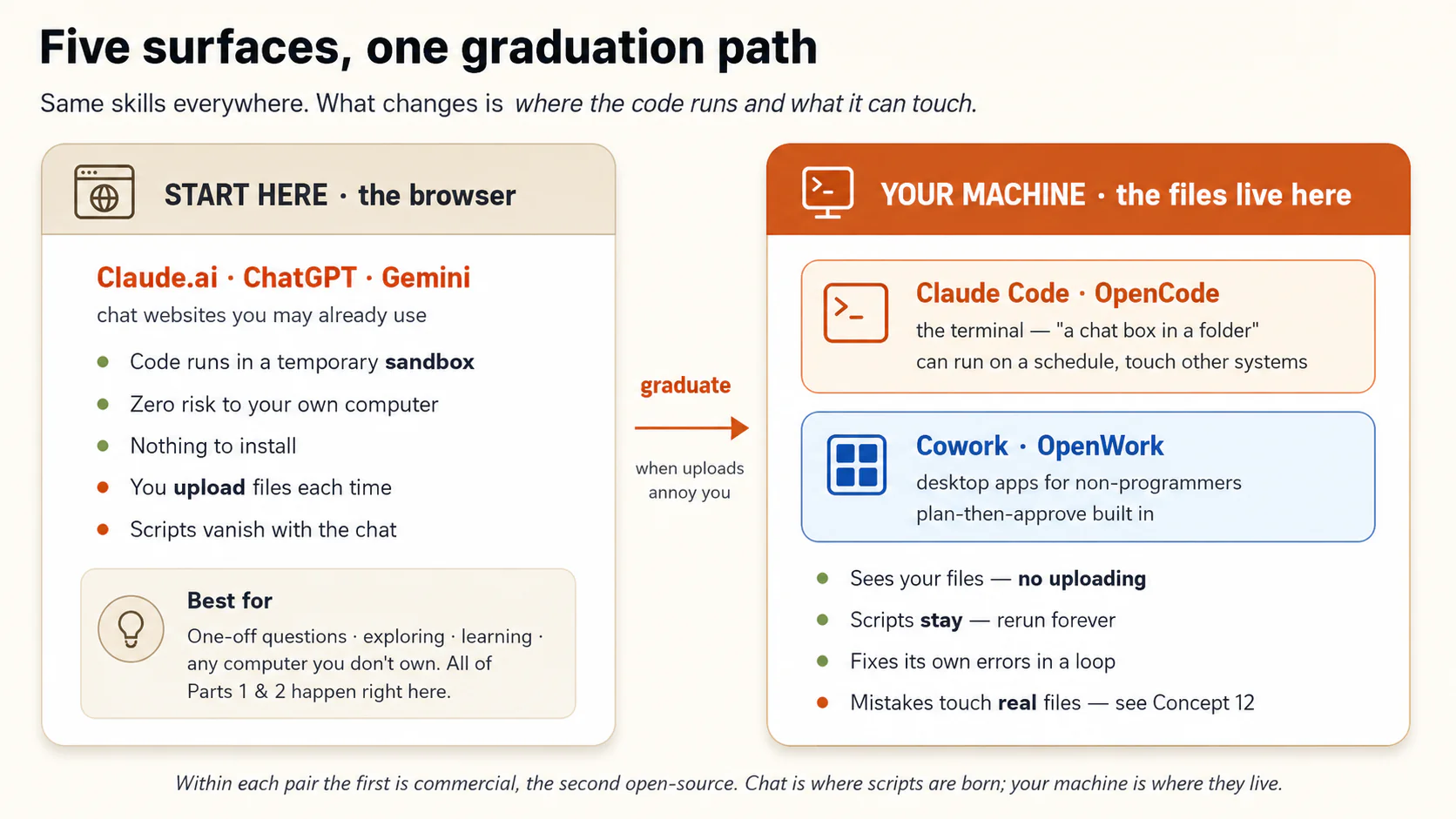 | ||
| Wohi, lekin aap terminal ke bajaye app chahte hain, aur kuch move hone se pehle approve karne ke liye plan | Cowork ya OpenWork | Plan-then-approve verification ko surface ke andar laata hai. |
| Task ko schedule par chalna hai, ya doosre systems touch karne hain (network engineer ka case) | Claude Code ya OpenCode | Sirf aap ki machine par rehta code sote waqt chal sakta hai. |
Aur honest sequencing advice: Claude.ai par tab tak rahen jab tak uploading aap ke week ka annoying hissa na ban jaye. Woh annoyance graduation signal hai. Zyada tar readers is course ko real work par apply karne ke ek mahine ke andar mehsoos karte hain; tool-pair crash courses tab ke liye ready hain.
Aap terminal ya desktop app ko browser tab ke andar try nahin kar sakte; woh aap ke computer par rehte hain, aur unhein try karne ka matlab short install hai, jo Agentic Coding aur Cowork & OpenWork courses ke liye hai. Reassuring hissa: aap already real skills (brief, force code, verify, keep) apne haath se Claude.ai par practice kar chuke hain. Yeh surfaces code kahan chalta hai badalte hain, aap kya karte hain nahin. Wohi job, bara room.
Part 4: Power, safely held
Do closing concepts: us code ke safety rules jo real cheezein chhoo sakta hai, aur honest map ke one-prompt code kahan khatam hota hai.
12. Blast radius: us code ke rules jo aap ki files chhoota hai
Claude.ai par mistakes free hain: sandbox disposable hai aur aap ka computer untouchable. Jis lamhe aap un surfaces par move karte hain jahan code aap ki machine par chalta hai, Concept 2 ki warning theoretical nahin rehti: code bilkul wohi karta hai jo isay kaha gaya, perfectly, scale par, ghalat cheez samait. Misunderstood brief wala script 300 files ko wohi chaar seconds mein ghalat rename karta hai jo sahi rename karne mein lagte. Aur prompting course se do facts dobara kehna zaroori hain kyunke log inhein mehangi tareeqe se seekhte hain: agent ke delete kiye files aksar recycle bin skip karte hain, aur script ke edit kiye files undo history nahin rakhte.
To: chaar rules, follow karna sasta, jo taqreeban sara risk hata dete hain. Saath mil kar yeh blast radius chota karte hain, yaani agar run ghalat jaye to sab se bura kya ho sakta hai.
Rule 1: Copies par kaam karein jab tak script trust earn na kare. Kisi bhi run se pehle jo files modify kare: "First copy the folder to expenses-2025-backup, then work only on the original." Ek sentence. Jab (agar nahin, jab) script ke pehle runs ke dauraan kuch ulta hota hai, incident disaster ke bajaye shrug ban jaata hai. Script real data par kai martaba clean run kar chuka ho, to us script ke liye isay relax karein.
Rule 2: Destructive act se pehle dry run demand karein. Renaming, moving, deleting, overwriting: "Don't change anything yet. Show me the full list of operations you would perform (every rename, old name -> new name) and wait for my approval." Us list ko parhne mein do minute lagte hain aur misunderstanding pakar aati hai ("wait, yeh 2024 folder kyun touch kar raha hai?") jab woh abhi words hai, actions nahin. Cowork aur OpenWork design se yeh karte hain; terminal surface par aap enforce karte hain.
Rule 3: Territory scope karein. Agent ko sab se chote folder ki taraf point karein jisme problem hai: kabhi home directory nahin, kabhi "Documents" nahin, kabhi whole disk nahin. expenses-2025/ ke andar confused script twelve CSVs damage kar sakta hai jinhein aap ne Rule 1 ke tahat back up kiya. Drive ke top par confused script aap ki zindagi damage kar sakta hai.
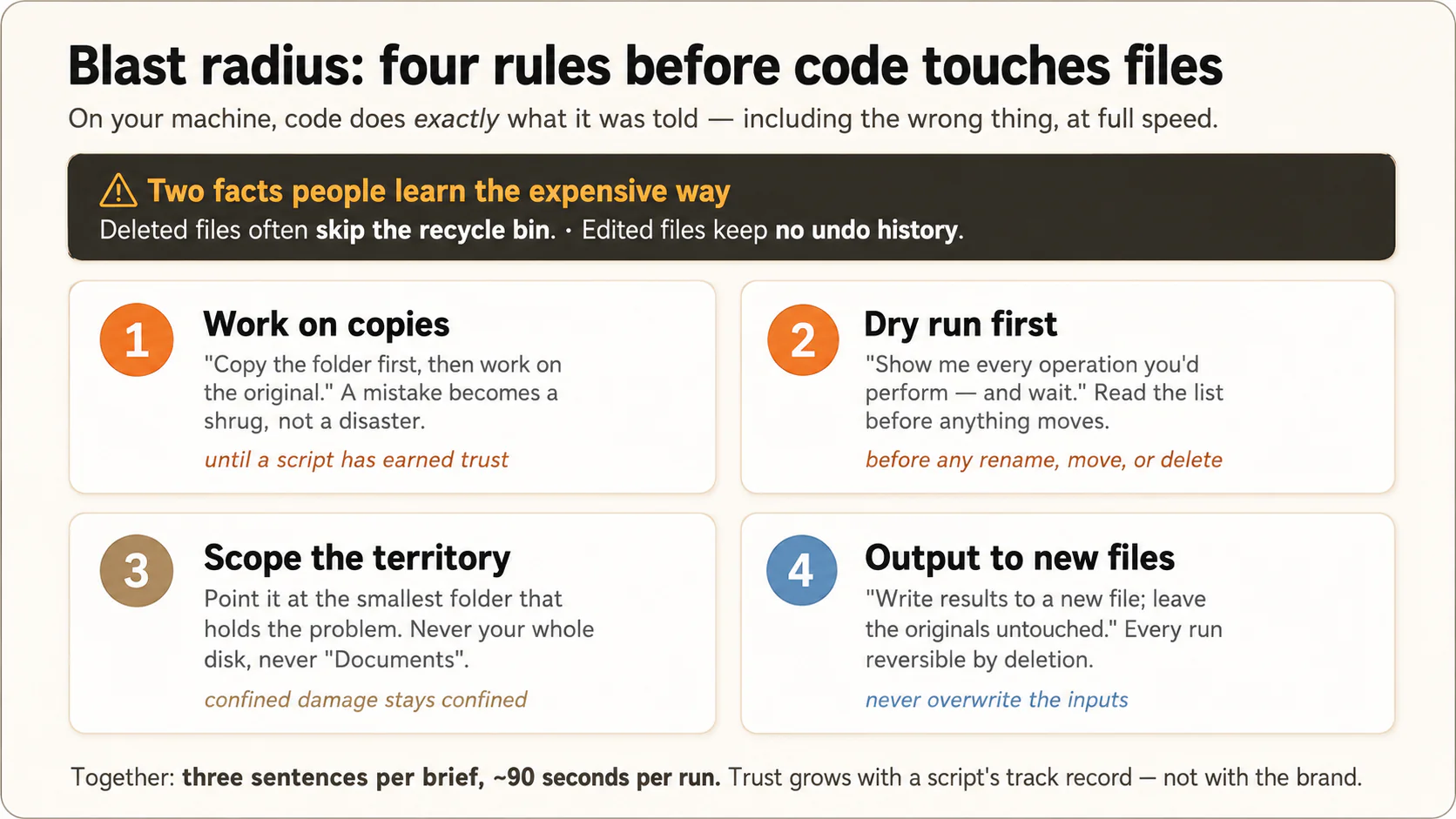 Rule 4: New files mein output; inputs kabhi overwrite nahin. "Write results to a new file; leave the originals untouched." Original data pristine rehta hai; har run deletion se reversible. Isay har brief ke Output section mein standing line bana dein.
Combined ritual har brief ke teen sentences aur har run ke taqreeban ninety seconds leta hai:
Copy the folder to a backup first. Show me your plan of operations before changing anything, and wait for approval. Write all output to new files; never modify the originals.
Yeh wahi permission ladder hai jo prompting course ne desktop apps ke liye di thi, code ke liye translate hui: trust specific scripts with track records ko milta hai, technology ko nahin, aur code ko kya chhoone ki ijazat hai woh sirf evidence ke saath barhti hai ke woh behave karta hai.
Non-software example. Ek researcher ne agent se interview recordings ke folder ko duplicates hata kar "clean up" karne ko kaha. Dry-run list ne 40 proposed deletions dikhaye, jisme six files aisi thin jise matching logic ne ghalat group kiya tha, kyunke do different interviews ki lengths identical aur names similar the. Us ne rule correct kiya ("match on content, not name and size"), dry run dobara chalaya, 34 true deletions approve keen. Woh six interviews jo silently vanish ho jaate (recycle bin se past, unrecoverable) plan ki do-minute reading ki wajah se bach gaye. Yeh ritual aap ko yahi deta hai.
🔬 Abhi yeh karein (2 min). Disaster rokne wala move practice karein: kisi change se pehle plan demand karein. Paste:
I have six files: report-jan.pdf, report-feb.pdf, notes.txt, report-mar.pdf, photo.jpg, report-apr.pdf. I want to rename only the "report-" PDFs to report-01.pdf, report-02.pdf, and so on, in date order. Before doing anything, show me your exact plan: every old name next to its new name. Change nothing yet, and wait for my approval.
Yeh aap ko old name ke saath new name ki list dikhata hai, aur rukta hai. Isay parhein. Check karein ke notes.txt aur photo.jpg untouched rehte hain. Yeh two-minute read, ek file move hone se pehle, poori safety habit hai. Aap ki real files par, yahi shrug aur catastrophe ka farq hai.
13. Map ka edge, aur us ke paar kya hai
Yeh course jaan boojh kar confident raha hai, kyunke apni territory mein confidence justified hai: aise masail jo brief mein fit hote hain aur aap ki files mein rehte hain, AI-written code jiska syntax aap kabhi nahin parhte (lekin result hamesha verify karte hain) compromise nahin. Yeh bas ab is kaam ka tareeqa hai. Lekin aap ko exactly pata hona chahiye territory kahan khatam hoti hai, frustration se bachne ke liye bhi aur yeh dekhne ke liye bhi ke book agay kahan jaati hai.
Edge ke paar, one-prompt code se zyada chahiye:
- Software jisme doosre log log in karte hain. Accounts, payments, simultaneous users, service jo 3 a.m. par up rehni chahiye: products, scripts nahin. AI ke saath buildable, lekin is book ke Part 4 ki engineering discipline ke saath, chat prompt se nahin.
- Real-world consequences wali always-on automation. "Email my clients automatically every week" unattended chalta hai, jahan Concept 6 ke checks nahin pahunchte. Ek script jise aap run aur verify karte hain aur ek worker jo khud chalta hai ke darmiyan gap wahi hai jo is course aur Digital FTEs ke darmiyan hai jise yeh book sikhati hai: crossable, lekin eval-driven discipline ke saath, optimism ke saath nahin.
- High-stakes acts jinka undo nahin. Code jo tax filing submit karta hai, mass email bhejta hai, trade execute karta hai. Code ko inhein prepare karne dein aur human ko fire karne dein. Jis din aap human hata dete hain, us din aap ko book ke later parts ki reliability engineering chahiye.
- Judgment jo computation ka costume pehne hue hai. "Compute which employees to promote": arithmetic trivial hai; criteria poora problem hain, aur woh aap ke hain, Python ke nahin. Code compute karta hai; aap decide karte hain.
Territory ke andar, aaj se aap ka: aap ki working life ka har reconciliation, rollup, rename, merge, clean, cross-check, flag, chart, aur report jo Volume, Precision, Repetition, ya Files trip karta hai. Zyada tar professionals ke liye yeh saal ke hundreds of hours hain, ab tak us skill ke peeche gated jise aap ko pehle seekhna zaroori bataya gaya tha.
Bookkeeper yaad hai jise us ki shaam wapas mili? Usay apni working life ke har reconciliation, rollup, rename, aur report se multiply karein, aur aap ke paas is course ka poora waada hai. Jo log yeh seekhte hain woh replace nahin ho rahe; woh apne week ke hours wapas le rahe hain. Yeh magic nahin; yeh commissioned code hai: problems once described, perfectly computed, forever kept, free rerun. Un mein se koi programmer nahin bana. Woh ache clients ban gaye. Ab aap bhi.
Book yahan se kahan jaati hai. Ab aap ke paas woh dono bare levers hain jin par yeh Foundations track bana hai: precise documents (jo Markdown In, HTML Out mein sikhaye) aur un ke zariye commissioned computation (yeh page). Jo baqi hai woh discipline hai jo decide karti hai kab inhein use karna hai: How to Think in the AI Era, yeh jaanna ke agent ko kab bulana hai aur kab nahin. Us ke baad, Problem Solving with General Agents dono levers ko Part 3 ke agent surfaces par le jaata hai aur operating discipline add karta hai (decomposition, constraints, autonomy ladder) jo "AI wrote me a script" ko "AI and I shipped the engagement" mein badalta hai. Tool-pair walkthroughs (Agentic Coding, Cowork & OpenWork) us din ke liye hain jab uploading aap ko annoy karna shuru kare.
Prompts try karne se pehle choti recap
Thirteen concepts, har ek ek line:
- Concept 1. Code ab usay likhne ki ability se gated nahin. AI code likhta aur chalata hai: kuch installed nahin, kuch pasted nahin. Aap poochte hain "kya main isay describe kar sakta hun?", "kya main isay build kar sakta hun?" nahin.
- Concept 2. Code exact instructions hain jo perfectly execute hoti hain, dono directions mein. AI language chunta hai; is course ke real data work ke liye iska matlab taqreeban har dafa Python hai. Aap us ki syntax kabhi nahin likhte ya parhte.
- Concept 3. Chaar signals code problem mark karte hain: Volume, Precision, Repetition, Files. Ek bhi kaafi hai. Koi bhi nahin to answer problem.
- Concept 4. AI kabhi kabhi compute karne ke bajaye estimate karta hai. Alfaaz kahein: "Write and run code. Show me that the code ran. Give me row counts first."
- Concept 5. Problem brief karein, program nahin: Goal, Input, Output, Rules (aap ki professional knowledge), Edge cases (imperfect data kya kare). AI ko pehle data inspect karne dein aur batane dein ke aap ko kya decide karna hai.
- Concept 6. Outputs ko independent knowledge ke khilaaf verify karein: known-answer tests, reality questions, plain-English replays, adversarial passes, cross-model checks. Untested precision-critical number par kabhi act na karein.
- Concept 7. Errors dialogue hain. Red text paste karein; wrong numbers ko symptoms ke taur par expected values ke saath report karein; teen failed fixes ke baad fresh approach demand karein.
- Concept 8. Repetition scripts ko assets banati hai: brief, script, aur known-answer sample ek folder mein rakhein. Once describe, forever run, kisi ko bhi hand karein.
- Concept 9. Claude.ai (aur ChatGPT, Gemini) zero-risk sandbox mein code chalata hai: one-off jobs aur aap ki learning ka home surface.
- Concept 10. Claude Code aur OpenCode agent ko aap ke folder ke andar rakhte hain: uploads nahin, persistent scripts, self-healing errors, scheduled runs. Terminal woh chat box hai jo folder mein rehta hai.
- Concept 11. Cowork aur OpenWork wahi power desktop app mein plan-then-approve ke saath wrap karte hain: verification surface ke andar built in.
- Concept 12. Jab code real files chhoo sakta hai: copies first, destruction se pehle dry runs, smallest folder possible, output new files mein. Har brief ke teen sentences.
- Concept 13. Map ka edge: multi-user software, unattended automation, no-undo actions, aur judgment calls ko baqi book chahiye. Baqi sab aaj se aap ka hai.
In sab ke neeche ek identity aur ek skill hai. Identity: aap client hain, contractor nahin. Skill, woh jo prompting course ko kabhi nahin chahiye thi: aap us kaam par trust kar sakte hain jo aap dekh nahin sakte, kyunke aap ne usay kisi aisi cheez ke khilaaf test kiya jo aap pehle se jaante the. Jo clients clearly brief karte hain, independently known cheez ke khilaaf verify karte hain, aur jo cheez unhon ne pay ki use rakhte hain, woh apne week ka real day wapas jeet lete hain, aise kaam par jo waqai matter karta hai. Yehi poora course hai.
Aap yeh pehle hi das martaba kar chuke hain
Agar aap ne oopar ke do-this-now boxes chalaye, to aap ne sirf yeh course parha nahin; aap ne isay use kiya. Aap ne code problems spot kiye, AI ko compute karne par force kiya, messy data ko tame karne wala brief likha, known-answer test chalaya, crash survive kiya, script rakha, aur dry run demand kiya. Yeh sab apni aankhon ke saamne, us data par jo page mein tha.
Ab training wheels hata dein. Neeche chaar projects wahi moves aap ke data par chalate hain, jahan answers waqai matter karte hain.
🚀 Projects
Woh das do-this-now boxes us data par rehearsals the jo hum ne aap ko diya. Yeh chaar projects asal cheez hain: aap ka data, aap ke stakes, aur end mein ek catch.
Catch ek aisi sachi cheez hai jo AI ka code dhoondh nikalta hai aur jo aap pehle se nahin jaante the, aur jis ke baare mein aap kuch kar sakte hain: cancel karne wali subscription, dispute karne wala charge, rescue karne wala grade, paise ke liye chase karne wala dost. To dhyan dein yeh projects kya nahin hain. Yeh show off karne ke liye screen banane ke baare mein nahin. Bhejne ke liye koi link nahin, publish karne ke liye koi page nahin. Jo cheez aap saath le kar jaate hain woh ek aisa jumla hai jo aap kisi real shakhs ko bata sakte hain ("AI ne ek subscription dhoondhi jo main bhool gaya tha, ab tak 796 ja chuke, plus ek double charge jise main dispute kar sakta hun") aur ek chota script jo aap rakhte hain. Catch hi demo hai.
Kisi data par project point karne se pehle poochein: kya kisi company ne theek isi cheez ke liye pehle se app bana di hai? Agar haan (bill split karne ke liye Splitwise, spend track karne ke liye budgeting app, aap ke phone ka year-in-review), to yeh yahan ke liye ghalat problem hai. App tabhi exist karti hai jab rules sab ke liye same hon. Aur agar rules universal hain, to brief karne ke liye kuch aap ka nahin, aur koi private answer nahin jo sirf aap ke paas ho jis ke khilaaf verification check kar sake.
Sahi problems is ke opposite hain: ek market of one. Aap ke rules, aap ki mess, ek aisa answer jise sirf aap confirm kar sakte hain. Theek wahan commissioned code store ki har app ko beat karta hai, aur wahan har neeche wala project rehta hai.
Money Detective se shuru karein; yeh har woh move sikhata hai jo baqi reuse karte hain. Pehle teen ek aise data mein catch dhoondhte hain jise aap sirf parh sakte hain; chautha wahi discipline aap ki files par modne mein lagaata hai, jahan stakes zyada hain kyunke wahan code delete kar sakta hai. Har ek free account par ghante se kam leta hai.
Project 145 minMoney DetectiveAage ki taraf apne paise track na karein. Apni hi real history mein chhupi leak ka shikaar karein.
"Paise bas ghaayab ho jaate hain aur mujhe nahin pata kahan jaate hain." Har kisi ne yeh kaha hai. Budgeting app isay aage ki taraf answer karta hai, isi liye ek already har kisi ke liye exist karti hai aur isi liye tracking off-the-shelf-app test fail karti hai. Yeh opposite move hai, aur wajah jis se koi app yeh nahin karti: aap apni hi real history mein peeche ki taraf us khaas leak ka shikaar kar rahe hain jise sirf aap pehchaan sakte hain.
Pehle ek sample wallet par shikaar rehearse karein jis ka answer aap check kar sakte hain, phir usay apne real export par chhor dein. Isay chat mein apni "file" ke taur par paste karein. Yeh ek student ke wallet ke chand mahine hain, har line par ek transaction. Positive amount paise in hain, negative amount paise out.Abhi apna export nahin? Pehle is wallet par rehearse karein
Date,What,Amount
2025-06-01,Pocket money,+5000
2025-06-04,PrimeVideo subscription,-199
2025-06-05,Spotify,-299
2025-06-07,Foodpanda,-650
2025-06-09,Careem ride,-300
2025-06-15,Tutoring received,+1500
2025-06-18,Foodpanda,-700
2025-06-28,Bank service fee,-50
2025-07-01,Pocket money,+5000
2025-07-04,PrimeVideo subscription,-199
2025-07-05,Spotify,-299
2025-07-08,Foodpanda,-650
2025-07-08,Foodpanda,-650
2025-07-14,Careem ride,-300
2025-07-28,Bank service fee,-50
2025-08-01,Pocket money,+5000
2025-08-04,PrimeVideo subscription,-199
2025-08-05,Spotify,-299
2025-08-10,Foodpanda,-700
2025-08-16,Careem ride,-350
2025-08-20,Tutoring received,+1500
2025-08-28,Bank service fee,-50
2025-09-01,Pocket money,+5000
2025-09-04,PrimeVideo subscription,-199
2025-09-05,Spotify,-299
2025-09-12,Foodpanda,-700
2025-09-17,Careem ride,-300
2025-09-28,Bank service fee,-50
Wallet paste karein, phir yeh brief:
Yeh mere wallet ke chand mahine hain (plus paise in, minus paise out). Paise lagataar ghaayab hote ja rahe hain aur main nahin dekh pa raha kahan. Mere money detective bano: code likho aur chalao, aur mujhe dikhao ke woh chala, taake yeh dhoondho ke paise asal mein kahan jaate hain, koi cheez jo har mahine chupke se mujhse charge kar rahi hai, aur koi charge jo ek hi din do dafa lagaya gaya. Phir batao ke meri agli pocket money tak mere paas kitna bachega.
Pehle backstage par apna trust earn karein. Is se pehle ke aap is ki dhoondhi kisi cheez par yaqeen karein, do aise numbers confirm karein jo aap khud check kar sakte hain: total paise IN 23,000 hone chahiye (chaar mahine ki 5,000 pocket money, plus tutoring do dafa 1,500 par), aur PrimeVideo har mahine nazar aana chahiye, ab tak 796 liye gaye (199 chaar dafa). Agar code dono reproduce karta hai, to woh cheezein jo us ne dhoondhin aur jinhein aap pehle se check nahin kar sakte the, unhon ne aap ka trust earn kar liya. Woh khaamosh check Concept 6 ka known-answer test hai jo nazar se door apna asal kaam kar raha hai.
Ab isay khud explain karwayein. Jo numbers aap check kar sakte the woh sahi aaye, to agla move yeh hai ke AI se apni hi soch un alfaaz mein bayan karwayein jo aap waqai parh sakein.
Ab isay aise samjhao jaise main code parh hi nahin sakta. Tum ne kaunsi language use ki, aur tum ne yeh numbers asal mein kaise nikale, khaaskar yeh ke tum ne kaise decide kiya ke koi cheez duplicate hai?
Yeh Concept 6 ka plain-English replay hai. Aap Python parh nahin sakte, lekin aap plain English mein logic check kar sakte hain: "main ne category ke hisaab se sum kiya, main ne ek charge ko recurring tabhi gina jab wahi amount har mahine aaya, main ne same-day same-amount ko possible duplicate flag kiya." Agar woh logic ghalat hai, to woh English mein ghalat parha jaata hai, aur aap ek line code parhe baghair usay pakar lete hain. Yeh bhi dhyan dein ke aap ne kabhi Python use karne ko nahin kaha (Concept 2): us ne language khud chuni, kyunke yeh data work hai aur sahi tool chunna us ka kaam tha, aap ka nahin.
Detective kya pakarta hai. Is wallet par woh teen sachi cheezein surface karta hai jo aap ne use nahin di thin: ek PrimeVideo subscription jo chupke se 199 mahina le rahi hai, ab tak 796, jo aap bhool gaye the ke aap ke paas hai; ek Foodpanda charge jo ek hi din do dafa laga, 8 July, ek double charge jise aap dispute kar sakte hain; aur asal leak, food delivery taqreeban 4,050 par, har subscription se zyada milakar. Forecast us ke oopar imandaari se chalta hai: aap asal mein net positive hain, aap bas mehsoos broke karte hain kyunke food delivery aap ko chote chote tukron mein nibble karti hai. (Aur detective apni footing ke baare mein imandar hai: woh forecast yeh assume karta hai ke aap ki tutoring income aati rahegi, aur yahan woh chaar mein se sirf do mahine aayi. Acha detective aap ko number aur woh dikhata hai jis par woh leaned tha.)
Aap ka ek jumla: "AI ne ek subscription dhoondhi jo main bhool gaya tha, ab tak 796 ja chuke, plus ek double charge jise main dispute kar sakta hun." Woh jumla ek verb par khatam hota hai. Aap cancel karte hain, aap dispute karte hain, aap hafte mein do dafa ghar khaate hain.
Tool rakhein. Is se kahein ke poori cheez ko ek plain-English header wale script ke taur par save kar de (Concept 8), kuch aisa naam ke saath "my monthly money check." Agle mahine aap ek fresh export paste karte hain aur kehte hain "run this," aur shikaar ek shaam ke bajaye tees second ki aadat ban jaata hai.
Agar catch kisi real decision ko drive karne wala hai (chase karne layak refund, koi budget jo aap kisi ko dikhayenge), to wahi brief ek doosri family ke doosre AI mein chalayein aur dekhein ke act karne se pehle dono leak par agree karte hain ya nahin. Yeh Concept 6 ka sab se strong check hai, real mein perform hua.
Optional: receipt rakhein. Catch hi asal deliverable hai, aur woh aap ke paas pehle se hai. Lekin agar aap copy rakhna ya kisi ko dikhana chahte hain (parent, apne records), to aap jo dhoondha use last course ki usi skill se package kar sakte hain, Markdown In / HTML Out.
Rakhne ya kisi ko dikhane ke liye: jo maine dhoondha use ek clean page mein badlo jise main save kar sakun, leak, bhooli hui subscription, double charge, aur tumhare ek line ke verdict ke saath.
Claude par report inline ek artifact ke taur par nazar aati hai jise aap save kar sakte hain; ChatGPT par woh ek .html file ke taur par download hoti hai jise aap apne browser mein kholte hain, dono tareeqe se wahi result. Yeh catch ko package karna hai, point ko nahin, aur yeh aap ke liye hai: aap ki apni bhooli hui subscriptions ki report aap ki aankhon ya kisi parent ke liye hai, kabhi koi link nahin jo aap publish karein. Yeh woh imandar maaina bhi hai jis mein yeh project code dono tareeqon se use karta hai: leak compute aur catch karne ke liye Python, usay package karne ke liye last course ki HTML markup, aur kabhi koi clickable app banane ke liye nahin. Yeh oopar wale practice wallet se bana hai, kisi ke real paise se nahin, is liye dikhana safe hai. Aap ka apne catches le kar aata, aur aap ki real report aap ki rehti hai, kabhi koi link nahin jo aap publish karein. Aap sample ko apne tab mein bhi khol sakte hain.▶ Ek sample report dekhein (aap ka saved page kaisa lag sakta hai)
Done when: code un do numbers ko reproduce karta hai jo aap pehle se jaante the, aur woh aap ko kam az kam ek sachi cheez deta hai jo aap nahin jaante the (bhooli hui subscription, double charge) jis par aap is hafte act kar sakein, plus ek saved script jise aap agle mahine dobara chala sakein.
Project 230-45 minWhat's My Grade, ReallyGrading rules ka woh ek set encode karein jo kisi app ke paas nahin, aap ke teacher ke, aur jaanein ke aap asal mein kahan khare hain.
Koi gradebook app yeh nahin jaanta ke aap ka teacher aap ki do sab se kam homeworks drop karta hai, das mein se behtareen 8 quizzes ginta hai, ek strong final ko weak midterm replace karne deta hai, aur late penalty par cap lagaata hai. Rules ka woh theek bundle duniya ke ek syllabus par exist karta hai, jo theek wajah hai ke woh off-the-shelf-app test pass karta hai: rules universal nahin, woh aap ke teacher ke hain, is liye sirf ek brief jo aap likhte hain unhein encode kar sakti hai. Yeh "problem brief karein, program nahin" (Concept 5) apni sab se khaalis shakal mein hai, kyunke yahan Rules section khud syllabus hai, plain English mein copy kiya gaya.
Apne real scores ikatthe karein (portal se seedha copy-paste, messy theek hai) aur apne teacher ke asal rules. Agar woh aap ke saamne nahin to sample par rehearse karein.Scores haath mein nahin? Is par rehearse karein, phir real karein
My homework scores: 60, 92, 88, 45, 90, 85
My quiz scores (best 8 of 10 count): 70, 95, 88, 100, 0, 91, 84, 77, 93, 80
Midterm: 72
Final: 86

My teacher's exact rules:
- Homework is 20% of the grade. Drop my two lowest homework scores, average the rest.
- Quizzes are 20%. Only my best 8 of 10 count (a 0 means I missed one).
- Midterm is 25%.
- Final is 35%. If my final percentage is higher than my midterm, the final replaces the midterm too.
Apne scores aur rules paste karein, phir yeh brief:
Yeh mere scores aur mere teacher ke exact grading rules hain. Code likho aur chalao, aur mujhe dikhao ke woh chala, taake har rule follow karte hue abhi mera asal grade nikalo, aur har part ka subtotal dikhao taake main ek haath se check kar sakun. Phir batao ke 90 percent tak pahunchne ke liye mujhe final mein kya chahiye.
Pehle backstage par apna trust earn karein. Poore grade par trust karne se pehle ek category khud check karein. Do sab se kam homeworks drop karein (45 aur 60) aur jo bache un ka average lein, 92, 88, 90, 85, jo 88.75 hai. Agar code ka homework subtotal 88.75 parhta hai, to un categories par us ki arithmetic jinhein aap aasani se haath se check nahin kar sakte, abhi aap ka trust earn kar gayi. (Apne data par, jo bhi single category kaagaz par compute karna sab se aasaan ho woh chunein. Yeh known-answer test hai, aur is mein ek minute lagta hai.)
Catch. Jo number wapas aata hai woh taqreeban kabhi aap ke zehan wala number nahin hota. Catch ek sachi, stakes-bearing figure hai jo aap ke paas nahin thi, plan ke saath juri: "main asal mein 79 par hun, woh 85 nahin jo main ne assume kiya tha, aur A ke liye mujhe final mein 88 chahiye." Woh jumla bhi ek verb par khatam hota hai. Yeh badalta hai ke aap aaj raat kya parhte hain, jo isay chalane ka poora point hai.
Tool rakhein. Isay ek "final mein mujhe kya chahiye" script ke taur par save karein. Jab bhi koi grade post ho dobara chalayein, aur aap ko hamesha theek pata hota hai ke aap kahan khare hain aur final ko theek kya clear karna hai.
Done when: code us ek category ko reproduce karta hai jise aap ne haath se check kiya, aur woh aap ko ek aisa real grade deta hai jo aap nahin jaante the plus woh exact score jo aap ko aage chahiye, itna specific ke aaj raat ka study plan badal de.
Project 345 minThe Books Don't MatchDo records jo agree karne chahiye: aap ka counted total aur messy digital wala. Gap dhoondein, shakhs ka naam lein.
Us bookkeeper ko yaad karein jo is course ke shuru mein thi, har mahine woh chand transactions ka shikaar karte ek shaam haar deti thi jahan do records disagree karte the? Aap ke paas us ka problem teen scale par hai. Aap ne class trip, club, ya group gift ke liye paise jama kiye. Aap ne jo aaya use count kiya, to aap asal total jaante hain, aur woh count aap ka known answer hai, woh cheez jo koi app nahin de sakti kyunke koi app us kamre mein nahin thi.
Ab isay messy digital record ke khilaaf reconcile karein: JazzCash ya Venmo ya Easypaisa ke memos free text se bhare, plus aap ki paper list ke kis ka kitna baqi hai. Aap ki private knowledge woh rules hain jo kisi app ke paas nahin: "memo mein pizza dues nahin, woh ek dost mujhe wapas paise de raha hai"; "Ali ke 1,000 us ko aur us ke bhai ko cover karte hain"; "ek number se 500 jise main nahin pehchaanta shayad kisi ke dues hain, lekin kis ke?" Rules ka woh bundle sirf aap ke zehan mein rehta hai, jo theek wajah hai ke yeh market of one hai aur Splitwise nahin.Settle karne ke liye apni koi collection nahin? Is par rehearse karein
Everyone owes 500 for the class trip. Eight people: Ali, Omar, Sara,
Bilal, Hina, Zoya, Ayesha, Usman. So the books should show 4,000.

Digital record (JazzCash), exactly as it came in, messy memos and all:
Date,From,Amount,Memo
2025-09-02,Ali,1000,trip me + my brother Omar
2025-09-02,Sara,500,trip dues
2025-09-03,Bilal,500,
2025-09-03,Hina,500,class trip
2025-09-05,0300-unknown,500,
2025-09-05,Usman,300,pizza
2025-09-06,Zoya,500,dues
2025-09-08,Ayesha,500,trip

What only I know (the rules):
- Ali's 1,000 covers Ali AND his brother Omar. Count it for both.
- Usman's 300 with "pizza" is NOT dues; he was paying me back. Ignore it.
- The 500 from "0300-unknown" has no name I recognize. Do not assume; flag it.
Dues list, digital record, aur apne rules paste karein, phir yeh brief:
Yeh hai ke har kisi ka kitna baqi hai, messy payment record, aur woh rules jo sirf main jaanta hun. Code likho aur chalao, aur mujhe dikhao ke woh chala, taake unhein reconcile karo: kis ne pay kiya, kis ka abhi baqi hai, aur kitna unaccounted hai. Koi bhi payment list karo jise tum kisi shakhs se match nahin kar sakte; guess mat karo. Mera counted total [your number] hai; mujhe dikhao yeh us ke khilaaf kaise stack karta hai.
Pehle backstage par apna trust earn karein. Aap ki counted figure, aath logon par 4,000 owed, yahan known answer hai, wahi role jo haath se band kiya mahina Concept 6 mein nibhata hai. Agar code ka "expected" total 4,000 ke ilawa kuch aata hai, to catch dekhne se pehle hi brief mein kuch off hai.
Catch. Is sample par kaagaz par books 500 short aati hain. Aap ke rules apply karte hue, saat log covered hain (Ali aur Omar 1,000 se, plus Sara, Bilal, Hina, Zoya, Ayesha), Usman ka akela payment pizza tha is liye us ka abhi baqi hai, aur ek unplaceable 500 ek number se hai jise aap nahin pehchaante. To catch ek real, actionable mismatch hai: ya to woh mystery 500 Usman ek aise handle se pay kar raha hai jise aap nahin jaante the, ya aap waqai abhi owed hain, aur ek message isay settle kar deta hai. Deliverable woh jumla hai jo aap aaj raat group chat mein bhej sakte hain: "Usman ke ilawa sab accounted for hain, aur ek mystery 500 hai, to books band karne se pehle main use message karunga." Aisa mismatch ya to aap ke brief mein bug hai ya ek sachi discrepancy jo chase karne layak hai, jo theek bookkeeper ka craft hai.
Tool rakhein. Isay apne reconciliation script ke taur par save karein. Agla trip, agla gift, agli collection: naya record aur nayi dues list paste karein, aur shikaar ki ek shaam ek-prompt check ban jaati hai.
Done when: code aap ke counted total ke khilaaf reconcile karta hai, aur woh aap ko chase karne ke liye ek specific naam ya place karne ke liye ek specific payment deta hai, woh ek sacha mismatch, ek aise jumle mein jo aap aaj raat group chat mein bhej sakein.
Project 445 minPhoto Gallery RescueAap ki photo gallery duplicates chhupa rahi hai jo real space kha rahe hain. Unhein dhoondein, safely delete karein, phir jo bache unhein date ke hisaab se sort karein.
Baqi teen projects aap ka data parhte hain. Yeh usay badalta hai, jo theek wajah hai ke yeh woh safety habit sikhata hai jo baqi nahin sikha sakte. Aap ki photo gallery ek mein do gardbar hai: yeh duplicates se bhari hui hai (wahi shot do dafa saved, taqreeban-identical bursts, ek screenshot jo aap ne idhar udhar copy kiya), aur jo kuch bach jata hai woh kisi haqeeqi tarteeb mein nahin rehta. Aap yahan dono theek karte hain: duplicates ko dhoondein aur safely delete karein, phir jo bache unhein date ke hisaab se sort karein. Catch yeh hai ke duplicates kitni space waste karte hain; safety lesson yeh hai ke unhein ek bhi real photo khoye baghair delete karna; aur natija yeh hai ke aap ki gallery aakhirkaar tarteeb mein aa jati hai.
Pehle duplicates dhoondein, aur dhyan dein ke AI kabhi aap ki photos ko "dekhta" nahin. Do photos mein farq karna ek algorithm hai, AI ka kaam nahin: code har image ko ek chote fingerprint mein shrink karta hai aur fingerprints compare karta hai. Aap theek wahi maangte hain:
Is folder mein duplicate aur near-duplicate photos dhoondne ke liye code likho aur chalao. Har image ko perceptual hash se fingerprint karo, jo match karti hain unhein group karo, aur batao ke kitne duplicates hain aur woh kitni space leti hain. Abhi kuch delete mat karo.
Catch ek number ke taur par aata hai: "18 sets mein 47 duplicates, 2.1 GB." Woh akela project ke layaq hai.
Phir safety gate, kyunke yeh step delete karta hai (Concept 12). Deleted files recycle bin skip kar jaati hain, aur fingerprint match ghalat ho sakta hai, kyunke do alag sunsets ek jaise lagte hain. To aap code ko apna plan dikhane par majboor karte hain kisi cheez ko chhoone se pehle:
Har set ke liye, sab se bari copy rakho aur jinhein tum delete karoge unhein names aur sizes ke saath list karo. Abhi kuch mat badlo. Pehle originals ki ek backup copy banao, phir meri approval ka intezar karo.
List parhein. Taqreeban hamesha ek "duplicate" hota hai jo asal mein ek alag lamha hota hai: usay spare karein, phir baqi approve karein. Woh review, kisi ek file ke delete hone se pehle, poora safety lesson hai, aur yeh woh ek move hai jo oopar wale read-only projects ne aap ko kabhi practice nahin karwaya.
Aakhir mein, jo bache usay sort karein, taake cleanup tikti rahe. Ek gallery jis ke duplicates nikal gaye hain woh phir bhi sirf aadha-saaf hai agar woh hazaar photos upload order mein pari hain. Ek aur instruction usay shape mein le aati hai:
Ab jo photos bachi hain unhein date ke hisaab se sort karo, newest first, ek aisi copy mein jise main ek nazar mein scan kar sakun. Mere originals ko mat chhuo.
Aap apni gallery ke saath khatam karte hain, deduped aur tarteeb mein: kuch publish nahin hua, kuch bheja nahin gaya, bas aap ki files aakhirkaar saaf-suthri. Yeh wahi hai jo code karta hai, interactive bana hua. Photos ka ek dher daalein (wahi photo do dafa try karein): yeh har ek ko fingerprint karta hai taake duplicates pakray, kuch bhi remove karne se pehle aapko review karne deta hai, phir baqi ko date ke hisaab se sort karta hai. Koi AI nahin, kuch upload nahin hota, sab kuch aap ke browser mein. Yeh neeche live load hota hai; aap isay apne tab mein bhi khol sakte hain.▶ Khud try karein (live)
Done when: code aap ko ek real number deta hai (dhoonde gaye duplicates aur woh jitni space waste karte hain), aap ne approve karne se pehle kam az kam ek false match pakra, originals ki ek backup mojood hai, to delete karna safe tha, aur jo bache woh date ke hisaab se sort ho gaye. Script rakhein, aur aap ki gallery dobara kabhi nahin bharti.
🛟 Agar project ke darmiyan atak jaayein
Har stall jo hum ne dekha hai in mein se kisi ek mein land karta hai. Apna symptom dhoondein, fix paste karein. Inmein se koi bhi aap se yeh samajhne ko nahin kehta ke kya ghalat hua; woh AI ka kaam hai.
1. "Yeh mera export open ya read nahin kar sakta." Aksar file, AI nahin. Paste karein: "Tell me exactly what's wrong with this file: its format, what you can and can't read from it, and what I should re-export or save it as instead." Agar download screen ne CSV aur Excel dono offer kiye the, doosra try karein. Das mein se nau dafa yeh ek re-export hota hai.
2. "Is ne jawab diya, lekin maine kabhi code block nahin dekha." Concept 4 wala silent estimate. Alfaaz dobara kahein, firmly: "Stop. Write and run code to answer this, show me the code, and give me the row count first." Koi code block nahin ka matlab koi code nahin chala, prose kuch bhi claim kare.
3. "Number us se match nahin karta jo maine counted kiya ya jo main jaanta hun." "it's wrong" na kahein. Isay ek symptom ke taur par report karein (Concept 7): "Your total is X but I counted Y. Show me the row count you processed, the date range, and the first five rows as the code sees them." Culprit (skipped row, comma jo text ki tarah parha gaya, aadha-poora export) taqreeban hamesha us inspection mein surface kar jaata hai. Aur yaad rakhein: in projects mein mismatch catch ho sakta hai, bug nahin.
4. "Wahi fix baar baar fail hota hai." Three strikes ka matlab approach ghalat hai, typing nahin. Paste karein: "We've tried this three times. Forget the current code. Restate the problem fresh and propose two completely different approaches."
5. "Meri file mein private data hai aur upload se nervous hun." Achi instinct; us par act karein. Yeh sab projects real paise aur real names ko chhoote hain, to yeh wala matter karta hai. Paste karein: "Before any analysis, make a cleaned copy with the names and account numbers removed, work only on that copy, and confirm what you removed." Ya woh columns khud pehle delete kar dein; totals ko un ki kam hi zaroorat hoti hai. Kuch sensitive upload karne se pehle apne tool ki data policy check karein, aur agar aap ka data waqai nahin ja sakta (workplace ya school ka rule), to sample par practice karein aur moves sirf ek approved tool ke andar apply karein.
6. "Project ke darmiyan free-tier usage khatam ho gaya." Yahan ka har project ek free tier mein fit hota hai, lekin heavy iteration daily cap hit kar sakti hai. Reset ka wait karein (aap ke saved brief ka matlab resume karna free hai), ya brief ko ek doosri model family mein re-paste karein aur chalte rahein; skill dono tareeqe se transfer hoti hai.
Chhe rescues ke neeche pattern: jab atkein, stuckness AI ko describe karein. Wahi skill jo code commission karti hai project rescue karti hai.
Ab aap code commission karte hain. Agla course aap ko engagement chalana sikhata hai: Problem Solving with General Agents ->
Flashcards Study Aid
Test Your Understanding
Thirteen concepts, ek identity: aap client hain, contractor nahin. Yeh thirty-two scenarios aap ko doosre logon ke spreadsheets, folders, aur broken runs mein daalte hain aur har concept ka central sawal poochte hain. Koi definition memorize karne par reward nahin; har ek is baat par reward karta hai ke asal mein kya karna hai. Reasoning se answer dein, sab se lambi option se nahin.