2026 mein AI Prompting: Ek Crash Course
13 Concepts, Asal Istemaal ka 80%
Zyadatar log AI ko Google search ki tarah istemaal karte hain. Woh ek chhota sawal type karte hain, jawab par sarsari nazar daalte hain, aur aage barh jate hain. Yeh trivia ke liye chalta hai. Lekin har us cheez ke liye nakaam ho jata hai jo aapki zindagi aur kaam mein asal mein ahmiyat rakhti hai.
Power users kuch alag karte hain. Woh AI ko aise brief karte hain jaise woh kisi samajhdaar lekin naye colleague ko karte: files, context, constraints, aur ek wazeh maang ke saath. Woh ek ke bajaye teen options ki ummeed rakhte hain. Woh behes karte hain. Woh dohrate (iterate) hain. Woh kaam ko check karte hain. Ek novice prompt aur ek power-user prompt ke darmiyan farq hoshyaari nahin hai; yeh chand aadaat hain jo koi bhi ek dopahar mein seekh sakta hai.
Yeh page wohi dopahar hai. Terah concepts, jo chaar chhote hisson mein bante hain. Koi code nahin, koi setup nahin, koi aisi jargon nahin jise aap context se na samajh sakein.
Is page se pehle: AI Asal Mein Kya Hai parhein. Woh course batata hai machine kya hai; yeh page sikhata hai us se baat kaise karni hai.
📚 Teaching Aid
Poori Presentation Dekhein: AI Prompting 2026
Ek haqeeqat is page ki har cheez ke neeche hai, aur aap isay AI Asal Mein Kya Hai (Idea 2) mein mil chuke hain: model stateless hai, yani turns ke darmiyan us ke paas apni memory nahin hoti, aur har dafa sirf us cheez se jawab deta hai jo abhi us ke context window mein hai. Neeche ki har cheez isi ek haqeeqat se nikalti hai.
Isi liye ek baat har neeche diye gaye section mein chalti hai: is page ki taqreeban har "advanced technique" do mein se ek harkat hai: sahi context andar laana, ya ghalat context bahar rakhna. Model sirf wohi dekhta hai jo is jawab ke liye uske context window mein hai. Aapka kaam yeh control karna hai ke andar kya jata hai. Har section ko isi nazar se parhein.
Tools ke baare mein ek baat: misaalein ChatGPT, Claude, aur Gemini ka zikr karti hain kyunke zyadatar parhne walon ke paas inmein se koi ek hai. Yeh skills kisi bhi jadeed chat AI mein muntaqil ho jati hain. Jahan koi feature kisi ek product ke liye khaas hai, wahan uska naam wazeh tor par diya gaya hai.
Aage parhne se pehle, abhi doosre browser tab mein Claude, ChatGPT, ya Gemini mein se kisi ek ka free account khol lein. Har ek ka ek free tier hai jiske liye sign up mein taqreeban ek minute lagta hai. Aapko abhi usmein kuch karne ki zaroorat nahin; bas usko khula rakhein. Phir ek baar shape ke liye seedha parh lein, aur aakhri block mein prompts try karne wapas aayein. Bina try kiye parhna aapko alfaaz deta hai; try karna aapko skill deta hai. (Aakhri exercises mein se ek aapse do tools ka aamne-saamne (side by side) muqabla karne ko kehti hai, is liye jab aap wahan pahunchein to shayad aapko doosra free account bhi khula chahiye ho.)
Ek chhota nota: jab se aapne aakhri baar dekha tha, kya badla
Agar aapne 2022 ya 2023 mein ChatGPT istemaal kiya tha aur faisla kiya tha ke yeh ek hoshyaar khilona hai, to jo tool aapko yaad hai woh ab aapke paas wala tool nahin hai. Kuch tabdeeliyaan jo chupke se hui:
-
Context windows taqreeban 1000x barhe. 2022 ka model chand hazaar alfaaz rakhta tha. 2026 ka model lakhon, kabhi kabhi das lakh, rakhta hai. Yeh badal deta hai ke aap ek prompt mein kya bhar sakte hain: ek poori kitab, kayi din ki taqreer, contracts ka ek poora folder.
-
Reasoning asal mein aa gayi. "Think step by step" pehle ek jadui jumla tha. Ab models ke paas wazeh thinking modes hain jo seconds, kabhi kabhi minutes tak chalte hain, jawab dene se pehle kayi tareeqe talaash karte hain. Isko naapne ka ek tareeqa: ek saal pehle, sab se mushkil kaam jo AI bharosemandi se khatam kar sakta tha woh aisa tha jo kisi insaan ko chand minute leta. Aaj woh aisa hai jo kisi insaan ko ek ghanta ya us se zyada leta. Concept 5 mein naape gaye number hain.
-
Web search ek built-in tool ban gaya. Model faisla karta hai ke kab kisi sawal ko taaza maloomat chahiye, ek search bhejta hai, chand pages parhta hai, aur jo milta hai usko jawab mein istemaal karta hai. 2022 ka model sirf usi cheez se jawab de sakta tha jo usne training ke waqt yaad kiya tha; 2026 ka model jawab ke beech mein ja kar kuch dhoond sakta hai. Yeh sab se zyada un cheezon ke liye ahmiyat rakhta hai jo badalti rehti hain: khabrein, qeematein, haaliya regulations, is hafte ke sports scores.
-
Code execution bhi ek built-in tool ban gaya. Model ek chhota program likh sakta hai, usse chala sakta hai, nateeja dekh sakta hai, aur us nateeje ko apne jawab mein istemaal kar sakta hai. Yeh sab se zyada un cheezon ke liye ahmiyat rakhta hai jinka woh warna apne zehan mein andaza lagata: asal numbers par hisaab, ek spreadsheet ko parhna, ek tez simulation chalana. Search aur code execution dono tools zyadatar ghair-mar'i hain: zyadatar users ko pata nahin chalta ke kab koi chalta hai, is liye woh nahin bata sakte ke jawab memory se aaya, ek taaza web page se, ya ek hisaab se. Jab aap ghaur karna shuru karte hain, to aapke prompts tez ho jate hain: aap pooch sakte hain "kya aapne is ke liye waqai search kiya?" ya model ko keh sakte hain "numbers ka hisaab karo, andaza mat lagao."
-
Multimodal ab ek sidebar nahin rahi. Aap ek tasveer, ek PDF, ek spreadsheet, ek voice memo, ya files ka ek folder kisi prompt mein daal kar unke baare mein sawal pooch sakte hain. Model in sab ko ek hi stream mein sambhalta hai.
-
Tools ne aapko yaad rakhna shuru kar diya. Teeno ab khud ek chhota profile likhte hain ke aap kaun hain aur kaise kaam karte hain, aur har nayi chat se pehle use load karte hain. Is ka matlab yeh nahin ke model ko memory mil gayi: product aap ke liye desk par ek note rakh raha hai. Concept 4 batata hai ke is se kya badalta hai aur isay kaise saaf rakhna hai.
-
Desktop apps aa gaye. Products ka ek naya category (Cowork, OpenWork) aapki files dhoond sakta hai, emails likh sakta hai, aur ijazat ke saath spreadsheets update kar sakta hai. Yeh ab chat nahin rahi; yeh kisi colleague ko ek chhota kaam saunpne ke zyada qareeb hai.
-
Developers ke liye command-line agents aa gaye. Claude Code aur OpenCode jaise tools terminal mein rehte hain, poore codebase mein parhte hain, ek saath kayi files edit karte hain, tests chalate hain, aur wapas report karte hain. Wohi tabdeeli jo desktop apps mein hai: AI asal cheezon par amal karta hai bajaye unko bayan karne ke, lekin yeh un logon ke liye hai jo code likhte hain.
Agar in tools ka aapka zehni khaaka athaarah maheene bhi purana ho, to aap inhein shayad uski 20% salahiyat par istemaal kar rahe hain jo aaj woh kar sakte hain. Yeh page us faasle ko khatam karta hai.
Part 1: AI cheezein kaise janta hai
Jab aap samajh lete hain ke jab aap AI se ek sawal poochte hain to asal mein kya ho raha hai, to phir aap nakaamiyon par hairan hona band kar dete hain.
1. Novice vs power user
Yeh slides khaas tor par school students ke liye banayi gayi hain jo pehli baar AI prompting seekh rahe hain. Teachers inhein classroom mein istemaal kar sakte hain taake Concept 1 ko umar ke mutaabiq misaalon (school trips, homework help, birthday parties) aur interactive exercises ke zariye mutaaruf karwa sakein. PPTX Download Karein offline classroom istemaal ke liye.
Dekhein ke do prompts ke darmiyan kya badalta hai. Sawal wohi hai; briefing wohi nahin.
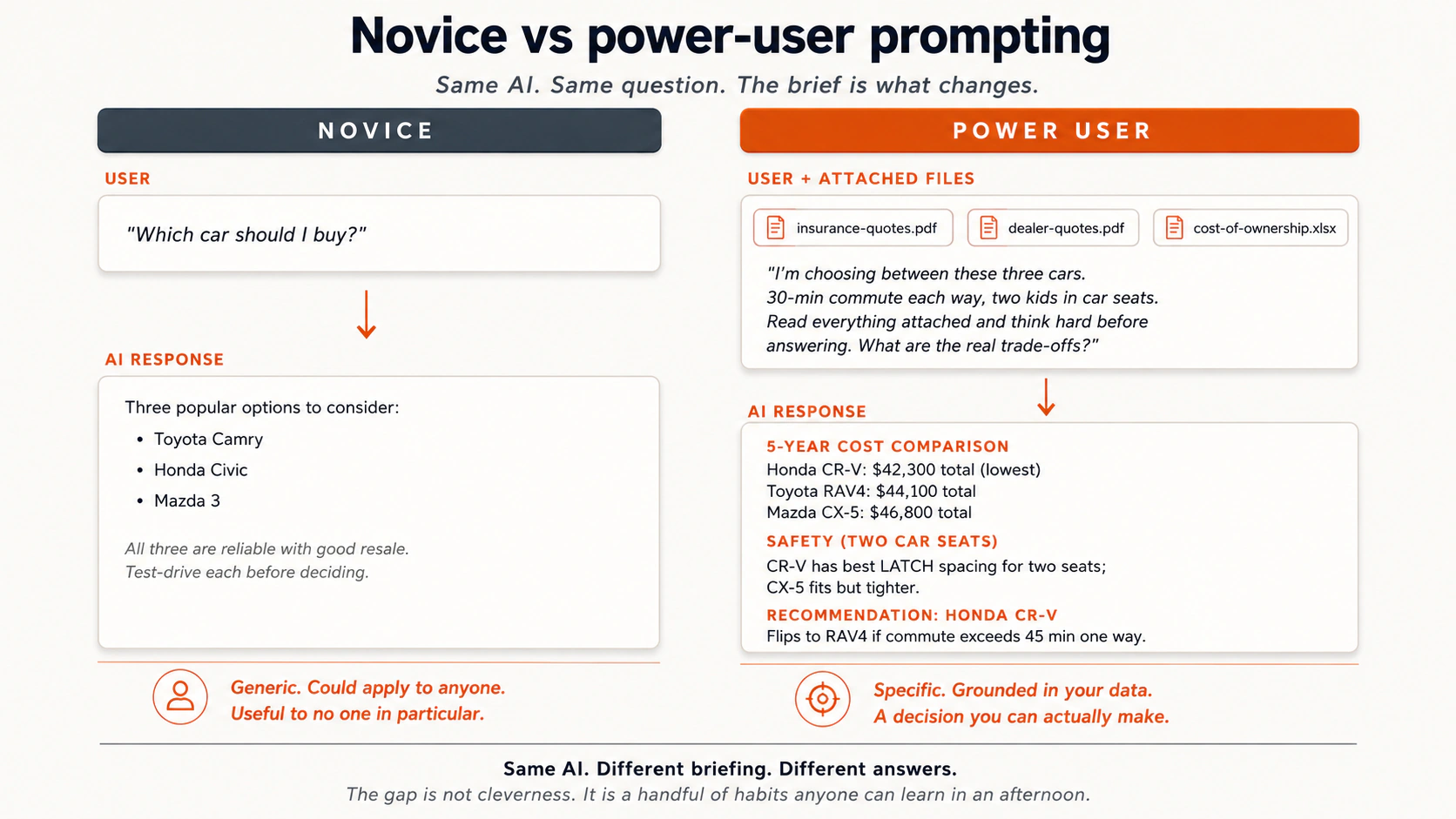
Maidan se chand aur asal muqabley:
- Car kharidna. Novice: "kaun si car behtar hai?" Power user: spec sheets, dealer quotes, aur insurance plans upload karta hai, phir poochta hai "trade-offs kya hain? Sab parho aur ghaur se socho."
- Kaam par self-review. Novice: "mere boss ke liye ek self-review likho." Power user: apne project tracker ka screenshot, haaliya project docs, aur notes ka ek voice memo upload karta hai, phir ek draft maangta hai.
- Ek business idea par tanqeed. Novice: "mere paas ek zabardast business idea hai, mobile tie-dyeing, is par tanqeed karo." Yeh sycophancy ka chaara hai, AI zyadatar taareef hi karega. Power user: "Ghair-jaanibdaari se tajzia karo. Yeh rubric istemaal karo: kya koi masla hai jise hal karna qaabil-e-qadar hai, kya koi market hai, kya koi competitive advantage hai?" AI ne us idea ko 100 mein se 8 score diya aur samjhaya ke kyun.
- Ek blog post likhna. Novice: "BlackBerry ke baare mein ek blog post likho." Nateeja: AI slop. Slop woh istelahi naam hai jo aisi AI output ke liye hai jo oopar se rawan aur andar se khaali hoti hai: grammar mein saaf, halka sa Wikipedia jaisa, "aaj ke is tez-raftaar daur mein" jaise jumlon se bhara, aur aisi koi baat nahin kehta jo parhne wala ek ghante baad yaad rakhe. Yeh wohi hai jo AI by default banata hai jab aap usko koi context aur koi constraints nahin dete. Power user: pehle outline, outline par tanqeed, har heading ko bullets mein phailao, bullets par tanqeed, sirf phir prose maango.
Woh zehni khaaka jo in sab ko jorta hai: AI ek bahut hoshyaar naye college graduate jaisa hai. Bahut motivated. Aap ke baare mein abhi zyada nahin janta. Usko ek aise hi brief karein. Kya ek naye colleague ke paas yeh kaam achhi tarah karne ke liye kaafi maloomat hoti? Agar nahin, to usko zyada dein.
2. Pretrained knowledge
Yeh slides khaas tor par school students ke liye banayi gayi hain. Yeh pretrained knowledge ko bachchon ke liye aasan andaaz mein samjhati hain: AI ne parh kar seekha, ji kar nahin. Yeh "Loud, Quiet, Secret" framework (woh topics jin par bahut baat hoti hai, thori, ya bilkul nahin), interactive classroom games (Trust-o-Meter, Stump the Robot, Be a Fact-Checker), aur ahem sabaq cover karti hain: "Pur-aetmaad lagna woh nahin jo sahi hona hai." PPTX Download Karein offline classroom istemaal ke liye.
AI ne duniya ka tajurba kar ke nahin seekha. Uska koi jism nahin, koi hawaas nahin, usmein ghoomne phirne mein guzra koi waqt nahin. Usne duniya ke baare mein text parh kar seekha: internet ka behisaab text. Reddit aur Quora threads, Wikipedia, kitabein, news articles, research papers, blogs, forums.
Training data mein kisi cheez ki kasrat taqreeban jawab ki bharosemandi ke baraabar hai. To:
- Mazboot: cooking, celebrity gossip, aam medical advice, top-1000 movies, mashhoor programming languages, Voyager 1 record par kya hai (NASA ka spacecraft jo 1970s mein launch hua, Zameen se taqreeban 25 billion miles door, 55 zabaanon mein salaam le kar ja raha hai), billiyan deewaron ko kyun ghoorti hain (woh aise halke se awaaz aur harkat mehsoos karti hain jo insaan se chhoot jate hain).
- Kam-yaab: quasars (aasmaan mein anteha-i raushan ajsaam jo black holes se chalte hain), Cantonese (internet text ka 0.1% se bhi kam), ilaqai tareekh, makhsoos peshawaraana ilm.
- Ghair-maujood: aapki company ka khufiya data, aapka niji calendar, koi bhi cheez jo model ki knowledge cutoff date ke baad shaaye hui, koi bhi cheez jo kisi ne aam internet par kabhi nahin daali.
Do amali nateeje:
Typos theek karne par waqt zaaya na karein. AI ko internet text par train kiya gaya, jo typos se bhara hai. Yeh ghalat likhe gaye prompts ko narmi se sambhal leta hai. "definately" ka ghalat hijje jawab nahin badlega.
Jazb-shuda ghaltiyon se hoshyaar rahein. AI ne unhi sources se ghalat-fehmiyaan aur purani maloomat bhi jazb kar li. Ek aetmaad se ghalat forum post model mein aetmaad se ghalat ban jati hai. Kisi bhi ahem cheez ko ek asal source ke khilaaf check karein.
Toota hua reasoning spot karna apni discipline hai, aur AI ke Daur Mein Sochna Crash Course isay seedha sikhata hai. Isay dhoondne ki pehli jagah un aetmaad-bhare pretrained jawabon mein hai jin topics par training data patla ya mutanaza tha. Aetmaad durustagi ki nishaani nahin hai.
Kisi pretrained jawab par bharosa karne se pehle ek tez zehni test:
| Sawal ki qism | Training data mein kitni achhi tarah maujood? | Bharosa kitna |
|---|---|---|
| "Main roux kaise banaaun?" | Cooking internet ke sab se zyada zer-e-behes topics mein se ek hai. | Zyada. |
| "Kisi top-1000 movie ka plot." | Hazaaron baar review aur dobara review hua. | Zyada. |
| "Kisi gumnaam gaon ki tareekh." | Shayad sirf ek Wikipedia paragraph, ya woh bhi nahin. | Kam; ek asal source ke khilaaf tasdeeq karein. |
| "Meri industry mein haaliya regulatory tabdeeli." | Taqreeban yaqeeni tor par knowledge cutoff ke baad. | Web search ke baghair kuch bhi bharosa na karein. |
| "Pichli timahi mein hamari company ne kya faisla kiya?" | Training data mein bilkul nahin. | Kuch bharosa na karein; model andaza laga raha hai. |
Yeh koi qaida nahin jise aapko yaad rakhna hai. Yeh wohi hiss hai jo aap kisi bhi doosre source par lagate hain: "is shakhs ko yeh kaise pata hoga?" Ise AI par bhi lagaayein.
Ek ghair-software misaal. Ek parhne wale ne ek baar AI se apni daadi ke gaon mein khele jaane wale ek ilaqai folk game ke qawaid ka khulasa maanga. AI ne aetmaad se qawaid ke teen paragraphs bana diye. Daadi se poocha gaya to unhone kaha ke qawaid taqreeban poori tarah ghalat the: AI ne doosre ilaqon ke milte-julte games ki tafseelein mila di thi kyunke woh khaas game internet par mushkil se hi tha. AI ne jhoot nahin bola; usne patle data se taamim (generalize) kar liya. Parhne wale ki ghalti yeh poochna nahin thi, balke yeh farz kar lena tha ke aetmaad durustagi ke baraabar hai.
Yeh jaan-ne ke liye uksaaye gaye ke AI bilkul aetmaad se kaise bol sakta hai aur phir bhi ghalat ho sakta hai? Iske peechhe ek gehri wajah hai. Elan Barenholtz ka article "LLMs show language does not describe reality" (IAI, 2026) saadah English mein samjhata hai ke yeh models asal mein kaise kaam karte hain. Article insani zabaan ke baare mein kuch baray falsafiyana daawe bhi karta hai; jo hissa aapko mufeed lage le lein aur baaqi ko nazar-andaz kar dein.
Ek mazedaar interactive exercise jo khaas tor par school students ke liye banayi gayi hai. Students topics (pizza, kutte, ek naayaab deep-sea machhli, aapka WiFi password, aaj aapne kya khaya, aapke khaandaan ke khaas Ludo qawaid) ko teen zones mein tabseem karte hain: Loud (sab is par baat karte hain, AI ise achhi tarah janta hai), Quiet (sirf chand log, AI ise ghalat samajh sakta hai), ya Secret (kisi ne ise likha hi nahin, AI ise nahin jaan sakta). Exercise Online Khelein | PPTX Download Karein offline classroom istemaal ke liye.
3. 3 retrieval modes: pretrained, web search, deep research
Jab aap ek sawal poochte hain, jadeed AI tools chupke se chunte hain ke kaise jawab dena hai. Ya to woh sirf pretrained knowledge se jawab dete hain, ya woh ek web search bhejte hain aur chand pages parhte hain, ya woh deep research chalate hain, jahan woh kayi minute darjanon sources scan karne mein lagate hain aur ek munazzam report likhte hain.
Aapko jaan-na chahiye ke kaun sa mode chal raha hai, kyunke har ek ki alag khoobiyaan aur alag nakaami ke tareeqe hain.
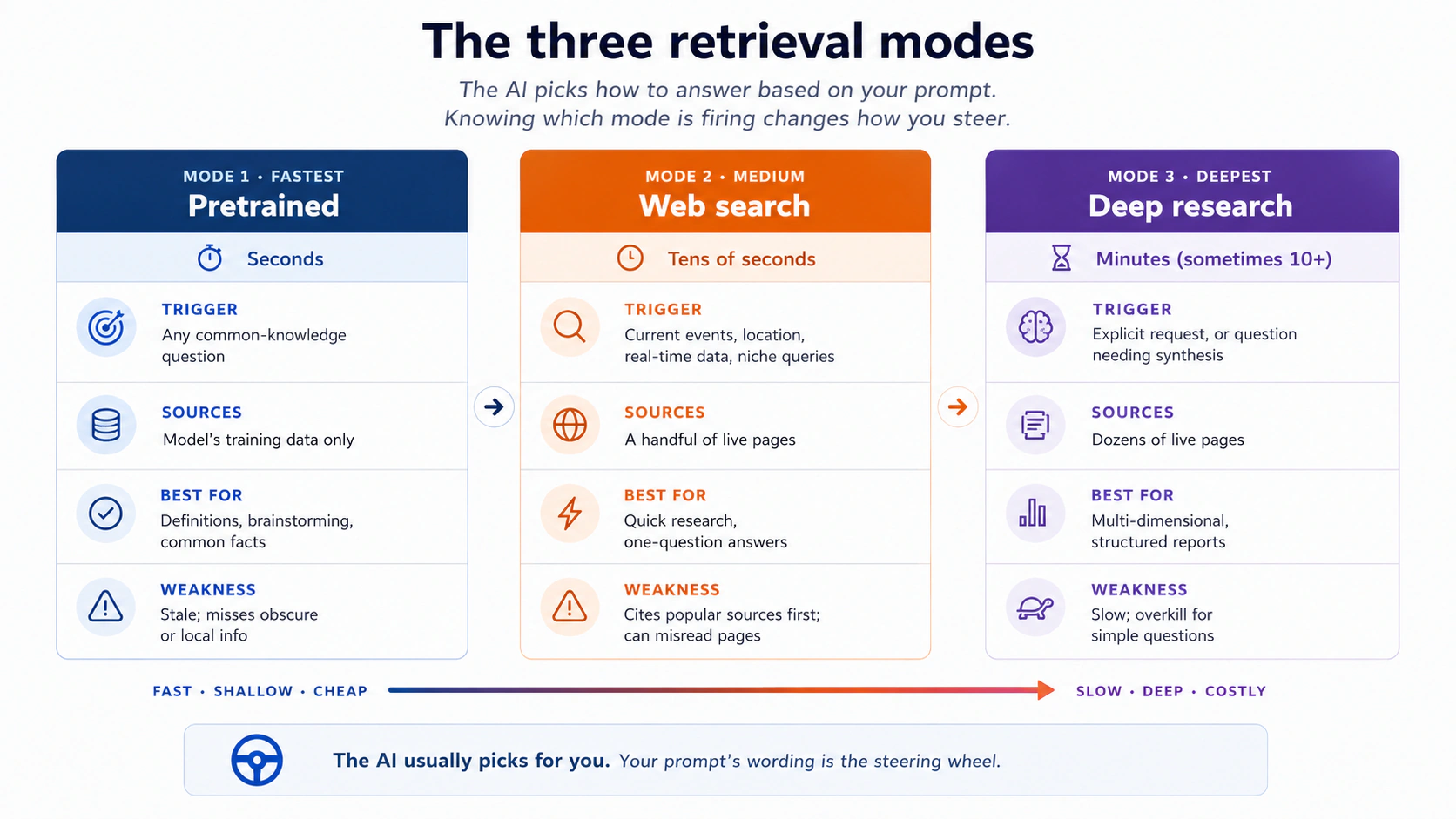
Isko thos banane ke liye chand misaalein:
- Pretrained theek jawab deta hai: "billiyan deewaron ko kyun ghoorti hain," "Voyager 1 record par kya hai," "Hamlet ke plot ka khulasa karo." Yeh hafte-dar-hafte nahin badalte.
- Web search ek basi model ko bachata hai: har model ki ek knowledge cutoff date hoti hai, aur jo bhi cheez us date ke baad viral hui woh uske liye ghair-mar'i hai. Ek meme, ek regulation, ek product launch: web search ke baghair, AI ko pata hi nahin ke aap kis baare mein baat kar rahe hain. Web search ke saath, woh ek haaliya article kheenchta hai aur theek jawab deta hai.
- Web search ka ghalat hona: ek dost ne poocha "Henderson, Nevada mein kahan daudna hai." AI ne ek 20-saal purane web page ka hawaala diya aur ek aisa school recommend kiya jo ab aam logon ke liye khula nahin. Web search yeh nahin dekhta ke sources mojooda hain ya nahin.
- Deep research jiska intezaar wajib hai: "hamare mohalle mein ek Halloween haunted house plan karo, jismein permits, fire safety, aur noise ordinances shaamil hon." AI ek research plan tajweez karta hai, kayi parallel searches chalata hai, khulasa karta hai, faisla karta hai ke aage kis cheez mein gehraai mein jaana hai, aur checklists ke saath ek kayi-section ki report banata hai. Yeh ek chatbot ka jawab nahin; yeh kaam ek junior researcher ko ek ghante ke liye saunp dene ke zyada qareeb hai.
Andar ki taraf, theek mechanics tool se tool badalti hain, lekin shape ek jaisa rehta hai. Ek search-and-retrieval layer searches jaari karti hai, result list scan karti hai, sab se relevant pages kheenchti hai, aur har ek ko ek chhote passage ya khulase mein simet deti hai. Aksar woh layer ek alag, chhota model hoti hai. Sirf simta hua version us user-facing model tak pahunchta hai jo aap se baat karta hai.
Jo model aap se baat kar raha hai woh aksar asal page ko seedha nahin parhta. Woh uska ek simta hua version parhta hai. Isi liye yeh kabhi kabhi ghalat bayan karta hai ke ek page ne asal mein kya kaha: maloomat model tak pahunchne se pehle ek translation layer se guzri, aur translation layers nuance kho deti hain.
Amali hal: AI ko batayein ke kis qism ke sources istemaal karne hain. "kya vaccines mehfooz hain" ke bajaye, koshish karein "World Health Organization, FDA, European Medicines Agency, aur peer-reviewed studies istemaal karo. Forums ya niji blogs istemaal mat karo." Source quality ek knob hai jise aap ghuma sakte hain. Default settings pehle mashhoor sources ka hawaala deti hain (Reddit, Wikipedia, YouTube, khud Google, Yelp), jo aksar qaabil-e-aetmaad hote hain lekin baray daao wale sawalon ke liye hamesha bharosemand nahin.
Doosra hal: AI se source quote karne ko kahein. "Har daawe ke liye, source page se theek wohi jumla quote karo jo iski hamayat karta hai." Yeh retrieval layer ko asal alfaaz saamne laane par majboor karta hai, jo summary-layer ki bahut si tabdeeli pakar leta hai.
Ek ghair-software misaal. Ek neighborhood-association ki rukn (volunteer) ne local water quality par ek town meeting ki taiyaari ke liye deep research istemaal ki. Uska prompt: "[uske shehar] mein pichle 24 maheenon ke mojooda water quality issues par research karo. EPA, shehar ki public utility reports, aur peer-reviewed studies istemaal karo. News editorials aur forums se bacho. Ek munazzam report banao jismein: (1) teen sab se zyada hawaala diye gaye issues, (2) trends dikhaane wale data tables, (3) teen thos sawal jo residents ko utility se poochne chahiyein." Aath minute baad uske paas ek briefing thi jo mojooda local data par mabni thi. Pretrained mode yeh nahin kar sakta tha; akela web search ek uthla jawab deta; deep research sahi tool tha kyunke sawal kayi-pehlu aur mojooda tha.
Apne zehan mein ek mode chunna. Aap aam tor par button daba kar mode nahin chunte; AI aapke prompt ki bina par chunta hai. Lekin aap rasta dikha sakte hain:
| Andaaz-e-bayaan ka pattern | Yeh aam tor par kya chalata hai |
|---|---|
| "X kya hai" / "Y ka khulasa karo" | Sirf pretrained. |
| "X par taaza kya hai" / "Aaj" / "Is hafte" / ek khaas shehar | Web search. |
| "X par ghaur se research karo," "citations ke saath report banao," "yeh source types istemaal karo" | Deep research (un tools mein jin mein hai; warna barhaya hua web search). |
| Files attach karna | Files ke liye pretrained rehta hai; agar prompt mojooda maloomat maange to web search kar sakta hai. |
AI vs Google. Yeh ek jaisa tool nahin. Google ko tez nazar daalne, kisi maaloom site par jaane, ya koi cheez khareedne (2013 Honda Civic ka air filter) ke liye istemaal karein. AI ko tab istemaal karein jab aapko taleef (synthesis) chahiye: pros aur cons, kayi-source ka muqabla, ek likha hua tajzia. Intekhab is par mabni hai ke aap ek link chahte hain ya ek jawab.
Ek aamne-saamne usool:
| Kaam | Google ke saath behtar | AI ke saath behtar |
|---|---|---|
| "Form 1040 ke liye sarkari IRS page dhoondo." | Haan. Aap ek khaas maaloom site par utarna chahte hain. | Nahin. |
| "Teen diabetes medications aur haaliya evidence kya kehta hai, muqabla karo." | Dheema. Aap 8 tabs parhenge. | Tez. AI evidence ko ek jagah jama kar deta hai. |
| "2018 ThinkPad ke liye ek replacement charger kharido." | Haan. Aap ek product link chahte hain. | Nahin. |
| "Ek 6-saala bachche ke saath 4-din ki Lisbon trip plan karo, museums nahin." | Dheema. Aap blogs aur reviews mein uljhenge. | Tez. AI constraints ko jor deta hai. |
| "Kal mausam kaisa hoga?" | Koi bhi. | Koi bhi. |
| "Mere tamatar ke paude ke patte peele kyun ho rahe hain?" | Theek. Kayi gardening sites. | Ek tasveer attach ke saath behtar. |
Agar aapka sawal "X kahan hai" hai, to Google ki taraf jaayein. Agar aapka sawal "yeh sab dekhte hue, mujhe kya sochna chahiye" hai, to AI ki taraf jaayein.
AI ke saath zyada qaabil-e-aetmaad web-search nataij kaise haasil karein
Jab aap waqai web search chahte hain, teen chhoti aadaat quality barhaati hain:
- Un sources ke naam lein jin par aap bharosa karte hain. "WHO, FDA, aur peer-reviewed studies istemaal karo, forums nahin."
- Inline citations maangein. "Har daawe ke baad source ka hawaala do."
- AI se kahein ke jise woh tasdeeq na kar sake usko nishaan-zad kare. "Agar koi daawa hawaala diye gaye sources se sabit na ho sake, to use 'unverified' mark karo."
Yeh teen lines, kisi bhi web-search prompt mein paste ki gayin, sab se aam nakaami ke tareeqe ko kam kar deti hain: AI ka chupke se kayi sources ko mila kar ek aetmaad-bhara jumla banana jise koi akela source hamayat nahin deta.
Part 2: AI se achhi tarah baat karna
4. Context hi poora khel hai
Insaan apni active working memory mein sirf chand cheezein rakhte hain: purane andaze kehte hain taqreeban saat, naye andaze chaar ke qareeb. Jadeed AI models ek hi waqt mein lakhon alfaaz rakh sakte hain, kabhi kabhi das lakh. Ise tanasub mein samajhne ke liye: taqreeban 750,000 alfaaz pehli 4 se 5 Harry Potter kitabein hain, ya kayi din ki musalsal taqreer. Model jawab dene se pehle yeh sab parh sakta hai.
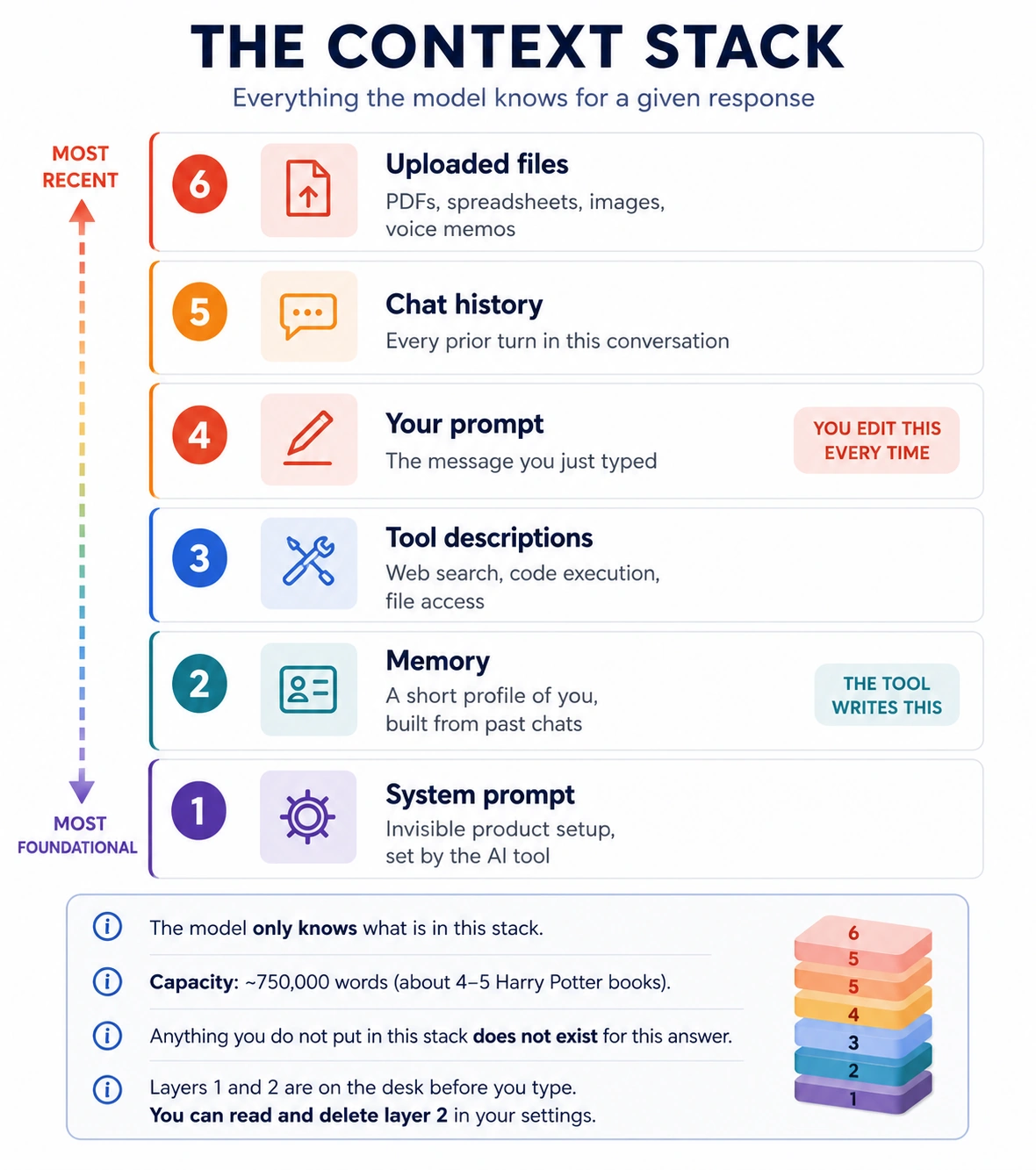
Lekin woh sirf wohi parh sakta hai jo aap usko dete hain. Context woh sab kuch hai jo kisi diye gaye jawab ke liye model ke window mein aata hai: system prompt jo product ne set kiya, kisi bhi tool ki tafseelein jise woh call kar sakta hai (web search, code, file access), aapka prompt, is guftagu ki chat history, koi bhi files jo aapne upload ki, aur in chhe layers mein sab se nayi, ek chhota profile jo tool ne aapke baare mein likha hai aur jis par hum isi concept mein baad mein wapas aayenge.
Aage barhne se pehle ek sawal. Jab aap ChatGPT, Claude, ya Gemini kholte hain aur apna pehla message type karte hain, kya AI bilkul zero se shuru karta hai, sirf us par kaam karte hue jo aapne abhi type kiya? Ya aapke aane se pehle kisi ne use instructions de di hoti hain?
Zyadatar log samajhte hain ke yeh blank shuru hota hai. Aisa nahin.
Jab aap aate hain to window khaali nahin hoti. Yahan "window" se murad context window hai: What AI Actually Is ka reading desk (Idea 5). Is waqt jo kuch us desk par hai (aapka prompt, ab tak ki guftagu, koi files jo aapne attach ki, aur chand cheezein jo tool ne aapke aane se pehle wahan rakh di) wahi sab kuch hai jo model janta hai, aur jo cheez desk par nahin hai woh is jawab ke liye maujood nahin. Upar ka diagram dikhata hai ke chhe cheezein is par aa sakti hain.
Ab us desk ki sab se neeche wali layer dekhein: system prompt. Jab aap ek nayi chat kholte hain, aap soch sakte hain ke aap blank surface se shuru kar rahe hain. Aisa nahin. Aap ek character bhi type karein is se pehle, jis company ne tool banaya hai woh desk par instructions ka ek set rakh chuki hoti hai. Aap inhein chat mein kabhi nahin dekhenge, lekin model aapki likhi hui kisi bhi cheez se pehle inhein parhta hai.
Isay aise samjhein jaise restaurant ka owner pehle customer ke baithne se pehle ek naye waiter ko brief karta hai. "Friendly raho. Daily special recommend karo. Agar koi allergens ke baare mein poochhe to hamesha kitchen se check karo, guess mat karo." Waiter har table ke saath woh instructions follow karta hai, aur aap woh briefing kabhi nahin sunte. AI bhi isi tarah kaam karta hai. Engineers in invisible instructions ko system prompt kehte hain.
Us briefing mein aam tor par kya hota hai:
- Kaise behave karna hai (helpful, honest, careful).
- Kya refuse karna hai (harmful content, dangerous instructions).
- Kaisa tone istemaal karna hai (formal, chatty, concise).
- Kab disclaimers add karne hain ("main AI hoon aur medical advice nahin de sakta").
- Kaun se tools call kar sakta hai (web search, code execution, file access).
Isi liye Claude, ChatGPT, aur Gemini ek hi sawal par bhi alag mehsoos hote hain. Jo "personality" aap mehsoos karte hain woh model ke andar baked nahin hoti. Woh company ki un instructions mein baked hoti hai jo aapke aane se pehle load ki gayi hoti hain. Claude ki instructions careful reasoning aur honesty par zor deti hain. ChatGPT ki conversational warmth aur broad helpfulness par. Gemini ki conciseness aur source grounding par. Wohi sawal, teen alag briefings, teen alag tones.
Khud try karein: teeno se poochein "explain why the sky is blue, in one paragraph." Facts milte julte honge. Tone, length, aur style wazeh tor par alag honge. Yeh farq zyada tar system prompt hota hai.
Ab aap jante hain kyun:
- AI polite hota hai chahe aap rude hon (use kaha gaya tha).
- Woh kuch requests refuse karta hai (use kaha gaya tha).
- Woh safety disclaimers add karta hai jo aapne nahin maange (use kaha gaya tha).
- Kabhi kabhi zaroorat se zyada maafi maangta hai (use caution ki taraf jhukne ko kaha gaya tha).
- Alag tools wohi facts alag awaaz mein dete hain (alag briefings).
Yeh personality traits nahin. Yeh instructions hain.
Aap apni layer bhi add kar sakte hain. Company ka system prompt fixed hota hai, lekin ab zyadatar tools aapko apni instructions likhne dete hain jo har chat mein uske saath load hoti hain. Jab aap apne tool ki instruction settings mein likhte hain "I am a nurse, assume clinical vocabulary" ya "always respond in formal English", to aap system prompt mein apni line likh rahe hote hain. Model har response se pehle ise parhta hai, bilkul company ki briefing ki tarah, isi liye yeh aapke repeat kiye baghair chipki rehti hai.
Har tool mein yeh kahan milega:
| Tool | Setting name | Direct link |
|---|---|---|
| Claude | Personal preferences (Settings > General) | claude.ai/new#settings/general |
| ChatGPT | Personalization (under Settings) | chatgpt.com/#settings/Personalization |
| Gemini | Personalization settings | gemini.google.com/personalization-settings |
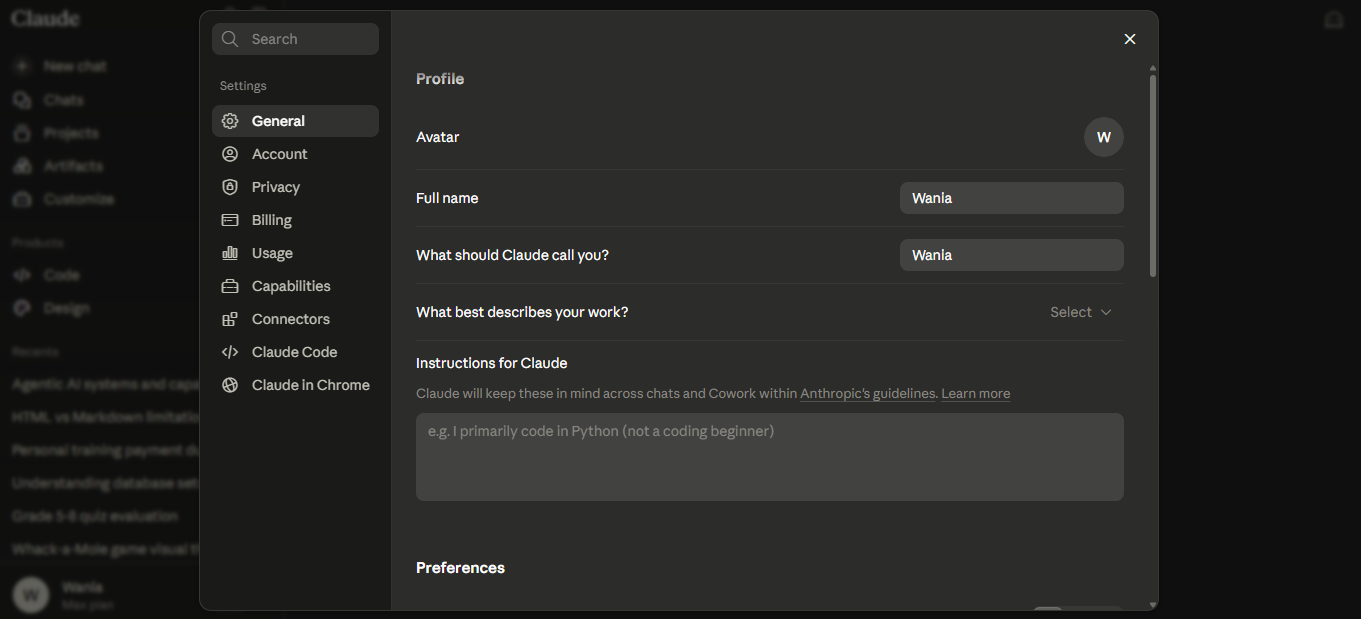
Yeh settings pages teeno tools mein asal mein aise dikhte hain. Har ek mein text area hota hai jahan aap apni instructions type karte hain, aur har future chat un instructions ko pehle se model ke desk par rakh kar shuru hoti hai.
Claude: Settings > General kholein aur "Instructions for Claude" tak scroll karein. Text area mein apni instructions type karein. Claude inhein aapki saari chats mein zehan mein rakhega.
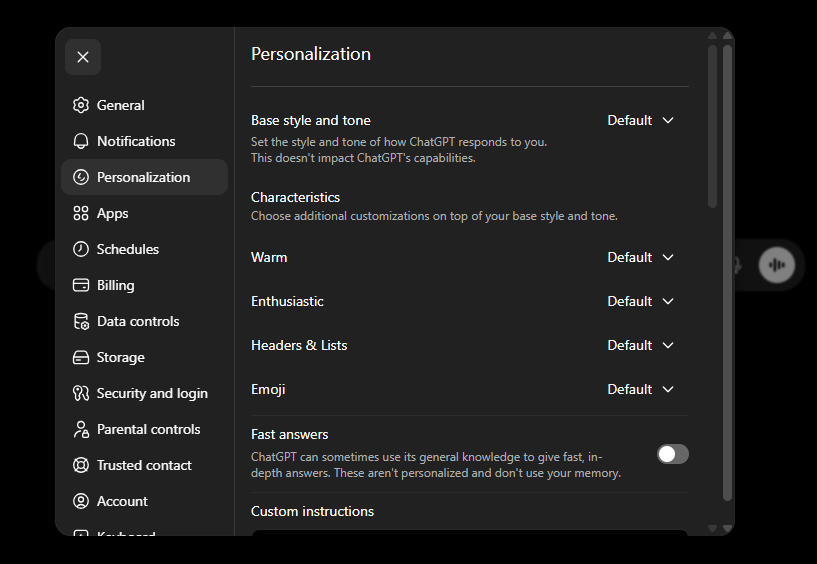
ChatGPT: Settings > Personalization kholein. Aap style controls (Warm, Enthusiastic, Headers and Lists, Emoji) aur neeche "Custom instructions" section dekhenge. Custom instructions tak scroll karein aur wahan apni instructions type karein.
Gemini: Personalization settings kholein. Switch on karein, phir apni instructions likhne ke liye Add button par click karein.
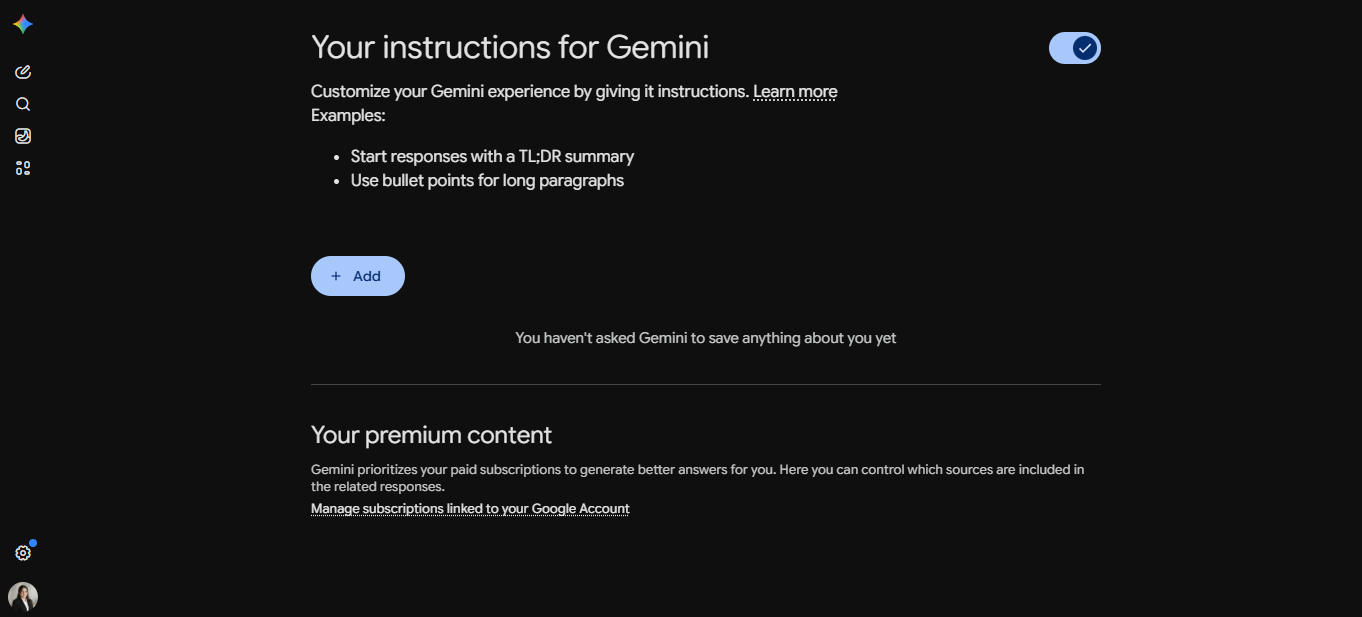
Teeno mein steps wohi hain: link kholein, apne baare mein aur AI se kaise jawab chahte hain is par chand sentences likhein, aur save karein. Us lamhe se har nayi chat aapki briefing pehle se loaded rakh kar shuru hoti hai. Aapko apni baat dobara nahin dohrani parti.
Ek chhoti magar asal misaal. Ek teacher apni instruction set karti hai: "I teach Grade 5 science. Explain everything at a 10-year-old's reading level. Never use jargon without defining it first." Peechhe kya hota hai: yeh sentences system prompt mein add ho jate hain, company ki apni instructions ke bilkul saath. To jab bhi woh nayi chat kholti hai, model ke desk par uske type karne se pehle dono briefings hoti hain: company wali ("be helpful, be honest, refuse harmful requests") aur uski wali ("I teach Grade 5 science, keep it simple"). Use phir kabhi "I'm a teacher" kehna nahin parta. Use har prompt mein "explain it simply" repeat nahin karna parta. AI pehle se janta hai, bilkul us waiter ki tarah jo pehle se kitchen se check karna janta hai, kyunke owner ki briefing ne pehle customer ke baithne se pehle yeh keh diya tha.
Yeh layer har chat se pehle load hoti hai, is liye is mein cheezein barhate rehna dilkash lagta hai: jab bhi AI koi na-pasandeeda kaam kare, ek aur line add kar dein. Ek saal baad bees lines hoti hain aur kuch chupke se ek doosre se takra rahi hoti hain. Anthropic ko apne products mein yehi masla mila aur July 2026 mein us ne jama ki hui mustaqil instructions ka zyada hissa delete kar diya, quality khoye baghair: jadeed models surat-e-haal ko itni achhi tarah parhte hain ke kai purane qawaid sirf raaste mein aa rahe the.
Do aadaat is layer ko mufeed rakhti hain. Wohi likhein jo AI khud nahin samajh sakta, jaise aapka kaam, audience aur sakht constraints, na ke woh jo woh waise bhi karta. Aur har chand maheene baad poori layer parhein, har line par yeh sawal karte hue: agar main ise delete kar dun to kya AI waqai kuch ghalat karega? Agar nahin, to delete kar dein. Yehi test aapki project instructions par bhi laagu hota hai.
Ab ek baar phir full stack dekhein. System prompt bunyaad hai, neeche wali layer. Aapka prompt, aapki chat history, aur aapki uploaded files sab iske oopar baithe hain. Jab aap in settings mein apni instructions likhte hain, to aap company wali layer ke bilkul saath apni layer add kar rahe hote hain, is liye har chat aapka context pehle se loaded rakh kar shuru hoti hai. Yeh poori tasveer hai ke model kya dekhta hai, aur yehi ek cheez hai jo model dekhta hai. Kyunke uski apni koi memory nahin, is stack se bahar koi cheez is jawab ke liye maujood nahin. Yeh stack hi is jawab ke liye poori duniya hai.
Thos muqabla:
- Khaali prompt: "physics aur zoology parhne ke pros aur cons." Aapko aam high-school-counselor wali advice milegi.
- Context-bhara prompt: wohi sawal, saath mein aapke career assessment ke nataij ek PDF ke tor par upload, aur aapke high-school schedule ka ek screenshot. Ab AI aapki khaas salahiyat ke profile, aapki khaas course history, aur kaun sa intekhab kis se fit karta hai, in par baat kar sakta hai.
Wohi model. Wohi sawal. Alag jawab. Farq context hai, prompt ki hoshyaari nahin.
Woh nazm-o-zabt jo aap seekh rahe hain: send dabane se pehle, khud se poochein ke ek samajhdaar naye colleague ko is ka achhi tarah jawab dene ke liye apne saamne kya chahiye hoga. Phir woh cheezein attach karein. Colleague jo kuch aap uske saamne rakhenge use ghaur se parhega; woh us cheez ka andaza nahin lagayega jo aapne usko nahin bataya, aapki almaari nahin dhoondega, aapki industry, aapki team ki tareekh, ya kal ke email thread ka andaza nahin lagayega. Agar usko yeh kaam karne ke liye kisi document ya kisi constraint ki zaroorat hoti, to aapko use shaamil karna hoga.
Ek ghair-software misaal. Ek 7th-grade ki teacher ne AI se kaha "water cycle par ek lesson plan banao." Output ek aam plan tha jo woh kisi bhi textbook mein dhoond sakti thi: definitions, ek diagram, teen discussion sawal. Agle din usne dobara koshish ki, teen cheezein attach kar ke: apna course syllabus (taake AI ko pata ho ke is lesson se pehle aur baad mein kya aata hai), pichle hafte ke student worksheets jin par grades nazar aate the (taake AI ko pata ho ke kaun se concepts samajh aaye aur kaun se nahin), aur uske school ka standardized test format. Naya lesson plan un do concepts ke paanch-minute review se khula jo pichle hafte ki worksheets ne kamzor dikhaaye the, naye material ko us test format mein piroya jo students May mein dekhenge, aur ek check-for-understanding sawal ke saath khatam hua jo uske syllabus ke agle topic se mel khata tha. Wohi model, wohi teacher, wohi mazmoon. Sirf farq yeh tha ke doosre prompt ne AI ko bata diya ke ek samajhdaar naye colleague ko kya jaan-na chahiye tha.
Yeh aadat, kisi bhi ghair-maamooli prompt se pehle ek checklist ke tor par dobara bayan:
| Sawal | Agar haan, to use attach ya bayan karein |
|---|---|
| Kya koi document hai jis se jawab mutaabiq hona chahiye? | Haan: use attach karein. |
| Kya koi constraint hai jiska AI andaza nahin laga sakta (budget, waqt, team mein kaun hai)? | Haan: use bayan karein. |
| Kya koi pichla context hai (ek pichla faisla, ek mojooda process)? | Haan: ek paragraph mein khulasa karein. |
| Kya koi output format hai jo aap chahte hain (table, email, bullet list)? | Haan: uska naam lein. |
| Kya koi audience hai (ek boss, ek bachcha, ek ajnabi)? | Haan: unka naam lein. |
Paanch lines ka context, theek se chuna gaya, paanch paragraphs ki hoshyaari ko maat de deta hai.
Chhati layer: AI ab aapke baare mein notes likhta hai. Oopar ki har cheez woh context batati hai jo aap desk par rakhte hain. Teeno tools ne ab ek aisi layer add ki hai jo woh khud banate hain. Kaam ke dauran tool chupke se ek chhota khulasa likhta hai ke aap kaun hain aur kaise kaam karna pasand karte hain, aur har nayi chat ke shuru mein woh khulasa window mein load karta hai.
Yeh pehle parhi baat ki khilaaf-warzi lag sakti hai. Aisa nahin, aur wajah aham hai: memory model ko memory nahin deti. Model ab bhi stateless hai aur sirf desk par mojood cheezon se jawab deta hai. Memory woh note hai jo tool aapke baare mein rakhta aur aapke type karne se pehle desk par rakh deta hai. Yeh stack ki chhati layer hai, usool se koi istisna nahin. "Model sirf wohi janta hai jo window mein hai" ab bhi bilkul sahi hai. Tool bas aapki taraf se window bharne mein behtar ho gaya hai.
| Tool | Iska naam | Isay kahan control karein | Clean-slate mode |
|---|---|---|---|
| Claude | Memory (chat search se alag) | Settings > Memory | Incognito chat |
| ChatGPT | Memory: saved memories aur past-chat reference | Settings > Personalization > Memory | Temporary Chat |
| Gemini | Personal context | Settings & help > Personal context | Temporary Chat |
Menu ke naam aur dastiyaabi badalte rehte hain, aur Gemini ka version personal Google account aur on activity history chahta hai, is liye school ya work login par nazar nahin aayega. Is table par andha bharosa karne ke bajaye apni settings check karein.
Teen aadaat aur ek tanbeeh.
- Ek baar parhein ke is ne kya store kiya. Memory panel khol kar waqai parhein. Zyadatar log dono taraf hairan hote hain: kuch baatein tawaqqo se zyada teekhi hoti hain, aur kuch aisi preference hoti hai jo unhone bas ek baar guzarte hue kahi thi aur tab se har jawab ko shape kar rahi hoti hai. Aap koi bhi line delete kar sakte hain.
- Ise khul kar durust karein. Agar koi jawab purani baat par tikka ho to chat mein keh dein: "aap farz kar rahe hain ke main ab bhi retail mein kaam karta hun; aisa nahin hai." Is se note update ho jata hai. Har tasheeh ke liye settings kholne ki zaroorat nahin.
- Jab context sirf ghalat rah dikhaye to clean-slate mode istemaal karein. Aapke aam kaam se door ek one-off sawal, ya koi topic jise aap mustaqbil ke jawabon ko shape nahin karwana chahte, incognito ya temporary chat mein hona chahiye.
- Raazdaari ki zimmedari rakhne walon ke liye tanbeeh. Agar aap doctor, lawyer, accountant ya teacher hain to memory note mein client aur student ki tafseelein chupke se jama ho sakti hain aur maheeno baad kisi ghair-mutalliqa chat mein wapas aa sakti hain. Shanakht ke qaabil tafseelein memory se bahar rakhein, aur aisa kaam clean-slate chat ya mehdood project mein karein.
Yeh neeche wale usool ko thora badalta hai. Context rot ab bhi hota hai, lekin memory on ho to nayi chat blank slate nahin rehti: purani guftagu ka shor chala jata hai aur aapka khulasa saath aata hai. Aam tor par yehi chahiye hota hai. Istisna tab hai jab khulasa khud masla ho. Agar AI har nayi chat mein wohi ghalat farz dohra raha hai to prompt dobara likhna band karein aur memory durust karein.
Jadeed context windows baray hain, lekin la-mehdood nahin, aur unke andar recall kamzor parta jata hai. Sab se bara amali masla jo log karte hain: woh ek bahut lambi guftagu kayi ghair-mutalliqa topics par chalaye rakhte hain. AI ne abhi aapko ek workout plan karne mein madad ki, ab aap usse ek spreadsheet debug karne ko kehte hain, ab aap usse apni khaala ke liye ek thank-you note likhne ko kehte hain. Workout ka context abhi bhi usmein maujood hai, model ka dhyan bata raha hai.
Usool: jab topic badle, ek nayi guftagu shuru karein. Karna sasta, balke muft, aur jawab namaayan tor par behtar ho jate hain.
Woh alaamaat jo aapko batati hain ke ek guftagu basi ho gayi:
- AI chat ke pichle hisson ka hawaala dene lagta hai jinka us baat se koi taalluq nahin jo aapne abhi poocha.
- Iske jawab waqt ke saath lambe aur ghair-wazeh hote jate hain, zyada lag-lapet ke saath.
- Yeh kisi constraint ki khilaaf-warzi karta hai jo aapne paanch baari pehle bayan ki thi.
- Yeh baar baar maafi maangne lagta hai bina kisi peshraft ke.
Jo ho raha hai uska ek naam: zyadatar jadeed chat tools, jab ek guftagu kaafi lambi ho jati hai, chupke se chat ke purane hisson ko compact kar dete hain: woh shuruaati baariyon ko le kar unka ek chhote paragraph mein khulasa karte hain, aur jagah banane ke liye asal ko khulase se badal dete hain. Claude ek chhota "compacting" message dikhata hai jab aisa hota hai; ChatGPT aur Gemini yeh khaamoshi se karte hain. Kahaani bach jati hai, lekin tafseelein nahin. Woh library jo aapne teen ghante pehle istemaal karne ko kahi thi, woh naming convention jis par aap raazi hue the, woh constraint jo aapne baari chaar mein bayan ki thi: in mein se koi bhi chupke se khulase mein gum ho sakti hai aur model ke jawabon mein aana band ho sakti hai. Hal wohi hai jo oopar wala usool hai, bas behtar wajah ke saath: ek chat window working memory hai, storage nahin. Jo cheez ek lambe session ke baad bhi bachni chahiye woh ek project, ek attach ki gayi file, ya ek note mein hai jise aap dobara paste kar sakein, na ke chat history mein aur na tool ke memory note mein, kyunke woh aapka khulasa rakhta hai, kisi ek guftagu ki tafseelein nahin.
Jab aap yeh dekhein, to hiss yeh hoti hai ke ek aur wazaahati prompt se ise theek kar lein. Iska muqabla karein: yeh sirf ek pehle se uljhe hue context mein aur zyada uljha hua context add karta hai. Iske bajaye oopar wala usool lagaayein. Nayi chat shuru karein, woh ek ya do baatein paste karein jo asal mein ahmiyat rakhti hain, aur wahan se aage barhein. Reset taqreeban hamesha bachaane se zyada tez hota hai.
Agar mari hui chat ne kuch banaya jo rakhne ke qaabil hai (ek plan, ek draft, ek faisla), to reset karne se pehle use ek file mein save kar lein. Is tarah aap kaam nahin khoyenge, lekin aap agle kaam mein shor bhi nahin ghaseetenge.
Concept 4 ki oopar wali checklist ek zaahir sawal uthaati hai: agar AI ko har baar ek colleague ki tarah brief karna parta hai, to yeh bahut sara dobara type karna hai. Jo jawab zyadatar jadeed tools ab dete hain woh ek feature hai jise projects kehte hain: ek workspace jise aap ek baar set up karte hain, un files, hidayaat, aur audience ke saath jo kisi qism ke kaam par hamesha laagu hoti hain, taake har chat jo aap uske andar shuru karein khud-ba-khud woh setup wirasat mein le le.
Project kab banayein. Jis lamhe aap mehsoos karein ke aapne ek hi topic par do ya zyada chats mein wohi files, wohi audience description, ya wohi constraints paste ki hain. Yehi ishaara hai: context ek project mein hai, ek prompt mein nahin.
Ek project aapko kya deta hai, iski chand misaalein:
- Ek "tax filing" project pichle saal ki return, aapki W-2s aur 1099s, aur ek hidayat ke saath jaise "Farz karo main ek US filer hun jiska ek dependent hai. Hamesha apna hisaab dikhao." Har sawal jo aap wahan poochte hain usi base se shuru hota hai.
- Ek "kids' school" project syllabus aur school calendar ke saath, aur ek hidayat jaise "Jawab dene se pehle hamesha date ko calendar ke khilaaf check karo." Mufeed jab "kya Monday ko school hai?" saal mein chaar baar aata hai.
- Ek "writing voice" project aapki tehreer ke teen namoonon ke saath aur ek hidayat jaise "Namoonon ke lehje aur lafz ke intekhab se mel khao. Aisi lag-lapet ya qaid mat add karo jo maine istemaal nahin ki." Ab har draft generic-AI-voice ke bajaye aapki awaaz mein shuru hota hai.
Oopar wale context rot usool se taalluq. Ek project ke andar, "nayi chat shuru karo" ka matlab ab yeh nahin ke jo AI aapke haalaat ke baare mein janta hai woh kho jaye: iska matlab sirf pichli guftagu ka shor khona hai. Khaday files aur hidayaat saath chalti rehti hain. To reset usool par amal karna sasta ho jata hai: aap chat reset karte hain, context nahin.
Teen tools, teen naam, ek idea. Claude ise Projects kehta hai, ChatGPT ise Projects kehta hai, aur Gemini ise Notebooks kehta hai (jo NotebookLM ke saath sync hote hain, Google ka standalone research tool: jo cheez aap ek mein add karte hain woh doosre mein nazar aati hai). Teenon aapko files upload karne, hidayaat save karne, aur ek hi paaedaar context par mabni kayi chats chalane dete hain. Yeh zor mein farq rakhte hain:
- Claude aur ChatGPT Projects hidayaat aur rawaiye ki taraf jhukte hain. Aap awaaz, kirdaar, qawaid, audience set karte hain, aur model us persona ko project ki har chat mein bharosemandi se thaame rakhta hai. Behtareen jab AI kaise jawab deta hai utni hi ahmiyat rakhta hai jitni woh kya janta hai: ek khaas awaaz mein likhna, ek codebase par kaam karna, ek brand tone barqaraar rakhna, koi bhi cheez jahan style ki consistency hi asal maqsad hai.
- Gemini Notebooks (aur NotebookLM) source ki taraf aur aage jate hain. PDFs, Google Docs, web URLs, YouTube videos, balke audio files daal dein, aur har jawab un sources par mabni wapas aata hai inline citations ke saath jin par aap click kar sakte hain. Ghair-maamooli baat: workspace dono taraf behta hai. Jo cheez aap NotebookLM mein daalte hain woh Gemini app ke usi notebook mein nazar aati hai, aur Gemini notebook ke andar aap jo bhi chat karte hain woh khud-ba-khud NotebookLM mein wapas ek source ban jati hai. To workspace waqt ke saath aapki apni soch jama karta jata hai: pichle hafte ki chat is hafte ki chat ke liye ek aur source hai jise woh quote kar sakti hai, jo "seekhne ko amal se jorta hai" us tarah se jo doosre tools nahin karte. NotebookLM Audio Overviews (podcast-style khulase jo aap sun sakte hain), Mind Maps, Flashcards, aur Slide Decks bhi aapke sources se khud-ba-khud banata hai. Behtareen jab aap parh rahe ho, research kar rahe ho, ya kayi sessions mein material par kaam kar rahe ho jahan har session agle ko zyada hoshyaar banaye.
Ek tez usool. Gemini Notebooks / NotebookLM ki taraf jaayein agar workspace waqt ke saath barhega: study notes, jaari research, koi bhi cheez jahan aap chahte hain ke har session agle ko aage barhaye. Claude ya ChatGPT Projects ki taraf jaayein agar workspace ek persona ya hidayaat ke set ke gird bana ho jise aap chahte hain AI chats mein bharosemandi se thaame rakhe.
Mid-2026 tak kahan kya dastiyaab hai:
| Tool | Ise kya kaha jata hai | Free tier? |
|---|---|---|
| Claude | Projects | Haan: free plan par 5 projects tak; har project ke andar files la-mehdood hain |
| ChatGPT | Projects | Haan: free plan har project mein 5 files tak support karta hai; paid plans ise 25 ya 40 tak barhate hain |
| Notebooks (Gemini mein) aur NotebookLM | Haan: dono free hain; paid tiers (NotebookLM Plus, Gemini AI Pro/Ultra) source limits barhate hain |
Free-tier caps ki alag shape par ghaur karein: Claude is baat ko mehdood karta hai ke aapke kitne projects ho sakte hain; ChatGPT is baat ko mehdood karta hai ke har project kitni files rakh sakta hai. Apne project ki saakht usi cap ke gird plan karein jo pehle takraye.
5. Reasoning, ya "ghaur se socho"
Ye slides khaas taur par school students ke liye banayi gayi hain. Ye reasoning modes ka concept ek aasan do-speed model ke zariye samjhati hain: tez jawab vs dheema, soch-samajh kar jawab. Teachers inhe class mein istemal kar sakte hain yeh samjhane ke liye ke AI se kab aur kyun jawab dene se pehle "ghaur se sochne" ko kaha jaye, umr ke mutabiq misalon aur interactive exercises ke saath. Poori Presentation Dekhein
Taqreeban 2023 tak, mushkil prompts ke liye maamooli mashwara tha "think step by step." Woh mashwara ab zyadatar fursooda ho chuka hai. Jadeed models ke paas built-in reasoning modes hain jinhein aap seedha bula sakte hain.
Ise kaise bulayein:
- Saadah zabaan mein maangein. Apne prompt mein "ghaur se socho" ya "jawab dene se pehle ehtiyat se socho." Yeh muntaqil harkat hai: yeh har jadeed chat tool mein chalti hai, bina kisi khaas syntax ko yaad rakhe.
- Interface mein thinking-mode toggle istemaal karein, jahan diya gaya ho.
- Kuch products par aapko poochna hi nahin parta: tool khud faisla karta hai ke kab koi sawal itna mushkil hai ke barhaay gaye thinking ki zaroorat hai, aur use aapke liye on kar deta hai.
Jab barhaya hua thinking on ho, to model kayi seconds tak soch sakta hai. Mushkil maslon par, kabhi kabhi das minute se zyada. Yeh sirf dheema type nahin kar raha; yeh andaroon-e-khana kayi tareeqe talaash kar raha hai, apna kaam check kar raha hai, aur sirf phir woh jawab likhta hai jo aap dekhte hain.
Ek 2025 METR study ne us sab se lambe kaam ko track kiya jo ek frontier model bharosemandi se mukammal kar sakta tha. Mid-2024 mein ek aage wale model ne aise kaam sambhaale jo insaanon ko taqreeban saat minute lete hain. Early 2025 tak yeh taqreeban ek ghante tak barh gaya tha, aur study ne paaya ke jis lambaai ko woh naapti hai woh taqreeban har saat maheene mein dugni ho rahi hai. Aapke liye iska matlab: AI ko asal, mushkil kaam saunpein, sirf aasan nahin. Yeh us se zyada sambhal sakta hai jitna aapki 2023 ki hiss tajweez karti hai.
Ek power-user pattern jo ise achhi tarah istemaal karta hai:
Main do cars ke darmiyan chun raha hun. Attached: dono ke spec sheets,
har ek ke liye mera insurance quote, aur pichle chhe maheenon ke mere
driving patterns ki ek spreadsheet.

Sab parho. Ghaur se socho. Phir mujhe batao:
1. Teen trade-offs jo asal mein mere driving pattern ke liye ahmiyat rakhte hain.
2. Tum kaun si car chunoge aur kyun.
3. Kin halaat mein tumhari recommendation badal jaati hai.
Yeh prompt teen cheezein karta hai: yeh mutalliqa context load karta hai, yeh wazeh tor par thinking ko bulata hai, aur yeh prose ki deewaar ke bajaye munazzam output maangta hai. Teenon aadaat hain.
Tez talaash, ek paragraph ke khulase, halki phulki brainstorming. Thinking mode dheema hai aur aapke usage budget ka zyada istemaal karta hai. Use un sawalon ke liye bachaayein jahan aap chahte ke ek insaan apna waqt le.
Thinking mode isi ke liye hai: tez nahin, balke us qism ke kayi-input, kayi-trade-off sawal sambhalne ke qaabil jise aap warna kisi sochne wale colleague ko saunp kar do din intezaar karte. Sauda asal hai. Aap compute ke chand minute aur usage budget ki ek chhoti miqdaar kharch karte hain. Aapko wapas woh cheez milti hai jise banane mein aap khud aadha din lagaate.
Oopar zikr kiye gaye us METR trajectory ka matlab: woh kaam jinhein aapne do saal pehle "AI ke liye bahut paicheeda" qaraar de diya tha, zyadatar ab aise kaam hain jo AI sambhal sakta hai, agar aap use achhi tarah brief karein aur thinking mode on karein. Har chhe maheene baad apne in mafrozaat ko dobara test karein ke AI kya kar sakta hai. Woh ghalat niklenge.
6. Sycophancy aur ise kaise bekaar karein
AI models ko insani feedback par train kiya jata hai. Khaas tor par, is par ke kin jawabon ko thumbs up mila. Lakhon users mein, logon se ittefaaq karne ko ikhtilaaf karne se zyada thumbs up milte hain. Nateeja: models is taraf jhuke hote hain ke aapko wohi batayein jo aap sunna chahte hain.
Ek November 2025 Washington Post analysis ne 47,000 ChatGPT conversations ka jaaiza liya aur paaya ke model ek ittefaaq ("haan," "sahi," waghaira) se shuru hua taqreeban 10 guna zyada baar bajaye iske ke woh "nahin" ya "ghalat" se shuru hua. Report ki gayi shuruaat "that's correct" aur "you're on the right track" jaise jumlon ke gird thi.
Aap ise khud tasdeeq kar sakte hain. Wohi model, ulat framing:
- "Kya aapko nahin lagta ke remote work office work se behtar hai?" → AI ittefaaq karta hai, wajuhaat ginwaata hai.
- "Kya yeh sach hai ke office work zyada productive hai?" → AI ittefaaq karta hai, wajuhaat ginwaata hai.
Hal jaadu nahin hai. Yeh sirf ghair-jaanibdaar framing hai. Yeh pattern do sathon par nazar aata hai: zaahiri ("kya aapko nahin lagta X?") aur baareek ("aisa evidence dhoondo ke X kaam karta hai"). Apne prompts mein dono se hoshyaar rahein:
| Baareek chaara jo aap likh sakte hain | Yeh AI ko kya ishaara deta hai | Ghair-jaanibdaar dobara likhna |
|---|---|---|
| "Aisa evidence dhoondo ke yeh strategy chalegi." | Nateeja tay hai; AI hamayat bhar deta hai. | "Is strategy ka tajzia karo. Iske haq aur khilaaf sab se mazboot daleelein ginwaao." |
| "Approach A approach B se behtar kyun hai?" | A jeet jata hai; AI wajuhaat ginwaata hai. | "Approach A aur approach B ka muqabla karo. Har ek ko cost, risk, aur waqt par score do." |
| "Mujhe X ko hire karne ke apne faisle ka difaa karne mein madad karo." | Faisla qufl-band hai; AI gola-baarood deta hai. | "Yeh mera faisla aur context hai. Sab se mazboot counter-argument kya hai jiske liye mujhe taiyaar rehna chahiye?" |
| "Mujhe batao ke mera draft bhejne ke liye taiyaar hai." | AI aapko batata hai ke yeh taiyaar hai. | "Is draft ko in 4 criteria par 1-10 score do. Har ek ke liye, mujhe woh tabdeeli batao jo score sab se zyada barhaye. Hamesha ek agla level hota hai." |
| "Tasdeeq karo ke yeh code sahi hai." | AI tasdeeq karta hai. | "Is code mein koi bug, edge case, ya un-kahi assumption dhoondo. Agar koi nahin, to keh do." |
Pattern: koi bhi andaaz-e-bayaan jismein find, defend, confirm, prove, support jaisa verb ho woh AI ko sawal se pehle ek nateeja thama deta hai. Use evaluate, compare, critique, find any, list both sides jaise verbs se badlein. Model phir bhi thora ittefaaq ki taraf jhukega, lekin aapne sab se buland ishaara hata diya hai.
Aam usool: do options bina kisi tarjeeh ka ishaara diye saamne rakhein, phir har ek ke pros aur cons maangein. Agar aap khud ko "kya X sach nahin hai" likhta paayein, to rukein aur dobara likhein "kis hadd tak, agar bilkul, X sach hai?"
Yeh concept ek bahut gehri skill ka sasta version hai. Thinking in AI Era Crash Course gehra version sikhaata hai: aise sawal kaise banayein jo woh saamne laayein jo aap pehle se nahin jante. Ghair-jaanibdaar-framing ki tarkeeb aapko rozmarra istemaal ke liye 80% raasta tay kara deti hai. Crash course baaqi tay karaata hai.
Ek ghair-software misaal. Ek founder ne AI se poocha: "mere paas ek zabardast business idea hai, bachchon ki birthday parties ke liye mobile tie-dyeing, is par tanqeed karo." AI ne idea ki garmjoshi se taareef ki aur wajuhaat ginwaayin ke yeh kyun kaamyaab ho sakta hai. Phir founder ne ek rubric ke saath dobara koshish ki: "Is idea ka ghair-jaanibdaari se tajzia karo. In mein se har ek ke liye, 1 se 10 tak score do aur jawaz do: (1) kya yahan koi asal masla hai, (2) kya koi market hai jo paisa dene ko taiyaar hai, (3) kya koi competitive advantage hai, (4) unit economics kya hai, (5) teen sab se ahem wajuhaat jin se yeh nakaam hota hai." Usi AI ne idea ko 100 mein se 8 diya aur thos andaaz mein samjhaya ke founder ko ise dobara kyun sochna chahiye. Pehla prompt sycophancy ka chaara tha. Doosra ek ghair-jaanibdaar rubric tha. Wohi model, wohi idea, ulat faisle. Farq yeh tha ke sawal kaise poocha gaya.
Ghair-jaanibdaar-rubric pattern. Ek rubric sirf un khaas cheezon ki list hai jinhein check karna hai, har ek ko alag se score ya jawab diya jata hai. Jab aap AI se kisi cheez ka jaaiza maangte hain (ek draft, ek plan, ek idea) bina ek rubric ke, to mubham criteria "zabardast kaam" mein sikut jate hain. Ek ke saath, khaas criteria AI ko asal mein dekhne par majboor karte hain. Muqabla karein:
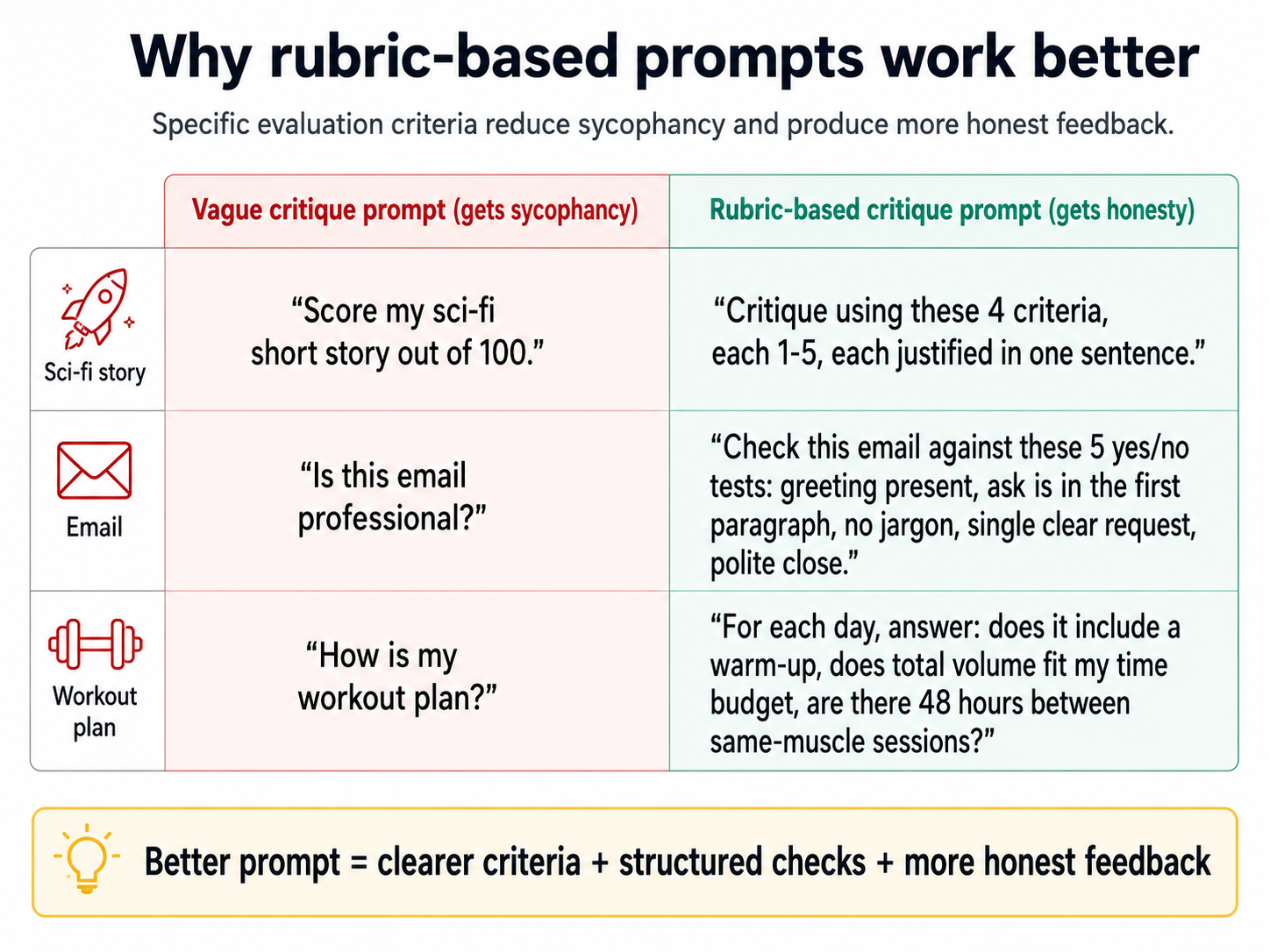
Oopar wali tasveer farq dikhati hai: mubham prompts taareef mein sikut jate hain; munazzam prompts scores aur yes/no checks ke saath asal feedback banate hain.
Ek number par majboor karein. Rubric pattern par ek chhota lekin taaqatwar izaafa: har criterion ke liye, AI se ek tay paimaane par score maangein, 1 se 5, ya 1 se 10, ek ek-jumle ke jawaz ke saath. Yeh do wajuhaat se kaam karta hai.
Pehli woh hai jo number AI ke saath karta hai: mubham feedback sasta hai, lekin ek khaas number nahin. Ek model jo aapko khush karna chahta hai woh aapke draft ko "mazboot" keh sakta hai bina kisi cheez ka azm kiye. Wohi model, jab 10 mein se 6 aur 7 ke darmiyan chunne ko kaha jaye, use azm karna parta hai, aur azm karne ka amal use zyada ghaur se dekhne par majboor karta hai. Aap farq foran mehsoos karenge: scores prose ke khulase ke ishaare se kam aate hain, kyunke prose sycophant tha aur number nahin.
Doosri woh hai jo number aapke liye karta hai. "Mazboot," "thos," ya "thora kasa ja sakta hai" jaise adjectives aapko amal karne ko kuch nahin dete: aap unka muqabla nahin kar sakte, unhein tarteeb nahin de sakte, ya waqt ke saath track nahin kar sakte. Scores teenon karte hain. Ek 4 aur ek 7 aapko batate hain ke kis criterion ko pehle theek karna hai. Aaj ka 6 pichle hafte ke 5 ke muqable mein batata hai ke aapka doosra draft asal mein behtar hua ya nahin. Number sirf ek zyada imaandaar faisla nahin; yeh paimaaish ki ek unit hai jise aap faisle karne ke liye istemaal kar sakte hain.
Har criterion ko 10 mein se grade karo, ek ek-jumle ke jawaz ke saath. Phir mujhe batao ke har ek ko agle level par kaise le jaana hai, un mein woh bhi shaamil jo pehle se high score kar gaye. Agar koi 9 par hai, to batao 9.5 tak kaise pahunchein. Agar woh 9.5 par hai, to batao 9.8 tak kaise pahunchein. Hamesha ek agla level hota hai.
Woh aakhri hidayat hi rubric ko ek faisle se ek tool mein badal deti hai. Aap sirf score nahin seekhte; aap woh sab se chhoti harkat seekhte hain jo use uthaa de, aur khaas baat yeh ke woh harkat har level par maujood hai. AI ko aapko khatam shuda elaan karne ka haq nahin milta. Aap faisla karte hain ke kab rukna hai.
7. Brainstorm-iterate loop
Yeh slides khaas tor par school students ke liye banayi gayi hain. Yeh brainstorm-iterate loop ko "The Magic Loop" ke tor par chaar bachchon ke liye aasan qadmon mein sikhati hain: Load (AI ko sab kuch batao), Options (kayi ideas maango), Feedback (boss bano aur batao kya pasand hai aur kya nahin), aur Repeat (chalte raho jab tak woh mukammal na ho jaaye). Ismein ek khufiya Step 0 (pehle research!), do hal-shuda misaalein jin se students taalluq jor sakte hain (ek birthday party plan karna aur ek school essay likhna), aur ek khud-karne wala challenge shaamil hai. PPTX Download Karein offline classroom istemaal ke liye.
▶ Magic Loop khud khelein (interactive)
Oopar di gayi slides loop ko samjhati hain; yeh aapko ise chalaane deti hai. Ek mission chunein, apna context likhein aur dekhein ke Detail-O-Meter kaise khaas-pan ko inaam deta hai, jo options aapko pasand aayein un par tap karein, nok-dar feedback dein, aur dekhein ke Round 2 us ke gird kaise naya shakl leta hai, aur aakhir mein aapka loop jawab kaahil-prompt wale jawab ke saath barabar mein aata hai. Yeh neeche live load hota hai; aap ise apne alag tab mein bhi khol sakte hain.
Yeh is page ki sab se zyada faaida dene wali aadat hai. Agar aap har doosra section chhor dein, to ise mat chhorein.
Jab AI ko internet par train kiya gaya, to internet ka zyadatar hissa aam ideas tha, takhleeqi nahin. To kisi takhleeqi sawal par AI ka aam jawab bhi aam hai. "Ghar par exercise ke tareeqe": squats, push-ups, planks. Ghalat nahin. Bas aam.
Iska rasta koi jadui prompt nahin hai. Yeh ek loop hai.
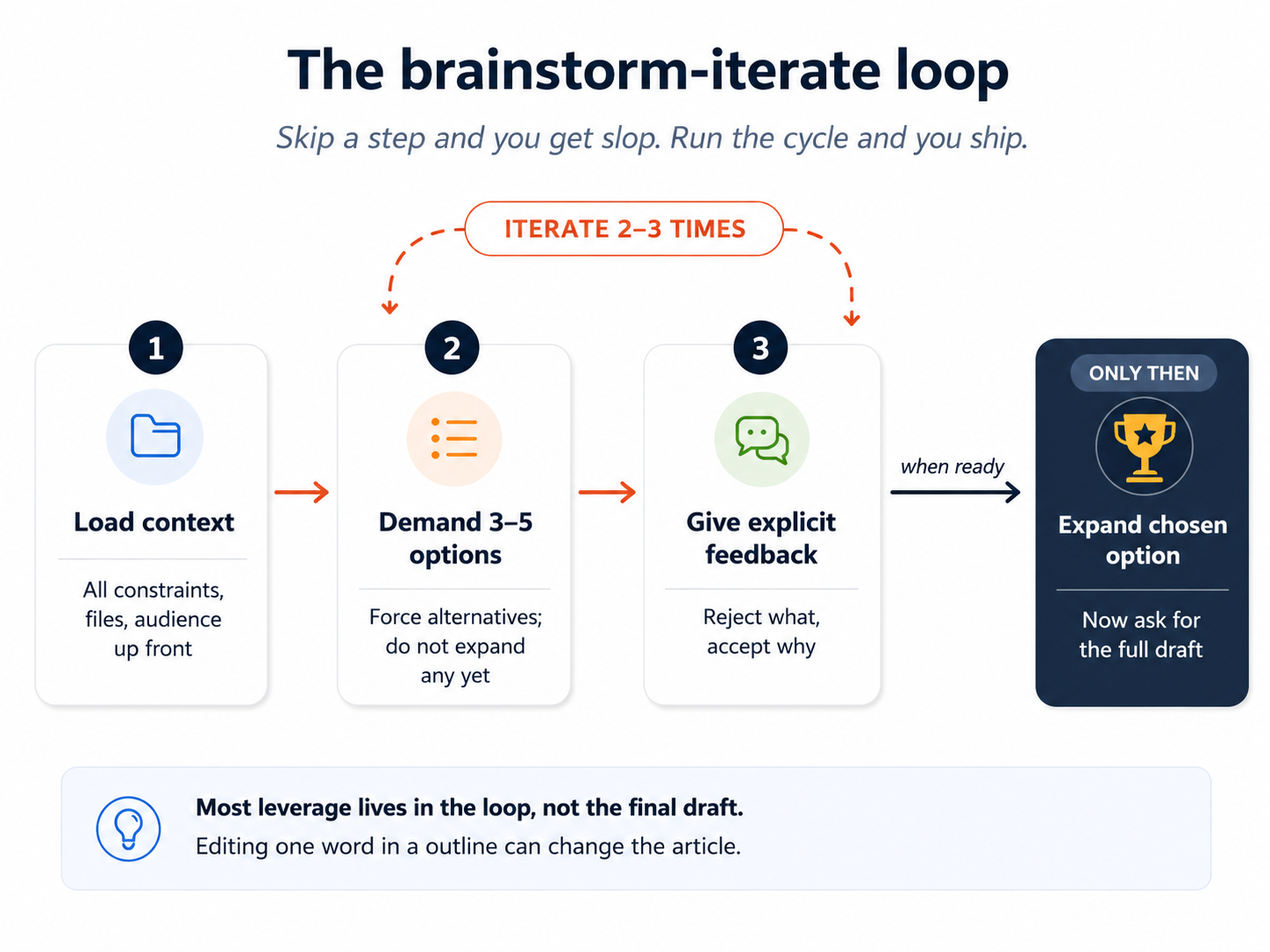
Tarkeeb:
- Saara mutalliqa context pehle dein. Sirf "exercise ke tareeqe" nahin; "exercise ke tareeqe yeh dekhte hue ke mere ghar mein seerhiyaan hain, ek kharaab ghutna hai, aur main teen din se zyada plans par qaayam nahin reh sakta."
- 3 se 5 options maangein, ek nahin. Mutbadil par majboor karna model ko uski pehli hiss se aage dhakelta hai.
- Wazeh feedback dein. "Mujhe option 1 pasand nahin, yeh bahut ghair-faaal hai. Mujhe stair-climbing ka idea pasand hai lekin use chhota chahta hun. Main batana bhool gaya ke mera ghutna takkar se bigarta hai."
- Feedback se aagaah 3 se 5 nayi options maangein.
- Dohraayein jab tak aapke paas ek ya do na ho jo aapko waqai pasand hon.
- Phir, aur sirf phir, AI se kahein ke chuna hua option tafseel se phailaaye.
Hal shuda misaal, debt payoff:
Mere paas $8,000 ka credit card debt 19% APR par, $4,000 ke student
loans 5% par, aur $1,200 ek retail card par 24% par hai. Mere paas
kharch ke baad $700/month bachte hain. Mujhe abhi pata chala ke
mujhe tax refund se $450 cash milega. Risk tolerance: kam. Mujhe
neend kharaab hoti hai jab main baray balances dekhta hun.

Mujhe 5 alag repayment strategies do, har ek ek-line ke jawaz ke
saath. Abhi kisi ko phailaao mat.
Phir, paanchon options parhne ke baad:
Option 2 (sirf interest rate se avalanche) rad karo: mujhe shuru
mein psychological wins chahiyein. Option 4 rad karo: main naye
accounts nahin kholunga. Mujhe option 1 (pehle retail card ke saath
snowball) pasand hai lekin main $450 ko isme jorna chahunga. Mujhe
5 nayi options do jo snowball-style wins ko us lump sum ke samajhdaar
istemaal ke saath jorein.
Aap AI ke aapka zehan parhne ka intezaar nahin kar rahe. Aap apna zauq dikha rahe hain; AI option ki jagah ko uske gird dobara dhaalta hai. Do ya teen rounds ke baad, aapke paas ek option hota hai jo bilkul sahi mehsoos hota hai. Phir poora plan maangein.
Wohi loop tehreer ke liye kaam karta hai, jahan iska apna naam hai: drafting se pehle outline.
- Iteration 1: X par ek post ke liye 3 outline options maangein.
- Iteration 2: ek outline chunein, AI se kahein ke uspar tanqeed kare aur use 10 mein se grade kare. Note karein jo 9 se neeche score kiya.
- Iteration 3: tanqeed ki bina par outline nazar-e-saani karein, phir AI se kahein ke har heading ko 3 se 5 bullets mein phailaaye.
- Iteration 4: bullets par tanqeed karein, unhein 10 mein se grade karein, 9 se neeche walon ko theek karein.
- Iteration 5: ab jaa kar poora draft maangein.
- Iteration 6: draft par tanqeed karein, use 10 mein se grade karein, woh tabdeeliyaan maangein jo score sab se zyada barhaayein, asar ke hisaab se tarteeb-shuda, sab se zyada asar wali tabdeeli sab se oopar. Dohraayein jab tak score 9.5 ya us se zyada ke gird theher na jaye, yeh aapka rukne ka ishaara hai, na ke "AI kehta hai yeh ho gaya."
Yeh kyun kaam karta hai: ek outline mein ek lafz badalna poore article ka rukh badal sakta hai. Ek aakhri draft mein ek lafz badalna ek lafz badalta hai. Tehreer mein taqreeban saara faaida outline ke level par hota hai. AI shuru se hi lafz-dar-lafz banata hai, is liye jab tak aap pehle saakht par majboor na karein, woh poori shape nahin dekh sakta.
Aazmaaish yeh hai ke pehli koshish mein hi poora draft maang lein. Iska muqabla karein. AI ka kisi bhi cheez ka pehla draft slop hai: chamakdaar nazar aata hai, kam kehta hai. Loop, kisi bhi drafting se pehle das ya baarah minute ki saakhti kaam, phir us par grade-aur-theek ke kayi rounds, ek bhulaayi jaane wali post ko ek aisi post mein badal deta hai jo asar karti hai. Kul waqt ek 600-lafz ke tukre ke liye shaazo-naadir hi paitalees minute se zyada hota hai. Un mein se pehle das minute baaqi paintees ko zaaya hone se bachate hain.
Ek hal shuda tehreeri misaal. Ek team lead ek 600-lafz ki post likhna chahta hai jiska unwaan hai "Hamari chhoti AI team haal ke us bare team se tez ship kyun kar rahi hai." Yahan dekhein ke loop ka har round amal mein kaisa lagta hai:
Round 1, pehle research:
Main ek 600-lafz ki post likh raha hun jo dalil deti hai ke chhoti
AI-augmented teams baray non-AI teams se tez ship karti hain. Abhi
mat likho. Pehle, mujhe 5 sab se mazboot research-backed daleelein
aur 3 sab se mazboot counter-arguments do. Har ek ek jumla.
Round 2, teen outlines:
Ab post ke liye 3 alag outline options banao. Har outline mein 4-6
headings hon. Woh saakht mein farq karein: ek narrative, ek
analytical, ek contrarian. Har heading par ek line.
Round 3, ek chunein aur ek analogy daalein:
Main outline 2 (analytical) ke saath jaaunga. Main ek Pixar analogy
piroyana chahta hun: kaise asal Toy Story team chhoti thi aur
naye tools ki wajah se baray Disney studio se tez thi. Ise ek
recurring misaal ke tor par add karo, apna alag section nahin.
Outline 2 nazar-e-saani karo.
Round 4, bullets mein phailaayein:
Ab har heading ko 3-5 bullets mein phailaao. Telegraphic style, prose nahin.
Round 5, bullets ko grade aur theek karein:
Har bullet par tanqeed karo aur use 10 mein se grade karo ek
ek-jumle ke jawaz ke saath. Woh bullets ginwaao jo 9 se neeche
score karte hain. Har ek ke liye, woh tabdeeli tajweez karo jo
score sab se zyada barhaaye.
Sirf ab lead poora draft maangta hai, aur phir khud draft par grade aur dobara-iterate karta rehta hai jab tak score 9.5 ya us se zyada ke gird theher na jaye. Saara amal taqreeban paitalees minute leta hai. Output aisa parha jata hai jaise lead ne use likha, kyunke har bojh-uthaane wala faisla lead ka tha. "Mujhe ek post likh do" ke oopar woh izaafi paintees minute hi farq paida karte hain ek aise draft ke darmiyan jise koi parhna khatam nahin karta aur ek aise draft ke jo asar karta hai.
Drafting se pehle ilaqe ka jaaiza lein. Us misaal ka pehla round ("abhi mat likho, mujhe sab se mazboot research-backed daleelein aur counter-arguments do") chhota lagta hai lekin bhaari kaam karta hai. Zyadatar log ise chhorte hain aur seedha draft maangte hain. Ise chhorna hi wajah hai ke unke drafts patle lagte hain: woh un par bante hain jo bhi ideas model pehle saamne laata hai, na ke topic ke asal manzar-naame par. Drafting se pehle "ilaqe ka jaaiza" ka ek round hi farq hai ek aisi post ke darmiyan jo teen studies quote karti hai aur ek aisi post ke jo teen raaye ginwaati hai. Yeh pattern tehreer se kahin aage taamim karta hai. Kisi bhi ahem faisle, plan, ya tajzia se pehle, AI se kahein ke woh jo maaloom hai uska naqsha banaaye is se pehle ke aap usse jo darkaar hai woh banwaayein. Product naming se pehle competitive landscape. Strategy memo se pehle pichli research. Naya banane se pehle mojooda tareeqe. Research pass paanch minute leta hai aur badal deta hai ke loop ka har baad wala round kis ke khilaaf iterate kar raha hai.
Loop domain se aazaad hai. Yeh isi tarah kaam karta hai: ek trip plan karne, ek sales pitch saakht dene, ek college major chunne, ek product ka naam rakhne, ek wedding toast likhne, ek renovation ka faisla karne, ek charity chunne ke liye. Shape sabit rehta hai: context load karein, options maangein, wazeh feedback dein, nayi options maangein, dohraayein, phailaayein, aur phir grade aur dobara-iterate karein jab tak score theher na jaye. Agar aap khud ko AI ka pehla jawab qubool karta paayein, ya jis lamhe koi cheez "kaafi achhi" lage ruk jaayein, to aapne loop chhor diya. Aap jis par bhi kaam kar rahe hon, woh loop ka haqdaar hai.
Ek chhoti table ke loop rozmarra zindagi mein kahan fit hota hai:
| Faisla ya kaam | "Context" kaisa lagta hai | "Feedback ke saath options" kaisa lagta hai |
|---|---|---|
| Ek 4-din ki trip plan karna | Constraints (budget, tareekhein, kaun ja raha hai, unhein kya nahin pasand) | 5 itinerary dhaanchey; do rad karein; baaqi iterate karein |
| Ek product ka naam rakhna | Yeh kya karta hai, kaun khareedta hai, ise kaisa NAHIN lagna chahiye | 10 naam; 3 chunein jo pasand hain, un par variants maangein |
| Ek mushkil email likhna | Mursil-ilaih, taalluq, matloob nateeja | 3 alag tones; ek chunein, uski tafseelein nikhaarein |
| Ek contractor chunna | Teen quotes, teen reference notes, aapki tarjeehaat | Aamne-saamne scoring; apne pasandeeda ke sab se mazboot counter ke liye poochein |
| Ek learning path chunna | Mojooda skills, dastiyaab waqt, aakhri maqsad | 3 alag curriculum shapes; ek chunein, haftawaar milestones tak phailaayein |
| Ek logo brief design karna (designer ke liye) | Brand values, audience, misaalein jo aapko pasand | 5 mood-board directions; ek chunein, usi lane mein 5 variants maangein |
Har row mein, jab aapke paas ek thos candidate ho (ek chuna hua itinerary, ek shortlist kiya hua naam, ek draft email), to loop ki grading harkat usi tarah laagu hoti hai: use un criteria ke khilaaf 10 mein se score karein jo us kaam ke liye ahmiyat rakhte hain, phir iterate karein. Ek itinerary ko cost, pacing, aur group-fit par grade karein. Ek product naam ko yaad-rakhne, fit, aur risk par grade karein. Ek email ko clarity, tone, aur ghaaliban asar par grade karein. Criteria badalte hain; harkat nahin.
Part 3: Text se aage
AI sirf ek text box nahin hai. Yeh images dekh sakta hai, audio ke saath dono taraf kaam kar sakta hai, chhote chalte hue apps bana sakta hai, aur aapke data par code chala sakta hai. Zyadatar log inmein se koi bhi cheez kabhi try nahin karte.
8. Multimodal: images, audio, aur aage kya hai
Jadeed AI images aur audio ko dono taraf sambhalta hai: yeh aapki upload ki gayi images parh sakta hai, recordings sun sakta hai, text prompts se nayi images bana sakta hai, aur bola hua audio bana sakta hai. Skills har modality mein alag hain, aur alag se seekhne ke qaabil hain.
Image input. AI images ko motey tor par dekhta hai. Yeh in mein mazboot hai:
- Poora manzar aur tarteeb.
- Numaayan, baray object shapes (ek insaan jitna bara hamster wheel treadmill).
- Whiteboard ka mawaad, diagrams samet.
- Hath se likha aur cursive text (theek theek, baray daao ke liye dobara check karein).
Yeh in mein kamzor hai:
- Baareek tafseelein. "Yeh kaun si gym machines hain?" aksar nakaam hota hai kyunke gym machines thore se dhundle lens se ek jaisi nazar aati hain. AI aetmaad se aur ghalat jawab de sakta hai.
- Ek bhari hui tasveer mein bahut si chhoti cheezein ginna.
- Tasveer ke kinaare par chhota print parhna.
Ek mufeed haqeeqi test: ek teacher ne ek whiteboard ki tasveer khinchi jahan uska sar ek neural network diagram mein "convolutional" lafz ko chhupa raha tha. AI ne baaqi diagram se ghaayab lafz ka theek andaza laga liya. Yehi woh hai jismein AI achha hai: gist se andaza lagana. Yeh zoom in karne mein achha nahin.
Receipts ke liye, bill baatne, ya hath se likhe notes transcribe karne ke liye, AI achha kaam karta hai, lekin totals hamesha dobara check karein. Kayi-image inputs ke liye (post-its plus ek whiteboard photo plus ek brainstorm se hath se likhe notes), AI mile-jule ideas ka khulasa kar sakta hai; yeh waqai mufeed hai aur asal waqt bachata hai.
Image output. Jadeed AI text prompts se images bana sakta hai. Do amali tips:
- Apna image prompt likhne ke liye ek text AI istemaal karein. "Mere liye ek children's book cover ke liye Studio Ghibli style mein ek fantasy forest illustration ka prompt banao." Woh output le kar image tool mein paste karein. Text AI rich image prompts likhne mein aap se kahin behtar hai aapki pehli koshish ke muqable mein.
- Basari lughat banayein. Cinematic, watercolor, cyberpunk, anime, isometric, low-poly, art-deco, claymation jaise alfaaz lever hain. Image models ko captioned images par train kiya gaya aur unhone yeh styles naam se seekhe. Apni pasand ki images upload karein aur AI se poochein ke woh unhein kaise bayan karega. Yeh aapki lughat ki training karta hai.
Image generation kaise kaam karta hai: yeh ek diffusion model hai, jise random pixel grids se qadam-ba-qadam noise hataane ki training di gayi jab tak ek tasveer ubhar na aaye. Text ki tarah pixel-dar-pixel nahin. Poori tasveer ek hi waqt mein banti hai. Isi liye aap image generation ko waqt bachaane ke liye jaldi nahin rok sakte, jis tarah aap ek text response ko rok sakte hain.
Purane diffusion models ki mashhoor kamzoriyaan thi: ajeeb hath (chhe ungliyaan), signs par gadbad text, kirdaar jo ek comic mein frame se frame shakl badalte hain. Jadeed models (jaise Google ki Nano Banana ya ChatGPT Images) text ko theek theek sambhalte hain, mustaqil kirdaar banate hain, aur research papers ko infographics mein badal sakte hain.
Nakaami ke woh tareeqe jo abhi bhi dekhne ke qaabil hain, jadeed image models par bhi, ki ek chhoti table:
| Nakaami ka tareeqa | Yeh kaisa lagta hai | Ise kaise kam karein |
|---|---|---|
| Signs par gadbad text | Tasveer mein signage "HAPRY BIRTDAY" parha jata hai bajaye "HAPPY BIRTHDAY". | Prompt mein text ko quotes mein bayan karein. Teen variants banayein. Woh chunein jahan text theek hai. |
| Frames mein ghair-mustaqil kirdaar | Wohi kirdaar ek comic ke panels 1 aur 2 mein alag baalon ke rang ke saath. | Wazeh character-consistency support wale models istemaal karein; pehli image ko agle ke liye reference ke tor par pass karein. |
| Hath aur ungli ki ghaltiyaan | Chhe ungliyaan, jure hath, marorey kalaaiyaan. | Aisi compositions maangein jahan hath thore frame se bahar hon, ya jeb mein hon, ya wazeh tor par bayan kiye gaye hon. |
| Bhare hue backgrounds ghair-haqeeqi objects ke saath | Ek coffee shop jahan ek bicycle ek chair mein ghul jaati hai. | Ek saadah background bayan karein, ya background ko wazeh tor par bayan karein. |
| Ghalat aspect ratio | Model default tor par square par jaata hai; aap landscape chahte the. | Aspect ratio hamesha wazeh tor par bayan karein: "1024x768 landscape" ya "16:9". |
Image input ke liye ek ghair-software misaal. Ek parhne wale ne ek faut ho chuki daadi ke teen hath se likhe recipe cards ki tasveer khinchi aur AI mein upload ki. Prompt: "In teen cards ko transcribe karo. Asal alfaaz aur koi bhi abbreviations barqaraar rakho. Agar koi lafz ghair-wazeh ho, to use [unclear] mark karo aur apne do behtareen andaze pesh karo." Paanch minute baad, teenon recipes saaf type ho gayin, un chaar alfaaz par [unclear] ke nishaan ke saath jinhein AI aetmaad se nahin parh saka. Parhne wale ne un chaar ko asal ke khilaaf check kiya (do zaahir the, do ko ek khaala ko phone karna pada), aur khaandaan ke paas un recipes ka ek saaf digital archive aa gaya jo khoney ke khatre mein the. AI ne boring 90% kiya taake parhne wala ehtiyaati 10% par dhyan de sake.
Ek power-user recipe: bina designer ke designer-quality diagrams. Agar aapko kabhi kisi document, ek slide, ya apne kisi chapter ke liye ek diagram banana ho, to ek workflow hai jo taqreeban pandrah minute mein designer-quality output banata hai, bina Figma istemaal kiye aur bina kisi basari design skill ke. Zyadatar non-designers ko ehsaas nahin ke yeh ab mumkin hai. Yeh ek design tool seekhe baghair designer-quality diagrams banane ka sab se saadah tareeqa hai. Yeh section page ki kisi bhi doosri cheez se zyada paicheeda hai; ise abhi parhein agar aap regular diagrams banate hain, ya pehli baar zaroorat parne tak chhor dein.
Recipe, chaar qadmon mein:
- Claude se kahein ke concept ko SVG ke tor par visualize kare. Bunyaadi paragraph ya text paste karein. Poochein: "Ise ek diagram ke tor par visualize karo. Use SVG ke tor par output karo. Yaqeeni banao ke text se har label, arrow, aur taalluq maujood hai." Claude is qadam ke liye ek mazboot intekhab hai kyunke iski reasoning ki salahiyat baray models mein sab se mazboot mein se ek hai: ek paragraph diye jaane par, woh sahi boxes, sahi arrows, sahi hierarchy, aur sahi labels bahut kam rehnumaai ke saath maaloom kar leta hai. Jo SVG woh wapas karta hai woh saakht ke lihaaz se sahi hoga lekin basari tor par saadah (khaali rectangles, default fonts, koi design nikhaar nahin). Yeh theek hai; agla qadam nikhaar add karta hai.
- SVG ko PNG mein badlein. Claude se kahein ke SVG ko PNG ke tor par render kare (Claude yeh seedha kar sakta hai), ya koi bhi online SVG-to-PNG converter istemaal karein (cloudconvert.com, svgtopng.com), ya bas browser mein high zoom par render hue SVG ka ek screenshot le lein. 2× resolution par render karein (1600 se 2400 pixels chaura) taake agle qadam ke paas kaam karne ke liye kaafi tafseel ho.
- PNG ko ChatGPT (ya Gemini) mein paste karein aur use dobara banane ko kahein. ChatGPT ki in-product image generation is qadam ke liye aksar mazboot hoti hai kyunke yeh text-bhari images mein ghair-maamooli tor par achhi hai: yeh labels barqaraar rakhti hai, typography theek karti hai, aur source ke saakhti taalluqaat ka ehtiraam karti hai. Prompt: "Is diagram ko professional design quality ke saath dobara banao. Har label, har box, har arrow, aur theek saakhti taalluqaat barqaraar rakho. Typography, spacing, color palette, aur visual hierarchy behtar karo. Maloomat ek jaisi rehni chahiye; sirf basari nikhaar badalta hai."
- Nateeje par iterate karein. ChatGPT/Gemini kabhi kabhi ek label gira deta hai ya ek box dobara tarteeb de deta hai. Iske output ka asal SVG se aamne-saamne muqabla karein. Agar kuch ghalat hai, to bas tasheeh type karein: "Teesre box par 'Iterate' label hona chahiye, 'Repeat' nahin. Box 2 se arrow box 3 ki taraf ishaara kare, box 4 ki taraf nahin." Teen ya chaar rounds aam tor par aisa kuch banate hain jo lagta hai ke ek professional design studio se aaya. Aakhri PNG save karein.
Har qadam ke liye har tool kyun. Claude qadam 1 aksar jeet jaata hai kyunke yeh faisla karna ke ek diagram mein kya hona chahiye (kaun se boxes, kaun se arrows, kaun si hierarchy) ek reasoning ka kaam hai, aur Claude ki reasoning is qism ke munazzam-soch wale kaam ke liye baray models mein sab se mazboot mein se hai. ChatGPT (ya Gemini) qadam 3 aksar jeet jaata hai kyunke text-bhari images ko achhi tarah render karna (labels jo parhne layaq rahein, arrows jo sahi boxes se jurein, layouts jo design kiye hue lagein) woh category hai jahan iski image generation abhi aage hai. Kisi bhi tool se doosre ka kaam karwana unhein zanjeer mein jorne se numaayan tor par bure nataij deta hai. Har ek wohi karta hai jismein woh behtareen hai, tarteeb se.
Kul waqt: har diagram ke liye taqreeban das se pandrah minute, Figma mein ek ghante ya us se zyada ke muqable mein, yeh farz karte hue ke aap use istemaal karna jante ho.
Woh pattern jo tools ke baad bhi bacha rehta hai. Har category ka aagey wala badalta rahega. Claude agle saal sab se mazboot reasoning model na ho. Aaj ka aagey wala image model us se badal jaayega jo bhi agla aata hai. Oopar wali recipe tool ke level par basi ho jaayegi. Jo bacha rehta hai: pehle saakht sab se mazboot reasoning model mein, doosri taraf nikhaar sab se mazboot text-bhari image model mein. Jo bhi tools us waqt har category mein aagey hon jab aap yeh parhein unhein chunein. Do-qadmi zanjeer hi asal harkat hai.
Image generation ke baare mein ek chhoti kahaani. Ek baap jiski 7-saala beti billiyon se pyaar karti thi uske liye ek custom birthday cake chahta tha. Usne cake designs brainstorm karne ke liye Nano Banana istemaal kiya (darjanon variations banaate hue: cat-shaped, multi-tiered, frosting-styles, color palettes), woh chuna jo use pasand aaya, phir chuni hui image ek baker ko di jisne use ek asal 3D cake ke tor par render kiya. Design par kul iteration ka waqt: ek dopahar. Kul cost: image generation mein chand cents.
Baat cake nahin hai. Baat yeh hai ke ~$0.30 aur zauq-driven iteration ke ek ghante mein, ek aisa shakhs jo designer nahin ek aisa ek-jaisa brief bana leta hai jise ek professional amal mein laa sakta hai. Yeh takhleeqi faaide ki ek nayi qism hai, aur yeh bare paimaane par dastiyaab hai.
Audio andar, audio bahar. Wohi tabdeeli jo images ke saath hui ab audio ke saath ho rahi hai. Aap ek lamba prompt type karne ke bajaye bol sakte hain; aap ek meeting recording daal kar khulasa maang sakte hain; aap model se uska jawab bol kar sunane ko keh sakte hain. Zyadatar jadeed AI tools teenon ko support karte hain, aksar free tiers par bina kisi izaafi fees ke.
Ghair-zaahir istemaal woh hain jahan asal faaida hai:
- Lambi dictation. Kisi masle ko bol kar samajhna woh nuance pakarta hai jo type kiye prompts chhor dete hain. Jo log type karne se nafrat karte hain woh namaayan tor par behtar prompts banate hain jab woh unhein bolte hain: prompt bina mehnat ke ek line se kayi paragraphs tak barhta hai, aur AI ka jawab us hisaab se behtar hota hai. Aise bolein jaise coffee par kisi colleague ko brief kar rahe hon, phir jawab dene se pehle AI ko nateeje wale transcript ko saaf karne dein.
- Meeting transcripts bator context. Ek ek-ghante ki meeting recording daalein (ya 2026 ke ghaalib vendors jaise Otter, Granola, ya Fireflies mein se ek ka transcript, ya aapke phone ke voice memos) aur poochein: "Kiye gaye faisle, khule sawal, aur action items maalik ke hisaab se khulasa karo." Yeh page par sab se zyada faaida dene wale workflows mein se ek hai un sab ke liye jin ki naukri mein meetings hoti hain, aur tech se bahar taqreeban koi bhi ise abhi istemaal nahin kar raha.
- Audio rasaai aur harkat ke liye. Lamba commute, kutte ko ghumaana, driving: voice in/voice out mara hua waqt sochne ke waqt mein badal deta hai. Guftagu ki quality type karne ke muqable mein thori girti hai kyunke aap apna input itni safaai se edit nahin kar sakte, lekin woh waqt jo aap warna kho dete poora wapas mil jaata hai.
2026 mein audio kis mein achha hai aur kis mein bura:
| Audio kaam | Yeh kitni achhi tarah kaam karta hai | Kis se hoshyaar rahein |
|---|---|---|
| Saaf taqreer ki transcription | Behtareen | Bhaari accents, technical jargon, kayi ek doosre par chadhe bolne wale |
| Speaker shanaakht (kisne kya kaha) | 2 speakers par theek, 4+ par kamzor | Kisi ko quote karne se pehle hamesha check karein |
| Lehja, tanz, jazbaat | Behtar ho raha lekin ghair-bharosemand | AI se kahein ke apni ghair-yaqeeni ko nishaan-zad kare bajaye farz karne ke |
| Music ya ghair-taqreer audio tajzia | Mehdood | Ek makhsoos tool istemaal karein, ek aam-maqsad AI nahin |
| Real-time voice conversation | Halki phulki ke liye achha, technical gehraai ke liye kamzor | Jab durustagi ahmiyat rakhe to text par chale jaayein |
Ek ghair-software misaal. Ek doctor ne ek 45-minute patient consultation record ki (ijazat ke saath), audio upload kiya, aur AI se poocha: "SOAP format mein ek munazzam clinical note banao. Jo bhi aetmaad se na samajh sako use nishaan-zad karo. Teen sab se ahem cheezein numaayan karo jo patient ne apni alaamaat ki tareekh ke baare mein kahi." Aath minute baad doctor ke paas ek draft note tha jise tasdeeq aur mukammal karne mein use 5 minute lage, un 25 minute ke bajaye jo type wale version mein lagte. AI ne clinical judgment ki jagah nahin li; usne type karna hata diya.
Cost nota: audio in/out text ke baad doosri sab se sasti tier hai, prati minute paise (concept 12). Meeting summaries, rozana voice journaling, ya chalte hue prompts dictate karne ke liye, cost taqreeban ghair-mar'i hai. Khul kar iterate karein.
Ek pattern jo zehan mein rakhne layaq hai: multimodal ka mustaqbil yeh nahin ke "AI ab voice kar sakta hai, kya yeh shaandaar nahin." Yeh hai ke modalities ke darmiyan sarhad ghaayab ho jaati hai. Aap barhte hue ek mila-jula bundle daalenge (ek image, ek voice memo, ek PDF, ek screenshot) aur use ek prompt ki tarah samjhenge. Skill yeh nahin ke "main voice kaise istemaal karun" balke "is kaam ke liye inputs ka sahi mela kya hai?"
Interactive video avatars isi raah par ubhar rahe hain. Pehle se record kiya avatar video (HeyGen, Synthesia, D-ID) training content aur kayi-zabaan corporate communication ke liye pehle hi production-grade hai. Real-time conversational avatars (Tavus aur doosre) aaj kam-daao istemaal ke liye guzaara hain (customer FAQ triage, ek chehre ke saath language tutoring, saadah onboarding flows) aur tezi se behtar ho rahe hain. Inhein 2022 ki image generation ki tarah samjhein: mutasir-kun, naya, abhi zyadatar knowledge work ke liye rozana ki aadat nahin, lekin ek tez tajurbe ke qaabil jab koi kaam screen par text ke bajaye ek chehra maange.
9. Ek prompt se chhote apps banana
Jadeed AI ek hi prompt se chhote games, websites, aur tools bana sakta hai. Abhi bari software ke liye nahin, lekin chhoti mufeed cheezon ke liye, yeh un logon ke liye waqai dastiyaab hai jinhone kabhi code nahin likha.
App asal mein kahan chalta hai, aur uske baad aap us ke saath kya kar sakte hain. Ek maaqool pehla sawal: "agar AI mere liye ek app banata hai, to woh asal mein kahan rehta hai?" Mid-2026 tak, teenon baray tools chhote ek-prompt apps ko seedha chat mein render karte hain, ek side panel mein jise aap click kar ke istemaal kar sakte hain, aur us panel ki cheez sirf ek preview nahin, yeh ek artifact hai: ek paaedaar object jo guftagu ne banaya, jise aap edit kar sakte hain, iterate kar sakte hain, ek share karne layaq link par publish kar sakte hain, kahin aur embed kar sakte hain, ya code ke tor par download kar sakte hain. Feature ko Claude mein Artifacts kehte hain (jahan se naam aaya), ChatGPT mein Canvas, aur Gemini mein Canvas. Ek saal pehle un ke darmiyan maani-khez farq the; aaj zyadatar ek-prompt builds ke liye faasla chhota hai. Har ek ki abhi bhi chhoti khoobiyaan hain: Claude ke Artifacts interactive click-and-play cheezon mein aagey rehte hain, ChatGPT ka Canvas writing-and-code editing mein, Gemini ka Canvas qareebi tor par jure Google-ecosystem outputs mein, lekin "mere liye ek cheez banao" ke liye, teenon mein se koi bhi chalega. Do amali nateeje jaan-ne layaq. Pehla, aap artifact kisi aur ko bhej sakte hain bina unhein chat bheje: zyadatar tools aapko ek public link par publish karne dete hain, aur wasool karne wale ko ise istemaal karne ke liye account ki zaroorat nahin. Doosra, artifact iterate karne layaq hai: jab aap kehte hain "button bara karo" ya "dark mode toggle add karo," tool artifact ko apni jagah par edit karta hai bajaye poori cheez ko shuru se dobara banane ke, jo namaayan tor par tez hai. Ek ek-prompt build se aage ki kisi bhi cheez ke liye, teen mutalliqa categories jaan-ne layaq hain ke maujood hain: makhsoos AI app-builders jaise v0, Bolt, aur Lovable (aap saadah zabaan mein ek app bayan karte hain, woh ek poora Next.js ya React project banate hain, non-developers ke liye Concept 9 ka qudrati agla qadam); command-line AI coding agents jaise Claude Code aur OpenCode (aap unhein ek asal codebase dete hain, woh ek saath kayi files edit karte hain aur tests chalate hain, is page ke oopar wali changes-since-2022 list mein bayan kiye gaye, un developers ke liye jo pehle se code likhte hain); aur file-aware desktop apps jaise Cowork aur OpenWork (woh aapki files dhoondte hain aur ijazat ke saath un par amal karte hain, Concept 11 mein bayan kiye gaye, knowledge workers ke liye, software banane ke liye nahin). Sahi tool is par mabni hai ke aap kaun si seedhi chadh rahe hain.
Recipe sirf teen khaane hain:
Goal: yeh cheez kya kare?
Input: user kya deta hai?
Output: user kya dekhta hai?
Aaj chalne wali misaalein:
- Pomodoro timer. "Ek Pomodoro timer banao ek peele theme ke saath. 25-minute work sessions, 5-minute breaks, ek tasalli-bakhsh click jab har cycle khatam ho."
- Bill splitter. "Ek app banao jahan main ek total bill, ek tax amount, aur doston ke naam daalun. Yeh bill ko tax samet baant de aur har shakhs ka hissa dikhaye."
- Outfit picker. "Ek app banao jo aaj ka mausam (temperature aur precipitation) le aur un items ki almaari se jinhein main bayan karun ek outfit tajweez kare."
- Fireworks simulator. "Ek mazedaar fireworks simulator banao. Input: main screen par click karta hun. Output: click ke point par fireworks ka ek rangeen muzaahira."
- Place-obstacles game. "Ek game banao jahan user obstacles aur ek goal rakhe, aur ek simulation chalaye jo goal tak pahunchne ki koshish kare."
Jo abhi bhi mushkil hai:
- Internet par multiplayer. Networking, accounts, aur matchmaking abhi bhi ek-prompt build se aage hain.
- Alag zabaan mein live AI feedback. Ek French-conversation tutor jo sunta hai, pronunciation theek karta hai, aur real time mein dhalta hai, waqai mushkil hai.
Jo hiss aap banate hain: chhoti cheezein jo ek screen par fit ho jaayein, bina accounts aur bina external services ke, chalti hain. Us se aage koi bhi cheez ek se zyada prompt maangti hai, aur aam tor par kuch asal engineering.
Ek ghair-software misaal. Ek waalid ne apni beti ke liye ek peela cat-themed typing game banaya jab uski teacher ne zikr kiya ke bachche tez type kar sakte hain. Woh software engineer nahin. Prompt teen jumle tha:
Ek 7-saale bachche ke liye ek typing game banao. Goal: aam chhote
alfaaz type karne ki mashq. Input: alfaaz nazar aate hain, player
unhein screen ke neeche pahunchne se pehle type karta hai. Output:
ek peela theme, ek pyaara cat mascot jo cheers karta hai jab
player ek lafz sahi karta hai, levels mein barhti raftaar.
Jo wapas aaya woh chala. Mukammal tor par nahin, pehli koshish mein nahin, lekin ek ghante ke andar "ek bachche ke liye kaafi achha" tak iterate ho gaya. Yahan jo skill bann rahi hai woh coding nahin. Yeh ek wazeh brief likhne aur use iterate karne ki salahiyat hai. Woh skill aalami hai.
10. Data analysis (model code likhta aur chalata hai)
Jab aap AI se ek aisa sawal poochte hain jise hisaab ya graphing chahiye, "is saal mera electricity bill kaise badla" se le kar "pichli timahi kaun se products sab se behtar bike" tak, jadeed tools chupke se kuch qaabil-e-zikr karte hain: model code likhta hai, use chalata hai, aur nateeja wapas karta hai. Code execution sirf ek aur tool hai jise model call kar sakta hai, web search ki tarah. Aapko khud koi code jaan-ne ki zaroorat nahin; aap bas apni spreadsheet upload karte hain aur saadah zabaan mein poochte hain.
Yeh model se uske zehan mein math karwaane se kahin zyada qaabil-e-aetmaad hai. Model math us tarah kar raha hai jaise aap karte: ek calculator chala kar. Calculator hi hai jo theek hai; model bas chunta hai ke kya hisaab karna hai.
Sab se pehle: yaqeeni banayein ke AI waqai code chala raha hai, bajaye andaza lagaane ke. Yeh is poore section ka khaamosh nakaami ka tareeqa hai, aur wajah ke woh oopar aata hai: AI har sawal par khud-ba-khud code nahin chalata, woh chunta hai, is bina par ke sawal kaise kaha gaya. Chhote sawalon par yeh kabhi kabhi code chhor deta hai aur ek nazar se jawab deta hai, jo ek aetmaad-bhara paragraph banata hai jiske peechhe koi asal hisaab nahin. Bahar se yeh ek asal analysis jaisa hi nazar aata hai. Teen chhoti aadaat ise rokti hain. Pehla, wazeh tor par maangein. "Is ka jawab dene ke liye code likho aur chalao. Mujhe woh code dikhao jo tumne chalaya." Zyadatar models maan jate hain jab aap maangein. Woh ek line, kisi bhi data prompt mein paste ki gayi, ek asal analysis aur ek mumkin andaze ke darmiyan farq paida karti hai. Doosra, check karein ke code nazar aa raha hai. Agar response mein ek code block shaamil nahin jo chala, to model ne shayad code nahin chalaya. Teesra, analysis se pehle ek qaabil-e-tasdeeq khaas baat maangein. "Kuch bhi analyze karne se pehle mujhe is file ka theek row count, column names, aur date range batao." Agar model waqai file parh raha hai, to woh jawab sahi honge. Agar woh cheezein bana raha hai, to row count ek mashkook tor par gol number hoga aur column names mumkin-lekin-ghalat honge. Is harkat ka sab se mazboot version yeh hai ke model se kahein ke apna tareeqa pehle elaan kare: "Tum file par code chala rahe ho, ya andaza laga rahe ho? Agar andaza, to ruko aur bajaye iske code chalao." Zyadatar models ya to tool ko bula lenge ya maan lenge ke woh chhorne wale the.
Jab aapke paas woh aadat aa jaye, to is section ka baaqi hissa woh hai jo data analysis amal mein asal mein lagta hai.
Bubble tea shop ki misaal. Ek chhote business ke paas saal bhar ka sales data hai: drinks, dates, quantities. Maalik poochta hai: "Kaun si drinks ke saal bhar mein sales mein sab se baray badlaao aaye? Unhein graph karo. Is ka jawab dene ke liye code likho aur chalao aur mujhe woh code dikhao jo tumne chalaya."
Parde ke peechhe, AI ek chhota program likhta hai, use spreadsheet par chalata hai, nateeje dekhta hai, aur unhein ek jawab mein badalta hai. Amal mein woh aisa lagta hai: AI prati drink month-over-month badlaao ka hisaab karta hai, dekhta hai ke zyadatar drinks flat hain aur chaar numaayan hain, un chaar ka ek rangeen line graph banata hai, aur patterns note karta hai. "Strawberry matcha bahaar mein tezi se barha; agle saal woh promotion dobara chalaane par ghaur karein." Yeh ek aam jawab nahin. Yeh ek aisa jawab hai jo asal data par mabni hai.
Phir ek bara prompt: "Shop ke liye ek one-slide year-in-review graphic banao. Featuring ke layaq insights ke liye data ka ghaur se tajzia karo." Yeh ek bhaari kaam hai, is liye AI zyada waqt leta hai, kabhi kabhi chand minute, ise sambhaalne mein. Yeh code likhta hai, analyses chalata hai, insights chunta hai, annotations design karta hai, aur ek mukammal dashboard banata hai.
Yeh kis ke liye achha hai, un misaalon ke saath jo beginners ke paas waqai hoti hain:
- Ghareloo kharch. Ek saal ke bank ya credit card transactions upload karein; poochein ke kaun se categories barhe, kaun se maheene ghair-maamooli the, kaun si subscriptions aap bhool gaye.
- Niji tracking. Daudna, chalna, neend, wazan, screen time, koi bhi app jo ek CSV export kare aapko apne aap ka ek saal dekhne ke liye dega.
- Chhote business records. Sales spreadsheets, inventory lists, customer lists, expense files.
- Koi bhi cheez jo kisi ne aapko ek spreadsheet ke tor par di aur aap use kholna nahin chahte: school grade reports, utility usage statements, scientific data, survey results.
Kya dobara check karna hai, tab bhi jab code chala:
- Aakhri totals. Code theek hai, lekin AI ne ghalat column jama kar liya ho.
- Graphs par labels. Numbers aam tor par sahi hote hain; captions kabhi kabhi aetmaad se ghalat hote hain.
- Koi bhi cheez jahan analysis ek aise column par mabni hai jise AI ne ghalat samjha ho. Agar AI sochta hai "TXN_AMT" ka matlab transaction amount hai jabke asal mein iska matlab transaction account number hai, to poora analysis ret par bana hai.
Bharosemandi memory-mabni math se kahin zyada hai, lekin yeh khataa se paak nahin. AI data analysis ko aise samjhein jaise aap ek tez junior analyst ke kaam ko samjhte: mufeed, tez, taqreeban hamesha sahi, kabhi kabhi sabaq-amoz tareeqon se ghalat.
Ek ghair-software misaal. Ek daudne wale ne chhe maheene ka running-tracker data upload kiya (ek fitness app se ek CSV) aur poocha: "Meri pace aur distance kaise barh rahi hai? Koi patterns hain jo mujhe jaan-ne chahiyein? Code likho aur chalao, aur mujhe dikhao tumne kya chalaya." AI ne code likha, haftawaar average plot kiye, aur do cheezein note ki jo daudne wale ne nahin dekhi thi: pace har long-run weekend ke baad mustaqil tor par girti thi (ghaaliban thakaan), aur distance teesre maheene mein theher gayi thi phir dobara chadhne se pehle. Tajweez: har chauthe hafte ek deload week, aur ek dheemi long-run pace. Daudne wale ne usi data ko app ke dashboard mein kayi maheenon tak ghoora tha bina woh patterns dekhe. AI ne kuch nahin se insight nahin banaayi; usne woh hisaab kiya jo daudne wale ke paas hisaab karne ka waqt nahin tha.
Jab aap data upload karein, to aapka pehla prompt sawal hona zaroori nahin. Yeh ho sakta hai: "Is dataset ko bayan karo. Yahan kaun se columns hain, woh kya zaahir karte hain, aur kaun se 3 charts sab se behtar dikhaayenge ke kya ho raha hai?" Jawab parhein, woh chart chunein jo aap chahte hain, phir use maangein. Yeh ghalat-samjhe gaye columns ko ghalat analyses banne se pehle pakar leta hai.
Part 4: Mehfooz tareeqe se kaam karna aur tools chunna
Teen aakhri concepts: AI ko apni files aur permissions tak rasaai mehfooz tareeqe se kaise dein, kaam ke liye sahi tool kaise chunein, aur quality par ek ghair-jaanibdaar ishaara kaise haasil karein jab kamre mein koi insani mahir maujood na ho.
11. AI desktop apps aur permissions
Ab products ka ek poora category hai jise AI desktop apps kehte hain: aise apps jo aapke computer par chalte hain aur, ijazat ke saath, aapki files dhoond sakte hain, unhein parh sakte hain, aur un par amal kar sakte hain. Claude ka Cowork aur OpenWork do misaalein hain, aur category barh raha hai.
Yeh kya kar sakte hain jo chat nahin kar sakti:
- PDFs ke ek bikhre folder mein dekhna, ek nayi tarteeb tajweez karna (files rename karna, unhein move karna, subfolders banana), aur jab aap manzoori dein to plan par amal karna.
- Ek project ke liye mutalliqa files jama karna (aap kehte hain "main in tareekhon par filming kar raha hun aur yeh log shaamil hain"), aur khud cheezein notice karna (ek crew member ki birthday shoot ke dauran aati hai, kya aap ek jashn jorna chahte hain).
- Ek folder mein parhna aur khulasa karna: "is projects/ folder ke mawaad ki bina par, maine pichli timahi mein kis par kaam kiya?"
Woh workflow jo ise mehfooz banata hai:
- Use kaam batayein. ("Is folder ko client ke hisaab se dobara tarteeb do.")
- Plan maangein, amal nahin. App file operations ki ek list tajweez karta hai.
- Plan ka jaaiza lein aur edit karein. Woh rename pakar lein jo aap nahin chahte, us ke hone se pehle.
- Sirf phir amal ki manzoori dein.
Do haqeeqatein jo zyadatar log mushkil tareeqe se seekhte hain:
- Delete ki gayi files aksar aapke recycle bin mein NAHIN jati jab ek AI app unhein delete karta hai. Woh chali jaati hain.
- Edit ki gayi files ki koi edit history NAHIN rehti jab tak aapke paas version control na ho. AI ki tabdeeli pichle version ko mita deti hai.
Jab tak aap yeh chand baar mehfooz tareeqe se na kar lein, har permission request ko us kaam ke liye darkaar sab se chhote folder tak mehdood rakhein. Ek aise app ke liye "full disk access" manzoor mat karein jise aapne do baar istemaal kiya hai.
Yeh waqai tool ki ek nayi shape hai. Use isi tarah samjhein: jaise pehli baar aapne ek junior employee ko ek asal account ki chaabiyaan di hon. Mufeed, tez, aur ehtiyaat ke layaq.
Ek ghair-software misaal. Ek consultant ke paas clients/ naam ka ek folder tha jo chaar saal mein 240 PDFs tak barh gaya tha: contracts, invoices, scoping documents, hath se scan kiye receipts, meeting notes. Usne ek AI desktop app se kaha: "clients/ mein dekho. Ek tarteeb ka scheme tajweez karo. Abhi koi file move mat karo. Mujhe tajweez kiya scheme ek tree ke tor par dikhao." App ne ek saaf tree banaya: prati client ek folder, contracts, invoices, aur notes ke liye sub-folders, 18 files ki ek nishaan-zad list ke saath jinhein woh aetmaad se classify nahin kar saka. Usne tajweez edit ki (do clients rename kiye, do folders merge kiye), phir amal ki manzoori di. Kul waqt: taqreeban pandrah minute. Wohi kaam teen saal se uski "kabhi" wali list par tha. Khulaava AI ka sochna nahin tha; yeh AI ka thakaau kaam karna tha taake sochna sasta ho gaya.
Permission ki seedhi. Aaraam haasil karne ke liye ek mufeed tarteeb:
| Aaraam ka level | Kya allow karein | Kis ko na kehte rahein |
|---|---|---|
| Pehle sessions | Ek chhote folder tak read-only access. | Koi bhi cheez jo likhti, delete karti, ya rename karti hai. |
| 2-3 kaamyaab runs ke baad | Ek khaas folder ke andar read aur write. | Desktop ya documents root jaisi wasee directories tak access. |
| Ek saaf hafte ke baad | Ek project tree mein parhna, ek mehdood subfolder ke andar likhna. | Us project se bahar koi bhi cheez. |
| Bharosemand | Tool-khaas permissions ("is folder mein PDFs rename karo," "is folder mein Word docs edit karo"). | Khula "jo bhi karna ho karo." |
Usool: scope track record ke saath barhta hai, na ke is se ke aap tool banane wali company par kitna bharosa karte hain. Bharosa aapke khaas workflow mein rawaiye se kamaaya jaata hai.
12. Cost, raftaar, aur kab kaun sa model istemaal karein
Apne zehan mein rakhne ke liye ek saadah stack:
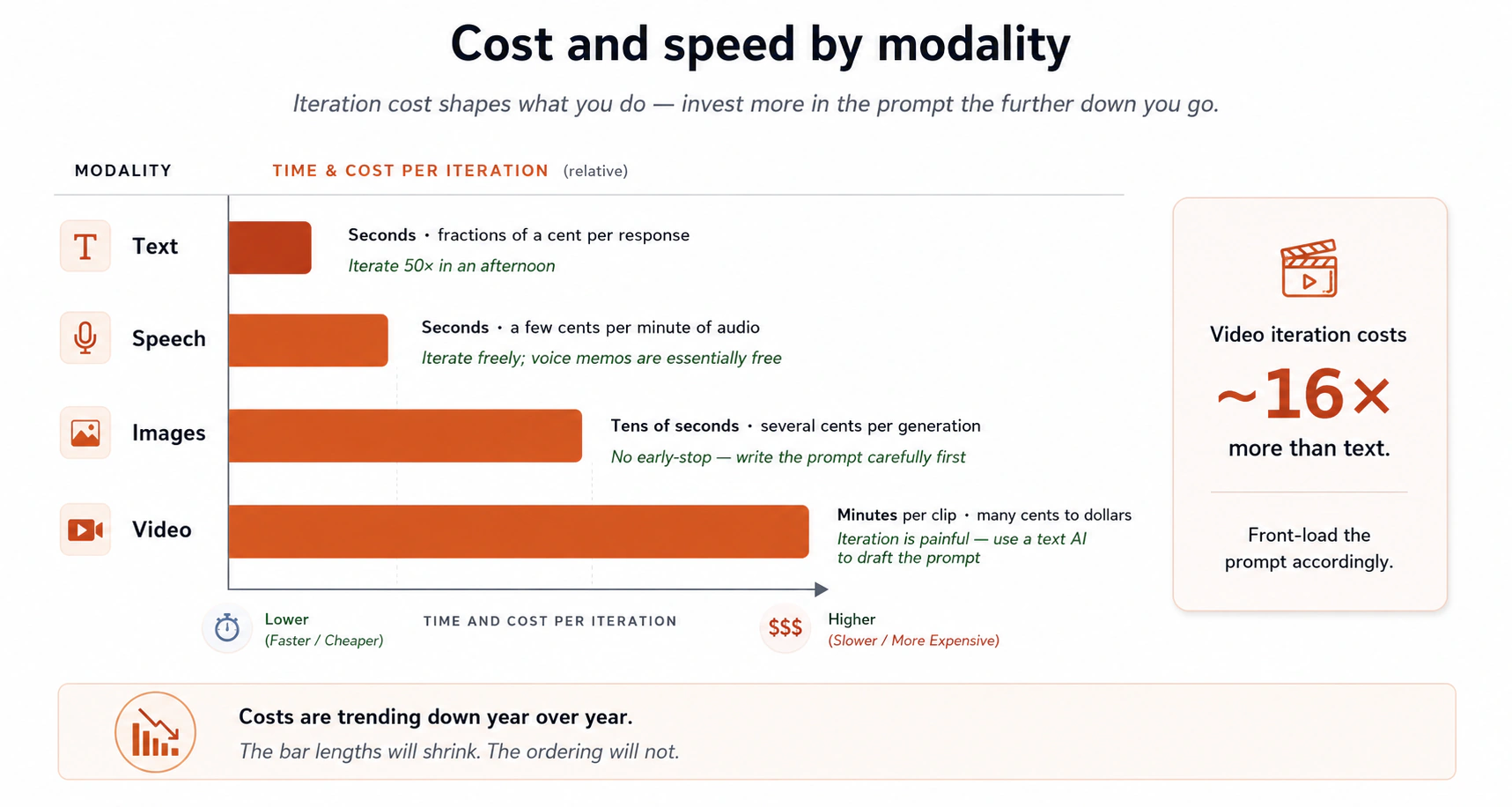
Alfaaz mein:
- Text: seconds, prati response ek cent ke hisse.
- Speech: seconds, prati minute audio chand cents.
- Images: das-bees seconds, prati generation kayi cents. Koi early-stop nahin, poori image ek hi waqt mein banti hai.
- Video: prati generation minute, kayi cents se chand dollars. Iteration takleef-deh hai kyunke har round dheema aur mehnga hai.
- Deep research: minutes, chand cents se ek-chauthai (quarter), lekin aapke liye darjanon sources jama kar deta hai.
Entry level par cost mushkil se hi ek rukaawat hai. baray chatbots, ChatGPT, Claude, Gemini, Meta AI, aur DeepSeek, sab free access dete hain jo is page jaise prompts ko aaraam se sambhaalta hai. Aap sirf tab paid plans tak pahunchte hain jab aap bhaari deep-research runs, bahut bari file uploads, video generation, ya la-mehdood rozana istemaal ke liye dhakka dete hain. Aakhri section ki exercises ke liye, in mein se kisi bhi ka free tier kaafi hai.
Do nataij:
- Iteration ki cost tay karti hai ke aap kya karte hain. Aap text par ek dopahar mein 50 baar iterate kar sakte hain. Aap video par ek dopahar mein 50 baar iterate nahin kar sakte. To jab aap images ya video banayein, to prompt mein pehle se zyada invest karein (aur use likhne ke liye ek text AI istemaal karein).
- Costs neeche ja rahe hain. Woh image jiska kharch aaj 10 cents hai agle saal uska ek hissa kharch karega. Apne ghar, ek birthday card, ya ek wedding invitation ke liye art banana tezi se muft ho raha hai.
Kis kaam ke liye kaun sa model? AI naa-hamwaar (jagged) hai: alag models alag cheezon mein achhe hain, aur aagey wala har chand maheene mein badalta hai. Koi ek behtareen model nahin hai. Do aadaat madad karti hain:
- Wohi prompt 2 se 3 models mein routine ke tor par try karein. Wohi sawal, kayi tools. Jawab parhein. Farq aapko hairaan karenge, aur woh aapki is hiss ko update karte hain ke kaun sa tool kis qism ke sawal ke liye behtareen hai.
- Ek tool se shaadi mat karein. Ek aisa worker jo sirf ek AI istemaal karta hai woh ek aisa worker hai jo apne do-tihaai kaamon ke liye is baare mein ghalat hai ke kaun sa tool behtareen hai. Switch karna muft hai; aap bas prompt ek alag tab mein paste karte hain.
Aapke kaam ke liye aaj ka behtareen AI teen maheene mein aapke kaam ke liye behtareen AI nahin hai. Dheelay rahein.
Ek mota khaaka ke har bara model abhi kis mein achha hota hai (yeh badlega; ise ek shuruaati nuqta samjhein, ek faisla nahin):
| Tool | Aksar is mein mazboot hota hai | Aksar is mein kamzor hota hai |
|---|---|---|
| Claude | Mushkil prompts par reasoning, long-document samajh, SVG aur diagram generation, code aur WebDev, ehtiyaati writing voice, munazzam tajzia. Abhi zyadatar Arena categories mein aagey hai. | In-product photo-realistic image generation ChatGPT aur Gemini ke muqable mein kam markazi hai. |
| ChatGPT | Top-ranked in-product image generation (GPT Image-2 Arena ki text-to-image aur image-edit categories mein aagey hai), voice mode, conversational range, wasee kaam ki coverage. | Kabhi kabhi tafseeli; lists aur headings ke saath zyada format kar sakta hai. |
| Gemini | Tez web search aur source synthesis, rich output ke saath deep research (charts, tables), mazboot image generation (Nano Banana variants Arena ke top 5 mein), qareebi Google Workspace integration. | Lehja zyada kata hua mehsoos ho sakta hai; kuch jawab idealan se chhote jhukte hain. |
| Meta AI | WhatsApp, Instagram, Messenger, aur Facebook mein embedded (pehle se ek billion se zyada logon ke device par); bina kisi subscription fee ke muft; Muse Spark (April 2026) muqaabilaati multimodal reasoning aur ek "Contemplating mode" laata hai jo kayi agents ko parallel mein chalata hai. Abhi Arena ke text leaderboard ke top 5 mein hai. Interactive visual artifacts (web dashboards, mini-games, quizzes) aur health ya scientific data ke liye behtareen. | Coding workflows aur long-horizon agents baray teen se peechhe hain; Projects, Canvas, ya Artifacts jaise integrations ka chhota ecosystem; abhi koi public API nahin (sirf ek private preview); agar aap zor se dhakka dein to usage rate-limited hai. |
| DeepSeek | Open-source weights jinhein aap self-host kar sakte hain ya kam cost par API ke zariye chala sakte hain; default ke tor par 1M-token context; V4-Pro STEM aur coding benchmarks par top closed-source models ka muqabla karta hai; V4-Flash tez, sasta rozmarra ka intekhab hai. | Chat-interface ka nikhaar baray teen se peechhe hai; consumer ecosystem (mobile apps, gehri integrations) chhota hai; Arena rankings zyadatar categories par Claude, ChatGPT, Gemini, aur Meta se neeche hain. |
Do naye rows par ek nota. Meta AI ki value pehle "ubiquity + muft, gehraai nahin" thi, lekin Muse Spark reasoning tasks ke liye gehraai ka kaafi faasla band kar deta hai jabke ubiquity-aur-muft ka faida rakhta hai. Agar aapke paas WhatsApp ya Instagram hai, to ab aap usi app ke andar sanjeeda soch kar sakte hain jise aap waise bhi kholne wale the. Phir bhi ise asal kaam ke liye istemaal karne se pehle do hadood jaan-ne layaq. Pehli, muft ka matlab la-mehdood nahin: Meta parde ke peechhe rate limits lagata hai, is liye Contemplating mode ka bhaari istemaal ya tez automated workflows aakhir-kaar throttle ho jaayenge. Doosri, aapke inputs mustaqbil ke Meta models train karne ke liye istemaal ho sakte hain. Meta ke terms is ki ijazat dete hain aur consumer product default tor par opt out ke liye configured nahin. Yeh Muse Spark ko hassaas mawaad ke liye ek bura intekhab banata hai: internal company documents, private code, medical information, koi bhi cheez jise aap ek training pipeline mein nahin daalna chahenge. Ghair-hassaas rozmarra ke kaam ke liye yeh behtareen hai. DeepSeek ki value open-source-aur-sasti hai: yeh sahi intekhab hai jab aap price ke prati hassaas hon, self-hosting ka option chahte hon, ya free-tier kaam ke liye woh 1M-token context window chahte hon. baray teen abhi bhi un gehre workflows par aagey hain jo yeh page sikhaata hai (Projects, Canvas, Artifacts, deep research), is liye woh hal-shuda-misaal wale tools rehte hain.
Table mein nahin, magar families ki list mein hain. xAI ka Grok ab Arena ke text leaderboard ke top tier mein hai, aur Moonshot ka Kimi kuch coding categories mein sab se oopar pahuncha hai. Dono ko table mein is liye detail nahin kiya gaya ke yeh page sirf un tools ko detail karta hai jo iski worked examples mein hain. Lekin Concept 13 ki cross-family checking mein yeh count karte hain: jis family ko aapne kabhi try nahin kiya, uske blind spots waqai alag ho sakte hain.
Bookmark karne wala leaderboard. Jab aap is ka ek mojooda nazaara chahte hain ke kaun sa model kis kaam mein aagey hai, to sab se mufeed waseela Arena hai. Users do gumnaam models ke andhe aamne-saamne muqablon mein vote karte hain, is liye rankings vendor marketing daawon ke bajaye asal tarjeehaat ko zaahir karti hain. Site text, code, vision, document, image generation, image edit, search, aur video ke liye alag leaderboards rakhti hai. Mahine mein ek baar check karein. Aagey wale tezi se badalte hain: jo model May mein ek category mein aagey hai woh August mein wahan na ho, aur ek naya aane wala hafton mein top five mein chhalaang laga sakta hai (Muse Spark ne April 2026 mein yeh kiya). Do baatein jaan-ne layaq: leaderboards lambe documents par ehtiyaati kaam se zyada conversational dilkashi ko tarjeeh dete hain, aur woh aise kaam sample karte hain jo vote-karne layaq users ko dilchasp lagte hain, jo hamesha aapka kaam nahin hota. Use kayi mein se ek ishaare ke tor par istemaal karein; Concept 13 mein leaderboard ishaaron ko un prompts par aapki apni A/B testing ke saath jorne par zyada hai jo aap waqai chalate hain.
Teen aadaat jo barhti rehti hain:
- Kam se kam do tabs khule rakhein. Ek primary tool aur ek backup. Jab primary aapko aisi cheez de jo theek na lage, to wohi prompt backup mein paste karein. Doosra jawab aksar faisla-kun hota hai.
- Ek prompt scratchpad rakhein. Ek note file (koi bhi text file chalti hai) jahan aap woh prompts jama karte hain jinhone ghair-maamooli tor par achhe nataij diye. Unhein dobara istemaal aur dhaalein. Yeh aapki niji library hai.
- Notice karein jab model ghalat ho. Daant ke tor par nahin, data ke tor par. Ghalti ek muft ishaara hai ke is tool ke kinaare kahan hain. "Tool X, Y ke baare mein aetmaad se ghalat" hafte mein ek baar log karna kisi bhi 2,000-lafz ke AI newsletter parhne se zyada mufeed hai.
Mahine mein ek baar, do cheezein saath karein: (1) jis bhi category ki aapko parwah hai uske liye Arena ke leaderboards par nazar daalein, aur (2) ek aisa kaam chunein jo aap regular karte hain (haftawaar status updates likhna, khaane plan karna, ek recurring document ka khulasa karna) aur use teen alag AI tools se chalayein. Note karein ke kis ne use aapke asal kaam par sab se behtar kiya. Use us kaam ke liye agle mahine tak istemaal karein, jab aap dobara test karein. Aapki tooling bina mehnat ke mojooda rehti hai, aur leaderboard aapko batata hai ke kya aapko ek aise naye aane wale ko test karna chahiye jo aapki nazar mein nahin tha.
13. Models, models ko check karte hain
Jab koi ground truth na ho (koi answer key nahin, koi mahir aapke paas baitha nahin, koi test jo red ho kar nakaam ho), to aap phir bhi quality par ek ghair-jaanibdaar ishaara haasil kar sakte hain. Aap ise models se ek doosre ko grade karwa kar haasil karte hain.
Halke version se shuru karein. Agar aapke paas aaj sirf ek AI tool khula hai, to single-model self-critique loop (theek neeche bayan) aapko zyadatar faida deta hai, aur yeh woh version hai jiski zyadatar rozmarra ke kaamon ko zaroorat hoti hai. Iske baad aane wali poori multi-model recipe high-stakes version hai: yeh farz karti hai ke ek doosra free account doosre browser tab mein khula hai, taqreeban ek minute ka setup, aur yeh setup sirf tab qaabil-e-qadar hai jab ghalat hona mehnga ho. Poori recipe abhi shape ke liye parhein, lekin pehle halke version ki taraf jaayein; bhaari wale par tab pahunchein jab aapki mez par koi cheez waqai use kamaye.
Alag models ke alag blind spots hote hain. Unhein milta-julta lekin ek jaisa nahin data par train kiya gaya, alag reward signals ke saath, alag teams ke zariye jinhone alag cheezon par zor diya. Ek nuqta jo ek model chhorta hai, ek doosra model aksar pakar leta hai. Un ke darmiyan ikhtilaaf woh ishaara hai jo aap kisi akele model se nahin paa sakte. Yeh sirf tab kaam karta hai jab models waqai alag families se aayein: Anthropic (Claude), OpenAI (ChatGPT), Google (Gemini), xAI (Grok), Meta (Meta AI / Muse Spark), aur DeepSeek alag families hain jin se kheencha ja sakta hai, aur nayi families aati rehti hain. Do Claude models ek doosre ko cross-check karna cross-model checking nahin hai; unke priors bahut milte-julte hain.
Yahan poori multi-model recipe hai, kayi documents par nikhaari gayi aur asal mashq se likhi gayi. Yeh high-stakes version hai; halka single-model loop agle subsection mein hai:
- Us behtareen model se shuru karein jis tak aapki rasaai hai. "Behtareen" ka matlab woh hai jiska aapke qism ke kaam par sab se mazboot reasoning aur long-output coherence ho. Kayi ishaare istemaal karein: Arena ke leaderboards ek shuruaati nuqta ke tor par (concept 12 inhein mutaaruf karaata hai), plus us qism ke kaam ke ek namaayanda namoone par aapki apni tez A/B test jo aap waqai karte hain. Yahan ek A/B test ka matlab sirf yeh hai: wohi prompt do ya teen models ko bhejein, jawab aamne-saamne parhein, aur apni aankhon ko batane dein ke kaun sa aapke qism ke kaam par behtar hai. Ek hi leaderboard se na bandhein; woh alag cheezein naapte hain, aur tarjeeh-mabni rankings lambe documents par ehtiyaati kaam se zyada conversational dilkashi ko tarjeeh deti hain.
- Pehla draft poore context ke saath banayein. Use ek colleague ki tarah brief karein (concept 1), mushkil maslon ke liye thinking mode on karein (concept 5), saakht ke liye brainstorm-iterate loop istemaal karein (concept 7).
- Use kahein ke apni output ko named criteria ke khilaaf 1 se 10 grade kare. "Kya yeh achha hai?" nahin balke "ise clarity, accuracy, structure, aur kya chhoot raha hai par score do, har ek 1-10, prati score ek ek-jumle ke jawaz ke saath." Pehla grade aam tor par 7 ya 8 hota hai.
- Use kahein ke apni tajaweez par amal kare. Dohraayein jab tak grade barhna band na ho, jo aam tor par 9 ke gird theher jaata hai.
- Draft ko ek alag family ke doosre model ke paas le jaayein. Wohi rubric maangein. Alag model, alag priors, alag blind spots. Doosra model woh cheezein pakarega jin par pehle model ne khud ko grade kiya, jo theek wohi band loop hai jis se aapko nikalna hai.
- Doosre model ki tanqeed wapas pehle model ke paas laayein. Use imaandaari se pesh karein: "ek doosre model ne yeh tanqeed banaayi. Faisla karo ke kaun se nuqte apnaane layaq hain, aur kyun. Jis se ittefaaq na ho use rad karo, aur samjhao." Pehla model faisla karta hai. Aap faisle ko dekhte hain.
- High-stakes kaam ke liye, ek teesre family ke teesre model ke saath dohraayein. Jab tak teen alag-family models aapke draft par behes kar chuke hon, aapke paas us cheez ke sab se qareeb hai jo yeh technology aapko de sakti hai.
- Tab rukein jab score do mustaqil models par aapke target ko paar kar jaaye. Akele aapke primary model se 9.5 us 9 ke baraabar nahin jo aapke primary plus ek alag-family model se hai. Doosra number woh hai jo kuch maani rakhta hai.
Single-model self-critique loop, akela
Oopar wale qadam 3 aur 4 apne aap istemaal ke qaabil hain, bina kabhi ek doosra model laaye. Bahut se kaam multi-model ke bojh ka jawaz nahin dete lekin phir bhi "ise is rubric ke khilaaf 1-10 score do, phir apni tajaweez par amal karo" ke ek round se faida uthaate hain. Ek haftawaar status update, ek thora paicheeda email, ek one-page memo: yeh sab ek self-critique pass se namaayan tor par behtar ho jaate hain.
Ek zyada faida wala variant: ek number ka target set karein aur model ko us ki taraf khud-mukhtaar tor par iterate karne dein. "Ise score do aur batao kya chhoot raha hai" ke bajaye, koshish karein "apne rubric ke khilaaf iterate karo jab tak tum saare criteria par 9.5 tak na pahuncho, phir mujhe aakhri version dikhao." Model grade karega, nazar-e-saani karega, dobara grade karega, nazar-e-saani karega, aur chalta rahega (ek hi response mein paanch ya chhe rounds) aur sirf tab aapke paas wapas aayega jab woh target tak pahunche ya theher jaaye. Yeh har round khud chalaane se namaayan tor par tez hai, aur yeh khaas tor par long-form artifacts (ek 5,000-lafz memo, ek chapter, ek jaame plan) ke liye achha kaam karta hai jahan hath se round-tripping thakaau hoti. Target khud ek steering mechanism hai: 9 ek alag chhat par majboor karta hai 9.5 se, aur 10 model ko behtar karne ke liye cheezein dhoondte rehne par majboor karta hai jab tak woh waqai koi na paaye.
Yeh aisa lag sakta hai jaise yeh concept 6 ki khilaaf-warzi karta hai, jisne aagaah kiya tha ke ek model apna kaam grade karte hue sycophancy ki taraf jaata hai. Farq rubric hai. Iske baghair, "kya yeh achha hai?" "zabardast kaam!" wapas karta hai, jo woh band loop hai jis ke baare mein concept 6 tha. Named criteria ke saath 1-10 score, model ko baaqi nuqton se kya chhoot raha hai ki nishaandahi karni parti hai, aur woh nishaandahi woh hai jis ke khilaaf aap amal karte hain. Rubric hi woh hai jo self-grade ko sycophancy se ek forcing function mein badal deta hai.
Page ab usi DNA ke teen nested versions pesh karta hai. Sab se halka chunein jo kaam ke saath fit ho:
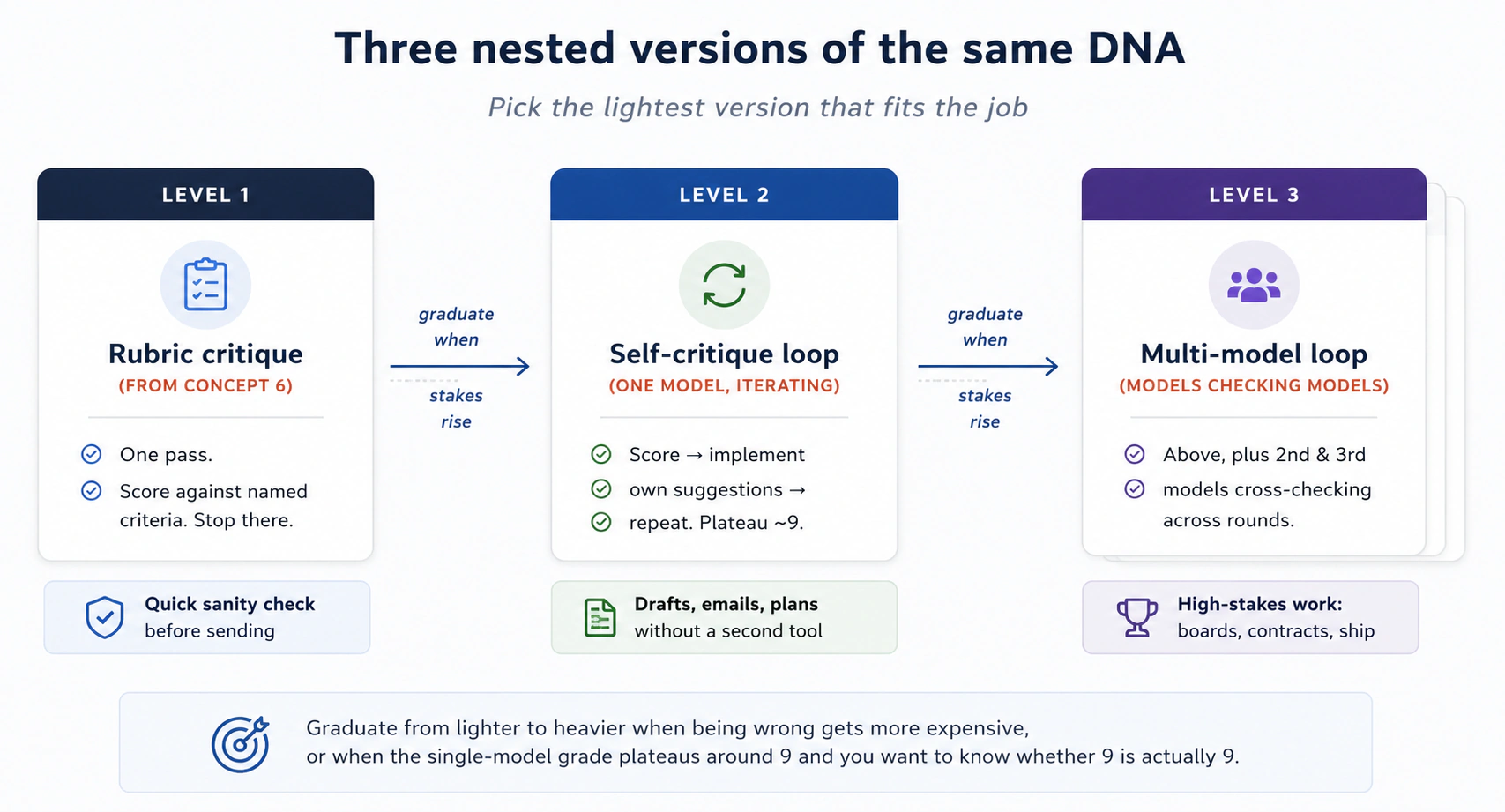
Halke version se bhaari ki taraf barhein jab ghalat hona zyada mehnga ho jaaye, ya jab single-model grade 9 ke gird theher jaaye aur aap jaan-na chahein ke 9 waqai 9 hai.
Grade kyun ahmiyat rakhta hai. Model se ek number nikalna number ke baare mein nahin hai. Yeh us baare mein hai jo number banane ke liye darkaar hota hai. Ek model jise aapke draft ko 7/10 score karna parta hai use yeh naam batana parta hai ke baaqi 3 nuqton se kya chhoot raha hai. Score ke baghair, "yeh kaafi achha hai" jaaiza ke tor par chal jaata hai. Score ke saath, "kaafi achha" ko banna parta hai "structure par 1 point khoya kyunke teesra section doosre ko dohraata hai; evidence par 2 points khoye kyunke teen daawon ka koi source nahin." Grade khaas-pan ke liye ek forcing function hai, aur khaas-pan woh hai jis par aap amal kar sakte hain. Yeh wohi waahid parhne layaq ishaara bhi hai jo aapko iteration N ka iteration N+1 se muqabla karne ko milta hai.
High-stakes kaam ke liye ek privacy nota. Cross-model checking ki tareef hi yeh hai ke aap apna draft kayi tools mein paste karte hain. Hassaas mawaad ke saath aisa karne se pehle har tool ki data policy par dhyan dein. Kuch tools (Claude apne consumer product par, ChatGPT training opt-out enabled ke saath, paid Gemini tiers) aapke inputs par train nahin karte. Doosre (Meta AI ka consumer product default tor par) kar sakte hain. Ek 40-page strategy memo, ek internal financial analysis, ya koi bhi cheez jo ek NDA ke tehat ho, sirf un tools se guzarni chahiye jin ki data policies aapne waqai check ki hain. Multi-model loop ka maqsad aapke blind spots pakarna hai; loop ka ulat maqsad aapke khufiya kaam ko ek training set mein daalna hai.
Ek imaandaar tanbeeh. Teen models phir bhi ek hi cheez ke baare mein sab ghalat ho sakte hain. Woh us se zyada training data share karte hain jitna aap andaza lagaayein, aur mutanaza ya kam-data topics (concept 2) par woh aksar wohi ghalat-fehmiyaan share karte hain. Score ek peshraft ka ishaara hai, sachaai ka ishaara nahin. High-stakes content ke liye (koi bhi cheez qanooni, medical, financial, ya kisi asal shakhs ke baare mein) koi bhi tadaad mein cross-model passes ek insani mahir ki jagah nahin le sakte jo bojh-uthaane wale daawon ka jaaiza le. Models ek doosre ko craft ke liye check karte hain. Insaan un facts ko check karte hain jo ahmiyat rakhte hain.
Loop kab chhorein.
Har kaam ise nahin kamaata. Ek chhoti email, ek tez talaash, ek halki phulki brainstorm: single-model theek hai. Multi-model cross-check us kaam ke liye bachayein jahan ghalat hona mehnga hai: ek memo jo aapka boss parhega, ek chapter jo publish hoga, ek faisla jo doosre logon ko mutaasir karta hai, ek contract jis par aap dastkhat karenge. Aam usool: agar ek sochne wala colleague ise jaance mein do ghante lagata, to yeh loop ko kamaata hai.
Ek ghair-software misaal. Ek consultant ne ek client board ke liye ek 40-page strategy memo taiyaar karte hue apne sab se mazboot model mein draft kiya aur uske apne grades ke khilaaf iterate kiya jab tak woh 9 par theher na gaye. Phir usne poora memo ek alag family ke doosre model mein paste kiya aur wohi rubric maanga. Doosre model ne use 7.5 diya aur gyaarah khaas issues ginwaaye, jin mein se teen uske primary model ne apne kisi bhi self-grading round mein nahin uthaaye the. Usne unhein faisle ke liye pehle model ko wapas diya; usne saat apnaaye aur chaar wajuhaat ke saath rad kiye. Ek aur family ke teesre model ne do aur saamne laaye. Baat aakhri scores nahin hai. Baat yeh hai ke woh counter-arguments jo woh khud kabhi na dekh pati, kyunke uska primary model uske blind spots share karta tha, board meeting se pehle memo mein the.
Prompts try karne se pehle ek chhota khulasa
Terah concepts bahut hain. Page ki shape, prati concept ek line:
- Concept 1. Ek novice prompt aur ek power-user prompt ke darmiyan farq chand aadaat hai: AI ko ek samajhdaar naye colleague ki tarah brief karein, context, constraints, aur ek wazeh maang ke saath.
- Concept 2. AI cheezein internet ke ek snapshot se janta hai, usne duniya ke baare mein text parh kar seekha, duniya ka tajurba kar ke nahin, is liye yeh aam topics par mazboot aur gumnaam ya haaliya par kamzor hai.
- Concept 3. Teen retrieval modes: pretrained, web search, deep research. Aapke alfaaz tay karte hain ke kaun sa chalta hai.
- Concept 4. Model ki apni koi memory nahin; context window is jawab ke liye uski working memory hai. Jawab ki quality ka sab se bara faisla-kun yeh hai ke aap us window mein kya daalte hain, aur projects aapko ise ek baar aage rakhne dete hain, har baar nahin. Tools ki memory features ek chhati layer add karti hain jo aapne nahin likhi, is liye use parhein aur saaf rakhein.
- Concept 5. Jadeed models seconds ya minutes ghaur se soch sakte hain agar aap unhein kahein.
- Concept 6. Models ittefaaq ki taraf jhuke hote hain. Ghair-jaanibdaar framing aur rubrics us tarafdari ka zyadatar bekaar kar dete hain; prati criterion 1-10 score par majboor karna, us tabdeeli ke saath jo har score barhaaye, baaqi ko bekaar kar deta hai.
- Concept 7. Wazeh-feedback ke saath iterate karne wala loop page par sab se zyada faida wali aadat hai. Har stage ko 10 mein se grade karein aur dobara-iterate karein jab tak score theher na jaaye, AI ko aapko khatam shuda elaan karne ka haq nahin milta.
- Concepts 8–9. AI images dekh sakta hai, audio ke saath dono taraf kaam kar sakta hai, aur chhote apps bana sakta hai, chalta hua app ek artifact hai jise aap iterate, share, aur embed kar sakte hain.
- Concept 10. AI code bhi likh sakta hai aur use aapke data par chala sakta hai, lekin yeh hamesha aisa khud-ba-khud nahin karta. Wazeh tor par maangein, aur tasdeeq karein ke code waqai chala.
- Concept 11. File-aware desktop apps (Cowork, OpenWork) ki ek nayi category hai. Permissions ko mehdood rakhein jab tak aap unhein mehfooz tareeqe se istemaal na kar lein.
- Concept 12. Kisi kaam ke liye sahi tool har chand maheene mein badalta hai. Alag families ko jaanein (Claude, ChatGPT, Gemini, Grok, Meta AI, DeepSeek) aur naye aane walon ki tawaqqo rakhein, sab ke free tiers ke saath, aur Arena woh leaderboard hai jise mahine mein dekhein.
- Concept 13. Jab kamre mein koi insani mahir na ho, models se ek doosre ko grade karwana, alag families ke aar-paar, ek ghair-jaanibdaar quality ishaare ke sab se qareeb hai.
In sab ke neeche ek harkat hai, ek darjan bhes mein dohraayi gayi: sahi context andar laao, ghalat context bahar rakho. Agar aap is page se ek bhi cheez yaad na rakhein siwaye us jumle ke, to aap phir bhi users ke top quartile mein honge.
Ab yeh try karein: thinking discipline mein gehrai se jaane se pehle baarah prompts
Parhna try karne ka ek mutbadil hai. Doosre tab mein Claude, ChatGPT, ya Gemini kholein. Yeh baarah prompts tarteeb se chalayein. Yeh kul taqreeban athaais minute lete hain aur is page ke har concept ki mashq karte hain jise aap ek chat tab se kar sakte hain.
1. Web-search trigger. AI ko apne training data se nikal kar mojooda info dhoondne par majboor karta hai.
Aaj [aapke mulk] mein kya bari khabar hui? Har daawe ko ek source
link ke saath cite karo. Koi bhi daawa jise tum citation ke saath
support na kar sako use "unverified" mark karo.
2. Sirf-pretrained sawal. Aam-ilm, koi lookup nahin chahiye. Tez aur aetmaad-bhara hona chahiye.
Billiyan deewaron ko kyun ghoorti hain? Do-paragraph ka jawab.
3. Context-bhara niji prompt. Constraints pehle load karne ki mashq.
Mere liye ek 15-minute ka home workout plan karo. Constraints: mere
ghar mein seerhiyaan hain, ek kharaab ghutna (koi squats nahin), main
teen din se zyada plans par qaayam nahin reh sakta, aur main chahta
hun ke karte hue thora bewaqoof mehsoos karun. Mujhe 3 options do,
koi tabsra nahin.
4. Ghair-jaanibdaar-framing dobara likhna. Prompt mein apni tarafdari pehchaanne ki mashq.
Jo sawal main poochna chahta hun woh hai: "Kya aapko nahin lagta ke
four-day work weeks sab ke liye zaahir tor par behtar hain?" Ise ek
ghair-jaanibdaar sawal ke tor par dobara likho jo yeh ishaara na de
ke main kaun sa jawab chahta hun. Phir dobara likhe gaye version ka
jawab do.
5. Teen-options brainstorm iteration ke saath. Markazi power-user loop.
Round 1: main ek chhota side project shuru karna chahta hun jo
hafte mein taqreeban 3 ghante leta hai aur ek saal mein paisa
kama sakta hai. Main ek [aapka pesha] hun jise [aapka shauq]
pasand hai. Mujhe 5 alag ideas do, har ek ek line. Kisi ko
phailaao mat.

(5 parhein. Jo pasand hai aur jo nahin chunein. Phir, USI
guftagu mein:)

Round 2: main options [N] aur [N] rad karta hun kyunke [wajah].
Mujhe [keyword] wala idea pasand hai lekin main chahta hun ke
yeh kam [cheez] istemaal kare. Mujhe 5 nayi options do jo is
feedback ko shaamil karein.
6. Outline-pehle tehreer. Prose se pehle saakht par majboor karein.
Main [koi topic jiski aapko parwah hai] ke baare mein ek 600-lafz
ki post likhna chahta hun. Ise abhi mat likho. Mujhe 3 alag
outline options do, har ek mein 4-6 headings. Har heading par ek line.
7. Ghaur-se-socho reasoning prompt. Ek asal niji faisla istemaal karein.
Main [aapki zindagi ka asal niji faisla] ke liye [Option A] aur
[Option B] ke darmiyan chun raha hun. Yeh mutalliqa context hai:
[context ka ek paragraph]. Jawab dene se pehle ghaur se socho.
Mujhe batao:
1. 3 trade-offs jo asal mein ahmiyat rakhte hain.
2. Tum kaun sa chunoge aur kyun.
3. Kin halaat mein tumhari recommendation badal jaati.
8. Grade-aur-behtar-karo tanqeed. Apne hi kaam par sycophancy se bachein.
Main kuch paste kar raha hun jo maine likha: [100-300 alfaaz kuch bhi paste karein].

Ise in 4 criteria istemaal karte hue tanqeed karo, har ek 1-10
score ke saath aur ek ek-jumle ke jawaz ke saath:
- Kya iska ek wazeh markazi daawa hai?
- Kya har paragraph sahi tarteeb mein hai?
- Koi aise jumle hain jinhein bina nuqsaan ke kaata ja sakta hai?
- Kya khatima parhne wale ke waqt ko kamaata hai?

Phir, har criterion ke liye, mujhe woh tabdeeli batao jo iska
score sab se zyada barhaaye. Hamesha ek agla level hota hai, ek
9 ka bhi 9.5 tak ek raasta hota hai.
9. Image-input kaam. AI ko parhne ke liye ek tasveer dene ki mashq.
[Koi bhi hath se likha note, receipt, ya whiteboard photo upload karein]

Jo likha hai use transcribe karo. Phir 3 bullets mein khulasa karo
ke yeh kis baare mein hai. Jo kuch tum aetmaad se na parh sako use
nishaan-zad karo.
10. Chhote-app prompt. Goal/Input/Output ki shape ki mashq. Jo wapas aayega woh ek artifact hoga jis par aap chat mein hi click aur iterate kar sakte hain.
Mere liye ek Pomodoro timer banao.
Goal: 25-minute work sessions, 5-minute breaks.
Input: main start dabata hun.
Output: ek nazar aane wala timer ulta ginta hua, ek tasalli-bakhsh
click jab har cycle khatam ho, ek peela theme. Mujhe chalta hua
version dikhao.
11. Data analysis: khaamosh nakaami ka tareeqa benaqaab karo. "Code ke liye wazeh tor par maango, phir tasdeeq karo ke chala" ki mashq. Yeh exercise do rounds mein hai.
Round 1, jaal: ek nayi guftagu mein, yeh prompt theek waise hi
paste karo jaise likha hai. Code ka zikr MAT karo.

  "Yeh 18 numbers hain: 47, 52, 89, 91, 23, 67, 78, 12, 95,
  44, 88, 71, 33, 56, 99, 18, 64, 82. Median, average, aur kaun
  se numbers outliers hain kya hain? Khaas raho."

Response ko ghaur se dekho. Kya AI ne tumhein ek code block
dikhaya jo usne chalaya? Ya usne ek paragraph likha jismein
numbers the aur koi nazar aane wala hisaab nahin? Apna jawab note karo.

Round 2, hal: usi guftagu mein, yeh paste karo:

  "Ab woh calculation dobara chalao, lekin is baar use karne ke
  liye code likho aur chalao, aur mujhe woh code dikhao jo tumne chalaya."

Dono jawabon ka muqabla karo. Agar pehle jawab mein median ghalat
tha, mashkook numbers gol kiye, ya bas mubham laga, to tumne abhi
concept 10 ka khaamosh nakaami ka tareeqa amal mein dekha. Sahi
jawab yeh hain: median 65.5, average ~61.6, koi wazeh outliers
nahin (numbers taqreeban baraabar phaile hain).
12. Cross-model review. Ek asal draft par multi-model aadat ki mashq. Ek saath do AI tools khule chahiyein, alag families se (Concept 13 dekhein).
Koi bhi 200-300 lafz ka draft lo jo tumne haal mein likha (ek email,
ek memo, ya in exercises mein se ek ka paragraph).

Step 1: apne primary AI tool mein, draft paste karo aur poocho: "Ise
clarity, structure, evidence, aur kya chhoot raha hai par 1-10 score
do. Prati score ek ek-jumle ka jawaz."

Step 2: ek alag family ka doosra AI tool kholo (agar tumhara primary
Claude hai, to ChatGPT ya Gemini ya Meta AI istemaal karo, ek aur
Anthropic model nahin). Wohi draft paste karo, wohi sawal poocho.

Step 3: dono scores aur dono tanqeedon ka aamne-saamne muqabla karo.
Koi bhi nuqta note karo jo sirf ek ne pakara. Woh nuqte hain jin ke
liye cross-model loop adaa karta hai.
🚀 Projects
Baarah prompts mein se har ek ne ek concept ki mashq karwaayi. Neeche pehle teen projects unhein ek saath zanjeer mein jorte hain, aur yeh aapko kahin aisi jagah le jaate hain jahan ek chat window nahin le ja sakti: ek aisi cheez ke saath jo aapne aam internet par live banaayi, ek aise pate par jise aap ek dost ko text kar sakte hain.
Har project ek free account par tees se saath minute leta hai aur jab aap taiyaar hon to khul jaata hai. Project 1 aaj karein; baaqi hafte ke liye bachaayein. Yeh tarteeb-shuda hain: har ek aisi harkat sikhaata hai jo agla istemaal karta hai. Agar kisi project ke beech mein kuch toot jaaye, to is section ka aakhri dropdown hal rakhta hai. Pehle teen ke liye shape ek jaisa hai:
 chat ise banata hai         aap download karte hain   internet ise serve karta hai
┌──────────────────┐       ┌──────────────┐  drag   ┌───────────────────────┐
│  chalta hua app  │ ────→ │  index.html  │ ──────→ │ your-app.netlify.app  │
│  side panel mein │       │   (ek file)  │         │ (ek asal, public URL) │
└──────────────────┘       └──────────────┘         └───────────────────────┘
Concept 9 ne kaha ke side panel ki cheez ek artifact hai: ek asal object jise aap download kar sakte hain, ek preview nahin. Pehle teen projects us waade ko bhuna lete hain. Project 4 capstone hai, aur yeh ek alag qism ki cheez ship karta hai: ek URL nahin balke ek knowledge artifact jo aapne AI ke saath banaaya, plus woh mustanad saboot ke aap ise chala sakte hain, sawal kar sakte hain, aur theek kar sakte hain.
Project 130-60 minSnake BattleIse khel kar ek game banayein, phir ise ek asal URL par ship karein.
ChatGPT, Claude, ya Gemini kholein aur kahein:
Chalo ek aisa game banayein aur khelein jahan ek snake barhne ke liye fruit balls khaata hai.
Side panel mein ek khelne layaq snake game zaahir hota hai. Done jab: aap apni arrow keys se snake ko chala sakein aur kuch khaa sakein. Agar aap phone par hain, to woh aapki pehli khwahish hai: "touch controls add karo." Ise ek minute khelein, aur us pehli cheez par dhyan dein jo aap chahte the ke alag hoti. Phir koi ehtiyaati brief mat likhein. Bas khwahish kahein:
Kya main game shuru hone se pehle apne snake ka color chun sakta hun?
Artifact apni jagah par update hota hai: ab ek start screen hai ek color picker ke saath. Khelte rahein, khwahish karte rahein. Phir khud game ke qawaid badlein:
Ab ise ek battle banao: computer-controlled snakes add karo, aur jab
ek snake marta hai to uska jism fruit mein badal jaaye jise doosre khaa sakein.
Yeh ek reader ki Snake Battle hai, ek asal Aapki is jaisi nahin lagegi, aur yehi baat hai. Yeh us jaisi lagegi jo bhi aapne khelte hue notice kiya.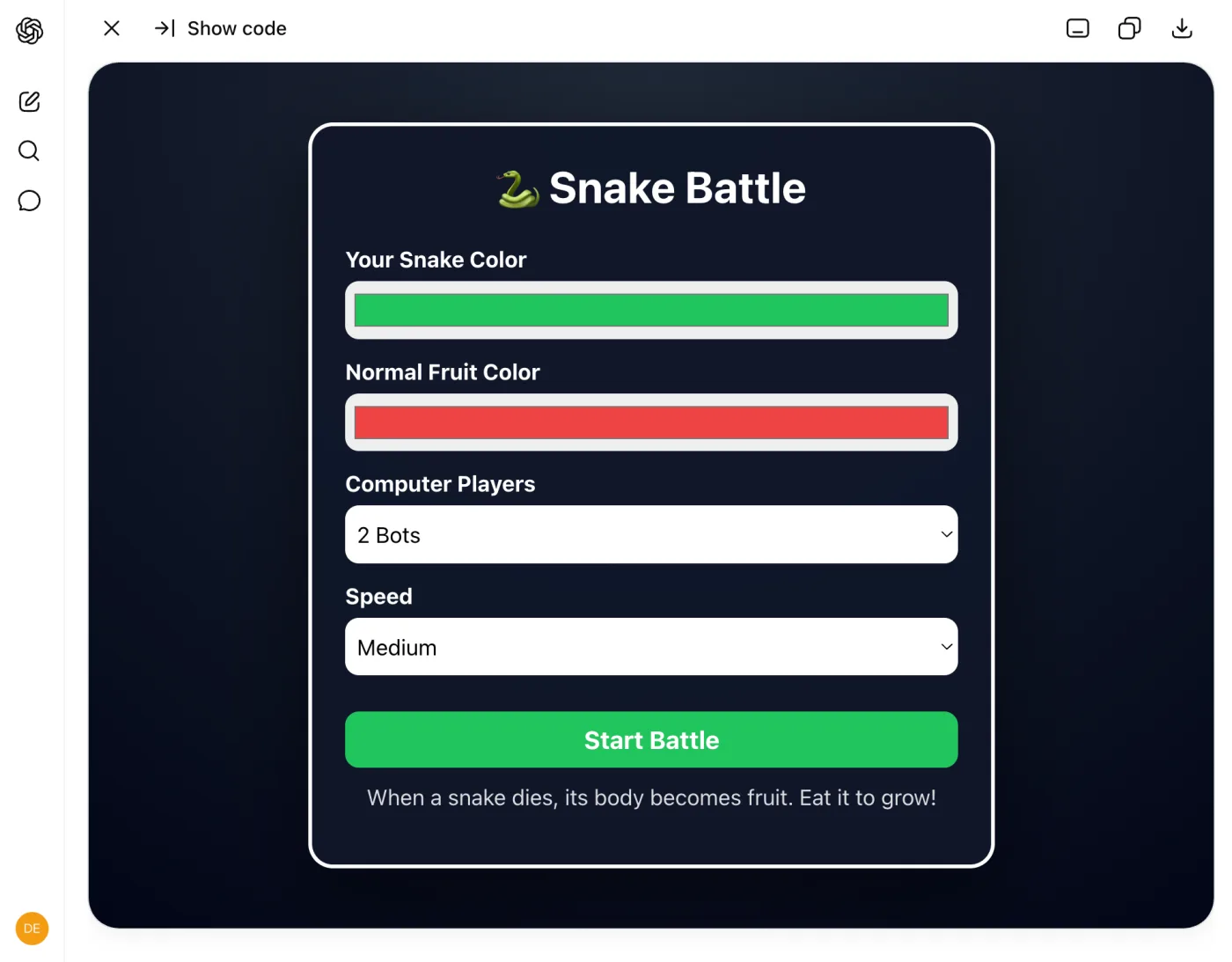
▶ Ek mukammal version khelein (us qism ki cheez jiski taraf aap bana rahe hain)
.netlify.app URL par theek us tarah ship ki gayi jaise aap apni ship karenge. Ek color chunein, Start Battle dabaayein, arrow keys se chalayein. Yeh neeche live load hoti hai; aap ise apne alag tab mein bhi khol sakte hain.
Teen jumlon mein, aapke paas ek start screen, color pickers, bot opponents, aur ek qaayda hai jo aapne eejaad kiya. Ab do cheezein notice karein. Pehli, woh jo aapne kabhi zikr nahin kiya: HTML, JavaScript, collision detection, game loops. Aapne ek tajurba bayan kiya aur model ne engineering ki, theek jaise Concept 9 ne waada kiya tha. Doosri, har jumla kahan se aaya. Planning se nahin. Khelne se. Yeh Concept 7 ka loop hai jismein feedback ka qadam sab se imaandaar nuqta-cheen se badal diya gaya hai jo dastiyaab hai: aap, game ke beech mein, notice karte hue ke aap kya chahte hain ke alag hota. Chalte rahein jab tak game aapka na ho jaaye. Tez snakes, ek score, sound effects, prati message ek khwahish.
Live hone se pehle ek aakhri pass. Aap is poore waqt ehsaas se grade kar rahe the; har khwahish ek chhota faisla thi. Ise ek baar wazeh karein: game se kahein ke khud ko score kare aur apni sab se kamzor jagah theek kare.
Is game ko teen cheezon par 1-10 score do: kya yeh mazedaar hai, kya yeh
wazeh hai ke kya karna hai, aur kya yeh mukammal mehsoos hota hai ya
khurdura? Har ek par ek jumla. Phir woh ek tabdeeli karo jo sab se kam
score barhaaye, aur use karo.
Yeh poori harkat chhote paimaane par hai. Ek number ek imaandaar jawab par majboor karta hai jahan "kya yeh achha hai?" hamesha sirf ek haan paata hai (Concept 6). Yahan ek round karein. Agla project is waahid maang ko ek aise loop mein badal deta hai jo tab tak nahin rukta jab tak scores na rukein.
Ab ise ship karein. Yeh woh harkat hai jo har project dobara istemaal karta hai, is liye ise ek baar ehtiyaat se karein:
-
Game download karein. ChatGPT ke canvas mein panel ke oopar ek download icon hai; Claude aur Gemini ke paas apne mein ek baraabar ka download ya export control hai. Aapko ek waahid
.htmlfile milti hai. Woh file poora game hai. -
File ka naam
index.htmlrakhein. Woh naam web ka "ek site ka pehla safha" ke liye usool hai, aur agle qadam mein hosting service usi ko dhoondti hai. -
netlify.com par ek free account banayein. Ek email address kaafi hai. Netlify ek hosting service hai: yeh files leti hai aur unhein internet par serve karti hai, ek free tier ke saath jo is project ki zaroorat se zyada hai.
-
Apni file ko drop zone mein drag karein. Signup ke baad, Netlify ek "Let's create your new project" page dikhata hai jiska drop zone, apne alfaaz mein, "a single HTML file" qubool karta hai. (Phone par, drag karne ke bajaye "browse files to upload" par tap karein.)
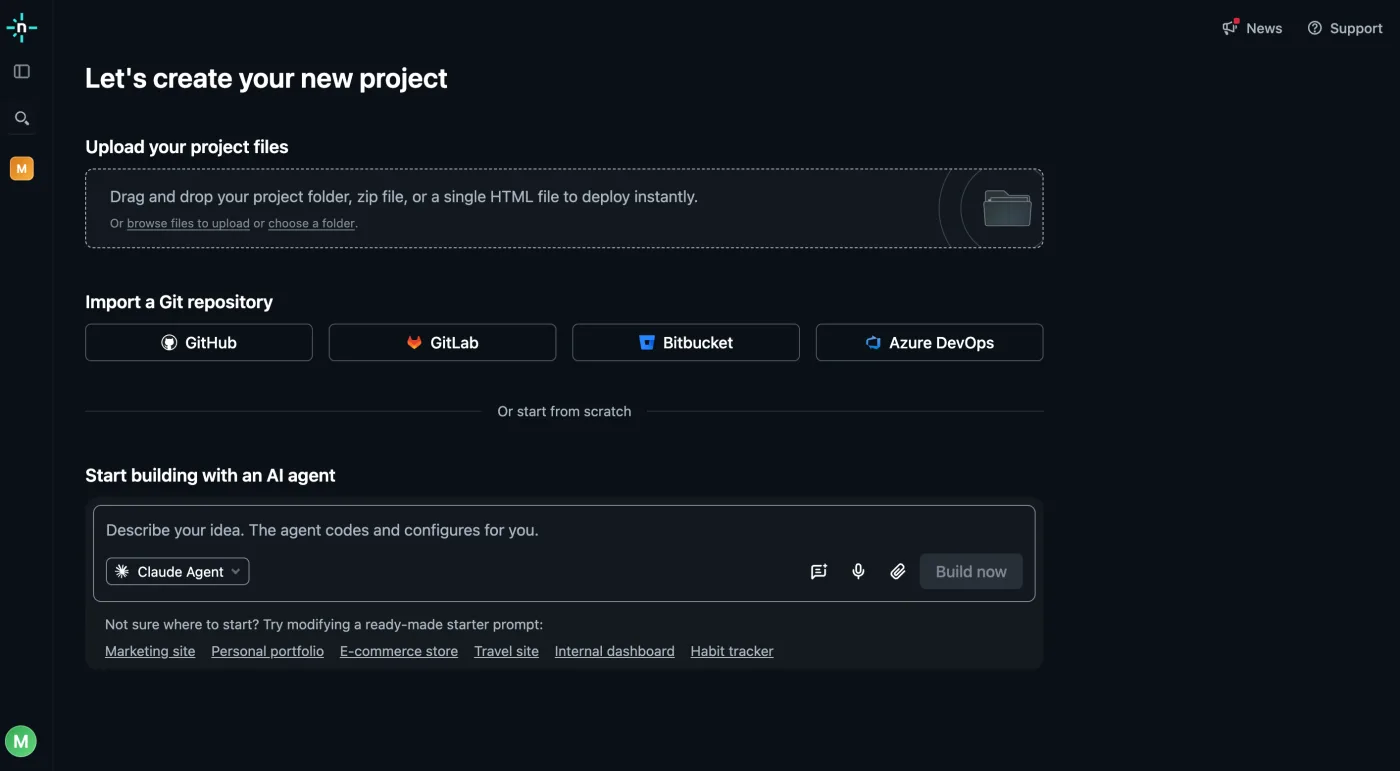
-
Jo address yeh aapko deta hai use kholein. Drop ke chand seconds baad, aapka game
.netlify.apppar khatam hone wale ek address par live hota hai. Done jab: game aapke phone ke browser mein load ho, sirf aapke computer par nahin. Link ek shakhs ko bhejein.
Ek munasib sawal: Concept 9 ne kaha ke chat tools ek artifact ko ek share karne layaq link par publish kar sakte hain, to download ki zehmat kyun? Kyunke publish kiya gaya link AI product ke andar rehta hai, aapki chat se juda. Download ki gayi file aapki hai: yeh kisi bhi hosting service par, ek USB stick par, das saal mein chalti hai. Netlify ittefaaq se aapki apni file ko khule web par daalne ka sab se tez free tareeqa hai, aur jo drag-and-drop aapne abhi kiya woh waqai wohi harkat hai jo professionals ek tez site khari karne ke liye istemaal karte hain.
Ek ship kiye game ko update karne ke liye: chat mein iterate karte rahein, dobara download karein, dobara rename karein, aur nayi file ko Netlify mein apne project ke deploys screen par drag karein. Wohi address, naya version.
Project 245-60 minWhack-a-MoleEk game banayein, phir ise 'kaafi achha' se aage grade karein jab tak yeh waqai mazedaar na ho jaaye.
Snake game achha is liye bana kyunke aapne use khela, phir ship karne se pehle ise ek baar grade kiya. Yahan, woh waahid grade poora engine ban jaata hai: aap page ki har harkat ek saath chalate hain, options brainstorm karte hain, saakht ke saath brief karte hain, test karte hain, ek rubric ke khilaaf score karte hain, aur rukne se inkaar karte hain jab tak scores buland na hon. Yeh "mere liye ek cheez banao" ka muzabbit version hai, aur yehi woh hai jo aisi cheez banata hai jise share karte hue aap fakhr karein.
Yeh ek reader ka Whack-a-Mole hai, jo ek asli Aapka game is jaisa nahin dikhega, aur yehi baat hai. Yeh us theme jaisa dikhega jo aapne chuna aur us feedback jaisa jo aapne diya.
▶ Ek tayyaar version khelo (is tarah ki cheez aap bana rahe hain)
.netlify.app URL par ship kiya gaya hai, bilkul usi tarah jaise aap apna ship karenge. Moles par click karein jab woh dikhein aur apna high score todne ki koshish karein. Yeh neeche live load ho raha hai; aap ise ek nayi tab mein bhi khol sakte hain.
Options maang kar shuru karein, ek build nahin (Concept 7):
Main ek Whack-a-Mole game banana chahta hun. Kuch bhi banane se pehle,
mujhe 3 alag visual theme options do. Har ek ek line.

Color scheme, moles kaise dikhte hain (animals, monsters, aliens), aur
overall mood (playful, spooky, elegant) mein farq rakho. Abhi kisi ko
banao mat.
Jo aapko pasand hai woh chunein aur model ko har woh cheez dein jo use banane ke liye chahiye. Yeh Concept 9 ka Goal / Input / Output hai, woh saakht jo andaze ke liye kuch nahin chhorti:
Main twilight garden theme chunta hun: gehre neele raat ke aasmaan ke
saath jhilmilaate sitaare, chamakte sunehre accents, gehri emerald ghaas,
aur moles ke tor par pyaare animal emojis.

Ab in specs ke saath game banao:

Goal: Moles ek 3x3 grid ke holes se bay-tarteeb tor par upar nikalte
hain. Player points score karne ke liye unhein click karta hai. Woh thori
der baad ghaayab ho jaate hain.

Input: Player un moles par click karta hai jo nazar aate hain.

Output:
- 3x3 grid wazeh tor par nazar aane wale holes ka jin ke gehre centers aur
  brown dirt rims hon jo ghaas se numaayan hon
- Yeh emojis istemaal karte hue moles: hamster, bear, frog, monkey,
  rabbit, fox - bare aur bilkul saaf jab woh upar nikalein
- Oopar ek score counter
- Ek color-coded progress bar ke saath 30-second countdown timer
- Moles hole ke ANDAR SE upar uthein, uske upar tairte hue nahin
Side panel mein ek khelne layaq game zaahir hota hai. Done jab: moles upar niklein aur ek par click karne se ek point barhe. Yeh pheeka mehsoos hoga, aur yeh mutwaqqa hai: aapke paas dhancha hai, ehsaas nahin. Ehsaas ek pass mein add karein (Concept 4, har tafseel jo aap chhorte hain model ko uska andaza lagana parta hai):
Game mein yeh features add karo:

1. SPEED: Moles dheeme shuru hote hain, taqreeban 2.5 seconds ke liye
   nazar aate hain. Speed SIRF tab barhe jab player ka SCORE barhe, na ke
   jab waqt guzre. Ek speed label dikhao: Easy, Fast, Frenzy.

2. INSTANT START: Pehla mole foran zaahir ho jab player Start click kare.
   Koi intezaar nahin.

3. HIT EFFECTS: Jab ek mole ko whack kiya jaaye, yeh sab dikhao:
   - Hit ke point par rangeen particle burst
   - Ek plus one text upar ki taraf tairta aur ghaayab hota
   - Asar ke liye ek tez screen shake
   - Web Audio API istemaal karte hue ek chhota sound effect

4. GAME OVER SCREEN: Aakhri score bara aur animated dikhao, kul hits,
   hits-per-minute stat, confetti animation, agar kamaaya ho to New High
   Score badge, aur ek Play Again button.
Ab ise khelein, aur woh karein jo Concept 7 ne sikhaaya: theek theek kahein ke kya ghalat hai AUR aap iske bajaye kya chahte hain. Mubham shikaayatein mubham fixes paati hain:
Maine game khela aur yeh issues paaye:

1. Moles zyadatar hole ke andar chhupe hain. Unhein dirt ke upar wazeh
   tor par nikalna chahiye taake main poora emoji chehra dekh sakun.
   Layering theek karo taake moles dirt ke saamne render hon.

2. Holes gehre background mein ghul jaate hain. Har hole ke khulne ke gird
   ek nazar aane wala halka brown rim add karo taake woh ghaas se wazeh
   tor par numaayan hon.

3. Start click karne ke baad pehla mole zaahir hone mein game 2 seconds
   leta hai. Use zero delay ke saath foran zaahir karo.

Teenon issues theek karo.
Yahan woh harkat hai jo ek khilone ko ek mukammal game se alag karti hai. "Kya yeh achha hai?" mat poochein, model hamesha haan kahega (Concept 6). Use ek rubric dein aur ise imaandaari se khud ko score karne par majboor karein:
Is game ko har criterion par 1-10 score do. Prati score ek ek-jumle ka
jawaz do. Phir HAR criterion ke liye, mujhe woh waahid tabdeeli batao jo
score sab se zyada barhaaye.

1. VISUAL CLARITY - Kya main foran har hole aur mole dekh sakta hun?
2. FUN FACTOR - Kya ek mole ko whack karna tasalli-bakhsh lagta hai?
3. DIFFICULTY CURVE - Kya yeh aasan shuru hota hai aur munsifana tor par
   mushkil hota hai?
4. POLISH - Kya yeh ek mukammal game lagta hai ya ek khurdura draft?
5. GAME FEEL - Kya animations aur sounds mujhe khelte rehne par maaeel
   karte hain?

Hamesha ek agla level hota hai. Ek 9 ka bhi 9.5 tak ek raasta hota hai.
Phir loop karein jab tak yeh score na kamaaye, aur aap faisla karte hain ke kab kamaaya, model nahin (Concept 13):
Tumne jo tajweez ki un mein se top 3 sab se zyada-asar tabdeeliyaan
implement karo. Phir game ko unhi 5 criteria par dobara score do. Chalte
raho jab tak saare scores 9 ya us se upar na hon. Main faisla karta hun ke
kab rukna hai, tum nahin.
Woh loop poora project hai. Use do baar chalayein aur aapka game "ek cheez jo AI ne banaayi" se "ek cheez jis par main apna naam likhun" tak ki lakeer paar kar leta hai. Jab aap ek aisa feature chahein jise asal design chahiye, sirf zyada tafseel nahin, to model se kahein ke banane se pehle soche (Concept 5). "Think hard" jumla extended reasoning on kar deta hai: Aur jab aapke paas ek version ho jo aapko pasand ho, to maaloom karein ke kya ek alag tool ne ise behtar kiya hota (Concept 12). Pehle wale theme-and-build prompt aur game-feel prompt ko jorein, phir unhein ek aise tool mein paste karein jo aapne istemaal nahin kiya: Ek aisa shakhs jo sirf ek hi AI istemaal karta hai woh andaza laga raha hai ke kaun sa behtareen hai. Ab aap jaan jaayenge, is qism ke build ke liye, apni aankhon se.Do power moves, jab basics chal jaayein
Is par ghaur se socho: main ek zyada hoshyaar difficulty system chahta
hun.

Abhi speed bas score ke saath barhti hai. Lekin ek player jo 10 seconds
mein 10 points score karta hai bahut maahir hai, jabke ek player jo 25
seconds mein 10 points score karta hai dheema hai. Unhein alag difficulty
levels ka saamna karna chahiye.

Ek adaptive difficulty system design karo jo player ke score AUR woh kitni
tezi se score kar rahe hain dono par ghaur kare. Pehle apna tareeqa
samjhao, phir use implement karo.Apne Prompt 2 aur Prompt 3 ko mila kar copy karo aur unhein ek alag AI
tool mein paste karo. Agar tumne Claude istemaal kiya, to ChatGPT ya
Gemini try karo.
Dono versions aamne-saamne khelo aur muqabla karo:
- Kis version ke visuals aur colors behtar hain?
- Kis version ke moles aur holes zyada wazeh hain?
- Kaun sa version khelne mein zyada mazedaar hai?
- Kis version ke animations aur sound behtar hain?
Dono se behtareen ideas lo aur apne main AI tool se kaho ke woh features
add kare jo doosre version ne behtar kiye.
Ise bilkul snake game ki tarah ship karein: download karein, index.html rename karein, Netlify mein drag karein (ek naya project). Done jab: ek dost aapka game link se apne phone par khel sake.
Project 330-60 minEk page jo aap hainEk one-page personal site jise ek ajnabi paanch seconds mein samajh le.
Is project ki pehli koshish aam tor par aisi dikhti hai. Ise novice approach kahein (Concept 1 amal mein):
Main is June Summer Camp mein AI seekh raha tha. Ab main soch
raha hun ke ek personal website banaun jo mere baare mein sab
kuch dikhaye aur woh bhi jo maine is Summer Camp mein seekha
hai. Share karo ke personal website mein kya kya jaata hai
Ab oopar wale idea ke saath ek personal website banao aur ise dikhao
Ek bilkul theek-thaak page wapas aata hai, aur yehi asal trap hai. Yeh poochna ke personal website mein kya jaata hai ek achhi instinct thi, lekin is sawal mein koi shakhs hai hi nahin, is liye jawab generic hai, aur doosra prompt woh sab ka sab qubool kar leta hai. "Mere baare mein sab kuch" asal mujh ke baare mein kuch bhi liye baghair pahuncha, is liye model us khaali jagah ko usi waahid tareeqe se bharta hai jo uske bas mein hai (Concept 2): apne training data ke average student page se. Stock sections, "passionate about learning," aisi achievements jo kisi ki bhi ho sakti hain. Shaista, saaf, kisi ki bhi nahin. Page usi tarah achha banta hai jis tarah is page ka har jawab achha banta hai: jab context asal ho jaaye.
Yeh wohi project hai jise ek reader ne, summer camp ke ek student ne, theek us tarah chalaaya jaise yeh page sikhata hai. Teen prompts, shuru se ship tak. Pehle brief: ek aisa goal jis mein audience shaamil ho, aur un faislon ki ek list jin mein woh kisi bhi design ke banne se pehle apni raaye chahta hai:
Ab tum ek professional personal website banaoge

Mera Goal: Khud ko sab ke saamne professionally pesh karna
(dost, rishtedaar, businesses)

Yeh kuch points hain jin par humein ise design karne se pehle
kaam karna hai:
1. Website ke Colors
2. Background aur Design
3. Text ka Size, Likhne ka Style
4. Kya information wahan hogi
5. Hum ise professionally kaise pesh karein

Banao aur dikhao
Is mein se kuch bhi designer vocabulary nahin. "Text ka Size, Likhne ka Style" kisi ka bhi official jargon nahin, aur phir bhi yeh kaam karta hai, kyunke yeh model ko batata hai ke kaun se faisle approve karne ka haq uska hai. Ek munasib page wapas aaya: saaf sections, sab se oopar uska naam. Yeh mukammal lag raha tha. Usne ise us tarah parha jaise ek visitor parhta, aur pakar liya jo ghaayab tha. Phir usne apni summer-camp certificate ki file chat mein attach ki (files bhi context hain, Concept 4) aur woh saboot bheja jo sirf wohi de sakta tha:
Yeh achha lagta hai lekin is mein sab se ahem information ghaayab hai

1. Main web par games design kar sakta hun. Showcase karne ke
   liye ek misaal: https://snake-game-by-junaid.netlify.app/
2. Main ChatGPT aur is jaise AI assistants ko professionally
   istemaal karna jaanta hun, jaise Claude aur Gemini
3. Main woh sab kuch jaanta hun jo yahan maujood hai
   https://agentfactory.panaversity.org/docs/ai-prompting-2026
4. Main oopar wale link ki cheezon ke baare mein kisi ko bhi
   professionally guide kar sakta hun
5. Summer camp ke aakhir mein ek exam tha aur main certified
   hua. Maine certificate attach kar diya hai

Ab plan karo aur ise update karo
Har line ek asal cheez hai jise ek ajnabi check kar sakta hai: ek game jo usne theek us tarah ship kiya jaise Project 1 ek ship karta hai, woh course jo usne parha (item 3 wohi page hai jo aap abhi parh rahe hain), ek file jo model khud parh sakta hai. Ek bhooli hui cheez ki qeemat ek message thi, ek restart nahin. Aur "Ab plan karo aur ise update karo" chand alfaaz mein Concept 7 ki azm-se-pehle-options wali instinct hai: pehle plan, phir page ko haath lagao. Jo version wapas aaya us mein wahan saboot tha jahan pehle adjectives hua karte the. Ek nazar baad, aakhri harkat: ek design khwahish, snake-game ke andaaz mein, itni khaas ke apna fix khud saath laaye:
Sab se oopar mera poora naam Muhammad Junaid Shaukat hai aur
agle section mein bhi wohi. Yeh bura lagta hai. Filhaal oopar
MJS aur mera game link hona chahiye
https://snake-game-by-junaid.netlify.app/
▶ Woh page dekhein jo in teen prompts ne banaya (live)
Yeh asal ship kiya gaya nateeja hai, ek aise address par jise usne Netlify ki settings mein apne naam par rename kiya, theek us tarah jaise neeche ship wala qadam bayan karta hai. Yeh yahan live load hota hai; aap ise apne alag tab mein bhi khol sakte hain.
Aapka is jaisa nahin lagna chahiye. Ise aap jaisa lagna chahiye.
Ab apna chalayein. Uski harkatein churayein, uske facts nahin: shuruaat apne goal aur is baat se karein ke page kis ke liye kaam karna chahiye, woh faisle list karein jin mein aap apni raaye chahte hain, phir "Banao aur dikhao." Agar aapko page ke bajaye page ki tafseel mile, to kahein: "do it." Aap in do alfaaz ko is section ke kisi bhi doosre prompt se zyada istemaal karenge. Jab pehla version mukammal lage, to ise ek visitor ki tarah parhein aur us sawal ka jawab dein jiska jawab usne diya: is page mein sab se ahem information kaun si ghaayab hai? Use asal, check ho sakne wali cheezon ki soorat mein bhejein: jo aapne ship kiya uske links (Project 1 wala game yahan aata hai), ek file jo model parh sake, jo aapne parha uske naam. Phir design khwahishein, prati message ek. "Heading cheekh rahi hai." "Kam purple." "Sections ke darmiyan zyada jagah."
Jab yeh mukammal lage, yeh mukammal nahin. Aur yahan grade karne wala aap nahin ho sakte: aap pehle se jaante hain ke aap kaun hain, is liye aap mehsoos nahin kar sakte ke page asal mein woh kehta hai ya nahin. Yeh woh waahid project hai jahan aapko kisi aur ki aankhein udhaar leni hoti hain. Wohi grade-and-fix loop chalayein jo aapne mole game par chalaaya (Concept 6 ki imaandaar-rubric harkat), ek tabdeeli ke saath: AI ko ek khaas ajnabi dein jo woh bane.
Pehli baar is page par aane wale ek khaas ajnabi bano. Ek chuno aur uske
zehan mein raho: ek recruiter jo aath seconds ke liye scan kar raha hai,
ek classmate jo mujhse kabhi nahin mila, ya koi jiske liye mera kaam waqai
ahmiyat rakhta ho. Page ko teen cheezon par 1-10 score do: kya tum paanch
seconds ke andar jaante ho main kaun hun, kya yeh zaahir hai ke main
chahta hun tum kya karo, aur kya kuch aisa parha jata hai jaise filler jise
tum chhod doge? Har ek par ek jumla, unki aawaaz mein. Phir woh waahid
tabdeeli karo jo sab se kam score barhaaye aur use page par laagu karo,
sirf bayan mat karo.
Use do baar chalayein, har baar ek alag ajnabi. Jab do log jo kabhi na milte dono aapko paanch seconds mein samajh lein, to page mukammal hai. Woh ittefaaq woh ishaara hai jo aap apni aankhon se nahin paa sakte.
Ise bilkul game ki tarah ship karein: download karein, index.html rename karein, Netlify mein drag karein (is baar ek naya project). Apne project ki settings mein aap random site name ko apne kareeb kisi cheez mein badal sakte hain, agar woh liya hua na ho. Done jab: aapka naam ek aise page tak pahunche jo aapne banaaya, aur address aapke bio mein baithe.
Project 42-4 hrsAI Mini TextbookAI ka istemaal kar ke ek topic par ek chhota learning chapter banayein, phir sabit karein ke aap ise chala aur check kar sakte hain.
Pehle teen projects mein se har ek ek public URL par khatam hua. Yeh jaan-boojh kar nahin hota. Yahan aap AI ka istemaal kar ke ek topic par jise aap parh rahe hain ek chhota mini textbook chapter banate hain, aur asal deliverable do cheezein hain: chapter (product) aur ek process notebook jo sabit karta hai ke aap AI ko chala, sawal kar, aur theek kar sakte hain (saboot). Neeche ki framing ek school student ke liye likhi gayi hai jo class se ek topic chunta hai, lekin yeh sab ke liye chalti hai: koi bhi topic chunein jise aap waqai seekhne ki koshish kar rahe hain, "teacher" ka matlab koi bhi ho jo aapka kaam check karega, aur submission ko ikhtiyari samjhein.
Yeh capstone is liye hai kyunke yeh is page ki har cheez ek saath mashq karta hai: AI ko mazboot context dena (Concept 4), sahi retrieval mode chunna (Concept 3), options-phir-feedback loop aur rubric scoring (Concept 7), aur daawon par bharosa karne ke bajaye unhein verify karna (Concepts 2 aur 13). Mini textbook product hai. Aapka prompt log, aapke fact-checks, aur aapka reflection woh saboot hain ke aap AI ko zimmedaari se istemaal kar sakte hain.
Yeh kaise kaam karta hai, pehle parhein. Aap asal kaam ChatGPT, Claude, ya Gemini mein ek doosre browser tab mein karte hain. Yeh card aapko chalane ke liye prompts deta hai, tarteeb se, aur neeche ek live workbook (Step 6 par) jahan aap apne hath se record karte hain ke aapne kya kiya, aapka saboot ke aapne AI ke saath kaise reasoning ki. Woh workbook abhi kholein aur jaise aap qadmon se guzrein use bharte rahein, bajaye iske ke ise sab aakhir ke liye chhor dein. Jis cheez ki aapko zaroorat hai woh is page par plus ek free AI account hai.
Step 1: Ek chhota topic chunein aur apna AI kholein
Ek chhota topic chunein, ek poora mazmoon nahin, kyunke aap ek chhote topic ko waqai chand safhon mein achhi tarah parha sakte hain. Photosynthesis mat chunein; hal-shuda misaal ise istemaal karti hai. Phir bas ChatGPT, Claude, ya Gemini kholein aur is project ke liye ek taaza chat shuru karein. Agar ittefaaq se aapke paas topic par notes ya ek textbook ho, to unhein baad mein paste karne ke liye paas rakhein; agar nahin, to AI ka apna ilm kaafi hai.
| Poora mazmoon | Ek chhota topic jise aap waqai parha sakein |
|---|---|
| Biology | Food chains aur energy kaise behti hai |
| Mathematics | Fractions aur percentages |
| Physics | Electric circuits |
| English | Ek mazboot essay introduction likhna |
| History | 1857 ki Jang-e-Azaadi ke asbaab |
Agar aap ek chahein to local ideas: load-shedding ke dauran electric circuits, shopping discounts istemaal karte hue percentages, ek school announcement istemaal karte hue English grammar, ya ratios istemaal karte hue ek class event ki budgeting.
Done jab: aapne ek chhota topic chun liya aur ek taaza AI chat khuli hai, jaane ke liye taiyaar.
Step 2: AI ko achhi tarah brief karein (Concept 4)
Do prompts chalayein. Pehle ek jaan-boojh kar kamzor wala, aur jawab save karein, taake baad mein aap aamne-saamne dekh sakein ke ek achha brief cheezon ko kitna behtar karta hai. Phir ek asal jo AI ko aapka context deta hai: aap kaun hain aur aap kya seekh rahe hain. Woh doosra prompt ek harkat mein Concept 4 ka poora sabaq hai.
___ samjhao.
Kyun: ise pehle sirf baseline dekhne ke liye chalayein, ek susth prompt aur ek achhe ke darmiyan farq.
Main Grade ___ ka student hun. Main ___ ke baare mein seekh raha hun. Ise
mujhe wazeh tor par samjhao, phir mujhe batao ke kya abhi bhi ghair-wazeh
hai aur main kya ghalat samajh sakta hun.
Kyun: yeh model ko aapki asal soorat-e-haal deta hai, taake jawab ek aam reader ke bajaye aap par fit ho.
Ikhtiyari, sirf agar aapke paas waqai notes, ek textbook photo, ya ek worksheet ho: unhein paste karein aur AI se kahein ke un par tikay. Zyadatar readers ise chhor sakte hain aur AI ka apna ilm istemaal kar sakte hain.
Yeh mere notes / ek textbook photo hain: ___. Inhein pehle istemaal karo.
Agar tum koi aisi cheez add karo jo in mein nahin, to use wazeh tor par
extra label karo.
Done jab: AI ne aapke asal context (aapka level aur aap kya seekh rahe hain) istemaal kar ke jawab diya. Har prompt, aur usne kya wapas diya iski ek line, neeche workbook mein paste karte rahein.
Step 3: Options lein, phir push back karein (Concept 7)
Apne topic ko samjhane ke teen alag tareeqe maangein, lekin AI ko abhi kisi ko poore chapter mein phailaane mat dein. Phir ek chunein, baaqi ko wajuhaat ke saath rad karein, aur nazar-e-saani shuda outlines maangein. Ek wajah ke saath rad karna woh harkat hai jo sabit karti hai ke aap AI ko chala rahe hain, sirf uska pehla idea qubool nahin kar rahe.
Mujhe ek Grade ___ student ko ___ samjhane ke 3 alag tareeqe do. Abhi
poore chapter mein mat phailaao. Har option ke liye, ek title, structure,
strengths, aur weaknesses do.
Kyun: yeh drafting se pehle brainstorming par majboor karta hai.
Main option ___ chunta hun kyunke ___. Main option ___ rad karta hun
kyunke ___. Outline ko 3 behtar versions mein nazar-e-saani karo aur unhein
mere class context ke liye zyada munasib banao.
Kyun: yeh dikhata hai ke aap AI ko chala rahe hain, sirf pehla jawab qubool nahin kar rahe.
Done jab: aapne kam se kam ek option ko ek wajah ke saath rad kar diya aur aapke paas ek nazar-e-saani shuda outline hai jo aapko waqai pasand hai.
Step 4: Chapter banayein (Part A)
Ab jab planning loop ho gaya, AI se kahein ke ghaur se soche aur aapke notes aur chune hue outline se poora chapter draft kare. Chapter mein saari das Part A sections honi chahiyein, jo neeche collapsible mein gini gayi hain.
Mere notes aur chune hue outline ko ghaur se parho. Clarity, accuracy, aur
age-fit ke baare mein ghaur se socho. Ab Grade ___ students ke liye poora
mini textbook chapter banao. Saadah zabaan, chhote paragraphs, examples,
common mistakes, flashcards, quiz, aur ek 7-day revision plan istemaal
karo.
Kyun: yeh ehtiyaati kaam sirf planning loop ke baad maangta hai.
Done jab: aapke paas ek draft hai jo saari das Part A sections cover karta hai.
Step 5: Ise score karein, phir verify karein (Concepts 2, 7, 13)
Pehle AI se kahein ke apne draft ko ek rubric ke khilaaf grade kare aur jo sab se chhoti edits woh tajweez kare woh kare. Phir use kahein ke apne ahem daawe ginwaaye, aur baray mein se chand khud check karein, apne notes, ek textbook, ya ek tez web search ke khilaaf, har ek ko Accept, Reject, Modify, ya Needs checking mark karte hue. Ek score aapko batata hai kahan behtar karna hai; verification aapko batata hai ke asal mein kya sach hai.
Chapter ko chaar criteria par 1 se 10 grade karo: clarity, accuracy,
age-fit, aur revision ke liye usefulness. Har score ko ek jumle mein jawaz
do. Phir mujhe woh sab se chhoti edit batao jo har score ko sab se zyada
barhaaye.
Kyun: yeh tanqeed ko qaabil-e-paimaaish behtari mein badal deta hai.
Chapter mein 6 se 10 ahem factual claims ginwaao. Har daawe ko mere notes
se supported, ek named source se supported, needs checking, ya unsupported
mark karo. Agar tumne kuch verify nahin kiya to dikhawa mat karo ke kiya.
Kyun: yeh andhe bharose ke bajaye imaandaar checking ki hamayat karta hai.
Done jab: aapne rubric ki edits laagu kar di aur kam se kam chand ahem daawon ko check kar liya. Rubric prompt aur jo daawe aapne check kiye unhein neeche workbook mein log karte rahein.
Step 6: Apna process notebook jama karein aur khatam karein
Saboot jama karein: aapka topic brief, sources, prompt log, fact-checks, aur reflection. Jaise aap kaam karein neeche live workbook bharein; yeh khud-ba-khud aapke browser mein save hoti hai aur ek Markdown file mein export hoti hai jise aap apne saboot ke tor par rakh, copy kar, ya print kar sakte hain. Poori Part B specification, prati table ek example row ke saath, iske neeche collapsible mein hai.
Done jab: aapka chapter ho gaya, aur aapki workbook saboot rakhti hai: woh main prompts jo aapne chalaaye, do facts jo aapne check kiye, aur apne alfaaz mein ek chhota reflection. Yeh kisi class ke liye kar rahe hain? Zyada poora version, zyada prompts, named sources, rubric, aur poori checklist, neeche collapsibles mein hain. Chapter use ke liye likhein jo topic se pehli baar mil raha hai. Saari das sections shaamil karein: Yeh saboot hai. Ismein chhe tukre hain. Do chhote tehreer ke tukre hain; chaar tables hain jo aap apne notebook ya doc mein bharte hain, ek waqt mein ek row. B1, Topic Brief. Ek chhota paragraph: kaun sa topic, aapne ise kyun chuna, ismein kya mushkil hai, yeh kis ke liye hai, aur reader ko aakhir tak kya samajhna chahiye. B2, Source List. Prati source ek row, kam se kam do: Retrieval modes (Concept 3). Kam se kam do sources ka naam lein, agar mumkin ho to kam se kam ek apne class material se, aur batayein ke aapne kaun sa mode istemaal kiya: Source types ya to ek class source (textbook page, teacher notes, worksheet, ek paragraph ki photo) ya ek trusted learning source (Khan Academy, Britannica, ek teacher-approved site) shumaar hote hain. Agar aapke tool mein web search nahin, to apna textbook aur teacher notes istemaal karein aur yeh likh dein. Sources eejaad mat karein. Agar AI aapko ek source de, to jab mumkin ho ise kholein aur check karein; agar aap ise verify nahin kar sakte, to ise "Needs checking" mark karein. Apna context package banayein. Model sirf wohi janta hai jo mojooda chat ya Project mein hai, is liye use dein: ek typed textbook paragraph, ek page ya worksheet ki saaf photo, ek diagram ya class note ki photo, aapke teacher ki hidayaat, woh vocabulary jo aapka teacher chahta hai, aur jo aapko pehle se uljhata hai us par aapke apne alfaaz. Privacy usool: kabhi passwords, apna ghar ka address, phone number, niji khaandaani tafseelein, ya niji photos upload mat karein. B3, Prompt Log. Kam se kam 8 prompts, poora amal dikhate hue na ke sirf aakhri jawab. Prati prompt ek row, oopar ke starter prompts ke aath types cover karte hue: B4, Rubric Scoring Table. Draft ko score karein, phir use behtar karein. Score ko andhe tor par qubool mat karein. Prati criterion ek row (clarity, accuracy, age-fit, usefulness): B5, Checking Table. 6 se 10 ahem AI statements chunein aur unhein check karein. Har ek ek row: B6, Reflection. 150 se 250 alfaaz: AI ne aapko kya samajhne mein madad ki, usne kya ghalat kiya ya ghair-wazeh chhora, kaun sa prompt sab se behtar chala aur kyun, aapne aakhri chapter mein kya badla, aur agli baar aap kya alag karenge. Yahan ek mukammal path ki shape hai, taake aap dekh sakein ke aap kahan ja rahe hain: Yeh namoona mutwaqqa structure aur quality dikhata hai. Aapko ise copy nahin karna: apna topic, sources, prompts, checks, aur reflection chunein. Title: AI Mini Textbook: Grade 8 ke liye Photosynthesis. Sabz paude sunlight, paani, carbon dioxide, aur chlorophyll istemaal kar ke apna khaana kaise banate hain. Part A: chapter 1. Title aur audience. Grade 8 ke liye Photosynthesis. Grade 8 students ke liye likha gaya. Samjhata hai ke sabz paude sunlight, paani, carbon dioxide, aur chlorophyll istemaal kar ke apna khaana kaise banate hain. 2. Learning goals. Samjhayein ke photosynthesis ka kya matlab hai; un main cheezon ki shanaakht karein jo paudon ko chahiyein; sunlight, chlorophyll, paani, aur carbon dioxide ka kirdaar samjhayein; bayan karein ke paude kya banate hain; paude khaana kaise banate hain is baare mein common mistakes se bachein. 3. Saadah explanation. Photosynthesis woh amal hai jis se sabz paude apna khaana khud banate hain. Paude insaanon aur jaanwaron ki tarah nahin khaate; sabz paude apne patton ke andar khaana banane ke liye sunlight istemaal karte hain. Yeh khaana ek sugar hai jise glucose kehte hain. Glucose banane ke liye, paudon ko sunlight, paani, carbon dioxide, aur chlorophyll chahiye. Chlorophyll patton mein sabz maada hai; yeh paudon ko sunlight se energy jazb karne mein madad karta hai. Paude apne patton mein chhote sooraakhon ke zariye hawa se carbon dioxide lete hain aur apni jaron ke zariye mitti se paani jazb karte hain. Sunlight aur chlorophyll istemaal karte hue, pauda paani aur carbon dioxide ko glucose aur oxygen mein badal deta hai. Glucose ko pauda energy aur barhne ke liye istemaal karta hai; oxygen hawa mein chhod di jaati hai. Ise yaad rakhne ka ek saadah tareeqa: Sunlight + Paani + Carbon Dioxide -> Glucose + Oxygen. Photosynthesis is liye ahmiyat rakhta hai kyunke yeh paudon ko khaana deta hai aur oxygen banata hai, jo insaanon aur jaanwaron ko saans lene ke liye chahiye. 4. Key terms. 5. Examples. Misaal 1, ek dhoop wali khirki ke paas ek pauda: ek dhoop wali khirki ke paas rakha aur theek se paani diya jaaye, to yeh photosynthesis ke zariye khaana bana sakta hai; patte sunlight jazb karte hain, jarein paani jazb karti hain, patte carbon dioxide lete hain, aur pauda inhein istemaal kar ke glucose banata hai, jo use barhne mein madad karta hai. Misaal 2, andhere mein rakha ek pauda: lambe waqt tak andhere mein rakha jaaye, to yeh theek se photosynthesis nahin kar sakta kyunke iske paas roshni nahin; kaafi roshni ke baghair yeh kaafi glucose nahin bana sakta aur waqt ke saath kamzor ho sakta hai. Yeh dikhata hai ke sunlight ahem hai. 6. Common mistakes. 7. Diagram ya visual idea. Arrows ke saath ek sabz pauda banayein: patton mein sunlight, mitti se jaron mein paani, hawa se patton mein carbon dioxide, patton se bahar oxygen, aur paude ke andar glucose ko us khaane ke tor par label karein jo usne banaaya. Neeche likhein: Sunlight + Paani + Carbon Dioxide -> Glucose + Oxygen. 8. Flashcards. 9. Quiz. Q1 Photosynthesis kya hai? Q2 Photosynthesis ke liye paudon ko chahiye teen cheezein batayein. Q3 Chlorophyll ka kirdaar kya hai? Q4 Photosynthesis ke dauran kaun sa khaana banta hai? Q5 Photosynthesis insaanon aur jaanwaron ke liye kyun ahem hai? Answer key: 1) woh amal jis se sabz paude sunlight istemaal kar ke apna khaana khud banate hain; 2) sunlight, paani, aur carbon dioxide, plus sunlight jazb karne ke liye chlorophyll; 3) chlorophyll sunlight jazb karta hai; 4) glucose; 5) yeh oxygen banata hai aur paudon ko khaana banane mein madad karta hai, jo Zameen par zindagi ko sahaara deta hai. 10. 7-day revision plan. Part B: process notebook B1, Topic Brief. Maine photosynthesis is liye chuna kyunke yeh ek ahem Grade 8 Biology topic hai. Bahut se students ise mushkil paate hain kyunke woh sunlight, paani, carbon dioxide, oxygen, glucose, aur chlorophyll ke kirdaar mein uljh jaate hain. Kuch sochte hain ke paude apna saara khaana mitti se lete hain. Mera chapter Grade 8 students ke liye likha gaya hai. Aakhir tak, unhein samajhna chahiye ke sabz paude apna khaana khud kaise banate hain aur yeh zindagi ke liye kyun ahmiyat rakhta hai. B2, Source List. B3, Prompt Log. B4, Rubric Scoring Table. B5, Checking Table. B6, Reflection. AI ne photosynthesis ko saadah zabaan mein samjha kar aur topic ko key terms, examples, common mistakes, flashcards, aur ek quiz mein munazzam kar ke mujhe samajhne mein madad ki. Mera pehla prompt bahut kamzor tha kyunke usne sirf "Photosynthesis samjhao" poocha, is liye jawab aam tha aur mere class level ke liye nahin banaya gaya. Sab se behtar prompt woh tha jahan maine AI ko apna grade level, textbook context, aur teacher vocabulary diya, aur ek poora chapter maanga. AI ne mujhe ek wazeh structure diya, lekin mujhe phir bhi facts check karne the. Ek ahem tasheeh yeh thi ke paude apna saara khaana mitti se nahin lete: woh mitti se paani aur minerals lete hain, lekin glucose apne patton mein banate hain. Agli baar main AI ko pehle apne class notes dunga, alag outline options maangunga, aur aakhri jawab istemaal karne se pehle ahem daawe check karunga. Yeh sirf ek namoona hai. Apna topic chunein, apne sources istemaal karein, apne prompts dikhayein, facts check karein, aur apna reflection likhein.Aapke chapter mein kya hona chahiye (das Part A sections)
# Section Ismein kya jata hai Length 1 Title aur audience topic, mazmoon, grade level, yeh kis ke liye hai aadha page 2 Learning goals 3 se 5 cheezein jo reader ko samajhni chahiyein chhoti list 3 Saadah explanation aasan zabaan, headings, chhote paragraphs 1 se 2 pages 4 Key terms kam se kam 5 alfaaz saadah definitions ke saath table 5 Examples kam se kam 2 hal-shuda ya asal-zindagi examples aadha se 1 page 6 Common mistakes kam se kam 5 ghaltiyaan aur unse kaise bachein list ya table 7 Diagram ya visual idea ek saadah diagram, flowchart, ya labeled visual 1 visual 8 Flashcards 10 cards, ek taraf sawal, doosri taraf jawab table 9 Quiz 5 sawal ek answer key ke saath chhota quiz 10 7-day revision plan ek saadah ek-hafte ka study plan table Aapke process notebook mein kya hona chahiye (Part B)
Source ka naam Type Maine ise kaise istemaal kiya Mere topic par Grade 8 textbook page Textbook / class source main definition aur key terms
# Mera prompt AI ne mujhe kya diya Maine aage kya badla 1 "___ samjhao." advanced alfaaz ke saath ek aam jawab dekha ke yeh bahut kamzor tha, apna grade + notes add kiye Criterion AI score (1 se 10) AI ki wajah Behtar karne ki sab se chhoti edit Mera faisla Clarity 8 wazeh, lekin yaad rakhna mushkil ek saadah diagram add karo qubool kiya, maine ek add ki AI statement Mera faisla (Accept / Reject / Modify / Needs checking) Evidence ya wajah Zaroorat ho to correction "Mera topic zyadatar X mein hota hai." Reject mera textbook kehta hai yeh Y mein hota hai Y mein theek kiya Ek mukammal path kaisa lagta hai (ek misaal)
Stage Is misaal mein Chuna hua topic Load-shedding ke dauran electric circuits, Grade 8 Physics Class context battery, switch, bulb, current, complete circuit, short circuit par teacher notes Named sources ek textbook page photo plus circuits par ek Khan Academy article ya video Options prompt circuits samjhane ke 3 tareeqe maange (water-flow, home-lighting, drawing-based) Chuna hua option home-lighting analogy, kyunke Kharian ke students load-shedding jante hain Final product ek chapter explanation, key terms, ek circuit diagram idea, common mistakes, flashcards, quiz, aur ek 7-day plan ke saath Ek poora hal-shuda misaal dekhein (photosynthesis, Grade 8): ise copy mat karein
Term Maani Photosynthesis woh amal jis se sabz paude sunlight istemaal kar ke khaana banate hain Chlorophyll patton mein sabz maada jo sunlight jazb karta hai Glucose ek qism ki sugar jo paude khaane ke tor par banate hain Carbon dioxide hawa se ek gas jo paude photosynthesis ke dauran istemaal karte hain Oxygen ek gas jo paude photosynthesis ke dauran chhodte hain Roots paude ka woh hissa jo mitti se paani jazb karta hai Leaves paude ka main hissa jahan photosynthesis hota hai Ghalti Tasheeh "Paude apna saara khaana mitti se lete hain." paude mitti se paani aur minerals lete hain, lekin glucose patton mein banate hain "Photosynthesis jaron mein hota hai." yeh zyadatar patton mein hota hai "Chlorophyll paude ka khaana hai." chlorophyll khaana nahin; yeh sunlight jazb karne mein madad karta hai "Oxygen khaana banane ke liye istemaal hoti hai." oxygen photosynthesis ke dauran banti hai, khaana banane ke liye istemaal nahin hoti "Paudon ko hawa ki zaroorat nahin." paudon ko hawa se carbon dioxide chahiye Sawal Jawab Photosynthesis kya hai? woh amal jis se sabz paude sunlight istemaal kar ke khaana banate hain Paude kaun sa khaana banate hain? glucose Paude kaun si gas lete hain? carbon dioxide Kaun si gas chhodi jaati hai? oxygen Kaun sa hissa paani jazb karta hai? roots Yeh zyadatar kahan hota hai? patton mein Chlorophyll kya hai? sabz maada jo sunlight jazb karta hai Sunlight kyun chahiye? yeh photosynthesis ke liye energy faraham karti hai Kya paude apna saara khaana mitti se lete hain? nahin, woh photosynthesis ke zariye glucose banate hain Yeh insaanon ke liye kyun ahem hai? yeh oxygen banata hai aur food chains ko sahaara deta hai Din Kaam Din 1 saadah explanation parhein aur key words ke neeche lakeer lagayein Din 2 photosynthesis, chlorophyll, glucose, carbon dioxide, oxygen seekhein Din 3 photosynthesis diagram banayein aur label karein Din 4 common mistakes table ka jaaiza lein Din 5 flashcards istemaal kar ke khud ko test karein Din 6 jawab dekhe baghair quiz ka jawab dein Din 7 apne alfaaz mein ek dost ya khaandaan ke fard ko photosynthesis samjhayein Source ka naam Type Maine ise kaise istemaal kiya Grade 8 Science textbook section Textbook / class source main definition aur key terms photosynthesis par teacher notes Teacher guidance ahem vocabulary pehchanne ke liye Khan Academy ya Britannica explanation Trusted learning source bunyaadi explanation check karne aur ghalat daawon se bachne ke liye # Mera prompt AI ne mujhe kya diya Maine aage kya badla 1 "Photosynthesis samjhao." kuch advanced alfaaz ke saath ek aam jawab dekha ke yeh bahut kamzor tha aur Grade 8 ke liye nahin likha gaya 2 "Main Grade 8 ka student hun. Photosynthesis ko key terms istemaal karte hue saadah alfaaz mein samjhao." sahi key words istemaal karte hue ek zyada wazeh explanation apna textbook aur teacher notes add karne ka faisla kiya 3 "Pehle mera Grade 8 textbook aur teacher notes istemaal karo. Koi bhi extra maloomat ko extra label karo." textbook vocabulary par dhyan diya, extras se bacha likhne se pehle outline options maange 4 "Mujhe ek Grade 8 student ko photosynthesis samjhane ke 3 tareeqe do. Abhi chapter mat likho." teen options: recipe analogy, factory analogy, diagram-first recipe analogy chuna 5 "Main recipe analogy chunta hun. Factory analogy ko bahut paicheeda keh kar rad karta hun. 3 outlines mein nazar-e-saani karo." terms, mistakes, flashcards, quiz ke saath teen behtar outlines ek diagram aur mistakes wala outline chuna 6 "Mere notes aur outline parho. Clarity aur age-fit ke baare mein ghaur se socho. Poora chapter banao." chapter ka ek poora pehla draft AI se kaha ke draft ko rubric se score kare 7 "Chapter ko clarity, accuracy, age-fit, usefulness par 1 se 10 grade karo. Jawaz do aur edits tajweez karo." scores: clarity 8, accuracy 8, age-fit 9, usefulness 8 diagram aur mistakes section behtar kiye 8 "6 se 10 factual claims ginwaao aur har ek ko supported, needs checking, ya unsupported mark karo." sunlight, chlorophyll, glucose, oxygen ke baare mein daawon ki ek list unhein apne textbook ke khilaaf check kiya aur wording theek ki Criterion AI score AI ki wajah Sab se chhoti edit Mera faisla Clarity 8 wazeh, lekin amal yaad rakhna mushkil ek saadah equation aur diagram idea add karo qubool kiya, maine dono add kiye Accuracy 8 facts sahi hain, lekin mitti ka kirdaar ghair-wazeh samjhao mitti paani deti hai, patte glucose banate hain qubool kiya, common mistakes mein add kiya Age-fit 9 zabaan Grade 8 ke liye munasib paragraphs chhote rakho, advanced chemistry se bacho qubool kiya Revision ke liye usefulness 8 mufeed, lekin revision tools madad karte flashcards aur ek 7-day plan add karo qubool kiya, maine dono add kiye AI statement Mera faisla Evidence ya wajah Zaroorat ho to correction "Photosynthesis woh hai jis se sabz paude khaana banate hain." Accept textbook aur teacher notes se mel khata hai koi nahin "Paudon ko photosynthesis ke liye sunlight chahiye." Accept textbook se mel khata hai koi nahin "Chlorophyll sunlight jazb karne mein madad karta hai." Accept teacher notes se mel khata hai koi nahin "Paude carbon dioxide lete hain." Accept textbook aur trusted source se mel khata hai koi nahin "Paude photosynthesis ke dauran oxygen chhodte hain." Accept textbook se mel khata hai koi nahin "Glucose woh khaana hai jo paude banate hain." Accept class notes se mel khata hai koi nahin "Paude apna saara khaana mitti se lete hain." Reject teacher notes kehte hain paude glucose patton mein banate hain paude mitti se paani aur minerals lete hain, lekin glucose photosynthesis mein banate hain "Photosynthesis zyadatar jaron mein hota hai." Reject textbook kehta hai yeh mukhya tor par patton mein hota hai photosynthesis zyadatar patton mein hota hai Ise kaise grade kiya jata hai
Category Mazboot kaam kya dikhata hai Points Topic aur learning goal wazeh topic, audience, mushkil, aur learning goal 8 Context package mufeed class notes, textbook text ya photo, vocabulary, ya teacher instructions jo AI ko diye gaye 12 AI workspace discipline context confusion se bachne ke liye ek Project ya wazeh tor par munazzam alag chats istemaal kiye 5 Named sources aur retrieval mode kam se kam do named sources, aur kaun sa mode istemaal hua (pretrained, source-based, ya web/search) 10 Prompt log aur iteration kam se kam 8 prompts: weak, context, source naming, 3-option loop, feedback, draft, rubric, verify 20 Mini textbook quality wazeh, munazzam, umar ke munasib, mukammal, aur revise karne mein aasan 20 Checking table ahem AI claims check kiye, theek kiye, ya imaandaari se "Needs checking" mark kiye 15 Reflection AI ne kis mein madad ki, kya tasheeh chahiye thi, aur kya seekha iska imaandaar bayan 10 Safety aur imaandaari ke usool
Submit karne se pehle, checklist
Aapka maqsad yeh dikhana nahin ke AI hoshyaar hai. Yeh dikhana hai ke aap AI ko rehnumaai de sakte hain, AI se sawal kar sakte hain, AI ko theek kar sakte hain, aur behtar seekhne ke liye AI istemaal kar sakte hain.
Done jab: aapka chapter mukammal hai (saari das Part A sections) aur aapka process notebook kaam sabit karta hai: kam se kam 8 prompts ka ek prompt log, kam se kam do named sources, aapke rubric scores, 6 se 10 statements ki ek checking table jo aapne verify kiye, aur apne alfaaz mein ek reflection.
Pehle teen projects se aap jo bhi address ship karte hain woh is liye maujood hai kyunke aapne saadah jumlon mein, ek banane wale model ko bataya ke aap kya chahte the. Woh ek engine par chalte hain: snake is liye achha banta hai ke aap khelte hue kya notice karte hain, mole game us rubric ki wajah se jis par aap use thaame rakhte hain, page is liye ke aap kaun hain. Context ke alag sources, wohi harkat. Sahi context andar laao. Capstone woh istisna hai jo usool ko sabit karta hai. Yeh bilkul koi address ship nahin karta, kyunke iska product ek aisi cheez hai jise aap samajhte hain aur woh saboot ke aap, model nahin, charge mein the.
Pehle teen projects mein se har ek ek waahid HTML file hai, kyunke yeh us idea ka size hai jo ek prompt utha sakta hai. Concept 9 ne hadd ko imaandaari se naam diya: accounts, internet par live multiplayer, data jise bachna hai, unhein asal engineering chahiye. Capstone ek alag hadd ka naam leta hai: ek model seconds mein ek poora chapter draft kar sakta hai, lekin sirf aap faisla kar sakte hain ke yeh sach hai ya nahin. Jab aapke ideas ek file se barh jaayein, ya ek draft par aapka bharosa ek nazar se barh jaaye, wahin se is kitab ka baaqi hissa shuru hota hai.
Jab ek project ghalat ho jaaye (in mein se ek hoga; sab normal hain)
| Alaamat | Hal |
|---|---|
| Side panel mein app khaali ya jamaa hua hai | Saadah alfaaz mein kahein: "yeh ek black screen hai" ya "start button kuch nahin karta." Model apna code dekh sakta hai aur aam tor par ise theek kar dega. Sab se bura: "ise shuru se dobara banao, zyada saadah." |
| Download ki gayi file text ki deewaar ke tor par khulti hai | Yeh ek text editor mein khuli. File par right-click karein, Open With chunein, aur apna browser chunein. File theek hai. |
| Netlify "Page not found" dikhata hai | File ka naam ghaaliban index.html nahin. Ise rename karein aur dobara drag karein. |
| Address bhadda hai | Yeh default tor par ek random naam hai. Aapke project ki settings aapko site rename karne deti hain, taake address yourname.netlify.app ban jaaye agar woh naam khaali ho. |
| Ek update ke baad ek dost purana version dekhta hai | Sab se nayi file ko project ke deploys screen par drag karein, phir unse page refresh karwaayein. |
Aap ab jaante hain ke yeh tools kya kar sakte hain. Kya aap itni wazeh tor par soch sakte hain ke unhein chala sakein yeh ek alag sawal hai, aur yehi woh sawal hai jis ke gird Thinking in AI Era Crash Course bana hai.
Shuru karne se pehle aksar poochay jaane wale sawalat
Kya mujhe yahan ya Thinking Crash Course mein exercises karne ke liye ek paid plan chahiye? ChatGPT, Claude, aur Gemini ke free tiers is page ke exercises aur zyadatar us cheez ke liye kaafi hain jo Thinking Crash Course aapse maangta hai. Ek paid plan madad karta hai agar aap bahut sara deep research karte hain ya ek session mein kayi files attach karte hain. Free shuru karein; sirf tab upgrade karein agar usage limits aapko block karne lagein.
Kya main ek tool istemaal karun ya teen? Rozana istemaal ke liye ek ko apna default chunein, lekin muqable ke liye kam se kam ek aur alag family se install karein (Concept 13 dekhein). Doosra tool rakhne ka maqsad doguna kaam karna nahin; yeh ek faisla-kun rakhna hai jab pehla tool aapko aisi cheez de jo theek na lage.
Meri company ChatGPT block karti hai. Exercises ke liye kya karun? Jo bhi jadeed AI tool aapki company allow karti hai use istemaal karein. Yeh skills kisi bhi text-in, text-out AI mein muntaqil ho jati hain. Agar kuch bhi allow nahin, to exercises ke liye ek niji device par apna niji account istemaal karein, yeh sochne ke baare mein hain, company data ke baare mein nahin.
Agar main is page ki recipes bhool jaaun to kya? Page bookmark karein. Recipes (iterate-aur-grade loop, rubric pattern, neutral-rephrase tarkeeb, project setup, "sab se chhoti tabdeeli jo score uthaaye" harkat) dhoondne ke liye banayi gayi hain, yaad karne ke liye nahin. Sirf yaad karne layaq ek hi cheez hai woh waahid jumla: sahi context andar laao, ghalat context bahar rakho.
Jab AI itna qaabil hai to thinking discipline mein gehrai mein kyun jaayein? Kyunke bina raah ke salahiyat zaayaa barha deti hai. 2026 ke kaam mein rukaawat banaane (jise AI ne sasta kar diya) se jaance (jise usne nahin kiya) ki taraf chali gayi hai. AI se ek aetmaad se ghalat analysis bilkul koi analysis na hone se zyada khatarnaak hai, kyunke woh khatam shuda lagta hai. Thinking Crash Course us judgment ki training karta hai jo faisla karta hai ke AI jo banaata hai uska kya karein. Woh judgment ek AI-bhare workplace mein sab se qeemti skill hai, aur zyadatar curricula use poori tarah chhor dete hain.
Apne pehle hafte mein dekhne wali aam ghaltiyaan
| Ghalti | Alaamat | Hal |
|---|---|---|
| AI ko ek search engine ki tarah samajhna | Chhote prompts, uthlay jawab, baar baar jhunjlahat | AI ko ek colleague ki tarah brief karein: context, files, constraints, maang. |
| Ek guftagu ko hamesha jama hone dena | Jawab waqt ke saath mubham hote jaate hain jaise purana context compact ho kar hata diya jaata hai | Jab topic badle to nayi guftagu shuru karein. Khaday context (files, hidayaat) ko ek project mein le jaayein. |
| Pehli koshish mein aakhri draft maangna | Chamakdaar output, khokhla content | Pehle outline, har stage par grade-aur-theek, bullets mein phailaayein, phir draft. |
| Bina ehsaas chaara-bhare andaaz | AI jo bhi aap ishaara karein us se ittefaaq karta hai | Bhejne se pehle ghair-jaanibdaar sawalon ke tor par dobara likhein. |
| Mubham tanqeed par raazi ho jaana | "Zabardast kaam!" bina kisi khaas-pan ke | Prati criterion 1-10 score maangein ek-jumle ke jawazon ke saath. Woh tabdeeli maangein jo har score sab se zyada barhaaye. |
| Jab AI kahe ke aap ho gaye to ruk jaana | "Achha lagta hai!" bina aage ke raaste ke | AI ko aapko khatam shuda elaan karne ka haq nahin. Iterate karein jab tak score theher na jaaye, na ke jab tak woh nikhra hua na sunaayi de. |
| Aetmaad ko durustagi maan lena | Gumnaam topics par hairaan-kun ghaltiyaan | Poochein "tumhein yeh kaise pata hoga?" High-stakes daawon ko asal sources ke khilaaf tasdeeq karein. |
| Pehle din wasee permissions manzoor karna | Files khoyin, edits mit gaye | Tang folders mehdood karein. Scope sirf track record ke saath barhaayein. |
Yeh kirdaar ki khaamiyan nahin. Yeh aadaat hain jo users ki pehli nasl (aap samet) shuru se bana rahi hai. Inhein ek baar pakar lena aksar qaayam reh jaata hai.
Is page ne in tools ko istemaal karne ki mechanics sikhaayi. Thinking in AI Era Crash Course woh discipline sikhaata hai jo mechanics ko faida-mand banaati hai. Iska waahid-jumle ka usool: deliverable kabhi jawab nahin; deliverable sochne ka mustanad saboot hai. Course chhe thinking aadaat ke tor par teen hisson mein bana hai:
-
Part 1: Foundations, woh posture jo aap AI kholne se pehle ikhtiyar karte hain. Prediction Lock (jo aap sochte hain ke jawab hai use AI ke aapko batane se pehle likhein, taake AI ka aetmaad-bhara jawab chupke se aapka na ban jaaye) aur Reasoning Receipt (har ahem AI daawe ko Accept / Reject / Modify / Surfaced / Missed label karein, ek-jumle ki wajah ke saath). Yeh mil kar sochna aapke paas aur typing AI ke paas rakhte hain, woh jagah jahan Concept 6 ishaara kar raha tha lekin kaam mukammal nahin kiya.
-
Part 2: Detection, pakarna ke AI kya ghalat karta hai. Error Taxonomy (chhe khaas nakaami ke tareeqe: factual error, logical gap, false confidence, missing context, fabricated source, stale fact, jinhein aap naam se scan karte hain bajaye ehsaas se) Concept 2 ke "aetmaad-bhare jawab sahi jawab nahin" ka gehra version hai. Thinking in Systems (kisi bhi AI-tajweez kardah faisle ke side effects ko un logon aur groups ke aar-paar track karna jinhein woh chhoota hai, un jagahon samet jahan side effects waapas aa kar asal faisle ko ulat dete hain) ek nayi zameen hai jise yeh page bilkul cover nahin karta.
-
Part 3: Origination, woh karna jo AI aapke liye nahin kar sakta. First Principles (us aam mashware par sawal uthaana jo har koi dohraata hai; ek masle ko buniyadi facts tak tornaa aur poochna ke kya maamooli jawab aapki soorat-e-haal mein bhi sach hai) Concept 6 ki ghair-jaanibdaar-framing wali harkat ka gehra version hai. Working WITH AI (woh collaboration model jahan aap sochte aur faisla karte hain, AI research aur drafting karta hai; us tanasub ko ulat dein aur aap ghair-zaroori ban jaate hain) Concept 7 ke iterate-with-feedback loop ka gehra version hai.
Jab aap taiyaar hon, Thinking in AI Era Crash Course ki taraf jaayein. Bina judgment ke power tools aetmaad-bhari ghaltiyaan tez karte hain, aur sochi-samjhi mashq hi waahid imaandaar tareeqa hai yeh jaan-ne ka ke aapka judgment behtar ho raha hai ya nahin.