The AI Agent Factory: Agent Era Ke Liye Definitive Book Aur Ecosystem
The AI Agent Factory
AI Tools ke Teesre Daur ke liye aik canonical source, jo chaar-channel ecosystem ke zariye diya gaya hai: kitab, AI tutor, AI building partner, aur specialized derivative books ki barhti hui family.
AI-Native Companies banane ka spec-driven, human-supervised tareeqa. Engineers, domain experts, aur enterprise leaders ke liye jo Agent era ki workforce bana rahe hain, aur is ke sab se in-demand role ka training ground: vendor-neutral Forward Deployed Engineer (FDE). Yeh kitab banana aur kamana, dono sikhati hai. Is se paisa kaise kamayein apni aik mukammal series hai.
Agent Era Mein Zinda Rehne Ki Chaar Skills
AI ab desk work ke zyada se zyada hisson mein human intelligence se aage nikal rahi hai. Yeh prediction nahin. Yeh current state hai, aur trend line sirf aik direction dikhati hai. Is liye honest sawal ab yeh nahin ke "main AI se smarter kaise rahun?" Woh race shuru hone se pehle khatam ho chuki hai. Sawal yeh hai: jab intelligence khud cheap ho jaye, tab bhi aapko kya chahiye?
Hum samajhte hain ke jawab chaar skills hain. Yeh chaar hi kyun, koi aur kyun nahin? Kyunke har aik wohi test pass karti hai: intelligence cheap hone par bhi scarce rehti hai. AI execution ki cost ko zero ki taraf dhakel rahi hai: writing, analysis, code, design, sab kuch. Jo woh cheap nahin kar sakti woh hai yeh chunna ke kya build karna hai, us AI ko direct karne ki craft jo ise build karti hai, result sach hai ya nahin is ka judgment, aur logon ke darmiyan trust. Jo skill AI absorb kar sakti hai, woh absorb karegi, aur us skill ki price us ke saath collapse hogi. Yeh chaar us jagah baithi hain jahan collapse nahin pahunchta.
In mein se teen aik loop banati hain: wohi 10-80-10 Rule jo is kitab ke har chapter mein chalti hai. Chauthi woh cheez hai jise loop kabhi contain nahin kar sakta.
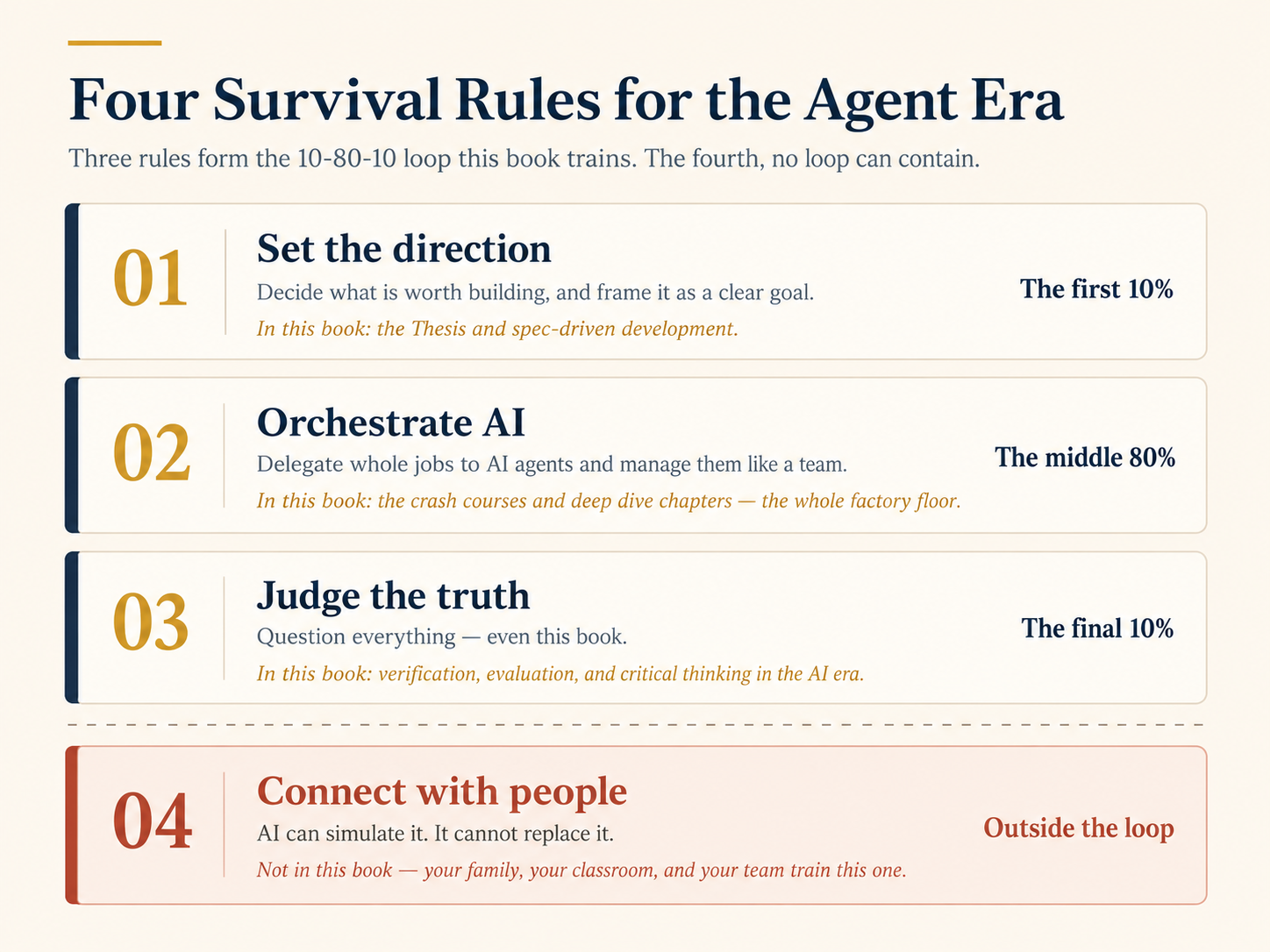
🎯 Direction Set Karein
🤖 AI Orchestrate Karein
⚖️ Truth Judge Karein
🤝 Logon Se Connect Karein
Yeh Kya Hai
Subah 8:07 baj rahe hain. Aik project manager report mein peeche hai. Aik finance lead aise systems ke darmiyan numbers reconcile kar raha hai jo aik dusre se baat nahin karte. Aik team us jawab ka intezar kar rahi hai jo kal aa jana chahiye tha. Ab sochiye ke in sab ne bas yeh kaam aik be-thak digital coworker ko de diya: aisa coworker jo hidayat par amal karta hai, wohi tools istemaal karta hai jo woh karte hain, apna kaam check karta hai, aur aisi cheez wapas deta hai jis par woh bharosa kar saken. Is coworker ko banana aur direct karna hi is kitab ka maqsad hai.
Pehle chand seedhe lafz, kyunke poori kitab in par tikti hai:
- Aik AI Worker (jise Digital FTE bhi kaha jata hai, yani "full-time equivalent", HR ki woh term jo aik employee ke kaam ke barabar capacity ko naam deti hai) woh AI hai jo real job karta hai, sirf sawal ka jawab nahin deta. Aik naye hire ka tasavvur karein jo kabhi sota nahin: aap usay batate hain kya karna hai, woh kaam karta hai, aur insaan phir bhi final sign-off deta hai.
- Aik general agent, jaise Claude Code, Claude Cowork, ya ChatGPT, woh all-purpose assistant hai jise aap direct karte hain. Aap ya to ise apna kaam karwane ke liye istemaal karte hain, ya phir in AI Workers mein se kisi aik ko banane ke liye.
- Aik AI-Native Company woh hoti hai jab aik founder chand logon aur bahut se AI Workers ke saath real business chalata hai, bari staff ke bajaye.
Yahi poora khayal hai. Baqi sab isay achi tarah karne ka tareeqa hai.
Yeh kitab chatbot tricks, impressive demos, ya strategy ke libaas mein short-lived prototypes ke bare mein nahin hai. Yeh dependable AI workers banane ke bare mein hai jo real business operations mein hissa le sakein. Yeh systems human judgment ki jagah nahin lete. Yeh usay extend karte hain, scale karte hain, aur repeatable banate hain.
Terminology par aik note. Is kitab mein Digital FTE, Digital Worker, aur AI Worker ki terms aik dusre ke badal ke taur par istemaal hoti hain. Yeh sab aik hi cheez ka naam hain: role-based AI agent jo human oversight ke neeche organization ke andar structured work karta hai. Thesis AI Worker ko apni technical term ke taur par istemaal karti hai; yeh kitab Digital FTE ko business-facing term ke taur par istemaal karti hai.
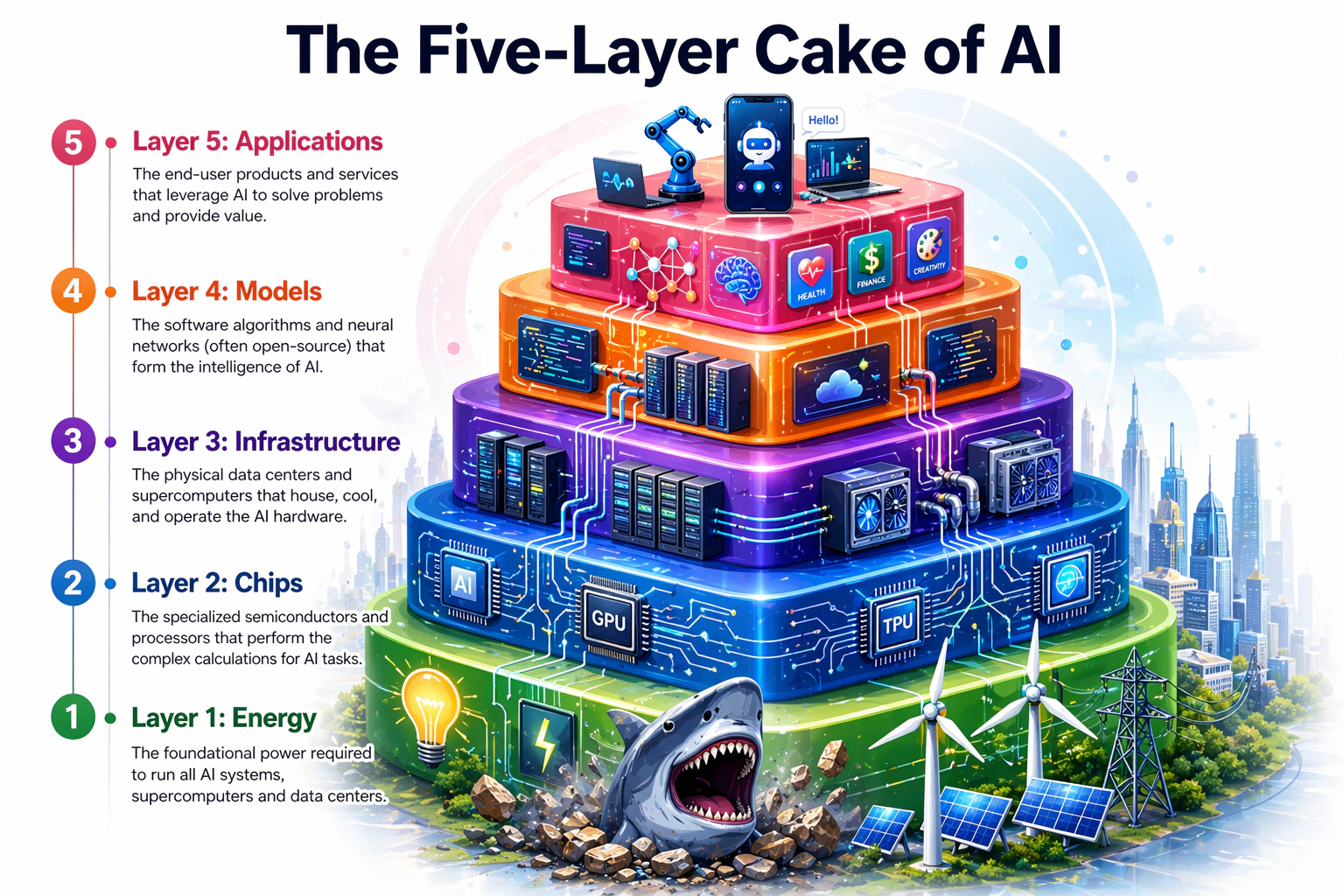
Modern AI aik unche five-layer cake ki tarah bani hai, aik metaphor jise Jensen Huang, NVIDIA ke CEO, ne popular kiya. Base par Energy hoti hai, jo duniya bhar ke bare data centers ko power deti hai. Us ke upar Chips aati hain, specialized processors jo har second trillions calculations karte hain. Phir Infrastructure aata hai: supercomputers aur cloud platforms ka global network jo in computations ko scale karta hai. Infrastructure ke upar Models hain, neural networks jo seekhte hain, reason karte hain, aur intelligence generate karte hain. Aur sab se upar, paanchwi layer par, Applications hoti hain: jahan AI technology rehna chhor kar useful banna shuru karti hai.
Neeche ki chaar layers mein billions of dollars invest kiye jate hain taake yeh paanchwi layer maujood ho sake. Yeh kitab isi paanchwi layer ke bare mein hai. Yeh aapko sikhati hai ke applications, agents, aur digital workers kaise banayein jo AI capability ko un products mein badalte hain jinhein log istemaal karte hain, un workflows mein jin par organizations bharosa karti hain, aur us value mein jise enterprises capture kar sakti hain.
Neeche wali layers is liye aham hain kyunke woh top layer ko mumkin banati hain. Models, infrastructure, aur hardware zaroori hain, lekin woh apne aap business value paida nahin karte. Value tab nazar aati hai jab intelligence ko workflows, products, services, aur operational systems ki shakal di jaye jinhein log waqai istemaal kar sakein.
Organizations ke darmiyan agla competitive gap sirf is se nahin aayega ke kis ke paas best model, sab se bara GPU cluster, ya sab se flashy prototype hai. Yeh us se aayega ke kaun intelligence ko repeatable execution mein badal sakta hai. Jis tarah software ne manual processes ko digital systems mein badla, Digital FTEs structured knowledge work ko scalable operational capability mein badlenge. Jo organizations inhein achi tarah banana seekhengi, woh tez chalengi, expertise ko behtar preserve karengi, aur leverage ki bilkul nai forms paida karengi.
The Agent Factory ka mission yeh hai ke aap in systems ko design aur build kar sakein, taake AI sirf powerful nahin balkay useful, governable, aur economically meaningful ban sake.
Buniyadi Khayal
Is kitab ke markaz mein aik seedha khayal hai:
Digital FTEs, jise Digital Workers bhi kaha jata hai, reliable AI agents hain jo real organizational environments ke andar structured knowledge work lagataar karne ke liye design kiye gaye hain.
Aik Digital FTE sirf prompt ke saath model nahin hota. Yeh aik system hota hai. Is mein domain expertise, explicit specifications, engineering architecture, aur human oversight milte hain taake kaam consistent, auditable, aur scale par ho sake.
The AI Agent Factory Digital FTEs ko design aur deploy karne ke liye systematic approach introduce karti hai: aise AI agents jo human expertise ko scalable digital workers mein badalte hain. Mil kar yeh aik AI-Native Company banate hain.
Sirf large language models par focus karne ke bajaye, yeh kitab samjhati hai ke dependable agent systems chaar critical elements ke combination se kaise ubharte hain:
- Structured Specifications: Clear definitions ke agents ko kya karna hai.
- Domain Expertise: Woh "knowledge engine" jo reasoning aur decision-making ko guide karta hai.
- Engineering Architecture: Woh infrastructure jo reliability aur scalability ensure karta hai.
- Human Oversight: Feedback loops jo accountability aur governance ko qaim rakhte hain.
Mil kar yeh elements aise agent systems banana mumkin karte hain jin par organizations trust kar sakein, deploy kar sakein, aur scale kar sakein.
Digital FTEs sirf technical construct nahin; yeh economic construct bhi hain. Yeh AI-Native organizations ko expertise package karne, execution bottlenecks kam karne, consistency behtar banane, aur naye service models, internal capabilities, aur revenue streams paida karne dete hain. Achi tarah banaye jayen to yeh sirf tasks automate nahin karte. Yeh scalable assets ban jate hain.
Yeh Kitab Kyun Hai
Aaj duniya bhar mein zyada tar organizations AI ko isolated experiments ke zariye approach karti hain: yahan aik prototype, wahan aik chatbot, aik promising workflow demo jo kabhi daily operations tak poori tarah nahin pahunchta.
Jo cheez missing hai woh excitement nahin. Jo missing hai woh method hai.
Bahut kam organizations ne reliable AI agents banane ka repeatable tareeqa develop kiya hai jo workforce ka real hissa ban sakein. Un ke paas strong models, talented log, aur business demand ho sakti hai, lekin phir bhi woh design discipline missing hoti hai jo in ingredients ko dependable digital workers mein convert kar sake.
Yeh kitab woh method introduce karti hai.
Yeh batati hai ke valuable AI employee opportunities kaise pehchani jati hain, expert knowledge ko structured specifications mein kaise badla jata hai, bounded agent workflows kaise design kiye jate hain, unhein reliable cloud-native infrastructure par kaise deploy kiya jata hai, aur human oversight ke saath kaise govern kiya jata hai. Dusre lafzon mein, yeh kitab aapko Agent Factory operate karna sikhati hai: spec-driven (aap pehle kaam ki clear specification likhte hain, phir AI se us ke mutabiq build karwate hain), human-supervised, agent-tool-powered process jiske zariye Digital FTEs (jise AI Workers bhi kaha jata hai) AI-Native Company ke andar design, manufacture, aur deploy kiye jate hain. Hum yeh process do tools se demonstrate karte hain jo isay embody karte hain: Claude Code, Anthropic ka frontier coding agent, aur OpenCode, open-source, model-agnostic alternative. Skills, specifications, aur architectural patterns jo aik mein likhe jayen, dusre mein kaam karte hain. Method constant hai. Tool variable hai.
Mez ki doosri taraf bhi isi qisam ki kami hai. Routine implementation har quarter sasti hoti ja rahi hai, is liye woh developers jo yeh gap band kar sakte hain kaam dhoondne mein mushkil ka saamna kar rahe hain. Intelligence khud commodity ban jaye to bohot se log abhi yeh naam bhi nahin de sakte ke un ki asal contribution kya hai.
Aik hi kitab dono kamiyon ka jawab de sakti hai, kyunke yeh aik hi maslay ke do rukh hain. AI ko kisi haqeeqi company mein kaamyaabi se utarne wala method hi woh scarce skill hai jo developer ko hire karne ke qabil banati hai. Business series isi silsilay ko paid engagement tak le jati hai.
Is kitab ke end tak, aap agentic AI ko sirf aik idea ke taur par nahin samjhenge. Aap dependable Digital FTEs ko organizational capability ke taur par manufacture karna samjhenge. Yeh organizations default se AI-Native hongi.
Apna Raasta Dhoondein
Har reader wohi choti ladder chadhta hai, aur aap kisi bhi rung par ruk sakte hain.
1. Foundations: yahan se shuru karein. Chand short courses, sab web browser mein (ChatGPT, Claude, ya Gemini; kuch install nahin karna). Pehle woh skills jo har kisi ko chahiye. Doctor, accountant, student, aur engineer sab wohi courses lete hain.
2. Mode 1: apna kaam tez karne ke liye AI istemaal karein. Basics haath mein hon to aap AI ko apne real tasks par lagate hain: writing, analysis, planning, code. Doer aap rehte hain; AI aapka power tool hota hai. Zyada tar log yahan bohot value hasil karte hain aur ruk jate hain.
3. Mode 2: AI Workers banayein jo kaam aap ke liye karein. Aage barhte hue, aap AI ko woh be-thak coworkers banane ke liye istemaal karte hain jin ka zikr opening mein tha: Workers jo laptop band hone ke baad bhi job karte rehte hain. Ab aap sirf doer nahin, builder hain.
4. Ladder ke top ka aik naam hai. AI Workers banana seekhein, phir unhein aisi company mein combine karna seekhein jo un par chalti hai, aur aap woh person ban jate hain jise job market ab top salaries de kar dhoond raha hai: Forward Deployed Engineer (FDE), woh engineer jo organization mein ja kar us ki AI workforce end to end banata hai. Is kitab ka poora arc aik line mein yeh hai: aap AI Workers banate hain, aur Workers mil kar AI-Native Company banate hain. Yeh person kaun hai, market kya pay karta hai, aur hamari vendor-neutral version hi companies ko waqai kyun chahiye, poori story The Roles This Book Trains mein hai.
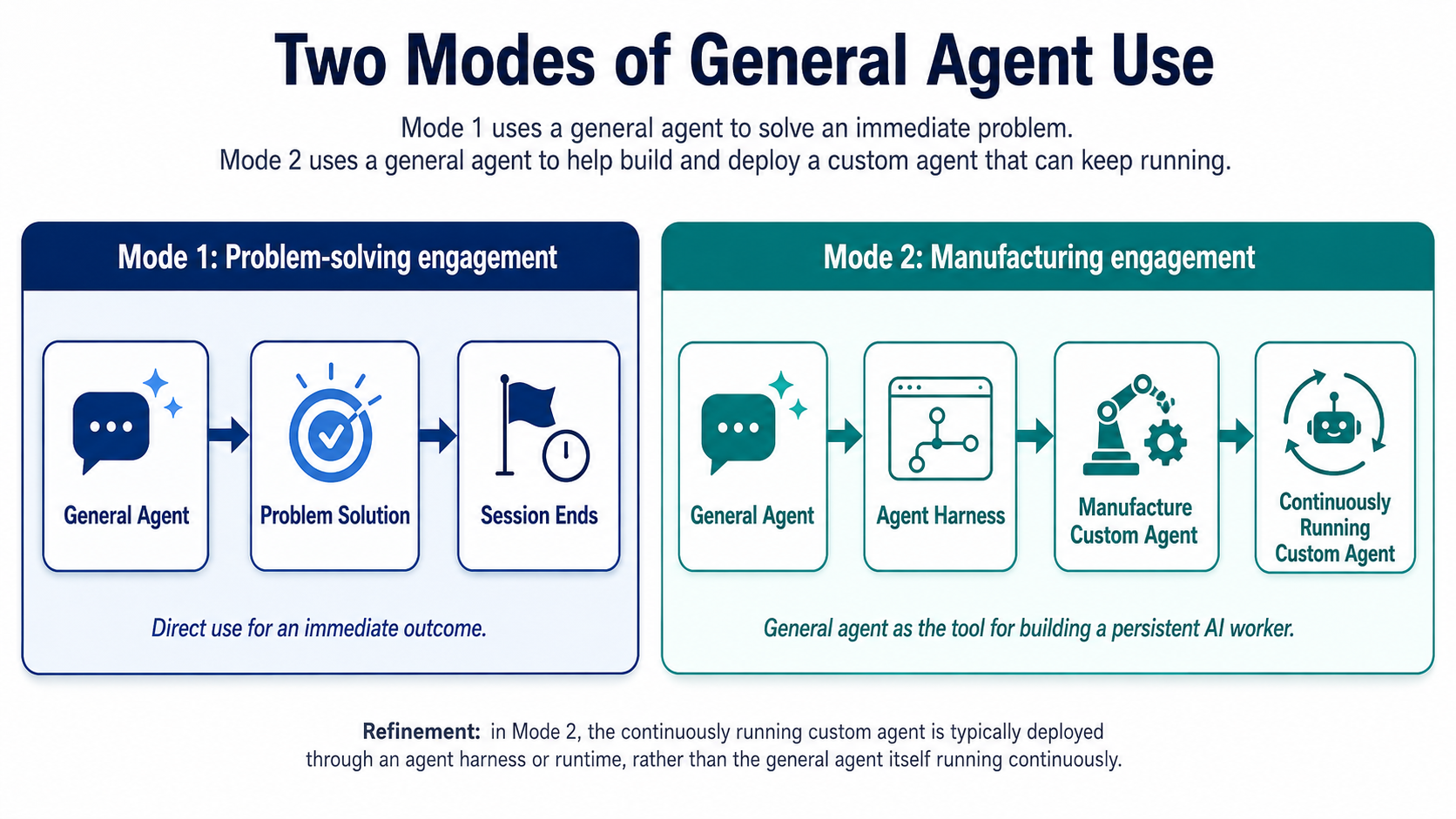
Mode 1 session ke andar problem solve karne ke liye general agent istemaal karta hai. Mode 2 custom AI Worker manufacture karne mein madad ke liye general agent istemaal karta hai jo session ke baad bhi chal sakta hai.
Aapko poori ladder chadne ki zaroorat nahin. Foundations plus Mode 1 apne aap mein serious skill set hai. Getting Started aapko course by course is ladder par le jata hai.
Is sab mein naye hain? Pehle short taaruf dekhein. Yeh chand minton mein core idea de deta hai, aur jab yeh click kar jaye, to baad ka har chapter parhna asaan ho jata hai.
Poori Presentation Dekhein: The Agent Factory Ka Taaruf
Phir Thesis parhein, jahan woh vocabulary milti hai jis par baqi kitab bani hai: Digital FTE, AI-Native Company, Two-Layer Model, 10-80-10 Rule. Wahan se Getting Started: Crash Courses poora raasta dikhata hai: pehle Foundations (acha entry point AI Prompting in 2026 hai), phir aapka mode, phir us ke mutabiq courses. Yeh wohi 10-80-10 rhythm hai jo kitab sikhati hai, learning par apply ki hui: thesis intent set karti hai, courses execution uthate hain, aur aapka professional judgment loop close karta hai.
Doosra Hissa: Is Se Paisa Kamana
Is waqt do baatein aik saath sach hain, aur aksar log sirf aik ko dekhte hain.
Developers ko kaam nahin mil raha. Agents routine code ka barhta hua hissa likh rahe hain, junior roles kam ho rahe hain, aur freelance boards par capable generalists aik dusre ke saath aur khud model ke saath bid kar rahe hain. Is pareshani ke neeche asal sawal "Mujhe job kaise milegi?" nahin hai. Sawal yeh hai: "Jab intelligence aur code saste hon, to meri asal contribution kya hai?"
Companies AI ko kaamyaab nahin bana pa rahi. Woh har jagah AI projects shuru kar rahi hain, magar custom enterprise pilots mein se taqriban 95 percent koi measurable financial return nahin dikhate (MIT, 2025). Is liye nahin ke models kamzor hain. Is liye ke koi unhein company ke asal data, rules, approvals, aur logon ke saath fit nahin karta. Yahi woh masla hai jise upar Yeh Kitab Kyun Maujood Hai bayan karta hai. Kami excitement ki nahin, method ki hai.
Ab in dono jumlon ko aik saath rakhein, kyun ke yahi is kitab ka maqsad hai. Aik taraf capable log hain jin ke paas andar jane ka raasta nahin. Doosri taraf asal paisa hai magar aage barhne ka raasta nahin. Un ke darmiyan faasla talent ya technology ki kami nahin. Yeh deployment gap hai, aur is ki chaurai bilkul aik job jitni hai.
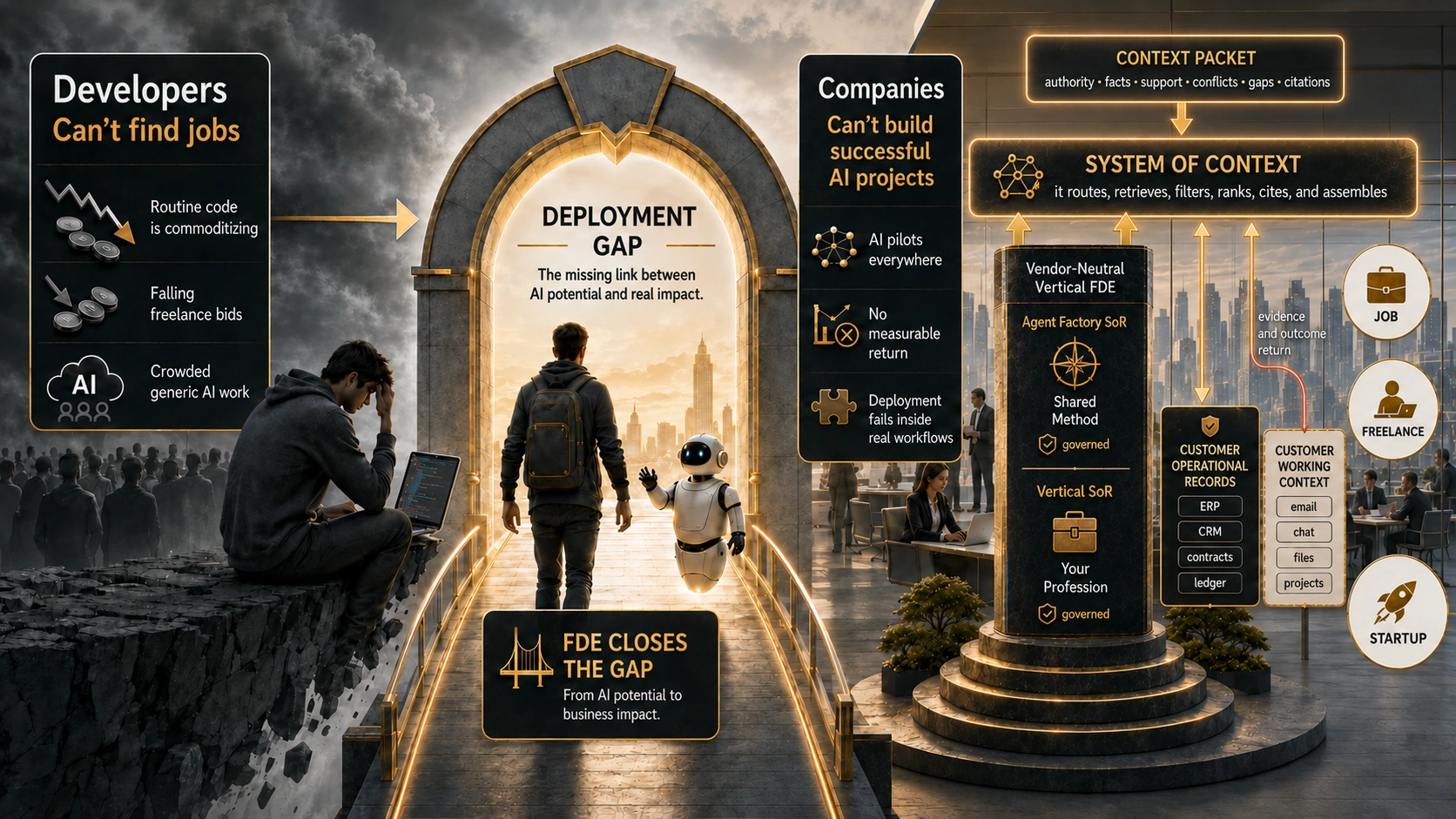
Is kitab ka technical hissa aapko woh job karna sikhata hai. Business hissa sikhata hai ke us ka paisa kaise mile, kyun ke jis skill ko koi khareede na woh hobby hai. Yeh hissa aik series hai. Market se shuru hota hai, aapke pehle invoice par khatam hota hai, aur "Main is se kamaun kaise?" ko motivational nahin balkay engineering sawal samajhta hai.
| Business series | Woh sawal jis ka jawab milta hai |
|---|---|
| The Roles This Book Trains | Agent era ne kaun si jobs paida ki hain, un ki pay kya hai, aur mere liye kaun si seat theek hai? |
| The Ecosystem | Is sab ki chalti hui misaal asal mein kaisi nazar aati hai? |
| The FDE AF Model | Paanch layers kya hain, aur graduate har layer par kahan kamata hai? |
| What You Carry In: The Ownership Argument | Jin cheezon ko main qeemti samajhta hoon, un mein se asal mein meri milkiyat kya hai? |
| Choosing Your Vertical | Kis aik profession, kis aik mulk, aur kis expert ka intekhab karun? |
| Designing the Vertical SoR | Us profession ka System of Record bunyadi usoolon se kaise design karun? |
| Getting Paid as a Vertical FDE | Capstone: poora roadmap, har route ki pay, us ki pricing, aur shuruat kahan se karni hai? |
Capstone aik daleel par aa kar tikta hai. Yeh upar di gayi chaar survival skills ki commercial shakal hai. Jab intelligence aur code saste hon to market aapke kaam ki kam qeemat deta hai, kyun ke zyada rivals wohi kaam kar sakte hain. Market us cheez ki qeemat deta hai jo aap ke paas hai. Is liye series aapko aik aisa asset banane mein madad deti hai jo aap rakh sakein: aik profession ka governed knowledge, aik jurisdiction mein, aik asal expert ke saath tayyar kiya hua. Is asset ko us company mein le jayein jise is ki zaroorat hai, aur aap woh role ban jate hain jise dhoondne par market billions kharch kar rahi hai magar bhar nahin pa rahi: vendor-neutral vertical Forward Deployed Engineer.
Wahan se teen raaste nikalte hain, aur aik hi asset teeno ke peeche kaam karta hai.
Job
Open Market
Aapka Apna Startup
Capstone aik baat saaf kehta hai aur yahan dohrana zaroori hai: imandaar version exciting version se zyada door tak jata hai. Aksar readers pehle clients ke liye governed knowledge systems aur AI Workers bana kar kamayenge, sirf woh cheezein istemal karte hue jo yeh kitab har shakhs ko deti hai. Is kaam ke liye aapke apne domain expert ya vertical ki zaroorat nahin, aur yahi sab se jaldi pay karta hai.
Aapka apna vertical business bara inaam aur mushkil gate hai. Yeh gate skill nahin, aik shakhs hai: senior professional jo aapke saath ise banane ke liye tayyar ho. Series is tarah design hui hai ke pehla route us shakhs ki talaash fund kar sake. Pehle route par rukna bhi haqeeqi outcome hai, failure nahin.
Yeh Kitab Kis Ke Liye Hai
Yeh kitab un cross-functional teams ke liye likhi gayi hai jo Agentic Enterprise bana rahi hain. Yeh groups aksar mukhtalif professional zubanein bolte hain, mukhtalif priorities follow karte hain, aur success ko mukhtalif tareeqon se measure karte hain: meeting-room comedy, bas laugh track ke baghair. Lekin Digital FTEs tabhi achi tarah bante hain jab yeh groups saath kaam karein, aur yeh kitab unhein shared framework deti hai. Yeh sab aik hi bare project mein shareek hain. Neeche har reader type Agent era ke naye job market mein aik named role se map hota hai; poora map The Roles This Book Trains mein hai.
| Reader Type | Agentic Enterprise Mein Kirdar | Aap Kya Hasil Karenge |
|---|---|---|
| AI Developers & Engineers | Infrastructure aur systems banana | Architectural patterns, spec-driven development, aur cloud-native deployment. |
| Domain Experts & Professionals | Behavior guide karne ke liye knowledge dena | Expertise ko reusable AI skills aur Digital FTEs mein badalne ke methods jo AI-Native Companies ko power karte hain. |
| Enterprise Executives | Organizational adoption lead karna | Enterprise AI ke liye governance models, risk controls, aur deployment strategies. |
| Product Managers & Architects | Business needs ko systems mein badalna | Workflows ko skills aur verifiable outputs mein decompose karne ke frameworks. |
| Department Leaders & Operators | Operational processes par AI lagana | Internal playbooks ko scalable Digital FTE workflows mein badalne ki techniques. |
AI Developers, Software Engineers & Platform Architects
Builders
Developers aur architects agentic AI ke promise ko production-grade systems mein badalne ke zimmedar hain. Jab ke bahut si AI applications fragile prototypes rehti hain, yeh kitab systematic engineering approach introduce karti hai taake:
- Spec-driven development se agents design kiye jayen.
- Cloud-native architectures (Docker, Kubernetes, Dapr) ke saath scalable systems banaye jayen.
- Secure aur auditable tool interfaces implement kiye jayen.
- Reusable skill libraries structure ki jayen jo domain expertise ko encapsulate karti hain.
Subject Matter Experts & Domain Professionals
Knowledge Holders
Sab se valuable AI systems gehri domain knowledge par depend karte hain. Accounting, law, finance, aur supply chain ke professionals aisi judgment rakhte hain jo AI behavior ke liye guiding structure ka kaam karti hai. Aap expertise ko structured artifacts mein encode karna seekhenge, khas taur par SKILL.md specifications mein (SKILL.md aik plain-text file hai jo woh skill package karti hai jise AI load kar ke follow kar sakta hai), taake yeh ensure ho:
AI routine reasoning kare, jab ke professionals judgment, oversight, aur accountability provide karein.
Enterprise Executives & Technology Leaders
Decision Makers
Senior leaders ko isolated experimentation se reliable enterprise deployment ki taraf jana hoga. Yeh kitab strategic roadmap deti hai taake:
- Governance models aur risk controls establish kiye jayen.
- Human-in-the-loop supervision implement ki jaye.
- Pilot programs se enterprise-wide scale tak phased adoption execute ki jaye.
AI Product Managers & Solutions Architects
Translators
Aap complex business processes ko automated tasks mein decompose karne mein critical role ada karte hain. Yeh kitab practical guidance deti hai taake:
- Workflows ko agent skills mein map kiya jaye.
- Automated reasoning aur human decision-making ke darmiyan boundaries define ki jayen.
- Verifiable outputs aur evaluation processes design kiye jayen.
Department Leaders & Operational Teams
Operators
Department leaders aksar aise workflows manage karte hain jo highly structured lekin time-intensive hote hain. Yeh kitab dikhati hai ke internal playbooks ko repeatable agent workflows mein kaise badla jaye taake:
- Repetitive analytical kaam kam ho aur consistency behtar ho.
- Expertise poori organization mein extend ho.
- Aisi digital capabilities ban sakein jo lagataar operate karti hain.
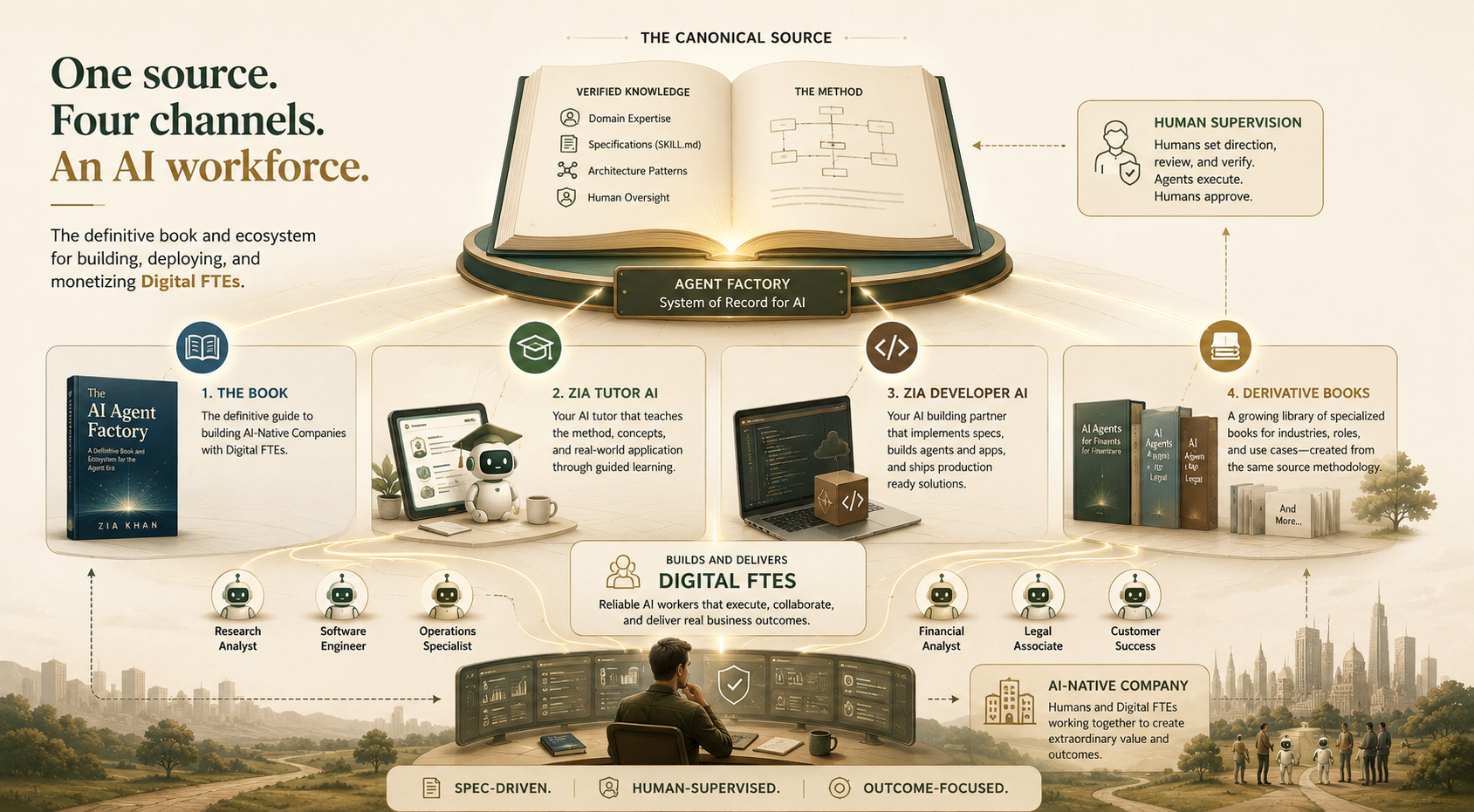
Yeh Kaise Deliver Hoti Hai: Aik Source, Chaar Channels
Aik source chaar channels ko power karta hai. Jab us source mein naya escalation protocol, behtar pattern, ya zyada wazeh definition shamil hoti hai to har channel ko woh update mil jata hai. Models, harnesses, aur zubanein badal sakti hain. Source barqarar rehta hai.
📘 Kitab
🎓 Zia Tutor AI
🛠️ Zia Developer AI
📚 Derivative Kitabein
Mil kar yeh chaar channels logon tak har us jagah pahunchte hain jahan learning aur building hoti hai. Derivative books zubanon, age groups, aur professions ke across jati hain. Zia Developer AI Claude Code aur OpenCode ke andar kaam karta hai, yani woh coding agents jo pehle hi developers ke haath mein hain. Zia Tutor AI learners se chat tab mein milta hai aur har learner ke apne free Claude par chalta hai, is liye kisi ko bhi, kahin bhi, baghair service cost ke scale kar sakta hai.
Delivery Ke Teen Modes
Readers aik hi knowledge base ko teen tareeqon se use kar sakte hain: seedha parh kar, AI tutor ke zariye seekh kar, ya AI partner ke saath build kar ke.
Insani Parhai
Zia Tutor AI
Zia Developer AI
Zia Tutor AI aur Zia Developer AI mukhtalif hosts ke liye aik hi architectural move karte hain. Tutor learners ke liye claude.ai ko extend karta hai. Developer builders ke liye Claude Code ya OpenCode ko extend karta hai. Ecosystem dono patterns sikhata bhi hai aur un par chalta bhi hai.
Kyunke teenon modes aik hi knowledge base se draw karte hain, kitab ki correction tutor ki teaching aur developer ki guidance tak aik hi waqt pahunchti hai. Kitab static artifact nahin. Yeh learning aur development ecosystem ka source of truth hai.
Yeh 10-80-10 pattern education par apply karta hai. Kitab pehle 10% mein domain knowledge, frameworks, aur professional standards ke zariye intent set karti hai. Zia Tutor AI aur Zia Developer AI personalized teaching aur qadam-ba-qadam building guidance ke zariye darmiyani 80% handle karte hain. Aakhri 10% aap dete hain: woh professional judgment jo confirm karta hai ke agent durust hai, deployment mehfooz hai, aur knowledge bharose ke qabil hai.
Do Tools, Aik Discipline
Claude Code aur OpenCode is kitab mein competitors nahin. Yeh aik hi discipline ke do expressions hain.
Do tools kyun, aik kyun nahin? Kyunke jo discipline yeh kitab sikhati hai usay kisi bhi specific tool se zyada zinda rehna chahiye. Agent Factory method: spec-driven design, skill-based architecture, human oversight, construction se hi portable hai. Isay single vendor ke product se bandh dena method ki bunyadi premise ke khilaf hoga. Is se woh risks bhi inherit honge jin par readers ka control nahin: pricing changes, access restrictions, strategic shifts. Aur yeh chupke se un readers ko exclude kar dega jinke constraints, economic, regulatory, ya architectural, dominant tool ko inaccessible bana dete hain.
Frontier Pehle
Open Aur Model-Agnostic
Dono wohi patterns implement karte hain jo yeh kitab sikhati hai. Skills, subagents, hooks, MCP servers (MCP woh standard tareeqa hai jisse agent outside tools aur data se plug hota hai), aur spec-driven workflow dono mein identically kaam karte hain. Claude Code ke liye likha gaya SKILL.md .opencode/skills/ mein drop hota hai aur badle baghair chalta hai. Discipline portable hai.
Agent Era Ke Liye System of Record
Jensen Huang, NVIDIA ke CEO, ne argue kiya hai ke AI agents systems of record ki zaroorat khatam nahin karte: woh single trusted sources of truth jin se business parhta hai, jin mein likhta hai, aur jin ke khilaf verify karta hai. Balkay agents inhein aur mazboot karte hain. Agents ko ground truth chahiye. Unhein authoritative jaghein chahiye jahan se woh parhein, jahan likhein, aur jahan verify karein. Is foundation ke baghair agents hallucinate karte hain. Is ke saath woh execute karte hain.
Huang enterprise ke liye yeh solve kar raha hai. Databases, workflows, aur operational platforms jo companies ne decades mein banaye hain, Agent era mein kam nahin balkay zyada essential ho jate hain. Agents SAP ya ServiceNow ko replace nahin karte. Woh inhein istemaal karte hain: machine scale par.
Lekin aik layer hai jise Huang solve nahin kar raha: human layer.
Millions of developers, architects, aur domain professionals ab AI agents banane wale hain. In mein se zyada tar ke paas seekhne ke liye koi canonical source nahin. Koi structured body of knowledge nahin jo verification ke liye design ki gayi ho, sirf consumption ke liye nahin. Woh scattered tutorials, outdated blog posts, aur model outputs se seekh rahe hain jo production agent systems ke real kaam ko reflect karte bhi ho sakte hain aur nahin bhi.
Aur jab yahi developers learning se building ki taraf move karte hain, to unhein wohi masla doosri shakal mein milta hai. Un ke AI coding partners us par draw karte hain jo model surface kar deta hai: aise patterns jo shayad kabhi verify, bounded, ya dependable Digital FTEs produce karne ke liye design hi na kiye gaye hon. Verified source ke baghair, human learning aur AI-assisted building dono wohi fragility inherit karte hain.
AI Agent Factory Book agentic AI education aur construction ke liye system of record hai. Yeh isi shakal mein ship bhi hoti hai. Agent Factory System of Record kitab ka content MCP ke zariye deta hai, taake Claude, ChatGPT, Claude Code, Cowork ya koi custom agent is se connect ho kar kitab ke verified ilm par apni bunyaad rakh sake.
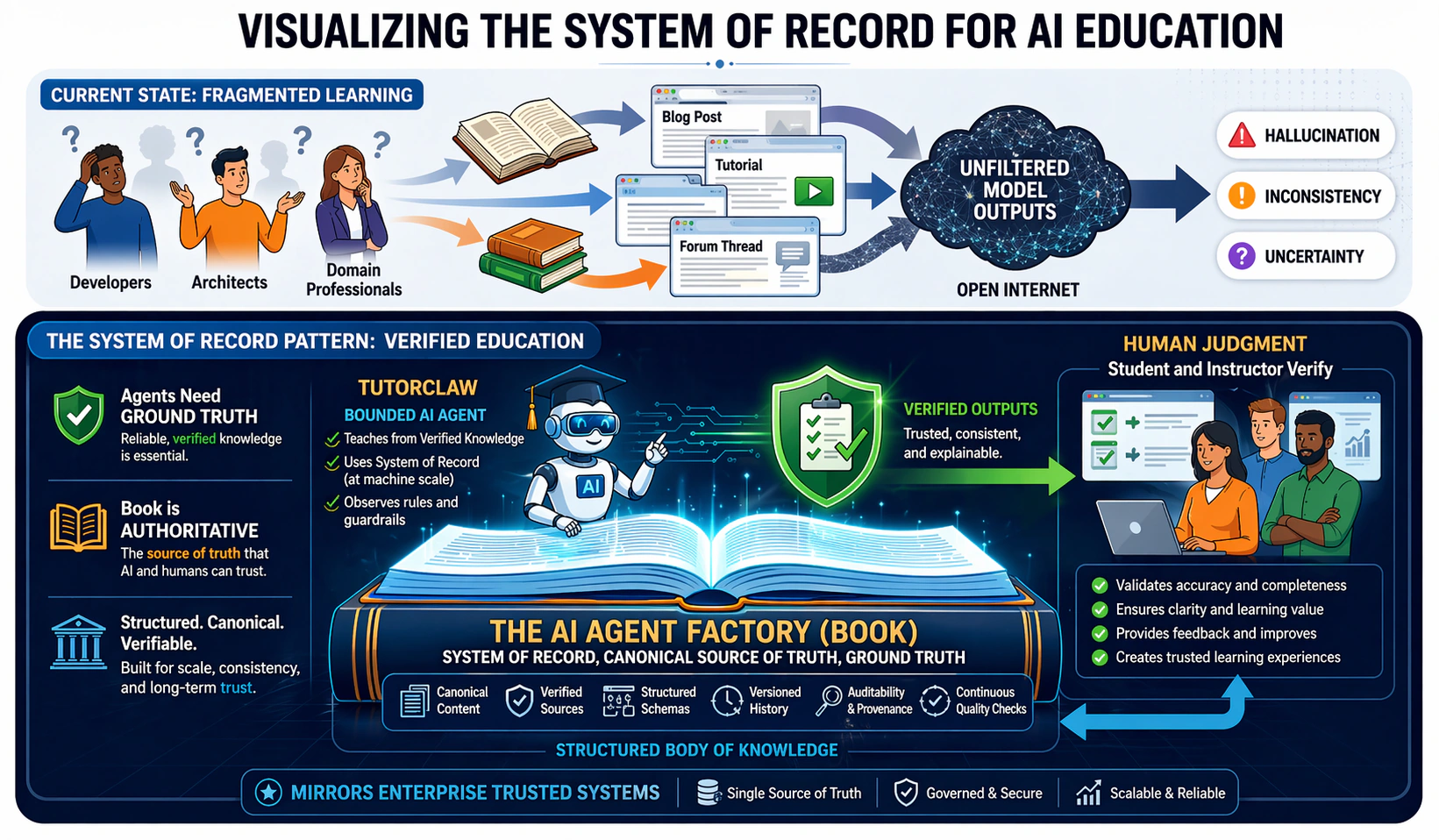
Yeh metaphor nahin. Kitab ki architecture usi pattern ko follow karti hai jo Huang enterprise systems ke liye describe karta hai:
- Kitab canonical source of truth hai: yeh define karti hai ke agents kya hain, kaise bante hain, aur kaise govern kiye jate hain. Agent Factory System of Record yeh knowledge har connected agent ko serve karta hai.
- Zia Tutor AI teaching agent hai: yeh open internet se nahin, kitab se parhta hai, aur probabilistic generation ke bajaye verified knowledge se sikhata hai.
- Claude Code aur OpenCode building agents hain: Zia Developer AI se equipped ho kar yeh Stack Overflow ya scattered tutorials ke bajaye kitab se parhte hain. Yeh improvised code ke bajaye verified specifications, SKILL.md templates, aur architectural patterns se Digital FTEs aur AI-Native Companies construct karte hain.
- Human judgment verification layer hai: students, instructors, developers, aur domain experts confirm karte hain ke teaching aur construction kitab ke intent se match karte hain. Yeh 10-80-10 pattern ka final 10% hai.
Lekin education sirf aadhi kahani thi. Wohi pattern construction tak extend hota hai, aur jab aap dono pipelines ko side by side draw karte hain, to symmetry khud architecture ban jati hai.
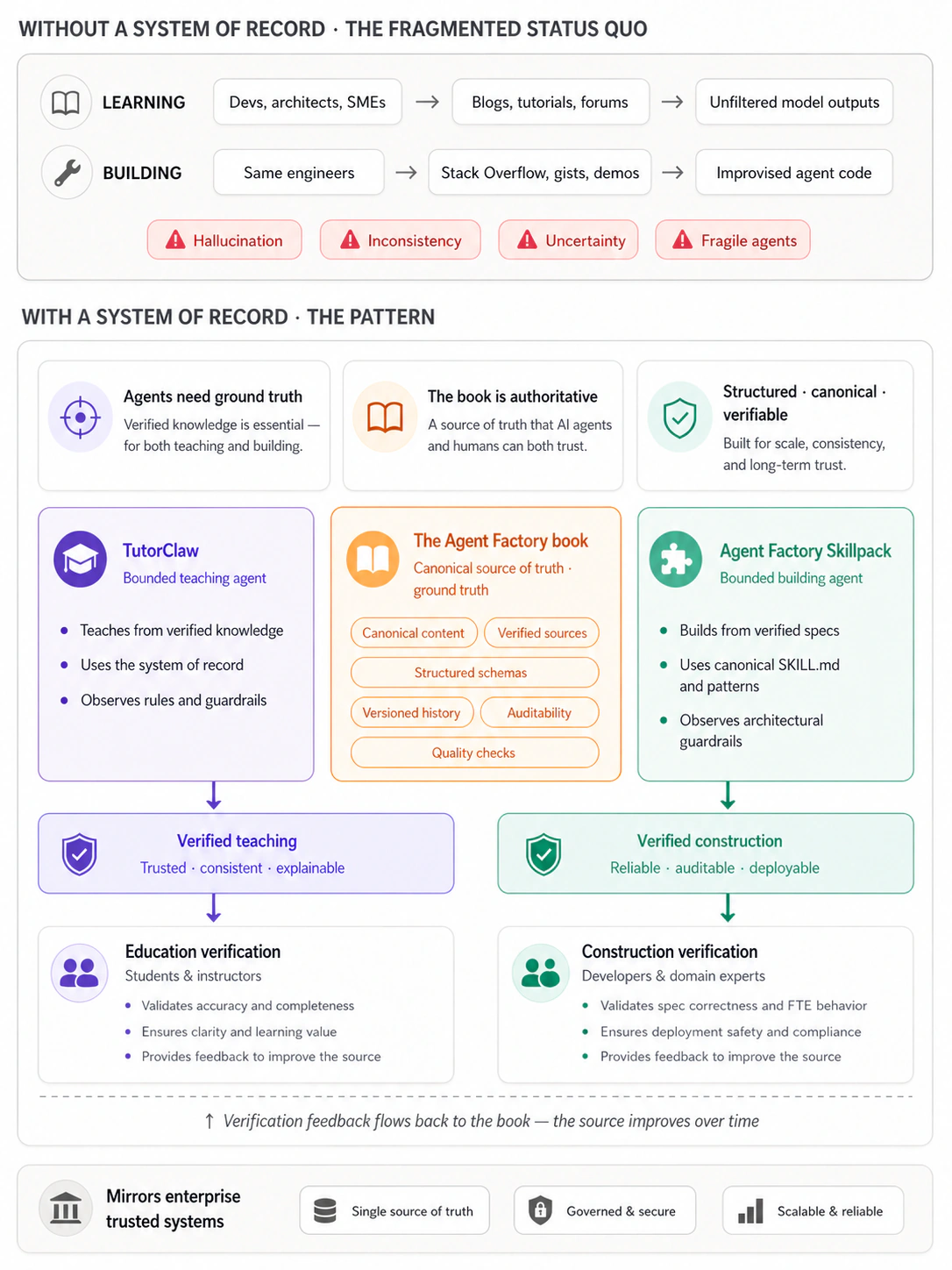
Lekin pattern education aur construction par rukta nahin. Wohi source teesri lane ko feed karta hai: derivative books ki barhti hui family, har aik do axes mein se kisi aik par specialized: topic ya audience, lekin source se wohi vocabulary, architecture, aur standards inherit karti hui.
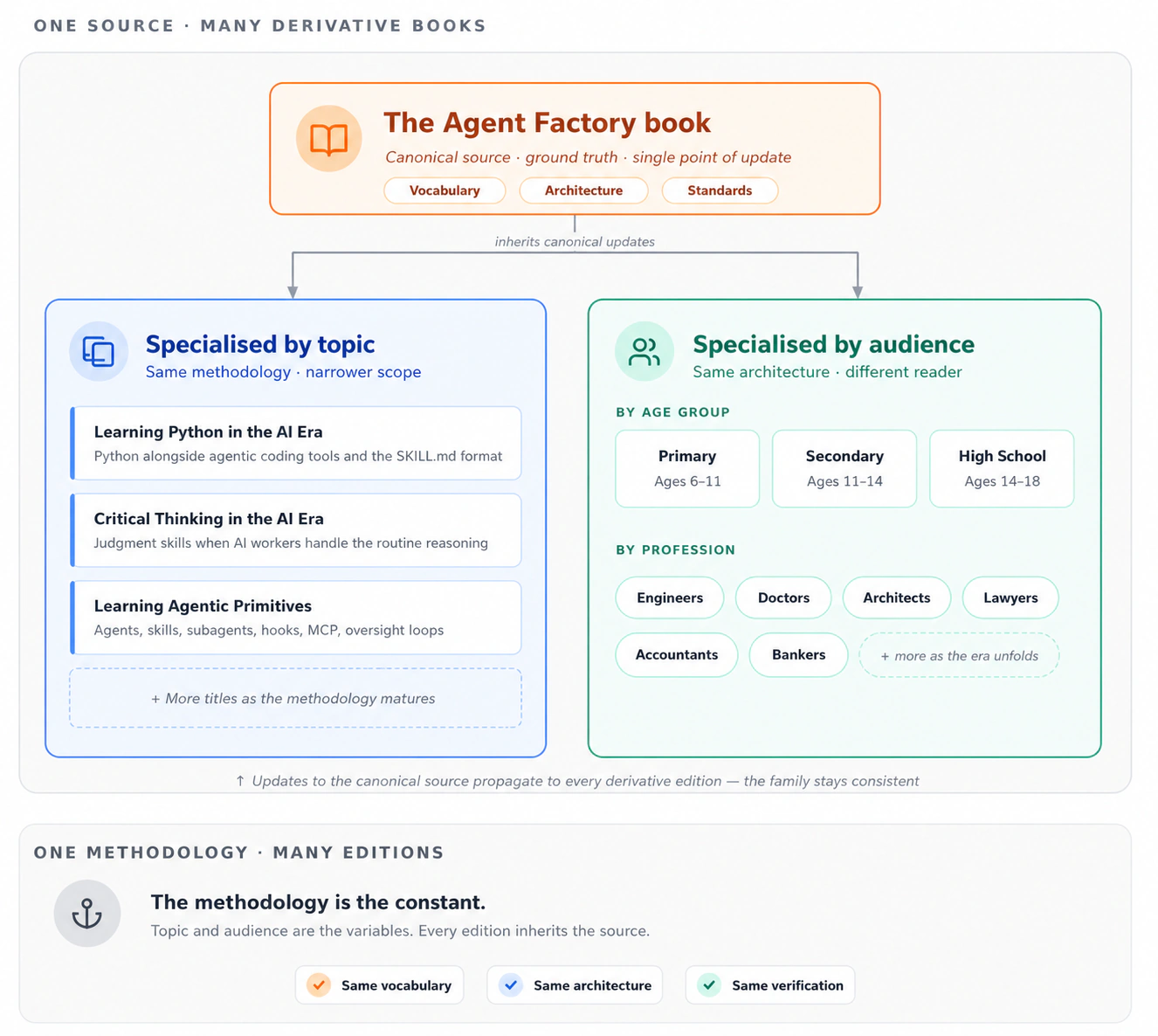
Topic axis. Kuch derivatives scope ko aik single discipline tak narrow karte hain jise Agent era reshape kar raha hai. Learning Python in the AI Era Python ko us tarah sikhati hai jis tarah ab sikhaya jana chahiye: agentic coding tools, spec-driven workflows, aur SKILL.md format ke saath jo Claude Code aur OpenCode mein chalta hai. Critical Thinking in the AI Era readers ko woh judgment skills deti hai jo tab chahiye hoti hain jab AI workers routine reasoning handle karte hain. Learning Agentic Primitives foundational concepts, agents, skills, subagents, hooks, MCP, oversight loops, ko focused primer mein compress karti hai. Methodology mature hoti rahegi to aur titles aayenge.
Audience axis. Dusri derivatives methodology ko constant rakhti hain lekin reader ke liye dobara likhti hain. Primary, secondary, aur high-school students ke liye editions inhi architectural ideas ko age-appropriate framings mein introduce karti hain, taake high-school student apna pehla SKILL.md usi vocabulary se bana sake jo uska professional counterpart aik decade baad istemaal karega. Profession-specific editions material ko engineers, doctors, architects, lawyers, accountants, bankers, aur un domains ke liye adapt karti hain jahan workforce Digital FTEs ke gird dobara draw ho rahi hai. Framework constant hai. Examples, priors, aur depth reader ke hisab se shift hote hain.
Jab canonical methodology update hoti hai, jaise naya escalation protocol, refined architectural pattern, ya sharper definition, to update poori family mein propagate hota hai. Har derivative correction inherit karta hai.
Aur is mein aik aur gehri symmetry kaam karti hai. Yeh kitab sirf system of record istemaal nahin karti: yeh aap ko woh agents banana sikhati hai jo systems of record istemaal karte hain, aur yeh unhi building agents, Claude Code aur OpenCode jo Zia Developer AI se equipped hain, ko power karti hai jo aap ko unhein construct karne mein madad dete hain. Learning system ki architecture, construction system ki architecture, aur curriculum ka content sab aik dusre ka aks hain. Aap pattern ko experience kar ke seekhte hain. Aap pattern ko istemaal kar ke build karte hain.
Yeh section aik aur sawal uthata hai: agar kitab System of Record hai to is par build karne ka plan kya hai? Is plan ka aik naam hai: The FDE AF Model. Yeh paanch-layer blueprint hai jo is System of Record ko vertical AI-native businesses mein badalta hai, aisi layers mein tarteeb diya hua jin par graduates build bhi kar saken aur kama bhi saken.
Wahi principle aik layer neeche infrastructure mein bhi chalta hai: jo Digital FTEs aap banate hain unhein literal system of record bhi chahiye, aur wahan kitab ka stance wahi hai: default tor par consolidate karein, deliberate tor par specialize karein, jahan aik Postgres relational data, documents, full-text search, aur AI vectors ko saath rakhta hai, un systems mein bikherne ke bajaye jo sync se drift ho jate hain. Architecture ke liye Thesis aur build ke liye Give Your AI Searchable Context dekhein.
Agentic Enterprise Banana
Agentic AI feature nahin. Yeh workforce hai. Companies ki agli nasal is ke gird usi tarah banegi jis tarah pichhli nasal software ke gird bani thi, aur jis discipline ke zariye yeh workforce design, manufacture, deploy, aur govern hoti hai, woh decide karega ke agla decade kaun jeetega.
Yeh contest apni fitrat mein global hai. Yeh us ke naam nahin hoga jis ke paas sab se bara model ya sab se gehra GPU stack ho; yeh us ke naam hoga jo AI capability ko workforce layer par reliable, governable, repeatable execution mein badal sake. Jo teams yeh jeetengi, woh sab chand shehron mein nahin baithi hongi. Woh har us jagah hongi jahan ambitious log internet access aur agentic engineering ki working knowledge ke saath build karne ka faisla karte hain.
AI tools ke evolve hone mein aik pattern hai, aur yeh dikhata hai ke lasting value kahan baithi hai. Pehle daur ke AI tools ne model ko product banaya. Dusre daur ne harness ko product banaya: Claude Code, OpenCode, Cursor, agentic coding environments jahan models apna kaam karte hain. Kuch log ab harness platform, SDKs, plugins, vendor-specific extension layers, ko teesra daur keh rahe hain. Hum us se aik layer upar baithe hain. Hum jis teesre daur ki baat karte hain woh woh daur hai jahan woh discipline jo harnesses aur un ke platforms ke across chalti hai product ban jati hai. Model commoditize hota hai. Harness commoditize hota hai. Harness platform commoditize hota hai. In teeno ke baad jo bachta hai woh canonical source hai: methodology, vocabulary, verification standards, aur SKILL.md library jise format honor karne wala koi bhi harness load kar ke chala sakta hai.
Yeh discipline ab itna zyada kyun matter karta hai? Kyunke economics jis taraf ja rahi hai.
"Hum bahut jald ten-person billion-dollar companies dekhenge: billion-dollar valuations ke saath. Mere tech CEO doston ke chhote se group chat mein is baat par betting pool chal raha hai ke pehla saal kaunsa hoga jab aik one-person billion-dollar company saamne aayegi, jo AI ke baghair naqabil-e-tasawwur hoti, aur ab woh hogi."
Anthropic CEO Dario Amodei ne tab se timeline ko narrow kiya hai, aur kaha hai ke pehli single-person billion-dollar company ke jald aane ka strong majority chance hai. Unhon ne developer tools, automated customer service, aur proprietary trading ko sab se likely categories bataya. Kuch hi mahinon mein pehli concrete example saamne aayi: aik solo founder ne rented infrastructure aur employees ki jagah AI agents istemaal kar ke telehealth business ko first-year revenue mein hundreds of millions tak build kiya. Har quarter mein aur examples aa rahi hain.
Jo architectural shape woh build karte hain, wohi hai jise Altman aur Amodei describe karte hain: founder ke paas apna source hota hai, AI agents woh kaam karte hain jis ke liye pehle teams chahiye hoti thin, aur rented infrastructure baqi kaam uthata hai. Is rented layer mein harnesses, messaging platforms aur model providers shamil hain.
Agent Factory ecosystem is shape ki aik misaal hai. Kitab source of truth hai. Zia Tutor AI sikhata hai aur Zia Developer AI build karta hai, yani woh kaam jo aam tor par aik team karti. Chat apps, coding tools aur AI models scratch se banane ke bajaye doosri companies se rent kiye jate hain. Kitab readers ko isi shape ki companies banana sikhati hai, aur jis ecosystem se woh parh rahe hain woh khud is ki aik misaal hai. The FDE AF Model har layer ka mukammal blueprint deta hai, jis mein yeh bhi shamil hai ke graduate har layer par kahan kama sakta hai.
Jo reader yeh kitab finish karta hai, woh agentic AI ko sirf idea ke taur par nahin samajhta. Woh samajhta hai ke kaunsa kaam Digital FTE ban sakta hai, us agent ko kaise specify karna hai jo woh kaam karega, us architecture ko kaise deploy karna hai jo usay chalata hai, aur ubharti hui workforce ko kaise govern karna hai.
Maqsad seedha hai: AI curiosity se aage nikal kar AI execution tak jana. Expertise operational ban jati hai. Workflows repeatable ho jate hain. Capabilities products ban jati hain. Organizations ko workforce ki nai qisam milti hai: digital, dependable, aur design se bani hui. Aur jo log is workforce ko banana seekhte hain unhein aisa leverage milta hai jo knowledge workers ki kisi pehli generation ke paas nahin tha.
Agent Factory ecosystem is leverage ko un ke haath mein dene ke liye maujood hai.