2026 Mein AI Prompting
ChatGPT, Claude, aur Gemini ko achhi tarah use karne ke 13 concepts: context, reasoning modes, deep research, multimodal, AI desktop apps, aur cross-model checking.
Zyada tar log AI ko Google search ki tarah use karte hain. Woh chhota sa sawal type karte hain, jawab ko jaldi se scan karte hain, aur aage barh jate hain. Yeh trivia ke liye chal jata hai. Lekin aap ki life aur work mein jo cheezen waqai ahmiyat rakhti hain, un ke liye fail ho jata hai.
Power users kuch mukhtalif karte hain. Woh AI ko us tarah brief karte hain jaise kisi smart lekin naye colleague ko brief karte: files, context, constraints, aur ek wazeh ask ke saath. Woh ek option ke bajaye teen options expect karte hain. Woh argue karte hain. Iterate karte hain. Kaam check karte hain. Novice prompt aur power-user prompt ke darmiyan farq cleverness nahin hai; yeh chand habits hain jo koi bhi aik afternoon mein seekh sakta hai.
Yeh page wahi afternoon hai. Terah concepts, chaar chhote parts mein grouped. Na code, na setup, na aisa jargon jo aap context se samajh na saken. Woh aik insight jo baqi sab ko samajh mein laati hai: is page ki lagbhag har "advanced technique" do moves mein se ek par aa kar rukti hai: sahi context andar lao, ya ghalat context bahar rakho. Har section ko isi lens se parhein.
Tools par ek note: examples ChatGPT, Claude, aur Gemini ka zikr karte hain kyun ke zyada tar readers ke paas in mein se koi ek hota hai. Skills kisi bhi modern chat AI par transfer ho jati hain. Jahan koi feature sirf ek product mein hai, us ka naam wazeh taur par diya gaya hai.
Pehli dafa seedha poora parhein taake shape samajh aaye. Phir wapas aayen aur closing block ke prompts try karein. Sirf parhne se aap ko alfaaz milte hain; try karne se skill milti hai.
Pichli dafa dekhne ke baad kya badla, ek chhota note
Agar aap ne 2022 ya 2023 mein ChatGPT use kiya tha aur decide kiya tha ke yeh ek clever toy hai, to jo tool aap ko yaad hai woh ab wala tool nahin hai. Kuch changes chup chap ho chuke hain:
- Context windows taqreeban 1000x barh gayin. 2022 ka model chand hazaar words hold karta tha. 2026 ka model laakhon words hold karta hai, kabhi kabhi ek million tak. Is se badal jata hai ke aap prompt mein kya bhar sakte hain: poori kitab, kai dinon ki speech, contracts ka folder.
- Reasoning real ho gayi. "Think step by step" pehle ek magic phrase thi. Ab models ke paas explicit thinking modes hain jo seconds, kabhi minutes tak chalte hain, aur jawab dene se pehle multiple approaches explore karte hain. Jin problems ko yeh handle kar sakte hain woh lagbhag atharah mahino mein "human ke minutes" se "human ke kai hours" tak shift ho gayi hain.
- Web search aur code execution built-in tools ban gaye. Model decide karta hai kab web search karni hai ya code run karna hai, phir results ko apne jawab ka hissa banata hai. Zyada tar users ko yeh invisible lagta hai; jab aap jaan lete hain ke yeh ho raha hai, aap ke prompts sharper ho jate hain.
- Multimodal sidebar nahin raha. Aap aik photo, PDF, spreadsheet, voice memo, ya files ka folder prompt mein drop kar sakte hain aur un par sawal pooch sakte hain. Model in sab ko ek stream mein handle karta hai.
- Desktop apps aa gayin. Products ki ek nai category (Cowork, Microsoft Copilot, Google Antigravity) aap ki permission se aap ki files dhoond sakti hai aur un par action le sakti hai. Yeh ab chat nahin hai; yeh ek chhota task coworker ko delegate karne ke qareeb hai.
Agar in tools ka aap ka mental model sirf atharah mahine purana bhi hai, to aap shayad inhein aaj ki capability ke 20% par use kar rahe hain. Yeh page woh gap band karta hai.
Part 1: AI cheezen kaise jaanta hai
Pehle teen concepts is baat ke bare mein hain ke jab aap AI se sawal poochte hain to asal mein kya ho raha hota hai. Agar aap yeh samajh lein, to failures par hairan hona band ho jata hai.
1. Novice vs power user
Neeche do columns ke darmiyan dekhein kya badalta hai. Sawal wahi hai; prompt wahi nahin.
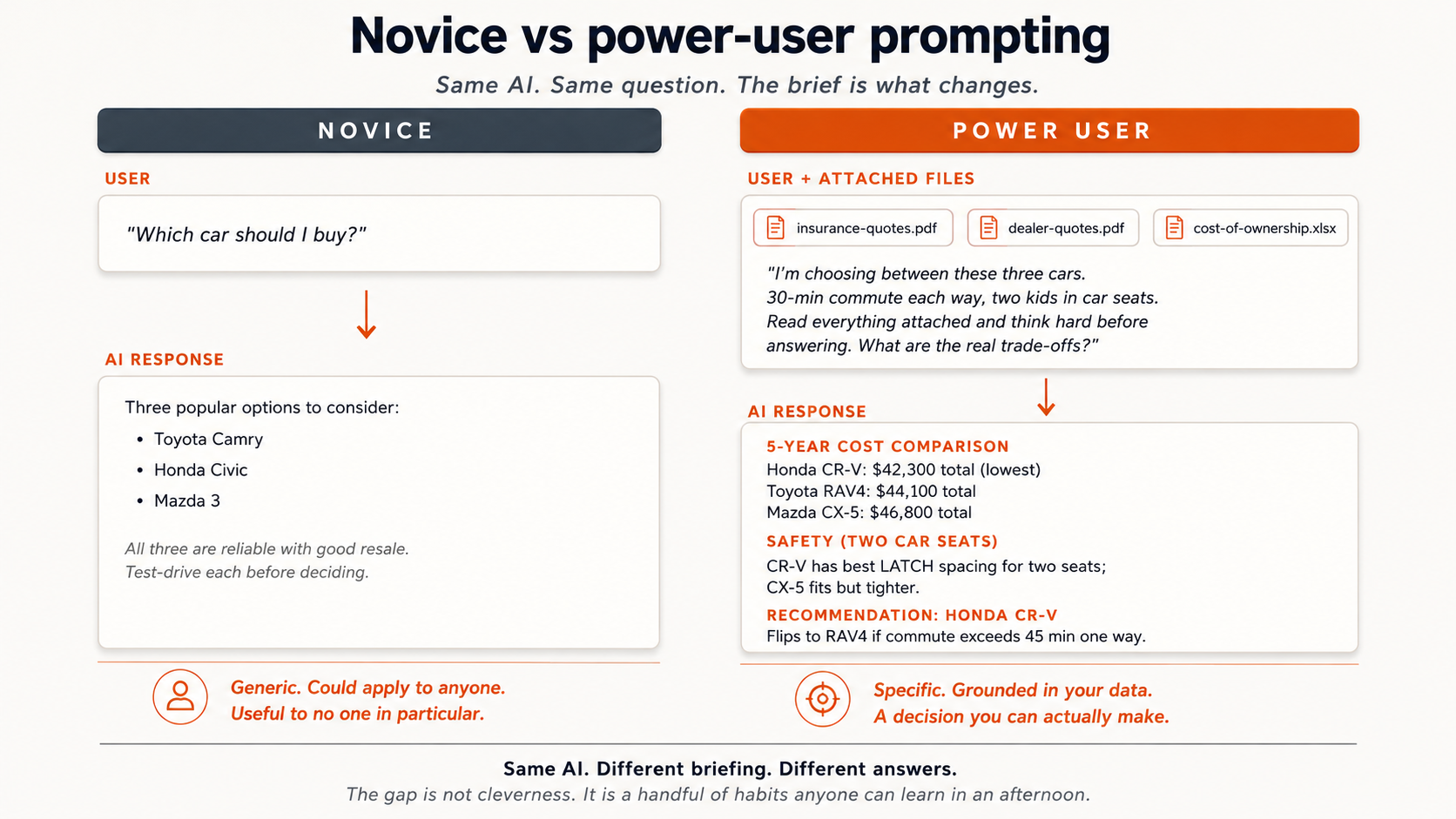
| Novice prompt | Power-user brief | |
|---|---|---|
| Length | Ek line | Ek chhota brief, plus attached files |
| Context given | Kuch nahin | Insurance quotes, dealer pricing, cost-of-ownership spreadsheet |
| Constraints stated | Kuch nahin | "30-minute commute each way, two kids in car seats" |
| Instruction to think | Kuch nahin | "Read everything attached and think hard before answering" |
| AI response | Teen popular models, generic | Five-year cost comparison, car-seat constraint se judi safety analysis, aur un conditions ke saath recommendation jahan yeh flip hoti hai |
Field se kuch real contrasts:
- Car khareedna. Novice: "which car is best?" Power user: spec sheets, dealer quotes, aur insurance plans upload karta hai, phir poochta hai "what are the trade-offs? Read everything and think hard."
- Work par self-review. Novice: "write a self-review for my boss." Power user: apne project tracker ka screenshot, recent project docs, aur notes ka voice memo upload karta hai, phir draft mangta hai.
- Business idea critique karna. Novice: "I have a great business idea, mobile tie-dyeing, critique it." Yeh sycophancy bait hai, AI zyada tar tareef karega. Power user: "Analyze objectively. Use this rubric: is there a problem worth solving, is there a market, is there a competitive advantage?" AI ne us idea ko 100 mein se 8 score diya aur bataya kyun.
- Blog post likhna. Novice: "write a blog post about the BlackBerry." Result: AI slop. Power user: pehle outline, outline par critique, har heading ko bullets mein expand, bullets par critique, aur sirf phir prose.
In sab ko jorne wala mental model: AI ek bohat smart fresh college grad jaisa hai. Highly motivated. Abhi aap ke bare mein zyada nahin jaanta. Isay usi tarah brief karein. Kya ek naye colleague ke paas is job ko achhi tarah karne ke liye kaafi information hoti? Agar nahin, to usay zyada dein.
2. Pretrained knowledge
AI ne duniya ko parh kar nahin seekha. Is ne duniya ke bare mein text parh kar seekha. Specifically: internet text ki massive quantity. Reddit aur Quora threads, Wikipedia, books, news articles, research papers, blogs, forums.
Training data mein frequency lagbhag answer ki reliability ke barabar hoti hai. Is liye:
- Strong: cooking, celebrity gossip, common medical advice, top-1000 movies, popular programming languages, Voyager 1 record par kya hai (NASA spacecraft jo 1970s mein launch hua, Earth se lagbhag 25 billion miles door, 55 languages mein greetings le kar), cats walls ko kyun ghurte hain (woh subtle sounds aur movements detect karte hain jo humans miss kar dete hain).
- Sparse: quasars (sky mein extremely bright objects jo black holes se powered hote hain), Cantonese (internet text ka 0.1% se kam), regional history, niche professional knowledge.
- Absent: aap ki company ka secret data, aap ka private calendar, model ki knowledge cutoff date ke baad publish hua kuch bhi, kuch bhi jo kisi ne public internet par kabhi nahin dala.
Do practical consequences:
Typos fix karne mein waqt zaya na karein. AI internet text par train hua tha, jo typos se bhara hua hai. Yeh misspelled prompts ko gracefully handle karta hai. "definately" ki misspelling jawab nahin badlegi.
Absorbed errors par nazar rakhein. AI ne unhi sources se misconceptions aur outdated information bhi absorb ki. Ek confidently wrong forum post model mein confidently wrong ban jati hai. Important cheez ko primary source ke against check karein.
Part 0 aap ko broken reasoning detect karna sikhayega. Usay dhoondne ki pehli jagah confident-sounding pretrained answers hain, khaas taur par un topics par jahan training data thin ya contested tha. Confidence correctness ka signal nahin hai.
Pretrained answer par trust karne se pehle ek quick mental test:
| Question type | Training data mein kitna represented hai? | Trust level |
|---|---|---|
| "How do I make a roux?" | Cooking internet par sab se zyada discussed topics mein se hai. | High. |
| "Plot of a top-1000 movie." | Hazaaron dafa reviewed aur re-reviewed. | High. |
| "History of an obscure village." | Shayad sirf ek Wikipedia paragraph, ya kuch bhi nahin. | Low; primary source se verify karein. |
| "Recent regulatory change in my industry." | Lagbhag yaqeenan knowledge cutoff ke baad. | Web search ke baghair kuch trust na karein. |
| "What did our company decide last quarter?" | Training data mein bilkul nahin. | Kuch trust na karein; model guess kar raha hai. |
Yeh koi rule nahin jo aap ko memorize karna hai. Yeh wahi instinct hai jo aap kisi bhi source par apply karte: "is person ko yeh kaise pata hoga?" Isay AI par bhi apply karein.
Aik non-software example. Aik reader ne AI se apni grandmother ke village mein khele jane wale regional folk game ke rules ka summary manga. AI ne confidently teen paragraphs rules ke produce kiye. Jab grandmother se poocha gaya, unhon ne kaha rules lagbhag poori tarah ghalat thay: AI ne doosre regions ke similar games ki descriptions blend kar di thin kyun ke specific game internet par mushkil se available tha. AI ne jhoot nahin bola; is ne sparse data se generalize kiya. Reader ki mistake poochna nahin thi, confidence ko accuracy samajhna thi.
3. 3 retrieval modes: pretrained, web search, deep research
Jab aap sawal poochte hain, modern AI tools chup chap choose karte hain ke jawab kaise dena hai. Ya to woh sirf pretrained knowledge se answer dete hain, ya web search chala kar chand pages parhte hain, ya deep research run karte hain, jahan woh kai minutes laga kar dozens of sources scan karte hain aur structured report likhte hain.
Aap ko maloom hona chahiye ke kaun sa mode fire ho raha hai, kyun ke har mode ki strengths aur failure modes mukhtalif hain.
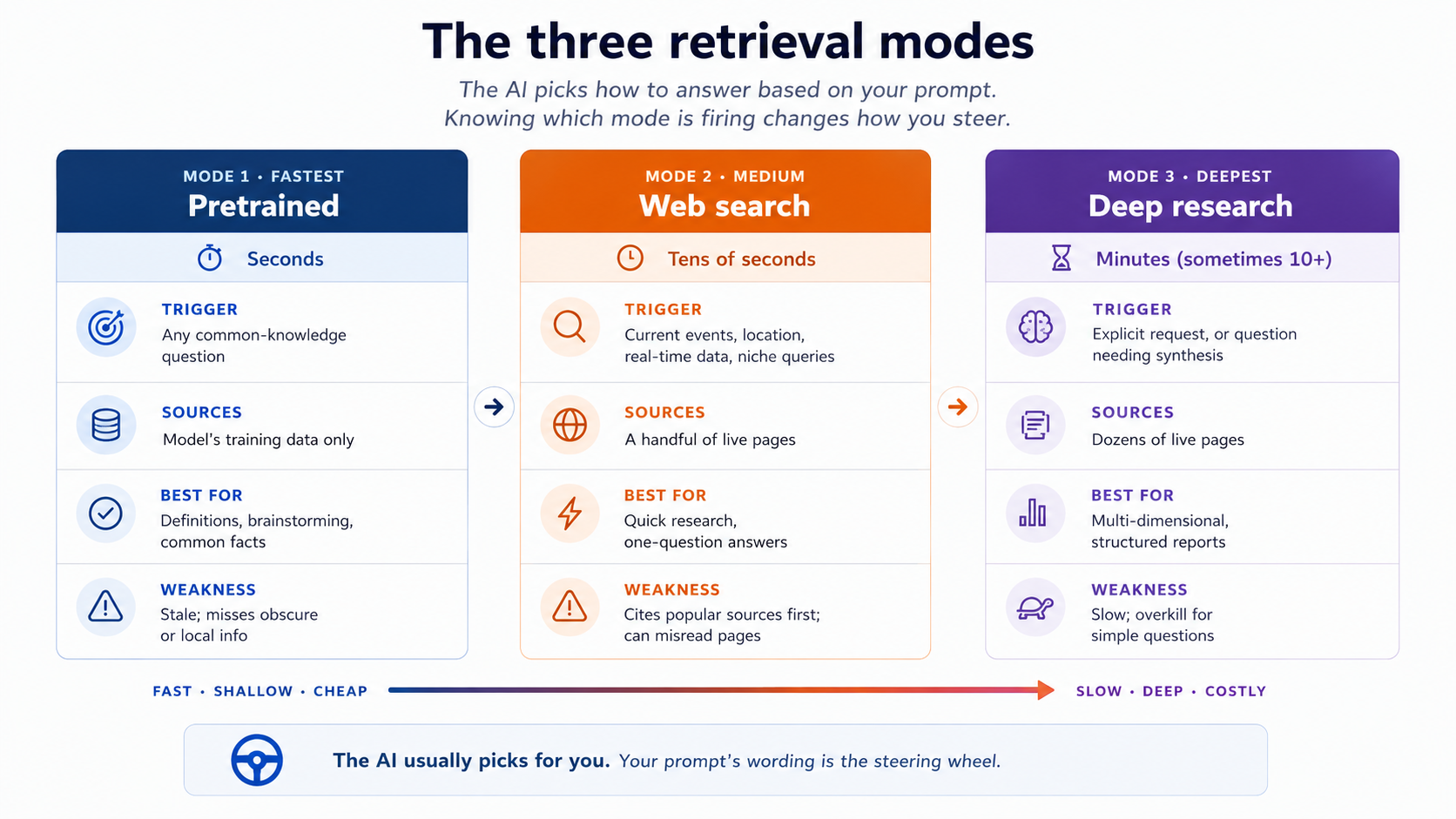
Teen modes side by side:
| Mode | Trigger | Time | Sources | Best for | Weakness |
|---|---|---|---|---|---|
| Pretrained | Koi bhi common-knowledge question | Seconds | Model ka training data | Definitions, brainstorming, common facts | Stale, obscure ya local info miss karta hai |
| Web search | Current events, location, niche queries, real-time data | Tens of seconds | Chand live pages | Quick research, one-question answers | Popular sources pehle cite karta hai, pages misread kar sakta hai |
| Deep research | Explicit request, ya synthesis chahne wala question | Minutes (kabhi 10+ bhi) | Dozens of live pages | Multi-dimensional, structured reports | Slow, simple questions ke liye overkill |
Isay concrete banane ke liye kuch examples:
- Pretrained answers fine: "why do cats stare at walls," "what's on the Voyager 1 record," "summarize the plot of Hamlet." Yeh week to week change nahin hote.
- Web search stale model ko rescue karta hai: GPT-5.4 ki knowledge cutoff August 2025 thi. "6 7" meme us ke baad viral hua. Web search ke baghair AI ko maloom hi nahin hota aap kya keh rahe hain. Web search ke saath yeh recent article khinchta hai aur sahi answer deta hai.
- Web search ka ghalat jana: ek friend ne poocha "where to run in Henderson, Nevada." AI ne 20-year-old web page cite kiya aur ek aisa school recommend kiya jo ab public ke liye open nahin tha. Web search yeh check nahin karta ke sources current hain ya nahin.
- Deep research wait ke qabil: "plan a Halloween haunted house in our neighborhood, including permits, fire safety, and noise ordinances." AI research plan propose karta hai, kai parallel searches chalata hai, summarize karta hai, decide karta hai agla kis cheez mein dig karna hai, aur checklists ke saath multi-section report produce karta hai. Yeh chatbot answer nahin hai; yeh kaam ek junior researcher ko ek ghante ke liye dene ke qareeb hai.
Under the hood, aam taur par do models cooperate kar rahe hote hain. Ek user-facing model aap se baat karta hai. Ek alag assistant model searches issue karta hai, result list scan karta hai, sab se relevant pages download karta hai, aur har page ke short summaries likhta hai. Sirf woh summaries user-facing model tak wapas aati hain.
User-facing model original page kabhi nahin parhta. Woh page ka summary parhta hai jo doosre AI ne likha hota hai. Isi liye kabhi kabhi yeh page ne asal mein jo kaha tha usay misrepresent karta hai: information model tak aane se pehle translation layer se guzri, aur translation layers nuance lose kar deti hain.
Practical fix: AI ko batayein ke kis type ke sources use karne hain. "are vaccines safe" ke bajaye try karein "use the World Health Organization, the FDA, the European Medicines Agency, and peer-reviewed studies. Do not use forums or personal blogs." Source quality ek knob hai jise aap turn kar sakte hain. Default settings popular sources pehle cite karti hain (Reddit, Wikipedia, YouTube, Google itself, Yelp), jo aksar reliable hote hain lekin high-stakes questions ke liye hamesha trustworthy nahin.
Doosra fix: AI se source quote karne ko kahen. "For each claim, quote the exact sentence from the source page that supports it." Yeh assistant model ko original wording surface karne par force karta hai, jo summary-layer drift ko kaafi catch kar leta hai.
Aik non-software example. Aik teacher ne apni 7th-grade class ke liye local water quality par unit plan karne ke liye deep research use ki. Us ka prompt: "Research current water quality issues in [her city] over the last 24 months. Use the EPA, the city's public utility reports, and peer-reviewed studies. Avoid news editorials and forums. Produce a structured report with: (1) the three most-cited issues, (2) data tables showing trends, (3) three age-appropriate classroom activities students could do to investigate one of these issues at home." Aath minutes baad us ke paas current local data par grounded unit plan tha. Pretrained mode yeh nahin kar sakta tha; web search alone shallow answer deta; deep research sahi tool tha kyun ke question multi-dimensional aur current tha.
Apne zehan mein mode choose karna. Aam taur par aap button click kar ke mode pick nahin karte; AI aap ke prompt ke base par pick karta hai. Lekin aap steer kar sakte hain:
| Phrasing pattern | Yeh aam taur par kya trigger karta hai |
|---|---|
| "What is X" / "Summarize Y" | Sirf pretrained. |
| "What's the latest on X" / "Today" / "This week" / koi specific city | Web search. |
| "Research X thoroughly," "produce a report with citations," "use these source types" | Deep research (un tools mein jahan yeh hoti hai; warna extended web search). |
| Files attach karna | Files ke liye pretrained rehta hai; agar prompt current info maange to context ke liye web search kar sakta hai. |
AI vs Google. Yeh same tool nahin hain. Google quick scans, kisi specific known site tak navigate karne, ya koi cheez khareedne ke liye use karein (2013 Honda Civic ka air filter). AI tab use karein jab aap ko synthesis chahiye: pros and cons, multi-source comparison, written-out analysis. Choice is par depend karti hai ke aap link chahte hain ya answer.
Side-by-side rule of thumb:
| Task | Google ke saath behtar | AI ke saath behtar |
|---|---|---|
| "Find the official IRS page for form 1040." | Yes. Aap specific known site par land karna chahte hain. | No. |
| "Compare three diabetes medications and what the recent evidence says." | Slower. Aap 8 tabs parhenge. | Faster. AI evidence ko ek jagah synthesize karta hai. |
| "Buy a replacement charger for a 2018 ThinkPad." | Yes. Aap product link chahte hain. | No. |
| "Plan a 4-day Lisbon trip with a 6-year-old, no museums." | Slow. Aap blogs aur reviews juggle karenge. | Fast. AI constraints integrate karta hai. |
| "What's the weather tomorrow?" | Either. | Either. |
| "Why are my tomato plant leaves yellowing?" | OK. Multiple gardening sites. | Photo attached ho to behtar. |
Agar aap ka question "where is X" hai, Google ki taraf jaiye. Agar aap ka question "given sab this, what should I think" hai, AI ki taraf jaiye.
Zyada reliable web-search results kaise hasil karein
Jab aap web search chahte hain, teen choti habits quality raise kar deti hain:
- Un sources ka naam dein jin par aap trust karte hain. "Use the WHO, the FDA, and peer-reviewed studies, not forums."
- Inline citations maangein. "Cite the source after each claim."
- AI se kahen jo verify nahin kar saka usay flag kare. "If a claim cannot be supported by the cited sources, mark it 'unverified'."
Yeh teen lines, kisi bhi web-search prompt mein paste karne se, sab se common failure mode kam hota hai: AI chup chap sources ke across synthesize karta hai aur ek confident sentence produce karta hai jise koi single source support nahin karta.
Part 2: AI se achhi tarah baat karna
Agley chaar concepts is page ka heart hain. Yeh woh habits hain jo AI ko useful paane wale shakhs ko AI ko transformative paane wale shakhs se alag karti hain.
4. Context poora game hai
Humans active working memory mein taqreeban 7 cheezen rakhte hain. Modern AI models ek waqt mein laakhon words hold kar sakte hain, kabhi kabhi ek million tak. Proportion samajhne ke liye: taqreeban 750,000 words pehli 4 se 5 Harry Potter books, ya kai dinon ki continuous speech ke barabar hain. Model jawab dene se pehle yeh sab parh sakta hai.
Lekin yeh sirf wahi parh sakta hai jo aap isay dete hain. Context woh sab kuch hai jo kisi given response ke liye model ki window mein aa jata hai: product ka set kiya hua system prompt, un tools ki descriptions jinhein yeh call kar sakta hai (web search, code, file access), aap ka prompt, is conversation ki chat history, aur koi files jo aap ne upload ki.
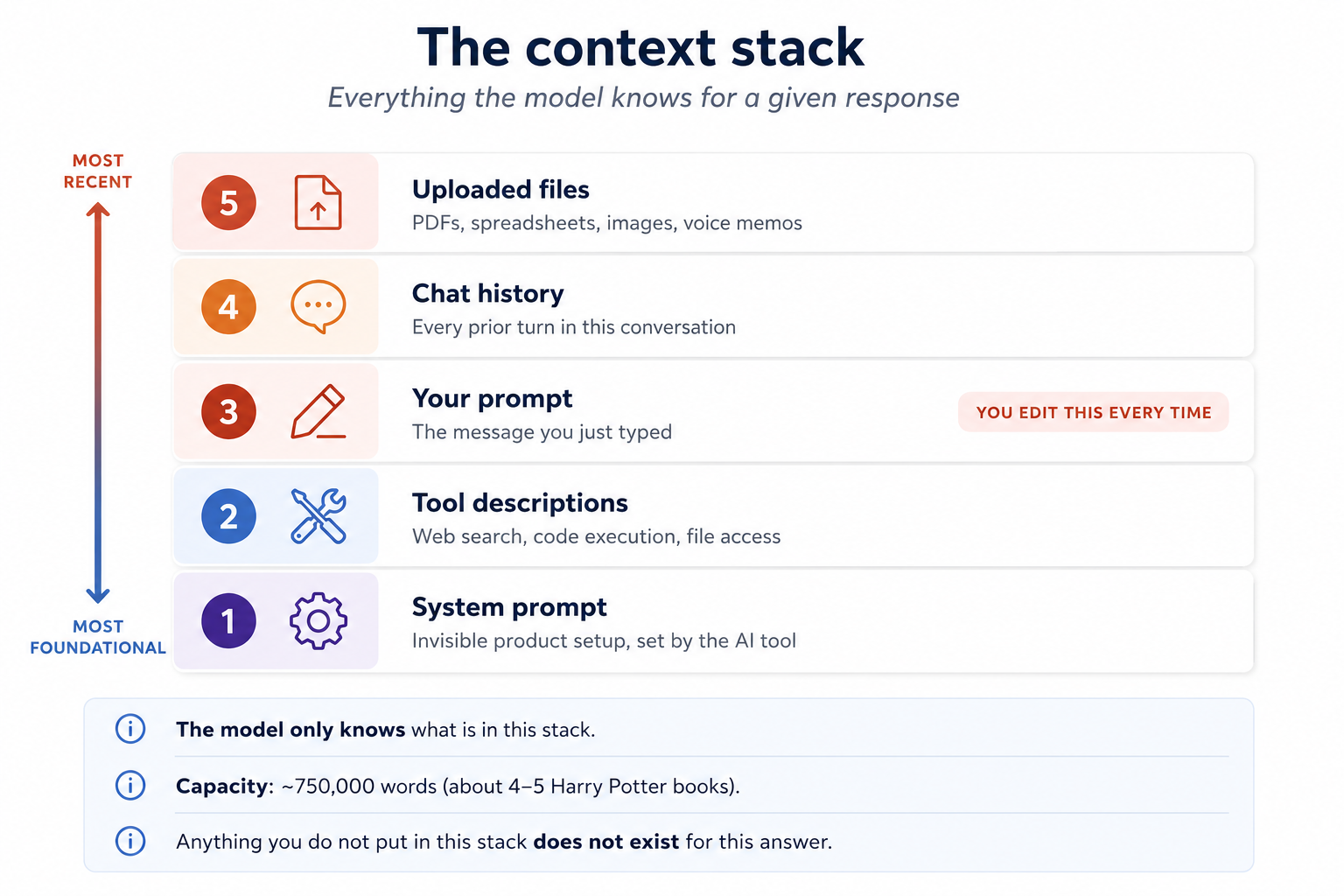
Concrete contrast:
- Bare prompt: "pros and cons of studying physics versus zoology." Aap ko generic high-school-counselor advice milegi.
- Context-rich prompt: wahi sawal, plus aap ke career assessment results PDF ke taur par upload aur aap ke high-school schedule ka screenshot. Ab AI aap ke specific aptitude profile, aap ki specific course history, aur kaun si choice kis se fit hoti hai us par baat kar sakta hai.
Same model. Same question. Different answer. Farq context hai, prompt ki cleverness nahin.
Aik non-software example. Aik small-business owner AI se baar baar pooch rahi thi "how do I price my consulting work" aur generic advice le rahi thi (hourly versus project-based, value-based pricing, etc.). Phir us ne teen cheezen attach kar ke dubara try kiya: us ki last six invoices, do competitors ke rate sheets ka screenshot jo usay bheje gaye thay, aur client mix par one-paragraph note. Wahi AI, ab grounded, specific recommendation produce karta hai: tiered structure with named anchor price, competitors ki positioning mein grounded justifications, aur cleanly written email jo woh next prospect ko bhej sakti thi. Model attempts ke darmiyan smarter nahin hua tha. Isay job karne ke liye kaafi cheez de di gayi thi.
Aap jo discipline seekh rahe hain: send press karne se pehle apne aap se poochein ke aik smart new colleague ko is ka achhi tarah jawab dene ke liye samne kya chahiye hoga. Phir woh cheezen attach karein.
Unifying mental model: AI ek bohat smart fresh college grad jaisa hai jo highly motivated hai, lekin abhi aap ke bare mein zyada nahin jaanta. Woh jo kuch aap is ke samne rakhenge, carefully parhega. Jo aap ne nahin bataya woh guess nahin karega. Woh khud se aap ki filing cabinet search nahin karega. Woh aap ki industry, aap ki team ki history, last quarter ke results, ya kal ki email thread infer nahin karega jab tak aap un cheezon ko brief mein na daalein. Empathize karein: kya is prompt mein job waqai karne ke liye kaafi information hai? Agar nahin, to zyada dein.
Doosra non-software example. Ek 7th-grade teacher ne AI se kaha "draft a lesson plan on the water cycle." Output generic plan tha jo kisi bhi textbook mein mil sakta tha: definitions, diagram, teen discussion questions. Agley din us ne dubara try kiya, teen cheezen attach kar ke: us ka course syllabus (taake AI ko pata ho is lesson se pehle aur baad mein kya aata hai), pichle hafte ke student worksheets visible grades ke saath (taake AI ko pata ho kaun se concepts land hue aur kaun se nahin), aur school ka standardized test format. Naya lesson plan un do concepts ke five-minute review se start hua jo pichle worksheets ke mutabiq weak thay, naye material ko May mein students ke samne aane wale test format se thread kiya, aur syllabus ke next topic se matched check-for-understanding question par close hua. Same model, same teacher, same subject. Farq sirf yeh tha ke doosre prompt ne AI ko woh bataya jo aik smart new colleague ko jaanna chahiye hota.
Habit, kisi bhi non-trivial prompt se pehle checklist ke taur par:
| Question | Agar yes, attach ya describe karein |
|---|---|
| Kya koi document hai jis ke saath answer consistent hona chahiye? | Yes: usay attach karein. |
| Kya koi constraint hai jo AI infer nahin kar sakta (budget, time, team mein kaun hai)? | Yes: usay state karein. |
| Kya prior context hai (previous decision, existing process)? | Yes: aik paragraph mein summarize karein. |
| Kya output format chahiye (table, email, bullet list)? | Yes: us ka naam dein. |
| Kya audience hai (boss, child, stranger)? | Yes: un ka naam dein. |
Context ki paanch sahi lines, cleverness ke paanch paragraphs se behtar hoti hain.
Modern context windows bari hain, lekin infinite nahin, aur un ke andar recall degrade hota hai. Sab se bari practical mistake log yeh karte hain: woh kai unrelated topics ke across ek bohat lambi conversation chalate rehte hain. AI ne abhi aap ko workout plan karne mein help ki, ab aap usay spreadsheet debug karne ko kehte hain, ab aunt ke liye thank-you note likhne ko. Workout context ab bhi wahan hai, model ko distract kar raha hai.
Rule of thumb: jab topic badle, nai conversation start karein. Karna cheap hai, free hai, aur answers visibly behtar ho jate hain.
Symptoms jo batate hain ke conversation stale ho gayi hai:
- AI chat ke earlier parts ka reference dena shuru karta hai jin ka abhi pooche gaye sawal se koi taalluq nahin.
- Answers waqt ke saath zyada lambe aur vague ho jate hain, hedging zyada hoti hai.
- Woh aisi constraint contradict karta hai jo aap ne paanch turns pehle stated ki thi.
- Woh progress ke baghair baar baar apologize karna shuru karta hai.
Jab yeh dekhein, "one more clarifying prompt" se fix na karein. Yeh sirf tangled context mein aur tangled context add karta hai. Nai chat kholein, woh ek ya do facts paste karein jo waqai matter karte hain, aur wahan se continue karein. Reset lagbhag hamesha rescue se tez hota hai.
Do habits ka useful pairing:
| Habit | Yeh kya karta hai | Kab use karein |
|---|---|---|
| Har topic ke liye nai chat | Accumulated noise remove karta hai. | Jab bhi aap tasks switch karein. |
| Useful state file mein save karein | Sirf important cheez ko next chat mein re-load karne deta hai. | Jab long conversation ne rakhne layak kuch produce kiya ho (plan, draft, decision). |
Combined: aap kaam lose nahin karte, lekin noise ko next task mein drag bhi nahin karte.
5. Reasoning, ya "think hard"
Takreeban 2023 tak hard prompts ke liye standard advice "think step by step" thi. Yeh advice ab zyada tar obsolete hai. Modern models ke paas built-in reasoning modes hain jinhein aap directly invoke kar sakte hain.
Naye keywords:
- "Think hard" ya "think carefully before answering" apne prompt mein.
- "Ultrathink" un tools mein jo isay recognize karte hain (kuch Claude products karte hain).
- Interface mein thinking-mode toggle, jahan available ho.
Jab aap yeh on karte hain, model kai seconds tak soch sakta hai. Hard problems par, kabhi kabhi das minutes se zyada. Yeh sirf dheere type nahin kar raha; yeh internally multiple approaches explore kar raha hai, apna kaam check kar raha hai, aur sirf phir woh answer likh raha hai jo aap dekhte hain.
2025 ki METR study ne track kiya ke frontier model sab se lambi kaun si task reliably complete kar sakta hai. 2024 mein answer woh tasks thay jo humans se minutes lete hain. 2025 tak yeh woh tasks thay jo humans se kai hours lete hain. Trajectory ab bhi climb kar rahi hai. Aap ke liye implication: AI ko real, hard tasks dein, sirf easy nahin. Yeh aap ke 2023 instincts se zyada handle kar sakta hai.
Ek power-user pattern jo isay achhi tarah use karta hai:
I'm choosing between two cars. Attached: spec sheets for both,
my insurance quote for each, and a spreadsheet of my driving
patterns over the last six months.

Read everything. Think hard. Then tell me:
1. The three trade-offs that actually matter for my driving pattern.
2. Which car you'd choose and why.
3. Under what conditions your recommendation flips.
Yeh prompt teen cheezen karta hai: relevant context load karta hai, explicitly thinking invoke karta hai, aur prose ki wall ke bajaye structured output maangta hai. Teeno habits hain.
Quick lookups, aik paragraph ke summaries, casual brainstorming. Thinking mode slower hai aur aap ke usage budget ka zyada hissa use karta hai. Isay un questions ke liye bachayein jahan aap chahte ke human apna waqt le.
Aik non-software example. Aik small-business owner ko apne office ke liye teen commercial cleaning vendors ke darmiyan choose karna tha. Us ke paas teeno ke quotes, references, aur har company ki history ka one-page summary tha. Us ka pehla prompt: "Which of these vendors should I choose?" AI ne generic checklist di (price dekho, reviews dekho, references mango). Useful, lekin decision nahin.
Us ne thinking mode on kar ke, bohat mukhtalif prompt ke saath dubara try kiya:
Attached: three commercial cleaning vendor quotes, three reference
sheets I called myself, and a one-paragraph note on what matters
most to me (consistency over price, since I've been burned twice).

Think hard before answering. Then:
1. Identify the three trade-offs I should actually be weighing.
2. Score each vendor on each trade-off, with one-sentence
   justifications grounded in the attached files.
3. Recommend one, and tell me what would make you switch.
AI ne lagbhag chaar minutes socha. Output one-page memo tha, bilkul requested structure ke saath, recommendation jise woh usi afternoon act kar sakti thi. Decision time, end to end: ek prompt, chaar minutes thinking, das minutes reading. Wahi decision do hafton se us ki desk par para tha.
Thinking mode isi ke liye hai: tez nahin, balki aise multi-input, multi-trade-off question handle karne ke qabil jise aap warna thoughtful colleague ko dete aur do din wait karte. Trade real hai. Aap compute ke chand minutes aur usage budget ka chhota hissa spend karte hain. Wapas woh cheez milti hai jo aap khud aadha din laga kar banate.
METR finding par ek note. METR ek research group hai jo measure karta hai ke frontier AI model sab se lambi task reliably complete kar sakta hai. 2024 mein ceiling woh tasks thi jo humans se chand minutes lete hain. 2025 tak yeh woh tasks thi jo humans se kai hours lete hain. Trajectory steep hai aur ab bhi climb kar rahi hai. Aap ke liye implication: jin tasks ko aap ne do saal pehle mentally "too complex for AI" categorize kiya tha, woh ab zyada tar tasks AI handle kar sakta hai, agar aap isay achhi tarah brief karein aur thinking mode on karein. Har chhe mahine AI kya kar sakta hai is par apni assumptions re-test karein. Woh ghalat hongi.
6. Sycophancy aur isay neutralize kaise karein
AI models human feedback par train hote hain. Specifically, un responses par jinhein thumbs up mila. Millions of users ke across, logon se agree karna disagree karne se zyada thumbs up lata hai. Result: models aap ko woh batane ki taraf biased hain jo aap sunna chahte hain.
ChatGPT conversations ke 2024 Washington Post analysis ne paya ke model users se lagbhag 10 times zyada agree karta tha jitna disagree karta. Reported phrases mein "that's correct," "good point," "you're on the right track," aur ek painful gem shamil tha: "dude, you just said something deep without even flinching, you're a thousand percent right."
Aap khud verify kar sakte hain. Same model, opposite framings:
- "Don't you think remote work is better than office work?" -> AI agree karta hai, reasons list karta hai.
- "Is it true that office work is more productive?" -> AI agree karta hai, reasons list karta hai.
Fix magic nahin hai. Sirf neutral framing hai. Compare:
| Bait phrasing (aap ka preferred answer signal karta hai) | Neutral phrasing (answer maangta hai) |
|---|---|
| "Don't you think remote work is better?" | "How does productivity compare between remote and in-office work?" |
| "Aren't carbon taxes bad for small businesses?" | "How do carbon taxes affect small businesses? Cite both directions." |
| "Do you agree AI will create a lot of jobs?" | "What does current research say about AI's net effect on jobs?" |
| "Does remote work reduce productivity?" | "What does the evidence say about remote work and productivity?" |
| "Find sab the positive measures of performance this quarter." | "Summarize this quarter's performance data. Flag both positive and negative trends." |
Bait ki subtler form: apne data mein AI se "find sab the positive measures of performance" kehna. Aap model ko pehle hi bata chuke hain ke aap kaunsa jawab chahte hain. Woh unhein dhoond lega, data mostly negative ho tab bhi. Isay neutral instruction se replace karein: "summarize the data, flag what is improving and what is degrading."
Apne prompts mein pehchanne layak kuch aur bait phrasings:
| Subtle bait jo aap likh sakte hain | Yeh AI ko kya signal karta hai | Neutral rewrite |
|---|---|---|
| "Find evidence that this strategy will work." | Conclusion fixed hai; AI support fill karta hai. | "Evaluate this strategy. List the strongest arguments for and against." |
| "Why is approach A better than approach B?" | A jeetta hai; AI reasons list karta hai. | "Compare approach A and approach B. Score each on cost, risk, and time." |
| "Help me defend my decision to hire X." | Decision locked hai; AI ammunition deta hai. | "Here is my decision and the context. What's the strongest counter-argument I should be ready for?" |
| "Tell me my draft is ready to send." | AI batata hai ready hai. | "Critique this draft against these 4 yes/no criteria. Recommend the smallest change that would lift the lowest score." |
| "Confirm that this code is correct." | AI confirm karta hai. | "Find any bug, edge case, or unstated assumption in this code. If there are none, say so." |
Pattern: koi bhi phrasing jismein find, defend, confirm, prove, support jaisa verb ho, AI ko question se pehle conclusion de deti hai. Inhein evaluate, compare, critique, find any, list both sides jaise verbs se replace karein. Model ab bhi agreement ki taraf thora bias rakhega, lekin aap ne loudest signal hata diya hai.
General rule: do options ko preference ka hint diye baghair lay out karein, phir har ek ke pros and cons maangein. Agar aap khud ko "isn't X true" likhte hue pakrein, ruk kar isay "to what extent, if at sab, is X true?" bana dein.
Yeh concept ek bohat gehri skill ka cheap version hai. Part 0 Chapter 1 (Asking Better Questions) deep version train karta hai: aise questions formulate kaise karne hain jo woh cheez surface karein jo aap pehle se nahin jaante. Neutral-framing trick everyday use ke liye aap ko 80% rasta de deti hai. Chapter baqi deta hai.
Aik non-software example. Ek founder ne AI se poocha: "I have a great business idea, mobile tie-dyeing for kids' birthday parties, critique it." AI ne idea ki warmly tareef ki aur reasons list kiye ke yeh succeed kar sakta hai. Founder ne phir rubric ke saath dubara try kiya: "Analyze this idea objectively. For each of the following, score 1 to 10 and justify: (1) is there a real problem here, (2) is there a market willing to pay, (3) is there a competitive advantage, (4) what's the unit economics, (5) what are the top three reasons this fails." Wahi AI ne idea ko 100 mein se 8 diya aur concrete terms mein explain kiya ke founder ko isay rethink kyun karna chahiye. Pehla prompt sycophancy bait tha. Doosra objective rubric tha. Same model, same idea, opposite verdicts. Farq sawal poochne ka tareeqa tha.
Objective-rubric pattern. Jab aap AI se kisi cheez ko evaluate karne ko kehte hain (draft, plan, idea), ambiguous criteria "great work" mein collapse ho jate hain. Specific yes/no criteria AI ko waqai dekhne par force karte hain. Compare:
| Vague critique prompt (sycophancy milti hai) | Rubric-based critique prompt (honesty milti hai) |
|---|---|
| "Score my sci-fi short story out of 100." | "Critique using these 4 criteria, each 1-5, each justified in one sentence." |
| "Is this email professional?" | "Check this email against these 5 yes/no tests: greeting present, ask is in the first paragraph, no jargon, single clear request, polite close." |
| "How is my workout plan?" | "For each day, answer: does it include a warm-up, does total volume fit my time budget, are there 48 hours between same-muscle sessions?" |
Trick yeh hai ke har rubric criterion ka jawab clear yes ya no se possible ho (ya 1-to-5 score with written justification). Soft criteria ("is this engaging?") sycophancy ke liye room chhor dete hain. Hard criteria nahin.
7. Brainstorm-iterate loop
Yeh is page ki single highest-leverage habit hai. Agar aap har doosra section skip karein, isay skip na karein.
Jab AI internet par train hua, internet ka zyada hissa common ideas tha, creative nahin. Is liye creative question par average AI response bhi common hota hai. "Ways to exercise at home": squats, push-ups, planks. Ghalat nahin. Bas average.
Is se bachne ka tareeqa magic prompt nahin hai. Yeh ek loop hai.
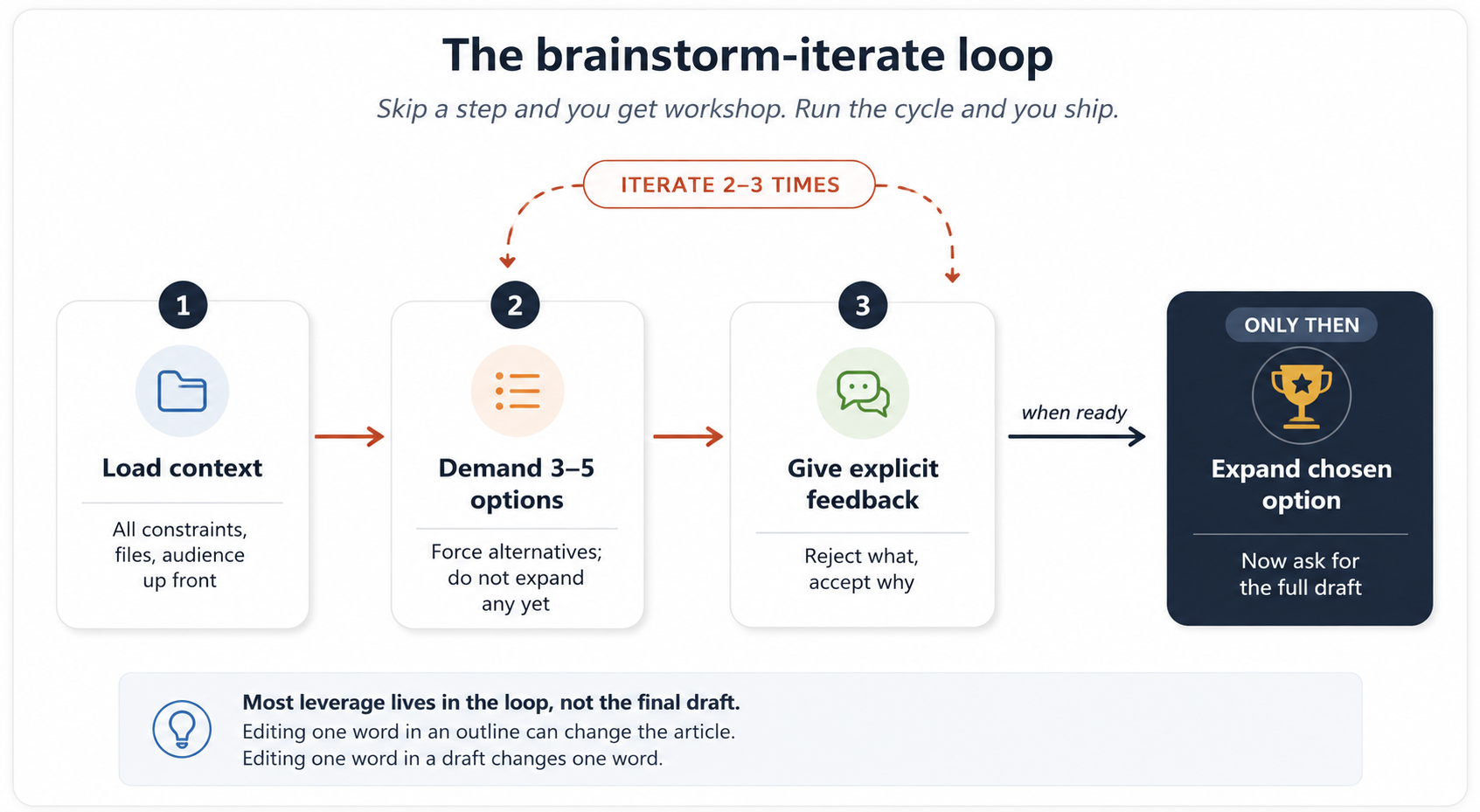
Recipe:
- Saara relevant context upfront dein. Sirf "ways to exercise" nahin; "ways to exercise given that I have a trampoline, a cat, and I cannot stick to plans for more than three days."
- Ek nahin, 3 se 5 options maangein. Alternatives force karne se model apni pehli instinct se aage jata hai.
- Explicit feedback dein. "I don't like option 1, it's too passive. I do like the trampoline idea but want it shorter. I forgot to mention I have a bad knee."
- Feedback se informed 3 se 5 naye options maangein.
- Iterate karein jab tak ek ya do options na mil jayein jo aap ko genuinely pasand hon.
- Phir, aur sirf phir, AI se chosen option detail mein flesh out karne ko kahen.
Worked example, debt payoff:
I have $8,000 in credit card debt at 19% APR, $4,000 in student
loans at 5%, and $1,200 in a retail card at 24%. I have $700/month
free after expenses. I just learned I'll get $450 in cash from a
tax refund. Risk tolerance: low. I sleep badly when I see big
balances.

Give me 5 different repayment strategies, each with a one-line
rationale. Don't expand any of them yet.
Phir, paanch options parhne ke baad:
Reject option 2 (avalanche by interest rate alone): I want
psychological wins early. Reject option 4: I won't open new
accounts. I like option 1 (snowball with the retail card first)
but I'd want to fold the $450 in. Give me 5 new options that
combine snowball-style wins with smart use of that lump sum.
Notice karein kya ho raha hai. Aap AI ka mind read karne ka wait nahin kar rahe. Aap apna taste dikha rahe hain, aur AI option space ko us ke gird reshape kar raha hai. Do ya teen rounds ke baad aap ke paas ek option hota hai jo bilkul sahi mehsoos hota hai. Ab aap full plan maangte hain.
Wahi loop writing ke liye bhi kaam karta hai, jahan is ka apna naam hai: drafting se pehle outline.
Iteration 1: ask for 3 outline options for a post on X.
Iteration 2: pick one outline, ask AI to critique it.
Iteration 3: revise the outline, ask AI to expand each heading
            into 3-5 bullets.
Iteration 4: critique the bullets, fix the weak ones.
Iteration 5: only now ask for the full draft.
Yeh kyun kaam karta hai: outline mein ek word edit karna poore article ki direction badal sakta hai. Final draft mein ek word edit karna sirf ek word badalta hai. Writing ka lagbhag saara leverage outline level par hota hai. AI start se word-by-word generate karta hai, is liye jab tak aap pehle structure force nahin karte, yeh poori shape nahin dekh sakta.
Temptation yeh hoti hai ke pehli try par full draft maang liya jaye. Resist karein. AI ka kisi bhi cheez ka first draft workslop hota hai: polished dikhta hai, kehta kam hai. Loop polished nothing ke das minutes ko actually-useful something ke tees minutes mein badal deta hai.
Ek worked writing example. Ek team lead 600-word post likhna chahta hai titled "Why our small AI team is shipping faster than the big team across the hall." Loop ka har round practice mein yun dikhta hai:
Round 1, research pehle:
I'm writing a 600-word post arguing that small AI-augmented teams
ship faster than larger non-AI teams. Don't write yet. First, give
me the 5 strongest research-backed arguments and the 3 strongest
counter-arguments. One sentence each.
Round 2, teen outlines:
Now produce 3 different outline options for the post. Each outline
should have 4-6 headings. They should differ in structure: one
narrative, one analytical, one contrarian. One line per heading.
Round 3, ek pick karein aur analogy add karein:
I'll go with outline 2 (analytical). I want to weave in a Pixar
analogy: how the original Toy Story team was small and faster than
the giant Disney studio because of new tools. Add this as a recurring
example, not its own section. Revise outline 2.
Round 4, bullets mein expand karein:
Now expand each heading into 3-5 bullets. Telegraphic style, not prose.
Round 5, bullets critique karein:
Critique the bullets. Which ones are weakest? Which would a skeptical
reader push back on hardest?
Sirf ab lead full draft maangta hai. Pura process lagbhag tees minutes leta hai. Output aisa parhta hai jaise lead ne likha ho, kyun ke har load-bearing decision lead ka tha. Yeh loop hai.
Defend karne wali instinct: yeh "write me a post" se zyada kaam lagta hai. Hai bhi, lagbhag bees minutes. Jo cheez yeh produce karta hai woh bees hours ki value ke qareeb hoti hai, kyun ke yahi woh version hota hai jo poora parha jata hai.
Loop domain-agnostic hai. Yeh isi tarah kaam karta hai: trip plan karna, sales pitch structure karna, college major pick karna, product ka naam rakhna, wedding toast likhna, renovation decide karna, charity choose karna. Shape constant rehti hai: context load karein, options demand karein, explicit feedback dein, naye options demand karein, iterate karein, phir expand karein. Agar aap khud ko AI ka first answer accept karte hue paate hain, aap ne loop skip kiya hai. Aap jo bhi kaam kar rahe hain, woh loop deserve karta hai.
Daily life ke across loop kahan fit hota hai, ek short table:
| Decision ya task | "Context" kaisa dikhta hai | "Options with feedback" kaisa dikhta hai |
|---|---|---|
| 4-day trip plan karna | Constraints (budget, dates, kaun ja raha hai, kya napasand hai) | 5 itinerary skeletons; do reject; baqi iterate |
| Product ka naam rakhna | Yeh kya karta hai, kaun khareedta hai, kya bilkul sound nahin karna chahiye | 10 names; 3 pasand pick karein, un par variants maangein |
| Difficult email likhna | Recipient, relationship, desired outcome | 3 mukhtalif tones; ek pick karein, specifics refine karein |
| Contractor choose karna | Teen quotes, teen reference notes, aap ki priorities | Side-by-side scoring; favorite ke against strongest counter maangein |
| Learning path pick karna | Current skills, available time, end goal | 3 mukhtalif curriculum shapes; ek pick karein, weekly milestones tak expand karein |
| Logo brief design karna (designer ke liye) | Brand values, audience, examples jo aap ko pasand hain | 5 mood-board directions; ek pick karein, us lane mein 5 variants maangein |
Part 3: Text se aage
Teen concepts jo woh cheezen unlock karte hain jin ka logon ko aksar pata hi nahin hota ke AI kar sakta hai.
8. Multimodal: images, audio, aur aage kya
Modern AI images ko do directions mein handle karta hai: yeh aap ki uploaded images dekh sakta hai, aur text prompt se nai images generate kar sakta hai. Dono skills bohat mukhtalif hain.
Image input. AI images ko coarse taur par dekhta hai. Yeh in cheezon mein strong hai:
- Overall scene aur composition.
- Distinct, large object shapes (giant human-sized hamster wheel treadmill).
- Whiteboard contents, diagrams ke saath.
- Handwritten aur cursive text (decent, high stakes ke liye double-check).
Yeh in mein weak hai:
- Fine details. "What gym machines are these?" fail hone ka tendency rakhta hai kyun ke gym machines slightly blurry lens se similar lagti hain. AI confidently aur wrongly answer kar sakta hai.
- Cluttered scene mein kai choti cheezen count karna.
- Image ke edge par small print parhna.
Useful real-world test: ek teacher ne whiteboard ki photo li jahan us ka head neural network diagram mein word "convolutional" block kar raha tha. AI ne diagram ke baqi hissa se missing word sahi infer kar liya. AI isi cheez mein achha hai: gist se infer karna. Zoom in karne mein achha nahin.
Receipts, bill split karne, ya handwritten notes transcribe karne ke liye AI achhi tarah kaam karta hai, lekin totals hamesha double-check karein. Multi-image inputs ke liye (post-its plus whiteboard photo plus brainstorm ke handwritten notes), AI combined ideas summarize kar sakta hai; yeh genuinely useful hai aur real time bachata hai.
Image output. Modern AI text prompts se images generate kar sakta hai. Do practical tips:
- Apna image prompt likhwane ke liye text AI use karein. "Generate me a prompt for a fantasy forest illustration in a Studio Ghibli style for a children's book cover." Woh output lein, image tool mein paste karein. Text AI pehli try par aap se kahin behtar rich image prompts likhta hai.
- Visual vocabulary build karein. Cinematic, watercolor, cyberpunk, anime, isometric, low-poly, art-deco, claymation jaise words levers hain. Image models captioned images par train hue aur unhon ne in styles ko naam se seekha. Jo images aap ko pasand hon upload karein aur AI se poochein woh unhein kaise describe karega. Yeh aap ki vocabulary train karta hai.
Image generation kaise kaam karti hai: yeh diffusion model hai, jo random pixel grids se noise step by step remove karna seekhta hai jab tak image emerge na ho. Text ki tarah pixel-by-pixel nahin. Poori image ek saath generate hoti hai. Isi liye aap time bachane ke liye image generation ko early stop nahin kar sakte, jaise text response interrupt kar sakte hain.
Purane diffusion models ki famous weaknesses thin: weird hands (six fingers), signs par garbled text, comic mein frame to frame characters ki appearance change. Modern models (jaise Google's Nano Banana) text reasonably handle karte hain, consistent characters generate karte hain, aur research papers ko infographics mein convert kar sakte hain.
Modern image models par bhi dekhne layak failure modes ka short table:
| Failure mode | Kaisa dikhta hai | Kaise mitigate karein |
|---|---|---|
| Signs par garbled text | Image ki signage "HAPRY BIRTDAY" parhti hai, "HAPPY BIRTHDAY" ke bajaye. | Prompt mein text quotes ke andar specify karein. Teen variants generate karein. Jahan text sahi ho woh pick karein. |
| Frames ke across inconsistent characters | Comic ke panel 1 aur 2 mein same character ka hair color different hota hai. | Explicit character-consistency support wale models use karein; first image ko next ke liye reference ke taur par wapas pass karein. |
| Hand aur finger errors | Six fingers, fused hands, twisted wrists. | Aisi compositions maangein jahan hands partially out of frame, pockets mein, ya clearly described hon. |
| Implausible objects ke saath cluttered backgrounds | Coffee shop jahan bicycle chair mein merge ho jati hai. | Simple background specify karein, ya background explicitly describe karein. |
| Wrong aspect ratio | Model square default karta hai; aap landscape chahte thay. | Aspect ratio hamesha explicitly specify karein: "1024x768 landscape" ya "16:9". |
Image input ke liye ek non-software example. Aik reader ne apni deceased grandmother ke teen handwritten recipe cards ka stack photograph kiya aur AI par upload kiya. Prompt: "Transcribe these three cards. Preserve the original wording and any abbreviations. If a word is unclear, mark it [unclear] and offer your two best guesses." Paanch minutes baad teeno recipes cleanly typed thin, un chaar words par [unclear] marks ke saath jinhein AI confidently read nahin kar saka. Reader ne woh chaar originals ke against check kiye (do obvious thay, do ke liye aunt ko phone call chahiye thi), aur family ke paas recipes ka clean digital archive aa gaya jo lost hone ke risk par tha. AI ne boring 90% kar diya taake reader careful 10% par focus kar sake.
Agar aap ko document, slide, ya apne chapter ke liye diagram banana ho, to aik workflow hai jo taqreeban pandrah minutes mein designer-quality output de sakta hai, Figma ke baghair aur visual design skill ke baghair. Zyada tar non-designers ko andaza hi nahin ke yeh ab mumkin hai.
Recipe chaar steps mein:
- Claude se concept ko SVG ke taur par visualize karwayen. Underlying paragraph ya text paste karein aur kahen: "Visualize this as a diagram. Output it as SVG. Make sure every label, arrow, and relationship from the text is present." Claude is step ke liye achha hai kyun ke yeh paragraph se boxes, arrows, hierarchy, aur labels reason kar leta hai. Pehla SVG structurally correct hoga, visually plain ho sakta hai — yeh theek hai.
- SVG ko PNG mein convert karein. Claude se render karwa lein, ya online SVG-to-PNG converter use karein, ya browser mein high zoom par screenshot lein. 2x resolution par render karein taake next step ke paas enough detail ho.
- PNG ChatGPT mein paste karein aur redraw karne ko kahen. Prompt: "Redraw this diagram with professional design quality. Preserve every label, every box, every arrow, and the exact structural relationships. Improve typography, spacing, color palette, and visual hierarchy. The information must remain identical; only the visual finish changes."
- Result par iterate karein. ChatGPT kabhi label drop kar deta hai ya box rearrange kar deta hai. Output ko original SVG ke saath side by side compare karein. Agar kuch ghalat ho to seedha correction type karein: "The third box should be labeled 'Iterate', not 'Repeat'." Teen ya chaar rounds ke baad aam taur par professional-looking result mil jata hai.
Har tool har step ke liye kyun. Claude step 1 mein strong hai kyun ke diagram ki structure decide karna reasoning task hai. ChatGPT step 3 mein strong hai kyun ke text-heavy images ko visually polish karna image-generation task hai. Tools badalte rahenge, lekin pattern zinda rahega: structure pehle strongest reasoning model mein, polish baad mein strongest text-heavy image model mein.
Total time: taqreeban das se pandrah minutes per diagram, jabke Figma mein yahi kaam aik ghanta ya zyada le sakta tha.
Image generation ke bare mein ek chhoti story
Ek father jis ki 7-year-old daughter cats se pyaar karti thi, us ke liye custom birthday cake chahta tha. Us ne cake designs brainstorm karne ke liye Nano Banana use kiya (dozens of variations generate kar ke: cat-shaped, multi-tiered, frosting-styles, color palettes), jo design beti ko pasand aaya woh pick kiya, phir chosen image baker ko di jis ne usay real 3D cake ke taur par render kiya. Design par total iteration time: aik afternoon. Total cost: image generation ke chand cents.
Point cake nahin hai. Point yeh hai ke taqreeban $0.30 aur taste-driven iteration ke ek ghante mein, ek non-designer shakhs ne one-of-a-kind brief produce kiya jise professional execute kar sakta tha. Yeh creative leverage ki nai qism hai, aur widely available hai.
Audio in, audio out. Images ki tarah audio mein bhi wahi shift aa chuki hai. Aap typing ke bajaye long prompt dictate kar sakte hain; meeting recording drop kar ke summary maang sakte hain; model se apna answer loud read karwa sakte hain. Zyada tar modern AI tools in teeno ko support karte hain, aksar free tiers par bhi.
Non-obvious uses mein asli leverage hai:
- Long-form dictation. Problem ko zubani soch kar bolna woh nuance capture karta hai jo typed prompts miss kar dete hain. Jo log typing pasand nahin karte, woh bol kar dramatically better prompts bana lete hain — prompt aik line se kai paragraphs tak barh jata hai, aur AI ka answer bhi behtar hota hai. Colleague ko coffee par brief karne ki tarah bolen, phir AI ko transcript clean karne dein.
- Meeting transcripts as context. Aik ghante ki meeting recording ya transcript upload karein aur poochein: "Summarize the decisions made, the open questions, and the action items by owner." Meetings wali jobs ke liye yeh is page ka sab se high-leverage workflow hai, aur tech ke bahar abhi bohat kam log isay use kar rahe hain.
- Audio for accessibility and movement. Long commute, dog walk, driving — voice in/voice out dead time ko thinking time bana deta hai. Typing ke muqable conversation quality thori gir sakti hai kyun ke aap input ko cleanly edit nahin kar sakte, lekin jo waqt warna zaya hota, woh recover ho jata hai.
2026 mein audio kis cheez mein achha aur kamzor hai:
| Audio task | Kitna achha kaam karta hai | Kis cheez se bachna hai |
|---|---|---|
| Clear speech ki transcription | Excellent | Heavy accents, technical jargon, multiple overlapping speakers |
| Speaker identification (kis ne kya kaha) | 2 speakers par decent, 4+ par weak | Kisi ko quote karne se pehle hamesha check karein |
| Tone, sarcasm, emotion | Improve ho raha hai lekin unreliable | AI se uncertainty flag karne ko kahen, assume karne ko nahin |
| Music ya non-speech audio analysis | Limited | General-purpose AI ke bajaye specialized tool use karein |
| Real-time voice conversation | Casual ke liye good, technical depth ke liye weak | Jab precision matter kare to text par switch karein |
Aik non-software example. Aik doctor ne patient consultation ki 45-minute recording consent ke saath record ki, audio upload ki, aur AI se kaha: "Produce a structured clinical note in SOAP format. Flag anything you could not understand confidently. Highlight the three most important things the patient said about their symptom history." Aath minutes baad doctor ke paas draft note tha jise verify aur finalize karne mein 5 minutes lage, jabke typed version 25 minutes leta. AI ne clinical judgment replace nahin ki; is ne typing hata di.
Cost note: audio in/out text ke baad doosra sab se cheap tier hai — pennies per minute (concept 12). Meeting summaries, daily voice journaling, ya walk par prompts dictate karne ke liye cost taqreeban invisible hoti hai. Freely iterate karein.
Yaad rakhne layak pattern: multimodal ka future yeh nahin ke "AI voice kar sakta hai, cool" — balki yeh hai ke modalities ki boundary ghaib ho jati hai. Aap mixed bundle daalenge (image, voice memo, PDF, screenshot) aur isay aik prompt ki tarah treat karenge. Skill "voice kaise use karni hai" nahin, balki "is job ke liye inputs ka sahi combination kya hai" hai.
Interactive video avatars bhi isi trajectory par ubhar rahe hain. Pre-recorded avatar video (HeyGen, Synthesia, D-ID) training content aur multilingual corporate communication ke liye pehle hi production-grade hai. Real-time conversational avatars low-stakes uses ke liye passable hain — customer FAQ triage, face ke saath language tutoring, simple onboarding flows — aur tezi se improve ho rahe hain. Inhein image generation 2022 ki tarah treat karein: impressive, novel, abhi har knowledge work ka daily habit nahin, lekin jab job ko screen par face chahiye ho to quick experiment ke layak.
9. Ek prompt se chhoti apps banana
Modern AI aik single prompt se chhote games, websites, aur tools build kar sakta hai. Abhi large software ke liye nahin, lekin choti useful cheezon ke liye yeh un logon ke liye genuinely accessible hai jinhen kabhi code likhna nahin aaya.
Recipe sirf teen slots hai:
Goal: what should this thing do?
Input: what does the user provide?
Output: what does the user see?
Examples jo aaj kaam karte hain:
- Pomodoro timer. "Build a Pomodoro timer with a yellow theme. 25-minute work sessions, 5-minute breaks, a satisfying click when each cycle ends."
- Bill splitter. "Build an app where I enter a total bill, a tax amount, and the names of friends. It splits the bill including tax and shows each person's share."
- Outfit picker. "Build an app that takes today's weather (temperature and precipitation) and recommends an outfit from a closet of items I describe."
- Fireworks simulator. "Generate a fun fireworks simulator. Input: I click on the screen. Output: a colorful display of fireworks at the click point."
- Place-obstacles game. "Build a game where the user places obstacles and a goal, and runs a simulation that tries to reach the goal."
Jo ab bhi hard hai:
- Internet par multiplayer. Networking, accounts, aur matchmaking ab bhi one-prompt build se bahar hain.
- Doosri language mein live AI feedback. French-conversation tutor jo sunta hai, pronunciation correct karta hai, aur real time mein adapt karta hai genuinely hard hai.
Aap jo intuition build karte hain: choti cheezen jo ek screen par fit hoti hain, accounts ke baghair aur external services ke baghair, kaam karti hain. Us se aage kuch bhi one prompt se zyada maangta hai, aur aam taur par kuch real engineering bhi.
Aik non-software example. Ek parent ne apni beti ke liye yellow cat-themed typing game banaya jab us ki teacher ne mention kiya ke bachche faster type kar sakte hain. Woh software engineer nahin hai. Prompt teen sentences tha:
Build a typing game for a 7-year-old. Goal: practice typing
common short words. Input: words appear, the player types them
before they reach the bottom of the screen. Output: a yellow
theme, a cute cat mascot that cheers when the player gets a
word right, increasing speed across levels.
Jo wapas aaya woh kaam karta tha. Perfect nahin, first try par nahin, lekin ek ghante ke andar "kid ke liye good enough" tak iterate ho gaya. Yahan jo skill build ho rahi hai woh coding nahin. Yeh clear brief likhne aur usay iterate karne ki ability hai. Yeh skill universal hai.
| Idea | Shayad one-prompt friendly | Shayad zyada chahiye |
|---|---|---|
| Custom theme wala timer | Yes | |
| Friends ke liye bill-splitter | Yes | |
| Words ki list se flashcard quiz | Yes | |
| Ek player ke liye simple platformer | Yes | |
| Internet par multiplayer game | Yes (servers, accounts) | |
| Working e-commerce store | Yes (payments, inventory) | |
| Voice feedback wala live language tutor | Yes (real-time audio) | |
| Devices ke across sync hone wala daily-checking habit tracker | Yes (cloud sync, accounts) |
10. Data analysis (model code likhta aur run karta hai)
Jab aap AI se aisa sawal poochte hain jise calculation ya graphing chahiye, modern tools chup chap kuch remarkable karte hain: model code likhta hai, usay run karta hai, aur result return karta hai. Code execution bas ek aur tool hai jise model call kar sakta hai, web search ki tarah.
Yeh model se apne head mein math karwane se kahin zyada reliable hai. Model math usi tarah kar raha hai jaise aap karte: calculator run kar ke. Precise calculator hai; model sirf choose kar raha hai ke kya compute karna hai.
Bubble tea shop example. Ek small business ke paas sales data ka ek saal hai: drinks, dates, quantities. Owner poochta hai: "Which drinks had the biggest changes in sales over the year? Graph them."
AI spreadsheet dekhta hai, har drink ke month-over-month changes compute karne ke liye code likhta hai, observe karta hai ke zyada tar drinks flat hain aur chaar stand out karte hain, un chaar ka colored line graph generate karta hai, aur patterns note karta hai. "Strawberry matcha rose sharply in spring; consider re-running that promotion next year." Yeh generic answer nahin. Yeh actual data mein grounded answer hai.
Phir ek longer prompt: "Create a one-slide year-in-review graphic for the shop. Analyze the data carefully for insights worth featuring." Yeh minutes of thought trigger karta hai; AI code likhta hai, analyses run karta hai, insights pick karta hai, annotations design karta hai, aur finished dashboard produce karta hai.
Yeh kis ke liye achha hai:
- Spreadsheet analysis (running tracker, sales records, budget files, lab data).
- Trends ke quick graphs jo rows ko ghur kar nazar nahin aate.
- Aggregations aur comparisons jo Excel mein aap se 20 minutes lete.
Kya double-check karna hai:
- Final totals. Code precise hai, lekin AI ne ghalat column sum kiya ho sakta hai.
- Graphs ke labels. Numbers aam taur par sahi hote hain; captions kabhi kabhi confidently wrong.
- Kuch bhi jahan analysis kisi column par depend karta hai jise AI ne misinterpret kiya ho.
Reliability memory-based math se bohat zyada hai, lekin infallible nahin. AI data analysis ko ek sharp junior analyst ke kaam ki tarah treat karein: useful, fast, lagbhag hamesha right, kabhi kabhi instructive tareeqon se wrong.
Aik non-software example. Ek runner ne six months ka running-tracker data upload kiya (fitness app se CSV) aur poocha: "How are my pace and distance progressing? Are there any patterns I should know about?" AI ne code likha, weekly averages plot kiye, aur do cheezen notice ki jo runner ne nahin dekhi thin: har long-run weekend ke baad pace consistently drop hota tha (likely fatigue), aur third month mein distance plateau hua phir dubara climb kiya. Recommendation: har fourth week deload week, aur slower long-run pace. Runner months se app ke dashboard mein isi data ko dekh raha tha lekin patterns nahin dekh saka. AI ne nothing se insight invent nahin kiya; is ne woh compute kiya jo runner ke paas compute karne ka waqt nahin tha.
Jab aap data upload karte hain, pehla prompt question hona zaroori nahin. Yeh ho sakta hai: "Describe this dataset. What columns are here, what do they represent, and what 3 charts would best show what is going on?" Jawab parhein, chart pick karein, phir usay maangein. Yeh misinterpreted columns ko wrong analyses banne se pehle catch karta hai.
Part 4: Mehfooz tareeqe se kaam karna aur tools choose karna
Do final concepts jo badalte hain ke AI aap ke liye kya kar sakta hai, aur job ke liye right tool kaise pick karna hai.
11. AI desktop apps aur permissions
Ab products ki poori category hai jise AI desktop apps kaha jata hai: apps jo aap ke computer par run hoti hain aur, permission ke saath, aap ki files dhoond sakti hain, parh sakti hain, aur un par act kar sakti hain. Examples mein Cowork, Microsoft Copilot, aur Google Antigravity shamil hain. Cowork Anthropic ka product hai. Category grow kar rahi hai.
Yeh kya kar sakti hain jo chat nahin kar sakti:
- PDFs ke messy folder ko dekhna, nai organization propose karna (files rename karna, move karna, subfolders create karna), aur aap ke approve karne ke baad plan execute karna.
- Project ke related files ikathe karna (aap kehte hain "I'm filming on these dates and these people are involved"), aur khud notice karna (crew member ka birthday shoot ke dauran aa raha hai, kya aap celebration fold in karna chahte hain).
- Folder ke across parh kar summarize karna: "what did I work on last quarter, based on the contents of this projects/ folder?"
Workflow jo isay safe banata hai:
- Isay task batayein. ("Reorganize this folder by client.")
- Action nahin, plan maangein. App file operations ki list propose karta hai.
- Plan review aur edit karein. Woh rename catch karein jo aap nahin chahte, us ke hone se pehle.
- Sirf phir execution approve karein.
Do facts jo zyada tar log mushkil tareeqe se seekhte hain:
- Deleted files aksar recycle bin mein NAHIN jati jab AI app unhein delete karti hai. Woh chali jati hain.
- Edited files edit history NAHIN rakhti jab tak aap ke paas version control na ho. AI ki change previous version overwrite kar deti hai.
Jab tak aap yeh safely chand martaba na kar lein, har permission request ko task ke liye zaroori sab se chhote folder tak scope karein. Kisi app ke liye "full disk access" approve na karein jise aap ne sirf do dafa use kiya hai.
Yeh tool ki genuinely nai shape hai. Isay usi tarah treat karein: jaise pehli dafa aap ne junior employee ko real account ki keys di thin. Useful, fast, aur care ke qabil.
Aik non-software example. Ek consultant ke paas clients/ naam ka folder tha jo chaar saal mein 240 PDFs tak barh gaya tha: contracts, invoices, scoping documents, hand-scanned receipts, meeting notes. Us ne AI desktop app ko kaha: "Look through clients/. Propose an organization scheme. Do not move any files yet. Show me the proposed scheme as a tree." App ne clean tree produce ki: har client ke liye ek folder, contracts, invoices, aur notes ke liye sub-folders, aur 18 files ki flagged list jinhein woh confidently classify nahin kar sakta tha. Us ne proposal edit kiya (do clients rename kiye, do folders merge kiye), phir execution approve ki. Total time: lagbhag pandrah minutes. Wahi job us ki "someday" list par teen saal se thi. Unlock AI ka thinking karna nahin tha; unlock AI ka tedium karna tha taake thinking cheap ho jaye.
Permission ladder. Comfortable hone ke liye useful sequence:
| Comfort level | Kya allow karein | Kis cheez ko no kehte rahein |
|---|---|---|
| First sessions | Ek single small folder ka read-only access. | Kuch bhi jo writes, deletes, ya renames karta hai. |
| 2-3 successful runs ke baad | Ek specific folder ke andar read and write. | Broader directories jaise desktop ya documents root ka access. |
| Ek clean week ke baad | Project tree ke across read, scoped subfolder ke andar write. | Us project ke bahar kuch bhi. |
| Trusted | Tool-specific permissions ("rename PDFs in this folder," "edit Word docs in this folder"). | Open-ended "do whatever you need." |
Principle: scope track record ke saath grow karta hai, us company par trust ke saath nahin jis ne tool banaya. Trust aap ke specific workflow mein behavior se earn hota hai.
12. Cost, speed, aur kaunsa model kab use karein
Zehan mein rakhne ke liye simple stack:
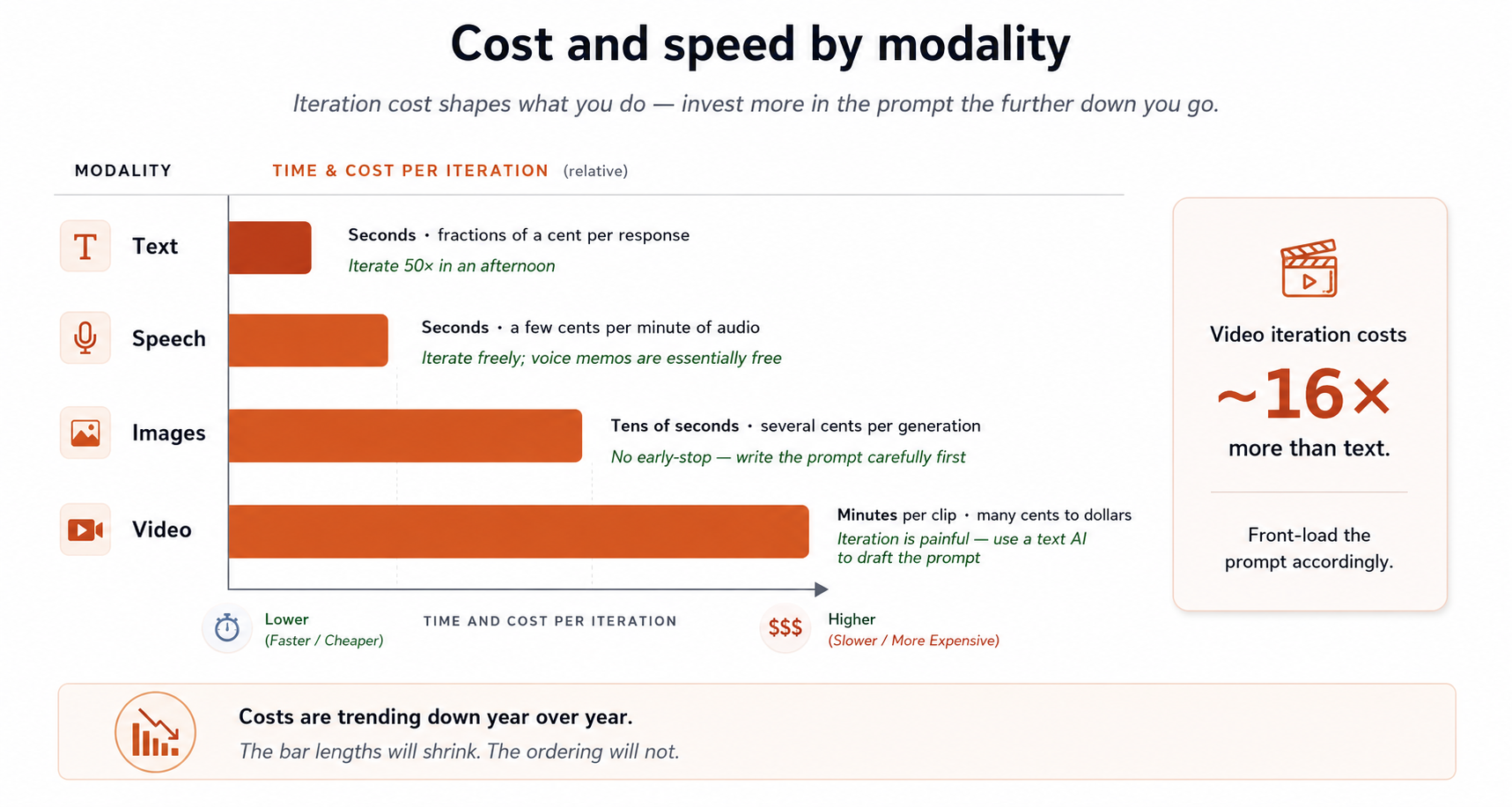
Alfaaz mein:
- Text: seconds, har response ke fractions of a cent.
- Speech: seconds, audio ke har minute ke chand cents.
- Images: tens of seconds, har generation ke several cents. Early-stop nahin, poori image ek saath generate hoti hai.
- Video: har generation ke minutes, many cents se chand dollars tak. Iteration painful hai kyun ke har round slow aur expensive hai.
- Deep research: minutes, several cents se quarter tak, lekin dozens of sources aap ke liye synthesize karta hai.
Do implications:
- Iteration cost shape karta hai ke aap kya karte hain. Aap aik afternoon mein text par 50 dafa iterate kar sakte hain. Video par 50 dafa nahin. Is liye jab images ya video generate karein, prompt mein upfront zyada invest karein (aur isay likhne ke liye text AI use karein).
- Costs trend down kar rahe hain. Jo image aaj aap ko 10 cents cost karti hai, next year us ka fraction cost karegi. Apne home ke liye art, birthday card, ya wedding invitation generate karna rapidly free ban raha hai.
Kaun sa model kis task ke liye? AI jagged hai: mukhtalif models mukhtalif cheezon mein ache hain, aur leader har chand mahine badalta hai. Koi single best model nahin. Do habits help karti hain:
- Same prompt 2 se 3 models mein routinely try karein. Same question, teen tools. Teeno answers parhein. Differences aap ko surprise karenge, aur yeh aap ki intuition update karte hain ke kaunsa tool kis qism ke question ke liye best hai.
- Aik tool se shaadi na karein. Jo worker sirf ek AI use karta hai woh apne two-thirds tasks ke liye best tool ke bare mein ghalat hota hai. Switching free hai; aap bas prompt different tab mein paste karte hain.
Aaj aap ke task ke liye best AI teen mahine baad aap ke task ke liye best AI nahin hoga. Loose rahein.
Har major model abhi aam taur par kis mein strong hota hai, ek rough snapshot (yeh badlega; isay starting point samjhein, verdict nahin):
| Tool | Aam taur par kis mein strong hota hai | Aam taur par kis mein weaker hota hai |
|---|---|---|
| ChatGPT | Conversational range, in-product image generation, broad task coverage. | Kabhi verbose; lists aur headings ke saath over-format kar sakta hai. |
| Claude | Long-document understanding, hard prompts par careful reasoning, writing voice. | In-product image generation competitors ke muqablay mein kam central hai. |
| Gemini | Fast web search aur source synthesis, rich output (charts, tables) ke saath deep research, Google's data se tight integration. | Tone zyada clipped mehsoos ho sakta hai; kuch responses ideal se short hote hain. |
Teen habits jo compound karti hain:
- Kam az kam do tabs open rakhein. Aik primary tool aur ek backup. Jab primary aap ko kuch aisa de jo right mehsoos na ho, same prompt backup mein paste karein. Doosra answer aksar tiebreaker hota hai.
- Prompt scratchpad rakhein. Ek note file (koi bhi text file chalegi) jahan aap woh prompts collect karte hain jin se unusually ache results mile. Unhein reuse aur adapt karein. Yeh aap ki personal library hai.
- Notice karein jab model wrong ho. Scolding ke taur par nahin, data ke taur par. Wrongness free signal hai ke is tool ke edges kahan hain. Hafte mein aik dafa "tool X confidently wrong about Y" log karna kisi bhi 2,000-word AI newsletter parhne se zyada useful hai.
Mahine mein aik dafa, ek task choose karein jo aap regularly karte hain (weekly status updates likhna, meals plan karna, recurring document summarize karna). Us task ko teen mukhtalif AI tools se run karein. Note karein kis ne best kiya. Agley mahine tak us task ke liye wahi use karein, phir re-test karein. Aap ki tooling effort ke baghair current rehti hai.
13. Models checking models
Jab ground truth maujood na ho — na answer key, na paas baitha expert, na koi test jo red fail ho — phir bhi aap quality par ek objective signal hasil kar sakte hain. Tareeqa yeh hai ke models se aik doosre ka kaam grade karwaya jaye.
Mukhtalif models ke blind spots mukhtalif hote hain. Un ki training data overlap karti hai, lekin identical nahin hoti; un ke reward signals aur product priorities bhi mukhtalif hoti hain. Jo point aik model miss karta hai, doosra aksar pakar leta hai. Un ke darmiyan disagreement woh signal hai jo kisi aik model se akela nahin milta.
Recipe yeh hai:
- Us best model se start karein jis tak aap ki access hai. "Best" se murad woh model hai jo aap ke task par reasoning aur long-output coherence mein sab se strong ho. Public leaderboards ko starting point samjhein, final verdict nahin.
- Pehla draft full context ke saath generate karein. AI ko colleague ki tarah brief karein, hard problems par thinking mode on karein, aur structure ke liye brainstorm-iterate loop use karein.
- Usi model se apne output ko named criteria ke against 1 se 10 tak grade karne ko kahen. "Is this good?" nahin. Kahen: "clarity, accuracy, structure, aur missing pieces par 1-10 score do, har score ke liye aik sentence justification ke saath."
- Us se apni suggestions implement karwayen. Repeat karein jab tak grade barhna band na ho jaye — aksar yeh 9 ke qareeb plateau hota hai.
- Draft doosre model ke paas le jayen aur wahi rubric dein. Doosra model pehle model ke blind spots pakarta hai.
- Doosre model ki critique pehle model ko wapas dein. Seedha kahen: "another model produced this critique. Evaluate which points are worth adopting, and why. Reject anything you disagree with, and explain."
- High-stakes work ke liye teesre model ko bhi shamil karein. Different family, different training data, different temperament. Teen models ki behas ke baad aap ke paas is technology ka sab se qareebi triangulated signal hota hai.
- Tab rukhein jab target score do independent models par cross ho jaye. Primary model ka akela 9.5 utna meaningful nahin jitna primary plus doosre model ka 9.
Upar ke steps 3 aur 4 apne aap mein bhi useful hain, bina second model khole. Bohat se tasks multi-model overhead justify nahin karte, lekin "score this 1-10 against this rubric, then implement your own suggestions" se visibly behtar ho jate hain: weekly status update, tricky email, one-page memo.
Is ka higher-leverage variant: numerical target set karein aur model ko us tak autonomously iterate karne dein. Misal: "iterate against your own rubric until you reach 9.5 across all criteria, then show me the final version." Model grade karega, revise karega, dobara grade karega, aur final version tab dikhayega jab target hit ho ya plateau aa jaye.
Yeh concept 6 se conflict nahin karta, jahan self-grading ke sycophancy risk ki warning thi. Farq rubric hai. Baghair rubric ke "is this good?" ka jawab "great work!" ban jata hai. Named criteria aur 1-10 scores ke saath model ko batana padta hai ke baqi points kahan gaye.
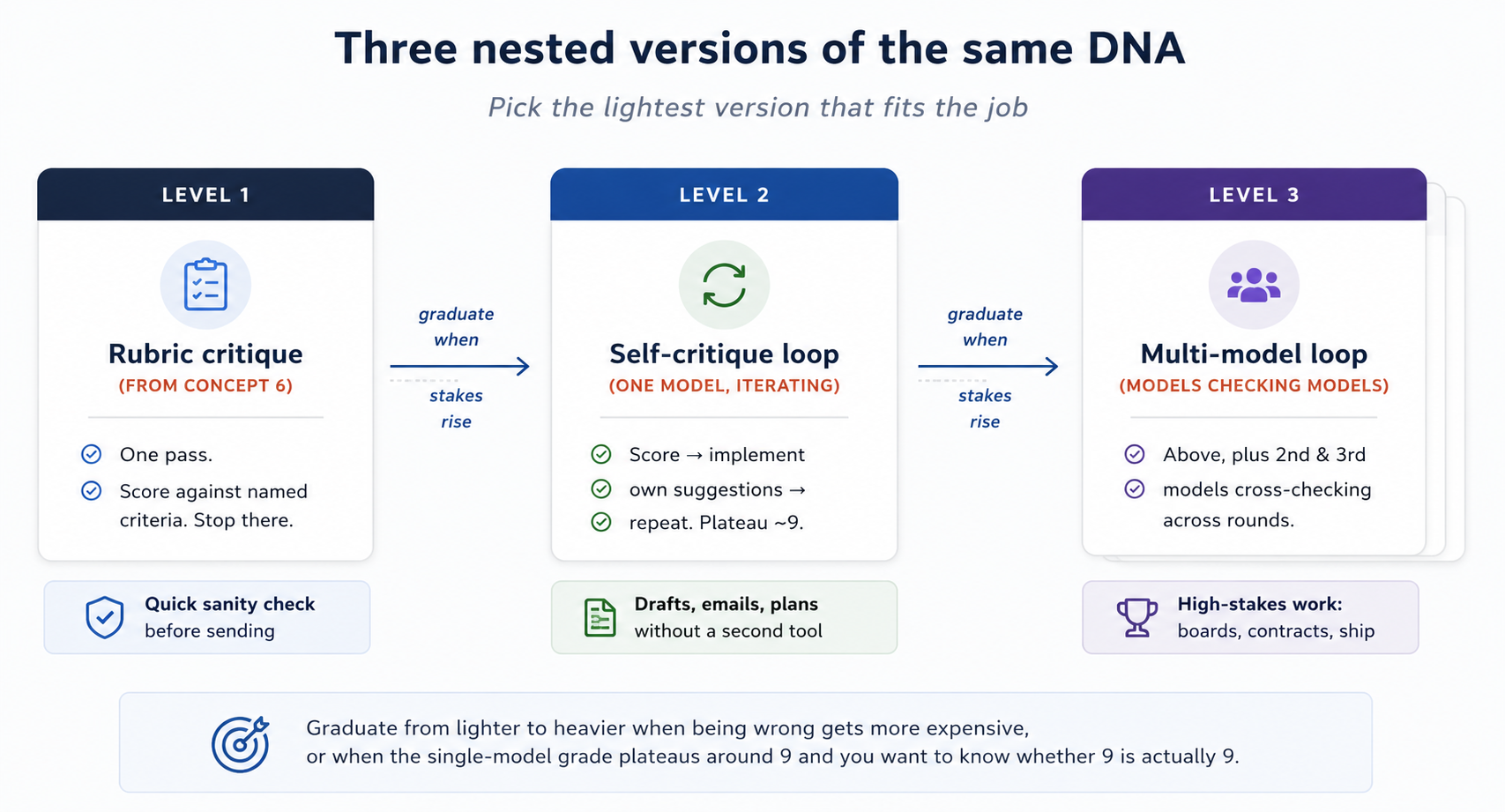
| Version | Yeh kya hai | Kab use karein |
|---|---|---|
| Concept 6 rubric critique | Aik pass: named criteria ke against score, phir ruk jana. | Quick sanity check jab draft send karne wale hon. |
| Single-model self-critique | Score, apni suggestions implement, repeat until plateau. | Drafts, emails, plans, summaries jahan second tool kholay baghair output better chahiye. |
| Full multi-model loop | Single-model loop plus second aur third models cross-checking. | High-stakes work: boss ke liye memo, publish hone wala chapter, ya sign hone wala contract. |
Jab ghalat hone ki qeemat barh jaye, lighter version se heavier version par graduate karein.
Grade kyun matter karta hai. Number khud maqsad nahin. Number nikalne ke liye model ko yeh batana padta hai ke baqi points kahan gaye. "Pretty good" review nahin hai. "7/10 kyun ke third section second ko repeat karta hai, aur teen claims ke paas source nahin" actionable review hai. Grade specificity force karta hai, aur specificity par aap act kar sakte hain.
Doosra aur teesra model kyun matter karte hain. Aik model apne kaam ko apni hi priors ke mutabiq improve karta hai, phir kehta hai ke woh priors satisfy ho gaye. Yeh zaroori nahin ke draft waqai strong ho. Jab do ya teen mukhtalif models aik score par converge karte hain, woh convergence aik single model ke 9.5 se zyada information carry karti hai.
Honest caveat. Teen models phir bhi aik hi cheez par ghalat ho sakte hain. Un ka training data aap ke andaze se zyada overlap karta hai, aur sparse ya contested topics par woh aksar same misconceptions share karte hain. Score progress signal hai, truth signal nahin. Legal, medical, financial, ya real person ke bare mein high-stakes content par human expert ab bhi load-bearing claims verify karega.
Loop kab skip karein. Har task is ka haqdar nahin. Short email, quick lookup, casual brainstorm — single-model enough hai. Multi-model cross-check un kaamon ke liye bachayein jahan ghalat hona mehnga hai: boss ke liye memo, publish hone wala chapter, doosron ko affect karne wali decision, ya contract jo aap sign karenge.
Aik non-software example. Aik consultant client board ke liye 40-page strategy memo prepare kar rahi thi. Us ne strongest model mein draft banaya aur self-grades ke against iterate kiya jab tak score 9 par plateau nahin hua. Phir us ne full memo doosre model mein paste kiya: "Critique this memo using these criteria: argument strength, missing counter-arguments, weak transitions, unsupported claims. Score 1-10 per criterion." Doosre model ne 7.5 diya aur 11 specific issues list kiye, jin mein se teen primary model ne kabhi raise nahin kiye thay. Woh issues pehle model ko wapas diye gaye; us ne saat adopt kiye, chaar reject kiye with reasons, aur affected sections rewrite kiye. Teesre model ne nayi draft par do aur fixable issues nikale. Final scores: 9, 9, 9.5. Extra time taqreeban 40 minutes tha, lekin memo bohat zyada strong ho gaya.
Deeper move yeh hai: zyada tar log "model ne kaha good hai" par ruk jate hain. Woh closed loop hai. Discipline yeh hai ke aik model ke apne verdict par kabhi akela trust na karein; second opinion force karein, aur score ko conversation ka start samjhein, end nahin.
Prompts try karne se pehle ek short recap
Terah concepts bohat hain. Page ki shape aik paragraph mein:
Aap ne seekha ke AI internet ke snapshot se cheezen jaanta hai (concept 2), us snapshot se aage jane ke liye is ke paas teen retrieval modes hain (concept 3), answer quality ka single biggest determinant yeh hai ke aap upfront kitna relevant context load karte hain (concept 4), modern models hard think kar sakte hain agar aap kahen (concept 5), yeh agreement ki taraf biased hain aur neutral framing us bias ka zyada hissa fix kar deti hai (concept 6), explicit-feedback ke saath iterate loop is page ki highest-leverage habit hai (concept 7), AI images dekh sakta hai, generate kar sakta hai, audio ke saath kaam kar sakta hai, small apps bana sakta hai, aur code run kar sakta hai (concepts 8 se 10), file-aware desktop apps ki nai category hai jismein naye safety considerations hain (concept 11), job ke liye right tool month to month badalta hai is liye aap ko loose rehna chahiye (concept 12), aur jab human expert room mein na ho to sab se qareebi objective quality signal models ko aik doosre ka kaam grade karwana hai (concept 13).
In sab ke neeche ek move hai, jo dozen disguises mein repeat hota hai: sahi context andar lao, ghalat context bahar rakho. Agar aap is page se sirf yeh ek sentence yaad rakhein, tab bhi aap users ke top quartile mein honge.
Ab yeh try karein: Thinking Baseline se pehle gyarah prompts
Reading trying ka placeholder hai. Doosre tab mein ChatGPT, Claude, ya Gemini kholein. Yeh gyarah prompts order mein run karein. Total lagbhag pachees minutes lagte hain aur is page ke har concept ki exercise karte hain.
Gyarah prompts (expand karne ke liye click karein)
1. Web-search trigger. AI ko training data chhor kar current info look up karne par force karta hai.
What major news happened today in [your country]? Cite each claim
with a source link. Flag any claim you can't support with a citation
as "unverified".
2. Pretrained-only question. Common-knowledge, lookup ki zaroorat nahin. Fast aur confident hona chahiye.
Why do cats stare at walls? Two-paragraph answer.
3. Context-rich personal prompt. Constraints upfront load karne ki practice.
Plan a 15-minute home workout for me. Constraints: I have a
trampoline and a cat, no squats (bad knee), I hate sticking to
plans for more than three days, and I want to feel slightly
silly while doing it. Give me 3 options, no commentary.
4. Neutral-framing rewrite. Prompt mein apni bias spot karne ki practice.
The question I want to ask is: "Don't you think four-day work
weeks are obviously better for everyone?" Rewrite this as a
neutral question that doesn't signal what answer I want.
Then answer the rewritten version.
5. Three-options brainstorm with iteration. Core power-user loop.
Round 1: I want to start a small side project that takes about
3 hours per week and might make money in a year. I'm a [your
profession] who likes [your hobby]. Give me 5 different ideas,
one line each. Don't expand any of them.

(Read the 5. Pick what you like and don't like. Then, in the
SAME conversation:)

Round 2: I reject options [N] and [N] because [reason]. I like
the [keyword] idea but I want it to use less [thing]. Give me
5 new options that incorporate this feedback.
6. Outline-first writing. Prose se pehle structure force karein.
I want to write a 600-word post about [a topic you care about].
Don't write it yet. Give me 3 different outline options, each
with 4-6 headings. One line per heading.
7. Think-hard reasoning prompt. Real personal decision use karein.
I'm choosing between [Option A] and [Option B] for [real personal
decision in your life]. Here's the relevant context: [a paragraph
of context]. Think hard before answering. Tell me:
1. The 3 trade-offs that actually matter.
2. Which you'd choose and why.
3. Under what conditions your recommendation would flip.
8. Objective-rubric critique. Apne kaam par sycophancy avoid karein.
I'm pasting in something I wrote: [paste anything 100-300 words].

Critique it using these 4 criteria, each scored 1-5 with a
one-sentence reason:
- Does it have a clear central claim?
- Is each paragraph in the right order?
- Are there any sentences that could be cut without loss?
- Does the ending earn the time the reader spent getting there?

Then suggest the smallest change that would lift the lowest score.
9. Image-input task. AI ko photo dene ki practice.
[Upload any handwritten note, receipt, or whiteboard photo]

Transcribe what's written. Then summarize what it's about in
3 bullets. Flag anything you couldn't read with confidence.
10. Small-app prompt. Goal/Input/Output shape ki practice.
Build me a Pomodoro timer.
Goal: 25-minute work sessions, 5-minute breaks.
Input: I press start.
Output: Visible timer counting down, a satisfying click when
each cycle ends, a yellow theme. Show me the working version.
11. Cross-model review. Real draft par multi-model habit practice karein. Is ke liye do AI tools ek saath open hon.
Take any 200-300 word draft you wrote recently (an email, a memo, or a paragraph from one of these exercises).

Step 1: In your primary AI tool, paste the draft and ask: "Score this 1-10 on clarity, structure, evidence, and what's missing. One-sentence justification per score."

Step 2: Open a second AI tool. Paste the same draft, ask the same question.

Step 3: Compare the two scores and the two critiques side by side. Note any point only one of them caught. Those are the points the cross-model loop pays for.
Ab aap jaante hain ke yeh tools kya kar sakte hain. Kya aap inhein direct karne ke liye kaafi clearly soch sakte hain, yeh alag sawal hai, aur Part 0 isi sawal ke gird bana hai.
Start karne se pehle frequently asked questions
Kya Part 0 ki exercises ke liye paid plan chahiye? ChatGPT, Claude, aur Gemini ke free tiers Thinking Baseline aur zyada tar chapter exercises ke liye kaafi hain. Paid plan help karta hai agar aap bohat deep research karte hain ya session mein bohat files attach karte hain. Free se shuru karein; upgrade sirf tab karein jab usage limits aap ko block karne lagen.
Kya mujhe ek tool use karna chahiye ya teen? Daily use ke liye aik default pick karein, lekin comparison ke liye kam az kam ek aur install karein. Doosre tool ka point double work karna nahin; point yeh hai ke jab pehla tool kuch aisa de jo right mehsoos na ho, to aap ke paas tiebreaker ho.
Meri company ChatGPT block karti hai. Exercises ke liye kya karun? Jo bhi modern AI tool aap ki company permit karti hai, use karein. Part 0 ki skills kisi bhi text-in, text-out AI par transfer hoti hain. Agar kuch bhi permitted nahin, chapter exercises ke liye personal device par personal account use karein (Part 0 ke deliverables thinking ke bare mein hain, company data ke bare mein nahin).
Kya Thinking Baseline ke liye AI use karna cheating hai? Yes, aur is se sirf aap apne aap ko cheat karenge. Baseline ungraded hai. Is ka sirf purpose honest snapshot capture karna hai jise aap baad mein compare kar sakte hain. AI se boosted baseline aap ko misleadingly high starting point deti hai aur aap ki growth ke evidence ko erase kar deti hai.
Agar main is page ki recipes bhool jaun to? Page bookmark karein. Recipes (iterate loop, rubric pattern, neutral-rephrase trick) look up karne ke liye design ki gayi hain, memorize karne ke liye nahin. Sirf ek sentence memorize karne ke qabil hai: sahi context andar lao, ghalat context bahar rakho.
Part 0 thinking par itna waqt kyun spend karta hai jab AI itna capable hai? Kyun ke direction ke baghair capability waste multiply karti hai. AI ka confidently wrong analysis no analysis se zyada dangerous hai, kyun ke woh finished lagta hai. Part 0 woh judgment train karta hai jo decide karta hai ke AI jo produce karta hai us ke saath kya karna hai. AI-saturated workplace mein wahi judgment sab se valuable skill hai, aur zyada tar curricula isay entirely skip karte hain.
Pehle hafte mein dekhne layak common mistakes
| Mistake | Symptom | Fix |
|---|---|---|
| AI ko search engine ki tarah treat karna | Short prompts, shallow answers, repeated frustration | AI ko colleague ki tarah brief karein: context, files, constraints, ask. |
| Ek conversation ko forever accumulate karne dena | Answers waqt ke saath vaguer ho jate hain | Topic badle to nai conversation start karein. |
| Pehli try par final draft maangna | Polished output, hollow content | Pehle outline, outline critique, bullets tak expand, phir draft. |
| Bait phrasings bina realize kiye | AI us cheez se agree karta hai jo aap ne imply ki | Send karne se pehle neutral questions ke taur par rewrite karein. |
| Critiques par rubric skip karna | "Great work!" with no specifics | Objective yes/no criteria dein; har criterion ke score maangein. |
| Confidence ko accuracy samajhna | Obscure topics par surprising errors | Poochein "how would you know this?" High-stakes claims primary sources ke against verify karein. |
| Day one par broad permissions approve karna | Files lost, edits overwritten | Folders tight scope karein. Scope sirf track record ke saath grow karein. |
Yeh character flaws nahin hain. Yeh woh habits hain jo users ki pehli generation (aap khud shamil) scratch se build kar rahi hai. Inhein aik dafa catch karna aksar stick kar jata hai.
Ab se Part 0 ke chapters tak kya badalta hai, is par ek chhota lafz. Is page ne aap ko in tools ke mechanics sikhaye. Chapters woh discipline sikhate hain jo mechanics ko waqai pay off karata hai:
- Chapter 1 (Asking Better Questions) concept 6 mein milne wale cheap version par deep jata hai: aise questions kaise formulate karne hain jo woh surface karein jo aap pehle se nahin jaante.
- Chapter 2 (Detecting Broken Reasoning) concept 2 mein milne wale hints par deep jata hai: confident AI answers correct answers ke barabar nahin hote, aur failures catch karne ki repeatable techniques hoti hain.
- Chapter 6 (Working With AI, Not For AI) concept 7 ki surface par deep jata hai: brainstorm-iterate loop ek much larger collaboration playbook ka sirf ek move hai.
- Doosre chapters woh skills sikhate hain jise mechanics page bilkul touch nahin karta: systems thinking, first principles reasoning, ethical reasoning, uncertainty ke andar decision-making, aur learning how to learn.
Aap ke paas tools hain. Chapters aap ko woh judgment dete hain jo tools ko waqai pay off karata hai.
Jab aap ready hon, Part 0: Thinking is the Curriculum par jaiye aur Thinking Baseline se start karein: aap ki current thinking skills ka 30-minute ungraded snapshot, kisi bhi training se pehle. Aap Chapter 10 ke baad same assessment repeat karenge aur compare karenge. Isay skip na karein. Part 0 ka poora point aap ko aisa person banana hai jise AI amplify kar sake, aisa nahin jise replace kar sake, aur yeh jaanne ka sirf ek tareeqa hai ke yeh kaam hua ya nahin: measure karein ke aap kahan se start hue thay.
Judgment ke baghair power tools confident mistakes ko tez kar dete hain. Is page ne aap ko tools sikhaye. Is part ka baqi hissa judgment sikhata hai.