The AI Agent Factory — Agent Era ke liye aik mustanad kitab aur ecosystem
The AI Agent Factory
AI Tools ke Teesre Daur ke liye aik canonical source — jo four-channel ecosystem ke zariye deliver hota hai: kitab, aik AI tutor, aik AI building partner, aur specialized derivative books ki barhti hui family.
AI-Native Companies banane ka spec-driven, human-supervised tareeqa. Un engineers, domain experts, aur enterprise leaders ke liye jo Agent daur ki workforce build kar rahe hain.
"Hum bohat jald aisi ten-person billion-dollar companies dekhenge — billion-dollar valuations ke saath. Mere tech CEO doston ke chhote se group chat mein is baat par betting pool chal raha hai ke pehla saal kaunsa hoga jab aik one-person billion-dollar company saamne aayegi — jo AI ke baghair naqabil-e-tasawwur hoti — aur ab woh hone wali hai."
— Sam Altman, OpenAI, Alexis Ohanian ke saath guftagu mein, January 2024 (video · analysis)
Anthropic ke CEO Dario Amodei ne tab se timeline ko aur tang kar diya hai. Un ke mutabiq pehli single-person billion-dollar company ke bohat jald aane ka 70 se 80 percent chance hai — aur unhon ne developer tools, automated customer service, aur proprietary trading ko sab se zyada mumkin categories bataya hai. Kuch hi mahinon mein pehli concrete misaal bhi saamne aa gayi: aik solo founder ne rented infrastructure aur employees ki jagah AI agents istemal karte hue telehealth business ko pehle saal mein four hundred million dollars revenue tak pohancha diya. Har quarter mein aur misaalein saamne aa rahi hain.
Yeh prediction ab sirf khwahish nahin rahi. Is ko paida karne wali architecture nazar aani shuru ho gayi hai. Aur asal organizations mein yeh kuch is tarah shuru hoti hai:
Subah 8:07 baj rahe hain. Aik project manager reporting mein pehle hi peeche hai. Aik finance lead disconnected systems ke darmiyan numbers reconcile kar raha hai. Aik operations team un jawabon ka intezar kar rahi hai jo kal aa jane chahiye the. Das dashboards kholne, paanch logon ke peeche bhagne, aur faislon ko haath se jorne ke bajaye, woh kaam aik Digital FTE ko de dete hain — aik AI employee jo specifications follow karta hai, approved tools use karta hai, human oversight ke andar kaam karta hai, aur aise outputs deta hai jin par organization waqai trust kar sake.
Yahi is kitab ka wada hai.
Yeh kitab chatbot tricks, impressive demos, ya strategy ke roop mein pesh ki gayi short-lived prototypes ke bare mein nahin hai. Yeh dependable AI workers banane ke bare mein hai jo real business operations mein hissa le sakte hain. Yeh systems human judgment ko replace nahin karte. Yeh usay barhate hain, scale karte hain, aur repeatable banate hain.
Is kitab mein hum Digital FTE (Full-Time Equivalent employee) ka concept introduce karte hain — aise AI agents jo organizations ke andar real kaam kar sakte hain, bilkul aik human employee ki tarah. Traditional organizations mein FTE se murad aik full-time human employee ki work capacity hoti hai. Digital FTE us ka AI equivalent hai: aik intelligent agent ya digital worker jo tasks perform kar sakta hai, workflows chala sakta hai, information analyze kar sakta hai, aur real organizational systems ke andar teams ki madad kar sakta hai. Human employees ke baraks, Digital FTEs musalsal operate kar sakte hain, foran scale ho sakte hain, aur bari tadaad mein deploy kiye ja sakte hain. Jaisay jaisay AI systems mature honge, organizations barhti hui tadaad mein aisi teams banayengi jahan human employees aur Digital FTEs saath kaam karenge — hybrid workforces ki shakal mein jo human judgment aur machine intelligence ko combine karte hain. Yahi workforce mil kar AI-Native Company banati hai.
Terminology par aik note. Is kitab mein Digital FTE, Digital Worker, aur AI Worker ke alfaaz aik dusre ke badal ke tor par use hue hain. In sab ka matlab aik hi cheez hai: aik role-based AI agent jo human oversight ke neeche organization ke andar structured kaam karta hai. The thesis apni technical term ke tor par AI Worker use karti hai; yeh kitab business-facing term ke tor par Digital FTE use karti hai.
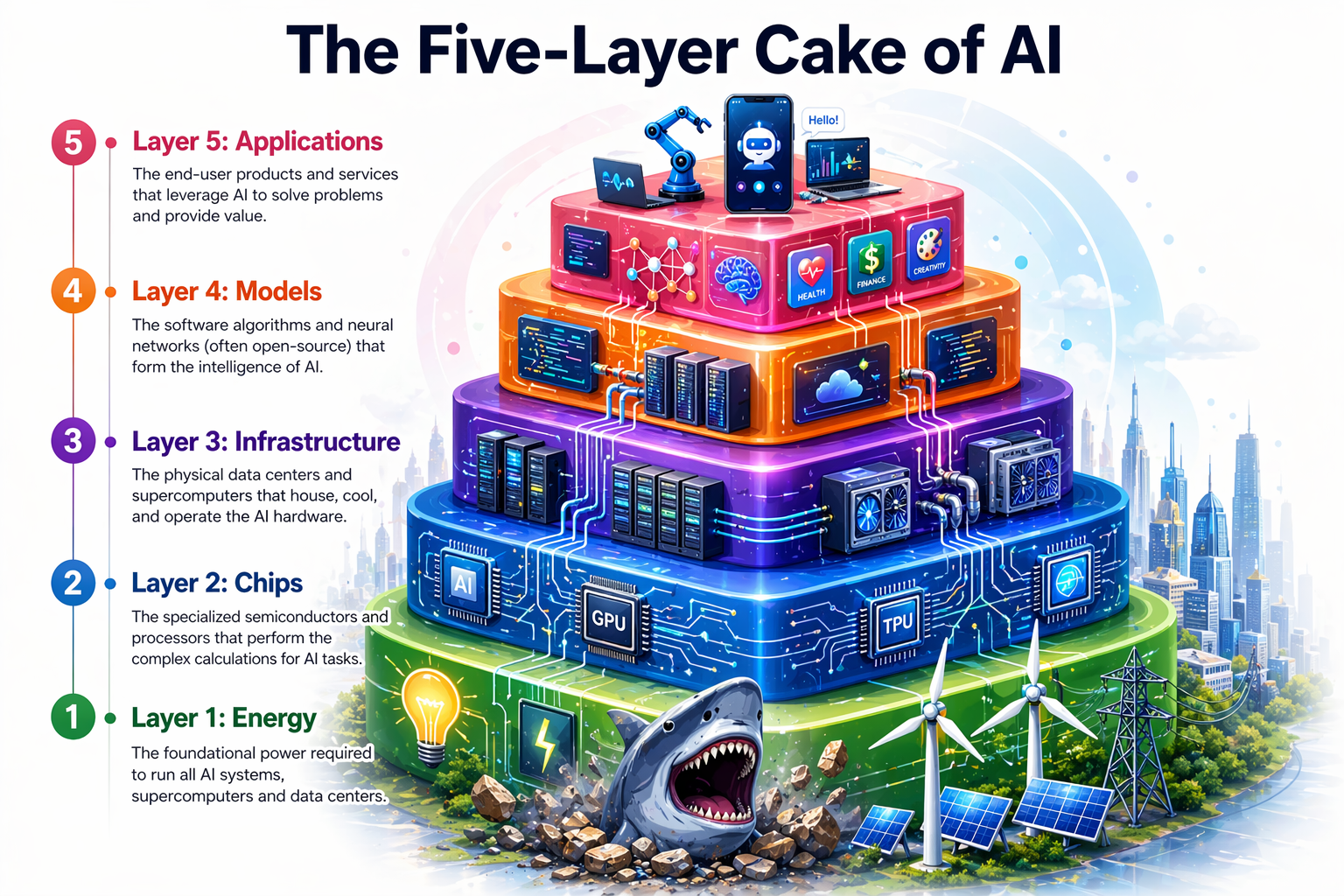
Modern AI aik bohat buland five-layer cake ki tarah bana hua hai — yeh tashbeeh Jensen Huang, NVIDIA ke CEO, ne mashhoor ki. Sab se neeche Energy hoti hai, jo duniya bhar ke wasee data centers ko power deti hai. Us ke upar Chips hoti hain, woh specialized processors jo har second trillions calculations karti hain. Phir Infrastructure aata hai — supercomputers aur cloud platforms ka global network jo in calculations ko scale karta hai. Infrastructure ke upar Models hote hain — neural networks jo seekhte hain, reason karte hain, aur intelligence generate karte hain. Aur sab se upar paanchwin layer aati hai: Applications — jahan AI sirf technology rehna chhor deta hai aur waqai useful ban jata hai.
Lower four layers mein billions of dollars is liye invest kiye jate hain taake yeh fifth layer wujood mein aa sake. Yeh kitab isi fifth layer ke bare mein hai. Yeh aap ko applications, agents, aur digital workers banana sikhati hai jo AI capability ko un products mein badalte hain jo log use karte hain, un workflows mein jin par organizations bharosa karti hain, aur us value mein jise enterprises capture kar sakte hain.
Lower layers is liye aham hain kyun ke woh top layer ko mumkin banati hain. Models, infrastructure, aur hardware zaroori hain, lekin apne aap business value create nahin karte. Value us waqt paida hoti hai jab intelligence ko workflows, products, services, aur operational systems ki shakal di jati hai jinhein log waqai use kar saken.
Organizations ke darmiyan agla competitive gap sirf is baat se nahin aaye ga ke kis ke paas best model, biggest GPU cluster, ya flashiest prototype hai. Yeh us se aaye ga ke kaun intelligence ko repeatable execution mein badal sakta hai. Jis tarah software ne manual processes ko digital systems mein badla, usi tarah Digital FTEs structured knowledge work ko scalable operational capability mein badal denge. Jo organizations inhein achhi tarah banana seekh lengi, woh tez chalengi, expertise ko behtar mehfooz rakhenge, aur leverage ki bilkul nai sooratein paida karengi.
The Agent Factory ka mission yeh hai ke aap ko in systems ko design aur build karne mein madad de — taake AI sirf powerful nahin, balkeh useful, governable, aur economically meaningful bhi ban sake.
Bunyadi Khayal
Is kitab ke markaz mein aik sada sa khayal hai:
Digital FTEs — jinhein Digital Workers bhi kaha jata hai — reliable AI agents hain jo real organizational environments ke andar musalsal structured knowledge work karne ke liye design kiye gaye hain.
Digital FTE sirf aik model aur prompt nahin hota. Yeh aik system hota hai. Is mein domain expertise, wazeh specifications, engineering architecture, aur human oversight mil kar yeh yaqeen banate hain ke kaam consistency ke saath, auditably, aur scale par ho.
The AI Agent Factory Digital FTEs ko design aur deploy karne ka aik systematic approach introduce karti hai — aise AI agents jo human expertise ko scalable digital workers mein badal dete hain. Jab yeh saath kaam karte hain to AI-Native Company banti hai.
Sirf large language models par tawajjo dene ke bajaye, yeh kitab samjhati hai ke dependable agent systems char aham elements ke combination se kaise ubharte hain:
- Structured Specifications — Agents ko kya karna hai, is ki wazeh taareef.
- Domain Expertise — woh "knowledge engine" jo reasoning aur decision-making ko guide karta hai.
- Engineering Architecture — woh infrastructure jo reliability aur scalability ko ensure karta hai.
- Human Oversight — woh feedback loops jo accountability aur governance ko qaim rakhte hain.
In sab ke milne se aise agent systems bante hain jin par organizations trust kar sakti hain, jinhein deploy kar sakti hain, aur scale kar sakti hain.
Digital FTEs sirf technical construct nahin hain; yeh economic construct bhi hain. Yeh AI-Native organizations ko expertise package karne, execution bottlenecks kam karne, consistency behtar banane, aur naye service models, internal capabilities, aur revenue streams paida karne mein madad dete hain. Agar inhein theek banaya jaye to yeh sirf tasks automate nahin karte. Yeh scalable assets ban jate hain.
Yeh Kitab Kis Ke Liye Hai
Yeh kitab un cross-functional teams ke liye likhi gayi hai jo Agentic Enterprise build kar rahi hain, jin mein yeh log shamil hain:
- AI Developers & Architects — production-grade, reliable agent systems banana.
- Subject Matter Experts — niche expertise ko reusable AI skills mein badalna.
- Enterprise Executives — responsible aur scalable AI adoption ki rehnumai karna.
- Product Managers — complex business workflows ko agent capabilities mein translate karna.
- Operational Teams — real organizational bottlenecks ko hal karne ke liye AI agents apply karna.
Mil kar yeh groups woh collaborative bunyaad banate hain jo Digital FTEs build karne ke liye darkaar hai — digital workers ki aik nai class jo human expertise ko extend karne aur nai economic value unlock karne ke liye design ki gayi hai.
Yeh groups aksar mukhtalif professional zubanein bolte hain, mukhtalif priorities ke peeche bhagte hain, aur success ko mukhtalif tareeqon se naapte hain — conference room wali comedy jisme laugh track nahin hota. Lekin Digital FTEs tabhi achhi tarah ban sakte hain jab yeh groups saath kaam karein.
Yeh kitab unhein aik mushtarka framework deti hai.
Yeh Kitab Kyun Maujood Hai
Aaj duniya bhar mein aksar organizations AI ko isolated experiments ke zariye approach karti hain: yahan aik prototype, wahan aik chatbot, aur kahin aik promising workflow demo jo rozmarra operations tak pohanch hi nahin pata.
Jo cheez missing hai woh excitement nahin hai. Jo missing hai woh method hai.
Bohat kam organizations ne reliable AI agents banane ka koi repeatable tareeqa develop kiya hai jo workforce ka real hissa ban saken. Un ke paas strong models, talented log, aur business demand ho sakti hai, lekin phir bhi un ke paas woh design discipline nahin hoti jo in ingredients ko dependable digital workers mein badal sake.
Yeh kitab woh method introduce karti hai.
Yeh samjhati hai ke qeemti AI employee opportunities ko kaise pehchana jaye, expert knowledge ko structured specifications mein kaise badla jaye, bounded agent workflows ko kaise design kiya jaye, unhein reliable cloud-native infrastructure par kaise deploy kiya jaye, aur human oversight ke zariye un ki governance kaise ki jaye. Dusre alfaaz mein, yeh kitab aap ko Agent Factory chalana sikhati hai: woh spec-driven, human-supervised, agent-tool-powered process jis ke zariye Digital FTEs (jinhein AI Workers bhi kaha jata hai) AI-Native Company ke andar design, manufacture, aur deploy kiye jate hain. Hum is process ko do aise tools ke zariye dikhate hain jo isay embody karte hain: Claude Code, Anthropic ka frontier coding agent, aur OpenCode, open-source aur model-agnostic alternative. Jo skills, specifications, aur architectural patterns aik ke liye likhe jate hain woh dusre mein bhi kaam karte hain. Method constant hai. Tool variable hai.
Is kitab ke aakhir tak aap agentic AI ko sirf aik idea ke tor par nahin samjhenge. Aap yeh samjhenge ke dependable Digital FTEs ko organizational capability ke tor par kaise manufacture kiya jata hai. Aisi organizations default tor par AI-Native hongi.
Yeh Kitab Sirf Matn Nahin, Infrastructure Hai: Delivery Ke Teen Modes
Aksar kitaben parhne ke liye likhi jati hain. Yeh kitab parhne ke liye, aik AI tutor ke zariye sikhane ke liye, aur aik AI building partner ki rehnumai ke liye likhi gayi hai — aur yeh sab aik hi knowledge base se hota hai. Yeh sirf aik kitab nahin hai. Yeh learning aur development ke aik ecosystem ki foundation hai jo delivery ke teen modes ke liye design kiya gaya hai.
Insani Parhai
Riwayati rasta. Chapters parhein, frameworks ka mutalea karein, exercises mukammal karein, aur deploy kiye ja sakne wale artifacts banayein. Har chapter professional taleem ki aik self-contained unit hai — aur derivative books ki family is mode ko topics aur audiences tak phailati hai.
TutorClaw
Aap ka personal AI tutor. WhatsApp, Telegram, aur web par persistent memory ke saath 24/7 chalta hai. Chapters mein mojood unhi governance principles aur jurisdiction-aware frameworks se qadam ba qadam sikhata hai — aap ki pace aur background ke mutabiq dhal kar.
Kitab TutorClaw ko us ki expertise deti hai. TutorClaw kitab ko awaaz deta hai.
Agent Factory Skillpack
Aap ka AI building partner. Claude Code aur OpenCode mein chalta hai — wohi skills, specs, aur patterns dono mein kaam karte hain. Yeh aap ko specs likhne, SKILL.md ko structure karne, escalation protocols define karne, aur MCP connectors configure karne mein guide karta hai.
Jahan TutorClaw theory sikhata hai, wahin Skillpack tameer ke dauran aap ke saath chalta hai.
Yeh kyun aham hai. Aik hi knowledge base teeno modes ko power karta hai. Jab koi chapter update hota hai — banking compliance ke liye naya jurisdiction overlay, legal ops ke liye refined escalation protocol — to woh update aik hi waqt mein TutorClaw ki teaching aur Agent Factory Skillpack ki guidance tak pohanch jata hai. Kitab static artifact nahin hai. Yeh aik ecosystem ke liye single source of truth hai: human learning, AI tutoring, aur AI-assisted building, sab aik hi authoritative foundation se nikalte hain.
Yeh 10-80-10 pattern khud taleem par apply hota hai. Kitab intent set karti hai (pehla 10% — domain knowledge, frameworks, professional standards). TutorClaw aur Agent Factory Skillpack execution sambhalte hain (80% — personalized teaching aur step-by-step building guidance). Aap outcome verify karte hain (aakhri 10% — woh professional judgment jo tasdeeq karta hai ke agent sahi hai, deployment mehfooz hai, aur knowledge sound hai).
Do Tools, Aik Discipline
Claude Code aur OpenCode is kitab mein competitors nahin hain. Yeh aik hi discipline ki do sooratein hain.
Do tools kyun, aik kyun nahin? Kyun ke yeh kitab jo discipline sikhati hai usay kisi bhi khaas tool se zyada der tak zinda rehna chahiye. Agent Factory method — spec-driven design, skill-based architecture, human oversight — apni design ke lihaz se portable hai. Isay kisi aik vendor ke product se bandh dena method ki bunyadi premise ke khilaf hoga. Is se woh risks bhi virasat mein milenge jo readers control nahin kar sakte: pricing changes, access restrictions, strategic shifts. Aur khamoshi se un readers ko bahar kar dega jin ki constraints — economic, regulatory, ya architectural — dominant tool ko inaccessible bana deti hain.
Frontier-first
Anthropic ka frontier coding agent. Anthropic ke sab se capable models par chalta hai, polished developer experience ke saath aata hai, aur Claude ecosystem ke saath sab se gehri integration deta hai.
Open aur model-agnostic
Open-source alternative. 75+ providers se connect karta hai — Claude, GPT, Gemini, DeepSeek, Qwen, local models via Ollama — aur aap ko economics, latency, aur task complexity ke mutabiq un ke darmiyan switch karne deta hai.
Dono wohi patterns implement karte hain jo yeh kitab sikhati hai. Skills, subagents, hooks, MCP servers, aur spec-driven workflow dono mein bilkul aik jaisa kaam karte hain. Claude Code ke liye likha gaya SKILL.md .opencode/skills/ mein drop hota hai aur baghair tabdeeli ke chalta hai. Discipline portable hai.
Agent Daur Ke Liye Aik System of Record
NVIDIA ke CEO Jensen Huang ka kehna hai ke AI agents systems of record ki zaroorat ko khatam nahin karte — balkeh usay aur mazboot karte hain. Agents ko ground truth chahiye. Unhein aisi authoritative jaghein chahiye jahan se woh parhein, jahan likhein, aur jahan verify kar saken. Is bunyaad ke baghair agents hallucinate karte hain. Is bunyaad ke saath woh execute karte hain.
Huang enterprise ke liye yeh masla hal kar raha hai. Databases, workflows, aur operational platforms jinhein companies ne dasakon mein banaya hai, agent daur mein kam nahin balkeh zyada aham ho jate hain. Agents SAP ya ServiceNow ko replace nahin karte. Woh unhein use karte hain — machine scale par.
Lekin aik layer aisi hai jis ke liye Huang ka hal nahin hai: human layer.
Laakhon developers, architects, aur domain professionals ab AI agents build karne wale hain. In mein se aksar ke paas seekhne ke liye koi canonical source nahin hai. Koi aisa structured body of knowledge nahin jo sirf consumption ke liye nahin, balkeh verification ke liye design ki gayi ho. Woh scattered tutorials, outdated blog posts, aur model outputs se seekh rahe hain jo shayad production agent systems ke asli kaam ko sahi reflect karein ya na karein.
Aur jab yahi developers learning se building ki taraf badhte hain, to unhein yahi masla aik dusri shakal mein milta hai. Un ke AI coding partners usi cheez par bharosa karte hain jo model surface kar de — aise patterns jo shayad kabhi verify, bound, ya dependable Digital FTEs paida karne ke liye design hi na kiye gaye hon. Canonical source ke baghair, human learning aur AI-assisted building dono ko aik hi fragility virasat mein milti hai.
The AI Agent Factory Book agentic AI education aur construction ke liye aik system of record hai.
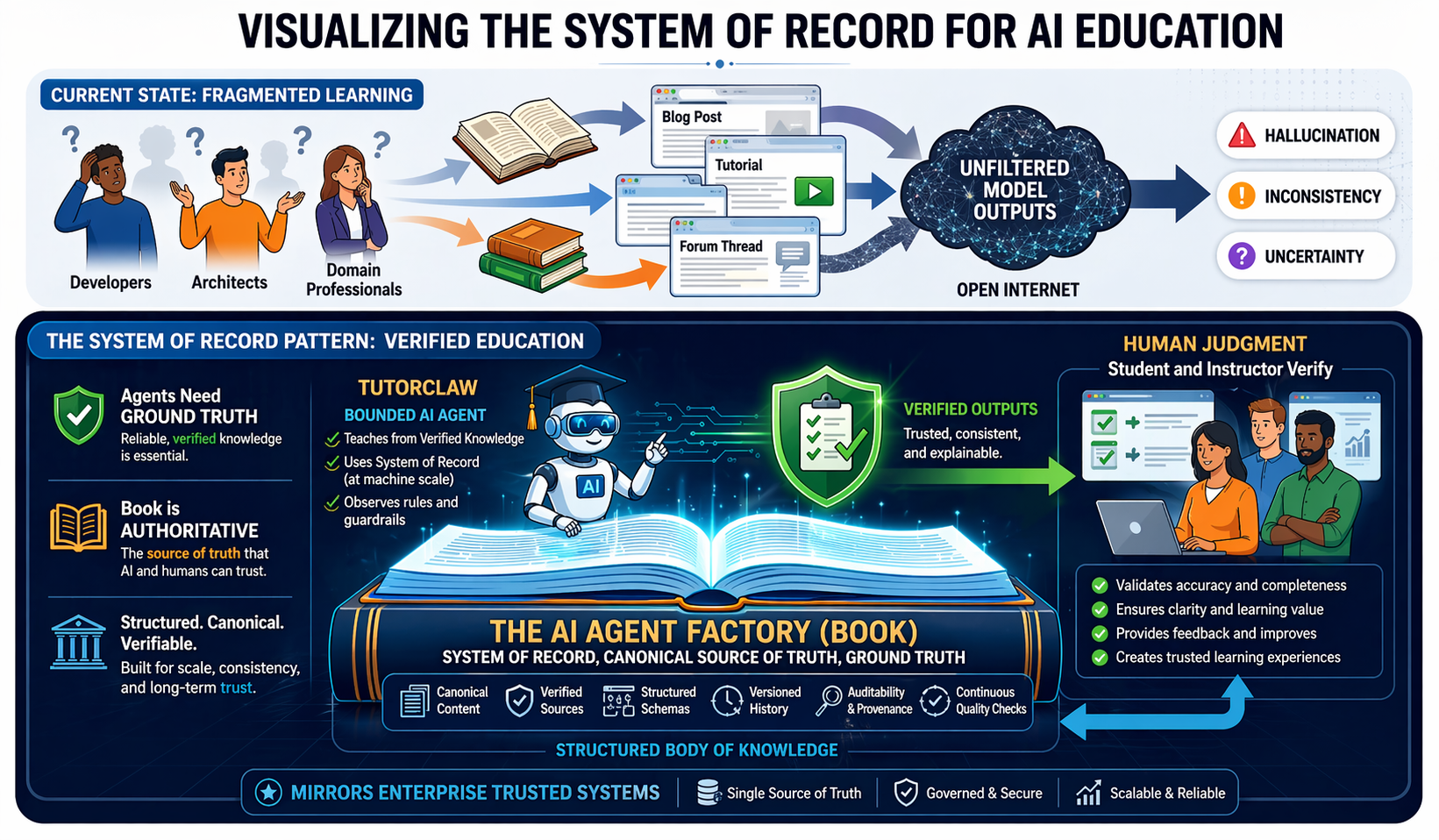
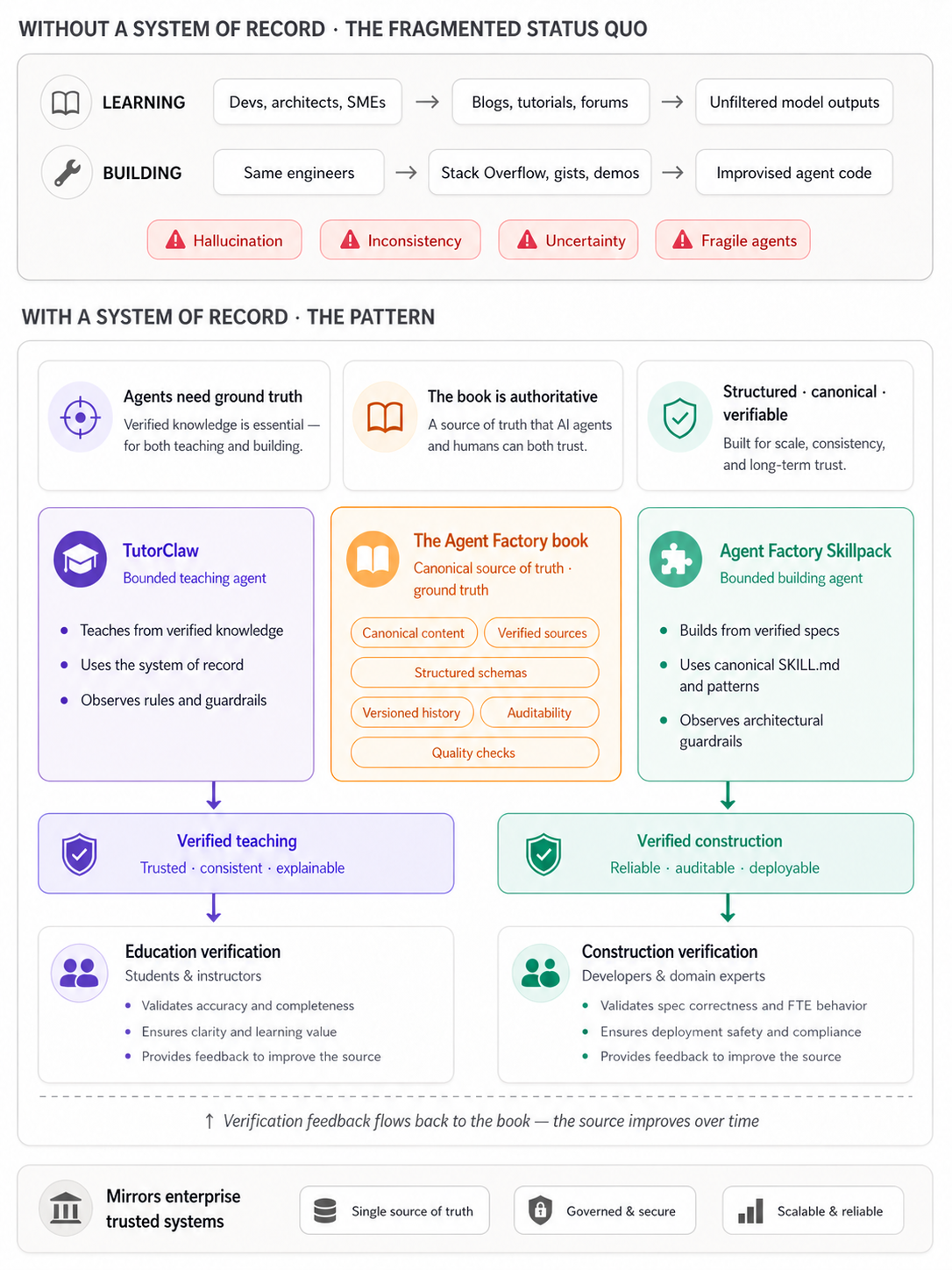
Yeh koi metaphor nahin hai. Kitab ki architecture wohi pattern follow karti hai jo Huang enterprise systems ke liye bayan karta hai:
- Kitab canonical source of truth hai — woh authoritative knowledge base jo yeh define karti hai ke agents kya hain, kaise bante hain, aur kaise govern kiye jate hain.
- TutorClaw teaching agent hai — yeh open internet se nahin, kitab se parhta hai, aur probabilistic generation ke bajaye verified knowledge se sikhata hai.
- Claude Code aur OpenCode building agents hain — Agent Factory Skillpack se lais ho kar yeh Stack Overflow ya scattered tutorials ke bajaye kitab se parhte hain, aur improvised code ke bajaye verified specifications, SKILL.md templates, aur architectural patterns se Digital FTEs aur AI-Native Companies construct karte hain.
- Human judgment verification layer hai — students, instructors, developers, aur domain experts tasdeeq karte hain ke TutorClaw jo sikhata hai aur Skillpack-equipped harness jo build karta hai woh kitab ki niyyat se match karta hai. Yahi 10-80-10 pattern ka aakhri 10% hai.
Lekin taleem sirf aadhi kahani thi. Yeh hi pattern construction tak bhi phailta hai — aur jab aap dono pipelines ko side by side rakhte hain to un ki symmetry khud architecture ban jati hai.
Lekin yeh pattern taleem aur construction par rukta nahin. Wohi canonical source teesri lane ko bhi feed karta hai: derivative books ki barhti hui family, jisme har kitab do axes mein se kisi aik par specialized hoti hai — topic ya audience — lekin source se wohi vocabulary, architecture, aur standards virasat mein leti hai.
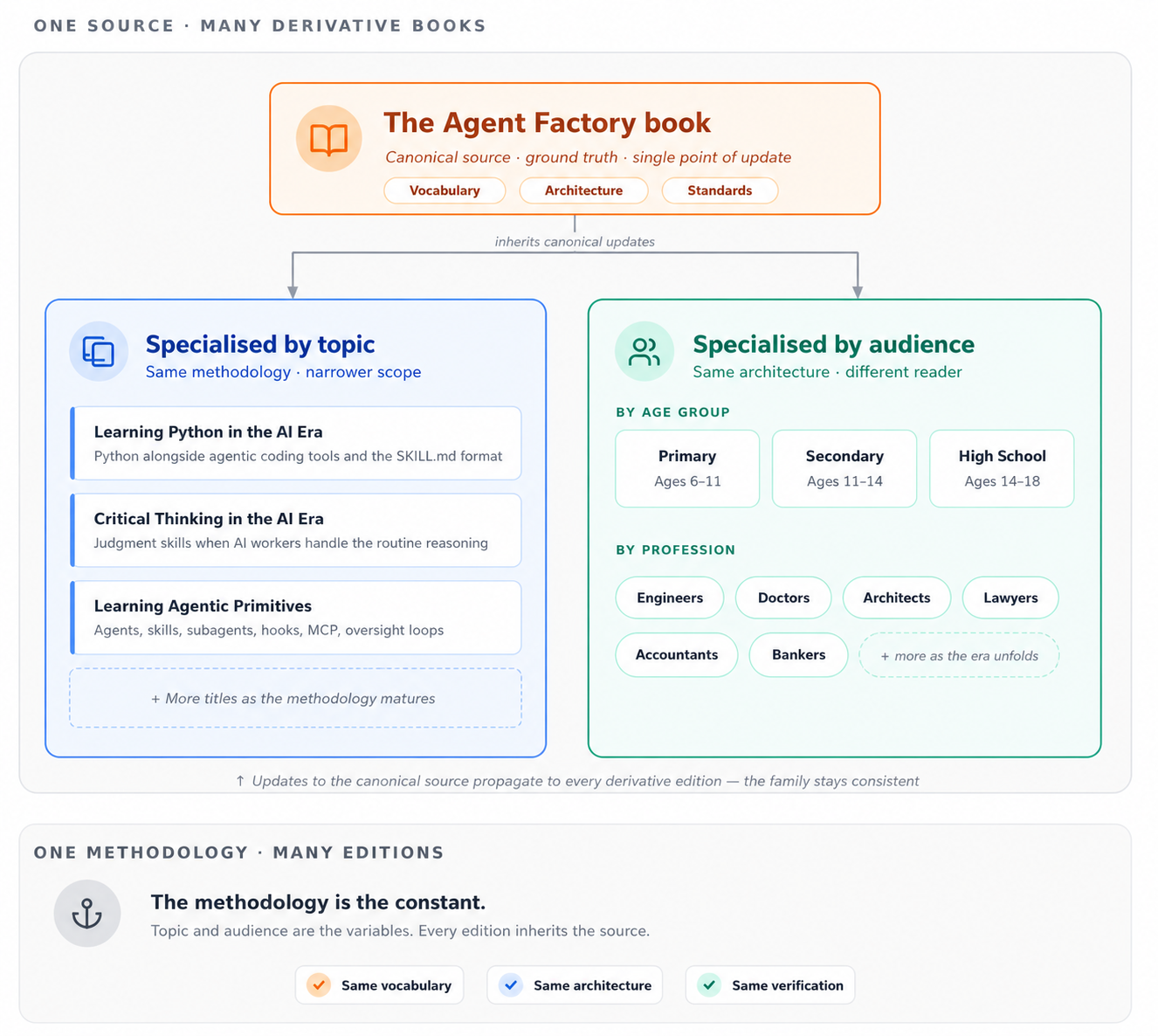
Topic axis. Kuch derivatives scope ko aik hi discipline tak mehdood kar dete hain jise Agent daur badal raha hai. Learning Python in the AI Era Python ko us tarah sikhati hai jis tarah ab sikhana zaroori hai — agentic coding tools, spec-driven workflows, aur us SKILL.md format ke saath jo Claude Code aur OpenCode mein chalta hai. Critical Thinking in the AI Era readers ko woh judgment skills deti hai jo us waqt darkaar hoti hain jab AI workers routine reasoning sambhal rahe hon. Learning Agentic Primitives foundational concepts — agents, skills, subagents, hooks, MCP, oversight loops — ko aik focused primer mein compress karti hai. Jaisay jaisay methodology mature hogi, aur titles aate jayenge.
Audience axis. Dusri derivatives methodology ko constant rakhti hain lekin usay reader ke liye dobara likhti hain. Primary, secondary, aur high-school students ke liye editions inhi architectural ideas ko age-appropriate framing ke saath pesh karti hain — taake aik high-school student apna pehla SKILL.md usi vocabulary mein bana sake jo us ka professional counterpart das saal baad use kare ga. Profession-specific editions is material ko engineers, doctors, architects, lawyers, accountants, bankers, aur un dusre domains ke liye adapt karti hain jahan workforce Digital FTEs ke gird dobara likhi ja rahi hai. Framework constant hai. Examples, priors, aur depth reader ke mutabiq badalti hai.
Aksar kitab aik destination hoti hai. Agent Factory book aik source hai. Jab canonical methodology update hoti hai — naya escalation protocol, refined Skillpack pattern, ya sharper definition — to yeh update poori family mein phail jata hai. Har derivative yeh correction virasat mein leta hai. Methodology constant hai. Topic aur audience variables hain.
Aur is mein aik aur gehri symmetry kaam kar rahi hai. Yeh kitab sirf system of record istemal nahin karti — yeh aap ko un agents ko banana sikhati hai jo systems of record use karte hain, aur yeh unhi building agents (Claude Code aur OpenCode, Agent Factory Skillpack ke saath) ko power bhi karti hai jo aap ki madad se unhein construct karte hain. Learning system ki architecture, construction system ki architecture, aur curriculum ka content sab aik dusre ka aaina hain. Aap is pattern ko usay experience karke seekhte hain. Aap is pattern ko usay use karke banate hain.
AI Tools Ka Teesra Daur — aur Us Ke Upar Wali Layer, Jo Global Workforce Ke Liye Bani Hai
AI tools ke pehle daur ne model ko product bana diya. Dusre daur ne harness ko product bana diya — Claude Code, OpenCode, Cursor, woh agentic coding environments jahan models apna kaam karte hain. Kuch log ab harness platform — SDKs, plugins, vendor-specific extension layers — ko teesra daur keh rahe hain. Hum us se aik layer upar baithe hain. Hamare liye teesra daur woh hai jahan woh discipline jo harnesses aur un ke platforms ke aar-paar chalti hai khud product ban jati hai. Model commoditize hota hai. Harness commoditize hota hai. Harness platform commoditize hota hai. In teeno ke baad jo cheez bachti hai woh canonical source hai — methodology, vocabulary, verification standards, aur SKILL.md library jise koi bhi aisa harness jo is format ko respect karta ho load karke chala sake.
Agent Factory ecosystem isi layer mein rehti hai. Kitab canonical source hai. TutorClaw canonical source ka 24/7, har zuban mein, kisi bhi phone par, khud ko sikhane wala roop hai. Agent Factory Skillpack canonical source hai jo developer ke chune hue harness ke andar chalti hai. Derivative book family canonical source ka woh version hai jo har audience aur har domain ke liye dobara likha gaya hai. Char delivery channels, aik source.
Is ki architectural shape un businesses jaisi hai jin ka Altman aur Amodei zikr kar rahe hain. Founder ke paas owned canonical source hota hai. AI agents woh kaam execute karte hain jo pehle teams ko darkaar hota tha. Rented infrastructure — harnesses, messaging platforms, model providers — un hisson ko sambhalta hai jinhein founder own nahin karta. Aik kitab apne aap billion-dollar company nahin ban sakti. Aik live tutor apne aap billion-dollar company nahin ban sakta. Aik build tool apne aap billion-dollar company nahin ban sakta. Lekin combination — kitab, tutor, aur build tool, jo sab aik hi canonical source se parhte hain — sanche ke lihaz se wahi qisam ka business hai jo agla daur paida karega.
Yeh muqabala apni fitrat mein global hai. Agla daur us ke naam nahin hoga jis ke paas sab se bara model ya sab se gehra GPU stack ho — yeh us ka hoga jo AI capability ko workforce layer par reliable, governable, repeatable execution mein badal de. Jo teams yeh muqabala jeetengi woh sab aik hi chand shehron mein nahin baithi hongi. Woh har us jagah baithi hongi jahan ambitious log internet access aur agentic engineering ki working knowledge ke saath build karne ka faisla karein. Agent Factory book isi liye maujood hai taake un teams ke paas build karne ke liye canonical source ho.
Char channels har us jagah pohanchte hain jahan yeh muqabala chal raha hai. Derivative book family zubanon, umri groups, aur professional disciplines ke aar-paar safar karti hai — primary, secondary, aur high-school students ke liye age-appropriate depth ke saath editions, engineers, doctors, architects, lawyers, accountants, aur bankers ke liye profession-specific editions, aur un disciplines ke liye topic-specific editions jinhein Agent daur dobara shape de raha hai. Agent Factory Skillpack un harnesses par sawar hai jo pehle hi duniya bhar ke millions developers ke haath mein hain. TutorClaw learners se WhatsApp, Telegram, aur web par milta hai — woh channels jo four billion se zyada logon tak pohanchte hain — usi zuban mein jis mein canonical source translate ki gayi ho. Methodology portable hai kyun ke usay deliver karne wala har channel portable hai.
Constant canonical source hai. Variables channels hain. Jab methodology update hoti hai to har channel us ke saath update hota hai: kitab, har derivative book, har Skillpack-equipped harness, har TutorClaw conversation. Truth ka aik source hai aur delivery ki bohat si surfaces. Jo model aaj TutorClaw ko power karta hai woh kal badal sakta hai. Jis harness mein Skillpack chal rahi hai woh agle saal badal sakta hai. Jitni zubanon mein derivative books translate hongi woh barhti raheingi. Canonical source baqi rehta hai. Architecture constant hai. Baqi sab variable hai.
📘 Kitab
Canonical source. Woh authoritative knowledge base jahan se har dusra channel parhta hai.
💬 TutorClaw
Canonical source jo har zuban mein, kisi bhi phone par, 24/7 khud ko sikhati hai — WhatsApp, Telegram, web.
🛠️ Skillpack
Canonical source jo developer ke chune hue harness ke andar chalti hai — Claude Code, OpenCode, ya koi bhi aisa tool jo SKILL.md format ko honor kare.
📚 Derivative Books
Canonical source jo har audience aur har domain ke liye dobara likhi jati hai — topic, age, aur profession ke lihaz se.
Altman aur Amodei ne bataya ke jab AI agents woh kaam karte hain jo pehle logon ki teams kiya karti thin to kya mumkin hota hai. Agent Factory ecosystem is ki amali misaal hai. Kitab source of truth hai. AI agents — TutorClaw sikhata hua, Skillpack build karti hui — woh kaam karte hain jo warna aik team ko karna padta. Baqi sab kuch — messaging apps, coding tools, aur AI models khud — dusri companies se rent par liya jata hai, scratch se build nahin kiya jata. Yeh usi business shape ki misaal hai jis ke bare mein Altman aur Amodei small-team billion-dollar companies ke hawale se prediction kar rahe hain. Kitab readers ko sikhati hai ke is shape ki companies kaise banayi jati hain. Jis ecosystem se woh parh rahe hain, woh khud bhi isi shape ka hai.
Qari Ka Guide
Yeh kitab un readers ke liye likhi gayi hai jo mukhtalif disciplines se aate hain, lekin sab aik hi bade project mein shareek hain: Agentic Enterprise build karna.
In systems ko build karne ke liye multiple disciplines ke darmiyan collaboration darkaar hai. Yeh kitab un cross-functional teams ke liye likhi gayi hai jo Agentic Enterprise build karne ki zimmedar hain.
| Qari | Agentic Enterprise Mein Kirdar | Aap Kya Hasil Karenge |
|---|---|---|
| AI Developers & Engineers | Infrastructure aur systems banana | Architectural patterns, spec-driven development, aur cloud-native deployment. |
| Domain Experts & Professionals | Behavior ko guide karne ke liye knowledge dena | Expertise ko reusable AI skills aur un Digital FTEs mein badalne ke tareeqe jo AI-Native Companies ko power karte hain. |
| Enterprise Executives | Organizational adoption ki qiyadat karna | Enterprise AI ke liye governance models, risk controls, aur deployment strategies. |
| Product Managers & Architects | Business needs ko systems mein translate karna | Workflows ko skills aur verifiable outputs mein todne ke frameworks. |
| Department Leaders & Operators | Operational processes par AI apply karna | Internal playbooks ko scalable Digital FTE workflows mein badalne ki techniques. |
AI Developers, Software Engineers & Platform Architects
Tameer Karne Wale
Developers aur architects agentic AI ke waade ko production-grade systems mein badalne ke zimmedar hain. Jab ke bohat si AI applications abhi bhi fragile prototypes bani hui hain, yeh kitab aik systematic engineering approach introduce karti hai taake:
- Spec-driven development ke zariye agents design kiye jayen.
- Cloud-native architectures (Docker, Kubernetes, Dapr) ke saath scalable systems banaye jayen.
- Secure aur auditable tool interfaces implement kiye jayen.
- Aisi reusable skill libraries structure ki jayen jo domain expertise ko encapsulate karti hon.
Subject Matter Experts & Domain Professionals
Ilm Ke Rakhwale
Sab se qeemti AI systems gehri domain knowledge par depend karte hain. Accounting, law, finance, aur supply chain ke professionals aisi judgment rakhte hain jo AI behavior ke guiding structure ka kaam karti hai. Aap seekhen ge ke expertise ko structured artifacts — khas taur par SKILL.md specifications — mein encode kaise kiya jaye, taake yeh yaqeen ho ke:
AI routine reasoning execute kare, jab ke professionals judgment, oversight, aur accountability dein.
Enterprise Executives & Technology Leaders
Faisla Karne Wale
Senior leaders ko isolated experimentation se nikal kar reliable enterprise deployment ki taraf jana hoga. Yeh kitab un ke liye aik strategic roadmap deti hai taake:
- Governance models aur risk controls qaim kiye jayen.
- Human-in-the-loop supervision implement ki jaye.
- Pilot programs se enterprise-wide scale tak phased adoption execute ki jaye.
AI Product Managers & Solutions Architects
Tarjuman
Aap complex business processes ko automated tasks mein todne mein aham kirdar ada karte hain. Yeh kitab practical guidance deti hai taake:
- Workflows ko agent skills mein map kiya jaye.
- Automated reasoning aur human decision-making ke darmiyan boundaries define ki jayen.
- Verifiable outputs aur evaluation processes design kiye jayen.
Department Leaders & Operational Teams
Operators
Department leaders aksar aise workflows manage karte hain jo bohat structured lekin time-intensive hote hain. Yeh kitab dikhati hai ke internal playbooks ko repeatable agent workflows mein kaise badla jaye taake:
- Repetitive analytical kaam kam ho aur consistency behtar bane.
- Expertise poori organization mein phail sake.
- Aisi digital capabilities ban sakein jo musalsal operate karein.
Agentic Enterprise Banana
Agentic AI koi feature nahin hai. Yeh workforce hai. Companies ki agli nasal us ke gird usi tarah banegi jis tarah pichhli nasal software ke gird bani thi — aur woh discipline jis ke zariye is workforce ko design, manufacture, deploy, aur govern kiya jata hai wahi tay karegi ke agle daur mein kaun jeetega.
Yahi discipline hai jis ke liye yeh kitab hai. Kitab us ka canonical source hai. TutorClaw isey 24/7, har zuban mein, kisi bhi phone par sikhata hai. Agent Factory Skillpack isey Claude Code, OpenCode, aur har us harness ke andar chalati hai jo SKILL.md format ko honor karta hai. Derivative book family isey har audience aur har domain ke liye dobara likhti hai jise Agent daur dobara shape de raha hai. Aik canonical source, four delivery channels, aur aik methodology jo neeche ki har layer ki commoditization se bach jati hai.
Jo reader yeh kitab mukammal karta hai woh agentic AI ko sirf aik idea ke tor par nahin samajhta. Woh samajhta hai ke kis kaam ko Digital FTE banaya ja sakta hai, us kaam ko karne wale agent ko kaise specify kiya jata hai, us architecture ko kaise deploy kiya jata hai jo isey chalati hai, aur us workforce ko kaise govern kiya jata hai jo is se ubharti hai. Woh yeh bhi samajhta hai ke Altman aur Amodei jis qisam ki company ka zikr kar rahe hain usay kaise build kiya jata hai — canonical source jo founder own karta hai, AI agents jo woh kaam execute karte hain jo pehle teams karti thin, aur rented infrastructure jo baqi sab kuch sambhalta hai.
Maqsad sada hai: AI curiosity se aage nikal kar AI execution tak pohanchna. Expertise operational ban jati hai. Workflows repeatable ho jate hain. Capabilities products ban jati hain. Organizations ko workforce ki aik nai qisam milti hai — digital, dependable, aur design ke saath bani hui — aur jo log is workforce ko banana seekh jate hain unhein aisa leverage milta hai jo is se pehle kisi knowledge worker ki nasal ke paas nahin tha.
Agent Factory ecosystem isi leverage ko un ke haath mein dene ke liye maujood hai.
Ecosystem Ke Saath Build Karna Shuru Karein
Aik canonical source, four delivery channels. Kitab parhein, tutor se baat karein, apne build agent ko equip karein — woh entry point chun lein jo aap ke seekhne aur ship karne ke tareeqe se fit baithta ho.