What You Carry In: The Ownership Argument
This book makes three arguments. The Thesis is the architectural one: it says what a company will own in this era, which is a workforce of AI Workers rather than a catalogue of software licences. The Operating Layer is the interface one: it says what software stops being once an agent drives it. This page asks the third question, and it is the one about your own position rather than a company's or a product's.
In this era the model is rented, the runtime keeps changing, and the method is given away in a book like this one. So what can a person actually own? Almost every answer fails. This page rules the failures out one at a time, names the one that survives, and shows why the practice you hope to own has nothing to stand on without it.
The question belongs to every practitioner in this era. The answer belongs most to the person who carries their work into somebody else's company, and the next section says exactly who that is.
 Two volumes carried through one door. The charcoal one every graduate has. The gold one is hers.
📚 Teaching Aid
View Full Presentation — What You Carry In
You cannot own the AI model: you rent it, and so does everyone else. You cannot own the tools: they change every year. You cannot own your hours: that is what the machine is absorbing. And you cannot own this method, because this book gives it to every reader for free.
So what is left? One thing. The written-down rules and judgment of one profession, in one country, governed by you and licensed from a real expert. That is the one thing in this era that no rival can buy and no vendor can take back. You hold it with your expert, not on your own. This page explains why, and what follows once you accept it.
Read this table once and the rest of the page becomes much easier. These are the words that do the work here.
| Word | Plain meaning |
|---|---|
| Asset | Something you still hold at the end of a year. Not the same thing as a skill |
| Vendor-neutral | Serving clients while carrying no vendor's platform or product with you |
| Refusal | One of the things this page rules out. Five candidates, so five refusals |
| Elimination | The act of ruling candidates out one by one until one is left |
| Vertical | One profession, in one country. "Tax accounting in Pakistan" is a vertical. "Accounting" is not |
| Jurisdiction | A country or region with its own rules and its own regulator |
| System of Record | The one governed source your agents read from, served to people as a website and to agents over MCP |
| Corpus | The collection of source documents inside a System of Record that your agents cite |
| Slice | One professional outcome, covered completely, inside the System of Record |
| Thin | A System of Record that covers one outcome |
| Thick | A System of Record that covers many outcomes, each of them complete |
| Probe | Cheap evidence gathered while scoring a domain, never part of the System of Record |
| Sponsor | The named person inside a possible first customer who can agree a starting number |
| Baseline | Where the client's work stands today, measured in the client's own workflow |
| Promotion | Repeated work moving down. Something built for one customer that recurs across several passes review and moves into the layer below, so every later client gets it |
| Premium | The extra price you can charge because nobody else has what you have |
| Gate | Two senses here. As a verb, to decide what you can reach. As a noun (the four gates), a checkpoint you must pass before the next step |
Words used across the whole book are collected in the glossary.
Who this page is addressed to
The question here is for everybody. The answer fits one kind of reader best: the person who works for clients rather than for one employer, and who brings no vendor's product with them. If that is not you yet, read on anyway. One section below is written for exactly that position.
One word needs pinning down before the argument starts, and it is "you."
The question is everyone's. Any practitioner in this era should ask what they will still hold at the end of a year. The answer is narrower, and one word in it does most of the work: vendor-neutral. It matters most if you serve clients rather than one employer, and carry no vendor's platform with you. Three kinds of reader fit that description: the vendor-neutral Forward Deployed Engineer this book trains, the freelance or fractional version of the same role (fractional means part-time for several clients at once), and the founder of a domain startup at Layer 3, the layer where a vertical is turned into products. Those are the people who carry something through a client's door, which is what the title of this page means.
If you are employed inside one company, the reasoning still holds and the elimination is still worth running. But one limit applies to you and not to them, and it is stated plainly in Who keeps what below: an asset you build for an employer belongs to the employer.
And if you hold no such role yet, this page is still yours to read. Most readers of this book will start on the service ladder, and the section on what this argument does not gate is written for exactly that position.
Five things you cannot own
Before you can decide what to own, you need a test for what counts. Two questions. Do you hold it, or is it somebody else's to take away? And do you hold it while other people do not? Something has to pass both. Almost nothing does, and the next five paragraphs show why.
Ownership is a strange question to ask about a career, so start with why it is the right one. A skill you can be hired for is not the same as an asset you hold. In a stable era the difference barely matters, because a skill lasts a working life. In this era it matters completely, because most skills are being absorbed and most tools are being replaced. So the durable question is not what you can do. It is what you still have at the end of a year of doing it.
So here is the test, and it has two halves. You hold it, meaning it is not rented and not somebody else's to withdraw. And not everyone holds it, meaning it can actually separate you from the next candidate. Fail either half and it is not an asset, whatever else it may be. Almost everything a practitioner values fails one half or the other.
Run the candidates.
You cannot own the model. You rent it, by subscription or by token. So does the person bidding against you for the same job, this afternoon, at the same price. When a better model ships you switch, and that is the point: this book is built so that better models arrive as a free upgrade. But an asset nobody can keep from your rival is not an advantage.
You cannot own the runtime. The harness is the software that runs the agent loop, holds its state, and calls its tools. This book deliberately trains you to use any of them and to stay portable, rather than to build one. The tool you use this year may not be the tool you use next year, and your discipline will outlive both. That is a good property, and it is not ownership.
You cannot own your labour. Hours and syntax fail together, and for the same reason. Selling hours of human work is the layer the machine is absorbing. It is also the model the old services pyramid was built on, in which many junior people bill hours under a few senior ones. So a client who asks you to cover a staff shortage is asking to rent your hours. A year of that leaves you with the invoices and nothing else. Writing code fails for the same reason, and it is where this book opens, on Harari's question. AI is absorbing syntax in real time. So teaching syntax teaches the one skill the machine is taking over fastest.
You cannot own a vendor's platform. Send an engineer into a client with a vendor's ontology and tools already built, and she has real leverage: one person now does in weeks what a team once did in years. An ontology, here, is the map of a company's concepts and how they relate to each other. But the leverage is not hers. It belongs to the vendor, and it is the reason the vendor pays for the engagement. When she leaves the vendor, the platform stays behind, and she has nothing left to bring.
This refusal is not simply one of five. It is the reason the other four matter to you at all. An engineer on a vendor's payroll does not need this page: she has been handed an asset, and her job is to deploy it. Strip the vendor away and the question becomes unavoidable. So vendor-neutrality is not a virtue this book recommends. It is the condition that makes owning something necessary. Everything that follows is what a vendor-neutral Forward Deployed Engineer does about it.
You cannot own the method, and this is the uncomfortable one. Everything this book teaches, it teaches to everyone. Spec-driven development, agent architecture, evaluation, oversight, deployment: every graduate gets the same instruction. So does the person applying for the job you want. A method that everybody who reads it shares cannot be the thing that separates you from them. That is not a flaw in the book. It is what makes it a book.
Five candidates, five refusals, and the test did the work rather than personal preference. Three failed the first half: the model, the runtime, and the platform all belong to somebody else and can be withdrawn. Two failed the second: your labour and the method are yours and everybody's at the same time. A sixth candidate is deliberately held back for its own section below, because the objection it raises deserves more than a line.
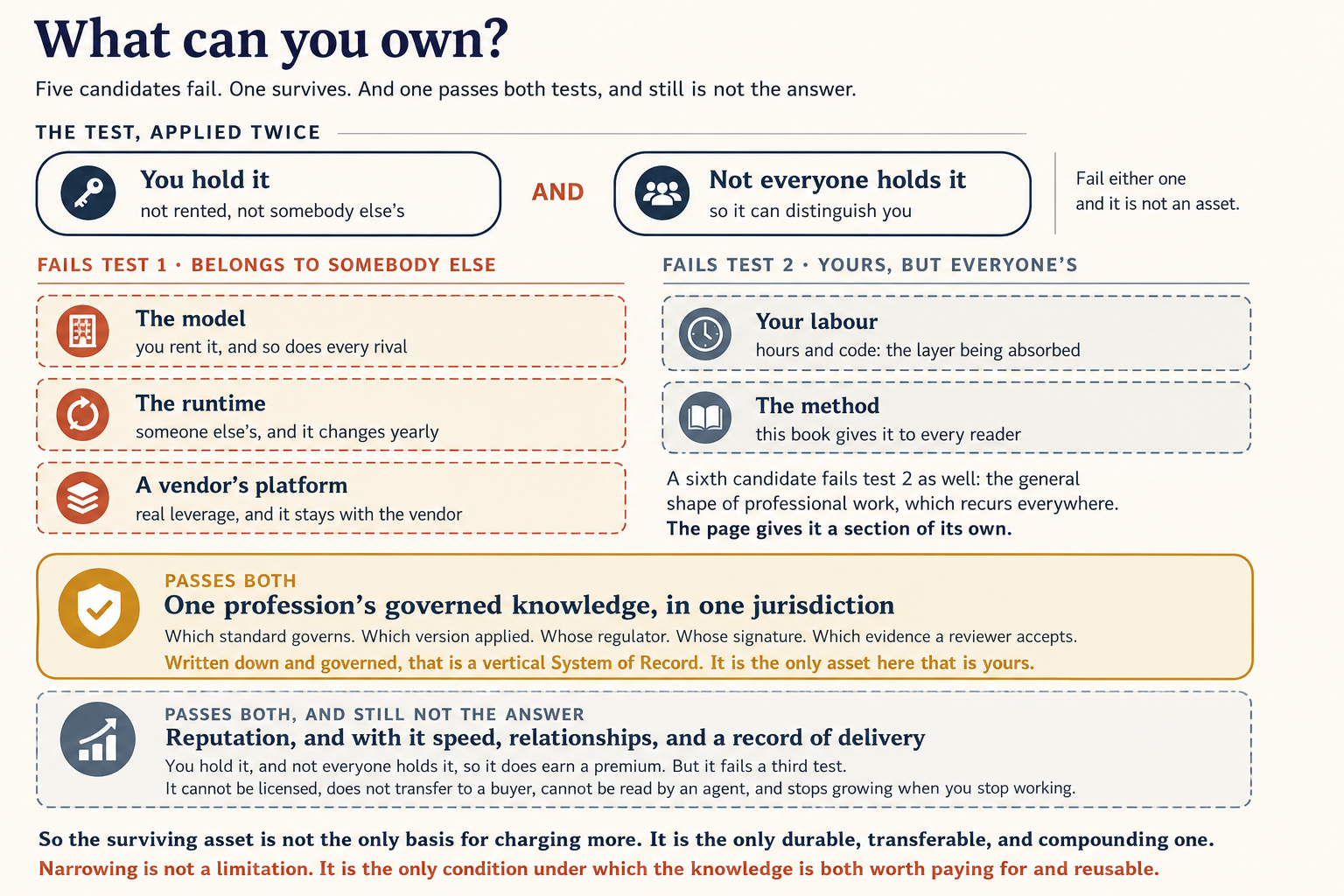 The same test as a table, including the candidate that passes it and still is not the answer.
One thing survives
Take away the five failures and one thing is still standing: what one profession knows, in one country, written down. Not how to do the work, which this book gives away, but which rule applies, which version of it was in force, and what a reviewer will accept as proof. Written down and governed, that is a vertical System of Record. You do not hold it alone. You hold it with the expert whose judgment is inside it.
Take everything above away and look at what is left standing.
Which standard governs this question. Which version of it was effective in this reporting period. Which country's regulator owns the rule. What the partner must sign personally and may not delegate. Which small difference is safe to carry, and which is the first sign of a real problem. Which piece of evidence a reviewer will accept, and which only looks like evidence.
None of that is method, so the book cannot give it to you. None of it is a vendor's, so nobody can withdraw it. None of it is general, so it does not travel from audit files to customs declarations. It is one profession's own governed knowledge, in one jurisdiction, and it is the answer to the question this page opened with.
Written down, governed, and served to both readers, meaning to humans as a website and to agents over MCP, that knowledge is a vertical System of Record.
Be exact about the word "yours" straight away, because the loose version of it is wrong. You do not own this corpus personally, and a corpus here means the collection of source documents your agents cite. It is held by the domain startup you build with your expert, it contains her material under licence, and it contains third-party sources under theirs. What you co-own is the assembly, the governance, and the procedures derived from her judgment. So the accurate claim is narrower than "you own the profession's knowledge," and it is also stronger: this is the only asset in the argument that a competitor cannot buy and a vendor cannot withdraw.
Three properties make it durable, and none is true of the refusals above. It changes, but it never becomes a commodity. A commodity is something anyone can buy anywhere at roughly the same price, which is what a rented model already is. Standards are revised periodically instead, and each revision is work only somebody inside the profession can do. So the asset needs maintenance, not replacement.
It can be licensed. You cannot license a skill. You can license judgment that has been written down, which is what turns one expert's twenty years into something a business can hold.
It grows. Every engagement adds one more outcome to it. So it is worth more in year three than in year one. A tool does the opposite.
And it is not one asset among several. It is the asset the whole practice stands on, and this book's architecture already says so in several places without gathering them into one claim. Inside the domain trio the System of Record is built first, always. The other two parts have nothing trusted to read until it exists. The expert twin, which is the agent that answers in your expert's voice, teaches from it. The domain builder, which is the tool that manufactures Workers for this profession, points Workers into it. And every Worker cites its rules to a reviewer, who then checks them. The money side leads to the same conclusion, starting from the opposite end. The engagement is priced against a result that only this asset lets you prove. The retainer, which is the fixed monthly fee that follows the build, pays you to operate Workers that read from it. The Layer 3 products are manufactured against it. And the first sponsor conversation happened at all because one governed page of it was worth reading.
So take it away and the practice does not shrink by a component. It has nothing left to stand on. Be precise about which practice, though, because the strong version of that line is wrong. A service practice stands up perfectly well without a vertical asset, on the method alone, and this book recommends exactly that to most readers. What has nothing to stand on is the business you were going to own. Remove the asset and what is left is a capable person with a shared method, renting hours, which is the position the refusals above spent their length describing.
One honest limit belongs here rather than later, because it constrains the whole argument. You cannot author this asset alone. The procedures inside it are written in a practitioner's voice and derived from a practitioner's real files, so what you own is owned jointly.
Jointly with whom, exactly, is worth being concrete about, because the phrase "you own it" hides a structure. The thing that holds the asset is the domain startup you and your expert build together. She licenses her persona and her written material into it, and she still owns them. Standards, statutes, and other third-party sources come in under their own licences. All of those terms are agreed before the vertical launches, not negotiated afterwards. So the accurate sentence is not that you own a corpus. It is that a business you co-own holds a governed corpus, and part of that corpus is material other people still own. That is a smaller claim than "you own an asset," and it is the true one.
What ownership is worth
Owning something is only useful if it changes what you can charge and what you can refuse. This section shows that the five things you cannot own are also the five things you cannot charge extra for. There is one exception, and it is the thing that survived the test.
The elimination did more than identify an asset. It identified the only thing you can charge a premium for, and the two results are the same result seen from different sides.
Go back through the refusals and ask what each one is worth at a negotiating table. Nothing, and for precisely the reason it failed. You cannot charge a premium for the model, because your competitor rents the same one this afternoon. You cannot charge for the runtime, because anyone can get it and the client knows it changes yearly. You cannot charge for the method, because every reader of this book has it. And you cannot charge for hours, because hours are the thing being priced down as the machine absorbs them, which is why the old services pyramid, with its many junior people billing hours, competes on rate and not on value. Pricing power requires that a buyer cannot obtain the thing elsewhere. That is the second half of the ownership test, restated as a commercial fact.
One candidate deserves a proper answer here, because it survives the test and the list above did not mention it. Reputation passes both halves. You hold it, and not everyone holds it, so it does support a premium, and so do speed, relationships, and a record of delivery. That objection is fair and the honest reply is a distinction rather than a denial.
Reputation is an asset of a different kind. It cannot be licensed to a partner. It does not transfer to a buyer. No agent can read it. And it does not accumulate into something a business can hold, because it lives in your name and stops growing when you stop working. A governed profession does all four. So the surviving asset is not the only possible basis for charging more. It is the only durable, transferable, and compounding one, meaning it lasts, it can be handed to somebody else, and it grows year on year, and it is the only one an agent can act on.
Three things follow from it.
You can price a result instead of your time. A buyer will pay for a result only if somebody can be held to it. Being held to a professional result means knowing which standard governs it, which version applied at the time, and what evidence a reviewer will accept. Nobody without the asset can promise that honestly. Anybody with the method can promise effort.
You can decline an engagement. An asset that grows in value even in a month when you sell nothing changes every negotiation. The client who wants to rent hours can be refused without it costing you a year, because the thing that makes you valuable next quarter is not this quarter's invoice.
You can be hired permanently, not just borrowed. A practitioner whose leverage belongs to a vendor is on permanent loan, useful while the vendor relationship lasts. One whose discipline and profession travel with her can be brought in-house without losing a step, which is a different conversation about a different price.
Notice what the market has done with this, independently. Pricing for AI agents is moving away from seats and hours. Two models are becoming more visible, and neither works without a governed asset behind it. One charges for a result rather than for an action. The other prices an agent the way you would price a full-time employee, which is the unit this book calls a Digital FTE, short for full-time equivalent. Neither is sellable by a practitioner who can only promise effort. The market did not adopt this book's framing. It arrived at the same place from the buyer's side, because a buyer paying for outcomes has to find somebody able to guarantee one.
One caution, because this works both ways. Charging for a result means carrying the cost of a result you fail to produce, so the pricing power the asset creates is only safe once its checker and its evaluation set are real. Ownership earns you the right to price an outcome. It does not excuse you from proving one first. And what to charge, on which rung, is an operational question this page deliberately leaves to the business model of the FDE AF Model.
What this does and does not gate
Nothing here says you cannot get work without the asset. You can be hired, freelance, and win clients without it, and most readers will start exactly there. What the asset changes is which work is offered to you, what you can charge for it, and what you still hold a year later.
Be exact here, because there is a strong version of this claim that is false and easy to reach for. Nothing on this page says you cannot work without the asset.
You can be hired without it. Some of the best-paid versions of the role depend on not having it. A vendor's engineer is handed the platform and needs no asset of her own, and senior salaried roles of that kind pay very well. You can freelance without it, at the rates a generalist gets, alongside the many capable generalists already competing for the same listings. And you can win clients without it, on the service ladder. There you earn at Layer 1 and Layer 4 using the shared System of Record alone. You build governed Systems of Record from a client's own manuals. You manufacture Workers with the generic tools that are already deployed. That work needs no slice, because it sells no vertical. It is where most readers of this book will begin, and where they should, and it is often how the expert is found.
So the asset does not gate access to work. It gates three other things, and those three build on each other over time. Which work you are offered, because a buyer paying for an outcome has to find somebody who can be held to one. What you can charge, because a premium requires something a competitor cannot obtain. And what you have at the end of a year, which is the question this page opened with.
There is one place the claim becomes firm, and it is worth stating narrowly, because a narrow claim is a credible one. For the vertical ladder the asset is close to necessary, and here is the precise version. A referral from your expert can get you the meeting. What it cannot get you is the next step. Nobody discloses their own baseline to somebody who has shown them nothing, so with no slice you may well have the conversation and still leave without a number, without a drafted contract of success, and without a business to run. Access to work is not gated. Access to a signed outcome is.
The two you carry
A practitioner who has done this work walks into a client holding two governed sources, not one. The first is this book, and every graduate has the identical copy, so it is necessary and it is no advantage. The second is one profession in one country, built with your expert, and nobody else has it. The first answers how the work is done. The second answers what the rules require.
So a practitioner who has done this work walks into a client carrying two governed sources rather than one, and the difference between them is the whole point.
The one you were given. The Agent Factory System of Record is this book, governed and served to both kinds of reader. It holds the method, and it holds more than the method: the arguments, the role map, the vocabulary, and this page. What matters here is not what is inside it but who else has it. Its content belongs to no single profession, which is what makes it reusable and also what makes it shared. An accountant and a customs broker read the identical pages, and so does every other graduate. So it is a refusal in physical form: you cannot work without it, and it gives you no advantage at all. Where this page needs a short name for it, it says the shared System of Record.
The profession, which you built. One vertical, one jurisdiction, licensed from a committed domain expert. It starts at one outcome covered completely and grows engagement by engagement. Nobody else has this one.
The two sit side by side with no integration work at all. Both are built from the same Layer 1 kernel, which is the one reusable piece of software the ecosystem runs every System of Record on. Markdown in, website out for humans, MCP out for agents. What matters here is the division of labour between them. One answers how, and the other answers what is required, and an agent holding both has a complete instruction where either alone leaves a gap.
Ruling out the others now helps here, because it explains something that otherwise looks like a shortcut. The second System of Record is allowed to be small precisely because it carries no method: specification, evaluation, deployment, and oversight all live in the first one already. What is left is only what the profession adds, which is exactly the part nobody could give you. Its smallness is not a compromise made to ship early. It is the shape of an asset with everything shared stripped out.
| The shared one | The one you build | |
|---|---|---|
| Where it came from | The ecosystem gave it to you | You built it, with your expert |
| How many exist | One, shared by every graduate | One per practitioner, per vertical, per jurisdiction |
| Depth at your first engagement | Deep and mature | One proven outcome, complete |
| How it grows | The platform maintains it | Engagement by engagement, by promotion |
| Who holds it | Panaversity's kernel and content | The domain startup you and your expert built |
| What it does for you | It is the harness you work inside | It is the reason a buyer takes the meeting |
How the asset is measured
Two words measure the asset, and they are easy to mishear. Thin means it covers one professional outcome. Thick means it covers many. Neither word says anything about quality, because every outcome inside it is complete either way. An outcome that is missing its hard cases is not thin. It is unfinished.
Two words describe how much of a profession the asset covers, and they are easy to mishear, so learn them here and use them everywhere else in this book. The unit is the slice: one professional outcome, covered completely. A System of Record with one slice is thin. One with many is thick.
They count outcomes and never shortcuts. Every outcome present is complete in either state, so an outcome that fails on missing evidence or the wrong jurisdiction is not thin but unfinished. Thin is not a draft, a prototype, or lightly governed content, because governance is not scaled to size: the first slice has an owner, versions, and review in its first week. And thick is not finished, because the law changes and new outcomes keep arriving.
That is the whole of it at the level of this argument: coverage grows, completeness never varies. Designing the Vertical System of Record carries the working detail, the states in between, the two engines that thicken an asset, and the additions that add weight without adding coverage.
Why not widen it?
Four professions can look alike from outside, because the same shape of work runs through all of them. So why not build one asset for that shape and serve all four? Because the shape is method, and the method is already shared. You would have built an empty box. Narrowing is what creates the asset, not what limits it.
Here is the sixth candidate, held back from the list above because it needs a section rather than a line. If the surviving asset is one profession's knowledge, the obvious efficiency is to widen it. Read a document against a rule. Cite the rule. List what is missing. Send onward what is unclear. That same shape of work appears in trade finance, medical coding, immigration, and company filings, which is why those four look alike from outside. So why not build one asset for that shape and serve four professions with it?
Because the shape fails the second half of the test, exactly as the method did. It is already given, it is already shared, and a corpus built around it has nothing to put inside. There is no source hierarchy, meaning no agreed order deciding which source wins when two of them disagree, because four professions have four such orders. There are no invariants either. An invariant is a rule that must stay true in every case, and those come from one profession's law and one profession's trust. You would have built an empty container: the shape of a corpus with nothing inside it.
The efficiency runs the other way. Narrowing is what creates the asset, because narrowness is the only condition under which the knowledge is both specific enough to be worth paying for and stable enough to reuse. One profession, one jurisdiction.
And now the two halves of this page meet. A vendor's engineer specialises by platform. Take the platform away and specialisation has to land somewhere, or you are a generalist consultant with nothing to reuse from one client to the next. So vendor-neutrality does not merely permit a vertical. It requires one. The vendor-neutral Forward Deployed Engineer and the governed profession are a single decision seen from two sides.
Choosing Your Vertical is how you decide which profession. Designing the Vertical System of Record is how you build it.
What the argument obliges you to do
If the asset is the only thing that separates you, it cannot wait for a customer to pay for it. Build first, sell second. The first slice is not a step that waits for a buyer. It is the step that produces one, because nobody tells a stranger what his own numbers are until that stranger has shown him something.
An argument about ownership has a consequence for sequence, and it is the part practitioners resist.
If the asset is the only thing that distinguishes you, then it cannot wait for a customer to fund it. Build first, sell second. The first slice is not a step that waits for a buyer. It is the step that produces one.
This book already implies that rule in three places without naming it. The portfolio is the credential. A résumé is judged on systems you actually shipped. And a sponsor who will not discuss a starting number is not a sponsor. Together they say one thing. Nobody names their own baseline for a stranger who has been shown nothing.
The slice does more than prove you are credible. It makes your argument for you. Walk into a mid-size firm carrying one governed page on that firm's own profession, and the buyer is not sitting through a pitch. He is reading his own work, written better than his own firm has written it, and the next question comes from his side of the table. Nobody had to invent a reason to hurry.
Where this sits among the launch gates. The four validation gates run in a fixed order rather than any order. Gate 1 is that your expert has signed. Gate 2 is that your rights basis is in writing. Both come before the slice, because the slice depends on both. Your expert writes its procedures and opens her own files to you. The rights basis decides which sources may legally sit inside it. Then the slice. Then gate 3, a named sponsor with a drafted contract of success. A contract of success is a written agreement on three numbers: where the work stands today, what will count as success, and how a reviewer will check it. Then gate 4, real prices from real suppliers rather than guesses.
Where the first sponsor comes from. Not a cold marketplace. Your expert is the vertical's first sales channel as well as its source of knowledge. Twenty years of practice is also twenty years of professional relationships. The firm that agrees to the first meeting is usually one that already trusts her. The freelance market and the local first proof come next. The international engagement comes after that, once a measured outcome exists to point at.
What the buyer supplies is the number. A baseline cannot exist before contact, because it is measured in the client's own workflow, and that is the only measurement a buyer can verify. The digging through your expert's files that built your slice ran on her material. The baseline runs on your customer's. Two sources, two moments, and no contradiction between them.
So the sequence is one line: expert, slice, sponsor, baseline, contract, engagement, thick. One step comes before every step that involves money, and it is the slice.
Build first, sell second governs the vertical ladder only. The service ladder starts with a client, as the section above explains. The vertical ladder starts with a slice.
Who keeps what
Four short answers. You and your expert hold the profession's System of Record, through the business you build together. The ecosystem owns the method one, and you use it. The customer keeps a working system they can change and the right to hire you. And nobody may promise the customer the profession's System of Record, because it is built on other people's licences.
An argument about ownership has to be exact about the boundaries, including the ones that are not in your favour. Here is the honest division.
What you own. The vertical System of Record, held by the domain startup you and your expert built, not by you personally. Her judgment and authored material are licensed into it and remain hers. Third-party sources sit inside it under their own terms. What you co-own is the assembly, the governance, and the derived procedures, which is a real asset and a narrower one than the whole corpus.
What you hold but do not own. The shared System of Record, the Agent Factory one. It belongs to the ecosystem. What protects you is not ownership but openness: plain versioned Markdown, standard Postgres with pgvector, and the open MCP protocol, so nothing you build inside it is trapped in a format only one platform can read.
What the customer keeps. A working system in production, on a stack they chose. Their own instance, holding their data, their thresholds, and their confidential ontology. The freedom to switch models, runtimes, and clouds. And the option to hire you outright.
What the customer does not keep. The vertical System of Record. There is a tempting sentence that gives it away, and it is worth naming so nobody says it: I bring the method and your profession, and you keep the second one when I leave. It sounds generous. It is false, and for a sharper reason than ownership. That System of Record is built from your expert's licensed material, and from third-party sources on their own terms. A licence to serve a standard inside your system does not become the customer's licence just because you offered it. Handing the corpus over would breach the agreements it is built on, quite apart from cutting your expert out of the business she is half of.
What an employer keeps. One case the four answers above do not cover, and it is the common one. Build a governed profession while employed, on your employer's time and with their expert, and your employer owns it. Not you. That is not unfair, it is what employment is, and it is why this argument is addressed to a practitioner who serves clients rather than one employer. It is also the sharpest reason the service ladder is a place to earn rather than a place to accumulate.
The discipline is always portable. The asset has an owner. Both halves have to be said, or the argument promises what it cannot keep.
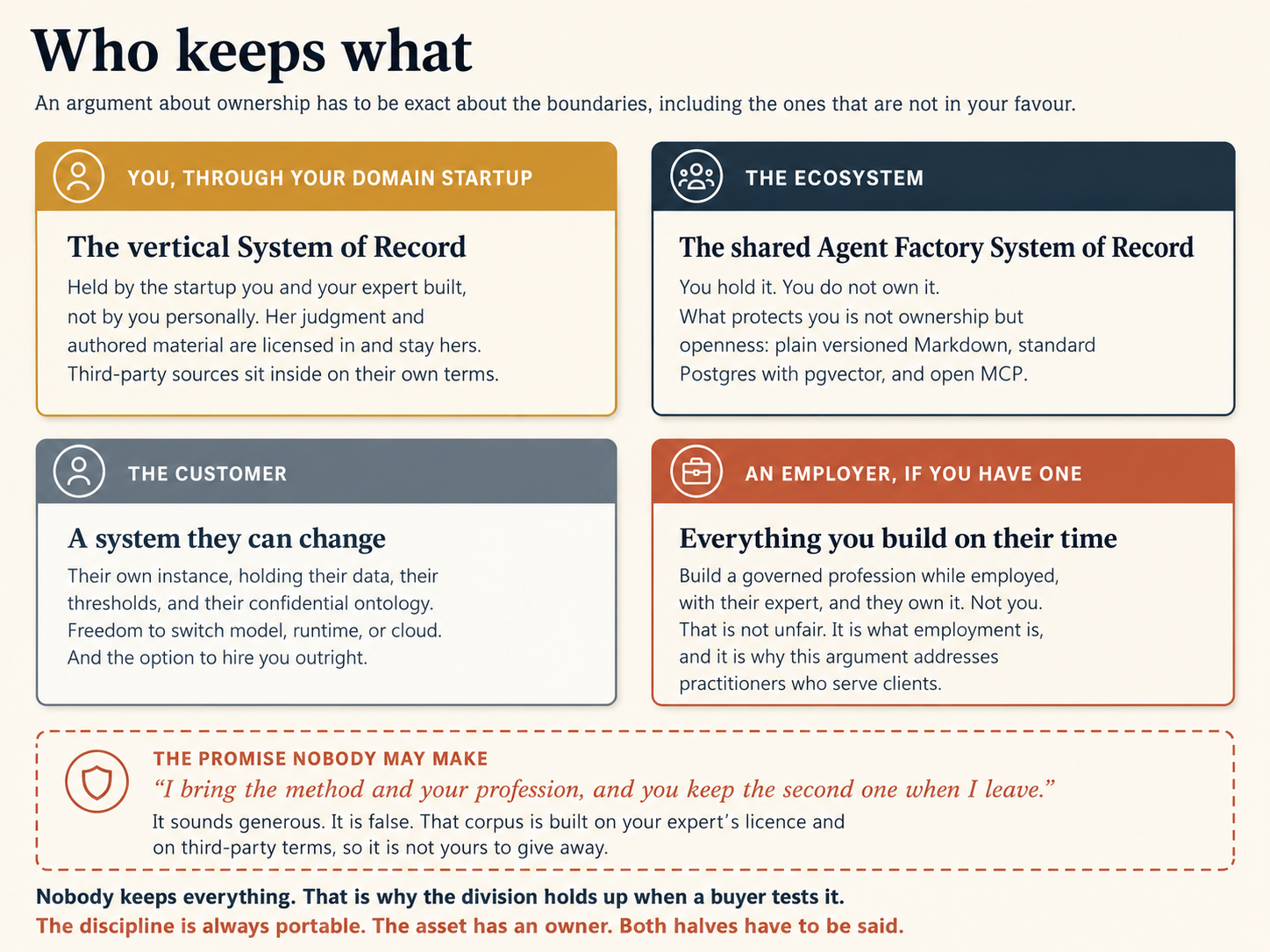 The division drawn as a ledger. Four parties, four cells, and one sentence that must never be said.
Read those answers as a ledger rather than a set of caveats, because they are what a client is actually buying. Under a vendor's engagement the leverage accumulates in the vendor's column and the client's stays thin. Here the columns are drawn deliberately, and nobody keeps everything. That is why it holds up when a buyer tests it.
What the argument rests on
This section lists the claims the page cannot do without. If one of them turns out to be false, the argument stops working. They are listed so you can test them rather than take them on trust.
The load-bearing claims, in the order this page established them. Remove any one and the rest stop holding. They are not the refusals from the elimination above, and they do not map onto them.
On the asset. Of the assets an agent can act on, only a governed profession passes both halves of the ownership test. It is held jointly with the expert who authored the judgment. The unit of building is one vertical in one jurisdiction, so serving a second country means a second build rather than an extension of the first. And without a committed author there is nothing to build and nothing to carry.
On the sequence. Build first, sell second, on the vertical ladder. The slice is built on your expert's files and passes the awkward cases before anyone sees it, because an unfinished outcome is not a thin one. The service ladder starts with a client instead.
On the numbers. The baseline comes from the client's own workflow, because that is the only number a buyer can verify.
On the boundaries. Two Systems of Record travel with you, the method and the profession. A third does not: the customer's own instance, holding their data and thresholds, which stays where it is. Promotion is the only bridge between them. And the customer does not keep the vertical System of Record, because your domain startup holds it and it stands on licences that are not the customer's to receive.
The honest label
One claim on this page is not yet proven, and this section says which one. Nobody has counted how many practitioners won their first customer because of a governed asset, because the category is too new. The reasoning is strong. The evidence is not in yet. This section also says what would prove the argument wrong.
One claim on this page is a projection, and it is labelled as one, the way this book labels every projection it borrows. It is worth separating from the claim just above it, because the two point in opposite directions and only one of them is uncertain. That a slice will win you a customer is the projection. That without one you cannot reach a sponsor conversation is the safer claim, because it follows from something anyone can check: buyers do not disclose their own baselines to strangers who have shown them nothing. Put simply: the negative claim is the safer one. We are surer that you need the asset than we are that the asset alone will win you the work.
That the asset is the only durable one follows from the elimination above, and ruling things out is reasoning rather than measuring. What is measured is the demand for the role. No verified count yet exists of practitioners who converted a governed corpus into a first customer, because the category is new and almost nobody has done it yet. The reasoning is sound and the alternatives are worse, and it is not yet proof. A reader who builds a good slice and still waits three months for a meeting has not disproved the argument.
What would change it. Three observations would force a revision, and each is worth watching.
If practitioners carrying governed slices win work no more easily than practitioners carrying only deployed Workers, then the slice is a portfolio item rather than a door-opener. The ownership half of the argument survives, because the asset would still be the only durable one, and the commercial half does not.
If a practice serving four professions from one asset built around the shape of the work reaches real scale, then the sixth refusal is wrong, and the profession is not the right unit.
If a general model plus a public corpus lets buyers answer their own jurisdictional questions without a governed source, then the surviving asset stops surviving, and this page needs rewriting from the elimination down.
None of the three has happened. Saying what would break an argument is part of making it.
Where to go from here
This page is the statement. Five pages act on it.
The Roles This Book Trains puts the argument to work on a career. The FDE AF Model is the five-layer blueprint the pairing sits inside, and it prices the work. Choosing Your Vertical is how you choose the profession. Designing the Vertical System of Record is how you build the asset. And How to Get Paid in the Agentic AI Era puts all four in walking order, then says what each of the three doors actually pays.
And if your honest answer today is that you have no committed expert, this argument is not aimed at you yet. Start on the service ladder, earn, and let the engagements bring you the expert.