Mode 1 — Problem-Solving
Solve it once. You drive the agent, the work gets done, you walk away.
You have learned to drive a general agent — Claude Code or OpenCode if you work with code, Cowork or OpenWork if you do not. This section is about the most common thing you will ever do with one: solve a real problem, once.
That is Mode 1. You open an agent, point it at a task, work with it until the task is done, take the result, and close the session. Nothing permanent is left behind; the next problem starts fresh. Most of the work you will ever hand an agent — for years — is Mode 1, and doing it well is a real skill, separate from writing clever prompts.
The book runs on two modes, and they are the spine of everything else:
- Mode 1 — solve it once (this section). You drive. The work is one-off.
- Mode 2 — manufacture a worker (the next section). You build a permanent Digital FTE — a "digital full-time employee" — that does the task again and again, on its own.
Frequency is not the dividing line. A Mode 1 task can come back every week (you simply keep running it by hand), and it stays Mode 1 until you decide it is proven enough to cross into Mode 2. What makes it Mode 1 is that you drive each run; what makes it Mode 2 is that it runs without you.
When most people get an agent, they do three things badly: they do not check whether the task belongs in an agent at all, they do not solve it cleanly, and they never notice when a task they keep redoing by hand should have become a permanent worker months ago. This section fixes all three — in that order.
Three courses, one path
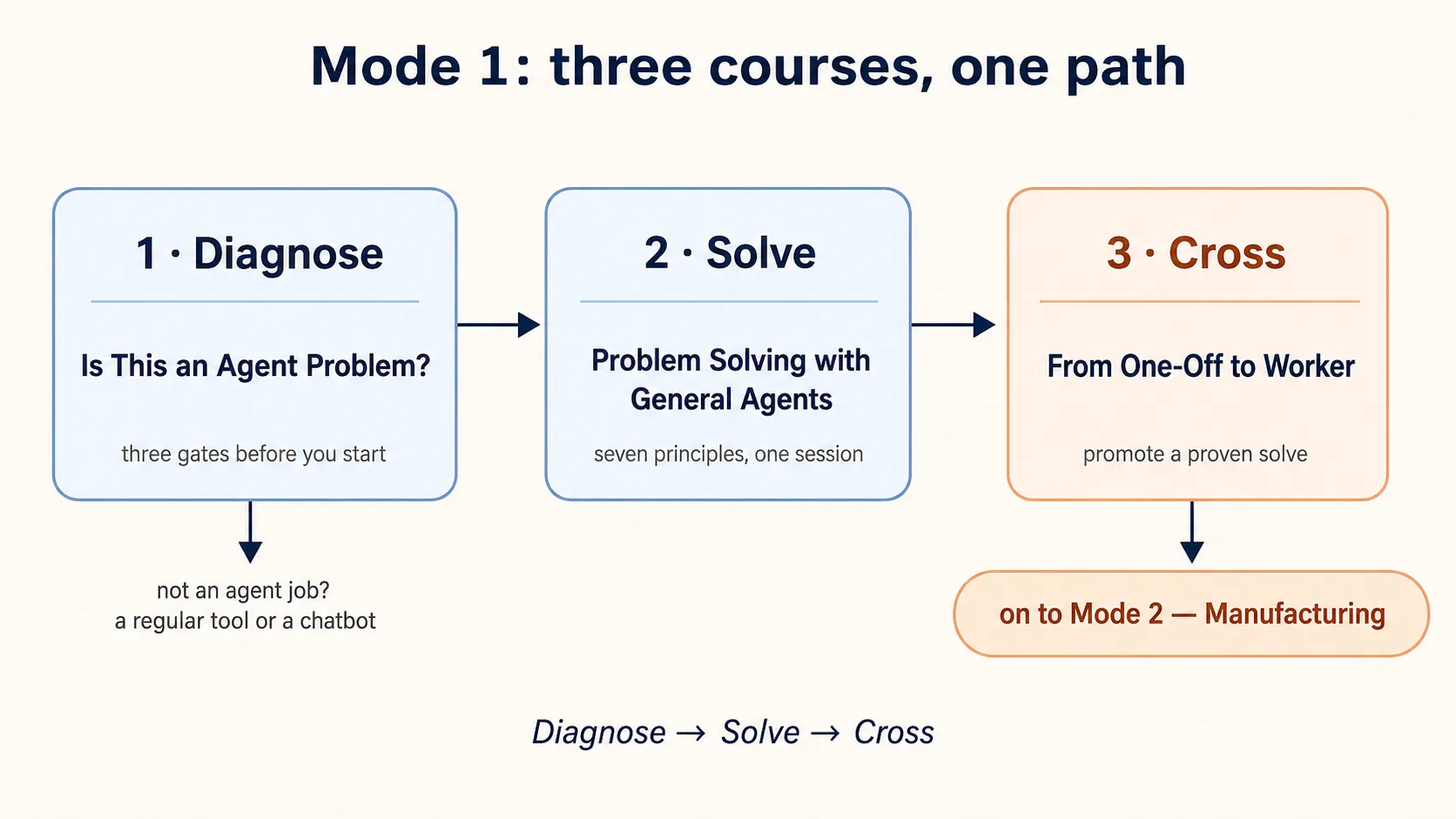
These are not three piles of tips. They are one path with three stages, and you walk them in order.
-
Diagnose — before you start. Most wasted agent sessions are lost before anyone types a word: the task was really a job for a spreadsheet, or a question for a chatbot, or it was never scoped. Is This an Agent Problem? gives you three gates you can run in ten minutes — is this even an agent job, will you do it once or every week, and what does "finished" look like — so you walk in with the right task, already sorted.
-
Solve — while you work. With the right task in hand, you have to solve it well inside one session. Problem Solving with General Agents teaches the seven principles for that: working in small reversible steps, using files as memory, verifying the result before you trust it, and more. It is the difference between an agent that wanders and one that lands.
-
Cross — when it is proven. Some tasks come back, week after week, solved the same way each time. From One-Off to Worker shows you when a repeated solve is ready to become a permanent worker, and how to promote it — turning the brief, the check, the steps, and the session you already have into something that runs without you. This is the bridge into Mode 2.
Diagnose, solve, cross. Run all three on one real task and you come out the far end with either a clean one-off finished, or a proven solution ready to manufacture. You can follow one person, Ana, across the first and last course — she sorts her weekly task at the gates, solves it by hand for a while, and finally crosses it into a worker. Her thread is the path made concrete.
What you need first
This section assumes you can already drive a general agent. If you cannot yet, do the General Agents section first — Claude Code & OpenCode or Cowork & OpenWork. It also assumes How to Think in the AI Era from Foundations: Mode 1 is as much about keeping your own judgment as it is about the tool. The Personal Agent Harnesses section just before this one is optional — you do not need it to work through Mode 1.
Where it leads
Most tasks end here, inside Mode 1: solved, shipped, done — and that is the right outcome, not a lesser one. A few tasks, the ones you keep doing again and again the same way, earn a permanent worker. When one does, the last course hands you across the line into Mode 2 — Manufacturing, where a proven solution becomes a Digital FTE that does the work without you.
Start with Is This an Agent Problem?.