How to Sell in the Agentic AI Era: Proof Replaces the Pitch
On August 3, 2026, Palantir reported a record quarter: revenue up 93 percent in one year, one of the fastest growth rates its industry has recorded. A company usually celebrates a quarter like that by praising its sales team. Palantir's CEO did the opposite. He told shareholders, in writing, that the growth was achieved with a sales head count that is small and getting smaller, on purpose.
That unusual boast matters to you because of the question you will face on the day you have something real to sell. How does a sale actually happen when you have no sales team, no brand, and no budget for outreach? The monetization roadmap built you the asset and the price. This page supplies its missing half: the selling motion. And Palantir is the right company to learn it from, because it invented the Forward Deployed Engineer role that roadmap trains, and it has now shown that role's selling motion working at the largest scale yet reported.
One sentence carries the whole page. In the agentic era, deployment is the sales motion: the working proof, built on the buyer's own data and measured against the buyer's own baseline, does the job the salesforce used to do.

The grey road is the pitch: a promise, carried by persuasion, and it is crumbling. The gold road is the proof: a working result on the buyer's own data, and it is where the growth now runs. The rest of this page walks that road.
For as long as enterprise software has existed, it was sold by salespeople: people whose job was to win meetings, build relationships, and persuade. One of the most prominent AI software companies just showed a different way. It grew revenue 93 percent in one year while shrinking its sales team. That shrinking head count, combined with its publicly documented bootcamp and embedded-engineer model, is strong evidence that proof and deployment now carry much of the work a salesforce used to do. It brings engineers to the customer, builds something real on the customer's own data in a few days, and lets the working result do the persuading.
This matters to you for one reason: you have no salesforce either. This page shows you the selling motion that needs neither a brand nor a budget, the same motion, scaled down to one person.
📚 Teaching Aid
View Full Presentation — Selling as a Vertical FDE
| Word | Plain meaning |
|---|---|
| Bootcamp | A short engagement, one to five days, where engineers build a working capability on the customer's own data and real problem |
| Product-led growth | Growth that comes from people using the product and wanting more, rather than from salespeople persuading them |
| Land and expand | Start with one small paid engagement, prove value, then grow the account use case by use case |
| Deployment Strategist | Palantir's non-engineering field role: the person who makes sure the build solves the right problem and gets adopted |
| Sales motion | The repeatable sequence of steps that turns a stranger into a paying customer |
| Wedge | A product or free resource that individual practitioners adopt on their own, pulling their employer toward a purchase |
| Proof cycle | The days between first contact and a working result the buyer can measure, which in this model replaces the sales cycle |
| Standing demo | A live, always-on demonstration a buyer can try without you in the room: for you, the SoR website anyone can read, plus the MCP endpoint a technical buyer can connect an agent to |
| Slice session | The one-person bootcamp this page builds: one afternoon with one decision-maker, your thin slice running on their real files, ending with their measured baseline |
| Proof sheet | The one-page document you send when a company asks for a brochure: every section is evidence with a link, ending in the measurement ask |
Every other new word is defined in the glossary.
What happened on August 3, 2026
The numbers first, because they are the reason anyone is listening. In its second quarter of 2026, Palantir reported revenue of 1.9 billion dollars, up 93 percent year over year, and profit of about 1.1 billion dollars: more profit in a single quarter than the company's total revenue in the same period the year before.1 US commercial revenue grew 149 percent from a year earlier, US government revenue grew 90 percent, and the company raised its full-year revenue guidance to about 8.15 billion dollars.2 Karp told CNBC that, to his knowledge, no business at Palantir's scale had ever grown even half as fast.2 It closed 220 deals of at least one million dollars in the quarter, of which 73 were worth ten million or more.3
Then the sentence that makes this a sales page rather than an earnings page. In the shareholder letter, CEO Alex Karp wrote that the results were achieved with a "minuscule and shrinking" sales head count, and called it another case of the company discarding conventional wisdom.4 He added that the acceleration in the US commercial business, 28 percent quarter over quarter, means what other companies need a year or longer to achieve, Palantir can do in about 90 days.
Three months earlier he had put a number on "minuscule," and the number is the part worth remembering. On the first-quarter call he said Palantir had roughly 70 salespeople, and that only about seven of them really sell, work he claimed a comparable company would staff with 7,000.5 Treat the 7,000 as rhetoric. Treat the 70 as the fact that matters, because it tells you the shape of the thing: a company approaching eight billion dollars of annual revenue, selling through a sales organization smaller than a single mid-sized firm's department.
Read the 90-day claim carefully, because it is easy to misread. Karp was comparing growth rates, not describing a sales cycle. Palantir's US commercial business grew 28 percent in one quarter, which is roughly what a healthy software company hopes to achieve in a year. He was not reporting that Palantir closes enterprise deals in 90 days. The defensible conclusion is narrower, and it is still remarkable: a deployment-led model appears able to create and expand commercial value at a speed conventional enterprise sales models rarely reach. The rest of this page is about the machinery behind that speed, and this book gives part of that machinery a name: the proof cycle, the days between first contact and a working result the buyer can measure.
One boundary belongs here, and the honest label at the bottom repeats it. The sales team is shrinking, but Palantir added nearly 500 employees overall in 2025.4 The company did not remove the humans between the product and the customer. It changed what those humans do. That distinction is the entire lesson of this page, so hold onto it.
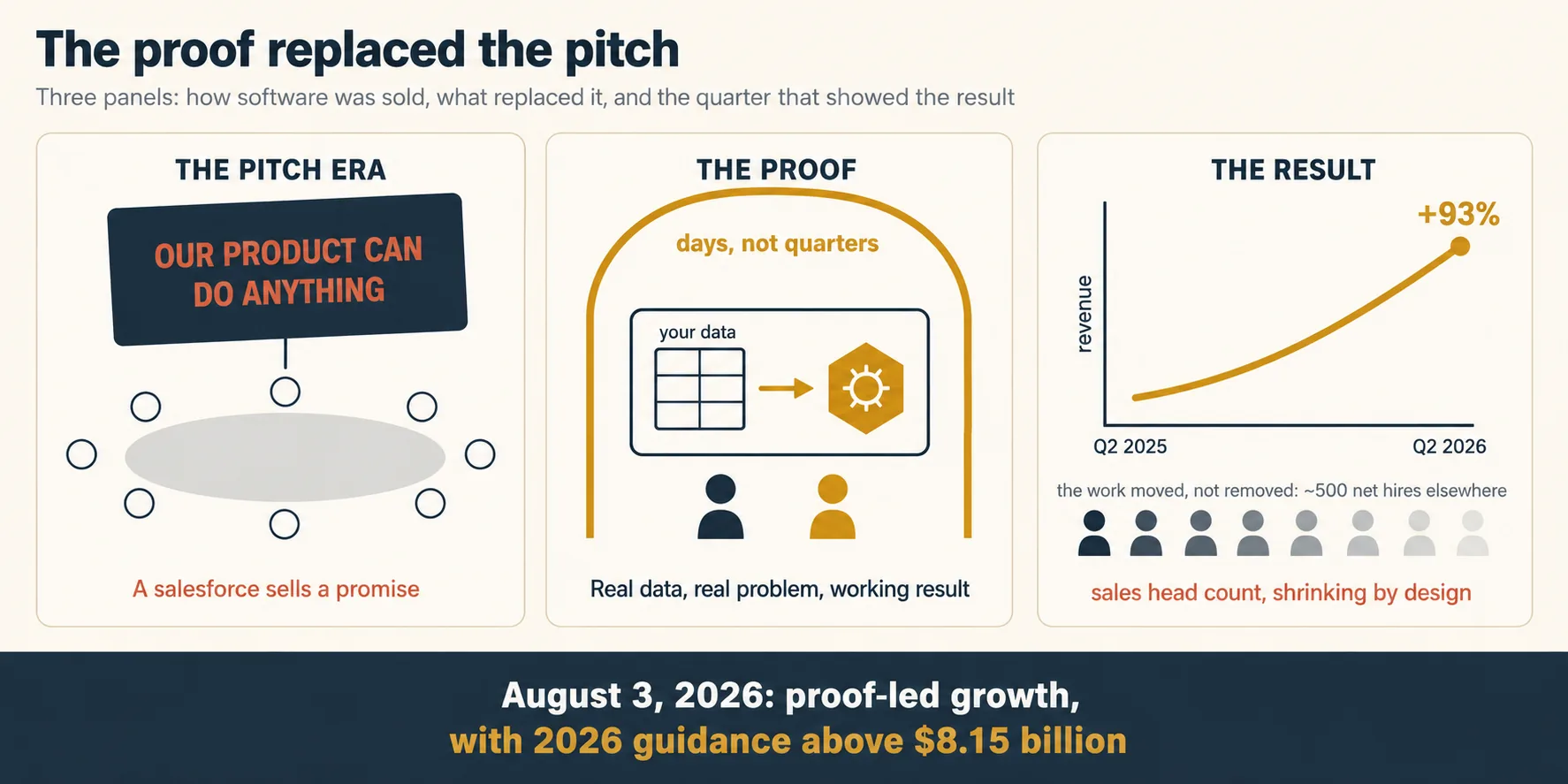
The quarter, in three panels. The caution in the third panel is drawn in on purpose: the head count moved rather than vanished, with nearly 500 net hires elsewhere in the same year.
How Palantir actually sells: three mechanisms
Three things do the work the salesforce used to do.
First, the bootcamp: a few days where Palantir engineers build something real on the customer's own data. The customer watches their own problem get solved, and the people in the room become the salespeople.
Second, the embedded engineer: the FDE, who sits inside the customer's company and builds until real value lands. A large part of that engineer's week is spent talking to the customer about their problems, which is the work an account manager used to do, done by someone who can also fix the problem on the spot.
Third, land and expand: the first contract is small. Value is proven, then the account grows one use case at a time, and the revenue shifts from services toward software.
The bootcamp replaces the pitch
When Palantir launched AIP in 2023, it faced a wave of demand and no traditional salesforce to process it. Instead of building one, it built an event format: the software bootcamp, part hackathon, part conference, run in a few days on the customer's own data and the customer's actual operational problem, ending with a functioning capability rather than a slide deck with next steps.6 The company told analysts plainly that bootcamps were the way it would sell AIP, and mentioned them 21 times in a single earnings call.6 The company's own head of business development described the effect from the back of a bootcamp room: once customers try the product, they end up on the stage, presenting the results to their peers.6
Notice what the bootcamp is, structurally. It is not a demo, because a demo runs on the vendor's data and proves nothing about the buyer's world. It is a compressed deployment: real data, real problem, real output, in days. The fastest way through an institution's doubt about AI is to show it a piece of its own operation, already improved.7 You are not selling a platform. You are selling the buyer a glimpse of their own reality, working better.
The embedded engineer replaces the account executive
The second mechanism is the one this book has been teaching all along, seen from the money side. Palantir does not hand software to a sales team and a manual to the customer. It embeds FDEs and Deployment Strategists inside the client's operations: builders working in the client's environment until solutions run in production, alongside strategists who make sure the work targets the right problems and gets adopted.8
Here is the detail that matters for a sales page. By one detailed analysis, a Palantir AI-era FDE spends roughly 30 to 40 percent of the working week on conversational customer discovery.9 Read that number again. A third of the engineer's time is spent doing exactly what an account manager used to do: listening, finding the next problem, building the relationship. The difference is that when this person finds the next problem, they can also build the solution, sometimes the same week. The discovery and the delivery collapsed into one role, and much of the dedicated salesperson's job moved into it.
Land and expand replaces the enterprise deal cycle
The third mechanism is the shape of the contract. Palantir's engagements start small: a bootcamp and a limited set of licenses. If value is proven, more use cases, workflows, and data domains are layered in, and over time the revenue mix tilts from services toward software subscription. Unlike a consulting firm, the services exist to drive product adoption, not to be the business. And unlike most software vendors, Palantir will fund its own engineering time up front to land a customer worth landing.8
So the deal never has to be sold big. It only has to be proven small, and then it grows. Deals are typically sponsored at the C-suite or mission-critical program level, which gives the field team authority to reframe workflows rather than just install a tool.8 The 220 deals worth at least one million dollars each in the quarter3 are consistent with that model, and one limit belongs on the record: Palantir does not disclose how many of them were expansions of existing accounts rather than new customer wins.
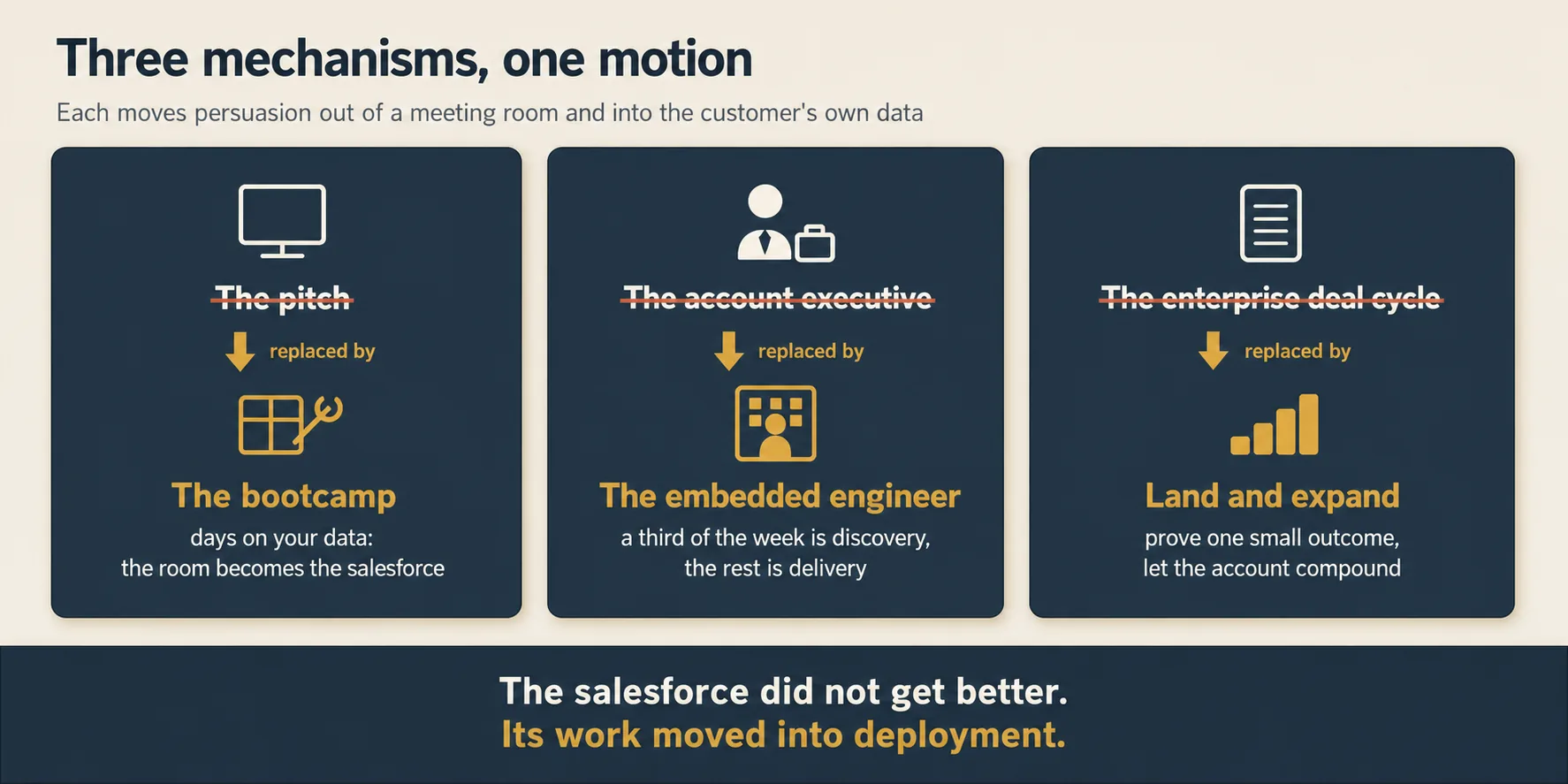
Three replacements, one direction. Each mechanism moves persuasion out of a meeting room and into the customer's own data.
The law this evidence supports: deployment is the sales motion
Now hold Palantir's model next to what this book has already made you do, and notice they are the same shape.
The monetization roadmap's sequence rule was build first, sell second: the slice is not a step that waits for a buyer, it is the step that produces one, because nobody discloses their own baseline to a stranger who has been shown nothing. That is the bootcamp logic, stated for one person. The contract of success prices the work from three numbers the buyer can verify: baseline, target, acceptance. That is land and expand, stated for one engagement. And the FDE role itself, embedded until the outcome is proven, is the collapsed discovery-and-delivery role that absorbed much of the account executive's work.
So the law, in one line: the proof replaced the pitch, and the person who builds the proof replaced the person who gave the pitch. Palantir did not shrink its salesforce because software started selling itself by magic. It shrank the salesforce while allocating more of the commercial work to engineers and strategists who sell by deploying. The head count moved, and this is why the 500 net hires matter: selling did not disappear as work, it became less concentrated in a separate job.
One more honest reading of the same fact, because it protects you from the most tempting wrong conclusion. The sales head count is small and shrinking, and it is not zero. Palantir still employs salespeople, Harvey runs an enterprise sales process, and Cursor hired sellers as it grew, because some commercial work is irreducible no matter how good the proof is: choosing which buyers to approach, making the ask, negotiating the contract, holding the price, and getting the signature. The proof can carry the persuasion. It cannot sign the paper. In your one-person version, that irreducible remainder does not disappear either. It lands on you, and you should plan for it as real weekly work: choosing the next partner, sending the ask, saying the boundary sentence, negotiating scope instead of price, and requesting the introduction. Expect it to take something like a day of your week, and treat that as a planning shape rather than a measurement. The failure modes below are the discipline for exactly that day. A reader who hears proof replaces the pitch as nobody sells anymore has misread this page. The selling shrank to a size one person can carry beside the engineering, and that is the entire reason this model is open to you.
For the old services pyramid, this is the end of a business model. For you, it is the door, and the reason is structural. A sales motion built on personal relationships and brand recognition takes decades to grow and money you do not have. A sales motion built on proof takes a thin slice, a laptop, and days. It is a rare thing in enterprise software: a sales motion that a skilled individual in Lahore or Lagos can run at their own scale, because the motion is engineering.
The question you came here to ask: are they selling with agents?
Honest answer: no, not mainly. There is no evidence that Palantir replaced its salespeople with AI agents doing outreach and closing. What replaced the salespeople is the model above: human engineers plus a product whose agents produce visible results fast.
The agents' real role in the sale is different and more important. The agents are the proof. When an agent on the customer's own data does in minutes what took a team days, that result is the sales pitch, and no human salesperson could ever deliver it.
This "no" is the best news on the page. If the secret were an AI sales agent, you could buy one, and so could everyone else. The secret is a motion, and this book has been training you in it since Station 1.
When the shrinking-salesforce headline crosses a reader's screen in 2026, the natural guess is that Palantir automated its sales team: AI agents prospecting, qualifying, emailing, closing. The reporting does not support that guess. What the record shows is the model above: bootcamps as the entry motion, embedded FDEs and strategists as the field force, land-and-expand as the contract shape.6 8 The humans were not automated away. Much of the separate sales job was absorbed into the deployment job.
Where agents genuinely enter the sale is one level down, and it is decisive. The bootcamp works because AIP's agents, wired to the customer's own data, produce a visible outcome inside days. The agents are not selling. The agents are the thing being demonstrated, and their speed is what lets a proof arrive in days instead of quarters. The product's capability, shown on the buyer's own problem, is the persuasion. Put simply: the demo became good enough to carry most of the selling.
Agents will increasingly assist the motion, for Palantir and for you: account research, follow-up drafts, baseline evidence, and monitoring of the deployed Workers whose numbers become the expansion case. Treat those as accelerants, not the motion itself. A team with no proof to show will not be saved by an agent that sends more emails about it.
Palantir is not alone: three more motions, and what each one teaches you
The shrinking-salesforce quarter is the loudest data point of the era, not the only one. Three other companies have reported exceptional growth selling AI, each with a different answer to the same question Palantir answered. Study all three, because each one validates a different part of the road you have already walked.
The wedge: Cursor and product-led growth
Palantir's motion needs engineers in a room with the customer. The second motion needs no meeting at all, and it produced growth that was even faster.
Cursor, the AI code editor from Anysphere, is reported as the fastest-growing business software company in history: roughly 100 million dollars in annualized revenue in January 2025, 500 million by June, one billion by November, two billion by February 2026, and about four billion by mid-2026, when SpaceX agreed to acquire the company for 60 billion dollars in stock, the largest acquisition of a venture-backed startup on record.10 It passed one billion in revenue with roughly 300 employees, and its enterprise page reports that 64 percent of Fortune 500 companies use it.11
Now ask how a company that small reached two thirds of the largest companies in America. Nobody ran a bootcamp for them. The sequence ran the other way: individual developers adopted a free or cheap tool because it made their own working day better, and once enough of them depended on it, their employer had a reason to buy it properly, because the tool was already inside the building, proving itself on the company's own code. By early 2026, enterprise customers reportedly made up about 60 percent of revenue: adoption that started with individuals ended in firm-wide contracts.12
What you borrow: the wedge is the individual practitioner, not the firm. Your vertical has juniors the way software has developers: the trainee accountant, the junior associate, the customs clerk who actually does the filings. Anything you publish that makes one practitioner's own day better, a free tier of the twin, an open cheatsheet, the SoR's public pages, is a wedge into the firm that employs them. The partner you eventually meet should ideally have already heard your vertical's name from a junior who uses it.
One honest note, because the pure version of this story misleads. Reporting indicates that as Cursor's enterprise business grew, its sales-led revenue grew about 100-fold in a year.12 Even the purest product-led company added humans to close firm-wide deals. Product-led growth earns the meeting. A person still closes it. That is the same division of labor as Palantir's, arrived at from the opposite direction.
The price: Sierra and the outcome the customer pays for
Every buyer of business software has lived with the same quiet unfairness for decades. The license fee is due whether the software delivers or not. Seats are paid for. Results are hoped for. The third motion removes that unfairness, and the removal built one of the fastest-growing companies of the era.
Sierra, founded in 2023 by former Salesforce co-CEO Bret Taylor and former Google executive Clay Bavor, sells customer-facing AI agents to large enterprises, and reached a reported 200 million dollars in annual recurring revenue and a 15.8 billion dollar valuation by mid-2026, with, by the company's account, nearly half the Fortune 50 as customers.13
What matters for this page is not the product but the price. Sierra's signature model is outcome-based: the customer pays a fee, reported by third parties at roughly one to two and a half dollars, each time the agent actually resolves an interaction, and in most cases pays nothing when the conversation goes unresolved or escalates to a human.13 The economics are stated plainly by the founder: a human-handled service call costs a company perhaps ten to twenty dollars, so a resolved automation is worth a portion of the saved cost.14 In July 2026 the company extended the model to long-horizon outcomes: an agent pursuing one business result, a claim or a renewal, across weeks, still priced on the result.13
What you borrow: validation, and a warning. The roadmap's contract of success, baseline, target, acceptance, is not a scrappy improvisation for people who cannot charge day rates. It is the era's flagship pricing model, carried by a founder who previously ran Salesforce, the largest sales organization in software, at a valuation that says the market believes it. When a buyer hesitates at outcome pricing, you now have a one-line answer: this is how leading AI companies charge, because it aligns the seller's incentive with the buyer's.
The warning travels with it, and the roadmap already gave it. Getting paid on outcomes means not getting paid on failures. Sierra can absorb unresolved conversations across millions of interactions. You absorb them across a handful of engagements. Your checker and your evaluation set are what make this pricing survivable at your scale, which is why the definition of ready below refuses to let you sell without them.
The trust: Harvey and the vertical door
A profession buys differently from a market. Ask a managing partner why the firm has not adopted AI, and the honest answer is rarely about the technology. It is a fear. Nobody wants to be the first firm in the city to trust client work to a machine, and nobody wants to explain that decision to a regulator, an insurer, or a client if it goes wrong. A motion that sells into a profession must answer that fear before it can say anything about features.
Harvey answered it with names. Harvey builds AI for legal work, one profession, and reached a reported 190 million dollars in annual recurring revenue by January 2026, nearly doubling in five months, with an 11 billion dollar valuation by March 2026. It reports over 100,000 lawyers on the platform across roughly 1,300 organizations, including half or more of the 100 largest US law firms.15
Its motion is neither bootcamps nor self-serve. Harvey publishes no pricing page: entry is a demo request into an enterprise sales process, and deployments are firm-wide commitments.16 What opened the profession was trust, built deliberately: early flagship law firms worked with Harvey as design partners, and their names then did what no advertising could, because law firms watch what their rivals adopt. The product also meets lawyers where they already work, inside Microsoft Word and Outlook, rather than asking the profession to move.16
What you borrow: the vertical door opens on names, not features. This is your expert argument and your first-client argument, running at scale. Harvey's early design partners are your committed expert and your first firm: the reference that answers the vertical buyer's deepest fear, which is going first. It is also why the roadmap insists that no vertical launches without a signed expert. And it is why your first engagement can justify a deliberate introductory price, when the agreement includes, in writing, the right to publish a named outcome and to ask for introductions. Do not exchange months of work for a reference the client has not agreed to provide. And note the placement lesson: Harvey sells inside Word because that is where legal work happens. Your Workers should surface inside the client's actual tools, the practice management system, the email, the spreadsheet, not inside one more portal the firm must remember to open.
Four motions, one law
Put the four side by side and the era's selling law appears.
| Motion | Flagship, with reported scale | What does the persuading | What you take from it |
|---|---|---|---|
| Proof-led | Palantir, about 8.15 billion dollars guided for 2026 | A working result on the buyer's own data, in days | The slice session and the embedded engagement |
| Product-led | Cursor, roughly 4 billion dollars ARR reported as of June 2026 | The practitioner's own daily experience of the product | The wedge: a free tier that recruits juniors inside the firm |
| Outcome-priced | Sierra, roughly 200 million dollars ARR reported as of mid-2026 | A price that only exists when the result does | The contract of success, now with a market-scale precedent |
| Trust-led | Harvey, roughly 190 million dollars ARR reported as of January 2026 | Named early adopters inside one profession | The signed expert and the quotable first client |
Not one of the four relies on a classical salesforce as the engine of its growth. Harvey runs an enterprise sales process, and Cursor hired sellers as it scaled, and in both cases the persuading is largely done before the salesperson arrives: by the names, or by the product already inside the building. Each company moved more of the persuasion into something structural: the proof, the product, the price, or the trust. They are not rival strategies. They are four places to put the persuasion so that no salesperson has to carry it. And here is the striking thing about the one-person vertical FDE: your motion, assembled over the last two pages, already contains all four. The slice session is your proof. The standing demo over MCP is your product wedge. The contract of success is your outcome price. Your expert's signature is your trust. The next section assembles them.
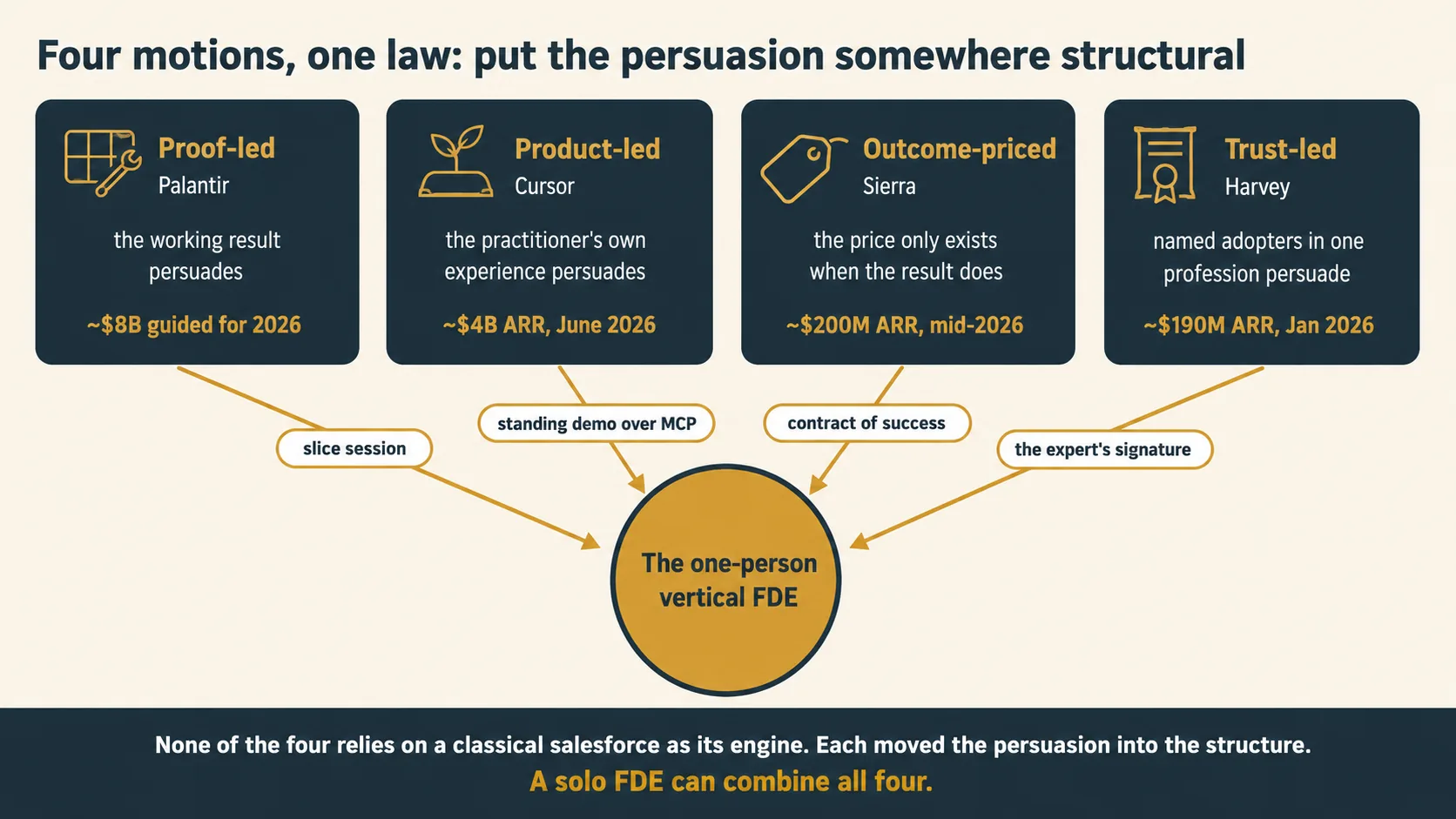
Four companies, four places to put the persuasion. A solo vertical FDE is small enough to combine elements of all four at once.
Your version of the model: the one-person bootcamp
You cannot copy Palantir's balance sheet, but you can copy its motion, because the motion is made of things you already have: a slice, a laptop, and days of work.
Your bootcamp is one afternoon with a partner at a small firm, running your slice on a few of their real files. Your embedded engineer is you, on a retainer. Your land and expand is the contract of success growing into the next outcome. And you have one tool Palantir's model never had: your System of Record is public as a website, and a technical buyer can connect an agent to its MCP endpoint and test what it knows before you ever meet.
The obvious objection comes first. Palantir runs its motion with thousands of engineers and a balance sheet that can pay for months of free work. Can one person run the same motion at all? Row by row, yes, because each mechanism scales down into a cheaper version of itself. The left column is what a company with eight billion dollars of yearly revenue does. The right column costs almost nothing but discipline.
| Palantir's mechanism | Your version, as a vendor-neutral vertical FDE |
|---|---|
| The AIP bootcamp: days on the customer's data, engineers in the room | The slice session: one afternoon with one partner, your thin slice running on three to five of their real (anonymized if needed) files, ending with their own baseline number on a whiteboard |
| The embedded FDE, a third of the week on discovery | You, inside the engagement, doing the discovery and the delivery as one person: every conversation about a problem is the next slice's requirements document |
| Land and expand from a small first contract | The contract of success on one outcome, then the retainer, then the second outcome priced with confidence because the connection pattern already exists |
| C-suite sponsorship that grants authority to reframe workflows | The one decision-making partner at a 20-to-200-person firm: the roadmap's honest boundary about who your real buyer is |
| The product demo that now carries most of the selling | The standing demo: the SoR website any buyer can read today, plus an MCP endpoint with a connection guide for their technical team, with nobody selling anything |
| Agents as accelerants around the motion | Your Workers doing the prospect research, drafting the follow-up, and compiling the before-and-after evidence pack after every engagement |
Three notes on the table, because each row hides a discipline.
The slice session has a definition of done, and it is a number. Palantir's bootcamp ends with a functioning capability. Yours ends with something better for your scale: the buyer's own baseline, measured in the room. Four hours per file, sixty filings per month, two days of partner review per engagement. Walk out with that number and the contract of success becomes arithmetic. Walk out without it and you gave a free demo. The session's boundary belongs in the same breath, in one sentence you can say aloud: this session is free and ends with your baseline number, and a pilot on more of your files is the first priced outcome, scoped to a named number of files for a named price. The whole session, on one sheet:
The slice session: the one-page runbook
Before the session, a few hours of preparation.
- The thin slice runs end to end on sample files without improvisation
- The anonymization checklist below is printed, and the client has seen it
- Three to five of their real files are agreed in advance, anonymized if required
- The whiteboard question is written down in their words: what does one file, filing, or review cost you today?
- The contract of success template is in your bag: baseline, target, acceptance, exit clause
The anonymization checklist, approved with their reviewer before any file is touched.
- Client names, addresses, and identifiers replaced or masked
- Financial figures preserved in structure, scrambled in value where the work allows
- No file leaves the client's machine unless the engagement letter says it can
- The client's own reviewer signs this list before the session, and keeps a copy
- Everything processed in the session is deleted in front of them at the end, unless agreed otherwise in writing
If their reviewer will not approve the list, run the session on synthetic files shaped like theirs. A smaller proof beats a compliance incident.
In the room, one afternoon.
- Ten minutes: they describe the work in their words. Write their words down, because every complaint is a requirements document.
- Run the slice on their files. Do not present. Let them watch their own problem being worked.
- If your vertical's expert twin is live, hand the partner the keyboard: one question, in their own words, and let them watch the citation arrive.
- When the output lands, measure the baseline with them: their number, their units, their process.
- Write the number on the whiteboard. Photograph it with permission.
- Say the boundary sentence, and stop.
The boundary script. Say it exactly, then stop talking.
This session is free, and it ends with your baseline number. A pilot on more of your files is the first priced outcome: [X] files, for [price], under a contract of success, and here is what leaving looks like if it does not deliver.
If they ask for a free pilot, the answer is the same sentence, said warmly, a second time. If they push on price, narrow the scope and never the price per outcome: fewer file types, one workflow, one quarter. If nobody can name the decision-maker and a date before you leave, it was a conversation rather than a deal: follow up once, then move to the next partner.
After the session, the same week.
- The one-page outcome note: their baseline, the proposed first outcome, the price, the exit clause
- The contract of success sent within two days, while the whiteboard photo is fresh
- If they sign, the pilot is Outcome 1, and the checker's monthly report starts building the renewal case
- If they do not, ask for one introduction anyway, because in a profession everyone knows everyone
The standing demo is your structural advantage, so make it usable. Palantir's proof requires scheduling engineers into a room. Yours does not, but its two halves carry different friction, and pretending otherwise loses buyers. The website half is truly frictionless: anyone can read your governed corpus at any hour without asking your permission. The MCP half is a deeper channel with real setup, because connecting an agent to an endpoint takes a compatible client, authentication, and some knowledge. So publish a one-page connection guide, sample questions, and a low-friction authentication path, and a buyer's technical person can test what your vertical knows without ever scheduling you. All of it costs you nothing you have not already built at Station 7.
The expansion pitch is written by your checker. Land and expand runs on proven value, which means somebody has to prove it continuously. That is what your evaluation set and your checker were for. A monthly one-page report, generated by a Worker, showing the baseline, the current number, and the exceptions escalated, is the whole expansion salesforce of a one-person firm. An engagement that measures itself builds its own renewal case.
Your proof has an ecosystem behind it, so borrow it at the right moments. You do not walk into the first meeting holding only your own slice, because the method you are selling already runs in public, on itself. The Agent Factory ecosystem is the pattern's live reference: this book served to humans as a website and to agents over MCP, with Zia Tutor AI as the working expert twin teaching from it. Three moments in the sale, three borrowings. On day zero, before you have any client, the ecosystem answers the skeptical buyer's hardest question, has this pattern ever worked anywhere, with a link instead of a claim. In the room, once your own vertical twin is live, it becomes a proof surface of its own: invite the partner to ask it one question in their profession's words, and let them watch the citation arrive, because an expert twin answering with sources is a demonstration no slide can match. And at expansion, the System of Context is the proof that closes the second outcome rather than the first: the moment a Worker cites your governed source and the firm's own memo, and reports that the two disagree, the connection layer has proven itself in front of the person who signs. One gate travels with that last borrowing, and it is the same gate the System of Context page states: the connecting layer is built after the slice ships and a Worker cites it, never before, so do not promise it in the first afternoon. The hands-on build is Building the Context Layer.
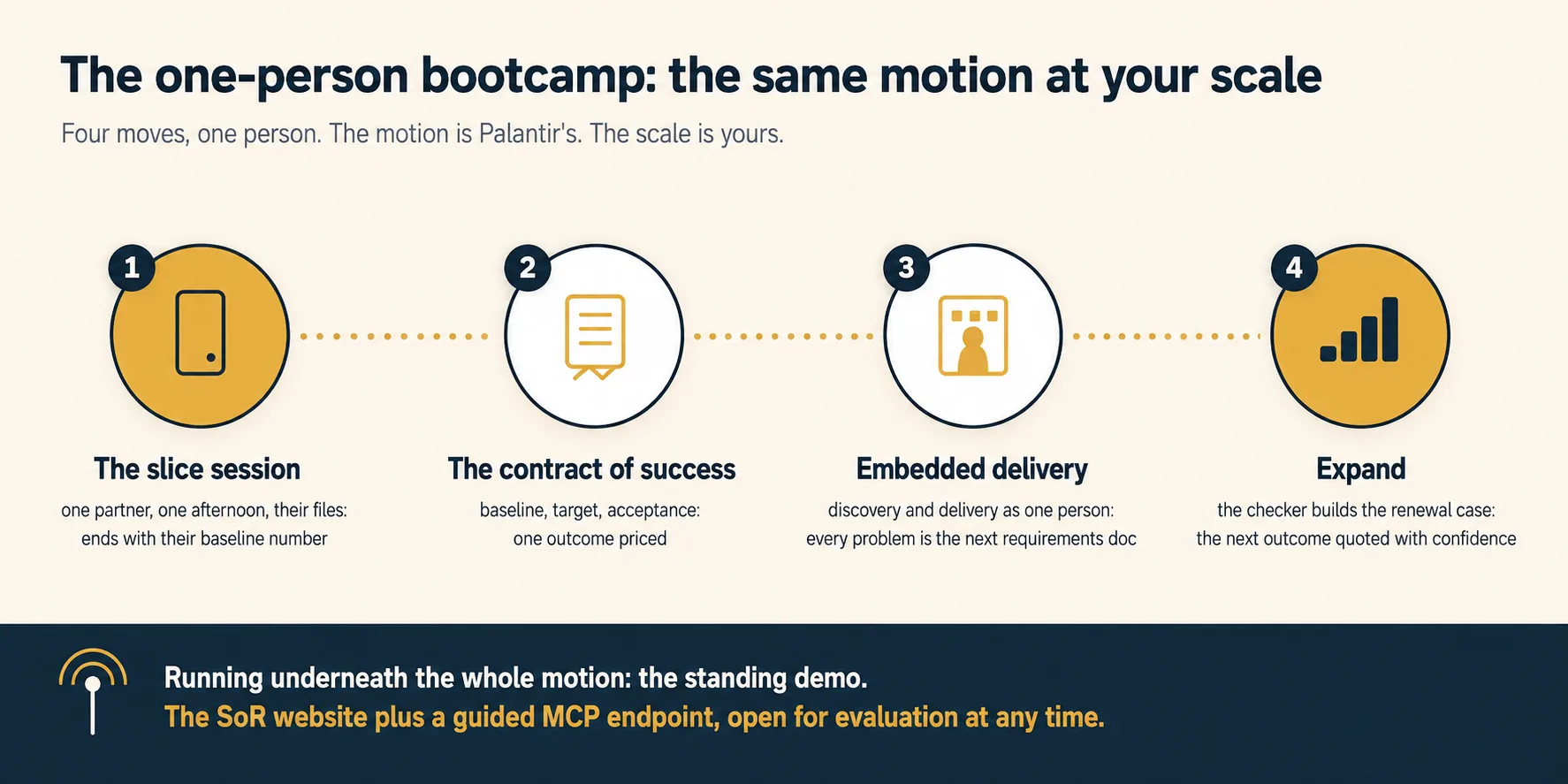
Four moves, one person. The motion is Palantir's. The scale, and the standing demo underneath it, are yours.
The other side of the table: the buyer's agent is already shortlisting
Everything above is about how sellers changed. The buyers changed too, and mostly in your favor.
Before a buyer ever talks to a vendor now, they ask an AI. Surveys of business buyers in 2026 find that most of them use AI somewhere in the purchase, about half start their research there, and AI answers now rival websites and salespeople as the first source a buyer consults.
This means part of your selling now happens inside an answer you never see: a partner asks their AI who can help with agentic automation for their profession in their country, and either your vertical is in the answer or it is not. The good news is that your System of Record's public pages are built to win exactly this game: public, structured, plainly written, and citable, where most of your competitors' marketing is a brochure an AI cannot quote. And once a buyer has found you, your MCP endpoint gives their technical people a direct way to test what your vertical actually knows.
The motions above describe the seller's side of the table. The buyer's side moved too, and one scene shows how.
Somewhere this week, a partner at a mid-sized firm typed a question into an AI assistant: can AI handle our kind of work, and who does this for firms like ours. The assistant answered with two or three names. Every firm on that list is now in a sales conversation it did nothing to start. Every firm missing from the list does not even know a buyer existed.
That scene is no longer unusual. G2's 2026 AI Search Insight Report found that 51 percent of business software buyers now start their research with an AI chatbot more often than with Google, that 71 percent rely on AI chatbots somewhere in their software research, and that the chatbot's answer often steers the shortlist itself: 69 percent said one led them to select a different vendor than they had planned, and buyers rank AI chatbots as the single most influential source shaping the shortlist.17 Forrester's 2026 survey of nearly 18,000 business buyers points the same direction, with 94 percent reporting they used AI during their most recent purchase, up from 89 percent a year earlier, and nearly half building the internal business case before contacting any vendor.18 The market has named the response: answer engine optimization, the craft of publishing content clear and credible enough that AI systems cite it when a buyer asks.19
Read that against what you built at Station 7, and notice something unusual: your public pages are already optimized for the buyer's agent, structurally, as a side effect of the architecture. AI systems favor content that is public, plainly written, question-shaped, specific, and corroborated. A governed System of Record is exactly that, by construction: one source of truth, written in plain language, organized by the questions a practitioner actually asks, with an expert's name on the judgment.
One clarification keeps this honest, because two different layers are easy to blur here. The MCP endpoint does not make you discoverable: public AI search does not read MCP servers, and a buyer's agent reaches your endpoint only after someone deliberately connects it. Discovery belongs to your public pages and to external corroboration. What the endpoint adds comes after discovery, and it is something no marketing site can offer: a buyer who has found you can point their own agent at your governed corpus and test what it knows, before a single meeting is scheduled.
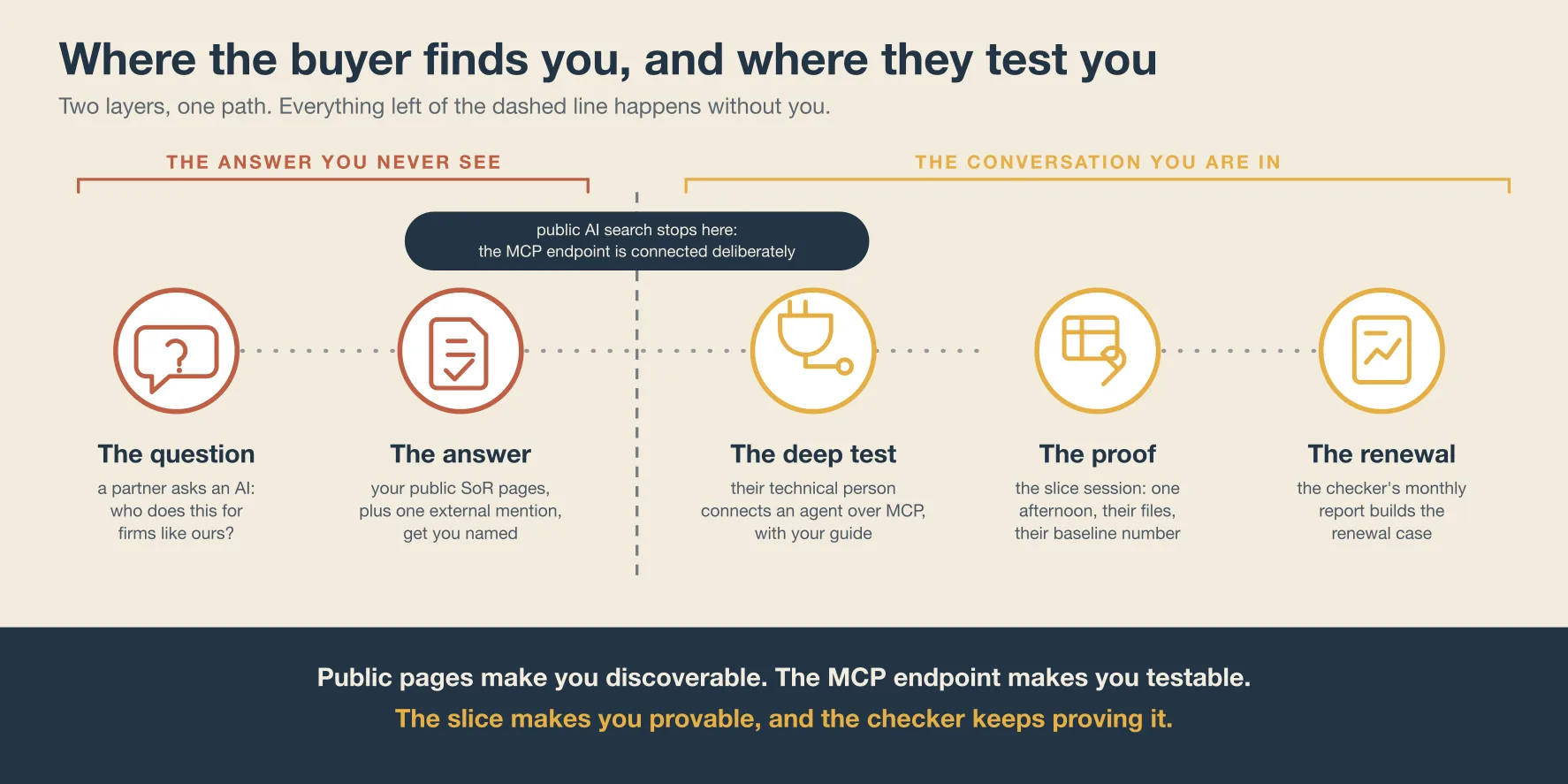
Two layers, one path. Everything left of the dashed line happens without you. Everything right of it is entered deliberately, which is why the connection guide matters.
Three practical moves follow, and none of them costs money.
Write the pages the buyer's question deserves. The question in the opening scene has an exact shape for your vertical: can AI handle working-paper preparation for audit firms in Pakistan, and who does this. Your SoR's public pages should contain the plain, direct answer to that question, with the jurisdiction named, because the model can only cite what exists. The checklist is four items: the page is public HTML, the headings are the buyer's own questions with the jurisdiction in them, the direct answer sits in the first forty words, and at least one independent source says the same thing about you. This is not marketing added on top of the corpus. It is the corpus, doing its second job. The full template is here:
The answer page: a fill-in template
Publish this as ordinary public HTML on your SoR's site. Fill every bracket. Do not gate it, do not put it in a PDF, and do not write it as marketing. Every heading is a question the buyer would type, and the direct answer sits in the first forty words under it.
Can AI handle [the professional outcome] for [firm type] in [jurisdiction]?
Yes, within defined limits. [One sentence: what the Worker does, on what inputs, producing what output.] Every answer cites [the governed source], and [exception types] escalate to [the named human role]. The work is governed by [your vertical System of Record], reviewed by [expert name and credential].
Who does this for firms like ours?
[Your name or firm name] builds and operates this for [firm type] in [jurisdiction]. The method is one governed source with two readers, and the professional judgment is authored by [expert name], [years] years in [profession].
What does it actually do, day to day?
[Three to five plain sentences. Name the files that go in, the checks that run, the output that comes out, and the moment a human signs. Use the profession's own words for the documents and steps.]
What does it refuse to do?
[Two or three sentences. Name the boundaries honestly: the case types it escalates, the judgments it never makes, the jurisdiction line it does not cross. This section builds more trust than any claim of capability.]
How can our technical team test it before a meeting?
The governed knowledge is served over MCP. [Link your one-page connection guide.] Connect any MCP-compatible agent, then try three questions: [one real professional question with a citable answer], [one whose answer needs the jurisdiction's rules], and [one the system should escalate rather than answer]. The third is deliberate: watching the system refuse correctly is the fastest trust test there is.
Has it worked anywhere real?
[The named outcome, one paragraph: the firm type, the baseline they measured, the number after, and who signed off. If you do not yet have one, write the honest version: the slice is live, the expert has signed, and the first contract of success is open. Never invent an outcome.] Either way, link the method's own live reference: the Agent Factory ecosystem runs this exact pattern on itself, in public, with a book served over MCP and an expert twin teaching from it.
What does an engagement look like?
One free afternoon: the slice session, run on three to five of your own files, ending with your baseline number measured in the room. After that, one priced outcome under a contract of success: baseline, target, and how a reviewer checks it. [Link your contact page.]
The corroboration step. The page above is necessary and not sufficient, because AI systems favor claims confirmed across independent sources. Place at least one of these before you rely on it: an article by your expert in their professional body's publication naming the vertical, a client's named outcome published where the client controls the text, or a recorded talk at an industry event with the vertical in the title.
The maintenance rule. Stale pages lose citations. Re-read this page every quarter, update the named outcome and the date, and keep the answer in the first forty words true.
Be corroborated somewhere you do not control. Models favor claims confirmed across independent sources. Your expert's professional-body article, a client's named outcome, a talk recorded at an industry event: one or two external mentions of your vertical, by name, do more for the buyer's answer than any amount of self-description.
Expect the informed first meeting, and be glad of it. A buyer who arrives having already compared you inside an AI has done your qualification for you. The MIT finding that most enterprise pilots return nothing20 has been absorbed by buyers too, which is why they now walk in skeptical of demos and asking for baselines. Forrester titled its own 2026 read of this shift with the same sentence this page has been arguing: risk-averse buyers demand proof, not promises.18 A skeptical buyer is bad news for a pitch. It is the best possible news for a proof.
Earning the first afternoon: ask for a measurement, not a meeting
One step is still missing, and it is the one most readers worry about. The slice session assumes a partner has already given you an afternoon. How do you get that afternoon, with no brand and no network?
The rule: never ask for a meeting to introduce yourself. Ask for a measurement. The old ask is thirty minutes to hear about your company, and every partner has learned to say no to it. The new ask is one afternoon to find out what one file actually costs their firm, measured on their own files, with their reviewer in the room, free, and ending in a number they keep whether or not they ever hire you.
That ask travels in one of four vehicles: your expert's introduction, a teaching session at the professional body, a junior who already uses your free material, or a short recording of the proof itself. Choose one and prepare it. Do not send a brochure.
Everything above assumes you are in the room, or that a buyer's search has found you. Between the two sits the step this page has not yet priced: converting being known into being given an afternoon. The old ask fails here because it spends the partner's attention on a promise. The proof-shaped ask succeeds because it gives before it takes: the baseline number is worth having even if the firm never buys anything, so agreeing to the session is rational for them before any trust exists. Four vehicles carry the ask, listed in the order they tend to work.
The expert's introduction. The signature bought the judgment and the rights, and it bought a third thing this page has not counted yet: twenty years of peers. Ask your expert for three names and a two-line introduction to each, nothing more. In a profession, the introduction transfers half the trust before you write a word, and it converts better than every other vehicle combined. This is also the quiet answer to the reader who wants to skip Station 5: without the expert, this vehicle does not exist.
The teaching session. This is the one-to-many version of the bootcamp, resized from Palantir's conference hall to a professional body's seminar room. Offer the association, the chamber, or the local society one free hour of continuing education: what agentic AI actually does to this profession's work, taught honestly, with the slice demonstrated live on sample files, including one case it correctly refuses and escalates. You are not pitching, you are teaching, and the difference is visible from the back of the room. You leave with an audience of partners who watched the proof work, and a sheet where any of them can book the afternoon. In relationship cultures this vehicle outperforms every cold channel, because the institution's invitation is itself a reference.
The junior's mention. The Cursor wedge, working for you. The free tier of the twin, the open cheatsheet, and the SoR's public pages exist so that a trainee accountant or junior associate uses them, finds their own day easier, and says so in front of a partner. This vehicle is slow, costs nothing, and compounds: you cannot schedule it, but every month of published material makes it more likely.
The recorded proof. When the outreach must be cold, the proof travels ahead of you: a 90-second screen recording of the slice completing one real task on synthetic files shaped like theirs, plus the standing demo link their technical person can test tonight. The message that carries it:
[Expert name], [credential], reviews the system I am about to show you. Here is a 90-second recording of it completing [one named task] on files shaped like yours, and here is the live governed source it cites, which your own agent can test: [links]. If it looks real, I would like one afternoon to run it on three to five of your files, with your reviewer approving the anonymization first. It is free, and it ends with one number you keep either way: what one [file] costs your firm today.
When the reply comes back as send us your company profile first, which in many markets it will, the answer is the proof sheet in the appendix: one page where every section is evidence, ending in the same measurement ask.
One honest label on that script. Cold outreach converts rarely even when it is proof-shaped, which is why this vehicle is fourth and not first. Its real job is different: the same recording and the same message, sent after a warm introduction or a teaching session, is what turns interest into a date. And one failure mode from the list below applies with double force here: the ask that mentions your stack, your architecture, or the word agentic more than once is a pitch wearing a proof's clothing, and the partner will recognize it.
One request will meet every one of these vehicles, especially in relationship markets: send us your company profile first. Refusing loses the door, and sending a services brochure loses the positioning this whole page built. The appendix at the end of this page is the answer: the proof sheet, the one-page document you send when someone asks for a brochure.
What you cannot copy, and what to do about it
An honest page names what the analogy cannot carry.
The subsidy. Palantir funds its own engineering time up front to land customers it wants,8 and can afford bootcamps that convert at less than 100 percent, because the wins repay the losses across a portfolio. You have no portfolio. So bound your free investment tightly: the slice session is an afternoon, prepared with hours, and anything longer is billed. The roadmap's warning about outcome pricing applies doubled to free work: generosity you cannot sustain is not a sales strategy, it is a slow way to run out of money.
The door. Palantir's engagements are sponsored from the C-suite of companies with AI budget lines.8 Your first buyer, as the roadmap insisted, is a small firm where one partner decides personally, carrying the fear the Harvey section named: going first. Palantir's brand answers that fear with logos. You answer it with two things: your expert's name, which is why no vertical launches without one, and the smallness of the ask, one outcome, one contract of success, one exit clause.
The lock-in. Here the copy must be an inversion. Palantir's model, like many deeply embedded vendor models, earns part of its return from the difficulty of leaving.21 Your position in the market is the vendor-neutral answer to exactly that, so your sales motion has to demonstrate the difference, not just claim it. Put the exit in the proof: the corpus is the client's own governed knowledge or your licensed vertical, the runtime is swappable, and the contract says what leaving looks like. The buyer who is shown a clean exit stops planning for one.
The failure modes of the motion
Eight ways this motion goes wrong. Like the roadmap's failure modes, every one is common, every one is survivable, and every one costs less to spot now than after three lost months. The most expensive one is also the quietest, so it comes first.
- Leaving the room without the number. The slice session's definition of done is the buyer's baseline, measured in their process. Applause, interest, and a request for a proposal are not it. The cure is mechanical: the session is not over until a number is on the whiteboard, and if the buyer will not measure, they were not a buyer yet.
- Unbounded free work. The boundary section above set the rule: one prepared afternoon, in writing, with the billing line marked. This failure mode is how the rule breaks in the room, because the request comes from the buyer and sounds reasonable: can you do a free pilot first, so we can see it on more of our files? The answer that keeps both the sale and the boundary is one sentence: the afternoon is free, and the pilot is the first priced outcome, scoped small enough to be an easy yes. A buyer who will not pay a small price for a measured outcome is unlikely to commit to a larger one.
- Pitching the technology instead of the outcome. The buyer does not want agents, MCP, or a governed corpus. They want the four hours per file to become forty minutes. Every sentence about your stack is a sentence the proof could have spoken better, and the stack talk invites the one comparison you lose: to a cheaper generalist who says the same words.
- Chasing the enterprise logo first. The big firm flatters and buys slowest, through procurement built for vendors with balance sheets. The cure is the buyer boundary this page has already drawn: the one partner who decides personally. The logo comes later, as a reference earned, not a door forced.
- Discounting instead of scoping. When the price meets resistance, the amateur cuts the number and keeps the promise. The professional keeps the price per outcome and narrows the outcome: fewer file types, one workflow, one quarter. A discount teaches the buyer your price was soft. A narrower scope teaches them your price is real.
- Mistaking politeness for intent. In relationship cultures especially, a warm meeting and a vague follow-up can continue for months without a decision. The test is the same one the roadmap applied to staff augmentation: can the buyer name the decision-maker, the working team, and a date? A deal with no named person and no date is a conversation, and conversations do not convert on their own.
- Being invisible to the buyer's agent. If nothing public, plain, and citable says what your vertical does and where, the AI the partner consults will recommend somebody else, and you will never know the meeting you lost. The cure costs nothing: the SoR's public answer pages, the jurisdiction named, and one external corroboration.
- Selling the second client from zero. The first engagement's most valuable output, after the money, is a named, quotable outcome and a satisfied partner who knows other partners. Failing to write the one-page outcome note, and failing to ask that partner for one introduction, means starting the next sale with nothing again. In a profession, everyone knows everyone: the referral is the vertical door's natural second opening, and it has to be asked for.
Ayesha sells without selling
The monetization roadmap told Ayesha's whole walk, from finding her expert to her first sale. Read one part of it again, through this page's lens, and notice that there is no pitch anywhere in it.
Her Chicago engagement did not begin with outreach. It began with an artifact: a governed slice of audit working-paper preparation, published for both readers, her aunt's name on the judgment. That artifact earned the meeting, which is the bootcamp's first law: the proof opens the door that the pitch cannot. In the room, she did not present. She ran her slice against the firm's own sample files, and left with the number no pitch extracts: four hours per working-paper file, the firm's own measurement of its own cost. The contract of success priced one outcome against it. That is the slice session, run exactly to its definition of done.
Then the embedded phase, and the moment that won the account without a salesperson. Six weeks in, her Worker cited the standard from her record, attached the firm's own 2023 lease memo as prior treatment, reported that the two disagreed, and escalated to the partner, who corrected an error his firm had repeated for three years. Nobody sold anything in that moment. The system proved something, in front of the person who signs. The retainer that followed, and the startup revenue that followed the retainer, were land and expand doing what it does when the proof keeps arriving on schedule.
One person, no salesforce, no brand, one jurisdiction crossing priced honestly. The motion at the top of this page, complete, at the scale you will actually run it.
The definition of ready to sell
You are ready to run this motion when every box is checked. Check them honestly, because the buyer's own files will test every one of them.
- Your thin slice is live: readable as a website, citable over MCP, so the standing demo exists before the first meeting.
- You can run the slice on a stranger's files in one afternoon without improvising, and you have a one-page anonymization checklist the client's own reviewer can approve before any file is touched.
- Your slice session has a written definition of done, and it is the buyer's baseline number, not applause.
- Your contract of success template is ready: baseline, target, acceptance criteria, and an exit clause you are proud to show.
- Your checker and evaluation set are real, because the monthly proof report is the expansion salesforce.
- You can name the one partner, or the short list of partners, whose firm fits the 20-to-200-person profile, and the expert whose name opens that door.
- Your first-afternoon vehicle is chosen and prepared: the introduction is requested, the teaching session is proposed, or the 90-second recording exists.
- Your proof sheet is filled in and printable, for the day a partner asks for a company profile: the template is in the appendix.
- Your SoR's public pages contain the plain answer to the question a buyer would ask an AI about your vertical, with the jurisdiction named, and at least one external source corroborates it.
- Your post-engagement routine is written: the one-page outcome note, and the request for one introduction.
- Your proof sheet is one page, every section is evidence with a working link, and the recording plays.
- Your free investment is bounded in writing: what the slice session includes, and where billing starts.
The honest label
This page inherits the honesty rules of the series, so its claims are labelled at their true strength: what is measured is separated from what is only reasoned. One reminder frames the whole section. Palantir's quarter is evidence that the motion works with Palantir's product, brand, and balance sheet behind it. It is not evidence that your first slice session will convert. Your first number, as always, is something you discover with your first buyer.
The earnings figures, the shrinking sales head count, the roughly 500 net hires, the bootcamp-as-sales-model, the embedded FDE and strategist model, the land-and-expand contract shape, and the discovery share of an FDE's week are all reported, and each carries its source below.
The figures for Cursor, Sierra, and Harvey deserve their own grade, because they come from a mix of company statements, press reporting, and third-party estimates rather than audited filings. Palantir's numbers are from a public company's earnings release. The other three are private companies, so their revenue figures are reported rather than filed, their pricing details are largely third-party estimates, and this page labels them that way in the text. Two details in particular should not be hidden. Cursor's growth began without a salesforce and then added one as enterprise deals grew, with sales-led revenue reportedly growing 100-fold in a year: product-led is how it started, not the whole story of how it scaled. And Sierra's per-resolution rates have never been confirmed by the company: the outcome-based structure is documented, the dollar amounts are estimates.
One causal boundary belongs here too. The quarter shows the model's results. It does not isolate how much of the growth each mechanism caused, and no public source does. This page therefore treats Palantir's numbers as strong evidence for deployment-led selling, not as a controlled measurement of it, and reads the 90-day statement as a growth comparison rather than a sales-cycle disclosure.
The buyer-behavior numbers are survey data, which is one grade below reported financials: different surveys disagree at the edges, and buyers describing their own behavior are not always accurate witnesses to it. The direction, that buyers research inside AI before contacting vendors, is consistent across every 2026 source this page found, so treat the direction as solid and any single percentage as approximate. The claim that Palantir sells primarily through this motion rather than through AI sales agents is an inference from that reporting: no source describes an agentic replacement of the sales function, and multiple sources describe the human deployment model in detail. If future disclosure shows agents doing a material share of Palantir's selling, this page updates.
The scaling-down argument, that the same motion works for a one-person vertical FDE, is this book's reasoning, built on the structural identity between the bootcamp and the slice-first rule. It is presented as reasoning, not as a measured result. The funnel table on the roadmap, published empty on purpose, is where the measurement will live: when graduates report how slice sessions convert to contracts of success, at what rate and price, those numbers belong here too, including the failures.
Where to go from here
If you arrived here from the monetization roadmap, you now hold its missing half: the asset, the price, and the motion. The next step is not another page. It is the first box of the definition of ready above that is still unchecked.
If the selling half is where you need depth, negotiation, discovery questions, ROI framing, and the discipline to refuse a bad ask, that belongs to the Certified Agentic AI Business Strategist track.
And keep one image from this page for the day a buyer asks why you have no sales presentation. A company guiding toward more than eight billion dollars of revenue this year just told its shareholders, in writing, that it grows with a tiny and shrinking sales head count. It does not rely on a presentation. It relies on engineers, deployment, and proof. So can you.
Appendix: the proof sheet, for the day they ask for a brochure
The request arrives in week one, and it arrives politely: before we meet, could you send us your company profile? A brochure is the wrong answer, because a brochure is the pitch in paper form: it sells a promise, lists services, and asks the reader to imagine value, which is everything this page taught you not to do. Refusing to send anything is also the wrong answer, because in most professional markets the request is a courtesy you do not decline.
The right answer is a different document: the proof sheet. One page, and every section on it is evidence rather than promise. The headline is the outcome, never the company. The expert's name comes first, because in a profession the name is the trust. The proof itself travels inside the paper, as a link and a code to the 90-second recording and to the standing demo. The limits are stated plainly, because on paper a stated boundary builds more trust than any capability claim. And the only ask on the page is the measurement afternoon, with the boundary sentence already in it, so the sale's discipline survives the format. It is the answer page, the slice session, and the boundary script, compressed onto the sheet a partner's assistant can print.
The proof sheet: a fill-in template
One page only. If a section has no honest content yet, use its honest version rather than deleting it, and never let a services list, a technology stack, or the word solutions onto the sheet.
1. The headline: the outcome, measured. [The professional outcome] for [firm type] in [jurisdiction], measured. One sub-line: a governed AI system, built with a named expert, proven on real files.
2. The expert, first. Professional judgment authored by [expert name], [credential], [years] years in [profession], [city]. This line goes above everything about you, because their name carries the trust yours does not yet.
3. Watch it work: 90 seconds. The link and a QR code to the recording of the slice completing one named task on files shaped like theirs. One sentence saying exactly what the recording shows, including that it cites the source at every step.
4. Test it before we meet. The standing demo, both halves: the public SoR link anyone can read, and one line for their technical team, the same source is served over MCP, connection guide included, ask it hard questions.
5. Proven where. The named outcome with its number, or the honest version: the slice is live, the expert has signed, and the first contract of success is open. Either way, the method's public reference: the Agent Factory ecosystem runs the same pattern on itself.
6. What it refuses to do. Three lines, real ones: the judgments it escalates, the jurisdiction line it does not cross, and who signs. This is the section that separates you from every vendor whose paper claims everything.
7. The one ask, boundary included. One free afternoon: the system runs on three to five of your files, your reviewer approves the anonymization first, and you keep one number either way, what one [file] costs your firm today. A pilot on more files is the first priced outcome. Contact line, and nothing else.
The footer test. Read the finished sheet once and delete anything a rival could also truthfully print. What survives is your proof sheet.
Here is the sheet filled in, and the worked example is this book's own publisher, because Panaversity's vertical is the method itself. Its expert is the author, its System of Record is this book, its expert twin is Zia Tutor AI, its builder is Zia Developer AI, and its open-source promise is the SoR Framework any reader can fork. Read it as a filled template, then fill your own with your vertical's names.
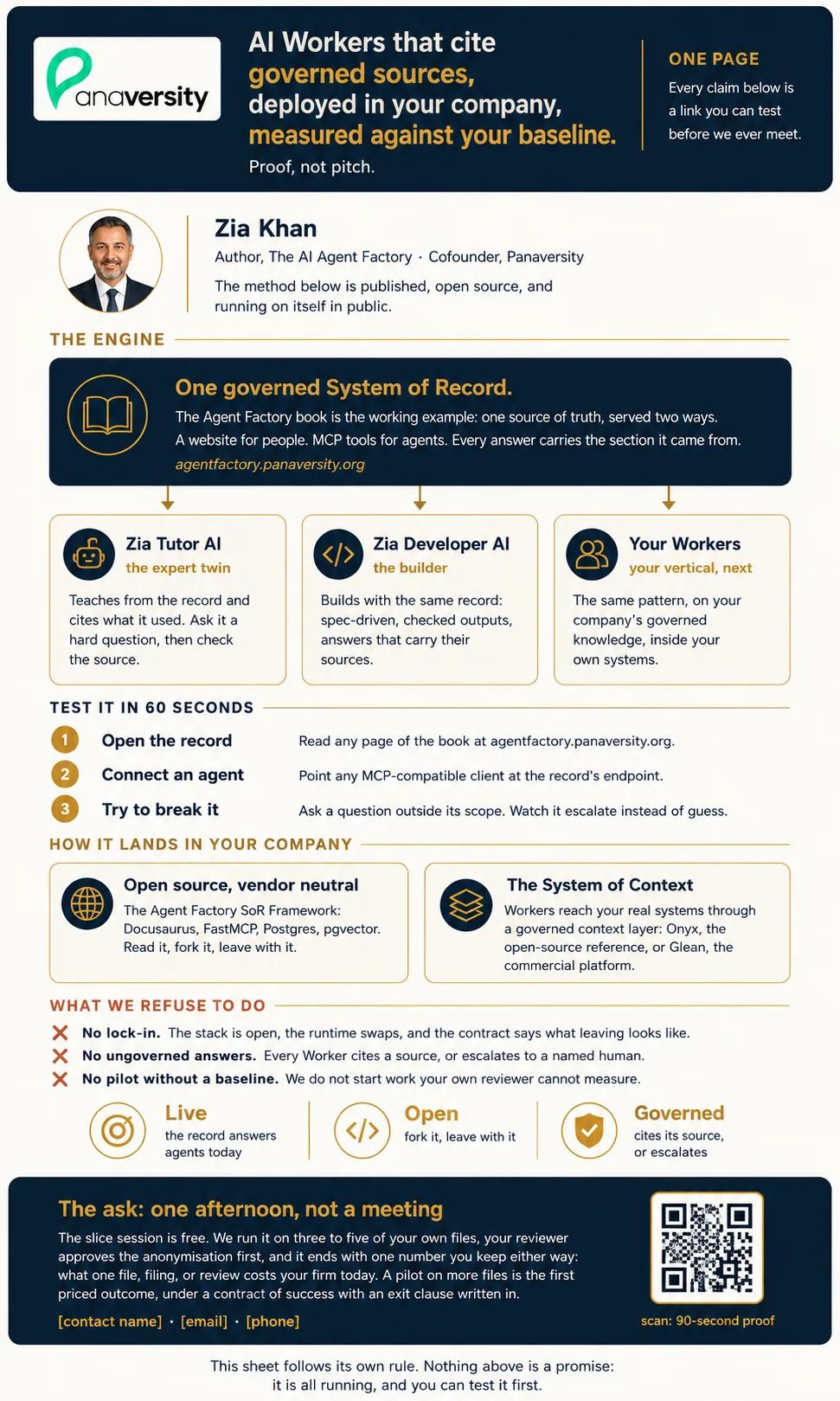
The filled template. Notice what is missing: no services list, no technology pitch beyond the open-source names, no company history. Every section is a link, a name, a refusal, or a number, and the only ask is the measurement.
Flashcards Study Aid
Test Your Understanding
Sources
Verification status, August 5, 2026. Every figure below was re-checked against a primary or first-tier source on that date. Palantir's quarter was confirmed against the company's own Q2 2026 press release (Exhibit 99.1 to Form 8-K, at sec.gov) and contemporaneous coverage; the G2 percentages against the published report; the Forrester figures against Forrester's own 2026 buyer research and its coverage; and the Cursor, Sierra, and Harvey figures across multiple independent 2026 reports. The last three remain private-company numbers: reported, not filed.