How to Get Paid in the Agentic AI Era: The Vendor-Neutral Vertical FDE Roadmap
This page is the capstone of the business series, and its subject is monetization: how everything the book taught you turns into money. Pages before it gave you the pieces: the roles, the ecosystem, the model, the ownership argument, the vertical choice, the design method, and the connecting layer. This page puts them in walking order.
It answers the question the whole series was built for. How do you get paid in the agentic AI era? There are three answers, and this roadmap maps all three: a salaried job, freelance and retainer income, or a domain startup you own.
One claim about money runs underneath all three. When intelligence and code get cheap, the market pays less for what you can do, because more rivals can do it. It pays for what you hold. So this road builds something you can hold, a governed profession in one jurisdiction, and then carries it into the companies that need it. The market calls the person who does this a Forward Deployed Engineer. The market's version is welded to one vendor's platform. Ours is not, which is what makes ours reachable from anywhere.
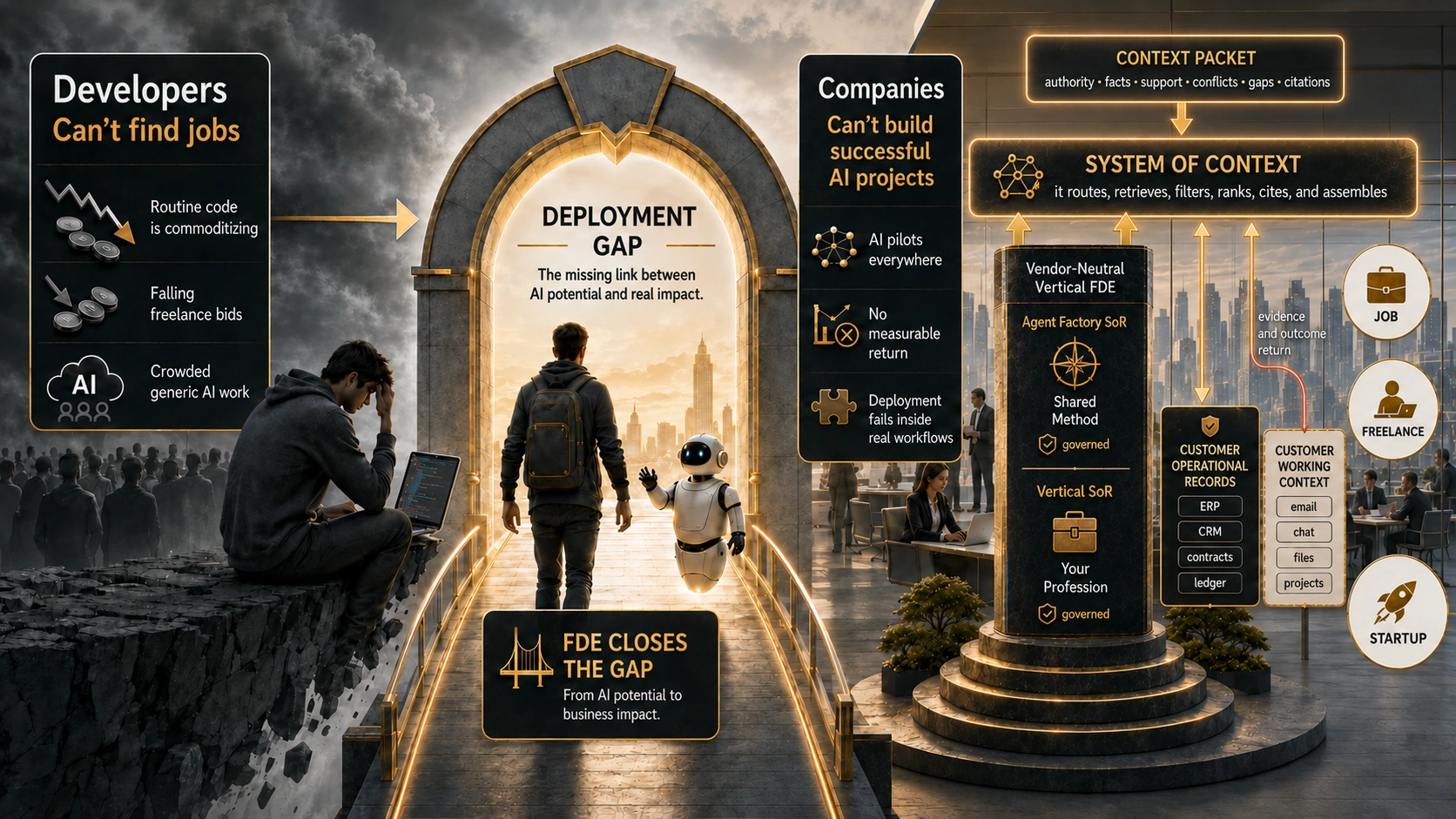
Left: capability with no way in. Right: money with no way through. The crossing is deployment work, and the pillar is what you carry across it. The Agent Factory System of Record is the shared method, given to every graduate. The vertical System of Record is your profession, and yours alone. Both carry the same mark, governed, because ungoverned knowledge is not an asset and nobody pays for it. Three contracts wait on the far side.
Software developers are losing jobs and freelance work because AI now writes more and more of the code. At the same time, most company AI projects fail, because nobody fits the AI into the company's real work. The market's answer is a new role: the Forward Deployed Engineer, an engineer who works inside the client's company until the AI actually delivers. The big AI companies are spending billions on this role. But their engineers lock every client into one vendor's platform, and their hiring doors are mostly closed to developers outside the US and Europe.
This book trains a version of the role anyone can reach: the vendor-neutral vertical FDE. You carry two things through the client's door. The method, which this book gives you, and which already exists as a real system you can connect an agent to today: the Agent Factory System of Record. And one profession's governed knowledge, which you build with a real expert.
This page is about getting paid for that. There are three ways to earn from it: take a job, freelance with monthly retainers, or build a startup you own. The road to all three is the same nine stations, and only the last one splits three ways.
One thing worth knowing early. Most readers will earn first in the simpler way, by building governed knowledge systems and AI Workers for clients, using only what this book gives everyone. That needs no expert and no vertical, and it pays soonest. Your own vertical is the bigger prize, and it needs one thing you cannot buy: a senior professional who will work with you. To learn the technology instead of the money, go to Getting Started.
📚 Teaching Aid
View Full Presentation — Getting Paid as a Vertical FDE
| Word | Plain meaning |
|---|---|
| FDE | Forward Deployed Engineer: an engineer embedded inside a client's company until the outcome is proven |
| Vendor-neutral | Tied to no single AI company's platform: free to use the best model and runtime for the client |
| Vertical | One profession, in one country: "tax practice in Pakistan" is a vertical, "accounting" is not |
| System of Record | One governed source of truth, served to people as a website and to agents over MCP |
| System of Context | The layer that connects the records to the customer's own systems and assembles what one task needs |
| Slice | One professional outcome, covered completely, inside your vertical System of Record |
| Service ladder | Earning with the shared method alone: client SoR builds and Worker manufacturing, no vertical needed |
| Vertical ladder | Earning from the vertical you own: the expert twin, domain products, and FDE engagements |
| Contract of success | The written agreement on three numbers: where the work stands today, the target, and how it is checked |
Every other new word is defined in the glossary.
Two problems, one gap
Two things are happening at the same time, and most people only ever look at one of them. Developers are losing work, because AI writes more of the routine code every month. Companies are spending money on AI and getting nothing back, because nobody fits the AI into how the company actually works.
Put those two sentences side by side and you can see the opening. One side has capable people with no way in. The other side has real money and no way to use it. The distance between them is not a shortage of talent or a shortage of technology. It is a job nobody is doing.
Two things are true at the same time right now, and most people only ever look at one of them.
Developers cannot find work. Agents write a growing share of routine code, junior roles are thinning, and freelance boards are crowded with capable generalists bidding against each other and against the model itself. The honest question underneath the anxiety is not "how do I get a job." It is "in an era where intelligence and code are cheap, what do I actually contribute?"
Companies cannot make AI work. They are starting AI projects everywhere, and about 95 percent of custom enterprise pilots show no measurable financial return.1 Not because the models are weak. Because nobody fits them into the company's real data, real rules, real approvals, and real people.
Now put those two sentences next to each other, because that is the whole idea of this page. One side has capable people with no way in. The other side has real money and no way through. The distance between them is not a talent shortage and not a technology shortage. It is a deployment gap, and it is exactly the width of one job.
The person who closes that gap has a name, and a market that is spending billions looking for them. The rest of this page is about becoming that person on your own terms, and being paid for it.
The answer at a glance
The full treatment is below. If you only read one thing, read this.
| Route | What you sell first | Who buys it first | What it becomes |
|---|---|---|---|
| Freelance | System of Record builds and manufactured Workers, using the shared method alone | Small and mid-sized firms, one decision-maker | Projects turn into monthly retainers |
| Job | Your proven ability to deploy an outcome inside a real company | A services firm, or a client who already saw your work | Salary, and access to enterprise-scale problems |
| Startup | A governed vertical: the expert twin, domain products, and engagements | Your expert's own profession, one jurisdiction | An asset you own, worth more each year |
Most readers start on row one, because it needs no expert, no licensed corpus, and no vertical. Row three is the largest prize and the hardest gate, and the gate is a person rather than a skill. Detailed pay bands for all three are in what each door pays.
How to use this page. Read the problem and the answer first: they explain why this road exists. Then walk the nine stations in order. Each station names the page that teaches it, and the one deliverable you leave with. Do not skip stations, because every station's deliverable is an input to the next one. Then read what the doors pay, the time budget, and the failure modes before you start walking.
Your side of the gap, in detail
For years the safe advice was: learn to code. That advice is breaking, and this book opens on the question it leaves behind.
Here is the shape of the answer. When doing the work becomes cheap, the value moves to the work around it: deciding what to build, saying exactly what it must do, putting it inside a real company, and checking that it worked. Machines are absorbing the typing. They are not absorbing the judgment.
Now notice where every item on that list happens. Inside somebody else's company, against somebody else's data, under somebody else's rules. That is the other side of the gap, described from your side of it.
For a generation, the safe advice was: learn to code. That advice is breaking in front of us, and the question every disrupted developer is now asking is the one this book opens with, borrowed from the historian Yuval Noah Harari: if we do not know what the job market will look like, what should we learn?
Here is the shape of the answer. When execution becomes cheap, the value moves to the work around execution: deciding what to build, specifying it precisely, deploying it inside a real company, and verifying that it worked. Syntax is being absorbed. Judgment, specification, and deployment are not. The whole role map of this book is built on that one sentence, and this roadmap is that map turned into a walking path.
Notice what that list is. Every item on it happens inside somebody else's company, against somebody else's data, under somebody else's rules. Which is the other side of the gap, described from your side of it.
Their side of the gap, in detail
The 95 percent number does not mean the models failed, or that the software never ran. It means the money never showed up.
The reason is simple. A model is a general ability. A company needs one exact thing done: this task, these rules, this approval chain, these people, this regulator. Turning the first into the second is slow work, done inside the company, and it is exactly the step most failed projects skipped.
So the buyer's problem is not that AI cannot do the job. It is that nobody made it fit. Work that somebody needs and nobody is doing is work somebody will pay for.
The 95 percent number is usually quoted carelessly. It does not say the models failed, or that the software never ran. It says the money did not show up, and the reason points straight at the cause. The model is a general capability. The company needs a specific outcome: this workflow, these rules, this approval chain, these people, this regulator. Turning the first into the second is deployment work, it is unglamorous, it is done on site, and it is exactly the step most pilots skip. A pilot with an impressive demo and no measurable return is almost always a pilot that stopped at the demo.
So the buyer's problem is not that AI cannot do the work. It is that nobody made it fit. That is a services problem, and services problems are bought.
The market's answer: the Forward Deployed Engineer
The job already exists and the market has named it. A Forward Deployed Engineer does the opposite of a normal software engineer. Instead of building a product at head office, they go inside the customer's company, sit with the people doing the work, and build there, on real data, until something real works.
Read that against the two problems above. It absorbs the developer with no work, because it is work. And it repairs the failed project, because it is the exact step that project skipped. One job, both problems.
One warning about the big numbers below. They describe large companies buying from large vendors. That is not your first customer. Your first customer is a small firm where one partner decides personally, and the demand you can actually reach is slower and smaller than the headline.
The market has already named the person who closes the gap, and priced the role accordingly. It was invented at Palantir and is now spreading through the whole industry. An FDE does the opposite of a normal software engineer. Instead of building a product at headquarters, the FDE goes inside the customer's company, sits with the people doing the work, and builds the solution there, on real data, until real value lands.
Read that job description against the two problems. It absorbs the developer who cannot find work, because it is work. And it repairs the pilot that produced no return, because it is precisely the step that pilot skipped. One role, both sides.
The demand numbers are on the roles page, and they are loud. FDE job postings grew more than 800 percent in nine months, while the candidate pool grew about 50 percent.2 In one week of 2026, AWS and Microsoft together committed 3.5 billion dollars to new FDE units.3 OpenAI built a deployment company around the role.4 Anthropic hires for it, and so do the consulting giants.
The services industry has run the arithmetic too. Sanjeev Aggarwal, a pioneer of India's outsourcing industry, says a firm of roughly 100 FDEs can build a 100 million dollar business, work that the old model staffed with 2,000 to 2,500 people.5 That is his projection, not a measurement. But notice whose projection it is: the man who built the old pyramid, describing its replacement.
One boundary on these numbers, because they are easy to misread. They describe enterprise buying. The engagements behind the 3.5 billion dollars go to companies like Unilever and Novo Nordisk, staffed by vendors with sales teams and balance sheets. That is not your first buyer. Your first buyer is a twenty to two-hundred person firm where one partner decides personally, there is no AI budget line yet, and the deepest fear is being the first firm in the city to try this. The demand is real, and the demand you can actually reach is thinner, slower, and smaller than the headline. Plan for that buyer, and the headline becomes context rather than a promise.
The two gates the market keeps shut
Read those same numbers again as a developer in Karachi, Lagos, or Manila, and two problems appear.
The first hurts the client. Every vendor's engineer builds on that vendor's platform, wires it into everything, and leaves. The client can keep building, but only as long as they keep building there.
The second hurts you. The job sits on the vendor's payroll. It usually asks for five or more years of experience and a US or European work address. So the fastest-growing services role of the era is one most of the world's developers can read about but not enter.
Both problems have one cause: the thing being installed is the vendor's product, and the vendor decides who installs it.
Read the same numbers again, as a developer in Karachi, Lagos, or Manila, and two problems appear.
The first problem is lock-in, and it hurts the client. Every FDE at Palantir builds on Palantir's platform. Every FDE at OpenAI builds on OpenAI's stack. The engineer goes deep into the client's company, wires one vendor's product into everything, and leaves. The client is now locked in: free to keep building, only as long as they keep building there. Andrew Ng has noted that clients struggle to find FDEs who are not tied to a single vendor, because for the vendor, the lock-in is the whole point of the role.6
The second problem is the hiring door, and it hurts you. The vendor FDE role lives on the vendor's payroll. Today it is mostly a senior door: five or more years of experience, usually a US or European work address. The billions being spent on FDE units are not being spent on hiring disrupted developers from the open global market. So the fastest-growing services role of the era is, for most of the world's developers, a role they can read about but not enter.
Both gates have the same cause: the vendor's platform is the thing being deployed, and the vendor decides who deploys it. Remove the platform and both gates open, though nothing else does. Experience, trust, sales access, and jurisdiction are still in front of you, and this page spends most of its length on them. But removing the platform raises the harder question first: what do you carry through the client's door instead?
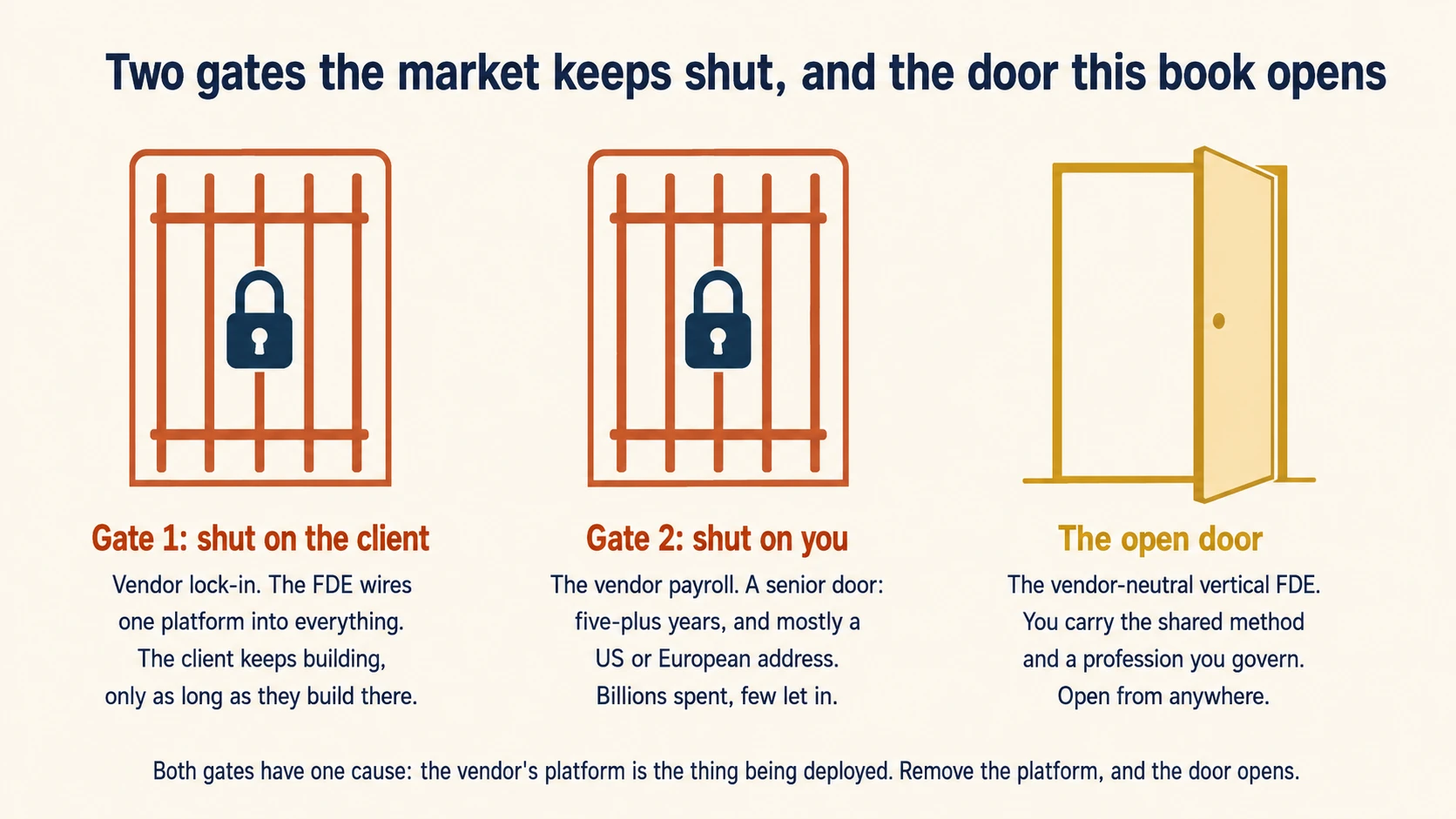
Both gates have one cause: the vendor's platform is the thing being deployed. Remove the platform and the door opens, though experience, trust, and jurisdiction still stand behind it.
Our answer: the vendor-neutral vertical FDE
Two words, one problem each.
Vendor-neutral fixes the lock-in. You are tied to no platform, so when a better model or a cheaper runtime arrives, your client simply switches. They are buying freedom now instead of paying to escape later.
Vertical fixes the empty hands. A vendor's engineer carries the vendor's platform. Take that away and you need something else to carry, or you are a general consultant with nothing to reuse between clients. What you carry is one profession, in one country, written down and governed, built with a real expert.
One trade to know before you commit. A vendor's engineer is often cheap or free to the client, because the vendor earns it back through lock-in. You are paid by the client. That is the point: they are paying for freedom, and you are paid for something a rival cannot copy.
This book's answer has two words in it, and each word solves one of the two problems.
Vendor-neutral solves the lock-in. You are bound to no platform. When a better model ships next quarter, your client switches. When a cheaper runtime appears next year, your client switches. The client buys freedom now instead of paying switching costs later. And you can be hired outright and kept, without losing a step, because your discipline lives in you and not in any vendor's product.
Vertical solves the empty-hands problem. A vendor's engineer carries the vendor's platform. Take the platform away, and specialization has to land somewhere. Otherwise you are a generalist consultant with nothing to reuse from one client to the next. It lands on the profession. The ownership argument proves this by elimination. You cannot own the model, the runtime, your hours, a vendor's platform, or the method in this book, because each one is rented, replaced, absorbed, or shared. The one asset that survives is one profession's governed knowledge, in one jurisdiction, built with a committed expert. So the vendor-neutral FDE walks in carrying two Systems of Record: the shared method, which this book gives every graduate, and the profession, which is yours.
The first of those is not a figure of speech. The Agent Factory System of Record is live over MCP, and any agent that speaks MCP can connect to it and answer from the book instead of guessing. Connect yours before you read further, because the rest of this page is easier to follow with the method already answering your questions. It is also the thing you are about to build for a profession, so use it first as a reader, then copy it as a builder.
One trade to name before you commit. A vendor's FDE is subsidized, sometimes free to the client, because the vendor earns it back in lock-in. A vendor-neutral FDE is paid by the client or by your own firm. That is the feature, not the bug: the client is paying for optionality, and you are being paid for something a rival cannot copy.
Where the technology is taught
This page teaches money. It does not teach the tools, and it will not try, because the book has one place for that: Getting Started. Whenever this page and that page disagree, that page wins.
Everyone starts the same way: six short Foundations courses, in a browser tab, with nothing installed, whether or not you can code. Then one decision. Use AI to do your work, or build AI that does the work for you. This road needs the second one, because a vertical FDE sells Workers they built, not personal speed.
Two numbers matter for planning here. About fifteen focused hours gets you to a first shipped Digital FTE. About twenty-eight gets you a governed workforce proven with evaluations. Those are evenings, not semesters.
One thing before you start walking, because two of the nine stations will stop you cold without it.
This page teaches monetization. It does not teach the technology, and it will not try, because the book already has one canonical place for that: Getting Started: Crash Courses. That page holds the whole curriculum, in order, with the mode decision at its centre and the time each depth costs.
Go there for the skills, and let it route you. Everyone starts on the same six Foundations, in a browser tab, with nothing installed and whether or not you can code. Then comes one decision: use AI to do your work (Mode 1), or build AI that does the work for you (Mode 2). This road needs Mode 2, because a vertical FDE sells manufactured Workers, not personal productivity.
Two numbers from that page matter to your planning here. The fastest route to a shipped Digital FTE is roughly fifteen hours of focused work. A governed workforce, proven with evaluations, is about twenty-eight. Those hours are the legs you walk this road on, and they are days of evenings rather than semesters.
When this page and Getting Started disagree about a course name, a sequence, or an hour count, that page wins. It is the curriculum's own source of truth, and it changes as the courses change.
What to expect, and what to check first
Two things belong here before you spend a year on this.
First, what usually happens. Most readers of this page will earn by building governed knowledge systems for clients and making AI Workers for them, using only what this book gives everyone. That needs no expert, no licensed material, and no vertical. It pays within weeks or a few months. It is where nearly every reader should start, and it is not second best.
The vertical business is the rarer outcome. It is open to the reader who finds a committed expert, and it is gated far more by that one relationship than by talent or effort.
Second, a short test. Five questions, answered in writing before Station 5. Your answers tell you which of the two roads is open to you today.
Two things belong here, before you spend a year on this. The first is what the road usually produces. The second is a short test that predicts whether the vertical half of it is open to you at all.
The expected outcome is the service ladder, and that is not a consolation prize. Most readers of this page will monetize by building governed Systems of Record for clients and manufacturing Workers for them, using the shared method alone. That work needs no expert, no licensed corpus, and no vertical. It pays within weeks or a few months, it compounds into a reputation, and it is where nearly every reader should start.
The vertical business is the exceptional outcome, not the usual one. It is available to the reader who finds a committed expert, and it is gated far more by that one relationship than by talent or effort. Read the rest of this page with that proportion in mind: the service ladder is what you should expect to reach, and the vertical is what you should aim at.
Now the test. Answer these five before Station 5, in writing, the way the selection method makes you write evidence beside every score.
| # | The question | Why it decides so much |
|---|---|---|
| 1 | Can you name a senior practitioner who would take your call today? | The whole vertical stands on one person signing. Ayesha's answer was her aunt, and that is the usual shape. |
| 2 | Is your candidate vertical governed by public law rather than licensed standards? | Statutes and regulator circulars can be published. Commercial standards often cannot, and permission is slow. |
| 3 | Can you fund six to nine months, from the service ladder or savings? | Build first, sell second means the asset comes before the money it earns. |
| 4 | Are the rules of your jurisdiction poorly documented in English? | That is where a general model cannot answer the question already, so a governed corpus is worth paying for. |
| 5 | Can you legally receive cross-border payment today? | An engagement you cannot invoice is not income. |
How to read your answers. Five yeses mean the vertical ladder is genuinely open, and Station 5 is your next step. A no on question 3 or 5 is a schedule problem, so fix it while you earn. A no on question 1 or 2 is the serious one, and the instruction is the same one the ownership argument gives: earn on the service ladder now, do not force a vertical you cannot supply, and let real engagements bring you the expert. Come back to this page when question 1 has a name in it.
The roadmap: nine stations
Nine steps, in order. The first four are reading, and they end with a decision. The next four are building, and they end with something real. The last one is selling.
Each step names the page that teaches it and the one thing you walk away with. That one thing is what the next step needs, which is why the order matters and why you cannot skip any of them.
Nine stations, in order. The first four are reading, and they end with a decision. The next four are building, and they end with an asset. The last one is selling. Each station names the page that teaches it and the one thing you leave with, because that thing is the next station's input.
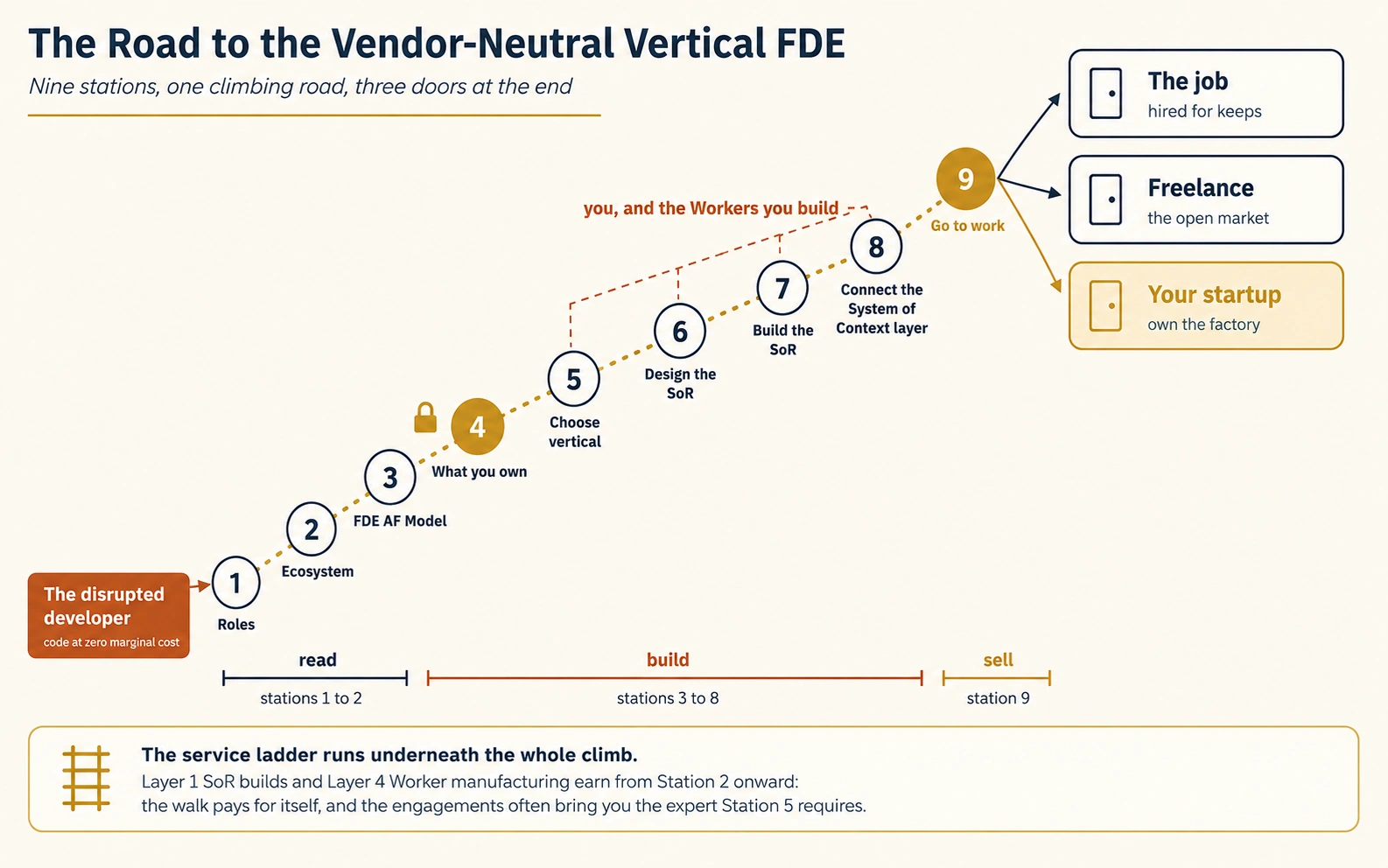
The whole walk in one view. Gold marks the two stations that decide everything: what you own, and where you get paid. The service ladder underneath is why the walk pays for itself.
Station 1: Understand the roles, and the FDE among them
Read: The Roles This Book Trains
Before you walk anywhere, learn the map. The agentic era has fanned work out into new roles: the Outcome Architect who owns intent, the Digital FTE Builder who manufactures Workers, the AI-Native Company Architect who designs the enterprise, and the Cloud AI Engineer who runs it. The FDE is not a separate skill set. It is all four roles, carried into a client's company by one person. The roles page also holds the demand data, the honest salary bands, the résumé signals, and the interview loop, so you know exactly what the market is buying before you build anything.
You leave with: a clear answer to "which seat fits me," and the knowledge that FDE describes where you work, not what you know.
Station 2: Understand the ecosystem
Read: The Ecosystem
The ecosystem is the working proof that this whole approach runs. It has three parts: the Agent Factory System of Record that serves this book to humans and agents, Zia Tutor AI that teaches from it, and Zia Developer AI that builds with it. You will reuse this exact pattern: your vertical will have its own System of Record, its own expert twin, and its own builder, assembled from the same components.
Do not just read about it. The System of Record is live over MCP, so add it as a connector and point your own agent at it. That five-minute exercise is the whole model in miniature: one governed source, served to a human as a website and to an agent as tools, answering from the book and citing the section rather than improvising. It is also the first working instance of the Layer 1 kernel, which means the component serving this book to you is the same component that will serve your vertical's corpus to your customers. Study the original before you copy it.
You leave with: the trio pattern in your head, and your own agent connected to the Agent Factory System of Record, so you have used the thing you are going to build.
Station 3: Understand the FDE AF Model
Read: The FDE AF Model
This is the blueprint you will operate inside: five layers, from the foundation machinery at Layer 0 to the customer engagement at Layer 4, with one law holding it together, that repeated work moves down. The page is also the business model. It shows where the platform earns, where you earn at every layer, and why the graduate's earning path climbs: services at Layers 1 and 2, ownership at Layers 3 and 4. Every station after this one is a move on this board.
You leave with: the five layers, the promotion law, and the earning map.
Station 4: Understand what you can own
Read: What You Carry In: The Ownership Argument
This station is the turn in the road, and most readers resist it. It proves that of everything you value, only one thing passes the ownership test: one profession's governed knowledge, held jointly with the expert who authored the judgment. It also states the sequence rule that governs the rest of this roadmap: build first, sell second. The slice is not a step that waits for a buyer. It is the step that produces one, because nobody discloses their own baseline to a stranger who has been shown nothing.
You leave with: the two-Systems-of-Record picture, and the discipline to build before you pitch.
Station 5: Choose your vertical
Read: Choosing Your Vertical
Do not guess. Follow the method: name one body of professional work, screen it for selling ease, run the eight tests, choose the beachhead, and validate against four gates in 60 to 90 days. One rule stands above all the scoring: no vertical launches without a committed domain expert, because the expert's judgment is the product. And one honest exit protects you: a domain that sells well but cannot carry a trio is a service domain, and earning in it is a good outcome, not a failure.
Two pieces of advice belong to a solo builder specifically, on top of that method.
Prefer public law to licensed standards, for your first build. A statute, a tax ordinance, a customs schedule, a registrar's filing rules, a labour regulation, a regulator's circular: these are publishable, and their rights basis is usually a licence you can read rather than a negotiation you must win. Commercial standards are workable and they are slow, because permission comes from an institution with its own committee. If your first beachhead needs a standards body's written permission, expect months, and expect the possibility of no. Public-law verticals let one person clear Gate 2 alone.
Prefer the jurisdiction where the rules are badly documented. Ask what a strong general model already answers without any corpus. Where the rules are in English, stable, and well published, the answer is most of it, and your corpus is competing with the model's own coverage. Where the rules are local, translated poorly or not at all, changed by circular, and understood mainly by practitioners, the model cannot answer and a governed source is worth paying for. The shrinking domains warning applies to jurisdictions exactly as it applies to domains.
You leave with: either a validated vertical with a signed expert, or a service domain that earns while your expert search continues. Both are wins.
Station 6: Design the vertical System of Record
Read: Designing the Vertical System of Record from First Principles
Now design the asset. Not by copying the profession's current workflows, because those were built around human limits and old technology. The method is first-principles, legacy-informed redesign. Write the outcome contract. Run the workflow archaeology with your expert. Sort every old element into three bins: keep what law and trust require, redesign what existed for human limits, and delete what existed for old technology. Write the source hierarchy, the invariants, the decision map, and the exceptions before the normal path. Build one thin slice, completely, and prove it against real professional review.
You leave with: the six filled templates and a designed first slice: one outcome, its invariants, its reflex, its checker, and its evaluation set.
Station 7: Build it on the Agent Factory SoR Framework
Course: the Vertical SoR build course (under development)
The design becomes software here. The Agent Factory SoR Framework is the open-source implementation of the Layer 1 kernel. It is built on four parts you already know from the stack: Docusaurus for the human-readable website, FastMCP for the agent-facing tools, Postgres for the governed store, and pgvector for retrieval by meaning. You load your designed slice into it and get the one thing the whole model requires: one governed source, two readers. Your expert's students read it in a browser. Your Workers cite it over MCP. You do not write the content twice.
The framework and its course are under active development. The design method at Station 6 is complete and usable today, and every technology underneath the framework is already taught in the crash courses: find them through Getting Started, which routes you to retrieval, MCP, and the Worker build in the right order. A builder who cannot wait can assemble the stack from those courses now. The framework packages that assembly so every graduate starts from the same tested base, and students will build their vertical Systems of Record on top of it when it ships.
You leave with: your thin slice, live: a website your expert approves and an MCP endpoint your agents cite.
Station 8: Connect the System of Context to the customer's real work
Read: The System of Context: Connecting the Records to Real Work
Your slice is live, and inside a real company it is the smallest thing in the room. That company holds information your record will never contain: the signed contract, this morning's balance, last year's working paper, and the message where a manager explained a decision nobody wrote down. Your Worker needs all of it to finish one job. It must never mistake any of it for the law.
So the last architectural problem on this road is not another source of truth. A System of Record decides what is true. A System of Context decides what arrives. The layer connects your two governed records, the customer's operational systems such as the ERP and the ledger, and the customer's ungoverned working material, then hands the Worker one cited bundle for one task. It adds no truth of its own, and one law holds the whole thing together: it carries authority, it never holds it. Eight invariants make that law enforceable, and the page states all eight.
Three things on that page decide money on this one.
The pattern is the asset, and the fitting is the service. The layer spans two layers of the model. Layer 3 holds the reusable pieces that contain no customer data: the authority map, the context packet shape, the connector patterns, the citation format, the retrieval evaluations, the conflict tests, and the permission patterns. That is yours, and you carry it into every client. Layer 4 is the fitting: their applications, their identity provider, their credentials, their thresholds, their case identifiers, their audit rules. That is deployment work you perform, and are paid for, at each customer. Confusing the two is how a founder mistakes a busy consulting practice for a business with something to sell.
It is what makes the second engagement cheaper than the first. The first customer pays for the fitting while you are still building the pattern. The second pays for a fitting that reuses it, and the third pays for one you can quote with confidence. That is the promotion law working on the connection layer, and it is the difference between a practice that scales and a calendar that fills.
Prepare the pattern before you sell, fit it inside the engagement. This station's deliverable is the Layer 3 pattern, which holds no customer data and can be built with nobody's permission but your own. The Layer 4 fitting happens inside a real customer's walls, which is Station 9. So this station does not delay your first sale. It is what makes the first sale deliverable on time.
Two honest boundaries belong here, because the page states them plainly and both cost money if ignored. Not every engagement needs this layer, and building it early is a real way to lose a quarter. You need one when the answer to "why was it done this way" lives outside every system anyone governs, which is the normal condition of long professional relationships. And one gate is not negotiable: do not build a System of Context until your thin slice is finished and your first Worker cites it, because a connecting layer with nothing governed to connect to is a search box with ambitions.
One last thing this station buys you, and it is worth more in a meeting than it looks on a page. The market has already named this category, so the buyer may know it as enterprise AI search, a work assistant, or a knowledge layer. Onyx is the open implementation you can install and take apart, and Glean is the commercial product a large buyer is most likely to name. Walking in able to use the buyer's own words, and then read the architecture underneath the product language, is the difference between selling and being sold to.
You leave with: a portable connection pattern for your vertical, meaning the authority map, the packet shape, the connector and permission patterns, and the conflict tests, plus the honest judgment of whether a given engagement needs the layer at all.
Station 9: Go to work
Read: the FDE sections of the roles page, and the business model
You now hold what almost no candidate on the market holds: the shared method, deep and governed, one governed slice of a real profession, built with a named expert and proven against real review, and a connection pattern that fits that slice into a company's actual systems without flattening anyone's authority.
How the sale itself happens, with no salesforce and no brand, is the subject of this page's other half: How to Sell in the Agentic AI Era. It takes the asset and the price you now hold and adds the motion, from the one-afternoon slice session that ends in the buyer's own baseline number, to the ask that earns that afternoon in the first place.
One boundary before the doors. This book trains the technical core of the role. The deeper selling craft, meaning negotiation technique, discovery questioning, ROI framing, and the discipline to refuse an unrealistic ask, belongs to the Certified Agentic AI Business Strategist track. You can walk through any of the three doors below without it. You will negotiate better with it.
You leave with: income, and the first real baseline number your vertical has ever been measured against.
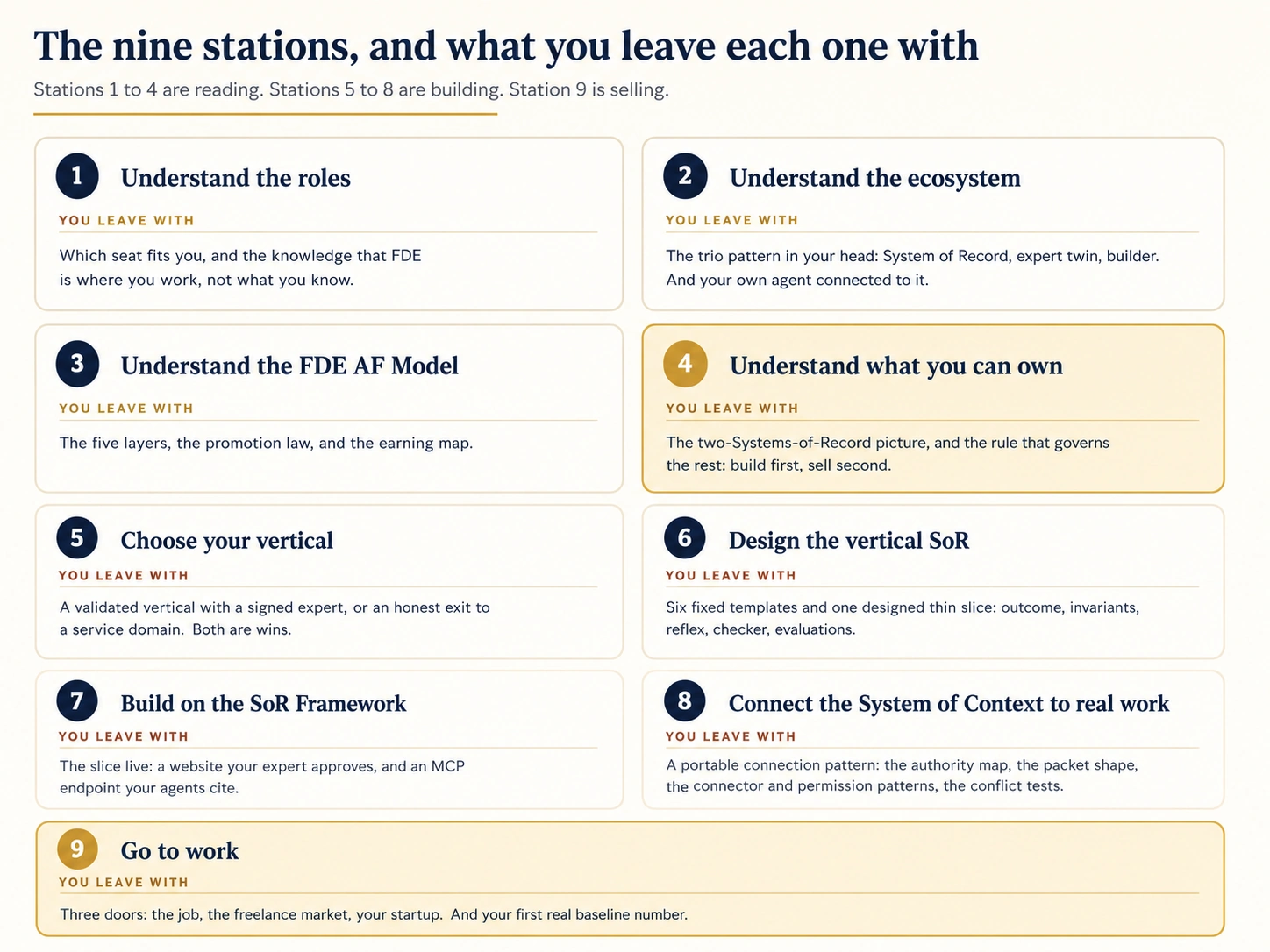
Stations 1 to 4 are reading and end in a decision. Stations 5 to 8 are building and end in an asset. Station 9 is selling. No station may be skipped, because each deliverable is the next one's input.
Three doors from the last station
Three ways to turn the same work into money. Take a job. Work for yourself, for several clients. Or build a company you own with your expert.
They are not either/or, and the usual path uses all three in order. Freelance work pays for the build. The first proven result makes you worth hiring. The growing vertical becomes the business.
Behind every door sits the same pair of things: the method the book gave you, and the profession you built. Only the contract changes.
Three ways to convert the same asset. The money behind each one is in the next section, so this one covers only what makes each door different.
Door 1: the job. Start where tenure is not the gate: independent services firms, and clients who have already seen your slice. The salaried vendor units are a later door, not a first one. Your résumé leads with the line no screener has seen before, a governed slice of a profession published for both readers, and the interview's hardest rounds are this book's curriculum examined out loud. The door's real advantage is the exit: a client can rent you as an FDE and then hire you outright as their AI-Native Company Architect, because your leverage walks in with you. Only the vendor-neutral version can make that trip.
Door 2: the freelance and fractional market. The marketplace category exists and the supply under it is still mostly generalists who do not describe FDE work at all.7 The shelf was built before anyone stocked it, and for a trained reader that emptiness is the opening. Its advantage is that the labour market is not local: the same contract can be won from Karachi, Lagos, or Bangalore. Payment, tax, compliance, and trust still cross borders, and question 5 of the preconditions test exists for exactly that reason. Its discipline is over-communication, because remote embedding is harder than remote coding.
Door 3: the startup. Your vertical becomes a domain startup you co-own with your expert, earning from the twin, the domain's education, ready-made domain Workers, and engagements with retainers. Its advantage is compounding: every engagement thickens the vertical, and the promotion law folds each repeated fix back into the shared builder, so the asset is worth more in year three than in year one. This is the door where the product, rather than your calendar, carries most of the revenue.
The doors are not exclusive, and the common path uses all three in order: freelance engagements fund the build, the first proven engagement makes you hirable, and the thickening vertical becomes the startup. The asset is the same behind every door. Only the contract changes.
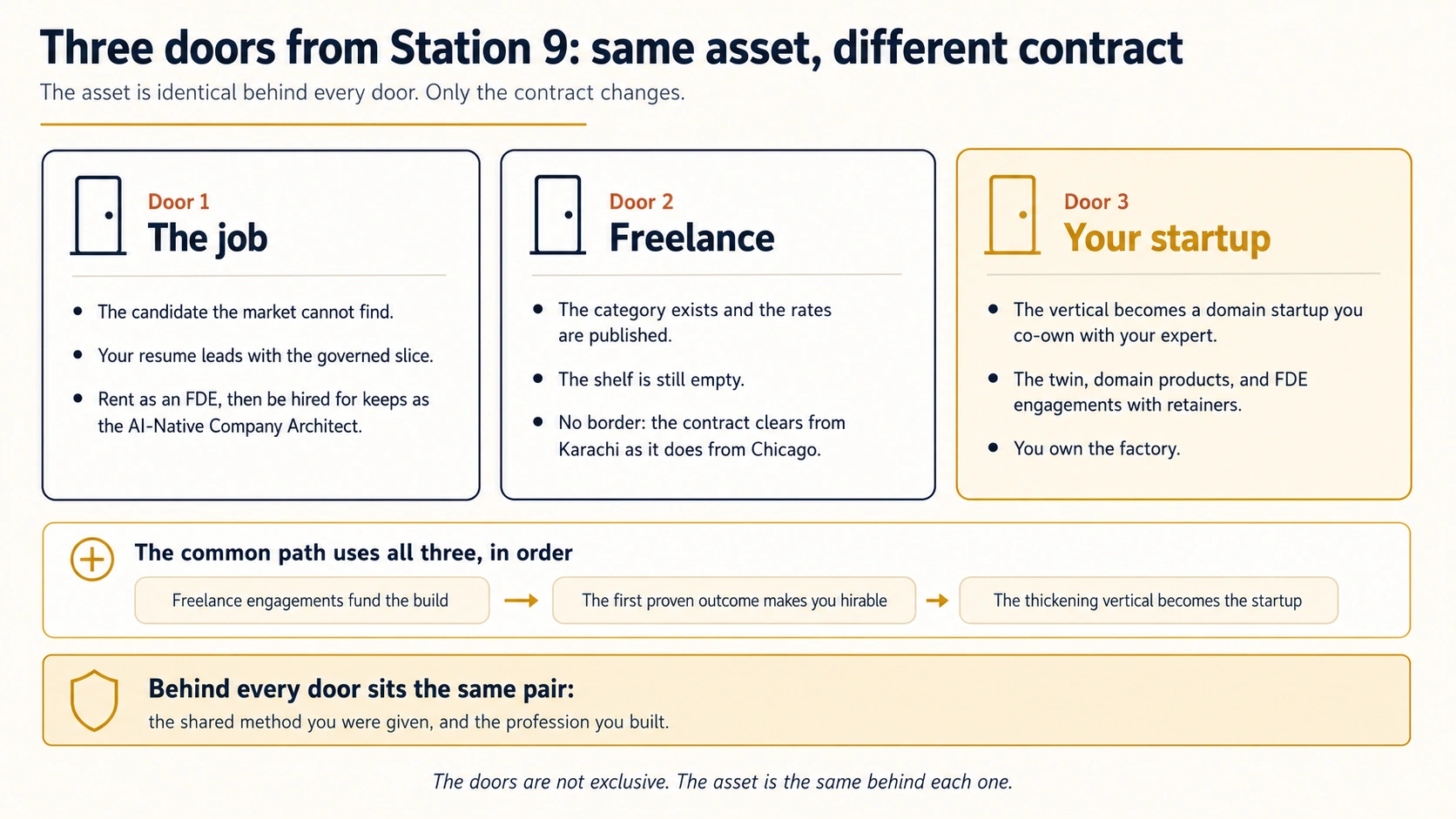
Same asset, three contracts. The common path uses all three in order: freelance work funds the build, the first proven outcome makes you hirable, and the thickening vertical becomes the startup.
What each door pays
Real published numbers, with their limits attached. Read the table as where the road leads, not as what you will earn this year.
None of these is your first number. A first paid job, sold locally, by somebody with no track record yet, is usually a small build for a small firm: a few hundred to a couple of thousand dollars. That is not failure. That is the service ladder doing its job, and it is how almost everyone reaches the bands below.
Notice the shape of the table. The top row is the biggest single number and it is a salary, so it has a ceiling and a gate. The bottom row has no number and no ceiling, and it is the only row that still earns in a month when you sell nothing.
A monetization page owes you numbers. Here they are, gathered from the pages this one stands on, with their limits attached.
| Door | What it pays | Read this as |
|---|---|---|
| The job | Median near 190,000 dollars a year, with typical bands of 170,000 to 200,000-plus. Anthropic's posted FDE bands run 200,000 to 300,000. Senior and staff engineers at frontier labs clear 450,000 to 600,000.8 | Measured from real postings. Mostly US and European roles, and mostly senior. |
| Freelance, per project | Roughly 2,000 to 5,000 dollars for a first integration, 5,000 to 15,000 for a custom implementation, and 15,000 and up for an enterprise deployment.7 | Published marketplace bands. Unproven profiles start lower. |
| Freelance, per hour | About 150 to 250 dollars an hour for strategic consulting. UK contract day rates run 600 to 750 pounds at mid-level and 1,200 to 2,000 at principal level.9 | The premium is earned by demonstrated outcomes, never listed. |
| The retainer | About 4,000 to 10,000 dollars a month for ongoing operation.7 | The recurring layer, and the one that compounds. |
| Your startup | No band exists, because you set the price. It earns at four layers at once: client System of Record builds, manufactured Workers, the expert twin and domain products, and engagements with retainers. | Not a salary. A business, with the ceiling and the risk that implies. |
One reality anchor before you read the bands. None of these numbers is your first number. A first paid engagement, sold locally, by someone with no track record yet, is usually a small build for a small firm: a few hundred to a couple of thousand dollars, not a marketplace band. That is not failure: it is the service ladder doing its job, and it is how almost everyone reaches the bands above. Treat the table as where the road leads, and your first invoice as proof you are on it.
Three notes on this table. First, the salaried column is the one the vendor gate stands in front of, so treat it as the market's price for the role rather than your first year's income. Second, the freelance bands are what the marketplace publishes, and a new profile starts near generalist rates: what moves you up the bands is a shipped outcome with a number attached. Third, the startup row has no band on purpose. Nobody has published one, because the category is new.
The pattern across the rows is the argument of this whole page, in money. The top row is the highest single number and it is a salary, capped and gated. The bottom row has no number and no ceiling, and it is the only row where the asset keeps earning in a month when you sell nothing.
How to price the work
Stop selling hours. Sell a result.
Before you build anything, agree three numbers with the customer, in writing. What the work costs them today. What will count as success. How a reviewer will check it. Four hours per file becoming forty minutes is not a slogan. It is the number the price is argued from, and the only one the buyer can verify.
That first number has to come from the buyer, measured inside their own process. This is also why you build the slice first: somebody who has been shown nothing will not tell you their own numbers.
One warning. Charging for a result means paying for a result you fail to produce. Only price this way once you can really check the result yourself.
The doors pay differently because they price differently, and one shift runs through all of them: you stop selling time and start selling a result. Four instruments do the work.
The contract of success is the pricing instrument. Before any building, you and the customer agree in writing on three numbers. The baseline is what the work costs today, measured in the customer's own workflow. The target is what will count as success. The acceptance criteria are how a reviewer will check it. Four hours per file becoming forty minutes is not a marketing line. It is the number the price is argued from, and it is the only number the buyer can verify.
The baseline must come from the buyer. You cannot know it before contact, because it is measured inside their process. This is also why the slice comes first: a buyer who has been shown nothing will not disclose their own numbers, so with no slice you can get the meeting and still leave without a baseline, without a contract, and without a price.
The retainer prices the Workers, not your hours. After the build, the monthly fee pays you to operate the Workers you manufactured and to keep them improving, because the shared domain builder is versioned and every customer receives the domain's fixes. That is the Digital FTE subscription model, and it is the difference between a project that ends and a practice that compounds.
Products price the asset itself. At Layer 3, the same vertical sells the expert twin's subscriptions, the domain's education, and ready-made domain Workers built once and sold many times. Nothing here is billed by the hour at all.
One caution belongs with all four, and the ownership argument states it plainly: charging for a result means carrying the cost of a result you fail to produce. Outcome pricing is only safe once your checker and your evaluation set are real. Ownership earns you the right to price an outcome. It does not excuse you from proving one first.
What to charge in a given negotiation, and how to hold the price when a buyer pushes, is the selling half of the role. That belongs to the Certified Agentic AI Business Strategist track.
Earning while you walk
This is the work that pays while you build the bigger thing.
You load a client's own manuals, standards, and procedures into the system, set up the governance, and charge for the build and the upkeep. You make AI Workers for clients with the tools everyone gets, and the client pays for the result rather than for your hours. Neither of those needs a vertical of your own.
Two things make this more than something you do while you wait. It builds the portfolio that a hiring screener and a marketplace both read as proof. And it puts you in rooms with working professionals, which is how most readers will meet the accountant, the customs broker, or the recruiter whose twenty years answer question 1.
The section above named the service ladder as the expected outcome. Here is what it actually is, in the model's own terms, because it is the mechanism that funds everything else.
At Layer 1, you load a client's own manuals, standards, and procedures into the kernel, set up the governance, and charge for the build and the upkeep. At Layer 2 and Layer 4, you manufacture AI Workers for clients with the deployed generic tools, and the client pays for the outcome rather than for your hours. Neither needs a slice, because neither sells a vertical. Both are paid work you can start as soon as you finish the manufacturing courses.
Two things make this more than a stopgap. It builds the portfolio a screener and a marketplace both read as the credential. And it puts you in rooms with practitioners, which is how most readers will meet the accountant, the customs broker, or the recruiter whose twenty years answer question 1 of the preconditions test.
So two ladders run at the same time. The service ladder earns now. The vertical ladder compounds later. Neither one waits for the other.
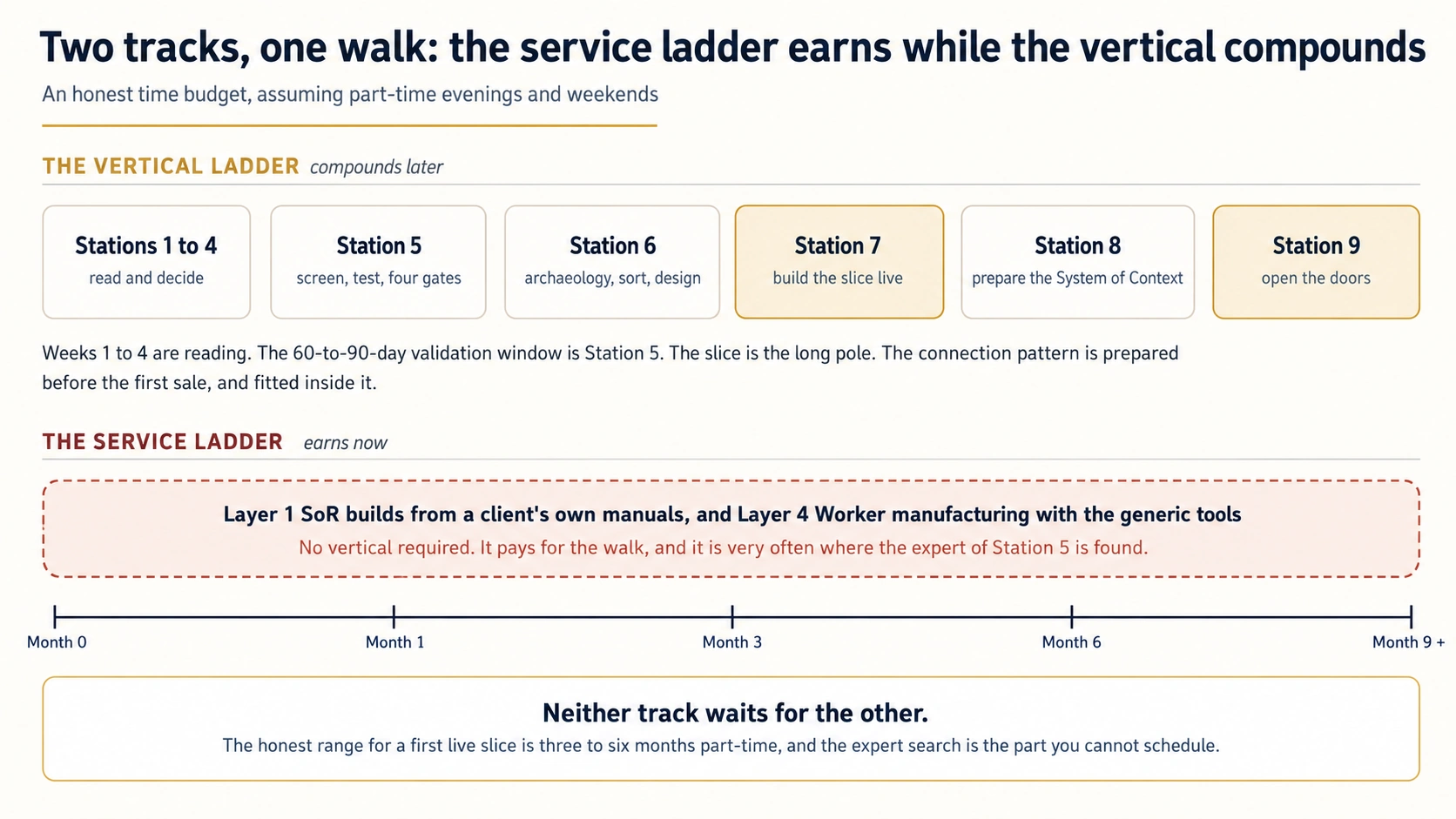
Neither ladder waits for the other. A first live slice is realistically three to six months part-time, and the expert search is the part you cannot schedule.
How long the road takes
A planning shape, not a promise. Your speed depends on your starting skill, your hours per week, and above all on how fast you find your expert.
Reading and deciding takes a week or two. The courses take about fifteen focused hours to a first Digital FTE. Choosing a vertical takes 60 to 90 days. Designing a slice takes three to six weeks, and building it takes two to four more. The connection pattern takes one to two. The first sale takes one to three months.
Two things about that list. The steps overlap, so the calendar is not the sum of the rows. And two of the rows are not yours to control: an expert has to say yes, and a buyer has to decide. Plan the rows you own.
A roadmap that never says how long the walk is, is not a roadmap. So here is a budget. Treat it as a planning shape, not a promise: your speed depends on your starting skill, your hours per week, and above all on how fast you find your expert.
| Stations | What you are doing | Typical time |
|---|---|---|
| 1 to 4 | Reading and deciding | 1 to 2 weeks |
| The crash courses | Learning to build, in Getting Started | About 15 focused hours to a first Digital FTE, about 28 to a governed workforce |
| 5 | Screening, tests, and the four gates | 60 to 90 days, and this is the canonical window |
| 6 | Archaeology and designing one slice | 3 to 6 weeks, and it moves at your expert's pace |
| 7 | Building the slice on the kernel | 2 to 4 weeks after the design is approved |
| 8 | Preparing the System of Context | 1 to 2 weeks, and the fitting is billed inside each engagement |
| 9 | The first sponsor and the first close | 1 to 3 months, and the buyer sets this clock |
Two notes on the total. First, the stations overlap: the technical courses run while you search for an expert, and Station 5's validation window runs while you earn on the service ladder. So the calendar is not the sum of the rows. Second, one row is not yours to control. Station 5 depends on a person saying yes, and Station 9 depends on a buyer's purchasing timeline. Plan the rows you own, and do not promise yourself the rows you do not.
The number that matters more than the total is the one the section above already gave you: your first paid work does not wait for Station 9. It starts as soon as you can build a client a governed System of Record.
The failure modes
Eight ways this road goes wrong. Every one is common, every one is survivable, and every one costs less to spot now than in month nine.
The most likely is also the most natural. Applying for jobs feels like progress, so people polish the résumé instead of building the one thing that gets them the meeting.
One outcome is deliberately not on the list, because it is not a failure. Running the whole method and ending with a service domain instead of a vertical is a correct result, and it is the one this page expects for most readers.
Eight ways this road goes wrong. Each one is common, each one is survivable, and each one is cheaper to recognize now than in month nine.
- Polishing the résumé instead of building the slice. The most natural mistake for a disrupted developer, because applying feels like progress. But the slice is the credential, and a buyer who has been shown nothing will not disclose their own baseline. The cure is the sequence rule: build first, sell second.
- Launching without a signed expert. "She agreed in principle" is not Gate 1. Without a committed author there is no twin, no derived reflexes, and no licensed material, so what you have is a document collection. The cure is the launch rule: signed, or serve the domain through the service ladder instead.
- Choosing the biggest market instead of the easiest real sale. Healthcare and banking look like the prize and buy the slowest. A wrong beachhead costs a quarter, and a wrong vertical costs a year. The cure is the screen and the eight tests.
- Shipping the slice as a demo. One clean example, no missing evidence, no wrong jurisdiction, no escalation case. It will pass your own review and fail the client's. The cure is designing the exceptions before the normal path and an evaluation set with the ugly cases in it.
- Accepting staff augmentation and calling it an engagement. The client who says "we are understaffed" is asking to rent your hours, which is the pyramid this whole road exists to leave. One question is the field test: who will be the working team alongside me? If nobody can be named, it is body-shopping in disguise.
- Widening the vertical to look bigger. Four professions share the shape of the work, so serving all four looks efficient. But the shape is method, and the method is already shared, so a corpus built on it has nothing inside. The cure is the narrowing argument: one profession, one jurisdiction.
- Forcing a vertical when question 1 has no name in it. The preconditions test asks whether a senior practitioner would take your call. When the honest answer is no, the tempting move is to proceed anyway and hope an expert appears once something exists to show. It rarely does, and the months spent building an ungoverned corpus are months the service ladder would have paid for. The cure is patience with a deadline: earn, publish, meet practitioners through real engagements, and let question 1 answer itself.
- Building the connecting layer before there is anything to connect. A System of Context with no finished slice behind it is a search box with ambitions, and it can absorb a whole quarter. The cure is the gate on that page: the slice ships first, a Worker cites it, and only then do you connect the customer's world.
One failure mode is not on the list, because it is not a failure. Running the whole method and exiting with a service domain instead of a vertical is a correct outcome, written down honestly, with a condition for revisiting it. It is also the outcome this page expects for most readers.
Ayesha walks the road
One person, the whole road, in two paragraphs.
Watch one step in particular. Her first customer is in a different country from her expert. That does not come free. A vertical is one profession in one country, so crossing a border is a new build that reuses the design, and it needs its own expert to sign off in the new place. She treated the crossing as a repeat with its own cost and priced it that way, which is why the sale worked.
You have met Ayesha at every station. Here is her whole walk in one paragraph.
She graduates and reads the role map: the FDE is where the demand is, and the vendor gate is shut to her (Station 1). She learns the ecosystem by using it, asking Zia Tutor AI her questions and connecting her own agent to the book's System of Record (Station 2). She learns the five layers and sees where each one pays (Station 3). The ownership argument turns her plan around, so she stops polishing her résumé and starts looking for an expert (Station 4). Her aunt, twenty years an accountant with her own written material, is the answer. Audit working-paper preparation passes the screen, the tests, and the four gates, and she scopes it as one profession in one jurisdiction rather than as "accounting." Customer support, her highest screen score, becomes her service domain and pays her bills during the whole walk (Station 5). She runs the archaeology on her aunt's forty-one-item checklist, sorts it into three bins, and designs one complete slice (Station 6). She builds it on the kernel: her aunt's material as a Docusaurus site her aunt's students read, and the same content her Workers cite over MCP (Station 7).
Then the doors, and here the jurisdiction rule proves its value. Her first buyer is a mid-size Chicago firm, served remotely from Lahore, and a US firm's working papers are not her aunt's jurisdiction. So the engagement is priced as the model's per-jurisdiction repeat: the shape of the slice carries over, and the sources, the invariants, and the checker are rebuilt for US audit requirements with a reviewer qualified there signing off. Inside the firm she fits her connection pattern to their world (Station 8): twenty-two years of working papers in SharePoint indexed, the trial balance queried live and never indexed, and permissions tested as a first-year junior before a single answer is tested. Six weeks later a Worker cites the standard from her record, attaches the firm's 2023 lease memo separately as prior treatment, reports that the two disagree, and escalates to the partner, who corrects a treatment his firm had repeated for three years. The working-paper file goes from four hours to forty minutes under a contract of success. The engagement becomes a retainer. The retainer becomes the first revenue of the domain startup she and her aunt co-own (Station 9, all three doors, in order).
Read that middle step carefully, because it is the most common misreading of this whole road. A vertical is one profession in one jurisdiction. Crossing a border is a new build that reuses the design, not a free extension of the old one, and it needs its own expert sign-off in the new jurisdiction. Ayesha's first sale works because she treated the crossing as a repeat with its own cost, and priced it that way.
The definition of ready
A checklist. You are ready to open the doors of Station 9 when every box is ticked. Tick them honestly, because a buyer will check.
You are ready to open the doors of Station 9 when every box is checked. Check them honestly, because a buyer will.
- You can explain the FDE role, its demand, and the vendor lock-in problem in your own words.
- You have walked the Getting Started route and chosen Mode 2, because this road sells manufactured Workers.
- You have shipped at least one horizontal capstone from that route: a deployed Worker, a plugin, or a connector-native app.
- You are earning, or ready to earn, on the service ladder with Layer 1 and Layer 4 work.
- Your vertical passed the screen and the eight tests, or is honestly parked with a written condition.
- Your expert has signed: not agreed in principle, signed.
- Every source in your slice has a documented rights basis.
- Your thin slice is complete: outcome contract, invariants, reflex, checker, and an evaluation set that includes the ugly cases.
- The slice is live on the kernel: readable as a website, citable over MCP.
- You can say whether a given customer needs a System of Context, and name the sources it would connect.
- Your portfolio page leads with the slice, and every bullet states an outcome, not an activity.
What this page does not cover
Three things this page leaves to somebody else. The technology is in Getting Started. The selling skills are in the Strategist track. And the legal and tax shape of your own business, meaning registering a company, writing contracts, invoicing across borders, and taking payment, is real work this book does not teach. Rules differ by country and change often, so buy an hour of a local accountant's time early.
Two boundaries were named already: the technology belongs to Getting Started, and the selling half belongs to the Strategist track. A third has not been named, and it matters. The legal and tax shape of your own business, meaning company registration, contracts, invoicing across borders, and how you take payment, is real work this book does not teach. Rules differ by country and change often, so buy an hour of a local accountant's time early. An engagement you cannot legally invoice is not income.
The honest label
What is measured, and what is only reasoned.
Measured: the demand for the role, the pay bands, the billion-dollar units, and the failure rate of company AI projects. Those are evidence, and every one is sourced at the bottom of this page.
Not measured: that a governed slice turns into a first client. That is this book's reasoning, because the category is new and nobody has counted yet. The safer version of the claim is the negative one. Without a slice, you can get the meeting and still leave without a number.
And the pay table is not a forecast of your income. It is what employers posted and what marketplaces advertise. Your own first number is something you will discover with your first buyer.
This page inherits the honesty rules of the pages it stands on, so read its claims at their true strength.
The demand for the FDE role is measured: the posting counts, the salary bands, and the billion-dollar units are all sourced below and on the roles page. The failure rate of enterprise AI pilots is measured. The lock-in problem is conceded from the vendors' own stages. Those parts are evidence.
The pay table needs one line of its own, because a number in a table looks harder than it is. Every band in it is a real published figure, and none of them is a forecast of your income. Salary bands are what employers posted, in markets most readers of this page cannot yet apply into. Marketplace bands are what the platform advertises, not what a new profile earns in its first month. And the startup row is honestly blank, because nobody has published a distribution of outcomes for a category this young. Read the table as the market's prices, and your own first number as something you will discover with your first buyer.
The services compression arithmetic is a projection, borrowed with its label attached. The time budget above is a planning shape drawn from this book's own experience, not a measured average across graduates. And the central promise of this roadmap, that a governed slice converts into a first client, is this book's reasoning rather than a statistic: the category is new, and no verified count of graduates who made the conversion exists yet. The negative claim is the safer one. Without a slice, you can get the meeting and still leave without a number. A reader who builds a good slice and waits three months for a client has not disproven the road. A reader who finds a faster road is asked to write in, because the book updates.
One more claim deserves its own label, because it is the load-bearing claim of this page rather than its most exciting one. That the service ladder is the expected outcome and the vertical is the exceptional one is a judgment, drawn from what gates the road: expert access and rights clearance, neither of which effort alone can solve. It is stated as a judgment on purpose. And it is a judgment we intend to replace with a number. The ecosystem trains thousands of readers, so the funnel can be measured: how many finish the manufacturing courses, how many name a candidate expert, how many obtain a signature, how many clear their rights basis, how many publish a slice, and how many close a first paid engagement, at what price. When that data exists, it belongs on this page, including the drop-off at every stage. A roadmap that reports only its successes is a brochure.
So here is the table, published empty, because publishing it empty is the commitment.
| Stage | Graduates |
|---|---|
| Finished the manufacturing courses | not yet measured |
| Named a candidate domain expert | not yet measured |
| Obtained a signed expert agreement | not yet measured |
| Cleared a documented rights basis | not yet measured |
| Published a live thin slice | not yet measured |
| Closed a first paid engagement | not yet measured |
Every row will carry a number, or it will carry this label. It will not carry a story.
Where to go from here
The road is now in front of you, and the first step costs nothing: open The Roles This Book Trains and find your seat. If you already know your seat, run the five preconditions and let your answers pick your next move. Five yeses, and Station 5 is next. A blank on question 1, and the instruction is the same one this page has given all the way through: start earning on the service ladder today, and let the engagements bring you the expert.
One last framing, for the day the walk feels long. The disruption that pushed you onto this road is not going to reverse. Intelligence will keep getting cheaper, and the value will keep moving toward the people who can deploy it inside real companies, against real rules, with proof. Every station on this road builds something the machine cannot absorb: a governed profession, a named expert's trust, and a record of outcomes with your name on them. Most readers will earn on the service ladder, and that is a real practice built on real skill. Some will find the expert, build the vertical, and own the factory. Both endings beat the one where the machine absorbed your work and you had nothing of your own to carry into the room.
The next page supplies the missing half: how the sale actually happens, with no salesforce, no brand, and no budget for outreach.