The Ecosystem Concept
One textbook. Two kinds of readers. A pattern that repeats for every profession.
The AI Agent Factory is no longer just the book you are reading. Around it now stand a tutor that teaches it, a developer agent that builds from it, a publishing pipeline that will rewrite it for new audiences, and a business model that earns on it. Together they form an ecosystem: a set of parts that live and grow on one shared source. And everything in it stands on one decision, simple to state: we stopped treating the textbook as a document and started treating it as a System of Record, one governed source of truth that people and AI agents both read.
This page tells the story of that decision from the beginning: how learning worked when textbooks ruled, why AI chat fails as a teacher, and how fixing both problems created a pattern you can repeat for your own profession. You do not need any technical background. If you have ever learned anything from a textbook, you can follow everything on this page. Any word you have not met before is explained where it first appears, and the glossary holds the rest.

Here is the whole page, before the story.
A system of record is the one place where the official version of something lives: when the ledger and a spreadsheet disagree, the ledger wins. Businesses have had them for decades. Books never did.
We made this book one. So the same source now serves people, who read it as a website, and AI agents, which read it through a connector.
Once the source is trustworthy, better readers can stand on it: a tutor that teaches the book in its author's voice and remembers where you stopped, and a developer agent that builds from it.
Then the same three pieces, one governed source, one tutor, one builder, can be made for any profession. That repeat is the ecosystem, and it is what this page is really about.
📚 Teaching Aid
View Full Presentation — The Ecosystem Concept
Until about 2022, knowledge had a shape
To learn databases, you picked up a textbook. It taught the relational model before normalization, first normal form before second, theory before tuning. You did not negotiate the sequence. The sequence was the teaching.
And one book served three people. The student learned from it. The teacher taught from it. The developer kept it on the desk and built from it. When the student became the developer, that was the system working: one source, everyone aligned on the same definitions, in the same order.
What did the developer build? Vertical systems for real businesses: an ERP, a general ledger, an inventory system. Think of Odoo, SAP, or Oracle. Each of these stored the official data of a business, and in enterprise software they have a well-known name. They are called systems of record. A system of record is the one place where the authoritative version of something lives. When Odoo and a spreadsheet disagree, Odoo wins, because Odoo is the system of record.
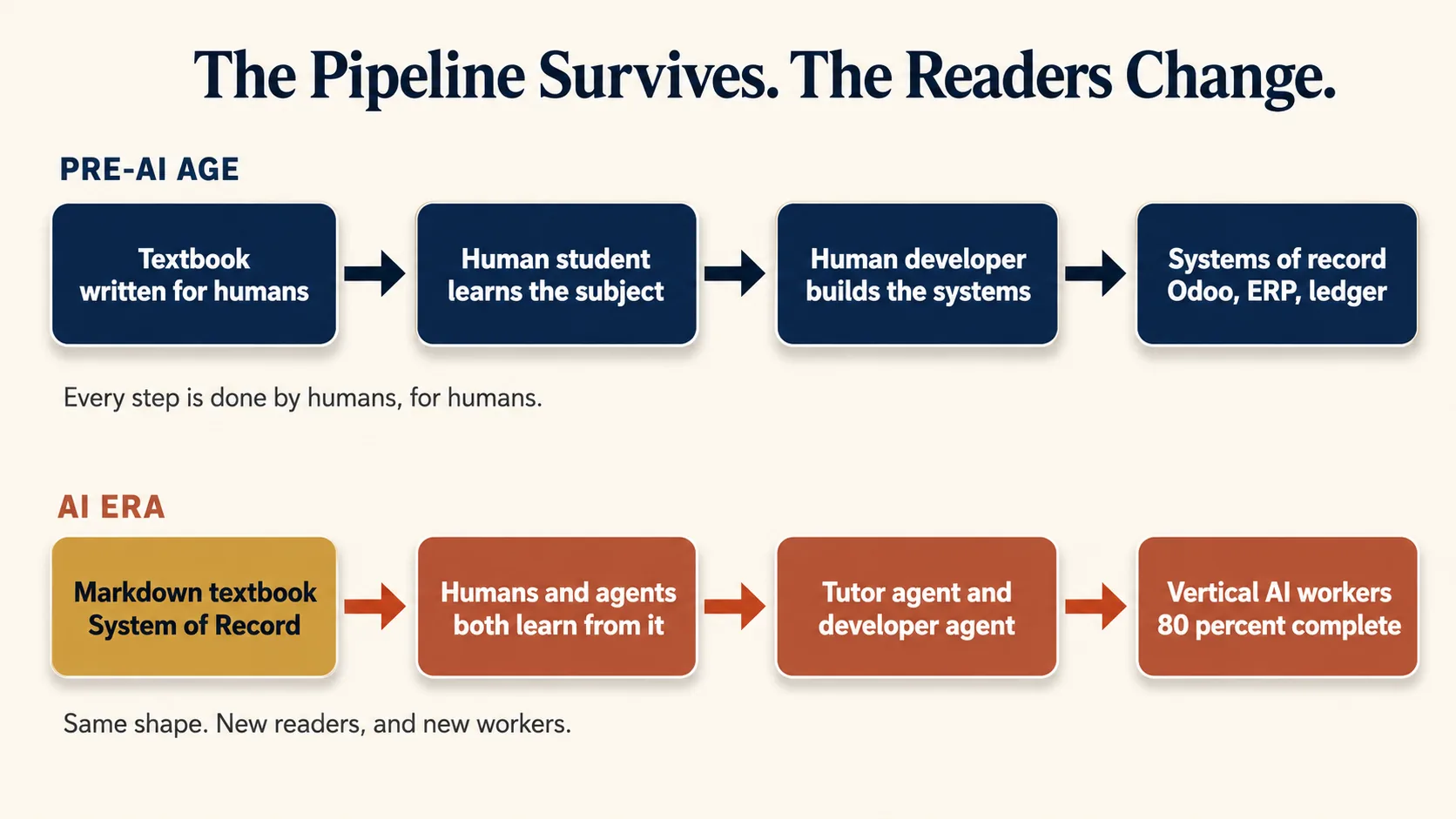
So the old pipeline looked like this:
Textbook → human learns → human becomes a developer → developer builds systems of record for businesses.
Every step was done by humans, for humans.
Then AI read every book
ChatGPT and Claude arrived: products whose brain, a large language model, had been trained across an enormous share of the world's published writing, textbooks included. The model has learned from hundreds of database books: every normal form, every index strategy, every worked example. OpenAI shipped Study Mode, and Google followed with Guided Learning of its own.
Which forced an honest question about our own book:
If the model has already read a hundred database textbooks, why does anyone need one more?
We took the question seriously. If the honest answer was "no reason," we wanted to be the first to know.
Ask it to teach you, and watch closely
Say "teach me database management systems" to a bare model, and watch what actually happens. Four failures appear, one after another:
- The answers change every time. Where does it start? Some days with files versus databases, other days straight into first normal form. How deep does it go? It decides, differently every time. This is not a flaw waiting for a patch. It is what the machine is: every answer is sampled from a spread of possibilities. The book's own crash course puts it plainly: the machine rolls weighted dice at every token. Ask twice, get two different courses. Put a class of thirty in front of it, get thirty.
- There is no starting point and no ending point. A textbook has a chapter one and a final chapter. A generic AI chat has neither. You can talk for a month and never know whether you have covered the subject or only repeated one small part of it.
- It keeps no learner record. It does not track what you completed, what you struggled with, or where you stopped. There is no progress report, because nothing about your learning is recorded anywhere.
- It has no method. Its pedagogy is only what it absorbed from training data, with nothing directing it: no method deciding when to ask, when to correct, when to advance. A good teacher asks questions before teaching, to find your level. The model improvises the teaching the same way it improvises the content.
The labs know all of this. That is exactly what Study Mode, guided learning, and memory are: serious product engineering wrapped around the machine. But learning a field is a journey. A course is hundreds of decisions about what comes next: which gap to close, which concept is ready, which must wait. Memory remembers you, your name, your projects, your preferences. It does not hold a learner record: what you have demonstrated, where you struggled, what you are ready for next. So every one of those decisions still lands on you.
Now be fair in the other direction, because the same test cuts against us. The old textbook had the governed sequence, chosen by a named author and verified by reviewers, but the book never asked you a question, never noticed you struggling, never remembered where you stopped. Those jobs always belonged to people: the teacher held the line, the gradebook held the record. And everyone has always known the best version of that arrangement: one teacher, one learner, the lesson shaped around you. Anyone who could afford it hired exactly that. Classrooms and cohorts exist because one-on-one from the best never scaled. The textbook was not the ideal. It was the copy of the teacher we could afford to print.
Hold on to both halves of that diagnosis. The model is missing a governed source and a record. The textbook was missing the teacher. The rest of this page fixes both.
The turn: the textbook becomes a System of Record
Business software solved the source half of this problem decades ago. A company does not let every app keep its own version of the customer list. It runs a system of record, one place where truth lives, which every other system reads and trusts.
We applied the same pattern to knowledge, with agents as first-class readers. The AI Agent Factory is a system of record for agentic AI education and construction, and it ships as one. Call it the knowledge base, the source of truth, or the Intelligence Bible, as the team does. The name matters less than the property: truth is defined once, and everything else reads from it.
One source now serves two kinds of reader:
| Reader | Door | What they get |
|---|---|---|
| Humans | The book as a website | Chapters in the authored sequence, figures, exercises. The textbook experience, free |
| AI agents | The Agent Factory System of Record, over MCP | The same canonical content, queryable. Verified chapters and definitions instead of training-data guesses |
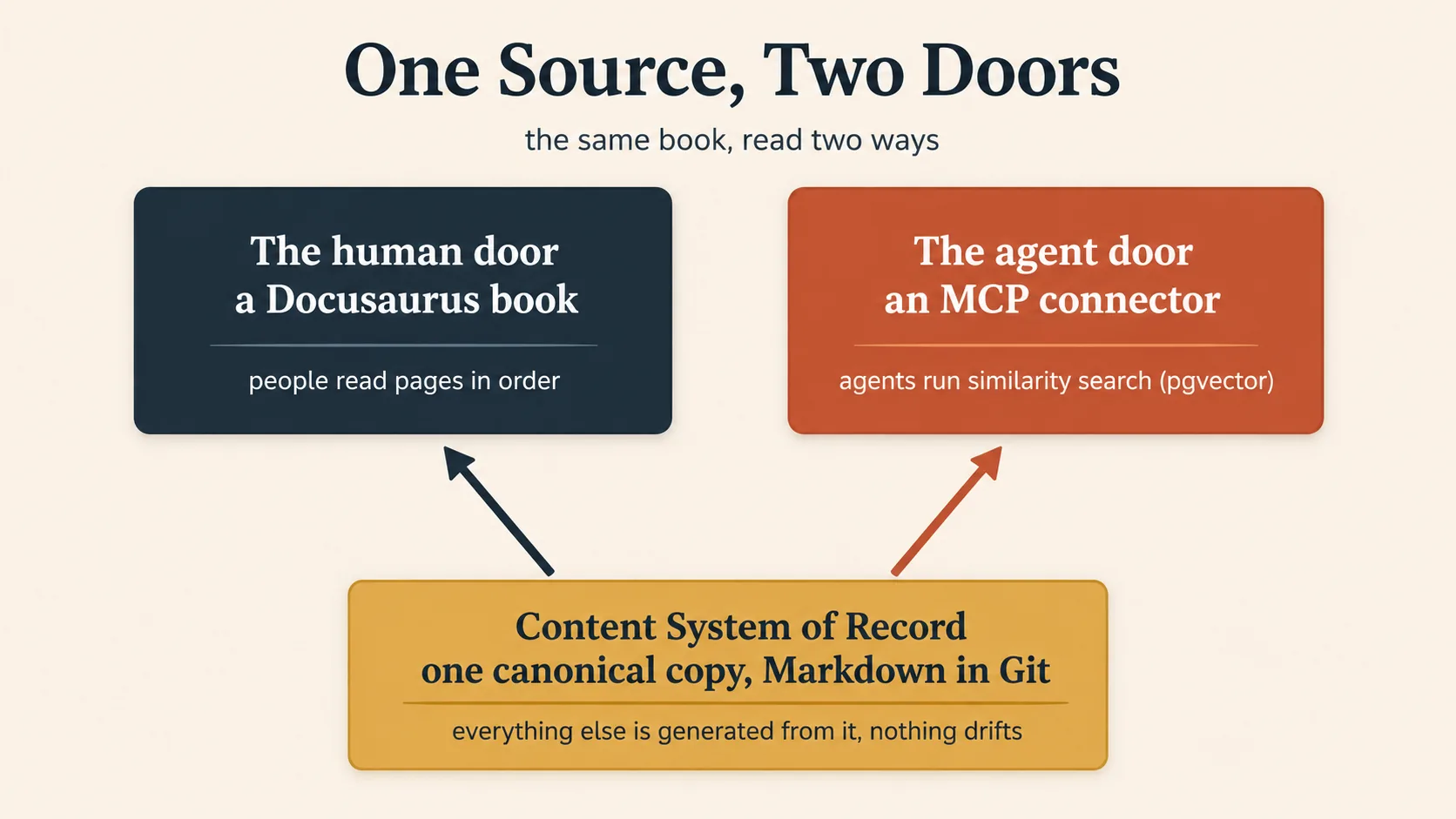
If you are not technical, read the next paragraph for its shape, not its parts. The shape is simple: one canonical copy of the book, and everything else generated from it.
Beneath both doors sits one stack. The canonical book lives in Git as MDX (Markdown extended with components) and is ingested into one Postgres: vector search for meaning, keyword and full-text for precision. Everything is generated from the canonical copy and re-synced whenever the book changes, so nothing drifts from the source. Consolidate by default, specialize deliberately: the book's own thesis, applied to itself.
The new pipeline looks like this:
Markdown textbook (System of Record) → humans and agents both learn from it → agents built on it teach and build → those agents produce vertical AI workers for businesses.
The shape of the old pipeline is still there. What changed is who can read the book, and who can do the work.
The ladder: four ways to learn from one book
Fix the source, and better readers can stand on it. Each rung keeps everything the rung below had, and adds the thing it was missing.
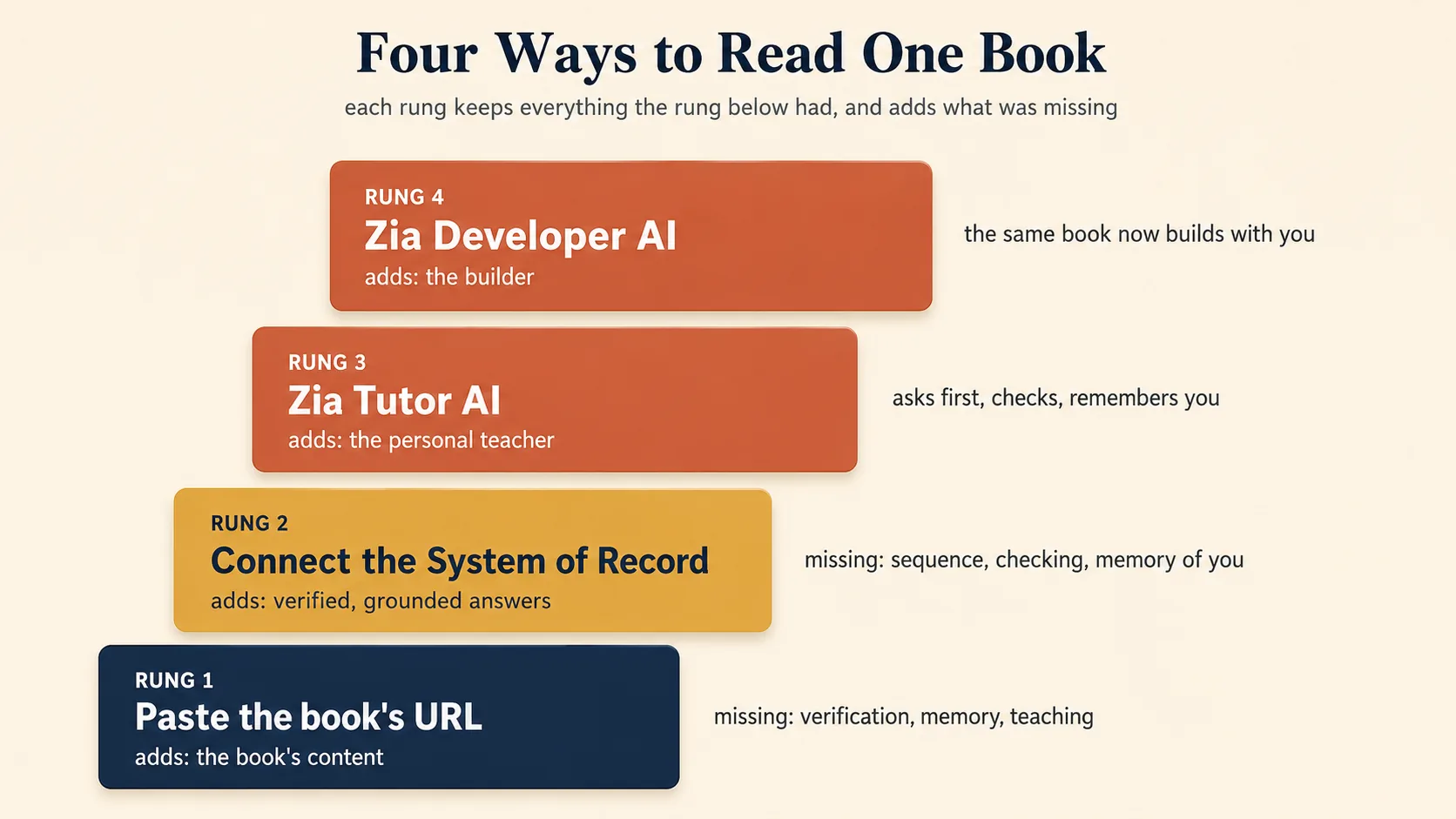
Rung 1: paste the book's URL. Hand any chatbot the book's address and ask away. Better than raw training data, but it skims, nothing is verified, and nothing is remembered.
Rung 2: connect the System of Record. Add one connector and every answer is grounded in verified chapters. What is still missing is everything a teacher adds: nobody chooses your sequence, checks your understanding, or remembers that you were ever there. Content is not teaching.
Rung 3: Zia Tutor AI. The SoR plus the personal teacher. Zia Khan is the author of this book and the voice it is written in, and Zia Tutor AI is his digital twin, built from the four things an ordinary AI teacher does not have. The Knowledge Record is the SoR itself: what to teach. The Identity Record carries his voice, his principles, and his instructional method. Your Learner Record holds your goal, what you have demonstrated, and your next step. Your personal profile holds your background and how you like to learn, yours to see and change.
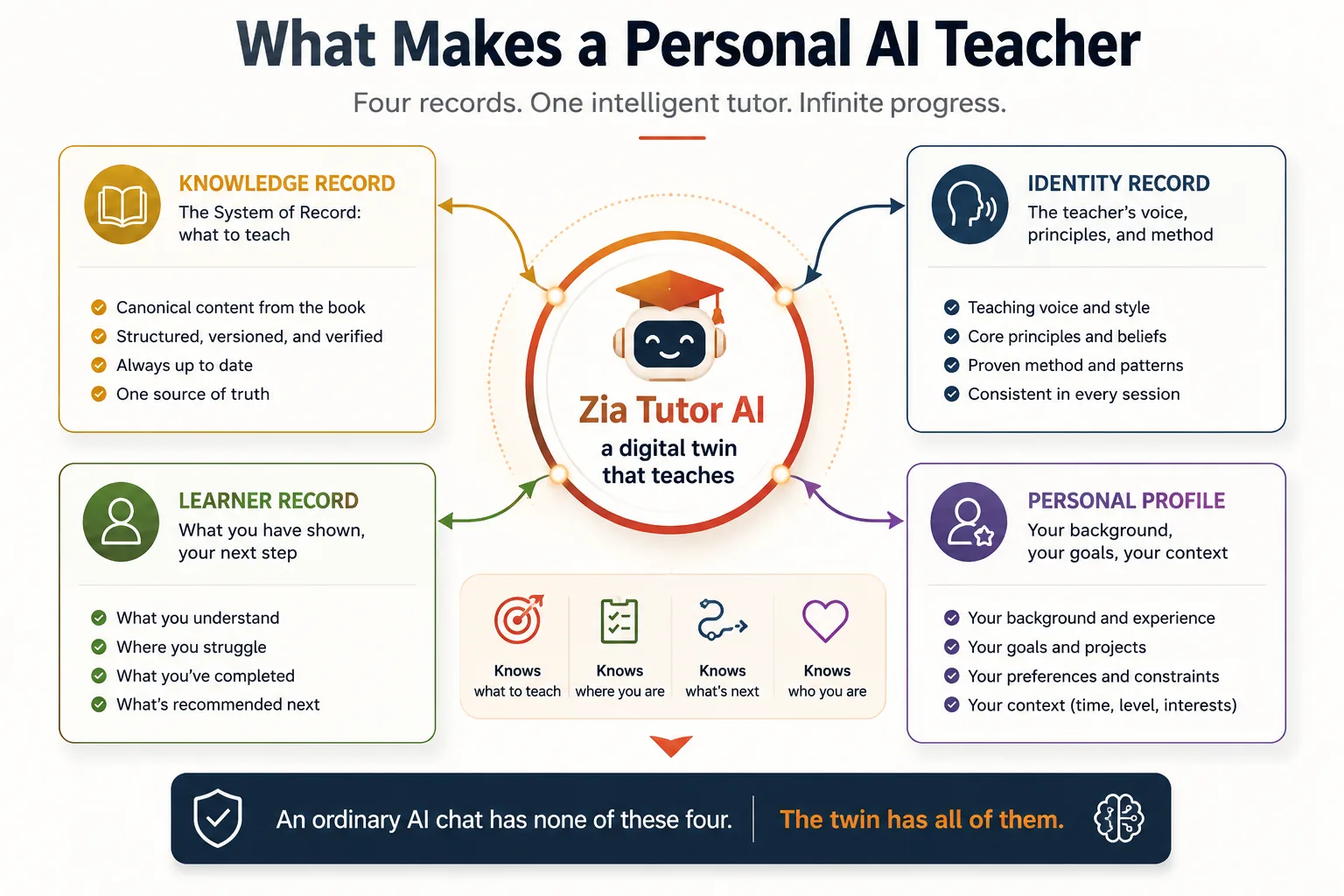
It asks before it teaches, checks understanding before it advances, and when you return days or weeks later, "continue where I left off" actually works. It runs inside free Claude: one connector and one skill. Nothing to install, nothing to pay. This is the rung the old world could never print: the one-on-one session from the best teacher, finally at scale.
Rung 4: Zia Developer AI. The developer role, restored. The same book that teaches you now builds with you.
The System of Record and Zia Tutor AI are live in Beta 1, and you can connect both now. Zia Developer AI is in development. What follows is what it is being built to do.
Why this is not an LMS
Every era of education has a defining system. In the last era, that system was the LMS. Moodle and Blackboard were software that managed learning: they enrolled you, collected your assignments, and stored your grades, and they never taught a single lesson. Teaching stayed scarce, rationed one classroom at a time.
Zia Tutor AI is best understood not as a product but as the defining system of the next era: a Personal AI Teacher. One system holds the governed content, teaches it in a real teacher's voice and method, and keeps your record as you learn. It fuses the three jobs that were split between the textbook, the teacher, and the LMS, and gives them to every learner personally. And it is a template, not a one-off: every vertical expert twin this book teaches you to build is the same shape for its own profession.
Zia Developer AI: the same book, construction lane
In the old world, the developer built from the same textbook the student learned from. Zia Developer AI restores that loop for the agent era: a layer on top of your coding agent, a Claude Code plugin first, with OpenCode and others to follow, that reads the same System of Record.
You describe the outcome. It selects the right architecture from the book, writes the spec, builds the agent, tests it, and installs it.
It starts deliberately small, in baby steps, on two slices of the book: the Agentic Coding Crash Course and Loop Engineering. These commands show the shape:
/vloop: "Build me a loop that plays the Pakistani national anthem every 10 minutes." It designs the loop (trigger, body, memory), builds it, tests it, and installs it, the way Loop Engineering teaches./vsor: "Build a System of Record of famous Pakistani dishes." It builds the working frame of a vertical SoR: schema, ingestion, Postgres with vector search, and an MCP server on top, the same shape as the book's own./vtutor: "Build a tutor on that System of Record." A Zia-style tutor for any domain: persona, pedagogy, learner record.
The /vsor command also shows how the building works. It does not start from a blank folder. The System of Record ships with sample repositories: working copies of the SoR kernel, with the schema, the ingestion pipeline, and the MCP server already in place and already tested. The agent takes one and adapts it to your domain: your schema, your content, your connector. Building from a proven copy is faster than building from a description, and the result inherits every fix the kernel has already received. When the kernel improves, the next vertical built from it starts better than the last one did.
The commands are training wheels. The destination is an agent that judges for itself which loop or component your problem needs: you state the requirement, it chooses the pattern. More and more of what it builds will be loop-shaped, because more and more real problems are.
The same move, for any domain
Look at what /vsor implies. The Agent Factory's SoR is not a one-off. It is the first instance of a repeatable kernel. The same component can hold many different collections of knowledge: an accountancy body of knowledge, a bank's policy manual, a cuisine, a curriculum. Fix the kernel once, and every instance inherits it.
Here is where the combination becomes powerful. The Agent Factory SoR teaches how to build agents. A vertical SoR teaches what the profession knows. Put the two together and you have the general equation of the whole ecosystem:
Agent Factory SoR + Vertical SoR = the complete governed knowledge to teach and build that vertical's AI workers.
Take sales as the first instance:
Agent Factory SoR + Sales SoR = everything needed to understand, teach, and build sales AI workers and sales Digital FTEs, AI employees that carry a full role.
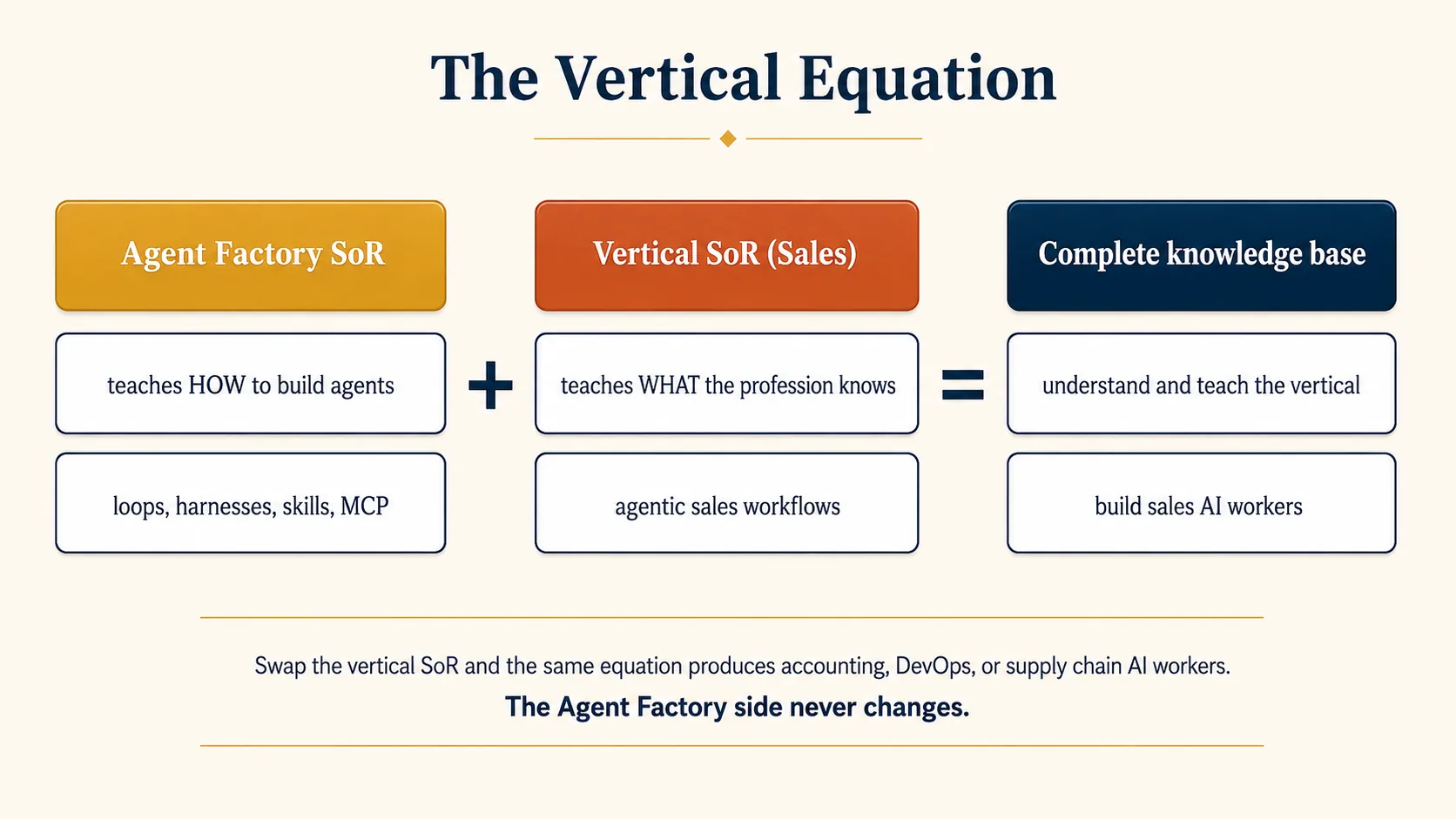
The same equation works for every domain, and every vertical gets the same three pieces the Agent Factory has: a System of Record, a tutor twin, and a developer agent. Swap the Sales SoR for the Accounting SoR and you get accounting AI workers. The Agent Factory side of the equation never changes. Only the vertical side does.
The first verticals on the build list run through the middle of every company: sales, marketing, human resources, supply chain, and past them, any profession with a body of knowledge worth governing.
A kit, not a sealed product
So how do you build one? That is the next section of the book, now in progress: Building the Vertical FDE Harness, the working framework you build your own System of Record with. The method for it is already written and live: choose your vertical, then design its System of Record from first principles. The harness is what turns that method into a running system.
And the harness makes explicit what is true of the whole ecosystem: it is built from atomic, open-source components meant to be built on, not just used. The vertical SoR framework, the harness templates, the sample repositories the developer agent builds from, the kernel patterns under the book's own SoR: each is a starting point you can take, adapt, and own. Nothing in the stack is a sealed product. It is a kit. Assemble your vertical from it, and what you assemble is yours.
Platform as a plugin, and why the cost is near zero
The whole shape has a name inside the team: platform as a plugin. A vertical does not ship as a new app for anyone to adopt. It arrives as plugins and connectors on the AI apps and coding agents its users already run, carrying its System of Record with it. That is also what makes the economics work from anywhere: the plugins bring the tools, and the user brings the model. The intelligence is supplied by the free tier of the AI app they already use. Your costs are a small server and a database, so value scales to hundreds of thousands of people without the LLM bill that usually caps reach. The book teaches you to build every piece: Connector-Native Apps, Plugins for AI Agents, RAG on Postgres.
Four rules that travel with it
The concept is not only technical. Four business rules travel with the whole shape, straight from the book's spine:
- Never build what locks you in. The big labs' forward-deployed engineers lock every client into one vendor's platform. This book trains the vendor-neutral vertical FDE.
- Proof replaces the pitch. You will have no salesforce, and you will not need one: in the agentic era, deployment is the sales motion. Working proof, built on the buyer's own data, does the persuading.
- Carry your own suitcase. Your method and your governed knowledge are what you carry in: assets you own, not access someone grants you.
- Select your vertical, then go deep. One profession, one expert partnership, one System of Record that everything else stands on.
How these become a working business, layer by layer, is the job of The FDE AF Model: that page owns the business model, and this one only names its rules.
The final step: 80 percent built, 20 percent customized
There is one more step in the pipeline, and it is where the ecosystem meets real customers and real careers.
The vertical developer agents do not build finished products for a general market. They build vertical agents that are about 80 percent complete. The remaining 20 percent is customization for a specific customer: their data, their rules, their integrations, and the unusual cases only they have.
Make it concrete. A Sales SoR gives a sales agent its 80 percent: the qualification method, the discovery questions, the objection answers, the follow-up rhythm. The FDE's 20 percent is everything only this customer has: their CRM fields, their pricing limits, their approval chain, and the one rule only their legal team enforces.
Notice what is new here, because the software industry could never afford this combination before. In the SaaS era, when software was sold as an online subscription, one product served every customer, and customization meant settings and checkboxes, because human developers made real customization too expensive to deliver at scale. Fully custom software existed, but only for customers who could pay heavily for it, and each custom build froze on delivery: it stopped inheriting improvements the day it shipped. AI changes the arithmetic on both sides. Agents make the 20 percent of real customization cheap enough to deliver to every customer. And the 80 percent base stays common across all of them, continuously updated from the Systems of Record, so every deployment keeps inheriting fixes and improvements after it ships. Custom like hand-built software, always current like SaaS: the agentic era is the first time one product can be both.
The 80 percent is the repeatable core. It comes from the two Systems of Record, so it is grounded, tested, and shared across every deployment. The 20 percent is the part that only a human who understands the customer can direct. That human is the Vertical FDE, the forward-deployed engineer this book trains, carrying two suitcases: the technical suitcase this book packs, and the domain suitcase you already own, deepened by your vertical's SoR. The customization work is where the FDE earns, and the shared 80 percent is why they can deliver fast.
There is a second reason the split works, and it comes from how coding agents behave. Point a coding agent at a problem with no spec, the style people call vibe coding, and it will choose any library, any framework, and any workflow it likes. Run it twice and you get two different systems. The known cure is a detailed specification, but writing a full spec for every project consumes much of the time the agent was supposed to save. The Systems of Record break that trade. The Agent Factory SoR and the vertical SoR together are a spec that is already written: the architecture, the patterns, and the profession's workflows are decided once and governed. So the FDE does not write the whole spec. The FDE writes only the thin spec that customizes the solution for this customer, and the record supplies the rest.
Do not confuse this 80/20 split with the 10-80-10 rule that runs through this book. They divide different things. The 10-80-10 rule divides one task by who does it: humans open with intent, AI executes the middle, humans close with judgment. The 80/20 split divides the product by what is shared: the core every customer gets, and the customization one customer needs. The two rules nest. When the FDE delivers the 20 percent, they run 10-80-10 on it. The FDE writes the spec, agents build the customization, and the FDE verifies it before the customer sees it. The FDE's job, in one line, is supplying the first ten and the last ten on the customer's twenty.
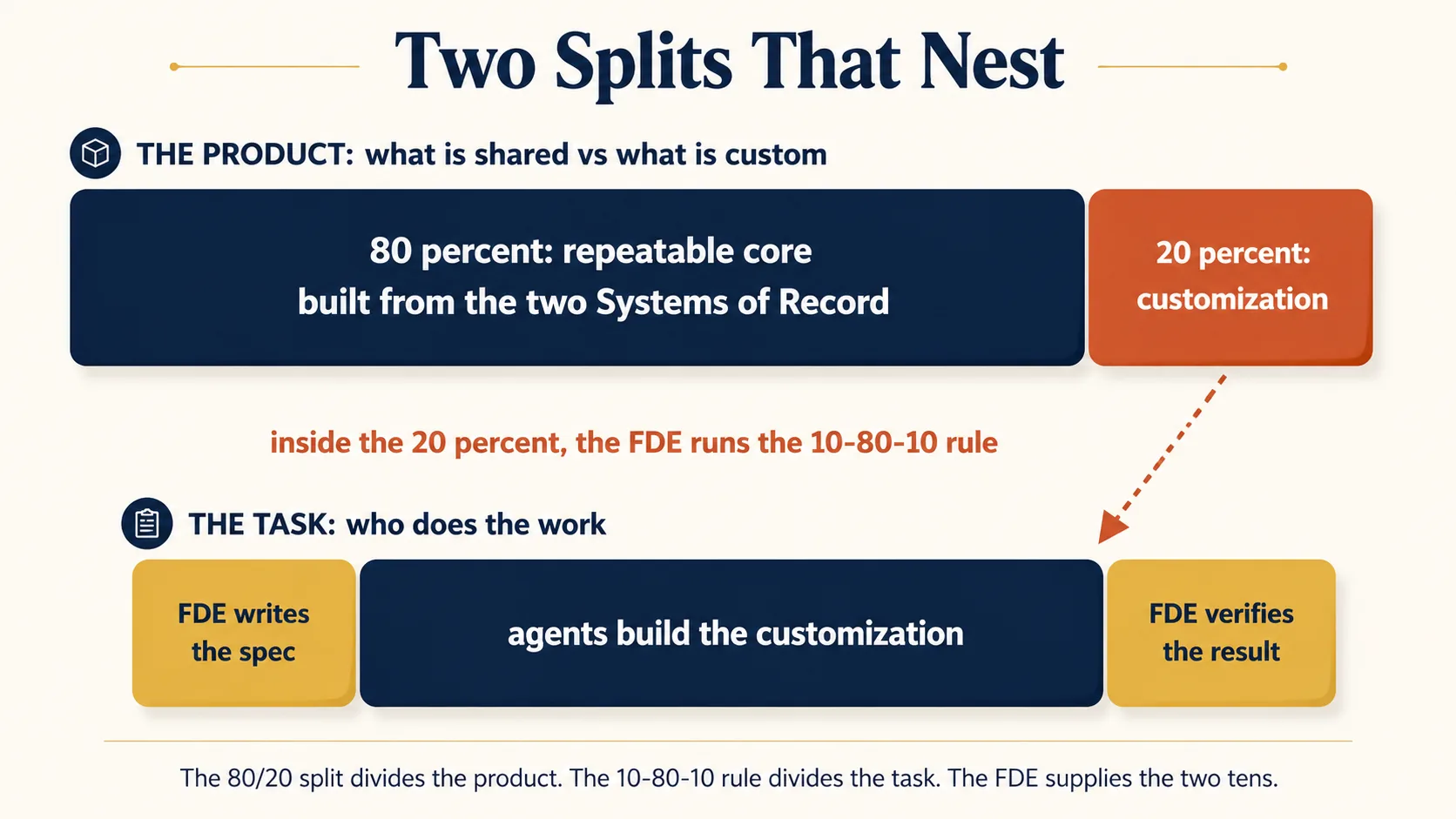
So the full pipeline, end to end, reads like this:
System of Record → tutor and developer agents on it → a vertical SoR beside it → an 80 percent complete vertical agent → a human FDE delivers the last 20.
Where this page leads
The story you just read is shipped, and each piece has a door:
- Connect the source: Agent Factory System of Record. Ground any agent in the book, today.
- Meet the teacher: Zia Tutor AI. Say "Teach me the Agent Factory."
- Watch the builder: Zia Developer AI. The construction lane, in development.
- Learn the business: The FDE AF Model. Five layers, and where each one earns.
- Build your own: choose your vertical, then design its System of Record, then connect the records to real work.
- Start learning: Getting Started: Crash Courses, or the guide on how to learn from this book.
The old textbook taught the student who became the developer. This one does more. It teaches you, it teaches your agents, and then it hands you its own open components, so the next System of Record, the next expert twin, the next vertical is one you build and own. The story on this page ends exactly where yours begins.