The AI-Native Transformation: From Adoption to Advantage
From experimentation, to transformation, to native. Most companies have already adopted AI. Almost none have been changed by it. This chapter is about the difference.
📚 Teaching Aid
View Full Presentation — AI-Native Transformation
The gap nobody talks about
Every company you compete with has access to the same models you do. The frontier is, increasingly, a public utility — the per-query cost of frontier-class AI has fallen by orders of magnitude in barely two years, and capability keeps climbing. And yet, for most firms, that abundance has not turned into advantage. Individuals report that AI saves them hours. Their organizations, more often than not, report that little has changed at the level that shows up in results.
This is the central paradox of our moment: AI adoption is near-universal, and AI advantage is rare. Adoption is cheap. It is a license, a login, a Slack integration. Advantage is expensive — not in dollars, but in courage, because advantage requires you to rebuild the way your company actually works.
The numbers are blunt. MIT's NANDA initiative, in its 2025 study of enterprise AI, found that 95% of deployments delivered no measurable impact on the P&L — only one in twenty produced real financial return. Its diagnosis was not the models but a learning gap: tools and organizations that never adapt to each other, so the AI speeds up a task without reshaping the work around it. McKinsey's read of the same landscape lands in the same place — roughly eight in ten companies have deployed generative AI, and roughly eight in ten report no material effect on earnings. The verdict is consistent: the barrier is organizational, not technological. The models work. The companies don't.
Bain and OpenAI, writing in Harvard Business Review, gave this same failure a name: the micro-productivity trap. A company falls into it when it treats AI as a plug-and-play SaaS subscription — scattering pilots across the org, lighting up isolated use cases, and accelerating individual tasks while the surrounding workflow still runs on tacit knowledge, manual handoffs, and systems that were never designed for machine intelligence. The task gets faster. The business does not. A worker saves twenty minutes; the output sits in a queue for two days waiting for a human to route it. The gain is real and it goes nowhere. PwC's workforce-consulting CTO Prasun Shah gives the same failure a sharper image: most firms are embedding AI employees into a human operating model — adding sticky tape to an operating model that is already breaking. The tape holds for a demo. It does not hold for a business.
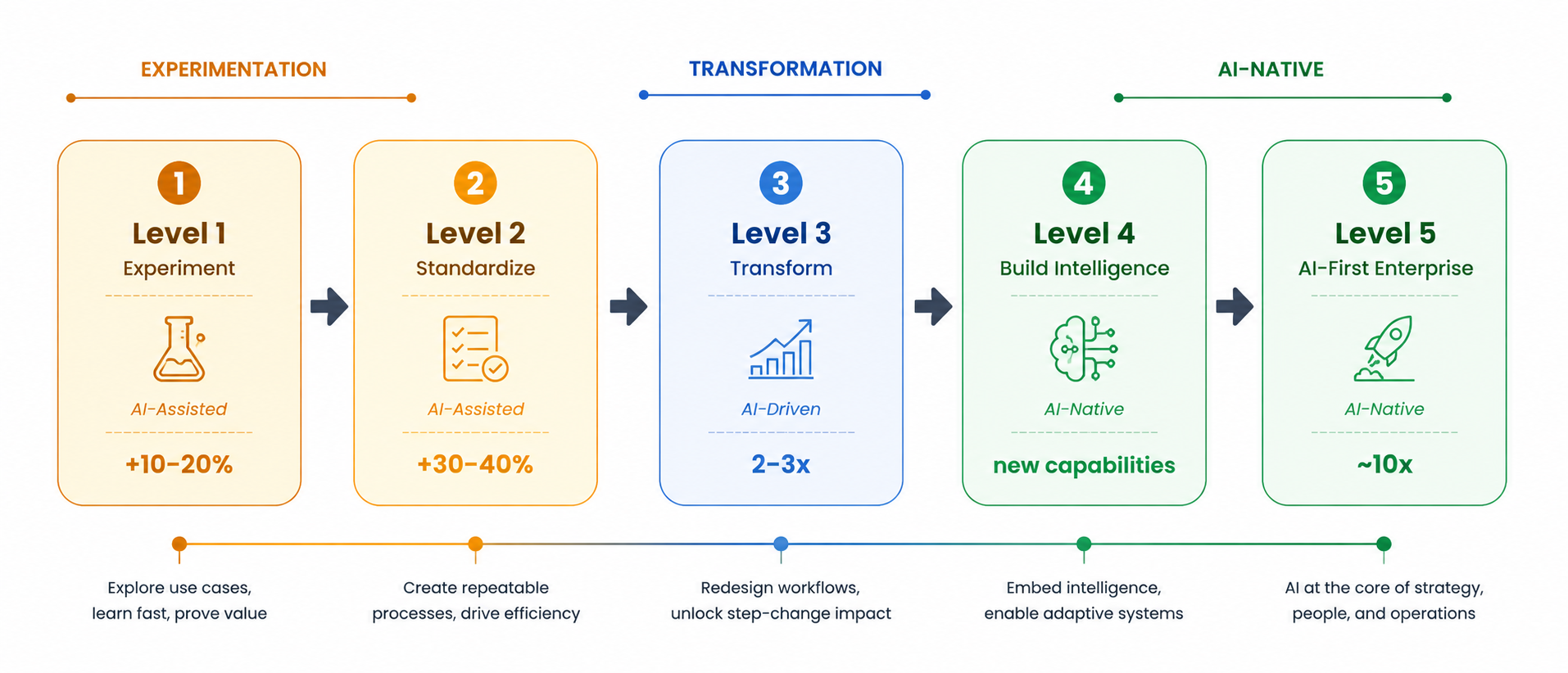
The micro-productivity trap: a faster task feeding a workflow that was never rebuilt for it. The local win is real; it just never reaches the P&L.
The trap has two locks:
- Offering lock-in — using AI only to optimize what you already sell. You make the existing product slightly better, slightly cheaper, slightly faster. You never ask whether the product itself should exist in its current form.
- Process lock-in — using AI only to automate the process you already run. You pour intelligence into a workflow that was designed for a world without intelligence. You pave the cow path.
Companies caught in both locks are doing AI. They are not being transformed by it. The firms that break out share one trait: they stop asking "how do we improve this task?" and start asking "what is this business actually for, and how would we build it if powerful AI had always existed?" Bain reports that the clients who make this shift — still a small early-adopter cohort — are seeing 10–25% EBITDA gains that compound as the program scales — not micro-productivity, but margin you can see from the boardroom.
This book exists to get you out of the trap. To do that, you first have to know which posture you are standing in.
Three postures: Experimentation, Transformation, Native
There are three ways a company can relate to AI. They are not three brands of the same thing. They are three different relationships with reality, and you cannot skip from the first to the third.
| Posture | The question it asks | Where AI lives | What changes |
|---|---|---|---|
| AI Experimentation | Can this tool help me? | On the edge of the org, in pilots and individual hands | People work faster |
| AI Transformation | How should this workflow be rebuilt? | At the center of redesigned processes | The way work flows changes |
| AI-Native | What is this company, written down? | In the operating core — AI is the workforce, not the helper | The business model itself changes |
In plain English. Experimentation means people use AI tools. Transformation means workflows get redesigned around AI. AI-Native means the company itself is built as a system of human principals, AI delegates, and Digital FTEs — the work is done by the AI workforce, and humans set direction and verify results.
That last row is the whole game, and it has a unit. An AI-native company's workforce is built from Digital FTEs — role-based AI employees that own a job end-to-end, not features that help a human do it. Hold the term; it is what everything in this chapter ultimately resolves to. (We earn the full definition in the architecture.)
Map these onto the maturity ladder this book uses throughout:
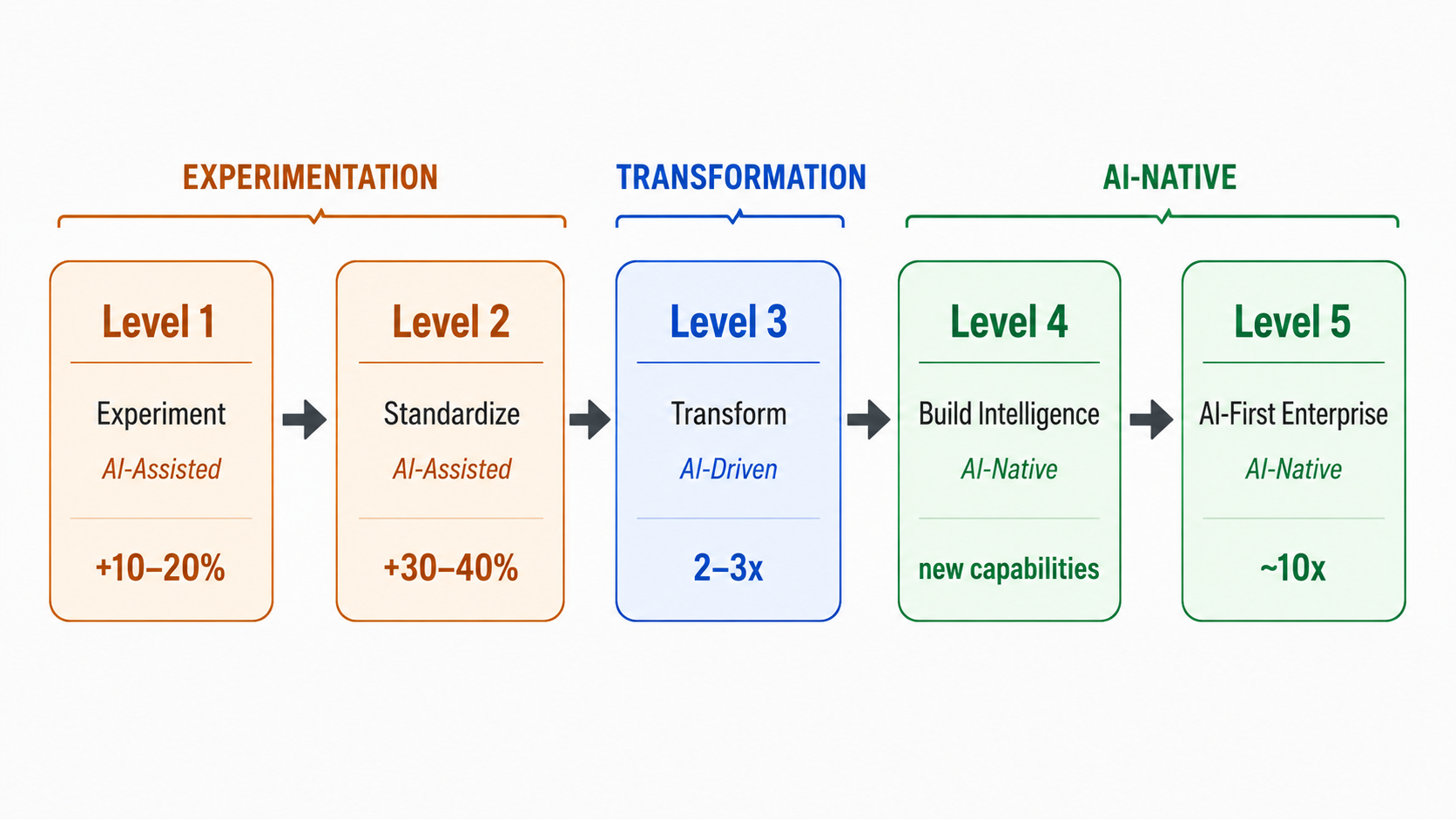
The three postures are not a separate scheme — they are this ladder, grouped. Experimentation is Levels 1–2: AI in individual hands, then standardized across the org. Transformation is Level 3: workflows rebuilt around AI. Native is Levels 4–5: the company itself built out of AI. Same spine, two resolutions.
You cannot skip levels. A company that tries to build AI-native products before its people have internalized AI-assisted work will fail — not because the technology isn't ready, but because the organization isn't. Experimentation builds intuition. Standardization builds trust and governance. Only then can transformation — rebuilding workflows around AI — actually hold. And only a transformed organization has the muscle to go native, where AI stops being a thing the company uses and becomes the thing the company runs on.
This is not only our framing — the destination already has names, and they are converging. Microsoft calls the company built around human-agent teams the Frontier Firm, and the new role inside it the agent boss: every employee a manager of agents rather than a doer of tasks. McKinsey calls the same end-state the agentic organization — and finds only about 1% of companies run the decentralized-network operating model it is built on, against 89% still running an industrial-age operating model. The labels differ; the claim is the same. The AI-native company is not a forecast — it is a paradigm a small set of firms already occupy, and the gap is opening fast: at Frontier Firms, 71% of workers say their company is thriving, against 37% elsewhere.
How to tell where you actually are. Posture shows up in where the money sits and what gets measured — not in the press release.
| If… | …you are |
|---|---|
| AI lives in IT or an innovation lab, and success is counted in tools adopted and pilots run | Experimenting |
| AI lives inside the business functions, and success is counted in workflow KPIs — cycle time, win rate, cost-to-serve | Transforming |
| AI is the workforce, and the company is measured by the outcomes that workforce ships | Native |
Read the row you actually live in, not the one you aspire to. Most leaders are one row lower than they think.
Most of the world is stuck between Level 1 and Level 2: lots of experiments, no standard, no advantage. The rest of this chapter is the bridge from there to native.
The four moves of transformation
Reaching Level 3 is not a procurement decision. It is a redesign. Bain and OpenAI distilled the firms that crossed this line into four moves, and they map cleanly onto how this book teaches you to build. We restate them here in the language of the Agent Factory. These four moves get you through transformation — to Level 3. Going native, Levels 4 and 5, is the work of the rest of this book; this chapter's job is to get you standing in the right posture to begin it.
Move 1 — Narrow ruthlessly
AI touches every function, which is exactly why the instinct to deploy it everywhere is the instinct to fail. The companies that win resist the spread. They pick four or five domains with the highest concentration of repeatable work and the clearest value, and they concentrate there. Software development, customer support, knowledge work, and marketing surface again and again across industries — but your domains are yours to find. McKinsey calls these lighthouse domains: a few high-value areas you rewire end-to-end and learn live, chosen partly because their success is visible enough to pull the rest of the company along behind them.
Ask the questions that narrow the field:
- Where is work most repeatable and resource-heavy today?
- Where are people bottlenecked — high value trapped behind low-leverage effort?
- What is high-value and low-effort to change?
- What do we build, what do we buy, and where do we partner?
One Fortune-1000 manufacturer in the HBR account — anonymized as FabricationCo — ran a single week-long, cross-functional workshop with frontline operators and managers, mapped its most important workflows end to end, and surfaced fourteen discrete use cases worth tens of millions in aggregate. It then refused to chase all fourteen. By concentrating on a small subset with near-term payoff, it put itself on track for roughly $30M in additional profit. Lowe's, partnering with OpenAI, narrowed in the same spirit — to the single core thing it exists to do: help customers complete projects.
The discipline is subtraction. A long list of use cases is not a strategy. A short list you will actually finish is.
Move 2 — Reimagine the workflow, don't automate it
This is the move most companies skip, and it is where the value lives. The hard part of AI transformation is not the technology. It is the process redesign. Automating a broken workflow gives you a faster broken workflow.
Reimagining means starting from the outcome the process is supposed to produce and rebuilding from a blank page, with AI assumed at the center. Take FabricationCo's quoting process. In the old world, design engineers spent hours producing a full engineered design for every bid — including the more-than-half that never converted. The redesigned workflow flips the order of effort: a non-designer produces a rapid twenty-minute cost estimate for early-stage bids, and full engineering is reserved for the opportunities most likely to close. The result was quote generation roughly fifteen times faster, less wasted effort, and better bid economics. They did not make the old process faster. They made the old process unnecessary.
This is the difference between process lock-in and outcome thinking. Lock-in asks "how do we automate quoting?" Outcome thinking asks "what does a quote do for the customer, and what is the fastest path to that outcome in a world with AI?" The second question is the one this entire book is built to answer.
Move 3 — Engage those closest to the work
Start with what is uniquely new here. As work shifts onto agents, the front-line role inverts: the individual contributor stops doing the task and starts directing the agents that do it — what Microsoft calls the agent boss. That changes the most important staffing question a transforming company asks.
The question is no longer "how many people do we need?" — it is "what is the right human-agent ratio for this work?" How many agents per role, and how many humans to set their direction and own the result. Get the ratio right, task by task, and the transformation holds; get it wrong and you have either expensive humans doing agent work or unsupervised agents doing damage.
The scale is what makes this non-optional: McKinsey estimates that by 2030, roughly three-quarters of current jobs will require redesign, upskilling, or redeployment. You cannot redesign that much work — or set the right human-agent ratio for it — from a conference room. Transformation is neither top-down nor bottom-up — it is both at once. Leaders set the vision and own the targets; the people who do the work every day own the redesign, because they are the only ones who understand the process well enough to reinvent it, and the only ones whose buy-in makes the new process stick. Three tactics get them into it:
- Recruit the best individual contributors, not just managers. The person who has already found their own quiet AI workaround is your most valuable transformation asset.
- Build a culture of prototyping everywhere, not just in the tech team. Hackathons and micro-sprints turn anxiety into momentum. A skeptical employee who sees a rough wireframe of the new way of working becomes an advocate faster than any memo could make them.
- Pilot visibly, scale on confidence. FabricationCo rolled out region by region, but invited the next regions to watch the pilots, sit in on feedback sessions, and see the wins before their own turn came. Lowe's piloted Mylow Companion in one or two departments per store — plumbing, electrical — refining prompts, guardrails, and UX on real associate feedback before expanding. That tool now runs across more than 1,700 Lowe's stores. The lesson: do not announce a transformation. Demonstrate one, and let it pull the rest of the org forward.
Move 4 — Measure what matters (and keep measuring)
"Productivity" and "efficiency" are not metrics. They are alibis. Real transformation ties AI to business outcomes you can compare against the non-AI baseline. McKinsey puts the rule bluntly: stop writing objectives like deploy AI and start writing them like lift retention by X points or cut time-to-market by Y days — every initiative tied to a number a CFO already tracks.
FabricationCo did not measure "engineer happiness." It measured win rate on AI-generated quotes versus traditional ones, quote turnaround time, downstream margins, and pricing accuracy — and saw a ten-percentage-point win-rate increase within three months. Lowe's tracked basket size, conversion, and incremental sales, alongside leading indicators like associate knowledge and customer satisfaction. When customers engage Mylow online, conversion more than doubles.
The choice of metric is itself a lever. One enterprise working with the agent platform Ema swapped tool-level metrics — cost per query, model accuracy — for outcome metrics like the share of contracts reviewed without human escalation, and reported its measured ROI tripling within two quarters: once the metric rewarded outcomes, the team stopped building point solutions in low-value workflows and concentrated where the outcome value was highest. What you choose to measure decides where you build.
But there is a second kind of measurement that traditional software never required, and that every AI-native company must master: the eval. Traditional software is deterministic — the same input returns the same output, so you test it once and trust it forever. An AI workforce is probabilistic: like a human, it can give different answers to the same question. You are managing behavior, not debugging code — and behavior drifts. So you evaluate it continuously, against a defined range of acceptable outputs. Lowe's built exactly this: subject-matter experts authored expert-validated responses, then scored model behavior against them and tuned the system until it cleared the bar. Evals are to AI systems what unit tests were to traditional code — except they never stop running. This book treats the eval not as an afterthought but as a first-class artifact of every Digital FTE you build.
What "AI-Native" actually means
Here is the claim most of the industry gets wrong. People hear AI-native and reach for tooling: better models, vector databases, an agent framework, an orchestration layer. Those things are real and they help. They are not what makes a company AI-native. To see what does, follow this book's own first principle all the way to its conclusion.
This book rests on a single discipline: spec-driven development. You do not get good software from a vague request — you get it by making intent explicit, by writing the specification precisely enough that an agent can execute against it. Ambiguity is the enemy, because an agent can act only on what has been made explicit. Every technique in these pages is an application of that one idea.
Now scale the idea up. A company is not different in kind from a piece of software; it is the largest system you will ever specify. It runs on decisions — what an account is, what a deal is, what counts as a customer, which system is authoritative when two of them disagree, who holds the authority to revise that answer. In a human-run company, none of these has to be written down. People absorb them over years on the job and paper over the gaps with judgment. The company functions because so much of it is left unstated.
Hand that work to a Digital FTE and the unstated stops working. An agent has no tacit judgment to fall back on — it cannot infer what the business never decided. So becoming AI-native is not, at root, a technology project. It is the act of specification turned on the firm itself: the company writes itself down. Engineering can build the tables; engineering cannot decide what a customer is. That belongs to whoever runs that part of the business — and most have spent their whole lives avoiding it, because until now nothing forced the question.
This is why spec-driven development is not merely how you build a feature in this book. It is how you build a company. The Seven Invariants laid out in the Thesis are the load-bearing form of this discipline: the decisions that must hold true, stated once and explicitly, before any agent can be trusted to act on the firm's behalf. Write them down and the work becomes delegable. Leave them implicit and your Digital FTEs inherit the same ambiguity your people have been quietly absorbing for years — except an agent cannot absorb it. (Operators have reached the same conclusion from the shop floor; we reach it from the spec. That two roads arrive at the same place is the strongest evidence it is true.)
When a company writes itself down, two layers come into focus — the Two-Layer Model that organizes this entire book:
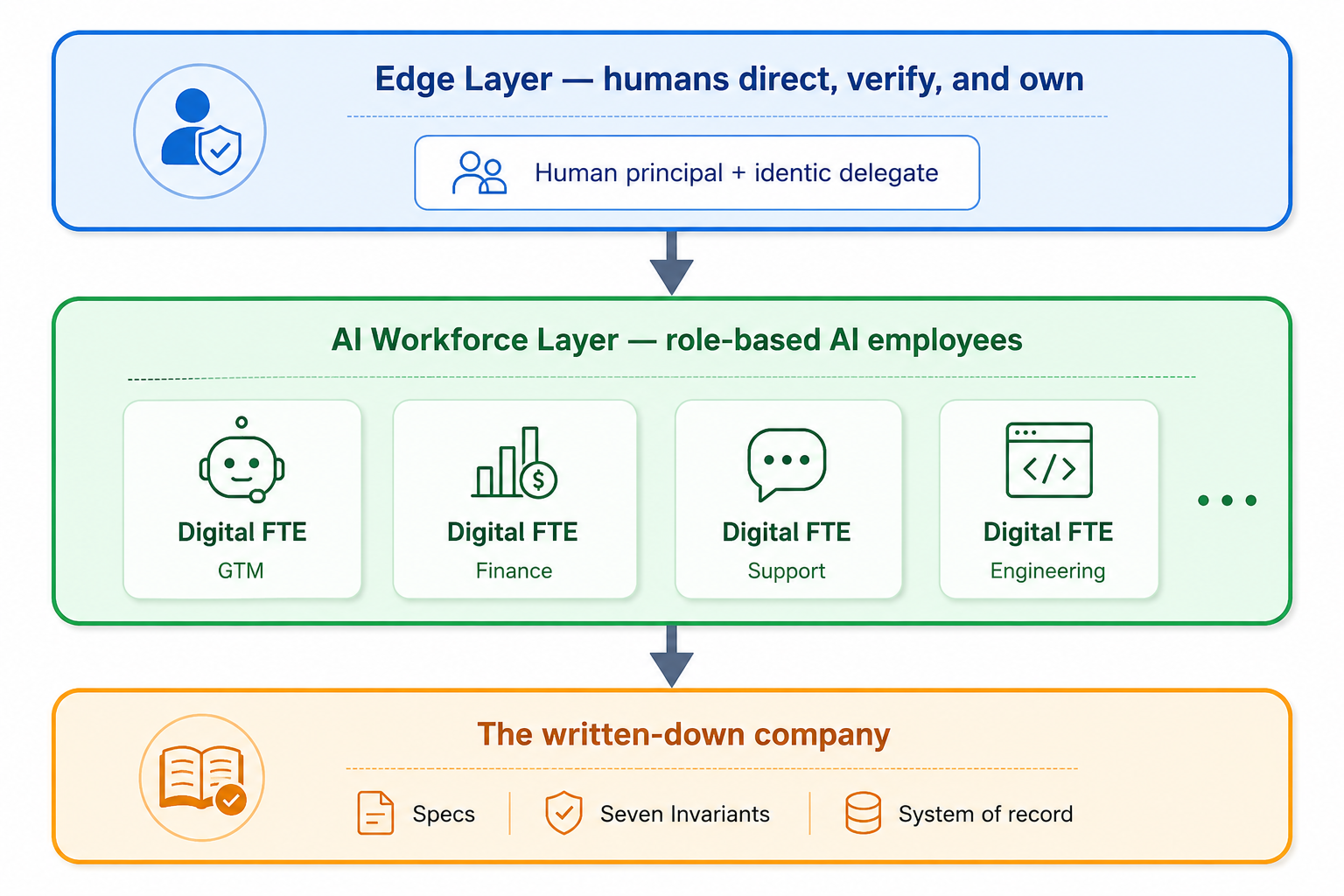
In an AI-native company, the AI Workforce Layer is not a feature bolted onto the product — it is the workforce, and most of it is no longer human. Each AI employee, or Digital FTE, is a domain expert — in GTM, finance, support, engineering, HR, legal — captured as a role-based agent that works around the clock, runs against the company's system of record, and is hired, assigned, and retired like any other worker. What such a company sells is no longer software but whatever its AI workforce ships: decisions, services, transactions, outcomes. You do not buy a product from it. You hire it.
Three words hold this apart, and the rest of the book depends on keeping them straight. The Agent Factory is the process that builds the workers. The AI-Native Company is the output — the running firm, staffed mostly by AI, directed by humans at the edge. The Digital FTEs are the workforce that results. This is the destination: not a company that uses AI, but a company built out of it.
And it is not a metaphor. The architecture that makes it real is specified in the Thesis as the Two-Layer Model (human-directed identic delegates at the Edge Layer; role-based AI Workers in the AI Workforce Layer), held together by Seven Invariants: the structural rules a manufactured workforce must obey to stay coherent, governable, and durable.
- The human is the principal — every chain of action traces to a person who owns intent, budget, and outcome.
- Every human needs a delegate — a personal agent that carries their context and authority and brokers the work.
- The workforce needs a management layer — an operating system that hires, assigns, governs, and retires Workers.
- Each Worker picks its own engine (model, tools, cost profile) — reliability and cost matched to the job, not imposed company-wide.
- Every Worker runs against a system of record — agents reason against authoritative state, not against tokens.
- The workforce is expandable under policy — hiring a new Worker is a callable capability, bounded by the principal's envelope.
- The workforce runs on a nervous system — events, durability, and flow control, so work propagates without a human routing each step.
Those seven are the constitution of the AI-Native Company. This chapter has argued why you will build one. The Thesis specifies how.
The AI-powered business model
A transformed company does the same things faster. An AI-native company does different things — and charges differently for them. Transformation changes your cost structure. Going native changes your business model. Four shifts define it.
1. Architecture as the operating core
An AI-native company does not bolt an API onto a legacy system. It rebuilds its processes, its workflows, and its lines of authority around machine intelligence as the core, and lets everything else follow from that. The consequence is structural, not cosmetic. Work that once demanded a corporate army now runs on a lean team of orchestrators, each commanding a workforce of Digital FTEs. Headcount stops being the measure of capacity. A handful of people who direct a thousand agents will outbuild a thousand people who direct none.
2. From seats to outcomes
Legacy SaaS charges per seat — per human who logs in. When the work is done by a Digital FTE, the seat is the wrong unit entirely. An AI-native company prices the outcome, not the login. That move also flips the risk: under per-seat software the buyer pays whether the tool delivers or not, but under outcome pricing the provider carries it — if the Digital FTE doesn't produce the result, the vendor doesn't get paid. You stop competing on features and start competing on whether the work actually got done, with your own revenue on the line. There is no more defensible ground than that.
Intercom shows the principle in the wild. It rebuilt itself around its support agent Fin and now charges $0.99 per outcome — a customer issue actually resolved — backed by a performance guarantee of up to $1M if resolution targets are missed. That repricing turned the company from a vendor of tools into a partner accountable for results, and carried Fin from $1M to over $100M in ARR.
Intercom is one instance of a repricing the whole industry is now naming: Service-as-Software. You no longer buy a tool and supply the labor to run it — you buy the finished outcome, and the software supplies the labor. SaaS sold you the tools; this sells you the workers. NVIDIA's Jensen Huang put it plainly at GTC 2026: every SaaS company becomes an agent platform. The logic is arithmetic — the world's software spend runs to hundreds of billions; the wage bill beside it runs to tens of trillions. An AI-native company is not chasing the software market. It is going after the wage bill.
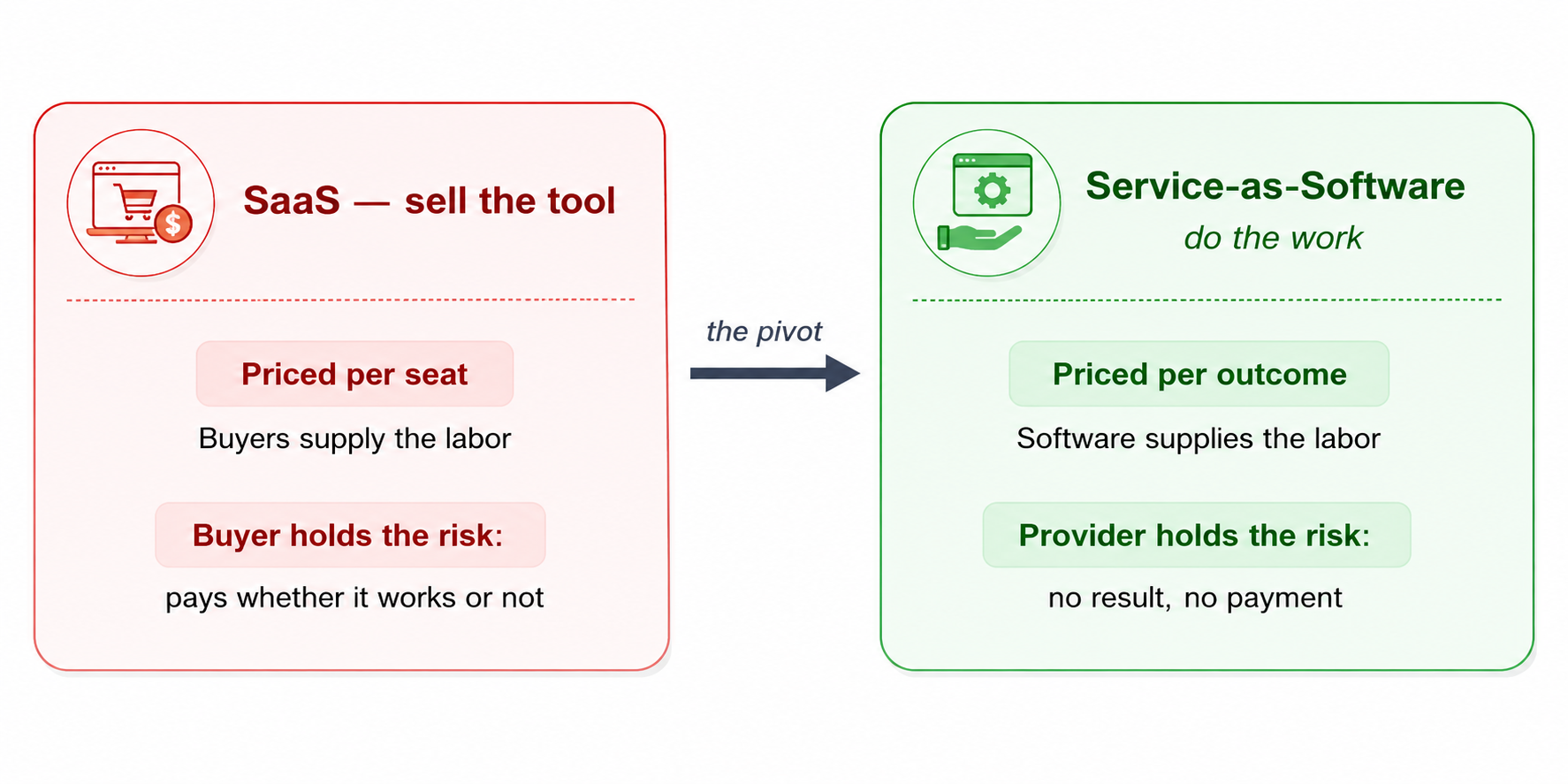
The repricing moves both the unit and the risk. Selling outcomes only works if you are willing to carry the downside of not delivering them — which is exactly why it is so hard to compete against.
3. From player to infrastructure — value-chain control
A mature AI-native product does not stay one tool among many. It moves deeper into the work, takes over the steps that matter, and eventually the industry around it reorganizes to fit. The arc runs from interesting to indispensable — from a feature a customer could switch out to the rails a customer runs on. The Digital FTE is how you walk that arc. Own the worker that does the work and you own the workflow. Own enough workflows and you no longer compete in the value chain. You become it.
4. The Digital FTE as the unit of economics
The whole model resolves to a single, knowable number. A human full-time equivalent has a salary, benefits, working hours, ramp time, and turnover. A Digital FTE has a token cost, a latency, an eval score, and an uptime — all of which trend down and better every quarter as models improve. The economics of an AI-native company are not "software margins on a SaaS product." They are the spread between what a unit of work is worth and what a Digital FTE costs to do it — a spread that widens as the frontier advances and that, in emerging markets especially, rewrites who can afford to build a world-class company at all.
And the model does not stop at pricing. Its furthest edge — the one the Thesis takes up — is the moment a Digital FTE stops merely costing money and starts spending it: buying its own compute, data, and services under a human's budget envelope. The open protocols that let agents authorize and settle payments are already shipping in production, which turns the unit of economics into an economic actor in its own right. That is the frontier the architecture is built to reach.
Why most companies will not make it
A clear-eyed chapter has to say this plainly: most companies that attempt this will fail, and the failure is already visible in the data. Gartner expects more than 40% of agentic-AI projects to be canceled by the end of 2027 — not because the agents can't work, but because of runaway cost, unclear value, and missing governance. The market is thick with "agent washing": of the thousands of vendors selling "agentic AI," Gartner estimates only around 130 are the real thing. The rest are last year's chatbots and automation scripts wearing an agentic price tag.
None of this contradicts the thesis. It confirms it. Every failure mode in the research points back to the same root that the four moves and the Seven Invariants exist to fix:
- The pilot that never integrates is MIT's learning gap — a tool bolted beside a workflow instead of rebuilt into it. The cure is reimagining the workflow (Move 2), not automating the old one.
- The diffuse copilot that moves no needle is McKinsey's horizontal-versus-vertical imbalance: broad assistants that scale fast and change nothing, while the function-specific use cases that would matter stay stuck in pilot. The cure is narrowing ruthlessly (Move 1).
- The agent with no owner is what Gartner is really describing — capability deployed without a principal, a budget envelope, or anyone accountable when it goes wrong. That is Invariant 1 violated: the human is the principal. An agent is only ever as good as the human who directs and governs it.
Two honest caveats keep this out of pure organizational determinism. First, the studies above are largely 2025 consulting and vendor research, much of it self-reported; read the magnitudes as signal, not gospel — the value is that independent sources point the same way. Second, not every blocker is organizational. In regulated, high-stakes work — a bank's credit decisions, a hospital's clinical notes — model reliability is still a real constraint: hallucination, cost that spikes under load, and data-residency rules can stop a well-designed workflow cold. A bank can rebuild its underwriting process perfectly and still stall because no model clears its error bar for an audited decision. The thesis does not wave this away; it engineers for it. That is precisely what the per-worker engine choice (reliability matched to the job), the authoritative system of record (so a Worker reasons against truth, not against tokens), and continuous evals exist to handle. "The models work, the companies don't" is the dominant pattern of 2026 — not a law of nature.
MIT found the same truth from the winning side. The surviving 5% were not the companies that bought the most AI; they were the ones whose systems were tightly integrated into a real workflow and learned from it — and buying from focused specialists or partnering well succeeded roughly twice as often as sprawling internal builds. Narrow scope, deep integration, a learning loop, and a human who owns the outcome: the winners are already doing what this book teaches. The 40% who quit will, almost always, have tried to skip a level.
The whole arc, in one frame
| Experimentation | Transformation | AI-Native | |
|---|---|---|---|
| AI is a… | tool | workflow | workforce |
| What you redesign | a task's speed | the process | the business model |
| The unit | copilot | agent | Digital FTE |
Left to right is the journey of this book. You cannot jump columns; you earn each one.
The boardroom imperative
None of this delegates downward. The single most reliable predictor of AI failure, across every industry Bain and OpenAI studied, is a CEO who recognizes AI as important and then hands it to the technology group with a vague instruction to "improve productivity." Stripped of specific, business-owned targets, those initiatives die quietly.
AI-native transformation is owned at the top or it does not happen. It requires the people with the organization-wide view to set ambitious targets, to decide which four domains matter, to make the uncomfortable decisions about what is authoritative and who has authority — and then to hold the whole company accountable to outcomes, not activity.
So the question this book will ask you, again and again, is not "which AI tool should we buy?" It is:
What would your company look like if it had been built, from the first day, out of Digital FTEs — and what is stopping you from building that company now?
Everything that follows is the answer.
The Thesis specifies the architecture that turns this argument into a company you can actually build — where most of the workforce is AI and seven invariants hold it together.
Flashcards Study Aid
Test Your Understanding
Sources. Full citations live in the book's references; the core sources for this chapter:
- Bain & OpenAI, How to Move from AI Experimentation to AI Transformation, HBR (Apr 2026) — the four moves, the micro-productivity trap, the EBITDA gains, and the Lowe's and FabricationCo cases.
- MIT NANDA, The GenAI Divide: State of AI in Business 2025 — the 95% figure and the learning gap.
- McKinsey, Seizing the Agentic AI Advantage and The Agentic Organization (2025) — the ~80% finding, lighthouse domains, and the agentic organization.
- Microsoft, 2025 Work Trend Index — the Frontier Firm, the agent boss, the human-agent ratio.
- Gartner (Jun 2025) — the 40% cancellation forecast and "agent washing."
- Intercom (fin.ai/pricing; GTMnow, Feb 2026) — Fin's $0.99-per-outcome model, the $1M guarantee, and the ARR figures.
- McKinsey, Rethink management and talent for agentic AI (2025) — the three-quarters-of-jobs-by-2030 redesign figure.
- MIT Technology Review Insights (sponsored content for Ema, May 2026), Rethinking organizational design in the age of agentic AI — the metric-switch ROI example (and the PwC "sticky tape" framing, if used). Sponsored content; primary McKinsey/BCG sources cited where available.
The maturity ladder, the spec-driven foundation, the Two-Layer Model, the Digital FTE, and the Seven Invariants are developed in The Agent Factory Thesis and across this book.