AI Fluency: A Crash Course
4 competencies. 3 ways to work with AI. One practical habit: decide, describe, check, and take responsibility.
Imagine a talented new colleague joins your team. On her first morning you say:
"Prepare a course outline on AI agents."
A few hours later she gives you a polished outline. It is written for PhD researchers. It assumes a full semester. It has almost no hands-on practice.
She was not incapable. You never told her the audience, the time available, the teaching style, or what students should be able to do at the end.
Working with AI is similar, with one difference. A new colleague learns. Tell her once that your students are beginners and she still knows it next month. AI carries nothing from one chat into the next. Every chat opens with a colleague who has never met you, so what you would tell a person once, you say again each time or put where the AI reads it automatically. A memory feature saves notes and sends them into the next chat, so the model itself still starts with nothing.
Even a complete brief does not guarantee a correct answer. AI can invent a fact or a source and still sound sure. Better instructions improve your odds without making the output true, so checking is a separate skill later in this course.
A powerful AI still gives poor results when the teamwork is poor. You need to know what to give AI, how to guide it, how to judge its work, and when not to use it.
That is what AI fluency means.
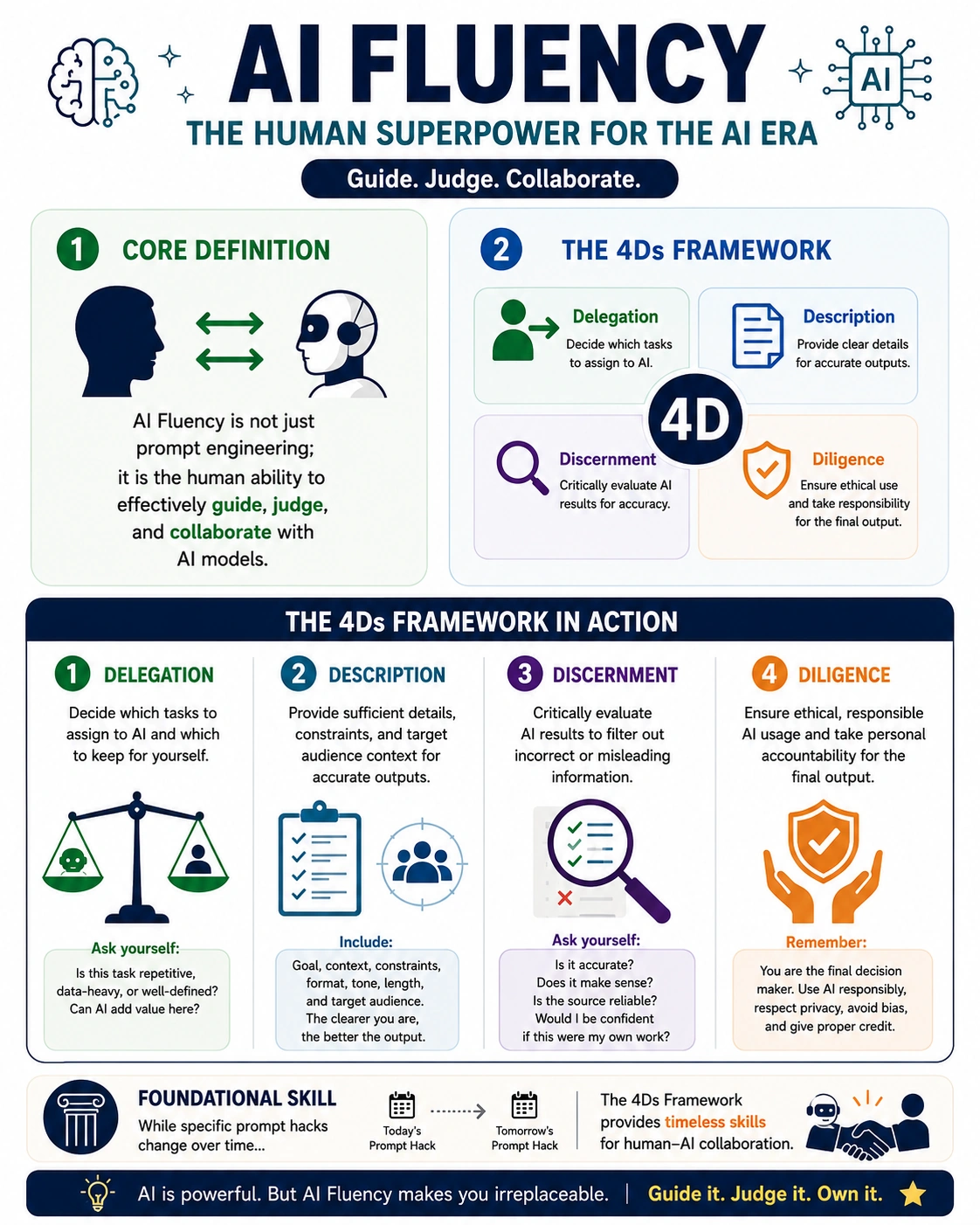
This course teaches the AI Fluency Framework, created by Professor Rick Dakan and Professor Joseph Feller in courses produced with Anthropic. It has four human competencies, called the 4Ds:
- Delegation: decide what AI should do.
- Description: explain what you need.
- Discernment: judge what AI gives you.
- Diligence: use AI responsibly and own the outcome.
You will use these four skills in a chat, in a coding agent, and in a Digital FTE, an AI worker set up to do a defined job for other people. FTE means full-time equivalent, how companies count one full-time worker.
Reading time: about 30 minutes, plus 15–20 minutes for the practice prompts and self-check.
📚 Teaching Aid
View Full Presentation, AI Fluency: the 4Ds
Four questions carry the whole course:
| Competency | Plain-English question |
|---|---|
| Delegation | What should AI do, and what should stay with me? |
| Description | What does AI need to know to do the work well? |
| Discernment | Is the result actually good and trustworthy? |
| Diligence | Is this a responsible way to use AI, and am I ready to own the result? |
Read What AI Actually Is first. It explains the machine, and this course explains how you work with it. AI Prompting in 2026 comes next with the practical techniques.
| Topic | What AI Actually Is | This course | AI Prompting in 2026 |
|---|---|---|---|
| How AI works | In depth | Quick reminder | Assumed |
| How to communicate | Why context matters | Description | Practical prompting techniques |
| How to judge answers | Why confident can be wrong | Discernment | Model-checking habits |
| What to give AI | The jagged frontier | Delegation | Choosing models and tools |
| Responsible use | Mostly out of scope | Diligence | Safe tool use and permissions |
The techniques will change as models improve. The four competencies are designed to last.
Quick glossary
The full list appears again at the end, under Terms this course adds.
- AI fluency: working with AI effectively, efficiently, ethically, and safely.
- The 4Ds: Delegation, Description, Discernment, and Diligence.
- Automation: AI performs a defined task you specify.
- Augmentation: human and AI work together as thinking partners.
- Agency: AI works toward a goal you set and chooses many steps.
- Delegation: deciding what AI does and what humans keep.
- Problem awareness: knowing the goal, the work, the risks, and what success means.
- Platform awareness: knowing which AI system or tool fits the task.
- Task delegation: assigning each part of the work to a human or to AI.
- Description: giving AI the information and guidance the work needs.
- Product description: defining the output you want.
- Process description: defining how the AI should approach the work.
- Performance description: defining how an AI behaves on its own, for its users.
- Discernment: judging whether AI's output, justification, and behavior are good enough.
- Product discernment: judging the result itself.
- Process discernment: judging whether your way of working with AI is paying off.
- Performance discernment: judging whether an AI's independent behavior serves its users.
- Diligence: taking responsibility for how AI is used and for its output.
- Creation diligence: choosing tools and data responsibly before and during the work.
- Transparency diligence: being honest about AI's role when it affects people.
- Deployment diligence: checking AI-assisted work before it is used or sent.
- Context engineering: designing all the information an AI needs: instructions, documents, tools, memory, and policies.
- Automation bias: the human tendency to trust automated output too easily.
- Hallucination: a confident AI output that sounds right but is invented or incorrect.
- Redaction: removing identifying details before you give data to an AI, while keeping the pattern the task needs.
- Digital FTE: an AI worker set up to do a defined job for other people. FTE means full-time equivalent.
- Tokens: the small pieces of text an AI reads and writes, and what you pay for.
- System of Record: the trusted store of a business's official data and rules.
- System prompt: a standing instruction an AI reads at the start of every chat.
- Eval suites: repeatable tests that score what an AI system produces.
See it in three minutes
Open any AI assistant. Paste this and read what comes back:
Write a welcome email for new members.
It will be competent, grammatical, and completely general, because you gave it nothing to work with. Now open a fresh chat and paste this:
Write a welcome email for new members of a small women's cycling club
in Karachi. Most are nervous beginners who have never ridden in traffic.
Warm and a bit funny, under 150 words, no exclamation marks. End by
telling them the Saturday 6am ride is slow on purpose and nobody gets
dropped.
Same model. Same task. Same three seconds of work for the machine.
The second email is better because the request carried what the first one left out. Who these people are. What they fear. How it should sound, how long, and what the point is.
Two things happened:
- The gap between the two results came from you, not from the model.
- You could tell the second email was better only because you knew enough about cycling clubs, or nervous beginners, or Karachi, to judge it.
The first is Description. The second is Discernment.
The eight ideas, each in one line
- Everyone has the same AI. Fluency is what you do with it, effectively, efficiently, ethically, and safely.
- There are three ways to work with AI: automation, augmentation, and agency.
- Delegation decides which work belongs to you and which belongs to AI, before you type.
- Description gives AI what it needs, in three kinds: product, process, and performance.
- Discernment judges what comes back, because a confident answer can still be wrong.
- Diligence uses AI responsibly, in three kinds: creation, transparency, and deployment.
- The four skills run as one loop, and they scale into engineering.
- Four beginner mistakes are common, each missing a different skill.
Part 1: Start with the big picture
1. AI access is not AI fluency
Two people open the same assistant, on the same plan, on the same morning. One gets work worth shipping. The other gets a polished result and throws it away. The tool did not differ. What they did with it did.
AI fluency means working with AI in a way that is effective, efficient, ethical, and safe:
- Effective: you reach the goal.
- Efficient: you do not waste time, effort, or tokens. Tokens are the small pieces of text an AI reads and writes, and they are what you pay for.
- Ethical: you use AI fairly and openly.
- Safe: you protect people, privacy, security, and important information.
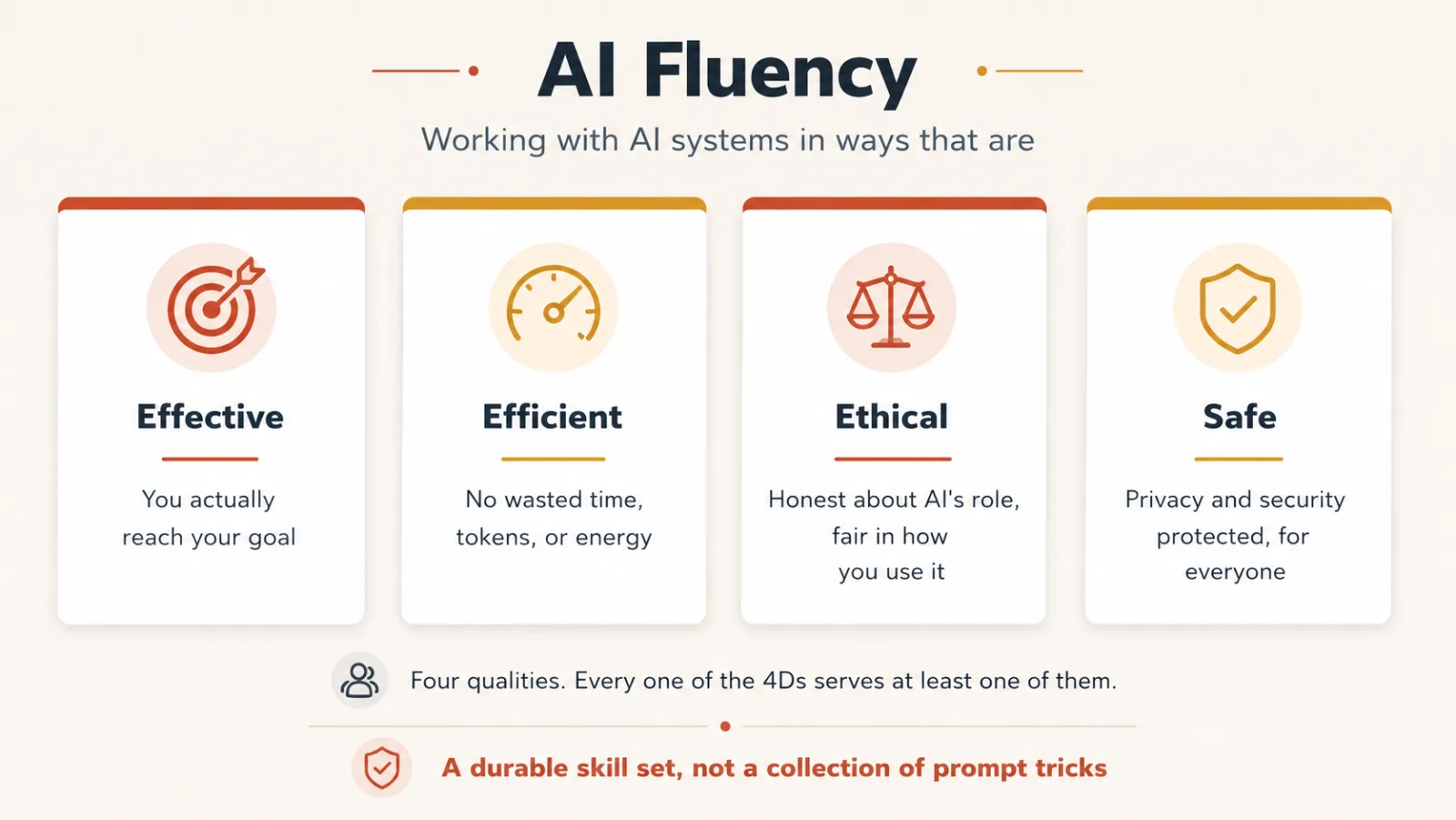
None of that requires training a model, knowing how one is built, or collecting "magic prompts." The foundation is making good human decisions around AI. That is why the framework focuses on the 4Ds. In one word each, Delegation is decide, Description is explain, Discernment is check, and Diligence is own.
In Mode 1 you use general agents to solve problems. In Mode 2 you build Digital FTEs for other people. If you cannot work well with one AI assistant, you are not ready to design a system that may act for thousands of users.
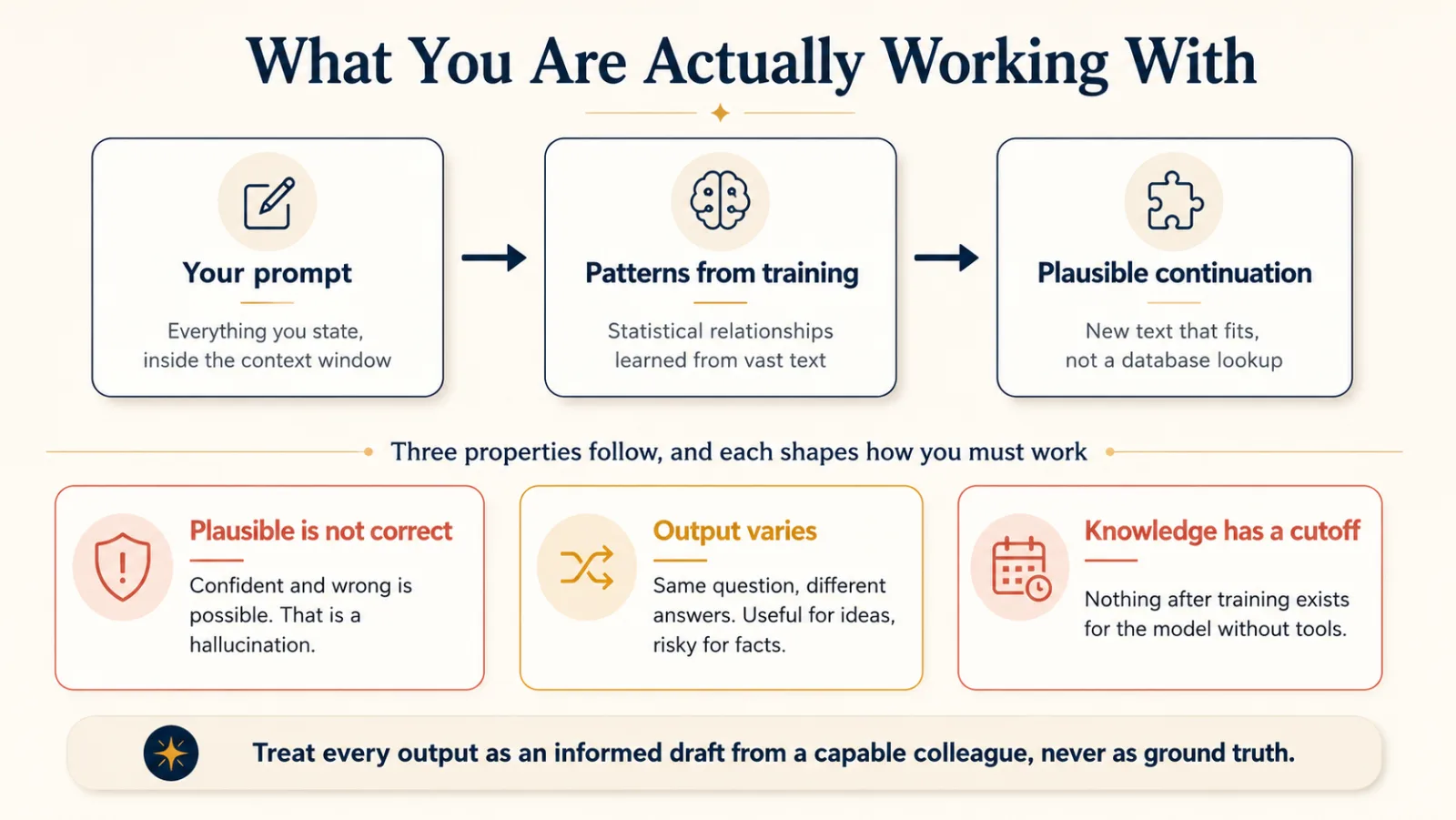
Keep these three from What AI Actually Is:
- Sounding right is not the same as being correct. AI can produce a confident answer that is wrong. A hallucination is exactly that, a confident answer built on invented information.
- The same answer is not guaranteed. The same request is likely to give a different answer next time.
- AI only works with the information available to it. That may include its trained knowledge, the conversation, documents, memory, search, and connected tools. If important information is missing, the AI may guess.
So treat AI output like work from a capable colleague, useful and still worth reviewing. One habit does not carry over. A colleague tells you when they are unsure, and AI keeps the same confident tone either way.
2. Three ways to work with AI: automation, augmentation, and agency
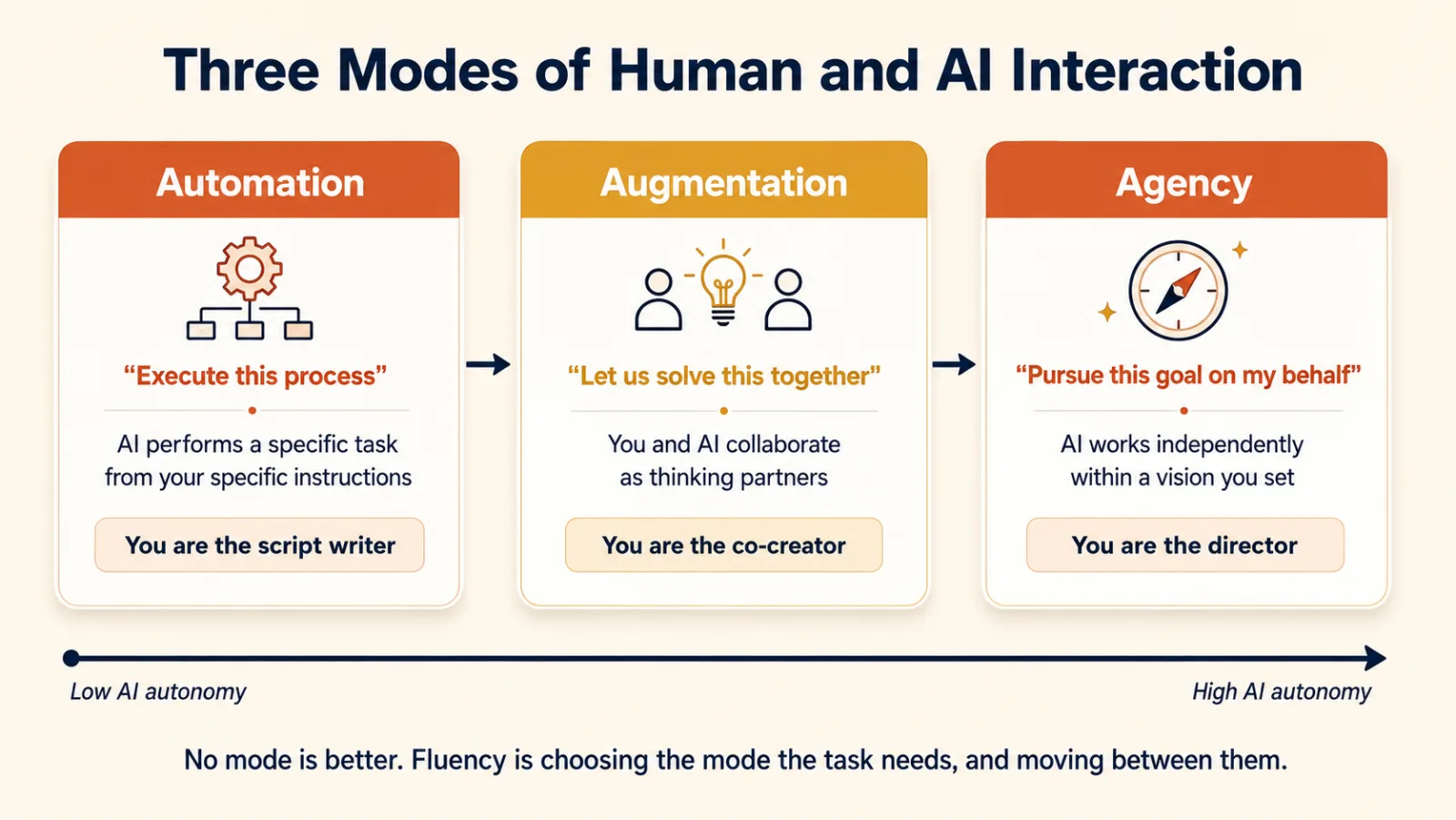
Humans work with AI in three broad modes:
- Automation: AI performs a task you specify.
- Augmentation: you and AI work on the task together.
- Agency: AI works toward a goal on your behalf.
The modes differ in how much freedom the AI has to decide what to do next.
Automation: "Do this task"
With automation, you tell AI exactly what task to perform.
Examples:
- "Summarize this report in five bullets."
- "Translate this email into Urdu."
- "Extract the invoice number, date, and total from this PDF."
You are close to a script writer. Automation fits work that is clear and repeatable.
Augmentation: "Help me think"
With augmentation, you and AI work together.
Examples:
- brainstorming a business idea
- reviewing a software architecture
- improving a lesson plan
- comparing two strategies
- exploring a question where you do not yet know the answer
Here AI is not following instructions. It acts more like a thinking partner. You may go back and forth for many turns. You ask, it responds, you challenge, it revises, and together you improve the result.
Agency: "Pursue this goal for me"
With agency, you give AI a goal and boundaries, then let it decide many of the steps. Instead of saying:
"Read these five emails and summarize them."
You might say:
"Keep my inbox manageable. Reply to routine messages, flag important ones, and ask me before doing anything you are unsure about."
Now the AI must decide which message is routine, which one is important, and when to ask you.
You have moved from script writer to director, except that a director watches every take and you often will not be watching.
The framework defines agency as a human who configures AI to independently perform future tasks, including for others, on their behalf. Two words carry the weight.
Future means you are not in the room. You set the AI up on Monday and it handles Thursday's work while you are asleep.
For others means the person the AI serves may not be you. You configure it, and your customer, your student, or your colleague talks to it.
Automation and augmentation keep you in the chair. Agency is where you get out of it, and that is what makes Mode 2 hard. You cannot supervise every decision, so the judgment has to be built in beforehand.
Automation and agency differ most here:
| Automation | Agency | |
|---|---|---|
| You provide | The task or steps | The goal and boundaries |
| AI decides | Very little | Many next steps |
| Your role | Script writer | Director |
| Common failure | A step is done badly | The goal or boundary is misunderstood |
No mode is automatically better, and one project may use all three. You might automate data extraction, use augmentation to think through exceptions, then give an agent limited authority over routine cases.
In Agent Factory terms, Mode 1 uses automation and augmentation. Mode 2 makes agency systematic. A Digital FTE is not merely "AI doing things." It is AI acting within a job definition, permissions, rules, and governance. It also works from a System of Record, which is the trusted store of the official data and rules a business runs on. See the System of Record page.
Part 2: The four competencies
3. Delegation: decide who should do what
The most common beginner mistake happens before the first prompt. People start typing without deciding what they want, what a good result looks like, which parts AI should do, and which decisions should never leave their hands. That is Delegation.
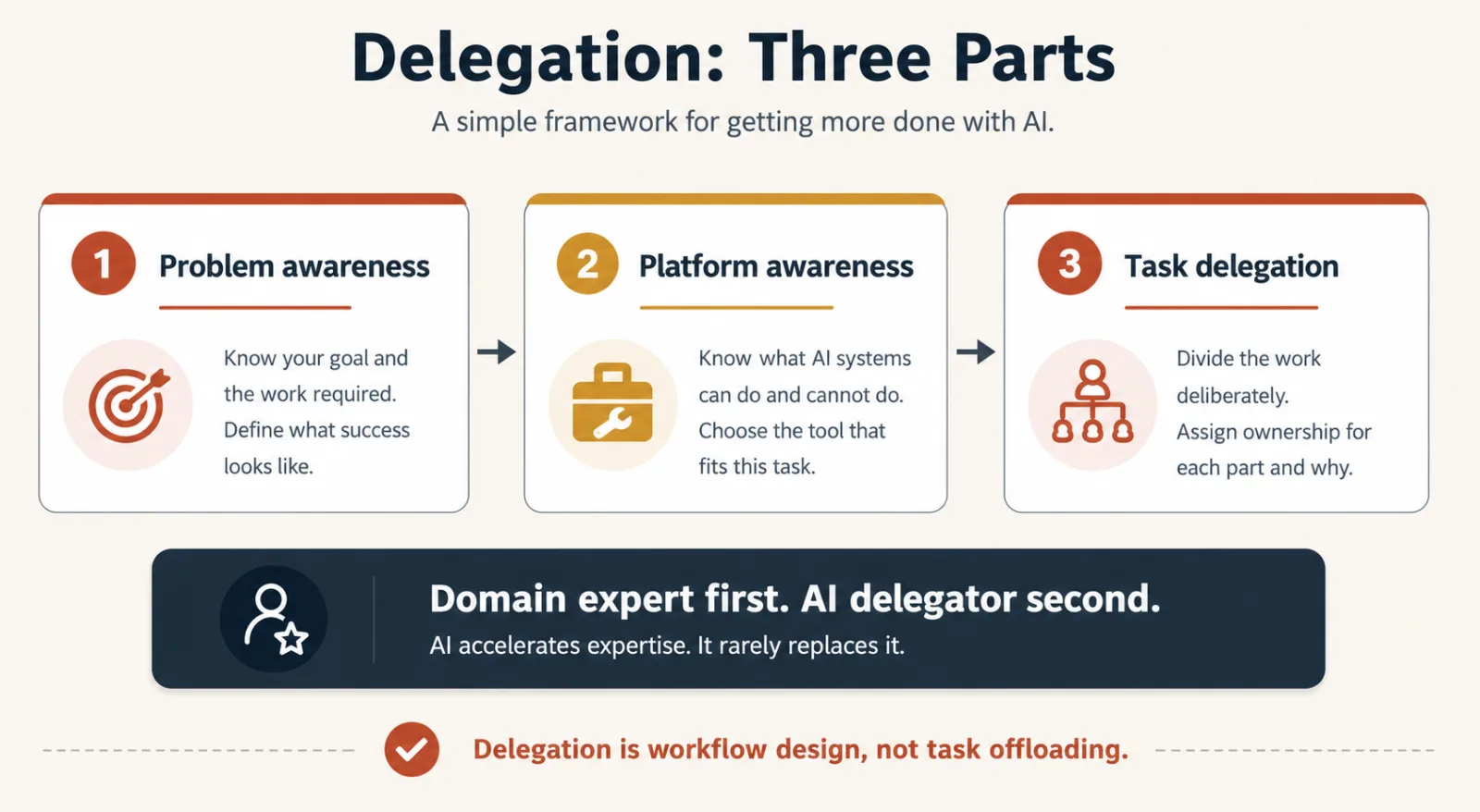
Delegation means deciding how the work should be divided between the human and the AI. It is not only giving work to AI. It is designing the workflow.
Delegation has three parts:
- Problem awareness: understand the goal and the work.
- Platform awareness: understand which AI system or tool fits the job.
- Task delegation: decide who does each part.
The framework's reference document calls the first one goal and task awareness. Same idea, two names.
3.1 Problem awareness: know what you are trying to accomplish
Before asking AI for anything, ask yourself:
- What is the goal?
- Who is this for?
- What does success look like?
- What could go wrong?
- Where is human judgment essential?
Suppose you want an AI agent to chase overdue invoices for a small business. A beginner might type:
"Build me an invoice-chasing agent."
The AI will produce something, but the hard questions are still unanswered:
- Which customers should it contact?
- How many days late must an invoice be?
- What tone should it use?
- Above what amount must a human approve the message?
- What happens if the customer disputes the invoice?
- Which accounting system may the agent read?
- May the agent send messages, or only draft them?
These are not prompting questions. They are business questions. AI cannot decide your business policy unless you deliberately give it that authority, and in many cases you should not.
3.2 Platform awareness: choose the right kind of AI
No AI system is equally good at every job. You might choose:
- a reasoning model for a hard multi-step problem. It works through the steps before it answers.
- a search-enabled assistant for current information. It looks things up on the web while it answers.
- a coding agent for software work. It reads and changes the files in a project.
- an agent-capable system for work with several steps. It uses tools and keeps going without a new instruction each time.
You do not need to memorize model names, because the market changes too quickly. You do need the habit of asking whether this is the right tool for this job.
Try different systems and keep notes on what works. Which AI Employees in 2026 is the book's current map.
3.3 Task delegation: divide the work deliberately
Once you understand the problem and the platform, split the job. Say you are creating a course like this one:
| Task | Best owner | Why |
|---|---|---|
| Decide the audience and learning goals | Human | Requires purpose and judgment |
| Suggest possible course structures | AI + human | AI gives breadth, human chooses |
| Draft sections from an agreed outline | AI | Fast at first drafts |
| Verify factual claims | Human | Accountability stays with the author |
| Add lived experience and local examples | Human | AI does not have your experience |
| Improve grammar and consistency | AI | Good fit for mechanical review |
| Approve the final course | Human | Your name and reputation are attached |
Instead of asking "Can AI do this?" you ask this:
Which parts should AI do, which parts should I do, and why?
Delegation becomes engineering when you build agents for others. Problem awareness becomes the specification: the goal, the constraints, the risks, and the definition of done. Task delegation becomes the boundary of the Digital FTE, meaning what it may do, what humans keep, and what must escalate.
Continue in Spec-Driven Development and The FDE AF Model.
4. Description: give AI what it needs
Think back to the colleague at the start. Her outline was wrong because you left out important information.
AI has the same problem, and more strongly. It works only from the information available to it, so if you leave out something important it guesses, and a reasonable guess can still be wrong.
Description means giving AI the information and guidance it needs to do the work well. It is much bigger than writing a good prompt. At full size it becomes context engineering, which means designing all the information an AI needs, not the wording of one message.
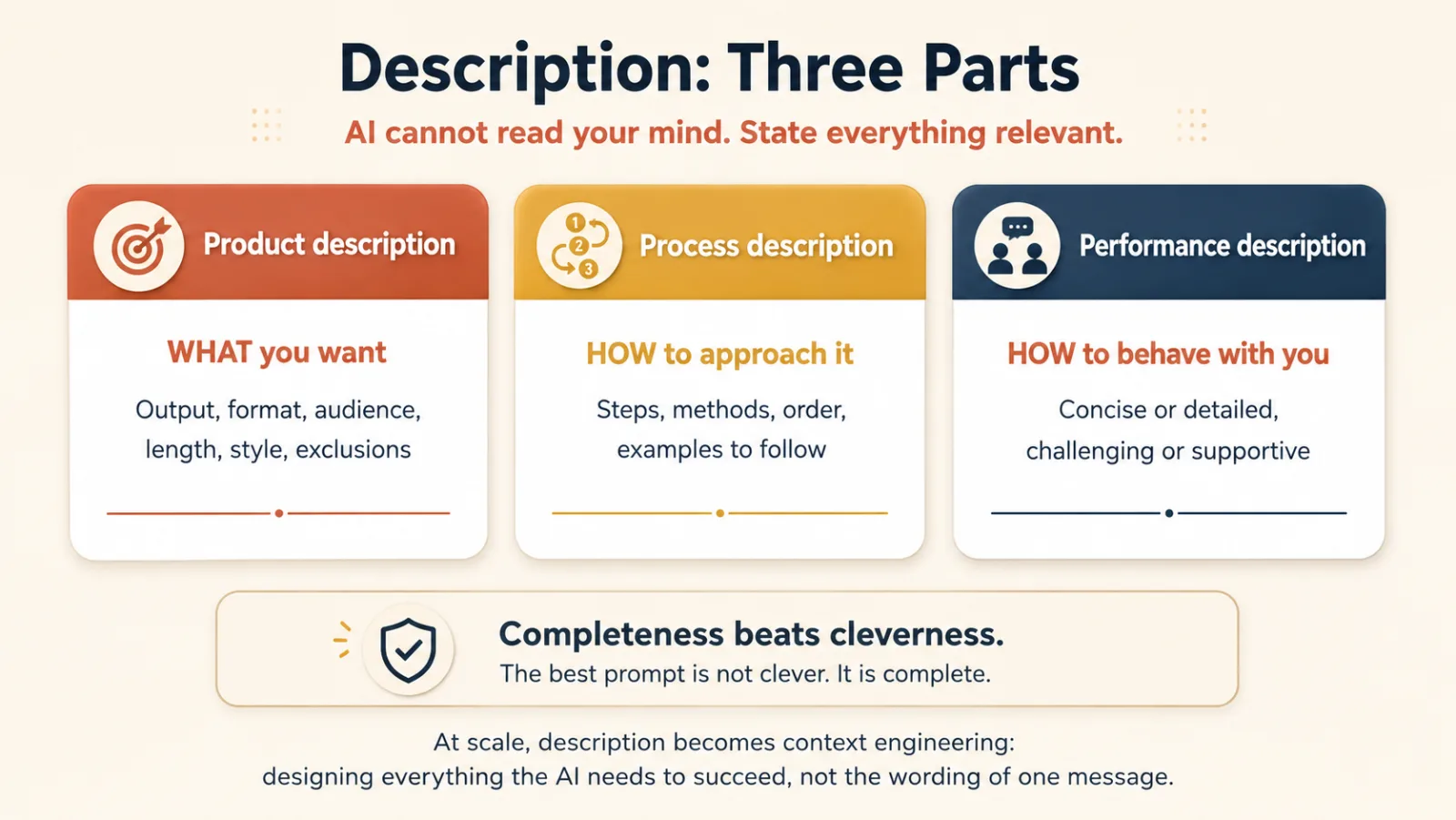
Description includes three things:
- Product description: what you want.
- Process description: how you want the work approached.
- Performance description: how you want the AI to behave, both with you and on its own.
The memory aid is:
What → How → How to work with me
4.1 Product description: define the result
Product description answers one question. What do I want back? Include:
- the type of output
- the audience
- the format
- the length
- the tone
- the important topics
- anything to leave out
Compare these two requests.
Vague:
"Summarize this report."
Clearer:
"Summarize this quarterly financial report for senior executives who have ten minutes to read. Focus on revenue trends, major risks, and recommended actions. Use short bullet points and keep it to one page. Highlight any figure that changed significantly from last quarter. Avoid unnecessary accounting jargon."
The second request is not more intelligent. It is more complete.
Completeness matters more than clever wording.
4.2 Process description: define the approach
Process description answers a second question. How should AI do the work? You might specify:
- the steps to follow
- the order of work
- the method to use
- examples to imitate
- checks to run before finishing
For example:
"Review this code for correctness first, security second, and style last. Do not spend time on naming issues until you have checked whether the code actually works."
Same product, a code review. Now the process is defined too.
Process description matters most when a job has several stages. Suppose you have proposals from three vendors and written criteria, meaning the things that matter most and how much each counts. Paste all three, ask for a recommendation, and the AI extracts, compares, scores, and writes in one pass. Then the only thing you can check is the ending. In Delegation you split the job by owner. Here you split it by order. Send one request per step, and check before you send the next.
- Extract the same facts from every proposal into one table: price, contract length, exit terms, and support hours. Exit terms are the rules for leaving early. Check: open each proposal and confirm three or four cells against the source.
- Compare the vendors on your criteria, using only the table. Check: does every difference it names actually appear in the table?
- Score each vendor, weighting what you said matters most. Check: do the scores follow your criteria, or did the AI add one you never asked for?
- Draft the recommendation. Check: does it claim only what steps 1 to 3 support?
Step 1 as a prompt:
Do only step 1 for now. Put the price, contract length, exit terms,
and support hours from each proposal into one table, then stop.
Extraction goes first because everything later depends on it. A wrong price carries through the comparison, the scoring, and the draft, and looks fine by the time you read it. Put the step where a mistake spreads farthest first, and check it before you continue.
4.3 Performance description: define how it behaves
Performance description answers a third question. How should this AI behave, and for whom? Start with today's version, where the answer is only you:
- concise or detailed
- supportive or challenging
- exploratory or decisive
- ask questions first or make reasonable assumptions
- flag uncertainty or just give the best answer
For example:
"Challenge my assumptions when they are weak. Flag uncertainty. Do not agree with me just to be polite. If my argument is stronger, explain why. If yours is stronger, hold your position and explain it."
This turns AI from a polite answer machine into a thinking partner.
That version serves an audience of one. The framework means something larger, and it is the same skill at two sizes. Performance description defines how an AI behaves on its own, for people who are often not you and will never see the instruction. When you type "do not agree with me just to be polite," you are writing a rule for behavior you have not seen yet. A tutoring agent may have a rule that it must never give the answer before the student has tried the problem. Same kind of sentence, written once and applied a thousand times.
In a chat, a bad performance description annoys you for ten minutes. In a deployed agent, it is the product.
AI Prompting in 2026 teaches techniques such as giving examples, setting constraints, splitting tasks, and defining roles. Description is the larger idea behind them.
Many teams use a prompt template with slots for role, context, task, constraints, and output format. Task, constraints, and output format are product description, and context is the start of context engineering. Add a line for how the work should proceed and one for how the AI should behave, and the template covers all three parts.
When you are not sure how to phrase a prompt, explain your situation in ordinary language and ask the AI to turn it into a clearer instruction.
From prompt engineering to context engineering
Prompt engineering asks how to phrase this message. Context engineering asks a bigger question. What information must be available for the AI to succeed? That information may include documents, examples, memory, conversation history, policies, tools, database records, definitions, and instructions.
A well-written prompt cannot rescue an agent that has the wrong data, missing rules, poor examples, or no access to the tools it needs.
Description scales into architecture. A system prompt is a standing instruction the AI reads at the start of every conversation, so it makes a performance description permanent. A SKILL.md makes a process description reusable. A System of Record holds the domain knowledge, rules, and governance an agent needs. At that scale, good Description is good context engineering.
Continue in System of Context and System of Record.
5. Discernment: do not confuse confidence with correctness
AI often sounds confident. A wrong answer does not arrive with a warning label. It can look polished, detailed, and certain.
Discernment is the ability to judge the quality of what AI gives you. Description asks whether you explained the job clearly. Discernment asks whether the AI actually did the job well.
Automation bias is the human tendency to trust an automated answer too easily, especially when the answer looks confident or professional.
A made-up answer can look almost identical to a correct one. Fluent writing, a link, and a confident tone are not proof. But a made-up answer usually shows one of four signs:
- Specifics that are too exact. A precise figure, date, name, or citation that came from nothing you gave it. "Vendor A delivered 99.97% of orders on time last year" is more suspicious than "Vendor A is reliable," because an exact number looks checked. Open the source before you repeat it.
- Confidence where an expert would hesitate. A question a specialist would answer with "it depends" comes back as a flat yes. Ask what would change the answer.
- Contradiction across a long output. Page 2 says the vendor charges a flat fee. Page 6 works the yearly cost from a per-user fee. Long outputs drift, so read the ending against the beginning.
- A claimed action that never happened. "I have sent the email," "I checked the source," "I ran the tests." Unless the tool shows you the sent message, the opened page, or the test log, treat the claim as a sentence, not an event.
When accuracy matters, verify.
Discernment has the same three parts as Description, pointed at the same three things:
- Product discernment: is the result any good?
- Process discernment: is working this way with AI actually paying off?
- Performance discernment: when AI acts on its own, are the people on the other end well served?
5.1 Product discernment: is the result good?
Ask:
- Is it factually correct?
- Did it follow every important requirement?
- Is anything missing?
- Is it internally consistent?
- Would an expert find it credible?
- Would I put my name on it?
Those six questions check the answer against three references: what you asked for, the source material, and your field's standards. An answer can pass two and still fail the one that matters.
This is where your own domain knowledge pays off. An accountant notices a bad accounting assumption, a programmer notices a subtle bug, and a teacher notices an explanation that will confuse beginners. AI speeds up expert work. It does not remove the need for expertise.
Judging the result also means judging the case made for it. A right answer resting on a wrong assumption will not stay right. Suppose the AI recommends Vendor A over Vendor B, the conclusion is sensible, but it assumed a feature Vendor A does not have. Do not trust the recommendation until the support for it holds up.
Useful things to ask the AI to show: assumptions, evidence, decision criteria, calculations, intermediate results, and alternative interpretations.
Treat these as a justification offered for review, not as a record of the model's hidden reasoning.
For example:
"Before recommending one option, list your assumptions, the evidence supporting them, and the criteria you are using to decide. Then give the recommendation."
When the answer should come from documents you already have, tie it to them. Suppose the question is which of the three attached proposals lets you leave the contract early. Add this:
Answer only from the three proposals I attached, not from anything
you know about these vendors. If a proposal does not state its exit
terms, say so instead of guessing. For every term you report, quote
the proposal's section heading and the sentence it came from.
The first line tells the model to use only what is in front of it. Without it the model fills gaps from training, which is where Vendor A's imaginary feature came from. The second gives it permission to say "the proposal does not say," which a model rarely does unless you allow it. The third hands you something you can check in a minute. None of this replaces reading the answer. It makes the reading faster, and it makes a made-up answer easier to catch.
5.2 Process discernment: is this way of working paying off?
Sometimes the answer is fine and the working relationship is not. Step back and judge the session itself, not its last message:
- Is the AI adapting to my feedback, or drifting back?
- Is it repeating a mistake I corrected twice?
- Has it become agreeable to the point of uselessness?
- Am I spending every turn repairing the same formatting problem?
- Am I editing its draft more heavily than I would have written the thing myself?
Answer the last one straight. Twenty minutes of steering that saves an hour is a win. Twenty minutes that saves fifteen is a loss you have been counting as a win because it felt productive.
When the process is not working, three moves escalate. Change the performance description. Change the tool. Take the task back. All three are fluency, and only the third feels like defeat.
5.3 Performance discernment: is the AI serving people well when you are not watching?
The third kind only exists once you have used agency. Performance discernment asks whether an AI's independent behavior produces good outcomes for the people meeting it. That is a different question from whether any single output was correct.
An AI tutor might answer every question accurately and still be a bad tutor, because it gives solutions the moment a student hesitates and nobody learns anything.
You cannot see this from inside a chat window. It shows up across many cases: what users do next, what they complain about, and the cases that go wrong the same way every time.
Nobody can read a thousand conversations by hand, so this kind of discernment turns into infrastructure that watches them for you.
The Description and Discernment loop
Description and Discernment form a loop:
- You describe what you want.
- AI produces something.
- You inspect it.
- You explain what must change.
- AI tries again.
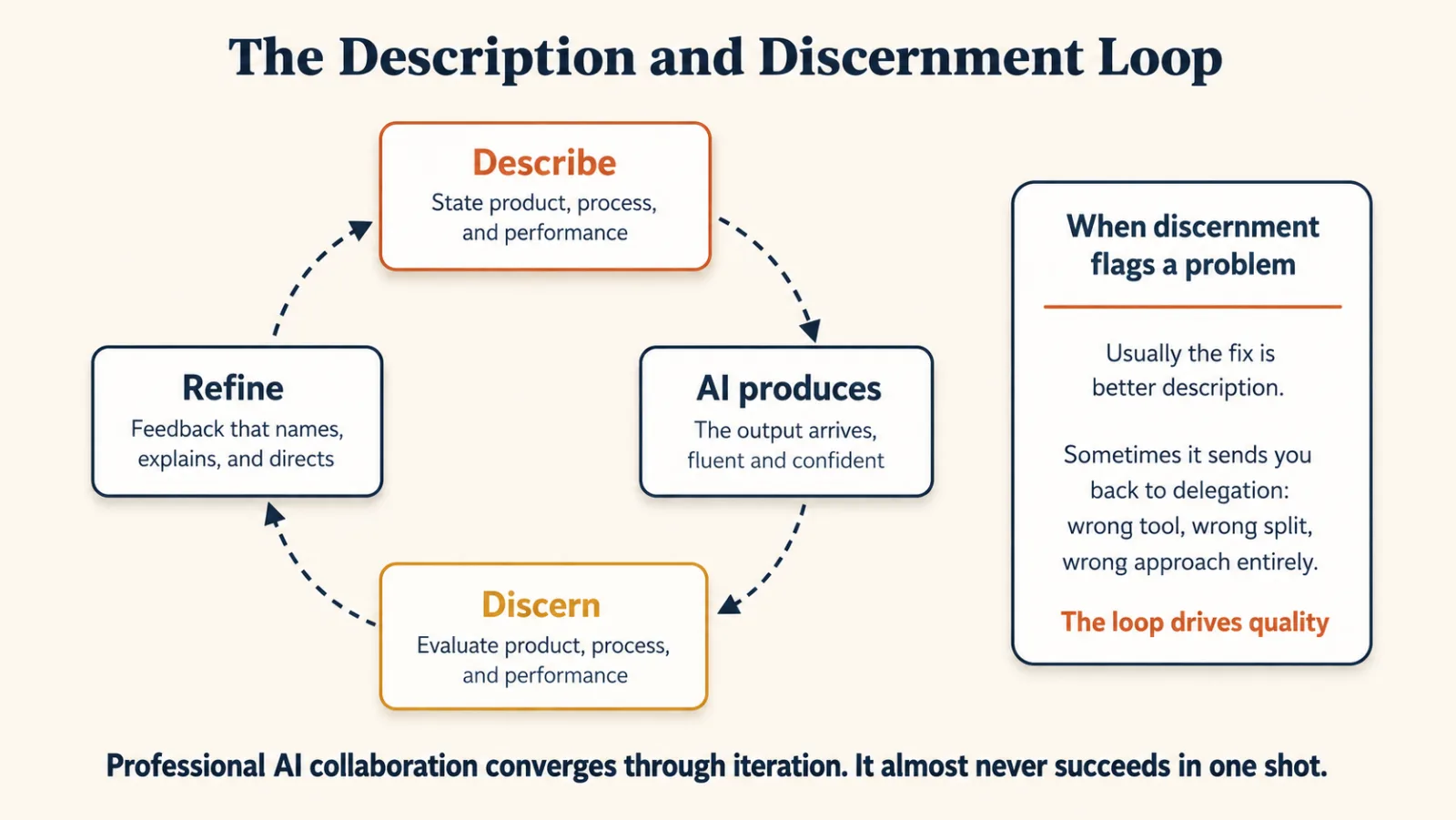
The first response is usually a draft, not the finish line.
When you give feedback, use this pattern:
Problem → Why it matters → Direction
Weak feedback:
"Wrong. Try again."
Better feedback:
"The second section assumes enterprise customers. Our audience is solo founders, so the advice is too expensive. Rewrite that section for a one-person business with a limited budget."
A good draft often needs another pass because it was written for the wrong reader. Take one finding: tickets doubled, the team did not grow, and first reply time slipped from four hours to nine. Ask the AI to write it twice, once for the board of directors and once for the support team.
For the board: "Tickets doubled and first reply time went from four hours to nine. The team did not grow. Approve two hires or accept nine-hour replies."
For the support team: "Tickets doubled this quarter and the team stayed the same size, so nine-hour replies come from the volume, not from you. Until the two hires arrive, work the oldest ticket first."
The board version is a number, a cause, and a decision. The team version is what changed, why it is not their fault, and what to do on Monday. Use the same feedback pattern. "This is for the support team, not the board. Rewrite it around what they should do next week."
Two habits make this go faster. First, edit in named passes instead of one general sweep. A clarity pass asks whether each sentence says one thing, a tone pass whether it suits this reader, and a formatting pass checks headings, lists, and length. Second, when the stakes justify it, ask for two or three drafts and edit from the strongest.
Sometimes better Description is not enough. Discernment may show that the Delegation decision was wrong. Perhaps you chose the wrong tool, or the AI should never have owned that part. That is also fluency.
Every review ends in one of three ways. The work goes out. It goes back with feedback in the pattern above. Or you take the task back, because the fix needs something only you know. Review checklists use some version of these names: ready to use, needs revision, needs human override. Decide which one before you type the next message, because naming the ending stops the "one more small change" loop that eats an afternoon.
Discernment becomes evaluation engineering. Your manual question, "Is this good enough?", turns into eval suites, monitoring, sampling, and release gates. An eval is a repeatable test that scores what an AI system produces, and a suite is a set of them. You cannot automate a judgment you have never learned to make yourself.
Continue in Trusting the Checker and Eval-Driven Development.
6. Diligence: use AI responsibly and own the result
The first three Ds help you get better results. Diligence asks a different question. Should I use AI this way at all?
Imagine a lecturer using AI to draft end-of-term feedback. The writing is excellent. But he pasted student names, grades, and disciplinary notes into a consumer AI service the university never approved. The students were not told that AI helped write comments that may become part of their academic record.
The output may be good. The use of AI is still irresponsible.
Diligence means taking responsibility for how AI is used and for what happens to its output.
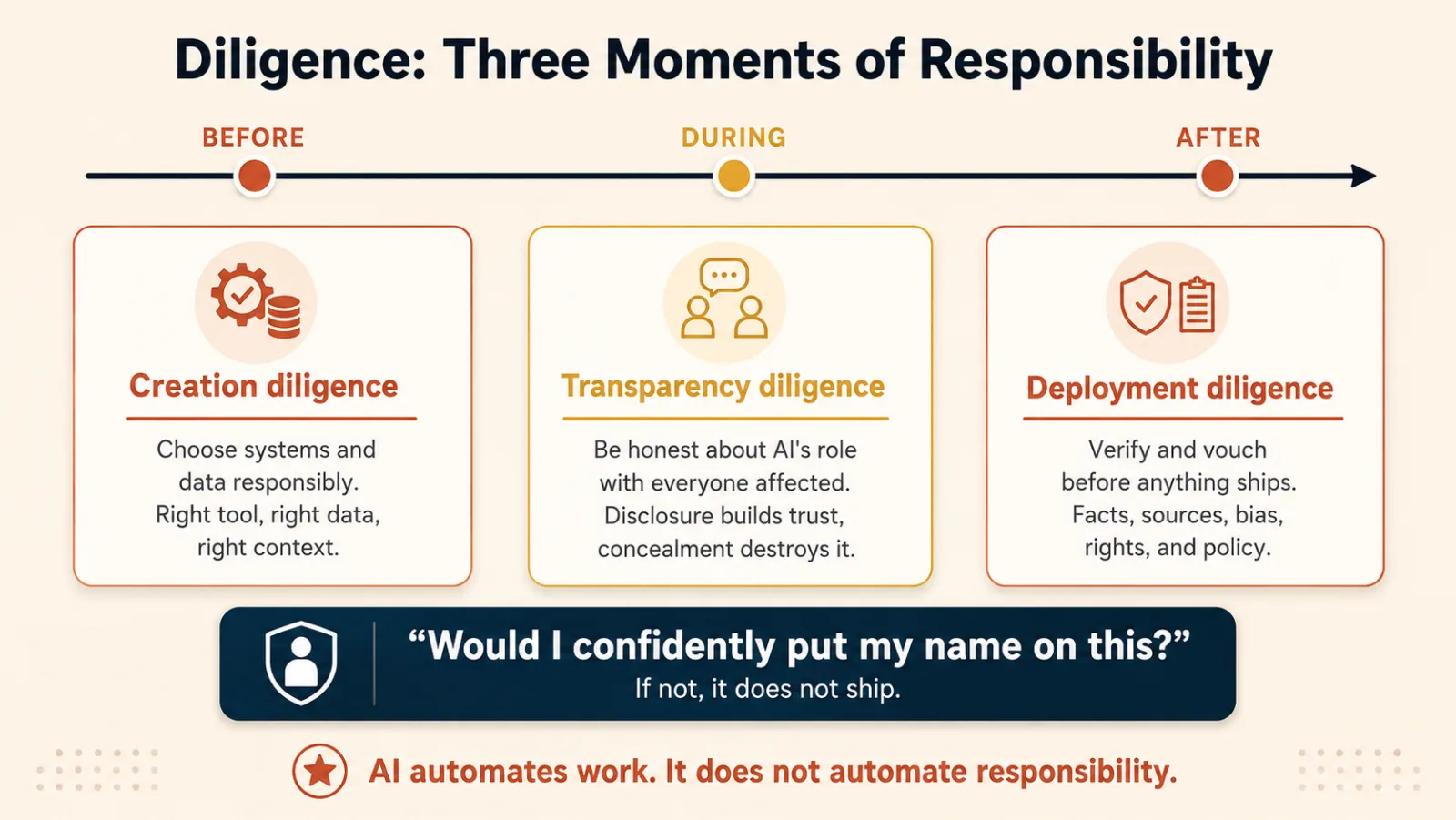
Diligence has three parts:
- Creation diligence: make responsible choices before and while creating.
- Transparency diligence: be honest about AI's role when people need to know.
- Deployment diligence: verify and take responsibility before the work is used or released.
6.1 Creation diligence: choose tools and data responsibly
Before you share information with an AI system, ask:
- Does this contain personal data?
- Does it contain confidential company information?
- Am I allowed to put this into this tool?
- Who can access or keep the data?
- Is this service approved by my organization?
- Are there legal, contractual, or professional restrictions?
The easiest path is not always the responsible one. Copying a real customer database into whatever AI tool is open saves five minutes and creates a serious privacy problem.
Often the fix is not to drop the task but to strip the data. In an approved tool, the lecturer could have removed every name and student ID, kept the grade range and the one behavior worth commenting on, and drafted from that. The AI needs the pattern, not the person.
Redaction means removing the details that identify a person or an organization before you give data to an AI, while keeping the pattern the task needs.
Redaction fails in two directions. Take out too much and the task cannot be done, because feedback with no grade and no incident is not feedback. Take out too little and a combination of details still points at one person. "The only student who missed the week 3 lab" names that student as surely as a name does. The test is whether someone reading only what you pasted could work out who it is about. Stripping the data does not answer the tool question.
6.2 Transparency diligence: be honest about AI's role
Not every AI-assisted task needs an announcement. But when AI materially affects other people, disclosure may matter.
Examples: academic work, hiring decisions, customer communications, medical or financial advice, professional reports, and anything presented as original human work.
The exact rule depends on the context, organization, law, and professional standard.
The more an AI-assisted result affects other people, the stronger the case for transparency.
Transparency does not mean publishing every detail of your workflow. It means not misleading people about AI's role when that role matters.
6.3 Deployment diligence: verify before it leaves your hands
Before AI-assisted work is published, sent, executed, or used in a decision, check it. The more people the result reaches, the more checking it needs. A step that cannot be undone deserves a deeper check than one you can retract.
A note to yourself gets a glance. The welcome email from the start of this course gets a full read. A report to a regulator gets a second reviewer. Anything irreversible, such as a sent payment or a deleted folder, gets its check before the act, because there is no reviewer afterwards.
Checking may mean:
- verify facts
- confirm sources exist
- check calculations
- review bias or unfair outcomes
- confirm permissions and rights
- follow organization policy
- get human approval for high-impact actions
Any number a decision rests on, such as a total or a percentage, must be computed and never generated. Ask a model to summarize a financial report and it does not add up the column the way a spreadsheet does. It predicts a likely-looking total, so the total can be wrong while every line item is right. Get the number from a spreadsheet, a calculator, or code the AI ran and showed you. Then check the inputs rather than the sum. Did it use the right rows and the right rate? If a summary reaches you with figures and no calculation you can see, ask where each number came from before you pass it on. How to make the AI run code instead of guessing is covered in AI Prompting in 2026.
Would I confidently put my name on this?
If the answer is no, the work is not ready.
Sometimes the honest answer is "I am not sure," because the case is unclear rather than plainly wrong. An AI-ranked shortlist of job applicants looks reasonable, but you cannot tell whether it favored graduates of two universities. Ask four questions:
- Who is affected, including people who will never see the result?
- What could go wrong for them, and would they be able to tell?
- What would a fair outcome look like?
- What should be disclosed, and to whom?
If you can answer all four, decide and write the answers down. If you cannot, escalate to whoever owns that decision. Guessing is the one option that turns an unclear case into your mistake.
AI can automate work. It cannot automate accountability.
If an AI-assisted system makes a harmful decision, the organization operating it is still responsible. If a coding assistant introduces a security flaw and an engineer ships it, the engineer and the organization still own the result.
Diligence is why the Agent Factory is governance-first. At system scale:
- Creation diligence becomes data rules, access control, and approved-tool policy.
- Transparency diligence becomes disclosure and user experience design.
- Deployment diligence becomes evaluation gates, audit logs, monitoring, and human review.
A policy only works if the approved tool is as easy to reach as the one people already have open. The lecturer's consumer service was one click away. If the approved tool takes a request form and a week of waiting, the easy path is a policy flaw, not only a personal one. Tell whoever owns the policy where it was hard.
In Mode 2 you build that responsibility into a product other people use.
Continue in System of Record and Designing the Vertical SoR.
Part 3: Put the 4Ds together
7. The 4Ds as a practical operating loop
Real work mixes the four competencies.
The framework's authors teach a Description and Discernment loop. This book uses all four competencies as one loop:
Delegate → Describe → Discern → Be diligent → Repeat as needed
Example: a bookkeeping Digital FTE
Ayesha is a Forward Deployed Engineer in Lahore, helping a small accounting practice in Karachi build a bookkeeping Digital FTE. The first job to automate is monthly bank reconciliation, which means checking the firm's own records against the bank statement.
Step 1: Delegation
Ayesha does not begin by asking an AI to "build a reconciliation agent." She maps the job with the accounting partners first. They decide:
- the agent may match bank transactions to ledger entries
- it may flag unmatched items
- it may draft a reconciliation report
- humans approve every journal adjustment
- humans keep every write-off decision
- anything affecting a client's tax position stays with an accountant
- high-value unmatched items escalate to a named person
Ledger entries are the firm's own record of each transaction. A journal adjustment is a manual correction. A write-off records money the firm no longer expects to collect. A tax position is how much tax a client owes.
Step 2: Description
Next, Ayesha gives the system the information it needs:
- the firm's chart of accounts
- matching rules
- examples of past reconciliations
- the report format the partners already use
- escalation rules
- definitions of duplicate payments and stale cheques
- a rule never to post a journal entry itself
- a rule never to contact a client directly
A chart of accounts is the list of categories a firm sorts every transaction into. A stale cheque is too old for the bank to pay. A journal entry is one record posted into the accounts.
Step 3: Discernment
Ayesha does not assume the agent works because a demo looks good. She tests it against past reconciliations the firm already trusts. The team checks:
- how many matches are correct
- how many incorrect matches slip through
- whether the right cases escalate
- whether the agent escalates too much
- whether performance changes over time
An accountant also reviews some matches that appear to have succeeded, not only the failures. A system can look safe simply by failing without saying so.
Step 4: Diligence
Client financial data stays inside approved infrastructure. Agent actions are logged. Where disclosure is required or appropriate, clients are told that reconciliation is AI-assisted. A human partner still signs the reconciliation and remains accountable for it.
The personal skill has become a system property.
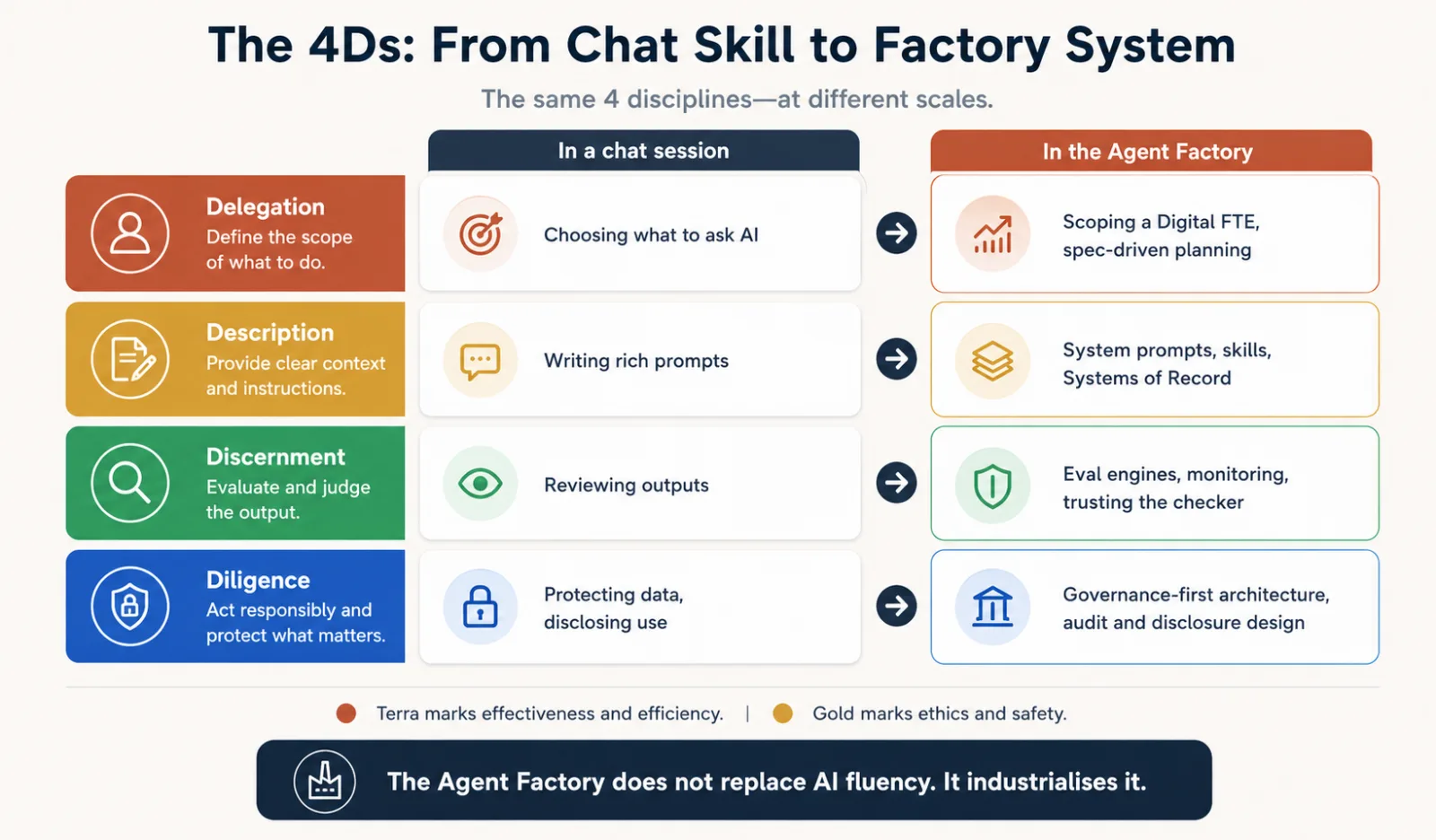
The same four rows as a table
| Competency | In a chat | In the Agent Factory |
|---|---|---|
| Delegation | Decide what to ask AI to do | Scope the Digital FTE and human/AI boundary |
| Description | Give instructions and context | System prompts, skills, context engineering, Systems of Record |
| Discernment | Review the answer | Evals, monitoring, sampling, trusting the checker |
| Diligence | Protect data and own the result | Governance, permissions, audit, disclosure, human review |
The Agent Factory does not replace AI fluency. It builds the same four skills into a system that runs at scale.
How this connects to the Four Survival Skills and the 10-80-10 Rule
The book's Four Survival Skills are set the direction, orchestrate AI, judge the truth, and connect with people. The first three form the 10-80-10 Rule. You spend the first 10 percent setting direction, the middle 80 percent running the work with AI, and the last 10 percent judging the result. The 4Ds map onto it:
- In the first 10% you set direction. Delegation and Description are strongest here.
- In the middle 80% you orchestrate AI. Description and Discernment repeat as AI produces work and you steer it.
- In the final 10% you judge the truth. Discernment becomes critical before anything important ships.
- Across all 100% you act responsibly. Diligence is not a final checkbox. It surrounds the whole workflow.
Practice in a chat window is rehearsal for building and governing AI systems.
8. Four common beginner mistakes
Most frustrating AI experiences come from one of four failures.
Mistake 1: Prompting before defining the problem
You start typing before deciding what success looks like.
Missing skill: Delegation.
Fix: define the goal, the audience, the constraints, and the human and AI split first.
Mistake 2: Treating the first answer as the final answer
You assume a weak first response means the AI is useless.
Missing skill: the Description and Discernment loop.
Fix: inspect the result, give specific feedback, and try again.
Mistake 3: Trusting a polished answer because it sounds professional
You mistake fluency for accuracy.
Missing skill: Discernment.
Fix: verify important facts, assumptions, calculations, and sources.
Mistake 4: Thinking about privacy or accountability only after something goes wrong
You focus on getting the task done and ignore how the AI is being used.
Missing skill: Diligence.
Fix: decide data, disclosure, approval, and accountability rules before you deploy.
A beginner checklist you can use every day
Before you ask AI to do real work, run this check:
| Stage | Ask yourself |
|---|---|
| Delegate | What is the goal? What should AI do? What stays with me? |
| Describe | What output, context, method, and behavior does AI need? |
| Discern | How will I know the answer is correct, complete, and useful? |
| Be diligent | Is the data safe? Does AI's role need disclosure? Who approves and owns the result? |
This is not paperwork for every small task. The point is to make the four questions automatic.
A short recap before you practice
AI fluency is not memorizing prompts. It is working with AI effectively, efficiently, ethically, and safely.
You can work with AI in three modes:
- Automation: AI performs a defined task.
- Augmentation: you and AI think together.
- Agency: AI acts on its own toward a goal you set, often for people who are not you.
In all three modes the four competencies stay the same:
- Delegation: decide the human and AI split.
- Description: give AI what it needs.
- Discernment: judge what comes back.
- Diligence: use AI responsibly and own the outcome.
If you remember one sentence from this course:
Decide what AI should do. Describe the work clearly. Check what comes back. Own what happens next.
Try this now: six prompts
Open an AI assistant and try these. You need not do all six in one sitting.
1. Build a 4D plan for a real task
Choose something you really need to do this week.
I need to do this: [describe the task].

Before we start, walk me through the four Ds of AI fluency for it:
delegation, description, discernment, diligence. Ask me one question
at a time, skip any that obviously does not apply, and give me the
plan as a short table at the end.
What to notice: the plan is mostly your answers, not the AI's. Delegation and Diligence are decisions only you can make. The AI is useful for remembering to ask, not for deciding.
2. Use Discernment on a topic you already know
Choose a subject where you have real experience.
Let's discuss [topic I know well].

Talk to me like a knowledgeable colleague, not a lecturer.
As we go, I will watch for three things:
- where you improve my thinking,
- where I need to correct you,
- where my own experience makes me reject your suggestion.

Start by asking which part of the topic I want to discuss.
What to notice: how cheap discernment is when you know the subject. You caught the wrong claim without effort. That ease is your expertise, and it is what you will not have in exercise 3.
3. Feel what it is like to be a non-expert
Now choose something you know almost nothing about.
Teach me the basics of [topic I know little about].
Explain it for a complete beginner and use concrete examples.

At the end, identify the claims in your explanation that I should
verify with a reliable source, and explain why they deserve checking.
What to notice: how differently the same quality of output lands. Nothing felt wrong, because you had nothing to check it against. Every user of an agent you build will feel that, which is why a Digital FTE needs evals rather than trust.
4. Write a performance description
Use this at the start of a serious working session:
During this conversation:
- challenge weak assumptions,
- flag uncertainty on factual claims,
- do not agree with me just to be polite,
- ask a clarifying question when an ambiguity would materially change the answer,
- change your recommendation when new evidence supports a change,
- explain why when you disagree with me.
What to notice: how few turns it takes before the difference is obvious, and how quickly it fades in a new chat if you forget to set it again. That is why a deployed agent keeps its performance description in a system prompt, not in someone's memory.
5. Inspect the justification before accepting a recommendation
Give the AI a real decision you are weighing, then add:
Before making a recommendation, list:
1. the important assumptions,
2. the evidence supporting them,
3. the criteria you are using to compare the options,
4. the major uncertainties.

Then make the recommendation.
I want a justification I can review, not just a conclusion.
What to notice: whether any assumption on that list is one you would have accepted without noticing. That is the one worth checking, and it is invisible when you get only the conclusion.
6. Run a small project through the full 4D loop
Choose a project you can finish in about an hour, such as a study plan, presentation, proposal, or small coding task.
I want to complete this project using the 4D AI Fluency framework:
[describe the project].

First, help me decide the human/AI division of work.
Then, before each AI-owned task, ask what product, process,
and performance I want.

After each important output, stop so I can evaluate it.
At the end, run a diligence check covering facts, sensitive data,
disclosure, approvals, and anything I should verify before using the work.
When you finish, ask:
Which D required the most effort from me?
That is the competency to practice most.
Quick self-check
Answer these from memory. If one makes you scroll up, that section did not land yet.
- What four qualities define AI fluency?
- What is the difference between automation, augmentation, and agency?
- What are the three parts of Delegation?
- What are the three parts of Description?
- Why can a confident AI answer still require verification?
- What are the three parts of Discernment?
- What are the three parts of Diligence?
- What question can you ask before shipping AI-assisted work?
- In one sentence, what is the 4D loop?
- How does Discernment become an engineering practice in the Agent Factory?
Answers
- Effective, efficient, ethical, and safe.
- Automation runs a defined task, augmentation works with you as a thinking partner, and agency acts toward a goal with more freedom to choose the steps.
- Problem awareness, platform awareness, and task delegation.
- Product description, process description, and performance description.
- Because sounding right is not the same as being correct. Fluent wording does not verify facts, assumptions, or reasoning.
- Product discernment, process discernment, and performance discernment.
- Creation diligence, transparency diligence, and deployment diligence.
- "Would I confidently put my name on this?"
- Decide what AI should do, describe the work, evaluate what comes back, and take responsibility for the whole process.
- It becomes evals, monitoring, sampling, and review gates that test whether an AI system performs well enough.
Terms this course adds
The vocabulary of the machine lives in What AI Actually Is and the book's Glossary. These are the terms this course adds.
Open the full term list
AI fluency. Working with AI effectively, efficiently, ethically, and safely.
The 4Ds. Delegation, Description, Discernment, and Diligence.
Automation. AI performs a task you specify.
Augmentation. Human and AI work together as thinking partners.
Agency. AI works toward a goal you set and chooses many steps.
Delegation. Deciding what AI does and what humans keep.
Problem awareness. Knowing the goal, the work, the risks, and what success means.
Platform awareness. Knowing which AI system or tool fits the task.
Task delegation. Assigning each part of the work to a human or to AI.
Description. Giving AI the information and guidance the work needs.
Product description. Defining the output you want.
Process description. Defining how the AI should approach the work.
Performance description. Defining how an AI behaves on its own, for its users. At chat scale it is your working-style preference. At system scale it is a deployed agent's standing behavior.
Discernment. Judging whether AI's output, justification, and behavior are good enough.
Product discernment. Judging the result itself.
Process discernment. Judging whether your way of working with AI is paying off.
Performance discernment. Judging whether an AI's independent behavior serves its users.
Diligence. Taking responsibility for how AI is used and for its output.
Creation diligence. Choosing tools and data responsibly before and during the work.
Transparency diligence. Being honest about AI's role when it affects people.
Deployment diligence. Checking AI-assisted work before it is used or sent.
Context engineering. Designing all the information an AI needs: instructions, documents, tools, memory, and policies.
Automation bias. The human tendency to trust automated output too easily.
Hallucination. A confident AI output that sounds right but is invented or incorrect.
Redaction. Removing identifying details before you give data to an AI, while keeping the pattern the task needs.
Where this leads
Next, AI Prompting in 2026 turns Description into practical habits you can use every day. How to Think in the AI Era strengthens Discernment and critical thinking.
Courses that build on each D
Later in the build path:
- Spec-Driven Development turns Delegation and Description into an engineering method.
- Trusting the Checker and Eval-Driven Development turn Discernment into evaluation infrastructure.
- System of Record and Designing the Vertical SoR turn Diligence and governance into architecture.
For the exams this material prepares you for, see Certifications.
Sources and license note
The AI Fluency Framework was created by Rick Dakan and Joseph Feller. Rick Dakan is Professor of Creative Writing and AI Coordinator at Ringling College of Art and Design. Joseph Feller is Professor of Information Systems and Digital Transformation at Cork University Business School, University College Cork. Their course AI Fluency: Framework and Foundations was produced with Anthropic and released under CC BY-NC-SA 4.0. Their reference document, Framework for AI Fluency: Practical Overview Document, is released under CC BY-NC-ND 4.0.
This crash course is an independent explanation of that framework, in this book's own words and examples. It is not a copy or an adaptation. Every competency, sub-competency, and modality definition here was checked against the authors' Practical Overview Document and terminology sheet. The Agent Factory mappings, the chat-to-factory scaling, and the four-D loop framing are extensions for this book, and any errors in them are ours.
Read the original as well. It is free.
- The AI Fluency Framework, the authors' own site, with papers, presentations, and open educational resources.
- AI Fluency: Framework and Foundations, the free 12-lesson original course on Claude Academy, about 3 to 4 hours. Also reachable at anthropic.skilljar.com.
- Framework for AI Fluency: Practical Overview Document, the authors' living reference document and the most precise statement of the sub-competencies.
- The companion courses Teaching AI Fluency, AI Fluency for Educators, and AI Fluency for Students, also free on Claude Academy and OpenCourses.ie.
- The AI Fluency Framework terminology sheet (PDF), copyright 2025 Rick Dakan, Joseph Feller, and Anthropic, released under CC BY-NC-SA 4.0.
Flashcards Study Aid
Test Your Understanding
These scenarios drop you into other people's work with a decision already waiting. Answer from the reasoning rather than the wording, and notice which D each one is testing.